CIS
The Impact of World Bank and IMF Programs
on Democratization in Developing Countries
Published by the Center for Comparative and International Studies (ETH Zurich and University of Zurich)
Sophia Limpach Katharina Michaelowa Universität Zürich
ISSN 1662-7504
The Impact of World Bank and IMF Programs on
Democratization in Developing Countries
1Sophia Limpach and Katharina Michaelowa
[email protected] • [email protected]
University of Zurich
Center for Comparative and International Studies (CIS) September 2010
This paper proposes a theory on the interference of World Bank and IMF programs with domestic politics by changing the prevailing power balance between pro-democratic and anti-democratic forces. However, World Bank and IMF programs differ in design and impact. Thus, the question arises whether the participation in dif-ferent types of World Bank and IMF programs also has a difdif-ferent impact on democratization in recipient coun-tries. Therefore, this paper analyzes empirically the separate and joint effects of World Bank and IMF programs on democratization in 76 developing countries in Africa and Asia from 1974 to 2007. Our results show that aid modalities matter. In general, while World Bank and IMF programs do not change electoral accountability mechanisms in recipient countries, they induce changes in civil liberties and domestic oversight of the borrower government. Traditional lending types have significant negative short-term effects on the extent of horizontal accountability and civil liberties in recipient countries, while more flexible policy lending types significantly increase the extent of checks and balances at the domestic level in the long term. Moreover, civil society’s par-ticipation in the formulation and implementation of national poverty reduction strategies potentially increases a country’s civil liberties record.
Key words: Democratization, international financial institutions, aid, conditionality, power balances, poverty reduction, PRS
1 The authors are very grateful to André Bächtiger, Axel Dreher, James Vreeland and Eric Werker for sharing their data with us. We thank Rodwan Abouharb, Eugenia Baroncelli, David S. Brown, Florens Flues, Jeffry Frieden, Desha M. Girod, Simon Hug, Kathryn Lavelle, Amanda Licht, Trude M. Midtgård, Stephen Nelson and Anke Weber for offering helpful advice. Special thanks go to David Schönholzer, who has provided valuable research assistance. Earlier versions were presented at the 2009 Americal Political Science Association Meeting, the 2009 General Conference of the European Consortium for Political Research, the 2009 International Political Economy Society Meeting, the 2010 Swiss Political Science Association Meeting, and the 2010 Political Econ-omy of International Organizations Meeting. Financial support by a special research grant of the University of
1. Introduction
In the 1990s, the World Bank and IMF’s structural adjustment programs came under rising criticism from civil society for having, in general, negative social and economic impacts on marginalized people and for undermining democracy in recipient countries (for a comprehensive assessment of these nega-tive consequences, see the Structural Adjustment Participatory Review International Network Report 2004, which was born of an unique five-year collaboration among citizen’s groups, developing cotry governments, and the World Bank). The policy conditions attached to these programs seemed un-able to lever critical political and economic reforms. At the same time, there was an increasing aware-ness on the part of the donor community that broadened participation and political competition were crucial ingredients for aid effectiveness and economic progress. As a result, both bilateral and multi-lateral donors began to look for new development strategies, redefining their role not only in the trans-fer of financial resources, but also in contributing to good governance which, at least implicitly, also includes democratization – the issue on which we will focus here.
In this context, a closer analysis of the instrument of poverty reduction strategies (PRS) is particularly warranted. Tied to a set of governance conditions, PRS have placed issues of poverty reduction and good governance at the center stage of the official agenda in a number of developing countries. Intro-duced in 1999, PRS related lending is currently the World Bank and IMF’s main program type for regulating access to debt relief and concessional financing. By replacing the former structural adjust-ment programs (SAPs), the PRS approach seeks to increase the participation of civil society in the design and implementation of national development strategies. As a result, the international financial organizations (IFIs) expect to see the voices of formerly excluded social groups help to formulate more effective development strategies leading to welfare-improving outcomes. Along with that the PRS approach induces political processes on which we will focus here. We argue that PRS can con-tribute to a democratic transition in recipient countries by empowering civil society and strengthening democratic accountability of governments towards their citizens and vis-à-vis other domestic political institutions.
Whereas bilateral donors have shown fewer problems in autonomously redefining their role, the offi-cial mandate of the World Bank and the IMF does not allow them any political interference with re-cipient countries. In practice, however, their lending modalities do have political consequences for recipient nations (independently of whether this effect is intended by the international financial institu-tions or not). The design of loan conditionality is intrinsically highly political because it involves poli-cies and processes which affect the welfare of most people (Killick 1995: 170) and thus changes the power balances between the political actors involved in the domestic democratization process. Adapt-ing Rueschemeyer et al.’s (1992) theoretical concept of political power balances to the context of de-velopment cooperation, we distinguish three categories of political actors: the multilateral donors, the
borrower government, and the domestic civil society, who all shape democratization processes through complex and dynamic interaction. In our theoretical framework, democratization is perceived as an outcome of a conflictual decision-making process between these domestic and international actors, whereby the whole process is conditioned by formal and informal institutions (see also the PRS case studies by Booth 2003; Bierschenk et al. 2003). All in all, whether certain types of IFI program lend-ing have a positive or negative impact on democratization in developlend-ing countries depends on the in-centives or constraints created for the borrower government and the domestic civil society through multilateral program lending. The question thus arises, whether IMF and World Bank programs en-courage or inhibit democratization, and how their traditional and more recent forms of lending ar-rangements and accompanying conditions have fared in this respect.
Previous research on the political economy of international organizations has rarely analyzed the do-mestic political consequences of their lending within recipient countries. If they received scholarly attention, their political impact was mainly conceptualized in terms of regime stability (cf. Bienen and Gersovitz 1985; Sidell 1988; Killick 1995; Franklin 1997; Dreher and Gassebner 2008). Three excep-tions with a focus much closer to ours, are Nelson and Wallace (2005), Barro and Lee (2005), and Abouharb and Cingranelli (2007). Most of these papers have a primarily empirical orientation.
In this paper, we would like to contribute to the growing research on the political effects of the World Bank and the IMF in developing countries by complementing the existing empirical findings with the theoretical insights of other strands of the literature. Our paper builds upon redistributive theories of democratization, neo-patrimonial politics, and class formation in developing countries. We combine Rueschemeyer et al.’s (1992) theoretical model of relative class power with the landmark analysis of neo-patrimonial politics in Sub-Saharan Africa (cf. Bayart 1993; Bratton and van de Walle 1997; Cha-bal and Daloz 1999) and strategic group theory as developed in the Southeast-Asian context (cf. Evers and Schiel 1988; Schubert et al. 1994; Evers and Gerke 2009). As the latter convincingly argue, the working class and the bourgeoisie are weakly developed in African and Asian countries. Instead, the state has taken a leading role in the capitalist development of the developing world which is highly influenced by international factors. In a context where resources are scarce, the domestic struggle for political power is particularly accentuated among different fractions of the society. The appropriation of state resources through informal means is the focal point of neo-patrimonial politics. It is often seen as a more effective strategy by the ruling elites in developing countries for cementing their place in power than building formal democratic institutions that submit government behavior to public scrutiny (cf. Herbst 1990; Collier 2006). Because the informal institutions of neo-patrimonial politics are em-bedded in state structures, they are socially very powerful. To a large extent, they determine the distri-bution of power within society and between the state and society.
World Bank and IMF programs are negotiated between the IFIs and the borrower goverments, thus interfering directly with the internal power balances of recipient countries. In analyzing the causal mechanisms of the IFIs’ influence on domestic politics, we draw on the aid effectiveness literature. Research indicates that foreign aid is a highly fungible resource and acts similarly to other forms of non-tax revenues (Moore 1998; Bräutigam and Knack 2004; Knack 2004). Malevolent governments can distribute the extra resources to their key constituencies and thus cement their place in power (Morrison 2009; Licht 2010). As many developing countries show strong democratic deficits, foreign aid is seen to exhibit mainly negative influences on democratization in recipient countries. By con-strast, some scholars argue that donor intent and aid modalities can counteract this negative baseline effect for democratization (Goldsmith 2001; Collier 2006; Morrison 2007; Bermeo 2009). As opposed to bilateral donors, ever since the 1970s, the IMF and the World Bank have made their financial assis-tance conditional on certain policy and institutional reforms in recipient countries. Conditionality plays a central role in their programmatic lending approaches. As far as it is related not only to eco-nomic policy, but also to political governance, we may expect a positive effect of multilateral aid on democratization in developing countries or at least some compensation of the otherwise possibly nega-tive effect of aid.
With this paper, we also attempt to make an empirical contribution to the existing literature. In fact, this is the first large-scale study comparing the impact of differenttypes of World Bank and IMF pro-grams on democratic transitions in recipient countries. It is based on a panel of 76 developing coun-tries in Africa and Asia from 1974 to 2007. We explore a longer time series than previous studies, which allows us to include the most recent World Bank and IMF program lending based on PRS. We assume that apart from the funding itself the aid modalities are particularly relevant. They have changed over time and across different program types. The various lending approaches by the World Bank and the IMF differ in terms of eligibility, development objective, donor conditions, and program duration. We thereby distinguish firstly, between the traditional lending types of the World Bank and the IMF available to all member countries and their concessional lending types for which only low-income countries are eligible; secondly, within the later, between those which are conditioned on spe-cific policies and those which have process conditions attached. Eventually, the aim of this paper is to explore, whether the participation in different types of World Bank and IMF programs has a different impact on the quality of democracy in recipient countries.
Methodologically, we build upon the few pioneering studies having analyzed the impact of IMF and World Bank program lending on human rights, rule of law, and democratization in recipient countries. Based on the discussion in Abouharb and Cingranelli (2007: 81), we analyze the effects of World Bank and IMF concessional programs jointly. Moreover, following Barro and Lee (2005), we correct
for potential endogeneity of program participation using an instrumental variables approach. And fi-nally, in keeping with Nelson and Wallace (2005), we examine the relevance of time-delayed effects by analyzing the effect of IFI program lending on the level of democracy over different time horizons (using different lags of the IFI program variable).
The rest of this paper is organized as follows: In section 2 we will first review important contributions of various strands of the literature. In section 3 we will clarify our democracy concept and move on from there to build our theoretical framework for analyzing the underlying causal mechanisms be-tween the various types of IFI program lending and different dimensions of democracy. Section 4 dis-cusses the data and operationalization of our hypotheses. Section 5 provides an overview of our eco-nometric estimation strategy the results of which are presented in section 6. Finally, section 7 presents a discussion of the major findings, followed by a conclusion in section 8.
2. Previous
research
2.1. Democracy diffusion and promotion
The international dimension has rarely been examined in the comparative political research on democ-ratic transition and consolidation in developing countries. In explaining the so-called “third wave”, democratization studies have either largely concentrated on micro-explanations relating to political processes, contingent events, and the choices of domestic principal leaders in democratic transitions (e.g., O’Donnell et al. 1986; Di Palma 1990; Przeworski 1991; Higley and Gunther 1992) or focused on contextual variables at the macro level, such as pre-existing economic conditions, cultural heritage, class interests, or the existence of a vibrant civil society for explaining democratic consolidation (e.g., Diamond 1999; Clague et al. 2001; Linder and Bächtiger 2005).
Recent empirical work, however, started to explicitly take international factors into account and to integrate them into more complete democratization models. Following Levitsky and Way (2005: 21), international influences on democratization come in two forms: linkage (the density of a country’s external ties) and leverage (governments’ vulnerability to external pressure). Globalization and de-mocratic diffusion studies have found an overall positive impact of external linkages. On the one hand, economic globalization reflected in a country’s trade and capital market integration is perceived as significantly affecting national democracy levels (e.g., Doorenspleet 2004; Rudra 2005). On the other hand, political influences from abroad are considered as having an impact on domestic politics through diffusion processes or demonstration effects, whereby democratizing countries “infect” their more authoritarian neighbors (e.g., Starr and Lindborg 2003; Wejnert 2005; Brinks and Coppedge 2006).
Democratization is not only shaped by diffusion processes, but also promoted by international actors through external leverage. Theoretically spoken, foreign assistance has the potential, on the one hand, to create the structural prerequisites necessary for democratic transition and survival, and on the other hand, to directly empower domestic actors that struggle for democratization (Finkel et al. 2007: 410). Even though most studies within the aid effectiveness literature focus on economic outcomes, some studies have empirically examined the impact of foreign aid on political outcomes. Yet, the empirical experience regarding the effects of aid on democratization is controversial. Some scholars find a posi-tive relationship between bilateral aid and democratization, particularly for aid given with “intent” (cf. Goldsmith 2001; Dunning 2004; Finkel et al. 2007; Bermeo 2009), while others find that external as-sistance has no effect or rather inhibits democatic transition and good governance (cf. Svensson 2000; Bräutigam and Knack 2004; Knack 2004; Busse and Gröning 2009; Morrison 2009; Licht 2010). The aid and democratization literature usually does not distinguish between bi- and multilateral aid. The specific role of international organizations is widely neglected.
2.2. Political economy of international organizations
Democratization processes work not only through neighboring countries and bilateral donors, but also through regional or, more broadly, international organizations. Pevehouse (2002) shows that member-ship in democratic regional organizations can encourage the process of democratization in member states. Another study in the European context concludes that not only the membership status, but even the offering of a membership perspective in combination with EU political conditionality on democ-racy, shows a robust and strong effect on political reforms in EU neighboring countries (Schimmelf-ennig and Scholtz 2008). Similar studies related to the influence of IFIs on democratization in devel-oping countries are rare.
More generally, the effect of IFIs’ lending on developing countries is widely examined in the literature on the political economy of international organizations. However, the outcomes considered are gener-ally limited to economic variables such as growth and income inequality (for an overview, see Mosley et al. 1991; Killick 1995; Killick et al. 1998; Khan and Sharma 2001; Vreeland 2003; Dreher 2006). In most studies, the IFIs’ economic impact in recipient countries has been found to be negative. For ex-ample, Abouharb and Cingranelli (2007: 7) conclude that “structural adjustment did the most damage to the least well off in society. It usually reduced the size of the ‘economic pie’ to be distributed, and resulted in a more unequal distribution of the pie itself”.
A handful of empirical studies with a more political orientation further analyzed the consequences of these economic effects, such as social protests and political demonstrations. Some older studies on IMF-supported financial stabilization either do not finad any significant effect on political stability, or if they find a correlation, the causal relationship remains unclear (cf. Bienen and Gersovitz 1985;
Remmer 1986; Sidell 1988). They suggest that the observed political instability is probably due to the common causal factor of economic difficulties. More recent studies control for this common factor and find a negative effect on political stability in recipient countries (cf. Franklin 1997; Dreher and Gas-sebner 2008).
The fact that the World Bank and the IMF officially constrain their activities to purely economic inter-ventions may explain why previous research on the IFIs’ development assistance has focused on its economic payoff (or lack thereof) rather than on its social and political effects. Nevertheless, there are three global, comparative empirical studies that have taken up the issue of the IFIs’ impact on democ-ratization in a systematic way.2 The econometric analyses carried out by Barro and Lee (2003, 2005) suggest that IMF financial stabilization programs have a marginally negative effect, directly on de-mocracy and indirectly on economic growth over the contemporaneous and the lagged five-year pe-riod.
By contrast, the study by Nelson and Wallace (2005) reveals that countries being under any kind of IMF program show significantly higher democratization levels, and concludes that the conditions at-tached to the loans disbursed by the IMF have a positive effect on the quality of democratic institu-tions in participating countries. These positive effects grow over time. For a one-year time lag, no apparent relationship between the participation in an IMF program and the level of democracy is de-tected. However, in the three-year and five-year lagged models, the coefficients for participating in an IMF program become stronger and statistically significant (ibid.: 22-23).
Similarly, the path-breaking study by Abouharb and Cingranelli (2007) on the IFIs’ human rights im-pact looks at the length of time a country has been under a structural adjustment program by either the World Bank or the IMF in the 1980 to 2003 period. The authors find that longer exposure to structural conditionality is positively correlated with procedural democracy. At the same time, their finding that long-term structural adjustment has a negative impact on a wide range of civil, worker and human rights points to the paradox that structural adjustment “may have led, simultaneously, to advances in procedural democracy and a decline in substantive democracy” (ibid.: 207).
These three studies all provide important ground for our analysis which will build on a combination of their methods and add a theoretical framework of the possible democratization processes at work.
2 There is an additional early study by Moore and Scarrit (1990) on the impact of IMF conditionality agreement on African polity structures. However, given their limited data and geographical focus we do not include this
2.3. PRS case studies
As opposed to the cross-country analyses reviewed above, PRS case studies have always been more attentive to the political processes implied by the IFIs’ interventions. More specifically, the discrep-ancy between procedural and substantive democracy fostered through external democracy promotion received a lot of attention in a multitude of PRS case studies. The democratizing potential of the par-ticipatory processes leading to the formulation of the national development strategies has been studied by scholars and development practitioners alike. Yet, results in terms of country ownership and politi-cal democratization are mixed.
Positive impacts of PRS processes are seen in three key areas, namely (i) that the PRS consultation process created new space for domestic policy dialogue and resulted in an unprecedented engagement of civil society organizations in poverty policy debates; (ii) that the PRS process contributed to a much stronger focus on poverty inside government; and (iii) that the PRS approach focused attention on donor coordination internationally and at the recipient country level (e.g., Booth 2003; Molenaers and Renard 2003; World Bank and IMF 2005; Driscoll and Evans 2005). However, a lot of challenges for achieving national ownership and democratic control of the PRS process are still remaining. They are mainly seen in the areas of institutionalizing sustainable participation and taking the domestic political context into account. Even though the ownership principle suggests participation of a variety of actors, in practice the PRS process was often characterized by “government ownership” rather than broader “country ownership” (Dürr et al. 2008). Moreover, governments often limited participation by depoli-ticizing the topics open for discussion and by polidepoli-ticizing the selection of participants (cf. Eberlei 2001; Molenaers and Renard 2003; IEO 2004; World Bank and IMF 2005; Driscoll and Evans 2005). Another challenge that has not attracted enough attention so far is that many PRS processes have un-folded in semi-democratized states in which domestic politics tend to be patronage-based, with frag-mented party systems, politicization of administration, as well as weak state regulatory and implemen-tation capacities. Some case studies indicate that there is a risk that PRS will become identified with the political party in power and be discarded when there is a change of government (e.g., Bierschenk et al. 2003; Booth 2003; World Bank 2003; Dijkstra 2005).
All of these are important aspects of policy processes in developing countries which appear relevant when trying to construct a theoretical framework for the impact of different types of IFI lending on democratization. In this paper, we will thus attempt to connect the insights from case study analysis with the aforementioned literature on the international determinants of democratization, and the litera-ture on the political economy of international organization. In doing so, we seek to advance the re-search frontier by closing two rere-search gaps that have been identified in the previous literature:
Firstly, we would like to contribute to theory-building on the impact of international organizations on democratization by combining ideas from different academic disciplines. Until now, we have found few studies trying to combine the various strands of the literature. Democratization studies have rarely taken actors outside the nation-state into account. On the other hand, with the possible exception of a few PRS studies (e.g., Stewart and Wang 2003; Brown 2004; Dürr et al. 2008), the impact of the IFI on democratic outcomes has rarely been included within the existing political economy and develop-ment policy literature. Two likely reasons for the lack of studies on external influences in democratiza-tion research are that core theories are missing (Pevehouse 2002; Grugel 2003) and that the under-standing of the specific causal mechanisms linking international organizations to the quality of democ-racy in recipient countries is quite limited (Levitsky and Way 2005; Nelson and Wallace 2005). Secondly, we will differentiate between both, various types of IFI programs and various time hori-zons, i.e. periods during which they may become effective. Most empirical studies on bilateral and multilateral aid have either distinguished between its short-, medium- and long-term impact (cf. Clem-ens et al. 2004; Nelson and Wallace 2005; Atoyan and Conway 2006), or they have analyzed its im-pact in terms of different program types (cf. Boockmann and Dreher 2003; Dreher and Sturm 2006; Biglaiser and DeRouen 2009; Bermeo 2009). Given that both aspects, different program types and time horizons, may well be relevant jointly, it is surprising to see that, apart from two studies on the IMF (cf. Evrensel 2002; Figura 2007) the different combinations have never been examined by other scholars. Today, the available data on World Bank and IMF lending also include about a decade’s experience with the PRS approach, i.e. the approach supposed to mark the most important structural change in comparison to other lending types. Being able to include the PRS programs into our analysis offers a unique opportunity to examine potential differences in the impact of different types of finan-cial support to developing countries over time.
3. Theoretical
framework
3.1. Democratic dimensions and deficits in hybrid regimes
Democracy in this paper is defined as a political regime “that presents a stable institutional structure that realizes the liberty and equality of citizens through the legitimate and correct functioning of its institutions and mechanisms” (Morlino 2004: 12). Following Morlino, we consider different dimen-sions of democracy. At the center of his concept of democracy stands the notion of accountability, which is defined as “…the obligation of elected political leaders to answer for their political decisions when asked by citizen-electors or other constitutional bodies” (ibid.: 17). A government in a democ-ratic polity is accountable in two ways: vertically and horizontally. Vertical accountability exists be-tween the governor and the governed, when the former can be removed from power by the latter,
usu-ally through elections. This first type of accountability has a periodic nature and is dependent on elec-tion dates. The actors involved in vertical accountability are politically unequal. Horizontal account-ability, on the other hand, is the responsibility governors have to answer to other institutions or collec-tive actors that have the expertise and power to control the behavior of those in power. Horizontal accountability is mainly constitutional and/or law-bound. In contrast to vertical accountability, the actors are, for the most part, politically equal (ibid.: 17-18). Besides these two accountability dimen-sions of democracy which represent the essence of procedural democracy, we consider a third, more substantive dimension of democracy delineating the limitations of state power, namely civil liberties. This third dimension of civil liberties does not constitute in itself the exercise of democratic power; rather, it guarantees the individual freedom from arbitrary state power and secures the political equal-ity between citizens as a necessary pre-condition for the formal routines of a democratic system (for an interesting discussion, see Rueschemeyer et al. 1992: 44). In summary, democracy including both procedural and substantive dimensions is conceptualized in this paper as a matter of degree or quality and varies between and within different dimensions of democracy.
Today, many developing countries are moving back and forth along these three dimensions of democ-racy. They seem to be stuck in a “gray zone” (Carothers 2002: 9) which appears to be the most com-mon political background for the recipients of IFI program lending. In the theoretical realm, this has led scholars to speak of hybrid regimes that feature both democracy and autocracy (Karl 1995). Hybrid regimes have at least formal democratic institutions, but in practice, access to power is often ensured by non-democratic means. They face serious democratic deficits within all three democratic dimen-sions: Deficits in vertical accountability are due to shortcomings in the voting or administrative sys-tem, also due to very little effective choice between alternative political programs, or to a weak and divided civil society, controlled by dominant partial interests. The horizontal accountability deficit is embodied primarily in an overly powerful and potentially tyrannical executive vis-à-vis the legislative, in widespread corruption, or in an intimidated judiciary and media (Luckham et al. 2001: 23). Finally, citizenship rights in the developing world are often hollow. Equal rights and entitlements as citizens can be denied either formally, due to constitutional and legal arrangements, or effectively as a result of gender, social inequalities, lack of organization, cultures of intolerance and violence (ibid.). These democratic deficits are often very long-lasting due to the political leadership’s unwillingness to change the prevailing power constellation. According to Carothers (2002), “dominant power politics” appears to be the most widespread political syndrome in Africa and Asia. Its central feature is that one political grouping dominates the system in such a way that it ensures its power and leadership, thus leaving “little prospect for an alternation of power in the foreseeable future” (ibid.: 11-12). As the majority of the countries in our sample are hybrid regimes, the question thus arises whether and how external ac-tors can intervene to change the existing power balances, thereby mitigating the widespread democ-ratic deficits in the developing world.
3.2. Power balances in developing countries
In order to analyze these possible outside-in linkages and their impact on domestic democratization processes, we will adapt the political economy approach of power balances, originally developed by Rueschemeyer et al. (1992). In their view, democratization is first and foremost a matter of power. They identify three “balances of power” favoring or inhibiting democratization: (i) the balance of power among different classes and class coalitions in society; (ii) the structure, strength, and autonomy of the state apparatus and its interrelations with civil society; and (iii), the impact of transnational power relations on both the balance of class power and on state-society relations. These power bal-ances depend on structural conditions decisive for democratization of which capitalist development appears as the main driving force. The development of a modern market economy, according to the authors, “affects the chances of democracy primarily because it transforms the class structure and changes the balance of power between classes. It is the growth of a counter-hegemony of subordinate classes and especially the working class that is critical for the promotion of democracy” (ibid.: 45-47). Democratization in their theoretical framework thus is a bottom-up process, which gives the many an effective share of power in the institutionally differentiated political sphere (ibid.: 75).
Applying their relative class model of democratization to the recipient countries of IFI program lend-ing, we will modify it in the following way:
Firstly, the concept of class is not very useful in analyzing social groups in African or Asian countries. The working class, which is perceived by Rueschemeyer et al. (1992) as the main proponent of de-mocratization in advanced industrialized countries, is weakly developed. This is due to a lack of indus-trialization in the new democracies where the Western gap between capital and labor has never been accentuated. Because of the weakness of the bourgeoisie and the working class, the state has assumed a leading role in the national capitalist development. As a consequence, the societies in many develop-ing countries are not so much differentiated between social classes as defined by their relation to the organization of production than structured along different social groups with strategic importance for the political development within these countries. We thereby refer to the “strategic group theory” as developed by the Bielefelder school of development sociology (cf. Evers and Schiel 1988; Schubert et al. 1994). A good introduction is provided by Evers and Gerke (2009). Depending on the national con-text, strategic groups may be based on social, ethnic, or religious characteristics, but also on profes-sional affiliations (e.g., the military, the civil service etc.). They share one common goal: “to secure present and future chances to gain access to resources; to share chances of appropriation of resources and their distribution” (ibid.: 3). As resources by definition, and in particular in the developing world, are scarce, strategic groups try to shape the economic and political system in a way that offers them the best chances for appropriating additional surplus (ibid.: 8). In contrast to class theory, strategic group formation is a constant process of conflict and coalition, which may (or may not) result in the
establishment of social classes in Marxian terms. Moreover, the state is not perceived as an objective superstructure set above the class base, but rather as a sphere of activity where the subjective motiva-tions and strategies of strategic groups are central. The legitimation of their strategies, e.g. through the politization of ethnicity, through reference to religious movements, or through a demonstrated nation-alist value orientation, is of particular importance in this theoretical framework. It can even shape the group’s public appearance. In the rapidly developing societies of the Third World, we consider the concept of strategic groups as a more adequate analytical category than rigid class structures. Hence, unlike Rueschemeyer et al. (1992) we will not focus on the balances between classes but on the socie-tal balance among previously excluded groups and dominant strategic groups.
Secondly, the interactions between the state as a partially autonomous block of power and a highly heterogeneous civil society have received considerable attention in earlier studies on the relationship between civil society and the state in developing countries. We will follow Rueschemeyer et al. (1992) regarding their concept of state autonomy that can be both pro- and anti-democratic. Autonomy from a dominant strategic group is considered as pro-democratic, whereas autonomy from the population as a whole is conceptualized as anti-democratic. The pro-democratic autonomy refers to the situation where the state is autonomous as to any specific social group, and strives for public welfare. By con-trast, anti-democratic autonomy refers to the situation where the state is autonomous from the general public, a situation where the state is domesticated by the dominant strategic group using public re-sources to pursue its own private ends at the cost of civil society and the general public. The state thus has a mainly instrumental character in that the the dominant strategic group uses its main assets – money, jobs, information and monopoly on force – as a resource base. The state apparatus serves as rent distribution agency in order to maintain clientelistic relationships with particular segments of so-ciety. In the African and Asian context, this pattern of anti-democratic state autonomy has been de-scribed as “neo-patrimonial politics”3, which highlights the informal and cultural aspects of politics in
developing countries as well as the blurring of boundaries between the private and the public (cf. Bayart 1993; Bratton and van de Walle 1997; Chabal and Daloz 1999). As these informal or cultural aspects of politics are embedded in formal state structures, they are socially powerful (cf. Ruesche-meyer et al. 1992: 51) and should thus become part of our analysis. We will look at the extent of pro- or anti-democratic autonomy of the state with a special focus on neo-patrimonial politics in developing countries.
3 The origins of the neo-patrimonial approach are found in the socio-anthropological theories of patron-client relations in the developing world. These vertical networks of dyadic alliances are characterized by unequal status, face-to-face contact, and reciprocal exchange (for an overview of the anthropological literature on patron-age see Gellner and Waterbury 1977). In political science, the term “neo-patrimonialism” was first used by Eisenstadt (1973) to characterize patrimonial practices in modern contexts. In this regard, he made reference to Max Weber who distinguished ideally between patrimonial rule in traditional societies and rational-legal forms of authority in modern state bureaucracies.
Thirdly, concerning the impact of transnational power relations, we agree with Rueschemeyer et al. (1992) that political and economic international relations (or dependencies) are vitally important for the domestic power balance and thus for the prospects of democracy. However, we complement their perspective of focusing on the system of states and economic dependencies by adding the IFIs to their theoretical framework. We will concentrate primarily on the impact of World Bank and IMF programs and accompanying policies on power balances in recipient countries. As their program lending offers large revenues for established and competing strategic groups, they could, in practice either reinforce the power of the dominant strategic group or encourage the growth of alternative centers of power in developing countries. Moreover, because their loans, credits and grants are given to the government in borrowing countries, they might have a direct impact on the domestic power balance between the state and civil society. Finally, they constitute a powerful actor themselves able to tip the balance between domestic and international regime in order to increase the chances for democratization.
To sum up, we agree with Rueschemeyer et al. (1992) that democratization is a matter of power bal-ances. The chances for democratization are conditional on various formal and informal institutions influencing the power balances within society, between the state and society, and between the domes-tic and international regimes. However, we differ from Rueschemeyer et al. (1992) in that we perceive democratization processes as actively driven by both domestic and external actors, and not merely shaped by diffuse political and economic forces. Democratization in our theoretical framework is not only a bottom-up process, but might also be influenced from the top down. But how does this influ-ence of the World Bank and IMF on democratization look like? What are the causal mechanisms be-tween the IFIs and democratization in developing countries? In the next sub-chapter, we will argue that their influence might work either in the direction towards, or against democratization in recipient countries in Africa and Asia depending on the specific type of IFI program lending and their respec-tive influence on the power balances discussed above.
3.3. Causal mechanisms
Hybrid regimes appear to be locked into political balances which are undesirable from a development and democratization perspective. Power is unevenly distributed within society, between the state and society, and between the borrower government and the IFIs. Within society, a dominant strategic group often controls the means of production due to their affiliations with the the ruling elite, while the poor constituting the vast majority of the population lack access to political and economic power. State-society relations in developing countries are often characterized by a powerful state and a weak civil society. This common pattern can be attributed at least partially to the colonial inheritance in these countries. The colonial state typically enjoyed high autonomy from the indigenous society (Rue-schemeyer et al. 1992: 64). In many cases, the anti-democratic character of state autonomy often
per-colonial leaders institutionalized their regimes not through electoral votes but by establishing patron-client relationships and direct state interventions. Through the distribution of resources to patron-clients they gained the necessary political support for remaining in power. Regarding the balance between society and the state, there is thus a lack of popular control of the state in many African and Asian societies. Finally, with respect to the power balance between the domestic and international regime, most of the time, power is concentrated on the side of the IFI as they have the money their clients, i.e. the bor-rower governments, usually need (Gros and Prokopovych 2005: 15).
In our theoretical framework, a transition to democracy occurs when the pro-democratic forces within these three power balances are strengthened. For two out of the three dimensions of democratic quality defined above (chapter 3.1), the proposed theoretical relationships between the IFIs’ impact on power balances and democratization are relatively clear-cut. A transition to democracy occurs, when the so-ciety as a whole can exercise more control over the state apparatus (vertical accountability), and when the socio-economic and political equality within society increases, i.e. when previously excluded so-cial groups are strengthened vis-à-vis the dominant strategic group (civil liberties).
Regarding the transnational power balance, the expected theoretical impact of strengthening the bor-rower in relation to the donor is rather ambiguous. There should be a positive effect on horizontal ac-countability of the borrower government, given that the recipient country already exhibits a substantial degree of democratic quality. However, as the majority of the countries in our sample are hybrid re-gimes with overly powerful executives, the IFIs are often the sole institutional actors in developing countries who have the power and the expertise to hold the government accountable. If the power of the donor is strengthened at the cost of the borrower, it then depends on the incentives created by the specific type of program lending whether this increased power of the IFIs has a positive or negative impact on horizontal accountability. A positive effect on horizontal accountability in recipient coun-tries thus can be expected when the IFIs encourages the growth of alternative centers of power which are capable to hold the borrower government accountable, while a negative effect results if no alterna-tive execualterna-tive constraints are promoted (horizontal accountability).
In delineating the specific causal mechanisms of external leverage and linkages, this paper builds on the aid effectiveness literature, where an interesting debate on the effects of aid on political regimes is taking place.
As mentioned in section 2, some scholars argue that, in general, foreign aid has a negative effect on democracy, because it makes a government less accountable to its citizens as it has alternative reve-nues at its disposal. In doing so, aid parallels other “unearned” income sources, particularly oil and other rents from mineral extraction (cf. Moore 1998; Bräutigam and Knack 2004; Knack 2004).
For-eign aid reduces (or even replaces) a government’s need for taxation, an “earned” income source which normally exhibits greater levels of public scrutinity and cannot easily be appropriated by the ruling elite. Hence, the principal problem with foreign aid is its discretionary use by non-democratic recipients. Given to the government, it directly influences the power balance between the state and the society, as it strengthens the anti-democratic autonomy of the state from the wider society. As a result, the vertical accountability in recipient countries decreases. This argument draws heavily on the litera-ture on the rentier state and the political resource curse (cf. Mahdavy 1970; Beblawi and Luciani 1987; Karl 1997; Ross 2001; Wantchekon 2002; Jensen and Wantchekon 2004).
At the same time, a positive effect of aid on political regime is attributed to donor intent and specific modalities of aid delivery, which make them less fungible than the rents generated from natural re-sources. According to this perspective, foreign aid is given for a specific purpose and not allocated randomly. In addition, it comes with various donor-imposed mechanisms of scrutiny which may sub-stitute for lessened pressure from society in developing countries (cf. Goldsmith 2001; Collier 2006; Morrison 2007; Bermeo 2009). While these scholars generally acknowledge the negative baseline effect of non-tax revenues on democratization, they argue that aid agencies have added value to the resource transfer. The program objectives and donor conditions have the potential to mitigate the nega-tive effect of aid on democratization. In particular, foreign aid could increase horizontal accountability in recipient countries through making financial flows transparent and through installing appropriate checks and balances on government behavior. Moreover, it aims at creating the necessary conditions for greater socio-economic equality among citizens. As a result, political equality within society and thus the extent of civil liberties might increase.
A third perspective claims that foreign aid revenues have neither positive nor negative effects on po-litical regimes, but a stabilizing property. They enable a regime to stay in power (Morrison 2009; Licht 2010). However, because the majority of the African and Asian countries in our sample are hybrid regimes, we expect this stabilizing property of foreign aid to cause negative long-term effects on the quality of democracy in developing countries.
Previous research has been confronted with two challenges: Firstly, the results may be sensitive to the time period under review. Most studies evaluating the macroeconomic effects of IFI programs have analyzed rather short time periods as they expect policy measures to positively affect growth within 1 to 3 years after program initiation, if they do so at all (cf. Conway 1994; Vreeland 2003; Dreher 2006; Atoyan and Conway 2006). By contrast, political effects of foreign aid have often been considered within a 4 to 5 year period to take the electoral rhythm into account (cf. Nelson and Wallace 2005;
Finkel et al. 2007; Schimmelfennig and Scholtz 2008). Similarly, the effect of aid on growth is
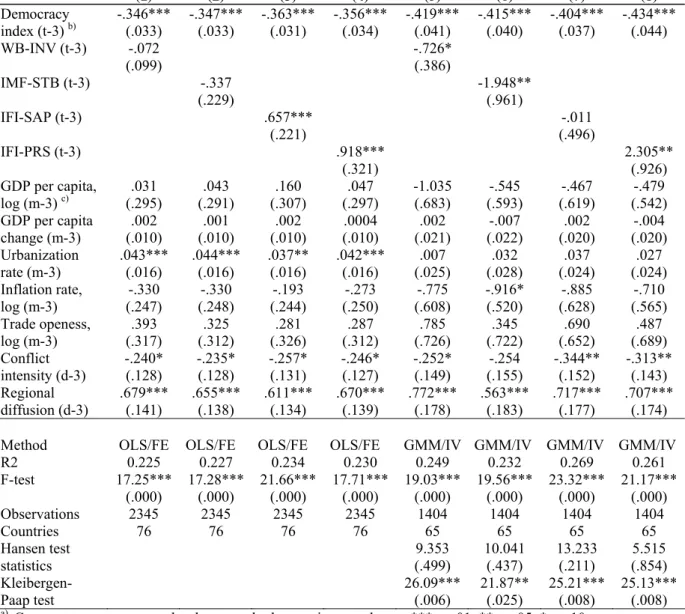
effec-tiveness literature (cf. Clemens et al. 2004; Barro and Lee 2005; Rajan and Subramanian 2008). We expect that at least parts of the conflicting results of previous research can be explained by the use of different time lags. To see this, we will analyze the political effects of different IFI programs over various time horizons reaching from 1 to 5 years.
Secondly, the causal mechanisms through which the IFIs may influence domestic power balances in recipient countries can be either direct or indirect. Democratization in borrowing countries may be affected directly through the money disbursed and the existence and form of conditions attached to loans, credits and grants, or through policy advice. However, democratization may also be influenced indirectly, through the IFI programs’ impact on economic growth and income distribution. The idea is that World Bank and IMF programs should generate economic growth, and that, in turn, as predicted by modernization theory, economic development furthers democratization in developing countries. Taking this finding into account, and assuming that the their programs achieve their proclaimed goal of promoting economic growth and poverty reduction, one would expect an indirect positive effect of IFI lending on democratic quality in recipient countries. However, given the combined time required for the macroeconomic effect and the following effect on democratization, the overall time horizon may easily exceed our maximum observation period of 5 years. Given the relatively recent introduc-tion of certain lending programs a consideraintroduc-tion of effects over an even longer time period does not seem to be appropriate here. Therefore, we will develop our hypotheses only with regard to the direct effects of IFI programs on democratization in recipient countries (for a good discussion of direct and indirect mechanisms of international influence, see Stallings 1992).
3.4. Program types and hypotheses
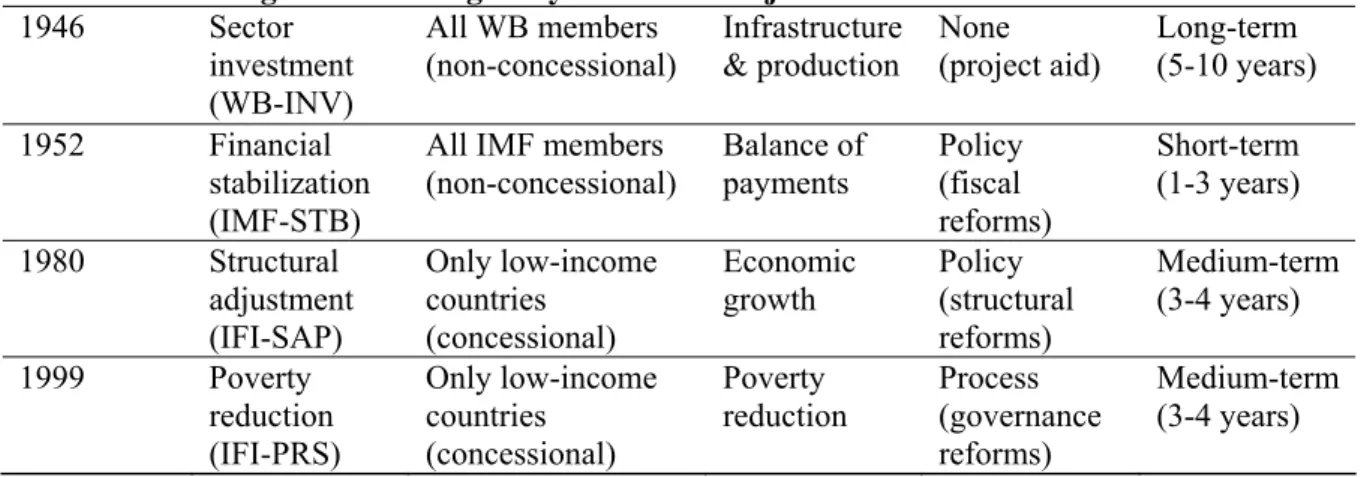
We consider four general types of IFI program lending which have subsequently been introduced in their international development cooperation (see Table 1):
Table 1: Types of IFI program lending
Introduced Program Eligibility Objective Conditions Duration
1946 Sector investment (WB-INV) All WB members (non-concessional) Infrastructure & production None (project aid) Long-term (5-10 years) 1952 Financial stabilization (IMF-STB)
All IMF members (non-concessional) Balance of payments Policy (fiscal reforms) Short-term (1-3 years) 1980 Structural adjustment (IFI-SAP) Only low-income countries (concessional) Economic growth Policy (structural reforms) Medium-term (3-4 years) 1999 Poverty reduction (IFI-PRS) Only low-income countries (concessional) Poverty reduction Process (governance reforms) Medium-term (3-4 years)
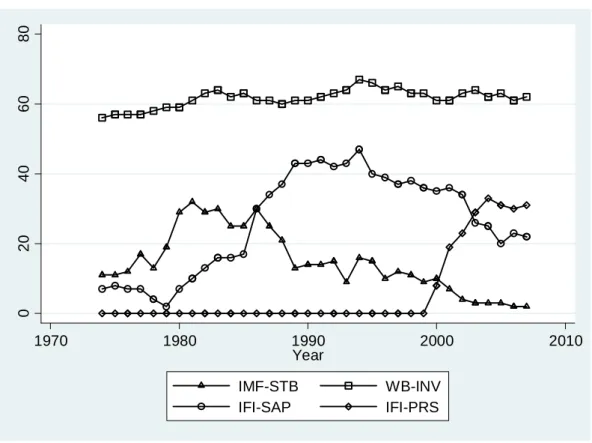
The four lending types are: World Bank sector investment projects (WB-INV), IMF financial stabili-zation programs (IMF-STB), IFI structural adjustment programs (IFI-SAP), and IFI poverty reduction programs (IFI-PRS). These broad types or categories of IFI lending differ in terms of eligibility. Con-cessional lending by the IFIs includes long-term loans that are only given to the poorest of the devel-oping countries at terms that are below market rates, while non-concessional lending is available to all member countries.
Although the IMF and World Bank have the same origins (Bretton Woods Agreements of 1944), the same members, and largely similar charters, the division of labor was initially clear-cut: The IMF’s non-concessional programs promoted international trade and exchange stability in the global economy through balance of payments support of its member countries, while the World Bank’s non-concessional projects aimed at reconstructing the physical and social infrastructure of its member countries, particularly in the less developed countries.
After the 1970s debt crises, however, the Bretton Woods Institutions started to collaborate explicitly regarding their concessional program types, e.g. defining common eligibility criteria for very poor countries or sending members of their staff to each others mission teams. Today, both IFIs work close-ly together in supporting sustainable economic growth and poverty reduction in developing countries and transitions economies (cf. Butkiewicz and Yanikkaya 2004; Dreher and Vaubel 2004; Faini and Grilli 2004; Abouharb and Cingranelli 2007).
Existing studies seldom examine the joint impact of World Bank and IMF programs. Even though the missions of the two IFIs have become more similar during the last decades and there is increasing cooperation between them, they have largely been analyzed separately (Abouharb and Cingranelli 2009: 49) – with the majority of the studies focusing on the IMF. This may lead to a wrong interpreta-tion of the impact of these specific programs. We thus separate the effects of the World Bank and IMF non-concessional programs, but we analyze their concessional programs jointly.
Depending on program eligibility, lending objective, donor conditions and program duration, we argue that different types of IFI program lending exhibit either a positive or negative impact on existing power balances in borrower countries and as a result, on different dimensions of democracy. The theo-retical reasoning behind this argument is lined out in the following for each individual lending type.
3.4.1. World Bank sector investment projects (WB-INV)
First introduced in 1946, investment lending has been the World Bank’s main instrument for deliver-ing development assistance to low- and middle-income countries.
• Eligibility: The World Bank’s investment projects are available to all International Bank for Reconstruction and Development (IBRD) and International Development Association (IDA) borrowers who are not in arrears with payments to the Bank Group.
• Objective: The World Bank’s sector investment operations provide funding (in the form of IBRD loans or IDA credits and grants) to borrower governments for physical investments, re-habilitation and maintenance, and technical assistance. Typically, these big capital-intensive projects finance either real sector investments in infrastructure or utilities that directly support production, such as
roads, ports and water treatment plants
(“hard projects”), and social sector investments, such as technology transfer in agriculture, public health campaigns, popu-lation growth control and mass education (“soft projects”) (Gros and Prokopovych 2005: 10).• Conditions: Development assistance by the World Bank is tied to projects; there are no politi-cal conditions attached. Funds are disbursed against projected or actual expenditures related to the purchase of works, goods, and services in support of specific economic and social devel-opment objectives in the overall context of the Country Assistance Strategy.
• Duration: World Bank financing of these large-scale investment projects is usually spread over 5 to 10 years (for more information, see the World Bank’s (2009a) project database as well as the World Bank’s (2009b) products and services).
Short-term effects on vertical accountability (state-society power balance)
The specific form of non-conditional project aid makes WB-INV lending very similar to bilateral aid funds and natural resource rents. According to the aid effectiveness literature, project funds are gener-ally disbursed without any consideration of domestic accountability relationships. The financial re-sources provided by the World Bank reduce the government’s dependence on its citizenry for tax rev-enue. The government is strengthened as the most powerful actor in the domestic political arena. Be-sides the extra resources, it obtains the informational advantage of the level of foreign aid rents, and the discretionary power over the distribution of these rents (cf. Jensen and Wantchekon 2004: 821). As a result, the power balance between the state and society moves further towards the government. We thus expect a negative effect of WB-INV programs on government’s accountability towards its citi-zens in our sample of hybrid regimes.
Short-term effects on horizontal accountability (borrower-donor power balance)
WB-INV projects are negotiated between the executive branch of the government of the recipient country and the representatives of the World Bank, while “the legislature, the heart of any democracy, is not formally part of the negotiation process” (Alexander 2006, cited in Abouharb and Cingranelli 2007: 204). As a result, these projects are often funded outside the budget without being subject to parliamentary review or any other domestic control mechanisms. This strengthens the power of the borrower government vis-à-vis the World Bank who should be interested in transparent and regular domestic oversight of governments’ financial transactions. Moreover, since there are no policy condi-tions attached to WB-INV projects, they do not provide any incentives for the government to allow the growth of alternative centers of domestic power which may then be capable to hold it accountable. The effect on horizontal accountability is thus expected to be negative.
Short-term effects on civil liberties (within-society power balance)
Finally, the question arises if WB-INV projects have the potential to change the prevailing power bal-ance among the previously excluded social groups and the dominant strategic group. According to our theoretical framework, greater socio-economic equality would result in higher equality on the political level as well and can be operationalized through the civil liberties record of a country. Theoretically, one could expect WB-INV projects to have either a positive or a negative impact on civil liberties in recipient countries. It might be positive, when previously excluded social groups are strengthened through investment projects. For instance, one could imagine that these groups benefit from improved infrastructure in remote areas, which would subsequently increase socio-economic equality within society regarding access to markets, schools, hospitals, etc. However, as Stallings (1992: 51) convinc-ingly argues, many of these large-scale investment projects from infrastructure to industrial production facilities went directly to state-owned firms controlled by the dominant social group within society. Because there is no conditionality attached to WB-INV projects, the dominant social group having domesticated the state is not constrained in using and distributing WB-INV projects to its own clien-tele at the cost of other social groups. We would therefore rather expect a negative impact of WB-INV projects on civil liberties in recipient countries.
Long-term effects on democratic quality (stabilizing negative trend)
In the long term, the stabilizing character of WB-INV projects matters most for all three power bal-ances. The duration of these large-scale investment projects extends over several election cycles (if any). Following the initial agreement between the Bank and the chief executive, over the whole dura-tion of the project, the steady flow of foreign aid thus strengthens the incumbent’s posidura-tion. As there is
no policy conditionality, WB-INV projects do not provide any countervailing impulse for a change the prevailing power balance between the state and society and within society in recipient countries. Nor are there any incentives that might change the international balance of power between the domestic political regime and the World Bank. Seen from a rather critical perspective, their patronage relation-ship on the international level fits well with the widespread pattern of neo-patrimonial politics in de-veloping countries.
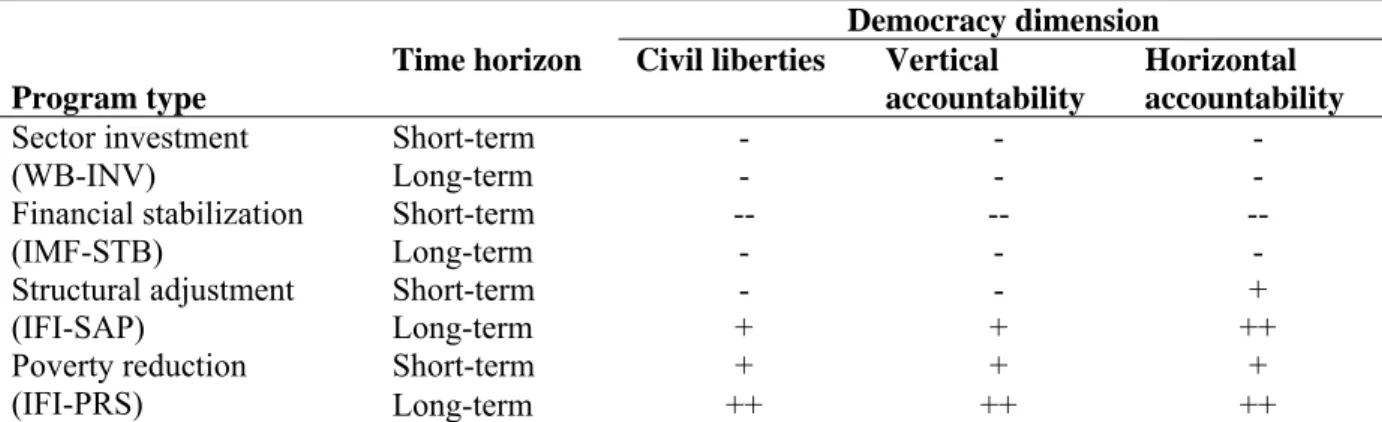
We thus expect a negative impact of WB-INV projects on vertical and horizontal accountability and on civil liberties in recipient countries, and we do not expect this effect to vary over time, i.e., between the short and the long term. The corresponding hypotheses are:
Hypothesis (1a): In the short term, World Bank sector investment projects have a negative effect on changes in vertical and horizontal accountability as well as civil liberties in the hybrid re-gimes of the developing world.
Hypothesis (1b): In the long term, due to their stabilizing properties World Bank sector invest-ment projects continue to have a negative effect on all three dimensions of democratic quality in developing countries.
3.4.2. IMF financial stabilization programs (IMF-STB)
The two main types of IMF-STB programs are the Stand-by Agreements (SBAs) designed to address temporary payments deficits (since 1952) and the Extended Fund Facility (EFFs). The latter was in-troduced in 1974 to support countries with protracted balance of payments difficulties as the recogni-tion grew that payments imbalances could no longer be expected to be corrected within a single year (Sidell 1988: 6; IMF 2005: 5).
• Eligibility: The IMF’s non-concessional facilities are available to all IMF member countries. However, they typically support high- and middle-income countries and do not cover coun-tries with low incomes. Correspondingly, these facilities’ are subject to repayments and inter-est rates based on rates in the major industrial countries (cf. Bordo and Schwartz 2000: 118; Evrensel 2002: 577; Hutchinson 2003: 327; Barro and Lee 2005: 1248; IMF 2005: 5).
• Objective: Originally, the IMF’s mission as stated in its 1944 Articles of Agreement was to fa-cilitate the growth of international trade, to guarantee exchange stability in the world system, and to provide capital infusions to member countries dealing with temporary balance of pay-ments difficulties. With the breakdown of the system of fixed exchange rates in 1973, the IMF lost its role as “guarantor of fixed exchange rates’’ and evolved more into a role of “crisis manager” or “development financier”. Correspondingly, the IMF’s focus shifted from the
management of the fixed exchange rates system to deficit lending and surveillance of its member countries’ monetary and fiscal policies (James 1996: 592; Jensen 2004: 196; Barro and Lee 2005: 1247).
• Conditions: IMF-STB programs come in the form of general budget support with strict policy conditionality attached, i.e. the IMF requires that the borrower government initiates reforms of monetary and fiscal policy prior to receiving loans (Bordo and Schwartz 2000: 118). Policy conditions include currency devaluation, reduction in the budget deficit, initiation of privatiza-tion, tax, and trade liberalization among other policy measures.
• Duration: In line with the IMF’s core mission of responding to economic crisis (Collier 2006: 1487), program duration is usually restricted to 1 to 3 years (and may be extended for a fourth year in the case of EFFs).
Short-term effects on vertical accountability (state-society power balance)
The IMF-STB programs differ from the World Bank’s investment projects in their mode of aid deliv-ery and program duration. Unlike project aid, they come in the more fungible form of general budget support, which should increase the anti-democratic autonomy of the state from the general public even more than project lending by the World Bank. This argument is in line with Bermeo’s (2009) empiri-cal findings. She looks at regime change and finds that there is no significant effect of bilateral in-vestment projects on the likelihood of regime change, but a significant negative effect of more fungi-ble forms of aid, such as general budget support (ibid.: 14). As the the rent-seeking mechanisms re-garding these “unearned” non-tax revenues is accentuated by IMF-STB programs, we thus expect a strongly negative impact of IMF-STB programs on vertical accountability in the short term.
Short-term effects on horizontal accountability (borrower-donor power balance)
In contrast to investment lending by the World Bank, financial stabilization programs by the IMF have
a relatively short duration. Because the IMF-STB programs are designed for managing crisis
situa-tions, they tend to strengthen the chief executive and weaken possible oversight by the legislative and other domestic accountability groups. At the same time, IMF-induced market-friendly reforms set clear limits for the borrower government and provide the Fund with significant leverage (Biglaiser and DeRouen 2009: 81). However, the increased power of the IMF does not result in creating sustainable checks and balances and political control mechanisms on the domestic level. This can be attributed to
the perceived crisis situation in the recipient country, in which even otherwise relatively democratic
governments often rule per emergency law without regular domestic oversight. Due to their interven-tionist character, we thus expect IMF-STB programs to fundamentally reduce horizontal accountabil-ity in recipient countries.
Short-term effects on civil liberties (within-society power balance)
Previous research on IMF program lending demonstrates quite convincingly that its non-concessional lending facilities have significant negative effects on income distribution (cf. Pastor 1987; Garuda 2000; Vreeland 2003; Nooruddin and Simmons 2006). They argue that the Fund’s “financial austerity” programs, also including cuts in government spending in social sectors, often cause a significant dete-rioration in the income distribution and particular hardship for the poorest segments of the population. As social discontent is high among a large part of the population, countries under IMF stabilization programs are more likely to experience collective protest. The government in turn, may react by in-creasing the level of repression (Franklin 1997: 576). Following this argumentation, we propose that IMF stabilization programs have a negative impact on the within-society power balance, and thus on civil liberties in recipient countries.
Long-term effects on democratic quality (decreasing negative trend)
With respect to the expected effects over time, we should recall that the IMF-STB programs are de-signed only for short-term interventions.4 They are exceptional measures in the face of a severe crisis
situation and are not supposed to be extended over a longer time period. As a result, we should expect that their negative effects on democratic quality decrease over time. In general, we thus expect no significant long-term effects of IMF-STB programs on all three dimensions of democracy.
Therefore, we posit that IMF-STB programs have a strong negative impact on the likelihood of a de-mocratic transition in program countries. They reduce both dede-mocratic accountability and civil liber-ties in the short term. However, as they are explicit short-term facililiber-ties we expect their negative im-pact on democratic quality to decrease over time. This is reflected in the following hypotheses:
Hypothesis (2a): In the short term, IMF financial stabilization programs have strongly negative effects on changes in vertical and horizontal accountability and significantly reduce the degree of civil liberties in program countries.
Hypothesis (2b): In the long term, the negative effects of IMF financial stabilization programs on all three dimensions of democratic quality decrease over time.
4 Nevertheless, some countries are frequent users of IMF-STB programs (cf. Bird et al. 2004). In this case, pro-longed participation could accentuate their negative effects for democracy on all three dimensions of democratic quality over time. However, because other types of IFI lending (i.e., concessional programs) are more often used to address specifically the underlying structural problems of frequent users, which cannot be resolved in the short term, we expect the negative effects of IMF-STB programs to fade out in the long term.
3.4.3. IFI structural adjustment programs (IFI-SAP)
In the 1980s, the IFIs started concessional financing by introducing structural adjustment programs. Structural adjustment lending by the World Bank began with an early forerunner in the mid-1960s (India) and was revived in the mid-1970s after the first great oil price shock in 1973. Following the second oil shock in 1979, structural adjustment programs were definitively introduced in 1980. How-ever, due to hesitations and uncertainties within the Bank towards this type of program lending, it lasted until the mid-1980s before conditional, non-project lending was internally established. The IMF in turn, introduced its Structural Adjustment Facility (SAF) in 1986, which was later on replaced by the Enhanced Structural Adjustment Facility (ESAF) in 1987 (Barro and Lee 2005: 1248).
• Eligibility: The eligibility criteria for the IMF’s structural adjustment facilities are based on a country’s per capita income and are linked to the World Bank’s concessional lending (IMF 2005: 5). The World Bank assesses eligibility for concessional lending on the basis of a coun-try's performance in implementing policies that promote economic growth and poverty reduc-tion (IDA 2010). Structural adjustment lending is only available to low-income countries. The interest rate charged is below market rates at 0.5 percent.
• Objective: Structural adjustment programs generally aim at “adjustment with growth” (Killick 1995: 83), i.e., they foster structural and macro-economic reforms in a sector or the economy as a whole.
• Conditions: Structural adjustment lending by both IFIs provides direct budget financing to borrower governments. Funds are disbursed quickly, usually conditional on the completion of mutually agreed structural and institutional reforms (World Bank 2009c: 4). The policy condi-tions attached to IFI-SAP lending generally foresee three means in order to realize these re-forms; namely increasing the role of the market relative to the public sector, improving the ef-ficiency of the public sector, and mobilizing additional domestic resources (Jensen 2004: 197).
• Duration: Structural adjustment programs are frequently part of a programmatic series of op-erations, in which the IFIs support a medium-term program (3 to 4 years) of policy reform (Polak 1991: 19; Gros and Prokopovych 2005: 6; World Bank 2009b).
Short-term effects on vertical accountability (state-society power balance)
Due to their specific aid modalities, IFI-SAP lending lies between the Bank’s investment projects and the Fund’s stabilization programs regarding the rigour of conditionality and the length of program duration. In terms of accountability relationships, we therefore expect mixed effects of IFI-SAPs re-garding their impact on vertical vis-à-vis horizontal accountability. Similar to IMF-STB programs, the negative effect of quick-disbursing budget support on vertical accountability should also hold for IFI-SAP lending. Even though the economic policy conditions attached to structural adjustment programs