E
Ennggiinneeeerriinngg SSyysstteem
mss D
Diivviissiioonn
Working Paper Series
ESD-WP-2007-06
P
OLICY
I
SSUES IN
I
MPLEMENTING
S
MART
C
ARDS IN
U
RBAN
P
UBLIC
T
RANSIT
S
YSTEMS
Final Report – ESD.10 Introduction to Technology and Policy
Makoto Eguchi
Susan Fredholm
Shan Liu
Paulina Ponce de León Baridó
Jacqueline Ye
Massachusetts Institute of Technology Technology and Policy Program
in Urban Public Transit Systems”
Final Report
December 8, 2006
Makoto Eguchi, Susan Fredholm, Shan Liu,
Paulina Ponce de León Baridó & Jacqueline Ye
Massachusetts Institute of Technology
1 Table of Contents... 3
2 Executive Summary... 4
3 Background... 7
3.1 What are Smart Cards?... 7
3.2 History of Smart Cards... 7
3.3 Smart Card Application for Urban Transportation... 8
3.4 Characteristics and Components of a Transit Smart Card System... 9
4 Analysis of Existing Implementation...10
4.1 Existing Smart Card Systems...10
4.1.1 Table Summary of Smart Card Systems...10
4.1.2 Sample Case Studies...10
4.2 Improvement/Benefits...24
4.2.1 Efficiency...24
4.2.2 Financial Benefits for Transportation Providers...25
4.2.3 Marketing Benefits for Transportation Providers...26
4.3 Concerns...26
4.3.1 Standardization / Technical Considerations...26
4.3.2 Security and Privacy...27
4.3.3 Equity...27
4.3.4 System Failures...28
4.4 Trade-offs...28
4.4.1 Efficiency – Equity Trade-off...30
4.4.2 Efficiency – Security Trade-off...31
4.4.3 Efficiency – Privacy Trade-off...32
5 Analysis of Future Development of Smart Card Systems...34
5.1 Expanded Application...34
5.1.1 Potential Issues...35
5.2 Advancement of Card Technology...36
5.2.1 Smart “Card” No More...36
5.2.2 Biometric Identification Technology...37
5.3 Standardization Efforts to Increase Interoperability...37
Conclusion...39
5.4 Recommendations...39
5.5 Summary...42
6 Acknowledgements...43
7 List of Figures...44
8 List of Tables...Error! Bookmark not defined. 9 Bibliography...46
2
Executive Summary
Many public transportation institutions have been discarding their magnetic strip payment cards or traditional cash-based fee collection systems in favor of automated fare collection systems with smart card technology. Smart cards look like traditional credit cards or ID cards; however, using RFID technology, they allow for contactless payment and identification. Smart cards are becoming increasingly popular among transit agencies primarily because they are convenient for customers, reduce administrative costs for transit agencies, and have the potential of improving the performance of complex transit systems overall.1 The increased availability and affordability of contactless cards has also contributed to this trend in adoption.2
This report examines six principal smart card transit systems of the world - those of Chicago, Hong Kong, London, Singapore, Tokyo, and Washington DC. Using these case studies, this report determines the principal benefits and concerns resulting from using smart cards for transit payment. The primary benefits were determined to be efficiencies for both the transit riders and transit authority. Therefore, this report also includes a formal discussion of the efficiency-equity, efficiency-security and efficiency-privacy tradeoffs which result from various implementations of smart cards in urban transit. The formal treatment of these tradeoffs differentiates this report from other similar studies. Using the knowledge gained from evaluating these tradeoffs, recommendations are given for the implementation and development of future smart card systems.
The benefits of introducing smart cards into a city’s transit system include:
• Increased punctuality of buses as boarding time is reduced.
• Reduced operational costs as the number of cash-based transactions is reduced and the
printing of tickets is eliminated.
• Easy recording of transit usage data that can be used to improve the system. • Easier implementation of complex fare structures.3,4,5
The primary concerns of introducing smart cards into a city’s transit system include:
• Cost of substituting a traditional fare collection system with a smart card system. • Selection of a smart technology standard that is compatible with other existing smart
card and transit systems.
• Privacy of user information on personalized smart cards (both in terms of tracking an
individual’s movements and gaining access to financial and identification data).
• Equitable access to smart cards and their benefits among different social groups such
as low-income riders, tourists, and children. (For example, some smart cards require users to have a bank account or credit card.)
• Response to smart card system failures.
This report also takes a look at some of the major future trends associated with urban transit smart cards in Chapter 5. These trends include the expanding of the number of applications for each card, the consolidation of devices, and increased technical standardization along international, regional, and local levels.
1 Hong 2006 2 Hendry 2001: 219 3 Hong 2006 4 Hendry 2001: 220
Finally, the following steps are recommended to ensure an effective, equitable, and secure implementation of smart cards in urban transportation.
• Choose a technology standard that allows for integration with other smart card
systems.
By choosing a standard system, these smart cards may also be used with other transportation, retail, and identification smart card systems, among others. Such an open and flexible system can more easily incorporate changes in future technology, respond to new demands from society, and meet future regulatory requirements. Furthermore, transit agencies may prefer to act as clients of another organization’s smart card system rather than being responsible for issuing the cards themselves.
• Offer two types of cards – one with embedded personal identification data, and
one without.
Two types of smart cards are recommended for each transit system - one with more features, but less privacy, than the other. This gives users the option to not link personal identification or financial information with their transit card.
• Consider a distance-based fare structure.
Where possible, we recommend transit administrators consider the implementation of complex fare structures as a way to make ridership charges more equitable while at the same time increasing the agency’s revenue through price discrimination. If the characteristics of the city and its population are favorable for the implementation of such fare structure, we suggest distance-based fees be calculated according to the radial distance between the start and end of the trip, rather than on the distance traveled between the two locations. However, due to the specific transit routes available and socioeconomic distribution of people with respect to transit lines, some cities have found that flat fare structures remain more equitable.
• Continue to respect different pricing structures for different social groups
Cities should continue to allow students, children, and seniors to obtain the same reduced fares as before the implementation of smart cards.
• Provide financial incentives to encourage adoption
If trying to get a large of number of riders to adopt a new smart card system early in its implementation, incentivize the switch by making it the cheapest option available.
• Provide backup functionality in case of central system failure
If the smart card system fails, there should be some alternative way for riders to continue to pay for travel. Transit agencies need to consider the different options for providing backup functionality. Among these options is the continued acceptance of cash and/or magnetic strip cards, as well as equipping local computers to communicate with smart cards even if the central server is down.
• Routinely screen system for software failures
The system needs to be designed so that software checkups are routinely carried out to prevent over or under-charging of customers, and mishandling of personal data.
beyond transportation
If smart cards can be used for the purchase of goods and services other than public transportation, such as food and retail, parental controls can prevent children from misusing their cards.
3
Background
3.1 What are Smart Cards?
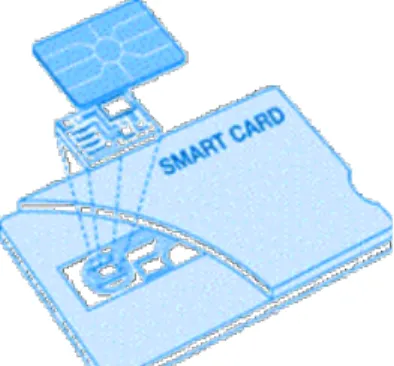
Smart cards are microprocessor cards6, made of a chip and an integral operating system. As described by Attoh-Okine and Shen, “the chip contains a processor, arithmetic processing registers, random access memory (RAM) used during program execution, read only memory (ROM) to house the operating systems, and EEPROM (Electrically Erasable Programmable Read-Only Memory) for data storage, [while the] operating system provides the ISO-complaint command, data access, security controls and security algorithms.”7 The chip is constructed into the credit card sized card, which must be introduced into a reader/writer machine that powers the chip and enables communication between the card and the other parts of the system. If the card is contactless, communication with the card reader is enabled through radio frequency identification (RFID) technology.
Figure 3-1: Smart Card and Microprocessor8 3.2 History of Smart Cards
The direct predecessors of smart cards are magnetic cards that store digital data in a form that is easily read by a machine. Smart card use is typically tied to a physical real-time method of personal identification by the cardholder, such as signing or providing a personal identification number (PIN). Magnetic cards are unsuitable for storing confidential information, however, because anyone with access to the adequate equipment can read, alter, and even delete the information stored in the card. The development of the smart card was, in a way, a response to the need for solving this security problem in a way that would not burden card transactions.9
There is some disagreement regarding when smart cards were originally introduced and patented, with dates ranging between 1968 and 1974. According to Rankl & Effing, the idea of using an integrated data storage and logic processing circuit as part of an identification card was originally patented in Germany in 1968, with a similar patent being processed in Japan in 1970. By 1974, Roland Moreno had filed for a patent of an Integrated Chip (IC) card, which shortly thereafter was referred to as a smart card.10 It was not until 1984, however, after the French Postal and Telecommunications Services Agency carried out a successful telephone cards field trial that smart cards usage increased and widened. After a
6 Hendry 2001: 4
7 Attoh-Okine, N.O. & Shen, L. David 1995: 523 8 http://www.tiresias.org/guidelines/pats.htm 9 Rankl & Effing, 2001: 3
different pilot project was carried out in Germany in 1984-85 to compare different technologies for telephone cards, it was agreed that smart card technology was superior to magnetic-stripe cards and optical-storage cards, not only because they offered greater reliability and were more difficult to manipulate, but also because they promised greater flexibility for future implementations.
Microprocessor chips were first deployed on a large scale in the telecommunications sector of France and Germany, mostly for mobile applications. Advances in cryptography and semiconductor technology enabled the use of smart cards for banking purposes – Rankls & Effing suggest that these advances, along with other hardware and software improvements, “made it possible to implement complex, sophisticated mathematical algorithms that allowed previously unparalleled levels of security to be achieved.”11 An additional important characteristic of the improved smart cards was that they were easily available to everyone to carry and use everywhere.
Current usage of smart cards can be found in the healthcare sector, transportation services (both for urban transit and interstate highway tolls), as well as corporate and educational identification and security access controls. Smart cards are expected to play an important role in the future of secured monetary transactions and identification practices over the Internet.12
3.3 Smart Card Application for Urban Transportation
The components of a city’s transit system – the buses, trams, metro trains, etcetera – are usually the responsibility of a single private or public authority, and are run as “profit centers and must account for their income and volume of passengers as well as their costs.”13 Either way, an effective transit system must allow for seamless journeys, so that a ticket is sufficient for a passenger’s trip regardless of how many different types of transit components he or she utilizes. There is an obvious need for charging different fees based on the passenger’s choice of transit mode and the distance traveled. Fees also vary due to the social service nature of public transportation, as some of the services provided to certain passengers, such as children or the elderly, may be subsidized. The complexity of the system makes it difficult to control, with fare evasion a common problem.
Public transportation institutions have begun to shift their traditional cash-based fee collection systems to automated fare collection systems that use smart card technology. Smart cards are becoming increasingly popular among transit agencies because they are convenient for customers and have the potential of improving the performance of the transit system overall.14 The increased availability and affordability of contactless cards has also contributed to this trend.15
There are several benefits to introducing the use of smart cards in the transit system, for they “combine the secure, cashless transactions and personalized applications that encourage people to use mass transit.”16 The performance of transit systems improves by using smart cards because the reliability of service increases as a result of a reduced board-waiting time,
11 Rankl & Effing: 4 12 Rankl & Effing: 7 13 Hendry 2001: 220 14 Hong 2006 15 Hendry 2001: 219
which leads to increased punctuality and possible reduction in journey time. The operational costs of the system also decrease because cash-transactions are eliminated, as is the need to continuously print boarding tickets. The use of smart cards enables transit agencies to identify and record usage and demographic information and patterns that can help them to enhance their operation management and meet government reporting requirements. Finally, the use of smart cards increases the flexibility of the system by enabling the implementation and administration of various fare policies. 17,18,19
An automated fare collection system that uses smart card technology is initially expensive, though it is estimated that the system, in the long run, “may eventually cost only one-third of the old system due to improved efficiency and lower maintenance costs.”20 This relatively young technology is yet to be standardized and continues to change rapidly. Therefore, its implementation needs to be highly flexible to allow the system to develop with future smart card improvements. This lack of standards has led to a lack of compatibility between transit systems in different cities, which can be bothersome and impractical for transit users.
An additional concern towards the use of smart cards in urban transit is its potential to infringe on individuals’ privacy through the tracking of users’ travel and movement patterns. If smart cards are used for additional services other than transit, then other personal information can equally be monitored.
Various cities have adopted a smart card-based automated fare collection system, and many others are planning to also do so in the future. Cities that currently use smart cards in their transit systems include Hong Kong, Washington D.C., Tokyo, Singapore, London, and Chicago.
3.4 Characteristics and Components of a Transit Smart Card System
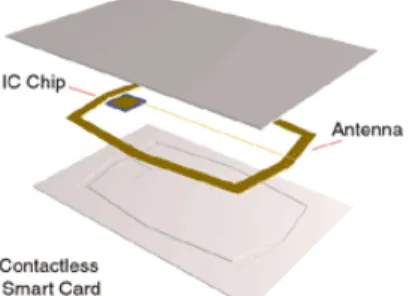
A smart card used for transit purposes is ideally one with a microprocessor chip that allows for contactless payment. Smart cards with microprocessor chips are useful to transit purposes because one can add and change data on the processor, whereas with memory cards one can only use pre-programmed data and make no changes. While memory smart cards can only be used once, smart cards with microprocessors can be reprogrammed when necessary and thus continuously reused. The contactless feature of the smart card helps to expedite the process of boarding, because transit users do not need to even take the card out of their wallet or purse.
Figure 3-2: Contactless Smart Card Structure21
17 Hong 2006 18 Hendry 2001: 220
19 Attoh-Okine, N.O. & Shen, L. David 1995: 523 20 Poon & Chau in Hong 2006
4
Analysis of Existing Implementation
4.1 Existing Smart Card Systems
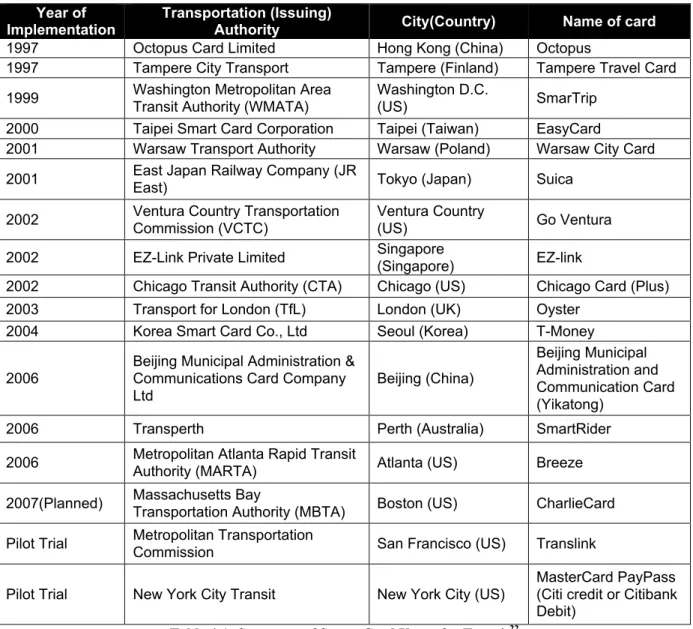
4.1.1 Table Summary of Smart Card Systems Year of
Implementation
Transportation (Issuing)
Authority City(Country) Name of card
1997 Octopus Card Limited Hong Kong (China) Octopus
1997 Tampere City Transport Tampere (Finland) Tampere Travel Card 1999 Washington Metropolitan Area
Transit Authority (WMATA)
Washington D.C.
(US) SmarTrip 2000 Taipei Smart Card Corporation Taipei (Taiwan) EasyCard
2001 Warsaw Transport Authority Warsaw (Poland) Warsaw City Card 2001 East Japan Railway Company (JR
East) Tokyo (Japan) Suica 2002 Ventura Country TransportationCommission (VCTC) Ventura Country(US) Go Ventura 2002 EZ-Link Private Limited Singapore(Singapore) EZ-link
2002 Chicago Transit Authority (CTA) Chicago (US) Chicago Card (Plus) 2003 Transport for London (TfL) London (UK) Oyster
2004 Korea Smart Card Co., Ltd Seoul (Korea) T-Money
2006
Beijing Municipal Administration & Communications Card Company Ltd Beijing (China) Beijing Municipal Administration and Communication Card (Yikatong)
2006 Transperth Perth (Australia) SmartRider 2006 Metropolitan Atlanta Rapid TransitAuthority (MARTA) Atlanta (US) Breeze
2007(Planned) Massachusetts BayTransportation Authority (MBTA) Boston (US) CharlieCard
Pilot Trial Metropolitan TransportationCommission San Francisco (US) Translink
Pilot Trial New York City Transit New York City (US)
MasterCard PayPass (Citi credit or Citibank Debit)
Table 4-1: Summary of Smart Card Usage for Transit22 4.1.2 Sample Case Studies
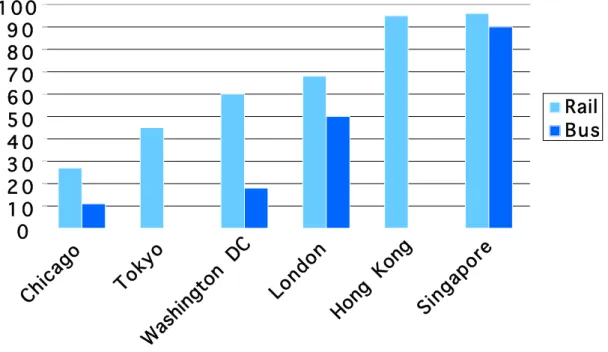
In this section, six of the world’s premier urban transit smart card systems are examined – those of Chicago, Hong Kong, London, Singapore, Tokyo, and Washington DC. Of these programs, Hong Kong’s Octopus Card and Singapore’s EZ-Link are considered the most successful because they have achieved penetration rates greater than 90%, as is shown in Figure 4.1. These two smart cards are multi-module and multi-purpose, meaning that they can be accepted as standard payment in services across industries, including transportation, retail, food, education, security, and healthcare. The Octopus and EZ-Link are truly commercialized due to their high level of personalization, artistic themes, and souvenir values. Tokyo’s Suica
card can also be used in many retail services, but the extent of its reach is less due to standardization issues between Tokyo’s railway companies. In contrast, smart cards in the cities of Chicago, London, and Washington DC, are restricted to transportation use. The table and chart below summarize the key characteristics of the six smart cards systems studied.
City Uses Available Options
Chicago
(Chicago Card & Card Plus) Transit
Pay-Per-Use (CC&CCP) 30-Day Pass (CCP)
Hong Kong (Octopus)
Transit Parking Retail Identification Building Access etc
Pay-Per-Use
London (Oyster) Transit Pay-Per-UsePeriod and Concession Passes
Singapore (ez-link)
Transit Retail Identification Building Access etc
Pay-Per-Use Concession Passes
Tokyo (Suica) TransitRetail Pay-Per-UsePeriod and Concession Pass Washington D.C. (SmarTrip) TransitParking Pay-Per-Use
Table 4-2: Usage and Options of the Six Major Smart Card Programs23
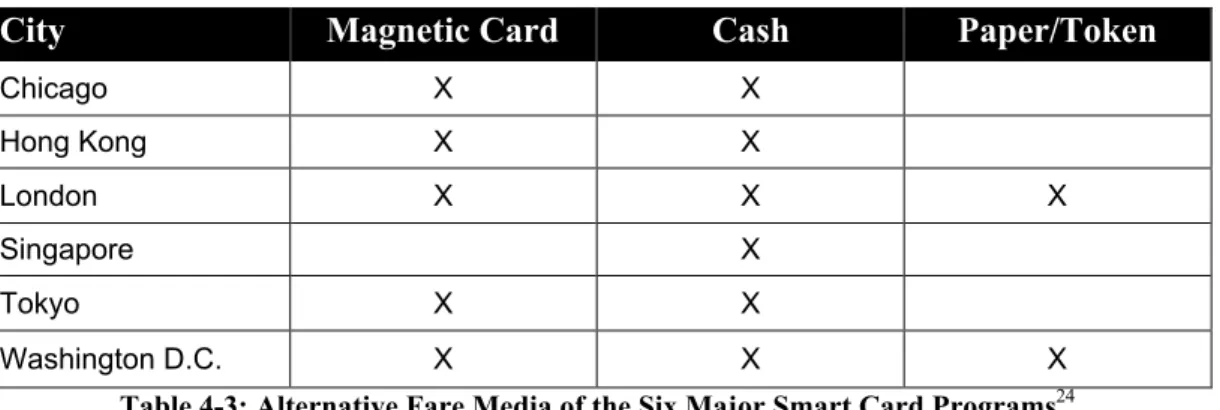
City Magnetic Card Cash Paper/Token
Chicago X X Hong Kong X X London X X X Singapore X Tokyo X X Washington D.C. X X X
Table 4-3: Alternative Fare Media of the Six Major Smart Card Programs24
All of the cities have maintained some form of traditional payment, but the majority is phasing out the use of paper tickets and tokens.
23 Hong 2006: 30. IT Media, November 2005 24 Hong 2006: 30. IT Media, November 2005
0 1 0 2 0 3 0 4 0 5 0 6 0 7 0 8 0 9 0 1 0 0 Chicago Tokyo Washington DC London Hong Kong Singapore Rail Bus
Figure 4-1: Comparison of Smart Cards Penetration Rate of the Six Major Smart Card Programs25
4.1.2.1Chicago
Background
Chicago, a major transportation hub, has a city area of 606.2 sq km, and a population of 2.8 million.26 The Chicago Transit Authority (CTA) controls the second largest public transportation system in the US. It operates a network of buses, a rapid transit system, a commuter rail service, and interstate highways. Weekly ridership can reach 1.5 million.27 Chicago Card Basics
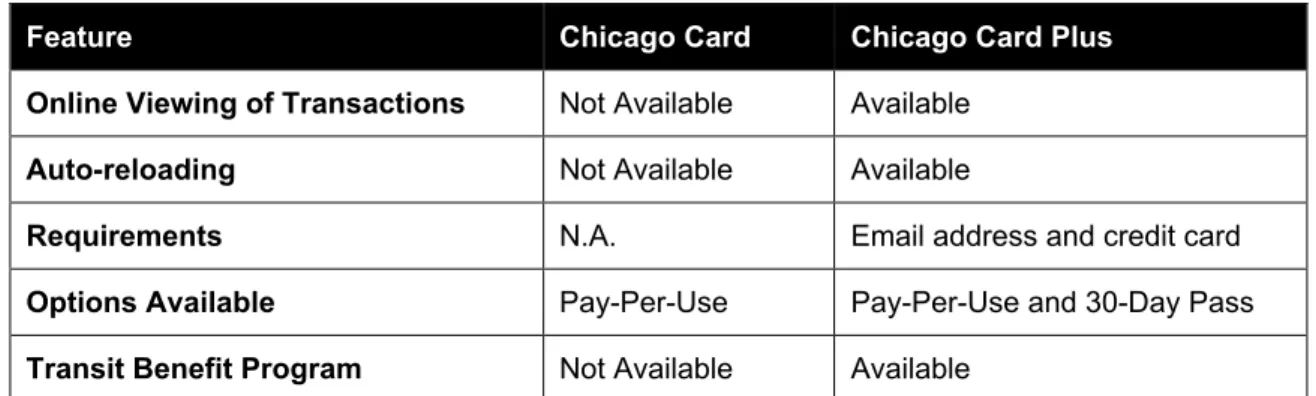
Chicago introduced two types of smart cards to its transportation system in 2002: the Chicago Card and the Chicago Card Plus. Both of these cards provide faster payment by eliminating the need to remove the card from a wallet in order for it to be read. The Chicago Card Plus offers more features than the Chicago Card and, as such, is marketed differently. The Chicago Card offers pay-per-use proximity payment. In addition to this feature the Chicago Card Plus provides a monthly payment option, online account management, and automatic reloading of the card from the card owner’s bank account. Therefore, the additional conveniences of the Chicago Card Plus require that additional personal information be tied to the card. Whereas Chicago Card Plus users are required to register a valid email address and credit card, Chicago Card users do not have to meet such requirements. However, pass-back privileges28 still allow one card to be used to pay for up to 7 people entering a transit vehicle together.
25 Hong 2006: 30. IT Media, November 2005 26 The City of Chicago.
27 Hong, Yi. Thesis 167
28 Pass-back privileges refers to the ability of one person to pass their transit card back over the fare gate for a
companion to use. In other words, one card can be used multiple times sequentially to allow a each member group to charge their travel to this same card.
Figure 4-2: Chicago Card, Card Plus29
Feature Chicago Card Chicago Card Plus
Online Viewing of Transactions Not Available Available
Auto-reloading Not Available Available
Requirements N.A. Email address and credit card
Options Available Pay-Per-Use Pay-Per-Use and 30-Day Pass
Transit Benefit Program Not Available Available
Table 4-4: Difference between the Chicago Card and the Chicago Card Plus30
Usage
Chicago Cards are read by the front of rail station turnstiles and bus fare-boxes on all but one available transit route.31 These cards are sold for $5 both online and at more than 700 locations throughout the Chicago land area, including several major retailers.32 Recently, to encourage adoption, the CTA waived the $5 purchase fee until June 2006.33
Currently, Chicago Cards are only available for paying full adult fares. Student, senior, weekly and other reduced fare structures are available via magnetic strip cards, called Transit Cards. Nevertheless, all users of Chicago Cards are given a US$0.25 discount on the full fare price of each single ride, equivalent to savings of 12.5%. Chicago Card holders are also provided a 10% bonus for each $20 of value added to their cards. As of May 2006, the CTA estimated that the penetration rates of Chicago Card (Pay-Per-Use) were 22.2% for rail and 8.4% for bus, and 5.2% for rail and 2.2% for bus with the Chicago Card Plus (30-Day Pass)34.
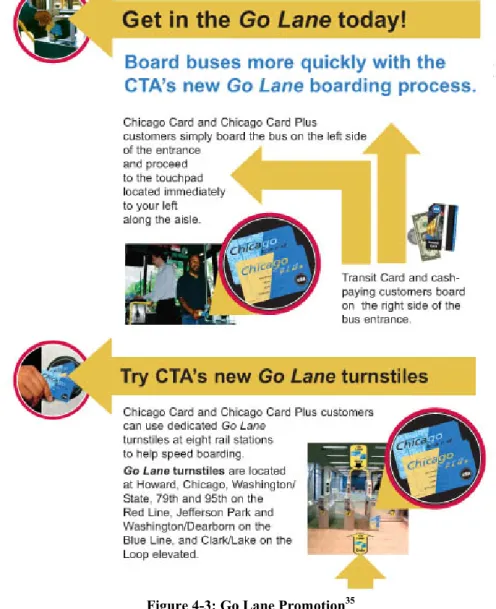
Chicago is currently running an express lane pilot program, the Go Lane, for Chicago Card and Chicago Card Plus owners. The Go Lane allows these smart card holders to form a separate line from the transit users that choose to pay with cash or by using a magnetic strip card. The smart card holders are able to enter the bus to the left of these other riders and thereby board the bus much faster. Similarly, the Go Lane program has designated lanes for smart card holders to use when going through subway turnstiles. The Go Lane program is depicted in the advertisement shown in Figure 4.3.
29 Chicago Transit Authority. “Chicago Card Frequently Asked Questions.” 30 Hong 2006: 33
31 Chicago Transit Authority. “Chicago Card Frequently Asked Questions.” 32 Chicago Transit Authority. “CTA Fares.”
33 Monifa Thomas, The Chicago Sun-Times “No-fee Chicago Cards extended to May 31” 34 CTA Fare Media Summary in Hong 2006: 34
Figure 4-3: Go Lane Promotion35
Evaluation
In a 2005 CTA survey, almost 45 % of the participants cited convenience as the principal advantage of the Chicago Card and the main reason for using it. Additional reasons include saving money by using the card, automatic reloading of the card, and a reduced boarding time.36 An important motivation for riders to adopt the smart card system is the savings it provides. In the case of the Chicago Card, there was no difference in price between this smart card and a 7-Day Pass, which was a magnetic card; if there was a difference, it was that the latter allowed for a greater number of trips during the week. In this case, users preferred the magnetic card to the smart card.37
One of the challenges the Chicago Card system has faced is being able to integrate the three regional transit systems, Metra, Pace and the CTA. While smart cards seemed to provide the best option, regional officials argued they were too “expensive and untested to now pursue.”38 Instead, they chose to introduce a regional transit card with one side being a zoned
35 Chicago Transit Authority. “Go Lane Pilot Program” 36 Hong 2006: 23
37 Hong 2006: 86 - 92 38 Herguth 2003
monthly Metra pass, and the other a magnetic strip Pace and CTA pass – a consequence of the failure to meet the challenges of how to “get three systems to talk to each other.”39 At the beginning of 2006, a software problem in the system led to over billing Chicago Card and Chicago Card Plus holders for using the bus system. While various users identified the overcharge (which, in at least one case, was of US$70), the CTA was uncertain about how many other customers had been affected.40 This problem highlights the increased intensity of the consequences that glitches in the automated system may cause.
4.1.2.2Hong Kong
Background
Hong Kong, a highly developed modern city with an area of 1092 sq km, and a population of 7 million, has a sophisticated and advanced transportation system.41 Hong Kong’s major modes of urban transport are metro systems including the Mass Transit Railway (MTR) and the Kowloon-Canton Railway (KCR) (consisting of both rapid transit and light rail system), a tramway that exclusively operates double-decker trams, public bus services, and ferries.42 Public transportation is heavily used by local residents and tourists, summing up to over 11 million daily passenger journeys on all modes of transportation.43
Smart Card technology was first introduced to Hong Kong in 1997. The card carries the brand name Octopus (___), and is operated by Octopus Holdings Limited, which was launched by several public transportation companies comprised of MTR, KCR, Kowloon Motor Bus, Citybus, and New World First Bus. Octopus’s popularity and acceptance is unmatched in any other city with similar smart card programs. It is deemed the most successful and well-developed contactless smart card system for mass transit in the world.
Figure 4-4: Octopus cards design44
Octopus Basics
MTR collaborated with ERG Transit Systems, an Australian transit system vendor, to build Octopus’s back-end structures and design the overall system. The card uses Sony’s FeliCa radio frequency identification (RFID) chip running on 13.56 MHz.45 The card is contactless, allowing users to either touch the card on the Fare Deducting Processor at the entrance or exit gate while traveling, or simply hold out a wallet or bags containing the card, thus significantly increasing uploading efficiency.46 All wireless communication through the card is encrypted using two-way authentication.
There are two types of Octopus smart cards: Sold and On-Loan. Both can be purchased
39 Herguth 2003 40 Groark 2006
41 CIA—The World Factbook, Hong Kong. 42 Wikipedia, Hong Kong.
43 Hong, Yi. Thesis 137
44 Octopus Website. <http://www.octopuscards.com/> 45 Smart Card Alliance “Hong Kong Octopus Card.”
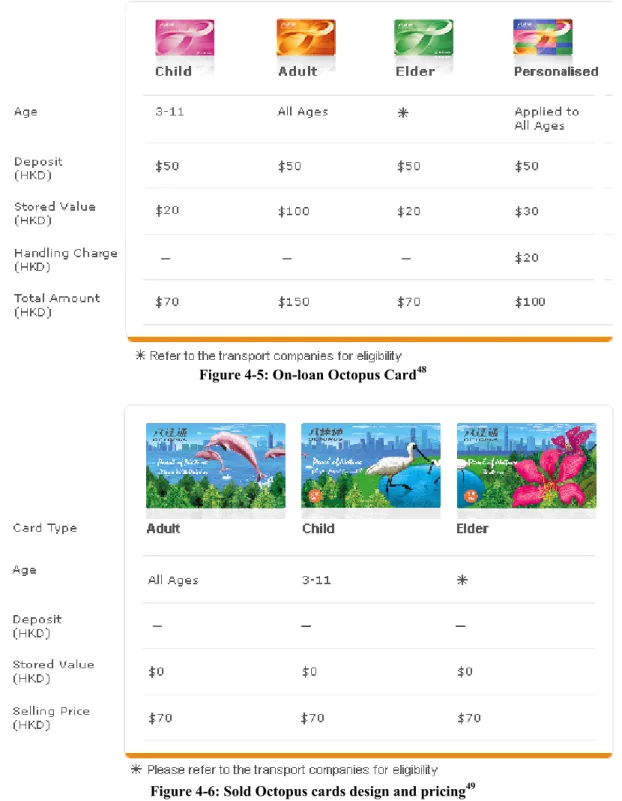
online or from any MTR customer service center, Airport Express Line service center, KCR ticket office, and 7-Eleven and Circle K convenience stores, among others. The Sold Octopus cards have special designs, and are regularly promoted as souvenirs. The On-Loan cards are for daily use and require a refundable HK$50 deposit, though they can be personalized for HK$20 with the user’s name and photograph on the card.47 The differences are shown in the following figures.
Figure 4-5: On-loan Octopus Card48
Figure 4-6: Sold Octopus cards design and pricing49
47 Octopus Cards Limited 48 Octopus Cards Limited 49 Octopus Cards Limited
Usage
Soon after the Octopus system launched in 1997, 2.5 million smart card transactions daily took place. This number increased to 7 million by 2003, translating into a daily monetary value equivalent to US$6.5 million.50 In 2005, Octopus reached 90% penetration on the MTR
system.51 With Octopus’s success as an electronic payment for mass transit, other businesses and services soon started to accept Octopus payment. Now, 25% of Octopus transactions are related to non-transit businesses. These businesses include Hong Kong’s main supermarkets, Starbucks, McDonald’s, many convenience stores, more than 3,000 vending machines, pay phones, and public recreational centers charging for admission.52 Octopus is available at over 410 service providers, across markets in transportation, apparel, food, parking, cinemas, stores, and restaurants. Even schools are using Octopus as students’ identification cards for library loans and payment for food and tuition. Private estates and offices also use Octopus as an access control ID. In total, the company has issued more than 9 million Octopus cards and 150,000 smart watches.53
After the initial purchase of an Octopus card, customers can reload values onto the same card by signing up for the Automatic Add Value Service (AAVS), using cash at any outlet that accepts Octopus for payment, or using electronic funds transfer at Add Value Machines or ATMs. The AAVS automatically charges the card owner’s credit card account with either HK$250 or HK$500, as specified by the customer. The Octopus card service not only provides convenience and standardization in payment method across platforms, it also offers various fare discounts, bonuses, and rebates in public transportation. All money retained on the On-Loan cards is fully refundable, unless the card is returned within 3 months of purchasing because a small fee is charged to discourage such practice.
Evaluation
One of the key factors contributing to the success of Octopus cards is that it received complete support from all transport operators in a particular area, facilitating widespread acceptance. Nevertheless, not everyone agreed with the new system, which in turn was not flawless. The card also gained wide acceptance in micro-payment markets, such as small retail shops. Some merchants did not want to introduce smart card payments, however, because they would be subject to an interchange charge. To do this, the transport authority in effect had to become a money issuer. Transit operators enjoyed considerable savings in maintenance using smart card versus magnetic systems, and there is far less cash handling especially for bus operators. Passenger throughput is much faster at gates or when boarding buses, though bottlenecks at stations can be transferred from the gates to the escalators. Smart cards give operators more information than older systems, and enable operators to introduce more sophisticated fare policies and marketing initiatives.54
4.1.2.3London
Background
Metropolitan London covers a land area of 1,584 sq km, and has a population greater than 7 million.55 The city has the world’s oldest transportation network, which is administered and
50 Octopus Cards Limited 51 Hong, Yi. Thesis 137 52 Octopus Cards Limited 53 Octopus Cards Limited 54 International Railway Journal 55 National Statistics
regulated by Transport for London (TfL). The capital’s transport system includes London’s buses, underground subways (the Tube), Docklands Light Railway (DLR), Croydon Tramlink, and London River services.56 Daily passenger volume is large in the greater London area, totaling up to 6.3 million bus journeys and up to 3 million Underground trips.57
London launched a 1.2 billion pound smart card program called Oyster in 2002. The trial period lasted approximately a year, and large-scale implementation started in the fall of 2003. The use of the Oyster card is currently restricted to TfL and National Rail services, but the TfL has plans to add financial functionality to the card, modeled after the Octopus card in Hong Kong.
Oyster Basics
The Oyster card is a contactless smart card using RFID technology with a 10 cm range. It is designed by Transys based on Philips’ MIFARE standard 1k chip. In 2006, approximately 5 million people are using Oyster.58 There are a variety of passes an Oyster card can hold, including Pay-As-You-Go, 7-Day, monthly Travel Cards, monthly or season bus passes, and Freedom passes for elderly and disabled Londoners.59 Card registration is required for monthly or annual season tickets.
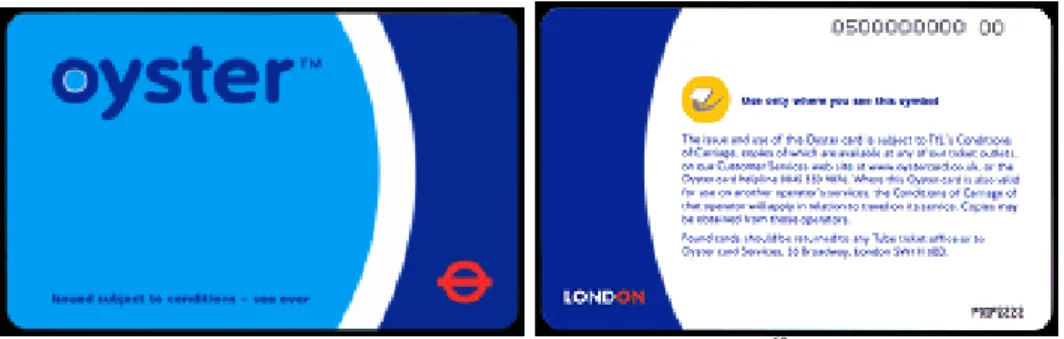
Figure 4-7: Oyster card, front and back60
Usage
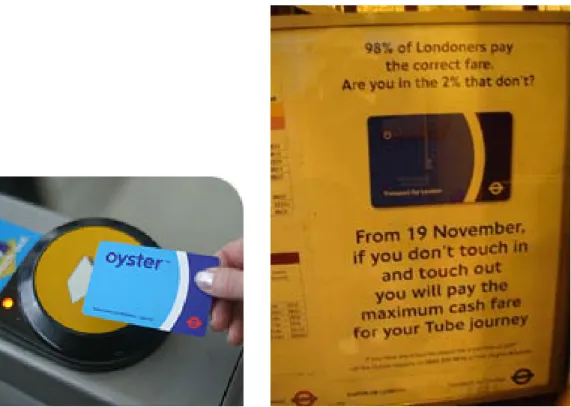
Oyster owners make the smart card touch a card reader at the start and end of a trip. The TfL promises a lowest fare policy on Oyster to encourage adoption, and a daily price capping for frequent travelers. Various discounts on Oyster are offered to people in the following categories: 16 years old and younger, 16 to 17, and students older than 18. Passengers can purchase or add value to the cards at numerous Underground and DLR stations, National Rail ticket offices, tram stops, online, or by phone. Adults and students cardholders can also sign up for an Auto top-up account online which money is automatically added when balance falls below 5 pound. Lost and stolen cards are reported online. After November 19th, 2006,
passengers will be penalized for forgetting to touch in and out at the right stations, by applying a maximum cash fare for the particular Tube or DLR trip.
56 Transport for London 57 Hong, Yi. Thesis 174 58 RFID News.
59 Transport for London 60 Transport for London
Figure 4-8: a) An Oyster card reader61 b) Poster warning
Evaluation
London commuters generally support the Oyster card because it offers really good discount compares to buying paper ticket (magnetic strips). A ticket for a single underground trip costs 3 pound, but the same trip only costs 1 to 1.8 pound on Oyster. Public transportation is not cheap in London. Therefore Oyster can reduce the financial burden for frequent travellers. Besides trip savings, Oyster card also eliminates problems with cash transaction, and waste associated with printing paper tickets.
Challenges to the system are both technical and societal. Many travelers complain about the robustness of Oyster card. The card is easily damaged from flexing and rubbing with loose changes. The replacement procedure can be a hassle although individual experience varies. Sometimes the card readers would error out and force the traveler to seek assistance from a London Underground staff in order to gain access through the gate. The helpfulness of the staff again varies in individual situations. Another major concern of Oyster system is privacy. TfL can track commuters’ movement every time their cards are read. The card’s unique ID number is linked to the owner’s name. Information such as the location and time at which the card made the contact are recorded. Civil right groups, such as Liberty, are concerned about the types of organizations that can access these data and potentially misuse the information.62
4.1.2.4Singapore
Background
Singapore, a city-state with a total area of 692.7 sq km, and a population of 4.5 million, is one of the world’s major trading links and Asia’s major transportation hub.63 Domestic transport modes include a network of expressways, a heavy rail Mass Rapid Transit (MRT) metro system, and a Light Rapid Transit (LRT) light rail system. Public transportation is heavily
61 Transport for London 62 Aaron Scullion.
used, adding to more than 2.8 million daily bus passengers and up to 1.3 million rail passengers.64
EZ-Link Basics
The EZ-Link card is a contactless smart card that uses RFID technology at 13.56 MHz, conforming to ISO/IEX 7816 card dimensions. The card can communicate with the reader within a 10 cm radius. Secure encryption is implemented to preserve information integrity. Customers can use these cards as forms of identification or request special themes and personalized designs for the cards.
Figure 4-9: EZ-Link Cards65
Usage
As of May 2006, the penetration rate for EZ-Link cards has been estimated as high as 90% for bus travel, and 96% for rail. Over 8 million cards have been issued, and there is an average of 4 million transit-related smart card transactions in Singapore each day.66 Singapore introduced the EZ-Link smart card in 2002 and by January 2003, phased out the use of all magnetic stripe cards. Transit riders without EZ-Link cards must therefore pay cash or purchase a one-time use Standard Ticket, which requires a deposit that is refunded upon return of the card. The EZ-Link system covers all buses and rail transit systems in the city.67 The EZ-Link fare system for transit is distance-based. Riders must tap their card upon entering and exiting a vehicle. The maximum distance fare is charged if the user fails to tap out.
Unlike some cities’ transportation smart cards, Singapore's EZ-Link cards serve multiple purposes. For all students, and many others in Singapore, the cards are a form of identification. All students are required to have ID cards, and given that most also need to use public transit these two purposes have been combined onto this one card.68 The EZ-Link cards can be personalized with your photo and other identification information, or simply with a photograph or image of your choice. The cards are now an accepted form of payment at several fast food restaurants, supermarkets, and select government services.
As of September 2006, users may use these cards with their home computers to make purchases online or add value to their cards if they purchase a home card reader. The anonymous EZ-Link cards are treated as cash payments online. Nicholas Lee, Senior Vice-President of Business and Technology at EZ Link Private Limited promises that even with
64 Singapore Land Transport: Statistics In Brief 2005. Land Transport Authority. 65 EZ-Link. “The Card:: Products:: ez-link card:: Card Types”
66 Hong, Yi. Thesis 34 67 Hong, Yi. Thesis 34 68 Hong, Yi. Thesis 34
the personalized cards, no identification data contained on the cards will be passed along to online merchants during these transactions.69
Some people question the need for a children's concession card to be an identity card as well. Smart cards are more expensive for parents to replace when lost by their children than traditional student ID cards. Also, several parents criticized the expansion of the EZ-Link service to include fast food restaurants and vending machines. They are concerned that they have limited ability to ration how their children use the money stored on their cards, and yet they must provide the cards to their children in order for transportation to and from school each day.70
Evaluation
Transition to use of the EZ-link system was not without problems. It took 6 months of fine-tuning the EZ-Link software after its introduction onto buses before the software error rate dropped below the 1% target.71 Three years later, in 2005, software glitches resulted in overcharging customers on 0.053% of rides.72 In 2006, the EZ-Link ticketing system was given an average score of 7.4 out of 10, indicating overall satisfaction with the service, on a survey conducted by the Public Transport Council.73 Another either unadvertised or unexpected result of the EZ-Link system occurred with single-trip rail tickets. The required deposit fee for single-trip rail tickets resulted in increased lines and slower travel time per person. The problem was that it forced single-use riders to wait in a line to obtain the card, and then again to return the card upon disembarking.74 This problem has a great impact on infrequent users including tourists.
Comparing smart cards with magnetic strip cards, "[it] was found that while the use of magnetic strip cards has an average throughput of 40 passengers per minute at fare gates and 35 passengers per minute at bus entry, the average throughput for smart cards was 50 passengers per minute at both fare gates and bus entry."75 In Singapore, the EZ-Link cards cost S$5.20 (≈ US$3.30) a piece to produce compared to S$0.40 (≈ US$0.25) a piece for the old magnetic stripe cards.76
TransitLink estimates that bus fare evasion occurs in 1.8% of bus trips, or an average of 42,000 cases per day. With an average amount of S$0.60 evaded, this amounts to S$9 million of daily lost revenue. Seventy percent of this fare evasion is the result of underpayment. Most often this means that passengers “tap-out” of a bus at a stop earlier than the one at which they actually leave the bus, or less than a full fare of cash is inserted into the register. Twenty-four percent of fare evasion cases are the result of non-payment when passengers intentionally choose not to tap their smart cards upon entering the bus. The final 6% of fare evasion comes from people using someone else’s reduced fare card.77
69 Nicholas Lee, Senior Vice-President of Business and Technology 70 Wikipedia “EZ-Link”
71 Lian, Gon Chin. “Fewer ez-link errors on buses; Less than 1 per cent of transactions last month went wrong,
which is within the target set”
72 Lian, Gon Chin. “Bugs still plague ez-link on buses; TransitLink says system errors accounted for about a
quarter of all refunds last month”
73 The Straits Times (Singapore). “Bus service better but there's room to improve: poll; Long waiting times and
journeys, overcrowding top list of complaints” November 2, 2006
74 Lian, Gon Chin.
75 Sim, Seow and Prakasam, 2003 in Hong thesis, 24 76 Segaran and Sim, 2004 in Hong thesis, 25. and EZ-Link.
4.1.2.5Tokyo
Background
The capital city of Tokyo, with a land area of 2,187 sq km and a population of near 12.7 million, is Japan’s largest transportation hub. The major domestic forms of transportation include trains, subways, buses, monorails, and trams. Rail is the primary mode of transport, and is operated by JR East. Tokyo Metro and Tokyo Metropolitan Bureau of Transportation are responsible for the subways. Other government agencies and private companies operate the bus network.
Suica Basics
JR East launched the Suica IC card ticketing system in November 2001. Suica, which stands for “Super Urban Intelligent Card,” is a rechargeable contactless smart card. The Suica card uses contactless RFID technology called “FeliCa”, developed by Sony. The same technology is also used in the Octopus card in Hong Kong, and the EZ-Link card in Singapore.
Figure 4-10: The Suica Card78
There are two types of Suica cards. One type is a standard prepaid Suica card. Another type is a Suica commuter pass, which can be used unlimitedly between any two designated stations during a certain period, such as one month, three months, or six months. The Suica commuter pass is used at other stations in the same way the prepaid Suica is used.79
Since January 2006, the Suica card has been incorporated into mobile phone technology. Mobile phones can be used as prepaid Suica or Suica commuter pass cards. Passengers can charge their Suica to the mobile or purchase the commuter pass through the network of the user’s mobile phone, without having to go to the stations.
Figure 4-11: Suica Mobile Phone Reader80
78 JR East Company 79 JR East Company 80 JR East Company
Usage
As of May 2006, 16.6 million Suica cards had been issued. The Suica is currently usable not only in the Tokyo area (528 stations), but also in the regions of Niigata and Sendai (36 and 66 stations respectively). The Suica card is also usable in the ICOCA network, another rechargeable contactless smart card system in the Osaka region in Japan. By March 2007, other transportation companies in the Tokyo area will be able to share the use of the Suica. This will enable Suica holders to use their card at almost any railway station in Tokyo.81 The Suica can also be used outside of the railway sector, such as in grocery stores, restaurants, bookstores, and other businesses in the city. Approximately 1,000 stores accept the payment of Suica nowadays. In addition, the mileage of Japan Airlines (JAL) can be transferred to the Suica’s electric money. Overall, Suica had been used for 100,000 electronic money transactions a day as of May 2005. JR East aims to drive daily transactions up to 2 million in the near-term and to 4 million by fiscal 2009.82
Evaluation
The mobile Suica, which was introduced in January 2006, has generated synergy effects. The user of mobile Suica reached 20,000 people in two weeks after introduction, and 60,000 people in one month. The mobile Suica increases both the use of Suica and the number of cell phone users, and brings benefits to both JR East and cell phone companies. However, there are still concerns about mobile Suica. For example, only credit card holders can use the mobile Suica.83
4.1.2.6Washington DC
Background
Washington DC is the capital of the US, with a city area of 177 sq km, and a population of 582,049 people. Washington DC is considered to have the 2nd largest rail system and 5th largest bus network in the US.84 The Washington Metropolitan Area Transit Authority (WMATA) operates both the Metrobus and the Metrorail.
SmarTrip Basics
The SmarTrip Card is a plastic contactless stored-value smart card used for payment within the WMATA of Washington DC. It can be reloaded and used permanently. The SmarTrip Card was first introduced in the Metrorail system in 1999 and was implemented in the Metrobus system in 2004. Since June 2004, the Metro parking system can also be paid for with the SmarTrip Card. The SmarTrip Card can also be used in the transit systems of Maryland and Virginia. 85
By the fiscal year of 2005, 700,000 SmarTrip Cards had been sold. The percentage of Metrorail rides made using the SmarTrip Card was 35% between 1999 and 2005, and by early 2006 the number had increased to more than 60%.86
81 JR East Company
82 JR East Annual Report 2005 83 IT media, February 2006 84 Hong 2006: 151
85 Hong 2006: 31 86 Hong 2006: 32
Figure 4-12: SmarTrip Card87
Usage
A microchip in the SmarTrip Card stores its value, most recent entry and exit points, and a unique identifier. However, the unique identifier is not linked to a person's name or identity, unless one registers the card online. If riders register SmarTrip cards, they can recover the card balance value (minus the $5 cost for a new card) when the card is lost, stolen, or damaged. The unique identifier also allows workers to enrol in the Smart Benefits program to receive their monthly benefit automatically to their SmarTrip card.88
Riders with insufficient value to pay their fare are allowed to exit the system with a negative balance. This negative balance must, however, be paid before the card may be used again to enter the system.
In addition, WMATA and Citi have teamed up to consolidate a Citi Platinum Select SmarTrip MasterCard, a Metro SmarTrip Card and a Citi credit card into one plastic card.89 Evaluation
In 2004, WMATA decided to introduce a smart card-only payment system at all WMATA parking lots. As a result, station dispensers sold as many cards in a single year as were sold in the previous five years. However, tourists also have no option to pay by cash. During the summer season, for example, up to 50% of the cards obtained from the dispensers are used by one-time users.90
4.2 Improvement/Benefits 4.2.1 Efficiency
Smart cards provide many efficiency improvements to both customers and transportation providers.
The most obvious benefit is that smart card fare collection systems are an easier payment method and allow faster boarding. Passengers no longer have to prepare cash or a token, or wait in line to get tickets. Therefore, the boarding process can become smoother and faster. There is also a major cost saving opportunity for transportation providers since they can decrease cash transactions, which are more labor intensive and prone to errors.
87 Washington Metropolitan Area Transit Authority 88 Wikipedia, “SmarTrip”
89 Washington Metropolitan Area Transit Authority
These efficiency benefits can be enhanced with contactless smart cards. Passengers can go through automatic ticket gate without having to remove the card from their wallets or purses. This will further decrease congestion at checkpoints, and the convenience resulted may induce a higher adoption rate.
According to a survey of Chicago Transit Authority in 2005, almost half of the 232 respondents who own a Chicago Card cited convenience as the main reason for using it.91 In
2002, one year after the introduction of Suica, JR East carried out the questionnaire survey. Of the respondents who use Suica, approximately 45% said that JR East's service had become easier to use, 10% replied that they use JR East more often than before, and 5% stated that when they had a choice of lines to the same destination they had started using JR East. That is to say, the result of this survey confirmed that Suica is creating new demands.92
Secondly, some smart cards can be used for non-transportation purposes. Suica in Tokyo, Octopus in Hong Kong, and EZ-Link smart card in Singapore can be used as electric money for the payment at convenience stores, restaurant, etc. EZ-Link smart card in Singapore is also used as identification for students and other people. They do not have to carry multiple cards or cash. These non-transportation functions help to increase the usage of smart cards. Furthermore, in contrast to conventional magnetic card or paper ticket, smart cards can be reissued with their value reinstated when lost, stolen or damaged if individual identification information is connected to the card.
4.2.2 Financial Benefits for Transportation Providers
Smart cards provide financial benefits for transportation providers. First, smart cards can reduce various operational costs. According to the statement of JR East president, the maintenance cost for contactless smart card systems is lower than that for magnetic card systems because the automatic fare collecting gates for contactless smart card systems have fewer mechanical parts. Also, if Suicacards became more common, it could be possible to reduce the number of ticket vending machines, ticket offices, other facilities and station staff.93 This allows the freed space and staff to be used for other purposes.
Second, smart card systems can reduce fare evasion because fares are automatically calculated and collected. When bus operators do not have to collect cash and distribute paper tickets, they can instead concentrate on preventing fare evasion.94
Finally, smart card systems enable transportation providers to set flexible fare policies. Flexible fares enhance competitiveness between transportation options. As a result, they can attract more passengers and increase the mass transportation agency’s revenue.95
91 Hong, Yi. Thesis 23 92 JR East Annual Report 2004 93 JR East Annual Report 2002 94 Hong, Yi. Thesis 24 95 Hong, Yi. Thesis 25
4.2.3 Marketing Benefits for Transportation Providers
With smart cards, passenger behavior can easily be tracked and recorded into a database. This information about passenger behavior, such as common origins and destinations, frequency of travel, length of standard trip, etc, is very valuable for transportation providers. Providers can use this information to enhance their business plans96 by better evaluating the traffic demand and assessing future investment.
4.3 Concerns
Along with the convenience of urban transit smart cards come several concerns. From a technical standpoint, there are several different technologies available, each with their own strengths and weaknesses, which are not necessarily compatible with each other. From a policy perspective, some of the key concerns are privacy of data, and equity in both access to and use of these cards. The following subsections will outline the primary concerns about smart card implementation in urban transit.
4.3.1 Standardization / Technical Considerations
The term smart card encompasses several different data storage and transmission technologies. Therefore, the type of smart card technology chosen for use in any particular city affects the ultimate range of locations where the card can be used. For example, neighboring cities may choose to use the same technology such that riders can use the same card in both locations. Similarly, within a city, the technology platform chosen determines whether or not different smart card applications including building access, library borrowing, and transit, can all be combined onto one card. Japan’s Suica card, Hong Kong’s Octopus Card, and Singapore’s EZ-Link card all use the same RFID technology. The other cities examined in Section 4.1 use other platforms.
An example of similar smart card standardization in the United States is found in electronic toll systems. E-ZPass transponders are sold separately by each of the following states, but may be used while traveling in any of these participating states: Maine, New Hampshire, New York, New Jersey, Pennsylvania, Delaware, Maryland, Virginia, West Virginia and Illinois.97 Instead of the E-ZPass, Massachusetts offers the FAST LANE, a distinct system which is fully compatible with the E-ZPass system.98 E-ZPass holders may use their transponders to pay Massachusetts FAST LANE tolls and likewise FAST LANE transponders will pay E-ZPass tolls. A similar interoperability between urban transit cards might encourage more cities to adopt the technology. With technology standards that allow interoperability, a city is able to transport more riders without having to pay the administrative costs of creating new cards and accounts for each visitor.
At this time, several different standards are used in urban transit smart cards. Standardization efforts are ongoing at international and national levels. Wary of selecting a technology different from what becomes the future standard, some cities are hesitant to adopt any smart
96 Hong, Yi. Thesis 25
97 E-ZPass. “Summary of Facilities Accepting E-ZPass.” 98 Massachusetts Turnpike Authority. “FAST LANE Program”
card technology at this time. In Chapter 5, the future development of standards is discussed in more detail.
4.3.2 Security and Privacy
As smart cards are used in more locations, and have increasing amounts of personal data stored on them, this personal data is spread to more people and organizations. In cities where customers must both swipe or tap in and out of the transit systems, the card-administering agency can now track between where and when individuals are traveling. As previously mentioned, this information can be used to improve transit routes and schedules; however, if any personal identification is contained within the card, this transit data can also be used to track the whereabouts of individuals. If a card is lost or stolen, users have to worry about how much personal data could be stolen by reading the data on their card. Does the card contain customers’ full names and addresses, phone numbers, email addresses, or bank account information? The card-administrating agency’s choice of where to store data, either in a centralized database, or on individual cards, as well as how to use it in conjunction with usage data, are important with regard to privacy.
Most cities using smart cards offer multiple types of cards, some with more privacy than others. For example Chicago offers two card options, the Chicago Card and the Chicago Card Plus. No bank account or email address is required to obtain Chicago Card; however for those people willing to provide this information, they may obtain a Chicago Card Plus and obtain additional conveniences including the ability to manage their card online. An additional interesting contrast between these two cards is where the data is stored. Transaction and balance data for the Chicago Card is stored directly on the card, whereas to enable online account management of the Chicago Card Plus, this data is stored on a centralized server.99 London and Washington DC issue just one card but both provide the option for users to register their card online in order to obtain online access, and the ability to recover the card balance in case the card is stolen.
Singapore requires photo IDs for all students. Given the prevalence of EZ-Link use in the country, student identification is printed on their EZ-Link smart cards, thus eliminating the need for two cards issued to each student. Many adults in Singapore have EZ-Link cards which double as photo identification as well. However, this is not required. The issuance of smart cards to all Singapore school children has raised concerns among parents. Some parents are unhappy that their children can use these cards to buy fast food and other goods as well as transportation. Schools in Hong Kong similarly use Octopus cards as students’ identification for library loans and payment for food and tuition.100 Additionally, a smart card costs more for a parent to replace than a standard ID each time a child looses one.
Similar privacy concerns affect the use of retail store loyalty cards. However, despite infringements on personal privacy, a 2004 survey by Boston University’s College of Communication found that most cardholders agree that the benefits of using the card outweigh the privacy concerns.101
4.3.3 Equity
99 Hong 169
100 “Hong Kong Octopus Card.”
While smart cards provide additional conveniences for the majority of urban transit riders, they are not necessarily accessible to all transit riders. Low-income riders, tourists, and children are examples of groups that may not benefit from smart card implementation. For these groups, and others who simply do not wish to use smart cards, all cities using smart cards currently offer an alternative form of payment. Cash payments are still an option in all cities. Magnetic strip cards are available in most smart card locations including Chicago, Washington DC, Tokyo, and London. However, these cards are being phased out as smart cards become more common. In Hong Kong, the use of magnetic cards is now limited to specific trains. Singapore, however, has phased out the use of all magnetic cards and now requires the payment in cash if not using a smart card.
Many lower income transit riders do not have bank accounts and therefore the requirement that a smart card holder must tie their card to a bank account prevents this group of people from participating in the program. In cities where fares are discounted for smart card users, a bank account requirement makes this policy particularly inequitable. In most cities using smart cards, it is possible to obtain and reload a smart card without a bank account.
In Singapore, children below 0.9m in height are currently allowed to ride for free. Once they reach that height they are required to obtain a child EZ-Link pass. Some parents do not believe that basing a child’s status on height is fair. They state that families with taller children should not have to pay more for transportation than shorter families. Transit administrators cite the additional work it would take to check children’s birth certificates instead of height as a reason for the current policy. A young child (under 8 years) EZ-Link card, where no fares would be charged, has been proposed as a more equitable solution. 102
4.3.4 System Failures
Another concern for users and administrators of smart card systems is how to deal with system failure. What happens when the smart card system stops working? In Singapore, riders were frustrated to find they were asked to pay cash fares in such a situation. They found this to be an unfair solution given that cash payments are more expensive than EZ-Link payments in Singapore. Consumers felt unfairly penalized for a lack of service.103
Software glitches have also resulted in many cases of over-charging customers for their travel in Singapore. When this occurs, it requires both additional software development to fix the problems, and additional administration to refund affected customers.
4.4 Trade-offs
The increased efficiency in public transit resulting from the introduction of smart cards is considered to be one of the most, if not the most, important benefit of the implementation of an automated fare collection system. Securing higher efficiency, however, jeopardizes certain equity, security, and privacy characteristics of transit systems operating traditional fare collection systems.
102 Huang, Ms. Catherine Ngiam Sok The Straits Times (Singapore). 103 Ling, Law Sin. The Straits Times (Singapore).
The benefits of smart cards mentioned in previous sections can be divided into those affecting the individual user and those affecting the transit agency. For the user, smart cards are convenient because they can have multiple uses, they can be managed online, and, if contactless, they allow for faster boarding and thus have a potential to reduce travel time. In addition, users may be able to store personal information on their cards. The benefits of smart cards for transit agencies include the ability to store and record user’s personal information, track user’s mobility patterns, and phase out traditional payment systems such as those based on cash transactions. The following sections portray the tradeoffs each of these benefits entails, while Figure 4-13 illustrates the principal idea of trade-offs, where a card like the Chicago Card Plus, with multiple functionalities and features to store personal data and be used contactlessly is much more efficient than the standard Chicago Card. Nonetheless, the latter is a better safeguard of equity, security, and privacy concerns. At the other end of the spectrum one finds cash, which while being the least efficient payment method for transit purposes, does not invade commuter’s privacy, nor inflict equity or security issues among society.
Figure 4-13: Trade-off between Efficiency vs. Equity/Security/Privacy
As mentioned earlier, one of the major marketing appeals for smart cards is the convenience they provide transit users. Depending on the design of the smart card system in a particular city, users may enjoy benefits such as a discounted fare, an automatic loyalty program, faster pass-through time at checkpoints, and an online payment program. These benefits, however, are not equally shared among the various stakeholders utilizing the transit system. While a smart card program can bring efficiency benefits to most users of the public transit system, there are some groups that would be disadvantaged, including infrequent travelers, tourists, and lower-income populations.
4.4.1 Efficiency – Equity Trade-off
Efficiency vs Equity
•
Multiple Use
•
Online Account
Management
•
Contactless, Fast
Boarding
•
Personal Info on Card
•
Usage Tracking
•
Smart card only payment
Requires Credit Card or
Bank Account
Price discrimination
Figure 4-14: Efficiency vs. Equity Trade-off
4.4.1.1 Frequent vs. Infrequent Riders
Since there is often a higher cost associated with joining the smart card program, infrequent travelers may find it is not cost efficient to participate in the program. Therefore, they pay higher cash fares when using public transportation and/or enduring longer wait times to purchase a single-ride pass at the booth. Even when they do use smart cards, they can not enjoy the full benefit of the program because the benefits are designed for frequent usage. Tourists also face similar issues. Tourists have to pay a deposit for only short-term use of a smart card. Moreover, many tourists are often confused about navigating the public transportation in new cities while struggling with language and cultural barriers. Joining a smart card program can be more complicated than simply using cash to purchase single-ride passes. On the other hand, one can argue that frequent users and local residents do bare more financial burden in maintaining and developing the transit system and should logically enjoy more of its benefits.
4.4.1.2 Disadvantaged Groups
There is also an equity issue related to disadvantaged groups. First, low-income social groups and immigrant workers, among others, may not have the required credit card or bank account necessary for joining the smart card program. Second, the elderly population, which is not necessarily technically savvy, may have difficulty performing online transactions (for example, adding value to card or checking balance, among others). These groups do not enjoy the maximum benefits and conveniences that an urban transit smart card offers. Since public transit is a public service, the system should be designed so that all users can enjoy equal benefits.
4.4.2 Efficiency – Security Trade-off
Efficiency vs Security
•
Multiple Use
•
Online Account
Management
•
Contactless, Fast
Boarding
•
Personal Info on Card
•
Usage Tracking
•
Smart card only payment
Transit Only Card
Magnetic Strip or Cash
Alternative Payments
Figure 4-15: Efficiency vs. Security Trade-off
The same features that enable smart cards to have such a positive efficiency effect in the transit system and allow it to incorporate new functionalities to become integrated in different service systems, also introduce users to certain risks they might not be comfortable assuming. Furthermore, the smart card sponsoring agency might not know how to control and respond to these new risks.
4.4.2.1 Multiple Uses
The ability of smart cards to have multiple functionalities and thus be used as debit cards, ID cards, access cards, etcetera, makes them both more convenient and insecure. While such multi-functionality allows users to carry one card only, the potential consequences of losing the smart card are more severe. A solution to this could be to secure user’s private data in a central database and be able to access such information solely by use of the smart card, rather than storing all data on the card itself.
4.4.2.2 Contactless Feature
Smart cards’ ability to communicate contactlessly with the card readers at stations or buses jeopardizes the security of user’s information. This contactless feature of smart cards enables smooth payments, and has the potential to reduce boarding times, particularly in buses. The security concern regarding this feature lies in the fact that not all RFID transmissions use proper encryption, thus making contactless smart cards less secure than those designed for communicating through direct contact only. Depending on how far the smart card signal travels, sniffing on this transmission is easily done by standing close to someone with the right electronics. Some people argue that spying and eavesdropping on smart card transmission is unlikely to happen, disregarding this as a major security concern. If, however, smart cards store unencrypted personal identification and transaction details, this information is subject to illegal retrieval and identity theft.
4.4.2.3 Smart card only payment system
The introduction of smart cards as the sole form of transit payment, while economically viable and reasonable in that it reduces the transit agency’s operational costs, could be risky if
no backup payment system is established to respond to the potential failure of the automated fare collection system. If the card has multiple functionalities, the increased dependence of citizens on one small plastic card also augments their vulnerability to system failures and manipulations, such as is the case with identity theft.
4.4.3 Efficiency – Privacy Trade-off
Efficiency vs Privacy
•
Multiple Use
•
Online Account
Management
•
Contactless, Fast Boarding
•
Personal Info on Card
•
Usage Tracking
•
Smart card only payment
Information is
compromised if card is
stolen
Violate Privacy
Limited Choice
Figure 4-16: Efficiency vs. Privacy Trade-off
Many of the efficiency benefits of using smart cards in urban transportation come at the cost of the personal liberty or privacy of transit riders. The main privacy concerns with smart cards are tracking riders’ usage of the cards, and the storage of information on each card. Each of these concerns is explained in more detail below. Many current smart card users are also unaware of the libertie