Knowledge Extraction and
Representation Learning for
Music Recommendation
and Classification
Sergio Oramas Martín
TESI DOCTORAL UPF / 2017
Director de la tesi: Dr. Xavier Serra Casals
Dept. of Information and Communication Technologies Universitat Pompeu Fabra, Barcelona, Spain
Dissertation submitted to the Department of Information and Communication Technologies of Universitat Pompeu Fabra in partial fulfillment of the require-ments for the degree of
DOCTOR PER LA UNIVERSITAT POMPEU FABRA
Copyright © 2017 by Sergio Oramas Martín Licensed under Creative Commons Attribution-NonCommercial-NoDerivatives 4.0
Music Technology Group (http://mtg.upf.edu), Department of Information and Commu-nication Technologies (http://www.upf.edu/dtic), Universitat Pompeu Fabra (http://www. upf.edu), Barcelona, Spain.
iii The doctoral defense was held on ... at the Universitat Pompeu Fabra and scored as ...
Dr. Xavier Serra Casals
(Thesis Supervisor)
Universitat Pompeu Fabra (UPF), Barcelona, Spain
Dr. Markus Schedl
(Thesis Committee Member) Johannes Kepler University, Linz, Austria
Dr. Emilia Gómez
(Thesis Committee Member)
Universitat Pompeu Fabra (UPF), Barcelona, Spain
Dr. Brian Whitman
(Thesis Committee Member) Spotify, New York, USA
Acknowledgements
First of all, I would like to thank my supervisor, Dr. Xavier Serra, for giving me the opportunity to work in this fantastic environment, the Music Technology Group, and for his wise advises. Also, I want to give special thanks to Paco Gomez for teaching me how to be a researcher. This thesis does not have a specific co-supervisor, but along this journey I have met three great researchers and better persons who have helped me through my PhD and without whom this work would have not been possible, Mohamed Sordo, Vito Claudio Ostuni, and Oriol Nieto. Special thanks also to Frederic Font for all these years sharing office, research, music, and friendship. A very important element of this thesis has been my collaboration with the TALN group. Everything started sharing pizza and water and now we have a lot of papers together and thousands of ideas. It was great collaborating and partying with Luis Espinosa-Anke and Francesco Barbieri. Also special thanks to Horacio Saggion for his wise advises, and Tommaso Di Noia, Aonghus Lawlor, and Michael O’Mahony for hosting me during my research stays at Politecnico de Bari and University College of Dublin. A special mention to Ichiro Fujinaga and Susan Weiss, who strongly believed in my research line. Also to my COFLA mates Emilia Gómez, Joaquin Mora, and José Miguel Díaz-Báñez, thanks for considering me a researcher from the first day. To my Pandora managers Andreas Ehmann, Oscar Celma, and Fabien Gouyon, who trusted me and gave me the opportunity to apply my research in the real world.
I also want to thank other amazing MTG people who shared with me know-ledge and laughs throughout these years. In no specific order, thanks to the SIC-refugio team Sebastian Mealla, Álvaro Sarasúa, Panos Papiotis. To Ra-fael Caro, my musicologist mate. To Oriol Romaní and Juanjo Bosh for so much fun. To Alastair Porter and Dmitry Bogdanov for their experience and friendship. To Andrés Ferraro who shared my vision. To Gopala Koduri and our conversations about semantics. To Jordi Pons for initiating me in the deep learning cult. To my new roommates Eduardo Fonseca, Xavier Favory, and former ones Gerard, Dara, Hector, Giuseppe, and Albin. To more great people I met in the MTG, Cárthach, Ángel, Dani, Marius, Alfonso, Sergio, Zacharias, Olga, Perfe, Sergi, Rong, and Georgi. To former members, Sankalp, Sertan, Sercan, Ajay, Swapnil, Joan, Justin, Jordi, Julian, Julio, Carles, Nadine, and Martí. To Joan and Miguel (TALN), Humberto, and Manuel. To my Pan-dora mates Massimo, Theo, Chun, and Andreu. To the Supertropical doctoral consortium. To all my friends. Sorry if I forgot to mention anyone.
Also thanks to Aurelio, Lydia, Sonia, Cristina, Magda, Jana, and Alba for vii
viii
helping me with the administrative work. Special thanks to Obra Social "La Caixa" and their fellowship program, to believe in me and support this re-search.
Last but not least, this work would never have been possible without the support of my wife Chiara, who followed me to Barcelona and helps me to pursue my dreams. Also very special thanks to my lovely Olivia, I started my PhD and my paternity at the same time, and I am pretty sure these have been the happiest years of my life, until now... To my little one on the way :) Finally, many thanks to my parents, brothers, and sisters, who helped me so much along my whole life, I am here thanks to them.
This thesis has been carried out at the Music Technology Group of Universitat Pompeu Fabra (UPF) in Barcelona, Spain, from October 2013 to September 2017, including a stay at Politecnico di Bari, Italy, from September 2014 to October 2014, at the Insight Centre for Data Analytics of University College of Dublin (UCD), Ireland, from May 2015 to July 2015, and at Pandora Media Inc., USA, from June 2016 to September 2016. It has been supervised by Dr. Xavier Serra. The work described in Chapter 4 is a joint effort by the author of this dissertation, and Luis Espinosa-Anke, both researchers in the Department of Information and Comunication Technologies of the Universitat Pompeu Fabra, Barcelona. Parts of the work described in Chapter 7 have been conducted in collaboration with Vito Claudio Ostuni, during the research stay at Politecnico di Bari. Work in some parts of this thesis has also been carried out in collaboration with other researchers, including Mohamed Sordo, Oriol Nieto, Francesco Barbieri, Horacio Saggion, Tommaso Di Noia, Francisco Gómez, and Aonghus Lawlor. The work in this thesis has been mainly supported by Obra Social "La Caixa" under their doctoral fellowship program, and by the Spanish Ministry of Economy and Competitiveness under the Maria de Maeztu Units of Excellence Programme (MDM-2015-0502). The research stay at UCD has been also funded by the Keystone COST Action IC1302 under grant number SFI/12/RC/2289. Parts of the work presented in this thesis were partly supported by the European Research Council under the European Union’s Seventh Framework Program, as part of the CompMusic project (ERC grant agreement 267583), and by the COFLA2 research project (Proyectos de Excelencia de la Junta de Andalucia, FEDER P12-TIC-1362).
Abstract
Music content creation, publication and dissemination has changed dramatic-ally in the last few decades. Huge amounts of information about music are being published daily in online repositories such as web pages, forums, wikis, and social media. However, most of this content is still unusable by machines due to the fact that it is mostly created by humans and for humans. Fur-thermore, online music services currently offer ever-growing collections with tens of millions of music tracks. This vast availability has posed two serious challenges. First, how can a musical item be properly annotated and classified within a large collection? Second, how can a user explore or discover preferred music from all of the available content? In this thesis, we address these two questions by focusing on the semantic enrichment of descriptions associated to musical items (e.g., artists biographies, album reviews, metadata), and the exploitation of the heterogeneous data in large music collections (e.g., text, au-dio, images). To this end, we first focus on the problem of linking music-related texts with online knowledge repositories via entity linking, and on the auto-mated construction of music knowledge bases via relation extraction. Then, we investigate how extracted knowledge may impact recommender systems, classification approaches, and musicological studies. We show how model-ing semantic information helps to outperform purely text-based approaches in artist similarity and music genre classification, and achieves significant im-provements with respect to state-of-the-art collaborative algorithms in music recommendation, while promoting long-tail recommendations. Next, we fo-cus on learning new data representations from multimodal content using deep learning architectures. Following this approach, we address the problem of cold-start music recommendation by combining audio and text. We show how the semantic enrichment of texts and the combination of learned data repres-entations improve the quality of recommendations. Moreover, we tackle the problem of multi-label music genre classification from audio, text, and images. Experiments show that learning and combining data representations yields su-perior results. As an outcome of this thesis, we have collected and released six different datasets and two knowledge bases. Our findings can be directly applied to design new algorithms for tasks such as music recommendation, and more specifically the recommendation of music from novel and unknown artists, which can potentially have an impact in the music industry. Although our research is motivated by particularities of the music domain, we believe that the proposed approaches can be easily generalized to other domains.
Resumen
La creación, publicación y diseminación de contenido musical ha cambiado radicalmente en las últimas décadas. Por un lado, grandes cantidades de in-formación son publicadas diariamente en páginas web, fórums, wikis y redes sociales. Sin embargo, la mayor parte de estos contenidos son aún incompren-sibles computacionalmente, ya que son creados por y para humanos. Por otro lado, los servicios de música online ofrecen inagotables catálogos con millones de canciones. Esta disponibilidad presenta dos desafíos. Primero, ¿cómo clasi-ficar adecuadamente un ítem musical en una gran colección? Segundo, ¿cómo puede un usuario explorar o descubrir música de su agrado entre todo el con-tenido disponible? En esta tesis, abordamos estas cuestiones centrándonos en el enriquecimiento semántico de descripciones de ítems musicales (biografías de artistas, reseñas musicales, metadatos, etc.), y en el aprovechamiento de datos heterogéneos presentes en grandes colecciones de música (textos, audios e imágenes). Para ello, primero nos centramos en el problema de enlazar textos musicales con bases de conocimiento online y en la construcción automatizada de bases de conocimiento musical. Luego investigamos cómo el conocimiento extraído puede impactar en sistemas de recomendación y clasificación, además de en estudios musicológicos. Mostramos cómo el modelado de información se-mántica contribuye a mejorar los resultados con respecto a métodos basados solo en texto, tanto en similitud de artistas como en clasificación de géneros musicales, y a conseguir mejoras significativas en recomendación de música con respecto a algoritmos de referencia, mientras a su vez se promueven recomenda-ciones de ítems menos populares. A continuación, investigamos el aprendizaje de nuevas representaciones de datos a partir de contenidos multimodales utili-zando redes neuronales, y lo aplicamos a los problemas de recomendar música nueva y clasificar géneros musicales con múltiples etiquetas, mostrando que el enriquecimiento semántico y la combinación de representaciones aprendidas produce mejores resultados. Uno de los frutos de esta tesis es la publicación de seis datasets y dos bases de conocimiento. Además, nuestros descubrimientos pueden ser directamente aplicados al diseño de nuevos algoritmos de recomen-dación de música, y más concretamente, de artistas nuevos y desconocidos, lo cual tiene potencial impacto en la industria musical. Aunque nuestra investiga-ción está motivada por las particularidades del dominio de la música, creemos que las metodologías propuestas pueden ser fácilmente generalizables a otros dominios.
Resum
La creació, publicació i disseminació de contingut musical ha canviat radical-ment en les últimes decades. Per una banda, una gran quantitat d’informació es publica diàriament a pàgines web, fòrums, wikis i xarxes socials. Tot i ai-xò, la majoria d’aquest contingut és encara incomprensible computacionalment degut a que es crea per i per als humans. Per una altra banda, els serveis de música online ofereixen inagotables catàlegs de milions de cançons. Aquest àmplia disponibilitat ofereix dos reptes; com es pot anotar i classificar adequa-dament un ítem musical en una col·lecció molt gran? I en segon lloc; com pot un usuari descobrir música del seu gust entre tot el contingut disponible? En esta tesi abordem aquestes qüestions centrant-nos en l’enriquiment semàntic de descripcions d’ítems musicals (biografies d’artistes, ressenyes musical, me-tadades, etc.) i en la exploració de dades heterogènies en grans col·leccions de música (textos, àudio i imatges). Ens centrem en primer lloc en el proble-ma d’enllaçar textos musicals amb bases de coneixement i en la construcció automatitzada d’aquestes bases de coneixement. Tot seguit investiguem quin impacte pot tenir el coneixement extret anteriorment en sistemes de recoma-nació y classificació, a més de en estudis musicològics. Mostrem a continuació com el modelat de la informació semàntica contribueix a millorar els resultats obtinguts amb métodes basats només en text, tant pel que fa a la similitud d’artistes com a la classificació de gèneres musicals. Aquest modelat també aconsegueix millores significatives en recomanació de música, en comparació a algorismes de referència, alhora que es promouen recomanacions d’ítems menys populars. A continuació investiguem l’aprenentatge de noves representacions de les dades a partir de diverses modalitats de contingut fent servir xarxes neu-ronals. Així encarem el problema de recomanar nova música combinant text i àudio. Mostrem com l’enriquiment semàntic dels textos i la combinació de representacions apreses millora la qualitat de les recomanacions. A més, abor-dem el problema de classificació de gèneres musicals amb múltiples etiquetes utilitzant text, àudio i imatges. Els experiments mostren que l’aprenentatge i la combinació de representacions de dades produeixen millors resultats. Un dels fruits d’aquesta tesi es la publicació de sis datasets i dues bases de co-neixement. A més, els nostres descobriments es poden aplicar directament al disseny de nous algorismes de recomanació de música i, més concretament, a la recomanació d’artistes nous o desconeguts, de tal manera que té potencial per generar impacte a la indústria. Encara que la motivació d’aquesta investigació són les particularitats del domini de la música, creiem que les metodologies proposades poden ser fàcilment generalitzables a altres dominis.
Contents
Abstract ix
Contents xv
List of figures xxi
List of tables xxiii
1 Introduction 1
1.1. Motivation . . . 1
1.2. Methodologies . . . 2
1.2.1. Why knowledge extraction? . . . 3
1.2.2. Why representation learning? . . . 4
1.3. Challenges . . . 5
1.3.1. Music classification . . . 5
1.3.2. Music recommendation . . . 6
1.4. Objectives and outline of the thesis . . . 7
2 Background 11 2.1. Introduction . . . 11
2.2. Natural Language Processing . . . 11
2.2.1. Knowledge base construction . . . 12
2.2.2. Music knowledge bases . . . 13
2.2.3. Entity linking . . . 14
2.2.4. Relation extraction . . . 15
2.3. Recommender Systems . . . 16
2.3.1. Knowledge-based approaches . . . 17
2.3.2. Deep learning approaches . . . 18
2.4. Music Information Retrieval . . . 18
2.4.1. Text-based approaches . . . 18 2.4.2. Knowledge-based approaches . . . 19 2.4.3. Music classification . . . 20 2.4.4. Artist similarity . . . 21 2.4.5. Music recommendation . . . 22 xv
xvi CONTENTS
I Knowledge Extraction from Text 23
3 Linking Music-related Texts to Knowledge Bases 25
3.1. Introduction . . . 25
3.2. Music entity linking . . . 26
3.3. ELVIS . . . 27
3.3.1. Argumentum ad populum in entity linking . . . 27
3.3.2. ‘Translating’ entity linking formats . . . 28
3.4. From Last.fm to ELMD . . . 29
3.4.1. Data enrichment . . . 30
3.5. Evaluation . . . 32
3.6. Extending ELMD . . . 34
3.7. Gold standard dataset . . . 35
3.8. Conclusion . . . 36
4 Automated Construction of Music Knowledge Bases 37 4.1. Introduction . . . 37
4.2. Method . . . 38
4.2.1. Notation . . . 38
4.2.2. Morphosyntactic preprocessing . . . 39
4.2.3. Semantic processing: entity linking . . . 40
4.2.4. Syntactic semantic integration . . . 41
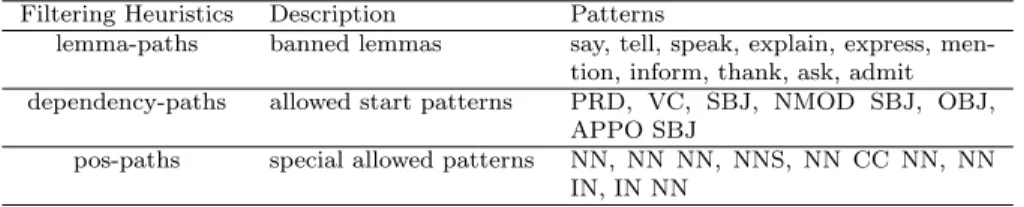
4.2.5. Relation extraction and filtering . . . 42
4.2.6. Dependency-based loose clustering . . . 43
4.2.7. Scoring . . . 44
4.3. Experimental setup . . . 46
4.3.1. Source dataset . . . 46
4.3.2. Extracted knowledge bases . . . 47
4.4. Experiments . . . 48
4.4.1. Quality of entity linking . . . 48
4.4.2. Quality of relations . . . 50
4.4.3. Coverage of the extracted knowledge base . . . 52
4.4.4. Interpretation of music recommendations . . . 53
4.5. Conclusion . . . 54
5 Applications in Musicology 57 5.1. Introduction . . . 57
5.2. Building culture-specific knowledge bases: the flamenco case . . 58
5.2.1. Flamenco music . . . 58
5.2.2. FlaBase . . . 59
5.2.3. Content curation . . . 60
5.2.4. Knowledge extraction . . . 63
CONTENTS xvii
5.3. Diachronic study of music criticism . . . 67
5.3.1. Dataset . . . 68
5.3.2. Sentiment analysis . . . 69
5.3.3. Experiments . . . 70
5.4. Conclusions . . . 74
6 Semantic Enrichment for Similarity and Classification 75 6.1. Introduction . . . 75 6.2. Artist similarity . . . 76 6.2.1. Entity linking . . . 76 6.2.2. Knowledge representation . . . 77 6.2.3. Similarity approaches . . . 79 6.2.4. Experiments . . . 80
6.2.5. Results and discussion . . . 82
6.3. Music genre classification . . . 84
6.3.1. Dataset description . . . 85
6.3.2. Linguistic processing . . . 85
6.3.3. Features . . . 85
6.3.4. Baseline approaches . . . 86
6.3.5. Experiments . . . 87
6.3.6. Results and discussion . . . 87
6.4. Conclusion . . . 88
7 Sound and Music Recommendation with Knowledge Graphs 91 7.1. Introduction . . . 91
7.2. Knowledge enrichment via entity linking . . . 93
7.3. Recommendation approach . . . 94
7.3.1. Explicit feature mappings for graph-based item repres-entations . . . 97
7.3.2. Feature combination . . . 99
7.4. Experimental evaluation . . . 100
7.4.1. Datasets description . . . 101
7.4.2. Experiment settings . . . 102
7.4.3. Sound recommendation experiment . . . 103
7.4.4. Music recommendation experiment . . . 106
7.5. Conclusion . . . 109
II Representation Learning from Multimodal Data 111 8 Cold-start Music Recommendation 113 8.1. Introduction . . . 113
xviii CONTENTS
8.3. Learning artist representations from text . . . 116
8.3.1. Semantic enrichment . . . 116
8.3.2. Word embeddings . . . 117
8.4. Learning track representations from audio . . . 117
8.5. Multimodal fusion . . . 118 8.6. Experiments . . . 119 8.6.1. Dataset . . . 119 8.6.2. Artist recommendation . . . 119 8.6.3. Song recommendation . . . 121 8.7. Conclusions . . . 122
9 Multi-label Music Genre Classification 125 9.1. Introduction . . . 125 9.2. Multimodal dataset . . . 126 9.2.1. Genre labels . . . 127 9.3. Multi-label classification . . . 127 9.3.1. Labels factorization . . . 128 9.3.2. Evaluation metrics . . . 129
9.4. Album genre classification . . . 129
9.4.1. Audio-based approach . . . 130 9.4.2. Text-based approach . . . 130 9.4.3. Image-based approach . . . 131 9.4.4. Multimodal approach . . . 131 9.5. Experiments . . . 132 9.5.1. Audio classification . . . 133 9.5.2. Text classification . . . 134 9.5.3. Image classification . . . 135 9.5.4. Multimodal classification . . . 136 9.6. Conclusions . . . 136
10 Summary and future perspectives 139 10.1. Introduction . . . 139 10.2. Summary of contributions . . . 140 10.2.1. Scientific contributions . . . 140 10.2.2. Datasets . . . 142 10.2.3. Knowledge bases . . . 142 10.2.4. Software . . . 143 10.2.5. Publications . . . 143
10.3. Directions for future research . . . 143
CONTENTS xix
Appendix A: Publications by the author 171 Appendix B: Datasets, Knowledge Bases, and Software 175
Datasets . . . 175 Knowledge bases . . . 175 Software . . . 176
List of figures
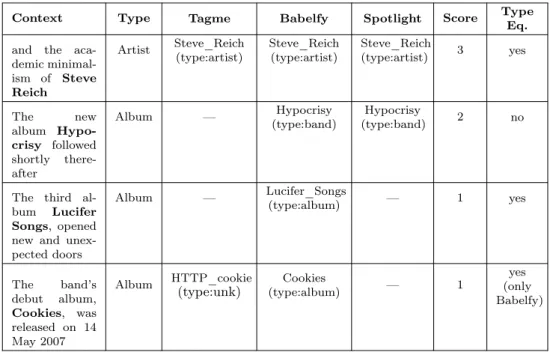
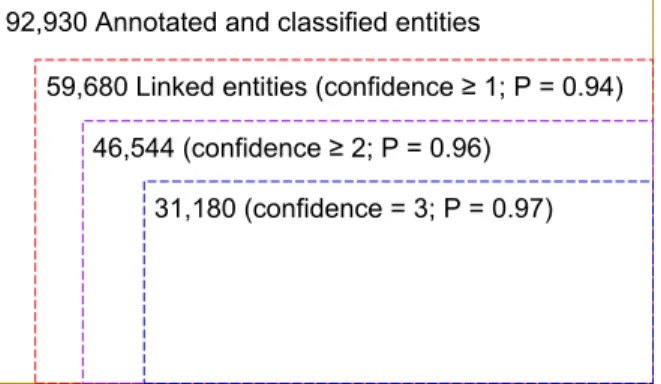
1.1. Long-tail distribution. . . 6 1.2. Thesis overview. . . 8 3.1. ELVIS Workflow. . . 28 3.2. Number of entities and precision of the manual evaluation. . . 31 3.3. ELMD Overview. Number of annotations, confidence score, and
precision values at different confidence score thresholds. . . 34 4.1. Example sentence with dependency parsing tree. . . 39 4.2. Semantic integration on syntactic dependencies. . . 42 4.3. Example of a parsed relation pattern p ∈ P and a valid cluster
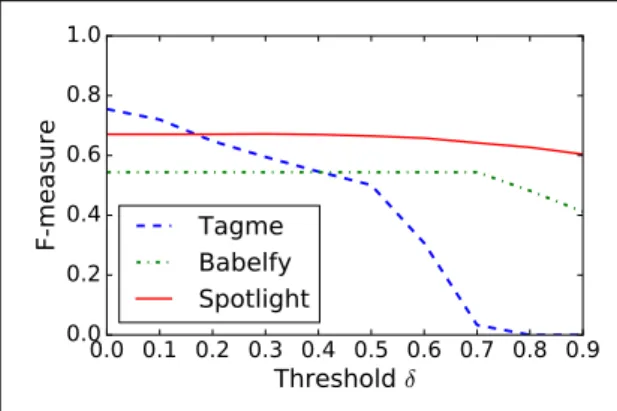
pattern (bold). . . 44 4.4. Percentage of triples and relation patterns fromKBSF-ft. . . 47 4.5. F-measure of the entity linking systems at different thresholds. . . 49 4.6. Precision of relations. . . 52 4.7. User interface for the music recommendation experiment. . . 55 5.1. Ontology schema . . . 60 5.2. Selected data sources . . . 61 5.3. F-measure for different values ofθ . . . 63 5.4. FlaBase distributions. . . 67 5.5. Artists by decade of birth . . . 67 5.6. Overview of the opinion mining and sentiment analysis framework. 70 5.7. A sentence from a sample review annotated with opinion and aspect
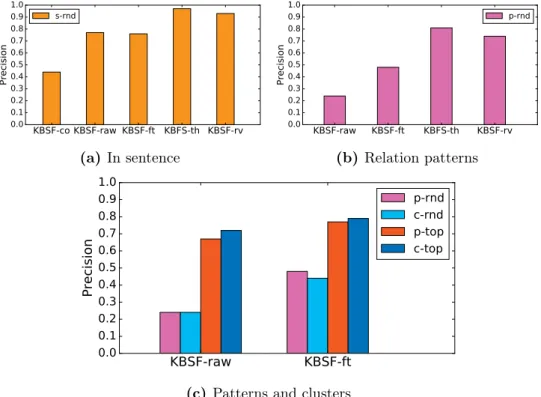
pairs. . . 70 5.8. Sentiment (a, c, and d) and rating (b) averages by review
publica-tion year; Kernel density estimapublica-tion of the distribupublica-tion of reviews by year (e); GDP trend in USA from 2000 to 2014 (f) . . . 72 5.9. Sentiment (a), rating (b), and sentiment by genres (c) averages by
album publication year. . . 73 6.1. Workflow of the proposed method. . . 76 6.2. Knowledge graphs. . . 78 6.3. Percentage of accuracy of the different approaches. . . 88 6.4. Confusion matrices. . . 89 7.1. Portion of the final knowledge graph enriched with WordNet and
DBpedia . . . 95 xxi
xxii List of figures
7.2. An example of 3-hop item neighborhood graph for the itemi. . . . 97 7.3. Precision-Recall, Novelty, and Aggregate Diversity plots in
Free-sound dataset . . . 105 7.4. Precision-Recall, Novelty, and Aggregate Diversity plots in Last.fm
dataset . . . 108 8.1. Model architecture. . . 115 9.1. t-SNE of album factors. . . 133 9.2. Particular of the t-SNE of randomly selected image vectors from
List of tables
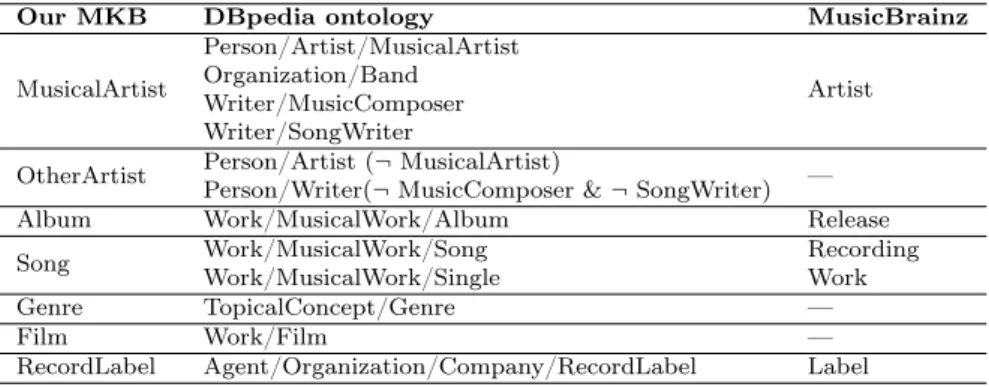
3.1. Equivalence of types between Last.fm and DBpedia. Yago, Schema, and DBpedia refer to the correspondent ontologies. . . 30 3.2. Agreement examples of ELVIS. . . 31 3.3. Precision and coverage of ELMD mapping to DBpedia. . . 32 3.4. Statistics of the linked entities in ELMD. . . 32 3.5. Statistics of the extended ELMD corpus. . . 35 3.6. Percentage of linked entities in the extended ELMD corpus. . . 35 3.7. Statistics of the ELMD gold standard corpus. . . 36 4.1. Type mapping. . . 41 4.2. Complete set of patterns used in the filtering heuristics . . . 43 4.3. Regular expressions for dependency paths in cluster patterns. . . . 44 4.4. Example of a relation cluster. . . 45 4.5. Statistics of all the extracted KBs . . . 48 4.6. Precision and recall of the entity linking systems considered. . . . 49 4.7. Precision and recall of the entity linking systems considered. . . . 50 4.8. Top-5 most frequent entities by type and tool. . . 51 4.9. Number of triples with labeled relations in the different KBs. . . . 53 5.1. Precision, Recall and F-measure of entity linking approaches. . . . 65 5.2. PageRank Top-5 artists by category. . . 66 5.3. Precision values of artist relevance ranking. . . 66 5.4. Number of albums by genre with information from the different
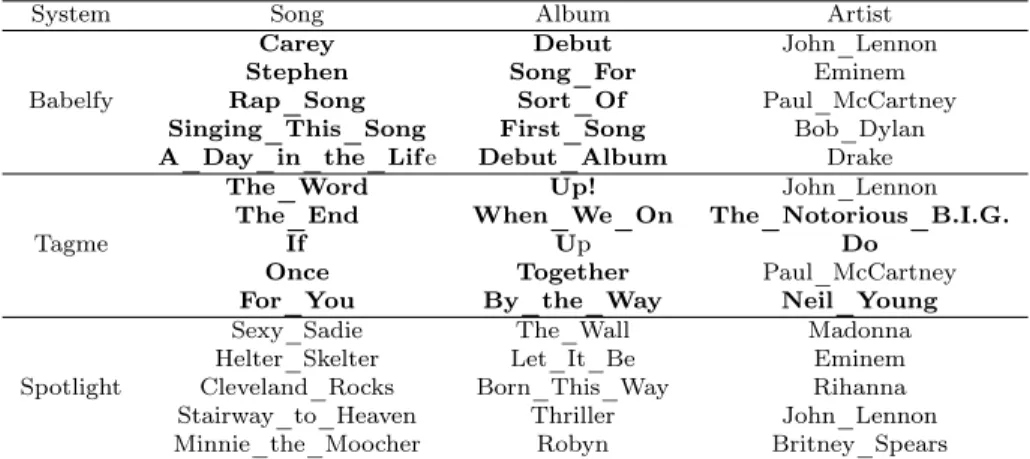
sources in MARD. . . 69 6.1. Precision and nDCG for Top-N artist similarity in the MIREX
data-set. . . 83 6.2. Precision and nDCG for Top-N artist similarity in the Last.fm dataset. 83 6.3. Average genre distribution of the top-10 similar artists using the
MIREX dataset. . . 84 6.4. Accuracy of the different classifiers. . . 87 7.1. Number of tags and keywords. . . 101 7.2. Accuracy, Novelty, and Aggregate Diversity results for different
ver-sions of the Freesound dataset. . . 103 7.3. Accuracy, Novelty, and Aggregate Diversity results for different
ver-sions of the Last.fm dataset. . . 107 xxiii
xxiv List of tables
8.1. DBpedia properties selected for each entity class. . . 116 8.2. Artist Recommendation Results. . . 120 8.3. Song Recommendation Results. . . 121 9.1. Top-10 most and least represented genres. . . 127 9.2. Results for Multi-label Music Genre Classification of Albums. . . . 132
CHAPTER
1
Introduction
1.1.
Motivation
We are witnessing an unprecedented information explosion thanks to the dra-matic technological advancement brought by the Information Age (Smith, 2009). This technological (r)evolution has enabled the release and publica-tion of huge amounts of data into online repositories such as web sites, forums, wikis, and social media. Art and culture have benefited dramatically from this context, which allows potentially anyone with an available Internet connection to access, produce, publish, comment, or interact with any form of media. In this context, music content creation, publication, and dissemination has changed dramatically. Online music services, such as Pandora, Spotify, Apple Music, Google Play, Deezer, Tidal, Amazon Music, or Soundcloud, benefit from this situation and currently offer ever-growing catalogs with dozens of millions of music tracks, which are in turn just one click away from millions of users. This vast availability of music poses two serious challenges: First, how can a musical item be properly annotated and classified within a large collection? Since manually managing these large libraries is not feasible due to size constraints, automatic methods for the annotation and classification of large-scale music collections have been an active area of research in recent years (Schedl et al., 2014). Second,how can a user explore or discover preferred music from all the available content? Traditionally, users have relied on their friends, their favorite music radio host, a music expert in their local retail store, etc. to obtain recommendations on artists or albums they might like. Although this traditional approach is still valid and used by many people, its ability to cover the vast amount of available music nowadays is seriously hindered. Therefore, automatic approaches to music recommendation have become necessary (Celma & Herrera, 2008).
Large music collections combine information from multiple data modalities, such as audio, images, text or videos. In addition, music collections can be 1
2 CHAPTER 1. INTRODUCTION
enriched with user-generated content published online. However, as stated 17 years ago by Cohen & Fan (2000) “The main problem, of course, is that the bulk of information on the Web is designed to be read by humans, not by machines”. Nevertheless, this problem is far from being totally solved. In this context, Natural Language Processing is playing a key role, as one of its main lines of research is precisely to transform human readable content into machine readable data (Cowie & Lehnert, 1996).
The way human readable content and multimodal data present in large music collections is represented and combined in computational models poses numer-ous challenges. Artificial intelligence methods, such as machine learning, heav-ily rely on the choice of data representation. Therefore, finding representations that maximize the different explanatory factors of variation behind the data is a fundamental task. Traditional approaches rely on handcrafted features to represent the variability of the data, whereas more recently, and thanks to the raise of deep learning techniques, representation learning approaches have demonstrated their superiority in multiple domains (Bengio et al., 2013). In this thesis, we address the aforementioned challenges of classification and recommendation of musical items in large music collections from two differ-ent standpoints: (1) extracting structured knowledge from music-related texts and further enriching this knowledge with semantic information present in online knowledge repositories, (2) learning new data representations from het-erogeneous data using deep learning architectures and further combining these representations in multimodal networks. We hypothesize that such enriched knowledge and learned multimodal data representations are crucial for improv-ing recommendation and classification algorithms.
1.2.
Methodologies
This thesis is framed within the Music Information Retrieval (MIR) research tradition. MIR is a multidisciplinary field of research concerned with the ex-traction, analysis, and usage of information about any kind of music entity (e.g., song, artist, album) on any representation level (e.g., audio signal, sym-bolic MIDI, metadata) (Schedl, 2008). According to Schedl et al. (2013), the musical factors that influence human music perception can be categorized into music content and music context. Music context relates to all musical aspects that are not encoded in the audio signal, such as song lyrics, artist’s biography, album cover artwork, or music video clips, whereas music content is defined as human perceptual aspects that can be extracted from the audio signal. Follow-ing this distinction, research methodologies within the MIR community that deal with data modalities different from audio (e.g., text, images) are often called context-based approaches, whereas methodologies based on the analysis of the audio signal are called content-based approaches. Although we agree
1.2. METHODOLOGIES 3
with this classification criteria, in this thesis we follow the nomenclature used in the Recommender Systems community (Ostuni et al., 2013) and consider audio signal, text (e.g., metadata, artist’s biographies, song lyrics), and im-ages (e.g., album cover artwork, artist’s photographies) as different modalities of content.
1.2.1. Why knowledge extraction?
As pointed out by Humphrey et al. (2012), MIR approaches are typically based on a two-stage architecture of feature extraction and semantic interpretation (e.g., classification, regression, clustering, similarity ranking, etc.). Tradition-ally, MIR has been mainly focused on the use of features extracted from audio, and has not paid much attention to other data modalities. However, in re-cent years several studies have shown the benefits of using context-based and multimodal approaches (Schedl et al., 2014).
Audio features are often classified into low, mid, and high-level representa-tions (Bello & Pickens, 2005). Low-level representarepresenta-tions (e.g., spectral flux, cepstrum, MFCCs) are measured directly on the audio signal. Mid-level rep-resentations (e.g., chords, onsets) represent musical attributes extracted from the audio combining machine learning and musical knowledge. High-level rep-resentations (e.g., mood, form, genre) are related to human interpretations of the data, and are typically built on top of low and mid-level representations. The extraction and exploitation of features from these three representation levels have been widely studied in the MIR field (Casey et al., 2008).
Following this feature hierarchy, when dealing with textual data, we can also differentiate between low, mid, and high-level representations. Low-level rep-resentations (e.g., word frequencies, word co-occurrences, n-grams) are meas-ured directly on text. Mid-level representations (e.g., part-of-speech tags, noun phrases) combine linguistic knowledge and statistical analysis of text corpora. High-level representations (e.g., syntactic dependencies, disambiguated named entities, semantic relations) involves a semantic understanding of text. In the context of MIR, most of the literature is focused on low-level and mid-level rep-resentations (Celma et al., 2006; Lamere, 2008; Whitman & Lawrence, 2002; Knees & Schedl, 2013), and very few in high-level ones (Tata & Di Eugenio, 2010; Knees & Schedl, 2011; Sordo et al., 2012). Little attention has been paid to the semantic of words or the context they are being used. Thus, the research in the MIR field, has not yet exploited the epistemic potential of text.
In the first part of this thesis, we focus on knowledge extraction and knowledge-based approaches. On the one hand, we work on new methodologies for the extraction of high-level semantic representations from music-related unstruc-tured texts. On the other hand, we put the emphasis on the development of approaches that exploit these semantic representations in music
recommend-4 CHAPTER 1. INTRODUCTION
ation and classification. In addition, we also study how semantic information may impact musicological studies.
1.2.2. Why representation learning?
As stated before, MIR approaches are commonly based on a two-stage archi-tecture of feature extraction and semantic interpretation. In this context, data representations are generally obtained following a traditional feature extrac-tion process, which involves a combinaextrac-tion of music domain-knowledge, psy-choacoustics, and audio engineering (Humphrey et al., 2012). This is known as feature engineering, and compensates the inability of traditional machine learn-ing algorithms to extract the discriminative information of the data. However, it involves a labor-intensive human effort, and also all the different explanatory factors of variation behind the data are not represented (Bengio et al., 2013). Huge efforts have been put in the last two decades in the definition and extrac-tion of audio features, which has given rise to comprehensive software libraries that assemble many of these feature extraction techniques (Bogdanov et al., 2013b; Mcfee et al., 2015).
Contrarily to feature engineering, representation learning (or feature learning) is a technique that allows a learning system to automatically discover the vari-ation behind the data directly from raw signals. As shown by Humphrey et al. (2012), MIR approaches can benefit from the use of these learning approaches using deep neural networks. In a neural network, each hidden layer maps its input data to an inner representation that tends to capture a higher level of abstraction. This methodology has two main advantages. First, blurring the boundaries between the two-stage architecture, which implies fully automated optimization of both stages at once. Second, it results in general-purpose ar-chitectures that can be applied to different MIR problems and data modalities. In the last years, several works have been published where audio-based deep learning architectures have been applied to MIR tasks such as music recom-mendation (Van den Oord et al., 2013) and music classification (Choi et al., 2016a), among others. However, to the best of our knowledge, there is no multimodal system that makes use of deep learning approaches for music re-commendation or music classification.
While in the first part of the thesis we use data representations based on tra-ditional feature engineering approaches, in the second part of this thesis we focus on representation learning approaches using deep neural networks. We apply this methodology to different data modalities (audio, text, and images) and their combination, and in the context of music recommendation and clas-sification.
1.3. CHALLENGES 5
1.3.
Challenges
In this section we describe in detail the two main challenges addressed in this thesis: music classification and music recommendation.
1.3.1. Music classification
The advent of large music collections has posed the challenge of how to access the information in terms of retrieval, browsing, and recommendation. One way to ease the access of large music collections is to keep annotations of all music resources (Sordo, 2012). Annotations can be added either manually or automatically. However, due to the high human effort required for manual an-notations, the implementation of automatic annotations processes has become a necessity.
We distinguish two ways of automatically enhancing annotations: (i) gath-ering annotations from external sources, and (ii) learning annotations from the collection’s data. To address (i), information can be obtained from on-line knowledge repositories (e.g., Wikipedia, MusicBrainz), or extracted from collections of unstructured documents. This imposes the challenge of how to properly map collection’s items with external entities. To address (ii), machine learning techniques can be applied over the collection’s data. When annota-tions are learned from audio, this classification task is often called auto-tagging. However, annotations can be learned from different data modalities, such as album cover artworks, tags, editorial metadata, video clips, etc.
Among the different categories of annotations used in music collections, the most prototypical are: music genres, instruments, and moods. Music genre labels are useful categories to organize and classify songs, albums, and artists into broader groups that share similar musical characteristics. Music genres have been widely used for music classification, from physical music stores to streaming services. Automatic music genre classification thus is a widely ex-plored topic (Sturm, 2012). However, almost all related work is concentrated in the classification of music items into broad genres (e.g., Pop, Rock), assign-ing a sassign-ingle label per item (Bogdanov et al., 2016). This is problematic since there may be hundreds of more specific music genres (Pachet & Cazaly, 2000), and these may not necessarily be mutually exclusive (i.e., a song could be Pop, and at the same time have elements from Deep House and a Reggae groove). As pointed out by McKay & Fujinaga (2006), annotations should allow more than one genre per recording, and information from several modalities should be combined for classification.
In this thesis, we focus on the problem of enriching annotations in music col-lections from the two above defined standpoints, i.e., gathering and learning. We study how semantic technologies may be useful to improve the annotations
6 CHAPTER 1. INTRODUCTION
Figure 1.1: Long-tail distribution.
of musical items. In addition, we tackle the problem of multi-label music genre classification from different data modalities (i.e., audio, text, and images) and their combination.
1.3.2. Music recommendation
Information overload in modern Web applications challenges users in their decision-making tasks. Recommender systems have emerged in the last years as fundamental tools in assisting users to find, in a personalized manner, what is relevant for them in overflowing knowledge spaces (Ricci et al., 2011). Music recommendation is a relatively young but continuously growing research topic, in both MIR and Recommender Systems communities. Although sev-eral research approaches and commercial systems have been proposed in the last decade, many of them are adaptations from other domains (Celma, 2010). Music has its own specificities with respect to other domains. For instance, a user may consume a musical item several times, or very different items accord-ing to the user context (e.g., workaccord-ing, dinnaccord-ing, exercisaccord-ing). Therefore, music recommendation is a challenging and still unsolved problem.
Although music online services make available almost all existing music, only a small percentage of these catalogs is actually consumed by the vast majority of users. Music consumption follows what is called a long-tail distribution (Celma, 2010) (see Figure 1.1). Therefore, one of the main challenges in music recommendation is how to make this niche of unknown musical items profitable. Moreover, as new music is continuously being created, new artists and releases appear every day. Hence, another important challenge in music recommender systems is how to deal with these new items, which is often called thecold-start problem.
To tackle these problems, it is crucial to have good item descriptions and to exploit all the available multimodal data (e.g., images, audio, texts, and
1.4. OBJECTIVES AND OUTLINE OF THE THESIS 7
videos). The web is full of user-generated content with relevant information about music, which has the potential to impact in the performance of mu-sic recommender systems. However, as stated before, this content is mostly unstructured and requires the application of knowledge extraction techniques that exploit the semantic of texts. In addition, up to now, audio content has been barely exploited in commercial recommender systems. However, thanks to the advent of novel deep learning approaches that raised the accuracy of audio-based recommendations (Van den Oord et al., 2013), audio may turn into a key factor in order to provide accurate long-tail recommendations. Most research in music recommendation has been dedicated to developing al-gorithms that providegood and useful recommendations (Celma, 2010), neg-lecting the importance of the novelty and diversity of recommendations (Ado-mavicius & Kwon, 2012; Bellogín et al., 2010). In addition, very few approaches are able to provide explanations of the recommendations to the users (Passant & Raimond, 2008; Passant, 2010). According to Celma & Herrera (2008), giving explanations of the recommendations provides transparency to the re-commendation process and increases the confidence of the user in the system. In this thesis we further explore the music recommendation problem from three different perspectives. First, we investigate how information extracted from large collections of music-related documents may be useful to provide explanations of recommendations to users. Second, we tackle the problem of recommending long-tail items by enriching item descriptions with semantic information combined with user feedback data. Finally, we address the problem of cold-start music recommendations by combining different data modalities using deep neural networks.
1.4.
Objectives and outline of the thesis
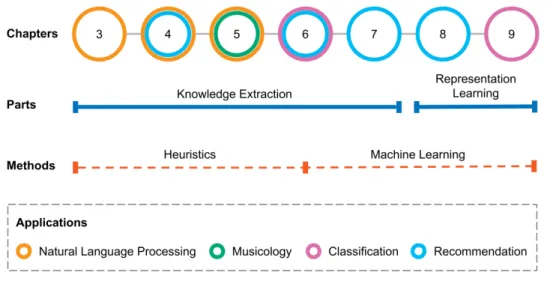
In the previous sections we have explained the motivations and context of our thesis. According to that, the main objective of this thesis is to improve the classification and recommendation of musical items in large music collections, with special emphasis on the promotion of novel and less popular items. To do so, we have addressed two different methodologies, one related to the ex-traction of structured knowledge from unstructured text sources and its further enrichment using information present in online knowledge repositories, and the other related to the learning of new data representations from multimodal data using deep learning architectures. The former approach may be also applied to other music related problems such as the creation of music knowledge repos-itories or the discovery of musicological knowledge. Therefore, in addition to the classification and recommendation problems, we have also addressed these linguistic and musicological challenges. In Figure 1.2, a diagram of this thesis is shown, organized according to the different approaches, methods, and
ap-8 CHAPTER 1. INTRODUCTION
Figure 1.2: Thesis overview.
plications present in each chapter. Although this thesis is focused on the music domain, we strongly believe that the work we present can be easily adapted to other multimedia domains.
This thesis is structured as follows: Chapter 2 presents some background know-ledge and related work on Natural Language Processing, Recommender Sys-tems, and Music Information Retrieval. Hereafter, the work in this thesis is divided in two Parts: In Part I we explore different techniques and approaches to extract semantic information from unstructured music-related text sources. Then, these semantic representations are exploited in music classification, sim-ilarity, and recommendation problems. Within this part, Chapter 3 illustrates the problem of linking musical texts and knowledge repositories. In Chapter 4 we address the automatic generation of music knowledge bases from unstruc-tured text sources. This chapter encloses with an experiment on explanations of music recommendations based on extracted knowledge. In Chapter 5, two experiments study the potential impact of knowledge extraction techniques in musicological studies. Chapter 6 presents the application of a semantic-based approach to music similarity and classification, whereas Chapter 7 addresses the problem of long-tail sound and music recommendations by enriching item descriptions with semantic information. Then, in Part II an approach to learn data representations from different data modalities using deep neural networks is applied to music recommendation and classification problems. In Chapter 8 we address the problem of cold-start music recommendations using audio and text. Next, in Chapter 9 we apply a similar representation learning approach for multi-label classification of music genres using audio, text, and images. At the end of each chapter, we include a focused discussion about the relevant
1.4. OBJECTIVES AND OUTLINE OF THE THESIS 9
results and conclusions. We conclude this thesis in Chapter 10 with a sum-mary of our work, our main conclusions, and a discussion about open issues and future perspectives.
CHAPTER
2
Background
2.1.
Introduction
The literature review presented in this chapter is divided in three parts. Each part is focused on one of the main fields of research where this thesis is framed: Natural Language Processing (NLP), Recommender Systems (RS), and Music Information Retrieval (MIR). First, we summarize existing work on several areas of Natural Language Processing, with special focus on its application to the music domain (Section 2.2). We define what a knowledge base (KB) is and the different existing types. In addition, we enumerate the available knowledge bases that contain music information. Then, we explain what entity linking is and briefly describe some state-of-the-art systems. Additionally, we outline different existing approaches for relation extraction. Next, we briefly explain the main methodologies used in Recommender Systems, and illustrate the available work on knowledge-based approaches (Section 2.3). Finally, we dig into the existing literature on Music Information Retrieval (Section 2.4). More specifically, we first review the state of the art in text-based and semantic-based approaches. Then, we focus on three specific MIR tasks: music genre classification, artist similarity, and music recommendation.
2.2.
Natural Language Processing
Natural Language Processing (NLP) is a field of study that focuses on the interactions between human language and computers. One of the main sub-topics of NLP is Natural Language Understanding (NLU), which deals with machine reading comprehension. Knowledge Representation and Reasoning is a key enabler of Intelligent Systems (Suchanek et al., 2007), and plays an im-portant role in NLU (Baral & De Giacomo, 2015). In this thesis, we focus on an important aspect of NLU, which is how to make sense of the data that is generated and published online on a daily basis. This data is mostly produced 11
12 CHAPTER 2. BACKGROUND
in human-readable format, which makes it unsuitable for automatic processing. Considering that deep understanding of natural language by machines seems to be very far off (Cambria & White, 2014), there is great interest in formal-izing unstructured data, and knowledge bases are a paradigmatic example of large-scale content processed to make it machine readable.
Information extraction is the task of automatically extracting structured in-formation from unstructured or semi-structured text sources. It is a widely studied topic within the NLP research community (Cowie & Lehnert, 1996). A major step towards understanding language is the extraction of meaning-ful terms (entities) from text as well as relationships between those entities. This statement involves two different tasks. First, the identification and cat-egorization of entity mentions. This task is called named entity recognition. However, when this task involves a latter step of disambiguation of entities against a knowledge base it is called named entity disambiguation or entity linking. Second, the identification of relevant semantic relations between en-tities. This task is called relation extraction.
The work described in this thesis strongly focuses on the exploitation of lin-guistic and semantic properties of text collections. For this reason, we deem relevant to cover related work in the following areas: (1) knowledge base con-struction and curation; (2) music knowledge bases; (3) entity linking, and (4) relation extraction.
2.2.1. Knowledge base construction
We may define a knowledge base as a repository of knowledge organized in a predefined taxonomic or ontologic structure, potentially compatible with other knowledge bases, thus contributing to the Linked Open Data initiative1. These
knowledge bases may be designed to represent unconstrained knowledge, or a single domain of interest. This representation is formalized either manually, automatically, or with a combination of both.
We understand language by making sense of the connections between words, concepts, phrases, and thoughts (Havasi et al., 2007). Knowledge bases consti-tute a resource for encapsulating this knowledge. Previous efforts on knowledge base construction may be characterized as: (1) handcrafted knowledge bases; (2) integrative projects (automatic in design, but reliant on manually validated data); and (3) fully automatic, also in the relation extraction process.
Among the first group, the best known is probably WordNet (Miller, 1995), a lexical database which groups concepts in “synonym sets”, and encodes predefined relations among them such as hyponymy/hypernymy, meronymy, holonymy, or instantiation. Manually constructed knowledge bases, however,
1
2.2. NATURAL LANGUAGE PROCESSING 13
are mostly developed in specific domains, where the degree of ambiguity is lower and there is more availability of trained knowledge engineers.
Next, integrative projects are probably the most productive, as they are the most ambitious attempts in terms of content coverage and community involve-ment, not only users, but also contributors. Examples of these include Yago (Suchanek et al., 2007), an automatically created knowledge base derived from integrating Wikipedia and WordNet; DBpedia (Lehmann et al., 2014), a col-laboratively maintained project aimed at exploiting information present in Wikipedia, both structured and in free text;Freebase(Bollacker et al., 2008), also a collaborative effort mainly based on extracting structured knowledge fromWikipedia; orBabelNet(Navigli & Ponzetto, 2012), a semantic network which started as a seamless integration of WikipediaandWordNet, and today constitutes the largest multilingual repository of words and senses.
With regard to the third group we refer to approaches where knowledge is obtained automatically. Endeavours in this area include TextRunner (Banko et al., 2007), widely regarded as the first Open Information Extraction (OIE) system;ReVerb(Fader et al., 2011), particularly designed to reduce noise while keeping a wide coverage, thanks in part to a set of syntactic and lexical con-straints;NELL (Carlson et al., 2010b), which incorporates semantic knowledge in the form of a handcrafted taxonomy of entities and relations; PATTY (Na-kashole et al., 2012) and WiseNet (Moro & Navigli, 2012, 2013), in which a shared vision to integrate semantics is applied both at the entity and relation level; DefIE (Bovi et al., 2015b), a recent development in OIE tested on the whole set ofBabelNetglosses; andKB-Unify(Bovi et al., 2015a), not an actual information extraction implementation, but rather a unification framework for knowledge bases.
2.2.2. Music knowledge bases
MusicBrainz and Discogs are two paramount examples of manually curated music knowledge bases. They are not strictly knowledge bases, but open mu-sic encyclopedias of mumu-sic metadata, which are built collaboratively and are openly available. MusicBrainz, in addition, has been published as Linked Data by theLinkedBrainz project2.
As for generic knowledge bases based onWikipedia, such as the ones described earlier, these include a remarkable amount of music data, such as artist, album, and song biographies; definitions of musical concepts and genres; and articles about music institutions and venues. However, their coverage is biased towards the best-known artists, and towards products from Western culture. Finally, let us refer to the notable case of Grove Music Online3, a music encyclopedia
2
http://linkedbrainz.org/
3
14 CHAPTER 2. BACKGROUND
containing over 60k articles written by music scholars. However, it has the drawback of not being freely open, as it runs by subscription. Other than the aforementioned curated repositories, to the best of our knowledge, there is not a single automatically learned open music knowledge base. A first step in this direction is taken in this thesis.
2.2.3. Entity linking
The advent of large knowledge repositories and collaborative resources has contributed to the emergence of entity linking, i.e., the task of discovering mentions of entities in text and link them to a suitable knowledge repository (Moro et al., 2014b). It encompasses similar subtasks such as named entity disambiguation (Bunescu & Pasca, 2006), which is precisely linking mentions of entities to a knowledge base, or wikification (Mihalcea & Csomai, 2007), specifically using Wikipedia as knowledge base. Another highly related tech-nique is word sense disambiguation (Stevenson & Wilks, 2003). Its main task is to identify which sense of a word (i.e., meaning) is used in a sentence, when the word has multiple meanings.
There has been a great development of entity linking systems for unconstrained domains. Among these systems we focus on three of them in this thesis:
DBpedia Spotlight(Mendes et al., 2011) is a system for automatically
annot-ating text documents with DBpedia URIs, finding and disambiguannot-ating natural language mentions of DBpedia resources. DBpedia Spotlight is shared as open source and deployed as a Web service freely available for public use4.
TagMe(Ferragina & Scaiella, 2012) is an entity linking system that matches
terms with Wikipedia link texts and disambiguates them using the Wikipedia in-link graph. Then, it performs a pruning process by looking at the entity context. TagMe is available as a web service5.
Babelfy (Moro et al., 2014a) is an entity linking and word sense
disambig-uation system based on non-strict identification of candidate meanings (i.e., not necessarily exact string matching), together with a graph-based algorithm that traverses the BabelNet graph and selects the most appropriate semantic interpretation for each candidate6.
In the context of Open Data7, the need for benchmarking datasets and
eval-uation frameworks for entity linking is clear. However, while general-purpose datasets and benchmarks exist (Usbeck et al., 2015), dealing with highly spe-cific domains (e.g., chemistry) or ever-evolving areas (e.g., video games or
4https://github.com/dbpedia-spotlight/dbpedia-spotlight/ 5 https://tagme.d4science.org/tagme/ 6 http://babelfy.org/ 7 http://linkeddata.org/
2.2. NATURAL LANGUAGE PROCESSING 15
music) poses a greater challenge due to linguistic idiosyncrasies or under-representation in general-purpose knowledge bases. This is true in the music domain as well, where available data is scarce (Pereira, 2014). Among the few works on entity linking for the music domain, let us refer to Gruhl et al. (2009), who describe an approach for detecting musical entities from MusicBrainz in informal text. In addition, Zhang et al. (2009) describe a system for musical entity linking in the Chinese language based on Hidden Markov Models. There is a number of evaluation benchmarks for general-purpose entity linking systems. Cornolti et al. (2013) and Usbeck et al. (2015) put forward bench-marking frameworks for comparing entity linking systems, defining a hierarchy of entity linking problems together with a set of novel measures. Rizzo et al. (2014) and Gangemi (2013) provide evaluation reports on the performance of different state-of-the-art named entity recognition and entity linking systems. 2.2.4. Relation extraction
Extracting semantic relations between entities is an important step to acquire and formalize the knowledge contained in unstructured natural language text (Wang, 2008). Relation Extraction (RE) is an established task in Natural Lan-guage Processing (Bach & Badaskar, 2007). It has been defined as the process of identifying and annotating relevant semantic relations between entities in text (Jiang & Zhai, 2007).
Relation Extraction approaches are often classified according to the level of su-pervision involved. Supervised learning is a core component of a vast number of relation extraction systems, as they offer high precision and recall. How-ever, the need of hand-labeled training sets makes these methods not scal-able to the thousands of relations found on the Web (Hoffmann et al., 2011). More promising approaches, called semi-supervised approaches, bootstrapping approaches, or distant supervision approaches do not need big hand-labeled corpus, and often rely on existent knowledge bases to heuristically label a text corpus (Carlson et al., 2010b; Hoffmann et al., 2011).
Open information extraction methods neither require an annotated corpus nor a pre-specified vocabulary, as they aim to discover all possible relations in the text (Banko et al., 2007). However, these unsupervised methods have to deal with uninformative and incoherent extractions. In Fader et al. (2011) part-of-speech regular expressions are introduced to reduce the number of these incoherent extractions. Less restrictive pattern templates based on dependency paths are learned in Mausam et al. (2012) to increase the number of possible extracted relations.
Dependency parsing is an NLP technique that provides a tree-like syntactic structure of a sentence based on the linguistic theory of Dependency Grammar (Tesnière, 1959). One of the outstanding features of Dependency Grammar is
16 CHAPTER 2. BACKGROUND
that it represents binary relations between words (Ballesteros & Nivre, 2013). Dependency relations have been successfully incorporated to relation extrac-tion systems. For example, Bunescu & Mooney (2005) describe and evaluate a relation extraction system based on shortest paths among named entities. Culotta & Sorensen (2004) focus on the smallest dependency subtree in the sentence that captures the entities involved in a relation, and Gamallo et al. (2012) propose a rule-based dependency-parsing open information extraction system. Moreover, in Nakashole et al. (2012); Moro & Navigli (2012); Bovi et al. (2015b) syntactic and semantic information is exploited to reduce in-consistent relations, by means of the combination of dependency parsing and entity linking techniques.
2.3.
Recommender Systems
The main objective of a recommender system is to predict the rating or pref-erencethat a user would give to an item. By doing so, its mission is to provide suggestions for items to be of use to a user (Ricci et al., 2011). Item is the general term used to denote what the system recommends to users (e.g., song, album, video, book).
Within the recommender systems arena, there are two main methods for com-puting recommendations: collaborative filtering and contend-based ones. The most popular is collaborative filtering, which provides recommendations to a user by considering the preferences of other users with similar tastes. The two primary areas in collaborative filtering are neighborhood methods and lat-ent factors models. Neighborhood methods are based on computed similarity between items or between users (Sarwar et al., 2001). By contrast, latent factor models are based on the decomposition of the sparse user-item inter-actions matrix to a set of user and item d-dimensional vectors using matrix factorization techniques (Koren et al., 2009). The recommendation problem is then treated as a matrix completion problem, where missing entries are filled by taking the dot product of the corresponding user and item latent factors. Since collaborative filtering methods rely only on user feedback information, they may suffer from the so-called cold-start problem (Saveski & Mantrach, 2014). That is, when new items are introduced in the system, they cannot be initially recommended as there is no feedback information related to them. In addition, most popular items tend to attract most of the recommendations in collaborative filtering approaches. The relation between items and popular-ity is typically represented as a long-tail distribution (Anderson, 2006) (see Figure 1.1). A large number of items in the catalog normally receive few in-teractions from users, so they are hardly recommended. These less popular items may be promoted by priming other evaluation measures rather than prediction accuracy, such as novelty or diversity (Abdollahpouri et al., 2017).
2.3. RECOMMENDER SYSTEMS 17
However, another larger set of items in large catalogs receive almost no inter-actions. These items in theextreme long tail are in practice cold-start items, as the number of interactions is smaller than the minimum value required for collaborative filtering methods.
Contrary to collaborative filtering, content-based methods (Mooney & Roy, 1999) rely only on item features, and recommendations are based on simil-arity between such features. Content-based methods do not suffer from the cold-start problem and are not biased towards popular items. However, col-laborative filtering methods tend to perform better when measuring the overall accuracy of the predictions (Pilászy & Tikk, 2009). Finally, hybrid methods (Burke, 2002) try to combine the best of both worlds, combining both item-content and item-user feedback. When available, the usage of side information about items has proven to boost the performances of pure collaborative filtering techniques (Ning & Karypis, 2012).
2.3.1. Knowledge-based approaches
The usage of structured knowledge to improve recommendation systems has been proposed in many works in the past. For instance, in Mobasher et al. (2004) structured semantic knowledge about items is used in conjunction with user-item ratings to create a combined similarity measure for item comparis-ons. In Ziegler et al. (2004) taxonomic information is used to represents the user’s interest in categories of products. In Anand et al. (2007) the authors use an ontology of items to infer user preferences from rating data. In Canta-dor et al. (2008), user preferences and item features are described by semantic concepts to obtain users’ clusters corresponding to implicit Communities of Interest. In Middleton et al. (2009) an ontological recommender system makes use of semantic user profiles with the effect of mitigating cold-start and improv-ing overall recommendation accuracy. In all of these works, the experiments prove an accuracy improvement over traditional memory-based collaborative approaches especially in presence of sparse datasets.
With the rise of the Semantic Web, a new class of recommender systems has emerged, taking advantage of the availability of large Linked Open Data (LOD) datasets. One of the first approaches in this sense is Heitmann & Hayes (2010), where LOD is used to mitigate cold-start and sparsity prob-lems. In Fernández-Tobías et al. (2011) DBpedia is leveraged for computing cross-domain recommendations. In Di Noia et al. (2012a,b) a model-based approach and a memory-based one are presented leveraging LOD datasets. In Ostuni et al. (2013) the authors show how to compute top-N recommenda-tions from implicit feedback using linked data sources. In Ostuni et al. (2014) a LOD content-based method is presented, where a neighborhood-based graph kernel is defined for matching graph-based item representations. Finally,
an-18 CHAPTER 2. BACKGROUND
other interesting direction about the usage of LOD is explored in Musto et al. (2014), where the authors present a content-based context-aware recommend-ation framework that adopts a semantic representrecommend-ation based on distributional semantics and entity linking techniques.
2.3.2. Deep learning approaches
Recently several researchers have tried to apply deep learning techniques to re-commender systems. Here we list some of these works. Restricted Boltzmann Machines (RBM) was one of the first neural networks methods used in re-commender systems, modeling user-item interaction (Salakhutdinov et al., 2007). Neural networks have been also applied to learn latent factors from item content-features, which has been revealed as a useful technique for cold-start recommendations (Wang et al., 2015). This technique has been successfully applied to audio (Van den Oord et al., 2013) and text (Bansal et al., 2016). Neural networks have been also applied to other recommendation problems, such as session-based recommendation (Hidasi et al., 2015) or playlist genera-tion (Vall et al., 2017).
2.4.
Music Information Retrieval
As stated in Section 1.2.1, Music Information Retrieval (MIR) is a multidiscip-linary field of research that is concerned with the extraction, analysis, and us-age of information about music. Traditionally, MIR has been more focused on the use of audio content, underestimating other sources of information. How-ever, in recent years several studies have showed the benefits of using other modalities, as well as their combination in multimodal approaches (Schedl et al., 2014). Although MIR approaches have been traditionally focused on au-dio content, there has been a growing interest in text-based and multimodal ap-proaches along the past decade. However, most of these text-based apap-proaches are focused on low and mid-level text representations, ignoring the full epi-stemic potential expressed in texts. In addition, most audio-based approaches have traditionally relied on handcrafted features, underexploring factors of variability behind the data. In this section, we first focus on existing literature related to text and knowledge-based approaches applied to MIR in general. Then, we further explore the related work of three specific MIR tasks: music classification, artist similarity, and music recommendation.
2.4.1. Text-based approaches
Early work on NLP in the context of MIR is related to the extraction of music artist information from artist-related web pages by parsing their HTML-trees (Cohen & Fan, 2000), using weighted term profiles (Ellis et al., 2002;
2.4. MUSIC INFORMATION RETRIEVAL 19
Whitman & Lawrence, 2002), or counting co-occurrence of artist names in results provided by search engines (Schedl et al., 2005). Other text sources, such as song lyrics (Laurier et al., 2008; Corona & O’Mahony, 2015) and tweets (Hauger et al., 2013; Schedl & Hauger, 2012) have been also studied. More detailed information about text-based approaches applied to MIR problems can be found in Knees & Schedl (2013); Schedl et al. (2014).
In recent years, there have been some initial attempts to work with high-level text representations in the context of MIR. In Sordo et al. (2012), a method-ology for extracting semantic information from music-related forums is pro-posed, inferring semantic relations from the co-occurrence of musical concepts in forum posts. In Knees & Schedl (2011) a methodology to automatically extract semantic information and relations about musical entities from arbit-rary textual sources is proposed. In Tata & Di Eugenio (2010) a method to extract information about individual songs from album reviews is proposed, combining syntactic, semantic and sentiment analysis. Finally, the C@merata task (Sutcliffe et al., 2016, 2015), part of the MediaEval evaluation campaigns from 2013 to 2017, is focused on music Question & Answering (Q&A) systems. In this task the input is a natural language phrase, combined with a music score in MusicXML format, and the required output is one or more matching passages in the score.
There have also been some interesting works trying to understand the semantics behind the audio signal using natural language text. The earliest work, by Whitman & Ellis (2004), combines text analysis with acoustic descriptors in order to automatically generate music reviews from the audio signal. In Koduri (2014), culturally relevant and musically meaningful information about melodic intervals extracted from audio and text are structured in a formal knowledge representation and exploited to compute similarity measures for the discovery of musical entities.
2.4.2. Knowledge-based approaches
Knowledge representations have also been studied in the context of MIR, but instead of being extracted from text, they are typically retrieved from online knowledge repositories. For instance, in Sordo et al. (2013) a set of semantic facets is automatically obtained and anchored upon the structure of Wiki-pedia, and tags from the folkosonomy of Last.fm are then categorized with respect to the obtained facets. In Celma (2006), information from different sources is gathered in a central knowledge repository following the Semantic Web principles and using the Friend of a Friend (FOAF) ontology. This se-mantic information is then exploited for music recommendation. In Passant & Decker (2010), the DBpedia graph is used to provide explanations of music recommendations, whereas in Ostuni et al. (2013), the same is combined with