by Liezl Smith
Thesis presented in partial fulfilment of the requirements of the degree of Master of Commerce (Computer Auditing) in the Faculty of Economic and Management Sciences at Stellenbosch University
Supervisor: Prof W Boshoff Co-supervisor: Dr C Lamprecht
i
Declaration
By submitting this dissertation electronically, I declare that the entirety of the work contained therein is my own original work, that I am the sole author thereof (save to the extent explicitly otherwise stated), that reproduction and publication thereof by Stellenbosch University will not infringe any third-party rights and that I have not previously in its entirety or in part submitted it for obtaining any qualification.
Liezl Smith
Date: December 2018
Copyright © 2018 Stellenbosch University All rights reserved
ii
Machine learning is a strategic technology that can have an important effect on business, as it is able to perform tasks efficiently that were previously only performed by humans. When implementing this technology in the relevant business processes and utilising it effectively, users have to understand both it as well as other aspects have to be considered. It was found that one area that is well suited to the adoption of machine learning, is accounting. In addition, prior research has shown a need for accounting users to be educated in machine learning as part of their professional training. Therefore, the aim of this study was to enhance users’ understanding of machine learning technology specifically in the performance of accounting processes.
A grounded theory methodology was employed to identifying the accounting tasks machine learning could perform, to describe how machine learning functions and to identify the risks, benefits and limitations associated with the technology. Finally, steps and considerations when implementing machine learning technology in the accounting process were provided.
The findings of this research are that the user has a key role to play when using machine learning technology in the accounting processes and thus has to understand the technology, the risks and limitations, as well as the benefits of the technology. The risks discussed relate not only to machine learning technology but also to all the components that enable the functioning of the technology to ensure alignment with the accounting process goals.
Based on these findings, this research presents the user considerations and steps to take when implementing machine learning in selected accounting processes. These can be used to identify areas that may require attention when a business is adopting machine learning. One important consideration is the implementation of adequate data governance. This is because most of the risks identified for machine learning technology are data risks. Further research could therefore be directed at developing a data governance framework for machine learning technologies.
iii
OPSOMMING
Masjienleer is 'n strategiese tegnologie wat 'n belangrike uitwerking kan hê op besigheid, aangesien dit take doeltreffend kan uitvoer wat voorheen net deur mense uitgevoer is. Wanneer hierdie tegnologie in die toepaslike besigheids prosesse geïmplementeer en doeltreffend benut word, moet gebruikers dit verstaan en verskeie ander aspekte oorweeg. Daar is bevind dat Rekeningkunde een area is wat goed geskik is vir die aanneming van masjienleer. Daarbenewens, het vorige navorsing bevind dat rekeningkundige gebruikers opgelei moet word in masjienleer as deel van hul professionele opleiding. Die doel van hierdie studie was dus om gebruikers se begrip van masjienleertegnologie te verbeter, spesifiek in die uitvoering van rekeningkundige prosesse.
'n Gefundeerde teorie navorsingsmetodologie is gebruik om die rekeningkundige take wat masjienleer kan uitvoer te identifiseer, te beskryf hoe masjienleer funksioneer en om die risiko's, voordele en beperkings wat met die tegnologie verband hou, te identifiseer. Ten slotte is stappe en oorwegings tydens die implementering van masjienleertegnologie in die rekeningkundige proses verskaf.
Die bevindinge van hierdie navorsing is dat die gebruiker 'n sleutelrol speel wanneer masjienleertegnologie in die rekeningkundige prosesse gebruik word en dus moet die gebruiker die tegnologie, die risiko's en beperkings, sowel as die voordele van die tegnologie verstaan. Die risiko's wat bespreek word, hou nie net verband met masjienleertegnologie nie, maar ook met al die komponente wat die funksionering van die tegnologie moontlik maak om belyning met die doelwitte van die rekeningkundige proses te verseker.
Op grond van hierdie bevindinge, bied hierdie navorsing die gebruikersoorwegings en die stappe om te neem wanneer masjienleer in geselekteerde rekeningkundige prosesse geïmplementeer word. Hierdie oorwegings en stappe kan gebruik word om areas te identifiseer wat aandag benodig wanneer 'n besigheid masjienleer implementeer. Een belangrike oorweging is die implementering van voldoende databeheer, aangesien die meeste van die risiko's wat vir masjienleertegnologie geïdentifiseer is, data-risiko's is. Verdere navorsing kan dus gerig word op die ontwikkeling van 'n data-beheerraamwerk vir masjienleertegnologieë.
iv
ACKNOWLEDGEMENTS
I am forever grateful to all those persons who assisted and supported me in the completion of this work. I firstly want to thank my heavenly Father, this work was enabled by you alone. All glory be yours. In addition, I would like to express a special word of thanks to the following people:
• My husband, William, for every hour of selfless time you gave up to stand by and support me. This thesis would not exist without you.
• My grandmother, who has since passed away, for supporting me to carry on.
• My parents, who love and support me and brought me thus far.
• My supervisor, Stiaan Lamprecht. I have such respect for your wisdom and knowledge; thank you for your guidance and willingness to share your expertise with me.
v TABLE OF CONTENTS ABSTRACT ... i OPSOMMING ... iii Chapter 1: Introduction ... 1 1.1 Background ... 1 1.2 Research focus ... 2
1.3 Research design and methodology ... 4
1.4 Research motivation ... 5
1.5 Research scope ... 6
1.6 Limitation of research... 6
1.7 Organisation of the research ... 7
Chapter 2: Accounting processes and accounting tasks ... 8
2.1 Introduction ... 8
2.2 Translation of manual and electronic documents into accounting information ... 9
2.2.1 Breaking down the translation of documents into tasks ... 10
2.2.2 Technology used in document translation ... 13
2.2.3 Data available in document translation ... 14
2.3 Reconciliation of financial information ... 15
2.3.1 Breaking down the account reconciliation process into tasks ... 16
2.3.2 Technology used in the account reconciliation process ... 17
2.3.3 Data available in the account reconciliation process ... 18
2.4 Preparation of management accounts ... 19
2.4.1 Breaking down the management accounts reporting process into tasks ... 20
2.4.2 Technology used in the management accounts reporting process... 22
2.4.3 Data available in the management reporting process ... 23
2.5 Conclusion ... 24
Chapter 3: Overview of machine learning ... 25
3.1 Introduction ... 25
3.2 Context and framework of machine learning ... 26
3.3 Types of machine learning algorithm ... 27
3.4 Machine learning architecture ... 28
3.5 Description of the supervised learning techniques ... 30
3.5.1 Classification algorithms ... 30
3.5.2 Prediction algorithms ... 39
3.5.3 Dual-use algorithms: classification and prediction ... 40
3.6 Description of unsupervised learning techniques ... 45
3.6.1 Pattern detection ... 45
vi
3.7 Description of the semi-supervised learning techniques ... 50
3.7.1 Semi-supervised clustering ... 50
3.8 Tasks that can be addressed by machine learning technology ... 51
3.9 Conclusion ... 55
Chapter 4: Risks, benefits and limitations when implementing machine learning ... 56
4.1 Introduction ... 56
4.2 Machine learning technology risks pertaining to the accounting objectives ... 56
4.2.1 Qualitative characteristics for financial reporting ... 57
4.2.2 Machine learning risks and benefits per accounting objective ... 58
4.3 Technology governance of the machine learning life cycle ... 62
4.4 Machine learning architecture risks ... 64
4.5 Business infrastructure risks when building machine learning models ... 67
4.5.1 Configuration of machine learning architecture ... 68
4.5.2 Interoperability of analysis tools ... 68
4.5.3 Serving architecture ... 68
4.5.4 Monitoring ... 69
4.6 Acquiring machine learning from a service provider ... 69
4.7 The benefits and limitations of various machine learning techniques ... 70
4.8 User-related risks ... 78
4.9 Maintenance risks ... 78
4.10 Security risks ... 79
4.11 Conclusion ... 81
Chapter 5: Guidelines for implementing machine learning in an accounting context 86 5.1 Introduction ... 86
5.2 Step 1: Assigning responsibility for implementing machine learning technology .... 86
5.3 Step 2: Consider the accounting objectives ... 88
5.4 Step 3: Consider the machine learning model and architectural components ... 89
5.4.1 Machine learning model considerations ... 89
5.4.2 Data considerations ... 91
5.4.3 Feature selection and training and testing set considerations ... 92
5.4.4 Algorithm considerations ... 93
5.4.5 Testing considerations ... 93
5.5 Step 4: Consider infrastructure needs... 94
5.5.1 Service provider and purchased machine learning considerations ... 96
5.6 Step 5: Consider user requirements ... 97
5.7 Step 6: Consider the security requirements ... 97
5.8 Conclusion ... 99
Chapter 6: Conclusion ... 100
vii
LIST OF FIGURES
Figure 1: The traditional record-to report process ... 9
Figure 2: Flow chart of tasks using a bill recognition system as an example ... 10
Figure 3: Tasks in the reconciliation accounting process ... 15
Figure 4 Tasks in the management reporting process ... 19
Figure 5: The components of management accounts ... 20
Figure 6: The Artificial Intelligence Tree: The Many Branches of Artificial Intelligence Application ... 27
Figure 7: Machine Learning Architecture ... 29
Figure 8: Types of classification machine learning techniques ... 31
Figure 9: An example of a decision tree ... 33
Figure 10: A Bayesian Belief Network showing causal relationships between events ... 37
Figure 11: Accurate classification of P using the k-nearest neighbour algorithm ... 38
Figure 12: A two-dimensional example of a support vector machine ... 41
Figure 13: A single neuron ... 41
Figure 14: A multilayer neural network with a hidden layer ... 42
Figure 15: An artificial network classifying elements of an invoice ... 43
Figure 16: A high level diagram of the convolutional neural network used for image classification... 45
Figure 17: The Self-Organising Map Network ... 47
Figure 18: An example of K-means follow diagram ... 49
Figure 19: Machine Learning Architecture (Copy of Figure 7) ... 64
viii
LIST OF TABLES
Table 1: Research questions and corresponding research objectives ... 3
Table 2: Types of reconciliations ... 16
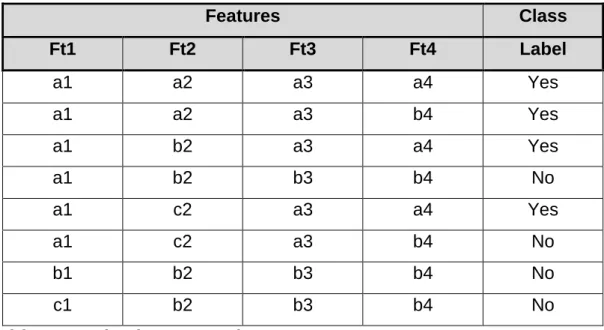
Table 3: An example of a decision tree training set ... 32
Table 4: Naïve Bayes training data ... 36
Table 5: Accounting problem types and recommended machine learning techniques... 52
Table 6: Technology life cycle user involvement ... 63
Table 7: Machine learning risks mapped to accounting objectives ... 58
Table 8: Machine learning benefits per accounting objective ... 61
Table 9: Machine learning architecture risks ... 65
Table 10: Benefits and limitations of respective machine learning techniques ... 70
Table 11: Benefits and limitations of machine learning techniques mapped to objectives ... 74
Table 12: Identified risks and relevant user considerations ... 82
1
Chapter 1: Introduction
1.1 Background
In order to maintain a competitive advantage, Gartner Inc. advises that companies should examine the business impacts of strategic technologies, which may indicate a need to adjust business models and operations. Failure to examine these technologies may mean the loss of a competitive advantage (Cearly, Walker & Burke, 2016). One such strategic technology is machine learning, a branch of artificial intelligence. Machine learning has enabled many tasks that would previously have been performed by humans to be efficiently and accurately completed by a computer.
Cearly et al. (2016) state that machine learning technologies have been developed to assist systems to appear to understand, learn, predict and adapt. They have the potential to operate with little or no human guidance, which surpasses that of traditional rule-based algorithms. Accordingly, by implementing machine learning technologies, business may benefit from an increase in productivity and accuracy as well as substantial cost savings.
The data science needed to create machine learning systems is complex and most businesses will therefore choose to acquire packaged machine learning applications rather than developing their own (Cearly et al., 2016). However, despite the complexity, management must understand the unique characteristics of machine learning technology to ensure that it is correctly implemented and aligned with the desired business outcomes (Gillion, 2017:3).
The financial division of a business is one of the areas that could benefit from the application of machine learning, specifically the area of accounting. In considering the training given to professional accountants, PwC (2015:16) recognises the need for undergraduate accounting programmes to include advanced topics on machine learning as part of the curriculum. Of the various artificial intelligence skills that PwC (2015:16) recommends, Sutton, Holt and Arnold (2016:68) argue that machine learning is a key stream of artificial intelligence for application in accounting.
This study addresses the need to assist users to understand machine learning technologies, specifically in the area of accounting, as explained in the next section.
2
1.2 Research focus
In this section, the research problem, research aim, research questions and research objectives will be addressed.
Machine learning techniques can assist accounting users in their decision-making. Although there are many types of machine learning techniques, they can be divided into two categories, namely, predictive techniques and explanatory techniques. The type of technique used will depend on the decision being made. For example, predictive techniques are able to predict outcomes that are based on patterns learnt by the machine learning model from the data although these patterns are often not explained to, or seen by, the user. Predictive machine learning techniques are more complex than explanatory machine learning techniques, which identify factors that are causally related to an outcome (Sainani, 2014:841; Sutton et al., 2016:69).
A lack of ability on the part of the accounting decision maker to discriminate between explanatory and predictive machine learning technologies when deciding which alternative to use and rely on indicates a need for machine learning research in accounting (Sutton et al., 2016:69). Assisting accounting decision makers to understand machine learning technologies and the issues that require consideration when implementing them would help to promote the application of these technologies in accounting and stimulate the need for research on these technologies.
Bräuning, Hüllermeier, Keller, & Glaum (2016:296) emphasised the importance of understandability and model simplicity in machine learning. Understanding the technology and the associated benefits and risks will assist users to select one that is appropriate to their needs. It will also make them aware of the issues to consider and the steps to take when implementing and using these technologies. Accordingly, the aim of this research is to enhance users’ understanding of machine learning technology specifically in carrying out accounting processes.
To achieve this aim, the research focused on three accounting processes, identifying the tasks involved in each process. These three accounting processes were selected as they cover some of the main processes in the traditional record-to-report process which is illustrated in Figure 1. These tasks were cast as problems in the accounting processes that
3
machine learning technology could solve. Subsequently, machine learning technologies were identified that could be applied to the identified tasks.
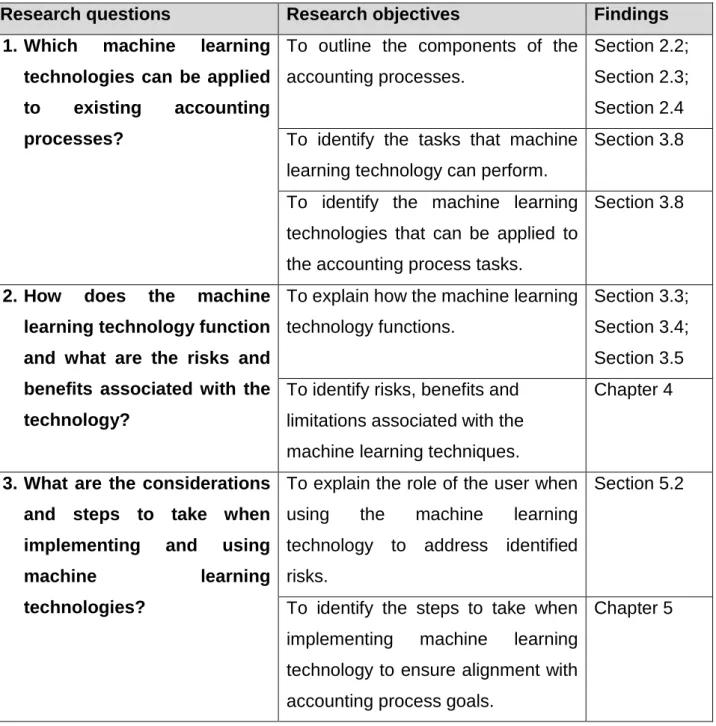
In order to achieve the research aim, three research questions were formulated for this study. Research objectives were then in turn set for each research question. The research questions and the corresponding research objectives, as well as the sections in which the respective findings are discussed, are indicated in Table 1.
Table 1: Research questions and corresponding research objectives
Research questions Research objectives Findings
1. Which machine learning technologies can be applied to existing accounting processes?
To outline the components of the accounting processes.
Section 2.2; Section 2.3; Section 2.4 To identify the tasks that machine
learning technology can perform.
Section 3.8
To identify the machine learning technologies that can be applied to the accounting process tasks.
Section 3.8
2. How does the machine learning technology function and what are the risks and benefits associated with the technology?
To explain how the machine learning technology functions.
Section 3.3; Section 3.4; Section 3.5 To identify risks, benefits and
limitations associated with the machine learning techniques.
Chapter 4
3. What are the considerations and steps to take when implementing and using
machine learning technologies?
To explain the role of the user when using the machine learning technology to address identified risks.
Section 5.2
To identify the steps to take when implementing machine learning technology to ensure alignment with accounting process goals.
4
1.3 Research design and methodology
As the research questions focus on gaining theoretical insights in order to develop a method for understanding the technology in an accounting context, the research design will be exploratory. An exploratory research design allows for the development of a grounded picture of the phenomena as well as the development of tentative theories or hypotheses (USC Libraries, n.d.).
A grounded theory methodology was employed to address the research problem. This is a methodology that is used to develop a theory, in this case theory about emergent technologies where there is not, as yet, an established theory (Sutton, Reinking & Arnold, 2011:46). Bryant (2002:35) argues in this regard that the grounded theory method is particularly suited to information systems technology research and highlights the mandate of research to develop both an understanding of discovered facts and adequate models for specified purposes. Furthermore, this method aligns with the aim of this research, namely, to enhance accounting users’ understanding of machine learning technology.
The research was both qualitative in nature (Creswell, 2009:4) and non-empirical, as the existing literature was synthesised (Torraco, 2005:357) to achieve the objective of improving the understanding of this technology with respect to accounting tasks. An integrative literature review was therefore performed with the aim of enhancing user understanding of machine learning, specifically with regard to its application in accounting.
The literature review relied on Scopus, EBSCOhost, IEEE and AAA digital library databases (Sutton et al., 2016:64), as well as available publications in the form of books, accredited journals and academic work on machine learning, including publications specifically in the field of finance.
As a starting point, the three accounting processes selected were investigated to determine which components presented problems that could be solved by machine learning. These problems are presented as tasks.
Having provided an overview of the selected accounting processes and tasks, the research identified various machine learning techniques that could be applied to perform the tasks described. This was done by identifying the learning problem, being the task that the machine learning needs to be able to perform (Someren & Urbancic, 2006:363), for each
5
accounting task and then identifying the different types of machine learning technique to address each learning problem and explaining their capabilities.
The research then considered how machine learning techniques were already being used in accounting practice to address the identified tasks. Where no machine learning had yet been applied in practice, suitable machine learning techniques were identified in the research. When evaluating the available machine learning technologies, it was evaluated in the context of the different technologies that encompass artificial intelligence. A link was now presented between accounting processes and machine learning techniques.
Having selected the machine learning techniques to apply to the tasks identified in the accounting processes, the functioning of the applicable machine learning technology was explained. This was followed by a discussion of the risks, benefits and limitations associated with these technology that was grounded in the principals of King IV. Finally, in response to these identified risks, benefits and limitations, the issues to be considered when implementing the technology and the steps to take when using the technology were identified.
1.4 Research motivation
Bailey and Pearson (1983:532) identify a number of factors that influence user satisfaction when using new information technology products. These factors include understanding the system, the perceived usefulness of the system, and the congruence between what the user wanted and what the product provided.
More specifically, to assist users in deciding which machine learning techniques to apply, an understanding of the strengths and weaknesses of these techniques in the context of business is useful (Bose & Mahapatra, 2001:211). Therefore, users hoping to exploit the advantages of machine learning in their accounting processes would benefit from an understanding of the technology, its benefits and its applications, as well as the issues to consider and the way that the user can responds to the identified risks.
This research will address the need for research into strategic technologies, namely machine learning, and the need to assists users in understanding the technology. Assisting users to understand the technology will hopefully encourage them to consider implementing machine learning when a problem arises that machine learning could address.
6
1.5 Research scope
The focus of this research will be on the following specific processes in accounting:
1. Translation of manual and electronic documents into accounting software information 2. Reconciliation of financial information
3. Preparation of management accounts
1.6 Limitation of research
The research does not intend to address all the areas of accounting in which machine learning intervention is possible; it will only address the three accounting processes that have been identified. Only those tasks for which a suitable machine learning technology could be found at the time of this research were addressed. Furthermore, the research will only consider machine learning technologies appropriate for addressing the identified problem types in the accounting process and therefore does not intend to present an exhaustive list of machine learning technologies.
Considerable research has been performed in the areas of machine learning applied to auditing and the detection of fraud using such technologies, therefore these areas were not considered for this research.
In order to achieve the objective of understanding the machine learning technologies, the design and functioning of each technology will be explained. In doing so, the research is limited to explaining the design and functionality of the technology for the purposes of understanding it and identifying the associated risks, benefits and limitations. Therefore, this is not explained at the technical level required to develop the technology.
The risks and benefits identified for the machine learning technology will be those that are unique to the technology and not those that pertain to the environment in which machine learning operates such as database or accounting software risks or risks pertaining to supporting technologies such as cloud platforms. Hence, these risks and benefits are not addressed in this research.
7
1.7 Organisation of the research
The research consists of six chapters.
Chapter 2 identifies the various accounting processes that will be addressed and outlines the tasks involved in these processes. This assists in outlining the areas that can be addressed by machine learning technology.
Chapter 3 provides an overview of the machine learning techniques available to perform the tasks identified in the accounting processes. The chapter also provides an understanding of the way machine learning technology is structured and how machine learning techniques work. This chapter further discusses which techniques are currently applied to accounting process tasks and which tasks could be applied to the identified accounting processes tasks as based on the existing research.
Chapter 4 explains the risks, benefits and limitations of machine learning technologies.
Chapter 5 formulates the guidelines for implementing machine learning technologies in the accounting context.
Chapter 6 concludes with a summary of the main findings of the study for consideration by users when implementing machine learning technology in an accounting context.
8
Chapter 2: Accounting processes and accounting tasks
2.1 Introduction
The aim of this study was to enhance users’ understanding of machine learning technologies specifically in the performance of accounting processes. This chapter provides a description of the three accounting processes that were selected, and highlights the tasks involved in each of these processes. The purpose of the chapter, then, is to investigate the tasks performed in each accounting process and the technology that is currently being employed in the process and, finally, to describe the tasks. The tasks which could be performed by machine learning are presented in chapter 3 section 3.8.
To gain an understanding of the accounting processes, numerous services offered by financial process software providers were considered. There is a paucity of published research on applications that employ machine learning techniques. While the reason for this is unclear, it is speculated that it may be due to a lack of reporting on such applications, as a result of the unwillingness to reveal these applications for competitive reasons (Amani & Fadlalla, 2017:39).
The three accounting processes identified for this research were broken down into a number of tasks, each representing a certain sphere of the administrative activity. After identifying the different tasks, specific consideration was given to identifying which technology was used in each accounting process. Krutova and Yanchev (2014:13) indicate that the technology applied in an accounting process entails a sequence of measures that assist in the introduction of resources at the input phase, the processing of the resources and the production of different levels of information sets at the output.
Once the technology was identified, it was important to identify the data and the structure of the data available for the task, as the data needed to be appropriate for machine learning techniques (Fedyk, 2016). The choice of machine learning technique was based partly on the differences in data characteristics or data type (Someren & Urbancic, 2006:371).
9
Accordingly, the product of the current chapter is the layout of the tasks performed in the three accounting processes selected, together with an understanding of the supporting technologies identified as useful for enabling machine learning techniques to be applied and the structure of the data available in each accounting process. These will be used to identify the relevant machine learning techniques in chapter 3.
The research is set out in accordance with the traditional record-to-report process, as illustrated in Figure 1. In line with this, firstly, the manual and electronic documents are translated into accounting information, secondly, financial information is reconciled, and finally, management accounts are prepared.
Figure 1: The traditional record-to-report process (Deming, n.d.:7) (Adapted)
Figure 1 above shows that the record-to-report process commences with the external information sources, which are covered in section 2.2, followed by account reconciliations, which are addressed in section 2.3, then journal entries and month-end closure, and finally analysis and reporting are performed, which are addressed in section 2.4. This study does not address the performance of compliance and control procedures.
2.2 Translation of manual and electronic documents into accounting information
The first process to be addressed is the translation of manual and electronic documents into accounting information. The purpose of converting documents into a digital form is to enable businesses to analyse the documented data efficiently and more affordably. In pursuance of this purpose, the process of detecting, extracting and processing data from documents needs to be efficient and accurate (Ming, Liu & Tian, 2003:489; Rhodes & Wheat, 2015:1). The efficiency and accuracy of the process may be increased by incorporating machine learning techniques. External Information Sources Account Recon-ciliations Journal
Entry Month-End Close Analysis Reporting Compliance& Control
10
2.2.1 Breaking down the translation of documents into tasks
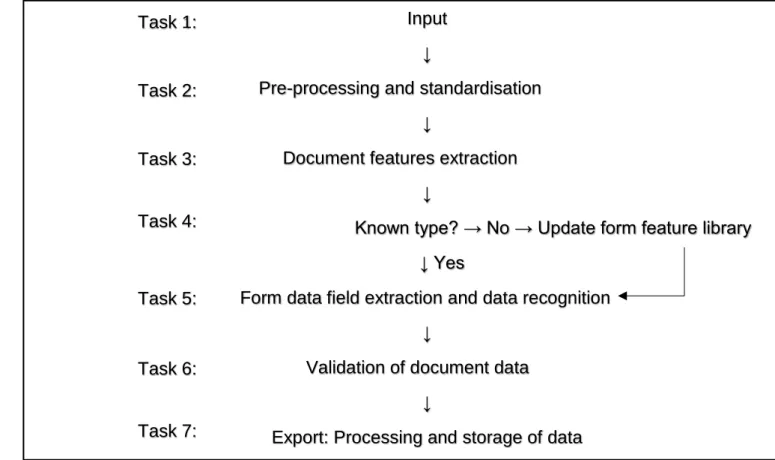
This section describes each of the tasks in the process of translating documents into accounting information. Various documents need to be translated into electronic information for accounting purposes. An example of this process is illustrated in Figure 2 (Ming et al., 2003:490) for a supplier invoice.
Figure 2: Flow chart of tasks using a bill recognition system as an example (adapted from Ming et al., 2003:490)
In Figure 2 the tasks in the documentation translation process are set out in the order in which the software or user performs them. The tasks are discussed in more detail as follows:
Task 1. Input: Documents such as invoices are uploaded into the translation software in the form of a paper document which is either scanned or loaded electronically, for example in the form of an email attachment (Kohlmaier, Hess & Klehr, 2006:1). The document format will affect the structure of the available data as described in section 2.2.3.
Task 2. Pre-processing and standardisation: Documents are pre-processed prior to data extraction. Various algorithms, which are described in section 2.2.2, are applied to correct the images and then standardising techniques are applied to these images, which include
Input
↓
Pre-processing and standardisation
↓
Document features extraction
↓
Known type? → No → Update form feature library ↓ Yes
Form data field extraction and data recognition
↓
Validation of document data
↓
Export: Processing and storage of data Task 1: Task 2: Task 3: Task 4: Task 5: Task 6: Task 7:
11
standardising the page size, page orientation, font, text size, colour, element positioning, page numbering, margins, column size, watermarks, line numbering and page breaks (Rhodes & Wheat, 2015:0029).
Task 3. Document features extraction: The components of the documents are translated by identifying the document template and the document schema. The schema identifies the different elements of information which are to be extracted from the document while the
template sets out how the information is physically arranged in the document. Based on the identified template, the system will then have a set of rules for locating the information for each schema in the document (Sorio, 2013:25).
The data is extracted from the documents and converted to an electronic format using Optical Character Recognition (OCR) (Kohlmaier et al., 2006:1; Rhodes & Wheat, 2015:0031). Accordingly, the document features may trigger algorithms which label identifiable data elements. For example, the presence of the words “Invoice number” may trigger the string of numbers following that header to be labelled as invoice number (Kohlmaier et al., 2006:1). The technology used to perform the data and features extraction is described in section 2.2.2.
Additionally, the document translation software may extract other types of data from the document, for example the metadata, which identifies the document creator, time created, document file size, creation date and any modification dates, type of text in the file, version, font, name, and other data. These elements can be used as a database navigation key (Rhodes & Wheat, 2015:5).
Task 4. Form type feature library which includes document type recognition and classification: A library, knowledge repository or set of template-specific extraction rules may be kept of known document types, for which particular content, structure, form or other attributes have been established. Using the library, the document translation software can automatically determine where to find relevant data on a given document based on the document data type recognised (Ming et al., 2003:493; Sorio, 2013:27; Rhodes & Wheat, 2015:0036).
12
The document type can be determined by the document translation software based on the extracted identifiable data elements such as the schema and the template by considering known document types in the form type feature library as described.
If, however, the document is an unknown type, the extracted results are displayed and the results need to be confirmed manually item by item. In this way, the user can train the system to identify and extract the key data. These features are subsequently stored in the form-type feature library. These stored rules are then able to interpret future documents from the same source (Ming et al., 2003:490; Kohlmaier et al., 2006:2; Sorio, 2013:23).
Task 5. Form data field extraction and data recognition: Once the document type is established, the document translation software determines where to locate important data on the given document (Ming et al., 2003:493; Rhodes & Wheat, 2015:0036). Thus the software is able to present structured data from the extraction, because it is able to determine which data is important and how that data should be recognised. For example, the identifying elements in an invoice, such as an invoice number, enable the software to identify the document as an invoice and process the data as invoice data (Kohlmaier et al., 2006:2).
Task 6. Validation of document data: The software tests the validity, accuracy and completeness of the data by means of validation tests. These are, for example, able to ascertain whether there are inconsistencies between paired documents such as purchase orders and supplier invoices, or whether the invoice is a duplicate invoice. Error detection may then prompt the user to process the invoice manually (Kohlmaier et al., 2006:1,2).
Task 7. Processing and storage of data: After the data extraction process, the user is shown the structured dataset generated. This interface may be interactive to allow entries in the generated dataset to be edited manually if necessary (Rhodes & Wheat, 2015:9). The user then confirms the data, and the interpreted data is converted into a file which is saved in a database in a specific document format such as Extensible Mark-up Language (XML), although there are various other documents formats that could be used (Rhodes & Wheat, 2015:0068). XML is a standard data exchange format with many variations, which makes the data structure complex (Lee, Tsatsoulis & Perry, 2009:1).
13
2.2.2 Technology used in document translation
Certain technologies can be greatly improved by incorporating machine learning techniques. The technologies identified in the document translation process are set out in accordance with the various tasks identified in section 2.2.1.
Task 1. Input: The technology employed to upload electronic documents include scanners, image capturing devices such as digital cameras and a variety of software, producing electronic documents in diverse formats.
Task 2. Pre-processing and standardisation: Images may be corrected by means of a trembling process to reduce noise in the image, and image angle testing may be conducted to correct for any slant in handwritten words or in entire images. This technology improves the data extraction task (Ming et al., 2003:490-492).
Task 3. Document features extraction: Once documents are standardised, recognisable elements such as text, numbers and special characters can be automatically detected using optical character recognition (OCR) (Rhodes & Wheat, 2015:2).
OCR is a technique used to convert scanned documents into computer readable text (Larsson & Segerås, 2016:5). The three basic principles applied to OCR for recognising objects include integrity, purposefulness and adaptability (Emmanuel & Nithyanandam, 2014:439; ABBYY Technologies, n.d.). The last-mentioned, adaptability, may be assisted by the program being able to learn by itself, as enabled by machine learning.
Task 4. Form-type feature library which includes document type recognition and classification: The document type may be recognised based on its form using image classification, which sorts documents by appearance or pattern. This may incorporate machine learning techniques. Text classification can be used to classify the document type based on content, and both statistical and semantic text analysis are employed to classify text content (ABBYY, 2017).
The system can be trained to process flexible or irregular document layouts by incorporating machine learning techniques together with natural language processing (NLP) (ABBYY, 2017). NLP converts human language into a format that computers are able to recognise and use (Collobert & Weston, 2008:160).
14
Task 5. Form data field extraction and data recognition: Template-specific extraction rules are algorithms which enable the system to extract information from documents. These rules predict which field a specific data item refers to, for example a particular item may be the invoice number field and another the date field (Sorio, 2013:17).
Case-based reasoning, based on previous cases, can be used to decide which techniques to use to extract the data fields (Hamza, Belaïd & Belaïd, 2007:327; Larsson & Segerås, 2016:8). Watson (1999:307) describes case-based reasoning as a method which attempts to solve cases by using solutions observed in similar previous cases.
Task 6. Validation of document data: As with any data input, the accuracy of the data will need to be verified. Arithmetic validation rules can be applied to ensure the accuracy of the data (OCREX, 2017). In addition, machine learning can be used to determine whether the data from the document is correct, as demonstrated by Larsson and Segerås (2016:37).
Task 7. Processing and storage of data: Bose and Mahapatra (2001:212) indicate that data warehousing technology enables the organisation and storage of large amounts of financial information in a form that can be analysed using machine learning techniques .
The classification of the problems or tasks that can be addressed by machine learning, as well as the description of the specific techniques available for use, are described in chapter 3 section 3.8.
2.2.3 Data available in document translation
Printed documents may have weak structures caused by the placement of the text on the page. This has to be addressed using template specific extraction rules. Other documents may be in electronic and structured formats such as XML, from which the information in the document can be easily determined (Sorio, 2013:13).
Documents, and therefore the data used in training machine learning technology, are easily accessible and the input data either already exists in digital form or it can be easily digitised (SMACC, 2017:6). However, variations in the components of data input indicate the need for solutions to be adaptable. This consideration is discussed in chapter 5 section 5.4.1.
15
2.3 Reconciliation of financial information
This section will address the second accounting process, which is the reconciliation of financial information. The purpose of the account reconciliation process is to verify the integrity of a business’s account balances. An example of the process is illustrated in Figure 3.
Figure 3: Tasks in the reconciliation accounting process (adapted from BlackLine, 2014)
These tasks will be performed for all the reconciliations a business has to perform as part of its overall financial reporting process and will depend on the industry in which the business operates and the nature of the transactions. Not all reconciliations are financial, for example businesses may require industry-specific reconciliations, but these will still support the reporting process (Trintech, 2017). Table 2 (Trintech, 2017) presents a summary of different types of reconciliation.
Task 3: Matching
Task 4: Exceptions identified
Task 5: Exceptions investigated
Task 6: Corrective action
Task 7: Documentation
↓
Task 1: Data preparation
Task 2: Comparison ↓ ↓ ↓ ↓ ↓
16
Table 2: Types of reconciliation
Category Type of reconciliation
Bank reconciliations Bank accounts
Credit cards Gift cards Currencies
Other reconciliations Inventory
Supplier statements
Goods receipt invoice receipt Suspense accounts
System to system Intercompany Payroll
Inventory
Industry specific reconciliations Airliners (bag drop)
Insurance (policy) Hospital (patient count) Source: Adapted fromTrintech (2017)
2.3.1 Breaking down the account reconciliation process into tasks
BlackLine (2014), a company which is endorsed by SAP for its accounting automation software, describes the account reconciliation process. The tasks performed in the account reconciliation process are as follows:
Task 1. Data preparation: Data is collected and processed into an appropriately comparable format, which depends on the technology employed to perform the comparison.
Task 2. Comparison: The transactional data contained in the account balance and the information produced by an independent system are compared. For example, for the bank general ledger account, a comparison is made between the information contained in the general ledger bank account and the information as per the bank statements, which are produced by an independent system.
17
Task 3. Matching: Transactional data records contained in the one set of information are matched to the corresponding record in the second set of information. These records are linked and marked as reconciled, verifying the integrity of the data.
Task 4. Exceptions identified: Discrepancies are identified where differences are detected between the data being compared in each set of information, or where data available in one system has no corresponding data in the other system.
Task 5. Exception investigation: The discrepancies identified are investigated by scrutinising the origin of the data records and inspecting the supporting sources for the existing data in order understand the cause of the discrepancies.
Task 6. Corrective action: Once the cause of discrepancies is determined, corrective action is taken. This may involve making journal entries to correct balances or transactional errors.
Task 7. Documentation: The investigation process is documented together with the corrective action and any supporting documentation, after which all of this information is stored for audit purposes.
2.3.2 Technology used in the account reconciliation process
The technologies required in the reconciliation process are set out in accordance with the different tasks identified in section 2.3.1.
Task 1. Data preparation:The datasets that are compared may be imported from a variety of sources, including accounting software packages, enterprise resources planning (ERP) software (described in section 2.4.2), external platforms such as banking or supplier platforms or data converted from scanned manually generated documents (BlackLine, 2014). The technology used in the preparation of data is discussed in section 2.2.2 above.
Task 2 and 3. Comparison and matching: Technologies employed to perform data matching have included record linkage approaches. These record linkage approaches include rules-based approaches, which rely on heuristics. However, the drawback of this method is that heuristics developed for one application are not likely to work for another. For automated reconciliation, deep learning and statistical methods are recommended (Chew &
18
Robinson, 2012:326). The problems that can be addressed with machine learning are described in chapter 3 section 3.8.
Task 4 to 7. Exception investigation, correction and documentation: The software will produce a report displaying both the unmatched and the matched items (Chew, 2014:2). The user will have to investigate, correct and document any unmatched items.
2.3.3 Data available in the account reconciliation process
An account reconciliation will consist of two transaction datasets, each of which may be from a different source and in a different format (Chew, 2014:1). Before the software can perform a reconciliation, the transactional data must be converted into the correct format.
2.3.3.1 Sources of data
Financial datasets may be sourced from the entity’s own ERP system, accounting software package, or other internal system, while other datasets may comprise third-party documents, such as bank statements and supplier statements obtained from external platforms such as those of banks and suppliers (BlackLine, 2014).
2.3.3.2 Data format
The data, namely, the transactions being reconciled, consist of a set of transaction features. These transaction features may comprise only one data field or may be separated into a number of fields. The features represent the information that makes up the transaction and enables the software to distinguish one transaction from another. For example, the feature may comprise the transaction description, transaction date, account number or transaction value, represented as separate fields or one single field, depending on the source from which the data is obtained (Chew, 2014:3).
The data in each dataset may appear in a structured format such as categorical or continuous data or it may be in an unstructured format, with free-form text. Free-form transaction descriptions mean that the descriptions are at the user’s discretion and not limited by a category such as an account number or invoice number, thus making this unstructured format more difficult to reconcile as result of the variation (Chew & Robinson, 2012:324).
19
2.4 Preparation of management accounts
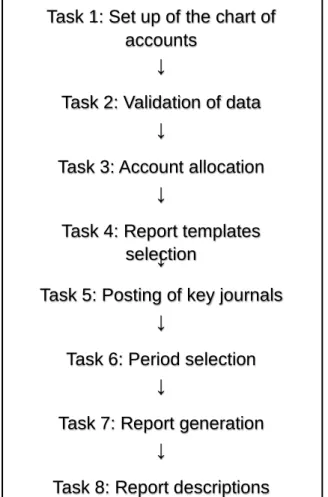
The final process to be addressed is the preparation of management accounts. Management accounts are a summary of a business’s accounting data which is prepared for the firm’s management. The purpose of preparing management accounts is to provide information that can assist management with decision-making (Whittington, 2007:198; Gorbunova & Bochkarev, 2011:25). An example of the process is illustrated in Figure 4.
Figure 4 Tasks in the management reporting process (adapted from DBASS Chartered Accountants, 2014)
Management accounts have three components, namely, financial reporting, performance measurement and cost planning (Cokins, 2013:27). Figure 5 illustrates the different components and gives examples of the different types of report that make up each component, in line with Trigo, Belfo and Estébanez (2014:120).
The reports contained in management accounts may be either descriptive and retrospective, providing an overall view of the business’s historical performance, or they may be predictive
Task 3: Account allocation
Task 4: Report templates selection
Task 5: Posting of key journals
Task 6: Period selection
Task 7: Report generation
Task 8: Report descriptions
↓
Task 1: Set up of the chart of accounts
Task 2: Validation of data
↓ ↓ ↓ ↓ ↓ ↓
20
and prospective, making use of historical data to predict future events (Amani & Fadlalla, 2017:35; Appelbaum, Kogan, Vasarhelyi & Yan, 2017:36). The differences inherent in the reports affect the tasks involved in their preparation.
Figure 5: The components of management accounts (adapted from Cokins, 2013:27)
Business needs may vary, and small businesses in particular are unlikely to produce all the reports mentioned here. Those that are produced would be dependent on management’s decision-making needs (CPA Australia Ltd, 2011:4).
2.4.1 Breaking down the management accounts reporting process into tasks
The first set of reports included in the management accounts is the financial reports, which are generated using internal data (Appelbaum et al., 2017:35). In order to produce an accurate set of financial reports, the process followed in the Sage Line 50 software was considered (DBASS Chartered Accountants, 2014). The tasks included in the preparation of financial reports are as follows:
Reporting
Financial reporting
Performance
measurement Cost planning
• Transaction processing
• Accounts payable • Accounts receivable • Costing of goods sold
• Inventory valuation • Variance reports • Budget vs. actual • Profitability • Cash flow management • Key personnel indicators • Budgeting • Forecasting • What-if analysis • Analysis of strategic options • Benchmarking • Strategic management accounting • Business risk management Management reporting
21
Task 1. Set up of the chart of accounts: The chart of accounts (COA) is an organised listing of the individual accounts that are used to record transactions and make up the reporting lines of the ledger system. The COA therefore provides the structure for classification of financial information. Classification structures will vary from company to company. Management accounts could, for example, break down financial information into underlying segments such as departments, products, employees, geographical locations, projects and customers (Cooper & Pattanayak, 2011:3).
Task 2. Validation of data: The data used to prepare the management accounts must be accurate, valid and complete. Therefore, prior to preparing the accounts, all transactions should be posted and reconciliations performed as described in sections 2.2 and 2.3 above.
Task 3. Account allocation: The transactions used in preparing the reports may be stored in a database and will need to be allocated to the specific chart of accounts by the user. The account allocation will be based on the nature of the transaction.
Task 4. Report templates selection:Reporting templates may be used in the preparation of management accounts. These are templates used for creating financial reports with predefined fields and formats. The templates can be predefined or blank and customisable (Roy, 2005:3).
Task 5. Posting of key journals: Period end journals may need to be posted, including for example wage journals, stock journals, prepayments and accrual journals.
Task 6. Period selection: The period for which the management accounts are prepared is selected.
Task 7. Report generation: The reports that make up the management accounts are produced by summarising the transactions for each reporting line in accordance with the chart of accounts mapped onto reporting templates.
Task 8. Report descriptions: Notes and descriptions may be added to the quantitative information contained in the management accounts to assist users’ understanding of the information.
22
Next, performance measurement is carried out using insights and inferences, as well as analysis of the processes or events that have taken place, to evaluate corporate performance. This process uses mainly internal data, although some external data such as industry benchmark information is also used to process cost analysis reports.
Cost planning reports are subsequently produced using both the financial reports and the analysis performed. Among other things, these cost planning reports forecast the future business performance, determine a budget to achieve the desired forecast and evaluate strategic options (Appelbaum et al., 2017:35).
2.4.2 Technology used in the management accounts reporting process
In this section, the technologies required for preparing the management accounts are discussed in line with the various tasks identified in section 2.4.1. In this process, technology is used to prepare the data, carry out the matching, produce the report of any exceptions identified and process any corrective actions.
User guidelines are discussed in chapter 5. As part of these guidelines, section 5.5 discusses the investment in technology required to enable the use of machine learning techniques. This section identifies those technologies that may enable the use of machine learning techniques in reporting.
Management accounts can be prepared either using information from the business’s accounting information system or extracting it from the accounting module of a larger enterprise resource planning application.
An accounting information system (AIS) is an application which works together with other information technology systems to record accounting transactions. An AIS collects, stores and processes financial and accounting data which then used to prepare reports for use by management; data may also include nonfinancial transactions that may impact the processing of financial transactions (Belfo & Trigo, 2013:537).
An enterprise resource planning (ERP) system is an information system that integrates resources, business process activities and information. It consists of various modules, of which accounting is one. The processes performed in the accounting module include the
23
creation of a chart of accounts, posting to journals and the generation of financial statements (Adhitama, Sarno & Sarwosri, 2016:20).
An ERP system enables management to access the operational data required for decision-making and business control (Appelbaum et al., 2017:31).
Extensible Business reporting language (XBRL) assists in the integration of applications. XBRL, a XML-based language, is a global standard for communicating business information. Accordingly, its use will ensure interoperability, thus allowing accounting information systems be more integrated with other systems. This is important as the automation of management accounting reporting will be dependent on the level of integration of the different applications producing information for the reports (Belfo & Trigo, 2013:542).
Natural language generation (NLG) used in producing report descriptions is a technology that converts structured data into written or spoken language. By incorporating an inference engine, the NLG system can perform tasks like summarising large amounts of data, explaining why datasets change, and making recommendations (Yseop, 2017:6).
2.4.3 Data available in the management reporting process
During the analysis of the document translation and reconciliation processes, the recommended format identified for data was XBRL. The Companies and Intellectual Property Commission (CIPC) acknowledges that XBRL can be used to integrate back-end processes in companies when automating the preparation of financial statements (Companies and Intellectual Property Commission, 2017b).
The CIPC is the central government agency in South Africa responsible for the registration of all companies. The CIPC indicates that the use of XBRL enables the automatic verification of compliance by means of a validation engine, with the aim of improving the efficiency and accuracy of the reporting process (Companies and Intellectual Property Commission, 2017b).
Big data may enable the preparation of more complex reports as it ensures sufficient data for making decisions. Big data can consist of data gathered inside the business – because this data is usually stored in a database it is generally structured – and external data, which is gathered from outside the business. External data is generally unstructured and therefore
24
often requires analytical tools to extract the information required for decision-making (Appelbaum et al., 2017:35).
2.5 Conclusion
This chapter described the three accounting processes, as well as the tasks performed in each process, the supporting technologies that would enable the inclusion of machine learning techniques in the process and the data available in the respective accounting processes.
An understanding of the tasks performed is the key to identifying the areas that can be addressed by machine learning technology. Each of the tasks that can be addressed using machine learning techniques will present a learning problem. Their machine learning solutions will be identified in chapter 3 and will be organised in the same sequence as the identified tasks.
25
Chapter 3: Overview of machine learning
3.1 Introduction
Having identified the different tasks in the accounting processes in chapter 2, this chapter describes the tasks that are considered problem areas and which are to be addressed by machine learning technology. The chapter also considers areas where machine learning techniques may be employed to enhance the capabilities of existing technologies in the respective processes (identified in chapter 2).
The objectives of this chapter of the study are to describe the components of the machine learning technology and the different machine learning techniques, as well as to identify the learning problems that machine learning techniques can address and that can be applied to each of the identified learning problems. This is in line with one of the research objectives of this study: to identify machine learning techniques that can be applied to the tasks in the accounting process.
The first section, section 3.2, provides a context for machine learning, which is considered important in view of the aim identified for this study, namely, to enhance users’ understanding of machine learning technology specifically in the performance of accounting processes.
The next section provides a description of the types of machine learning and the components of a machine learning architecture. Various machine learning techniques are then described and, in conclusion, the final section indicates the learning problems that can be applied to these techniques.
The machine learning techniques identified in this chapter are then discussed in more detail in chapter 4, where the risks and benefits associated with the specific machine learning techniques are described, as well as the risks, benefits and limitations of machine learning technology. These identified risks, benefits and limitations are then used in chapter 5 to formulate guidelines for implementing machine learning technology in an accounting context.
26
3.2 Context and framework of machine learning
Machine learning is one of the technologies that can be used in the accounting process to assist in the automation of tasks. Tools used in automation can be divided into different classes, namely, rules-based automation (robotic), knowledge-based cognitive intelligence and artificial intelligence. Combining artificial intelligence tools such as machine learning with robotic tools can automate the processing of unstructured inputs from beginning to end (Everest Group, 2014:11).
Machine learning is a subset of artificial intelligence, where patterns in data are learnt and applied in a changing environment. The technology does not require all possible situations to be known during development. Machine learning can be used in two ways: to detect the patterns that explain a process, known as explanatory machine learning technology, and to make predictions; this is known as predictive machine learning technology (Ayodele, 2010a:2; Sainani, 2014:841).
Machine learning technology is able to predict solutions or detect patterns despite uncertainty. This differs from knowledge-based systems which can only solve problems using stored knowledge and facts, as well as heuristics and other elements such as models and known patterns provided by human experts (Valavanis, Kokkinaki & Tzafestas, 1994:114).
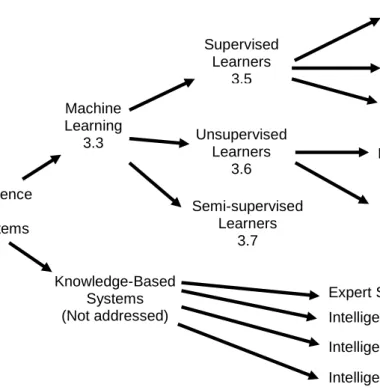
Figure 6 (Sutton et al., 2016:62) illustrates the different branches of artificial intelligence and therefore provides the context of machine learning in relation to other artificial intelligence technologies.
27
Figure 6: The artificial intelligence tree: the many branches of artificial intelligence application (adapted from Sutton et al., 2016:62)
It is important to be able to distinguish between the different artificial intelligence technologies, as different technologies may be able to address different user needs in business processes (Everest Group, 2014). However, knowledge-based systems are beyond the scope of this study.
Having provided a context for machine learning technology, the different types of machine learning technique are discussed in the next section. This is intended to contribute to understanding the framework for machine learning technology and was considered important, as non-expert users of machine learning techniques do not usually understand the terms that distinguish the different types of machine learning (Someren & Urbancic, 2006:366).
3.3 Types of machine learning algorithm
Having provided the context for machine learning within the field of artificial intelligence, as well as a description of the different components of machine learning technology, this section describes the different types of machine learning algorithm. The different machine learning types are distinguished by considering the objective of the algorithm, how the machine learning algorithm learns, as well as the structure and volume of the data used for learning (Ayodele, 2010:19; Castle, 2018:1).
Artificial Intelligence And Intelligent Systems Machine Learning 3.3 Knowledge-Based Systems (Not addressed) Supervised Learners 3.5 Unsupervised Learners 3.6 Classifiers 3.5.1 Predictors 3.5.2 Dual use 3.5.3 Pattern Detection 3.6.1 Clustering 3.6.2
Intelligent Decision Support System Expert Systems
Intelligent Decision Aid
Intelligent Agents Semi-supervised
Learners 3.7
28
Supervised learning algorithms require training. The algorithm is trained by using a labelled dataset which consists of examples of input data as well as the labels which indicate predicted targets or output data. Labels assist the algorithm in determining which features are important. The algorithm then generalises the training set by mapping the inputs to the correct responses, which enables it to produce output for new inputs (Ayodele, 2010:19; Castle, 2018:1; Larsson & Segerås, 2016:11; Marsland, 2009:6; SMACC, 2017:9).
Unsupervised learning algorithms do not require training. The input data is unlabelled, meaning the predicted values are not provided, which may be because they are unknown. The algorithm needs to determine the links between the inputs provided to identify patterns or commonalities that can be used to categorise new data or solve problems (Ayodele, 2010:19; Larsson & Segerås, 2016:11; Marsland, 2009:6; SMACC, 2017:9).
Semi-supervised learning algorithms are trained using a combination of labelled and unlabelled data to generate an appropriate function. The labelled portion indicates patterns which may exist, while the unlabelled data, usually the larger portion of the data, is used to establish perceived or unknown patterns for the data (Ayodele, 2010:19; Castle, 2018:1).
Having described the different machine learning technique types, the machine learning architecture is described in the next section. The architecture provides an overview of the components of the machine learning technology, including the different areas required to create a machine learning model that supports the use of the machine learning techniques.
3.4 Machine learning architecture
This section describes the different components of the machine learning architecture. This architecture will be adapted to the needs of the machine learning model as determined by the type of machine learning techniques used for a given task. The different machine learning techniques are subsequently described in the next section.
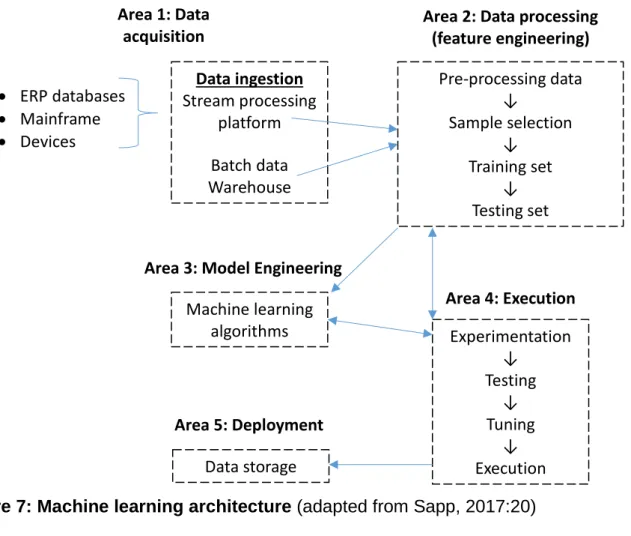
Gartner recommends that the following five functional areas be included in the machine learning architecture: data acquisition, data processing, data modelling, execution and deployment (Sapp, 2017:19). These areas are illustrated in Figure 7 which diagrammatically demonstrates the machine learning architecture.
29
Figure 7: Machine learning architecture (adapted from Sapp, 2017:20)
The functional areas illustrated in Figure 7 of the machine learning architecture are described by Sapp (2017:21) as follows:
Area 1: Data acquisition
Encompasses the collection and preparation of data for processing from a variety of sources and ensures that the data is reliable and adaptable for processing.
Area 2: Data processing including feature analysis
This area normalises and transforms the data into a structure suitable for machine learning. In addition, training sets and testing sets are selected in this area. A training set is a dataset which is used by the algorithm to identify relationships (Dataiku, 2017:5), while a testing set is a dataset used to assess whether the algorithm functions as desired. Feature analysis is performed to assess which features of the data are required for training the machine learning algorithm.
Area 3: Model Engineering
Area 4: Execution
Area 5: Deployment Area 1: Data
acquisition Area 2: Data processing(feature engineering) • ERP databases • Mainframe • Devices Data ingestion Stream processing platform Batch data Warehouse Pre-processing data ↓ Sample selection ↓ Training set ↓ Testing set Machine learning algorithms Experimentation ↓ Testing ↓ Tuning ↓ Execution Data storage
30
Area 3: Data modelling
This area includes the selection of the machine algorithms and the adaptation of the algorithm to the identified learning problems.
Area 4: Execution
In this area the prepared data and the machine learning algorithm are brought together to train the machine learning algorithm, test the model and then make any necessary changes to the algorithm to ensure that the machine learning model operates in a way that addresses the learning problem.
Area 5: Deployment
In this area the outputs of the machine learning model are made available for use in the applicable business applications or are stored as data to be used in reporting for example.
Having described the different machine learning technique types and the machine learning technology architecture, the different machine learning techniques available to address the learning problems identified in the form of accounting tasks are described in the next section.
3.5 Description of the supervised learning techniques
Descriptions of each of the machine learning techniques are provided in sections 3.5 to 3.7. The techniques are organised by learning problem type, as shown in Figure 6 of section 3.2. In describing the different machine learning techniques, the term “features” in data science refers to the independent variables or predictor variables (Dataiku, 2017:5).
The techniques described are applied to the learning problems in section 3.8. The benefits and limitations of the different machine learning techniques are identified in chapter 4 section 4.7. This section describes the various supervised learning techniques, starting with classification algorithms.
3.5.1 Classification algorithms
Classification algorithms are supervised learners, and therefore their development consists of a two-step process consisting of training and testing. During training, the algorithm maps class labels to data features. These features can predict the class labels of new data by learning from a training dataset that will consist of a set of data records and associated class