Abstract
—
Dynamic Routing in Wireless Sensor Networks
(WSNs) has played a significant task in research for the recent years.
Energy consumption and data delivery in time are the major
parameters with the usage of sensor nodes that are significant criteria
for these networks. The location of sensor nodes must not be
prearranged. Clustering in WSN is a key methodology which is used
to enlarge the life-time of a sensor network. It consists of numerous
real-time applications. The features of WSNs are minimized the
consumption of energy. Soft computing techniques can be included
to accomplish improved performance. This paper surveys the modern
trends in routing enclose fuzzy logic and Neuro-fuzzy logic based on
the clustering techniques and implements a comparative study of the
numerous related methodologies.
Keywords
—
Wireless sensor networks, clustering, fuzzy logic,
neuro-fuzzy logic, energy efficiency.
I.
INTRODUCTION
N
WSNs
, routing consists of both heterogeneous and
homogeneous systems with a huge number of tiny devices
called sensor node. Each device will have the responsibility of
sensing, computation and secure communication [1], [85].
Devices are cooperating to each other and the sensor will
autonomously sense the data. Two components are used in the
wireless network aggregation; point and base station [3].
Further, nodes have rigorously limited computation, storage
and power capabilities. However, they will tolerate numerous
challenges [6]. The position of sensor nodes cannot be
pre-determined because they are deployed randomly. The sensors
are battery driven and deployed in unmanned environments,
requiring energy conservation. The sensors are mostly mobile
[2]. Static routing algorithms fail in WSNs. Random
deployment may result in holes which are regions without
enough working sensors. Clustering is one of the techniques
to extend the network lifetime. In a clustering protocol, the
geologically neighboring nodes are gathered into virtual
groups called “clusters” [9], [65].
Each cluster has one Cluster Head (CH) and other nodes
are called cluster nodes. Instead of direct communication with
the destination, all the cluster nodes send data to the CH [88].
Clustering algorithms can be based on some criteria like
Harold Robinson Y. is an Associate Professor with the Department of Computer Science and Engineering, SCAD College of Engineering and Technology, India (e-mail: [email protected]).
Golden Julie is an Assistant Professor, Department of Computer Science and Engineering, Anna University, Chennai, India (e-mail: [email protected]).
battery nodes power, mobility, network size, speed, distance
and direction [4], [5].
Low Energy Adaptive Clustering Hierarchy (LEACH) is
one of the most well-known energy efficient clustering
algorithms for WSNs [7], [66]. The operation of LEACH has
two stages; setup phase and steady phase. To minimize the
packet overhead, the steady-state segment considers data
aggregation [12] for secure transmission. Besides LEACH,
various clustering algorithms have been proposed for
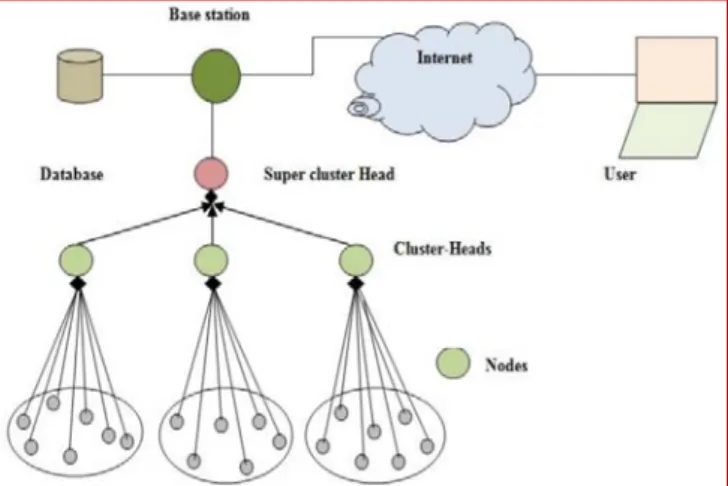
homogeneous WSNs [8], [86]. Fig. 1 illustrates the
architecture for the WSNs.
Fig. 1 Architecture of WSNs
II.
ROUTING PROTOCOLS
Routing is the process of forwarding data from source to
destination. Routing occurs in network layer. Routing
involves two activities. One is identifying the path for
forwarding the data; second is transferring the packet without
error [10], [11], [87]. A lot of attributes to the sink will select
the best path for transfer the packet using packet control
messages [15], [76]. Subsequently, transferring packet from
the source to the destination also hold various attributes for
forwarding data successfully. Each packet should deliver the
data without any error or security issues to the destination for
finding optimal path [18], [77].
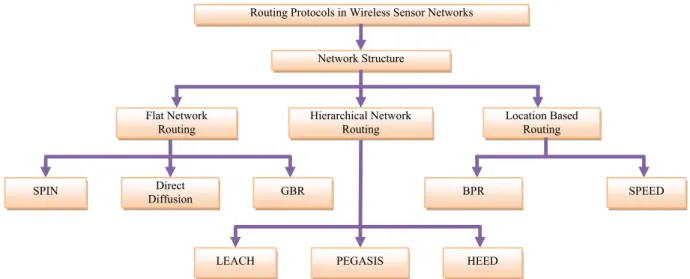
The delivered packet uses some standard metric to evaluate
the correct and efficient path [89]. They are, Flat network
routing, Hierarchical routing, and Location based routing as
shown in Fig. 2.
Y. Harold Robinson, E. Golden Julie
A Comparative Study on Fuzzy and Neuro-Fuzzy
Enabled Cluster Based Routing Protocols for
Wireless Sensor Networks
I
Fig. 2 Taxonomy of routing protocol in WSN
A. Flat Network Routing
Flat network routing consists of larger number of nodes in a
network. Due to larger network size the node will not have
general identifier. Some of the Flat network routing
algorithms are SPIN [40], Directed diffusion [41], GBR [43].
Fig. 3 Cluster Formation in WSN
B. Hierarchical Network Routing
Hierarchical routing or cluster based routing is a layer
routing protocol. It utilizes energy in an efficient manner, it
improves overall system scalability. It consists of two layers
in formal model, in which one layer is responsible for
selecting the CH and the other layer is responsible for routing.
This is used for lower energy consumption. Examples are
LEACH [46], HEED [44].
C. Location Based Routing
In location based routing, sensor nodes are addressed by
means of their location, the location may be available from
GPS. Sensor node consists of small GPS receiver for
communicate [67]. It is equipped with scheduling the node for
sleep (ideal) to improve energy. Node distances are calculated
by their signal strength. Example: GRF [42].
III.
CLUSTER BASED ROUTING PROTOCOL
Traditional routing protocols for WSN are used for energy
efficiency and load balancing. Clustering is used for energy
efficiency and reducing overhead [25], [28].
A. LEACH
LEACH has two phases. The first one is setup phase and
the other is steady state phase. In the setup phase, LEACH
selects randomly some nodes as a CH without any
predetermined fraction of nodes. The threshold T(n) is
computed based on an equation that integrates the valuable
percentage to suit a CH, the set of nodes, and the current
nodes that have not been selected as a CH in the last (1/P)
rounds, it is denoted by G. It is given by,
T n
/if n ϵ G
(1)
where, G is the set of nodes that are involved in the CH
election [26], [29]. During the steady phase, each CH collects
the sensed data from the member node and aggregates them
[90].
B. PEGASIS
The enhancement of LEACH protocol is called as Power
Efficient Gathering in Sensor Information System
(
PEGASIS). It consists of chain based clusters. All the nodes
can communicate with its neighbor nodes in the chain. The
chain construction is based on greedy fashion. Other nodes in
the chain start receiving data and send the data to its next
neighbor after aggregating the data. Sink node will receive
data from the leader. Multi-hop routing is done in PEGASIS.
There is delay in the chain for the nodes which are far away
from the leader node [32].
C. Threshold Sensitive Energy-Efficient Sensor Network
Protocol (TEEN)
TEEN protocol is used for time critical applications. It uses
a data centric mechanism [63]. Sensor node senses the
medium continuously. The minimum possible value of an
Routing Protocols in Wireless Sensor NetworksNetwork Structure
Flat Network
Routing Hierarchical Network Routing Location Based Routing
LEACH PEGASIS HEED
SPIN Direct
Diffusion GBR BPR SPEED
attribute is known as hard threshold. Message transmission
consumes less energy. This process will remove burden from
the CH [34].
D. Geographic Adaptive Fidelity (GAF)
GAF [22] has three states; (i) detection, (ii) active and (iii)
sleeping. Every node starts with the detection state [35].
TABLE I
CLUSTER ROUTING PROTOCOLS IN WSNS
Protocol
Name Stability Cluster Delivery Delay Scalability Complexity Algorithm Efficiency Energy LEACH Medium Small Very Very Low Low Very Poor
HEED High Medium Medium Medium Medium
PEGASIS Low Large Very Very Low High Poor
TEEN High Small Low High Very High
GAF Medium Poor High Medium Medium
IV.
SOFT COMPUTING TECHNIQUES
Soft computing could be a branch of engineering that has
its inspiration from nature. In control system engineering,
formal logic primarily based controller provides higher
performance than standard controllers. Recently, several fuzzy
based clustering algorithms [21], [10] have been proposed
which ensure lower energy consumption.
A. Fuzzy Logic
A fuzzy inference system is based on fuzzy set theory for
computing framework. The basic structure of fuzzy rule base
system consists of three parts [60], [69]. They are rule based,
database and reasoning mechanism [57], [70]. Fig. 2
illustrates the procedure.
Fig. 4 Membership function for Angle
Fig. 5 Membership function for Distance
Fig. 6 Membership function for Energy
Fig. 7 Membership function for Fuzzification using Mamdani
Fig. 8 Architecture for Fuzzy Logic
Fig. 9 Membership Function
Fuzzy logic consists of a decision making approach which
works similarly to human control logic, which provides a
simple method to reach a conclusion from imprecise, vague,
or ambiguous input information [13], [17], [71]. The
execution of a fuzzy logic system will reduce the computation
problem compared to the conventional mathematical methods
[14], [19].
The fuzzy rules and fuzzy reasoning are the backbone of
fuzzy inference system [23]. It consists of a series of
IF-THEN rules that relate the input fuzzy variables with the
output fuzzy variables using linguistic variables (modeling
human thinking) [16], [20].
Fig. 10 Output File
V.
CLUSTER BASED PROTOCOL USING FUZZY LOGIC
Fig. 11 Fuzzy System Model
In general, fuzzy logic is a multi valued logic, by which
intermediate values can be defined using expressions such
as true/false, high/low, below/above, etc. [37], [72], [73].
The most common fuzzy logic inferences are the Mamdani
and Tsukamoto-Sugeno methods [38].
The input of a Mamdani fuzzy logic system is usually a
crisp value. Mamdani uses the centroid technique which
tries to determine the point where a vertical line divides the
combined set into two equal parts [24]. Fig. 5 displays our
fuzzy model.
VI.
CH SELECTION BASED PROTOCOL USING FUZZY LOGIC
In Cluster Head Election using Fuzzy (CHEF) logic
approach [47], the CH selection is based on two parameters:
One is energy remain of the node (initial all nodes having
same energy), second parameter is local distance (it is based
on the signal receiving strength) and output parameter is
chance (tentative CH) using fuzzy if then rule. CH election
is based on fuzzy rule among all sensor nodes in the
network. By using fuzzy logic, the computational overhead
is reduced and prolongs the network lifetime [75].
A. Fuzzy Multi Constraint Routing
The fuzzy multi constraint routing protocol [59] consists
of many constraints like collision, traffic level, buffer
occupancy, battery power etc. Only one constraint is not
enough for selecting CH.
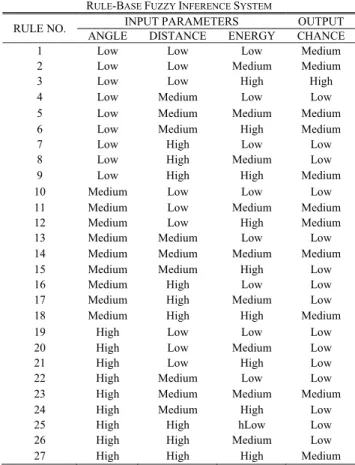
TABLEII
RULE-BASE FUZZY INFERENCE SYSTEM
RULE NO. INPUT PARAMETERS OUTPUT
ANGLE DISTANCE ENERGY CHANCE
1 Low Low Low Medium
2 Low Low Medium Medium
3 Low Low High High
4 Low Medium Low Low
5 Low Medium Medium Medium
6 Low Medium High Medium
7 Low High Low Low
8 Low High Medium Low
9 Low High High Medium
10 Medium Low Low Low
11 Medium Low Medium Medium
12 Medium Low High Medium
13 Medium Medium Low Low
14 Medium Medium Medium Medium
15 Medium Medium High Low
16 Medium High Low Low
17 Medium High Medium Low
18 Medium High High Medium
19 High Low Low Low
20 High Low Medium Low
21 High Low High Low
22 High Medium Low Low
23 High Medium Medium Medium
24 High Medium High Low
25 High High hLow Low
26 High High Medium Low
27 High High High Medium
B. Improved Fuzzy Unequal Clustering
Improved fuzzy unequal clustering [58] approach
contains three parameters, energy, distance and density, as
input variables and output variables are chance and radius
as shown in Table V. A simulation result shows better
improvement in the network life time.
C. FRCA
Fuzzy Relevance–Based CH selection algorithm [61] is
developed for wireless mobile ad-hoc sensor networks. It
consists of three parameters Energy, Mobility, and
Distance. Based on the degree, the node will select tentative
CH. It reduces overhead due to flat structure by easy
resource management and bandwidth allocation, efficient
management of node positions and energy. FRCA improve
routing performance.
D. Fuzzy C Means Algorithm (FCM)
It is a centralized clustering algorithm [50]. It uses the
highest residual energy and the location information of
nodes for selecting CHs. In this one, every point has a
degree of belonging to some clusters rather than specifically
belonging to single cluster [54]. The fuzzy logic principle is
used for computing the degree of belonging to each cluster.
This algorithm minimizes the inter-cluster distance. It is a
very important tool used for image processing systems.
There is better formation of clusters when compared to
other approaches because the mean distance of each node to
CH is minimized which optimizes the transmission power
of non-CH nodes [74]. Fuzzy C-means approach is more
useful to distribute the nodes among the clusters and to
distribute the loads of the networks [51].
E. Energy-Efficient CH
Selection
The energy-efficient cluster head selection (NECHS)
mechanism is using fuzzy logic [56]. Table VI
demonstrates Rule-Base Fuzzy Inference System for
Energy-Efficient CH selection. For defuzzification, centre
of gravity method has been used [48].
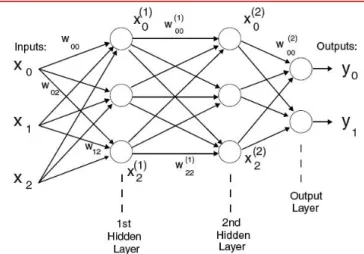
Fig. 12 Artificial Neural Network Model
Fig. 13 Feed Forward Neural Network Model
Fig. 14 Routing Model
F. Fuzzy Self Clustering Algorithm (FSCA)
It improves the performance of ACE [52] (an emergent
algorithm for highly uniform cluster formation), clustering
technique by fuzzy logic based system in each node. FSCA
[36] ensures to become a CH by specifying the nodes
eligibility (Tables VII and VIII). It is useful when all the
nodes within a cluster possess low energy [39]. The clusters
are formed with size equal to or greater than the network
density then after these clusters migrate away from each
other such that the overlap between them is reduced to zero.
New clusters might be formed in this process [45], [81],
[84].
G. Energy Aware Unequal Clustering Fuzzy Algorithm
The algorithm [49] proposes unequal clustering to
overcome the clustering problem. In the first round, CHs are
selected based on probabilistic models. In subsequent
rounds, heads are selected based on their energy levels.
Fuzzy parameters used are residual energy and distance of
the nodes as shown in Table IX. Mamdani method is used
as the fuzzy inference technique. Linguistic variables for
the fuzzy set are close, medium and far for distance to base
station whereas for residual energy, the variables are low,
medium and high [30]. Nodes can adjust their transmission
range. Distance of next node is calculated based on
Received Signal Strength. Nodes are all stationary. All the
nodes are homogeneous. Node density is not considered
[33].
TABLEIII
RULE-BASE FUZZY INFERENCE SYSTEM FOR CHEF Energy Local distance Chance
Low Far Very Low
Low Medium Low
Low Close Rather Low
Medium Far Medium Low
Medium Medium Medium
Medium Close Medium High
High Far Rather High
High Medium High
High Close Very High
TABLEIV
RULE-BASE FUZZY INFERENCE SYSTEM FOR FUZZY CONSTRAINT ROUTING
Buffer occupancy Battery power Hop count Grade
Low Low Low 0
Medium Medium Medium 0
Medium High Medium 0
Medium Medium High 0
Medium High High 0
High High Medium 1
High Medium High 1
High High High 1
TABLEV
RULE-BASE FUZZY INFERENCE SYSTEM FOR IMPROVED FUZZY UNEQUAL CLUSTERING
Input variables Output variables
Energy Distance Density Chance Radius
High Far High High Little Large
High Far Medium Little High Large
High Far Low Medium Large
High Moderate High High Little Large
High Moderate Medium Medium Medium
… …… … … …
Low Near Low Low Small
TABLEVI
RULE-BASE FUZZY INFERENCE SYSTEM FOR ENERGY-EFFICIENT CH SELECTION
Set of node number Set of remaining energy Probability of CH selection
Few Very low Very low
Few Low Very low
Few Medium Low
Few High Medium
Medium Very low Very low
Medium Low Low
Medium Medium Medium
Medium High High
Many Very low Low
Many Low Medium
Many Medium High
Many High Very high
TABLEVII
RULE-BASE FUZZY INFERENCE SYSTEM FOR FSCAINITIAL RULES
Node’s Time (T) Node’s Loyal Follower Initiation Chance
Low Low, Medium 0
Low High 1
Medium Low 0
Medium Medium, High 1
High Low, Medium, High 1
TABLEVIII
RULE-BASE FUZZY INFERENCE SYSTEM FOR FSCAMITIGATION RULES
Node’s loyal followers Node’s energy Migration chance
Low Low, Medium, High 1 ,2, 3
Medium Low, Medium, High 4 ,5, 6
High Low, Medium, High 7 ,8, 9
TABLEIX
RULE-BASE FUZZY INFERENCE SYSTEM FOR ENERGY AWARE UNEQUAL
CLUSTERING FUZZY ALGORITHM
Distance to base Residual energy Competition radius
Close Low Very small
Close Medium Small
Close High Rather Small
Medium Low Medium Small
Medium Medium Medium
Medium High Medium large
Far Low Rather large
Far Medium Large
Far High Very large
VII.
CLUSTER BASED PROTOCOL USING NEURO-FUZZY
TECHNIQUE
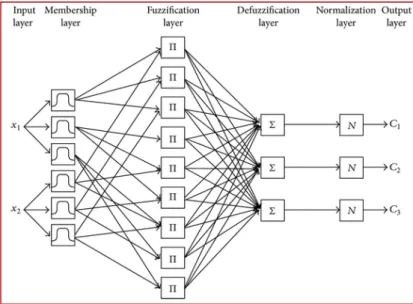
Neuro-fuzzy [55], [79], [80], [82], [83] means
combination of neural network and fuzzy logic. The
memory, available power, processing speed is the linguistic
input variables. The output variable is monitoring
coefficient. It works in dense environment. It uses fuzzy
logic for increasing the network lifetime as shown in Table
X.
A. Cluster Adaptation Method
It gives better performance than statistical en-route
filtering. It has been reported by developing fuzzy based
system [53], [78]. It gives better routing in sensor networks.
The input parameters are Partition Information of Cluster
Region (PICR) [62], the Number of Sensors in the Cluster
Region (NSCR) [64], Energy of Cluster Head (EOC) [11]
and Distance from Cluster to base station (DFC) [31]. The
output Fitness of the Cluster with Cluster head (CFWC)
[27] is derived using Fuzzy rules. The fuzzy set for CFWC
is Stop, Consider and Move.
TABLEX
RULE-BASE FUZZY INFERENCE SYSTEM FOR NEURO-FUZZY
Power Memory Processing speed Monitoring coefficient
Low Low Low Not used
Medium Medium Medium Critical
Medium High Medium Event
Medium Medium High Event
Medium High High Event
High High Medium Continuous
High Medium High Continuous
High High High Continuous
VIII.
CONCLUSION
Clustering is an important operation in WSN. In this
paper, several fuzzy clustering techniques are analyzed.
Comparative table is drawn for those fuzzy clustering
techniques. Each has its own merits and demerits. No
algorithm is perfectly suitable for commercial purposes. So it
is still an open challenge for future research and development.
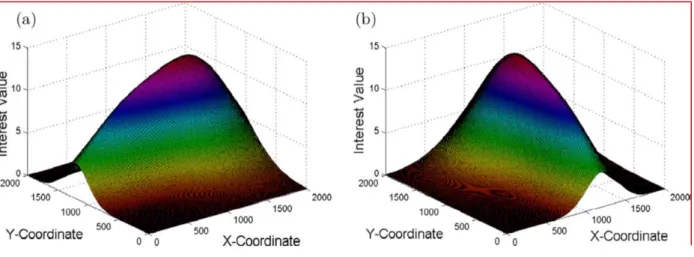
Fig. 15 Interest value
Fig. 16
CH
formation
Fig. 17 Non-Linear Regressive Neural Network
Fig. 18 Linear Regressive Neural Network
Fig. 19 Neuro-Fuzzy Layers
Fig. 20 Architecture of ANFIS
TABLEXIINPUT AND OUTPUT PARAMETERS OF FUZZY LOGIC BASED CH SELECTION
Algorithm Fuzzy Logic Type Input Parameter Output Parameter Membership Function for Output Parameter Features CHEF [47] Type 1 fuzzy set Energy, Local Distance Chance Triangular Prolong the lifetime Reduce overhead, Fuzzy Multi constraint
Routing [59] Type 1 fuzzy set Energy, Hop count Buffer occupancy, Grade Triangular Maximizes throughput Reduce overhead, Improved Fuzzy Unequal
Clustering [58] Type 1 fuzzy set Energy, Distance, Density Chance, Radius Triangular Prolong the lifetime of WSN
FCM [50] Type 1 fuzzy set Mean distance - -
Uniform distribution of clusters NECHS [56] Type 1 fuzzy set Neighbor nodes, residual energy Probability high; Triangular-low, little low, Trapezoidal-very low, very
medium; little high, high
Efficient than LEACH FSCA [52] Type 1 fuzzy set Node lifetime, total number of loyal
follower
Chance to being CH Triangular Efficient coverage, reduce amount of redundant messages EEUCF [49] Type 1 fuzzy set Distance to base, Residual energy Competition radius Triangular
Prolong the lifetime of WSN by distributing
the workload Neuro-fuzzy technique
[55] Type 1 fuzzy set
Memory, Available power, Processing
speed Monitoring coefficients
Trapezoidal-not used, continuous triangular-critical,
event
Used in monitoring systems Cluster adaptation method
[53] Type 1 fuzzy set EOC, PICR, DFC, NSCR CFWC Triangular To evaluate the fitness of clustering
TABLEXII
INPUT AND OUTPUT PARAMETER OF FUZZY LOGIC BASED CH SELECTION
Protocol Name CH Stability Delivery Delay Scalability Algorithm Complexity Energy Efficiency
CHEF Medium Very Small Very Low Medium Very Poor
Fuzzy Multi constraint Routing High Medium Medium Medium Medium
Improved Fuzzy Unequal Clustering Medium Large Very Low High Medium
FCM High Small Low High Medium
NECHS Medium small High Medium Medium
FSCA Medium small Medium Medium High
EEUCF High Medium Medium Low Very High
Neuro-fuzzy technique High Medium High Low High
Cluster adaptation method Medium Large Medium Medium High
REFERENCES
[1] A.M Nirmala, A.M., Subramaniam, P., Anusha Priya, A., Ravi, M.: Cluster Head Selection Protocol using Fuzzy Logic for Wireless Sensor Networks. IJASCSE. 2 (3), (2013)
[2] Chongdeuk Lee, Taegwon Jeong: FRCA: A Fuzzy Relevance-Based Cluster Head Selection Algorithm for Wireless Mobile Ad-Hoc Sensor Networks. Division of Electronic Engineering, Chonbuk National University, Jeonbuk, Korea.
[3] Harold Robinson, Y., &Rajaram, M. (2015). “Trustworthy link failure recovery algorithm for highly dynamic mobile adhoc networks”, World Academy of Science, Engineering and Technology, International Journal of Electrical, Computer, Energetic, Electronic and Communication Engineering, vol.9, no.2, 233–236.
[4] Aslam, M., Rasheed, M.B., Shah, T., Rahim, A., Khan, Z.A., Qasim, U., Qasim, M.W., Hassan, A., Khan, A., Javaid, N.: Energy optimization and Performance Analysis of Cluster Based Routing Protocols Extended from LEACH for WSNs.
[5] Heinzelman, W., Chandrakasan, A., Balakrishnan, H.: Energy-efficient routing protocols for wireless micro sensor networks. in Proc. 33rd Hawaii Int. Conf. System- Sciences(HICSS). Maui, HI, Jan. 2000. [6] Harold Robinson, Y., &Rajaram, M. (2015), “Energy-aware multipath
routing scheme based on particle swarm optimization in mobile ad hoc networks”, The Scientific World Journal, 1–9. doi:10.1155/2015/284276.
[7] Erfan. Arbab, Vahe. Aghazarian, Alireza. Hedayati, Nima. Ghazanfari Motlagh: A LEACH-Based Clustering Algorithm for Optimizing Energy Consumption in Wireless Sensor Networks. 2nd International Conference on Computer Science and Information Technology (ICCSIT'2012) Singapore. April 28-29, (2012).
[8] Lindsey, S., Raghavendra, C.S.: PEGASIS: Power-efficient Gathering in Sensor Information Systems. Parallel and Distributed Systems, 9 (924). (2002).
[9] Robinson, Y. Harold, M. Rajaram, and Honey Raju. "Evolutionary Program Based Approach for Manipulator Grasping Color Objects." World Academy of Science, Engineering and Technology, International Journal of Computer, Electrical, Automation, Control and Information Engineering 8.12 (2015): 2235-2240.
[10] Younis, O., Fahmy, S.: HEED: A Hybrid, Energy-efficient. Distributed Clustering Approach for Ad Hoc Sensor Networks. Mobile Computer, 3 (366). (2004).
[11] Ye, M., Li, C., Chen, G., Wu, J.: EECS: An Energy Efficient Cluster Scheme in Wireless Sensor Networks. Proceedings of IEEE International Workshop on Strategies for Energy Efficiency in Ad Hoc and Sensor Networks. Phoenix, Arizona, (2005) April 7–9.
[12] Princess, P. Joyce Beryl, and Y. Harold Robinson. "Discrete and Stationary Adaptive Sub-Band Threshold Method for Improving Image Resolution." World Academy of Science, Engineering and Technology, International Journal of Computer, Electrical, Automation, Control and Information Engineering 9.4 (2015): 1003-1006.
[13] Haifeng Jiang, Yanjing Sun, Renke Sun, Hongli Xu Hindawi: Fuzzy-Logic-Based Energy Optimized Routing for Wireless Sensor Networks. International Journal of Distributed Sensor Networks. (2013).
[14] Shurman, M.M., Alomari, Z.A., Mhaidat, K.M.: An Efficient Billing Scheme for Trusted Nodes Using Fuzzy Logic in Wireless Sensor Networks. Wireless Engineering and Technology. 5, 62-73. 2014. [15] Robinson, Y. H., Julie, E. G., & Princess, P. J. B. (2016). Manipulation
of Image Segmentation Using Cleverness Artificial Bee Colony Approach. World Academy of Science, Engineering and Technology,
International Journal of Computer, Electrical, Automation, Control and Information Engineering, 10(3), 607-614.
[16] http://en.wikipedia.org/wiki/Fuzzy_logic.
[17] Antonio M. Ortiz. Fernando Royo. Teresa Olivares, Jose C. Castillo, Luis Orozco Barbosa, Pedro J. Marron.: Fuzzy-logic based routing for dense wireless sensor networks.
[18] Robinson, Y. H., Julie, E. G., & Balaji, S. Bandwidth and Delay Aware Routing Protocol with Scheduling Algorithm for Multi Hop Mobile Ad Hoc Networks. World Academy of Science, Engineering and Technology, International Journal of Computer, Electrical, Automation, Control and Information Engineering, 10(8), 1512-1521.
[19] Su, W., Bougiouklis, T. C.: Data fusion algorithms in cluster-based wireless sensor networks using fuzzy logic theory.” In Proceedings of the 11th WSEAS international conference on communications. [20] Tarique Haiderl, Mariam Yusuf.: A Fuzzy Approach to Energy
Optimized Routing for Wireless Sensor Networks. The International Arab Journal of Information Technology. 6 (2), April 2009.
[21] Balaji, S., Julie, E. G., Rajaram, M., & Robinson, Y. H. Fuzzy Based Particle Swarm Optimization Routing Technique for Load Balancing in Wireless Sensor Networks, World Academy of Science, Engineering and Technology, International Journal of Computer, Electrical, Automation, Control and Information Engineering Vol:10, No:7, 2016, pp. 1384 – 1393.
[22] Wikipedia.: Routing basics”docwiki.cisco.com/wiki/routing_basics [23] Naveen Sharma, Anand Nayyar: A Comprehensive Review of Cluster
Based Energy Efficient Routing Protocols for Wireless Sensor Networks. 3 (1), January 2014.
[24] Geethalakshmi, M., and Y. Harold Robinson. "Fault tolerant routing and scheduling scheme for multi hop wireless networks." International Journal of Advanced Research in Computer Science and Software Engineering 3, no. 3 (2013).
[25] Jamal N. Al-Karaki Ahmed E. Kamal.: Routing Techniques in Wireless Sensor Networks: A Survey.
[26] S.K Singh, M.P Singh and D.K Singh, “A Survey of Energy-Efficient Hierarchical Cluster-Based Routing in Wireless Sensor Networks,” In International Journal of Advanced Networking and Applications, vol.02, pp.570-580, 2010.
[27] Balaji, S., Rajaram, M., Robinson, Y. H., & Julie, E. G. (2016). A Hypercube Social Feature Extraction and Multipath Routing in Delay Tolerant Networks. World Academy of Science, Engineering and Technology, International Journal of Computer, Electrical, Automation, Control and Information Engineering, 10(6), 1220-1229.
[28] Heinzelman, W.R., Chandrakasan, A., Balakrishnan: Energy-Efficient Communication Protocol for Wireless Microsensor Networks. In Proceedings of the 33rd Annual Hawaii International Conference on System Sciences, Maui, HI, USA, pp. 10–19, 4–7 January 2000. [29] Younis, S., Fahmy, O.: HEED: A hybrid, energy-efficient, distributed
clustering approach for ad-hoc sensor networks. IEEE Trans. Mobile Computer, 366–379, 2004.
[30] Balaji, S., Harold Robinson, Y. and Rajaram, M. (2016) SCSBE: Secured Cluster and Sleep Based Energy-Efficient Sensory Data Collection with Mobile Sinks. Circuits and Systems, Vol.8, No. 7, pp. 1992-2001. http://dx.doi.org/10.4236/cs.2016.78173.
[31] Wendi Rabiner Heinzelman, Anantha Chandrakasan, Hari Balakrishnan: Energy Efficient Communication Protocol for Wireless Microsensor Networks. In the Proceedings of the Hawaii International Conference on System Sciences, January 4-7, 2000, Maui, Hawaii.
[32] Manjeshwar, D.P., Agrawal, E.: TEEN: A Routing Protocol for Enhanced Efficiency in Wireless Sensor Networks. In Proceedings of
the 15th International Parallel and Distributed Processing Symposium (IPDPS), San Francisco, CA, USA, pp. 2009–2015, 23–27 April 2001. [33] Robinson, Y.H., Balaji, S. and Rajaram, M. (2016) “ECBK: Enhanced
Cluster Based Key Management Scheme for Achieving Quality of Service”, Circuits and Systems, Vol. 8, No. 7, pp. 2014-2024. http://dx.doi.org/10.4236/cs.2016.78175.
[34] YaXu, John Heidemann, Deborah Estrin: Geography informed Energy Conservation for Ad Hoc Routing. Proceedings of the Seventh Annual ACM/IEEE International Conference on Mobile Computing and Networking (ACM Mobicom), 2001.
[35] Heinzelman, W.R., Chankdrakasan A., Balakrishnan, H.: Energy Efficient Communication Protocol for Wireless Microsensor Network. Int. Conf. Sys. Scien. 8, 2000, pp. 3005–3014.
[36] Harold Robinson, Y., Rajaram, M., Golden Julie, E. and Balaji, S. (2016) Dominating Set Algorithm and Trust Evaluation Scheme for Secured Cluster Formation and Data Transferring. World Academy of Science, Engineering and Technology, International Journal of Computer, Electrical, Automation, Control and Information Engineering, vol. 10, No. 2, pp. 388-393.
[37] Zhao F., Guibas, L.: Wireless Sensor Networks: An Information Processing Approach. Morgan Kaufmann Publishers –San Francisco 2004.
[38] Klir G.J., Yuan, B.: Fuzzy Sets and Fuzzy Logic: Theory and Applications. Prentice Hall –New Jersey 1995.
[39] Harold Robinson, Y., Rajaram, M., Golden Julie, E. and Balaji, S. (2016), “Tree Based Data Fusion Clustering Routing Algorithm for Illimitable Network Administration in Wireless Sensor Network”, World Academy of Science, Engineering and Technology, International Journal of Computer, Electrical, Automation, Control and Information Engineering Vol:10, No:6, pp. 1123 – 1130.
[40] Weilian Su the Odoros C. Bougiousklis: Data Fusion Algorithms in Cluster-based Wireless Sensor Networks Using Fuzzy Logic Theory. Proceedings of the 11th WSEAS International Conference on communication, Agios Nikolaos, Crete Island, Greece, July 26-28, 2007.
[41] Ehsan Amiri, Hassan Keshavarz, Mojtaba Alizadeh, Mazdak Zamani, Touraj Khodadadi: Energy Efficient Routing in Wireless Sensor Networks Based on Fuzzy Ant Colony Optimization. International Journal of Distributed Sensor Networks. 2014, 17.
[42] Harold Robinson, Y., Rajaram, M., Golden Julie, E. and Balaji, S. (2016), “TBOR: Tree Based Opportunistic Routing for Mobile Ad Hoc Networks”, World Academy of Science, Engineering and Technology, International Journal of Computer, Electrical, Automation, Control and Information Engineering Vol:10, No:6, pp. 1115 – 1122
[43] Shio Kumar Singh, Singh, M.P., Singh, D.K.: Routing Protocols in Wireless Sensor Networks: A Survey. International Journal of Computer Science & Engineering Survey (IJCSES). 1 (2), November 2010. [44] Intanagonwiwat, Govindan, R., Estrin, D.: Directed Diffusion: A
Scalable and Robust Communication Paradigm for Sensor Networks. Proc. Sixth Ann. ACM/IEEE Int’l Conf. Mobile Computing and Networking (MOBICOM), pp. 56-67, Aug. 2000.
[45] Ramalakshmi, S., & Robinson, Y. H. (2014). “ATMPH: Attaining optimal throughput capacity of MANET with power control in heterogeneous network”, Programmable Device Circuits and Systems, 6(4), 111–115.
[46] Haas, Z.J. Halpern, J.Y. Li, L.: Gossip-Based Ad Hoc Routing. In Proceedings of the 19th Conference of the IEEE Communications Society (INFOCOM), New York, NY, USA, June 2002; 23–27, pp. 1707–1716.
[47] Younis, O., Fahmy, S.: HEED: A Hybrid, Energy-Efficient, Distributed Clustering Approach for Ad Hoc Sensor Networks. IEEE Transactions on Mobile Computing, 2004, 3(4), 660–669.
[48] Harold Robinson, Y., & Rajaram, M. (2014). “A novel approach to allocate channels dynamically in wireless mesh networks”, World Academy of Science, Engineering and Technology, International Journal of Computer, Electrical, Automation, Control and Information Engineering, vol. 8, no.10, pp. 1865–1868.
[49] Laiali Almazaydeh, Eman Abdelfattah, Manal Al-Bzoor, Amer Al- Rahayfeh: Performance evaluation of routing in wireless sensor networks. International Journal of Computer Science and Information Technology, 2 (2), April 2010.
[50] Kim, J.M., Park, S., Han, Y., Chung, T.: CHEF: Cluster Head Election mechanism using Fuzzy logic in Wireless Sensor Networks. in Proceeding of the 10th International Conference on Advanced Communication Technology (ICACT), pp. 654–659. 2008.
[51] Robinson, Y. H., & Rajeswari, S. R. (2011). “Energy-based dynamic encryption for wireless sensor networks. Wireless Communication”, vol.3, no.9, pp. 661–663.
[52] Hakan Bagci, Adnan Yazici: An energy aware fuzzy approach to unequal clustering in wireless sensor networks. Applied Soft Computing. 13, pp. 1741–1749, 2013.
[53] Hoang, D.C., Kumar, R., Panda, S.K.: Fuzzy C-Means Clustering Protocol for Wireless Sensor Networks’, in Proceeding of the IEEE International Symposium on Industrial Electronics (ISIE), pp. 3477– 3482. 2010.
[54] Golden Julie, E., Tamil Selvi, S., & Harold Robinson, Y. (2016). “Performance Analysis of Energy Efficient Virtual Back Bone Path Based Cluster Routing Protocol for WSN”, Wireless Personal Communications, Springer, 1–19, DOI 10.1007/s11277-016-3520-5. [55] Tashtoush, Y.M., Okour, M.A.: Fuzzy Self-Clustering for Wireless
Sensor Networks. In proceeding of the IEEE/IFIP International Conference on Embedded and Ubiquitous Computing, pp. 223–229. 2008.
[56] Kim, B.H., Moon, S.Y., Lee, H.Y., Sun, C.I., and Cho, T.H.: Cluster Adaptation Method to Enhance Performance of Filtering scheme in Sensor Network. in Proceeding of the 11th International Conference on Advanced Communication Technology, pp. 411–416. 2009.
[57] Harold Robinson, Y., Rajaram, M., Golden Julie, E. and Balaji, S. (2016), “Detection of Black Holes in MANET Using Collaborative Watchdog with Fuzzy Logic”, World Academy of Science, Engineering and Technology, International Journal of Computer, Electrical, Automation, Control and Information Engineering Vol:10, No:3, pp. 575 – 581.
[58] Veena, K.N., Vijaya Kumar, B.P.: Dynamic Clustering for Wireless Sensor Networks: A Neuro-Fuzzy Technique Approach’ in Proceeding of the IEEE International Conference on Computational Intelligence and Computing Research (ICCIC), pp. 1–6. 2010.
[59] Hu, Y., Shen, X., Kang, Z.: Energy-efficient Cluster Head Selection in Clustering Routing for Wireless Sensor Networks. In Proceedings of the 5th International Conference on Wireless Communications, Networking and Mobile Computing, WiCom’09, pp. 1–4. 2009.
[60] G. Arun Sam Paul Thomas, R. Karthik Ganesh, A. Kandasamy, S. Balaji, Y. Harold Robinson, (2011) “An Advanced Controlled-Flooding Routing with Group Organization for Delay Tolerant Networks using A-SMART”, Emerging Trends in Electrical and Computer Technology (ICETECT), 978-1-4244-7926-9/11, IEEE.
[61] Songmao, Chenglinzhao, Zhengzhou, yabin.: An improved fuzzy unequal clustering algorithm for wireless sensor network. 6th international ICST conformance on communication and networking in china (CHINACOM), 2011.
[62] Mala Chelliah, Siddhartha Sankaran, Shishir Prasad, Nagamaputurgopalan, Balasubramaniansivaselvan: Routing for wireless mesh networks with multiple constraints using fuzzy logic. International Arab Journal of Information Technology. 9 (1), jan. 2012.
[63] Harold Robinson, Y, Golden Julie E, Balaji S, Ayyasamy A, (2016), Energy Aware Clustering Scheme in Wireless Sensor Network Using Neuro-Fuzzy Approach , Wireless Personal Communications, Springer, 1-19, Doi: 10.1007/s11277-016-3793-8
[64] Chongdeuk lee, Taegwonjeong.: FRCA: A fuzzy relevance –based cluster head selection algorithm for wireless mobile ad-hoc sensor networks. Sensors. 11, 5383-5401, 2011.
[65] Anitha Shanmugam, Dr. Abirami Thiayagarajan, "Mining of Behavioral
Patterns Using Prefix Sharing ASP-Tree in Wireless Sensor Networks", International Journal of Advances in Computer and Electronics Engineering, Volume 2, Issue 3, March 2017, pp. 28 – 32.
[66] Balaji, S., E. Golden Julie, and Y. Harold Robinson. "Evaluation of Context Information for Intermittent Networks." World Academy of Science, Engineering and Technology, International Journal of Computer, Electrical, Automation, Control and Information Engineering 10.9 (2017): 1693-1704.
[67] Rakhi Sharma, Dr. D. V. Gupta, "Effects of Selfish node on Routing Protocols in Delay Tolerant Network", International Journal of Advances in Computer and Electronics Engineer-ing, Volume 2, Issue 3, March 2017, pp. 08 - 10.
[68] Xing, G., Jia, W. and Li, M., Rendezvous Algorithms for Wireless Sensor Networks with a Mobile Base Station. IEEE Transaction on Mobile Compution, 11(1), pp.47-60, 2012.
[69] Robinson, Y. Harold, and M. Rajaram. "Establishing pairwise keys using key Predistribution schemes for sensor networks." World Academy of Science, Engineering and Technology, International
Journal of Computer, Electrical, Automation, Control and Information Engineering 9.2 (2015): 608-612.
[70] Kim, D.S. and Chung, Y.J., June. Self-organization routing protocol supporting mobile nodes for wireless sensor network. In Computer and Computational Sciences, 2006. IMSCCS'06. First International Multi-Symposiums on (Vol. 2, pp. 622-626). IEEE, 2006.
[71] Vincze, Z., Vass, D., Vida, R., Vidács, A. and Telcs, A., Adaptive sink mobility in event-driven multi-hop wireless sensor networks. In Proceedings of the first international conference on Integrated internet ad hoc and sensor networks (p. 13). ACM, May 2006.
[72] Golden Julie, E., Tamil Selvi, S., & Harold Robinson, Y. “Opportunistic routing with secure coded wireless multicast using MAS approach”, World Academy of Science, Engineering and Technology, International Journal of Computer, Electrical, Automation, Control and Information Engineering, vol. 8, no.7, pp. 1247–1250, 2014.
[73] Jain, S., Shah, R.C., Brunette, W., Borriello, G. and Roy, S., Exploiting mobility for energy efficient data collection in wireless sensor networks. Mobile Networks and Applications, 11(3), pp.327-339, 2006.
[74] Deng, S., Li, J. and Shen, L., Mobility-based clustering proto-col for wireless sensor networks with mobile nodes. IET wireless sensor systems, 1(1), pp.39-47, 2011.
[75] Balaji, S., Golden Julie, E. & Harold Robinson, Y. “Development of Fuzzy based Energy Efficient Cluster Routing Protocol to Increase the Lifetime of Wireless Sensor Networks“, Mobile Netw Appl (2017), pp. 1-13. https://doi.org/10.1007/s11036-017-0913-y
[76] Erman, A.T., van Hoesel, L., Havinga, P. and Wu, J., 2008. Enabling mobility in heterogeneous wireless sensor networks cooperating with UAVs for mission-critical management. IEEE Wireless Communications, 15(6), pp.38-46.
[77] Chatzigiannakis, I., Kinalis, A. and Nikoletseas, S., Sink mobility protocols for data collection in wireless sensor net-works. In Proceedings of the 4th ACM international workshop on Mobility management and wireless access (pp. 52-59). ACM, 2006.
[78] Robinson, Y. Harold, and M. Rajaram. "A memory aided broadcast mechanism with fuzzy classification on a device-to-device mobile Ad Hoc network." Wireless Personal Communications 90.2 (2016): 769-791.
[79] Chandran, S.R., Manju, V.S., Alex, A.P., A Neuro-Fuzzy Approach to Route Choice Modelling. International Journal of Science and Applied Information Technology Vol.2 , No.2, Pages : 09-11, 2013.
[80] Sasikala K., Rajamani V., A Neuro Fuzzy based conditional shortest path routing protocol for wireless mesh network, In-ternational Journal of Enhanced Research in Management and Computer Applications, vol. 2 issue 5, 2013.
[81] Robinson Y,Harold, Julie E,Golden, Ayyasamy A, Archana M, “Cluster based Routing in Sensor Network using Soft Computing Techniquies: A Survey“,Asian Journal of Research in Social Sciences and Humanities, Vol. 7, No. 3, pp. 341-360.
[82] Pon Rohini R, Shirly S, Joy Winnie Wise D.C., Multipath Routing Using Neuro Fuzzy in Wireless Sensor Network, In-ternational Journal for Research in Applied Science and Engi-neering Technology, vol 3 issue IV, 2015.
[83] Fard, M.V., Mazinani, S.M. and Hoseini, S.A., Introducing a novel fault tolerant routing protocol in wireless sensor net-works using fuzzy logic. International Journal of Computer Science & Information Technology, 5(5), p.171, 2013.
[84] Robinson, Y. Harold, E. Golden Julie, A. Ayyasamy, and M. Archana. "Cluster based Routing in Sensor Network using Soft Computing Techniquies: A Survey." Asian Journal of Research in Social Sciences and Humanities 7, no. 3 (2017): 341-360.
[85] Y. Xu, A. Saifullah, Y. Chen, C. Lu, S. Bhattacharya, Near optimal multi application allocation in shared sensor networks, in: Proceedings of the Eleventh ACM International Symposium on Mobile Ad Hoc Networking and Computing, MobiHoc ’10, ACM, New York, NY, USA, 2010, pp. 181–190. doi:10.1145/1860093.1860118. URL http://doi.acm.org/10.1145/ 1860093. 1860118.
[86] R. Huang, X. Chu, J. Zhang, Y. H. Hu, Energy-efficient monitoring in software defined wireless sensor networks using reinforcement learning: A prototype, International Journal of Distributed Sensor Networks 2015. doi:10.1155/2015/360428.
[87] Abouelfadl, A. A., El-Bendary, M. A. M., & Shawki, F. (2014). Enhancing transmission over wireless image sensor networks based on ZigBee network. Life Science Journal, 11(8), 342–354.
[88] El-Bendary M. A. M.,, Kasban, H., & El-Tokhy, M. A. R. (2014). Interleaved reed-solomon codes with code rate switching over wireless
communications channels. In: International Journal of Information Technology and Computer Science (IJITCS) (http://www.ijitcs.com) on, 16(1).
[89] Stankovic, J. A., Wood, A. D., & He, T. (2011). Realistic applications for wireless sensor networks. In S. Nikoletseas & J. D. P. Rolim (Eds.), Theoretical aspects of distributed computing in sensor networks (pp. 835–863). Berlin: Springer.
[90] Momani, M., & Challa, S. (2010). Survey of trust models in different network domains. arXiv preprint arXiv:1010.0168.
Dr. Y. Harold Robinson is currently working as an Associate Professor and Head, Department of Computer Science and Engineering in SCAD College of engineering and Technology, Tirunelveli. He Completed PhD in Anna University, Chennai. He finished ME degree in Anna University, Chennai. He received his Ph.D. from Anna University Chennai. His research interests are Wireless Networks Mobile Computing, Wireless Sensor Networks. He has published several Research papers in International Journals. He has presented many papers in National and International conferences in Network security, Mobile Computing and Cloud Computing.
Dr. E. Golden Julie received her B.E degree in Computer Science and Engineering in 2005 from Anna University Chennai and ME degree in Computer Science and Engineering in 2008 from Anna University Chennai. She received Ph.D from Anna University Chennai. Presently she is working as assistant professor in Regional centre Anna University, Tirunelveli, India She has published many research papers in various fields. Her research area includes Wireless Sensor Adhoc Networks and Image Processing. She is a member of ISTE.