Wellesley College
Wellesley College Digital Scholarship and Archive
Honors Thesis Collection
2016
Tutor-Complete: An Educational Game and
Intelligent Tutoring System for Languages and
Automata
Katherine Kjeer
[email protected]Follow this and additional works at:
https://repository.wellesley.edu/thesiscollection
This Dissertation/Thesis is brought to you for free and open access by Wellesley College Digital Scholarship and Archive. It has been accepted for inclusion in Honors Thesis Collection by an authorized administrator of Wellesley College Digital Scholarship and Archive. For more information, please [email protected].
Recommended Citation
Kjeer, Katherine, "Tutor-Complete: An Educational Game and Intelligent Tutoring System for Languages and Automata" (2016). Honors Thesis Collection. 395.
WELLESLEY COLLEGE
Tutor-Complete:
An Educational Game and Intelligent
Tutoring System for Languages and
Automata
by
Katherine Kjeer
Submitted in Partial Fulfillment of the Prerequisite for Honors
in the
Computer Science Department
“Play is the highest form of research.”
WELLESLEY COLLEGE
Abstract
Computer Science Department Bachelor of Arts
by Katherine Kjeer
Educational games and Intelligent Tutoring Systems have been shown to improve stu-dent learning outcomes by increasing engagement and providing individualized instruc-tion. However, while introductory programming students frequently benefit from such systems, students in upper-level theoretical courses such as CS 235 (Languages and Au-tomata) have dense textbooks and dry mathematical readings as their primary or only resources. Tutor-Complete aims to fill this gap by presenting two fundamental CS 235 concepts in a game environment. In the first activity, students construct Determinis-tic Finite-State Automata in order to guide their character across a landscape. In the second activity, students build proofs using the pumping lemma to defeat the “villain” character. Tutor-Complete also fosters a peer-learning environment by encouraging stu-dents to explain concepts to each other and providing hints based on past student work. Finally, Tutor-Complete uses Bayesian Knowledge Tracing to model students’ knowledge and tailor the learning experience accordingly.
Acknowledgements
With sincere appreciation, I thank my advisor, Eni Mustafaraj, for her incredible guid-ance and support of this thesis. Tutor-Complete would not exist without her encourage-ment and expertise. I also thank my committee members, Lyn Turbak and Orit Shaer, for their valuable feedback and generosity in this process.
Thank you to all the Computer Science professors that I have studied or worked with (Lyn Turbak, Sohie Lee, Taxis Metaxas, Stella Kakavouli, Randy Shull, Jean Herbst, Scott Anderson, Rhys Price Jones, Ben Wood, Eni Mustafaraj, Orit Shaer, and Brian Tjaden) for sharing their wealth of knowledge about this amazing field.
I am grateful to the Computer Science students that participated in user studies for this thesis, whose thoughtful feedback has strengthened Tutor-Complete and generated ideas for future work.
Finally, I am very thankful to my family, friends, and professors for their support, encouragement, and patience in the process of building Tutor-Complete and writing this thesis.
Contents
Abstract ii
Acknowledgements iii
List of Figures vii
List of Tables ix
List of Algorithms x
Abbreviations xi
1 Introduction 1
1.1 Educational Games . . . 1
1.2 Intelligent Tutoring Systems . . . 2
1.3 Motivation . . . 3
1.4 Educational Goals . . . 4
1.5 Thesis Overview . . . 4
2 Related Work 5 2.1 Microworlds . . . 5
2.1.1 BuggleWorld, TurtleWorld, and PictureWorld . . . 5
2.1.2 Programmer’s Learning Machine . . . 6
2.1.3 PacMan . . . 6
2.2 Concept Testers. . . 7
2.2.1 JFLAP . . . 7
2.2.2 JDSL Visualizers and Testers . . . 8
2.3 Games . . . 8 2.3.1 Game2Learn . . . 9 2.3.2 Dragon Architect . . . 9 2.3.3 Minecraft . . . 10 3 Game Design 11 3.1 Game Overview . . . 11 3.2 CS 235 Concepts . . . 12
3.2.1 Deterministic Finite-State Automata . . . 12 iv
Contents v
3.2.2 The Pumping Lemma for Regular Languages . . . 13
3.3 Activities . . . 13
3.3.1 DFA Activity . . . 14
3.3.2 Pumping Lemma Activity . . . 17
3.4 Design Factors . . . 23
3.5 Worlds . . . 25
3.5.1 World DFA Activities . . . 26
3.5.2 World Pumping Lemma Activities . . . 26
3.6 Features . . . 27 3.6.1 Educational Gaming . . . 27 3.6.2 Peer Instruction . . . 29 3.6.3 Tutoring. . . 29 4 Hint Generation 31 4.1 Overview . . . 31 4.2 Initialization . . . 33 4.3 Graph Similarity . . . 34 4.4 Grouping . . . 37
4.5 Markov Decision Process. . . 39
5 Bayesian Knowledge Tracing 41 5.1 Theory . . . 41
5.2 Pumping Lemma: Classical BKT . . . 43
5.3 DFAs: Contextual BKT . . . 45
6 Evaluation 47 6.1 User Study Design . . . 47
6.2 DFA Results . . . 49
6.2.1 DFA Interface Feedback . . . 49
6.2.2 DFA Understanding Feedback. . . 50
6.2.3 DFA Hints Feedback . . . 50
6.2.4 DFA Activity Score Feedback . . . 51
6.3 Pumping Lemma Results . . . 52
6.3.1 Pumping Lemma Interface Feedback . . . 52
6.3.2 Pumping Lemma Understanding Feedback. . . 52
6.3.3 Pumping Lemma Changing String Feedback. . . 53
6.4 Overall Results . . . 54
6.4.1 Explanations Feedback. . . 54
6.4.2 Story Feedback . . . 55
6.4.3 Dashboard Feedback . . . 55
6.4.4 General Feedback. . . 56
7 Conclusions and Future Work 58 7.1 Principal Results . . . 58
7.2 Future Work . . . 60
7.2.1 Tips . . . 61
7.2.2 Custom Challenges . . . 61
Contents vi
7.2.3.1 Group 1: Current CS 235 Students . . . 63
7.2.3.2 Group 2: Former CS 235 Students . . . 64
7.3 Thesis Conclusion . . . 64
A Hint Generation Functions 66 B DFA BKT Training Data 70 C User Study Protocol 73 C.1 Introduction. . . 73
C.2 Demo . . . 73
C.2.1 DFA Activity . . . 73
C.2.2 Pumping Lemma Activity . . . 74
C.3 Explanations . . . 76
List of Figures
1.1 Contrasting CS 111 and CS 235 Resorces . . . 3
2.1 BuggleWorld and TurtleWorld [1] . . . 6
2.2 Programmer’s Learning Machine [2] . . . 6
2.3 PacMan [3] . . . 7 2.4 JFLAP [4] . . . 8 2.5 JDSL [5] . . . 8 2.6 Game2Learn [6] . . . 9 2.7 Dragon Architect [7] . . . 10 2.8 Minecraft [8] . . . 10
3.1 Tutor-Complete Home Page . . . 12
3.2 DFA Activity Buttons . . . 14
3.3 DFA Activity: Testing String Matching Pattern . . . 15
3.4 DFA Activity: Testing String Not Matching Pattern . . . 16
3.5 DFA Activity: Testing Outcomes . . . 17
3.6 Pumping Lemma Activity: Choosing Language . . . 18
3.7 Pumping Lemma Activity: Pumping Length. . . 18
3.8 Pumping Lemma Activity: Choosing String . . . 18
3.9 Pumping Lemma Activity: Possible Parsings . . . 19
3.10 Pumping Lemma Activity: Changing String . . . 19
3.11 Pumping Lemma Activity: Choosing Parsing . . . 20
3.12 Pumping Lemma Activity: Choosingi . . . 20
3.13 Pumping Lemma Activity: Choosing an Incorrecti . . . 20
3.14 Pumping Lemma Activity: Choosing Reason . . . 21
3.15 Pumping Lemma Activity: Choosing an Incorrect Reason . . . 21
3.16 Pumping Lemma Activity: Choosing a Correct Reason. . . 21
3.17 Pumping Lemma Activity: Completing Language . . . 22
3.18 World Initial Views. . . 26
3.19 World DFA Activities . . . 26
3.20 World Pumping Lemma Activities . . . 27
3.21 Activity Scores . . . 28
3.22 Faves. . . 28
3.23 Explanations . . . 29
4.1 Iceberg Activity Hint. . . 32
4.2 Translating Suggested Actions. . . 39
5.1 Bayesian Knowledge Tracing Model. . . 42 vii
List of Figures viii
6.1 DFA Activity Interface Feedback . . . 49
6.2 DFA Activity Understanding Feedback . . . 50
6.3 DFA Activity Hints Feedback . . . 51
6.4 DFA Activity Score Feedback . . . 51
6.5 Pumping Lemma Activity Interface Feedback . . . 52
6.6 Pumping Lemma Activity Understanding Feedback . . . 53
6.7 Pumping Lemma Activity Changing String Feedback . . . 54
6.8 Explanations Feedback . . . 55
6.9 Story Feedback . . . 55
6.10 Dashboard Feedback . . . 56
List of Tables
3.1 Heroes, Items and Villains . . . 12
3.2 DFA Activity: Test String Matching Pattern . . . 15
3.3 DFA Activity: Test String Not Matching Pattern . . . 16
3.4 DFA Activity: Testing Outcomes . . . 17
3.5 Pumping Lemma Activity: Steps . . . 22
3.6 World DFA Activities . . . 26
3.7 World Pumping Lemma Activities . . . 27
4.1 Mapping Similar DFA Nodes . . . 40
5.1 Bayesian Knowledge Tracing Parameters . . . 42
5.2 Pumping Lemma BKT Parameters . . . 43
5.3 Pumping Lemma BKT Actions . . . 44
5.4 Pumping Lemma BKT Actions - Examples . . . 44
5.5 DFA BKT Features. . . 45
B.1 DFA BKT Training Data - Ranges . . . 70
B.2 DFA BKT Training Data - Guess Values. . . 71
B.3 DFA BKT Training Data - Slip Values . . . 71
B.4 DFA BKT Training Data - Total Values . . . 72
List of Algorithms
4.1 Hint Initialization. . . 33
4.2 GraphSimilarity Object . . . 35
4.3 GraphWrapper Object . . . 36
4.4 Cluster Object . . . 38
A.1 GraphSimilarity: inNodeMap and outNodeMap . . . 66
A.2 GraphSimilarity: initializeSimilarityMatrices . . . 67
A.3 GraphSimilarity: measureSimilarity. . . 68
A.4 GraphSimilarity: enumFcn . . . 69
Abbreviations
DFA DeterministicFinite-StateAutomaton
ITS Intelligent Tutoring System
BKT Bayesian Knowledge Tracing
MDP Markov Decision Process
To Emily, my sister and best friend
Chapter 1
Introduction
“Tell me and I forget. Teach me and I remember. Involve me and I learn.”
Benjamin Franklin
Tutor-Complete is both an educational game and an Intelligent Tutoring System (ITS). This chapter introduces the background of both aspects of Tutor-Complete, the moti-vation for Tutor-Complete’s activities, and the educational goals that drove the design and development processes.
1.1
Educational Games
While games have a long history of entertainment applications, they are quickly ex-panding into education. Researchers name engagement, motivation, improved academic performance, and hightened retention as just a few of the benefits of educational games [9–11]. According to Ib´a˜nez et. al. [9],
Students who are engaged are attracted to their work, persist in their aca-demic activities despite challenges and obstacles, and take visible delight in accomplishing them . . . Among the most successful approaches (for fostering student engagement) are digital games because they can potentially create engaging learning experiences for students when coupled with effective ped-agogy.
Moreover, educational games have been identified as being particularly successful in computer science, due to the motivational nature of games’ graphics, scenarios, and interactivity [12].
CHAPTER 1. INTRODUCTION 2
1.2
Intelligent Tutoring Systems
What is an Intelligent Tutoring System?
An Intelligent Tutoring System (ITS) is a computer system intended to help students master a given set of material. ITSs are distinct from other types of computer-aided instruction systems since they provide real-time, individualized instruction to students. Classical ITSs consist of four components: [13]
1. Problem Solving Environment: Students engage in problem-solving activities, e.g. constructing a DFA or a pumping lemma proof
2. Domain Knowledge Module: The system maintains a representation of the material, e.g. a framework for generating regular languages or a structure for pumping lemma proofs
3. Student Model: The system models students’ mastery of a particular skill in the domain, e.g. choosing the transitions in a DFA or the counterexample string in a pumping lemma proof
4. Pedagogical Module: The system determines next actions based on the student model, e.g. promoting students to the next level after the DFA and pumping lemma skills are mastered
In particular, the student model is important to the tutoring capabilities of a computer-based educational system. Tutor-Complete uses Bayesian Knowledge Tracing (BKT) to implement its student model. The details of the BKT student modeling process are discussed inChapter 5.
Why use Intelligent Tutoring Systems?
Numerous studies in education have demonstrated the effectiveness of human tutors [14,15]. However, the use of human tutors is limited by time, money, tutor availability, and other resources. Thus, ITSs aim to “capture the effective behaviors of human tu-tors, thereby creating an optimal educational tool” [15]. The four components of ITSs described above have been successful in providing individualized instruction in a variety of domains, including algebra, geometry, basic physics, and introductory programming [13,16,17].
CHAPTER 1. INTRODUCTION 3
(a) CS 111 Resources (b) CS 235 Resources
Figure 1.1: Contrasting CS 111 and CS 235 Resorces
1.3
Motivation
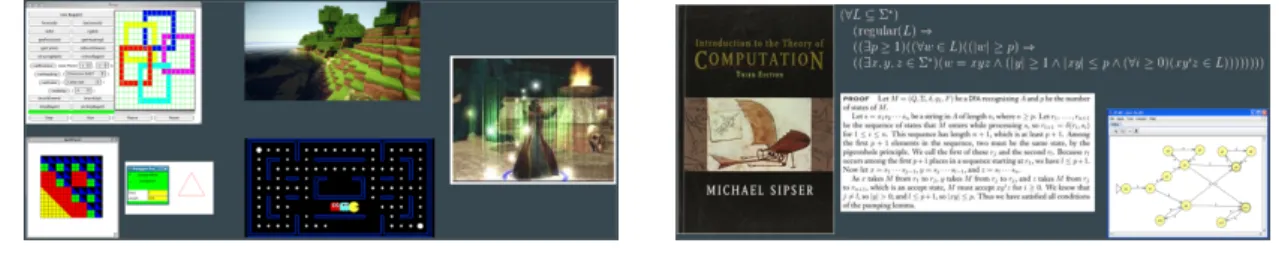
ITSs in their most common domains, listed in Section 1.2, generally emphasize appli-cations and specific problem-solving skills rather than abstract theoretical concepts. In addition, most ITSs are directed at elementary, middle, or high school students rather than college students [13, 16]. Educational games are also, for the most part, made for introductory rather than advanced courses (see Chapter 2). As a result, students in introductory courses such as CS 111 (Introduction to Programming) benefit from educa-tional microworlds and games like BuggleWorld,PacMan, andMinecraft. However, CS 235 (Languages and Automata) students’ primary resources are textbooks, dense mathe-matical readings, and simulation programs without gaming or tutoring components (see
Figure 1.1).
Tutor-Complete attempts to fill this gap by providing CS 235 students with an engaging game and tutoring system that presents the abstract, theoretical course material in a concrete, understandable way. Tutor-Complete includes activities for two fundamental CS 235 concepts: Deterministic Finite-State Automata (DFAs) and the pumping lemma for regular languages. In the DFA activities, students build structures to guide the “hero” character across a terrain to collect a reward. The pumping lemma activities are structured in an adversarial format, with a back-and-forth style gameplay between the computerized “villain” character and the student-controlled hero character. This design was motivated by observing student difficulties with proof by contradiction (the technique used in pumping lemma proofs). One of the goals of this activity is to clarify which decisions in the proof are the responsibility of the student and which outcomes are dictated by the nature of the problem. A complete discussion of Tutor-Complete’s gameplay and design can be found in Chapter 3.
CHAPTER 1. INTRODUCTION 4
1.4
Educational Goals
The design and implementation of Tutor-Complete are centered on the following educa-tional goals:
1. Educational Gaming: Tutor-Complete will increase student engagement and motivation by presenting the DFA and pumping lemma concepts in a concrete and enjoyable manner.
2. Peer Instruction: Tutor-Complete will leverage the collective knowledge of its users in order to help students learn from each other and solidify their individual understanding by explaining concepts to other students.
3. Tutoring: Tutor-Complete will offer hints and feedback to students as they work on activities, and model students’ knowledge in order to adapt the learning expe-rience to each student.
To support these goals, Tutor-Complete includes three game levels with activities focus-ing on DFAs and the pumpfocus-ing lemma. Students write explanations and use a “fave”-based rating system to foster a peer-learning environment. Hints in the DFA activities are based on the actions of past students, and Bayesian Knowledge Tracing is used to track students’ progress.
1.5
Thesis Overview
After reviewing existing educational systems inChapter 2,Chapter 3 describes Tutor-Complete’s gameplay and design. We give an overview of Tutor-Tutor-Complete’s background story and the DFA and pumping lemma concepts the activities focus on. We discuss the design considerations of Tutor-Complete, including the goal to make the story and game-play applicable and enjoyable without distracting from the educational purpose. Each of the levels is described with its corresponding activities, hero and villain characters, and reward items. Tutor-Complete’s features are explained in terms of the educational goals listed above. Chapter 4describes the algorithms used in the intelligent hint generation process. Chapter 5discusses the Bayesian Knowledge Tracing implementation and usage in Tutor-Complete to model students’ knowledge. The evaluation process and results are discussed inChapter 6. Finally, Chapter 7summarizes the results of the thesis and outlines the plans for future work.
Chapter 2
Related Work
“If you want to go somewhere, it is best to find someone who has already been there.”
Robert Kiyosaki
Before discussing Tutor-Complete in greater detail, we survey several examples of ex-isting educational systems. This chapter outlines three categories of exex-isting systems: microworlds, concept testers, and educational games. Each type of system has some similarities to Tutor-Complete. However, Tutor-Complete also incorporates different features or addresses different issues than each of these existing systems.
2.1
Microworlds
Many introductory programming courses use microworlds to boost student enjoyment while completing homework assignments. Like Tutor-Complete, these systems aim to present computer science concepts in a concrete and engaging manner, and to provide a visual, fun environment for students to interact with course content. However, these systems are not educational games, since they lack the underlying story and reward system that characterize games. In addition, they are targeted toward introductory rather than advanced courses.
2.1.1 BuggleWorld, TurtleWorld, and PictureWorld
These three microworlds were developed at Wellesley College for use in CS 111 (Intro-duction to Programming and Problem-Solving). In the former version of CS 111, taught in Java, they were used to increase students’ excitement about programming concepts
CHAPTER 2. RELATED WORK 6
(a) BuggleWorld (b) TurtleWorld
Figure 2.1: BuggleWorld and TurtleWorld [1]
Figure 2.2: Programmer’s Learning Machine [2]
and provide visual feedback while solving problems, particularly when learning recursion [1].
2.1.2 Programmer’s Learning Machine
The Programmer’s Learning Machine (PLM) was developed for the CS 1 course at the Universit´e de Lorraine, France. It is a series of microworlds, including a Buggle Universe and a Turtle Universe, based on Wellesley’s BuggleWorld and TurtleWorld [2]. PLM contains a set of over 160 predefined exercises for students to complete. It provides examples of the goal for each exercise, and a feedback loop while students work on exercises. PLM is more similar to an educational game in that has a set of goals and rewards, but it lacks the overarching story typical of true educational games, and the exercises are meant to enforce content rather than acquire it.
2.1.3 PacMan
Professors at UC Berkeley developed a set of PacMan projects for their CS 188 (In-troduction to Artificial Intelligence) course, which were also used in Wellesley’s CS 232 (Artificial Intelligence) course in Fall 2015. In these projects, students implement var-ious AI algorithms in the context of a PacMan game [3]. For example, in one project, students write a perceptron classifier to help PacMan navigate through a maze. The authors found that the projects “have boosted enrollment, teaching reviews, and student engagement”, and describe the projects as a tool to teach AI concepts while “allow(ing)
CHAPTER 2. RELATED WORK 7
Figure 2.3: PacMan [3]
students to visualize the results of the techniques they implement” [18]. The projects present AI algorithms in a game context, but the projects themselves do not constitute a game.
2.2
Concept Testers
Intermediate computer science courses such as Data Structures and Algorithms may use concept testers to allow students to visualize and test abstract concepts. While these systems are designed for more advanced courses and abstract content, they are typically not educational games and also lack the tutoring capabilities of an Intelligent Tutoring System.
2.2.1 JFLAP
JFLAP was developed at Duke University for CPS 140 (Mathematical Foundations of Computer Science), and was also used in Wellesley’s CS 235 in Fall 2014. JFLAP is a tool for, among other tasks, constructing and simulating DFAs. It provides immediate feedback in a step-by-step testing mode, as well as a mechanism for students to exper-iment with DFA construction [4]. The authors also developed PumpLemma, a tool for constructing pumping lemma proofs, which is no longer supported and was not tested by the authors. According to the authors’ user testing, students “found the tools useful for testing out their answers” [4].
CHAPTER 2. RELATED WORK 8
Figure 2.4: JFLAP [4]
2.2.2 JDSL Visualizers and Testers
JDSL is a group of visualizers and testers developed jointly at Brown Univeristy and Johns Hopkins University for CS 2 (Data Structures and Algorithms). It is a tool designed for students to interact with data structures and algorithms [5]. The visualizers are a set of animations to help students understand and compare different data structures and algorithms. The testers run student code and compare the output to predefined correct results.
2.3
Games
In addition to microworlds, introductory programming courses often use games to present concepts in a friendly and enjoyable manner. These systems leverage game design, sto-ries and rewards to increase student engagement and motivation, but are typically aimed at introductory courses and lack tutoring capabilities.
CHAPTER 2. RELATED WORK 9
(a) Saving Sera (b) Catacombs
Figure 2.6: Game2Learn [6]
2.3.1 Game2Learn
The goal of the Game2Learn lab at North Carolina State University is to “leverage games in retaining students in computer science” [6]. The lab runs a program in which upper-level students develop games for introductory courses, thus providing the students with valuable research experience in addition to the benefits resulting from the introductory games. During one such program, the authors tested two games. In the first, Saving Sera, students write simple programs to complete in-quest tasks, e.g. unscrambling a do-while loop to help a fisherman count his fish. In the second, Catacombs, students solves programming questions in order to construct “spells”, e.g. writing nested for loops to construct a bridge.
2.3.2 Dragon Architect
Dragon Architect was developed at the University of Washington for their Introductory Computer Science course. The goal of Dragon Architect is to teach “computational thinking”, which the authors break down into concepts, practices, and perspectives [7]. To accomplish this goal, Dragon Architect uses a 3-D game structure in which students use the Blockly language to program a dragon character to assemble a set of blocks, similar to Minecraft. As students progress, they are given more complex code blocks to use.
CHAPTER 2. RELATED WORK 10
(a) Code Blocks (b) Game View
Figure 2.7: Dragon Architect [7]
2.3.3 Minecraft
Minecraft is a popular game in many introductory programming courses. Researchers at Flinders University of South Australia studied the effect of Minecraft on introductory programming education by building a set of Minecraft extensions, where students as-semble block structures using programming concepts (variables, assignment, selection, looping, etc.) [8]. The researchers’ goal was to extend students’ CS understanding into higher levels of Bloom’s taxonomy by leveraging the familiarity of Minecraft [8].
Figure 2.8: Minecraft [8]
This chapter concludes the introductory material of the thesis. The next three chapters describe Tutor-Complete in detail. We begin the description by examining the game as-pect, including the story, levels, design factors, and specific features. We then consider the algorithms used to implement the hint generation and Bayesian Knowledge Tracing processes that form Tutor-Complete’s Intelligent Tutoring System aspect.
Chapter 3
Game Design
“A game is a series of interesting choices.”
Sid Meier
This chapter outlines the game aspect of Tutor-Complete, including basic gameplay, activities, and features. We give a brief overview of the two fundamental CS 235 concepts covered in Tutor-Complete (DFAs and the pumping lemma), and discuss the design factors that arose during the construction of Tutor-Complete’s game structure. We describe the three game levels and conclude by listing Tutor-Complete’s main features according to the educational goals of the project.
3.1
Game Overview
Tutor-Complete is an adventure game that contains three “worlds”, each based on a different part of the natural world: JungleWorld, OceanWorld, and IceWorld. In each world, students play a “hero” character whose quest is to reclaim the “items” that the “villain” character has stolen. In order to reclaim the items, students complete two activities in each world: building DFAs and constructing proofs using the pumping lemma (see Section 3.3).
The hero, item, and villain for each world are listed below:
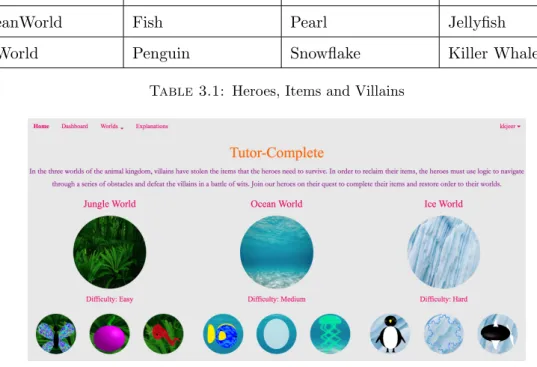
Tutor-Complete’s home page displays the three worlds with their hero, item, and villain underneath them:
CHAPTER 3. GAME DESIGN 12
World Hero Item Villain
JungleWorld Butterfly Berry Snake OceanWorld Fish Pearl Jellyfish IceWorld Penguin Snowflake Killer Whale
Table 3.1: Heroes, Items and Villains
Figure 3.1: Tutor-Complete Home Page
3.2
CS 235 Concepts
Tutor-Complete’s activities each focus on one major concept from CS 235. The first activity in each world focuses on DFAs, and the second activity focuses on the pumping lemma. This section gives a brief overview of these two concepts, before the activities themselves are discussed in Section 3.3.
3.2.1 Deterministic Finite-State Automata
The formal definition of a DFA as given by Sipser [19] is below:
Definition 3.1. Finite Automaton
A finite automaton is a 5-tuple (Q,Σ, δ, q0, F), where: 1. Qis a finite set called thestates,
2. Σ is a finite set called thealphabet,
3. δ:Q×Σ→Qis the transition function, 4. q0 ∈Q is thestart state, and
CHAPTER 3. GAME DESIGN 13 Furthermore, a finite automaton isdeterministicif and only if for each (q, σ)∈Q×Σ, there is exactly one outputδ((q, σ)) =q0 ∈Q(i.e. δ is a function whose domain is all of
Q×Σ).
More informally, a DFA is a machine that takes a string of characters from its alphabet Σ and either accepts or rejects the string. A DFAM accepts a stringsif and only ifM
ends on some final state f ∈F after readings. If a DFA M recognizes all strings sin some setL(and rejects all strings not inL), thenLis theregular language recognized by M. A language is regular if and only if it is recognized by some DFA.
3.2.2 The Pumping Lemma for Regular Languages
From Sipser [19]:
Theorem 3.2 (Pumping Lemma). If A is a regular language, then there is a number p (the pumping length) where, if s is any string in A of length at least p, then s may be divided into three pieces, s = xyz, satisfying the following conditions:
1. for each i≥0, xyiz∈A, 2. |y|>0, and
3. |xy| ≤p.
The pumping lemma is frequently used to prove that some language L is not regular using proof by contradiction: assume thatLis regular and give a strings∈Lfor which the three conditions of the pumping lemma fail, i.e. for each possible parsing of sinto
s=xyz where |y|>0 and |xy| ≤p, there is somei≥0 such thats0 =xyiz /∈L.
3.3
Activities
The DFA and pumping lemma concepts in CS 235 are each emphasized in one activity for each of Tutor-Complete’s three worlds. This section details the gameplay of each activity and how its corresponding concept is featured. In keeping with Tutor-Complete’s goal of increasing student engagement by presenting concepts in a concrete and enjoyable manner, the activities avoid using CS 235 terminology that may be unfamiliar to students wherever it is feasible and appropriate to do so.
CHAPTER 3. GAME DESIGN 14
3.3.1 DFA Activity
In the DFA activity in each world, students build a structure that allows the hero char-acter to cross some terrain and collect the reward items. For example, in JungleWorld, the butterfly hero crosses a network of stepping stones in order to cross a river. This structure is a DFA, where the states are stepping stones and the alphabet is {Purple, Orange}. This alphabet is analogous to the {0,1} or {a, b} alphabets commonly used in examples from CS 235, but the colors Purple and Orange are used to create a more visual representation.
During this activity, students are given a regular language to build a DFA structure for. The language is called a “pattern” in the activity, to avoid using CS 235-specific terminology. For example, the first pattern in the JungleWorld DFA activity is Purple Orange Orange Purple Orange (analagous to the finite language {01101} in CS 235). Students build and test their structures using the following actions:
1. Add node
2. Mark node as final 3. Add Purple transition 4. Add Orange transition 5. Delete node or transition 6. Test
7. Reset
Figure 3.2: DFA Activity Buttons
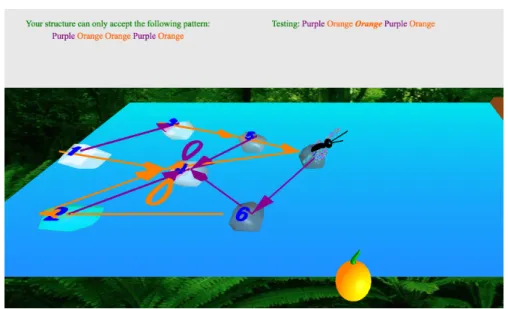
When a student clicks “TEST”, their DFA structure will be simulated on two different strings: one that matches the current pattern and one that does not. For example, for the pattern Purple Orange Orange Purple Orange, the system will first test the student’s
CHAPTER 3. GAME DESIGN 15 DFA on the string Purple Orange Orange Purple Orange, and then test the DFA on a random string such as Purple Orange Purple Purple. When testing strings, the system will match the test string character by character against the current pattern. If the characters match, the system will send out a reward (e.g. a berry in JungleWorld). Otherwise, the system will send out a villain character (e.g. a snake in JungleWorld). For the pattern Purple Orange Orange Purple Orange and the test string Purple Orange Orange Purple Orange,
Pattern Symbol Test Symbol System Sends
Purple Purple Purple reward Orange Orange Orange reward Orange Orange Orange reward Purple Purple Purple reward Orange Orange Orange reward
Table 3.2: DFA Activity: Test String Matching Pattern
Since the test string matches the pattern, only rewards are sent out.
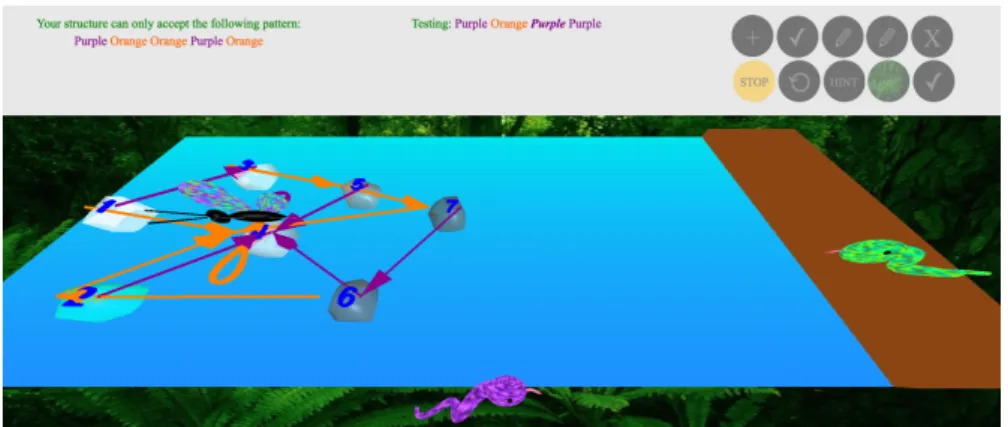
CHAPTER 3. GAME DESIGN 16 For the pattern Purple Orange Orange Purple Orange and the test string Purple Orange Purple Purple,
Pattern Symbol Test Symbol System Sends
Purple Purple Purple reward Orange Orange Orange reward Orange Purple Orange villain Purple Purple Purple reward
Orange — —
Table 3.3: DFA Activity: Test String Not Matching Pattern
Since the test string does not match the pattern, at least one villain is sent out.
Figure 3.4: DFA Activity: Testing String Not Matching Pattern
To pass a given pattern, the student’s DFA must accept the test string that matches the pattern and reject the test string that does not. Students can mark any of their DFA nodes as final by coloring them green. If the hero character ends on a green node while testing a string that matches the pattern, the student passes that test and the hero gets to collect the reward. If the hero character does not end on a green node, the student fails that test case. On the other hand, if the hero character does not end on a green node while testing a string that does not match the pattern, the hero character avoids the villain and the student passes. If the hero does end on a green node, the villain “attacks” and the student fails. These outcomes are summarized below:
CHAPTER 3. GAME DESIGN 17
Test String Ending Node Outcome Pass/Fail
Matches pattern Green Hero collects reward Pass Doesn’t match Not green Villain is evaded Pass Matches pattern Not green Hero doesn’t collect reward Fail Doesn’t match Green Villain attacks Fail
Table 3.4: DFA Activity: Testing Outcomes
(a) Passed Matching String (b) Passed Non-Matching String
(c) Failed Matching String (d) Failed Non-Matching String
Figure 3.5: DFA Activity: Testing Outcomes
3.3.2 Pumping Lemma Activity
In the pumping lemma activity in each world, the villain character is trying to convince the hero that a given (nonregular) language is regular. The student, playing the hero character, must use the pumping lemma to defeat the villain’s argument and prove that the language is in fact nonregular. Each activity represents the villain’s argument as some structure that the hero must destroy using a weapon. For example, in Jungle-World, the villain’s argument is represented as a table held up by pillars, which the hero knocks down using a bow and arrow. The table holds some reward (e.g. a berry in JungleWorld) that the hero collects once the villain’s argument is knocked down. The activity progresses in the following steps:
CHAPTER 3. GAME DESIGN 18
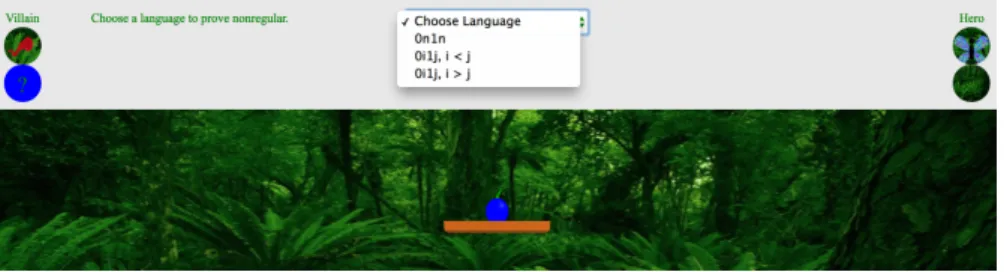
Figure 3.6: Pumping Lemma Activity: Choosing Language
Each activity has a predetermined set of nonregular languages to choose from (see
Section 3.5). For illustration, we will choose the language{0n1n|n≥0}.
2. The villain gives the pumping length p.
Figure 3.7: Pumping Lemma Activity: Pumping Length
The pumping length of a language is not something the student gets to choose or determine during a pumping lemma proof. Instead, the pumping lemma is typically represented as an unknown constant p. In the game, this is a choice the villain character gets to make, and is given to the hero character.
3. The student chooses a string s in the language to pump.
Figure 3.8: Pumping Lemma Activity: Choosing String
Choosing a string in the language (of at least length p) to pump is one of the key decisions that the student must make in a pumping lemma proof. Not all strings “break” the pumping lemma, i.e. some strings can be pumped: for all parsings
xyz and all i≥0, xyiz is still in the language. Thus, choosing a correct string is
vital to the rest of proof. In addition, the string choice can either complicate or simplify the rest of the proof (seeStep 5).
4. The villain specifies the ways that he can parse the giving string s into
CHAPTER 3. GAME DESIGN 19
Figure 3.9: Pumping Lemma Activity: Possible Parsings
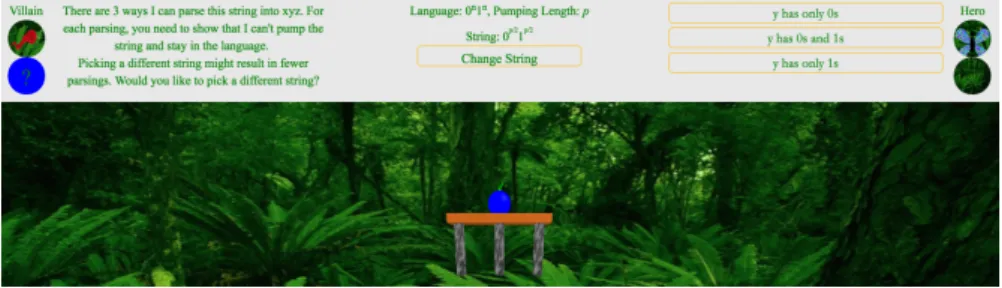
Suppose the student chooses the string 0p/21p/2. The villain character can parse this string in three different ways: y can consist of only 0s, 0s and 1s, or only 1s. Since there are three possible parsings, the student has to knock down three “pillars” of the villain’s argument. In the game, the table is now held up by three pillars.
5. If applicable, the student can choose to go back to Step 3 and choose a different string s0 in the language to pump.
Figure 3.10: Pumping Lemma Activity: Changing String
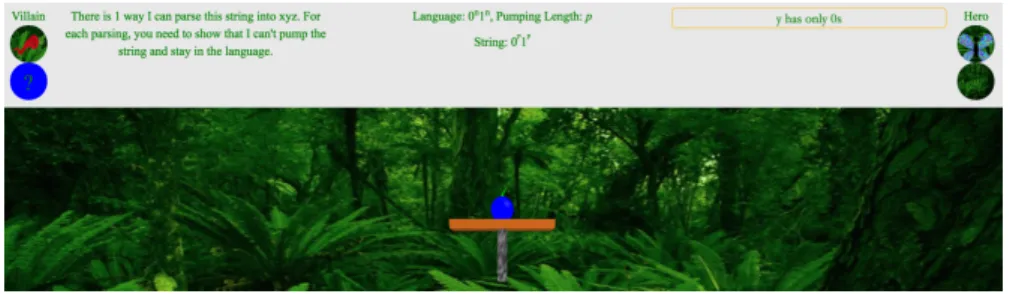
A judicious string choice will minimize the number of ways the string can be parsed, making the rest of the proof simpler. In our example, if the student chooses 0p/21p/2, the villain has three possible parsings. However, choosing the string 0p1p would give the villain only one possible parsing, simplifying the remainder of the proof for the student. The activity alerts the student to this fact and gives her the option to change her string choice. As mentioned in Step 3, choosing a string is an important skill in pumping lemma proofs, so the activity places a high priority in improving students’ ability to make wise string choices.
6. Once the student is satisfied with her string, she chooses one of the villain’s possible parsings in order to prove it is “unpumpable”.
In a pumping lemma proof, the student must show that no matter how the villian parses the student’s chosen string s, the villain cannot pump the string and stay in the language, i.e. the parsing is “unpumpable”. Thus, the student must do the remaining steps for each possible parsing. In this example, suppose the student chooses to go back and choose the string 0p1p. Since the villain now only has one
CHAPTER 3. GAME DESIGN 20
Figure 3.11: Pumping Lemma Activity: Choosing Parsing
possible parsing, the table is held up by one pillar instead of three. Thus, the student chooses the parsing wherey has only 0s for the remainder of the proof. 7. For the current parsing s = xyz, the student chooses an integer i ≥ 0
such that xyiz is not in the language.
Figure 3.12: Pumping Lemma Activity: Choosingi
The student must choose a value ofisuch that the villain can’t pump the current parsing and stay in the language. Not all values of i fulfill this condition. For example, choosingi= 1 allows the villain to pump xyz and stay in the language:
xyiz = xy1z = xyz, which is in the langugage (since xyz is in the language). If the student chooses an incorrect i, no weapon (bow and arrow in JungleWorld) appears.
Figure 3.13: Pumping Lemma Activity: Choosing an Incorrecti
8. The student chooses a reason why her chosen value of i forces xyiz to not be in the language.
CHAPTER 3. GAME DESIGN 21
Figure 3.14: Pumping Lemma Activity: Choosing Reason
If the student chooses a correct value of i, a weapon appears, but it is not fired. The student must choose a reason in order to fire the weapon. Suppose the student chooses i= 2. The student must explain why xy2z is not in the language, using the fact that, in the current parsing,y contains only 0s. The correct reason in this case is “xy2z has more 0s than 1s”.
If the student chooses an incorrect reason, the weapon fires at a pillar but misses, and then resets so the student can choose a different reason.
Figure 3.15: Pumping Lemma Activity: Choosing an Incorrect Reason
However, if the student chooses a correct reason, the weapon fires at a pillar and knocks it down, and the current parsing is considered complete.
CHAPTER 3. GAME DESIGN 22 9. Steps 6-8 repeat for each of the villain’s possible parsings.
Figure 3.17: Pumping Lemma Activity: Completing Language
Once each possible parsing has been shown “unpumpable” by the student, the student collects the reward and the proof for this language is completed. The student will not be able to choose this language next time she plays this activity; instead, she must choose a language she has not yet completed (unless she has completed all the languages, in which case she may choose any language).
The steps are summarized in Table 3.5, specifying which steps are the responsibility of the hero character (student) and which are the responsibility of the villain.
Personal experience as both a student and as a tutor for CS 235 suggests that one of the
Step Description Responsibility Of
1 Choose language Hero 2 Give pumping length Villain 3 Choose string? Hero?
4 Specify possible parsings Villain 5 Change string Hero 6 Choose parsing Hero 7 Choose i ? Hero?
8 Choose reason ? Hero?
9 Repeat Steps 6-8 for each parsing Hero
Table 3.5: Pumping Lemma Activity: Steps
major difficulties students have with pumping lemma proofs is keeping track of which parts of a proof are the student’s responsibility and which are dictated as part of the problem. For example, students may erroneously think that they are able to choose how the “villain” is able to parse their given string, or that the problem dictates the value of
CHAPTER 3. GAME DESIGN 23 to the student which choices are her responsibility and which are fixed by the particular problem (chosen by the villain in the game). There are three key choices made by the student in a pumping lemma proof: choosing the string, choosing i, and choosing the reason. These choices are marked with a? inTable 3.5.
3.4
Design Factors
The design of Tutor-Complete’s story and features had two important goals. First, the story needed to be applicable to students with a wide variety of interests and back-grounds. The story was not designed to appeal to any one particular type of student, but to be readily engaging to students with many personal interests. Second, Tutor-Complete needed to increase student motivation and engagement without introducing excessive distractions. One of the main purposes in making Tutor-Complete a game was to engage students with the material; thus, student engagement was a high priority. However, Tutor-Complete is first and foremost an educational system, and any unnec-essary distractions would detract from the educational goals of the project.
There were many possible choices for the background story of the game: robotics, me-dieval fantasy, outer space, etc. The animal kingdom was chosen as the story theme since it fits the following descriptions:
1. Neutral: The animal kingdom doesn’t invoke gender or similar personal char-acteristics, and thus avoids any possible complications of gendered characters or other demographics concerns. For example, a game with a princess that needs to be rescued (such as the game Saving Sera - seeSection 2.3.1) could involve negative gender stereotypes.
2. General: The other possible story themes are more tailored to specific interests. For example, it is less likely that all students would be interested in robotics, and so that story might be less engaging for more users.
3. Familiar: Similarly, the animal kingdom is, to at least a reasonable extent, famil-iar to the majority of possible users. Several of the other possible themes rely on more specific knowledge that would have limited the story’s accessibility for some users.
4. Efficient: From a development and usability perspective, it is important that the graphical models can be rendered as quickly as possible. The animal kingdom involves models that are more performance-compatible than the humans or other characters in other possible story themes.
CHAPTER 3. GAME DESIGN 24 5. Varied: The animal kingdom allows for the inclusion of a variety of levels. Cur-rently, the game includes the jungle, the ocean, and the Arctic, and other worlds could be added in the future. This theme permits many types of exotic environ-ments while keeping to a unified story.
6. Simple: As mentioned above, Tutor-Complete aims to avoid unncessary distrac-tions. One potential distraction is an overcomplicated story that has users reading through long paragraphs of background information. The animal kingdom story has a simple setup that requires very little preliminary reading, yet is still reason-ably interesting and engaging.
Another important goal of Tutor-Complete’s design was the balance of student enjoy-ment and distractions. While designing the story, interface, and features, several aspects that were intended to boost student enjoyment gave rise to potential sources of distrac-tion. Below are a few notable enjoyment factors, along with corresponding distraction sources and how they were mitigated:
1. Graphics and animation: The three-dimensional graphics and animation were added to increase the enjoyment factor of the game over plain two-dimensional graphics. In part, the three-dimensional graphics aim to increase the similarity between Tutor-Complete and other three-dimensional games that students regu-larly play for fun.
Potential distraction: Some entertainment games have long animation sequences with no input from the user. If Tutor-Complete included animation simply for animation’s sake, students would be spending time watching animation sequences rather than working through the educational activities. With this in mind, Tutor-Complete only includes animation where it benefits the activity; for example, animating the hero character between nodes in a DFA while testing or animating a weapon to knock down the villain’s pumping lemma argument.
2. Styled web interface: Designing the user interface was an important process that focused on both usability and aesthetics. Many existing educational systems have minimal interfaces that were not made for aesthetic appeal, but Tutor-Complete’s interface was designed to be both easy and pleasant to use.
Potential distractions: While the interface should be visually appealing, it should not be the focus of the system. Flashy CSS styling or an overabundance of popups could distract students from the educational material. In addition, if the system allowed too much customization, students could get wrapped up in customizing their interface (changing the color scheme, choosing an “avatar”, etc.). To avoid these distractions, the interface includes a limited number of clean popups and
CHAPTER 3. GAME DESIGN 25 minimal CSS animations. Also, while the system does adapt to each student (see
Chapter 5), students cannot customize their interface.
3. Engaging story: As stated above, a primary goal of the game aspect of Tutor-Complete is to increase student engagement and motivation. Thus, the game should have an interesting background story.
Potential distraction: An interesting story could have an excessively detailed plot-line, requiring students to read long descriptions before beginning the activities, and to remember plot information that could interfere with their ability to focus on the educational material. As discussed earlier in this section, the animal kingdom story was chosen in part for its simplicity and minimal background information. 4. Points and rewards: In addition to the story, the game uses points as a
motiva-tion factor. Students earn points for their performance in activities, and use their points to unlock subsequent levels. The game also includes a competitive aspect in the explanations feature: students can “fave” each other’s explanations, and compete to write explanations that earn the most faves (seeSection 3.6.1).
Potential distractions: The points and rewards are intended to provide additional motivation, not to be the primary focus of the game. Activities that focus solely on accumulating points or earning rewards would detract from the main educational activities. In addition, an overemphasis on competition could cause students to use the system primarily to improve their ranking compared to other students, rather than on improving their understanding of the CS 235 concepts. To avoid these distractions, the game does not include activities other than the DFA and pumping lemma activities discussed earlier in the chapter. The “fave” system is a small part of the system, and the faves do not affect a student’s progress in the educational activities. Students do not have to use the explanations feature at all, but the fave system is there to encourage students to write explanations.
3.5
Worlds
Tutor-Complete has three levels, or “worlds” as they are referred to in the game: Jun-gleWorld, OceanWorld, and IceWorld. Each world has a DFA and a pumping lemma activity, with its own type or set of associated languages. The worlds range in difficulty, from Easy (JungleWorld) to Medium (OceanWorld) to Hard (IceWorld). The initial view of each world is shown below.
CHAPTER 3. GAME DESIGN 26
(a) JungleWorld (b) OceanWorld (c) IceWorld
Figure 3.18: World Initial Views
3.5.1 World DFA Activities
Each DFA activity draws its problems from a different type of regular language. In each activity, the DFA node is a different type of object. The following lists the language type and node type for each DFA activity.
World Language Type Language Example Node Type
JungleWorld Finite 01101 Stepping Stone OceanWorld English description Contains at least two 0s Starfish
IceWorld Regular expression 01* Iceberg
Table 3.6: World DFA Activities
(a) River Activity (b) Starfish Activity (c) Iceberg Activity
Figure 3.19: World DFA Activities
Each DFA activity has a set of languages of its corresponding type (e.g. finite languages) that make up the first few problems. After that, the activity will generate random languages of its corresponding type for an indefinite number of problems (so the student can do as many problems from a DFA activity as she wishes).
3.5.2 World Pumping Lemma Activities
Each pumping lemma activity uses a weapon to knock down the villain’s argument, which is represented using some structure. Each pumping lemma activity also uses a
CHAPTER 3. GAME DESIGN 27 predetermined set of nonregular languages. The following table lists the weapon and villain argument structure for each pumping lemma activity.
World Weapon Villain Argument
JungleWorld Bow and Arrow Table, supported by Pillars OceanWorld Trident Net, made up of Strands IceWorld Spear Tower, made up of Icebergs
Table 3.7: World Pumping Lemma Activities
(a) Table Activity (b) Net Activity (c) Tower Activity
Figure 3.20: World Pumping Lemma Activities
3.6
Features
Each of Tutor-Complete’s features was designed to fit with the educational goals of the project: educational gaming, peer instruction, and tutoring (seeSection 1.4). The major features are described here in terms of the educational goal(s) that they support.
3.6.1 Educational Gaming
The goal of Tutor-Complete’s game is to increase student engagement and motivation by presenting the DFA and pumping lemma concepts in a clear and concrete manner. The following features were designed to support the game.
1. Activity Scores: In addition to a background story, the game aspect of Tutor-Complete uses a point-based reward system to increase student motivation. Stu-dents receive scores in each activity that are determined using Bayesian Knowledge Tracing (see Chapter 5). Each world has a minimum DFA activity score and a minimum pumping lemma activity score that is required to unlock the world.
CHAPTER 3. GAME DESIGN 28 (JungleWorld has minimum scores of zero, so it is automatically unlocked for all students). Once a student has reached the minimum scores for both activities in a world, she unlocks the next world. For example, once a student’s JungleWorld activity scores meet the minimum OceanWorld scores, she unlocks OceanWorld. The activity scores are displayed and updated in real time in each activity, and all activity scores are summarized using progress bars on the student’s dashboard.
Figure 3.21: Activity Scores
2. Faves: Students have the option to write explanations about their ideas and strate-gies. To encourage high-quality explanations, students can “fave” each other’s explanations. Students are given three faves per week that they can use to rate other students’ explanations (students cannot fave their own explanations). Stu-dents can view explanations they have faved on their dashboard. They can view, sort, search, and fave explanations on the explanations page of the system.
(a) Student’s Faved Explanations (b) Explanations Page
Figure 3.22: Faves
3. Game Actvities: The DFA and pumping lemma activities discussed in this chapter form the core of Tutor-Complete’s game aspect. These activities were designed to be part of a game, while incorporating other educational features such as hints and knowledge tracing, as discussed below.
CHAPTER 3. GAME DESIGN 29
3.6.2 Peer Instruction
The value of peer instruction has been demonstrated in numerous educational studies, including in technological environments [20–22]. In particular, peer instruction helps students to learn from each other as well as improve their own understanding of the material [22].
1. Explanations: While they are not required to do so, students are encouraged to write explanations that all students can view. These explanations are intended to help students benefit from each other’s ideas, and also to help students solidify their own understanding by explaining concepts to others. Students can view and edit their own explanations on their dashboard, and they can write new explana-tions at any time on the explanaexplana-tions page. Explanaexplana-tions can be tagged for quick searching: for example, a student might tag an explanation about finite languages (in the river DFA activity) with #river.
(a) Student’s Explanations (b) New Explanation
Figure 3.23: Explanations
2. Hints: During the DFA activities, students can receive up to two hints per problem (see Chapter 4). These hints are based on the actions that other students have taken when they were at a similar point in the problem. Thus, these hints help students learn from each other’s work, and also from each other’s mistakes. Since past students may not always have taken the correct action, the hints are not guaranteed to suggest correct actions.
3.6.3 Tutoring
In addition to being a game, Tutor-Complete includes capabilities of a tutoring system. In particular, the system generates hints and tracks students’ progress using Bayesian Knowledge Tracing.
CHAPTER 3. GAME DESIGN 30 1. Hints: As stated above, students can receive hints during the DFA activity. This feature helps support the peer instruction goal, but is also a tutoring feature: one characteristic of a computer-aided instructional system is the ability to give hints or feedback to students [13,23].
2. Bayesian Knowledge Tracing: The ability to model students’ knowledge of the material is an important characteristic of an Intelligent Tutoring System [13]. Bayesian Knowledge Tracing is used as the student model in Tutor-Complete (see
Chapter 5).
This chapter described the first part of Tutor-Complete; namely, the educational game aspect. The following two chapters describe the algorithms used in the Intelligent Tu-toring System aspect, beginning with hint generation and then turning to Bayesian Knowledge Tracing.
Chapter 4
Hint Generation
“Talk is cheap. Show me the code.”
Linus Torvalds
Hint generation supports both the peer instruction and tutoring educational goals. This chapter first gives an overview of the hint generation process and the role of hints in the DFA activities. The algorithms for implementing hint generation are then described in more detail.
4.1
Overview
Students can request up to two hints per problem in each DFA activity. When a student requests a hint, the system will return up to three suggested actions based on the actions that past students have taken at similar points in the problem. Using past student data to generate hints has been successfully used in existing ITSs [24]. Possible suggested actions take one of the following forms:
1. Add a stone 2. Delete stone X
3. Add a(n) [purple/orange] transition from stone X to stone Y 4. Delete a(n) [purple/orange] transition from stone X to stone Y 5. Mark stone X as final
6. Mark stone X as not final
CHAPTER 4. HINT GENERATION 32 7. Reset
Below is an example of a hint in the iceberg (IceWorld) DFA activity.
Figure 4.1: Iceberg Activity Hint
Note that not all suggested actions are necessarily correct, since not all past students will have taken the correct action at every point in a problem. In addition, not every suggested action is guaranteed to be relevant. In the above example, the student had already taken the second suggested action (“Add an orange transition from stone 1 to stone 4”). The purpose of the hints is, in part, to support the peer instruction goal by helping students learn from each other’s actions and mistakes, not to suggest perfectly optimal and relevant actions every time. However, hints are also intended to be a tutor-ing feature, so the hint generation process does attempt to suggest at least one helpful and relevant action per hint request. Student feedback on the hints feature is discussed inChapter 6.
When a student requests a hint, the following process occurs:
1. A set of states and actions is generated for the student’s current problem (currently only implemented for JungleWorld).
2. The student’s DFA is compared with past student DFAs using a graph similarity algorithm.
3. All past student DFAs and the current student’s DFA are grouped according to the similarity calculated in the previous step.
4. A Markov Decision Process (MDP) is built using the DFA groups as MDP states. 5. Value iteration is used to construct a ranked list of up to three suggested actions. 6. Graph similarity is used to translate each suggested action to the structure of the
CHAPTER 4. HINT GENERATION 33 The following sections describe the above steps in detail. As an implementation note, each piece of the hint generation process (graph similarity, MDP, etc.) is represented using a JavaScript object, where each function that is shown in pseudocode is part of the object’s prototype.
4.2
Initialization
The first hint request for any given problem will not have any data from past students. Thus, in order to ensure that the first hint request for a problem has at least some data to work with, the system generates a set of states and actions for the current problem. Currently, this functionality is only implemented for JungleWorld, which uses finite lan-guages for its DFA activity.
The initialization process constructs the solution to a given language probabilistically: at each step in the solution, the correct next action is taken with probability p and a random action is taken with probability 1−p, wherep is set to 0.9. This is to ensure that the first hint request is not guaranteed to suggest perfectly correct actions, so that the first student to request a hint does not have an advantage over future students. Subsequent hint requests will have (possibly incorrect) student actions in the database, so the initial hint request intentionally uses possibly incorrect actions as well.
Algorithm 4.1 Hint Initialization
function Initialize(language)
this.initialStates←[{nodes: [], transitions:{purple:{}, orange:{}}}] this.initialActions←[]
this.addSolution(language)
this.lastState.isCorrect=true
end function
function addSolution(language)
langStr←language.randomString()
for allsinlangStr do
this.addState(s)
end for
forindexfrom 0 to this.initialStates.lengthdo if Math.random()> p then
this.addCorrectTransition(langStr, index)
else
this.addRandomTransition(langStr, index)
end if end for end function
CHAPTER 4. HINT GENERATION 34 The initialization functions are implemented in the Computer object, which main-tains an array of solution states (this.initialStates) and an array of solution actions (this.initialActions). The functions addState, addCorrectTransition, and ad-dRandomTransition manipulate the initialStates and initialActions fields.
4.3
Graph Similarity
A DFA can be represented as a directed graph, with nodes and transitions (edges) be-tween nodes. In order to find the actions that past students took at a similar point in the problem to the current student, it is necessary to determine what constitutes a “similar point” in the problem: in other words, to determine which past student DFAs are similar to the current student’s DFA. Since a DFA can be represented as a directed graph, this step is a graph similarity problem.
Tutor-Complete implements a neighbor-matching graph similarity algorithm from meth-ods developed at the University of Belgrade [25], and adapted from the Java implemen-tation in [26]. The neighbor matching method is summarized below:
LetA andB be two directed graphs. The similarity between nodeiinAand nodej in
B is iteratively computed for each iterationkby:
xkij+1 ← s k+1
in (i, j) +skout+1(i, j)
2 (4.1)
where skin+1(i, j) and skout+1(i, j) are the similarity scores for the incoming nodes and outgoing nodes for bothiandj, respectively. The similarity betweeniandjis based on the similarity between all nodes that have edges leading toiand those incoming toj, and on the similarity between all nodes that have edges starting fromi and those outgoing fromj. The incoming and outgoing similarities have equal weight. The similarity scores are defined as follows:
skin+1 ← 1 min nin X l=1 xkfin ij(l)ginij(l) s k+1 out ← 1 mout nout X l=1 xkfout ij (l)g out ij (l) (4.2)
min =max(id(i), id(j)) mout =max(od(i), od(j))
nin=min(id(i), id(j)) nout=min(od(i), od(j))
whereid(i) is the in-degree of nodeiandod(i) is the out-degree of nodei(and similarly for nodej). fijinandgijinare the enumeration functions that give the maximum similarity value for each node in the given node list [26].
CHAPTER 4. HINT GENERATION 35 The graph similarity step in Tutor-Complete is implemented using two objects: Graph-Similarity and GraphWrapper. The GraphGraph-Similarity object calculates the similarity between two graphs that contain edges of only one color (purple or orange) using the neighbor matching algorithms from [25, 26]. The GraphWrapper object calculates the similarity between two DFAs using the similarity from both purple and orange edges (transitions), and provides additional functions to map each node a in graph A to its most similar nodeb in graphB.
Algorithm 4.2 GraphSimilarity Object
function GraphSimilarity(nodes1, edges1, nodes2, edges2) this.nodes1←nodes1, this.edges1←edges1
this.nodes2←nodes2, this.edges2←edges2
this.inN odeM ap1←this.inNodeMap(this.nodes1, this.edges1)
this.inN odeM ap2←this.inNodeMap(this.nodes2, this.edges2)
this.outN odeM ap1←this.outNodeMap(this.nodes1, this.edges1)
this.outN odeM ap2←this.outNodeMap(this.nodes2, this.edges2)
this.nodeSimilarity←new Array(this.nodes1.length) this.inN odeSimilarity←new Array(this.nodes1.length) this.outN odeSimilarity←new Array(this.nodes1.length) this.initializeSimilarityMatrices()
end function
function getGraphSimilarity
gSim←0.0
this.measureSimilarity()
if this.nodes1.length == 0 && this.nodes2.length == 0then return 1.0
end if
if this.nodes1.length <this.nodes2.length then
gSim←this.enumFncn(this.nodes1, this.nodes2,0)/this.nodes1.length
else
gSim←this.enumFncn(this.nodes1, this.nodes2,1)/this.nodes2.length
end if
if this.edges1.length == 0 && this.edges2.length == 0then return 1.0 - 0.5 *M ath.abs(this.nodes1.length−this.nodes2.length)
end if returngSim
end function
The pseudocode for the remainder of the GraphSimilarity functions can be found in
CHAPTER 4. HINT GENERATION 36
Algorithm 4.3 GraphWrapper Object
function GraphWrapper(nodes1, edges1, nodes2, edges2)
this.nodes1←nodes1, this.edges1←edges1 this.nodes2←nodes2, this.edges2←edges2
this.pSim←new GraphSimilarity(nodes1, edges1.purple, nodes2, edges2.purple) this.oSim←new GraphSimilarity(nodes1, edges1.orange, nodes2, edges2.orange) this.nodeSimilarity←new Array(this.nodes1.length)
this.computeNodeSimilarityMatrix()
end function
function getGraphSimilarity
purpleSimilarity←this.pSim.getGraphSimilarity()
orangeSimilarity←this.oSim.getGraphSimilarity()
nodesDif f erence←M ath.abs(this.nodes1.length- this.nodes2.length)
return0.5∗purpleSimilarity+ 0.5∗orangeSimilarity−0.1∗nodesDif f erence
end function
function setNodeMap
this.nodeM ap← {}
forindexfrom 0 to this.nodes1.length do
mostSimilarIndex← maxIndex(this.nodeSimilarity[index], index)
mostSimilarN ode← this.nodes2[mostSimilarIndex] this.nodeM ap[this.nodes1[i]]←mostSimilarN ode
end for
returnthis.nodeM ap
end function
function computeNodeSimilarityMatrix
forifrom 0 to this.nodes1.lengthdo forj from 0 to this.nodes1.length do
purpleN odeSim← this.purpleGraphSim.nodeSimilarity[i][j]
orangeN odeSim← this.purpleGraphSim.nodeSimilarity[i][j]
this.nodeSimilarity[i][j]←0.5∗(purpleN odeSim+orangeN odeSim)
end for end for end function
CHAPTER 4. HINT GENERATION 37 The helper functionmaxIndex(array, index) (not shown) returns the index of the
max-imum element of the given array, starting at the given index and searching in both di-rections. It is used to find the node with the highest similarity score to each node in this.nodes1 insetNodeMap.
4.4
Grouping
Since student DFAs can vary widely, the hint generation process considers groups of student DFAs rather than individual DFAs. After computing the similarity scores be-tween each past student DFA, the DFAs are grouped together by similarity score. Two DFAs D1 and D2 are in the same group, or “cluster”, only if the similarity score be-tweenD1andD2is greater than or equal to some minimum scoreM IN SIM, set to 0.9. The grouping step is implemented using a Cluster object, which maintains an array of clusters. Each cluster is an array of DFAs (represented as graphs) that are at least 0.9 similar to each other. The Cluster object iteratively builds its clusters by finding the cluster to which each DFA Dis most similar. IfD is at least 0.9 similar to the first DFA M in the existing cluster, D is added to the cluster. Otherwise, a new cluster is created andD becomes the first DFA in the new cluster.
In addition to building clusters, the Cluster object also computes a reward for each cluster. Each cluster reward is proportional to the number of correct DFAs it contains. For example, if a cluster contains 7 correct DFAs and 3 incorrect DFAs, that cluster’s reward is 0.7∗CORRECT REW ARD, where CORRECT REW ARD is set to 100. (Each DFA that is passed to the Cluster object has a field isCorrect, which is deter-mined while the student is playing the DFA activity). These rewards are used in the Markov Decision Process to determine which past student actions led to the best out-come, i.e. to the cluster with the highest reward (see Section 4.5).
The pseudocode for the Cluster object is shown below. The “states” field of a Clus-ter is an array of DFAs. These states are distinct from the states of each individual DFA.
CHAPTER 4. HINT GENERATION 38
Algorithm 4.4 Cluster Object
function Cluster(states)
this.states←states
this.clusterArray←[]
this.stateT oClusterM ap← {}
this.clusterRewards←[]
for allstatein this.statesdo
this.clusterState(state)
end for end function
function clusterState(state)
maxSim←0
clusterIndex← −1
//find the index of the existing cluster to whichstateis at least 0.9 similar, if any
forifrom 0 to this.states.lengthdo
testState←this.clusterArray[i][0]
graphW rapper ← new GraphW rapper(testState.nodes, testState.transitions,
state.nodes, state.transitions)
testSim←graphW rapper.getGraphSimilarity()
if testSim > maxSimthen
maxSim←testSim
if maxSim >=M IN SIM then
clusterIndex←i
end if end if end for
//addstateto its most similar cluster or create a new cluster if necessary
if clusterIndex == −1 then
this.clusterM ap.push[state]
this.stateT oClusterM ap[state.name]←this.clusterArray.length−1
else
this.clusterArray[clusterIndex].push(state)
this.stateT oClusterM ap[state.name]←clusterIndex
end if end function
function setRewards
forifrom 0 to this.clusterArray.length do
correctStates←0
forj from 0 to this.clusterArray[i].length do
if this.clusterArray[i][j].isCorrectthencorrectStates←correctStates+ 1
end if end for
reward←CORRECT REWARD * correctStates/this.clusterArray[i].length this.clusterRewards[i]←reward
end for end function
CHAPTER 4. HINT GENERATION 39
4.5
Markov Decision Process
Once a Cluster object has been created to hold an array of clusters of student DFAs, those clusters become states in a Markov Decision Process (MDP). The MDP is defined as follows:
• S (States): set of clusters of DFAs - from Cluster object
• A (Actions): set of past student actions
• P(s, s0) (Transition probabilities):
# of past student actions leading from statesto states0
# of total past student actions leading froms (4.3)
• R(s) (Rewards): scaled proportion of correct DFAs in states- from Cluster object
• γ (Discount factor): 0.9 - to encourage actions that led to a solution more quickly This step is implemented using an MDP object. The MDP object uses value iteration to find at most three actions that led from the cluster containing the student’s current DFA to the highest-valued cluster(s).
Once the actions are found, the MDP translates the actions back to the student’s current DFA using the nodeMap in the GraphWrapper object that maps each node from a DFA
D1 to its most similar node in another DFA D2. For example, suppose the suggested action is “Add a purple transition from stone 4 to stone 2”, the past student DFA that generated the suggested action is the DFA D1, and the current student has the DFA
D2 as shown below:
(a) Past Student DFAD1 (b) Current Student DFAD2
Figure 4.2: Translating Suggested Actions
The GraphWrapper object maps each node in D1 to its most similar node in D2 as follows:
![Figure 2.8: Minecraft [ 8]](https://thumb-us.123doks.com/thumbv2/123dok_us/9782709.2469996/24.893.322.626.584.755/figure-minecraft.webp)