Zurich Open Repository and Archive University of Zurich Main Library Strickhofstrasse 39 CH-8057 Zurich www.zora.uzh.ch Year: 2019
Scented Since the Beginning: On the Diffuseness of Test Smells in
Automatically Generated Test Code
Grano, Giovanni ; Palomba, Fabio ; Di Nucci, Dario ; De Lucia, Andrea ; Gall, Harald C
Abstract: Software testing represents a key software engineering practice to ensure source code quality and reliability. To support developers in this activity and reduce testing effort, several automated unit test generation tools have been proposed. Most of these approaches have the main goal of covering as more branches as possible. While these approaches have good performance, little is still known on the maintainability of the test code they produce, i.e., whether the generated tests have a good code quality and if they do not possibly introduce issues threatening their effectiveness. To bridge this gap, in this paper we study to what extent existing automated test case generation tools produce potentially problematic test code. We consider seven test smells, i.e., suboptimal design choices applied by programmers during the development of test cases, as measure of code quality of the generated tests, and evaluate their diffuseness in the unit test classes automatically generated by three state-of-the-art tools such as Randoop, JTExpert, and Evosuite. Moreover, we investigate whether there are characteristics of test and production code influencing the generation of smelly tests. Our study shows that all the considered tools tend to generate a high quantity of two specific test smell types, i.e., Assertion Roulette and Eager Test, which are those that previous studies showed to negatively impact the reliability of production code. We also discover that test size is correlated with the generation of smelly tests. Based on our findings, we argue that more effective automated generation algorithms that explicitly take into account test code quality should be further investigated and devised.
DOI: https://doi.org/10.1016/j.jss.2019.07.016
Posted at the Zurich Open Repository and Archive, University of Zurich ZORA URL: https://doi.org/10.5167/uzh-172208
Journal Article Published Version
The following work is licensed under a Creative Commons: Attribution-NonCommercial-NoDerivatives 4.0 International (CC BY-NC-ND 4.0) License.
Originally published at:
Grano, Giovanni; Palomba, Fabio; Di Nucci, Dario; De Lucia, Andrea; Gall, Harald C (2019). Scented Since the Beginning: On the Diffuseness of Test Smells in Automatically Generated Test Code. The Journal of Systems and Software, 156:312-327.
Scented Since the Beginning: On the Diffuseness of Test Smells
in Automatically Generated Test Code
Giovanni Granoa, Fabio Palombaa, Dario Di Nuccib, Andrea De Luciac, Harald Galla
aUniversity of Zurich, Zurich, Switzerland bVrije Universiteit Brussel, Brussels, Belgium
cUniversity of Salerno, Fisciano, Italy
Abstract
Software testing represents a key software engineering practice to ensure source code quality and reliability. To support developers in this activity and reduce testing effort, several automated unit test generation tools have been proposed. Most of these approaches have the main goal of covering as more branches as possible. While these approaches have good
performance, little is still known on the maintainability of the test code they produce,i.e.,whether the generated tests
have a good code quality and if they do not possibly introduce issues threatening their effectiveness. To bridge this gap, in this paper we study to what extent existing automated test case generation tools produce potentially problematic test
code. We consider seven test smells, i.e., suboptimal design choices applied by programmers during the development
of test cases, as measure of code quality of the generated tests, and evaluate their diffuseness in the unit test classes
automatically generated by three state-of-the-art tools such as Randoop, JTExpert, and Evosuite. Moreover, we
investigate whether there are characteristics of test and production code influencing the generation of smelly tests. Our
study shows that all the considered tools tend to generate a high quantity of two specific test smell types,i.e., Assertion
Roulette andEager Test, which are those that previous studies showed to negatively impact the reliability of production code. We also discover that test size is correlated with the generation of smelly tests. Based on our findings, we argue that more effective automated generation algorithms that explicitly take into account test code quality should be further investigated and devised.
Keywords: Test Smells, Test Case Generation, Software Quality, Empirical Studies
1. Introduction
Software testing is widely recognized as a fundamental practice to ensure the correct behavior of any successful software project [1]. As such, with the help of testing
frameworks like, e.g., JUnit, developers create test cases
and run them periodically [2, 3]. In addition, developers can integrate manually created tests with automatically generated ones, which aim at testing behaviors of produc-tion code that humans can rarely exercise [4]. To support developers in this activity, many techniques and tools to automatically produce test suites with high code cover-age have been proposed [5–9]. Besides techniques aimed at maximizing code coverage as main goal, also multi-objective approaches have been proposed to achieve ad-ditional objectives, such as the minimization of (i) oracle cost [10], (ii) dynamic memory consumption [11], (iii) num-ber of test cases [12], (iv) execution time [13], (v) numnum-ber of targets that are accidentally covered [14], and (vi) test code quality [15, 16]. Although the effort devoted by the research community to define techniques able to automat-ically generate test cases, there is still a lack of empirical investigations about the characteristics of the test code produced by such tools. More specifically, while recent
studies have been conducted to evaluate the effectiveness of test cases [17–22] and the usability of these tools in practice [23], it is still unclear whether the test code auto-matically generated is immune from design problems that possibly negatively affect its effectiveness or the ability of developers to interact with them.
Motivation. As pointed out by Fraser and Arcuri [24], hav-ing well-designed generated tests is a key challenge for au-tomated tools because the goal of these tests it to target difficult faults for which automated oracles are not
avail-able and that, therefore, must bemanually verified after
the generation process [24]. As such, developers are re-quired to first comprehend automatically generated tests in order to properly design assertions. Furthermore, recent studies have shown that poorly designed test code may (i) induce the so-called flakiness, that is, a non-deterministic behavior of a test [19] and (ii) limit the fault detection capabilities of test cases [22]. Finally, in case one of the generated test cases fails, developers are still required to understand what caused the failure by manually analyzing the test.
For all these reasons, even if automatically generated tests can be continuously re-generated and not maintained
1 public void test5 3() throws T h r o w a b l e { 2 O r g a n i z a t i o n M o d e l I m p l o r g a n i z a t i o n M o d e l I m p l0 = new O r g a n i z a t i o n M o d e l I m p l (’ ’tmp . txt’ ’) ; 3 O r g a n i z a t i o n S o a p o r g a n i z a t i o n S o a p0 = new O r g a n i z a t i o n S o a p () ; 4 O r g a n i z a t i o n o r g a n i z a t i o n0 = O r g a n i z a t i o n M o d e l I m p l . t o M o d e l ( o r g a n i z a t i o n S o a p0) ; 5 o r g a n i z a t i o n M o d e l I m p l0. s e t P r i m a r y K e y (4 2 9 4 9 6 7 2 9 5L ) ; 6 O r g a n i z a t i o n W r a p p e r o r g a n i z a t i o n W r a p p e r0 = new O r g a n i z a t i o n W r a p p e r ( o r g a n i z a t i o n0) ; 7 b o o l e a n b o o l e a n0 = o r g a n i z a t i o n M o d e l I m p l0. equals ( o r g a n i z a t i o n W r a p p e r0) ; 8 a s s e r t E q u a l s (4 2 9 4 9 6 7 2 9 5L , o r g a n i z a t i o n M o d e l I m p l0. g e t P r i m a r y K e y () ) ; 9 a s s e r t F a l s e (b o o l e a n0) ; 10 } 11
Listing 1: Example of test case generated byEvoSuite.
during the evolution of a project, there are still a number of major challenges making the design of test code relevant for automated test generation techniques.
To better illustrate the problem statement, let
con-sider the following scenario. John is a developer of the
Liferayproject,1an open source portal to build personal
and professional websites. Once implemented a new code
change,John wants to ensure that such a change did not
introduce regressions. Besides running the test cases al-ready available in the project, he decides to complement
them with those automatically generated by EvoSuite
[5]—one of the state-of-the-art automated test case gen-eration tools—in order to enlarge the test suite and pos-sibly identify faults missed by existing tests. Before
run-ning the entire set of tests, John has to manually check
all the assertions of the generated tests: this is a time-consuming activity, especially because he has to under-stand what each automatically test case is about. For in-stance, one of those generated test cases is shown in
List-ing 1. Before checkList-ing the expected values in the assert
statements, John needs to figure out what is the target
production method: in this case, it is not immediately
clear because the test exercises the getPrimaryKeyof the
classOrganizationModelImpl(line 8 of Listing 1) as well
as checking whether the objectorganizationModelImpl0
is equal to organizationWrapper0 (line 9 of Listing 1).
As such, understanding the correct value to assign as first parameter of the assertions requires the analysis of the program flow. In any case, once completing this manual
analysis, John can finally execute the test suite. As a
re-sult, the test shown in Listing 1 fails; for this reason,John
starts debugging the code to find the cause of the failure. He starts by looking at the assertions, however they do not provide any explanation, thus making the debugging
phase harder. At the end, John realizes that the
produc-tion code does not exhibit any real fault, but the test case failed just because it relies on an external resource that is never initialized (line 2 of Listing 1). Once fixed this test
1
https://dev.liferay.com
design problem, the process runs fine andJohncan finally
put his source code change in production.
Our work and contribution. In our previous work [25], we started analyzing the design of automatically gener-ated test code by conducting a large-scale empirical study
on the SF110 dataset, a set of 110 open source software
projects [26], to investigate to what extent the test classes
automatically generated byEvoSuite [5] are affected by
test smells [27], i.e., symptoms of the presence of poor design or implementation choices in test code. We explic-itly focused on test smells for two reasons. In the first place, they represent a good measure to quantify the qual-ity of tests with respect to their design. Furthermore, test smells have been connected by previous research to all the key issues related to the design of automatically generated test cases: they indeed hinder test code comprehensibility and understandability [28] as well as test code effectiveness [19, 22]. As such, they may significantly impact the de-velopers’ ability to use automatically generated test cases for improving source code reliability. The results achieved
in our preliminary study showed that two test smells (i.e.,
Assertion Roulette andEager Test) were particularly dif-fused in automatically generated test classes, but also that the presence of test smells was strongly correlated to char-acteristics of the project such as size and number of classes [25].
In this paper, we build on top of our previous analy-ses with the aim of enlarging our empirical knowledge on the relation between test smells and automated test case generation tools. Specifically, we extend our original work with four new main contributions:
1. We investigate the behavior of three state-of-the-art automated test case generation tools such as Randoop [29], JTExpert [9], and EvoSuite [5] which have different underlying generation
algo-rithms. This analysis aims at providing a wider
overview on whether and how test smells represent a problem for different testing tools.
2. We improve our analysis method by running our experiments on a curated dataset composed of 100
non-trivial classes. Indeed, Shamshiri et al. [30] showed that the vast majority of the classes
avail-able in the SF110corpus are branchless and,
there-fore, the tests generated for those classes are mean-ingless and worthless to analyze in studies aimed at understanding the characteristics of automated tools [7, 30]. Thus, we verify the presence of test smells only considering test classes that actually put auto-mated test case generation tools in action.
3. We perform an analysis on the relationships be-tween test/production code quality (as measured by the Chidamber and Kemerer’s software metrics suite
[31]) and the likelihood that the experimented au-tomated test case generation tools produce smelly tests.
4. We conduct a fine-grained manual analysis aimed at investigating whether the characteristics of the gen-eration algorithms employed by the considered tools impacts on the test smell introduction.
The key results of our study show that all the con-sidered tools naturally output a large amount of two test
smell types, namely Assertion Roulette and Eager Test,
which are the ones that previous findings revealed to sig-nificantly hinder test code effectiveness [22]. The nature of these tools is the cause of “smelliness”. Indeed, they are too much eager to cover parts of source code, being focused on code coverage, independently from any other aspect. Furthermore, we find that the test size is corre-lated with the generation of smelly tests, meaning that the higher the amount of code generated by these tools the higher the chance of introducing test smells.
Structure of the paper. Section 2 reports the background and the literature related to test smells and automated test case generation. In Section 3 we describe the empirical study definition and design, while in Section 4 we report the results. The discussion and the implications of the study are part of Section 5, while we report the possible threats to the validity in Section 6. Finally, Section 7 concludes the paper.
2. Background and Related Work
The main goal of our study is to investigate the promi-nence of design problems in the test code automatically generated by existing tools. Therefore, it is at the
inter-section of two main topics,i.e.,test smells and automated
test case generation. In the following subsections, we pro-vide an overview of the both the topics as well as of the related literature.
2.1. Code Smells in Test Cases
Like production code, test code should also be designed following good programming practices [32]. During the last decade, the research community spent a lot of effort on the definition of methods and tools for detecting de-sign flaws in production code [33–43], as well as empirical studies aimed at assessing their impact on maintainability [44–62].
However, design problems affecting test code have been only partially explored. The importance to have well de-signed test code was originally highlighted by Beck [63],
while Van Deursen et al. [27] defined a catalog of 11 test
smells, i.e.,a set of a poor design solutions to write tests,
together with refactoring operations able to remove them. Such a catalog takes into account different types of bad
design choices made by developers during the
implemen-tation of test fixtures (e.g.,a too genericsetUp()method
where test methods only access a part of it), or of single
test cases (e.g., test methods checking several objects of
the class to be tested). In the context of this work, we limit our focus on a subset of the test smells defined by
Van Deursenet al. [27], as not all of them can be studied
when considering automatically generated code. Indeed, almost all the automated tools for generating test classes do not produce test fixtures [5, 7, 9, 64, 65]. For this reason, we focus on the seven test smell types that can po-tentially affect test code automatically generated and that are presented in the following:
Mystery Guest (MG). This smell arises when a test uses
external resources (e.g.,file containing test data), and thus
it is not self contained [27]. Such tests are difficult to comprehend and maintain, due to the lack of information to understand them. Furthermore, it may lead the test to
be flaky [19]. To remove aMystery GuestaSetup External
Resource operation is needed [27].
Resource Optimism (RO). Tests affected by such smell make assumptions about the state or the existence of ex-ternal resources, providing a non-deterministic result that depends on the state of the resources [27]. Also in this
case, to remove the smell aSetup External Resource
refac-toring [27] is needed.
Eager Test (ET). A test is affected by Eager Test when it checks more than one method of the class to be tested [27], making the comprehension of the actual test target difficult. The solution is represented by the application
of an Extract Method refactoring, able to split the test
method in order to specialize its responsibilities [66].
Assertion Roulette (AR). As defined by Van Deursen et
al. [27], this smell“comes from having a number of
asser-tions in a test method that have no explanation”. Thus, if an assertion fails, the identification of the cause behind the failure can be difficult. Besides removing the unneeded assertions, to remove this smell and make the test clearer
an operation ofAdd Assertion Explanation can be applied
[27]. It is worth noting that one the explanatory power of anassertstatement could be subjectively assessed,e.g.,a developer may easily understand an assertion because s/he an expert of the source code under test. Nevertheless, this test smell arises when the cause leading an assertion to
fail is notexplicitly stated within the assert statement. In
particular, JUnit developers can include, as first
parame-ter of an assert statement, a String message reporting
the motivation behind a failure caused by that assertion. AnAssertion Roulette appears if there are more than one assert statement where such a first parameter is not set.
Indirect Testing (IT). A test that checks the correspond-ing production class uscorrespond-ing methods of another class [27]. Such indirection, in addition to being a design error, can
create problems in the comprehension of the sequence of calls performed by the test case during its activities and
make the test prone to flakiness [19]. Van Deursen et al.
[27] suggest to remove this smell by applying an Extract
Method refactoring, followed by a Move Method one, in order to re-organize such indirection moving the methods to the appropriate test class.
For Testers Only (FTO). This smell arises when a produc-tion class contains methods only used by test methods [27]. This kind of production classes should be removed, since it does not provide functionalities used by other classes in the system. From the testing side, this smell involves an extra effort needed in order to comprehend and modify assertions [27].
Sensitive Equality (SE). When an assertion contains an
equality check through the use of the toStringmethod,
the test is affected by a Sensitive Equality smell. In this
case, the failure of a test case can depend on the details of
the string used in the comparison, e.g., commas, quotes,
spaces etc. [27]. A simple solution for removing this smell
is the application of an Introduce Equality Method
refac-toring, in which the use of the toStringis replaced by a
real equality check.
On top of the work done by Van Deursenet al. [27],
Meszaros defined other smells affecting test code [67].
Starting from these two catalogs, Greiler et al. [68, 69]
showed that test smells related to fixture set-up fre-quently occur in industrial projects and, therefore,
pre-sented a static analysis tool, namelyTestHound, to
iden-tify fixture-related test smells. Van Rompaey et al. [70]
proposed a heuristic structural metric-based approach to
identify General Fixture andEager Test instances.
How-ever, empirical results demonstrated that structural met-rics have low accuracy in the detection of both test smells.
This was later confirmed by Palomba et al. [71], who
compared the performance of the techniques by Greiler
et al. [68, 69] and Van Rompaey et al. [70] with the one
achievable by Taste, a textual-based detector exploiting
information retrieval techniques to identify three test smell types: they concluded that textual analysis can be more precise than the structural one when detecting test smells.
As for the empirical studies, Bavota et al. [28]
con-ducted an empirical investigation in order to study (i) the diffusion of test smells in 18 software projects, and (ii) their effects on software maintenance. The results of the study demonstrated that 82% of JUnit classes in their dataset are affected by at least one test smell, but also that the presence of design flaws has a strong negative impact on
maintainability. Tahir et al. [72] conducted an
empiri-cal study on the relation between production code quality metrics and test smells, finding that some design aspects,
e.g., Cyclomatic Complexity, are strongly related to the emergence of design flaws in test code. With respect to
the work by Bavota et al. [28] and Tahiret al. [72], it is
important to note that they investigated manually writ-ten tests, while automatically generated tests are diamet-rically different because they are created algorithmically. As such, it may be possible that the diffuseness of some test smells as well as their co-occurrences may be different than those of manually generated tests, as all generation algorithms may have peculiar ways to construct tests. This is indeed what happens in practice: for example, Bavota
et al. [28] found that theGeneral Fixturetest smell often appears in combination with other test smells; however, this is not possible in automatically generated tests be-cause the currently available tools do not generate fixtures
at all. Similarly, several Indirect Testing instances were
found in previous works targeting manually created tests, while in our case this is unlikely because each automatic test case generated explicitly covers a single production class. For this reason, we argue that, on the one hand, the diffuseness and co-occurrences of test smells in automati-cally generated tests are different from those of manually written ones and, on the other hand, being aware of the co-occurrences generated by automated tools would poten-tially help tool vendors and researchers in building novel algorithms that are aware of them while optimizing code coverage.
Spadini et al. [22] studied the relation of test smells
to software quality, analyzing whether (i) smelly tests are more change- and fault-prone than other tests and (ii) pro-duction code exercised by smelly tests is more fault-prone. Results of their study reported that test smells represent an important problem for maintainability and reliability of software systems, as they negatively influence the qual-ity of both production and test code. These findings were also supported by Palomba and Zaidman [19], who
discov-ered that three test smells (i.e., Indirect Testing,Resource
Optimism, and Test Run War) can induce tests to have
a non-deterministic behaviour. Tufano et al. [73]
stud-ied (i) when test smells occur in source code, (ii) what is their survivability, and (iii) whether their presence is asso-ciated with the presence of code smells in production code. Key findings from their study highlight that test smells are generally introduced when the corresponding test code is committed in the repository for the first time, and that they tend to remain in a system for a long time. Further-more, they discovered some relationships between test and code smells.
Finally, De Bleser et al. [74] noted that most of the
studies on test smells have been limited to Java in
com-bination with the JUnit testing framework. Therefore,
they studied the diffusion and perception of test smells in Scala in combination with the ScalaTest testing framework. They transposed the original test smell
defini-tions to this new context, and implementedSoCRATES,
a tool for their detection. Their results show that (i) test smells have a low diffusion across test classes; (ii) the most
frequently occurring test smells are Lazy Test, Eager
Test, andAssertion Roulette; and (iii) many devel-opers are able to perceive but not to identify the smells.
With respect to the papers described so far, our work can be considered complementary. Indeed, to the best of our knowledge the empirical study proposed in this paper is the first one investigating the prominence of test smells in automatically generated test code.
2.2. Automated Generation of Test Cases for Object Ori-ented Code
Automated test case generation techniques have been conceived to reduce the cost of software testing and helping developers to maximize the percentage of code elements (e.g., statements or branches) being exercised according to well-established code coverage criteria [75]. Broadly speaking, the process of automated generation of a test case for a certain method requires the selection of a test targets, the creation of method sequences able to cover it, and the introduction of test assertions.
Last decades witnessed the introduction of several tech-niques for test case generation. In this section, we mainly focus on approaches based on both random and search-based software testing. Moreover, we describe the inner working of the three tools we compare in the presented study.
2.2.1. Random Test Case Generation
Tools based on random testing [9, 29, 76–78] randomly select methods and object constructors and invoke them by using previously computed values as input. In particu-lar,JCrasher[76] finds method calls whose return values can be used as input parameters, but it does not analyze
the execution feedback. Eclat[78] discards the sequences
of method calls that make the program behave differently than a set of correct training runs. Therefore, the perfor-mances of the tool are strongly influenced by the quality of the sample execution given as input.
Randoop. Randoop [29] similarly incrementally gener-ates inputs by randomly selecting a method call to apply. The algorithm that builds the sequences works as follow. The sequences are built incrementally, starting from an
initial empty set. At first, a method m belonging to the
production class is randomly selected. Thus, Randoop
applies an extension operator to m: it creates a new
se-quencesby concatenating a set of input sequences followed
by the method callm. Such input sequences are randomly
extracted by S,i.e.,the set of the valid sequences that do
not violate any contract. Once a new sequence sis built,
it is executed to assure that it is both non-redundant and
valid. If s is valid, the algorithm adds it to S. In some
particular cases multiple calls tomare necessary to reach
a desired object state. For such a reason,Randoop
imple-ments a repetition mechanism: with a given probability,
instead of appending a single call m to create a new
se-quence, it appends M calls with a maximum value set by
default to 100. At the end of the search —i.e., when the
given time limit is over—Randoopcreates the regressions
test fromS while the non-valid sequences are used to
gen-erate error-revealing tests. Finally, Randoop places the
assertions by iterating over each statement of the
gener-ated valid sequencesS: it firstly looks at the return values
of each non-void method; then, it places the corresponding
assertion. In particular cases,e.g., for strings that
repre-sent raw object references, the assertion is not inserted.
JTExpert. As explained, traditional random testing ap-proaches generate candidate solutions that run against the
class under test (CUT), resulting in an achieved coverage.
On the contrary,JTExpert[9] performs an informed
ran-dom search in the sense that it targets only the uncovered branches. At first, it performs static analysis to identify i) the ways the class under test might be instantiated, ii) the
methods that change the state of the CUT, called
state-modifier, and iii) the methods that reach a given target,
called target-viewfinder. A method sequence is composed
of a set ofstate-modifier methods and atarget-viewfinder
method. The creation of the method sequence works as
follow. A number ofn state-modifier methods is selected
and added to the sequence. n is calculated accordingly
to domain vector for the potential test candidates. Such a vector is the sum of the CUT-instantiators, the possible
state-modifiermethods and the set of thetarget-viewfinder
methods. To conclude the sequence, JTExpert always
puts a target-viewfinder method call at the bottom of
the sequence. It is worth to note that only the
target-viewfinder methods that can hit a previously uncovered
target are considered. To actually write the test data,
JT-Expert randomly selects one of the uncovered branches and then generates a method sequence for such a branch relying on the aforementioned approach. The sequence is then executed and evaluated: in case it hits uncovered branches, the sequence it is added to the final suite and the branches are marked as covered; in the opposite case, the test is discarded. At the end of the generation process, JTExpert places the assertions relying on an approach
similar to the one detailed forRandoop.
2.2.2. Search-Based Test Case Generation
Besides random approaches, search-based software testing approaches have also been developed [7, 24, 79– 81]. The resolution of an optimization problem using a search algorithm requires the definition of the solution rep-resentation and the fitness function. In the context of test case generation for object oriented programming, a solu-tion is represented by a not fixed sequence of construc-tor and method invocations, including parameter values [75]. The fitness function is a combination of two
mea-sures: approach level [80] and branch distance [79]. The
approach levelrepresents how far is the execution path of a given test case from covering the target branch, while the
branch distance represents how far is the input data from changing the boolean value of the condition of the decision node nearest to the target branch. As the branch distance
value could be arbitrarily greater than the approach level, it is common to normalize the value of the branch distance
[82]. The approach implemented in theeToctool [75]
se-lects the branches to cover incrementally. In details, it
(i) enumerates all targets (e.g., branches); (ii) performs a
search, for each target, until all targets are covered or the total search budget is consumed; (iii) combines all gener-ated test cases in a single test suite. This can lead to an important limitations. In particular, it (i) is sensible to branches that are infeasible or difficult to cover and (ii) it is not able to share potentially useful information across individual searches. To deal with such limitations, Fraser
and Arcuri proposed the whole test suite generation
ap-proach [24], implemented in the EvoSuite tool [5]. This
approach evolves testing goals simultaneously. A candi-date solution is represented as a test suite and the fitness function is represented by the sum of all branch distances and approach levels of all the branches of the program un-der test. Nonetheless the whole suite approach proposed by Fraser and Arcuri [24] has a drawback: it tends to re-ward the whole coverage more than the coverage of single branches [7]. Thus, in some cases, trivial branches are pre-ferred to branches that are harder to cover, affecting the overall coverage. To mitigate such a problem, Panichella
et al. [7] formulate the test data generation problem as a many-objective problem. In particular, the authors con-sider the branch distance and the approach level of each branch as a specific fitness function. In this reformulation, a test case is considered as a candidate solution, while the fitness function is evaluated according to all branches at the same time. Since the number of fitness functions could be very high, the authors introduced a novel
many-objective GA, namedMOSA(Many-Objective Sorting
Al-gorithm) and integrated the new approach inEvoSuite.
Panichellaet al.[7] further refined MOSA by
present-ing DynaMOSA. Such a variant focuses the search on a
subset of uncovered targets computed relying on the
con-trol dependency graph of the CUT, to discern the tar-gets free of control dependencies. At the beginning of the search, DynaMOSA considers as objectives only the tar-gets that are free of control dependencies. The objectives vector is thus updated as soon as new targets are covered.
Panichella et al. [83] recently introduced a multi-criteria
variant of DynaMOSA that considers heterogeneous cov-erage targets simultaneously.
EvoSuite. While implementing most of the previously
de-scribed approaches, the whole test suite generation
ap-proach is the one used by default by EvoSuite. It starts
randomly creating an initial population of test suites
hav-ing a maximum sizeM specified in input (50 by default).
While doing that, EvoSuite aims at keeping the size of
each test case constrained by an upper bound. This is done because due to the absence of automated oracle, software testers have to manually check the outputs and modify
the assert statements. For the same reason, EvoSuite
employs a Bloat Control mechanism that tends to prefer
shorter test cases over long ones. Once generated the ini-tial population, the evolutionary search starts evolving it by performing crossover and mutation operations. In the
former, a new suite (anoffspring) is generated by splitting
and combining part of the test cases from two selected par-ents. On the other contrary, mutation operators randomly change statements of a test at a finer-grained level. Given that, it is worth noting that the method sequences forming the final tests do not change after the random generation performed to initialize the population. By default, the
test cases evolved byEvoSuitedo not contain assertions.
However, it is possible to generate them at the bottom of the generation process applying mutation testing [5]. To
this end, EvoSuite generates at first a large number of
assertions that are subsequently filtered by their ability to detect mutants: only the minimum set of assertions able to detect all the mutants generated for the CUT is kept in the generated test cases. Such a mechanism is able to reduce the number of redundant assertions.
2.2.3. Test Case Generation and Code Quality
While most of the approaches described so far only considers coverage as the primary goal to achieve, some consider also the quality of generated test code as an
objec-tive to maximize. Afshanet al. [84] noticed that a critical
goal to achieve when generating test cases is code read-ability. For this reason, they proposed the use of natural language models for the generation of tests having
read-able string input. Subsequently, Daka et al. [85] defined
a post-processing technique able to optimize readability by mutating generated tests leveraging a domain-specific model of unit test readability based on human judgement.
Finally, Palomba et al. [15] incorporated cohesion and
coupling metrics into the process of test case generation of MOSA with the goal of producing more maintainable test cases. As a result, they showed that the test cases gener-ated by the proposed approach are not only more cohesive and less coupled, but also able to increase the branch cov-erage and shorter tests than test cases generated by the standard MOSA algorithm. Our work is complementary those described above, since it has the goal to empirically understand the extent to which automated tools for test case generation tend to produce smelly code.
3. Empirical Study Definition and Design
In this section we report the planning of the study that we conducted to analyze the distribution of the test smells
defined by Van Deursenet al. [27] in the context of
auto-matically generated test cases.
3.1. Goals and Research Questions
The goal of the study was to empirically determine
the extent to which unit tests generated by existing au-tomated test case generation tools are affected by design
different families of algorithms are more/less prone to pro-duce smelly unit tests thus possibly increasing mainte-nance costs and (ii) the likely factors influencing test smell diffuseness. We designed the following research questions: • RQ1: What is the diffuseness of test smells in
auto-matically generated test cases?
• RQ2: Which test smells occur together?
• RQ3: Is there a relationship between the presence of test smells and the characteristics of the production classes?
• RQ4: Is there a relationship between the presence of test smells and the size of the test suite?
The first two research questions aimed at quantifying the prominence of test smells in the tests automatically generated by existing tools, exploring their diffuseness in
isolation (RQ1) and their co-occurrence (RQ2).
Subse-quently with RQ3 andRQ4 we analyzed possible factors
influencing the presence of smells in test code, studying characteristics related to both production and test code.
3.2. Context Selection
Thecontext of the study was composed of 100 classes
contained in the publicly available SF110dataset [26].
This corpus is composed of Java classes belonging to a representative sample of 100 projects from the Source-Forge.net repository, augmented with 10 of the most pop-ular projects in the repository. Such benchmark has been widely used to assess test case generations tools [7, 24, 86], but findings in the field [30] demonstrated that most of the
classes of the dataset are trivial to cover (e.g.,they contain
branchless methods that can be fully covered by a simple method call) and, therefore, are not suitable for studies aimed at understanding characteristics and performance of automated testing tools [7, 30]. Therefore, we selected the non-trivial classes starting from an entire initial set of
23,886 Java classes. To this end, we first computed the
McCabe’s cyclomatic complexity for each method of the dataset by using CKJM [87]. The McCabe’s cyclomatic complexity is defined as the number of independent paths in the control flow graph and it is equal to the number of branches plus one. As expected we found that most of the
classes are trivial (i.e., the cyclomatic complexity is one)
and they could be covered by a simple method call. Hence, we decided to consider only methods with at least two
con-ditional statements (i.e., cyclomatic complexity equal to
five). Details about the considered classes, including their name and cyclomatic complexity, are available in our on-line appendix [88].
3.3. Extracting the Automatically Generated Test Classes
To test the behavior of different algorithms, we gen-erated test classes by employing three publicly available
tools in their default configurations,i.e.,Randoop 3.1.5
[29],JTExpert 1.4[9], andEvoSuite 1.0.5[89]. As
de-tailed in Section 2,Randoopexploits a feedback-directed
random testing,JTExpertrelies on guided random
test-ing, and EvoSuite is based on evolutionary algorithms.
Note that the use of default values does not impact the performance of automated test case generation tools, as shown by Arcuri and Fraser [90]. To address the intrin-sic non-deterministic nature of the tools, we generate each test suite ten times for each class under test. This led to
the definition of 1,000 test classes for each experimented
tool (10 runs * 100 subjects * 3 tools = 3,000 test classes).
It is important to note that the link between a generated test and a production class is intrinsically given by the generation process itself. Indeed, all the test case genera-tion tools work as follow: the user has to specify a given class under test (CUT) and, afterward, the tool runs. At the end of the search process, the tool will generate a cor-respondent unit test, linked to the given CUT.
3.4. Extracting Test Smells
In our study, we focused on the seven test smell types
introduced in Section 2,i.e., Mystery Guest,Resource
Op-timism, Eager Test, Assertion Roulette, Indirect Testing,
For Testers Only,Sensitive Equality. Due to the high
num-ber of test classes to analyze (i.e.,1,000 for each tool), we
could not perform a manual detection. Thus, we relied on an automated test smell detector previously implemented
and empirically evaluated by Bavota et al. [28]. Unlike
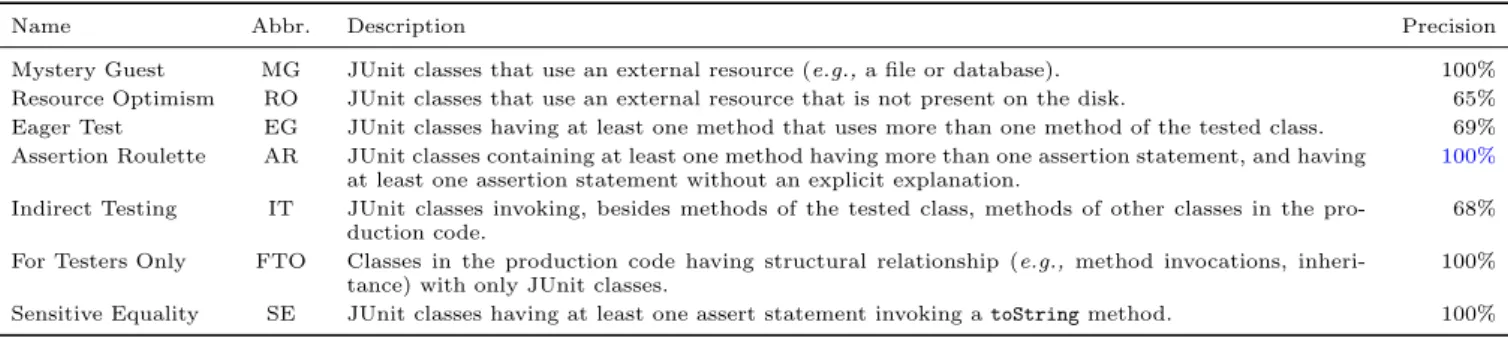
other existing detection tools [68, 70, 71], the selected de-tector is able to identify all the test smells considered in this study by applying a heuristic metric-based technique that overestimates the presence of test design flaws in or-der to detect all the instances (100% of recall), having an average precision of 88%. Table 1 reports the set of rules used by the tool to detect smelly tests. While most of the detection rules applied by the detector are rather straightforward, it is worth discussing the one related to the Assertion Roulette. Indeed, one can think that the explanatory power of an assert statement could be
sub-jectively assessed,e.g.,a developer may easily understand
an assertion because s/he an expert of the source code under test. Nevertheless, this test smell arises when the
cause leading an assertion to fail is not explicitly stated
within the assert statement. In particular, JUnit develop-ers can include, as first parameter of any assert statement, a Stringmessage reporting the motivation behind a
fail-ure caused by that assertion. TheAssertion Roulettesmell
is detected if there are more than one assert statement where such a first parameter is not set. Thus, the associ-ated detection rule simply counts the number of assertions in a test method and, for each of them, verifies whether a message is reported as first parameter. Finally, the de-tector marks a test method as affected by the smell if the
String message is not set for more than one assertions.
Note that the heuristic implemented by Bavotaet al.[28]
Table 1: Rules used to detect candidate test smells.
Name Abbr. Description Precision
Mystery Guest MG JUnit classes that use an external resource (e.g.,a file or database). 100% Resource Optimism RO JUnit classes that use an external resource that is not present on the disk. 65% Eager Test EG JUnit classes having at least one method that uses more than one method of the tested class. 69% Assertion Roulette AR JUnit classes containing at least one method having more than one assertion statement, and having
at least one assertion statement without an explicit explanation.
100%
Indirect Testing IT JUnit classes invoking, besides methods of the tested class, methods of other classes in the pro-duction code.
68%
For Testers Only FTO Classes in the production code having structural relationship (e.g.,method invocations, inheri-tance) with only JUnit classes.
100%
Sensitive Equality SE JUnit classes having at least one assert statement invoking atoStringmethod. 100%
calls of the org.junit.Assert class, e.g., assertEquals
or fail.
Despite the accuracy of the detector was already as-sessed by the original authors, it might still be possible that its performance in our context were lower. To make sure that the detector was really suitable for our purposes,
we re-evaluated its precision2 on a statistically significant
sample of 341 JUnit test classes marked as smelly by the
tool across the 3,000 test classes generated by the three
investigated automated test case generation tools over the different runs. Such a (stratified) sample is deemed to be statistically significant for a 95% confidence level and
±5% confidence interval [91]. Specifically, two authors of
this paper first performed the validation independently: they were provided with (i) the source code of the consid-ered tests and corresponding production classes and (ii) a spreadsheet file reporting the list of all the tests to
clas-sify. The task was to assign a truth value in the set{true,
false}to each test of the list: the inspector assigned the
value true when a test was actually affected by a test
smell, false otherwise. Once the inspectors had
com-pleted this task, the produced outcomes were compared, and the inspectors discussed the differences, namely test smell instances marked as such by one inspector, but not by the other. All those tests positively classified as smelly by both the inspectors were considered as actual smells. Regarding the other instances, the inspectors opened a discussion in order to solve the disagreement and took a joint decision; such a discussion took three hours in total,
concerned 27 tests (11Eager Test and 16Indirect Testing
candidate instances), and was based on the definition of the smells as well as the argumentation of the inspectors. To measure the level of agreement between the two inspec-tors, we computed the Jaccard similarity coefficient [92],
i.e., number of test smell instances identified by both the inspectors over the union of all the instances identified by them. The overall agreement between the two inspectors before the discussion was 92%. As a result of the manual validation, we found that the precision of the tool is 75% overall. The last column of Table 1 shows the precision achieved by the tool on the individual test smells consid-ered: from the table, we could observe that it has 100%
2
Note that the recall could not be evaluated because of the lack of a comprehensive oracle of test smells.
precision when considering four of the seven smells, while for Resource Optimism, Eager Test, and Indirect Testing
the precision ranges between 65% and 69%. In these cases, the lower precision of the detector is due to the intrinsic complexity of the detection mechanisms related to these
smells: as an example, the detection ofAssertion Roulette
instances is much easier and precise than Eager Test
be-cause the former can be simply identified by considering
the structural composition of anassertstatement, while
the latter requires the analysis of the behavior of a test, namely the identification of its multiple targets. Neverthe-less, our validation of the statistically significant sample of instances given by the tool allowed us to claim that it is decently accurate in all cases to allow our experiment.
3.5. Data Analysis and Metrics
Once detected the test smells affecting each of the
3,000 JUnit test classes considered, we answeredRQ1 by
verifying the distribution of test smells in the analyzed classes. In other words, we measured how many times a certain test smell type was found over the classes automat-ically generated by each testing tool. We also computed
the relative diffuseness, i.e., the number of smelly JUnit
classes over the total number of classes generated. We considered the JUnit classes generated by the
test-ing tools in different runs as independent,i.e.,the ten
JU-nit classes—produced in the ten execution runs by the test-ing tools—which test each production class in the dataset were considered as ten different instances with no rela-tion with each other. This choice was done to balance the non-determinism of the generation algorithms: indeed, as explained in Section 3.3 the selected tools may behave in
different ways during each run (e.g.,generating a test smell
in one execution and producing a clean class in the sub-sequent run). For this reason, we preferred to consider the general behavior of the tools, focusing on a large-scale analysis done with as many test classes as possible, rather than focusing on the behavior of the tools with respect to single test classes.
As forRQ2, we investigated how often the presence of
a test smell in a JUnit class implies the presence of an-other test smell. To this aim, we generated a database of transactions composed of the test smell instances found in each class considered. Such a database was then analyzed
by means of Association Rule Mining [93]: this unsuper-vised learning technique is used to identify local patterns highlighting attribute value conditions that occur together
in a given dataset. More formally, let I={i1, . . . , in} be
a set of n binary attributes called items and indicating
the presence of a certain property in the element under
consideration, and let T ={t1, . . . , tm} a set of m
trans-actions indicating the set of all the elements analyzed, an association rule is defined as an implication of the form
X ⇒ Y, whereX, Y ⊆ I and X∩Y = ∅. In our work,
the set T is composed by all the test classes generated by
the experimented automated test case generation tools,
while each item in the set I indicates the presence of a
given test smell in that test class. Therefore, an
associa-tion rule T Slef t ⇒ T Sright, between two disjoint sets of
test smells implies that, if a JUnit test class is affected
by each tsi ∈ T Slef t, then the same class should be
af-fected by each tsj ∈ T Sright. The validity and strength
of an association rule is determined by its support and confidence [93]:
Support= |T Slef t∪T Sright| T
Confidence= |T Slef t∪T Sright| |T Slef t|
whereTis the total number of classes considered. To
com-pute the association rules, we used the statistical software
R and the package arules which implements the
well-knownApriorialgorithm [93]. In Section 4 we discuss the
top-5 rules output for each analyzed testing tool. More-over, to complement the quantitative findings we also per-formed a fine-grained qualitative analysis aimed at under-standing the causes making a certain generation algorithm more/less prone to produce test smells: we manually an-alyzed the test code generated by the different tools with the aim of relating the peculiarities of the exploited algo-rithms and the presence of test smells. To this aim, two authors of this paper independently reviewed all the test classes produced by the tools looking for the root causes which make the test code smelly.
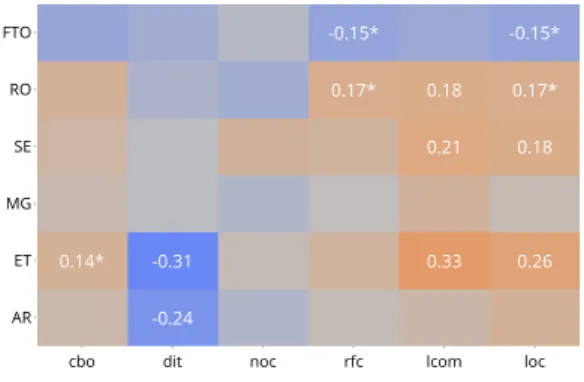
To answer RQ3 and understand the relationship
be-tween test code and production class characteristics, we
computed the Kendall’s rank correlation (Kendall’sτ) [94]
between the distribution of the test smells and the values of four different Object-Oriented metrics able to
charac-terize a class under different perspectives (i.e., Lines of
Code (LOC), Lack of Cohesion of Methods (LCOM), Cou-pling Between Object Classes (CBO), Response for a Class (RFC), and Depth of Inheritance Tree (DIT)) [31] — all the code quality metrics were computed using the publicly
available CKJM tool3 developed by Spinellis [87].
In particular, Kendall’s τ is a measure of correlation
between two variables X and Y defined in [-1; +1], where
3
The tool is available at: https://www.spinellis.gr/sw/ckjm/.
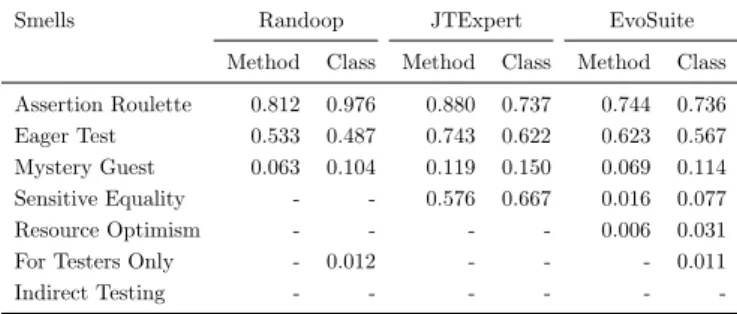
Table 2: Relative diffuseness for the seven considered test-smells over the tests generated byEvoSuite,Randoop, andJTExpert. We report the values per class and per method
Smells Randoop JTExpert EvoSuite
Method Class Method Class Method Class
Assertion Roulette 0.812 0.976 0.880 0.737 0.744 0.736
Eager Test 0.533 0.487 0.743 0.622 0.623 0.567
Mystery Guest 0.063 0.104 0.119 0.150 0.069 0.114
Sensitive Equality - - 0.576 0.667 0.016 0.077
Resource Optimism - - - - 0.006 0.031
For Testers Only - 0.012 - - - 0.011
Indirect Testing - - -
-+1 represents a perfect positive linear relationship, -1 rep-resents a perfect negative linear relationship, and values in between indicate the degree of linear dependence be-tween X and Y. To interpret the results, we used estab-lished guidelines [94] reporting that there is no correlation
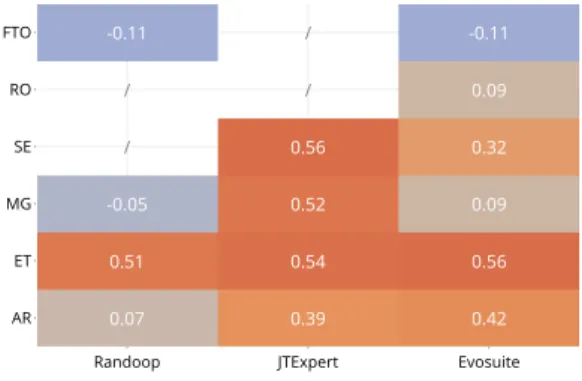
when 0≤ρ <0.1, small correlation when 0.1 ≤ρ <0.3,
medium correlation when 0.3 ≤ρ < 0.5, and strong
cor-relation when 0.5 ≤ρ≤1. Similar intervals also work in
cases of negative correlations.
InRQ4we verified whether the presence of test smells
can depend on the size of the test class generated.
Simi-larly toRQ3, we employed the Kendall’s rank correlation
[94] to measure the relation between the distribution of the test smells and the size of the corresponding JUnit test classes.
In addition to the above quantitative analyses, we con-ducted a qualitative investigation to assess which charac-teristics and peculiarities of the test case generation algo-rithms lead to the introduction of test smells. More specif-ically, two authors of this paper jointly analyzed the source code of the three considered tools in order to understand how they (i) actually generate method sequences and (ii) add assertions to the test code. During this process, the two authors first cloned the projects from their respective repositories; then, they both analyzed the algorithm defini-tions, the generated test classes, and the source code when
available (i.e., for Randoop and EvoSuite). Through
this analysis, the two authors could come up with quali-tative insights that aim at explaining the reasons behind the results coming from the correlation analyses previously performed. In Section 4 we discuss the results of our study by reporting the quantitative findings first, followed by the qualitative observations made by the automatic test case generation tool inspectors.
4. Analysis of the Results
In this section we report and discuss the results of the study aimed at answering our research questions.
4.1. RQ1: The Diffuseness of Test Smells
Our first research question aimed at studying how dif-fused test smells are in test code automatically generated
by existing testing tools.
Results. Table 2 reports, for each automated testing tool considered, the percentage of smelly JUnit test classes and methods found when running the test smell detector over the generated tests. The first thing that leaps to the eye is the high diffuseness of test smells in automatically gener-ated JUnit classes for all the experimented test-generation tools. On the one hand, this confirms the results
pre-viously achieved on EvoSuite [25], while on the other
hand, it demonstrates that the problem of test smells is
widely diffused also for other tools like Randoop and
JTExpert. More specifically, almost 81% of the JUnit
classes generated by EvoSuite can be consideredsmelly
(i.e., they contain at least one test smell instance); the
percentage is even higher for the other tools, i.e., 98%
and 92% forRandoopandJTExpert, respectively. The
results are very similar when lowering the granularity at
method-level. Among the considered test smells,
Asser-tion Roulette is the most diffused (e.g., 81% and 98% of
methods and classes generated by Randoopare affected
by this smell, respectively), followed by Eager Test (e.g.,
73% of test methods generated byJTExpertare smelly).
Discussion. The first result of our study clearly points out that, despite different heuristics for test case generation are employed by the considered tools, the distribution of test smells is nearly the same (as reported in Table 2). This is due to multiple reasons. Let first focus on the most
diffused smell, i.e., Assertion Roulette. According to the
formal definition, this smell arises when a JUnit class con-tains at least one assertion statement without an explicit
declaration (i.e.,no use of the optional first argument
pro-vided by the JUnit framework to add explanations). The
main problem leading to the high diffuseness ofAssertion
Roulette relates to the fact that none of the considered tools is able to generate those kind of comments for the placed assertions. For instance, Listing 2 shows an
exam-ple of test case generated byRandoop: as it is possible to
observe, the test case contains 12 different assertions with-out any explanation, either as a comment or as an optional message passed as first parameter to the assertion. This aspect, together with the poor readability of the test case, would make the understanding of the exercised behavior hard. We found this kind of issue for all the automated test code generators.
EvoSuite only excepts to this behavior when it fails a test verifying an exception. For the sake of compre-hensibility, let consider the test shown in Listing 3. The
test first initializes local objects of the the BrowseNode
class and, then, exercises the code to check whether a NullPointerException is thrown when calling the
method getSubNode with a string parameter referring to
a non-existing node. When testing for this behavior, we
noticed that Evosuite uses the assertionfail (line 8 in
Listing 3) by including a textual message that explain what the test is supposed to verify in production code. Thus,
1 public void test0 0 9() throws T h r o w a b l e {
2 ...
3 org . junit . Assert . a s s e r t T r u e (" ’" + str3 + " ’ != ’" + " null - null -- hi ! " + " ’", str3. equal s (" null - null -- hi ! ") ) ;
4 org . junit . Assert . a s s e r t N u l l ( str4) ;
5 org . junit . Assert . a s s e r t T r u e (" ’" + str8 + " ’ != ’" + " null - null -- hi ! " + " ’", str8. equal s (" null - null -- hi ! ") ) ;
6 org . junit . Assert . a s s e r t N o t N u l l ( a r r a y L i s t2 1) ; 7 org . junit . Assert . a s s e r t T r u e (" ’" + str2 6 + " ’ !=
’" + " null - null -- hi ! " + " ’", str2 6. equals (" null - null -- hi ! ") ) ;
8 org . junit . Assert . a s s e r t N u l l ( str2 7) ;
9 org . junit . Assert . a s s e r t T r u e (" ’" + str3 1 + " ’ != ’" + " null - null -- hi ! " + " ’", str3 1. equals (" null - null -- hi ! ") ) ;
10 org . junit . Assert . a s s e r t T r u e (" ’" + str3 7 + " ’ != ’" + " null - null -- hi ! " + " ’", str3 7. equals (" null - null -- hi ! ") ) ;
11 org . junit . Assert . a s s e r t N u l l ( str3 8) ;
12 org . junit . Assert . a s s e r t T r u e (" ’" + str4 2 + " ’ != ’" + " null - null -- hi ! " + " ’", str4 2. equals (" null - null -- hi ! ") ) ;
13 org . junit . Assert . a s s e r t N o t N u l l ( a r r a y L i s t5 2) ; 14 org . junit . Assert . a s s e r t N o t N u l l ( a r r a y L i s t5 6) ; 15 }
16
Listing 2: Test method automatically generated by Randoop
suffering of Assertion Roulette
1 public void test0 2() throws T h r o w a b l e { 2 B r o w s e N o d e b r o w s e N o d e0 = new B r o w s e N o d e () ; 3 B r o w s e N o d e b r o w s e N o d e1 = new B r o w s e N o d e () ; 4 b r o w s e N o d e1. a d d S u b N o d e ( b r o w s e N o d e0) ; 5 // U n d e c l a r e d e x c e p t i o n ! 6 try { 7 b r o w s e N o d e1. g e t S u b N o d e (" -- \ n ") ; 8 fail (" E x p e c t i n g e x c e p t i o n : N u l l P o i n t e r E x c e p t i o n ") ; 9 } catch( N u l l P o i n t e r E x c e p t i o n e ) { 10 v e r i f y E x c e p t i o n (" net . k e n c o c h r a n e . a4j . beans . B r o w s e N o d e ", e ) ; 11 } 12 } 13
Listing 3: Test case generated by EvoSuite that expect a
NullPointerException
in these cases the tool precludes the introduction of an
Assertion Roulette.
From our analyses, we can therefore conclude that all the three tools tend to introduce an instance of this smell as soon as a new assertion is added in a JUnit class. To bet-ter understand the extent of the issue, we also computed
the assertion density [95], i.e., the number of assertions
per test case, of the tests given as output by the three
tools. We found that the tests generated by EvoSuite
have an assertion density of 2, whileRandoopand
JTEx-pertgenerate on average suites with 14 and 5 assertions
per test, respectively. Those results are due to the mecha-nisms used to place the assertions (described in Section 2):
as such, whileEvosuitereduces the set of assertions
gen-erated via mutation testing, the other tools have very little control over the number of placed assertions and possibly
increase the presence ofAssertion Roulette instances.
Some other insights can be discussed when considering
the second most diffused smell,i.e., Eager Test, that arises
produc-tion class. This smell is naturally related to the method sequences that form the final test cases. More specifically, with our qualitative investigation into the algorithms ex-ploited by the considered tools we could conclude that the
presence ofEager Test instances is caused by the intrinsic
randomness in generating the method sequences forming
the final test cases. As detailed in Section 2, EvoSuite
randomly generates the initial population (i.e.,the initial
set of tests) by putting together random method sequences that likely refer to different production methods. There-fore, the tests are scented since the beginning. Indeed, crossover and mutation operations performed though their
evolution do not change the structure of the tests, i.e.,
these operators do not act on method sequences, thus not removing the initial smells nor introducing new ones.
A similar phenomenon occurs withRandoopand
JT-Expert. The former extends the sequences either by ap-pending a method call at the end of the sequence or com-bining two existing ones: it is easy to observe how such a
mechanism leads to eager sequences. JTExpert, instead,
builds the method sequences by combining state-modifier
methods with a target-viewfinder one. While the former
are often needed to expose faulty object states, the tools
has little control over the number ofstate-modifier
meth-ods that form the sequence. This mechanism may induce the introduction of sequences referring to different produc-tion methods, thus introducing a smell.
A final discussion point regards a peculiarity of
JT-Expert. While the distribution of test smells is gener-ally similar in all the three considered tools, the
diffuse-ness ofSensitive Equalityinstances inJTExpertis much
higher than the others. To recall, Sensitive Equality
hap-pens when an assertion contains an equality check though
the use of a toStringmethod. Listing 4 shows a related
example of a test case generated by JTExpert for the
class VariableLabelTableModel. As reported, the tool
tends to generate statements where the asserts are
com-posed of calls to thetoStringJava API in case of checks
involving String objects, leading to the introduction of
Sensitive Equality instances. This is true for most of the
String equality controls in our dataset (94% of them are
done by means of thetoStringfunction).
Summary of RQ1. Test smells are widely diffused
in test cases automatically generated by all the ex-perimented tools: 81%, 92%, and 98% of the JUnit
classes generated byEvoSuite,JTExpert, and
Ran-doop, respectively, can be considered smelly. Among
the studied smells, we found that Assertion Roulette
andEager Testare the most spread within our dataset.
4.2. RQ2: On the Co-Occurrence of Test Smells
In the second research question, we investigated to what extend test smells co-occur in automatically gener-ated tests.
1 @Test public void T e s t C a s e9() throws T h r o w a b l e { 2 V a r i a b l e L a b e l T a b l e M o d e l c l s U T V a r i a b l e L a b e l T a b l e M o d e l =null; 3 c l s U T V a r i a b l e L a b e l T a b l e M o d e l =new V a r i a b l e L a b e l T a b l e M o d e l ( c l s U T V a r i a b l e L a b e l T a b l e M o d e l P1P1, c l s U T V a r i a b l e L a b e l T a b l e M o d e l P1P2) ; 4 int c l s U T V a r i a b l e L a b e l T a b l e M o d e l P2R =0; 5 c l s U T V a r i a b l e L a b e l T a b l e M o d e l P2R = c l s U T V a r i a b l e L a b e l T a b l e M o d e l . g e t C o l u m n C o u n t () ; 6 a s s e r t E q u a l s (3, c l s U T V a r i a b l e L a b e l T a b l e M o d e l P2R ) ; 7 A r r a y L i s t c l s U T V a r i a b l e L a b e l T a b l e M o d e l P3R =null; 8 c l s U T V a r i a b l e L a b e l T a b l e M o d e l P3R = c l s U T V a r i a b l e L a b e l T a b l e M o d e l . g e t D a t a () ; 9 Object c l s U T V a r i a b l e L a b e l T a b l e M o d e l P3RP0R =null; 10 c l s U T V a r i a b l e L a b e l T a b l e M o d e l P3RP0R = c l s U T V a r i a b l e L a b e l T a b l e M o d e l P3R . clone () ; 11 a s s e r t E q u a l s (" [] ", c l s U T V a r i a b l e L a b e l T a b l e M o d e l P3RP0 R . t o S t r i n g () ) ; 12 a s s e r t E q u a l s (1, c l s U T V a r i a b l e L a b e l T a b l e M o d e l P3RP0R . h a s h C o d e () ) ; 13 a s s e r t E q u a l s (" [] ", c l s U T V a r i a b l e L a b e l T a b l e M o d e l P3R . t o S t r i n g () ) ; 14 a s s e r t E q u a l s (true, c l s U T V a r i a b l e L a b e l T a b l e M o d e l P3R . i s E m p t y () ) ; 15 String c l s U T V a r i a b l e L a b e l T a b l e M o d e l P4R =null; 16 ... 17 } 18
Listing 4: Example of Test Case suffering of Sensitive Equality generated byJTExpert.
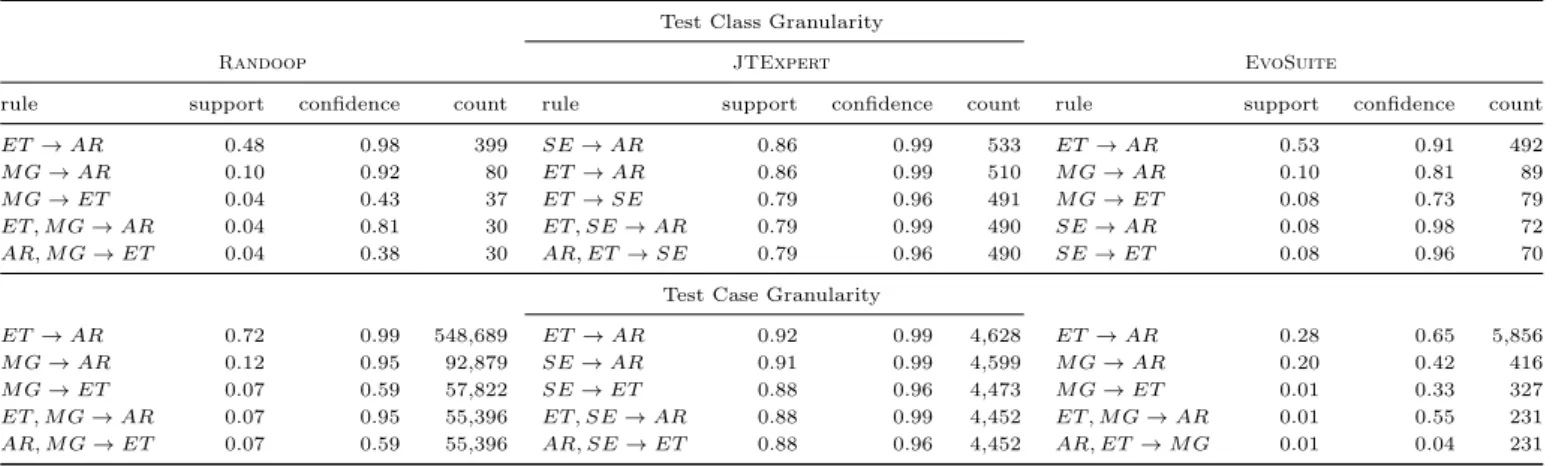
Results. Table 3 shows, for each tool, the five most im-portant association rules detected when considering both the test class granularity (upper part of the table) and test method granularity (lower part of the table). It is easy to
note that ET →ARis the rule that most frequently
oc-curs with a high support and confidence. Indeed, in case of EvoSuiteand Randoop, it represents the rule with the highest number of occurrences (492 and 399, respectively),
while for JTExpert510 occurrences were detected (i.e.,
for half of the generated test suites). On the one hand, this rule might be a reflection of the high diffuseness of those two smells in the analyzed dataset: it may be that
the massive presence of an Eager Test accidentally
coin-cides with a large amount of co-occurrences ofAssertion
Roulette instances. On the other hand, however, we can also explain such a rule with the following reasoning: with the aim of maximizing the overall branch coverage, the in-vestigated tools tend to exercise more production code as possible. Often, this would eventually break the
Single-Condition Tests principle [67], i.e., the best practice of
having a single behavior exercised by each test and lead to
the introduction of anEager Test instance. Moreover,
dif-ferent behaviors imply more production code executed by a test case that could result in more assertions generated
via mutation testing: as a result, someAssertion Roulette
instances might be generated in the same place.
Our findings also revealed that Mystery Guest
in-stances often co-occur with bothAssertion Roulette and
Eager Test in the cases of Evosuite and Randoop.
The relation that Sensitive Equality has with Assertion
Roulette when considering Evosuite and JTExpert is pretty expected, as the former smell naturally appears