Teachers’ Viability and Perception on Online Teacher Training Program
Galuh Kirana Dwi Areni
1(*), Alief Noor Farida
21,2 English Language Department, Faculty of Languages and Arts, Universitas Negeri Semarang, Semarang, Indonesia
(*) (e-mail) [email protected]
Abstract
In-service training for teachers needs to adapt with the industry 4.0 which urges the teachers to equip themselves with skills in using technology. Ministry of Education and Culture, hand in hand with Ministry of Research, Technology, and Higher Education organize in-service teacher training (INSETT). The training starts with e-learning which aims to update the teachers’ knowledge and competence. This paper aims to find out the teachers’ viability and perception on the e-learning course they had. A questionnaire is given to teachers who joined the INSETT program to collect qualitative data. The result is expected to give inputs to policy-makers for subsequent programs.
Keywords
: e-learning, teacher training programIntroduction
Being a professional becomes one of the requirements for teachers in Indonesia. Being profesional means that someone can be an expert in doing his/her job by using the knowledge s/he has (Muhafizga, 2014). Further, he explained that ideal teachers must have four competences, i.e. pedagogical competence, behaviour competence, social competence, and profesional competence. In order to acquire those competences and to fulfil the national standard of education, Indonesia government holds a program called In-Service Teacher Training Program (INSETT program). This program is aimed at preparing graduatees of both teacher training institutions and non-teacher training institutions, who posses high motivation and interest in being teachers, to have complete teacher competencies. After passing this program, they will receive teacher certificates.
Ministry of Education and Culture goes hand in hand with Ministry of Research, Technology, and Higher Education to organize the INSETT program. The teachers must be selected administratively and academically by Direktorat jenderal Guru dan Tenaga Kependidikan of Ministry of Education and
Culture before becoming participants in this program (Hadi, 2018). In previous time, the program was
held in some teacher training institutions chosen by the goverment. The participants from any towns had to stay temporarily to have the training at the chosen institutions. They had to join it for fully 10-12 days. They got both pedagogical and professional materials before they had their national examination and performance test. If they passed all of the required scores, they would be able to receive teacher certificates and become professional teachers.
Starting from 2018, considering the industrial reavolution 4.0 era, the goverment tries to apply online course in the INSETT program before having face-to-face workshops. The INSETT program is held in three steps: (1) online course for 3 months; the materials, which are in forms of either texts, audio, or video, can be accessed by using internet from participants’ home towns; (2) workshop and peer teaching (face-to-face meetings) at the chosen teacher training institution for 5 weeks; and (3) practicum teaching for 3 weeks at participants’ schools (Mulyana, 2018).
The researchers focus only on the first step (online/e-learning course) because the purpose of having this study is to find out the participants’ viability and perception on the e-learning course. In this step, they have the online course for both pedagogical and professional materials at their home towns. They can learn the materials by themselves, do discussion with the instructors, make and
1st International Conference on Education, Social Sciences and Humanities (ICESSHum 2019)
submit the assignments to the given website. At the same time, the instructors can do some discussions with them and give feedback to their assignments via online. By knowing the strenghts and weaknesses of this online course, we can offer some inputs in form of opportunities and threats of it to the authorities so that they can make improvement for the future training program.
Some studies have discussed about INSETT program. The functions of in-service teacher training program to increase teachers’ professional development in Indonesia (Muhafizga, 2014). Teacher training programs are also held in other countries in order to improve the teacher competences (R. Essel, E. Badu, 2009) (Saleem, 2016). However, there are problems in conducting INSETT program, such as cost burden, time constraint, teaching approaches and techniques, poor planning on activities, and inadequate facilities (Osamwonyi, 2016). In his study, he also proposed some recommendations to solve the problems. This study differs from the other articles because the researchers tried to analyze the learning/online course, which is newly organized in the INSETT program. The e-learning/online course must be completed in 3 months. E-learning is a system or concept of education which uses Information and Communication Technology (ICT) in the teaching and learning process (Riadi, 2014). In addition, he stated that e-learning gives flexibility in both time and place, improves students’ independence and costs efficiently for both students and the institution. There are 5 advantages of having online courses, i.e. the broad range of materials that we want to read; the comfort of rules freedom to join the course because the participant can access it from anywhere, anytime, anyplace; having a good resume; self-paced learning, and lower cost (Norman, 2016).
The first objective of this study is to find out the viability of the INSETT program participants on the e-learning/online course of INSETT program they had. Viability is the ability to success in reaching the goal. Some past studies discussed viability on learning. Blended learning approach was proven to be one success approach in extended learning (Hendrickson, Lori, Rebecca Hagen Jokela, Janene Gilman, Sara Croymans, Mary Marczak, Virginia S. Zuiker, 2010). The viability of online competency-based education was discussed (Gardner, 2017). In this study, the researchers tried to analyze the viability of the INSETT program participants to do the e-learning/online course. This covers the internet connection and their ICT readiness.
The second objective of this study is to find out the participants’ perception on the e-learning/online course of the INSETT program they had. Perception is a process where one will form an impression about someone or something (Ahen, 2009). It is constructed as a result of individual observation toward certain things or events occur around them which will produce certain perception.” The perception of higher education between USA students and China students are strongly influenced by the culture and the educational system (Xu, 2011). In addition, there is a strong relationship between students’ perception in learning and their academic achievements (Remali, Azrinawati mohd, Jiventeren Selavathy, Nurulnadiah Mohd Aris, Fatin Zakirah Zulkhepli, 2015). This study differs from the past studies because the researchers tried to analyze the INSETT participants’ perception on the e-learning/online course they had. The perception covers the time efficiency, cost efficiency, and the given materials.
Method
This is a qualitative research which aims to know the perception of the in-service teachers who join the teacher training program. By using survey methodology, a questionnaire was shared through social media to the participants. The participants of this study were the in-service teachers who joined the teacher training program in English Department of Universitas Negeri Semarang in 2018 and 2019. A total of 57 teachers responded to the questionnaire.
The questionnaire used in the survey consisted of two parts; the first part is to get information about the respondent’s viability to do the course, including the internet connection and their ICT readiness, and the second part is to get information about the respondent’s perception on the online teacher training program. The respondents were asked about their perception not only on the time
and cost efficiency, but also on the materials available on the online course. They were also asked to share their comments and suggestions to improve the online teacher training program. The data were then analyzed to get their perception on the online teacher training program they had done.
Results and Discussion
The first aim of this study is to examine whether the in-service teachers in Indonesia are viable to do online course, included in INSETT program. Online course is highly dependent on internet connection. The in-service teachers joined the teacher training program in our department are mostly ready with the need of the internet connection (see table 1). Only 4% had problem with internet connection as they lived in remote areas. This condition urged them to do extra effort to get a good connection to access the online course. Facilities, like internet connection, still become problems in developing countries, like Indonesia and Nigeria (Osamwonyi, 2016).
Table 1. Internet Connection Quality
Questions Very
Good
Just OK Very bad
How is the internet connection in your area? 28% 68% 4%
Not only the internet support but also the participants’ ability in using technology determine the online course’ success. Table 2 shows that 81% of the participants have no problems in using technology, in this case the computer and the website. The participants are already used to using technology in their lives. In addition, the website used in INSETT program is considered easy to use. There is a manual book, Panduan LMS Brightspace SPADA Indonesia, provided by the website developer. The manual book was considered helpful as it gives step-by-step guidance on how to use the website. This improves the students’ independence in learning (Riadi, 2014).
Table 2. ICT-related issues
Statements Yes No
I have no problem with ICT. 81% 19%
I need to be trained before I do the online course. 48% 52%
The web is easy to use. 96% 4%
The manual book available guides me to use the online learning web well. 96% 4%
As a proverb states that success is dependent on effort, the participants who successfully passed the online course showed their greatest effort. They have to be able to manage their time in the middle of their busy teaching schedule. They usually do the course in the middle of their work or at midnight. As shown in table 3, they spent at least 1 to 2 hours a day to access the website, and even most of them spent more than 5 hours a day to read the materials and do the assignments and tests. They had to be able to finish the materials in limited time because they are in-service teachers who are still teaching while doing the online teacher training program. This problem also came up in Nigeria (Osamwonyi, 2016).
Table 3. Time allocation
Questions 1 – 2 hours a day 3 – 4 hours a day 5 or more hours a day
How long did you spend your time to do the online course? 5% 34% 61% Questions In the morning In the afternoon In the evening
When did you do the online course? 7% 7% 86%
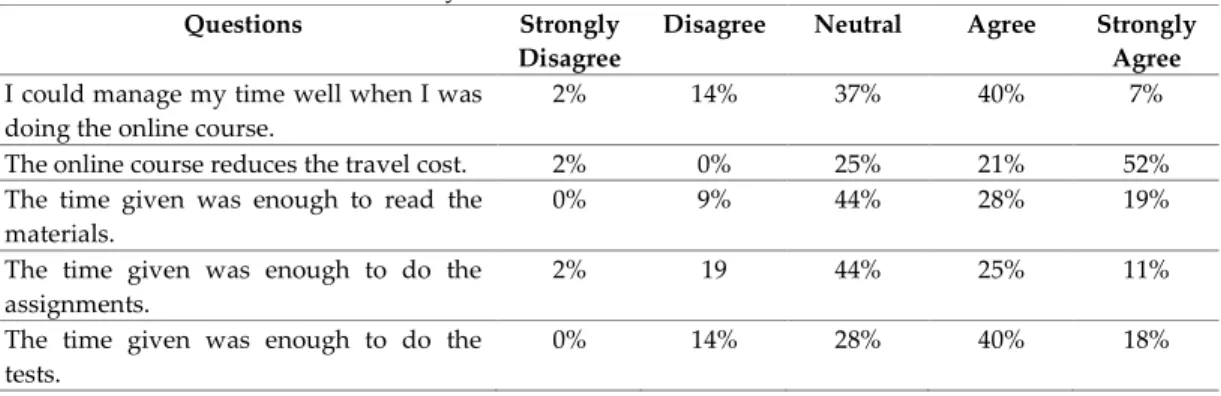
In spite of the activities the teachers have, most of the participants stated that they can manage their time well. As stated above, they have to be able to use their spare time to read the materials and
do the given tasks. This is supported by the data shown in table 4. Another strength owned by online is that it is efficient in terms of time and cost. Almost 75% participants agree that this online course help them to save their expenses as they do not have to travel a lot to other places. This is in line with (Norman, 2016) that online course is efficient in terms of time and money. However, the rest still spend some money to find some places where they can access the internet.
Table 4. Time and Cost Efficiency
Questions Strongly
Disagree
Disagree Neutral Agree Strongly
Agree
I could manage my time well when I was doing the online course.
2% 14% 37% 40% 7%
The online course reduces the travel cost. 2% 0% 25% 21% 52%
The time given was enough to read the materials.
0% 9% 44% 28% 19%
The time given was enough to do the assignments.
2% 19 44% 25% 11%
The time given was enough to do the tests.
0% 14% 28% 40% 18%
Online courses are always done in scheduled time. This means that the participants must follow the timeline prescribed. INSETT program covers 6 units on pedagogical module and 6 units on professional module. This module must be done in 3 months. The data in table 4 shows that participants think that the allocated time is enough for them to read the materials and do the assignments. Some others think that they need more time to do those activities. In addition, most of them agree that the time is enough for them to do the tests because the tests are in the form of multiple-choice.
One of the keys that guarantee a course’s success is the material. The INSETT program aims to improve the teachers’ competences, especially the pedagogical and professional competences. The course provides reading resources, tasks, assignments, and tests that can be independently accessed by the participants. Table 5 shows the participants’ perception on the materials available in the online course. Most of them have already learned pedagogical materials because they graduated from teacher training institutions. Only 8% of the participants do not have educational background as teachers. In fact, the INSETT program helps them not only refresh but also update their pedagogical knowledge. The new information improves their pedagogical competence and their teaching quality. It was acquired from the tasks they did and the discussion forums led by the instructors as well.
Table 5. The online course’s materials on pedagogical competence
Questions Strongly
Disagree
Disagree Neutral Agree Strongly
Agree
I have learned the learning materials on pedagogy before.
0% 8% 46% 37% 9%
The learning materials on pedagogy available on the website refresh and add my previous knowledge.
0% 0% 16% 44% 40%
The learning materials available on the online course help me improve my pedagogical competence.
0% 0% 16% 37% 47%
The tasks given improve my pedagogical competence.
0% 2% 12% 46% 40%
The forums led by the instructors improve my understanding on the materials.
0% 4% 16% 53% 27%
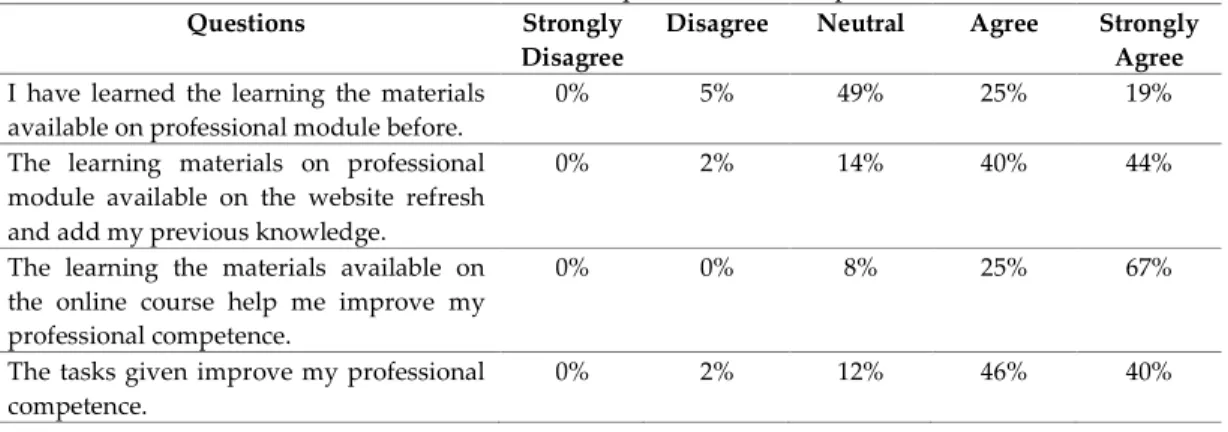
As mentioned before, the INSETT program also covers professional materials. The materials refresh the teachers with knowledge on English lesson, including short functional texts and various
genre texts taught at junior high school and senior high school. The in-service teachers are English teachers who definitely graduate from English department. Therefore, they have learned most of the professional materials before. Table 6 shows that the participants mostly agree that the materials in the professional module improve their previous knowledge as the materials available are more up-to-date. The tasks also require them to practice the materials so that they know what kind of assessments they can apply when they are teaching in the future.
Table 6. The online course’s materials on professional competence
Questions Strongly
Disagree
Disagree Neutral Agree Strongly
Agree
I have learned the learning the materials available on professional module before.
0% 5% 49% 25% 19%
The learning materials on professional module available on the website refresh and add my previous knowledge.
0% 2% 14% 40% 44%
The learning the materials available on the online course help me improve my professional competence.
0% 0% 8% 25% 67%
The tasks given improve my professional competence.
0% 2% 12% 46% 40%
This study implies that the in-service teachers in Indonesia are ready to have online course in INSETT program. However, in the survey, the participants also give their suggestion for the better online course. First, the materials should be better developed. They found that some materials in the online course were poorly planned by the material’s developer, for examples: incomplete tasks, unclear instructions, and invalid tests. Second, the time allotment should be lengthened. As the participants are in-service teachers, they have a lot of things to do and need more time to finish their learning on online course. Third, the government should provide adequate facilities, especially the internet connection for everyone who join the INSETT program. These suggestions are in line with the recommendation given by Osamwonyi (2016).
Pedagogical Implication
The in-service teachers’ perception on the online program of INSETT is positive. It also has positive relation to the teacher’s success in finishing the program. Most of them are able to finish the online INSETT program well because they are still young and have good ICT skill needed. In addition, although they have to work harder as they have to work at school and do the abundant assignments after school, they successfully manage their time. They also perceive the online program as a good way to save their finance as they do not have to leave their work and their hometown.
The finding of the study implies that the in-service teachers who join the INSETT program are basically viable for the online program. However, a few of them find difficulties in accessing the online program due to the internet connection quality. Therefore, the policy maker should consider this problem to make a better INSETT program such as providing facilities and/or giving an optional program (offline INSETT program) for those who live in remote areas.
When they do the online program, they learn materials, assignments, and tests. The study shows that they can do the tests well. In the end of this program, the in-service teachers will have to pass a national exam. It is expected that the tests they have on online program help them face the national exam. Therefore, material developer and test maker should work on the material together.
Suggestion for further study
Participants’ viability and perceptions on the online course are examined in this survey. However, a further research should be done to seek for the instructors’ and the material developers’ perception
as well. The perception of the instructors and the material developers will greatly affect the success of this program and give impact to the teachers’ competences. Furthermore, this study has not discussed the impact of the perception to the teacher’s academic competencies and performance.
Conclusions
The online course included in INSETT program in Indonesia has been held for two years. Most in-service teachers who are selected to join INSETT program are viable in doing the online course. They have good internet connection to access the program and are able to manage their time well. according to the participants, the given materials successfully improve their knowledge on the pedagogical and professional, and have positive impacts on their teaching competences. Some weaknesses are also found, like the internet connection and the quality of test items.
Acknowledgments
The researchers would like to extend our gratitude to anyone who involved in the INSETT program of English Department at Universitas Negeri Semarang, especially to the in-service teachers who had willingly filled out the questionnaires.
References
Ahen, J. A. (2009). Student’s Perception towards English for Self Expression. Universiti Malaysia Sarawak. Retrieved from http://ir.unimas.my/4188/1/Student’s perception towards english for self expression.pdf
Gardner, A. (2017). The viability of online competency based education: An organizational analysis of the impending paradigm shift. The Journal of Competency-Based Education.
https://doi.org/https://doi.org/10.1002/cbe2.1055
Hadi, S. (2018). PENDIDIKAN PROFESI GURU PPG DALAM JABATAN TAHUN 2018. Retrieved March 6, 2019, from http://lpmplampung.kemdikbud.go.id/detailpost/pendidikan-profesi-guru-ppg-dalam-jabatan-tahun-2018
Hendrickson, Lori, Rebecca Hagen Jokela, Janene Gilman, Sara Croymans, Mary Marczak, Virginia S. Zuiker, P. D. O. (2010). The Viability of Podcasts in Extension Education: Financial Education for College Students. The Journal of Extension, 48(4). Retrieved from
https://joe.org/joe/2010august/a7.php
Muhafizga. (2014). PENDIDIKAN PROFESI GURU (PPG) SEBAGAI STRATEGI PENGEMBANGAN PROFESIONALITAS GURU DALAM UPAYA PENINGKATAN MUTU PENDIDIKAN INDONESIA. Retrieved March 7, 2019, from
https://hafizsejarah.wordpress.com/2014/06/27/pendidikan-profesi-guru-ppg-sebagai-strategi-pengembangan-profesionalitas-guru-dalam-upaya-peningkatan-mutu-pendidikan-indonesia/ Mulyana, A. (2018). PPG dalam Jabatan (PPGDJ) Tahun 2019. Retrieved March 5, 2019, from
https://ainamulyana.blogspot.com/2018/10/ppg-dalam-jabatan-ppgdj-tahun-2019.html Norman, S. (2016). 5 Advantages of Online Learning: Education Without Leaving Home. Retrieved
from https://elearningindustry.com/5-advantages-of-online-learning-education-without-leaving-home
Osamwonyi, E. F. (2016). In-Service Education of Teachers: Overview, Problems and the Way Forward. Journal of Education and Practice, 7(26), 83–87. Retrieved from
https://files.eric.ed.gov/fulltext/EJ1115837.pdf
R. Essel, E. Badu, W. O.-B. & A. A. S. (2009). In-Service Training: An Essential Element in the Professional Development of Teachers. Malaysian Journal of Distance Education, 11(2), 55–64.
Retrieved from Malaysian Journal of Distance Education
Remali, Azrinawati mohd, Jiventeren Selavathy, Nurulnadiah Mohd Aris, Fatin Zakirah Zulkhepli, N. S. S. (2015). Understanding the impact of Students’ Perception in Learning toward Academic Performance. In National Symposium & Exhibition on Business & Accounting (pp. 1–9). Retrieved from
https://www.researchgate.net/publication/287195181_Understanding_the_impact_of_Students’_ Perception_in_Learning_toward_Academic_Performance
Riadi, M. (2014). Pengertian, Karaktiristik dan Manfaat E-Learning. Retrieved from
https://www.kajianpustaka.com/2014/06/pengertian-karaktiristik-dan-manfaat-elearning.html Saleem, Z. (2016). Role of In-Service Teacher Training in the Professional Development of Prospective
Teachers. Information and Knowledge Management, 6(8), 53–60. https://doi.org/https://doi.org/10.7176/IKM
Xu, H. (2011). Students’ perceptions of university education – USA vs. China. Research in Higher
Education Journal. Retrieved from
https://www.researchgate.net/publication/267823537_Students’_perceptions_of_university_educ ation_-_USA_vs_China