University of Arkansas, Fayetteville
ScholarWorks@UARK
Theses and Dissertations
5-2019
Expanding Outcomes in Educational Program
Evaluation: Student Outcomes, Systemic Effects,
and Policy Implications
Heidi Lauren Holmes University of Arkansas, Fayetteville
Follow this and additional works at:https://scholarworks.uark.edu/etd
Part of theCurriculum and Instruction Commons,Educational Assessment, Evaluation, and Research Commons, and theEducation Policy Commons
This Dissertation is brought to you for free and open access by ScholarWorks@UARK. It has been accepted for inclusion in Theses and Dissertations by an authorized administrator of ScholarWorks@UARK. For more information, please [email protected].
Recommended Citation
Holmes, Heidi Lauren, "Expanding Outcomes in Educational Program Evaluation: Student Outcomes, Systemic Effects, and Policy Implications" (2019).Theses and Dissertations. 3214.
Expanding Outcomes in Educational Program Evaluation: Student Outcomes, Systemic Effects, and Policy Implications
A dissertation submitted in partial fulfillment of the requirements for the degree of Doctor of Philosophy in Education Policy
by
Heidi Lauren Holmes Brigham Young University
Bachelor of Arts, 2012
May 2019 University of Arkansas
This dissertation is approved for recommendation to the Graduate Council.
____________________________________ Jay P. Greene, Ph.D Dissertation Director ____________________________________ Patrick J. Wolf, Ph.D Committee Member ____________________________________ Robert M. Costrell, Ph.D Committee Member
Abstract
Education policy debates over the last twenty years have focused on the need to increase students’ test scores. The federal government and states have implemented and expanded a variety of test-based, school accountability policies. Accountability pressures have incentivized schools to narrow their curriculum, decrease time allocated to extracurricular activities, and focus on short-term student outcomes. This dissertation focuses on expanding outcomes in educational program evaluations and demonstrates the value of looking beyond the goal of increasing student test scores. The first chapter, using random assignment, estimates the causal effects of culturally enriching field trips on various student outcomes. Such field trips have been declining in part due to accountability pressures. We find evidence that such field trips can actually have a positive impact on student achievement as well as school engagement. The second chapter focuses on post-secondary outcomes for students. Also using an experimental design, we evaluate the impact of the Louisiana Scholarship Program on the likelihood of students entering college. Despite the program negatively affecting student test scores, we find that the program had no significant effect on the likelihood that students enter college. Finally, the third chapter takes a broader approach and evaluates systemic effects created by charter schools. Using nationwide data, I analyze the extent to which charter schools crowd out private schools in the market. I find evidence that charter and private schools compete for student enrollment, and as charter schools remain in the market, the quantity of private schools decreases.
Acknowledgements
I would first like to acknowledge my advisor, Dr. Jay Greene, and my other dissertation committee members, Dr. Patrick Wolf and Dr. Robert Costrell, whose guidance and insight over the last four years has been invaluable. This work would not be possible without their support. I would also like to acknowledge my coauthors, Dr. Angela Watson, Molly Beck, and Dr.
Jonathan Mills, who have greatly contributed to this work. Furthermore, I want to acknowledge Laura Florick, who has expertly managed our longitudinal arts field trip experiment, along with our research partners at The Woodruff Arts Center who are dedicated to improving students’ lives and who have been incredible partners. Additionally, I am grateful for the faculty and the staff in the Department of Education Reform for their excellent training and encouragement that has helped me develop as a researcher.
Finally, I would like to thank my family for their unwavering support and
encouragement. I am most grateful for the never-ending support of my husband, Dane Erickson. He enthusiastically moved to Arkansas and over the past four years has provided countless takeout meals, an endless supply of Diet Coke, and a steady foundation that I rely on daily.
Dedication
To my parents, Doug and Erin Holmes, to whom I owe my passion for education and who taught me to seek after truth.
Table of Contents
Introduction ... 1
References ... 7
Chapter 1: Does Art Make You Smart? A Longitudinal Experiment of the Effects of Multiple Arts-Focused Field Trips ... 9
Introduction ... 9
Previous Literature ... 11
Research Question and Hypotheses ... 14
Study Design ... 15
Results ... 23
Discussion ... 27
Conclusion ... 29
References ... 30
Chapter 2: The Effect of the Louisiana Scholarship Program on College Entrance ... 32
Introduction ... 32
Louisiana Scholarship Program Description ... 34
Literature Overview ... 34 Research Methodology ... 43 Results ... 50 Discussion ... 54 Conclusion ... 57 References ... 59
Chapter 3: Who Wins in School Choice? Evaluating the Impact of Charter Schools on the Market Share of Private Schools ... 64
Introduction ... 64
Research Question and Theory ... 66
Previous Literature ... 70 Research Methodology ... 72 Results ... 75 Discussion ... 81 Conclusion ... 84 References ... 86 Conclusion ... 89
List of Published Papers
Erickson, H. H., Greene, J. P., Watson, A. R., & Beck, M. I. (2019). Does Art Make You Smart? A Longitudinal Experiment of the Effects of Multiple Arts-Focused Field Trips. EDRE Working Paper no. 2019-05. Social Science Research Network (Chapter 1 of this dissertation).
Erickson, H. H, Mills, J.N., & Wolf, P.J. (2019, April). The Effect of the Louisiana Scholarship Program on College Entrance. EDRE working paper no. 2019-12. Social Science Research Network. (Chapter 2 of this dissertation)
Introduction
Ever since the Nation at Risk report was published in 1983 under President Ronald Reagan’s administration, education reform has been a hotly debated topic at all levels of government. The report declared that American students were falling behind students in other nations and that a tide of mediocrity was sweeping through the United States (Gardner et al., 1983). As a result, politicians, activists, and parents fearing that the United States would lose its economic standing in the world, called for higher standards and greater accountability at all levels of public education. Since the report’s release, the demand for greater accountability has continued until today and remains central to education policy debates. President George W. Bush implemented the first substantial federal accountability program, No Child Left Behind (NCLB), in 2002. NCLB mandated that states administer tests in grades three through eight with the hope of holding schools accountable for student test scores and ensuring that students, especially minority and economically disadvantaged students, made adequate yearly progress. If schools failed to meet set standards, they faced threats of sanctions. While it is unclear the extent to which schools actually experienced sanctions, NCLB significantly changed the schooling climate where administrators and teachers felt great pressure to improve students’ test scores (Reback, Rockoff & Schwartz, 2014; Ladd, 2017). In an attempt to enhance federal accountability policy, President Barack Obama replaced NCLB with the Every Student Succeeds Act (ESSA) in 2015. ESSA allows states to design the specific features of their accountability systems, but the law still requires states to administer tests in grades three through eight. While states have slightly more flexibility, student test scores remain the primary focus.
As a result of increased federal involvement in school accountability policy, policymakers and schools have intensely focused on improving student test scores.
order to increase instructional time as well as time dedicated to test preparation in the hope of meeting accountability metrics (Greene; 2017; Ladd, 2017). Because of the increased emphasis on test scores, there is great political pressure to make policy decisions regarding implementing, sustaining, expanding, and discontinuing various education programs on a program’s ability to increase test scores. Despite the attention to test scores by policy makers, few parents believe that test scores are the only, or even the most important measure of educational success (DiPerna & Catt, 2016; Erickson, 2017; Glazerman & Dotter, 2016; Hastings, Kane, & Staiger, 2005). Most families want an education for their children that does not simply teach students reading and math skills, but which also provides a safe learning environment where students learn citizenship, perseverance, and creativity, as well as expose them to a world beyond what they already know. But, due to high-stakes, test-based accountability, many of the other values that schools provide are not frequently considered when evaluating educational policies, which leads to a narrow understand of how and what programs impact students. I do not intend to say that test scores are not an important measure of educational success, student academic achievement is an important outcome, but a hyper sensitivity to test scores comes at the expense of other
important educational inputs and outcomes.
In this dissertation, I evaluate programs and focus on student outcomes that have not been commonly considered during the high-stakes accountability era. These programs can impact students’ success during and after their K-12 schooling and have widespread policy implications for the education system. Chapter 1 evaluates the benefits of culturally enriching field trips and how these field trips affect students’ engagement in school as well as future academic outcomes. Field trips are a long-standing tradition in schools that serve to enrich students’ learning and to expose them to a broader world. However, there is evidence that such field trips are declining in
part due to accountability pressures (Gadsden, 2008; Government Accountability, 2009; Rabkin & Hedberg, 2011). Schools, particularly low performing schools and those in high poverty areas, instead choose to increase instructional time in math and reading in the hopes of boosting test scores. This additional seat time comes at the expense of other subjects and supplemental educational activities. Unfortunately, there is limited rigorous research on the benefits of field trips. I, along with my colleagues, seek to understand these benefits by conducting, what is to our knowledge, the first ever longitudinal experiment of arts-related field trips. In collaboration with the Woodruff Arts Center in Atlanta, Georgia and a nearby, large urban school district, we randomly assigned fourth and fifth grade students to receive three arts-related field trips or to serve as a control. The Woodruff Arts Center is a world class arts center that offers premier facilities and award-winning theater productions and concerts that are of the highest professional quality. Treatment students receive a field trip to the Alliance Theatre, the Atlanta Symphony Orchestra, and the High Museum of Art, while the control group receives business as usual, which could be one field trip to various locations around Atlanta. We then measure the effect of the field trips on a variety of student outcomes. Surprisingly, we find that treatment students in the first cohort experience gains on their math and English Language Arts (ELA) end-of-year test scores. This finding was contrary to our original hypothesis since we expected to see no
substantial test score gains. We believe that the test score gains may be a result of increased school engagement because we also find that treatment students report enjoying attending school more and have fewer reported behavioral infractions than their control counterparts. It is clear that attending three arts related fieldtrip throughout the year did not diminish student test scores, but instead could potentially increase test scores, as well as increase student engagement. As
such, the practice of reducing field trips due to accountability pressures is perhaps unnecessary and attending field trips may instead improve students’ academic outcomes.
Chapter 2 is an evaluation of the Louisiana Scholarship Program’s (LSP) effect on college entrance. The LSP is a private school voucher program that provides government financial aid to low-income families to attend a private school of their choice. There is a vast amount of school choice research that evaluates the effect of a program on students’ academic achievement; however, there is less known regarding the impacts school choice programs have on students’ post-secondary outcomes. Much of the policy discussion surrounding school choice focuses on whether or not programs are successful at increasing students’ test scores.
Policymakers face significant political pressure to discontinue programs that do not improve test scores. However, it is not clear if school choice programs affect student achievement and longer-term outcomes such as high school graduation and college entrance rates in the same way.
In the school choice literature, there is a growing disconnect between a program’s effect on student achievement and later educational attainment (Hitt, McShane, & Wolf, 2018). For example, some choice programs, especially charter schools, have shown large significant test score gains but null or even negative effects on post-secondary outcomes. The opposite is true with other programs, particularly private school choice programs, demonstrating no significant effect on test scores, but large effects on high school graduation rates. When policy decisions are made based on test score results exclusively, the programs that have less impact on test scores face being discontinued despite improving students’ longer-term outcomes. In previous
evaluations, the LSP has shown large negative effects on students’ math and reading test scores (Mills & Wolf, 2019). However, in this study using an experimental design, we find no
different rate than do their control counterparts. Our findings elicit many questions regarding how to evaluate programs and whether or not to maintain or discontinue the LSP. What is clear is that test scores and other outcomes are not always correlated and making significant policy decisions based solely on test scores provides a limited perspective on the varied impacts of a program.
Chapter 3 takes a broader approach to program evaluation and analyzes how charter schools impact the supply of private schools. While most of the school choice literature focuses on measuring participant effects, school choice programs can have significant impacts on the entire education system. Traditional public, charter, and private schools all play an important role in the K-12 schooling market. It is important to understand how one schooling sector affects others as a change in the supply of schools in one sector can impact the supply and quality of schools in another. Charter schools have grown quickly and expanded across the United States since they were first introduced in 1991. As of 2018, only seven states did not have a charter law. Charter schools offer a cost-free alternative to families who have been paying a premium for private schools. As such, families are likely to leave private schools for charters when new schools open. Using nation-wide panel data, I evaluate the extent to which charter schools affect the market share of private schools. I specially look at the effect that charter schools have on private school student enrollment as well as the number of private schools. I find that as charter school enrollment increases in a specific county, private school enrollment and the number of private schools in that county decreases. These findings have broad policy implications because they demonstrate that there is a demand for alternative schooling options and that some families prefer charter schools over traditional public schools. These findings also have significant financial implications because as more students leave the private sector and enter public schools,
public education funds are spread among more students, lowering per-student spending overall. This study illustrates the importance of considering the systemic impacts of programs because a change in one sector can have substantial ramifications on the entire education system.
Overall, this dissertation demonstrates the need to think broadly about how educational policies affect students and the education system as a whole. As a result of the test-based
accountability era, schools have increased instruction in core subjects at the expense of thinning their overall curriculum. Research on various educational programs has also focused primarily on measuring the impact programs have on student academic achievement. However, as
illustrated in the following three chapters, test scores give an important, yet narrow view on how programs affect students and the education system. In Chapter 1, we find evidence that students who were randomly assigned to receive multiple culturally enriching field trips were more engaged in school and they scored higher on their end-of-year exams than did control students. These findings question the efficacy of schools increasing traditional classroom instruction at the cost of reducing the number of extracurricular activities such as field trips. In Chapter 2, we find that the Louisiana Scholarship Program had no significant effect on the likelihood of students enrolling in college. This finding is particularly interesting given the large, negative effect the program had on student test scores. This chapter demonstrates the importance of considering long-term student outcomes such as college entrance when evaluating policies. The final chapter broadens the literature on school choice by focusing on the systemic effects created by charter schools. I find that charter schools draw a significant amount of enrollment from nearby private schools and that over time, the number of private schools actually decreases to adjust for declining enrollment. These findings have significant implications for state and local education resources.
References
DiPerna, P. & Catt, A. D. (2016). 2016 Schooling in America survey: Public opinion on K-12 Education and school choice. Edchoice, Polling Paper no. 28. Retrieved from
https://www.edchoice.org/research/2016-schooling-america-survey/.
Erickson, H. H. (2017). How do parents choose schools, and what schools do they choose? A literature review of private school choice programs in the United States. Journal of School Choice, 11(4), 491-506.
Gadsden, V. (2008). The arts and education: Knowledge generation, pedagogy, and the discourse of learning. Review of Research in Education, 32(1), 29-61.
Gardner, D. P., Larsen, Y. W., Baker, W., Campbell, A., & Crosby, E. A. (1983). A nation at risk: The imperative for educational reform. Washington, DC: United States Department of Education.
Glazerman, S., & Dotter, D. (2016). Market Signals: How Do DC Parents Rank Schools, and What Does It Mean for Policy? Policy Brief. Mathematica Policy Research, Inc. Government Accountability Office (2009). Access to arts education: Inclusion of additional
questions in education’s planned research would help explain why instruction time has decreased for some students. Report to Congressional Requesters. February, GAO-09- 286. Retrieved from https://www.gao.gov/new.items/d09286.pdf.
Greene, J. P. (2017). Futile accountability systems should be abandoned. Education Next, 17(3), 51-54.
Hastings, J. S., Kane, T. J., & Staiger, D. O. (2005). Parental preferences and school
competition: Evidence from a public school choice program (No. w11805). National Bureau of Economic Research.
Hitt, C., McShane, M. Q., & Wolf, P. J. (2018). Do impacts on test scores even matter? Lessons from long-run outcomes in school choice research. American Enterprise Institute. Retrieved from http://www. aei. org/publication/do-impacts-on-test-scores-even-matterlessons-from-long-run-outcomes-in-school-choice-research.
Ladd, H. F. (2017). No Child Left Behind: A deeply flawed federal policy. Journal of Policy Analysis and Management, 36(2), 461-469.
Mills, J.N., & Wolf, P.J. (2019). The effects of the Louisiana Scholarship Program on student achievement after four years. EDRE working paper no. 2019-10. Social Science Research Network, April 23.
Reback, R., Rockoff, J., & Schwartz, H. L. (2014). Under pressure: Job security, resource allocation, and productivity in schools under No Child Left Behind. American Economic Journal: Economic Policy, 6(3), 207-41.
Chapter 1: Does Art Make You Smart? A Longitudinal Experiment of the Effects of Multiple Arts-Focused Field Trips1
Introduction
In this paper we estimate the causal effects of culturally enriching field trips on students’ academic performance and school engagement. Such field trips are a long-standing tradition in schools. There are many potential benefits for students from attending culturally enriching field trips.Field trips to cultural institutions, particularly arts institutions, expose students to new ideas, places, and cultures while providing opportunities to deepen learning outside of the traditional classroom. Arts institutions provide meaningful opportunities not only to see, hear, and discuss works of arts, but expose students to a world beyond what they know. Many students, especially in low-income areas, experience little beyond their homes, neighborhoods, and schools. Field trips can vastly expand what children experience as part of their schooling. Field trips to cultural institutions such as art museums and theaters continue mostly due to the wisdom of educators and historical tradition. However, in recent decades, institutions such as arts venues, science museums, and zoos have noticed a decline in field trip attendance (Ellerson & McCord, 2009; Greene, Kisida, & Bowen, 2014). Teachers and students also reported a decline in school sponsored field trips (Government Accountability Office, 2009; Keiper et al., 2009).
Some evidence suggests that schools are reducing the number of field trips due to
increased pressure from high-stakes accountability (Gadsden, 2008; Government Accountability, 2009; Rabkin & Hedberg, 2011). Under test-based accountability systems schools are under pressure to reconsider the costs and benefits of traditional educational field trips as they focus on increasing math and reading test scores (Gadsden, 2008; Rabkin & Hedberg, 2011; Student Youth & Travel Association, 2016). Responding to these pressures, schools allocate additional
time to instruction, specifically in math and reading, and test preparation while cutting back on non-tested subjects and other activities such as field trips. Notably, academically low-performing schools that serve students from high-poverty areas are more likely to report a decline in school-sponsored field trips, including arts-focused trips (Government Accountability Office, 2009; Keiper et al., 2009). These schools also face the greatest accountability pressures. A decline in field trips in high-poverty areas is especially concerning as field trips can provide equitable access to cultural institutions for students across various economic and racial groups.
Unfortunately, there is little systematic evidence on the value of cultural field trips for students. However, foregoing field trips could have unintended consequences for students as time in school is allocated to other academic activities in hopes of increasing student test scores. We seek to increase the literature on the impacts of field trips with the goal of better
understanding the benefits for students and what might be lost if schools continue to decrease such activities. We expand the literature on the educational benefits of field trips by conducting, to our knowledge, the first-ever multi-visit, longitudinal experiment to estimate these effects. We randomly assign fourth and fifth grade students in ten elementary schools in a large urban school district to receive multiple arts-related field trips throughout the school year or to serve as a control group. This paper presents the results from the second year of the study. Our findings show significant educational benefits for students who attend arts-related field trips. We find that treatment students exhibit higher levels of school engagement. Surprisingly and contrary to our hypothesis, we find that treatment students also perform significantly better on their end-of-year standardized tests, and that this effect is persistent one year after treatment. These effects appear to be stronger for the first cohort of students in our sample.
The paper proceeds as follows. First, we discuss the previous literature on the impact of field trips and arts exposure for students. Second, we present our research questions and describe the study design. We then present our results and conclude with discussing policy implications and future research.
Previous Literature
Despite the educational tradition of fieldtrips, there is limited rigorous research evaluating the effects students experience from such activities. We draw on the literature evaluating the benefits of arts education as well as research on specific field trips. We group the literature based on research design pulling from both observational and experimental designs. Observational Studies
There are a handful of observational studies focusing on the value of the arts for students’ academic and social development. Longitudinal studies find positive correlations between arts exposure and academic outcomes (Ruppert, 2006; Lacoe, Painter, & Williams, 2016). Jægar and Møllegarrd (2017), comparing identical twins, find that children who frequent museums,
theaters, and musical performances when they are younger also perform better in school when they are teenagers. Notably, a recent meta-analysis on the effects of student achievement from arts integration programs finds a four-percentage point increase in achievement (Ludwig, Boyle, & Lindsay, 2017). While a four-percentage point increase reflects significant academic gains, the authors warn against causal interpretation as none of the studies in the meta-analysis were able to establish a causal connection between arts activities and academic performance. Further, Lacoe, Painter, & Williams (2016) evaluate an arts integration program and find evidence that the dosage of exposure is important; students who receive longer and more intensive dosages
experience larger academic gains and fewer school suspensions. However, they also find diminishing effects once treatment ceases.
Other research has found social and emotional benefits from exposure to the arts. A recent study looking at single-visit art museum field trips finds that students experience increases in critical thinking, creative thinking, and human connection (Randi Korn & Associates, 2018). Human connection is defined as an awareness or sense of connection to others and the self and is similar to the construct of social perspective taking (Gehlbach, Brinkworth, & Wang, 2012; Greene et al., 2018). In addition to a single art museum visit, the study adds a second treatment condition of a near identical arts program that takes place in a classroom instead of in the museum. The authors find that the in-gallery experience appears to be more impactful than simply seeing and discussing identical art content at school (Randi Korn & Associates, 2018). Experimental Studies
Fortunately, there is a growing, yet still limited, body of literature on the causal effects for students from arts integration and specifically, arts-related field trips. A study of a district-wide arts enrichment program where, due to budget constraints, schools were randomly chosen to participate, shows positive outcomes on students’ compassion for others, school engagement, as well as increased standardized test scores (Bowen & Kisida, 2019). Greene, Kisida, and Bowen (2014) experimentally evaluate the effects of a single visit to an art museum on student outcomes and find that students who tour an art museum demonstrate a host of significant benefits when measured nearly two months after the visit occurs. Treatment students are more likely to report a greater desire to consume art in the future and actually visit the same art museum on their own following the field trip (Kisida, Greene, & Bowen, 2014). In addition, there is evidence that treatment students demonstrate increased levels of critical thinking skills,
as well as increased tolerance, content knowledge, and historical empathy (Bowen, Greene, & Kisida, 2014; Greene, Kisida, & Bowen, 2014). Further, these benefits appear stronger for students from low socioeconomic backgrounds.
In a similar experimental study evaluating the effects of attending field trips to see live theater performances, students demonstrate higher levels of tolerance, social perspective taking, and evidence of increasing desire to consume theater in the future (Greene, et al., 2015; Greene et al., 2018). Particularly interesting, Greene et al. (2018) adds a second treatment condition wherein some students receive a field trip to a live theater performance, some receive a field trip to see a movie of the same play, and the control group remains at school and receives neither the play nor the movie treatment. Students who view the live theater performance demonstrate higher levels of tolerance, social perspective taking, and content knowledge compared to the students who viewed a movie of the same play.
Our current study adds to the existing literature on the benefits of culturally enriching field trips in four ways. First, we use an experimental design that allows us to capture the causal effects on students from attending field trips. Second, where most of the previous literature focuses on the effects from attending one field trip, treatment students in this study attend three different arts-related field trips: an art museum, live theater, and the symphony. Third, this study takes place in a large urban city, and the participating schools consist primarily of students of color who are from economically disadvantaged backgrounds. Much of the existing research was conducted in suburban and rural areas. Fourth, this study is the first longitudinal experiment where we collect both survey and administrative data for students in our sample.
Research Question and Hypotheses
This paper examines whether attending multiple arts-focused field trips throughout the school year improves students’ engagement in school and affects their academic performance. We measure the effect of receiving three field trips in one year, six field trips over two years, and the effect one year following treatment. We set the following hypotheses:
H1: We expect that treatment students will demonstrate higher levels of school engagement.
H1a: We expect treatment students to report higher levels of school engagement through self-reported measures on surveys than their control counterparts. H1b: We also expect treatment students to have fewer behavioral infractions throughout the school year than their control counterparts.
H2: We expect to find no statistically significant treatment effect on students’ end of year standardized test scores.
We hypothesize that treatment students will demonstrate higher levels of school
engagement by spending time away from traditional instruction and being exposed to new ideas and art forms with which they are unfamiliar. Exposing students to new ideas sparks their creativity and desire to learn. When students are excited about a certain subject or idea, they are naturally more engaged in school. It is also possible, that simply providing a break from
traditional instruction motivates and refreshes students so that they enjoy school more. There is not a comprehensive measure of school engagement; we use a self-reported and behavioral measure to capture students’ engagement. First, we use students’ self-reports on how boring they believe school is. Second, we use the number of infractions a student receives in a year. Students who are engaged in school are less likely to act out. Using both self-reported and behavioral measures provides a good proxy for students’ engagement in school.
While field trips can expose students to arts and provide a unique learning environment, it is unlikely that three arts-related trips will significantly affect students’ academic performance on math or reading exams. Three days away from traditional instruction is unlikely to harm student achievement nor provide enough content to improve test scores. While some previous studies have found positive effects on students’ academic performance from arts exposure, these studies have evaluated more intensive arts integrations programs. We are evaluating a less intensive program of only arts-related field trips. As such, we expect to find no significant difference between treatment and control students’ test scores.
Study Design
In partnership with The Woodruff Arts Center in Atlanta, Georgia and a large urban school district, we randomly assign fourth and fifth grade classes within ten elementary schools to receive a field trip to each of the three Woodruff arts partners, the Alliance Theatre, the Atlanta Symphony Orchestra, and the High Museum of Art, or to serve as a control group. The Woodruff Arts Center is a world-class center that offers some of the nation's leading exhibits and facilities. The three high-quality field trips, all part of the otherwise existing educational
programming at each venue, are carefully designed for maximum impact and cultural relevancy. The hour-long Alliance Theatre performance is designed for children and families and performed by a professional cast and is of the highest artistic quality. A trained volunteer docent leads the long High Museum of Art’s program featuring several works of art followed by an hour-long hands-on studio experience led by a teaching artist. Finally, the Atlanta Symphony
Orchestra fills their 1,700-seat facility for an hour-long concert with a full symphony performing music carefully selected for younger audiences and accented with large-screen video descriptions and images.
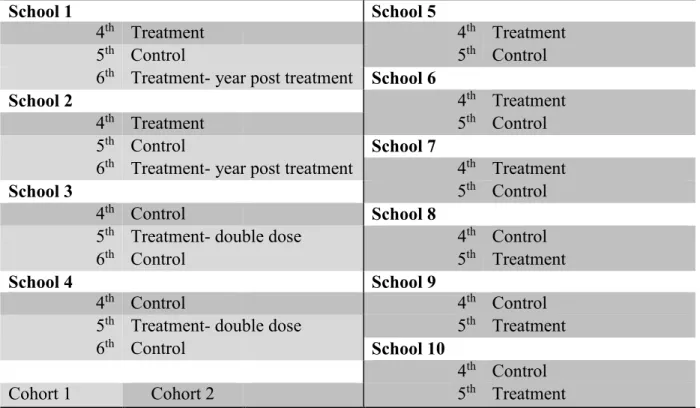
In the first year of the study there were four participating schools, and in year two six additional schools were included for a total of ten schools. Randomization occurred within schools between the fourth and fifth grade. We ensured that we had equal numbers of fourth and fifth grades that were assigned to treatment and control. For example, in the first year of the study with four participating schools, two schools had fourth grade receive treatment and fifth grade serve as a control; while the other two schools had fifth grade receive treatment and fourth grade serve as a control. Treatment students who were in fourth grade in the first year received an additional year of treatment when they were in fifth grade the following year. Table 1 shows treatment assignment in year two for each school and grade. In year two, we are able to estimate the effect of three field trips in one year, six field trips in two years, and the effect of three field trips a year following the treatment.
Table 1: Treatment Assignment by Cohort in Year 2
School 1 School 5
4th Treatment 4th Treatment
5th Control 5th Control
6th Treatment- year post treatment School 6
School 2 4th Treatment
4th Treatment 5th Control
5th Control School 7
6th Treatment- year post treatment 4th Treatment
School 3 5th Control
4th Control School 8
5th Treatment- double dose 4th Control
6th Control 5th Treatment
School 4 School 9
4th Control 4th Control
5th Treatment- double dose 5th Treatment
6th Control School 10
4th Control
Cohort 1 Cohort 2 5th Treatment
Randomization occurred within schools between 4th and 5th grades. Students in 6th grade from schools 1 and 2 were randomly assigned to treatment when they were in 5th grade in year one of the study. As such, in year two they are one year post treatment. Students in 5th grade in schools 3 and 4 were randomly assigned to treatment when they were in 4th grade in year one of the study. As such, in year two they receive an additional dose of treatment for a total of 6 field trips.
Ideally, we would prefer to randomize individual students to the treatment or control group; however, it is logistically difficult to take a mix of fourth and fifth grade students from different classes and schools on three field trips throughout the year. We wanted to minimize the administrative burden on the schools and create minimal disruption to their normal schedules. It was easier on schools and more efficient for entire grades within a school to attend the field trips. We believe that our design remains a rigorous experiment because participating students are very similar to each other prior to randomization, therefore increasing the probability of having
schools. Second, the ten schools all serve very similar student populations. Students live in a large, urban area and are primarily students of color and the majority qualify for free or reduced-price lunch (FRL). Third, fourth and fifth grade students in the same schools are relatively similar to each other. The primary reason students are either in fourth or fifth grade is their birthday. We also believe that arts-related field trips are unlikely to affect fourth grade students in a significantly different way than fifth grade students in the same school. If, by chance, there are significant differences between fourth and fifth graders, our design accounts for the
differences by ensuring a balance of fourth and fifth grades across the treatment and control groups.
Following randomization, our research team surveyed all students at the beginning of the school year. The treatment group then attended the three field trips throughout the course of the school year. It is important to note that the treatment consisted of the three field trips and one day of professional development for teachers in treatment grades conducted by The Woodruff Arts Center. Any supplementary activities either before or following any of the field trips were done at the discretion of the teacher or school. The control group received business as usual which could have been up to one field trip to various locations in Atlanta throughout the school year. Our team then administered post surveys near the end of the school year following the end-of-grade exams. We also received administrative data from the school district for all students in the year prior to them entering the study and each year following.
Sample and Data
Our sample consists of just under 1,400 students who are 10.5 years old on average. Over 90% of the students in our sample identify as black or African American. We do not report the percent of students who qualify for FRL because the majority of schools in our sample record all
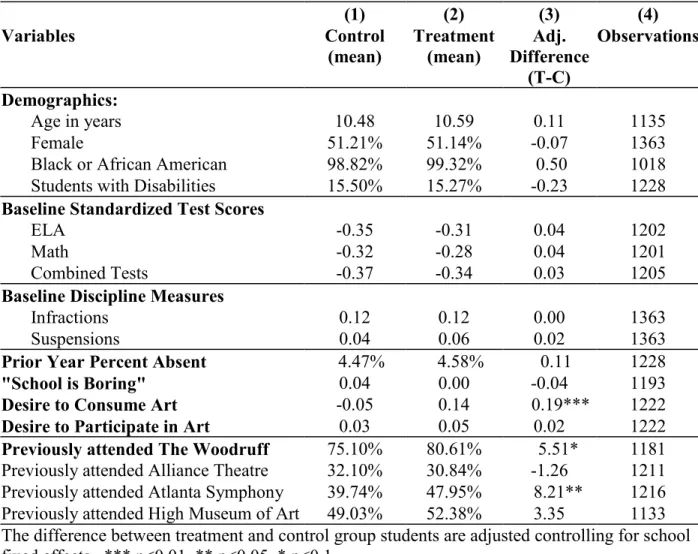
students as qualifying for FRL. Table 2 includes demographic and pre-treatment measures for treatment and control groups separately.
Our treatment and control groups are statistically similar to each other at baseline on key measures such as demographics, special education status, test scores, discipline measures, and school attendance (Table 2, Column 3). Most of these measures come from administrative data provided by the school district. There are some statistically significant differences between the treatment and control groups on pre-treatment survey measures. Treatment students report greater desires to consume art in the future (Table 2, Column 3). However, we believe these differences are due to teachers priming treatment students prior to our pre-treatment surveys and are not due to underlying differences between the two groups. Teachers were aware of their class’ treatment assignment prior to surveying due to scheduling constraints. Many teachers told the students before beginning the survey that they were going to attend various field trips
throughout the year and discussed the importance of museums and theaters prior to survey administration. We believe these differences reflect some effect of the treatment if students exhibit interest in the arts when they simply anticipate attending the given institutions. We controlled for baseline desire to consume art in our analysis and it does not affect our outcomes of interest in any significant ways.
Table 2: Pre-Treatment Comparisons of Treatment and Control Groups
(1) (2) (3) (4)
Variables Control
(mean) Treatment(mean) DifferenceAdj. (T-C)
Observations Demographics:
Age in years 10.48 10.59 0.11 1135
Female 51.21% 51.14% -0.07 1363
Black or African American 98.82% 99.32% 0.50 1018
Students with Disabilities 15.50% 15.27% -0.23 1228
Baseline Standardized Test Scores
ELA -0.35 -0.31 0.04 1202
Math -0.32 -0.28 0.04 1201
Combined Tests -0.37 -0.34 0.03 1205
Baseline Discipline Measures
Infractions 0.12 0.12 0.00 1363
Suspensions 0.04 0.06 0.02 1363
Prior Year Percent Absent 4.47% 4.58% 0.11 1228
"School is Boring" 0.04 0.00 -0.04 1193
Desire to Consume Art -0.05 0.14 0.19*** 1222
Desire to Participate in Art 0.03 0.05 0.02 1222
Previously attended The Woodruff 75.10% 80.61% 5.51* 1181
Previously attended Alliance Theatre 32.10% 30.84% -1.26 1211 Previously attended Atlanta Symphony 39.74% 47.95% 8.21** 1216 Previously attended High Museum of Art 49.03% 52.38% 3.35 1133 The difference between treatment and control group students are adjusted controlling for school fixed effects. *** p<0.01, ** p<0.05, * p<0.1
Consent and Attrition
We received consent to participate in the study from 78% of all enrolled fourth and fifth grade students in the ten elementary schools. Of the enrolled students, we did not receive a spring survey from 39.6% of students. There was a 6.8% differential attrition rate between the treatment and control groups with more students leaving the control group. We received school district administrative data from nearly all students who consented to the study. However, we received more consent forms from the treatment than the control group. Therefore, when using administrative data, we have a 15.7% differential attrition rate between the treatment and control groups.
When using only survey data, the overall and differential attrition rates fall within the What Works Clearinghouse tolerable threat of bias under optimistic assumptions (What Works Clearinghouse). We believe the optimistic assumptions are appropriate for this study because it is unlikely that treatment status affects the attrition of a student from our sample. Students in our sample are a highly mobile population and movement within the year is fairly common as seen in the overall attrition rate.
When district administrative data is included, however, we have a higher threat of bias under the What Works Clearinghouse guidelines. The administrative data has significant benefits, despite the high differential attrition between the treatment and control groups.
Administrative data provides data on students who leave their original school but stay within the district. It also provides a rich set of control and outcome variables of interest. Unfortunately, issues with consent and attrition are common in field work. As a robustness check, we ran our analysis with administrative data limiting it to students who have spring surveys. All effects remain in the same direction and are typically stronger in magnitude and statistically significant at higher confidence levels when just using students with survey and administrative data. In this paper, we present the analysis that includes all students from whom we received administrative data.
Outcome Measures
In this paper we focus on the effects field trips have on students’ academic performance and school engagement. To measure academic performance, we use a composite math and English language arts (ELA) score on the Georgia Milestones end-of-grade exams. The Georgia Milestones are given to all public school students in the state starting in third grade and the exam scores are used in Georgia's accountability system. In our analysis, we include baseline test
scores which are from the school year prior to treatment2. All test scores are standardized within grade level and presented in standard deviation effect sizes.
To measure school engagement, we use the number of infractions a student receives during the school year as well as the student’s self-reported responses of how boring school is. In the district administrative data, we are able to see every time a student is written up for a
behavioral infraction. We use the number of infractions during the treatment year as our outcome variable and control for the number of infractions in the prior year. For student self-reports, students indicate how much they agree with the statement “School is boring” on a five-point scale from disagree a lot to agree a lot. We control for pre-treatment responses to the same statement. All pre- and post-treatment responses are standardized. We recognize that these two measures do not capture all forms of student engagement, but believe they capture important elements of school engagement.
Analyses
Due to the randomized field trial design, which generates similar treatment and control groups, we use a straightforward analytic approach to estimate the causal effect of attending arts-related field trips on students’ academic performance and school engagement. Our technique estimates mean differences between the treatment and control groups using the following equation for outcome 𝑌 for student i in school s:
𝑌𝑖𝑠 = 𝛽0+ 𝛽11𝑇𝑟𝑒𝑎𝑡𝑖𝑠+ 𝛽22𝑇𝑟𝑒𝑎𝑡𝑖𝑠+ 𝛽3𝑃𝑇𝑟𝑒𝑎𝑡𝑖𝑠+ 𝛽4𝐵𝑎𝑠𝑒𝑙𝑖𝑛𝑒𝑖𝑠+ 𝑋𝑖𝛽5+ 𝜃𝑠 +
𝛼𝑖 + 𝜀𝑖𝑠
2 For our baseline test score measure, we use a combined standardized score of all Georgia Milestone exams a student took in the year prior to a treatment. All students took the math and ELA milestone while some students also took the science and social studies exams.
Where 1𝑇𝑟𝑒𝑎𝑡 is a binary variable equal to 1 if a student receives one dosage of treatment,
2𝑇𝑟𝑒𝑎𝑡 is equal to 1 if a student receives a second dosage of treatment, and 𝑃𝑇𝑟𝑒𝑎𝑡 is equal to 1 if a student receives treatment in the prior year. In order to increase the precision of our
estimates, we include baseline measures of the outcome, 𝐵𝑎𝑠𝑒𝑙𝑖𝑛𝑒, and a vector of student characteristics, 𝑋, which includes binary variables for a student’s gender and if the student is in sixth grade. Because randomization occurred within schools, 𝜃 is a fixed effect for each school, which effectively compares treatment and control students within the same school instead of across schools. We also include student random effects, 𝛼, to account for correlation between a student’s error over the two years. It is important to note that we have an unbalanced panel data set where cohort one students appear in year one and year two, and cohort two students only appear in year two. We believe random effects are appropriate because we are correcting for student errors correlated over time and not trying to account for potential endogeneity where fixed effects would be more appropriate. Finally, 𝜀 is the stochastic error term clustered at the teacher level to account for spatial correction from students in the same classroom.
Results
Student Academic Performance
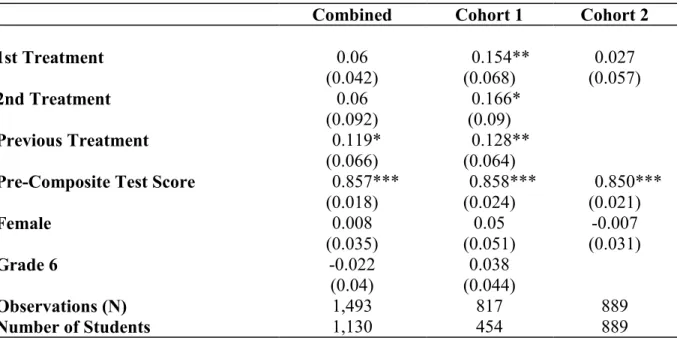
As reflected in Table 3, receiving the opportunity to attend three field trips has a
marginally statistically significant effect at the 90% confidence level on students’ math and ELA test scores the year following treatment. Receiving treatment in a prior year leads to a 0.12 standard deviation increase in the following year test scores. However, the effect on test scores varies when looking at cohorts one and two separately. Cohort one students who receive the first dosage of treatment experience a statistically significant 0.15 standard deviation increase in test scores compared to their control counterparts. This effect is significant at the 95% confidence
level. The effect persists a year after treatment, where treatment students score 0.13 standard deviations higher than control students. The effect slightly increases with a second dosage of treatment, where treatment students score 0.17 standard deviations higher than control students; however, it is only statistically significant at the 90% confidence level. These effects do not appear for cohort two students.
Table 3: Treatment Effect on End of Grade Math and ELA Tests
Combined Cohort 1 Cohort 2
1st Treatment 0.06 0.154** 0.027 (0.042) (0.068) (0.057) 2nd Treatment 0.06 0.166* (0.092) (0.09) Previous Treatment 0.119* 0.128** (0.066) (0.064)
Pre-Composite Test Score 0.857*** 0.858*** 0.850***
(0.018) (0.024) (0.021) Female 0.008 0.05 -0.007 (0.035) (0.051) (0.031) Grade 6 -0.022 0.038 (0.04) (0.044) Observations (N) 1,493 817 889 Number of Students 1,130 454 889
Fixed effects for the ten elementary schools and student random effects are included in each model. Standard errors clustered at the teacher level are in parentheses. Observations refer to the number of observations in the panel. Number of students refers to the number of unique students in the sample *** p<0.01, ** p<0.05, * p<0.1
Student School Engagement
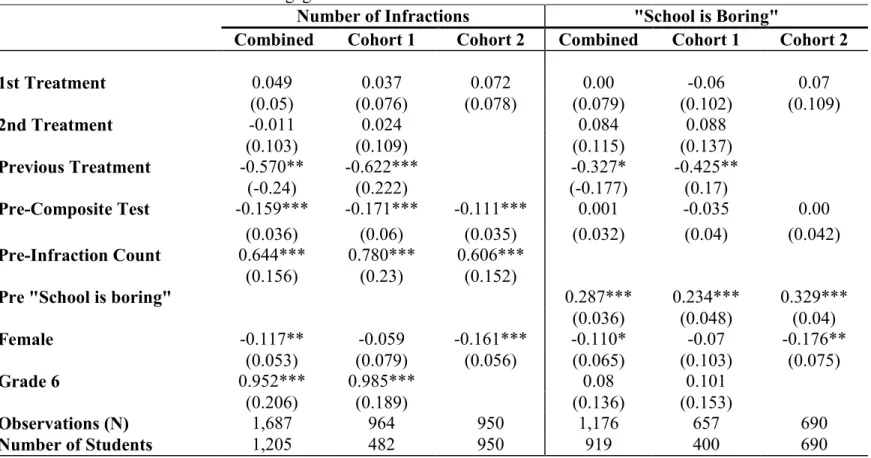
As reflected in Table 4, receiving the opportunity to attend three arts-related field trips significantly increases student engagement a year following treatment when measured by the number of disciplinary infractions and self-reports. Treatment students have 0.6 fewer infractions than their control counterparts in a year after treatment. This effect is significant at the 95% confidence level. They also reported that school was less boring by 0.33 standard deviations; however, this effect is only significant at the 90% confidence level. These effects are solely
found for previously treated students in cohort one, but it is important to note that only cohort one students have been in the study for two consecutive years.
Table 4: Treatment Effect on School Engagement Measures
Number of Infractions "School is Boring"
Combined Cohort 1 Cohort 2 Combined Cohort 1 Cohort 2
1st Treatment 0.049 0.037 0.072 0.00 -0.06 0.07 (0.05) (0.076) (0.078) (0.079) (0.102) (0.109) 2nd Treatment -0.011 0.024 0.084 0.088 (0.103) (0.109) (0.115) (0.137) Previous Treatment -0.570** -0.622*** -0.327* -0.425** (-0.24) (0.222) (-0.177) (0.17) Pre-Composite Test -0.159*** -0.171*** -0.111*** 0.001 -0.035 0.00 (0.036) (0.06) (0.035) (0.032) (0.04) (0.042) Pre-Infraction Count 0.644*** 0.780*** 0.606*** (0.156) (0.23) (0.152)
Pre "School is boring" 0.287*** 0.234*** 0.329***
(0.036) (0.048) (0.04) Female -0.117** -0.059 -0.161*** -0.110* -0.07 -0.176** (0.053) (0.079) (0.056) (0.065) (0.103) (0.075) Grade 6 0.952*** 0.985*** 0.08 0.101 (0.206) (0.189) (0.136) (0.153) Observations (N) 1,687 964 950 1,176 657 690 Number of Students 1,205 482 950 919 400 690
Fixed effects for the ten elementary schools and student random effects are included in each model. Standard errors clustered at the teacher level are in parentheses. Observations refer to the number of observations in the panel. Number of students refers to the number of unique students in the sample *** p<0.01, ** p<0.05, * p<0.1
Discussion
We present the first experimental evidence on the effects from students attending multiple arts-related field trips. We find that treatment students received fewer behavioral infractions and reported that they enjoyed school more than their control counterparts. The significant effect on behavioral infractions is only present for treatment students a year after treatment. We believe that we are able to capture this effect due to a structural change between elementary and middle schools. Previously treated students consist of cohort one students who were assigned to the treatment group in fifth grade and in the second year of the study are in sixth grade where they progressed to middle school (see Table 1). Middle schools are more likely to write-up students for various behavioral infractions than are elementary schools. It is likely that treatment affects students’ behavior in all grades, but that there is insufficient variation in student discipline records in elementary school for our models to detect any differences. Despite data limitations, we find evidence that arts-related field trips significantly reduce the number of infractions a student receives. These results provide causal evidence of the benefit of field trips on student behavior.
Contrary to our hypothesis, we find evidence that students in cohort one experienced test score gains from one and two years of treatment and that the effect persisted a year following treatment. We expected that treatment would have no significant impact on student test scores. We believed that three days out of school were unlikely to negatively affect test scores, but at the same time, three field trips were unlikely to provide enough math or ELA content to significantly improve scores. There are a few possible explanations for this unexpected result. First, it is possible that the treatment affects students’ academic performance through school engagement. We found that treatment students experienced a significant increase in school engagement.
Treatment students could have exerted greater effort in their core subjects which then affected their test scores. Second, it is possible that students learned skills or content from the field trips that assisted them on their exams. Each of The Woodruff arts partners design their programing with the Georgia state standards in mind with the goal of connecting students’ experiences to classroom content. However, this seems less probably given that the field trips were only three days and unlikely to provide specific content that overlapped with a significant portion of the standardized tests. The specific mechanisms of how the field trips benefit students is unknown. The experimental design, while the only method to produce causal results, is, unfortunately, a black box and does not give any evidence of mediating mechanisms.
It is important to note that the test score effects are primarily for cohort one students. While there is no clear reason why the treatment affects cohort one and two students differently, there were a couple disruptions throughout the school year in the year cohort two entered the study that could affect how the cohorts responded to the treatment. First, in the fall, Hurricane Irma hit Atlanta and many schools were closed for more than a week due to loss of electricity and damage to school buildings. Second, later that same year, Atlanta also experienced severe winter storms resulting in school cancellations and rescheduling one of the three field trips. Both natural disasters resulted in multiple missed days, and while missing a few days of school is unlikely to affect test scores, missing multiple days plus the added stress of natural disasters could offset any test score increases the treatment caused. It is also possible that there are some underlying differences between cohort one and two students that we are not capturing which influences the way students respond to the treatment. However, we believe this is less likely as both cohorts are not statistically different from each other on key demographic and
students, it is clear that missing a few days of school to attend field trips does not negatively impact student test scores. As such, the practice of reducing field trips due to accountability pressures to allow more time for instruction is not needed, and furthermore, providing students with experiences outside the classroom may even improve test scores.
Conclusion
We provide the first causal evidence of sustained academic and school engagement benefits for students from attending culturally enriching field trips. One of the most intriguing findings is that student test scores are not negatively affecting from missing three days of
instruction and in some cases test scores substantially increase up to 16% of a standard deviation. Test score gains also remain one year after treatment. These gains are strikingly significant given that the elementary schools in our sample are generally low performing schools with very few students performing at grade level. Test score effects are particularly important when considering accountability policies. Due to increased accountability pressures to improve student test scores, many schools have opted for additional instructional time in core subjects along with extensive test preparations at the expense of other activities. However, the evidence presented here questions how effective these changes may be. While quality instruction and seat time are important for student academic progress, there are other valuable ways to increase student learning while also providing opportunities for a broader curriculum.
Many questions remain about the benefits of field trips for students; specifically, if the academic and school engagement effects we observe will persist multiple years after treatment and if additional cohorts will experience these same benefits. We hope to be able to answer these and many other questions in coming years as a third cohort is added, and as we continue to follow existing students through their middle and high school experiences.
References
Bowen, D., Greene, J., & Kisida, B. (2014). Learning to think critically: A visual art experiment. Educational Researcher, 43(1), 37-44.
Bowen, D., & Kisida, B. (2018). Investigating Causal Effects of Arts Education: Experimental Evidence from Houston’s Arts Access Initiative. Kinder Institute for Urban Research 7(4). Retrieved from https://kinder.rice.edu/research/investigating-causal-effects-arts-education-experiences-experimental-evidence-houstons-arts.
Ellerson, N., & McCord, R. (2009). One year later: How the economic downturn continues to impact school districts. American Association of School Administrators. Retrieved from at http://www.aasa.org/content.aspx?id=8152.
Gadsden, V. (2008). The arts and education: Knowledge generation, pedagogy, and the discourse of learning. Review of Research in Education, 32(1), 29-61.
Gehlbach, H., Brinkworth, M., & Wang, M. (2012). The social perspective taking process: What motivates individuals to take another’s perspective? Teachers College Record, 114, 1-29.
Greene, J. P., Hitt, C., Kraybill, A., & Bogulski, C. A. (2015). Learning from Live Theater. Education Next, 15(1), 54-61.
Greene, J., Kisida, B., & Bowen, D. (2014). The educational value of field trips. Education Next, 15(1), 78-86.
Greene, J., Erickson, H., Watson, A., & Beck, M. (2018). The play’s the thing: Experimentally examining the social and cognitive effects of school field trips to live theater
performances. Educational Researcher, 47(4), 246-254.
Government Accountability Office (2009). Access to arts education: Inclusion of additional questions in education’s planned research would help explain why instruction time has decreased for some students. Report to Congressional Requesters. February, GAO-09-286. Retrieved from https://www.gao.gov/new.items/d09GAO-09-286.pdf
Jaeger, M. M., & Møllegaard, S. (2017). Cultural capital, teacher bias, and educational success: New evidence from monozygotic twins. Social science research, 65, 130-144.
Keiper, S., Sandene, B., Persky, H., & Kuang, M. (2009). The nation’s report card: Arts 2008 --music and visual arts. National Assessment of Educational Progress at Grade 8. National Center for Education Statistics 2009-488. Retrieved from
https://nces.ed.gov/nationsreportcard/pubs/main2008/2009488.asp.
Kisida, B., Greene J., & Bowen, D. (2014). Creating cultural consumers: The dynamics of cultural capital acquisition. Sociology of Education, 87(4), 281-295.
Lacoe, J., Painter, G., & Williams, D. (2016). Museums as classrooms: The academic and behavioral impacts of “School in the Park.” Working Paper. Sol Price School of Public Policy, University of Southern California.
Ludwig, M., Boyle, A., & Lindsay, J. (2017). Review of evidence: Arts integration research through the lens of Every Students Succeeds Act. Washington, DC: American Institutes for Research. Retrieved from
http://www.air.org/resource/review-evidence-arts-integration-research-through-lens-every-student-succeeds-act.
Randi Korn & Associates (2018). The Effects of Facilitated Single-visit Art Museum Programs on Students Grades 4-6. National Art Education Association & Association of Art Museum Directors. Retrieved from https://www.arteducators.org/research/articles/377-naea-aamd-research-study-impact-of-art-museum-programs-on-k-12-students.
Rabkin, N., & Hedberg, E. (2011). Arts education in America: What the declines mean for arts participation. National Endowment for the Arts, Research Report #52.
Ruppert, S. (2006). Critical evidence: How the ARTS benefit student achievement. National Assembly of State Arts Agencies. Retrieved from
https://files.eric.ed.gov/fulltext/ED529766.pdf.
Student Youth & Travel Association (2016). Student youth and travel digest: A comprehensive survey of the student travel market. Mclean, VA. Retrieved from
https://syta.org/wpcontent/uploads/2017/08/SYTD-Social-Impact-8.11.pdf. Watson A. R., Greene, J. P., Erickson, H. H., & Beck, M. I. (2019) Altered Attitudes and
Actions: Social-emotional effects of multiple Arts Field Trips. Department of Education Reform working paper 2019-04.
What Works Clearninghouse. Procedures and Standards Handbook Version 3.0. Institute of Education Sciences (IES). Retrieved from https://ies.ed.gov/ncee/wwc/Docs/
Chapter 2: The Effect of the Louisiana Scholarship Program on College Entrance3
Introduction
Private school choice continues to be a highly controversial education reform. Choice remains popular, however, as the number of private school choice programs and participating students have both increased rapidly in the last decade (EdChoice, 2019. School choice broadly gives parents the opportunity to select a school for their children other than their residentially assigned public school. Private school choice, in the form of vouchers, tax-credit scholarships, or Education Savings Accounts (ESAs), provides families the opportunity to select a private school for their child and to receive financial support to pay for tuition. Milton Friedman (1962) argued that a robust market of schools supported by government resources but managed privately would lead to a more efficient and successful education system. Choice critics contend that education is a public good best delivered by government-run schools (Gutmann, 1987).
Most research evaluating private choice programs has focused on their effects on student academic achievement. A majority of experimental evaluations find modest, neutral-to-positive effects of private school choice on the student achievement of participants (Bettinger & Slonim, 2006; Cowen, 2008; Cowen et al., 2013; Greene, Peterson, & Du, 1999; Greene, 2001; Howell et al., 2002; Howell & Peterson, 2006; Jin, Barnard, & Rubin, 2010; Krueger & Zhu, 2004; Rouse, 1998; Wolf et al, 2013), with some recent and notable exceptions that find negative effects on student test scores (Abdulkadiroğlu, Pathak, & Walters, 2018; Dynarski et al., 2017; Figlio & Karbownik, 2016; Mills & Wolf, 2019; Waddington & Berends, 2018). Abdulkadiroğlu, Pathak, and Walters (2018) and Mills and Wolf (2019) both evaluate the Louisiana Scholarship Program (LSP) and find large negative effects on both math and English Language Arts (ELA) test scores
in the first year of the program. Mills and Wolf (2019) include three additional years of data and find that the negative test score effects diminish in the second year and become statistically insignificant in the third year only to reemerge in the fourth and final year of the program evaluation. The LSP, demonstrating large negative effects on student test scores, stands out as the most notable exception to the majority of findings in private school choice research.
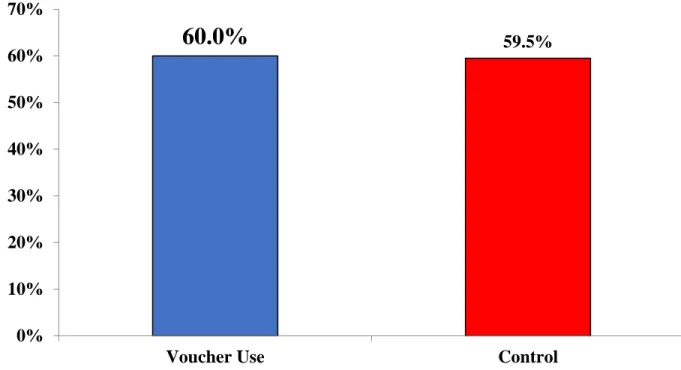
In this paper we seek to understand how the LSP impacted college enrollment for students who applied to the program in its first year, 2012-13. Using detailed data from the National Student Clearinghouse (NSC) Student Tracker Service, we find that 60% of students who were awarded a scholarship through a lottery and enrolled in their first-choice private school enter college, compared to 59.5% of their control student counterparts. We find that treatment students are two percentage points more likely to enroll in a four-year institutions than a two-year; however, this difference is not statistically distinguishable from zero.
This paper expands our understanding of how the LSP affected students on multiple educationally important outcomes. It also contributes to the emerging body of literature on private school choice programs’ effects on student attainment by using an experimental design to estimate the causal effect of the LSP on college entrance. Finally, it adds another case to the growing list of school choice evaluations reporting a disconnect between the short-term test score effects and longer-term attainment effects of school choice programs (Hitt, McShane & Wolf, 2018).
The paper proceeds as follows: first, we define the features and policy context of the LSP; second, we review the previous literature on private school choice including the LSP; third, we discuss our research methodology and data; fourth, we present our results; and last, we discuss the implications of our findings and further research.
Louisiana Scholarship Program Description
The LSP is a school voucher program providing students a scholarship to attend a private school of their choice. The program piloted in New Orleans in 2008 and expanded statewide in 2012. Students are eligible for the LSP if their family incomes are below 250% of the federal poverty line and if they are currently attending a public school rated C, D, or F on the statewide school grading system. Students entering kindergarten or currently enrolled in the Recovery School District, which is the state government takeover mechanism for Louisiana schools, are also eligible to apply for a scholarship.
Scholarship funding comes from the state and is the lesser amount of 90% of state and local funding or the tuition of the private school of the student’s choice. In order to participate in the program, private schools are required to administer the state standardized test and cannot have selective admission policies. They also must comply with state financial and safety regulations.
In the first year of the statewide program, 2012-13, over 9,500 students applied for and 5,296 were awarded a scholarship (Mills & Wolf, 2017a). The majority of student applications in the first year were for kindergarten through third grade, with 19% of applications for seventh through twelfth grades.
Literature Overview
A large body of research evaluates the effects of various private school choice programs on the student achievement of participants (Abdulkadiroğlu, Pathak, & Walters, 2018; Bettinger & Slonim, 2006; Cowen, 2008; Dynarski et al., 2017; Greene, Peterson, & Du, 1999; Greene, 2001; Jin, Barnard, & Rubin, 2010; Krueger & Zhu, 2004; Mills & Wolf, 2019; Rouse, 1998; Waddington & Berends, 2018; Wolf et al., 2013). A recent meta-analysis by Shakeel, Anderson,
and Wolf (2016) summarizes the effects of private school vouchers around the world and finds statistically significant positive effects on student test scores two or three years after random assignment, with larger results in reading than math. The effects for programs in the United States are smaller and less conclusive than the effects in non-U.S. countries. In many studies there are heterogeneous effects for various subgroups. For example, in the D.C. Opportunity Scholarship Program, test score impacts are larger for girls and students who entered the program from public schools that were not classified as needing improvement (Wolf et al., 2013). A number of studies find greater impacts for African American than for non-African American students (e.g. Howell et al., 2002).
There is a much smaller body of literature on the effects of private school choice on students’ educational attainment as measured by high school graduation, college entrance, and degree completion. This research base is less developed than the private school choice
achievement impacts literature because attainment evaluations require following students for many years after their initial experience in the program. Educational attainment is, however, arguably, more important than student test scores because it is a more direct proxy for student success and is strongly associated with a host of positive long-term outcomes. Higher levels of educational attainment are predictive of a longer, healthier, and more economically productive life (Belfield & Levin, 2007; Day & Newburger, 2002; Meara, Richards & Cutler, 2008; Muenning, 2005; Muennig, 2008). Moreover, the achievement effects of a school choice program seldom predict that program’s later attainment effects. Some choice programs demonstrate large positive test score impacts for students but null or negative post-secondary outcomes; while other programs show no effect on test scores but large positive effects on