issn 1239-6095 (print) issn 1797-2469 (online) helsinki 30 september 2014
Editor in charge of this article: Veli-Matti Kerminen
Knowledge transfer of climate-ecosystem-interactions
between science and society — introducing the climate
Whirl concept
eija Juurola
1)2), Janne F. J. Korhonen
1)2), liisa Kulmala
3), Pasi Kolari
1)2),
Ulla taipale
4),
Jussi rasinmäki
5), taina ruuskanen
1)6),
terike haapoja
7),
Jaana Bäck
2), Janne levula
8), laura riuttanen
1), ella-maria Kyrö
1),
ivaylo Dzhedzhev
5), eero nikinmaa
2), timo vesala
1)and markku Kulmala
1) 1) Department of Physics, P.O. Box 48, FI-00014 University of Helsinki, Finland2) Department of Forest Sciences, P.O. Box 27, FI-00014 University of Helsinki, Finland 3) Finnish Forest Research Institute, Jokiniemenkuja 1, P.O. Box 18, FI-01301 Vantaa, Finland 4) Aalto University, School of Arts, Design and Architecture, Aalto Biofilia — Base for Biological Arts,
Otakaari 7, FI-02150 Espoo, Finland
5) Simosol Oy, Rautatietori 4, FI-11130 Riihimäki, Finland
6) Palmenia Centre for Continuing Education, P.O. Box 53, FI-00014 University of Helsinki, Finland 7) Laivanvarustajakatu 3 a 5, FI-00140 Helsinki, Finland
8) Hyytiälä Forestry Field Station, Hyytiäläntie 124, FI-35500 Korkeakoski, Finland Received 15 Nov. 2013, final version received 16 June 2014, accepted 19 June 2014
Juurola, e., Korhonen, J. F. J., Kulmala, l., Kolari, P., taipale, U., rasinmäki, J., ruuskanen, t., haapoja, t., Bäck, J., levula, J., riuttanen, l., Kyrö, e.-m., Dzhedzhev, i., nikinmaa, e., vesala, t. & Kulmala, m. 2014: Knowledge transfer of climate-ecosystem-interactions between science and society — introducing the climate Whirl concept. Boreal Env. Res. 19 (suppl. B): 406–411.
Making scientific principles behind the forest–atmosphere interactions more understand-able for the general public would help them to follow and evaluate the political or personal decisions related to climate and climate change. Climate Whirl is a concept developed by a trans-disciplinary group of researchers in the area of science, art, education and software design. It aims at introducing a holistic view on climate and ecosystem research, using not only the traditional scientific communication channels, but also artistic manifestations in the form of workshops, exhibitions, seminars and interactive websites. Our aim is to increase public awareness of the interactions between climate and forests, as well as of the role of boreal forests in climate change. An already existing website Carbon Tree is a start-ing point that provides tools utilised in the further development of the concept. We present the first activities of the concept: Carbon Tree website, Interactive Carbon Tree installa-tion, Hyytiälä Art Residency and interdisciplinary workshops.
Introduction
Already for decades, northern ecosystems have been recognized to be important in regulating the atmospheric processes, especially CO2
con-centration and climate (e.g. Keeling 1960, Hall et al. 1975, Dixon et al. 1994, Schimel 1995, Kulmala et al. 2001, Luyssaert et al. 2007, Hari et al. 2009). In recent years, the need for imme-diate actions to prevent and mitigate climate
change effects has put pressure on the research-ers to raise the awareness in the general public. Although there is ample amount of informa-tion available to wide audiences, the problem itself, as well as the public discussion around the problem, is so complex that it is difficult for people to understand or to make judgements and evaluate the governmental and societal actions taken against climate change. If the scientific principles behind climate change, or in our case, behind the effects of forest ecosystems on cli-mate (Kulmala et al. 2004), were more under-standable for the public, it would be easier to follow and evaluate the impacts of political or personal decisions on everyday life. How-ever, the interaction between atmosphere and biosphere is extremely complex and, therefore, popularization of the obtained results has been problematic. Furthermore, as a major fraction of the research is made using public funding, it is justified to expect the results to be publicly avail-able and in understandavail-able form. Therefore, it is of utmost importance to translate the scientific results into common language.
The SMEAR II station in southern Finland (Hari and Kulmala 2005) — a Finnish flagship station for measuring the relationships between atmosphere and forest in boreal zone — is a unique place where, in addition to top quality research and advanced education, remarkable scientific design and innovations take place. It is essential that also these unique achievements reach audience outside the scientific community. However, it is not a simple task to demonstrate the value and significance of the work at the sta-tions. In this paper, we present the Climate Whirl concept that includes the existing Carbon Tree website and the Hyytiälä Art Residency at the SMEAR II station.
Climate Whirl concept
We have developed a concept called Climate Whirl that is a dialogue between science, art, education and software design to make the novel scientific knowledge available to anyone inter-ested in forest ecosystems, atmosphere and their relations to climate change. In Climate Whirl, the tree–atmosphere interactions with climate
are presented in larger scale. The Climate Whirl concept utilises different media like internet, art in its diverse forms, art and science exhibitions and other public events, game development, teacher education, etc.
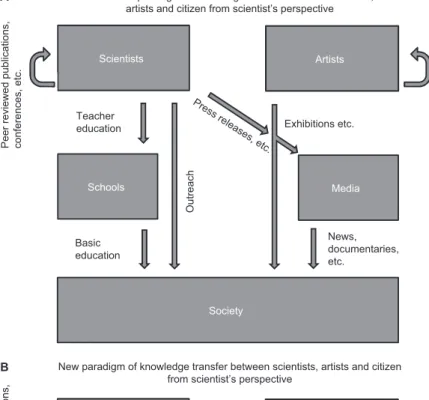
Climate Whirl introduces a holistic view on climate and ecosystem research in a manner that is at the same time comprehensible and thought-provoking; increasing the awareness of the natu-ral phenomena, interactions between climate and forests, and climate change. In addition, we aim to increase interaction between scientists, artists, teachers and citizen (Fig. 1).
The scientific core of Climate Whirl is based on the studies of ecosystem–climate interactions carried out at the SMEAR stations. In the centre of the concept are the different interactions and feedbacks between climate and ecosystems. Cli-mate Whirl acts as a framework for many differ-ent activities such as interactive “live” websites, artworks, summer schools, workshops, games, etc. An already existing website Carbon Tree is a starting point that provides tools and approaches that will be utilised in the further development of the Climate Whirl concept. In the first phase, the concept includes the Carbon Tree website, the Interactive Carbon Tree installation, Hyytiälä Art Residency, and interdisciplinary workshops.
Carbon Tree website
The Carbon Tree website (http://www.carbon-tree.fi/) is targeted to non-experts, general public and schools. Our aim was to create an appealing and visually catching website that avoids the default entry points for this kind of information, graphs, such as line and scatter plots that the scientists are accustomed to use for data presenta-tion, but the general public is not familiar with. At the same time it was essential that all the con-tents of the website is based on solid science and on our recent research results (both theoretical and empirical). Thus, the website presents both artistic animation and traditional graphs to visual-ize the real time uptake and release (Lagergren et al. 2008, Kolari et al. 2009) of carbon in a Scots pine forest at SMEAR II.
Many years of intensive measurements have provided a lot of information on the behaviour of
the forest: how photosynthesis and respiration, i.e. uptake and release of atmospheric carbon reacts to environmental factors. We know very well how tree functioning vary depending on the time of the year, available light and CO2, air and soil temperature, and water availability in the soil. This knowledge is expressed by
mathemati-cal models that can forecast the overall behav-iour of a tree (Mäkelä et al. 2008). These models are used to illustrate the dynamic features of the tree carbon exchange at the Carbon Tree website (Kulmala et al. 2012).
In spring 2013, the Carbon Tree website was re-launched with more interactivity and Traditional paradigm of knowledge transfer between scientists,
artists and citizen from scientist’s perspective
Scientists Artists Exhibitions etc. Press re leases, etc. Teacher education
Peer reviewed publications
, conferences, etc. Schools News, documentaries, etc. Basic education Media Outreac h Society A
New paradigm of knowledge transfer between scientists, artists and citizen from scientist’s perspective
Scientists Artists
Exhibitions etc. Teacher
education Peer reviewed publications, conferences, etc.
Schools News, documentaries, etc. Basic education Media Social medi a Horizontal learning , citizen scienc e Inspiration, ideas Participative outreac h Society B Press re leases, etc.
Fig. 1. (A) traditional
and (B) new paradigms of knowledge transfer between scientists, artists and a citizen from scien-tist’s perspective.
better possibilities to be utilized in education at both elementary and high-school levels. On the updated website, a visitor can study the effects of various environmental factors on photosynthetic carbon gain of a tree, either by browsing through different times of day or year, or by manipulating the environmental factors. Furthermore, details about transpiration and the role of stomata in regulation of transpiration are described in a separate, animated page. An ample amount of articles, pictures and graphs provides detailed and scientific information on the gas exchange of trees and the role of forest ecosystems in climate. By filling in the quizzes, visitors can test their knowledge on functioning of trees and basics on environmental factors affecting photosynthesis. Currently, we are developing a website to include the emissions of volatile organic compounds from our study tree (Bäck et al. 2005), and the subsequent fate of the compounds in the atmos-phere. This will include visualisation of a selec-tion of different chemical reacselec-tions in atmosphere and their effects e.g. on cloud formation.
The new version of Carbon Tree was wel-comed by the audience. During the first year, the total number of visits increased from less than 3000 to more than 10 000 per month. At the beginning of 2013, more than 90% of all the visits were from Finland; in October 2013 only 53%. In October 2013, there were visits from more than 30 countries; especially from Germany, Denmark, USA, The Netherlands and Italy, but also countries like China, India and Brazil.
Interactive Carbon Tree
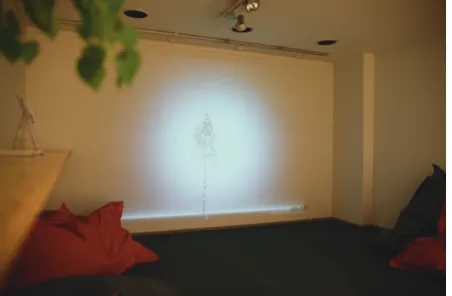
As one of our aims in the Climate Whirl concept is to use different media to reach the public and especially schools, we have developed Interac-tive Carbon Tree, an artistic installation that demonstrates the effects of different environ-mental factors on photosynthetic carbon gain in a Scots pine tree. Using a specially designed control box, visitors can adjust the availability of light, carbon dioxide and temperature to a virtual tree that is projected on the wall (Fig. 2). In response, the carbon tree visualises how dif-ferent environmental factors affect the capture
of carbon from the atmosphere by changing the visual particle flow rate into the tree and out of it.
Interactive Carbon Tree is independent from online field data, utilising the measured environ-ment near the visitor and the same mathemati-cal models as the website. Interactive Carbon Tree has already been on display in several expositions, and in future, it will be used also in schools.
Hyytiälä Art Residency
Art reaches wider and more heterogeneous audi-ence than popular sciaudi-ence. At best, art provokes new ideas that challenge conventional attitudes towards climate issues and other areas of sci-entific research. For a fruitful dialogue between science and art it is, however, important to recognise the independence of art and artist from any commercial, political or even scientific control.
An art residency program was initiated in Hyytiälä Forestry Field Station and SMEAR II in 2013. The objective was to encourage the usage of novel approaches at the intersection of arts and sciences for transmission of the complex and multilevel research to a wider audience.
Initiating a meaningful dialogue between a scientist and an artist might be challenging due to the lack of common language and/or shortage of time. We tried to overcome this problem by allocating resources to appointing a dedicated scientific mentor who introduces the world of measurements and equipment to the artist.
The first art residency was organised in summer 2013. The application process included writing a proposal (a) describing the development of a project related to the interaction between forests and the atmosphere, and (b) presenting a plan for an art-and-science workshop around this particular topic. As a result, a German media artist Agnes Meyer-Brandis (http://www.ffur.de/) was invited to Hyytiälä for a three-month period to carry out her own artistic work linked to the investigations at the SMEAR II research sta-tion. In her work, Meyer-Brandis fused multiple research areas creating art that often includes technology and fantasy as well as fantastic technologies. In recent years, she explored, for
example, the formation of water droplets during weightlessness flights carried out by German Space Agency, trailed along the migration routes of a mysterious Moon Geese, and designed an apparatus that enhances cloud formation.
During her residency in autumn 2013, Meyer-Brandis was investigating the research and the studied natural phenomena in Hyytiälä. The work was centred on trees and on the communication between humans and trees. An important part of her work was to exchange ideas and knowledge with researchers and other staff in Hyytiälä. The residency will lead to a piece of contemporary art which will be unveiled in 2014 and to a hands-on workshop at the Hyytiälä Forestry Field Station in August 2014. An intensive three-day workshop will be an ideal opportunity to invite participants — students, researchers and artists — to share visions and ideas and to work together.
Although the project is still ongoing, the experiences of the art residency are encourag-ing. The keys to the success of the project were e.g. an efficient and professional selection of an artist, and the ability to have a dedicated scien-tific mentor involved in the project.
The workshop that will be organised in 2014 will be a new experience, but surely thought-provoking and illustrative. It will offer a chance for scientists, students and artists to get together, and create an atmosphere where contributions by all the participants collide and deepen insights
on how science can be communicated by diverse expressions. The presence of Mayer-Brandis has already initiated inspired discussions and activi-ties in Hyytiälä.
To be able to develop the art residency fur-ther, it is important to collect the experiences both from the people working at the Hyytiälä and SMEAR II station, as well as from the invited artist. We aim to continue the interactions between art and science, and include the art resi-dency as a regular activity of the research group.
Future perspectives
We acknowledge the importance of knowledge transfer between scientists, artists and gen-eral public. In the Climate Whirl concept, the research-based knowledge of climate–forest interactions is re-formulated, to promote differ-ent ways of understanding. This is done through the Carbon Tree website, the Interactive Carbon Tree installation and Hyytiälä Art Residency. The positive experiences make us look forward to continuing and expanding the Climate Whirl concept further.
Acknowledgements: The financial support by Tieteen tiedotus
ry., Kone Foundation, the Academy of Finland Centre of Excellence program (project no. 1118615), Nordic Centre of Excellence CRAICC, and the Academy project “ICOS” (project no. 17352) are gratefully acknowledged.
Fig. 2. the projected
par-ticle tree in the Interactive
Carbon Tree installation
in the science corner of the University of helsinki in 2012. Photo: liisa Kul-mala.
References
Bäck J., Hari P., Hakola H., Juurola E. & Kulmala M. 2005. Dynamics of monoterpene emissions in Pinus sylvestris during early spring. Boreal Env. Res. 10: 409–424. Dixon R.K., Solomon A.M., Brown S., Houghton R.A.,
Trexier M.C. & Wisniewski J. 1994. Carbon pools and flux of global forest ecosystems. Science 263: 185–190. Hall C.A.S., Ekdahl C.A. & Wartenberg D.E. 1975. A
fifteen-year record of biotic metabolism in the Northern Hemi-sphere. Nature 255: 136–138.
Hari P. & Kulmala M. 2005. Station for Measuring Ecosys-tem–Atmosphere Relations (SMEAR II). Boreal Env.
Res. 10: 315–322.
Hari P., Andreae M.O., Kabat P. & Kulmala, M. 2009. A comprehensive network of measuring stations to moni-tor climate change. Boreal Env. Res. 14: 442–446. Keeling C.D. 1960. The concentration and isotopic
abun-dances of carbon dioxide in the atmosphere. Tellus 12, doi:10.1111/j.2153-3490.1960.tb01300.x.
Kolari P., Kulmala L., Pumpanen J., Launiainen S., Ilvesniemi H., Hari P. & Nikinmaa E. 2009. CO2
exchange and component CO2 fluxes of a boreal Scots
pine forest. Boreal Env. Res. 14: 761–783.
Kulmala L., Kolari P., Rasinmäki J., Haapoja T., Dzhedzhev I. & Juurola E. 2012. Carbontree visualizes the CO2 uptake and release of a Scots pine. In: Kulmala M., Lap-palainen H.K., Boy, M., Brus M. & Nieminen T. (eds.),
Report Series in Aerosol Science 134: 394–397.
Kulmala M., Hämeri K., Aalto P.P., Mäkelä J.M., Pirjola L., Nilsson E.D., Buzorius G., Rannik Ü., Dal Maso M., Seidl W., Hoffman T., Janson R., Hansson H-C., Viisanen Y., Laaksonen A. & O’Dowd C.D. 2001. Over-view of the international project on biogenic aerosol formation in the boreal forest (BIOFOR). Tellus 53B: 324–343.
Kulmala M., Suni T., Lehtinen K.E.J., Maso M.D., Boy M., Reissell A., Rannik Ü., Aalto P., Keronen P., Hakola H., Bäcl J., Hoffmann T., Vesala T. & Hari P. 2004. A new feedback mechanism linking forests, aerosols, and cli-mate. Atmos. Chem. Phys. 4: 557–562.
Lagergren, F., Lindroth A., Dellwik E., Ibrom A., Lankreijer H., Launiainen S., Mölder M., Kolari P., Pilegaard K. & Vesala T. 2008. Biophysical controls on CO2 fluxes of
three northern forests based on long-term eddy covari-ance data. Tellus 60B: 143–152.
Luyssaert S., Inglima I., Jung M., Richardson A.D., Reich-stein M., Papale D. & Moors E. 2007. CO2 balance of
boreal, temperate, and tropical forests derived from a global database. Global Change Biol. 13: 2509–2537. Mäkelä A., Pulkkinen M., Kolari P., Lagergren F., Berbigier
P., Lindroth A., Loustau D., Nikinmaa E., Vesala T. & Hari P. 2008. Developing an empirical model of stand GPP with the LUE approach: analysis of eddy covari-ance data at five contrasting conifer sites in Europe.
Global Change Biol. 14: 92–108.
Shimel D. 1995. Terrestrial ecosystems and the carbon cycle.