Supplementary Information
Protective effects of quercetin against pyrazinamide induced hepatotoxicity
via
cocrystallization strategy of complementary advantages
Fang Liu,a Ling-Yang Wang,a Yan-Tuan Li,a,b Zhi-Yong Wua and Cui-Wei Yanc
a. School of Medicine and Pharmacy, Ocean University of China, 266003, PR China. E-mail: [email protected] b. Laboratory for Marine Drugs and Bioproducts, Qingdao National Laboratory for Marine Science and
Technology, 266003, PR China.
c. College of Marine Life Science, Ocean University of China, Qingdao, 266003, PR China.
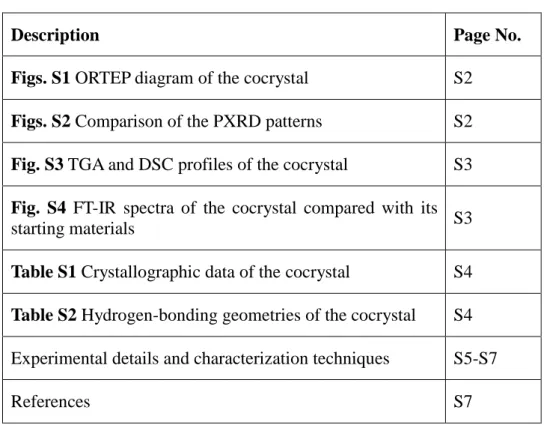
Contents
Description Page No.
Figs. S1 ORTEP diagram of the cocrystal S2
Figs. S2 Comparison of the PXRD patterns S2
Fig. S3 TGA and DSC profiles of the cocrystal S3
Fig. S4 FT-IR spectra of the cocrystal compared with its
starting materials S3
Table S1 Crystallographic data of the cocrystal S4
Table S2 Hydrogen-bonding geometries of the cocrystal S4
Experimental details and characterization techniques S5-S7
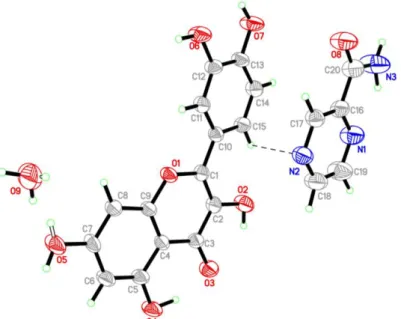
Fig. S1 The ORTEP diagram of PZA-QUE cocrystal with atom numbering.
Fig. S2 PXRD comparison ofPZA-QUE cocrystalcompared with the starting materials.
5 10 15 20 25 30 35 40 45 50 2 Theta (°) In tensity PZA-QUE PZA QUE
Fig. S3 TGA and DSC profiles of PZA-QUE cocrystal. 100 200 300 400 500 600 700 800 -5 0 5 10 15 20 25 30 Temperature /
℃
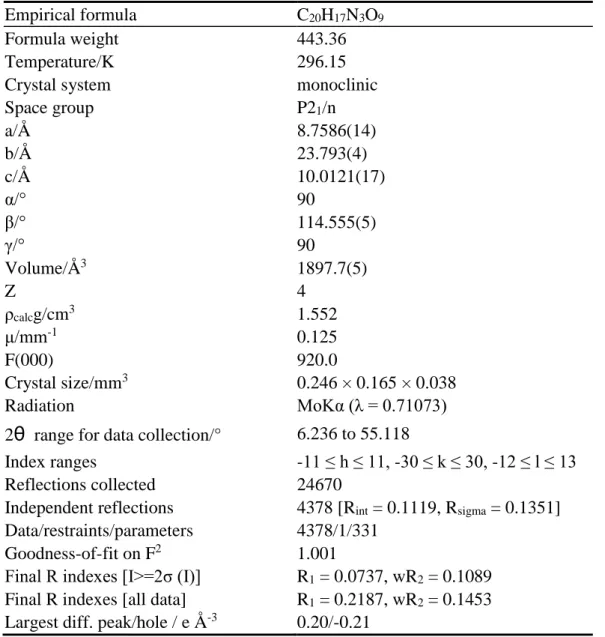
DSC / (mW/mg) TG / % exo Peak : 265.5 ℃ Onset : 253.5 ℃ 0 20 40 60 80 100 3900 3600 3300 3000 2700 2400 2100 1800 1500 1200 900 600 Wavenumber (cm-1) % Tr ansm ittanc e Cocrystal Quercetin PyrazinamideTable S1 Crystallographic data of the cocrystal. Empirical formula C20H17N3O9
Formula weight 443.36
Temperature/K 296.15
Crystal system monoclinic
Space group P21/n a/Å 8.7586(14) b/Å 23.793(4) c/Å 10.0121(17) α/° 90 β/° 114.555(5) γ/° 90 Volume/Å3 1897.7(5) Z 4 ρcalcg/cm3 1.552 μ/mm-1 0.125 F(000) 920.0 Crystal size/mm3 0.246 × 0.165 × 0.038 Radiation MoKα (λ = 0.71073)
2θ range for data collection/° 6.236 to 55.118
Index ranges -11 ≤ h ≤ 11, -30 ≤ k ≤ 30, -12 ≤ l ≤ 13 Reflections collected 24670
Independent reflections 4378 [Rint = 0.1119, Rsigma = 0.1351]
Data/restraints/parameters 4378/1/331 Goodness-of-fit on F2 1.001
Final R indexes [I>=2σ (I)] R1 = 0.0737, wR2 = 0.1089
Final R indexes [all data] R1 = 0.2187, wR2 = 0.1453
Largest diff. peak/hole / e Å-3 0.20/-0.21
Table S2 Hydrogen-bonding geometries of the cocrystal (Å, °).
D–H···A d(D–H) d(H···A) d(D···A) D–H···A N(3)—H(3A)···O(8) i 0.88(5) 2.05(5) 2.926(5) 173(5)
O(7)—H(7)···O(4) ii 0.89(4) 1.87(4) 2.746(4) 166(4)
O(9)—H(9)···O(7) iii 0.88(2) 1.95(2) 2.822(3) 172(3)
O(9)—H(9A)···O(5) 0.87(2) 1.89(2) 2.708(3) 162(3) O(6)—H(6A)···N(2) iv 0.87(2) 1.86(2) 2.731(3) 172(4)
Symmetry codes: (i) -x, 1-y, 2-z; (ii) -3/2+x, 1/2-y, -1/2+z; (iii) 1/2-x, -1/2+y, 3/2-z; (iv) -1/2+x, 1/2-y, -1/2+z;
Experimental details and characterization techniques
Materials. Pyrazinamide (PZA) and Quercetin (QUE) were obtained from J & K Chemical Ltd, with greater than 99% purity. All analytical grade solvents were purchased from Sinopharm Chemical Reagent Co., Ltd. and used without further purification.
Preparation of the cocrystal. A mixture of PZA (1.23 g, 0.01 mol) and QUE (3.38 g, 0.01 mol) was dissolved in 0.2 L of water, methanol and ethyl acetate (1:4:1, v/v/v) at 50 °C and evaporated slowly at room temperature. After about 5 days, yellow needle-shaped crystals of the PZA-QUE cocrystal were harvested and dried under vacuum (4.43 g, 96.2% yield).
Powder X-ray diffraction (PXRD). PXRD patterns were obtained using a Bruker D8 Advance X-ray diffractometer (Cu Kα radiation). The voltage and current applied were 40 kV and 40 mA respectively. Samples were measured in reflection mode in the 2θ range 5-50° with a scan speed of 1.5 °/min (step size 0.025°, step time 1.0 s).
Single crystal X-ray diffraction (SCXRD). Single crystal X-ray diffraction was performed on a Bruker Apex II CCD diffractometer using Mo Kα radiation (X = 0.71073 Å) at 296(2) K. The structure was solved by direct methods using SIR20041 and refined with full-matrix least-squares difference Fourier analysis using SHELX-20162 software. All non-hydrogen atoms were refined with anisotropic displacement parameters. The hydrogen atoms on carbon atoms were placed in calculated positions and refined with a riding model with C–H bond lengths of 0.93 Å and Uiso(H) =
1.2 (C atoms). The H atoms on O and N atoms were founded in a difference Fourier map and refined freely or as riding with refined bond distances and Uiso(H) = 1.2 (N atoms), respectively.No
proton transfer phenomenon was observed in the structure. Crystal data and structural refinement parameters are summarized in Table S1.
Fourier-transform Infrared (FTIR). Fourier-transform Infrared (FTIR) spectra were collected by a Nicolet model Impact 470 FTIR spectrophotometer in the range of 3900 to 500 cm-1 at ambient
conditions.
TGA and DSC was performed to confirm purity of the new solids forms on a Mettler Toledo TGA/SDTA 851e module and a Mettler Toledo DSC 822e module, respectively with the heating rate of 5 ºC/min between the temperature range of 50-800 ºC under nitrogen atmosphere.
a flat surface at one side and the other side was sealed. The pellet was then dipped into 500 mL buffer medium (pH 7.4) at 37 °C with the paddle rotating at 70 rpm. At different intervals for 0.5 h, 5 ml of the dissolution medium was withdrawn and replaced by an equal volume of fresh medium to maintain a constant volume. Samples were filtered through 0.2 µm nylon filter and assayed for drug content samples using high performance liquid chromatography.
In vivo pharmacokinetics. This pharmacokinetic study was carried in strict compliance with the Guideline on Administration of Lab, (Ministry of Science and Technology, China). The animal handling procedures were reviewed and approved by the Laboratory animal center, Qingdao,China. Adult male Sprague Dawley rats (200~250 g) were purchased from Animal Center of Zhejiang University of Traditional Chinese Medicine, and maintained on a 12 h light/dark cycle in a free pathogen facility. The rats were food (not water) deprived for 18 h prior to the start of the experiment. Vegetable oil was selected as the gavage vehicle because all crystal forms were observed to be insoluble. 10 rats were randomly allocated into two groups (n = 5) and administered orally at a single dose of 200 mg/kg body weight cocrystal and the physical mixture QUE with PZA (equimolar ratio). Serial blood (350 μL) samples were collected from retro-orbital plexus into lithium heparin tube of two groups before dosing at 0.25, 0.5, 0.75, 1, 2, 4, 6 and 10 h. Blood samples were centrifuged at 2,000 g (4 ºC) for 20 min, the harvested plasma was collected and stored at -80 °C. For liquid extraction, 200 μL acetonitrile solution was added to 200 μL plasma. After vigorous vortex, the sample was centrifuged at 8000 g at 4 °C for 15 min. Finally, the supernatant liquid was placed in a glass insert, and analyzed by HPLC. The serum concentration profile and the PK parameters were determined by PKSolver3.0 software based on a noncompartmental model.
Experimental details of HPLC. HPLC was carried out on a Agilent 1260 series high performance liquid chromatography with a Agilent Eclipse XDB-C18 column (2504.6 mm, 5 µm particle size). An injection volume of 10 μL was used with an eluant flow rate of 1 mLmin-1. Detection
wavelength in the UV-visible range was set at 360 nm. The samples were eluted with a mobile phase containing a mixture of methanol and ultrapure water in a ratio (v/v) of 20:80.
In vivo hepatotoxicity study. This pharmacokinetic study was carried in strict compliance with the Guideline on Administration of Lab, (Ministry of Science and Technology, China). The animal handling procedures were reviewed and approved by the Laboratory animal center, Qingdao,China. Adult male Sprague Dawley rats (200~250 g) were purchased from Animal Center of Zhejiang University of Traditional Chinese Medicine, and maintained on a 12 h light/dark cycle in a free pathogen facility. Standard pellet diet and water was given ad libitum. The 24 rates were divided
into four groups (untreated control group, PZA treated group, PZA-QUE cocrystal treated group and the physical mixture QUE with PZA (equimolar ratio) treated group, n = 6). All treatment doses were prepared in vegetable oil to form a suspension. The cocrystal and mixture were administered orally to animals in a dose equivalent to 35 mg/kg of body weight, while the plain drug PZA were given at an equivalent dose of PZA in the cocrystal. The blood samples were collected at 3 d. The blood samples were centrifuged at 3000 rpm for 10 min; plasma was collected and analyzed for the estimation total antioxidant status (TAS) and the liver enzymes AST and ALT, utilizing ready-made kits (Randox, UK), according the specifications of manufacturer.
References
(1) Burla, M. C.; Caliandro, R.; Camalli, M.; Carrozzini, B.; Cascarano, G. L.; De Caro, L.; Giacovazzo, C.; Polidori, G.; Spagna, R. J. Appl. Crystallogr.2005, 38, 381.
(2) Sheldrick, G. M. Acta Crystallogr. Sect. C Struct. Chem.2015, 71, 3.