UCLA Electronic Theses and Dissertations
TitleCompiler and Runtime Support for Efficient and Scalable Big Data Processing Permalink
https://escholarship.org/uc/item/0mm732wp Author
Nguyen, Khanh Truong Duy Publication Date
2019
Peer reviewed|Thesis/dissertation
Los Angeles
Compiler and Runtime Support for Efficient and Scalable Big Data Processing
A dissertation submitted in partial satisfaction of the requirements for the degree Doctor of Philosophy in Computer Science
by
Khanh Truong Duy Nguyen
Khanh Truong Duy Nguyen 2019
Compiler and Runtime Support for Efficient and Scalable Big Data Processing
by
Khanh Truong Duy Nguyen
Doctor of Philosophy in Computer Science University of California, Los Angeles, 2019
Professor Harry Guoqing Xu, Chair
Large-scale data analytical applications such as social network analysis and web analysis have revolutionized modern computing. The processing demand posed by an unprecedented amount of data challenges both industrial practitioners and academia researchers to design and implement highly efficient and scalable system infrastructures. However, Big Data pro-cessing is fundamentally limited by inefficiencies inherent with the underlying programming languages.
While offering several invaluable benefits, a managed runtime comes with time and space overheads. In large-scale systems, the runtime system cost can be easily magnified and be-come the critical performance bottleneck. Our experience with dozens of real-world systems reveals the root cause is the mismatch between the fundamental assumptions based on which the current runtime is designed and the characteristics of modern data-intensive workloads. This dissertation consists of a series of techniques, spanning programming model, compiler, and runtime system, that can efficiently mitigate the mismatches in real-world systems, and hence, significantly improve the efficiency of various aspects of Big Data processing.
Specif-ically, this dissertation makes the following three contributions. The first contribution is the
development of a framework named Facade aiming to reduce the cost of object-based rep-resentation without an intrusive modification of a JVM. Facade uses a compiler to generate
that objects are created only as proxies. Facade advocates for the separation of data storage and data manipulation. The execution model enforces a statically-bounded total number of
data objects in an application regardless of how much data it processes. Thesecond
contri-bution is the design and implementation of Yak, the first hybrid garbage collector tailored for Big Data systems. Yak provides high throughput and low latency for all JVM-based lan-guages by adapting its algorithms to two vastly different types of object lifetime behaviors
in Big Data applications. Finally, the third contribution is a JVM-based alternative to
en-able instantaneous data transfer across processing nodes in clusters called Skyway. Skyway optimizes away inefficiencies of relying on reflection — a heavyweight runtime operation, and handcrafted procedures in converting data format by transferring objects as-is, without changing much of their existing format.
We have extensively evaluated those compiler and runtime techniques in several real-world, widely-deployed systems. The results show significant improvement of the system over the baseline: faster execution, reduced memory management costs, and improved scalability. The techniques are also highly practical and easy to integrate without much user efforts, making the adoption in real setting possible. The work has inspired a line of several follow-up work from academia. Moreover, the Yak system has been adopted by a telecommunication company.
Jens Palsberg Miryung Kim Anthony John Nowatzki Harry Guoqing Xu, Committee Chair
University of California, Los Angeles 2019
1 Introduction . . . 1
2 Background . . . 8
2.1 Memory Bloat . . . 8
2.2 Garbage collection . . . 9
2.3 Behavior of a Big Data application . . . 11
2.4 Data shuffling . . . 12
3 Mitigating Object-based Representation Mismatch . . . 15
3.1 An Empirical Study on Memory Bloat Caused by the Use of Objects . . . . 16
3.2 Facade overview . . . 17
3.2.1 Technical challenges and solutions . . . 17
3.3 The Facade Execution Model . . . 20
3.3.1 Data Storage Based on Native Memory . . . 20
3.3.2 Using Objects as Facades . . . 22
3.3.3 Bounding the Number of Facades in Each Thread . . . 27
3.3.4 Performance Benefits . . . 28
3.4 Facade Design and Implementation . . . 29
3.4.1 Our Assumptions . . . 29
3.4.2 Data Class Transformation . . . 30
3.4.3 Type specialization for Object and Object[] . . . 33
3.4.4 Computing Bounds . . . 34
3.4.5 Supporting Concurrency . . . 35
3.4.6 Data Conversion Functions . . . 37
3.4.7 Memory Allocation and Page Management . . . 37
3.4.8 Correctness and Profitability Arguments . . . 40
3.4.9 Modeling of Important Java Library Classes . . . 42
3.5.1 GraphChi . . . 44
3.5.2 Hyracks . . . 50
3.5.3 GPS . . . 53
3.6 Summary . . . 56
4 Mitigating Garbage Collection Mismatch . . . 58
4.1 The Garbage Collection Mismatch . . . 59
4.2 Object Characteristics in Real Systems . . . 60
4.3 Design Overview . . . 63
4.4 Implementation . . . 67
4.4.1 Region & Object Allocation . . . 67
4.4.2 Tracking Inter-region References . . . 69
4.4.3 Region Deallocation . . . 73
4.4.4 Collecting the CS . . . 79
4.5 Evaluation . . . 79
4.5.1 Methodology and Benchmarks . . . 79
4.5.2 Epoch Specification . . . 81
4.5.3 Latency and Throughput . . . 82
4.5.4 Memory Usage . . . 85
4.5.5 Performance Breakdown . . . 86
4.5.6 Comparison with G1 . . . 88
4.6 Summary . . . 90
5 Mitigating Data Transfer Mismatch . . . 92
5.1 Serialization/Deserialization Costs in Real World . . . 92
5.2 Skyway Design Overview . . . 94
5.2.1 Correctness . . . 96
5.2.2 Efficiency . . . 96
5.3.1 Global Class Numbering . . . 99
5.3.2 Sending Object Graph . . . 103
5.3.3 Receiving Object Graph . . . 108
5.4 Evaluation . . . 110
5.4.1 Java Serializer Benchmark Set . . . 110
5.4.2 Improving Apache Spark with Skyway . . . 113
5.4.3 Improving Apache Flink with Skyway . . . 118
5.5 Summary . . . 119
6 Related Work . . . 122
6.1 Software Bloat Analysis . . . 122
6.2 Reducing the number of objects via program analysis . . . 123
6.3 Region-based Memory Management . . . 125
6.4 Garbage Collection . . . 126
6.5 Effort in programming languages community . . . 127
6.6 Memory Management Optimizations in Big Data Systems . . . 128
6.7 Object Sharing in the OS . . . 130
2.1 Graphical illustration of control and data paths. . . 12
2.2 A graphical illustration of data transfer. . . 13
3.1 The ratios between the total bytes of data objects and the size of their actual
payload . . . 16
3.2 A data structure in regular Java and its corresponding data layout in a native
page. . . 21
3.3 A transformation example; part (a). . . 22
3.4 A transformation example; part (b) . . . 23
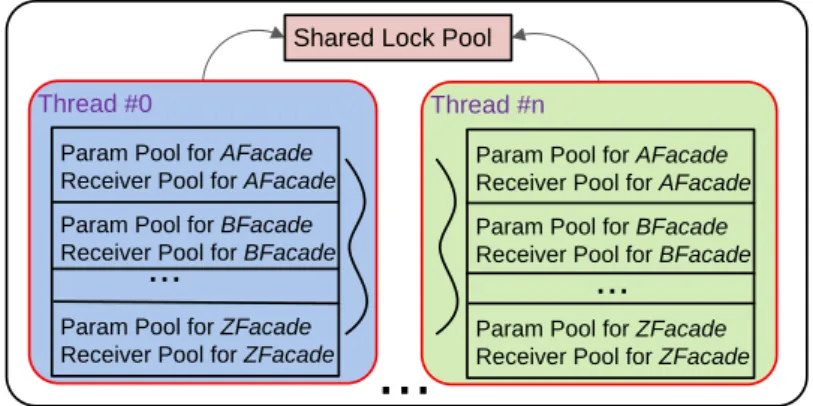
3.5 A graphical representation of threads and pools, where AFacade, BFacade,. . .,
and ZFacade are facade types. . . 35
3.6 A program (a) and its corresponding page manager tree after Line 7 is executed
(b), assuming 2 threads t1 and t2 are executing. . . 40
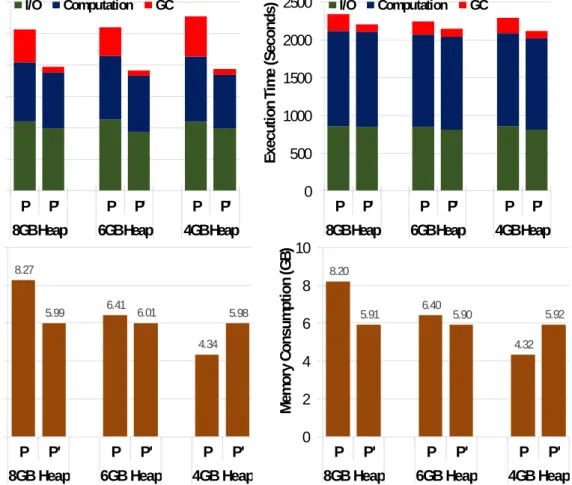
3.7 Performance comparisons between the original (P) and Facade-transformed
pro-grams (P’) on GraphChi. . . 46
3.8 Performance improvements with and without data record inlining. . . 48
3.9 Computational throughput of GraphChi on various graphs; each trend-line is a
least-squares fit to the average throughput of a program. . . 49
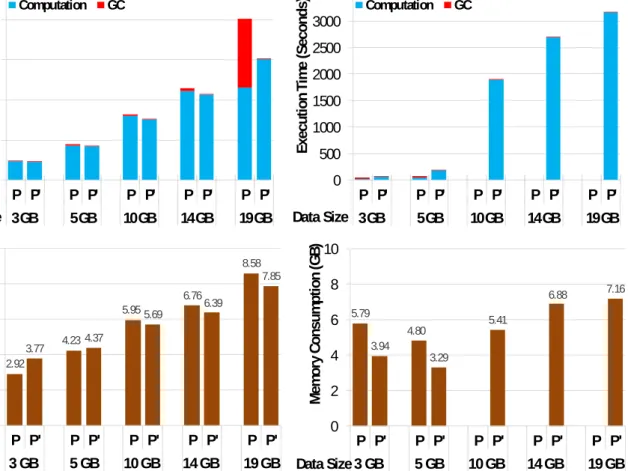
3.10 Performance comparisons between the original (P) and Facade-transformed (P’)
programs on Hyracks. . . 52
3.11 Performance comparisons between the original (P) and Facade-transformed (P’)
programs on GPS. . . 55
4.1 Memory footprint for the first 160 seconds of the executions when GraphChi
runs PR (top) and CC (bottom). Each dot in (a) represents the memory
con-sumption measured right after a GC; each bar in (b) shows how much memory
is reclaimed by a GC; dotted vertical lines show the iteration boundaries. . . 61
4.4 An example of regions: (a) a simple program and (b) its region semilattice at
some point of execution. . . 65
4.5 The heap layout in Yak. . . 68
4.6 (a) An object referenced by b escapes its epoch via the stack variablea; (b) An
object O created by thread t and referenced by a.g escapes to thread t0 via the
load statement b=p.g. . . 71
4.7 Examples showing potential problems with references on a remote stack: (a)
moving object D is dangerous; and (b) object E, which is also live, is missed in
the transitive closure. . . 72
4.8 An example heap snapshot (a) before and (b) after the deallocation of region
hr21, t1i. . . 77
4.9 Performance comparisons between PS and Yak on various programs. . . 83
4.10 Memory footprints collected from pmap. . . 84
4.11 Yak performance comparisons on GraphChi between different page sizes . . . . 88
4.12 Performance comparisons between Yak and PS when datasets of various sizes
were sorted by Hyracks ES on a 24GB heap . . . 88
4.13 Performance comparisons between G1 and Yak on Hyracks . . . 89
5.1 Spark serialization/deserialization costs: (a) performance breakdown and (b)
bytes shuffled under the Java and Kryo serializer. partitions. . . 93
5.2 Skyway’s overview. . . 95
5.3 Skyway’s system architecture. Purple and orange rectangles represent input
(in-heap) buffers and output (native) buffers, respectively; objects flow along red
arrows. . . 95
array of three elements on a 64-bit HotSpot JVM. mark contains object locks,
hash code of the object, and GC bits. klass points to the meta object
repre-senting the object’s class. What follows is the data payload – three references
to Integerobjects. baddr and tID are both added by Skyway. . . 106
5.6 Serialization, deserialization, and network performance of different S/D libraries.
Although we have compared Skyway with 90 existing libraries, we include in this figure Skyway and 27 fastest-performing libraries. The last bar is simply a
placeholder of the 63 libraries that perform slowly. . . 111
5.7 Size of serialized object by different libraries. . . 112
5.8 Spark performance with Java serializer, Kryo, and Skyway. . . 115
5.9 Ratio between the number of bytes generated by Skyway and the number of
bytes generated by Java serializer and Kryo. . . 116 5.10 Flink performance with Flink’s built-in serializer and Skyway. . . 118
3.1 A summary of code generation. Suppose variables a and b have types A and B,
respectively. . . 32
3.2 Performance summary of GraphChi on Twitter-2010 graph: reported are
ex-ecution time of original run (T) and Facade run (T’), the reduction of total execution times (%ET), engine update times (%UT), data load times (%LT), garbage collection times (%GC), and peak memory consumption (%PM) under
three different memory budgets (e.g., 8GB, 6GB, and 4GB) . . . 47
3.3 GraphChi performance comparisons on different datasets: reported are the total
execution times of the original program (T), and its Facade-version (T’); %ET reports Facade’s reduction in execution time and %TR reports the throughput
improvement. . . 49
3.4 Hyracks performance comparisons on different datasets: reported are the
to-tal execution times of the original program (T), and its Facade-version (T’);
OME(n) means the program runs out of memory in n seconds. %GC and %PM
report Facade’s reduction in GC time and peak memory consumption,
respec-tively. . . 51
3.5 GPS performance comparisons on different datasets: reported are the Facade’s
reduction in execution time (%ET) and GC time (%GC); LJ-A. . .LJ-E are
dif-ferent synthetic supergraphs of the Live Journal (LJ) graph; TW is the
Twitter-2010 graph. . . 54
4.1 Auxiliary functions used in Algorithms 1 – 4 . . . 69
4.2 Our benchmarks and their descriptions. . . 80
4.3 Datasets and heap configurations used to run our programs; for Hadoop, the
configurations a&b GB are the max heap sizes for each map (a) and reduce
all run time, GC time, including Yak’s region deallocation time,Application
(non-GC) time, and Memory consumption across all settings on each
frame-work. The values shown depict Min ∼ Max and (Mean), and are normalized to
PS. A lower value indicates better performance versus PS. . . 82
4.5 Statistics on Yak’s heap: numbers of cross-space references (CSR), cross-region
references (CRR), and total references generated by stores (TR); average per-centage of objects escaping to the CS (CSO) among all objects in a region when
the region retires; and total number of regions created during execution (R). . . 87
4.6 Summary of G1 and Yak performance normalized to baseline PS. Each cell
shows Min ∼ Max and (Mean), and are normalized to PS. Lower is better. . . . 90
5.1 Graph inputs for Spark. . . 114
5.2 Performance summary of Skyway and Kryo on Spark: normalized to baseline
(Java serializer) in terms of Overall running time, Serialization time, Write
I/O time, and Deserialization time,Read I/O time (including the network
cost), and the Sizeof byte sequence generated. A lower value indicates better
performance. Each cell shows a percentage range and its geometric mean. . . . 116
5.3 Descriptions of the queries used in Flink. . . 118
5.4 Performance improvement summary of Skyway on Flink: normalized to Flink’s
built-in serializer. Each cell shows a percentage range and its geometric mean.
From the bottom of my heart, oceans of gratitude go to my advisor, Professor Harry Xu. I simply would not be where I am now without him. Without his encouragement, I would not have started graduate school. And without his tireless effort in training and mentoring me, I would have not finished this seven-year journey. Professor Xu has inspired me to become a passionate researcher, a dedicated professor, and a supportive mentor, just like him. When I self-doubted, he encouraged me. When I felt lost, he guided me back on track. When all I saw was darkness, he lighted a path. I have been very fortunate to have him as my advisor. I will forever reserve my deepest gratitude for his guidance, understanding, and support towards my professional success and personal growth.
At UCLA I would like to thank Professor Tony Nowatzki, Professor Miryung Kim, Pro-fessor Jens Palsberg; at UC Irvine I owe my gratitude to ProPro-fessor Michael Carey, ProPro-fessor Aparna Chandramowlishwaran, Professor Brian Demsky, Professor Alex Nicolau for serving on my doctoral committee. Their valuable feedback has been of tremendous help completing this dissertation.
I dedicate this dissertation to my parents, Xuan Nguyen and Thoa Phan, who made countless sacrifices raising me and four siblings. Even though we are now half-the-globe apart, I know they are always besides me. I also cannot thank my two uncles, Vu Phan and Huy Phan and their spouses enough. Thank you for many family meals that really warm my heart. And thank you for being there for me during my ups and downs in life.
I would like to thank Dr. Kathryn McKinley and Chris MacGregor for the summer internship at Google. The experience has enriched my life with real-world problems and industrial work environment. I very much look forward to a chance working together again in the future.
My special thanks to Dr. Shan Lu from University of Chicago and Dr. Rajiv Gupta from UC Riverside. The honor of winning the prestigious Google Ph.D. Fellowship would have not been possible without their strong support.
My former labmate, Dr. Lu Fang, deserves a special mention. I count myself lucky to have him as a bother-in-arms on many research projects, and as a close friend. With his strong technical skills and great professionalism, he is the best colleague one could ask for.
John Thorpe, Tim Nguyen, Christian Navasca. Thanks for making my journey less stressful and fill it with friendship and teamwork.
I have the opportunity to mentor many high school students, undergraduates from UC Irvine and from Kookmin University whom regrettably, I cannot acknowledge all by name. Thank you for helping me become a better mentor.
It would be incomplete if I do not convey my gratitude to my teachers in early days. Mr. Son Tran and Mr. Tuan Nguyen from Thang Long High School in Vietnam patiently taught me how to program in Pascal, kindled my interest in Computer Science. Professor Scott Edwards and Professor Stephen Plett from Fullerton College tremendously helped me keep the fire burning.
Above all, I thank God for the chance to meet every single person, the luck I have, and all the much-needed strength during this journey. The end of Ph.D. is very exciting but I am more excited for the beginning of the next chapter of my life.
The work presented in this dissertation has been supported by the National Science Foundation under grants CNS-1321179, CCF-140982, CNS-1613023, and CNS-1703598, by the Office of Naval Research under grants N00014-14-1-0549 and N00014-16-1-2913, and a Google Ph.D. Fellowship.
Khanh Truong Duy Nguyen
EDUCATION
University of California, Los Angeles 2018 - 2019
− Ph.D. in Computer Science (expected)
University of California, Irvine
− Ph.D. in Computer Science 2012 - 2018
Advisor: Prof. Harry Xu (moved to UCLA)
2017 - 2019 Google Ph.D. Fellow
2017 Facebook Ph.D. Fellowship Finalist University of California, Irvine
− M.S. in Computer Science 2012 - 2015
− B.S. in Computer Science 2010 - 2012
Cum Laude, Donald Bren School of ICS Honor Program Graduate Fullerton College
− A.S. in Computer Science 2006 - 2010
− A.A. in Mathematics 2006 - 2010
High Honors EXPERIENCE
Research Assistant September 2018 - June 2019
University of California, Los Angeles, CA
Software Engineer Intern June 2018 - September 2018
Google Inc, Seattle, WA
Research Assistant June 2012 - June 2018
University of California, Irvine, CA
Teaching Assistant Fall 2013, Summer 2017
University of California, Irvine, CA
Proctor July 2011 - September 2011
University of California, Irvine, CA
Web Assistant August 2010 - December 2010
P8. Cheng Cai, Qirun Zhang, Zhiqiang Zuo, Khanh Nguyen, Harry Xu, and Zhendong Su. Calling-to-Reference Context Translation via Constraint-Guided CFL-Reachability
ACM SIGPLAN Conference on Programming Language Design and Implementation (PLDI) P7. Khanh Nguyen, Lu Fang, Christian Navasca, Harry Xu, Brian Demsky, and Shan Lu.
Skyway: Connecting Managed Heaps in Distributed Big Data Systems
The 23rd International Conference on Architectural Support for Programming Languages and Operating Systems (ASPLOS)
P6. Khanh Nguyen, Kai Wang, Yingyi Bu, Lu Fang, and Harry Xu.
Understanding and Combating Memory Bloat in Managed Data-Intensive Systems ACM Transactions on Software Engineering and Methodology (TOSEM)
P5. Khanh Nguyen, Lu Fang, Harry Xu, Brian Demsky, Shan Lu, Sanazsadat Alamian, and Onur Mutlu.
Yak: A High-Performance Big-Data-Friendly Garbage Collector
The 12th USENIX Symposium on Operating Systems Design and Implementation (OSDI) P4. Khanh Nguyen, Lu Fang, Harry Xu, and Brian Demsky.
Speculative Region-based Memory Management for Big Data Systems
The 8th Workshop on Programming Languages and Operating Systems (PLOS)
P3. Lu Fang, Khanh Nguyen, Harry Xu, Brian Demsky, and Shan Lu.
Interruptible Tasks: Treating Memory Pressure As Interrupts for Highly Scalable Data-Parallel Programs
The 25th ACM Symposium on Operating Systems Principles (SOSP)
P2. Khanh Nguyen, Kai Wang, Yingyi Bu, Lu Fang, Jianfei Hu, and Harry Xu.
Facade: A Compiler and Runtime Support for (Almost) Object-Bounded Big Data
Appli-cations
The 20th International Conference on Architectural Support for Programming Languages and Operating Systems (ASPLOS)
P1. Khanh Nguyen and Harry Xu.
Cachetor: Detecting Cacheable Data to Remove Bloat
The 9th Joint Meeting of the European Software Engineering Conference and the ACM SIGSOFT Symposium on the Foundations of Software Engineering (ESEC/ FSE)
Introduction
The past decade has witnessed the explosion of Big Data, a phenomenon where massive amounts of information are created at an unprecedented scale and speed. As a reference data point, former Google CEO Eric Schmidt, at the Techonomy’10 conference, shared that the accumulation of data generated in just two days could dwarf the total information that had been created in all human history up until 2003. As another example, the seventh Digital
Universe study jointly conducted by Dell EMC and International Data Corporation [75] —
the only study to quantify the amount of global data produced annually — reveals that the digital universe to grow 10-fold by 2020 — from 4.4 zettabytes (i.e., trillion gigabytes) in 2013 to 44 zettabytes. To put that in perspective, the amount of information is equivalent to 6.6 stacks of 128GB iPad Air tablets, each stack is enough to cover the distance from the earth to the moon.
The availability of an enormous amount of data has led to the proliferation of large-scale, data-intensive applications. Big Data analytics quickly become a key component of modern enterprise computing, transforming science, healthcare, finance, business, and ultimately, the whole society. As the digital universe expands, companies, government agencies, and aca-demic institutions have increasing demands for scalable software systems that can quickly analyze data of massive scale at petabyte or higher to discover patterns, trends, and associ-ations, especially those relating to human behaviors and interactions. For instance, retailers and media companies leverage users history to offer personalized product recommendations. Government agencies such as the SEC and the SSA as well as commercial banks fight frauds daily using Big Data technologies to monitor huge amounts of financial transactions.
The mainstream approach to tackle the scalability challenge is to enable distributed pro-cessing using a large number of machines in clusters or in the cloud. An input dataset is split among machines so that many processors can work simultaneously on a computing
task. Popular Big Data systems include, to name a few, Hadoop [35], Giraph [34], Hive [36],
Hyracks [51], Storm [38], Naiad [130], Spark [182], and TensorFlow [28]. Often, these Big
Data systems are developed in managed languages, such as Java, C#, or Scala. This is primarily because these languages 1) enable fast development cycles due to simple usage and automatic memory management and 2) provide abundant library suites and community support.
However, a managed runtime comes at a cost [77, 127, 132–135, 137, 169, 171–173, 175]:
memory management in Big Data systems is prohibitively expensive. These systems com-monly suffer from severe memory problems, causing poor performance and low scalability. That is due to a mismatch of memory usage in this emerging environment. Under the object-oriented modeling of data, a concrete object is created for each data item, thus, the heap
of a Big Data application contains several orders of magnitude more objects than a general,
non-data-intensive application. Allocating and deallocating a sea of data objects puts a se-vere strain on the runtime system, leading to high memory management overhead — objects compete for memory storage as well as CPU and networking time, causing prolonged execu-tion time, and inability to process datasets of even moderate sizes. For example, Bu et al.
[55] reports an average-sized application on Giraph [34], an Apache open-source graph
ana-lytics framework initiated by Yahoo!, cannot successfully process 1GB of input data despite having 12GB of memory available.
While there exists a large body of techniques that can improve Big Data performance [29,
30, 51, 56, 57, 65, 89, 100, 116, 140, 144, 160, 161, 177, 179, 184], they focus on horizontal
scaling, i.e., scaling data processing to a large cluster of machines with an assumption that the processing task on each machine yields satisfactory performance. However, in practice,
and our experience [135] confirms that, in many cases, the data-processing program running
memory limit soon after it starts and the system struggles with finding allocation space for new objects throughout the execution. Consequently, data-intensive applications crash due to out-of-memory errors in a surprisingly early stage. Even if a program runs successfully to the end, its execution is usually dominated by garbage collection (GC), which can take 40-60%
of a job’s end-to-end execution time [55, 77, 134, 135]. The problem becomes increasingly
severe in latency-sensitive distributed cloud applications such as web servers or real-time analytical systems, where one slow-performing node can hold up the entire cluster, delaying
the processing of user requests for an unacceptably long time [118, 119].
Going back to unmanaged language? Unsatisfactory performance and low scalabilty in con-temporary Big Data systems is a real problem that has seriously concerned developers of data-intensive systems. Debates on whether systems development should forsake managed languages to avoid their inherent inefficiencies and switch to unmanaged languages such as C
and C++ can be found almost everywhere [7,8, 25]. While that appears to be a reasonable
choice, unmanaged languages are more error-prone; debugging memory bugs in an unman-aged language is known to be a notoriously painful task, which can be further exacerbated by the many Big Data effects, such as distributed execution environment, huge volumes of heap objects, and extremely long running time. Furthermore, since most existing data processing frameworks are already developed in a managed language, it is unrealistic to re-implement them from scratch.
Unlike the mainstream approach which tackles the scalability problem by spending more resources (e.g., machines or memory), we approach this problem from a different
perspec-tive. This dissertation focuses on enabling vertical scaling, i.e., systematically improving the
performance of each data-processing program. By optimizing the program running on each worker node, large performance gains can be expected in a data center. With the reduction of data processing time on each node, the data center is expected to have increased throughput and reduced energy consumption, leading to economic benefit.
Our extensive experience with dozens real-world, data-itensive systems reveals that the core reason for the low performance of existing Big Data engines is the mismatch between ancient
assumptions and abstractions, based on which runtime systems are developed, and behavior of modern Big Data workloads. Specifically, the mismatches are:
1. Object-based representation mismatch.In a Big Data application, comparing to a standard application, the heap contains several orders of magnitude more of objects and references since they are created proportionally with the cardinality of the input dataset. Each object has a memory overhead in term of object header space and pointer reference. While the memory cost of maintaining millions of objects in non-Big-Data applications can be acceptable, the existence of billions of objects in a heap of a Big Data application exacerbates the runtime cost, limiting scalability.
2. Garbage collection mismatch. State-of-the-art garbage collectors are built upon generational hypothesis which assumes objects are short-lived. The hypothesis holds true for many applications, and dictates the design of the managed heap. However, the behavior of the majority of runtime objects in Big Data applications do not match such assumption. Instead, they often exhibit strong epochal behavior: their lifetime often spans the execution of a data manipulation task, which is often long. Much of the GC effort is wasted by repeatedly scanning a huge number of objects while they are not reclaimable. The challenge encountered by state-of-the-art GCs in data-intensive applications is fundamental, causing unsatisfactory performance.
3. Serialization mismatch. Data transferring process is designed very slow and ineffi-cient: an object must be serialized (i.e., turning an object from heap format to byte format) by the sender; and then deserialized (i.e., a complete opposite process, turning a byte sequence into a heap object) by the receiver. It is understandable that the seri-alization interface was developed in such a way since only a few objects needed to be serialized in standard applications. However, in Big Data systems, data transferring is a common task in the processing pipeline that needs to be invoked on a sea of objects to be transferred via network. Slow serialization is an unacceptable hurdle in such a performance-sensitive task.
The mismatches in existing managed runtime system motivate the development our tech-niques that can dramatically improve the runtime system efficiency for modern Big Data workloads. This dissertation consists of a series of techniques, spanning programming model, compiler, and runtime system, aiming to mitigate the mismatches, optimizing away runtime system inefficiencies, and thus, significantly improve the efficiency of various aspects of Big Data processing. In particular, the contributions of this dissertation are:
• Contribution 1.Facade [135], a non-intrusive approach targets the performance prob-lem caused by excessive object creation in an object-oriented Big Data application. We propose a facade-based programming model in which data are stored in raw mem-ory buffers and objects are created as proxies only to satisfy control purposes and to manipulate buffered data. Facade guarantees that the number of runtime objects for each data type is statically bounded. The compiler performs a semantics-preserving transformation on data classes to store and access data in native memory pages. We have implemented Facade and used it to transform 7 common applications on 3 real-world data processing frameworks: GraphChi, Hyracks, and GPS. Our experimental results show the The execution of an object-bounded program is much more memory-efficient. The generated programs have (1) achieved a 3%–48% execution time reduction
and and up to 88×GC time reduction; (2) consumed up to 50% less memory, and (3)
scaled to much larger datasets.
• Contribution 2.Yak [134], a new hybrid collector that can adapt intelligently to two different types of object lifetime characteristics in Big Data workloads. In Yak, data objects are speculatively allocated into lattice-based data regions while the generational GC only scans and collects the control space, which is much smaller. By moving all data objects into regions and deallocating them as a whole at the end of the lifetime of each region, significant reduction in GC overheads can be achieved.
We implemented Yak inside Oracle’s production JVM, OpenJDK 8. The JVM-based implementation enables Yak to work for all JVM-based languages such as Java, Python,
and Scala. Our experiments on several real-world systems such as Hadoop, Hyracks and GraphChi with various types of applications and workloads demonstrate that Yak outperforms the default Parallel Scavenge production GC in OpenJDK on real Big
Data systems. Specifically, Yak reduces GC latency by 1.4 – 44.3×and improves overall
application performance by 12.5% – 7.2× while requiring almost zero user effort.
• Contribution 3. Skyway [132], a more efficient, tailored-for-Big-Data-systems seri-alizer to reduce the data transfer cost among managed heaps. Skyway enhances the JVM, directly connects managed heaps on different machines. Under Skyway, objects are transferred as-is from the source to the destination without changing much of the format, enabling them to be used immediately after the transfer. Unlike all existing approaches, Skyway provides performance benefits to any JVM-based system by com-pletely eliminating the need of invoking reflection functions to convert data formats, thus saving computation power. It also requires less developer intervention in register-ing classes to be serialized as well as in hand-writregister-ing serialization functions.
We have implemented Skyway also in Oracle’s production JVM, OpenJDK 8. Our evaluation on a Java serializer benchmark set JSBS, Apache Spark, and Apache Flink shows that (1) Skyway outperforms all the 90 existing serializers in JSBS. It even
outperforms popular industrial effort: 2.2× faster than Kryo and 1.9× faster than the
Google‘s protobuf; (2) compared with Kryo and the Java serializer, Skyway improves the overall Spark performance by 16% and 36% for four representative analytical tasks over four real-world datasets; (3) for another real-world system Flink, Skyway improves its overall performance by 19% compared against Flink’s highly-optimized built-in serializers.
Impact. Asides from improving dramatically efficiency of several popular Big Data systems as demonstrated in our evaluations, this line of work has attracted much attention from
both academia and industry. The Facade system [135] inspired a line of several follow-up
the same idea [86] to improve Naiad, Microsoft’s dataflow egnine; Oracle and UC Berkeley
researchers developed a coordinated GC system for latency-sensitive workloads [118, 119];
and the idea was also adopted by a group of scholars from China, Denmark, and Hongkong
to improve the memory management in Apache Spark [117, 151]. As another example, the
Yak GC [134] was of interest of Oracle and recently commercialized by Huawei for use in
their telecommunication systems.
Organization. The remainder of this dissertation is organized as follows. Chapter 2 intro-duces several basic concepts. Chapter 3 discusses Facade, a framework to statically bound total number of objects created regardless of the size of the workload at the compiler level. Yak, a new hybrid garbage collector for Big Data systems is introduced in Chapter 4. Chap-ter 5 describes the system Skyway built to directly connect managed heaps, reducing data transfer cost in clusters. Related work is discussed extensively in Chapter 6. Finally, we conclude in Chapter 7 with some exciting future directions.
Background
In this chapter, we introduce some basic concepts to facilitate the discussion of our techniques in subsequent chapters.
2.1
Memory Bloat
The term memory bloat refers to excessive memory space required for processing. Memory
bloat commonly exists in enterprise computing [169, 171, 172, 175]. In object-oriented
pro-gramming, for example, each Java object has a fixed-size header space to store its type and the information necessary for garbage collection (e.g., in the Oracle 64-bit HotSpot JVM, the header takes 8 bytes for regular objects and 12 bytes for arrays). In an application that contains a huge number of objects to represent and manipulate data items of small size, since the data contents in each such object do not take much space, the space overhead cannot be amortized. That is not all, a significant source of this space overhead is object references due to the pervasive use of pointer to form data structures. With multiple layers of indirec-tion, these pointers consume a significant portion of the heap. Based on a study reported
in [127], the fraction of the useful payload data in an IBM application is only 13% of the total
space. The space impact can be significantly magnified in a data-intensive application when massive amounts of input data need to be represented and processed in memory. Studies
in [55, 136] found that packing factor, a metric which is defined as the maximal amount
of actual data that be accommodated into a fixed amount of memory, in various system is below satisfactory. Moreover, in these applications, because the input dataset is too large to
fit totally into memory, data processing pipeline often must be divided to work on a small partition of the input resulting in significantly increased round-trip I/O costs.
As a result, data processing systems written in managed languages frequently face severe memory problems that cause them to fail with out-of-memory errors, reducing its scalability although the size of the processed dataset is much smaller than the heap size. For example,
in Spark [181,182], a leading system in Big Data processing, even machines with reasonably
large memory resources cannot satisfy its need and out-of-memory errors have been
con-stantly reported on StackOverflow [24] and the Apache mailing list [1]. Similarly, numerous
examples of Hadoop users facing out-of-memory errors can also be found on StackOverflow
(e.g., [9–21, 23]). Graph processing systems are not excluded; systems like Giraph [34] is
reported not able to process moderate-sized graphs on large clusters although the amount
of data for each machine is well below its memory capacity [55].
2.2
Garbage collection
Garbage collection (GC) is extremely useful, as it simplifies the programming model, there-fore freeing valuable programmer time, while avoiding bugs and memory leaks that are notoriously hard to track and fix. As any C programmer can witness, the manual manage-ment of a dynamic heap is extremely complex and highly error-prone. If the heap is shared by many applications written by different programmers, accessed in parallel, or includes disk storage or distributed access, then manual resource management is simply out of question.
The mainstream collectors in modern systems are tracing garbage collectors. A tracing GC
performs allocation of new objects, identification of live objects, and reclamation of free memory. It identifies live objects by following references (thus called tracing), starting from a set of root objects that are directly reachable from live stack variables and global variables. It computes a transitive closure of live objects; objects that are unreachable during tracing are guaranteed to be dead and will be reclaimed.
There are four kinds of canonical tracing collectors: mark-sweep, mark-region, semi-space, and mark-compact. They all identify live objects in the same way as discussed above. Their allocation and reclamation strategies differ significantly:
• Mark-sweep collectors [78,124] allocate from a free list, mark live objects, and then put
reclaimed memory back on the free list. Since a mark-sweep collector does not move live objects, it is time- and space-efficient, but it sacrifices locality for contemporaneously allocated objects.
• Mark-region collectors [44,48,52] reclaim contiguous free regions to provide contiguous
allocation. Some mark-region collectors such as Immix [48] can also reduce
fragmenta-tion by mixing copying and marking.
• Semi-space [40,43,47,59,67,98,156] and mark-compact [62,104,148] collectors both
move live objects. They put contemporaneously-allocated objects next to each other in a space, providing good locality.
These canonical algorithms serve as building blocks for more sophisticated algorithms such as
the generational GC [156], which built upon the popular, conventional generational
hypoth-esis. The hypothesis states objects are short-lived: most recently allocated objects are more
likely to become garbage and won’t survive a GC run. This dictates the design of the heap, which divides the heap into a young and an old generation. Allocation happens in young
generation. Most GC runs arenursery (minor) collections that only scan references from the
old to the young generation, promotes (i.e., copies) reachable objects to the old generation, and then frees the entire young generation. Garbage collection for the old generation occurs infrequently. Only when nursery GCs are not effective, not yielding enough memory for the
applications, a full (major) collection scans both generations to free more memory. As long
as the generational hypothesis holds, which is true for many large conventional applications that make heavy use of short-lived temporary data structures, generational GCs are efficient: a small number of objects escape to the old generation, and hence, most GC runs need to traverse only a small portion of the heap to identify and copy these escaping objects.
More formally, if the number of live objects isn and the total number of edges in the object
graph (i.e., number of references) ise, the asymptotic computational complexity of a tracing
garbage collection algorithm is O(n+e). For a typical data-intensive application, its object
graph often consists of a great number of isolated object subgraphs, each of which represents either a data item or a data structure created for processing data items. As such, there often
exists an extremely large number of in-memory data objects, and bothn andecan be orders
of magnitude larger than those of a regular Java application. In fact, commonly GC is the performance bottleneck that significantly hurts system performance. Evidence shows that
GC accounts for 25-50% [55, 77, 132, 135], and could go up to as much as 73% of the total
execution time [134].
2.3
Behavior of a Big Data application
It is important to first understand the behavior of a typical Big Data application. Unlike
traditional, object-oriented programs, evidence [55,86,135] shows that a Big Data program
often has a very clear logical distinction between acontrol path and adata path as exemplified
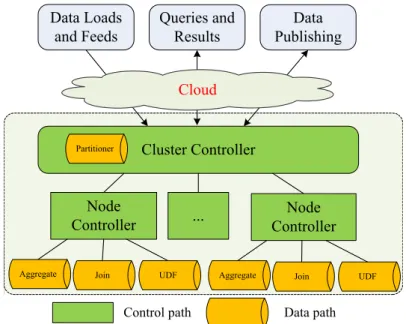
in Figure 2.1. The control path performs cluster management and scheduling, organizes tasks into pipelines, establishes communication channels between nodes, and interacts with users to parse queries and return results. Meanwhile, the data path primarily consists of data
manipulation functions such asAggregate,Joinor user-defined functions (e.g.,Map,Reduce
in Hadoop) that can be connected to form a data processing pipeline.
These two paths follow different heap usage patterns. The control path behaves similar to a regular application. It could have a complicated logic to drive the program flow but create a small number of objects. More importantly, control objects follow the conventional wisdom: recently allocated objects are also most likely to become unreachable quickly; most objects have short lifespans. Meanwhile, the data path, not only is the main source where most
objects are created (e.g., this path can create up to 95% of the total number of objects [55]),
its execution of exhibits strong epochal behavior—each piece of data manipulation code is
Data Loads and Feeds Queries and Results Data Publishing Cloud Cluster Controller Node Controller ... Node Controller
Aggregate Join UDF Aggregate Join UDF Partitioner
Control path Data path
Figure 2.1: Graphical illustration of control and data paths.
control objects—they represent the input data set as well as intermediate and final results of processing. The execution of each epoch starts with allocating many objects and then manipulating them. These objects are often held in large arrays and stay alive throughout the epoch, which is often not a short period of time.
2.4
Data shuffling
Modern Big Data systems need to frequently shuffle data in the cluster – a map/reduce
framework such as Hadoop [35] shuffles the results of each map worker before performing
reduction on them; a dataflow system such as Apache Spark [182] supports many RDD
transformations that need to shuffle data across nodes. As most of these systems are written in managed languages such as Java and Scala, data is represented as objects in a managed heap. This task utilizes serialization/deserialization procedures.
Transferring an object O across nodes is complicated, involving three procedures shown in
Figure 2.2. First, a serialization procedure turns the whole object graph reachable from
O into a binary sequence. This procedure reformats each object—among other things, it
and changes the representation of certain meta data. Then, this byte sequence is transferred
to a receiver machine via the network. Finally, adeserialization procedure reads out the byte
sequence, creates objects accordingly, and eventually rebuilds the object graph in the heap of the receiver machine.
Figure 2.2: A graphical illustration of data transfer.
The serialization interface, unfortunately, was designed very compute-inefficient. To illus-trate, we discuss the handling of three key pieces of information these procedures have to
extract, transfer, and reconstruct for every object reachable from O: (1) object data (i.e.,
primitive-type fields), (2) object references (i.e., reference-type fields), and (3) object type.
1. Object data access: A serializer needs to invoke reflective functions such as
Reflec-tion.getField and Reflection.setField to enumerate and access every field to extract, on the sender side, and then write-back, on the receiver side, each primitive object field individually. In a Big Data system, each data transfer involves many mil-lions of objects, which would invoke these functions for milmil-lions of times or more. It is worth noting that reflection is a very expensive runtime operation. It allows the pro-gram to dynamically inspect or invoke classes, methods, fields, or properties without
type information available statically at the cost of time-consuming string lookups, and is undesirable in performance-critical tasks.
2. Reference adjustment: References contained in reference-type fields of transferred ob-jects need to be adjusted, since those obob-jects will be placed in different addresses on the receiver node. The Java serializer uses reflection to obtain and inline the contents of referenced objects into the binary representation of the referencing object. It
con-structs all objects reachable from O on the receiver machine using reflection, and then
sets reference fields with the addresses of the just created referenced objects through reflection.
3. Type representation: Each type is represented by a special meta object in a managed runtime, and is referenced by the headers of the objects of the type. However, type references cannot be used to represent types in a byte sequence, because the meta objects representing the same type may have different addresses in different runtimes. The Java serializer represents every type by a string that contains the name of a class and all its super classes. This design causes meta data (i.e., type strings) to consume
a huge portion of the byte sequence transferred across the network. Furthermore,
re-flection must be used to resolve the type from each string during object re-creation on the receiver node.
While many serialization/deserialization libraries [39, 106, 145] have been developed, large
inefficiencies exist in their implementations. Both our own experience and evidence from
previous work [131] show that data shuffling has a non-trival cost:
serialization/deserializa-tion accounts for 30% of the execuserialization/deserializa-tion time in Spark. Microsoft researchers reported that 5% of all Google datacenter traffic are from Protobuffers that serialize and deserialize data
Mitigating Object-based Representation Mismatch
One major performance issue that the managed runtime suffers from is the memory bloat due to the wasted space for objects’ header and excessive amount of pointers and references, leading to high space overhead and low memory packing factors. Comprehensive studies across many contemporary Big Data systems confirm that these overheads lead to signifi-cantly reduced scalability—e.g., applications crash with out-of-memory errors, although the
size of the processed dataset is much smaller than the heap size [55,136].
This chapter presents our effort in mitigating the object-based representation mismatch is Big Data systems. We develop a system named Facade that can optimize the memory overheads caused by the use of objects, and thus, provide bare-metal performance for all JVM-based Big Data applications. The key to success is reducing the ratio between auxiliary data and actual payload by bounding the number of heap objects and references at compiler level. We begin with a study to validate the memory bloat issue in Section 3.1. Section 3.2 gives an overview of our approach, including several challenges and how we overcome them. Then, the following 2 sections discuss Facade execution model (3.3), and implementation details (3.4). After experimental results are presented in Section 3.5, we conclude the chapter in Section 3.6.
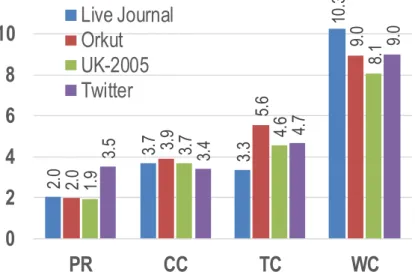
2. 0 3. 7 3. 3 10 .3 2. 0 3. 9 5. 6 9. 0 1. 9 3. 7 4.6 8. 1 3. 5 3. 4 4. 7 9. 0
0
2
4
6
8
10
PR
CC
TC
WC
Live Journal
Orkut
UK-2005
Figure 3.1: The ratios between the total bytes of data objects and the size of their actual payload
3.1
An Empirical Study on Memory Bloat Caused by the Use of
Objects
To empirically quantify object headers and references space overhead , we ran three graph
analytics programs and one data analytic program on Apache Spark [182], the de-facto
leader in Big Data processing. We used Spark version 2.1.0 on a cluster of 11 nodes, each with 2 Xeon(R) CPU E5-2640 v3 processors, 32GB memory, 1 SSD, running CentOS 6.9 and connected by a 1000Mb/s Ethernet. The three graph programs were Page Rank (PR), Connected Components (CC) and Triangle Counting (TC); the other program was Word
Count (WC) over four real-world graphs, Live Journal [42], Orkut [26], UK-2005 [50], and
Twitter-2010 [107]. Kryo [106], a high-performance serializer, recommended for Spark, was
used.
To understand the size difference, we modified Kryo to report the numbers of bytes occupied by data objects before and after they were serialized by Kryo. The first number includes the size of the actual data as well as the space overhead incurred by the JVM, and the second number represents the size of the actual data. Finally, these numbers were aggregated across all machines.
Figure 3.1 reports the ratios between these two numbers. Across all programs, on
aver-age, the space overheads of the object-based representation is 3.2×. The main reason for
this large overhead is that these applications create billions of small data objects (e.g.,
java.lang.Integer, java.lang.Long, or java.lang.Double), whose corresponding
header/-pointer overhead cannot be amortized by actual payloads. This experiment validates existing
studies in [55, 136] and motivates our work.
3.2
Facade overview
The key observation made in the study is that to develop a scalable system, the number of data objects and their references in the heap must not grow proportionally with the car-dinality of the dataset. To achieve this goal, we develop Facade, a compiler and runtime
system, that aims to statically bound the number of heap objects during the execution of a
data-intensive application, thereby significantly reducing the space and temporal overhead incurred by the object-based data representation.
3.2.1 Technical challenges and solutions
There are three major challenges in Facade’s design. We briefly discuss these challenges and how Facade overcomes them.
Challenge 1: How to bound the size of the managed heap? Despite a rich body of
work that attempts to reduce the number of objects [49, 61, 70, 80, 114, 152, 170], none of
them can work with modern data processing frameworks whose codebases have millions lines of codes or they can work with large heaps containing billions of objects. This is because they all rely on expensive inter-procedural analyses which are known not able to scale to large systems.
In order to overcome this challenge, Facade does not use such heavy-weight analyses. Instead, we propose a novel execution model. Facade advocates to separate data storage from data manipulation: data are stored in the off-heap memory(i.e., not recognized as heap objects)
while heap objects are created as facades only for control purposes such as function calls
(i.e., bounded). As the program executes, a many-to-one mapping is maintained between
arbitrarily many data items in the native memory and a statically-bounded set of facade objects in the heap. In other words, each facade keeps getting reused to represent data items.
To enforce this model, our Facade compiler transforms an existing data processing program into an (almost) object-bounded program: the number of heap objects created for a data class in one thread is bounded by certain source code properties (i.e., a compile-time constant).
More formally, Facade reduces the number of data objects from O(s) to O(t∗n∗m+p),
wheresrepresents the cardinality of the dataset, tis the number of threads,n is the number
of data classes, m is the maximum number of facades in a data class’s pool, and p is the
number of page objects used to store data.
Challenge 2: What to transform? Real-world data-intensive systems have very large codebases and relied heavily on (third-party) libraries. Furthermore, features such as re-flection and dynamic class loading are prevalently used to instantiate types in third-party libraries and frameworks that cannot be resolved statically, there is little hope that a whole-program analysis/transformation can be done for any real system. No real-world whole-programs can be guaranteed to be safely transformed without using prohibitively expensive, sophisti-cated program analyses.
Luckily, as discussed in Section 2.3, there often exists a clear boundary between a control
path and a data path in a Big Data processing system. Although the data path creates most
of the runtime objects to represent and process data items, its implementation is rather
simple and its code size is often small (e.g., 35% of lines of code [55]) . This property enables
a systematic solution for data-intensive programs. Since a data path often contains simple data manipulation functions, developing a compiler to transform these functions is much more feasible than transforming the entire application.
Facade requires developers to provide a list of Java classes that form the data path. Each
class in this list is transformed by our compiler into a facade-based class. Many performance
problems result from the extensive use of large collections. For each collection class C (e.g.,
HashMap or ArrayList) in the standard Java library, we also transform it into a facade-based
class C0. The original class C is used in normal ways in the control path while type C0 will
be used in the data path to substitute C.
Challenge 3: How to reclaim data objects? As data objects are no longer subject to garbage collection, an important question is how and when to reclaim them from native
memory. A great deal of evidence shows that a data path isiteration-based [55, 77, 135]. In
this chapter, “iteration” refers to a piece of data processing code that is repeatedly executed. Its definition includes but is more general than that of “computational iteration” performed in graph algorithms. For example, an iteration can also be a MapReduce task or a dataflow operator in data-parallel frameworks. Iterations are very well defined in data processing
frameworks and can be easily identified by even novices. For example, in GraphChi [108], a
computational iteration that loads shards into memory, processes vertices, and writes updates
back to disk is explicitly defined as a pair of callbacks (iteration_start()anditeration_end()).
It took us only a few minutes to find these iterations although we had never studied GraphChi before. In a data-parallel system such as Hadoop, the code for a Map or Reduce task can be considered as an iteration because it is repeatedly executed to process data partitions. There is a strong correlation between the lifetime of an object and the lifetime of the iteration in which it is created: such objects often stay alive until the end of the iteration but rarely
cross multiple iterations. Hence, we develop an iteration-based memory management that
allocates data objects created in one iteration together in a native region and deallocates the region as a whole when the iteration finishes. There may be a small number of control objects that are also created in the iteration, and naively reclaiming the whole region may cause failures. We rely on developers to refactor the program code to move the creation of control objects out of the data path. In reality, this effort is very little because a data path rarely creates control objects (but it does use control objects passed from the control path).
3.3
The Facade Execution Model
To overcome the fundamental problem of memory bloat caused by the object-based represen-tation mismatch, we design the Facade framework that exploits compiler and runtime system support to separate data storage from data manipulation in a data-intensive program. The key idea is simple: data contents are allocated separately in native memory; heap objects no longer contain data, and they only provide data-manipulating methods. Objects now only represent data processors, not data contents, and hence, the number of heap objects is no longer proportional to the cardinality of the input dataset.
3.3.1 Data Storage Based on Native Memory
We propose to store data records in native, non-GCed memory. Similarly to regular memory allocation, our data allocation operates at the page granularity. A memory page is a fixed-length contiguous block of memory in the off-heap memory, obtained through a JVM’s native support.
To provide a better memory management interface, each native page is wrapped into a Java object, with functions that can be inserted by the compiler to manipulate the page. Note
that the number of page objects (i.e., pin O(t∗n∗m+p)) cannot be statically bounded in
our system, as it depends on the amount of data to be processed. However, by controlling the size of each page and recycling pages, we often need only a small number of pages to process a large dataset. The scalability bottleneck of an object-oriented data-intensive application lies in the creation of small data objects and data structures containing them; our system aims to bound their numbers.
From a regular Java program P, Facade generates a new program P0, in which the data
contents of each instantiation of a data class are stored in a native memory page rather than in a heap object. To facilitate transformation, the way of a data record is stored in a page is exactly the same as the way it was stored in an object except that the native-memory-based record does not contain a heap object’s header and padding.
class Professor{ int id; int numStudents; Student[] students; String name; } class Student{ int id; String name; } 12 1254 0x0504 0x070a 25 9 0x0800 4
...
...
13 2541 0x0868...
Type Fields 0x04e0 0x0504 0x070a 0x0800 Professor Student[] String Student...
Address Record Type Lock 0 253...
...
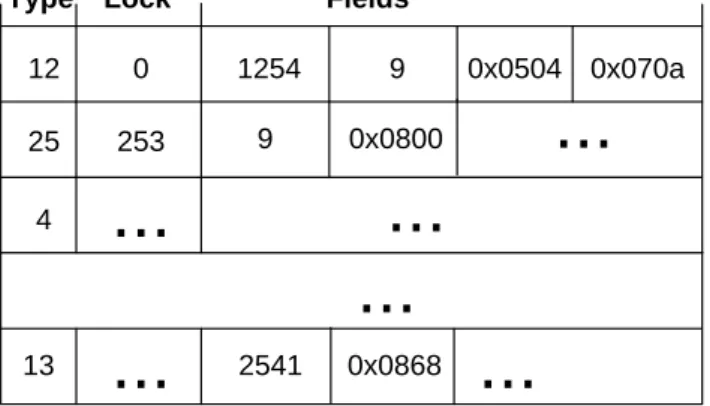
9Figure 3.2: A data structure in regular Java and its corresponding data layout in a native page.
Figure 3.2 shows the data layout for an example data structure in our page-based storage
system. Each data record (which used to be represented by an object in P) starts with a
2-byte type ID, representing the type of the record. For example, the IDs for Professor,
Student[],String, andStudentare 12, 25, 4, and 13, respectively. These types will be used
to implement virtual method dispatch during the execution of P0. Type ID is followed by a
2-byte lock field, which stores the ID of a lock when the data record is used to synchronize a block of code. We find it sufficient to use 2 bytes to represent class IDs and lock IDs — in our experiments with large systems, the number of data classes is often much smaller than
215; so is the number of distinct locks needed. Details of the lock implementation and the
concurrency support can be found in §3.4.5.
For an array record, the length of the array (4 bytes) is stored immediately after the lock ID. In the example, the number of student records in the array is 9. The actual data contents
(originally stored in object fields) are stored subsequently. For instance, field id of the
pro-fessor record contains an integer 1254;numStudents stores an integer 9; the fields students
and name contain memory addresses 0x0504 and 0x070a, respectively. These references are
referred to aspage references, as opposed toheap references in a normal Java program. Note
that for efficiency, page references are not offsets into the native page where the memory is held, they are the absolute memory address so that the Facade runtime can operate directly on them without further calculation.
2 int id;
3 int numStudents; 4 Student[] students; 5 String name;
1 class Facade { long pageRef; … } 2 class ProfessorFacade extendsFacade{ 3 static int id_OFFSET = 0;
4 static int numStudents_OFFSET = 4; 5 static int students_OFFSET = 8; 6 static int name_OFFSET = 12; 7 //no data fields
8 void addStudent
9 (StudentFacade sf){ 10 long this_ref = this.pageRef; 11 long s_ref = sf.pageRef; 12 int v = FacadeRuntime.getField( 13 this_ref, 14 numStudents_OFFSET); 15 FacadeRuntime.writeArray( 16 this_ref, 17 students_OFFSET, 18 v, s_ref); 19 FacadeRuntime.writeField( 20 this_ref, 21 numStudents_OFFSET, 22 v+1); 23 } 24 …//other methods }
1
2
1 class Professor{6 void addStudent(Student s){
9 } 10 …//other methods 11 } 7 students[numStudents++] 8 = s;
P
P’
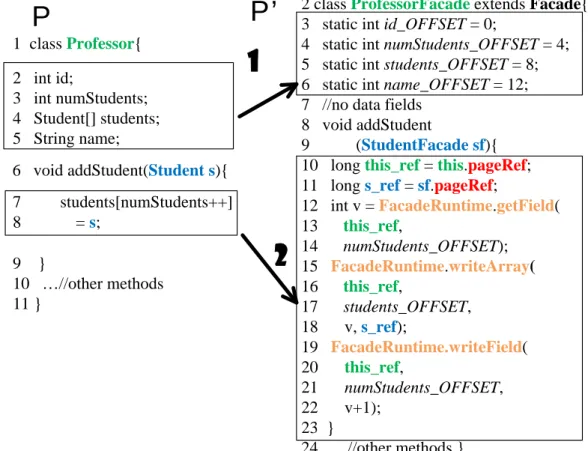
Figure 3.3: A transformation example; part (a).
3.3.2 Using Objects as Facades
We propose to create heap objects as facades for a data class, that is, they are used only for
control purposes such as method calls, parameter passing, or dynamic type checks, but donot
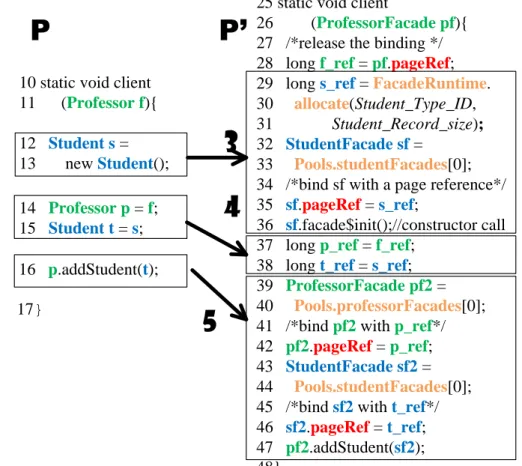
contain actual data. Figure 3.3 and Figure 3.4 depict an example with five transformations
using the same Professor class in Figure 3.2. For simplicity of illustration, we show the
unoptimized version of the generated program, under the assumption that the program is single-threaded and free of virtual calls. We will discuss the support of these features later.
Class transformation The transformations #1 and #2 from Figure 3.3 show an example
of class transformation. For illustration, let us assume both Professor and Student are
data classes. For Professor, Facade generates a facade classProfessorFacade, containing
17}
25 static void client
26 (ProfessorFacade pf){ 27 /*release the binding */ 28 long f_ref = pf.pageRef; 29 long s_ref = FacadeRuntime. 30 allocate(Student_Type_ID, 31 Student_Record_size);
32 StudentFacade sf = 33 Pools.studentFacades[0]; 34 /*bind sf with a page reference*/ 35 sf.pageRef= s_ref;
36 sf.facade$init();//constructor call 37 long p_ref = f_ref;
38 long t_ref = s_ref; 39 ProfessorFacade pf2 = 40 Pools.professorFacades[0]; 41 /*bind pf2 with p_ref*/ 42 pf2.pageRef = p_ref; 43 StudentFacade sf2 = 44 Pools.studentFacades[0]; 45 /*bind sf2 with t_ref*/ 46 sf2.pageRef = t_ref; 47 pf2.addStudent(sf2); 48}
3
4
5
10 static void client 11 (Professor f){ 12 Student s = 13 new Student(); 14 Professor p = f; 15 Student t = s; 16 p.addStudent(t);
P
P’
Figure 3.4: A transformation example; part (b)
pageRef that records the page reference of a data record (such as 0x0504 in Figure 3.2).
Setting a page reference to the field pageRef of a facade binds the data record with the
facade, so that methods defined in the corresponding facade class can be invoked on the
facade object to process the record. Readers can think of this field as the this reference in
a regular Java program.
ProfessorFacadedoes not contain any instance fields; for each instance fieldf inProfessor,
ProfessorFacade has a static field f_Offset, specifying the offset (in number of bytes) of
f to the starting address of the data record. These offsets will be used to transform field
accesses.
Method transformation For methodaddStudentinProfessor, Facade generates a new
objects, for each reference of a data object in the original program, we substitute it with either a page reference or a reference of a corresponding facade object using the following criteria:
• For any assignment, load, or store that involves a data object, the reference of the
data object is substituted with its page reference. For example, in Figure 3.4, the
transformation #4 replaces the variable assignments (Lines 14 – 15) in P with page
reference assignments (Lines 37 – 38) in P0. In these cases, the generated statements
do not have any heap objects involved.
• For parameter passing and value return in a call site, it is difficult to substitute object
references completely with page references, because if an object is used as a receiver object to call a method, replacing it with a page reference would make it impossible to make the call. In this case, we replace references to data objects with references to their corresponding facade objects. For example, in Figure 3.3, the signature of method
addStudent is changed in a way so that theStudent type parameter is replaced with
a new parameter of type StudentFacade.
In the generatedaddStudentmethod (Lines 8 – 23 in Figure 3.3), the new facade parameter
sf is used only to pass the page reference of the data record that corresponds to the original
parameter inP. The first task inside the generated method is to retrieve the page references
(Lines 10 and 11 in P0) from the receiver (i.e., this) and sf, and store them in two local
variables this_ref and s_ref. Any subsequent statement that uses this and s in P will
be transformed to use the page references this_ref and s_ref inP0, respectively. The field
accesses in Lines 5 and 6 inP are transformed to three separate calls to our library methods
that read values from and write values to a native page. Note that what is written into the
array is the page reference s_ref pointing to a student record — all references to regular
data objects in P are substituted by page references in P0.
Allocation transformation In Figure 3.4, the allocation in Lines 12 – 13 in P is
size of typeStudentby calling a library method allocate, which performs
native-memory-page-based allocation and returns a page reference s_ref which is a native memory address.
Details of the allocation algorithm and memory management are discussed in §3.4.7.
Call site transformation Since statements in P0 all use page references, a challenge in transforming a call site is how to generate the receiver object on which the call can be made. Our idea is to use facade objects (i.e., objects are created only as proxies). If a call is
made on a data object in P, we can obtain a facade object to call the same method in P0,
because a data class and its corresponding facade class have the same methods. However, doing so naively would generate a large number of facade objects, which would still cause space and memory management overhead. Hence, special care needs to be taken to minimize the number of facade objects used.
We solve the problem by pooling facade objects. For each facade class, we maintain a pool that contains a small number of objects of the class. This number can be statically bounded as discussed shortly. For instance, before generating an allocation site, as shown in Trans-formation #3 in Figure 3.4, the Facade compiler first generates code to retrieve an available
facade object from the pool (Lines 32 – 33 in P0) and bind it with the page references_ref
(Line 35). In this example, the first facade in the pool is available; the reason will be
ex-plained shortly. The constructor of class Student in P is converted to a regular method
facade$init in P0. Facade then generates a call to facade$init on the retrieved facade object (Line 36).
Similarly, Transformation #5 shows how a call to method addStudent on the Professor
object inP (Line 16) is transformed to a call to the same method on the ProfessorFacade
object inP0 (Line 47). This new call site needs (1) a receiver object and (2) a parameter
ob-ject. To prepare for these objects, we generate the statements from Line 39 to Line 44, which
retrieve a ProfessorFacade object pf2 for the receiver and a StudentFacade object sf2
for the parameter from their respective pools, and then bind them with their corresponding page references (Line 46). Finally, the call site in Line 47 is generated.