Minimization of weighted sum of total tardiness and make span in no wait
flow shop scheduling Using different heuristic algorithm: A Review
Umesh Gupta Research Scholar Mewar University Chittorgarh:INDIA [email protected] Dr. Rahul lodha Mewar University Gangrar Chittorgarh [email protected]
Dr. Ashwani Kumar Dhingra Department of Mechanical Engg.
UIET, MD University Rohtak, Haryana, INDIA [email protected]
Satish Kumar Department of Mechanical Engg. Vaish College of Engineering Rohtak
Abstract— No wait flow shop scheduling one of the most significant issues in the planning and operation of a manufacturing system. A succeeding operation start immediately after the preceding operation complete means no wait flow shop scheduling. Better no wait flow shop scheduling system has significant impact on cost reduction, increased productivity, customer satisfaction and overall competitive environment. In no wait flow shop scheduling problem, a set of n independent jobs have to be processed on a set of m machines. Every job requires a given fixed, non-negative processing time on every machine. Traditional flow shop scheduling problems has primarily been focused on completion time of jobs, and in current manufacturing tradition has been adopted criteria like on time delivery to stay in the rapidly growing markets. So industries focus has gone beyond the single objective scheduling system. The primary objective of no wait flow shop scheduling is to obtain the best sequence, which can be achieve by minimizes the various parameter like make span, flow time, idle time, work in-process and tardiness, etc. The paper has reviewed and classified the articles published in related journals between 1995 and 2015. With the help of this wide literature review identifies and discusses several issues significant to the performance of evolutionary algorithms, different objectives used to optimize parameter and their selection. The present work focused on review of various no wait flow shop scheduling problem involving make span other parameter consideration deals with the various type of heuristic algorithm(SA, GA, Taguchi, DOE etc.) for scheduling and what are the outcome of the same with various parameter selection, computer resource usage, hybridization and enhancement from the past work.
Keywords- Flowshop scheduling, SA, GA, Taguchi, Fuzzy logic, DOE, Review.
I. INTRODUCTION
No wait flow shop scheduling is a very important decision-making process that plays a vital role in Production industries. Scheduling problems are often categorized by the number of machine and available resources. In a flow shop environment, jobs are processed continuously from start to end without interruptions either on or between machines. The start of a job on a given machine may be delayed to ensure that its operation completion coincides with the start of its subsequent operation on the next machine. Scheduling is a decision making practice that is used on a regular basis in many manufacturing and services industries. Its aim is to optimize one or more objectives with the allocation of resources to tasks over given time periods. The resources and tasks in an organization can take a lot of different forms. A hybrid GA approach has proposed in no-wait flow shop scheduling problem for the minimization of make span by Gonzalez et. al.,1995[37].
Heijligers et. al., 1995[34] proposed a lower Bound estimations techniques for the optimization of make span time during scheduling and synthesis strategies. A fuzzy approach has been proposed by Macchiaroli et.al, 1996[41] to optimize manufacturing processes with no wait constraints. Chakravarthy and rajendran, 1999[17] applied a heuristic technique for the minimization of the bi criteria of makes span and maximum tardiness in a flow shop scheduling. The total weighted tardiness has also been minimized by Asano & Ohta, 1999[31] for an unrelated parallel machine scheduling problem. Moon et. al., 2002[39] proposed an efficient Genetic algorithm for the traveling salesman problem with precedence constraints. A fuzzy logic problem converted in to simulated annealing for the minimization of make span and the penalties of E/T has been planned by Zheng and Gu,2004[38]. Mattfeld and bierwirth, 2004[8] optimized the tardiness by applying an efficient genetic algorithm for job shop scheduling. An ant-bidding algorithm has been proposed by Donati et. al., 2008[2] for the optimization and phase transitions in generalized flow shop scheduling. Ponnambalam et. al., 2004[26] designed a TSP-GA multi-objective algorithm for the minimization of make span, mean flow time and machine idle time in flow-shop scheduling. A hybrid simulated annealing algorithm proposed by Nearchou, 2004[4] for the minimizing of make span in scheduling. Haq et. al., 2004[1] proposed a hybridization of metaheuristics for flow shop scheduling to minimize the make span in flow shop scheduling. Real-life perspective problem, proposed for solving single machine scheduling problem in chemical plant to minimize make span and improve efficiency proposed by Srdjevicand Srdjevic,2004[37]. Berkoune et. al., 2006[33]. proposed Lower bounds algorithm in the scheduling problem for uncertain demands to minimize Make span. A genetic algorithm for hybrid flow shops with sequence dependent setup times proposed by Ruiz and Maroto,2006[25]. in flow shop scheduling problem. Xing et. al.,2006[29]. planned a multi-objective fuzzy genetic algorithm in job scheduling. A new hybrid genetic algorithm suggested for the minimization of makes span and total flow time in bi-criteria no-wait flow shop scheduling problem by Liu et. al.,2008[30]. Moghaddam & Bajestani 2009[44] developed a novel branch and bound algorithm for an unrelated parallel machine to minimize the total weighted tardiness in scheduling problem. A genetic algorithm proposed for minimization of make span with two batching machines in a no-wait flow shop problem by Jolai et. al., 2009[11]. A modified heuristic genetic algorithm to minimize the weighted sum of total weighted squared tardiness and make span in bi-criteria m-machine sdst flow shop scheduling proposed by Dhingra and chandna,2010[5].Gao et. al., 2010[16] proposed a hybrid heuristics based on harmony search to minimize total flow time in no-wait flow shop problem. Make span and flow time also minimized by Huang et. al., 2012[18] using two-phase hybrid particle swarm optimization algorithm for solving permutation flow-shop
scheduling problem. Minimization of total tardiness with fuzzy simulated annealing algorithm proposed by Aldowaisan and Allahverdi, 2012[28] in no-wait flow shop scheduling. Aldowaisan and Allahverdi,2015[27] also minimized total tardiness with setup times by using two heuristic SA and GA in no-wait flow shop scheduling. Since the problem is NP hard and its solution is done by many heuristics like travelling sales man problem, Genetic algorithm, fuzzy logic, Taguchi method, heuristic SA and GA etc the researcher has been focused on hybridization techniques using GA no one paying attention for the optimization of parameter of different techniques like GA, SA, Fuzzy logic, Taguchi method etc before applying to no wait flow shop scheduling.
II. OBJECTIVE CONSIDERED
The objectives of no wait flow shop scheduling depend upon numerous performance parameters i.e. make span or total flow time, waiting time, earliness and tardiness, etc. according to the requirement of an industry. The primary objective of optimization of no wait flow shop scheduling parameter is to obtain the best combination of parameters, which minimize the various objectives. Make span is defined as the completion time at which all jobs complete the processing or equivalently may be termed as maximum completion time of jobs. A review of flow shop scheduling with make span criterion has been given by Hejazi and Saghafian, 2005[43]. No-wait flowshop problem has been addressed with respect to several performance measures including makespan and total completion time. [27]. As for the total completion time, some of the researchers Aldowaisan and Allahverd, 2012[28] proposed a constructive heuristic for minimizing total flow time where setup times were considered as
separate. While makespan and total completion time are directly related to job completion times, other measures such as number of tardy jobs, maximum tardiness, and total tardiness are more focused on job due dates. Recent research [27][28][31][10] proposed six different heuristics for minimizing total tardiness. Ali et. al., 2015 considered both make span and maximum tardiness. Researchers proposed several heuristics for the m-machine no-wait flowshop problem with respect to the number of tardy jobs.[3][5][14][15][17] It is important to note that the minimization of the number of tardy jobs and make span directly affects costs associated with late delivery as well as the percentage of on-time shipments. Very few researchers have considered number of tardy jobs and make span which directly affects no wait flow shop scheduling along with other performance parameters to optimize the problem. The selection of optimum performance measures is an important activity in process planning of no wait flow shop scheduling and is responsible to a great extent for production cost/time and quality.
The detail of parameters considered, and objective of work for different tool material has been shown in table the objectives of no wait flow shop scheduling depend upon numerous performance parameters i.e. make span, flow time, idle time, work in-process and tardiness, etc. according to the requirement of an industry. The primary objective of optimization of no wait flow shop scheduling parameter is to obtain the best combination of parameters, which minimize the various objectives.
The detail of parameters considered, and objective of work for different tool material has been shown in table I
TABLEI
REVIEW ON PERFORMANCE PARAMETER CONSIDERED
AUTHOR TOPIC NAME Parameter considered
Aldowaisan and Allahverdi(2015)
No-wait flow shop to minimize total tardiness with setup times
Minimizing total tardiness
Ghorbanali Mohammadi(2015)
Multi-objective flow shop production scheduling via robust genetic algorithms optimization technique
Minimizing multi-objective function including weighted sum of total weighted tardiness, make span, total weighted squared earliness and make span
Mohtashami et. al.(2015)
A novel multi-objective meta-heuristic model for solving cross-docking scheduling problems
Minimizing the make-span, transportation cost by cross docking facility
Gerst et. al. (2014) Batch scheduling in a two-stage flexible flow shop problem
Make span minimization problem on a 2-stage flexible flow shop with 𝑚𝑚 parallel identical machines in stage 1 and a single machine in stage 2
Cheng et. al. (2014) Two-machine flow shop scheduling with deteriorating jobs: minimizing the weighted sum of make span and total completion time
Minimize the weighted sum of make span and total completion time
Gu et. al. (2014) A mutualism quantum genetic algorithm to optimize the flow shop scheduling with pickup and delivery considerations
Minimize the make span
He et. al. (2014) Minimizing total completion time for preemptive scheduling with release dates and deadline constraints
O(n2) algorithm for the special case where the processing times and deadlines are agreeable
Akhshabi et. al. (2014) A hybrid particle swarm optimization algorithm for a no-wait flow shop scheduling problem with the total flow time
Minimizing the total flow time
Poura et. al. (2013) Optimizing a multi-objectives flow shop scheduling problem by a novel genetic algorithm
Make span, total waiting time and total tardiness in term of the planner-specified Weights
Jolai et. al. (2013) Bi-objective simulated annealing approaches for no-wait
two-stage flexible flow shop scheduling problem
Minimizing make span and maximum tardiness
Desai and Patel(2013) Batch scheduling by evolutionary algorithms for multi objective optimization
Multiproduct batch plant scheduling considered for multi objective optimization problem
Akhshabi et. al. (2012) Bi-criteria flow shop scheduling with fuzzy simulated annealing algorithm
Considered with two criteria of earliness and tardiness penalty
Aldowaisan and Allahverdi(2012) Minimizing total tardiness in no-wait flow shops Minimize total tardiness
Akhshabi et. al. (2012) Solving flow shop scheduling problem using a parallel genetic algorithm
Considered with two criteria of earliness and tardiness penalty
Huang et. al. (2012)
TWO-PHASE HYBRID PARTICLE SWARM OPTIMIZATION ALGORITHM FOR SOLVING PERMUTATION FLOW-SHOP SCHEDULING PROBLEM
Minimizing make span
Mokhtari et. al. (2012) A multi-objective flow shop scheduling with resource-dependent processing times: trade-off between make span and cost of resources
Minimize both make span and total cost of resources
Sabah Sadiq(2012) The Traveling Salesman Problem: Optimizing Delivery Routes Using Genetic Algorithms
Tsp is converted in to genetic algorithm problem and result of the same is compared with the greedy genetic algorithm Subashini and Bhuvaneswari
(2012)
Comparison of multi-objective evolutionary approaches for task scheduling in distributed computing systems
Aiming to obtain schedules achieving minimum make span and flow time
Gao et. al. (2010) Hybrid heuristics based on harmony search to minimize total flow time in no-wait flow shop
Minimize the total flow time
Kaizhou et. al. (2010) A novel grouping harmony search algorithm for the no-wait flow shop scheduling problems with total flow time criteria
Total flow time criteria
Dhingra and chandna(2010) A bi-criteria m-machine sdst flow shop scheduling using modified heuristic genetic algorithm
Weighted sum of total weighted squared tardiness and make span
Jolai et. al. (2009) A genetic algorithm for make span minimization in a no-wait flow shop problem with two batching machines
Make span minimization in a no-wait flow Shop problem with two batching machines
Yang et. al. (2009) Hybrid genetic-vns algorithm with total flow time minimization for the no-wait flow shop problem
No-wait flow shop problem with better average Performance in total flow time minimization
Moghaddam & Bajestani (2009) A novel b and b algorithm for a unrelated parallel machine scheduling problem to minimize the total weighted tardiness
Applicable for unrelated parallel machine Scheduling problems with sequence-dependent setup Time to minimize the total weighted tardiness
Liu et. al. (2008) A new hybrid genetic algorithm for the bi-criteria no-wait flow shop scheduling problem with make span and total flow time minimization
No-wait flow shop scheduling problem with the objective of the minimization of the make span and total flow time
Xing et. al. (2006) A multi-objective fuzzy genetic algorithm for job-shop scheduling problems
Solve job-shop scheduling problems with fuzzy processing time and fuzzy due date effectively
Ruiz and Maroto (2006) A genetic algorithm for hybrid flow shops with sequence dependent setup times and machine eligibility
Addition of unrelated parallel machines at each stage, sequence dependent setup times and machine eligibility
Berkoune et.al.(2006) Lower bounds for the scheduling problem with uncertain demands
Make span minimization before and after the insertion of the predicted demand
Srdjevic and Srdjevic (2004) Evolution based scheduling of chemical Reactions – a case study
Minimize make span and improve efficiency of certain robot controller
Haq et. al. (2004) A hybridisation of metaheuristics for flow shop scheduling Minimizing the make span for the flow shop scheduling problem
Nearchou (2004) A novel metaheuristic approach for the flow shop scheduling problem
Minimizing the make span in a permutation FSSP
Ponnambalam et. al. (2004) A tsp-ga multi-objective algorithm for flow-shop scheduling
Minimizing make span, mean flow Time and machine idle time
Donati et. al. (2004) An ant-bidding algorithm for generalized flow shop scheduling problem: optimization and phase transitions
A better and more effective search in the solution space, and copes with rescheduling in case of malfunctioning or glitches, and variations in the demand
Mattfeld and Bierwirth (2004) Discrete optimization an efficient genetic algorithm for job shop scheduling with tardiness objectives
Due-dates with tardiness objectives
Zheng and Gu(2004) Fuzzy Production Scheduling in No-wait Flow shop 2to Minimize the make span with E/T Constraints using SA
To minimize the make span and to minimize the penalties of the Em
Moon et. al.(2002) Discrete Optimization An efficient genetic algorithm for the traveling salesman problem with precedence constraints
In this tsp is converted in to genetic algorithm problem
Asano and Ohta (1999) Scheduling with shutdowns and sequence dependent set up times
Manipulates the starting time of the shutdown period so as to reduce the obtained maximum tardiness
Chakravarthy and Rajendran (1999)
A heuristic for scheduling in a flow shop with the bi criteria of make span and maximum tardiness minimization
Minimizing the make span and maximum tardiness of a job
Macchiaroli et.al.(1996) A fuzzy approach to optimize manufacturing processes with no wait constraints
Propose a decomposition approach making use of fuzzy logic in no wait job shop with various constraints and compare the same with other greedy algorithm result Heijligers et. al. (1995) High-level synthesis scheduling and allocation using
genetic algorithms
Special coding techniques and analysis methods are used to improve the runtime and quality of the results completion time Gonzalez et. al. (1995) A Hybrid Genetic Algorithm Approach For The
"No-Wait" Flow shop Scheduling Problem
Minimize make span
III. TECHANIQUES REVIEWED
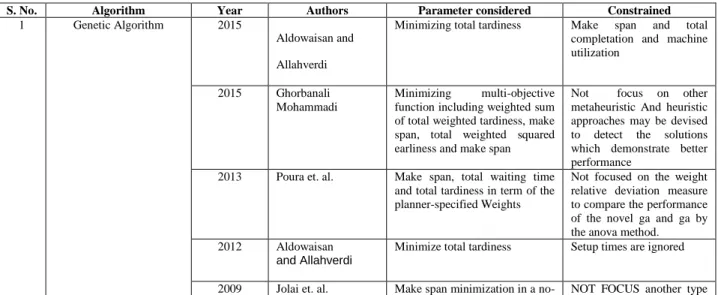
It has been found from review of literature that the researchers have worked on different strategies such as computational, statistical and analytical for the minimization of performance parameters. Some computational experiments have been planned by Artificial neural network (ANN), fuzzy logic, genetic algorithm(GA), partical swarm optimization(PSO) and with the combination of heuristic like NEH etc. for make span or total flow time, waiting time, earliness and tardiness as illustrated in table II
The various techniques have been reviewed also tabulated in table II
A. Genetic Algorithm
Genetic Algorithms provide a means to generate new population using mutation and cross over and then the selection of best generation on comparison with parents. These help to generate Pareto front and find the set of best suited solutions. Genetic algorithm differs from other met heuristics in the fact that it works with a set of encoded solutions to the problem, called population. Every solution or chromosome in the population is evaluated and assigned a fitness value. The idea is that the best individuals should also be the fittest. in a Genetic algorithm the population evolves over generations until some stopping criterion is reached. A Generation begins with the selection mechanism that randomly picks some members from the population. The fittest chromosomes should have a greater chance of being selected. Then, these
individuals Mate in a process called crossover and generate some new individuals, which are often called Offspring. Afterwards, some offspring might undergo another process called mutation in which some of the parts of the chromosomes or genes can change as in natural species mutation [25]. Ghorbanali Mohammadi, 2015[15] minimized multi-objective function including weighted sum of total weighted tardiness, make span, total weighted squared earliness and make span. Make span, total waiting time and total tardiness also optimized in term of the planner-specified Weights.by Pour et. al. 2013,[23]. Therefore, it can be concluded that the GA search solution beyond the scope of the experimental based optimization techniques such as TM, SA etc. Jolai et. al., 2013[10] have minimized the cost by optimized the performance of flow shop parameters. A genetic algorithm proposed for minimization of make span with two batching machines in a no-wait flow shop problem by Jolai et. al., 2009[11]. Liu et. al., 2008[30] suggested a new hybrid genetic algorithm for the minimization of makes span and total flow time in bi-criteria no-wait flow shop scheduling problem. A hybrid GA approach has proposed in no-wait flow shop scheduling problem for the minimization of make span by Gonzalez et. al., 1995[37].
B. Taguchi Methodology
Taguchi has envisaged a new method of conducting the design of experiments which are based on well defined guidelines. This method uses a special set of arrays called orthogonal arrays. These standard arrays stipulate the way of conducting the minimal number of experiments which could give the full information of all the factors that affect the performance parameter. The crux of the orthogonal arrays method lies in choosing the level combinations of the input design variables for each experiment [42]. A very limited researcher used Taguchi technique for the improvement in the performance of no-wait flow shop scheduling.
C. Partical Swarm Optimization
This optimization PSO is a social search algorithm which has been copied from the behavior of birds’ flocks. The PSO was initially used to discover the patterns of birds’ flight and the sudden changes that happen in their course of flight as well as the optimum changes in the shape of the flock. The PSO algorithm begins with a group of random answers (particles) and then it seeks to find the optimum answer by sorting (finding new positions) the particles in
each repetition [18]. It is to minimize the operation time, the transportation costs, and the number of truck trips proposed by Mohtashami et. al., 2015[3]. Make span and flow time minimized by Huang et. al.,2012[18] using two-phase hybrid particle swarm optimization algorithm for solving permutation flow-shop scheduling problem.
D. Simulated Anealing
Simulated annealing is a neighborhood search, approaches to approximate solutions; it begins with a high temperature. After generating an initial solution, it tries to move from the current solution to one of its neighborhood solutions. The variations in the objective function values are calculated. If a new solution gives a better objective value, it is accepted. If a new solution yields a poor value, it can be accepted according to the probability function p, where b k Boltzmann’s constant and t is the current temperature. By accepting poor solutions, simulated annealing can avoid being trapped on local optima. It repeats this process l times at each temperature to gain the thermal equilibrium, where l is a control parameter, usually called the markov chain length. The parameter t is gradually reduced by a cooling function as simulated annealing proceeds until the stopping condition is met [10]. Aldowaisan and Allahverdi, 2012[28] proposed fuzzy simulated annealing algorithm for the minimization of total tardiness in no-wait flow shop scheduling. A fuzzy logic problem converted in to simulated annealing for the minimization of make span and the penalties of E/T has been planned by Zheng and Gu, 2004[38].
E. Fuzzy Logic
Fuzzy logic is a form of many-valued logic that deals with approximate, rather than fixed and exact reasoning. Compared to traditional binary logic (where variables may take on true or false values), fuzzy logic variables may have a truth value that ranges in degree between 0 and 1. Fuzzy logic has been extended to handle the concept of partial truth, where the truth value may range between completely true and completely false. Furthermore, when linguistic variables are used, these degrees may be managed by specific functions [38]. Minimization of total tardiness with fuzzy is considered by Akhshabi et. al.,2012[21].
TABLEII
REVIEW OF DIFFERENT HEURISTICS AND OPTIMIZATION TECHNIQUE
S. No. Algorithm Year Authors Parameter considered Constrained 1 Genetic Algorithm 2015
Aldowaisan and Allahverdi
Minimizing total tardiness Make span and total completation and machine utilization
2015 Ghorbanali Mohammadi
Minimizing multi-objective function including weighted sum of total weighted tardiness, make span, total weighted squared earliness and make span
Not focus on other metaheuristic And heuristic approaches may be devised to detect the solutions which demonstrate better performance
2013 Poura et. al. Make span, total waiting time and total tardiness in term of the planner-specified Weights
Not focused on the weight relative deviation measure to compare the performance of the novel ga and ga by the anova method. 2012 Aldowaisan
and Allahverdi
Minimize total tardiness Setup times are ignored
wait flow Shop problem with two batching machines
of problem ex, (F2|p-batch (1), p-batch (2), b, no-wait |Cmax,).
2006 Ruiz and Maroto Addition of unrelated parallel machines at each stage, sequence dependent setup times and machine eligibility
Application are discussed with tile industry other industry not discussed 2004 Srdjevic and
Srdjevic
Minimize make span and improve efficiency of certain robot controller
It was easy to tune genetic parameters in small number of generations
2004 Ponnambalam et. al. Minimizing make span, mean flow Time and machine idle time
Can be develop more by giving the weight to the parameters.
2004 Mattfeld and Bierwirth
Due-dates with tardiness objectives
Tunable schedule builder which reduces the size of the search space
2 NSGA-II
MOPSO
2015 Mohtashami et. al. Minimizing the make-span, transportation cost by cross docking facility
Optimal location for establishing a cross-docking facility was not investigated and target functions can be included in the mathematical model to minimize the delays. 2013 Desai and Patel Multiproduct batch plant
scheduling considered for multi objective optimization problem
Hypothetical problem but not checked in industrial chemical plant
2012 Subashini And
Bhuvaneswari
Aiming to obtain schedules achieving minimum make span and flow time
This problem extended by hybridizing GA with PSO to make use of better spread of solutions
3 Lower Bound Ga 2014 Gerst et. al. A make span minimization problem on a 2-stage flexible flow shop with 𝑚𝑚 parallel identical machines in stage 1 and a single machine in stage 2
Job processing times and/or to more general (not necessarily 2-stage) flow shops.
2006 Berkoune et.al. Make span minimization before and after the insertion of the predicted demand
Obtained the solution for the parallel machine other type set up not considered. 1995 Heijligers et. al. Special coding techniques and
analysis methods are used to improve the runtime and quality of the results completion time
Other factors ignored
4 Branch And Bound Algorithm
2014 Cheng et. al. minimize the weighted sum of make span and total completion time
Bi-criteria scheduling problems (such as make span and the number of tardy jobs, minimizing total tardiness and earliness, etc) with time-dependent deteriorating jobs in single- or m-machine situations. 1999 Asano and Ohta Manipulates the starting time of
the shutdown period so as to reduce the obtained maximum tardiness
Other parameter not studied
2009 Moghaddam & Bajestani
APPLICABLE for unrelated parallel machine Scheduling problems with sequence-dependent setup Time to minimize the total weighted tardiness
but unable to give the optimal solution for problems after 10 jobs and 4 machines
5 Simulated Annealing 2015
Aldowaisan and Allahverdi
Minimize total tardiness Set up times are ignored it made the part of processing time.
2013 Jolai et. al. Minimizing make span and maximum tardiness
Not added realistic constraints
1999 Chakravarthy And Rajendran
Minimizing the make span and maximum tardiness of a job
Other criteria not considered
2004 Zheng and Gu To minimize the make span and to minimize the penalties of the Em
Converted fuzzy problem in to SA problem it can be checked with other type technique.
6 A mutualism quantum genetic algorithm
2015 Gu et. al. Minimize the make span Minimum mean tardiness, and multi measures 7 Baker's algorithm and the
generalized Smith's algorithm
2014 He et. al. O(n2) algorithm for the special case where the processing times and deadlines are agreeable
But it is worthwhile to settle this open question for our future work.
8 Swarm Optimization (Pso) Algorithm
2014 Akhshabi et. al. Minimizing the total flow time Objective functions for
different practical
constraints
9 Particle Swarm
Optimization Algorithm
2012 Huang et. al. Minimizing make span Sdst and no wait 10 Hybrid Simulated
Annealing Algorithm
2004 Nearchou et.al. Minimizing the make span in a permutation FSSP
Make span, total flow time, total tardiness, machine utilization, idle time, sum of set-up times etc not considered
11 Fuzzy logic 2012 Akhshabi et. al. Considered with two criteria of earliness and tardiness penalty
Other meta heuristic methods like memetic algorithm, and algorithm, forbidden search algorithm 2004 Zheng and Gu Minimize the make span and to
minimize the penalties of the Em
Converted fuzzy problem in to SA problem it can be checked with other type technique.
1996 Macchiaroli et. al. Propose a decomposition approach making use of fuzzy logic in no wait job shop with various constraints and compare the same with other greedy algorithm result
It can also compared with other technique like taboo search.
12 Proposed Parallel Genetic Algorithm
2012 Akhshabi et. al. Minimize the makespan Other parallel machine series machine
13 Hybrid Discrete ifferential Evolution Algorithm
2011 Mokhtari et. al. Minimize both make span and total cost of resources
Mean tardiness, maximum tardiness, and mean completion time
14 Harmony search and insert-and interchange-based neighbor search Algorithm
2010 Gao et. al. Minimize the total flow time Adaptive HS-based algorithm and HS-based hybrid algorithm not developed
15 Harmony Search
Algorithm
2010 Kaizhou et. al. Total flow time criteria Other objective not discussed
16 Modified Heuristic genetic algorithm
2010 Dhingra and
Chandna
Weighted sum of total weighted squared tardiness and make span
Not extended to other multi-criteria fitness function
17 Hybrid Genetic-Vns Algorithm
2008 Yang et. al. No-wait flow shop problem with better average Performance in total flow time minimization
More model can be considered
18 Hybrid Genetic Algorithm 2008 Liu et. al. No-wait flow shop scheduling problem with the objective of the minimization of the make span and total flow time
Parameter like sdst and wt tardiness ignored
1995 Gonzalez et. al. Minimize make span Computational efficiency not find out there is way to improve the same. 19 Multi-Objective Fuzzy
Genetic Algorithm
2006 Xing et. al. Solve job-shop scheduling problems with fuzzy processing time and fuzzy due date effectively
Many other objective functions are not applied
20 An Ant System And A Genetic Algorithm
2004 Haq et. al. Minimizing the make span for the flow shop scheduling problem
Objectives such as minimizing the tardiness, meeting due dates, maximizing the machine utilization, minimizing time lags
21 Ant-Based algorithm With A Greedy Algorithm
2004 Donati et. al. Better and more effective search in the solution space, and copes with rescheduling in case of malfunctioning or glitches, and variations in the demand
More model can be developed and result can be compared
22 TSP AND GA 2004 Ponnambalam et. al. Minimizing make span, mean flow time and machine idle time
Develop more by giving the weight to the parameters 2002 Moon et. al. In this tsp is converted in to
genetic algorithm problem.
For better optimization other method can also used. 2012 Sabah Sadiq Tsp is converted in to genetic
algorithm problem and result of the same is compared with the greedy genetic algorithm
For better optimization other method can also be used
simulated annealing algorithm proposed by Aldowaisan and Allahverdi, 2012[28]. Xing et. al., 2006[29] planned a multi-objective fuzzy genetic algorithm in job scheduling. Zheng and Gu, 2004[38] converted a fuzzy logic problem into simulated annealing for the minimization of make span and the penalties of E/T. A fuzzy approach has been proposed by Macchiaroli et. al., 1996[41] to optimize manufacturing processes with no wait constraints.
IV. CONCLUSSION
A review of the literature shows that researcher have worked on two or three distinct objectives by controlling the objective functions of no wait flow shop scheduling for the effective optimization. There should be balance between these algorithms. Because the scheduling problem is NP hard , this paper describe a detail review of no wait flow shop scheduling based on different technique such as GA(genetic algorithm ),ANN(advance neural network),TM(Taguchi method),Pso(Particle swan optimization) etc.These optimization techniques have been applied since last two decades in no wait flow shop scheduling. But GA and heuristic GA most frequently applied technique for optimization of no wait flow shop problem especially for the make span. Taguchi method is a experimental technique used by less researcher because it optimize the process using analyze SN ratio. Whereas GA & PSO, Heuristic are search technique worked with different relations, mathematical model and fitness functions. From the review of literature it can be Concluded that there many uncertainty and uncontrolled factors in optimization problem. Therefore a robust method is still required. This might give the optimum combination of total tardiness and makes span.
REFERENCES
[1] G A. Noorul Haq, D. Ravindran, V. Aruna, S. Nithiya, “A hybridisation of metaheuristics for flow shop scheduling,” International Journal advance Manufacturing Technology, vol. 24,pp.376–380,2004.
[2] Alberto V. Donati, Vince Darley, Bala Ramachandran, “An ant-bidding algorithm for generalized flow shop scheduling problem: optimization and phase transitions,” Advances in Metaheuristics for Hard Optimization Natural Computing Series, pp.111-136, 2008.
[3] Ali Mohtashami , Madjid Tavana, Francisco J. Santos-Arteaga ,Ali Fallahian-Najafabadi, “A novel multi-objective meta-heuristic model for solving cross-docking
scheduling problems,” Applied Soft Computing, vol.31,pp.30–47, 2015.
[4] Andreas C. Nearchou, “A novel metaheuristic approach for the flow shop scheduling problem,” Engineering Applications of Artificial Intelligence, vol.17, pp.289– 300, 2004.
[5] Ashwani Dhingra, Pankaj Chandna, “A bi-criteria m-machine sdst flow shop scheduling using modified heuristic genetic algorithm,” International Journal of Engineering, Science and Technology,vol. 2, no. 5, pp. 216-225,2010.
[6] Bojan M. Srdjevic & Dejan M. Srdjevic, “Evolution based scheduling of chemical reactions – a case study,” International Journal of Industrial Engineering, vol.11 (1), pp.35-42, 2004.
[7] Cheng He, Hao Lin, Yixun Lin, Junmei Dou, “Minimizing total completion time for preemptive scheduling with release dates and deadline constraints,” Foundations of Computing and Decision Sciences, vol. 39, 2014.
[8] Dirk C. Mattfeld, Christian Bierwirth, “Discrete optimization an efficient genetic algorithm for job shop scheduling with tardiness objectives,” European Journal of Operational Research, vol.155, pp. 616–630, 2004. [9] Enrique Gerstl, Gur Mosheiov, Aassaf Sarig, “Batch
scheduling in a two-stage flexible flow shop problem,” Foundations of Computing and Decision Sciences, vol. 39 no.1 (2014).
[10] F. Jolai , H. Asefi , M. Rabiee, P. Ramezani, “Bi-objective simulated annealing approaches for no-wait two-stage flexible flow shop scheduling problem,” Scientia Iranica, Transactions E: Industrial Engineering, vol. 20,pp. 861–872,2013.
[11] F. Jolai, H. Kor, S.M. Hatefi, and H. Iranmanesh, “A genetic algorithm for make span minimization in a no-wait flow shop problem with two batching machines,” International Conference on Computer Engineering and Technology, pp.238-242, 2009.
[12] Gao kaizhou, Pan Quanke,Li Junqing, He Yongzheng, “A novel grouping harmony search algorithm for the no-wait flow shop scheduling problems with total flow time criteria,” International Symposium on Computer, Communication, Control and Automation,pp.77-80,2010.
[13] Hadi mokhtari, Isa Nakhai Kamal Kbadi, Ali Cheraghalikhani, “A multi-objective flow shop scheduling with resource-dependent processing times: trade-off between make span and cost of resources,”
International Journal of Production Research vol. 49, no. 19 ,pp. 5851–5875,2011.
[14] Jinwei Gu, Manzhan Gu, Xingsheng Gu, “A mutualism quantum genetic algorithm to optimize the flow shop scheduling with pickup and delivery considerations,” Hindawi Publishing Corporation Mathematical Problems in Engineering, volume 2015, article id 387082, 17 pages,2015.
[15] Ghorbanali Mohammadi, “Multi-objective flow shop production scheduling via robust genetic algorithms optimization technique,” International Journal of Service Science, Management and Engineering, vol.2 (1), pp.1-8, 2015.
[16] K. Z. Gao, H. Li, Q. K. Pan, J. Q. Li, J.J. Liang, “Hybrid heuristics based on harmony search to minimize total flow time in no-wait flow shop,” Chinese Control and Decision Conference,pp. 1184-1188,2010.
[17] Karunakaran Chakravarthy & Chandrasekharan Rajendran, “A heuristic for scheduling in a flow shop with the bi criteria of make span and maximum tardiness minimization,” Production Planning & Control, vol. 10, no. 7, pp.707 –714, 1999.
[18] Ko-Wei Huang Chu, Sing Yang Chun-Wei Tsai, “A two-phase hybrid particle swarm optimization algorithm for solving permutation flow-shop scheduling problem,” International Journal of Computer Applications,vol.48(1),pp.11-18,2012.
[19] M.Akhshabi,R.tavakkoli,Moghaddam,R.Rahnamay,Roo dposhti,“A hybrid particle swarm optimization algorithm for a no-wait flow shop scheduling problem with the total flow time,” International Journal Advance Manufacturing Technolgy,vol.70,pp.1181–1188,2014. [20] Mingbao Cheng, Pandu R Tadikamalla, Jennifer Shang
and Bixi Zhang, “Two-machine flow shop scheduling with deteriorating jobs: minimizing the weighted sum of make span and total completion time”, Journal of the Operational Research Society, pp.1–11, 2014.
[21] Mohammad Ashkhabad, Mostafa Akhshabi, Javad khalatbari, “Bi-criteria flow shop scheduling with fuzzy simulated annealing algorithm,” African Journal of Business Management vol. 6(25), pp.7478-7488, 2012. [22] Mostafa Akhshabi, Javad Haddadnia, Mohammad
Akhshabi, “Solving flow shop scheduling problem using a parallel genetic algorithm,” Procedia technology,vol. 1,pp.351 – 355,2012.
[23] N. Shahsavari Pour, R. Tavakkoli-Moghaddam , H. Asadi, “Optimizing a multi-objectives flow shop scheduling problem by a novel genetic algorithm,” International Journal of Industrial Engineering Computations vol.4,pp. 345–354,2013.
[24] Ning Yang, Xiao-Ping Li, Jie Zhu, Qian Wang, “Hybrid genetic-vns algorithm with total flow time minimization for the no-wait flowshop problem,” Proceedings of the seventh international conference on machine learning and cybernetics, kunming, pp.935-940, 2008.
[25] Rube´n Ruiz, Concepcio´n Maroto, “A genetic algorithm for hybrid flow shops with sequence dependent setup times and machine eligibility,” European Journal of Operational Research, vol. 169, pp.781–800, 2006. [26] S. G. Ponnambalam, H. Jagannathan, M. Kataria, A.
Gadicherla, “A tsp-ga multi-objective algorithm for
flow-shop scheduling,” International Journal Advance Manufacturing Technology vol.23, pp.909–915, 2004. [27] Tariq Aldowaisan, Ali Allahverdi, “No-wait flow shops
to minimize total tardiness with setup times”, Intelligent Control and Automation, vol.06 no.01, pp.38-44, 2015. [28] Tariq Aldowaisan, Ali Allahverdi, “Minimizing total
tardiness in no-wait flow shops”, Foundations of Computing and Decision Sciences, vol. 37 no. 3, 2012. [29] Y.J. Xing, Z.Q. Wang, J. Sun, J.J. Meng, “A
multi-objective fuzzy genetic algorithm for job-shop scheduling problems,” Journal of Achievements in Materials and Manufacturing Engineering, vol.17 issue 1-2, pp.297-300, 2006.
[30] You-Gen Liu, Xia Zhu, Xiao-Ping Li , “A new hybrid genetic algorithm for the bi-criteria no-wait flow shop scheduling problem with make span and total flow time minimization,” Proceedings of the Seventh International Conference on Machine Learning and Cybernetics,Kunming,pp.883-888,2008.
[31] M. Asano, H. Ohta, “Scheduling with shutdowns and sequence dependent set-up times,” International Journal of Production Research, vol.37, issue 7, pp.1661-1676, 1999.
[32] Rabadi, G., Mollaghasemi, M., Anagnostopoulos, G.C., “A branch-and-bound algorithm for the early/tardy machine scheduling problem with a common due-date and sequence dependent setup time,” Computers and Operations Research, vol.31, pp.1727–1751, 2004. [33] Djamel Berkoune, Khaled Mesghouni, Besoa
Rabenasolo, “lower bounds for the scheduling problem with uncertain demands,” International Journal Applied Mathematics Computation Science, vol. 16, no. 2, pp.263–269, 2006.
[34] M.J.M. Heijligers, J.M. Cluitmans, J.A.G. Jess, “High-level synthesis scheduling and allocation using genetic algorithms”, Proceedings of the Asia and South Pacific Design Automation Conference, pp. 61-66, 1995. [35] G.Subashini, M.C.Bhuvaneswari, “Comparison of
multi-objective evolutionary approaches for task scheduling in distributed computing systems,” Saadhana vol. 37, part 6, pp.675–694, 2012.
[36] Charmi B. Desai, Narendra M. Patel, “Batch scheduling by evolutionary algorithms for multi objective optimization,” International journal of Engineering Science and Innovative technology, vol.2, issue 2, pp.599-604, 2013.
[37] Belzyt Gonzalez, Michel Torres, Jose A. Moreno, “A hybrid genetic algorithm approach for the "no-wait" flow shop scheduling problem,” Genetic algorithms in Engineering Systems: Innovations and Applications, conference publication no. 414,iee, 1995.
[38] Lu Zheng, Xingsheng Gu, “Fuzzy production scheduling in no-wait flow shop to minimize the make span with e/t constraints using sa”, proceedings of the 5'worid congress on intelligent control and automation, june 15-19, 2004.
[39] Chiung moon, Jongsoo kim, Gyunghyun Choi, Yoonho Seo, “Discrete optimization an efficient genetic algorithm for the traveling salesman problem with precedence constraints”, European Journal of Operational Research vol.140,pp. 606–617,2002.
[40] Sabah Sadiq, “The traveling salesman problem: optimizing delivery routes using genetic algorithms,” SAS Global Forum, paper 161, 2012.
[41] Roberto Macchiaroli, Salvatore Mol, Stefan Riemma, “A fuzzy approach to optimize manufacturing processes with no wait constraints,” Proceedings of the IEEE International Conference on Control Applications Dearborn, 1996.
[42] Aref maleki,Daronkolaei, Iman Seyedi, “Taguchi Method For Three-Stage Assembly Flow Shop Scheduling Problem With Blocking And Sequence-Dependent Set Up Times,” journal of engineering science and technology vol. 8, no. 5,pp. 603 – 622,2013. [43] S. Reza hejazi and S. Saghafian, “Flow shop-scheduling
problems with make span criterion: a review”.
International journal of production research, vol. 43, no. 14, 15, pp. 2895–2929, 2005.
[44] R. Tavakkoli-Moghaddam and M. Aramon-Bajestani, “ A novel b and b algorithm for a unrelated parallel machine scheduling problem to minimize the total weighted tardiness”, IJE transactions a: basics vol. 22, no. 3, pp.269-286, 2009.