Holistic Cloud Computing Environmental
Quantification and Behavioural Analysis
Peter Michael Garraghan
Submitted in accordance with the
requirements for the degree of Doctor of Philosophy
University of Leeds, School of Computing,
July 2014
This copy has been supplied on the understanding that it is copyright material and that no quotation from the thesis may be published without proper
acknowledgement.
Intellectual Property and Publication
Statements
The candidate confirms that the work submitted is his own, except where work which has formed part of jointly authored publications have been included. The contribution of the candidate and the other authors to this work has been explicitly indicated below. The candidate confirms that appropriate credit has been given within the thesis where reference has been made to the work of others.
I. Solis Moreno, P. Garraghan, P. Townend, J. Xu "Analysis, Modelling and Simulation of Workload Patterns in a Large-Scale Utility Cloud", IEEE Transactions on Cloud Computing, 2014. In this paper, a comprehensive study of the characteristics and behaviour of users and tasks temporally and spatially is conducted. The method of analysis was proposed by Ismael Solis Moreno and myself equally. The cluster analysis and distribution analysis of users and tasks was conducted by myself, with Ismael Solis Moreno contributing towards the month-day analysis. The design, implementation and validation of the simulator was performed by Ismael Solis Moreno. The paper was reviewed and improved by Paul Townend and Jie Xu. The content of this paper is the base of the workload analysis in Chapter 4.
P. Garraghan, P. Townend, J. Xu "Real-Time Fault-Tolerance in Federated Cloud Environments" IEEE 15th International Symposium on Object/Component/Service-Oriented Real-Time Distributed Computing Workshops (ISORCW), 2012. This work develops and evaluations a real-time fault-tolerant mechanism for deployed in a federated Cloud. The system model, experiment, analysis and evaluation was conducted by myself. The paper was reviewed and improved by Paul Townend and Jie Xu. The conclusions of this work is used for defining workload assumptions presented in Chapter 4.
I. Solis Moreno, P. Garraghan, P. Townend and J. Xu, "An Approach for Characterizing Workloads in Google Cloud to Derive Realistic Resource Utilization Models", in proceedings of The 7th International Symposium on Service-Oriented System Engineering (SOSE), San Francisco California, USA, 2013. For this paper,
the proposed method of analysis was proposed by Ismael Solis Moreno and myself. Ismael Solis Moreno conducted the implementation of the workload generator within the Cloud simulator. The conducted analysis of users and tasks was performed equally by Ismael Solis Moreno and myself. The paper was reviewed and improved by Paul Townend and Jie Xu. The content of this paper is the base of the coarse-grain analysis in Chapter 3 and the workload characterization in Chapter 4.
P. Garraghan, P. Townend, J. Xu "An Analysis of the Server Characteristics and Resource Utilization in Google Cloud" IEEE International Conference on Cloud Engineering (IC2E), USA, 2013. This paper analyzes the characteristics and inefficiencies of resource utilization in Cloud datacenter hardware. The data extraction, method of analysis and analysis results was conducted by myself. The paper was reviewed and improved by Paul Townend and Jie Xu. The analysis of server characteristics and resource utilization is presented in Chapter 5.
P. Garraghan, P. Townend, J. Xu "An Empirical Failure-Analysis of a Large-Scale Cloud Computing Environment" 15th IEEE International Symposium on High Assurance Systems Engineering (HASE), USA, 2014. This paper presents the temporal and spatial analysis of failures within a large-scale Cloud computing environment. The data extraction, analysis method, analysis results and applicability of work was conducted by myself. The paper was reviewed and improved by Paul Townend and Jie Xu. The contents of this work are presented in the failure-analysis section in Chapter 6.
P. Garraghan, I. Solis Moreno, P. Townend and J. Xu, “An Analysis of Failure-Related Energy Waste in a Large-Scale Cloud Environment”, IEEE Transactions on Emerging Topics in Computing, 2014. For this paper, the extraction of the data, methodology of analysis, failure identification, temporal and spatial failure analysis and the examples of applicability was performed by myself. The analysis of the impact of energy waste in the analyzed system was equally conducted by Ismael Solis Moreno and me. The proposed energy model was conducted by Ismael Solis Moreno. The paper was reviewed and improved by Paul Townend and Jie Xu. This method of analysis and analysis of failure-related energy waste is presented in Chapter 6.
Abstract
Cloud computing has been characterized to be large-scale multi-tenant systems that are able to dynamically scale-up and scale-down computational resources to consumers with diverse Quality-of-Service requirements. In recent years, a number of dependability and resource management approaches have been proposed for Cloud computing datacenters. However, there is still a lack of real-world Cloud datasets that analyse and extensively model Cloud computing characteristics and quantify their effect on system dimensions such as resource utilization, user behavioural patterns and failure characteristics. This results in two research problems: First, without the holistic analysis of real-world systems Cloud characteristics, their dimensions cannot be quantified resulting in inaccurate research assumptions of Cloud system behaviour. Second, simulated parameters used in state-of-the-art Cloud mechanisms currently rely on theoretical values which do not accurately represent real Cloud systems, as important parameters such as failure times and energy-waste have not been quantified using empirical data. This presents a large gap in terms of practicality and effectiveness between developing and evaluating mechanisms within simulated and real Cloud systems.
This thesis presents a comprehensive method and empirical analysis of large-scale production Cloud computing environments in order to quantify system characteristics in terms of consumer submission and resource request patterns, workload behaviour, server utilization and failures. Furthermore, this work identifies areas of operational inefficiency within the system, as well as quantifies the amount of energy waste created due to failures. We discover that 4-10% of all server computation is wasted due to Termination Events, and that failures contribute to approximately 11% of the total datacenter energy waste. These analyses of empirical data enables researchers and Cloud providers an enhanced understanding of real Cloud behaviour and supports system assumptions and provides parameters that can be used to develop and validate the effectiveness of future energy-efficient and dependability mechanisms.
Declaration
Some parts of the work presented in this thesis have previously appeared in the following papers:
P. Garraghan, I.S. Moreno, P. Townend, J. Xu, "An Analysis of Failure-Related
Energy Waste in a Large-Scale Cloud Environment", IEEE Transactions on
Emerging Topics in Computing, 2014.
I.S. Moreno, P. Garraghan, P. Townend, J. Xu, "Analysis, Modelling and
Simulation of Workload Patterns in a Large-Scale Utility Cloud", IEEE Transactions
on Cloud Computing, 2014
P. Garraghan, P. Townend, J. Xu "An Empirical Failure-Analysis of a Large-Scale
Cloud Computing Environment" in the proceedings of the 15th IEEE
International Symposium on High Assurance Systems Engineering (HASE), pp. 113-120, 2014.
P. Garraghan, P. Townend, J. Xu "Using Byzantine Fault-Tolerance to Improve
Dependability in Federated Cloud Computing" in the International Journal of
Software and Informatics, vol. 7, pp.221-237, 2013.
P. Garraghan, P. Townend, J. Xu, "An Analysis of the Server Characteristics and
Resource Utilization in Google Cloud" in the proceedings of the IEEE International
Conference on Cloud Engineering (IC2E), pp. 124-131, USA, 2013.
I.S. Moreno, P. Garraghan, P. Townend, J. Xu, "An Approach for Characterizing
Workloads in Google Cloud to Derive Realistic Resource Utilization Models" in
the proceedings of the 7th IEEE International Symposium of Service-Oriented System Engineering (SOSE), USA. pp. 49-60, 2013.
P. Garraghan, P. Townend, J. Xu, "Real-Time Fault-Tolerance in Federated Cloud
Environments" in the proceedings of 15th IEEE International Symposium on
Object/Component/Service-Oriented Real-Time Distributed Computing Workshops (ISORCW), pp. 118-123, China, 2012.
P. Garraghan, P. Townend, J. Xu, "Byzantine Fault-Tolerance in Federated Cloud
Computing" in the proceedings of the 6th IEEE International Symposium of
Service-Oriented System Engineering (SOSE), pp. 280-285, USA, 2011.
P. Garraghan, P. Townend, J. Xu, "Dependability in Federated Cloud
environments" in the proceedings of The UK e-Science All-Hands Meeting (AHM),
Acknowledgement
As I write this acknowledgement for the last page of my thesis, I can't help but reflect on the road traversed to arrive at this destination, as well as the people who were part of journey.
First and foremost, I'd like to thank my supervisors Professor Jie Xu and Dr. Paul Townend: it's difficult to express my gratitude to them for giving me the opportunity to join the group and supporting me in my research pursuits. I'd also like to thank my thesis examiners Professor Santosh Shrivastava and Dr. Karim Djemame for their excellent feedback and comments given in the examination, as well as Professor John Davies for taking the time to sanity check my thesis. I'd also like to thank immensely my colleague Dr. Ismael Solis Moreno who acted as a huge inspiration and mentor in my development as a researcher, and spent many late evenings with me staring at whiteboards. I also want to extend my gratitude to my colleagues and friends within the Distributed Systems and Services Group and the wider world, most notably Dr. David Webster and Renyu Yang.
Last but not least I'd like to thank my family for their eternal support and love, allowing me to reach this life milestone.
List of Acronyms
AD Anderson-Darling
CDF Cumulative Distribution Function
CMS Cloud Management System
CPU Central Processing Unit
CSV Comma Separated Value
ER Entity Relationship
ERP Enterprise Resource Planning
FaaS Failure-as-a-Service
GoF Goodness of Fit
HaaS Hardware-as-a-Service
HDD Hard Disk Drives
HPC High Performance Computing
HQL Hive Query Language
IaaS Infrastructure-as-a-Service
KPI Key Performance Indicators
LXC Linux Container
MTBF Mean Time Between Failure
MTTR Mean Time to Repair
NAS Network Attached Storage
NIST National Institute of Standards and Technology
OS Operating System
P2P Peer-to-Peer
PaaS Platform-as-a-Service
PDF Probability Distribution Function
QoS Quality of Service
RAM Random Access Memory
REST Representational State Transfer
SaaS Software-as-a-Service
SECaaS Security-as-a-Service
SoA Service Oriented Architecture
SOAP Simple Oriented Access Protocol
SQL Structured Query Language
VM Virtual Machine
VMM Virtual Machine Manager
VO Virtual Organization
Contents
1 Introduction ... 1
1.1 Research Motivation ... 1
1.2 Research Context ... 1
1.3 Aims and Objectives ... 3
1.4 Research Methodology ... 4
1.5 Major Contributions ... 5
1.6 Thesis Organization ... 6
2 Cloud Analytics ... 8
2.1 Evolution of Modern Computing Systems ... 8
2.1.1 Software System Model Definition ... 8
2.1.2 Conceptual Design of Software Systems ... 9
2.1.3 Tiered software System Architectures ... 10
2.1.4 Service Computing ... 14
2.1.5 Utility Computing ... 14
2.2 Cloud Computing ... 18
2.2.1 Cloud Computing Definition ... 18
2.2.2 Cloud Computing Characteristics ... 19
2.2.3 Cloud Computing Taxonomy ... 21
2.2.4 Cloud Actors ... 21 2.2.5 Service Model ... 22 2.2.6 Deployment Model ... 24 2.2.7 Workload in Cloud ... 26 2.2.8 Hardware ... 28 2.2.9 Virtualization ... 28
2.2.10 Cloud Computing Quality of Service... 30
2.2.11 Differences between Cloud and Previous Distributed Systems ... 30
2.3 Cloud Dependability ... 31
2.3.1 Faults, Errors and Failures ... 31
2.3.2 Dependability ... 33
2.3.3 The Need for Dependability in Cloud Datacenters ... 36
2.4 Cloud Analytics ... 39
2.4.1 Systems Analysis ... 39
2.4.2 Data Analysis... 41
2.4.3 Classification ... 42
2.4.4 Distribution Modelling ... 43
2.4.5 Workload Characterization in Cloud Computing ... 44
2.4.6 Servers ... 48
2.4.7 Failure Analysis of Large-Scale Distributed Systems ... 50
2.4.8 System Operational Waste ... 55
2.5 Challenges in Cloud Analytics ... 58
2.5.1 Confidentiality and Business Concerns ... 58
2.5.2 Characterizing System Behaviour ... 58
2.5.3 Analysis Method Abstraction ... 60
2.5.4 The Need for Cloud Analytics ... 60
2.5.5 Workload ... 61
2.5.6 Servers ... 62
2.5.7 Failures ... 62
2.5.8 Failure-related Energy ... 63
2.6 Summary ... 64
3 Cloud Datacenter Case Study ...66
3.1 Case study: Google Cloud Trace Log ... 66
3.1.1 Trace Log Description ... 66
3.1.2 Server Events ... 67
3.1.3 Tasks Events ... 68
3.1.4 Task Resource Usage ... 70
3.2 Datacenter Analysis Method ... 71
3.2.1 Datacenter Model ... 71
3.2.2 Analysis Infrastructure ... 72
3.2.3 Statistical Analysis Tools ... 74
3.3 Coarse-grain Analysis ... 74
3.4 Summary ... 79
4 Workload Characterization ...80
4.1 Overview ... 80
4.2.1 Workload Model ... 81
4.2.2 Workload Classification ... 83
4.2.3 Sampling Process ... 84
4.2.4 Workload Analysis Assumptions ... 85
4.2.5 Analysis Method ... 87 4.3 Cluster analysis ... 88 4.3.1 Users ... 88 4.3.2 Tasks ... 91 4.4 Distribution Analysis ... 93 4.4.1 Users ... 93 4.4.2 Tasks ... 95
4.5 Impact of Workload Behaviour on Cloud Environment ... 98
4.6 Results Validation ... 100
4.6.1 Simulation Validation ... 100
4.6.2 Improvement of CPU Consumption Patterns ... 103
4.7 Application of Work ... 105 4.8 Summary ... 107 5 Server Characteristics ... 109 5.1 Overview ... 109 5.2 Methodology ... 109 5.2.1 Utilization method ... 109
5.2.2 Resource Utilization Wasted ... 110
5.2.3 Research Assumptions for Case Study ... 111
5.3 Analysis Results ... 112
5.3.1 Resource Utilization ... 112
5.3.2 Waste resource ... 115
5.4 Impact of Server Characteristics and Server Inefficiencies ... 117
5.5 Summary ... 118
6 Failure and Failure-related Energy Waste Analysis ... 120
6.1 Overview ... 120
6.2 Failure Analysis Method ... 120
6.2.1 Event Sampling ... 121
6.2.2 Failure Event Identification ... 121
6.2.4 Energy Analysis ... 124
6.3 Failure Analysis ... 127
6.3.1 Termination Events Analysis ... 127
6.3.2 Servers ... 129
6.3.3 Tasks ... 132
6.4 Failure-related Energy ... 137
6.4.1 Task Failure Energy Waste ... 137
6.4.2 Server Failure Energy Waste... 138
6.5 Energy Waste Impact on the System ... 142
6.6. Summary and Application of Analysis ... 144
6.7 Summary ... 147
7 Conclusion and Future Work ... 149
7.1 Summary ... 149
7.2 Research Contributions ... 151
7.3 Overall Research Evaluation ... 153
7.4 Future Work ... 154
7.4.1 Dataset ... 154
7.4.2 Analysis Extension ... 155
7.4.3 Development of Cloud Mechanisms ... 156
Figures
Figure 2.1 Conceptual model of a software system ... 9
Figure 2.2 The layers of a software design system ... 10
Figure 2.3 (a) 1-tier, (b) 2-tier software system architecture. ... 11
Figure 2.4 (a) 3-tier, (b) N-Tier software system architecture. ... 13
Figure 2.5 Cloud taxonomy of service deployment and service model. ... 21
Figure 2.6 NIST Cloud Computing Model ... 22
Figure 2.7 Cloud Service Stack. ... 24
Figure 2.8 Cloud federation model ... 26
Figure 2.9 Virtualization techniques ... 29
Figure 2.10 Fault, error and failure propagation between system components . 32 Figure 2.11 Dependability Tree ... 33
Figure 2.12 Dependability and Security attributes. ... 34
Figure 2.13 Fault Hierarchy ... 35
Figure 2.14 Failure characterization ... 36
Figure 2.15 Methods of studying systems. ... 40
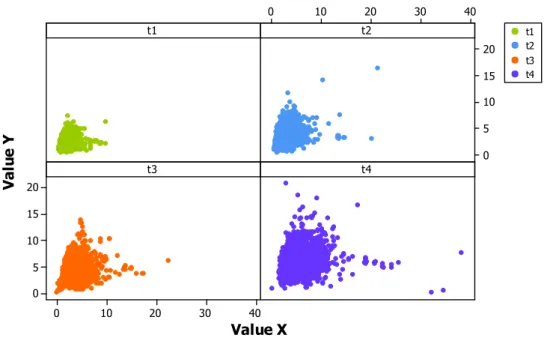
Figure 2.16 Example of Cluster analysis over four time periods t. ... 42
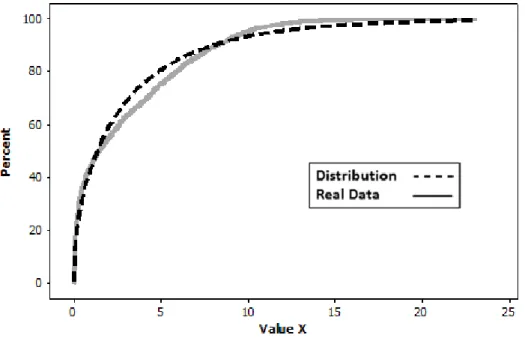
Figure 2.17 Example of distribution fitting of empirical data ... 43
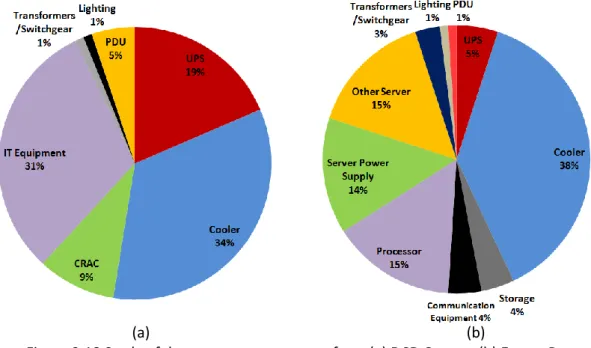
Figure 2.18 Study of datacenter energy usage from (a) DCD Census, (b) Emure Power ... 56
Figure 3.1 Server lifecycle ... 68
Figure 3.2 Task lifecycle ... 69
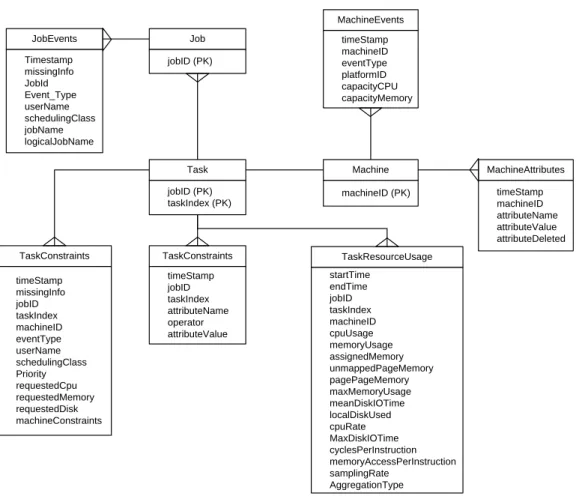
Figure 3.3 Entity Relationship Diagram of Google Cloud ... 72
Figure 3.4 Analysis Infrastructure Model ... 74
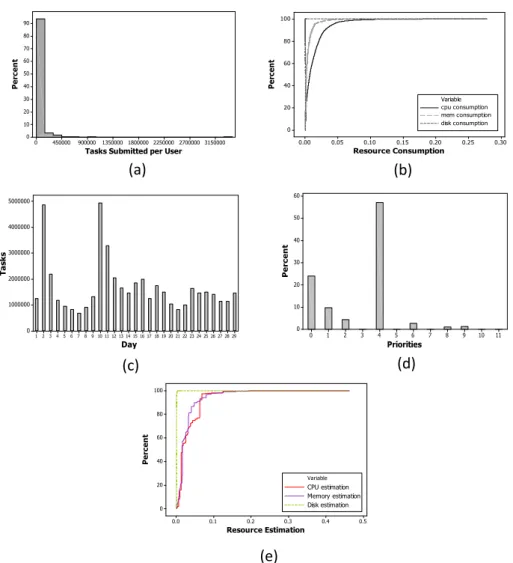
Figure 3.5 Coarse-grain analysis of task a) submission proportions, ... 76
Figure 3.6 (a) Percentage of tasks submitted per User, ... 77
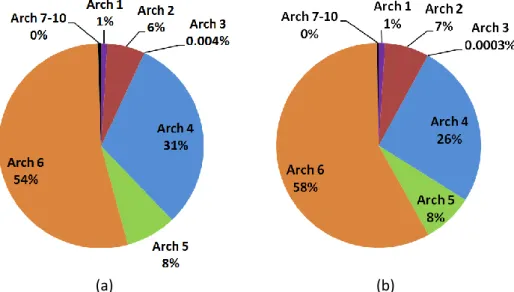
Figure 3.7 Proportions of (a) Server population, (b) Task submissions per server78 Figure 4.1 Clusterisation for users (a) Entire month, (b) Entire month (omitting outliers), (c) Day 2, (d) Day 18, (e) Day 26. ... 88
Figure 4.2 Clusterisation of tasks (a) Entire Month, (b) Day 2, (c) Day 18, (d) Day 26. ... 91
Figure 4.3 CDF of U1 parameters (a) CPU requested, (b) Memory requested, (c) Submission Rate. ... 93
Figure 4.4 CDF of U5 parameters (a) CPU requested, (b) Memory requested, (c) Submission Rate. ... 94
Figure 4.5 CDF of U6 parameters (a) CPU requested, (b) Memory requested, (c) Submission Rate. ... 94
Figure 4.6 CDF of T1 parameters (a) CPU, (b), Memory, (c) Length... 96
Figure 4.7 CDF of T2 parameters (a) CPU, (b), Memory, (c) Length... 97
Figure 4.9 CDF of task patterns between real and simulated data of task
execution time (seconds) for (a) CPU (s), (b) Memory, (c) Length. ... 102
Figure 4.10 Comparison of proportions of real and simulated data for ... 102
Figure 4.11 CDF of user patterns between real and simulated data for U5 (a) Requested CPU, (b) Requested memory, (c) Submission rate. ... 103
Figure 4.12 CPU utilization pattern improvement for (a)T2 and (b)T3 ... 104
Figure 5.1 Depiction of Full and Completed task within the Cloud datacenter. . 110
Figure 5.2. Distribution of server CPU utilization (a) Day 2, (b) Day 13, (c) Day 14, (d) Day 18. ... 112
Figure 5.3 Memory Utilization of Server Architecture Types ... 113
Figure 5.4 Distribution of server memory utilization (a) Day 2, (b) Day 13, (c) Day 14, (d) Day 18. ... 113
Figure 5.5 CPU Utilization of Server Architecture Types ... 115
Figure 5.6. Comparison of full and completed tasks in Day 2 for (a) Architecture 4 memory, (b) Architecture 4 CPU. ... 116
Figure 5.7 Comparison of full and completed tasks in Day 2 for (a) Architecture 2 memory utilization, (b) Architecture 2 CPU utilization ... 117
Figure 6.1 Power models of the selected platforms ... 126
Figure 6.2 Daily Termination Event (a) Occurrence, (b) Energy Waste ... 127
Figure 6.3 Proportion of Termination Event (a) Occurrence, (b) Energy waste . 128 Figure 6.4 Server failures within the observational period ... 129
Figure 6.5 Daily server failures within the observational period ... 130
Figure 6.6 Number of failures per server. ... 131
Figure 6.7 Empirical CDF of time between failures for server architectures. ... 132
Figure 6.8 Empirical CDF of server repair times. ... 132
Figure 6.9 Empirical CDF of time between failure for production tasks. ... 133
Figure 6.10 Empirical CDF of time between failure for production tasks. ... 134
Figure 6.11 Empirical CDF of repair times for a) All tasks, b) Production tasks .. 136
Figure 6.12 Task energy waste per priority. ... 137
Figure 6.13 Task energy waste per user. ... 138
Figure 6.14 Energy waste due to server failure a) Events, b) Server architecture. ... 139
Figure 6.15 Energy waste due to server failure per priority. ... 140
Figure 6.16 Top nine failed nodes (a) Failed tasks, (b) Energy waste. ... 141
Figure 6.17 Daily task failure (a) Number of events (b) Energy Waste. ... 143
Figure 6.18 Energy waste of trace log (a) TEs, (b) TEs and failure events breakdown. ... 144
Tables
Table 2.1 Classification of Typical Cloud Workloads ... 27
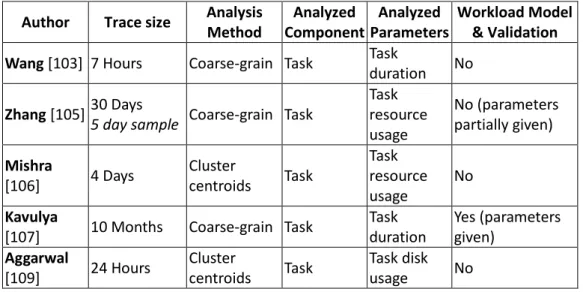
Table 2.2 Comparison of Cloud Workload Analysis Research ... 46
Table 2.3 Comparison of Different Failure Analysis ... 54
Table 3.1 Description of Google Cloud data tables. ... 67
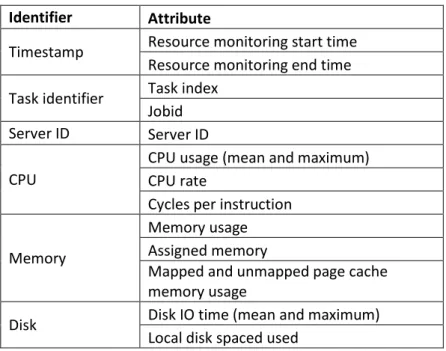
Table 3.2 Attributes of the task resource usage data table ... 70
Table 3.3 Summary of Catalogs ... 71
Table 3.4 General Trace Log Statistics. ... 75
Table 3.5 Server proportions and submission rates ... 77
Table 4.1 Statistical properties of users for different time periods ... 89
Table 4.2 Statistical Properties of User Clusters for Entire System ... 89
Table 4.3 Proportion of Task Clusters Population %... 90
Table 4.4 Statistical Properties of Task Clusters ... 92
Table 4.5 Best Fit Distribution Parameters of User Clusters for Entire System ... 95
Table 4.6 Probability of 0 for Task Resource Utilization ... 98
Table 4.7 Best Fit Distribution Comparison for Task Clusters ... 98
Table 4.8 Best Fit Distribution Parameters of Task Clusters for Entire System ... 98
Table 4.9 Simulation Results for Proportions of Cloud Datacenter Components101 Table 4.10 Sub-regions distribution fitting to improve CPU utilization for T2 and T3 ... 104
Table 5.1 Server Architecture Resource Utilization ... 114
Table 5.2 Summary of Day 2 Wasted Resource Utilization ... 116
Table 6.1 Failure Assumptions ... 123
Table 6.2 Server Mapping from Trace log to Real Systems ... 124
Table 6.3 General Failure Statistics. ... 128
Table 6.4 Statistical Properties and Model Parameters of Server MTBF ... 130
Table 6.5 Statistical Properties and Model Parameters of Server MTTR ... 131
Table 6.6 Statistical Properties and Model Parameters of Task MTBF ... 133
Table 6.7 Statistical Properties and Model Parameters of Task MTTR ... 135
1 Introduction
1.1 Research Motivation
Modern computing systems can be characterized by their requirement for substantial computing power; this has been augmented by an exponential increase in the volume of data available for processing. One approach to fulfill this requirement is to establish large scale computing systems, which typically require significant time and financial effort. Such systems are usually designed with respect to a maximum, least or average usage requirement, making the resultant system either under-used or unable to deliver desired functionality due to shortage of resources. Furthermore, such systems do not exhibit the ability to grow dynamically, and require extensive design and development procedures to cope with evolving user requirements. This problem is aggravated when the user requirements are susceptible to unexpected changes. Therefore, contemporary computing systems are inflexible by nature and it is extremely difficult to guarantee on-demand availability for them in a cost effective manner.
Cloud computing has emerged as a new paradigm to facilitate the establishment of large scale, flexible computing infrastructures that are able to provide services that are encapsulated as workloads to customers on demand. However, Cloud computing faces new challenges that are not found in traditional distributed systems and require extensive and in-depth research to characterize and quantify real operational behaviour. This in turn will facilitate research into a large number of research domains including security, resource management, dependability and energy-efficient computing.
1.2 Research Context
Research into distributed systems is enhanced by the empirical analysis of real-world systems. This is required in order to understand and study behaviour within operational environments as well as quantify system characteristics such as consumer behaviour, workload utilization and server failures [1]. Such analysis is critical for both researchers and system providers; for providers, it enables a way to understand and study behavioural patterns and identify areas of operational inefficiency in terms of energy-waste within the system [2]. For
researchers, it enables deeper understanding of system behaviour and is fundamental to defining and justifying system assumptions; both of which can be exploited in order to improve Quality of Service (QoS) and aid in business decision making. Moreover, parameters derived from such analyses can be exploited in order to develop simulation models which accurately reflect the operational conditions of a system. Such parameters are critical when evaluating the practicality of mechanisms which aim to enhance the resource management [3] and dependability [1] of a system.
Cloud computing systems have been characterized as large-scale multi-tenant systems that are able to dynamically scale-up and scale-down computational resources to consumers who have diverse Quality of Service requirements [8][10]. Such system infrastructure are typically deployed in datacenters which are collocated systems within the same physical location due to common environmental and physical security requirements, forming the Cloud datacenter. In recent years, a number of dependability and resource management approaches have been studied for Cloud computing datacenters. However, there are a lack of real-world Cloud datasets that have been analysed and extensively modelled in order to study the characteristics of Cloud computing and quantify their effect on system dimensions such as resource utilization, user behavioural patterns and failure characteristics. This leads in two key research problems. First, without the holistic analysis of real-world Cloud systems characteristics, dimensions of interest such as workload behavioural patterns, user submission patterns, server resource utilization, failure rates and energy consumption cannot be quantified, resulting in inaccurate research assumptions of Cloud system behaviour. Second, the simulated parameters used in state-of-the-art Cloud mechanisms such as resource management and dependability currently rely on theoretical values which do not accurately represent real Cloud systems, as important parameters such as failure times and energy-waste are not quantified from empirical data. This leads to a large gap in terms of practicality and effectiveness between developing and evaluating mechanisms within simulated and real Cloud environments.
This thesis presents a general analysis method and an in-depth analysis of large-scale production Cloud computing environments in order to study system
behaviour and quantify system characteristics in terms of consumer submission and resource request patterns, workload resource utilization and execution length, server utilization characteristics, and failures. Furthermore, this work identifies areas of operational inefficiency within a system, as well as quantifies the amount of energy waste created due to failures. These analyses of empirical data provide researchers and Cloud providers with an increased understanding of real Cloud characteristics and behavioural patterns, and provide realistic system assumptions and experiment parameters. These parameters can be used in a large number of Cloud research domains that require accurate workload behaviour, and develop and validate the effectiveness of energy-efficient and dependability mechanisms.
1.3 Aims and Objectives
The aim of this research is to study and present an in-depth analysis of large-scale production Cloud computing environments. This is urgently needed as the characteristics and behavioural patterns of real Cloud computing environments need to be comprehensively studied in order to understand large-scale system behaviour as well as produce quantifiable parameters and model key components such as consumer behaviour, workload characteristics, server resource utilization and failure characteristics. Furthermore, this work also identifies and quantifies the operational inefficiencies within these systems in terms of wasted resource utilization of servers as well as energy waste due to failures within the system. The findings in this work can be leveraged by other researchers and Cloud providers in order to evaluate developed mechanisms based on realistic simulation parameters.
Specifically, the objectives of this research are as follows:
i) To enable a more thorough understanding of the issues in accurately
modelling Cloud computing environments and comprehensively study
how Cloud behavioural characteristics impact the system. Cloud
computing has been stated to be a multi-tenant, heterogeneous, and flexible system that provisions computational services to diverse consumer requirements. However, there is a lack of in-depth studies that attempt to quantify fundamental system characteristics and their impact on the system environment. This is challenging due to the scale and
complexity of systems analysis when considering the relationships of components within a large-scale Cloud environment.
ii) To provide an in-depth method of holistic analysis for operational trace
logs to study and model Cloud behaviour. This work proposes a general
method of analysis that can be applied to Cloud datasets in order to study, model and quantify behavioural patterns and characteristics of system operation.
iii) Empirical analysis and modelling of large-scale Cloud computing
behavioural patterns and characteristics. This research aims to study
behavioural patterns and quantify key components within the Cloud environment, specifically within the areas of user behaviour, server resource utilization, workload execution length, resource utilization and failures. Such analysis is critical in understanding and building realistic research assumptions of the Cloud operational environment and deriving accurate simulation patterns derived from real systems.
iv) To identify and quantify operational inefficiency in terms of wasted
resource utilization and energy waste due to failures within large-scale Cloud environments. This work for the first time quantifies and studies the root cause of energy waste due to failures within large-scale distributed systems.These results can be used by providers to identify areas and root causes of operational inefficiency within production systems, and by researchers to enhance dependable energy-efficient research that presently rely on theoretical values and assumptions for energy waste.
1.4 Research Methodology
The research methodology of this work consists of two core components:
Identification of the challenges involved in studying and accurately modelling components of large-scale Cloud computing environments.
An approach to address these challenges through the development of an analysis method, which leverages techniques such as cluster analysis, distribution modelling, temporal and spatial analysis of Cloud datasets to study system behaviour and construct accurate Cloud environment models
for user behaviour, workload classification and utilization, server resource utilization, failures and energy-waste due to failures.
This analysis is decomposed into four main areas to characterize and model the Cloud environment: Workload, Servers, failures and failure-related energy-waste. To facilitate this, it was necessary to model the lifecycle and relationships of components in a real production Cloud datacenter trace log, as well as construct an analysis infrastructure for data extraction and processing in a timely manner. Each area of analysis includes the study of statistical properties and characteristics in order to analyze and model the behaviour of the Cloud environment, as well as how findings can be used for practical application.
1.5 Major Contributions
The major contributions of this work are:
The identification of in-depth analysis of operational traces from Cloud
computing datacenters as an effective means to comprehensively understand
system behaviour and enhance system assumptions of Cloud research.
Current Cloud research presently use theoretical values, small-scale experiments or characteristics from non-Cloud systems to derive system assumptions. These assumptions are greatly enhanced by the empirical analysis of real-world Cloud datacenters in order to derive and quantify realistic system behaviour.
A solution to the challenges of analyzing large-scale Cloud environments to
obtain meaningful results and identify relationships between components
within the system. Due to the massive scale and number of components
within a Cloud environment, there are challenges in performing non-superficial analyses to model the relationships and behaviour of users, workload, servers, failures and energy-waste. Furthermore, there are additional technical challenges in extrapolating and processing relevant data in a timely manner due to data size and heterogeneity, as well as lack of suitable analysis infrastructure. Finally, there are a limited number of methods of Cloud component analysis and modelling which contain a sufficient degree of abstraction that can be applied to Cloud trace logs agnostically of the underlying trace log format. This work provides a comprehensive method of analysis which models and captures key
characteristics of Cloud components including workload, failures, servers and resource-inefficiency which can be applied to system trace logs when performing empirical system analysis.
The analysis of Cloud datasets to study and model realistic user behaviour,
task classification, Cloud utilization models and failure characteristics and
models. Through the analysis of real world Cloud operational traces it is
possible to empirically study actual Cloud computing behaviour. Specifically, we present a non-superficial and comprehensive spatial and temporal analysis of user submission rates and resource estimation, workload classification, resource utilization and execution length, and failure and repair characteristics of workloads and servers. Furthermore, we present the model parameters for these components that can be used by other researchers to construct their own simulations derived from realistic Cloud environment assumptions, as well as aid system architects when designing resource managers to improve Cloud workload reliability.
The study and quantification of operational inefficiencies within Cloud
environment. This work not only quantifies resource waste in terms of server
utilization, but also presents the first analysis of failure-related energy waste produced within a Cloud environment. This is critical in not only identifying operational inefficiencies, but also quantifying their impact within large-scale systems in terms of energy cost.
1.6 Thesis
Organization
The thesis is composed of seven chapters, of which this is the first:
Chapter 2 provides an introduction to the topics of Cloud computing and dependability. Existing work in analyzing and modelling Cloud computing environments specifically within the areas of workloads and servers is explored. Furthermore, the current state-of-the-art in failure analysis and energy waste in modern systems is discussed. This work is presented in order to understand the challenges associated with studying, quantifying and modelling large-scale Cloud environments.
Chapter 3 The case study of this research - the Google Cloud trace log - is presented. The trace log specification, data attributes, and lifecycle of datacenter components are discussed and described in detail. The modelling of relationships
between the system logs, the method of data extraction and construction of the analysis infrastructure required for data processing is presented and discussed in detail. This chapter concludes by analysis of the statistical parameters of coarse-grain statistics of the datacenter operation.
Chapter 4 presents the method, analysis and modelling of workload behaviour within large-scale Cloud computing environments, including user submission rates, resource estimation, task resource utilization and execution length. This chapter concludes by demonstrating how these results have been integrated within energy-efficient resource management mechanisms.
Chapter 5 presents the method and analysis of server characteristics within the Cloud datacenter, including resource utilization per server architecture type as well as quantifying the operational inefficiencies of servers in terms of wasted resource utilization.
Chapter 6 presents the analysis of failures and failure-related energy waste of both workload and servers. Specifically, the failure characteristics of tasks and servers are comprehensively studied and modelled. Furthermore, the amount of energy-waste created due to failures is quantified and studied in detail. This chapter concludes by discussion of practical application of these results.
Chapter 7 summarises findings and provides conclusions and outlines potential future research directions for this work.
2 Cloud Analytics
2.1 Evolution of Modern Computing Systems
This chapter describes the broad context of this research - i.e. analysis of Cloud computing datacenters to quantify system characteristics, behavioural patterns and system inefficiencies. The evolution of modern computing systems and relevant technologies are presented in order to better understand the emergence of Cloud computing. The background of Cloud computing is discussed and then defined within the context of this thesis. The concepts of dependability and systems analysis and how they are can be used to enhance system operation is defined and discussed in detail. Finally, the current state-of-the-art in Cloud analytics within the areas of workload, failures, servers and energy-waste are discussed, highlighting the importance of such work within this thesis.
2.1.1 Software System Model Definition
In order to better understand the emergence of Cloud computing presented in this thesis, it is necessary to present and discuss the conceptual design of a system and the evolution of modern distributed systems.
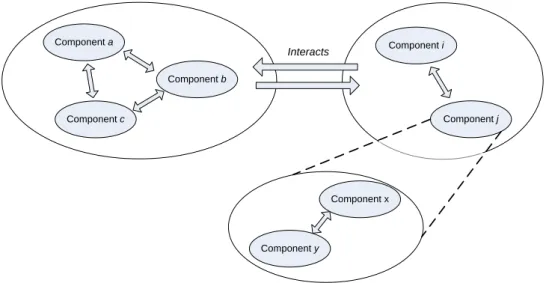
A software system is composed of a number of components, which work
together to provide functionality and interact with entities in the system
environment [4] as shown in Figure 2.1. These components can be humans,
software, hardware or even other systems. This concept can be used recursively, in that individual components may be composed of multiple subcomponents operating within a system environment. In this model, a consumer (which can also be seen as a user) is defined as another system that exists within the system environment, interfacing at the system boundary.
Computing and communication systems can be characterized by five fundamental properties: functionality, performance, cost, security and dependability [5]. The function of a system, which is the intended purpose of the system, is usually described by the functional specification in terms of system functionality and performance. Systems which provide different properties of interest and pursue different functions will exhibit different system behaviour.
The behaviour of the system is what the system does in order to perform its defined function and can be described as a sequence of states [5].
2.1.2 Conceptual Design of Software Systems
The architecture of most software systems are designed by separation into three distinct layers: presentation, application logic and resource [6] as presented in Figure 2.2. These layers are defined as follows:
The presentation layer is responsible for presenting information to the system
environment, and the interaction and communication with components that exist outside of the system. Examples of such entities include human users or other systems. A presentation layer can be implemented in a number of ways, such as a graphical user interface or a component that formats data into a given syntax. A typical example for this type of service is a program which drives an ATM screen.
The application logic layer is responsible for data processing and performing
actual operation requested by a user through the presentation layer. This layer is also referred to as the services offered by the system. A typical example for this type of service is a program which implements a withdrawal operation from a bank account. Component a Component b Component c Component i Component j
System System Environment
Interacts
Component x
Component y
The resource management layer is responsible for the management and implementation of data sources in the system irrespective of nature of the data source. This includes data residing within databases, file systems and other data repositories.
2.1.3 Tiered software System Architectures
These three layers are conceptual, logically separating the functionality of the software system. In reality, implementing such layers within a system can be combined and distributed in a variety of ways, referred to as tiers. There are four fundamental types of software system architectures, dependant on tier organisation: 1-tier, 2-tier, 3-tier and N-tier [6].
1-tier architectures consist of all three layers (presentation, application logic and resource management) merged into a single tier as shown in Figure 2.3(a). These architectures were the result of the development of mainframe-based systems that can be interacted with through the use of dumb terminals which display information prepared by the mainframe. Such practises were necessary at the time of conception due to system CPU efficiency being high priority due to limited CPU resources available. These systems are monolithic and interaction with the system environment is limited through the use of dumb terminals; as a result, 1-tier systems are viewed today as legacy systems as they are difficult and expensive to maintain as they are essentially monolithic pieces of code.
S
o
ft
w
a
re
s
y
s
te
m
Presentation layerApplication logic layer
Resource management layer
User
2-tier architectures are an evolution of the 1-tier architecture, and emerged due to the development of the PC, which replaced dumb terminals of a mainframe with smaller computer systems that interacted with larger, more computationally powerful servers. Conceptually, this resulted in the separation of the presentation layer from the server, and instead merging with the client (i.e. a user's PC) as shown in Figure 2.3(b). This architecture is commonly known as ‘Client-Server’.
This architecture presents two distinct advantages. First, as the presentation layer is separated from the server, the system can utilize computing resources from the client instead of the application logic and resource management layers, reducing resource utilization overhead. Second, it is possible to modify the presentation layer for different purposes without increasing system complexity, allowing different functionality for individual clients. However, there are limitations with this architecture in terms of scalability when increasing the number of clients interacting with the system causing increased server overhead. An additional issue is the legacy problem when 2-tier systems are used for objectives not originally intended; as the code written for clients is separate from the server, it is possible for clients to be developed to communicate with multiple servers enabling service integration. This results in increased system size, complexity and server dependency as modifications to a server also requires the client to be subsequently modified, causing clients to become larger and more complex than originally intended.
S
o
ft
w
a
re
s
y
s
te
m
Presentation layerApplication logic layer
Resource management layer User Client
S
o
ft
w
a
re
s
y
s
te
m
Application logic layer
Resource management layer
Presentation layer
Figure 2.3 (a) 1-tier, (b) 2-tier software system architecture.
3-tier architectures overcome some of the problems within 2-tier architectures; these architectures, as shown in Figure 2.4(a), feature a distinct separation between the three layers. Similar to the 2-tier architecture, the presentation layer resides on the client, while the application logic resides within a middle tier which communicates between the client and back-end resources. The abstraction and infrastructure that is used to support the application logic is often referred to as the Middleware [7].
3-tier architectures separate the application logic from the resource management layer as well as reducing the complexity of clients by preventing data resources from being accessed directly by the presentation layer. This minimises bottlenecks, as the application logic layer does not need to transfer additional data to the client. Moreover, system maintainability is improved as changes to the Middleware do not require corresponding changes to the presentation layer. By separating the middleware tier and linking it across many nodes, the scalability and reliability of the system is enhanced. However, 3-tier architectures face issues when integrating clients to multiple systems or other three-tier systems. This is due to a lack of standards in terms of interfaces and communication protocols resulting in the requirement of significant development in order to integrate different 3-tier systems together.
N-Tier architectures are similar to 3-tier systems; the main difference however is that they are more capable of linking to other systems and are capable of connecting to the Internet. An N-Tier architecture can emerge from one of two situations: the resource layer of the system is composed of other complete 2-tier or 3-tier architecture systems, or an additional tier is created by deploying a Web Service within the presentation layer that is treated as an additional layer due to its complexity in comparison to the client as shown in Figure 2.4(b). However, N-Tier architectures face the same problems as 3-tier architectures in terms of lack of standards to enable interoperability between systems over the Internet, and consequently increased complexity and the amount of middleware required for system integration [151]. This is particularly true when application logic is distributed across multiple machines that each use heterogeneous middleware. The evolution of software system architectures, from monolithic systems interacting through a dummy terminal, to many complex systems interconnected
together which can be accessed over the Internet demonstrates several trends in the evolution of software systems:
The first trend is that software systems are becoming increasingly complex; from the above discussion is it observable that an increasing amount of tiers are required in order to build systems which are capable of handling increased number of users and resource pools. Unfortunately, the introduction of additional tiers results in increased challenges when developing and maintaining the system due to complexity in tier configuration and communication [5]. The second trend is that there is an increasing requirement for software systems to be integrated together. As systems grow more complex, with the integration of additional tiers as well as application logic and data resources residing across multiple machines, there is an increased challenge in effectively integrating systems together. Furthermore, these systems must be capable of integrating and communicating with legacy systems currently used by the organization [150].
The third trends entails that software systems described above have evolved to facilitate the needs of individual organisations; the Internet age has since resulted in the formation of organizations which are in constant state of evolution in order to compete and prosper within the global marketplace [151].
Middleware Client
S
o
ft
w
a
re
s
y
s
te
m
Application logic layer
Resource management layer Presentation layer Middleware Client
S
o
ft
w
a
re
s
y
s
te
m
Application logic layer
Resource management layer Web browser Presentation layer Web server HTML filter
Such an environment has resulted in the need for systems that are capable of integration from different administrative domains, as well as potentially difference organisations. 3-tier and N-Tier system architectures are only capable of limited support in terms of system integration in such conditions. This is due to the lack of standards for communication and interactions between systems with heterogeneous architectures and administrative controls, resulting in increased complexity in middleware [5].
Service-oriented architectures have emerged as a means to address these challenges by enabling the development of applications composed of dynamic and loosely coupled applications capable of integrating across multi-organisational systems over the Internet in a standard way.
2.1.4 Service Computing
Service computing focuses on the connection between business processes and IT services so that business processes are seamlessly automated [8]. Service Oriented Architecture (SOA) is an architecture proposed for business to redefine processes to take advantage of 'formerly isolated component activities' [5]. Such architectures offer advantages over N-tier architectures in that complexity is reduced due to middleware decentralisation and modification less likely to affect existing services due to loose-coupling, in addition to well supported standards for developing cross-organizations systems over the Internet. A typical implementation of SOAs are through the use of Web Services, which are defined as self-contained, modular business applications that use standard interfaces over the Internet [23]. Web service developers make use of standards to enable interoperability between services. Two popular service based protocols for communication are SOAP [148] and REST [154].
The maturity of service computing has enabled the resurgence of a long sought concept: systems providing services to consumers as computing utilities.
2.1.5 Utility Computing
In modern day society, utilities such as water, gas, telecommunication and electricity are deemed as requirements for fulfilling routines in daily life [8]. In this context, we define utility as an essential service that can be easily obtained by the general population.
The idea of computing utility was realised as early as 1966 [9], where it was envisioned that computing networks would mature to reach a point where the idea of 'computer utilities' was made a reality and worked in similar principle to electrical and telephone utilities; able to provision computing service such as computing resources, development platforms or applications to consumers. There are two main actors within such environments; consumers and providers.
Providers are defined as entities that own and maintain the underlying
infrastructure to provision computing service. Consumers are entities (individuals or companies) that require computing power in order to achieve business objectives [10]. This service utility model for provisioning computing service provides a distinct advantage over traditional computing: Consumers pay providers for the amount of computer resources used over a given time frame, instead of investing, building and maintaining their own computing infrastructure which may be heavily underutilized for the majority of its life span if it is required for only handling large demand on a short-term basis.
There have been a number of technologies developed which increase the feasibility of computer utility. The first is the creation of communication protocols capable of forming distributed computer systems that are able to interact across the globe via the Internet, enabling the formation of potentially massive computer resource pools [8]. The second technology that has recently seen resurgence is Virtualization, which enables the abstraction of computing resources from the physical infrastructure enabling computing resources used by a consumer to be dynamically added and released on demand controlled by a virtual management system [11]. A typical use of this technology is the creation of Virtual Machines (VMs) which are self-contained environments which encapsulate state and virtual computing resources. The third technology is the evolutionary shift to service computing as discussed above, which allows computing utility and IT service to be provisioned to consumers as an automated business process through the use of standards.
As consumers move towards adopting such systems, the quality and reliability of the service provided becomes increasingly important. However, the level of service required by consumers can vary significantly depending on their business objectives. As a result, it may not be possible to fulfil all expectations for every
consumer from a service provider's perspective; hence a balance needs to be made via a negotiation process. At the end of the negotiation process, providers and consumers commit to a Service Level Agreement (SLA) [24]. SLAs provide a firm definition of the service agreement between service providers and consumers which includes defining the related service parties, service level objectives which formally express guarantee service conditions, and service parameters which are a measureable representation of service parties' obligations in order to measure whether service has been satisfactorily provisioned [153]. This typically includes service level guarantees, parameters and actions required in the case of violation [64]. One element provisioned and enforced through an SLA is the Quality of Service (QoS); QoS is a broad topic in the domain of Distributed Systems research, and can include a large variety of attributes ranging from geographical, economic, performance, real-time and security constraints of the service. Service providers use the SLA to optimize their infrastructures to meet the agreed terms of service, whilst service consumers use it to ensure that the agreed QoS has been fulfilled.
Modern day IT usage has grown at a substantial rate; consuming 1.8% of the global electricity consumption [25] and increased global data traffic more than fourfold within the past five years, and an expected further threefold increase by 2018 [26]. To meet this need, there has been a significant growth of large-scale distributed interconnected systems which are capable of providing computing service as a utility.
Through breakthroughs in research and technology, as well as the increased heterogeneity in consumer objectives, there have been a number of distributed systems with distinct characteristics that have emerged within the past few decades to pursue specific consumer objectives and attempt to realise the vision of computing utility.
Cluster computing [12][13][14] is a type of High-Performance Computing (HPC) paradigm that is capable of solving complex and huge-scale computing problems at reduced costs in comparison to traditional supercomputing systems. A cluster system is defined as a series of independent machines connected together by a network. Through the use of middleware, it is possible to create the illusion of a single system by abstracting the underlying infrastructure from users thereby
reducing system complexity [15]. Cluster systems have two principle actors; producers and consumers, which act in the same manner as the role for providers and consumers in utility computing [16].
Peer-to-Peer (P2P) systems are a class of systems which enables distributed resources to perform a function in a decentralized manner [17]. There is no division between client and servers since all nodes within the system are treated equally and can act as both clients and servers simultaneously. The objective of P2P systems is to aggregate resources across the system to improve system reliability and system scalability by reducing the dependency on centralized points within the system [18]. Such systems are highly effective for file sharing [19], security authentication and shared workspaces [20].
Grid computing systems coordinate resources not subject to centralized control using standard protocols and interfaces in order to deliver non-trivial service enabling sharing and selection of a large number of system types [21]. The motivation for Grid computing is to solve problems associated with "coordinated resource sharing and problem solving in dynamic, multi-institutional virtual
organizations (VOs)" [22]. Such systems are typically suited for solving research
problems that require massive amounts of computation and data within the domains of science, engineering and commerce [22].
It is possible for these distributed systems to be deployed within Datacenters; co-located systems within the same physical location in order to satisfy common environmental and physical security requirements, as well as ease system
maintenance [27]. Datacenters are traditionally used by consumers as co-locational facilities (i.e. consumers are provisioned physical space to purchase
and configure their own IT equipment which is maintained by the datacenter provider). Datacenter systems continue to grow and an unprecedented rate, with Datacenter sales in 2013 totalling over $143 billion [28], with a forecasted growth of Datacenter installations between 2013-2016 at 15-20% [29], and number of server racks in the UK increasing from 7.7 million by 15% [25].
Unfortunately, all of the above systems fail to realise the vision of true computing utility; for cluster computing, such systems are typically tightly coupled, resulting in limitations in portability due to middleware modification.
Grids are project-oriented in nature, with VOs forming in order to complete mutually beneficial objectives [66]. Furthermore, the business model of Grids is composed of providing computing services and resources as units to be spent, allowing the provider to manage schedule resources and available allotted time prior to provisioning service to consumers. This characteristic is debilitating to its capability to provide true utility to consumers on an ad-hoc basis [66]. In the case of Datacenters, providers only provision physical space to consumers who purchase, install and maintain their own IT infrastructure while the datacenter provider is responsible the physical security and operational environment conditions. This ultimately leads to limitations in dynamically providing computing utility to consumers as described previously.
The most modern paradigm to emerge that addresses this problem and further realises utility computing provisioned as a service is Cloud computing; loosely coupled systems - typically deployed within datacenters - capable of dynamically providing computing service and utility to consumers.
2.2 Cloud Computing
2.2.1 Cloud Computing Definition
Cloud computing has emerged as an increasingly popular means of providing utility computing to consumers. There is currently no standard definition for Cloud computing, however there are a number of proposed definitions. A popular definition for Cloud computing is taken from the National Institute of Standards and Technology (NIST) [30], which states that Cloud computing is:
"a model for enabling ubiquitous, convenient, on-demand network access to a shared pool of configurable computing resources that can be rapidly provisioned and released with minimal management effort or service provider interaction".
Furthermore, Cloud computing from an implementation perspective is defined as [31]:
"parallel and distributed system consisting of interconnected and virtualized computers that are dynamically provisioned and presented as one or more unified computing resources base on service-level agreements established through negotiation between the service provider and consumers".
Cloud computing environments are typically deployed within datacenters, which is owned by a provider or a third party. In recent years, datacenters have been increasingly deployed to provide global IT services and have been a key factor in the increased formation and uptake of Cloud computing which is typically deployed using such systems. As a result, within this work the term Cloud datacenter and Cloud computing environment are synonymous.
2.2.2 Cloud Computing Characteristics
As systems are capable of being constructed and implemented by using a wide variety of architectures, technologies, designs, etc. it is advantageous to define the characteristics of the system in order to comprehensively understand the definition and behaviour agnostic of physical implementation. Identified by NIST [30], there are five essential characteristics of Cloud computing.
On-demand self-service: Cloud self-service interfaces provide mechanisms that
support the management of the entire service delivery lifecycle. This allows consumers to acquire, manage and utilize computing resources and capability such as server resources and network storage automatically without needing direct human interaction from the service provider.
Broad network access: Cloud services are delivered over standard network
protocols and can be accessed through standard interfaces to promote heterogeneous devices (i.e. Mobile phones, workstations, laptops). This grants providers the capacity to deliver a variety of Cloud services to a wide selection of devices used by consumers over networks.
Resource Pooling: The Cloud provider is able to pool resources to multiple
consumers in the form of a multi-tenant model. These resources are assigned dependant on the demands of the consumer, who generally do not have fine-grained control or knowledge over the precise location of the resources provisioned. Instead, depending on the provider policy, consumers are capable of specifying the location of resource pooling at a higher level of abstraction such as country, state or datacenter.
Rapid Elasticity: Elasticity is the capability of a computing system to add or remove capacity from the system environment. Cloud resources are capable of being scaled-in and out dynamically in order to maintain expected QoS for
consumers as well as reduce costs; the latter is made possible as consumers are capable of adding and removing resources when required. These resources can be scaled in two directions: vertically (scale-up) by adding or removing resources from prior existing VMs or horizontally (scale-out) by adding or removing additional VMs.
Measured Service: Resource usage within Cloud systems can be monitored,
managed and reported to both consumers and providers transparently for metering and billing. This enables consumers capable of being billed based on their usage of Cloud resources and services while providers are able to track billing patterns in order to enhance provisioned service.
As a result of these system characteristics, there are secondary characteristics that manifest within Cloud environments which have been observed and identified within the literature.
Massive scalable and complex architectures: With the increased market uptake
of Cloud services [32][33][34], there has been a substantial growth in infrastructure [25][29], number of consumers [26][35] and Cloud services provisioned in datacenters; this growth is further augmented by the use of virtualisation technology and the ability to provision Cloud services on-demand. This has resulted in the increase in not just the number of Cloud datacenter facilities, but also the scale of such systems. Such increases have resulted in more complex management, architectures and applications [36][37][38], resulting in challenges when attempting to understand system characteristics as well as the relationship between components and their impact on system behaviour.
Wide diversity of dynamic workloads due to heterogeneous consumer demands.
Clouds typically are multi-tenant nature, with consumers pursuing different business objectives and QoS requirements [10]. As a result, the properties and characteristics of workload deployed within the Cloud environment can vary substantially [39][40]. Due to the Cloud's ability to scale to consumer needs, as well as the diversity of consumer business objectives through the use of rapid elasticity, workload in Cloud can be substantially heterogeneous in terms of resource consumption and execution length.
2.2.3 Cloud Computing Taxonomy
It is important to define Cloud computing by its capabilities in order to formulate a concise taxonomy. Cloud computing implementations can be classified according to their service delivery model in terms of Software, Platform and Infrastructure [41]. Different service models result in different functionality and responsibility for the Cloud consumer and provider, respectively. Furthermore, Cloud systems can also be deployed in a number of ways to provision service classified as Private, Public, Hybrid, Community and Federated [41][42]. These concepts and their relation to each other are shown in Figure 2.5 and are described in subsequent sections.
Public Hybrid Community Private
SaaS Software as a Service PaaS Platform as a Service IaaS Infrastructure as a Service Control & Governance
F le x ib ilit y o f P u rp o s e L e v e l o f A b s tr a c ti o n Economies of Scale
Figure 2.5 Cloud taxonomy of service deployment and service model.
2.2.4 Cloud Actors
It is necessary to define the principle actors within Cloud computing agnostic of service objective and physical deployment. According to the NIST Cloud Computing Reference Architecture [41] there are five principle actors within Cloud computing environments:
Cloud Provider: Entities that are responsible for management and administration
of the physical Cloud infrastructure as well as the mechanisms to deliver service to the consumer [42]. Providers are generally responsible for the overall management of Cloud, which includes physical server maintenance, cooling systems and VM scheduling and resource management.
Cloud Consumer Cloud Provider Cloud Service Management Service Orchestration Cloud Carrier Resource Abstraction and
Control Layer
Physical Resource Layer Hardware Facility Business Support Provisioning / Configuration Portability / Interoperability Cloud Auditor Privacy Impact Audit Performance Audit Security Audit Cloud Broker Service Intermediation Se
![Figure 2.15 Methods of studying systems [100].](https://thumb-us.123doks.com/thumbv2/123dok_us/840395.2606816/54.892.172.711.102.467/figure-methods-of-studying-systems.webp)