MORTEZA KARIMZADEH
EFFICIENT ROUTING PROTOCOL IN DELAY
TOLERANT NETWORKS (DTNs)
MASTER OF SCIENCE THESIS
Degree Programme in Communication Engineering
Examiners:
Prof. Yevgeni Koucheryavy
Dr. Dmitri Moltchanov
Examiners
and
topic
approved
in
the
Computing and Electrical Engineering Faculty
Council meeting on 6
thApril, 2011
II
Abstract
TAMPERE UNIVERSITY OF TECHNOLOGY
Master’s Degree Programme in Information Technology, Department of Communication Engineering
Karimzadeh, Morteza: Efficient Routing Protocol in Delay Tolerant Networks (DTNs) Master of Science Thesis, 47 pages
May 2011
Major: Communication Engineering
Examiners: Professor Yevgeni Koucheryavy and Dr. Dmitri Moltchanov
Keywords: Delay Tolerant Networks, Opportunistic networking, Forwarding mechanism, Routing protocol, Epidemic routing, Network coding
Modern Internet protocols demonstrate inefficient performance in those networks where the connectivity between end nodes has intermittent property due to dynamic topology or resource constraints. Network environments where the nodes are characterized by opportunistic connectivity are referred to as Delay Tolerant Networks (DTNs). Highly usable in numerous practical applications such as low-density mobile ad hoc networks, command/response military networks and wireless sensor networks, DTNs have been one of the growing topics of interest characterized by significant amount of research efforts invested in this area over the past decade. Routing is one of the major components significantly affecting the overall performance of DTN networks in terms of resource consumption, data delivery and latency. Over the past few years a number of routing protocols have been proposed. The focus of this thesis is on description, classification and comparison of these protocols. We discuss the state-of-the-art routing schemes and methods in opportunistic networks and classify them into two main deterministic and stochastic routing categories. The classification is based on forwarding decisions in routing methods adopted with or without the knowledge about the network topology and nodes trajectories. The protocols in each class have their own advantages and shortcomings.
In the stochastic routing protocols category, simple flooding-based protocols are feasible approaches in those networks where there is a little or no information about the network topology and there is no resource restriction. Epidemic routing is a flooding- based protocol relying upon the distribution of messages through the networks to deliver information to their destinations.
To demonstrate the performance of the epidemic routing protocol for information delivery in networks with intermittent connectivities, we provide several simulation experiments and show that this protocol with reasonable aggregate resource
ABSTRACT III consumption, ensures eventual message delivery in networks, using minimal assumptions regarding nodes trajectories, network topology and connectivity of underlying networks and only based on sufficient number of random pair-wise exchanges of messages among mobile nodes.
In the following, we introduce the recently proposed network coding concept and discuss coding-based information delivery advantages in wireless networks. Network coding is a recently introduced paradigm to efficiently disseminate data in wireless networks in which data flows coming from multiple sources are combined to increase throughput, reduce delay, and enhance robustness against node failures. Finally, we present some simulation experiments to show the superiority of network coding for information delivery in wireless networks, compared to pure flooding-based mechanisms.
IV
Preface
The research work reported in this thesis has been carried out the year 2010-2011 at the Department of Communication Engineering, Tampere University of Technology, Finland.
I would like to express my profound gratitude to my supervisors, Dr. Dmitri Moltchanov and Prof. Yevgeni Koucheryavy for their enthusiastic encouragement, valuable guidance, constant support and patience during the whole working period. I want to especially appreciate Dr. Dmitri’s vast knowledge and skills in many areas and his assistance in writing my papers and reports. I am greatly indebted to the many discussions we had on my research work and other interesting topics.
I am also grateful to Prof. Jarmo Harju for helpful discussion and advice during my graduate studies.
Last but not least, my deep gratitude goes to my family. To my wife Mozhdeh for her support and the tremendous help in keeping the family running. To my beloved father, Esmaeil and mother, Masumeh. I wish to send you my sincere gratitude for the love and encouragement from overseas. I dedicate this thesis to them.
Tampere, May 2011.
V
Table of Contents
Abstract ... II Preface ... IV Table of Contents ... V List of Acronyms ...VII
1.Introduction ... 1
1.1. The routing problem... 2
1.2. Contributions ... 2
1.3. Thesis organization ... 2
2.Delay Tolerant Networks ... 4
2.1. DTNs application examples ... 4
2.1.1. Inter-planet satellite communication networks ... 4
2.1.2. Sparse mobile ad hoc networks ... 5
2.1.3. Country-side area networks ... 5
2.1.4. Military battlefield networks ... 5
2.1.5. Wireless sensor networks ... 5
2.1.6. Exotic media networks ... 6
2.2. DTN characteristics... 6
2.2.1. Intermittent connection ... 6
2.2.2. Delivery latency and low data rate ... 7
2.2.3. Long queuing delay ... 7
2.2.4. Resource limitation ... 7
2.2.5. Limited longevity ... 8
2.2.6. Security ... 8
3.Information delivery in DTNs ... 9
3.1. Routing and forwarding ... 10
3.2. Routing-based approaches ... 10
3.2.1. Deterministic routing ... 11
3.2.1.1. Oracles based ... 11
3.2.1.2. Link state based ... 11
TABLE OF CONTENTS VI
3.2.1.4. Tree-based ... 12
3.2.2. Stochastic routing ... 12
3.2.2.1. Passive routing protocols ... 12
3.2.2.1.1. Epidemic routing ... 13
3.2.2.1.2. Spray and Wait ... 14
3.2.2.1.3. PROPHET ... 14
3.2.2.1.4. MobySpace ... 15
3.2.2.2. Active routing protocols ... 16
3.2.2.2.1. Meet and visit (MV) ... 17
3.2.2.2.2. Message Ferrying (MF) ... 17
3.3. Network coding-based approaches ... 18
3.3.1. Network coding-based epidemic routing (NCER) ... 18
3.3.2. Efficient routing protocol based on network coding (E-NCP) ... 19
4.Epidemic routing protocol ...20
4.1. Protocol objectives ... 21
4.2. Protocol algorithm ... 22
4.3. Implementation ... 24
4.4. Evaluation ... 26
5.Network coding ...31
5.1. Network Coding Advantages ...31
5.2. Linear network coding ... 34
5.2.1. Implementation ... 36
5.2.2. Evaluation ... 37
6.Conclusion and further research issue ...42
6.1. Conclusion ... 42
6.2. Future work ... 44
VII
List of Acronyms
AODV Ad Hoc On Demand Distance Vector CDF Cumulative Distribution Function CSMA Carrier Sense Multiple Access
DSR Dynamic Source Routing
DTNRG Delay Tolerant Networking Research Group DTNs Delay Tolerant Networks
E-NCP Efficient routing protocol based on network coding FIMF Ferry-Initiated Message Ferrying
FIFO First-In-First-Out
ID Identification
IMEP Internet MANET Encapsulation Protocol
LSR Link State Routing
MAC Media Access Control
MANETs Mobile Ad-hoc NETworks
MF Message Ferrying
MV Meet and Visit
NS2 Network Simulator -2
NCER Network Coding-based Epidemic Routing NIMF Node-Initiated Message Ferrying
OLSR Optimized Link State Routing PDA Personal Digital Assistant PLS Positional Link-trajectory State PROPHET Probabilistic routing protocol RLNC Random Linear Network Coding
TCP/IP Transmission Control Protocol/Internet Protocol TORA Temporally Ordered Routing Algorithm
TTL Time To Live
1
Chapter 1
Introduction
Current wireless networks, whether cellular networks or wireless local area networks, have provided a wide range of applications making it possible to successfully interconnect devices and systems, such as a mobile phone to a powerful server, all around the world. The widespread availability of miniature wireless devices such as cellular phones or laptops and ubiquitous access to various services through the wireless networks, rapidly make them as indispensable parts of our life. However, there are some wireless network applications in which the connectivity between end nodes has intermittent property due to dynamic topology or resource constraints and modern Internet protocols demonstrate inefficient performance in such scenarios. Network environments where the nodes are characterized by opportunistic connectivity are referred to as Delay Tolerant Networks (DTNs). The general field of DTN networking, as defined by the Delay Tolerant Networking Research Group (DTNRG), is concerned with “ How to address the architectural and protocol design principles arising from the need to provide interoperable communications with and among extreme and performance-challenged environments where continuous end-to-end connectivity cannot be assumed”. DTNs represent a class of networks, where no assumption regarding the existence of a well-defined path between two nodes wishing to communicate is made. Particularly, source and destination systems might never be connected to the network at the same time and connections among wireless nodes are temporal. Such networks may have sparse node densities, with short communication capabilities of each node. One-hop connections are often disrupted due to node mobility, energy conservation or interference. However, in these networks, a link can still be established when two nodes come into the coverage range of each other. DTN concept stipulates that such temporal links can be used to exchange information possible on behalf of other nodes hoping that it will eventually reach the destination. Although, this communication paradigm usually involves a lot of overhead in terms of additional delay as packets are often buffered in the network, it seems to be the only viable solution for such specific environments.
Due to wide-range application domains of DTNs such as Inter-planet satellite communication networks, wireless sensor networks, vehicular networks, country-side area networks and military battlefield networks they are receiving increasing attentions from both academia and industry.
CHAPTER 1. INTRODUCTION 2
1.1.
The routing problem
The existing TCP/IP based Internet, operates assuming end-to-end communication using a concatenation of various data-link layer technologies. The set of rules specifying the mapping of IP packets into network-specific data-link layer frames at each router provides the required level of interoperability. IP protocol still makes a number of key assumptions regarding the lower layer technologies making seamless IP layer communications smooth. These are: (i) there is an end-to-end path between two communicating end systems, (ii) the round-trip time between communicating end systems is not absurdly high and (iii) the end-to-end packet loss probability is rather small. Unfortunately, in DTN networks one or more of the above-mentioned assumptions are violated due to mobility, power conservation schedule or excessive bit error rate. As a result, classic protocols of the TCP/IP protocol stack are not appropriate for such environments [29]. A key reason why end-to-end communication is difficult in DTNs topology is that IP packet delivery works only when the end-to-end path is available. In practice, according to classic IP routing mechanisms an IP packet is dropped at the intermediate system where no link to the next hop currently exists. Such design restricts the end-to-end communication to those scenarios, where intermediate nodes have to buffer received packets to deliver them whenever they have an opportunity to contact their destinations [12].
1.2.
Contributions
In this thesis, we study information delivery which is a fundamental problem in delay tolerant networks.
The main contributions of this work are as follows.
o Discussing the state-of-the-art information delivery schemes in DTNs and classifying them into two main deterministic and stochastic categories;
o Study and simulation of an information delivery protocol using no information regarding DTNs topology, which provides a useful and efficient tool for building such networks;
o Study and simulation of a network coding-based information delivery method in wireless networks which improves the network performance, security and reliability.
1.3.
Thesis organization
The rest of the thesis is organized as follows.
o In the second chapter, a literature study describing an overview for the basic DTNs architectures, characteristics, challenges and some application examples are provided.
CHAPTER 1. INTRODUCTION 3
o The third chapter describes various information delivery mechanisms in networks with opportunistic connectivity and covers several representative solutions. This section is followed by discussing some special solutions based on combining routing and forwarding into a single bundle e.g. network coding.
o The fourth chapter explains the epidemic routing protocol, its objectives and routing algorithms. In the following several simulation experiments in various scenarios are presented to evaluate its performance in information delivery in DTNs. Discussions on the results are also included.
o In the fifth chapter network coding concept and its advantages exploiting in wireless network are discussed. In the rest, the results of performed simulation experiments regarding data delivery in wireless networks using coding-based and flooding-based mechanisms are demonstrated and compared.
o The sixth chapter discusses the conclusions of this research and draws possible future works in the field of DTN’s.
4
Chapter 2
Delay Tolerant Networks
DTNs represent a unique wireless network architecture enabling mobile nodes to have communications with each other in environments where there is no continual route between end nodes. DTNs are alternative structures to traditional networks facilitating connectivity of systems and network regions with sporadic or unstable communication links. In networks with such circumstances mobile relay nodes are used to carry and forwarding messages and make communications possible among other nodes. Depending on DTNs types communication opportunities could be either scheduled over time or completely random.
2.1.
DTNs application examples
Opportunistic networks often arise as a result of host and (or) router mobility. Another reason for sporadic connectivity is disconnection due to power management or interference. Some examples are discussed below.
2.1.1.
Inter-planet satellite communication networks
The DTN protocol emerged from the work first started in 1998 in partnership with Nasa's Jet Propulsion Laboratory. The initial goal was to modify the TCP protocol to facilitate communications between satellites. The objective of the interplanetary Internet project was to define the architecture and protocols for interoperation of the Internet resident on the Earth with other remotely located residents on other planets or spacecrafts. While the Earth's Internet is basically a "network of interconnected networks", the interplanetary Internet may therefore be thought of as a "network of disconnected Internets". Internetworking in such environments requires new techniques to be developed [12]. The speed-of-light delays, sporadic and unidirectional connectivities, as well as high bit error rates make the use of the current Internet protocols infeasible across such long distances [1].
CHAPTER 2. DELAY TOLERANT NETWORKS 5
2.1.2.
Sparse mobile ad hoc networks
In many cases, these networks may have unexpectedly intermittent connections due to node mobility or sparse deployment. Sometimes sporadic connectivity in the network could be periodic or predictable. For example, a bus carrying a computer can act as a store and forward message switch with limited RF communication capability. As it travels, provides a form of message switching service to its nearby clients to communicate with distant parties it will visit in the future [12].
2.1.3.
Country-side area networks
DTNs can bring digital connectivity to rural areas and other environments with limited or non-existing infrastructures. In such scenarios transportation systems such as cars, buses, and boats are used to provide relaying of messages by moving around and collecting/delivering messages from/to various nodes. Recently, a number of projects have been launched to explore such communication concepts. One example is the Message Ferry project aimed at developing a data delivery system in areas without existing Internet infrastructure [45]. Another example is the DakNet project that should potentially provide low-cost connectivity to the Internet to villages in India [43].
2.1.4.
Military battlefield networks
In a military setting DTN allows for a rich set of applications including dissemination of mission-critical information in battlefield scenarios. For these types of applications, the delay tolerant protocol should transmit messages across multiple-hop networks consisting of different sub networks based on network parameters such as delay and loss. Such systems may be expected to operate in hostile environments where mobility, noise, attacks, interference and/or intentional jamming may easily result in disconnection and data traffic may have to wait several seconds or more to be delivered [12,1].
2.1.5.
Wireless sensor networks
Wireless sensor networks are often characterized by limited end-node resources including energy, memory and CPU power. Communication within these networks is often aimed at limited usage of these resources. Scarcity of power calls for advanced power saving schedules naturally leading to intermittent connections between nodes. In this scenario, utilization of opportunistic communications becomes very important. Lack of infrastructure may force sensor network gateways to be intermittently connected to operator’s network. Scheduled down time, interference, or environmental hostility may cause the interruption of operable communication links [43].
CHAPTER 2. DELAY TOLERANT NETWORKS 6
2.1.6.
Exotic media networks
Exotic communication media includes near-Earth satellite communications, very long-distance radio links, acoustic transmission in air or water, free-space optical communications and nano-networks [31]. Depending on a certain scenario these systems might be subject to high latencies with predictable or sporadic interruptions (e.g. due to planets’ movements or scheduled arrival of a ship/vehicle), may suffer outage due to environmental conditions (e.g. weather), or may even provide a predictably available store-and-forward network service that is only occasionally available (e.g. satellites).
2.2.
DTN characteristics
To discuss the routing problem, we need a model capturing the most important characteristics of a DTN network. This section explores them concentrating on those that produce the most impact on routing and forwarding protocols implementation e.g. path properties, network architectures and end node resource constraints.
2.2.1.
Intermittent connection
One of the most important characteristics of DTNs is that the end-to-end connection between communicating end systems may not exist. Generally intermittent connections may be broadly categorized as due to a fault or not. Non-faulty disconnections happen in wireless environments and mostly caused by two sources: mobility and short duty cycle of system operation. Intermittent connection as a result of mobility depends on the application area of DTNs. Communication schedules can be created based on predictability or can be fully opportunistic. In the latter case nodes come to the coverage area of each other due to their random movement or due to movement of other objects [16, 27]. Figure 2.1 demonstrates predictability of communication schedules for mobile nodes in different scenarios.
Waypoin t
Schedules
Random Implicit Approximate Precise
Dee p Sp ace Bus Human M ovement Predictability
CHAPTER 2. DELAY TOLERANT NETWORKS 7 Intermittent connections caused by short duty cycles are common among devices with limited resources (e.g. sensor networks). These connections are often predictable. Dealing with disconnections requires the routing protocol to “understand” that the lack of connectivity between nodes happens as a result of a normal situation rather than force majeure, and should not be considered as an outage due to faulty operation [27, 30].
2.2.2.
Delivery latency and low data rate
Delivery latency is the amount of time between message injection into the network and its successful reception at the destination. Since many applications can benefit from short delivery times, latency is one of the most important performance metrics of interest. This delay consists of transmission, processing, propagation time over all links as well as queuing delay at each system along the path. In DTNs, transmission rates are often relatively small and latencies can be large. Additionally, data transmission rates can also be largely asymmetric in uplinks and downlinks [29]. In some application scenarios (e.g. deep-space communications), delivery latency may vary from a few minutes to hours or even days and a significant fraction of messages may not be delivered at all. For effective operation over DTNs with high latencies and low link rates, the key is to design the routing protocols and forwarding algorithms matching the actual mobility patterns [4, 16].
2.2.3.
Long queuing delay
The queuing delay is the time it takes to drain the queue of messages ahead of the tagged one. The queuing delay depends on data rate and the amount of competing traffic traversing network. In DTNs where a disconnected end-to-end path is rather common situation, the queuing time could be extremely large, e.g. minutes, hours or even days. As a result, for designing routing and forwarding mechanisms we should take into account that messages may be stored for long periods of time at intermediate nodes, and the choice of the next hop sometimes needs to be changed. The messages should be forwarded to alternative next hops if new routes to the destination are discovered [30,16].
2.2.4.
Resource limitation
Nodes in DTNs often have very limited energy sources either because they are inherently mobile or because the power grid is non-existent in their area of location. End systems consume energy by sending, receiving, storing messages and by performing routes discovery and computation. Hence, the routing strategies sending fewer bytes and performing less computation operations are often more energy efficient [27]. In some application scenarios (e.g. wireless sensor networks) nodes are also characterized by very limited memory and processing capability [15].
CHAPTER 2. DELAY TOLERANT NETWORKS 8
2.2.5.
Limited longevity
In some DTNs, end nodes may be deployed in hostile environments. This is especially true for sensor networks, military applications of DTNs and networks of devices used by emergency personnel [27]. In such cases, network nodes may be broken down and not be expected to last long. Recalling that the end-to-end path between two communicating entities may not exist for a long period of time, there could be the case when the delay of message delivery may exceed the lifetime of a transmitter node. As a result, the end system should not be made responsible for reliable delivery of data using classic transport layer protocols such as TCP. This feature needs to be delegated to the network [29].
2.2.6.
Security
DTNs are vulnerable to many malicious actions and bring a number of new security challenges. The use of intermediate nodes as relays offers extraordinary opportunities for security attacks, including compromising information integrity, authenticity, user privacy and system performance. The use of specific routing mechanisms including flooding-based ones may even increase the risks associated with inserting false information into the network. Extra traffic injected by malicious nodes creates another serious threat due to resource scarcity of DTNs in some application scenarios. Unauthorized access and utilization of DTN resources for specific malicious actions are other serious concerns. It is important to note that the research on DTN security is more challenging compared to conventional mobile ad hoc networks due to its unique security characteristics. These characteristics include exceptionally long delivery delays, sporadic connectivity, opportunistic routing, and make most existing security protocols designed for conventional ad hoc networks unsuitable for DTNs [19, 30].
9
Chapter 3
Information delivery in DTNs
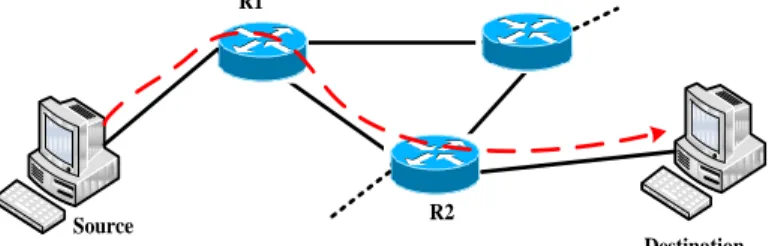
The current Internet architecture and protocols are extremely successful in providing different communication services in wired and wireless networks, using TCP/IP family of protocols. However, as we discussed these set of protocols may significantly degrade performance or even disrupt operation of the network in challenged and more dynamic environments. Within the set of networking mechanisms the routing protocol is one of the main objects affecting performance of information delivery. Indeed, it is up to the routing protocol to timely discover routes in the network and maintain the uniform view of the network. During the last ten years there have been enormous research efforts trying to adapt and improve various routing protocols originally proposed for wired and wireless networks to the case of DTNs. AODV [10], DSR [11], and OLSR [39] are just few examples of routing protocols offering relatively good performance in MANETs. However, these protocols may entirely stop network activities due to intermittent connection property. As shown in Figure 3.1 the major restriction of these protocols stems from the fact that they can work and find a route only if there is an end-to-end path between end systems. Otherwise, packets will be dropped by intermediary nodes if no link to the next hop exists at the moment.
Source
Destination R1
R2 R3
Figure 3.1: Traditional routing protocols schemes.
In DTNs the paths between end systems may frequently disconnect due to resource limitations, node mobility, sporadic channel availability and other DTN-specific properties. Recalling that there is absolutely no guarantee of timely delivery of data between end systems, it is unrealistic to expect that routing protocols can keep track of the topology changes in a timely manner.
One of the most important issues in a routing protocol algorithm is “routing objective”. In traditional routing schemes, minimizing some metrics such as propagation delay or the number of hops in path selection process may be considered as routing
CHAPTER 3. INFORMATION DELIVERY IN DTNs 10 objective. However, in DTNs, most of such objectives are not apparent. One of the possible metrics of interest can be message delivery to end nodes with maximum probability, while minimizing the end-to-end delay. In this section we classify routing protocols proposed for DTNs and discuss some of them.
3.1.
Routing and forwarding
Both routing and forwarding are processes used in the network layer of the communication protocol stack for data transmission.
In the forwarding function, the received messages are transferred from an input link to an output link or a certain set of output links. The basic thing is that the transfer of data messages is performed within a single node of the network. However, routing process refers to deciding the route for data transmission. It utilizes the knowledge acquired by means of routing protocols to decide the routes or paths to transfer data packets on their journey from source to destination. The routing protocols may use different routing algorithms for choosing the appropriate transmission path. The maximum number of hop counts, the shortest path, available bandwidth are examples of metrics that could be used by different routing algorithms in the decision making process.
These processes may work together. It means that the routing process finds a suitable path for data transmission and then forwarding process, based on the information obtained from the routing process, sends data packets to the output link which is toward to the destination of interest. However, in some cases such as flooding-based method, information delivery is achieved using only forwarding mechanism, in which the nodes replicate the data packets received from all output links in hopes of eventual submission.
3.2.
Routing-based approaches
In DTNs the route from a source to a destination is affected by opportunity of communication between intermediate nodes. These opportunistic contacts may have time-varying and temporal properties such as capacity, rate, latency and availability. As a result, the forwarding decision, should not only take into account the number of hops between the source and the destination but also other metrics too. Links availability also is one of these metrics. The routing process becomes more complicated if link availability is nondeterministic. Utilizing knowledge about the current state and using the ability to predict the future state of the network topology may significantly improve the choice of the optimal route eventually leading to more effective forwarding of data.
Network topology in DTNs could be classified as deterministic and stochastic. In deterministic case the network topology and/or its characteristics are assumed to be known. Contrarily, for stochastic topologies no exact knowledge of topology is assumed. There are specific protocols developed for each category.
CHAPTER 3. INFORMATION DELIVERY IN DTNs 11
3.2.1.
Deterministic routing
The main idea in computing the optimal route from a source to a destination in deterministic routing protocols is based on completely knowledge or predictable information about nodes future mobility patterns and links availability between them. Deterministic routing protocols could be divided into the following four approaches. Most of those are special modifications of well-known algorithms.
3.2.1.1.
Oracles based
Several oracle-based deterministic routing algorithms taking the advantage of predictable information about network topology and traffic characteristics have been suggested by Jain et al. (2004). Based on the amount of information they need to compute routes, the oracle-based algorithms are classified into complete knowledge and partial knowledge. Complete knowledge protocols utilize all information regarding traffic demands, schedules of contacts, and queuing in the forwarding process. However, in practical applications this knowledge is partially missing and routing needs to utilize available information. The authors in [37] purposed their routing framework by modifying the Dijkstra’s shortest-path algorithm assuming four knowledge oracles: (i) contact summary oracle provides the knowledge about aggregated statistics of contacts, (ii) contact oracle maintains information regarding the links between two nodes at any given time, (iii) queuing oracle presenting the queuing information in each node instantaneously, and (iv) traffic demand oracle provides the knowledge about the current and future traffic characteristics. Oracle-based algorithms are mostly suitable for networks with controlled topology or with existing full or partial information about that [37,3].
3.2.1.2.
Link state based
Gnawali et al. (2005) presented a modification of link state routing (LSR) protocol for use in deep-space networks, entitled “positional link-trajectory state” (PLS) protocol. PLS is a position-based routing mechanism that predicts the satellite or other spacecrafts moving paths to make routing decisions. In the suggested routing protocol, flooding is performed at first and then the predicted trajectory of nodes, links availability and their characteristics such as latency, error and rate through the network and link states are updated. Finally, each node independently re-computes its own routing table using a modified Dijkstra algorithm [33].
3.2.1.3.
Space-time based
Merugu et al. (2004) suggested a routing framework, which unlike conventional routing tables using only connectivity information, provides a space-time routing table relying on information about destination and arrival time of messages. These two
CHAPTER 3. INFORMATION DELIVERY IN DTNs 12 metrics are used to choose the next hop in a route. The underlying reason behind this approach is that in wireless networks with mobile nodes, the network topology changes with time and choosing the best route depends not only on destination but also on the topology evolution. The forwarding table in each intermediate node is a two dimensional matrix composed of destination address and instances of time when this route has been obtained. The forwarding decision is a function of both destination and time [31].
3.2.1.4.
Tree-based
Handorean et al. (2005) presented a tree-based routing algorithm based on the knowledge about motion and availability patterns of mobile nodes. Depending on how the routing information is obtained they classified the path selection mechanisms into three cases : (i) the source node initially has complete information about speed and direction of motion of all other nodes and has the ability to estimate route trees for data delivery to destination nodes, (ii) the source originally has no information about other nodes motions and each node exchanges its own information with its neighbors and learns the path to a destination whenever they meet. The second method is useful in applications where nodes have highly mobile patterns and obtaining the global knowledge is difficult (e.g. emergency networks). (iii) the future trajectory of nodes is predicted relaying on the past recorded knowledge [35]. The tree-based routing protocol requires maintenance algorithms to somehow keep the tree alive.
3.2.2.
Stochastic routing
When there is no information about nodes mobility patterns obtained via deterministic predictions or historic information stochastic routing mechanisms need to be used. Depending on whether nodes dynamically adapt their trajectories or mobility patterns to improve the routing process, routing protocols based on stochastic techniques could be classified into passive or active protocols.
3.2.2.1.
Passive routing protocols
Protocols falling in to this category assume that the moving path of nodes does not change in order to dynamically adapt to the routing and forwarding process of messages. The basic idea of these mechanisms is to combine routing with forwarding by flooding multiple copies of a message to the network by a source and waiting for successful reception. Obviously, the more the copies of the message on available links, the more the probability of the message delivery. As one can see this scheme may provide low delay at the expense of worse resource utilization. This approach is useful in those networks, where forwarding and storage resources of nodes are not scarce and there is nothing or very little knowledge regarding topology and nodes mobility [12]. In following we discuss several routing protocols using passive stochastic techniques.
CHAPTER 3. INFORMATION DELIVERY IN DTNs 13
3.2.2.1.1.
Epidemic routing
Epidemic routing algorithm was the method which firstly introduced by Demers
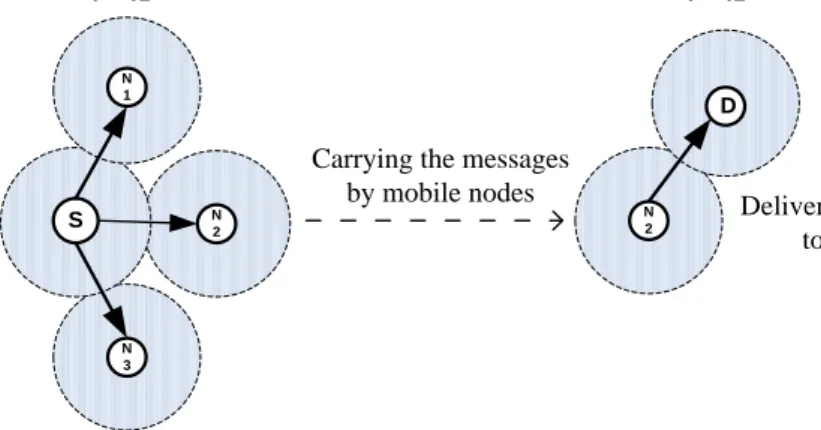
et al. in [3] to synchronize databases which use replication mechanism. This algorithm was modified by Vahdat et al.(2000) and proposed as a flooding-based forwarding algorithm for DTNs. In the epidemic routing scheme, the node receiving a message, forwards a copy of it to all nodes it encounters. Thus, the message is spread throughout the network by mobile nodes and eventually all nodes will have the same data. Although no delivery guarantees are provided, this algorithm can be seen as the best-effort approach to reach the destination. Each message and its unique identifier are saved in the node’s buffer. The list of them is called the summary vector. Whenever two adjacent nodes get opportunity to communicate with each other, they exchange and compare their summary vectors to identify which messages they do not have and subsequently request them. To avoid multiple connections between the same nodes, the history of recent contacts is maintained in the nodes caches [7]. The scheme of message distributions is shown in Figure 3.2.
S N 1 N 2 N 3 D Forwarding a copy of messages to encounterd nodes
Carrying the messages
by mobile nodes Delivering the messages to destination N
2
t = t1 t = t2
Figure 3.2: Epidemic routing protocols schemes.
Assuming sufficient resources such as node buffers and communication bandwidth between nodes, the epidemic routing protocol finds the optimal path for message delivery to destinations with the smallest delay. The reason is that the epidemic routing explores all available communication paths to deliver messages [37] and provides strong redundancy against node failures [15]. The major shortcoming is wasting of resources such as buffer, bandwidth and nodes power due to forwarding of multiple copies of the same message. It causes contentions when resources are limited, leading to dropping of messages. The epidemic routing has been suggested to use in those conditions when there are no better algorithms to deliver messages. It is especially useful when there is lack of information regarding network topology and nodes mobility patterns [35].
CHAPTER 3. INFORMATION DELIVERY IN DTNs 14
3.2.2.1.2.
Spray and Wait
Wasteful resource consumption in the epidemic routing, could be significantly reduced if the level of distribution is somehow controlled. Spyropoulos et al. (2005) proposed the spray and wait mechanism to control the level of spreading of messages throughout the network. Similar to the epidemic routing, the spray and wait protocol assumes no knowledge of network topology and nodes mobility patterns and simply forwards multiple copies of received massages using flooding technique. The difference between this protocol and the epidemic routing scheme is that it only spreads L copies of the message. The authors in [42] proved that the minimum level of L to get the expected delay for message delivery depends on the number of nodes in the network and is independent of the network size and the range of transmission.
The spray and wait method consists of two phases, spray phase and wait phase. In the spray phase the source node after forwarding L copies of message to the first L
encountered nodes, goes to the wait phase, waiting for delivery confirmation. In the wait phase all nodes that received a copy of the message wait to meet the destination node directly to deliver data to it. Once data is delivered confirmation is sent back using the same principle.
To improve the performance of the algorithm Spyropoulos et al.(2005) purposed the binary spray and wait scheme. This method provides the best results if all the nodes’ mobility patterns in the network are independent and identically distributed (iid) with the same probability distribution. According to the binary spray and wait, the source node creates L copies of the original message and then, whenever the next node is encountered, hands over half of them to it and keeping the remained copies. This process is continued with other relay nodes until only one copy of the message is left. When this happens the source node waits to meet the destination directly to carry out the direct transmission [42].
In general, various methods limiting the number of distributed messages reduce recourse consumption and contention in intermediate nodes and often result better performance compared to the classic epidemic routing scheme, especially in highly loaded network conditions
3.2.2.1.3.
PROPHET
The probabilistic routing protocol using history of encounters and transitivity (PROPHET) is a probabilistic routing protocol developed by Lindgren et al. (2003). The basic assumption in the PROPHET is that mobility of nodes is not purely random, but it has a number of deterministic properties e.g. repeating behavior. In the PROPHET scheme, it is assumed that the mobile nodes tend to pass through some locations more than others, implying that passing through previously visited locations is highly probable. As a result, the nodes that met each other in the past are more likely to meet in the future [6]. The first step in this method is the estimation of a probabilistic metric
CHAPTER 3. INFORMATION DELIVERY IN DTNs 15 called delivery predictability, 𝑃(𝑎, 𝑏) Є [0,1]. This metric estimates the probability of the node A to be able to deliver a message to the destination node B. Similar to epidemic routing, whenever a node comes in to contact with other nodes in the network, they exchange summary vectors. The difference is that in the PROPHET method the summary vectors also contain the delivery predictability values for destinations known by each node. Each node further requests messages it does not have and updates its internal delivery predictability vector to identify which node has greater delivery predictability to a given destination [6]. The operation of the PROPHET protocol could be described in two phases: calculation of delivery predictabilities and forwarding strategies.
In calculation of delivery predictabilities phase, nodes update their delivery predictability metrics whenever meet each other. Visiting more nodes results in higher delivery predictability values. If two nodes do not meet each other for a long time, they exchange messages with low probabilities. Hence, they tag their delivery predictability values as aged. Delivery predictability has transitive property meaning that if node A
often meets node B and node B often meets node C, then node A most likely comes into contact with node C.
Unlike conventional routing protocols that base their forwarding decisions and selection of a path to a given destination on some simple metrics such as the shortest path or the lowest cost, forwarding strategy in the PROPHET is more complicated. Whenever a node receives a message and has no path to the destination it buffers the message and forwards it whenever another node is met. At this step, the forwarding decision could be affected by various issues. For example, forwarding more copies of the received message results in higher delivery probability values and lower delivery delays. On the other hand, more resources are spent. When a node meets a neighbor with low delivery predictability, there is no guarantee that it would meet another node with a higher delivery predictability value during the message life time. As a result, a reasonable threshold must be defined for the forwarding decision [6]. Finally, it is important to mention that according to [5, 17], “PROPHET is the only DTN routing protocol that has been formally documented using RFC draft [Prophet09]”.
3.2.2.1.4.
MobySpace
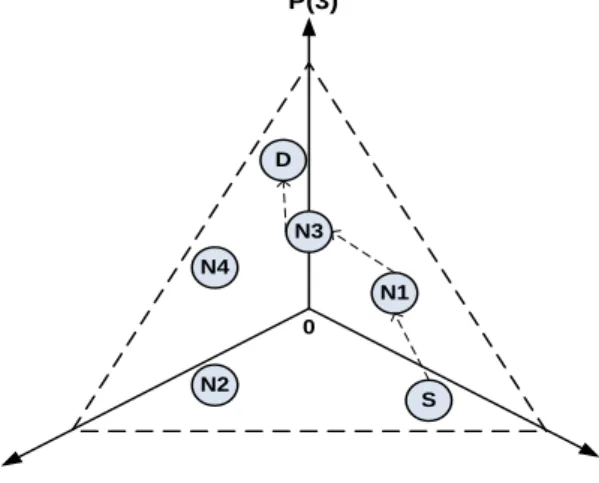
Leguay et al. (2005) suggested a mobility pattern space routing method called MobySpace. The major principle behind their proposal is that the two nodes with similar trajectories will meet each other with high probability. According to this method, each node forwards the received messages to the encountered nodes provided that they have similar mobility patterns with the destination node. The title of this protocol comes from a virtual Euclidean space used for taking decisions on the message forwarding process. In this virtual space each nodes is specified using its mobility pattern, called MobyPoint and routing is done towards nodes having similar MobyPoint with the destination node [24]. Each axis in the MobySpace defines the possible contact
CHAPTER 3. INFORMATION DELIVERY IN DTNs 16 and the distance from each axis presents the communication probability between nodes. In the MobySpace the closer nodes have higher probability to communicate with each other, so in the routing process the messages are forwarded toward the nodes that are as close to the destination node as possible [22,25]. Figure 3.3 illustrates forwarding paths in the MobySpace protocol.
S N2 N1 N3 D N4 0 P(3) P(1) P(2)
Figure 3.3: Forwarding path in the MobySpace.
The MobySpace protocol demonstrates better results whenever nodes’ mobility patterns are fixed. However, two nodes with similar mobility patterns may never communicate if they are separated in time. In the other words, the nodes with similar trajectories could meet each other provided that they are in the same time dimension [22].
3.2.2.2.
Active routing protocols
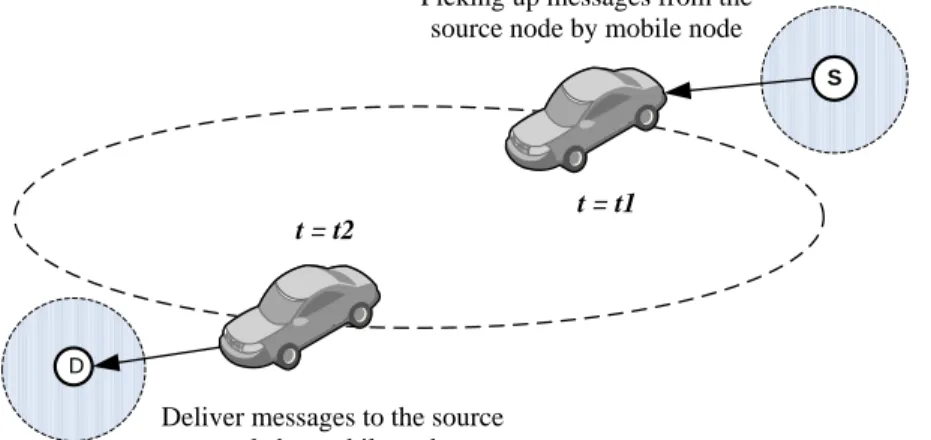
In this category of routing protocols, moving paths of some nodes are controlled in order to increase the message delivery probability. As demonstrated in Figure 3.4, in these schemes mobile nodes act as natural “message carriers” and after picking up and storing the messages from the source node move toward the destination node to deliver them. Very often the active routing methods are more complicated and costly in terms or resources that are not related to communications compared to the passive routing techniques. However, they may drastically improve the overall performance of system in terms of delay and loss metrics [8]. Active routing techniques could be implemented in those DTNs where no direct communication opportunities between end systems are expected by default, e.g. emergency and military networks. Buses, unmanned aerial vehicles (UAVs) or other types of mobile nodes can be used as ferry nodes in different DTN environments [22]. In this section we discuss several routing protocols using active stochastic techniques.
CHAPTER 3. INFORMATION DELIVERY IN DTNs 17
S
D
t = t1 t = t2
Picking up messages from the source node by mobile node
Deliver messages to the source node by mobile node
Figure 3.4: Message ferrying scheme in active routing protocols.
3.2.2.2.1.
Meet and visit (MV)
Burns et al. (2005) suggested the so-called meet and visit strategy for forwarding messages in structures with mobile source and fixed destination nodes. This scheme actively explores information about meeting of peer nodes and their visiting locations. The knowledge regarding meetings and visiting places is stored at each node and used to estimate message delivery probabilities. Three important assumptions are introduced in the MV protocol: (i) nodes have unlimited buffer space (ii) there is infinite link capacity (iii) and destination nodes are fixed.
The mobile ground-based or airborne autonomous agents are used to provide more communication opportunities in the network. Figure 3.5 shows two examples of mobile autonomous agents. The agents trajectories are adapted according to network routing and performance requirements. The so-called autonomous controller also is responsible to control the nodes movement path according to traffic demands [8].
Figure 3.5: Examples of autonomous agents ([8]).
3.2.2.2.2.
Message Ferrying (MF)
Zhao et al. (2004) described the so-called message ferrying method which uses mobile nodes with stable mobility patterns as collectors and carriers of messages. The
CHAPTER 3. INFORMATION DELIVERY IN DTNs 18 ferry nodes could provide connectivity among nodes in a network, where there are no possibilities for direct communication between end systems. Because of fixed moving path of ferry nodes, each node can save information about the ferries’ mobility patterns and may adapt its future trajectory to come into contact with ferry nodes to have sending or receiving messages. Depending on the entity initiating transactions, two forwarding schemes can be used for message delivery: node-initiated message ferrying (NIMF) and ferry-initiated message ferrying (FIMF). According to the first approach the ferry nodes choose their path using a predefined mobility pattern known by other nodes. Whenever the nodes want to send messages via the ferries, they need to adjust their trajectories to move towards the ferry nodes. The nodes can be informed about ferries’ paths using broadcasting messages originated by ferry nodes or using pre-defined schedules. In the FIMF, nodes broadcast call-for-service requests whenever they need to send or receive messages. The nearest ferry node is responsible for responding them and moving towards the nodes to pick up the messages [45].
3.3.
Network coding-based approaches
Network coding-based routing is an adaptation of the traditional store-and-forward mechanism. According to it, relay nodes combine and encode received packets before forwarding them. This approach exploits the basic principle of network-coding consisting in limiting the number of message forwarding in resource restrictive conditions. In traditional replication-based routing methods, successful transmission is achieved by delivering each of data packets separately; while in the network coding-based scheme destination nodes can recover sent packets by receiving only a reasonable number of coded packets. It means that coding-based schemes result in more reliable communications in poor and resource limited connectivity conditions. However, imposing additional computing overhead at nodes due to coding and decoding processes causes to performance degradation in networks with stable and well connected links [20]. Due to having outstanding benefits, network coding is currently one of the most promising research areas within the scope of information delivery in DTN-like networks. In this section we discuss two different proposals based on network-coding.
3.3.1.
Network coding-based epidemic routing (NCER)
Lin et al. (2007) developed a protocol based on combination of the network coding and epidemic routing. According to this protocol, instead of replicating just copies of messages as used in old epidemic routing, relay nodes flood random linearly coded versions of the received packets to other nodes whenever they have an opportunity to communicate. It has been shown that the suggested method provides better performance comparing traditional epidemic routing protocol in terms of average delivery delay, storage and bandwidth usage. More information about this protocol can be found in [48].
CHAPTER 3. INFORMATION DELIVERY IN DTNs 19
3.3.2.
Efficient routing protocol based on network coding (E-NCP)
E-NCP is another network coding-based routing protocol presented by Lin et al.
(2008). Recall that in NCER nodes forward encoded messages until the successful delivery is signaled by the acknowledgement packet or the message lifetime expires. E-NCP protocol is intended to improve NCER performance by optimizing the number of forwarded messages. Based on information theory, destination nodes should receive at least N randomly encoded packets in order to recover N original transmitted data packets with probability 1. In E-NCP in order to deliver data with high probability, the source node starts by sending more than N encoded packets spreading them to L
encountered relay nodes using the binary spraying scheme. Messages delivery delay and the number of relay nodes can be controlled by adjusting the L. In [47] the authors carried out detailed evaluation and optimization of the protocol.
20
Chapter 4
Epidemic routing protocol
Nowadays inexpensive wireless networking has provided a wide range of interesting applications. Using wireless network adaptors in small computing devices such as laptops, mobile phones, PDA’s makes possible ubiquitous access to a wide range of global information. Easy and rapid deployment properties of wireless networks with independent mobile nodes increase the popularity of them to be used in corporate environments to extend the coverage area of wired networks or to establish wireless communication systems for enormous commercial and military applications such as sensor networks, emergency and rescue operations, battlefield networks and disaster relief efforts. An ad hoc wireless network is an autonomous collection of mobile hosts operating without the aid of an established infrastructure of centralized administration. It allows mobile hosts to communicate with each other without pre-existing communication infrastructures. In such networks communications among mobile hosts through wireless links are carried out via their antennas. Often due to radio power limitation and channel utilization, a mobile host may not be able to communicate directly with other hosts in a single-hop fashion. As a result, the source host’s packets must be relayed by several intermediate hosts before reaching the destination host.
During the last ten years there have been enormous research efforts for data delivery in wireless environments and various routing protocols proposed such as AODV[10], DSR[11], OLSR[39] and TORA[44] offering relatively good performance in ad hoc networks. Although different optimizations are applied to adapt and improve efficiency of routing techniques, but common assumption behind existing protocols is that there is always an end-to-end path between source and destination nodes.
As it is mentioned earlier in chapter 2, this assumption is not always valid in realistic scenarios. In DTN-like networks, due to short-range communication capabilities, node mobility, energy conservation or interference connections among wireless nodes are temporal and the end systems might never be connected to the network at the same time. In such environments, traditional ad hoc routing protocols fail to deliver packets in the case of network partitioning between the end nodes. This happens due to the fact that, these routing protocols firstly try to establish a complete path between the source and destination nodes and then start to forward the actual data. The store-and-forward is a common approach used in routing mechanisms in circumstances that it is difficult to establish end-to-end paths and data packets are moved and stored throughout the network in hopes that they will eventually reach their
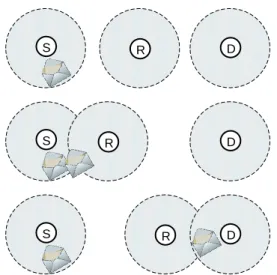
CHAPTER 4. EPIDEMIC ROUTING PROTOCOL 21 destinations. As it is illustrated in Figure 4.1, in the store-and-forward routing techniques, an intermediate node stores a packet that has been forwarded to it by other nodes, carries the packet as it moves and forwards it to another relay node or the final destination whenever a suitable path is available. Using the store-and-forward technique in DTN routing protocols helps to overcome the problems associated with opportunistic connectivity, variable and high error rates, long transmission delays and asymmetric data rates. S R D S R D S R D
t = t1
t = t2
t = t3
Figure 4.1: Store-and-forward information delivery scheme in networks with opportunistic connectivity.
The epidemic routing protocol, based on the store-and-forward technique is one of the approaches that has been proposed for data delivery in networks with sparse deployment and high mobility in which there may not be a contemporaneous path between source and destination nodes.
This chapter describes the basic epidemic routing mechanism and presents the results of extensive simulations in order to evaluate the performance of the proposed protocol. Simulations and analyses are based on the source code for the NS2 extensions for epidemic routing, provided by Amin Vahdat and David Becker [7].
4.1.
Protocol objectives
The epidemic routing algorithm was the method which firstly introduced by Demers
et al. in [3] to synchronize databases which use replication mechanisms. This algorithm was modified and proposed by Vahdat et al. as a flooding-based forwarding algorithm for DTNs [7].
The objectives behind designing the epidemic routing protocol were as follows.
o Efficient distribution of messages through partially connected ad hoc networks in a probabilistic fashion
CHAPTER 4. EPIDEMIC ROUTING PROTOCOL 22
o Minimizing the amount of consumed resources in any single message delivery
o Maximizing the percentage of messages that are eventually delivered to their destinations
Some of the issues regarding the information delivery protocol in this mechanism are as follows.
o Routing under uncertainty: Sender nodes have no knowledge of the exact location of other nodes. Therefore, a key issue is determining whether to transmit a message when the sender meets a potential carrier node. Accounting the nodes that the target carrier has recently met and its current path and velocity may be used to make a decision.
o Resource management: Intermediary mobile nodes have limited buffer space. Hence, the system must balance the conflicting goals of maximizing message delivery and minimizing resource consumption. It is most likely or even desirable to be more copies of a message in the system simultaneously. However, should not consume buffer space on every host to have a copy of the message just to ensure its timely delivery.
o Performance: Different metrics such as average latency, buffer consumption, communication bandwidth or amount of energy consumed in transmitting the message to its destination, may be considered to evaluate the performance of a routing protocol. The store and forwarding process consumes energy as well as metrics such as CPU cycles, memory and network capacity. Thus, it is important to balance the system performance and resource consumption in transmitting process.
o Reliability: Given the probabilistic nature of information delivery in the epidemic routing protocol, it is not possible to give delivery guarantees. In certain applications explicit acknowledgements of successful message delivery may be used to enhance the reliability. It can also be used in the originating nodes or carriers to free up their buffers associated with a message upon learning its successful reception at the intended host.
o Security: Security in the epidemic scheme may be declined due to traverse of messages through arbitrary hosts before reaching their final destinations. In sensitive applications receivers may require certain authenticity guarantees which can be obtained using various cryptographic techniques. Using the list of traversed hosts or preferred trusted hosts in each message may also be beneficial to improve security in the epidemic method.
4.2.
Protocol algorithm
The epidemic routing algorithm guarantees message delivery, provided that the nodes of the network find opportunities to have a sufficient number of pair wise connectivities and data exchanges. The epidemic routing is a flooding-based protocol
CHAPTER 4. EPIDEMIC ROUTING PROTOCOL 23 and relies upon the distribution of messages through the network for information delivery. In this method messages are distributed through connected parts of the ad hoc network and carried to other portions of the network through mobile nodes. Transitive transmission of messages results in the generated packets to be reached to their destinations with higher probabilities. Each node contains a local buffer maintaining generated messages and received messages on behalf of other hosts. When a message is received, it is placed in the buffer and tagged with a unique identifier. Each node stores the list of all entered messages IDs in a bit vector, called the summary vector. Whenever two nodes come into communication range of each other, exchange the summary vectors and determine the messages that they do not have. Then, each node requests from the faced node copies of the messages that it has not yet received. After this procedure, the nodes will have the same information in their buffers. This interchanging session is called anti-entropy.
A B 1 2 3 SVA Request = (SVA + SVB ) Messages unknown to B
Figure 4.2: Exchanged messages in the epidemic routing protocol between two hosts, when meet each other.
As it is shown in Figure 4.2, after meeting, node A informs node B about all the messages available at its buffer using SVA. Then, through a logical AND operation
between the negation version of its summary vector, -SVB (representing the messages
which it needs), and that of A, SVA node B determines the messages that it does not have
and requests them from node A. Then after, node A sends the requested messages to node B. This process is continued transitively whenever each node comes into communication range of other neighbors. To avoid redundant connections, each node maintains the list of hosts that it has met recently. Each node can independently decide to accept or reject messages sent from other nodes depending on the buffer size, trusted host list or etc. Assuming sufficient buffer space and time, this process guarantees message delivery.
As it is mentioned earlier, the epidemic routing uses flooding mechanism and tries to send each message over all the available paths in the network. This strategy makes it extremely robust against node and network failures and provides a large amount of redundancy as all nodes receive every message. Additionally, due to distribution of messages over all the available paths, message delivery is carried out in the minimum amount of time providing there are sufficient resources.
In the epidemic routing protocol each message is identified using a unique 32-bit number. The identifier is a concatenation of the host's ID and a locally-generated message ID (16 bits each).
CHAPTER 4. EPIDEMIC ROUTING PROTOCOL 24 In the forwarding process, the hop count parameter specifies the maximum number of epidemic exchanges that a particular message is subject to. Similar to the TTL field in an IP packet, the message with a hop count of one will only be delivered to the destination node and will be dropped from the buffer space of the carrier nodes if newer messages are arriving, but there is not enough space to buffering them and the destination node has not met yet. Choosing larger values for hop count causes more quick distribution of a message throughout the network and degrades the average message delivery time. However, it also increases total resource consumption in the system. Messages with higher priorities can be assigned larger hop counts to ensure faster delivery at the cost of extra resource consumption.
The buffer size of each node determines the maximum amount of memory space that the host is willing to allocate for epidemic message distribution. To ensure delivery of all messages with higher probabilities, the allocated space in at least a subset of nodes must be approximately equal to the expected number of distributed messages at any given instant of time. Otherwise, hosts drop older messages upon arrival of newer ones and it is probable that the older messages be flushed from buffers before delivery. Of course, in all communication systems a tradeoff between aggregate resource consumption and message delivery rate/latency have to be considered. In the case of limited memory space, different buffer management strategies may be used. First-in-first-out (FIFO) is one of the simplest and easiest policies to implement bounding the amount of time that a particular message is likely to stay in the host’s buffer. In this strategy, old messages will be flushed from the host’s buffer once new messages are introduced into the system and there is no space to buffering them. FIFO buffer management algorithm is appropriate in situations where the allocated buffer space in the host is larger than the number of distributed messages at any given instant of time. However, most often hosts’ buffer spaces are limited in mobile networks and FIFO policy is suboptimal from quality of service and fairness points of view. To provide different levels of quality of service and support preferential delivery, fair queuing algorithms such as Weighted Fair Queuing (WFQ) logically distributing available buffer space among competing hosts are proposed for future research by Amin Vahdat.
4.3.
Implementation
To evaluate the performance of the epidemic routing, NS2 network simulator is chosen. NS2 is a packet level simulator which supports radio propagation models with 802.11 MAC, ad hoc routing protocols and mobility scenarios with dynamic topologies. Experiments in this section are based on the source code for the NS2 extensions for the epidemic routing protocol provided by Amin Vahdat and David Becker. The epidemic routing protocol was implemented on top of the Internet MANET Encapsulation Protocol (IMEP) layer which is responsible for keeping a list of the current neighbors and notifying the epidemic agents of the nodes whenever they come into communication range and move out of radio range. The epidemic agent consisting of
CHAPTER 4. EPIDEMIC ROUTING PROTOCOL 25 buffered messages, the summary vector and an entropy code, utilizes the anti-entropy process to exchange messages between the neighbor nodes.
Defining realistic mobility models is one of the main difficulties in implementation of ad hoc networks in a simulation environment. As, no realistic data is available regarding the network structure and nodes trajectories. The possible way is relying on a reasonable approximation, based on the current research and rational assumptions. Random Waypoint model is a simplified mobility model used in most of the current related researches. According to this model each node picks a random spot, moves there with some random speed, and pauses for a random amount of time. The speed and the pause times are chosen uniformly distributed over some pre-specified range. Simulations in this section are based on the mentioned mobility model.
In this model, 40 mobile nodes move in a (1500m×300m) rectangular area. Each node starts its trajectory from a random spot in the rectangle and moves there with a uniform velocity distributed between 0-20 m/s without any pause time. Whenever the node reaches its start point picks a new destination and repeats the process.
The “setdest” program which is a tool in NS2 makes it possible to create a mobility model with different parameters as inputs. This tool could be used as follows.
NS2/ ns-2/indep-utils/cmu-scen-gen/setdest/setdest –n N –p P –s S –t T –x X –y Y
The input parameters of this command are described below.
o N : Number of the nodes;
o P : Pause time (s);
o S : Maximum speed (m/s);
o T : Mobility (simulation) time (s);
o X any Y: Dimension of the area (m).
The output of the above-mentioned command is a TCL file defining the mobility model of the nodes.
To generate the traffic pattern all nodes in the mobility model are selected as message sources/sinks such that 30 nodes send one message to 29 other nodes in the system, for a total of 870 messages. Each message in this communication pattern is 512
Bytes in length. They are generated per second and it means that all messages are initiated and transmitted after 870 seconds. Therefore, to achieve an effective evaluation, simulation time needs to be selected significantly more than 870 seconds. In performed experiments