Data Modelling To Determine Room Rate with Adaptive Network Based Fuzzy
Inference System And Particle Swarm Optimization
Fahd Sulthony1, Lukmandono2, Rony Prabowo3
1,2,3Faculty of Industrial Engineering, Institute of Technology Adhi Tama Surabaya e-mail : [email protected]
Abstract
Determination of room rate in a hotel is influenced by two factors, namely internal and external. From an external perspective, PT. PIM has eight competitor hotels that affect its room rate. The Hotel Manager analyzes each competitor's room rate changes to stay competitive. Human analysis has several shortcomings: subjectivity, fatigue and inconsistency. Then we need a decision support or decision companion machine to determine the room rate. ANFIS-PSO is a hybrid algorithm from the Adaptive neural network based fuzzy inference system (ANFIS) by utilizing Particle Swarm Optimization (PSO) optimization. Traditional ANFIS is Gradient Decent (GD) as an algorithm for parameter optimization (model). This often happens to be stuck to get optimal local results, to overcome this PSO is used as a solution. The results obtained from the ANFIS-PSO training contained a difference of Rp. 3173,187 or a percentage of 1.34%. From the modeling obtained applied to the hotel PT.PIM, with the result of an increase in revenue of Rp. 17,493,548. The conclusion obtained is that ANFIS-PSO can help managers to determine the room rate by modeling data obtained from the ANFIS-PSO method. Suggestion for the development of this research is that ANFIS-PSO has a complex complexity of training algorithms because there is a combination of two algorithms, so to make it better a different algorithm design is needed.
Keywords : Data Modelling, Adaptive Network based Fuzzy Inference System, Particle Swarm Optimization, Room Rate.
1. INTRODUCTION
The development of the industrial world in Indonesia currently looks increasingly rapid. The mushrooming of service companies, especially those engaged in tourism and hospitality, causes
increasingly intense competition between hotels. Success in winning the competition is determined by several things including quality, room rate and service.
Service is the quantity or variety of services provided by the hotel to its customers such as swimming pool, restaurant, fitness center, bar, etc. Quality is the quality of service to consumers, this is more emphasis on customer satisfaction with one type of service. Pool cleanliness is always guaranteed, the taste of cuisine that suits the tastes of consumers, fitness equipment that is complete and functioning properly, hospitality of hotel employees is an example of the quality of service provided by the hotel to guests or consumers.
In addition to quality and service, room rate is a very influential factor in fighting for the hearts of consumers and potential customers. Room rate is the nominal amount that must be paid by consumers for services provided by the hotel or service provider. If there is a comparison between several hotels with the same quality and service in terms of pricing and ignoring the factor of consumer loyalty to producers or service providers, consumers will tend to choose hotels that are more affordable. For this reason, a maximum calculation is needed (Kotler, 2000).
For this reason, companies are demanded to be able to run company management effectively, efficiently and competitively to determine strategies to be able to compete with other hotels. One strategy that can be used is to suppress product selling prices. The lower the product selling price, the higher the product sales level. Calculation of cost of goods is also an important factor in determining the selling price of products. A more appropriate cost determination will produce an accurate service product. By setting a good product selling price without reducing quality indirectly will give consumers the interest to enjoy the product / service being sold.
TiBuana, Vol. 03, No. 2, 2020
| 49
Based on the description above, the researcherformulated the problem as follows :
1. How to determine of room rates based on market research competitors?
2. Modeling to determine Room Rate with ANFIS and Particle Swarm Optimization methods?
2. Literatur Review
A. Adaptive-Network-Based Fuzzy Inference System (ANFIS)
Artificial Neural Network (ANN) is a commonly used learning-based classification model. On the other hand, Fuzzy Logic (FL) has an important role to model some aspects of knowledge and human thoughts without using precise quantitative mathematical analysis. ANFIS which has been proposed by [1], is a combination of Artificial Neural Network and Fuzzy Inference System. Figure 1 shows the architecture of ANFIS proposed by [1], which has two inputs, five network layers and one output. The ANFIS architecture is functionally same as the architecture of Rule Based Fuzzy. Supposed there are two inputs, x and y, and one output f, then there will be two rules on Sugeno model. The two rules are shown in Equation (1) and (2), where Aiand Biare fuzzy sets; p, q, and r
are consequent parameters.
Rule 1 :
) (1)
Rule 2 :
(2)
Figure 1. The architecture of ANFIS The five layers in ANFIS architecture are described as follows.
Layer 1: Each neuron in the first layer is
computed using the activation function with some adaptive parameters as shown in Equation (3).
(3)
a, b, and c are parameters whose value is
adjustable (adaptive). If the value of these parameters is modified, then the shape of the function will also change. Standard deviation and mean are used as the initial values of parameters a and c. While value 1 is used to initiate parameter b. All parameter in this layer is known as the premise parameter.
Layer 2: Each neuron in the second layer is fixed
neuron represented in Equation (4). Each node represents the predicate w of the i-th rules.
(4)
Layer 3: Each neuron in the third layer is a fixed
node calculated as the ratio between the predicate
w of the i-th rule and the sum of all predicates w,
as shown in Equation (5). The calculation result is known as normalized firing strength.
(5)
Layer 4: Output of neuron in the fourth layer is
calculated using Equation (6), which is described further in Equation (7). is normalized firing strength in the third layer and {p, q, r} are parameters of the neuron. These parameters are called as consequent parameters.
(6)
………..(7)
Layer 5: Output of neuron in the fifth layer,
which is also an output layer, is calculated as the sum of all inputs, as shown in Equation (8).
(8) B. Particle Swarm Optimization
Particle swarm optimization is a branch of the evolution algorithm. PSO is based on the behavior of a flock of birds or fish. Which where
a herd does not have a leader to find food so they will spread randomly to find the location of food according to Rini, et al (2011). This algorithm is based on the social behavior of this organism. Social behavior consists of individual actions and influences from other individuals according to Santoso, Willy (2011).
The word particle denotes a bird or flock of birds. Each particle behaves by using individual intelligence and is also affected by the behavior of the collective group. In other words if a bird finds the location of food with the shortest way then the other group will follow the path even though the distance is far from the individual who found the path proposed by Santoso, Willy (2011).
In this PSO algorithm, the search for solutions is carried out by a population consisting of several particles. The population is generated randomly with the smallest value limit and the largest value. Each pertikel presents the position and location of the problem at hand. Each particle searches for an optimal solution with the intelligence of the individual's experience by traversing the search space dimension of D search space D. This is done by means of each particle making adjustments to the best position of the particle (local best) and adjusting the position of the best particles of the whole herd (global best) while crossing the search space. At each iteration, each solution represented by the position of the particle is evaluated for performance by inserting the solution into the fitness function. Each particle is treated as a point on a certain dimension of space. Then there are two factors that give character to the pertikel status in the search space, namely position X and particle velocity Y delivered by Kennedy and Eberhart (1995).
The following is a mathematical formulation that describes position and speed:
(9)
(2.18) (10)
Where X is the position of the particle. V is the particle velocity. i and t are the particle index and t-iteration, in the N dimensional space.
The following are mathematical models
that illustrate the mechanics of improving particle status
……….(11)
(12) Where :
= , , ...., presents the local best of the i-th particle. Whereas = , , ..., presented the global best of the whole herd. and are positive values which are commonly called learning factors. and are positive positivity values between 0 and 1. Equation (11) is used to get the velocity of new particles based on the previous velocity, the distance between the current position and the best position of the particle (local best), and the current distance to the best position of the herd (global best). Then the particles fly to a new position based on equation (12)..
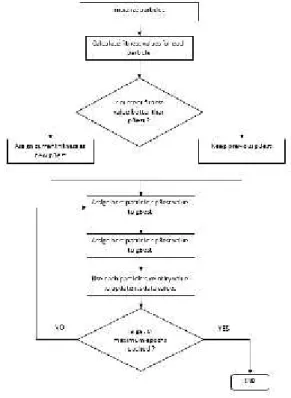
Figure 2. Flowchart PSO
The PSO algorithm includes the following steps: 1. Generate the initial position of a number of particles at once at a random initial speed
2. Evaluate the fitness of each particle based on its position.
TiBuana, Vol. 03, No. 2, 2020
| 51
3. Determine the particle with the best fitness,and set it as Gbest, for each particle, the initial Pbest will be the same as the initial position.
Repeat the following steps until the termination criteria are met
a. Using the existing Pbest and Gbest, update the speed of each particle using equation 11. Then with the new speed obtained, update the position of each particle using equation 12
b. Fitness evaluation of each particle
c. Determine the particle with the best fitness, and set it as Gbest. For each particle, determine Pbest by comparing the current position with Pbest from the previous iteration.
Check stopping criteria. If it is fulfilled then stop, if not then return to step a.
C. PSO-ANFIS
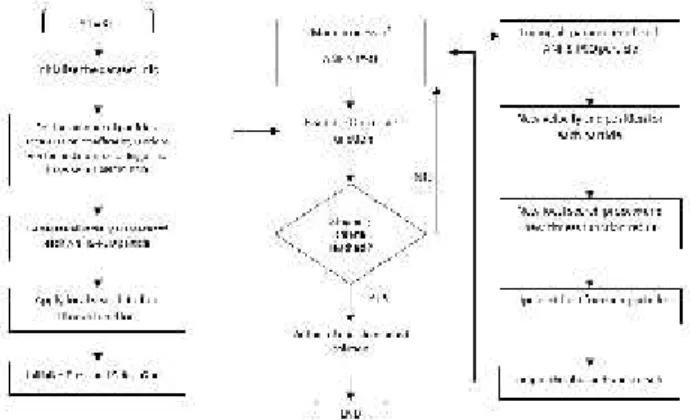
This method is a combination of the ANFIS method with parameter training using PSO to improve classification accuracy, speed up getting convergent values and also use it to avoid finding optimal local solutions. To combine ANFIS and PSO it is necessary to make some parameter adjustments. Rini, et al (2014) have proposed improvements to the ANFIS method with the learning of the PSO algorithm to balance accuracy and interpretability The following are the steps of the ANFIS-PSO procedure.
1. Initialing particle P (population size = N) and velocity for each particle in the search space. These parameter elements of the membership function consist of minimum and maximum dataset values, consequent parameters of ANFIS, linguistic parameter values and optimal rule values obtained from positive numbers 0 or 1. 2. Do a local search on ANFIS based on equation 2.19 and look for the initialization of the fitness function based on equation 2.20
3. Pbest initialization for each particle and will be used as a potential solution.
4. Evalusi Pbest, find the best Pbest and make it Gbest. The chosen Gbest will be the candidate for the solution.
5. Check the objective function. If the criteria are met then Gbest will be the solution, if it has not entered the next step.
6. Perform the main procedure process of ANFIS-PSO;
6.1 Based on the Gbest value, change each potential solution parameter: linguistic parameter values, parameters, and optimal rules using the
PSO rules.
6.2 Change the new results for each potential parameter solution for optimal linguistic parameter values, parameters, and rules.
6.3 Based on the new results of each potential solution parameter, calculate the local search for ANFIS and look for a new fitness function. 6.4 Modification of Pbest of each particle. If the current PBest is the dominant position, replace PBest with the current position. Keep the previous Pbest.
6.5 Evaluation of the results of PBest. The best PBest make Gbest and make candidat solution. 7. Check the value of the objective function. If it is met then make a solution, if not repeat the previous steps until the stopping criteria are met..
Figure 3. Flowchart ANFIS-PSO 3. RESEARCH METODE
This type of research with a market competitor survey. The method uses Adaptive-Network-Based Fuzzy Inference System (ANFIS) and Particle Swarm Optimization. For this modeling use Mathlab. Adaptive-Network-Based Fuzzy Inference System (ANFIS) and Particle Swarm Optimization are used as theoretical confirmation and to make recommendations on room rate values and to propose data validation testing.
Data collection methods
For data processing in this study using actual data from the company and data from a survey of market research competitors. The data used is a dataset taken from room rate survey data from several competitors of PT. PIM. The data used are competitor a, competitor b, competitor c, competitor d, competitor e, competitor f, competitor g, and competitor h. There are 9 entries obtained from the room rate
based on market research. for each total data in 1 (one) year from competitor a, competitor b, competitor c, competitor d, competitor e, competitor f, competitor g, competitor h, and competitor i. For testing the proposed method, the dataset consists of various competitors.
In research there are two stages, the learning phase and the testing phase (evaluation). The learning phase is used to get data modeling. The data modeling method of PSO-ANFIS is described by the membership function of each data feature. The membership function will be trained with Neural Network learning with the optimization method used is PSO.
After getting the data modeling, the next step is to evaluate with data testing. Evaluation will be done by measuring the difference between the predicted value with the actual value or by measuring the Mean Absulute Error Deviation.
The dataset in this study was drawn from the room rate data of hotels / competitors in one of PT.IM's hotel clusters. In total there are eight features. These features illustrate the number of hotels that will be studied. The total data obtained is taken from January to December 2019. The data taken is daily data, so the total data obtained is 364 data. The distribution of datasets will be divided into two parts, training data of 304 data or 10 months, and the last two months will be used as testing data. Training data is used to obtain data patterns, while testing data is used to test models that have been created from training data.
4. RESULT
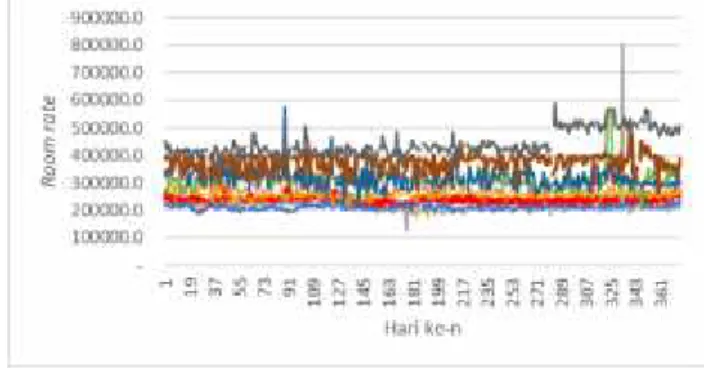
Figure 4 is a graphical description of all data and all time data. On the graph there are 9 hotel data including PT. PIM. In the graph the data model obtained is not linear or uneven. Room rates for all of these data sometimes go up and down. But globally the room rate is still around the initial room rate. An overview of the data or graphics of the target data or room rate data of PT.PIM hotels can be seen in Figure 4.3. Data from day 131 up to day 183 there is a difference in pattern with other days, there is a decrease in value. Unlike the target testing, the target testing is relatively more stable.
Figure 4. Graph of room rates throughout the hotel
Figure 5. Target Data Training and Testing In this study several trials were conducted. Each trial will get evaluated by measuring the mean absolute deviation. The trial run is used to find the best modeling of training data. The number of grouping / cluster parameters is used as the object of the trial. Clusters will be used to form a fuzzy inference system rule. In this study the fuzzy inference system created by the Sugeno-3 method. Fuzzy inference system type 3 Sugeno uses clustering to help form the rule. Clustering technique used is to use Fuzzy C-Mean.
TiBuana, Vol. 03, No. 2, 2020
| 53
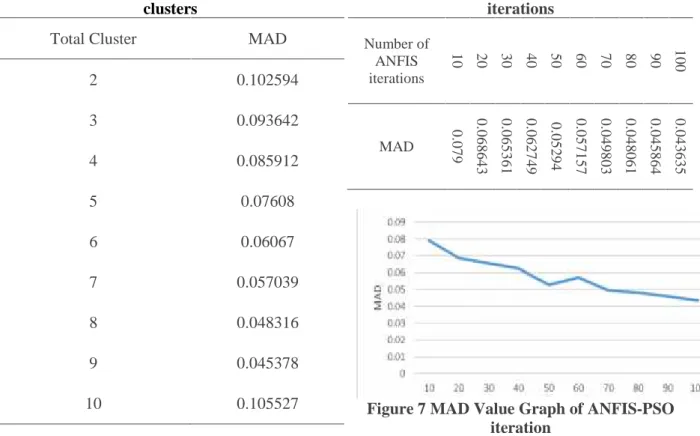
Table 1. The results of testing the number ofclusters
Total Cluster MAD
2 0.102594 3 0.093642 4 0.085912 5 0.07608 6 0.06067 7 0.057039 8 0.048316 9 0.045378 10 0.105527
Figure 6. Graph of MAD Value In table 1 the results of trials on the value of the number of clusters from two to 10 get varying values. The graph that is built from MAD values can be seen in Figure 4.8, the graph from the initial cluster decreases in value up to the 9th cluster, but has an increase in the 10th cluster and the algorithm cannot find a solution when the 10th cluster to the top. So from the data obtained the most optimal number of clusters is found in the 9th cluster
.
Table 2 The results of the trial number of iterations Number of ANFIS iterations 1 0 20 30 40 50 06 70 80 90 100 MAD 0 .0 7 9 0 .0 6 8 6 4 3 0 .0 6 5 3 6 1 0 .0 6 2 7 4 9 0 .0 5 2 9 4 0 .0 5 7 1 5 7 0 .0 4 9 8 0 3 0 .0 4 8 0 6 1 0 .0 4 5 8 6 4 0 .0 4 3 6 3 5
Figure 7 MAD Value Graph of ANFIS-PSO iteration
This iteration parameter has a function of how much this algorithm works. The more iterations, the longer this algorithm looks for a solution. In general, the more iterations are directly proportional to the decrease in error rate (MAD), this is in line with the values shown in table 4.2 and the data graph in Figure 4.9. Initial iteration initialization starts with 10 iterations then ten trials are carried out with an increase in the next 10 iterations. The maximum iteration tried is 100 iterations. According to the results in table 4.2 the best iteration is found in the 100th iteration with a value of 0.043635.
From the two parameter trials, the number of clusters and iteration of the algorithm obtained the maximum result is 9 the number of clusters and 100 iterations. Later this parameter will be used to get the data model for testing.
The initial step to get the data modeling is to create a fuzzy inference system, this is because the ANFIS method is a learning FIS. In Figure 4.10 is a picture of the initial FIS formed, before the learning process. The modeling structure consists of 8 data input data features, this corresponds to the parameters in1..in8. there is the FIS itself and there are results that are symbolized by the output in the image.
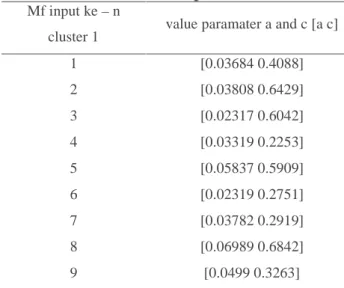
Table 3 Data Initialization parameter input membership value
Mf input ke–n
cluster 1 value paramater a and c [a c]
1 [0.03684 0.4088] 2 [0.03808 0.6429] 3 [0.02317 0.6042] 4 [0.03319 0.2253] 5 [0.05837 0.5909] 6 [0.02319 0.2751] 7 [0.03782 0.2919] 8 [0.06989 0.6842] 9 [0.0499 0.3263]
Initial parameter initialization for input data membership functions can be seen in Table 4.3, this value is obtained from the FCM clustering process that has been done previously with the specified number of clusters is 9. The membership function used is gaussian. In the gaussian function there are parameters a and c. parameter a functions to form the width of the function, and parameter c is used as the location of the function. As Figure 4.11, the value of c is 0.4088, so the center of the graph is at that value, and a value of 0.03684 is used as the width of the graph.
Figure 9. Initialize the gauss membership function on the 1st input
Figure 10. Structure of ANFIS-PSO In Figure 4.12 is a rule that is formed from the fuzzy inference system. There are 5 layers: the input layer consists of 8 nodes, describing the number of input data / data features. The second layer is the membership value layer. Where at this layer the membership function that is formed will produce 9 values at one input node, this happens according to the number of clusters that have been determined at the time of the formation of the FIS. So the total membership function of this layer is 9 multiplied by the number of data features of 8, the total is 56 membership functions. A membership function requires 2 parameter values as explained before, so the total value for learning must be 56 learning functions multiplied by 2.
The next layer is the rule layer, this layer is used to add up all the values depending on the rule formed. In this data model rule, there are 9 rules formed according to the many clusters set. A rule will contain the sum of each membership function in the cluster. For example, to produce the value of rule 1, all values of the 1st cluster membership must be added to the first input to the nth input. the mf output layer is the result of the least sequare estimation optimization algorithm, which at this layer each node will have 9 values. The last layer is the output layer. This layer is used to produce the final value. The final value is obtained by aggregating all the output values of mf.
The way this method works is that each data must go through 5 layers as shown in Figure 4.13, every time there will be two learning experiences: the first learning uses the least sequare estimation for advanced learning, and the PSO optimization is used for backward learning. Every time the data is learned, the parameter
TiBuana, Vol. 03, No. 2, 2020
| 55
values in the mf layer will change, if the error orobjective values change.
After doing 100 epochs or repetitions, the resulting values can be seen in Table 4.4. In the table, the values that we show are only the initial value and the final value, while the overall value is illustrated using the graph in Figure 4.9. In the picture, the error value obtained is that the more epochs, the lower it gets. The final error value obtained is 0.067859.
Table 4 Results of ANFIS learning objective values Epoch Error 1 0.138677 2 0.125403 3 0.127452 .. … 99 0.067177 100 0.067859
Figure 11. Graph of changes in objective values
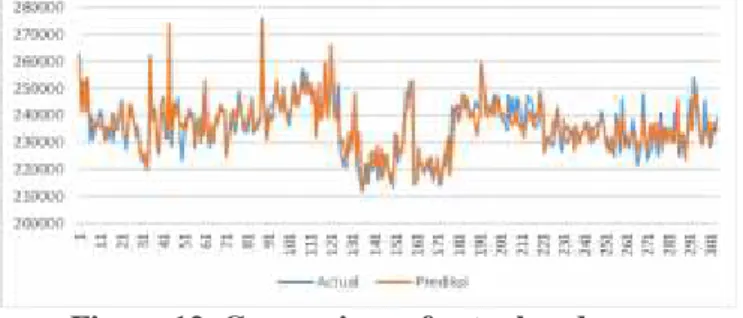
The results of plotting a picture of the difference between the actual and predicted values in the training data (PT.PIM hotel room rate) can be seen in Figure 4.14. Predicted values are drawn in orange, predictions can follow trends from actual data. The value of the absolute error or MAD difference resulting from the training process is 3173,187 which means that the average difference in the algorithm's predicted value and the actual value issued by the hotel is three thousand seventy-three point with a drop of seven rupiahs.
The relatively small number is seen from the nominal room rate of the hotel which ranges from more than two thousand to more thousand.
When using relative error measurement or MAPE, the average value of the relative error generated is 1.34% of the actual room rate. The standard deviation produced by the MAD measurement is 2842,853, in other words the average difference of each error has a standard of that value. While the STD value of MAPE is 1,206759%. The values above can be seen in the table.
Figure 12. Comparison of actual and predictive training data charts
This section will explain the design of a series of business modeling that will be carried out in research. In this study will separate survey data and test data in each dataset from the proposed ANFIS and PSO methods.
Data validation process is the most recent process in this study. The validation process will show how accurate the prediction results are using the ANFIS and Particle Swarm Optimization. MAD (Mean Absolute Error Deviation) equation used to compare the actual room rate value with the predicted room rate output value at PT.PIM.
In this business model design trial stage, each data in the dataset will be tested by calculating the Mean Absulute Error Deviation (MAD) written in equation 13
(13) Where N is the amount of data, and y is the output data. And y out prediction results.
Table 5. The results of measurement of error data output
MAD MAPE
AVERAGE 3173.187 1.347682 STD 2842.853 1.206759
The analysis results obtained this study the actual value and predictive value in the
training data (PT.PIM hotel room rate) can be seen in the difference value of the absolute error deviation or the resulting MAD is 3173,187 which means the average difference between the predicted value and the value actual amount issued by the hotel amounting to three thousand seventy-three point with a drop of seven rupiah. The relatively small number is seen from the nominal room rate of the hotel which ranges from more than two thousand to more thousand. When using relative error measurement or MAPE, the average value of the relative error generated is
1.34% of the actual room rate. The standard deviation produced by the MAD measurement is 2842,853, in other words the average difference of each error has a standard of that value. While the STD value of MAPE is 1,206759%. Based on ANFIS and Particle Swarm Optimization, the value of the room rate output of this study is more profitable and increases competitiveness for the company and more attractive to guests, so it is proposed to PT. PIM to use the input room rate output values in this study.
REFERENCES
1. Abdullah, A. A., & Terengganu, K. (2012). Internal Success Factor of Hotel Occupancy Rate. International Journal of Business and
Social Sience, 3(22), 199–218.
2. Atsalakis, G. S., Atsalaki, I. G., &
Zopounidis, C. (2018). Forecasting the success of a new tourism service by a neuro-fuzzy technique. European Journal of Operational Research, 268(2), 716–727. https://doi.org/10.1016/j.ejor.2018.01.044. 3. Al Shehhi, M., & Karathanasopoulos, A.
(2018). Forecasting Hotel Prices in Selected Middle East and North Africa Region (MENA) Cities with New Forecasting Tools. Theoretical Economics Letters,
08(09), 1623–1638.
https://doi.org/10.4236/tel.2018.89104. 4. Becerra, M., Santaló, J., & Silva, R. (2013).
Being better vs. being different: Differentiation, competition, and pricing strategies in the Spanish hotel industry.
Tourism Management, 34, 71–79. https://doi.org/10.1016/j.tourman.2012.03.0 14.
5. Bonner, J. (2017). New developments in
tourism and hotel demand modeling and forecasting. International Journal of Contemporary Hospitality Management, 29,
507–529.
6. Dong, Minggang., Wang, Ning. (2010),
“Adaptive Network-Based Fuzzy Inference System with Leave-Out Cross-Validation Approach for Prediction of Surface
Roughness”, Elsevier Jurnal Applied Mathematical Modelling Vol.35 hal
1024-1035.
7. Journal, I., & Issn, M. E. (2018). An Adaptive Neuro-Fuzzy Inference System
(ANFIS) for Wire-EDM of Ballistic Grade Aluminium Alloy. International Journal of
Automotive and Mechanical Engineering, 15(2), 5295–5307.
8. J-S.R. Jang. (1993) “ANFIS : Adaptive
Neural Network based Fuzzy Inference
System”,IEEE Transaction on System, MAN and Cybernetics, Vol.23.
9. Lee, S. H. (2016). How hotel managers decide to discount room rates: A conjoint analysis. International Journal of Hospitality Management, 52, 68–77. https://doi.org/10.1016/j.ijhm.2015.09.014. 10. Rini, Dian Palupi., Shamsuddin, Siti
Mariyam., Yuhanis, Sophiayati Yuhanis.
(2014), “Particle Swarm Optimization for ANFIS Interpretability and Accuracy”,
Springer Jurnal Soft Computing.
11. Pusinho, H.M.I., Mendes, V.M.F., Catalao,
J.P.S. (2010), “A Hybrid PSO-ANFIS Approach for Short-Term Wind Power
Prediction in Portugas”, Elsevier Jurnal
Energy Conversion and Management Vol.52 hal.397-402.
12. Soleimani, M., Salmalian, K. (2012)
“Genetic Algoritm Optimized ANFIS
Network for Modeling and Rediction of Energy Absorption rate of Brass Energy Absorbers”,Journal of Applied Matematics,
Islamic Azad University of Lahijan, Vol.8 No.4.
13. Sagir, A. M., & Sathasivam, S. (2017). A novel adaptive neuro fuzzy inference system based classification model for heart disease prediction. Pertanika Journal of Science and
Technology, 25(1), 43–56.
14. Santoso, Budi., Willy,Paul. (2011), Metoda
Metaheuristik konsep dan implementasi
15. Sada, A., Raheem, M., Saleem, A., Al-juboori, N. F. M., Flayyih, N., & Al-Juboori, M. (2013). INTERDISCIPLINARY JOURNAL OF CONTEMPORARY RESEARCH IN BUSINESS Factors Affecting Hotels Occupancy Rate (An Empirical Study on Some Hotels in Amman). Interdisciplinary Journal of Contemporary Research in Business, 142–
159.
16. Viglia, G., Mauri, A., & Carricano, M. (2016). The exploration of hotel reference prices under dynamic pricing scenarios and different forms of competition. International
Journal of Hospitality Management, 52, 46–
55.
https://doi.org/10.1016/j.ijhm.2015.09.010. 17. Yong, Y. L., Lee, Y., Gu, X., Angelov, P. P.,
Ngo, D. C. L., & Shafipour, E. (2018).
Foreign currency exchange rate prediction using neuro-fuzzy systems. Procedia Computer Science, 144, 232–238. https://doi.org/10.1016/j.procs.2018.10.523. 18. Zhang, Z., Ye, Q., & Law, R. (2011).
Determinants of hotel room price: An
exploration of travelers’ hierarchy of
accommodation needs. International Journal of Contemporary Hospitality
Management, 23(7), 972–981.
https://doi.org/10.1108/09596111111167551 .
19. Zang, Zhijun., Zheng, Huaimiao., Liu,
Yong. (2012) “Approach for InverseDesign
in Slop Engineering”. International Conference on Fuzzy System and Knowledge Discovery (FSKD).