AIS Electronic Library (AISeL)
AIS Electronic Library (AISeL)
ACIS 2012 Proceedings Australasian (ACIS)
2012
Industry and University Perspectives of Work Integrated Learning
Industry and University Perspectives of Work Integrated Learning
Programs in ICT Degrees
Programs in ICT Degrees
Chris PilgrimSwinburne University of Technology, [email protected]
Follow this and additional works at: https://aisel.aisnet.org/acis2012
Recommended Citation Recommended Citation
Pilgrim, Chris, "Industry and University Perspectives of Work Integrated Learning Programs in ICT Degrees" (2012). ACIS 2012 Proceedings. 15.
https://aisel.aisnet.org/acis2012/15
This material is brought to you by the Australasian (ACIS) at AIS Electronic Library (AISeL). It has been accepted for inclusion in ACIS 2012 Proceedings by an authorized administrator of AIS Electronic Library (AISeL). For more information, please contact [email protected].
Industry and University Perspectives of Work Integrated Learning
Programs in ICT Degrees
Chris Pilgrim
Faculty of Information and Communication Technologies Swinburne University of Technology
Australia
Email: [email protected]
Abstract
The ICT disciplines in Australian universities have a strong tradition of industry engagement in curriculum design and implementation particularly through work integrated learning programs. Work integrated learning (WIL) includes industry placements, internships, industry projects and other methods and approaches that aim to enhance the professional practice capabilities of students. There are various stakeholders involved in WIL programs including universities, students, government and industry, each with their own motivations and expectations. Whilst all stakeholders agree on the benefits to students, there are conflicting interests that jeopardise further development and innovation in WIL. This paper reports on surveys of industry and university stakeholders in order to understand representative views and current practices. The findings confirm a lack of a shared understanding between stakeholders regarding roles, responsibilities, models and benefits. The paper concludes with several recommendations regarding the adoption of an outcomes-based approach to the design and implementation of work integrated learning programs that will encourage innovation and quality in WIL.
Keywords
Education, work-integrated learning, industry-based learning, internships
INTRODUCTION
Australian universities have a strong history of engagement with industry regarding the design and implementation of ICT degree programs. There are many examples of best practice including innovative workplace experience programs and industry-linked final year projects. Authentic engagement with industry has the potential to bring significant benefits to all stakeholders including students, the university, industry and the community in general.
Despite the many examples of good practices and the significant potential benefits that come from these engagements, the 2008 ICT Scoping Study (Koppi and Naghdy, 2009) found that ICT graduates and ICT employers identified common deficiencies in the workplace readiness of new graduates particularly regarding the development of essential generic skills such as interpersonal and professional communications, business awareness and problem-solving abilities. The study suggested that new graduates and employers believed that these deficiencies could be addressed in large by appropriate workplace experience and recommended the development of further strategies for university/industry cooperation on curriculum and work-integrated learning.
This paper reports on a project that investigated the concerns that were raised in the 2008 ICT Scoping Study in the context of previous research into Work Integrated Learning (WIL). The project focused on the specific recommendations relating to the enhancement of the professional practice capabilities of graduates. The paper commences with an overview of various issues relating to work-integrated learning. It then describes the results of surveys of university leaders in learning and teaching in ICT and of industry representatives that provide a representative set of views of the issues and then concludes with some observations and recommendations.
WORK INTEGRATED LEARNING
The recent Australian Learning and Teaching Council (ALTC) national scoping study for Work Integrated Learning (WIL) (Patrick et al, 2009) reported on the broad and growing picture of WIL across Australia and ways of improving student learning experiences in relation to WIL. The project defined WIL as an umbrella term that included a “range of approaches and strategies that integrate theory with the practice of work within a purposefully designed curriculum”. Models of WIL may be classified on a continuum from the traditional external, industry-based WIL programs such as work experience placements and internships through to internal, university-based experiences such as project work, case studies and innovative virtual or simulated WIL
experiences. As the demand for WIL increases further alternative models are likely to be developed and refined in order to offer students a range of options for gaining workplace experience that suit different student motivations and capabilities and different university resourcing models and priorities.
The ALTC national scoping study identified a broad range of stakeholders connected with the design and implementation of WIL programs, including students, academics, employers, professional associations, and government (Patrick et al, 2009). There are well acknowledged benefits of WIL to all stakeholders. WIL provides students with an opportunity to test the theoretical knowledge learnt at university and to put it into action in the “complex and pressurized environment of the real professional world” (Bates, 2007). WIL programs integrate theory and practice providing students the opportunity to “develop those important ‘softer’ skills greatly valued by employers, such as team work, self-management and initiative” and “a graduate workforce who can make an immediate and meaningful contribution to increasing productivity and prosperity” (O’Connor, 2008). Employers also benefit from participation in WIL through recruitment opportunities (Patrick et al, 2009). In a survey of three Australian universities, Smith et al (2008) found that academics identified Industry-Based Learning as the single best feature of their degrees because it demonstrated alignment of their programs to industry. Finally universities benefit through improved student learning, engagement and retention (Patrick et al, 2009).
An authentic partnership or stakeholder approach to the planning, development and implementation of WIL programs is a critical success factor (Orrell, 2004; O’Connor, 2008). An integrated stakeholder approach that would be based on “formalised relationships and a common understanding of the associated responsibilities and level of commitment required” where there are “clear agreements and the recognition of needs as well as mutual benefit and costs” (Patrick et al, 2009). Smith et al (2008) link the quality of any Work Integrated Learning program to a dynamic interplay of stakeholder needs such as academic disciplines and departments contributing to the curriculum, the expectations of industry and professional associations, and the students. Implementation of a stakeholder approach to WIL requires identification of the responsibilities of each stakeholder and the benefits that each will derive from the program.
The importance of the identification and articulation of the specific responsibilities of each partner was noted by Bates et al (2007) who suggested that WIL is a three‐way partnership between the student, workplace, and educational institution. The student must take responsibility for their own learning during a placement, the university has the responsibility for ensuring the WIL curriculum provides students with learning opportunities including a requirement for reflective learning, the academic supervisor has responsibility for mentoring, support and feedback, and finally the workplace organisation has the responsibility for providing a relevant and suitable project for the student to focus on and a suitable induction process for introducing students to the specific workplace.
A related consideration is the identification of the explicit benefits for each stakeholder. Whilst the benefits to students are self-evident, it is sometimes challenging to identify the benefits for industry partners. The motivations of host organizations can range from those who have a ‘value-added’ ethos in which the placement is evaluated on tangible, short-term returns for the organization through to a ‘stakeholder’ ethos which emphasizes learning with a long-term view seeking benefits for all parties (Harvey et al, 1997). This can lead to a tension between ensuring that organisations benefit from some tangible task-related outcomes whilst retaining the academic requirement that students achieve an appropriate learning experience with intentional learning outcomes.
In addition to the key issues of managing the expectations and motivations of students, universities and industry, the Australian Government should also be regarded as being a stakeholder in WIL programs with their own particular motivations and expectations. The Government is now demanding more accountability for the quality of higher education through the Tertiary Education Quality and Standards Agency (TEQSA). The TEQSA Provider Course Accreditation Standards refer specifically to WIL in the following statement, “The higher education provider has effective arrangements to assure the quality of student work placements, practicum and other forms of work-integrated learning in the course of study, including assuring the quality of supervision” (TEQSA, 2011). TEQSA are adopting an outcomes approach to ensuring quality that will require universities to develop curriculum statements that formalize learning outcomes for programs and units. These requirements will have particular implications for WIL programs that have traditionally had relatively flexible approaches to learning outcomes, assessment and the roles of the participants (Bates, 2007).
Given these emerging government requirements and the necessity of the management of partnership relationships, there is an urgent need for the development of a shared understanding of the learning objectives, roles, responsibilities and benefits of WIL programs. This paper reports on a project that commences this process through surveys of the university and industry stakeholders in order to establish current practices and representative views.
SURVEYS
Two surveys were conducted. The first survey involved managers and educational leaders of ICT teaching units within Australian universities. The second survey obtained representative views and current practices from industry.
Survey 1 – University Practices and Views
The aim of the first survey was to obtain an understanding of the representative views and practices of WIL in ICT in Australian universities. The survey consisted of a number of questions rated on a 5-point Likert Scale where a tick was sufficient to indicate the response and an option to provide further comments. Entries to survey tick boxes were compiled to provide quantitative data.
Surveys were distributed to the Heads of ICT organisational units at Australian universities who were members of the Australian Council of Deans of ICT. A total of 22 completed surveys were received from 18 universities. In addition the same survey was provided to Associate Deans for Learning and Teaching (or their equivalent) in ICT at a forum of 36 attendees representing 25 universities resulting in 30 completed surveys. Discussions at the forum in relation to WIL in ICT were also captured. In total 52 surveys were received from universities.
Survey 2 – Industry Practices and Views
The aim of the second survey was to gather representative views and practices from industry regarding industry participation in the curriculum and work-integrated learning. The survey consisted of two main types of questions. Participants were asked questions that captured demographic and background information such as job title, gender, type of industry and state. The rest of the survey contained questions that were designed to explore the respondent’s views on work integrated learning and industry contribution to the curriculum. The questions included a check box response rated on a 5-point Likert Scale where a tick was sufficient to indicate the response and an option to provide further comments. Entries to survey tick boxes were compiled to provide quantitative data.
Surveys were distributed to members of the industry advisory boards and other industry partners at four Australian Universities as well as to industry members of the Australian Computer Society (ACS). The survey was distributed through online (SurveyMonkey) with some paper versions going to the university advisory committee members. A total of 182 responses were received comprising 68 responses from industry advisory boards/partners (36 online and 32 paper) and 114 responses from industry members of the ACS.
FINDINGS
The Value of Work Integrated Learning Programs
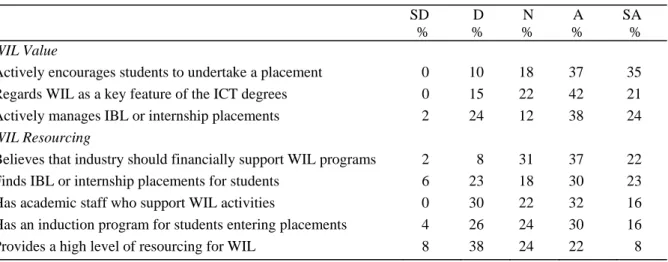
Table 1 shows local practices within ICT schools or departments based on the survey of university teaching and learning leaders. Responses range from Strongly Disagree (SD) to Strongly Agree (SA) with the proportion (%) of entries per box and ranked according to the strength of agreement (A + SA) with the given statements.
Table 1. University views on value and costs of WIL
These results suggest that the majority of universities regard Work-Integrated Learning (WIL) as a key feature of ICT degrees and actively encourage students to undertake a placement. A little over half of the universities
SD % D % N % A % SA % WIL Value
Actively encourages students to undertake a placement 0 10 18 37 35 Regards WIL as a key feature of the ICT degrees 0 15 22 42 21 Actively manages IBL or internship placements 2 24 12 38 24
WIL Resourcing
Believes that industry should financially support WIL programs 2 8 31 37 22 Finds IBL or internship placements for students 6 23 18 30 23 Has academic staff who support WIL activities 0 30 22 32 16 Has an induction program for students entering placements 4 26 24 30 16 Provides a high level of resourcing for WIL 8 38 24 22 8
actively find and manage placements and believe that industry should support the management of such programs. About half the ICT departments provide support for industry engagement with WIL although less than half provide support for students with an induction program.
The representatives from the Associate Dean forum unanimously agreed that from a University perspective WIL is beneficial in developing certain ‘professional attributes’ in students with many universities regarding WIL and IBL as key features of their degrees. There were some concerns raised during the forum regarding the need for some ‘hard evidence’ of the value of WIL in the context of student outcomes beyond the direct employment benefits and also that such employment benefits should not necessarily be seen as the primary goal of university education.
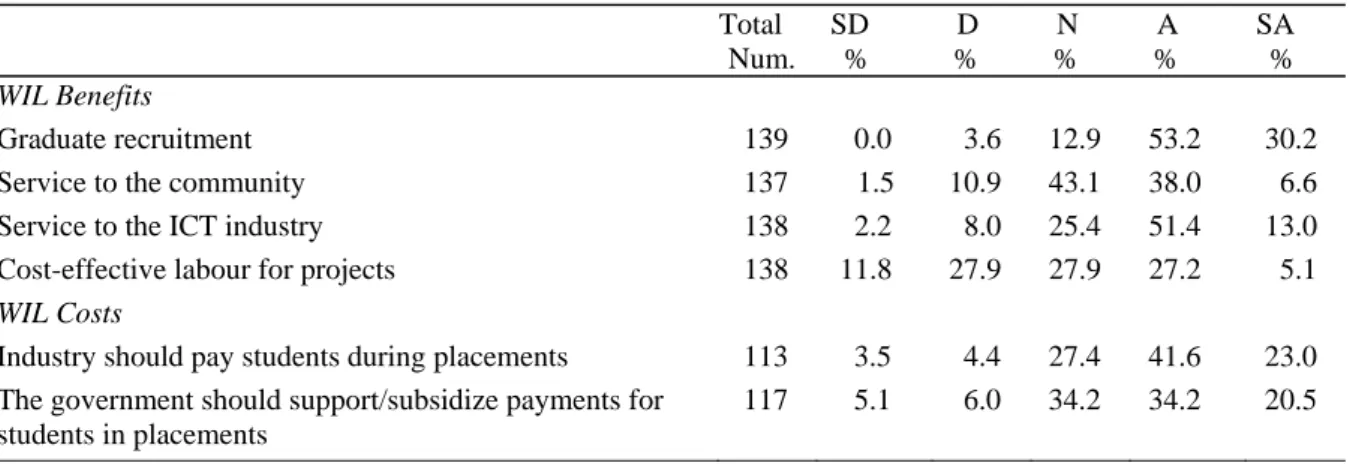
From an industry perspective there appears a strong consensus that traditional forms of WIL such as Industry-Based Learning (IBL) placements and internships are highly desirable and effective in developing the employability attributes of graduates (Table 2). Industry appears to regard WIL primarily as a graduate recruitment strategy however there is strong support for the view that WIL is a service to the ICT industry. Industry appears to have mixed views regarding government support or subsidises for WIL.
Table 2. Industry views benefit and costs of WIL to industry
Total Num. SD % D % N % A % SA % WIL Benefits Graduate recruitment 139 0.0 3.6 12.9 53.2 30.2 Service to the community 137 1.5 10.9 43.1 38.0 6.6 Service to the ICT industry 138 2.2 8.0 25.4 51.4 13.0 Cost-effective labour for projects 138 11.8 27.9 27.9 27.2 5.1
WIL Costs
Industry should pay students during placements 113 3.5 4.4 27.4 41.6 23.0 The government should support/subsidize payments for
students in placements
117 5.1 6.0 34.2 34.2 20.5
The comments from the industry respondents were generally supportive of WIL experiences,
“Involvement in graduate programs may not be cost-effective but they can build staff loyalty, improve industry recognition by potential recruits and encourage / improve the quality of IT graduates that would assist them in not for graduate intake, later when graduates transition to other roles. It lifts the game overall.”
However there were some respondents who raised concerns regarding the level of investment required by industry in engaging with a university WIL program,
“It will always be a very simple equation for any employer and that is cost related. How productive is someone going to be in how short a time.”
“WIL style tasks tend not to be cost effective as it usually requires senior staff to oversee and assist the students working on the project, particularly if the project requires business knowledge.”
Table 3 indicates the representative views of industry regarding the value of WIL experiences when recruiting graduates. These results indicate strong support for WIL experiences involving actual workplace experience rather than those where industry has involvement in an internal program such as projects or guest speakers
Table 3. Industry views regarding value of WIL when recruiting
Total Num. SD % D % N % A % SA % The student has worked in an industry placement for 3 to
12 months
148 2.0 6.8 10.1 42.6 38.5
The student has worked on a project that has been set by industry during their studies
148 0.7 8.1 29.1 47.3 14.9
The student has experienced a simulated workplace environment within a university
148 6.1 33.1 34.5 19.6 6.8
The student has been exposed to curriculum that has direct industry links including industry guest speakers
Models of Work Integrated Learning Programs
The significant benefits of WIL has incentivised universities to develop and implement a range of models of WIL extending from the traditional work experience placement or internship programs to innovative virtual or simulated WIL experiences. The range of models have also been acknowledge by the government with O’Connor (2008) noting that WIL comes in many different forms including “research, internships, studying abroad, student teaching, clinical rotations, community service or volunteer work, industry attachments or placements, sandwich programs, and professional work placements”. Boud and Symes (2000) regard all models of WIL, including those that occur in a workplace, in the community, within the university, and real or simulated, as valid “as long as the experience is authentic, relevant and meaningfully assessed and evaluated”.
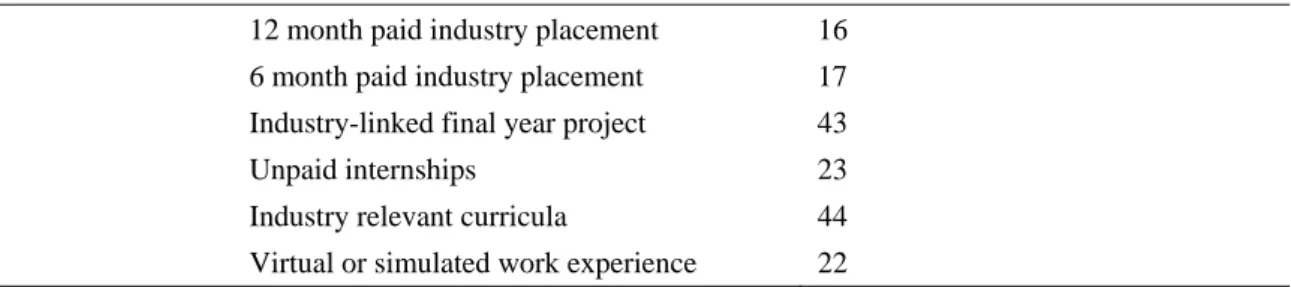
Table 4. University WIL opportunities available to students
12 month paid industry placement 16 6 month paid industry placement 17 Industry-linked final year project 43 Unpaid internships 23 Industry relevant curricula 44 Virtual or simulated work experience 22
Table 4 shows the tick-box results from the 52 respondents regarding the kinds of WIL opportunities available to students at their institution. Respondents may have ticked more than one box. Most respondents indicated that their curricula are industry relevant and that the final year project is somehow linked to industry.
Virtual or simulated work experiences seem to be a common practice. The Associate Dean’s Forum attendees were overwhelmingly in support of WIL models that provided authentic work experience for students. In particular the forum participants discussed alternative opportunities for students unable to attend a workplace (such as by means of a placement). For those students, a virtual or simulated experience was regarded as a valid option. Unpaid internships were also indicated by a similar number of respondents, and paid industry placements were the least available to students.
Survey respondents also had the opportunity to specify other options available to students or comment on the tick-box options, and these included:
Funded placements through WIL scholarships
Placements vary from a few weeks to about three months, and may be part-time, e.g., 2.5 days/week or a flexible 100 hours during the course
Paid internships in research organisations
Guest teaching by industry professionals
Assignments requiring interviews and interaction with ICT professionals in industry
The range of work integrated learning opportunities appears broad from a national perspective but the options at the local level will depend upon the university location (metropolitan or rural), local context, staff approaches and resource availability. The forum participants agreed that a range of models was required in order to provide the flexibility to accommodate the diversity of student capabilities, motivations and interests as well as different university resourcing models and priorities.
The industry representatives were surveyed on their views of the authenticity of the various models of WIL (Table 5).
Table 5. Industry views regarding authenticity of WIL models
Total Num. SD % D % N % A % SA % Students working in an industry placement for 3 to 12
months
148 0.7 2.7 12.8 45.9 37.8
Students working on a project that has been set by industry during their studies
147 0.7 8.8 29.3 46.3 15.0
A simulated workplace environment within a university 147 5.4 46.3 29.3 12.9 6.1 Curriculum that has direct industry links and is taught with
industry guest speakers
The results confirmed strong support for models of WIL that involved actual workplace experience such as internships, industry-based learning and work experience placements. The industry survey suggested that industry linked projects set as part of university studies, such as final year capstone projects, were still generally regarded as ‘authentic’ however not as much as a workplace experience.
The results indicate that a majority of industry respondents believe that simulated or virtual WIL experiences that are conducted within a university are less authentic. They do however have a higher regard for the authenticity of models of WIL that involves actual industry representatives, such as guest speakers. Perhaps this is an indication of a lack of confidence in university academics to provide students with an understanding of professional ICT work.
Some of the comments from the industry respondents confirm the finding that there is a strong preference in industry for the traditional work placement rather than other forms of learning experiences that provide students with a professional experience,
“There is no substitute for actual experience in the work place”.
“Practical industry placement gives the student an experience which he/she would not get in any other way.”
“Authentic is the key word for me here and a ‘simulated’ environment is not authentic or real.”
“Generally speaking, despite universities' best efforts, universities cannot recreate a true industry environment. No matter how deadline driven teams are, assessors have to limit interaction between teams and teaching staff to prevent accusations of collusion or assistance, Similarly, real world systems are often vague and indistinct and require at least some business knowledge, making precise evaluation difficult.”
These results and comments are consistent with the results in Table 5 that indicate that employers have a much lower regard for WIL experiences that do not involve a workplace experience when recruiting graduates.
Success Measures of Work Integrated Learning Programs
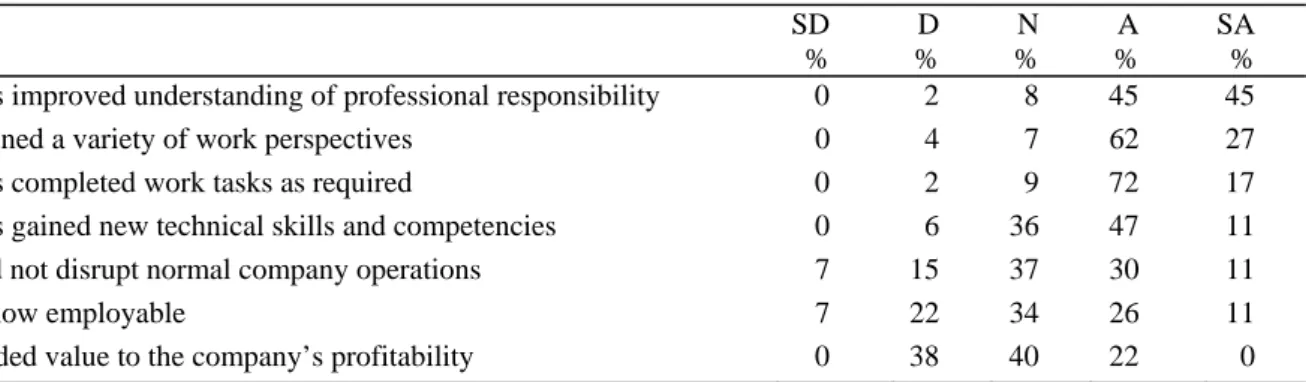
Table 6 shows the proportional responses (%) of academic staff to the statement: ‘The success of an Industry-Based Learning or internship placement is judged when the student:’.
Table 6. University views on success measures of placements
SD % D % N % A % SA % Has improved understanding of professional responsibility 0 2 8 45 45 Gained a variety of work perspectives 0 4 7 62 27 Has completed work tasks as required 0 2 9 72 17 Has gained new technical skills and competencies 0 6 36 47 11 Did not disrupt normal company operations 7 15 37 30 11
Is now employable 7 22 34 26 11
Added value to the company’s profitability 0 38 40 22 0
The results suggest that academics believe that a successful WIL experience provides students with an improved understanding of professional responsibility and the variety of work perspectives. Completion of work tasks is a strongly desired outcome but these are not necessarily related to gaining new technical skills and competencies because the proportion of responses to these two outcomes is different. On balance, not disrupting normal company operations is seen as a success but adding financial gain to the company is generally not.
Additional comments made by university survey respondents with respect to success measures include the attainment of analytical skills, better interpersonal skills, more realistic views about the workplace and work politics, and improved self-organisation. In addition to not disrupting company operations, it was noted that the students should not harm university-industry relations.
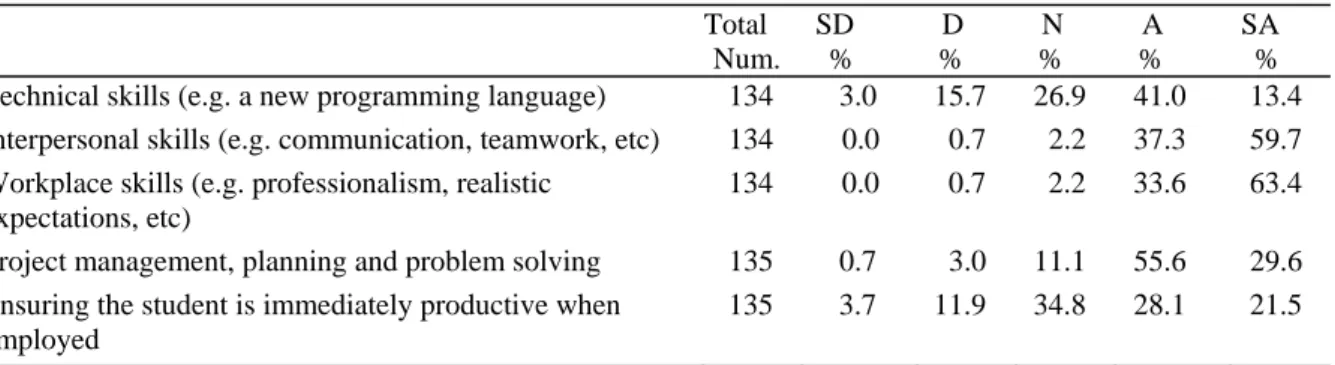
The results of the university survey may be contrasted with the industry survey question regarding their views on the attributes or skills that WIL should develop in students (Table 7). Whilst there is alignment regarding the value of the development of professionalism and work place skills there appears to be a stronger priority for employability outcomes from WIL programs.
Table 7. Industry views on attributes or skills that WIL should develop in students Total Num. SD % D % N % A % SA % Technical skills (e.g. a new programming language) 134 3.0 15.7 26.9 41.0 13.4 Interpersonal skills (e.g. communication, teamwork, etc) 134 0.0 0.7 2.2 37.3 59.7 Workplace skills (e.g. professionalism, realistic
expectations, etc)
134 0.0 0.7 2.2 33.6 63.4
Project management, planning and problem solving 135 0.7 3.0 11.1 55.6 29.6 Ensuring the student is immediately productive when
employed
135 3.7 11.9 34.8 28.1 21.5
The participants from the Associate Dean forum agreed that WIL is beneficial in developing certain ‘professional attributes’ in students. Although development of these attributes might improve student’s employment prospects, some at the forum argued that the value of WIL extended beyond employment benefits and that employment outcomes should not necessarily be seen as the primary goal of university education. These differences in priorities between the university’s priorities in teaching theory and practice along with life-long learning skills with industry’s priorities of employment outcomes and relevant work skills has resulted in some employers believing that “universities are not interested in meeting industry requirements” (Koppi and Naghdy, 2009). This tension is not new or limited to the Australian ICT context with Shoikova & Dwishev (2004) commenting on the academic goal to develop rounded graduates with life-long learning skills in contrast to industry priorities of graduates who are trained in the contemporary tools and techniques used in current corporate and industry environments.
DISCUSSION
The results of the university survey and Associate Dean forum discussions indicate that there are a range of rationale and practices for WIL in Australian universities. Universities recognise the educational and employment benefits of WIL and generally regard WIL as a key feature of ICT programs. Resourcing for WIL varies across the sector possibly influencing a variety of models of WIL that extend from the traditional work experience placement to virtual or simulated WIL experiences. Universities appear to advocate for more flexibility in WIL models to meet the diversity of student capabilities and interests, including international students and those students with inflexible part-time jobs. Universities also indicated that appropriate models of WIL are required to suit different university resourcing models and priorities.
The results indicate that the most prevalent WIL models were the ‘Industry-Linked Final Year Project’ and ‘Industry Relevant Curricula’. These models may be classified as ‘internal’ using a continuum from the traditional ‘external’, industry-based WIL experiences such as work experience placements and internships to ‘internal’, university-based experiences such as project work, case studies and experiential learning opportunities. Fewer universities provided traditional 6 month or 12 month paid industry-based learning placements.
The use of industry-linked final year projects as the key method of providing a WIL experience in ICT degrees is endorsed by the Australian Computer Society in their Accreditation Guidelines (ACS, 2009) that state that programs must “include a capstone unit in the final year to allow an assessment of the program objectives.” The ACS guidelines contain a Policy on Capstone Units that identifies two objectives for capstone units, the integration of the skills and knowledge developed throughout the program, and providing a structured learning experience to facilitate a smooth transition to professional practice. The ACS policy does not provide details of the types of learning experiences that would be appropriate to achieve these objectives apart from a statement regarding the need for “authentic learning experiences in relation to its intended professional outcomes”.
The issue of the authenticity of learning experiences is central to the success of WIL programs; however agreement on what makes a WIL learning experience authentic appears to be split between academic and industry views. Whilst universities support the development of virtual or simulated models, particularly for those universities where direct industry experiences are difficult to achieve, the results of the industry survey indicate some different views. The industry survey suggest that industry values models of WIL that involve direct experience within a workplace environment in terms of authenticity and as a consideration when recruiting graduates. There is a lesser preference for industry-linked projects and the use of industry guest speakers. There is significantly less support for university-based simulated workplace environments with comments such as “a ‘simulated’ environment is not authentic or real”.
The results of the university survey indicate that universities believe that a successful WIL experience provides students with an improved understanding of professional responsibility and the attainment of generic skills. These attributes were also identified by the industry survey as extremely valuable outcomes of WIL. Industry also indicated strong support for WIL having the objectives of developing student’s technical skills and ensuring that the student is immediately productive when employed. The forum discussions raised concerns from universities regarding industry priority for universities to produce work ready graduates possibly at the expense of a more holistic education with a focus on life-long learning. This issue was described as an ‘expectations gap’ in the ALTC WIL Project (Patrick et al, 2009) which recommended a “stakeholder integrated approach to the planning and conduct of WIL based on formalised, sustainable relationships and a common understanding of the procedures and commitment required by all those involved.”
An approach to develop a shared understanding regarding the authenticity of the range of learning experiences for WIL is required in order to achieve industry acceptance and recognition of innovative internal and virtual models of WIL. This approach also needs to address the balance that is needed between employability skills and lifelong learning.
The movement towards outcomes-based approach from TEQSA may provide a way forward to achieving a common understanding of the value of the full spectrum of WIL models. This approach involves an increased focus on the demonstration of student attainment of stated outcomes rather than teaching approaches and processes. The outcomes-based approach generally requires a linking of course and unit level learning objectives with graduate outcomes and encourages diversity and innovation in methods of delivery.
The findings from the surveys and forum discussions indicate that there is lack of a shared understanding between universities and industry regarding the learning objectives, roles, responsibilities and benefits for WIL programs.
Further work on the development of clear learning objectives for WIL is urgent. This development should be undertaken with the support of all stakeholders including universities, industry, professional bodies, industry associations and particularly students. The development of shared and agreed learning objectives will result in further innovation in WIL, including acceptance of different models of WIL including external forms where students go out to industry (e.g. industry placements, internships, field visits and community projects) as well as internal models where industry comes to students (e.g. guest speakers, case studies, industry linked projects and simulated experiences). The authenticity of each form of WIL should be evaluated according to the achievement of the agreed learning objectives. This change in focus will benefit all stakeholders particularly students.
CONCLUSION
The study confirms that stakeholders, including universities, government, industry and students, acknowledge the benefits of WIL. The study revealed strong academic support for students being exposed to professional practice through a variety of WIL models however that industry does not regard internal models of WIL such as simulated workplaces as authentic. Authenticity is the critical success factor in WIL. There are also opposing views regarding the objectives of WIL in relation to immediate employability outcomes or lifelong learning. It is recommended that all stakeholders collaborate on the development of an outcomes-based approach to WIL including the development of clear learning objectives for WIL experiences. Agreement on such learning objectives may provide the basis for mutual recognition of the authenticity of innovative models of WIL such as virtual and simulated experiences and will ensure the balance between employability skills and lifelong learning
REFERENCES
ACS 2009. ANZ ICT Accreditation Board, Accreditation Manual, Document 2A: Application Guidelines – Professional Level Courses, February 2009.
Bates A., Bates B., and Bates C., 2007. Preparing students for the professional workplace: who has responsibility for what? Asia‐Pacific Journal of Cooperative Education, 2007, 8:2, pp. 121‐129.
Boud, D. and Symes, C. 2000. Learning for real: work-based education in universities. In C. Symes & J. McIntyre (Eds), Working Knowledge: the new vocationalism and higher education, pp.14-29. Buckingham: Open University Press.
Harvey, L., Moon, S., Geall, V., and Bower, R., 1997. Graduates’ work: Organisational change and students’ attributes. Birmingham: CRQ and AGR.
Koppi, T. and Naghdy, F. 2009. Managing Educational Change in the ICT Discipline at the Tertiary Education Level, Australian Learning and Teaching Council (ALTC), Final project report.
O'Connor, B. 2008. Work Integrated Learning (WIL): Transforming Futures Practice... Pedagogy... Partnership, Address to: World Association for Cooperative Education Asia Pacific Conference, 1 Oct, 2008, from: http://www.deewr.gov.au/Ministers/OConnor/Media/Speeches/Pages/Article_081003_124044.aspx
Orrell, J. 2004. Work-integrated Learning Programmes: Management and Educational Quality, Proceedings of the Australian Universities Quality Forum.
Patrick, C., Peach, D., Pocknee, C., Webb, F., Fletcher, M., Pretto, G., 2008. The WIL (Work Integrated Learning) Report: A National Scoping Study, Australian Learning and Teaching Council (ALTC), Final project report.
Pauling, J.W. and Komisarczuk, P. 2007. ‘Review of work experience in a Bachelor of Information Technology’. Ninth Australasian Computing Education Conference (ACE2007), Ballarat, Victoria, January 2007. Conferences in Research in Practice in Information Technology, vol. 66, pp. 125–132.
Shoikova, E. & Dwishev, V. 2004. University - Industry network, Proceedings of the 27th Int’l Spring Seminar on Electronics Technology, IEEE, pp. 510-514
Smith, R., Mackay, D., Holt D. & Challis, D. 2008. Expanding the realm of best practices in cooperative industry‐based learning in information systems and information technology: an inter‐institutional investigation in Australian higher education, Asia‐Pacific Journal of Cooperative Education, 9:1, pp. 73‐80. TEQSA, 2011. Higher Education Standards Framework, Version 1, Department of IISRTE, Dec 2011.
ACKNOWLEDGEMENTS
This study was supported through the Australian Learning and Teaching Council Project: PP9-1274, “Addressing ICT curriculum recommendations from surveys of academics, workplace graduates, and employers”. The project team included J Armarego, P Bailes, P Hyland, T Koppi, T McGill, G Naghdy, F Naghdy, P Ogunbona, C Pilgrim and M Roberts.
COPYRIGHT
Chris Pilgrim © 2012. The authors assign to ACIS and educational and non-profit institutions a non-exclusive licence to use this document for personal use and in courses of instruction provided that the article is used in full and this copyright statement is reproduced. The authors also grant a non-exclusive licence to ACIS to publish this document in full in the Conference Papers and Proceedings. Those documents may be published on the World Wide Web, CD-ROM, in printed form, and on mirror sites on the World Wide Web. Any other usage is prohibited without the express permission of the authors.