THE U.S.-CHINA LAB-TO-LAB
TECHNICAL EXCHANGE PROGRAM
by Nancy Prindle
Ms. Prindle is a Principal Member of the Technical Staff at Sandia National Laboratories, where she is Project Manager for the China Programs in the International Security Initiatives Department. She is a specialist in nuclear systems, having worked at Sandia since 1978 in international programs for nuclear reactor safety, nuclear waste management, and nonproliferation. She holds a Master’s Degree in Mechanical Engineering from the University of California at Berkeley.
I
n July 1994, Deputy Assistant Secretary of State Rob-ert Einhorn requested that the U.S. Department of Energy (DOE) establish scientific interactions with China in support of U.S. arms control and nonprolifera-tion policy. The request called for scientific interacnonprolifera-tions between scientists at the DOE nuclear weapon labora-tories—Sandia National Laboratories (SNL), Lawrence Livermore National Laboratory (LLNL), and Los Alamos National Laboratory (LANL)—and their counterparts in China. Einhorn’s letter suggested that the initial scope be restricted to nuclear arms control and nonproliferation, but allowed expanding to other topics, such as chemical weapons or environmental issues, in the future on a case-by-case basis. Subsequent letter exchanges in 1994 and 1995 between DOE, the State Department, and the di-rectors of the participating scientific institutions involved, confirmed the desirability of such a program, as described by Einhorn, and the “U.S.-China Lab-to-Lab Technical Exchange Program” (CLL) was born.OBJECTIVES OF THE CLL
Both the United States and China took risks in estab-lishing the CLL. However, the compelling motivation for the CLL outweighed these risks, as the United States and China each recognized that the unique professional relationships their nuclear scientists fostered through the CLL would provide a vehicle for increasing trust and
developing common approaches on issues of concern to national and international security. Accordingly, they jointly defined the following three primary objectives for the CLL:
1. Provide technical contributions to arms control and nonproliferation efforts in the United States and China through joint development and deployment of inte-grated systems of modern technologies;
2. Explore new technical means for building mutual trust based on information shared about the operations and management of nuclear facilities, while at the same time protecting national security interests of both the United States and China; and
3. Establish long-lasting, professional relationships as a basis for understanding between U.S. and Chinese scientists concerned with arms control, nonprolifera-tion, and regional stability in Asia.
These objectives for the CLL are based upon both common ground and differences between the United States and China in the area of arms control and nonpro-liferation. Both countries attach great importance to the area of arms control, have engaged in technical research in this area in the past, and agree that arms control calls for international cooperation and mutual exchange. How-ever, there is much less technical arms control experi-ence in the Chinese nuclear weapons institutes,1 and the
nonproliferation topics) are usually more limited than those of the United States.2
The differences between the United States and China in the area of arms control give rise to a second level of objectives. This “working-level” set of objectives focuses on technical training and implementation issues for the Chinese. Particular emphasis is given to demonstrating technical means for sharing selected information on nuclear materials and facilities to comply with interna-tional agreements and participate in confidence-building measures, while at the same time protecting sensitive national security information.
Finally, it is noted for background purposes, that this technical exchange program between the United States and China should not be confused with the U.S.-Russian lab-to-lab program,3 as they are very different in scope,
objectives, funding sources, funding levels, and proce-dures. The Chinese program is funded at a much lower level than the Russian program. The scope of the China program is narrow and proactive—looking forward to build foundations for cooperation—rather than reactive as in the case of the Russian program. Another impor-tant difference is that, in contrast to the Russian pro-gram, the CLL is based on reciprocity of contributions, with no money being sent to China.
PROGRAM PARTICIPANTS
The CLL program is unofficial in nature, does not in-clude government officials in the cooperative exchanges, but derives its authority from close oversight of govern-ment officials on each side. In keeping with the original charter, the majority of the funds on the U.S. side for the technical exchange to date have come through DOE’s Office of Arms Control and Nonproliferation. The DOE officials and U.S. scientists coordinate interactions care-fully with a U.S. interagency oversight group to ensure they are consistent with and supportive of U.S. policy. Officials from the State Department, DOE, Department of Defense (DOD), National Security Council (NSC), Office of Science and Technology Policy (OSTP), and Arms Control and Disarmament Agency (ACDA) sit on the interagency oversight group, which is chaired by the Department of State’s Political/Military Affairs Bureau to provide policy guidance and review results of the pro-gram.
The U.S. national laboratory scientists in the program
ticipation through a tri-lab steering committee from SNL, LANL, and LLNL. The primary counterpart institution in China to date has been the China Academy of Engi-neering Physics (CAEP), which is responsible for the research, design, and engineering of China’s nuclear weapons program. The China Institute of Atomic En-ergy (CIAE) has also been involved in the CLL activi-ties. The CIAE is the research arm of the China National Nuclear Corporation (CNNC)4 responsible for scientific
research and development in civilian nuclear applica-tions, such as reactors and the fuel cycle (including en-richment, reprocessing, and waste management).
The Chinese nuclear scientists also emphasize their unofficial status in this program. Their steering commit-tee (comprised of scientists from CAEP) coordinates and approves all of their interactions with the United States. Prior to the spring of 1998, the CAEP received funding and final approval on its activities from government of-ficials through the Committee on Science and Technol-ogy in National Defense (COSTIND).5 Since the
beginning of 1998, bureaucratic changes in China’s of-ficial administrative bodies have created three separate systems with oversight responsibility for Chinese arms control activities:
1. Ministry of Foreign Affairs—the newly created Bureau for Arms Control headed by Ambassador Sha Zukang will be responsible for arms control policy and studies;
2. People’s Liberation Army (PLA)—the newly formed Department of Facilities and Equipment will incorporate much of the “old” COSTIND and assume responsibility for defense research and development, including technical and security aspects of arms con-trol; and
3. “New COSTIND”—will be a civilian organization with some arms control programs related to outer space and all nuclear topics.
The demarcation of roles and responsibilities between China’s oversight government entities, such as the “new COSTIND,” the new PLA department, the MFA, and the private entities to be formed from the old CNNC is unclear at present. However, it appears that the mission of the research institutes such as CAEP and CIAE will be unchanged in the new system. Chinese officials have pledged their support for the existing CLL program at high levels, and have committed to honoring the exist-ing CLL agreements durexist-ing this transition period. The
cated that they will need to establish new procedures for future agreements, however. These procedures should become clear towards the end of 1998 when the roles and responsibilities of the new government organizations are defined.
A third institution, which is developing a key role for verification of the Comprehensive Test Ban Treaty (CTBT) in China, is the Northwest Institute of Nuclear Technology (NINT) located in Xian. In the past, NINT was the institution responsible for conducting and ana-lyzing China’s nuclear testing program. Since China signed the CTBT, NINT has emerged with the primary responsibility for China’s field implementation of the technologies for the International Monitoring System (IMS).
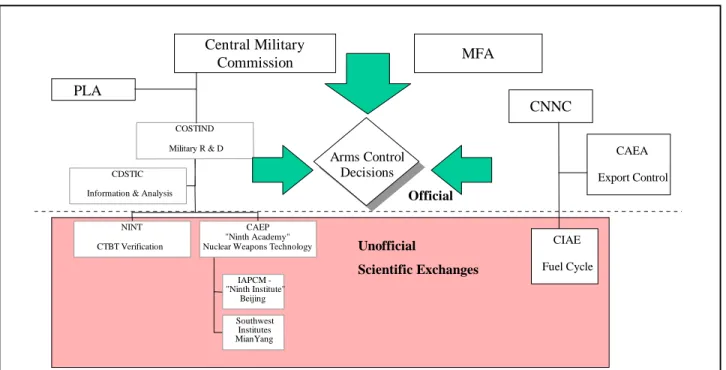
Figure 1 shows how these three Chinese research in-stitutes interacted prior to 1998 with government enti-ties in China for arms control decisionmaking. Note that the technical exchanges between U.S. and Chinese sci-entists through the CLL all occur at an “unofficial” level. The recent bureaucratic changes at the “official” level that have occurred in China have not affected the basic relations among these research institutes; and the CLL interactions have remained stable during this transition.
ROLE OF TECHNICAL COMMUNITY IN ARMS CONTROL EFFORTS
In order to assess the value of the technical exchange program between U.S. and Chinese nuclear scientists, one must consider what role the technical community plays in arms control and nonproliferation efforts. U.S. experience has shown that there are three primary roles for nuclear scientists in arms control and nonprolifera-tion:
1. To provide technical analysis and advice to the gov-ernment for achieving desired balances between arms control, nonproliferation, and national security inter-ests;
2. To provide technical assessments of the viability of certain arms control and nonproliferation proposals or regimes; and
3. To develop and implement the technical aspects of verification or control regimes for arms control and nonproliferation.
Clearly, the technical community must interact with official government organizations (including the military) responsible for making arms control and nonprolifera-tion decisions. Often, this interacnonprolifera-tion occurs in both the United States and China in an interdisciplinary forum that
Figure 1: Chinese Research Institutions Involved in Arms Control and Nonproliferation
CDSTIC Information & Analysis
NINT CTBT Verification IAPCM - "Ninth Institute" Beijing Southwest Institutes MianYang CAEP "Ninth Academy" Nuclear Weapons Technology COSTIND Military R & D Unofficial Scientific Exchanges
Official Central Military Commission Arms Control Decisions MFA PLA CNNC CIAE Fuel Cycle CAEA Export Control
also includes nongovernmental organizations (NGOs) and academia. The same is true in China, where these inter-actions tend to be ad hoc and based on relationships between individuals rather than on institutions.
OVERVIEW OF CURRENT PROJECTS
The U.S. laboratories (SNL, LANL, and LLNL) kicked off the technical exchange program with a series of work-shops with their Chinese counterparts at CAEP in fiscal years 1996 and 1997 to identify topics for collaboration. Several areas were targeted for joint projects. The re-sulting collaborative projects currently fall into two broad categories: those related to voluntary efforts for effec-tive and responsible nuclear materials management, and those related to commitments under specific arms con-trol and nonproliferation treaties and agreements. In the course of planning and carrying out the initial phases of this collaboration, other areas of potential cooperation of benefit to both parties have been identified. Figure 2 pro-vides a condensed summary of the current and future projects being pursued.
Three CLL project areas have been initiated to date in the areas of nuclear materials management, verification technologies, and nonproliferation. These individual projects in progress are described in more detail below.
Nuclear Materials Management
The flagship project for the CLL is a joint demonstra-tion of technologies for nuclear material protecdemonstra-tion, con-trol, and accounting (MPC&A) with participation from all three of the U.S. laboratories, the CAEP, and the CIAE. This demonstration will take place in July 1998 just outside Beijing at the Nuclear Materials Safeguards Laboratory of the CIAE. The concepts of applying tech-nologies to ensure physical protection and control of nuclear materials will be demonstrated in a vault-type room containing special nuclear material.
Supporting workshops were held in the United States during 1997 and 1998 for all the institutions participat-ing in the demonstration project. The workshops were followed by the exchange of scientists among CAEP, LANL, and SNL to allow principal investigators to work side-by-side to define the technical specifications for this demonstration. In addition to the facility and the special nuclear material, the Chinese are providing the nonde-structive assay equipment,6while the United States is
cal protection sensors, an entry and alarm control display computer, and accountability and measurement software. The MPC&A demonstration will provide an impor-tant foundation for building future activities for nuclear materials management in China. Both CIAE and CAEP are exploring remote and on-site monitoring and control technologies for application at actual facilities. In addi-tion, the electronic communication systems established between the U.S. and Chinese scientists for this demon-stration (including a dedicated website with a “collabo-rative work environment”) will be expanded as technically feasible to include remote desktop telecommuting capa-bilities between the U.S. and Chinese nuclear institutes.
Verification Technologies
Several topics have been pursued to date to develop common technical approaches in verification technolo-gies. The objectives of the activities considered have been to:
1. Provide mutual understanding of baseline data and confidence in synergistic data analysis of the CTBT IMS technologies and approaches for such analysis; 2. Improve technical data handling capabilities and experience for participation in the verification regime; 3. Encourage participation in early implementation and testing of IMS technologies and build mutual confi-dence in the ability to participate in transparency mea-sures (such as might be employed in an on-site inspection) without revealing national security infor-mation; and
4. Build mutual confidence in the ability to partici-pate in on-site inspections without revealing national security information.
In June 1997, LLNL and LANL initiated a project with IAPCM on atmospheric modeling related to CTBT veri-fication during a workshop in the United States. Over the course of two years, the participants will compare and evaluate modeling methods for “source term recon-struction,” using sample problems and incorporating data from the Chinese Weather Bureau. This work could even-tually branch out to include atmospheric modeling re-lated to sustainable development as well.
The CAEP scientists at Mianyang and IAPCM have shown interest in data handling methods for the IMS, simulations of on-site inspections and synergistic analy-sis of IMS data. Specific collaborations in these areas
Project Area Objectives Partners Status
Verification Technologies
* Data Handling (i.e., authentication and visualization)
* Increase experience and confidence in methods to analyze and present data
* Develop common technical approaches
CAEP Proposed; agreed in
principle for FY 99
* Data Analysis for CTBT International Monitoring System
* Develop common experience base in data analysis
* Understand seismic baselines
IAPCM NINT
(proposed)
Synergistic analysis agreed in principle for FY 99
* On-Site Inspections * Simulation exercises to develop
common understanding and approaches IAPCM NINT (proposed) Under discussion MPC&A
* Demonstration at CIAE * Demonstrate modern technology
to strengthen domestic safeguards
CAEP CIAE
In progress
* Prototype application * Employ modern MPC&A
technology at nuclear site
CAEP CIAE
Under discussion
Nuclear Export Control
* Workshops (2) on Role of U.S. Nuclear Scientists
* Educate counterparts and encourage involvement
(1)CAEP (2)CIAE
Completed August 1977 Proposed, pending DOE * Develop Information
Management Systems
* Build technical infrastructure for control
CAEP Proposed, pending DOE
* Joint Studies * Develop technical expertise to
support export control infrastructure
CAEP CIAE
Proposed, pending DOE
Remote Monitoring
* Authenticated Transportation Tracking and Monitoring * Fissile Material Production and Storage
* Enhance systems for application in China
* Develop common technical approaches to share information while protecting security interests
CAEP
CAEP CIAE
Proposal accepted for November 1998 start Workshop proposed for
FY 99 to define joint experiment
Energy and Environment
* Atmospheric Modeling * Develop regional monitoring and
emergency response capability
IAPCM In progress
* Nuclear Waste Management * Technical cooperation for back
end of fuel cycle
* Involve in international research and development
CAEP CIAE
Systematic consideration of options and technologies under discussion
* Nuclear Reactor Safety * Increase use of modern safety
analysis and designs
CIAE IAPCM
Risk assessment and safety analyses under discussion
* Clean Energy * Reduce pollution from coal CAEP Several technologies proposed by
CAEP for discussion
A joint seismic experiment was proposed in 1996 to both the CAEP and NINT to jointly analyze regional data from mining activities in both the United States and China. The purpose of the experiment was to provide background seismic signals from mining operations to aid in correct analysis and interpretation of the IMS seismic data. Both the CAEP and NINT declined to participate: the CAEP because the work was not considered to be within their scope; and NINT due to concerns about inadvertently revealing information that could be used to determine yields from past nuclear tests.
Nuclear Export Control
SNL and LANL presented technical material to the CAEP in August 1997 on “The Role of the U.S. Scien-tists in the Control of Nuclear Technologies” to explain how the U.S. weapons laboratories help the U.S. inter-agency efforts for nuclear export control. The purpose of the workshop was to educate counterparts in the CAEP on the technical role of nuclear scientists in aiding gov-ernment efforts for nuclear export control. The work-shop, which was coordinated very closely with official government talks on export control, was very timely, as it occurred during the same week that the State Council issued new regulations for control of nuclear weapon technology in China.
The workshop, held at the IAPCM offices in Beijing, was successful in achieving its purpose. It was well-attended by CAEP scientists with 18 individuals making the 28-hour trip from Mianyang. However, the cross-fertilization hoped for by participation from CNNC insti-tutes and IAPCM did not occur. Future interactions will build on the material presented in this first-of-its-kind workshop, and include a broader audience of scientists from China’s nuclear fuel cycle.
The 1997 workshop presentations covered the follow-ing topics: the evolution of international committees and control lists; the role of U.S. nuclear scientists in interna-tional and domestic efforts to decide what to control and how; the role of scientists in reviewing export licenses and in training customs officials; the process for reach-ing internal technical consensus; and the control of inter-national scientific interactions.
The Chinese participants were particularly interested in the genesis of the control regimes, and the process for implementing technical aspects of export control. Some
derived from a lack of understanding of the required com-mitments for membership in the Nuclear Suppliers Group (NSG) and the ensuing benefits of making such commit-ments.
The workshop received high-level endorsement with the presence of senior officials from both CAEP and the IAPCM. At the conclusion of the workshop, a represen-tative of the CAEP stated “We now have a clear picture of the function between the U.S. government, labs, and technical experts.” He affirmed the need for a similar role for CAEP in China, stating that “We are the nuclear weapons experts in China who know the critical tech-nologies; the government has to listen to us.” CAEP rep-resentatives also pointed to a need for more widespread education about the risks to China of lax control of com-modities useful for a nuclear weapon program, such in-formation is necessary for the new export control regulations to be effectively enforced in China.7 The U.S.
embassy in China also viewed the workshop as extremely valuable because it provided the “only inroad” into the military side of Chinese nuclear enterprises.
Future activity in this area will be integrated more closely with government interactions, as both the DOE and the U.S. Department of Commerce actively engage with their Chinese counterparts in the China Atomic Energy Authority (CAEA) and MOFTEC.8
AREAS FOR FUTURE COOPERATIVE EFFORTS
The nuclear cooperation agreement between DOE and the China State Planning Commission will provide ad-ditional opportunities for joint activities. This agreement, proposed in conjunction with the visit of President Jiang Zemin to the United States in October 1997, suggests areas for joint research and technology development in peaceful uses of nuclear technology, such as reactor safety, waste management, and transportation. Future efforts in the CLL program will have three thrusts: build-ing on the current activities with CAEP for more techni-cal depth and broader applications consistent with the national security interests of both counties; expanding the areas of interactions with CAEP to build common understanding for addressing international energy and en-vironment issues; and engaging additional key nuclear institutions in China responsible for arms control, nuclear energy development, and nuclear materials management.
Engaging Other Nuclear Institutions
During 1997, the CAEP, CIAE, and NINT competed for key technical arms control and nonproliferation roles in support of the Chinese government. NINT will lead CTBT verification efforts; CIAE will guide technical efforts for nuclear materials control (such as a potential fissile material cut-off); CAEP will lead arms control efforts involving warhead reductions and dismantlement. This partitioning of roles and responsibilities will require the U.S. laboratories to engage NINT and CIAE more than it has to date for projects related to the CTBT and discussions on monitoring of fissile material production.
The activities with CIAE will focus next on two pri-mary areas: remote monitoring technologies for nuclear materials and facilities, and nuclear waste management. A first step will be to formalize a relationship with CIAE similar to that established with the director of CAEP. In contrast, activities with NINT have not yet been pos-sible, because, as of June 1998, COSTIND had not given permission for such joint collaborations. However, in-formal discussions between U.S. scientists and NINT have suggested exploring environmental monitoring in support of the enhanced IAEA safeguards program as a fruitful area to pursue for Chinese government approval. The Chinese institutes currently involved in the CLL program have as primary interest areas for future coop-erative efforts the development of more expertise in ba-sic science and technology. The intersection of China’s interest with the national security concerns of both coun-tries contains many areas to be explored, both in the ex-isting scope and beyond. Three examples are suggested by the planned follow-on projects to the MPC&A dem-onstration:
1. Authenticated Tracking and Monitoring System
(ATMS)—CAEP and SNL will work jointly to enhance
the technical capabilities of the ATMS system, which is used to track and monitor remotely nuclear material movement, for successful deployment in China. 2. Remote Monitoring—The CIAE has suggested the possibility of installing remote monitors at the small neutron generator as a demonstration of monitoring the production of fissile material.
3. Risk Assessment—The CAEP wants to engage in projects using risk assessment methods that have wide application to many nuclear energy and materials man-agement situations, such as the safe operation of power plants and final disposal facilities for nuclear waste, as well as environmental protection problems.
In the coming years, U.S. scientists will explore these and other opportunities for projects that further arms control and nonproliferation goals while at the same time contribute to China’s safe and responsible energy and economic development.
ACCOMPLISHMENTS OF PROGRAM
The CLL technical exchange program has generated important and unique understanding of the nuclear plex in China. One challenge of the program is to com-municate that knowledge effectively within the United States. As of June 1998, U.S. scientists involved in the program have given presentations at two international arms control conferences and produced two studies with Chinese input.9 A U.S.-China glossary of MPC&A
ter-minology has been developed and is currently being re-viewed by CAEP scientists. In addition, there are regular meetings with the interagency contact group in Wash-ington. More avenues for dialogue and dissemination of information within the community concerned with China’s arms control and nonproliferation behavior, how-ever, are needed.
The scientific interactions over the last two years have provided opportunities for significant influence in the growing technical arms control community in China. These opportunities have been available to scholars from the NGO and academic communities, as well as scien-tists from DOE laboratories. The laboratory scienscien-tists bring unique expertise and perspectives gained from sev-eral decades of technical involvement in U.S. arms con-trol efforts. Some of these areas are shared with the broader U.S. arms control community interacting with the Chinese; that is, to promote the establishment of arms control efforts in CAEP and to build awareness of inter-national norms and technical capabilities.
The CLL, however, provides a unique opportunity for experts from the U.S. and Chinese nuclear weapons in-stitutions to engage in concrete, substantive activities that address arms control and nonproliferation issues as fundamental as how to set up, staff, and manage techni-cal arms control efforts within a nuclear weapon research environment and as far-reaching as the crucial role that can be played by nuclear weapons scientists in active control and management of nuclear technologies and materials. The MPC&A demonstration project in July 1998 will be a major first step in the CLL program, set-ting a precedent for cooperation between the U.S. and
China on arms control and nonproliferation. Such joint work can only become more important in the wake of India’s and Pakistan’s recent nuclear tests and could help reinforce existing international nonproliferation regimes.
1 The U.S. technical community has over 30 years experience in developing,
deploying, and maintaining verification and monitoring regimes for bilateral treaties with Russia, as compared to a limited engagement of China’s techni-cal community in the last decade.
2 In a meeting in Mianyang, China on May 10-11, 1998, a senior manager of
the China Academy of Engineering Physics (CAEP) succinctly summarized these common grounds and differences. He explained that the CAEP cur-rently must restrict their involvement in nuclear materials management stud-ies to areas that ensure the protection of domestic nuclear materials only, as compared to the U.S. institutes, which are involved in the global manage-ment of nuclear materials. The Chinese participation in international activi-ties for nonproliferation is also much more limited than that of the United States because of more limited funds, as well as more limited goals. For instance, the Chinese nuclear research institutes support the international safeguards programs of the International Atomic Energy Agency (IAEA) but with limited efforts compared to those of the United States
3 For information on the U.S./Russian program, see Jessica Stern, “U.S.
As-sistance Programs For Improving MPC & A,” The Nonproliferation Review 3 (Winter 1996), pp. 17-33.
4 Prior to January 1998, the CNNC was a large corporation under the State
Council with the status of a ministry, responsible for all of China’s civilian nuclear enterprises as well as for regulating the nuclear industry and exports through an affiliated organization, the China Atomic Energy Authority (CAEA). The CNNC was abolished in the spring of 1998, but CAEA has been left in place with staff reduced from 500 to 50. The CIAE will remain under the bureaucratic authority of the CAEA.
5 Prior to the spring of 1998, COSTIND was a strictly military organization,
reporting directly to the Central Military Commission, independent of the Ministry of Foreign Affairs (MFA) or other organizations under the State Council. In the spring of 1998, restructuring of COSTIND has affected sig-nificant changes in the bureaucracy responsible for funding and oversight of the CAEP. In May 1998, CAEP scientists indicated that the leaders of the “old” COSTIND, who will now reside within the PLA, will continue to play an important role for nuclear-related issues, including arms control and nuclear materials management. However, they also indicated that the new PLA de-partment may not have the final oversight of the CAEP.
6 The Chinese nondestructive assay equipment includes an active well
coin-cidence counter; neutron coincoin-cidence counter; and detectors for multi-group analysis.
7 Subsequent conversations with Dr. Dingli Shen from Fudan University have
reinforced the impression that experts in China do not have a solid under-standing of the issues involved in the control of nuclear technologies, dual use technologies, and participation in the NSG.
8 Senior officials in the CAEA stated in May 1998 that the restructuring of
CNNC is being done in part to create separation between the regulatory bodies of the civilian nuclear industry in China and the operations of the facilities. The officials responsible for nuclear export control in the past
9 The study by Prindle entitled “U.S. and China on Nuclear Arms
Con-trol and Nonproliferation: Building on Common Technical Interests” was presented at the Seventh International Arms Control Conference, Albuquerque, NM, April 1997 and has been published as part of the conference proceedings. A second study, of which Wen Hsu has com-pleted one phase, analyzes the key nuclear facilities in the Chinese nuclear complex. This second study will be useful for identifying pri-mary installations for consideration as prototypes in the next phase of the MPC&A technical collaborations.