Durham E-Theses
Classication of Frequency and Phase Encoded Steady
State Visual Evoked Potentials for Brain Computer
Interface Speller Applications using Convolutional
Neural Networks
PODMORE, JOSHUA,JAMES
How to cite:
PODMORE, JOSHUA,JAMES (2018) Classication of Frequency and Phase Encoded Steady State Visual Evoked Potentials for Brain Computer Interface Speller Applications using Convolutional Neural Networks, Durham theses, Durham University. Available at Durham E-Theses Online:
http://etheses.dur.ac.uk/12694/
Use policy
The full-text may be used and/or reproduced, and given to third parties in any format or medium, without prior permission or charge, for personal research or study, educational, or not-for-prot purposes provided that:
• a full bibliographic reference is made to the original source
• alinkis made to the metadata record in Durham E-Theses • the full-text is not changed in any way
The full-text must not be sold in any format or medium without the formal permission of the copyright holders. Please consult thefull Durham E-Theses policyfor further details.
e-mail: [email protected] Tel: +44 0191 334 6107
http://etheses.dur.ac.uk
1 | P a g e
Classification of Frequency and Phase Encoded Steady State Visual Evoked
Potentials for Brain Computer Interface Speller Applications using Convolutional
Neural Networks
Joshua James Podmore
Abstract
Over the past decade there have been substantial improvements in vision based Brain-Computer Interface (BCI) spellers for quadriplegic patient populations. This thesis contains a review of the numerous bio-signals available to BCI researchers, as well as a brief chronology of foremost decoding methodologies used to date. Recent advances in classification accuracy and information transfer rate can be primarily attributed to time consuming patient specific parameter optimization procedures. The aim of the current study was to develop analysis software with potential ‘plug-in-and-play’ functionality. To this end, convolutional neural networks, presently established as state of the art analytical techniques for image processing, were utilized. The thesis herein defines deep convolutional neural network architecture for the offline classification of phase and frequency encoded SSVEP bio-signals. Networks were trained using an extensive 35 participant open source Electroencephalographic (EEG) benchmark dataset (Department of Bio-medical Engineering, Tsinghua University, Beijing). Average classification accuracies of 82.24% and information transfer rates of 22.22 bpm were achieved on a BCI naïve participant dataset for a 40 target alphanumeric display, in absence of any patient specific parameter optimization.
2 | P a g e
Classification of Frequency and Phase Encoded Steady State Visual Evoked
Potentials for Brain Computer Interface Speller Applications using Convolutional
Neural Networks
Number of Volumes: 1
Name: Joshua James Podmore
Qualification: Masters by Research
Department: Psychology and, School of Engineering and Computing Sciences
Institution: Durham University
3 | P a g e
Table of Contents
Abstract ... 1 Title Page ... 2 Table of Contents ... 3 List of Abbreviations ... 5 Statement of Copyright ... 6 Acknowledgements ... 7 Aim ... 8BCI Definition and Origins ... 8
Synchronous vs Asynchronous/ Reactive vs Active BCI differentiation ... 8
BCI Configuration ... 9 Target Population ... 9 Functionality ... 10 Performance Metrics ... 10 Electroencephalography ... 12 EEG-based BCIs ... 13 Sensorimotor based-BCIs ... 14
Eye Tracker based-BCIs ... 16
P300 ... 16
Steady State Evoked Potentials ... 18
Machine Learning ... 21
Decoding Algorithms ... 21
Power Spectral Density Analysis ... 21
Canonical Correlation Analysis ... 21
Common Feature Analysis ... 22
K-Nearest Neighbour ... 23
Support Vector Machines ... 23
Filter Bank Analysis ... 24
Neural Networks- Review ... 26
Artificial Neural Networks ... 26
Multi-Layer Perceptrons ... 27
Deep Learning ... 28
Convolutional Neural Networks ... 29
Methodology ... 32 Data Origins ... 32 Participants ... 32 Stimulus Presentation... 32 Experimental Design ... 33 Data Acquisition ... 34
4 | P a g e
Data Pre-Processing ... 34
Datasets for Classification ... 34
Training Hardware ... 35
Network Features ... 35
Back-Propagation ... 35
Feature Extraction: Convolutional Layer ... 35
Normalization and Regularization: Batch Normalization ... 36
Drop-Out ... 37
Down-sampling: Max Pooling ... 37
Activation Function: Rectified Linear Activation ... 37
Decision Function: Softmax ... 38
Summary ... 38 Hypothesis ... 38 Results ... 39 8 Class Results ... 40 40 Class Results ... 42 Discussion ... 44 Results Summary ... 44 Accuracy of Classification ... 44
Information Transfer Rate ... 45
Confusion Matrix ... 45
Tsinghua Benchmark Data ... 46
Meta Parameters ... 47
Network Improvements ... 47
Network Initialization: Unsupervised Pre-Training ... 47
Local Response Normalization ... 47
CNNs for Pre-Processing ... 48 GPU Deployment ... 48 Real-World Application ... 48 Conclusion ... 49 Appendix ... 50 Appendix A ... 50 Appendix B ... 51 Appendix C ... 52 Appendix D ... 53 References ... 54
5 | P a g e
List of Abbreviations
BCI: Brain Computer Interface AoC: Accuracy of Classification AP: Average Precision
ITR: Information Transfer Rate GUI: Graphic User Interface SMR: Sensorimotor Rhythms ERP: Event Related Potential EEG: Electroencephalography
SSVEP: Steady State Visual Evoked Potential PDSA: Power Density Spectral Analysis CCA: Canonical Correlation Analysis
MCCA: Multiway Canonical Correlation Analysis PCA: Principal Component Analysis
KNN: K-Nearest Neighbours SVM: Support Vector Machines MP: Max-Pooling
6 | P a g e
Statement of Copyright
The copyright of this thesis rests with the author. No quotation from it should be published without the author's prior written consent and information derived from it should be acknowledged.
7 | P a g e
Acknowledgements
I would like to thank Dr Jason Connolly (Durham University Psychology Department) and Dr Toby Breckon (Durham University School of Engineering and Computing Sciences) for their support throughout my Masters by Research and in the preparation of the thesis herein.
8 | P a g e
Aim
The aim of the present thesis is to summarise and then extend upon findings across a vast array of non-invasive Brain-Computer Interface (BCI) research. Here I will scientifically examine the potential of deep learning neural networks to decode Steady State Visual Evoked Potentials (SSVEP) bio-signals, as harnessed via Electroencephalogram (EEG) for BCI communication applications. The majority of BCI spelling systems involve assigning alphanumeric characters to unique stimulus classes which produce reliable changes in bio-signal time-series data. In order to reduce misclassification error researchers often optimize the stimulus and EEG configurations on the single-subject level. The central premise under investigation is whether or not there exists sufficient similarity between 40 classes of SSVEP EEG data across trials and critically across
participants to produce classification accuracy values >=70%. This is a crucial step in the development of a ‘plug-in-and-play’ BCI speller for rehabilitation and assistive applications. This refers to a BCI which is capable of performing at industry level standards (>=70%) without; extensive pre-interfacing data collection, intensive training periods or laborious optimization processes. I will discuss in successive order the alternative bio-signals available for BCI applications, ultimately validating our selection of the SSVEP due to: 1) signal stability, 2) low latency/ refractory period, 3) minimal incidence of BCI illiteracy, and 4) primarily bottom up activation pathway. I will justify the implementation of a matrix style graphical user interface based on: 1) short training period, 2) low user operational fatigue, and 3) potential for maximal information transfer rates. I will finally substantiate the claim that convolutional neural networks (CNNs) possess qualities which surpass the techniques currently employed in terms of: 1) noise resilience, 2) generalisability across participants, 3) user specific data integration, and 4) potential for rapid deployment.
BCI Definition and Origins
BCIs are integrated hardware and software ensembles that harness bio-signals to power assistive devices (Vidal, 1973, Wolpaw, Birbaumer, McFarland, Pfurtscheller & Vaughan, 2002, Blankertz et al, 2006). These differ from Neural Computer Interfaces (NCI) which acquire signals from neurones peripheral to the brain, utilizing such techniques as electromyographic recording from afferent effectors (motor neurones within intact muscle groups) (Mackenzie & Ashtiani, 2011,
Vasiljevas, Turčinas, & Damaševičius, 2014). Over the past decade a number of significant developments have fostered a surge in BCI performance. Firstly, bio-signal acquisition devices such as eye trackers, electroencephalographs (EEG) and electromyograms (EMGs) have been introduced to the consumer market. This has improved online trouble-shooting documentation, the quantity of open source datasets and provided manufacturers with greater incentives to optimize their products across platforms, enhancing compatibility. Advances in signal processing algorithms for estimating optimal acquisition device configurations, pre-processing methods for artefacts removal and online device calibration techniques have led to the collection of cleaner, higher fidelity data. Finally, progress in long-life, high capacity, lightweight battery packs have enabled researchers to test BCI during mobile tasks, increasing the practicality of wearable BCI technology.
Synchronous vs Asynchronous/ Reactive vs Active BCI differentiation
There is a multifarious array of BCI formats which researchers must consider in relation to BCI end-users. Synchronous BCIs refer to systems in which the stimuli code is temporally locked. The discrete timing sequences of stimuli events are logged and serve as triggers to begin data acquisition, or operate as markers for the partitioning of data. Subsequently, analysis of the bio-signal time-series data is then performed. Finally, predictions are then made estimating the operation the user intends to perform. The BCI then cycles through these operations, all of which are dependent the initial presentation of a pre-specified time-locked stimulus. (Diez, Mut, Perona & Leber, 2011) These forms of BCI are also often found, however not exclusively, alongside so-called reactive BCI formats (Zander, Kothe, Jatzev & Gaertner, 2010). These systems involve attending external stimuli, such as a visual array, in order to generate reliable bio-signals for
9 | P a g e
controller systems to interact with afferent effectors. In contrast, asynchronous systems monitor user bio-signals continuously (Krumpe, Walter, Rosentiel & Spüler, 2016). Initiation of a cue is locked to a specific event. Assistive eye-tracking devices, more broadly categorized as Human-Computer Interfaces (HCIs), are often used in these contexts, as user fixation position can be monitored continuously with a high degree of resolution. Events such as the prolonged fixation of a visual target (dwell time), or a systematic pattern of winking and blinking can be programmed to operate different HCI functions. The latter is more problematic in BCI applications due to the inherently noisy characteristics of brain-based bio-signals. In order to maintain data integrity pre-processing must be carried out iteratively via repeated manual calibration, or performed automatically by script-based algorithms. Active BCI formats are frequently paired with these asynchronous systems. These utilize internally generated signals in absence of external stimuli, such as imagined movements to power assistive devices. These methods are therefore theoretically capable of providing any individual, irrespective of medical condition, some level of BCI control. The task requirements of active BCIs to date are however far more cognitively taxing, meaning substantial training is necessary for smooth operation. The current thesis will explore the development of an analysis pipeline for a synchronous reactive style BCI, whereby time-locked SSVEP stimuli provide external stimulation to trigger bottom up brain-based bio-signals.
BCI Configuration
Numerous bio-signals have been identified and tested over the past decades allowing developers to target BCIs to specific patient populations. Signal selection will differ depending on: 1) patient condition, 2) the task in which the individual is being assisted, and 3) the patient’s willingness for invasive surgery. Irrespective of the BCI format and target end user population, all BCIs share a network of fundamental components. 1st: a bio-signal sensor. 2nd: signal acquisition hardware. 3rd: signal amplification hardware. 4th: signal pre-processing software. 5th: feature extraction. 6th: device interface. 7th: effector hardware. The core aim of implementing this chain of code-based and hardware components is to ‘close the loop’ between the human user and their environment. In other words the goal of BCI is to provide real-time feedback between the user and their environment by restoring critical processes such as mobility and communication.
Target Population
The target population for the BCI research conducted herein is quadriplegic patients with anarthria (inability to vocalize) and dexterous vision in at least one eye. There are many aetiological pathways to this condition, the majority of which involve damage to either the brainstem or ventral pons. The most common pathways to injuring these cerebral areas are traumatic cerebral events such as ischemia (principally obstruction of the basilar arteries) (Patterson & Grabois, 1986) or haemorrhage (Kompanje, 2007). Less frequently cited aetiologies include progressive motor neurone diseases, such as amyotrophic lateral sclerosis, multiple sclerosis, polyneuritis with Guillain-Barre Syndrome, central pontine myelinolysis, cerebrospinal injury (thoracic level) and tumour formation (Smith & Delargy, 2005).
Quadriplegic patients are referred to as having “locked-in syndrome” (LIS) when in a state of wakefulness in concert with evidence of awareness inside a non-functioning body (Reigada, Mendes, Paiva, Tavares & Goncalves, 2014). There exist many classification systems for locked in syndrome, ranging from classical (some residual muscle dexterity), incomplete (residual vertical eye movements and blinking retained) and complete locked in syndrome (absence of all voluntary muscular control). The degenerative nature of progressive diseases, such as multiple sclerosis, lead to gradual reductions in the dexterity of muscle groups which initially appear unaffected by the condition. An individual could feasibly receive each of the above mentioned classifications throughout the duration of their life. The BCI research conducted thus far has focused primarily on the restoring functions which individuals with severe forms of paralysis can no longer perform independently. These include the restoration of mobility and communication. This thesis contains references to both these variants of BCI, however as the research conducted here involves the development of a BCI spelling device, the literature discussed mainly explores communication-based BCIs.
10 | P a g e
During the initial stages of progressive motor diseases, vocalized communication may persist with a lower level of control, meaning communication can still be established with the use of vocal sounds. Emotive context may also be ascertainable from characteristic inflections in the delivery of the vocalized sounds. Eventually, communication may be dependent on the use of a picture or alphabet board containing images or characters. Users can use these types of apparatus to spell out their thoughts or current internal state to an observant conversational partner or clinical assistant. In the later stages of motor degeneration, use of alphabet boards and potentially even simplistic yes/ no answering system based on blinks can become unviable (Smith & Delargy, 2005). Many LIS patients cannot use conventional devices made for patients with severe motor disability, because these require reliable control over at least one muscle group (Khanna, Verma & Richard, 2011). Previous studies into the mortality rate of patients suffering LIS vary depending on the aetiological basis for the condition (Patterson & Grabois, 1986). Associated vascular insults, specifically in relation to damage of the pons and brainstem demonstrate the highest risk of death and lowest probability of functional recovery. The most recent literature review reveals that despite modern therapeutic interventions only between 40-60% of patients survive the first four months after onset (Casonova, Lazzari, Lotta & Mazzuchi, 2003). From these studies it is evident that BCI researchers must work tirelessly to keep open the window of communication between patients and patient families for as long as possible. The target population for which this thesis is aimed at excludes those with severe incomplete or complete locked syndrome and is primarily aimed at classical locked in syndrome patients with retained dexterous eye movements.
Functionality
Surveys conducted on potential and current users of BCIs reveal functionality is the most important aspect of an assistive device. This term constitutes; device usability, usage load (fatigue induction) and system set-up/ calibration time (Lopes, 2001). In the past two decades huge leaps have been made in the development of: 1) signal noise reduction (bio-signal sensor advancements), 2) user interface design (graphic user interface layout) and 3) system portability. In the last decade continual improvements in performance have been demonstrated at lower computational cost which is pushing BCIs to the above mentioned end-goal of closed-loop real-time user control. The steady state visual evoked potential (SSVEP)-based convolutional neural networks (CNNs) defined herein possesses computational qualities which can achieve many of the critical characteristics a functional BCI must present. Primarily in relation to short system deployment duration, minimal training time and reduced mental workload during usage.
Performance Metrics
In order to evaluate BCIs across different use cases, stimuli designs and analyses methods, a number of performance metrics have emerged. Accuracy of Classification (AoC) is determined by calculating the proportion of correct predictions made in relation the total number of predictions. Often, AoC is expressed in an inverted format and referred to as error. In contrast this involves measuring the number of incorrect predictions, in relation to the total number of predictions made. Average Precision (AP) is determined by finding the proportion between the class predicted most frequently (mode) and the total number of predictions made. If an analytical method continuously predicts the same class, the method would be highly precise, this method could however continuously predict the same incorrect class. In this instance the analytical method demonstrates high precision and low accuracy. AoC and AP are primarily used by researchers to optimize the parameters of their BCI, for example these metrics would inform them of an uneven distribution of performance across classes. It is crucial to maintain consistent decode performance across classes in order to prevent interruptions in user workflow during real-time operation. The mean AoC (mAoC) and mean AP (MaP) metrics are used primarily to demonstrate BCI performance to external research groups and describes network performance across all classes tested.
Information transfer rate (ITR) refers to the speed at which users can issue commands, typically expressed in bits per minute. This metric was originally developed to measure the practical output of telecommunication devices. Wolpaw & Ramoser (1998) were the first researchers to introduce
11 | P a g e
this metric to evaluate the performance of BCIs. The ITR equation includes the following variables: 1) total data acquisition time, 2) number of executable operations (referred to as targets or classes) per trial and 3) the mean error in class prediction. ITR has become a common metric in the field of BCI as it demonstrates the functional capabilities of a system. In other words, ITR demonstrates the ecological validity of a BCI by defining performance over time. In reference to the equation below, N refers to the number of potential targets for classification, P denotes the probability that the target will be classified accurately and T indicates the duration of the data capture period.
B = log2 (N) + P*log2 (P) + (1 - P)*log2 ((1-P)/ (N-1))
Bits per minute= B*60/T
Infrequent mentions of analogous terminology such ‘letters per minute’ are present in BCI speller literature, as well as alternative methods of evaluating communication rate such as the ‘effective transfer rate’. However as AoC, mAoC, AP, MaP and ITR at the time of writing have been established as industry standards, these metrics will be used exclusively.
12 | P a g e
Electroencephalography
The application of Electroencephalography (EEG) is at the forefront of BCI development. These systems are composed of electrodes designed to rest against the scalp, detecting changes in micro-voltage across the lateral surface (Olejniczak, 2006). Neurones undergoing an action potential experience a shift in charged particles through the axon. This generates a primary electrical current and subsequent magnetic field. The harmonious propagation of action potentials leads to the generation of higher power magnetic fields. In contrast, magneto-encephalographs (MEGs) are capable of detecting primary currents due to the use of superconducting quantum interference devices (SQUIDs) (Stufflebeam, Tanaka & Ahlfors, 2011). Non-invasive MEG systems are utilized primarily for pre-surgical mapping (Solomon, Boe & Bardouille, 2015, Ahmed & Rutka, 2016, Alkhalili, Niranjan & Engh, 2016), post-surgical evaluation (Knowlton, 2008a, Knowlton et al, 2008b) and functional connectivity research (Spencer, Niznikiewicz, Shenton & McCarley,
2008). Despite MEG’s higher resolution on the temporal axis, as well as increased spatial localization capabilities, these systems are extremely costly. Maintenance of a low magnetic interference environment (Faraday cage), substantial power demands and lack of mobility reduce the applicability of such systems in research.
EEG differs from MEG by detecting so-called ‘secondary’ currents. Post-excitation a secondary magnetic field is generated which offsets the difference in charge across the neurone. The interaction of these magnetic fields leads to changes in the electrical potentials (micro-voltage) across the scalp. Behavioural, emotional and cognitive phenomena have been linked to changes in EEG signal amplitude and changes in the prevalence of frequency spectra (for review see, Mauss & Robinson, 2009). Traditionally, electrodes are housed in a flexible cap arranged according to the standardized 10-20 international EEG layout (refer to Figure 1). To minimise the impedance level for each sensor a thin medium of conductive gel is injected between the sensor and the skull, these are categorized as wet-systems. Impedance (Ω) defines the degree to which the flow of an alternating current is inhibited as it passes across a conductive surface. This differs from resistance, which defines a similar phenomenon in relation to direct current. Higher impedance levels lead to lower signal amplitudes which have been shown to negatively impact EEG: signal coherence (Tautan et al, 2014) and signal-to-noise-ratios (Kappenmann & Luck, 2010, Chi et al, 2012).
Figure 1. Diagram depicting the standardized layout of EEG electrodes across the lateral surface of the skull for the International 10-20 system.
13 | P a g e
The process of conductive gel application to each wet-EEG electrode can be time consuming as all electrodes must be adequately coated to minimize impedances. Coupling refers to an instance in which gel from neighbouring electrodes overlaps. The readings from the two overlapping electrodes will blend and invalidate signal localization assumptions, therefore necessitating a complete repetition of the procedure. This costly step-up time can be avoided with recent technological developments in materials science. Dry-EEG setups are now available with sensors coated in silver alloys to maintain sub-5kOhms impedances while keeping electrical interference to a minimum. The sensors for dry-EEG are often constructed to maximise contact against the scalp, with some featuring ‘feet’ to penetrate through user hair. Other methods utilize foam and spring-loaded housings, as well as intricate tightening mechanisms to accommodate for the unique proportions of the head. Primarily, dry-EEG benefits from rapid deployment, high portability and increased user comfort (Lopez-Gordo, Sanchez-Morillo & Valle, 2014, Mathewson, Harrison & Kizuk, 2017). Conversely, agitation of sensors in these applications result in more exaggerated changes in signal stability.
Development of EEG analysis techniques must consider the non-stationary qualities of the EEG signal. Fundamentally, these signals are non-linear with high dimensionality. Therefore, even when experimental protocols are repeated, signals derived from exposure to the same stimuli will differ over time (Vaid, Singh & Kaur, 2015). Corroboration of these EEG signal characteristics was provided after researchers produced phase portraits of EEG output via the use of reconstructive algorithms (Mayer-Kress, Gotfried & Layne, 1987). Authors identified that EEG time series evolve along a chaotic trajectory where minute changes in the initial conditions of data collection such as; skin conductivity, electrical interference and user concentration can result in divergent outcomes (Layne, Mayer-Kress & Holzfuss, 1986, Blanco, Garcia, Quiroga, Romanelli & Rosso, 1995).
When compared with other techniques such as functional magnetic resonance imaging, EEG kits suffer from poor spatial resolution across each Cartesian axis, with signal acquisition penetrating on average 1-2cm. Moreover, systems are typically restricted to the detection of neural wave patterns between 7 and 70Hz (Nunez & Srinivasan, 2006). Both aforementioned issues are the result of interference from the skull and cerebrospinal fluid during signal acquisition (Ng Logothetis & Kayser, 2013). Electrocorticography (Ecog) circumvents this issue by placing ‘depth sensors’ typically in a uniform grid format across the cerebral cortex enabling higher frequency sampling of up to 200Hz (Pfurtscheller & Graimann, 2003, Leuthardt et al, 2004). The technique however requires invasive surgical procedures to enable the implantation of sensors (Alcaraz & Manninen, 2017, Panov et al, 2017). Birbaumer (2006) revealed just one complete locked in syndrome patient out of sample group n= 17 indicated their willingness for sub-dural implantation. Additionally, the surgical trauma, clinician costs, hygiene upkeep and patient discomfort reduce the feasibility of implementing such systems on a large scale. Critically, EEG systems lack high spatial resolution; however the temporal sensitivity to changes in neuronal pattern firing is exceptional (sub-millisecond). BCI spellers employing tasks featuring time-locked decision making are therefore highly compatible with this set-up. Moreover, systems with high temporal resolution are arguably more conducive to the development of effective BCI spellers, as such devices are inherently more adept at contributing higher ITR metrics.
EEG-based BCIs
Numerous bio-signals are present within EEG output such as: P300 waves, sensorimotor rhythms and Steady State Visual Evoked Potentials (SSVEPs). Each of the aforementioned signals has been successfully applied in BCI speller device development. In the following sections I will briefly discuss the different approaches research teams across the globe have implemented in the development of assistive devices for individuals with severe forms of paralysis. Primarily this discussion will focus on the different bio-signals utilized and will examine the: practicality, performance and technical obstacles related to each approach. Ultimately, this investigation aims to validate the claim that EEG and more specifically, SSVEP-based EEG, is currently positioned as the optimal method of acquiring bio-signals for BCI applications.
14 | P a g e
Sensorimotor based-BCIs
Motor Imagery (MI) based BCIs typically harness signals known as sensorimotor rhythms (SMR) using EEG recording hardware. Imagined movements of effector muscles lead to predictable changes in neural firing patterns across corresponding motor regions. Such movements often make use of dominant effector movements to ensure maximum amplification of the signal ( Müller-Gerking, Pfurtscheller & Da Silva, 1999, Ang, 2012). Imagined or intended movement of e.g. dominant right hand to perform a power grip has been shown to highly correlate with a decrease in the amplitude of low frequency EEG components such as mu (range: 9-11Hz) and beta (range: 13-18Hz) rhythms in corresponding regions of primary somatosensory cortex (Pfurtscheller, 1999, Yuan et al, 2010). Typically, electrode locations: Cz, C3 and C4 (refer to Figure 1) are analysed due to the high levels of SMR propagation at these locations. This phenomenon is known as event related desynchronization (Pfurtscheller & Aranibar, 1979). Due to the top-down initiation of SMRs, successfully eliciting this signal can provide BCI applications for individuals with severe motor disabilities in combination with conditions impairing visual acuity and dexterity. This signal is therefore extremely flexible as it does not require the dexterous movement of any user muscle groups. Arguably BCI systems utilizing these bio-signals are available to a larger proportion of the most severely paralyzed patient populations, as compared with eye-tracking systems which require dexterous control of the ocular muscles.
Due to the somatotopic organisation of sensorimotor rhythms it provides the potential for BCI based applications to utilize many of the human body’s degrees of freedom. Theoretically, this could enable users to operate BCI devices across multiple dimensions. However, successful fine control of a SMR based BCI under continuous translation with real-world patient users in a 3D context has been documented only a handful of times (Doud, Lucas & Piansky, 2011, LaFleur et al, 2013). Power-based motor imagery of each individual effector: right arm and leg, left arm and leg, are reliably decoded with minimal error. However, inter-effector MI differentiation is problematic due to the restrictions of reduced spatial separation. For example right arm movement is easily distinguished from left arm movement. In contrast, right arm movement leftward vs right arm movement rightward is far more complex. This reduces the navigability of any MI based graphic user interface (GUI) for speller applications to around just 4-8 different command selections. Comparable SSVEP and P300 based systems have recently achieved up-to 40 and 72 possible command selections respectively (Chen et al, 2015, Townsend & Platsko, 2016), making these systems vastly more functional than SMR-based counterparts.
Moreover, there are considerable individual differences in the development of neural structures associated with the propagation of SMR signals. Those lacking the necessary structural integrity and white matter myelination (Halder et al, 2013) are termed ‘BCI illiterate’ (Kübler & Birbaumer, 2007). Moreover, inter-subject variability in: perception of self-worth (Burde & Blankertz, 2006), mental workload capacity (Hammer et al, 2012) and degree of past dominant hand utilization (Randolph, Jackson & Karmakar2010) have also been shown to correlate significantly with SMR signal power and ultimately user performance metrics. These same factors can also influence the quality of SSVEP and P300 waveform prevalence in EEG time-series; however BCI systems utilizing these bio-signals simply require users to fixate an external stimulus, as opposed to generating a dense mental image of limb movement. Therefore, despite the fact SMR-based BCI systems possess the potential for applications with high degrees of freedom, analytical methods for differentiating between the actuation of these different degrees is restricted. Effectively users would be constrained to sequential GUI command layouts. The distinct disadvantage of such a system is the need to illicit multiple bio-signals successively in order to execute just one target selection. When such systems are paired with SMR-based BCIs, this therefore necessitates multiple user imagined motor movements. Moreover, the impact of misclassification is compounded as the number of operations required for a selection increases.
Additionally, SMR-based BCI spellers require a prolonged training period before reliable classification results are acquired (Ahn & Jun, 2015). Previously researchers gathered substantial amounts of participant specific data in order to fine tune data pre-processing and analysis parameters. Target patients endured many hours of data collection in order to develop low noise reference waveforms with which to compare online EEG data output. For the lowest signal to
15 | P a g e
noise ratio users must expend vast amounts of energy concentrating on imagined movements which consistently share the same qualities: duration, power, context, handedness and end goal. This process is fatiguing due to the high mental workload and large number of repetitions required. To mitigate patient exhaustion during this data collection period it is possible to collect a small user dataset and then apply generative algorithms to produce artificial data. This is then employed to fine tune classification analysis parameters offline prior to online usage. However, the accuracy of reference signal representations can degrade overtime due to the aforementioned non-stationary properties of the EEG signal. Therefore, resulting data augmentations only provide relevant reference signal templates for short periods of time, requiring consistent re-collection of subject baselines. Researchers have also suggested BCI training prior to the on-set of a complete-locked-in state can also improve online performance in the long-term (Kübler & Birbaumer, 2008). However the mental concentration required during user-device-interfacing cannot be avoided. This therefore makes such a BCI paradigm inaccessible to many individuals with severe quadriplegia as chronic fatigue is often a co-morbid symptom.
In comparable SSVEP and P300-based systems, a short period at the start of an experimental session is used to collect reference data. Users are then tasked with fixating and attending stimuli. In contrast to SMR-based BCI, the provision of simplistic instructions for an intuitive task makes these alternative bio-signals far more accessible for both research and real-world user applications. Crucially, research has also shown that the LIS patient performance on classical motor imagery assessments such as the hand laterality task (Conson et al, 2008) is significantly lower than healthy participant counterparts. Further, research revealed the prevalence of event-related desynchronization in an SMR-based motor imagery assessments was significantly reduced in LIS patient groups (Hill et al, 2006). Importantly, this effect increased in power according to the severity of patient condition. Authors attributed this to a number of potential factors, namely; reduced utilization of relevant motor pathways, cognitive impairments and temporary attentional lapses during the task. Irrespective of the basis for these results, ultimately the findings indicate that the laborious training process required before the implementation of motor imagery based BCI may be at best substantially more problematic in LIS patient populations. Therefore, regardless of the theoretical capabilities of SMR based systems, the feasibility of implementing such BCIs in a real-world setting is at present extremely low. The plethora of justifications provided indicate why the development of a SMR-based multiple step BCI speller was avoided.
Efforts have been made to improve the performance of SMR-based BCI communication devices by introducing novel graphical stimulus designs. The Hex-o-Spell, developed at the Technical University of Berlin, represents arguably the most efficient form of sequential command GUI to date (Blankertz et al, 2006). A display containing six groups of letters, bunched in alphabetical order (Group 1= A-F, Group 2= G-L etc.) is presented on a computer monitor. First users identify which of the 6 groups their target letter resides in. Navigation between targets in the visual array is achieved via imagined movement of either the right (clockwise movement) or left arm (anti-clockwise movement). User intended direction is inferred from bio-signal analysis and the GUI changes accordingly. The 6 locations previously occupied by the 6 alphanumeral groups are then populated with individual characters from the group selected (Muller & Blankertz, 2006). In other words, to select the letter ‘A’ user must 1st attend Group 1. Then they would have to navigate to the solitary letter A at the 12 o’clock position. After this, a simple two class screen (yes and no box) is presented asking the user if the letter selected is their intended choice. The Hex-o-Spell design is extremely intuitive, due to the alphabetical grouping of targets, minimising user training time. Crucially, this format normalizes the selection time for all targets in the array, however at least 4 seconds are required to derive a reliable prediction from the SMR EEG data. With a minimum of 3 steps per character, maximal performance for such a system peaks at around 7.5 characters per minute.
A truly functional BCI speller should aim at making user commands as efficient as possible; therefore the development of one-step GUIs to increase ITRs is imperative. The most commonly used one-step GUI format is known as a matrix speller, specifically in relation to vision based BCIs. This involves having all targets (alphanumeric characters) presented at once, selecting the intended target after a single data collection period. This is problematic, irrespective of bio-signal
16 | P a g e
due the issue of target separation. An increase in the number of targets in an array reduces the distance between neighbouring targets. In other words, as the GUI becomes more densely populated the correlation between adjacent targets increases, therefore heightening the risk of misclassification. An increase in misclassification negatively influences the ITR as this necessitates the users to execute more commands to correct the mistakes of the bio-signal decoding algorithms in place.
Eye Tracker based-BCIs
Eye tracking based methods integrating matrix style GUIs have been successful in many applications including BCI wheelchair control, computer cursor control and spelling paradigms, (for review see, Majaranta & Raijha, 2002). Such devices are typically optical (camera based) and calculate the difference in orbital rotation of the eye to estimate user fixation point. This paradigm typically involves users viewing a display with targets spread across a computer monitor. Command execution is conventionally determined by a specific dwell time threshold (period of fixation upon a target). Patients with typical eye movement dexterity would be well suited to such paradigms. State-of-the-art eye tracking systems are capable of reliably distinguishing fixation loci differing by just 0.002o of visual angle. The spatial resolution of this technique therefore compliments a matrix style selection methodology, enabling one step selections from a densely populated target array. Successful attempts at creating ultra-low cost alternatives with high mobility and low computational demand have also been demonstrated, meaning these devices are economically viable (Abbot & Faisal, 2012).
Despite these inherent advantages such devices are impractical for many individuals with progressive motor degeneration conditions and those with severe cerebral motor area damage due to poor ocular motor control. When considering the target population for communicative BCIs eye tracking systems are sub-optimal as the ability to fixate steadily is not often retained by those suffering from congenital or progressively induced quadriplegia (Smith, 2005). It is also common for eye movements to be restricted to the horizontal plane; therefore any target array would have to be arranged in a thin column of characters (Riccio, Mattia, Simione, Olivetti & Cincotti, 2012). Moreover, as fixation density in the human eye reduces as a function of distance from the resting ocular centre point, a feature often exaggerated in quadriplegic patients, it makes such a GUI unfeasible. Eye-Tracker systems are inherently gaze-dependent and therefore not functionally relevant to a large portion of the BCI patient population. It is therefore necessary to explore brain-based bio-signals to power assistive BCI devices. SMR-brain-based systems are not restricted by patient ocular muscle control and are therefore positioned as far more applicable to patients with complete locked-in-syndrome. Further, P300 and SSVEP-based systems are arguably semi-dependent on user gaze, however to a far lower degree than comparable eye-tracking based methods.
Systems incorporating eye-tracking as a peripheral compensation for error however, do seem to have some functional applicability. These operate by locating regional points of fixation, as opposed to the exact spatial location. Lim et al (2015) implemented a hybrid webcam eye-tracker and SSVEP BCI speller paradigm. When compared to a standard SSVEP set-up the hybrid BCI revealed, over the course of a 68 character trial period, an average of 39 typographical errors were avoided. Nevertheless, recent research has directly compared SSVEP based BCI spellers and eye-tracking based spellers on low density visual arrays (4 targets) (Suefusa, 2017). Critically, authors reported SSVEP based methods had significantly higher information transfer rates and mean accuracies for smaller visual targets (40 mm2 and 20mm2). Matrix format arrays currently utilize target stimulus dimensions of around 200mm2. However the aforementioned findings illustrate that there is substantively more potential for increasing array density using SSVEP based BCI formats as compared to eye-tracking interfaces. It is for these reasons that the current thesis did not harness eye movement bio-signals for BCI speller applications.
P300
The seminal work of Sutton (1965) revealed that when human users attend to stimuli with a unique time-locked feature, a positive deflection with a latency of around 300ms is exhibited over the
17 | P a g e
central and parietal regions of the scalp during EEG recording. Farwell and Donchin (1988) exploited this characteristic waveform for BCI speller applications via an oddball paradigm. This involves displaying an array of target stimuli, all of which are programmed to augment at unique time locked points during the data acquisition period. In order for the user to demonstrate their intention to select a specific target they are instructed to attend a target in the array during the data capture period. The EEG output will reveal a distinct positive deflection around 300ms post stimulus augmentation. Analysis involves subtracting the latency of the P300 deflection (300ms) from the EEG time series. This enables researchers to estimate the point in time in which the stimulus augmentation occurred. This unit of time is then compared against the unique time locked values assigned to each target in the array and a prediction for the target intended for selection is deduced. There are numerous forms of stimulus augmentation; colour, size, motion (e.g. rotation) and texture to name a few.
Historically, P300 event-related potentials have been defined as gaze independent bio-phenomena and have therefore been classified as more applicable to locked-in patient populations in relation to eye-tracking or SSVEP-based BCI methods. This is due to the perceived top-down nature of the P300 bio-signal. In other words, the propagation of a P300 is contingent on the user making a conscious decision to attend a specific target in the array. As gaze and attention are not co-dependent, numerous authors assert that covertly attending to the target stimulus is sufficient to produce a viable ERP. Foreseeably, this paradigm therefore possesses a large scope of applicability across many levels of motor disorder severity, specifically in relation to users with poor or absent ocular control. As a result a multitude of studies have utilized these Event Related Potentials (ERPs) for the purposes of BCI spelling (Blankertz, Lemm, Treder, Haufe & Müller,
2011, Yeom, Fazli, Müller & Lee, 2014).
However, the pivotal article from Brunner et al (2010) revealed that P300 propagation is partially dependent on gaze. A typical 36 character array (6x6 matrix) was presented to healthy participants utilizing the popular row/ column paradigm. Each row and column was assigned individual time locked values which control the onset of the visual target augmentation. This results in all targets possessing a unique combination of row and column augmentation onset values. In one condition participants were free to fixate the intended letter for selection and reached and average AoC of 100% using step-wise regression analysis. The second condition required participants to fixate centrally (monitored via eye tracking systems) and were informed to shift their attention to characters intended for selection. Critically, fixation of the central cross was continuously monitored using eye-tracker systems. The latter condition resulted in random classification accuracies for over half the participants involved, also performance decreased as the distance between the fixation cross and the target letter increased. This therefore suggests that the P300 should be re-classified as semi-gaze dependent at best and does not have the potential applicability cited in many BCI speller review articles circulating presently. Critically, these results have been corroborated in additional studies (Treder & Blankertz, 2010).
Additional, yet pertinent issues associated with a P300 based BCI paradigms are related to signal degradation. Repeated exposure to the same stimulus augmentation reduces the amplitude of P300 wave deflection. Therefore, periods of usage must be rationed according to the rate of decay expressed for each user and thus the functionality of such a system drops drastically (Gonsalvez & Polich, 2002). These same obstacles are present in the implementation of SMR-based BCI, which often demand prolonged concentration in order to generate viable motor imagery neural signals. In contrast, SSVEP-based signals do not degrade in amplitude over-time; therefore these bio-signals are arguably better suited to long-term use cases. Some researchers have attempted to remedy this methodological issue in P300-based contexts by assigning alternative stimulus augmentation methods for different targets. The type of augmentation is also randomised over data capture periods to ensure that frequently used letters do not suffer from signal degradation to a greater extent than less frequently used letters. Efforts have also been made to optimise the stimulus presentation format of P300 based BCIs using ‘codebooks’. These are essentially binary representations which indicate distinct points in time at which stimulus augmentation occurs throughout the trial period. Essentially, instead of using one P300 event, multiple P300s are induced across the data acquisition period. The EEG output is then matched to the time-locked
18 | P a g e
codebook pattern assigned to one of the targets in the display. The implementation of such methods does significantly decrease misclassification error, however this comes at a substantial computational cost.
Impressive ITRs have been achieved utilizing the P300 in a BCI speller context. Townsend (2016), managed to achieve real-online BCI speller performance between 96 and 120 bpm in group of 9 healthy participants. These results were achieved by implementing a stimulus presentation paradigm based on user performance constraints in both the spatial and temporal domain. Optimal oddball temporal parameters were attuned to participant performance online, reducing the total data capture period. Additionally, sophisticated spatial positioning of individual oddball presentations were developed to overcome the issue of neighbouring target misclassification. Traditional methods of stimulus augmentation were replaced with newly corroborated methods which introduce human facial images as the oddball stimulus targets. This amplified the commonly low signal-to-noise ratios inherent to the P300 bio-signal. Authors calculate that the theoretical upper-bounds of this methodology could reach as high as 258 bits per minute and the online results collected herein represent arguably the highest event related potential based BCI ITR to date.
In contrast, comparative SSVEP based bio-signals have achieved significantly higher ITRs in real-time experiments (>180bpm) (Chen et al, 2014, Chen et al, 2015). This is due to the lower latency of the SSVEP bio-signal (140ms) as compared to the P300 waveform (300ms), therefore data capture periods per alphanumeric character can be minimized to a greater extent in the SSVEP-based systems, ultimately increasing the rate at which users can spell. Moreover, as participants were tested over a relatively short time period, therefore the characteristic effects of P300 signal degradation were not fully explored. The study herein aims to define an analytical methodology with maximal generalizability and long term home usage. This rational therefore justifies our selection of the SSVEPs over the P300 and associated event-related potential bio-signals.
Steady State Evoked Potentials
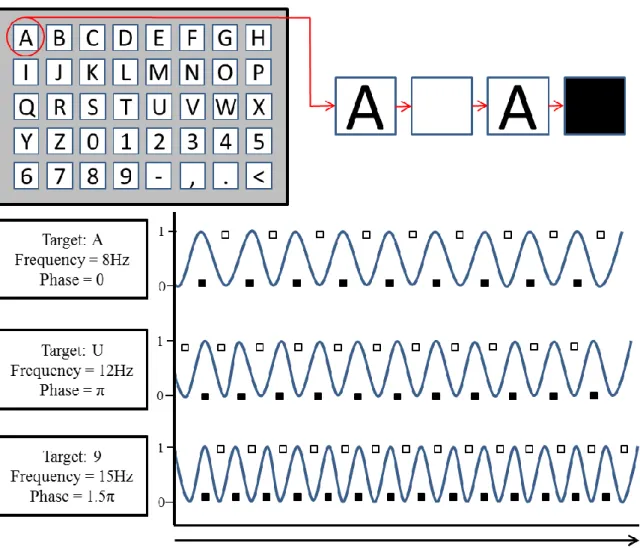
SSVEPs are periodic waveforms that propagate across the lateral surface of the occipital and parietal lobes. These waveforms are a fundamentally bottom up phenomenon measured via EEG. Human users fixating or attending a visual flickering stimulus demonstrate EEG waveforms which mimic the phase and frequency of the stimulus flicker rate (Norcia, Appelbaum, Ales, Cottereau & Rossion, 2015). In other words, attending a stimulus with an 8Hz frequency and a phase angle of 0o will result in the propagation of an 8Hz EEG waveform with 0o phase angle across the occipital and parietal areas (Naz & Bawne, 2016) (refer to, Figure 2). Crucially, the SSVEP bio-signal has the lowest latency of any brain-based bio-signal, at just 140ms (Di Russo & Spinelli, 1999, Johansson & Jakobsson, 2000). This low latency in concert with a rapid remission to baseline activity gives SSVEPs a distinct advantage over alternative bio-signals, with SMR paradigms requiring seconds of imagined movement data and P300 systems requiring at least 300ms for waveform elicitation. This positions SSVEPs as the ideal bio-signal for attaining high ITRs in BCI speller applications.
Moreover the absence of signal attenuation over time affords SSVEP based BCI the potential for continual, long term real-world use (Cecotti, 2011). Additionally, the principally bottom up nature of this signal means that no complex, fatigue inducing training period is required prior to device interfacing, as necessitated by SMR-based paradigms. Guger et al (2012) found that SSVEPs could be reliably detected across a sample of 53 participants, achieving a mean accuracy of classification on a 4 target LED array in 95.5% of trials. Similar studies utilizing large sample sizes (n =>80) have been performed using comparable P300-based systems (Guger et al, 2009), showing 89% of subjects achieved >80% AoC and in SMR-based systems (Guger et al, 2003), just 19% of subjects showed an AoC >80%, after a 30 minute training period. This also suggests that the potential risk of BCI illiteracy is low in relation to SSVEP-based BCI systems.
As the SSVEP bio-signal can be reliably decoded in the largest proportion of the general population, it provides BCI utilizing this bio-signal with the greatest scope. However, the stimuli
19 | P a g e
utilized in SSVEP-based paradigms can introduce obstacles to data collection. During the acquisition of EEG-based SSVEP data for BCI applications, researchers primarily utilize electrodes positioned over the occipital cortex. Data collected at these sites has been shown to contain, on the whole, the highest quality SSVEP signals. However, due to significant individual differences in the responsivity to SSVEP stimuli, parietal regions closely neighbouring the occipital electrodes are also monitored. The literature surrounding the optimal frequency ranges for eliciting SSVEPs with the highest SNR ratio differ. Generally it is accepted this optimum lies between 8 and 16Hz (Herrmann, 2001). It is important to note that the range off stimulation frequencies typically defined as optimal overlap considerably with visual stimulations patterns known to induce epileptic seizure (Fisher, Harding, Erba, Barkley & Wilkins, 2005). Photic sensitivity is estimated to be present in around 15-20% of those diagnosed with epilepsy (Shiraishi, Fujiwara, Inoue & Yagi, 2001). The incidence of epilepsy in the general population is relatively low (1/100), however it is important to note prior to exposure of low frequency stimulatory patterns. This therefore restricts the applicability of such systems to exclusively non-photo-epileptic populations. However, some researchers have recently published findings indicating that higher frequency stimulation patterns outside the ranges specified to induce epileptiform activity may produce waveforms with higher temporal stability (Won, Hwang,
Dähne, Müller, Lee, 2016).
Further limitations to the application of SSVEP based-BCI spellers include their historic classification as gaze-dependent bio-signals in BCI literature (Kübler, Kotchoubey, Kaiser, Wolpaw & Birbaumer, 2001, Gao, Cheng & Gao, 2003, Riccio et al, 2012). In other words, the propagation of an SSVEP is reliant on users fixating respective target stimuli, thus necessitating dextrous eye movement in order to form the basis of a reliable BCI speller system. Gaze dependency of the SSVEP signal therefore excludes patients with the most severe forms of quadriplegia from utilizing BCIs based on this waveform. To the opposite effect, a subset of studies directly researching this classification have produced results which suggest SSVEPs are more accurately defined as a semi-gaze-dependent (Muller, Malinowski, Gruber & Hillyard, 2003, Allison et al, 2008). Kelly, Lalor, Reilly, & Foxe, (2005) showed that SSVEPs could be accurately classified when attending one of two flicker visual stimuli in 71% of trials while controlling for fixation deviation via eye tracking systems. The minimal number of studies defining the semi-gaze-dependent nature of the SSVEP signal primarily include low density target displays. The apparent misclassification of SSVEP gaze-dependence has likely stunted the progress of purely attention based SSVEP BCI spellers. Therefore AoC performance of a purely attention based SSVEP-BCI in modern matrix style (>= 36 characters) GUI format is currently unknown. Arguably, the dependency of SSVEP propagation on attentional mechanisms could present obstacles to quadriplegic patients with low working memory capacity or chronic fatigue. However, ultimately the scope of SSVEP based BCI applications is potentially much larger than currently understood. This therefore poses the possibility that quadriplegic patients with low or absent ocular dexterity are in fact eligible for the use of SSVEP based BCI spellers.
In the past GUIs for SSVEP-based BCI used visual displays composed of Light Emitting Diodes (LEDs), as opposed to modern methods which rely on LED-based computer monitors. To reliably produce intended stimulatory patterns, target frequency values selected had to be divisible by the refresh rate of the device. For example, a 60Hz computer monitor is capable of reliably generating an 8.57Hz signal, as this corresponds to 7 frames per second (fps) (60Hz/ 8.57Hz = 7fps). LED devices previously exceeded the refresh rate of readily available computer monitors. Therefore, a larger portion of the optimal frequency range of SSVEPs (8-15Hz) could be utilized. Users were therefore required to attend two devices; an LED stimulator and computer monitor, to track the feedback (predicted target character) from the BCI speller.
In recent years the implementation of LED monitors with higher refresh rates in concert with state-of-the-art presentation algorithms, principally the approximation method, have remedied this obstacle (Manyakov, Chumerin & Van Hulle, 2012). Researchers have demonstrated that non-integer fps values, which are therefore non-divisible by the monitor refresh rate can reliably induce SSVEPs. This is achieved by interleaving two stimulation frequencies within a single refresh cycle. In order to generate a 9Hz stimulus frequency, researchers code a target to flicker at either
20 | P a g e
8.57Hz (7fps) or 10Hz (6fps) for a given portion of the refresh rate cycle. The proportion of 8.57Hz and 10Hz stimulus patterns is calibrated such that when the stimulus signal is averaged over the refresh cycle (e.g. 60Hz) it produces a 9Hz (6.67fps) stimulus pattern.
This same process of averaging is also true for the stimulus patterns embedded in the SSVEP EEG time-series. This affords the ability to increase the array density in matrix style GUI formats providing a larger number of operations to BCIs employing this presentation methodology (Hwang et al, 2012, Chen, Wang, Nakanishi, Jung & Gao, 2015). In conclusion, the capability for high density matrix style arrays with low latency has assisted researchers employing SSVEP-based BCIs in achieving the highest ITRs to date in both speller (Hwang et al, 2012, Chen, Wang, Nakanishi, Jung & Gao, 2014, Chen, Wang, Nakanishi, Jung & Gao, , 2015) and non-speller applications (Kwak, Müller & Lee, 2015). On review, the SSVEP bio-signal possesses the highest potential to form the basis for an out-of-the-box BCI speller for target quadriplegic patient populations.
21 | P a g e
Machine Learning
Machine Learning involves training a computational algorithm to classify (differentiate) or regress. Regression is used to estimate outcomes for an event in the future. For example, based on the current quality of EEG data (electrode impedance levels), researchers could estimate the likelihood that EEG signals will remain stable over time. Classification in contrast involves generating discrete observations such as estimating the frequency of an SSVEP. A number of the signal processing methods of EEG classification fall under this field of study. All methods incorporate analytical elements that learn features of the data for the purposes of optimization. A thorough discussion of the main analytical methods used for EEG analysis is documented herein.
Decoding Algorithms
Power Spectral Density Analysis
During Power Density Spectral Analysis (PDSA) of SSVEP data the EEG output undergoes a Fast Fourier Transform, which effectively converts EEG data from the time-frequency domain to an exclusively frequency based domain. Targets are determined by finding the frequency with the highest PSD value, then identifying the character corresponding to the predicted frequency value (Wang, Gao, Hong, Jia & Gao, 2008). Successful implementation of PDSA in relation to the decoding of SSVEP data has been demonstrated in numerous studies (Middendorf, McMillan, Calhoun & Jones, 2000). Additionally, the inclusion of harmonic and sub-harmonic component analysis fostered significant increases in classification accuracy (Cheng, Gao, Gao & Wu, 2002,
Müller-Putz, Scherer, Brauneis & Pfurtscheller, 2005). The approach however requires substantial time windows in order to produce accurate readings (Lin, 2006). Therefore the ITR of systems implementing PDSA exclusively is typically low. Such analysis may have facilitated the discovery of distinct waveform frequency bands (delta, theta, alpha, beta and gamma), however fast Fourier transforms are highly susceptible to noise. Additionally, the methods of addressing these issues such as the application of autoregressive parametric power spectrum estimation are not optimal. These forms of additional analysis assume that the EEG output is linearly dependent on previous sampled data points. However the non-stationary nature of EEG waveforms over time diminishes the integrity of this assumption. Moreover PDSA is restricted to single channel analysis, whereas the practise of taking a grand average across multiple EEG channels to boost classification accuracy is now standard practise (Friman, Volosyak & Graser, 2007). PSDA, though initially popular in EEG waveform classification, are now less viable than other means. In order to overcome the incidence of misclassification in high density matrix style spellers more powerful methods of classification analysis were developed.
Canonical Correlation Analysis
Multi-Channel optimization significantly improves signal to noise ratios by amplifying relevant data features. Techniques such as canonical correlation analysis (CCA) have demonstrated this definitively (for review see, Vialatte, Maurice, Dauwels & Cichocki, 2010). Previously these methods have been employed on large scale data analytics, assisting researchers in extracting relevant information from vast datasets (von Storch & Zwiers, 2002). CCA, in relation to SSVEP classification, involves generating reference signal patterns with identical properties to the target stimuli patterns. For example if the letter A is assigned a stimulus pattern in which a stimulus square overlaid onto the target letter flashes on and off 8 times per second, a corresponding 8Hz reference signal is generated (refer to Figure 2). Signals are also matched for; length of stimulation period, number of EEG channels, micro-voltage range and sample rate. The first study to utilize CCA for SSVEP detection (Lin et al, 2006) was motivated by the restrictions imposed by PSDA methods, which limit analyses to just one EEG channel. In CCA classification of SSVEP data, each EEG time-series channel is denoted as nth of matrix X. The adjacent dataset, denoted as nth of Y, is made up of a Fourier series for one of the stimulus frequencies used to control the SSVEP targets. Each row of the Y matrix is a harmonic of the stimulus frequency expressed as a vector. Correlational coefficients for Xnth and Ynth are calculated to observe the amount of variance each Xnth and Ynth can count for in the adjacent matrix. CCA then operates to find the linear combination of coefficients which maximises the correlational relationship between datasets X and Y. This is referred to as the correlational variable and is expressed as an ordinary correlation (p).
22 | P a g e
Typically, during CCA analyses, the number of correlational variables calculated is equal to the depth of the smallest dataset utilized. In the application of CCA for SSVEP detection, only the first correlational variable is calculated as this accounts for the most variance and reduces the computational load of the analysis. Correlational variables are calculated for each stimulus frequency against the EEG input data. The stimulus frequency which produces the highest correlational variable (p) forms the prediction for the SSVEP embedded in the EEG time-series (Lin, Zhang, Wu & Gao, 2007). CCA does not depend on state-of-the-art hardware, in terms of computational load and is therefore relatively well suited for real-time speller applications. Bin, Gao, Yan, Hong & Gao (2009) demonstrated the validity of such analysis, achieving a mean AoC of 95.30% (12 participants) and an ITR of 58 bits per minute during online experiments for a 6 target sequential SSVEP based BCI speller.
The researchers implementing CCA for SSVEP detection must assume that the changes in micro-voltage across the scalp, responsible for SSVEP propagation is the product of a linear system in which the SSVEP stimulus signal is the input. This assumption is problematic due to the inherently non-linear and non-stationary characteristics of EEG time-series (Klonowski, 2009). Another primary drawback of implementing standard CCA (as described herein) is the methodology for constructing reference signals. Sine-cosine functions are used to generate template references which are inherently too precise. In other words, as they are not based off real-world samples they lack the presence of latent EEG features making dense matrix style GUI formats unfeasible (Pan, Gao, Duan, Yan & Gao, 2011). Advances in CCA have involved blending artificial random noise into generated reference signals, as well as user specific EEG output. So-called Multiway-CCA (MCCA) builds on this weakness of standard CCA by constructing a reference signals that incorporate relevant data features from a sample of EEG tensor data to produce more flexible reference signals. However such adaptations still incorporate a restricted set of highly precise frequency templates, ignoring natural background noise and other latent variables. This therefore leads to analysis being constrained to representing exclusively within-class relationships, over-looking between-class information (Zhang et al, 2013).
Common Feature Analysis
Common Feature Analysis (CFA) arguably overcomes the inherent issues of CCA to a greater extent than MCCA by generating references signals purely based on participant data. Zhang, Zhou, Jin, Wang & Cichocki (2015) tested the performance of these three classification models using highly simplified SSVEP stimuli; four red squares flickering at 4 distinct frequencies (6, 8, 9 and 10Hz). Authors proceeded under the assumption that there are inherent similarities in the data collected from one participant exposed to the same stimulus frequency over multiple trials. Latent features hidden within the participant specific data are computed by finding correlations between within target data. This therefore builds the template arrays with which to correlate raw un-grounded data for prediction. Analysis of performance stats via paired t-tests revealed that CFA and MCCA produce significantly higher classification accuracies than CCA for all time windows (0.5-4 seconds in 0.5 second increments). CFA also significantly outperformed MCCA in terms of accuracy for both the 0.5 (70% vs 43%) and 1 second (78% vs62%) time windows. Critically CFA was also significantly less likely to select non-targets as compared to both MCCA and CCA. In relation to computational efficiency CFA was significantly more accurate than both MCCA and CFA for the 0.5 second time window and matched MCCA for efficiency in the 1sec time window. This decreases dramatically for CFA as the time window increases. Greater data capture requires more computational time for the development of the common feature values. Therefore after this 1 second time window the efficiency advantage is lost. A CFA model would therefore only be applicable for experienced BCI users capable of interacting with the device in decision windows of just 0.5 seconds. Conversely, MCCA would be advisable for first time BCI users. This study is an excellent example of how selection of the classification algorithm is highly dependent on the BCI application and user.