Middlesex University Research Repository:
an open access repository of
Middlesex University research
http://eprints.mdx.ac.uk
Vouldis, Angelos, 2012. Development and implementation issues for
managing sales performance. Available from Middlesex University’s
Research Repository.
Copyright:
Middlesex University Research Repository makes the University’s research available electronically.
Copyright and moral rights to this thesis/research project are retained by the author and/or other copyright owners. The work is supplied on the understanding that any use for commercial gain is strictly forbidden. A copy may be downloaded for personal,
non-commercial, research or study without prior permission and without charge. Any use of the thesis/research project for private study or research must be properly acknowledged with reference to the work’s full bibliographic details.
This thesis/research project may not be reproduced in any format or medium, or extensive quotations taken from it, or its content changed in any way, without first obtaining permission in writing from the copyright holder(s).
If you believe that any material held in the repository infringes copyright law, please contact the Repository Team at Middlesex University via the following email address:
Development and Implementation Issues
for Managing Sales Performance
A project submitted to
Middlesex University in
partial fulfilment of the
requirements for the degree of
Doctor of Professional Studies
Angelos Vouldis
Institute for
Work Based Learning
Middlesex University
ACKNOWLEDGEMENTS
To complete Doctor of Professional Studies in business and in academia
of people around you.
I would like to make a referral to some of the people who have provided this support over the last few years. Dr. Angelika Kokkinaki, my consultant, and Dr. Salomi Papadima- Sophocleous, my advisor, provided me
encouragement and always gave comments and feedback in a very encouraging and helpful approach. Professor Paul Gibbs as the academic d
strong support and en My employers Mercedes
Cyprus Institute of Marketing provided both the stimulus and resource to complete the doctorate programme. The Daimler A.G
through its support
implementation of this project. Special thanks go to my colleague complete this project
project as part of their daily activities. Finally, none of this would
my wife Maria and my family.
a considerable amount of quality time that was invested addition to my full time job
I thank them deeply for that.
The Doctorate in Professional Studies professionally and personally.
I will keep a reflecting journal
Thank you all.
Angelos Vouldis
2
ACKNOWLEDGEMENTS
Doctor of Professional Studies while working full time in demanding in business and in academia can only be successful with the support and encouragement of people around you.
I would like to make a referral to some of the people who have provided this support over the last few years. Dr. Angelika Kokkinaki, my consultant, and Dr. Salomi ophocleous, my advisor, provided me with a massive amount of advice and encouragement and always gave comments and feedback in a very encouraging and helpful approach. Professor Paul Gibbs as the academic director
strong support and encouragement.
My employers Mercedes-Benz Cyprus and the University of Nicosia and recently Cyprus Institute of Marketing provided both the stimulus and resource to complete the doctorate programme. The Daimler A.G. our principal company trust
through its support offered a high value and accuracy with the potential future implementation of this project.
Special thanks go to my colleagues in Mercedes – Benz Cyprus. I
project without their support and cooperation. They have accepted this project as part of their daily activities.
Finally, none of this would have been possible without the support and understanding of my wife Maria and my family. Their support was crucial for my studies. The
derable amount of quality time that was invested in my doctorate studies, in o my full time job.
I thank them deeply for that.
The Doctorate in Professional Studies is an emotional and personal experience professionally and personally.
reflecting journal for the rest of my life.
while working full time in demanding jobs can only be successful with the support and encouragement
I would like to make a referral to some of the people who have provided this support over the last few years. Dr. Angelika Kokkinaki, my consultant, and Dr. Salomi a massive amount of advice and encouragement and always gave comments and feedback in a very encouraging and irector of the DProf offered
Benz Cyprus and the University of Nicosia and recently the Cyprus Institute of Marketing provided both the stimulus and resource to complete the trusted my research and a high value and accuracy with the potential future
Benz Cyprus. I would be unable to ration. They have accepted this
possible without the support and understanding of crucial for my studies. They suffered my doctorate studies, in
3 TABLE OF CONTENTS ACKNOWLEDGEMENTS ... 2 LIST OF FIGURES ... 7 LIST OF TABLES ... 9 GLOSSARY ... 10 ABSTRACT ... 12 CHAPTER 1: INTRODUCTION ... 14 1.1 Chapter summary ... 14 1.2 Project Award... 14
1.3 Coherence of the Programme ... 14
1.3.1 DPS 4520: Review of Learning ... 14
1.3.2 Recognition and Accreditation of Learning (RAL 4): Professional Learning ... 18
1.3.3 Recognition and Accreditation of Learning (RAL 4): Research and Development Project Capability ... 19
1.3.4 RAL 5: Advanced developments in professional practice ... 19
1.3.5 DPS 4561: Planning a Practitioner Research Programme ... 20
1.4 Environmental Context ... 21
1.5 Financial Crisis of 2008 ... 23
1.6 Host Organisation ... 24
1.7 Format of the Proposed Project ... 28
1.8 Assumptions and limitations of the research ... 29
1.8.1 Assumptions of the research ... 29
1.8.2 Limitations ... 29
CHAPTER 2: RESEARCH METHODOLOGY ... 30
2.1 Chapter Summary... 30
2.2 Elements of the research methodology ... 30
2.2.1 Introduction ... 30
2.2.2 Epistemology ... 31
2.2.3 Theoretical perspective ... 32
2.2.4 Research Strategy ... 33
2.2.5 Research approach and data collection ... 37
2.2.6 Triangulation ... 41
2.2.7 Ethical consideration ... 42
2.3 Understanding the situation and context in the host organisation regarding sales performance... 43
2.4 Implementation process ... 49
CHAPTER 3: LITERATURE REVIEW ... 56
3.1 Chapter Summary... 56
3.2 Introduction ... 56
3.3 On measurement and management of business performance ... 56
3.3.1 Fundamental concepts ... 56
3.3.2 Definition of Business Performance Measurement... 57
3.3.3 Definition of Conceptual Framework ... 59
3.4 Models and frameworks for business performance measurement ... 61
4
3.4.2 European Foundation for Quality Management (EFQM) Excellence
Model® ... 64
3.4.3 ISO 9001:2000 ... 67
3.4.4 The Performance Prism ... 69
3.4.5 Six Sigma ... 71
3.4.6 Tableau de Bord (France)... 72
3.5 Selecting the appropriate model or framework for measuring business performance for a sales organisation ... 73
3.6 Factors affecting business performance ... 76
3.7 Conclusions from models and frameworks for measure business performance ... 80
CHAPTER 4: REVIEW OF EXISTING PRACTICES THROUGH THE ORGANISATION DOCUMENTARY ANALYSIS ... 82
4.1 Chapter Summary... 82
4.2 Adoption of ISO 9001:2000 at Mercedes Benz Cyprus... 82
4.3 Using blended learning methods for enhancing sales performance ... 83
4.4 Scorecard tool presented from the principal, Daimler A.G. ... 86
4.5 Advanced Training for Experienced District Managers ... 87
4.6 Monthly meetings, reports and visits to branches ... 88
4.7 Sales Funnel ... 89
4.8 Compensation system ... 91
4.9 Conclusions from the review of existing practices through the organisation documentary analysis ... 92
CHAPTER 5: PROJECT ACTIVITY ... 93
5.1 Chapter summary ... 93
5.2 Pre-model design focus group: Host Organisation management needs analysis ... 93
5.3 Post-Framework design focus group: Host organisation management assessment .. 97
5.4 Focus group with the management of other similar organisations ... 97
CHAPTER 6: PROJECT FINDINGS ... 99
6.1 Chapter Summary... 99
6.2 Findings from the pre-framework design focus group: Host organisation management need analysis ... 99
6.3 S.B.I.: The proposed integrated framework for measuring and managing sales performance... 112
6.3.1 Introduction ... 112
6.3.2 Vision ... 116
6.3.3 SWOT Analysis ... 116
6.3.4 Strategic Objectives (SO) and Key Performance Areas (KPA) ... 117
6.3.5 Key Performance Indicators (KPI's) ... 118
6.3.6 Balanced Scorecard ... 119
6.3.7 Employee Satisfaction ... 119
6.3.8 External Factors ... 120
6.3.9 Tracking Key Performance Indicators (KPI's) ... 120
6.3.10 Classification of Derived Actions ... 121
Corporate Communication ... 121
Training Development ... 121
Internal Communication... 122
Internal Procedures... 122
5
6.4 S.B.I. Compliance with design specifications ... 123
6.5 Reporting Analysis System Architecture ... 126
6.5.1 Overview of the system ... 126
6.5.2 Data Modelling implimentation ... 129
6.5.3 Database Design ... 130
6.5.4 Process Model ... 135
6.5.5 Data Flow Diagram ... 137
6.5.6 User Interface Design ... 139
6.6 Development of the proposed framework ... 143
6.7 Findings from the post-framework design focus group: Host organisation management assessment... 145
6.8 Validity of the proposed framework ... 149
6.9 Findings of focus group with the management of other similar organisations ... 155
6.10 The innovative contribution of the S.B.I. Framework ... 158
CHAPTER 7: CONCLUSIONS AND RECOMMENDATIONS ... 165
7.1 Chapter Summary... 165
7.2 Developing the framework during the global economic crisis ... 165
7.3 Effective leadership and organisational culture affective sales performance framework ... 166
7.4 Conclusions related to the research questions ... 166
7.5 Suggestions for future research ... 169
CHAPTER 8: REFLECTIVE REPORT OF RESEARCHER’S PERSONAL LEARNING AND PROFESSIONAL JOURNEY ... 171
8.1 Chapter Summary... 171
8.2 Reflections on research methodology from this research project ... 171
8.3 Reflections on professional knowledge and practice ... 174
8.3.1 Demonstrate in-depth knowledge of how to apply and justify project aims and objectives. ... 174
8.3.2 Research and development capability ... 174
8.3.3 Ethical understanding ... 175
8.3.4 Analysis and synthesis ... 175
8.3.5 Self appraisal/ reflection on practice ... 175
8.3.6 Planning/ management of learning... 176
8.3.7 Evaluation ... 176
8.3.8 Awareness of operational context and application of learning ... 176
8.3.9 Use of resources ... 176
8.3.10 Communication/ presentation skills ... 177
6
8.4 Impact of research project on the various stakeholders ... 177
REFERENCES ... 179
APPENDICIES ... 196
Appendix 1: Population by district in Cyprus ... 196
Appendix 2: Transport Sector in Cyprus ... 197
Appendix 3: Registration of private saloon cars, 2002-2011 in Cyprus ... 198
Appendix 4: Focus Group Manual with the Management team ... 199
Appendix 5: Word Frequency report with Nvivo. Focus group with the management team ... 214
Appendix 6: Data results for the evaluation of the models or frameworks from the management staff ... 215
Appendix 7: Data results for the evaluation of the existing reports and tools from the management staff ... 220
Appendix 8: Interview Manual with the Management of team evaluation framework 222 Appendix 9: Interview Manual with the Management of other similar organisations . 226 Appendix 10: Participants list – business cards for focus group interview with management of the host organisation model and framework investigation ... 232
Appendix 11: Participants list – business cards for the focus group with the management of other similar organisations ... 233
Appendix 12: Paper 1: A Critical Review of Business Performance Models and Frameworks and Their Application to Sales Organisations ... 234
Appendix 13: Paper 2 Enhancing Sales Performance through E-Learning Platforms.. 247
Appendix 14: Paper 3 Performance Management And Control, A Case Study In Mercedes Benz Cyprus ... 258
7
LIST OF FIGURES
Figure 1:1 “Keep walking on the path of my Reflective Learning” ... 16
Figure 1:2 the interface of the information system. Print screen of the live information system for the Sales Department in Mercedes-Benz Cyprus ... 20
Figure 1:3. Analysis of population, numbers of vehicles, persons per private saloon car in Republic of Cyprus ... 22
Figure 1:4. Registration of Private Saloon Cars, 2002-2011 in Cyprus ... 23
Figure 1:5. Contract between the Mercedes-Benz and Cyprus Import Corporation... 25
Figure 1:6. The first building of the organisation in Nicosia ... 25
Figure 1:7. New Mercedes-Benz and Smart showroom in Nicosia ... 26
Figure 1:8 Cyprus Import Corporation network ... 27
Figure 1:9. Flowchart of the organisation ... 28
Figure 2:1. Four elements (Crotty, 1998)... 30
Figure 2:2: Action research design (Kumar, 2005) ... 33
Figure 2:3. Checking Data using Triangulation (Baker & Hart, 2007) ... 42
Figure 2:4 Controlling nonconformities... 46
Figure 2:5. Data Analysis for the sales & marketing department in Mercedes-Benz Cyprus (Cyprus Import Corporation Ltd. Quality Manual, 2005) ... 47
Figure 2:6. Research steps... 50
Figure 2:7. Detailed analysis of the research implementation process ... 52
Figure 3:1. Balanced Scorecard Perspectives (Kaplan & Norton, 1992) ... 62
Figure 3:2. The Balanced Scorecard Institute’s 9 step framework (Rohm & Halbach, 2005) ... 64
Figure 3:3. The EFQM Excellence Model 2010 (Gemoets, 2010) ... 65
Figure 3:4. Fundamental Concepts (Gemoets, 2010)... 66
Figure 3:5. Model of process-based quality management (Grimes, 2003) ... 68
Figure 3:6. The Five Facets of the Performance Prism (Neely, et al. 2001) ... 70
Figure 3:7. Relation between objectives, action variables and action plans (Bourguignon, et al. 2004) ... 73
Figure 3:8. Measuring business performance: emerging research themes (Neely, et al. 2000) ... 74
Figure 3:9. Dashboard Types (Houghton et al, 2004) ... 79
Figure 3 :10. SOA Architecture. (Demirkan et al., 2009) ... 80
Figure 4:1. Blended Training development framework for the sales & marketing department at Mercedes-Benz Cyprus (Vouldis & Kokkinaki, 2010) ... 85
Figure 4:2. Reduce training costs - Minimise lost work time (Daimler Global Training, 2010) ... 86
Figure 4:3. Sales Process. (Daimler Global Training, 2010) ... 88
Figure 4:4. Sales Funnel concept (Anon, 2010) ... 90
Figure 5:1. The main stages of the focus group process (Blackburn, 2000) ... 94
Figure 6:1. S.B.I. framework for measuring and managing sales performance... 116
Figure 6:2. KPI Cycle (from Eswar & Ramesh, 2009) ... 118
Figure 6:3. Blended learning methods capture the strengths of both e-learning and classroom learning (Voci & Young, 2001) ... 122
Figure 6:4. S.B.I. Framework. Reporting analysis tool design ... 126
Figure 6:5. S.B.I. Framework. Reporting analysis tool design ... 128
Figure 6:6. Entity-Relation Diagram... 130
Figure 6:7. Functional Decomposition Diagram ... 136
Figure 6:8. DFD User Authentication ... 137
Figure 6:9. DFD Manager subsystem, Add Notes ... 138 Figure 6:10. DFD Manager subsystem, View KPIs Data, KPI Targets, Action Plans . 138 Figure 6:11. DFD Salesman subsystem, View KPIs Data, KPI Targets, Action Plans 138
8
Figure 6:12. DFD Administrator subsystem, View; Add; Update ... 139
Figure 6:13. Dashboard example KPI’s integrated with Actions Planning ... 140
Figure 6:14. S.B.I. installed in the live information system for the ... 141
Sale Department at Mercedes-Benz Cyprus ... 141
Figure 6:15. Reporting analysis tool, content page ... 142
Figure 6:16. Smart Criteria (from Shahin & Mahbod, 2007) ... 150
Figure 6:18. S.B.I. framework including the Compensation Scheme ... 153
Figure 6:19. Performance Achievement for Qualitative KPIs in Mercedes - Benz Cyprus from 11/2011 - 1/2013 ... 162
9
LIST OF TABLES
Table 2:1: Implementation process with combination of research methodology ... 51
Table 3:1. Selecting an appropriate model or framework for measuring business performance... 76
Table 3:2. Typology of Generic Strategies (Miles & Snow, 1978) ... 78
Table 6:1. A Sample of data records ... 105
Table 6:2 Research question (Which of these models, frameworks and approaches should be used to manage and measure business performance in Mercedes Benz – Cyprus?) ... 105
Table 6:3. Sample of data records ... 110
Table 6:4 Research question: Which of the existing various organisational related documents with a focus on sales performance issues can be used to manage and measure sales performance in Mercedes-Benz Cyprus? ... 111
Table 6:5 S.B.I. framework comparing with the suggestions from Globerson (1985), Maskell (1989) and Brown (1996) ... 123
Table 6:6. KPIs Matrix Development ... 128
Table 6:7. KPI DATA table structure ... 131
Table 6:8. KPI Targets table structure ... 131
Table 6:9. KPI CATEGORY table structure... 132
Table 6:10. DATA SOURCE table structure ... 132
Table 6:11. USER LEVEL table structure ... 132
Table 6:12. USERS table structure ... 133
Table 6:13. ACTION PLAN CATEGORY table structure ... 133
Table 6:14. ACTION PLANS table structure ... 134
Table 6:15. KPI SET table structure ... 135
Table 6:16. NOTES table structure ... 135
Table 6:17. Sample of data records ... 146
Table 6:18 Evaluation of the S.B.I. framework ... 146
Table 6:19. KPIs data source validation for Mercedes –Benz Cyprus ... 151
Table 6:20. KPIs data source validation for Automaster ... 154
Table 6:21. Sample of data records ... 155
Table 6:22 Using a model or framework for measuring and managing sales performance ... 156
Table 6:23 Performance Achievement for Qualitative KPIs in Mercedes - Benz Cyprus from 11/2011 - 1/2013 ... 161
GLOSSARY
Term Definition
AUDI AUDI is a German car manufacture produces premium cars as subsidiary of Volkswagen AG group.
Automaster
Automaster Ltd is the established company of the Cyprus Import Corporation group of companies which owned the Cyprus franchise for the Fiat, Alfa Romeo and Lancia and Jeep vehicles.
BMP Business Performance Measurement
BMW BMW produces premium cars and motorbikes under three premium brands: BMW, MINI and Rolls Royce.
BSC Balanced Score Card
Citrix Server
It is a server solution for delivering Windows application to user. User can access and use specific programs in a virtual environment. For example multiple users can access and use a single Microsoft Access database with updating data records in real time (Webopedia, 2011).
Daimler A.G
Daimler AG is one of the biggest producers of premium cars and the world's biggest manufacturer of commercial vehicles with selling products in global reach. It produces Mercedes-Benz Cars, Daimler Trucks, Mercedes-Benz Vans, Daimler Buses and Daimler Financial Services, the Daimler Group (Daimler A.G., 2011)
Demades Bros Ltd
Demades Bros Ltd owned the Cyprus franchise for the Fiat, Alfa Romeo and Lancia vehicles.
Dprof Doctorate in Professional Studies
Fiat Fabbrica Italiana Automobili Torino, FIAT produces cars under the following brands: FIAT, Lancia and JEEP and others.
IMS Information Management System
ISO
The International Standards Organisation. It is the specialised international agency for standards' making with a membership of over 90 countries.
Marketing Spend
Effectiveness
Marketing Spend Effectiveness is a term used within the Daimler Corporation to indicate the effectiveness of the marketing measure in relation to the cost incurred to carry out this measure. The Marketing Spend Effectiveness gives us an idea on which marketing measure is the most effective in attracting the customers to the products / the dealership.
MSDP Measurement System Development Process NVivo Qualitative data analysis software
PMMI
PMMI is a trade association with more than 500 member companies that manufacture packaging and packaging-related converting machinery, commercially-available packaging machinery components, containers and materials in the United States and Canada (PMMI, 2006)
Principals This refers to Daimler A.G. Quality
Management System
It regulates the structure of the organisation, the responsibilities, procedures, processes and resources necessary for the implementation of the quality policy and the achievement of quality objectives. This term is abbreviated as QMS.
Registration The formality in acknowledgement by a certification body accredited by a recognised national authority that an organisation
11
Term Definition
has been assessed and shown to comply with ISO 9000 at the time of assessment.
S.B.I.
Integrated framework for measuring and managing sales performance. S.B.I. for the abbreviation of the words SWOT Analysis, Balanced Score Card and ISO.
SME Small Medium Enterprise
SPSS Statistical Package for the Social Sciences SSM Soft Systems Methodology
Thomas Poutas
Thomas Poutas International is a dynamic and innovative Business Consultancy, specializes since 1999 in Change and Performance Management, Personnel Trainings and Assessments for industrial and service companies as well as public institutions at home and abroad.
ABSTRACT
The research project concentrates on the issues which a host organisation faces, in developing and implementing an efficient and cost-effective conceptual framework for measuring and managing sales performance in the automotive retail sector.
Sales performance is a critical and main issue for an organisation in order to achieve its strategic objectives, by translating the results into action and monitoring the process. Due to the global financial crisis, organisations experience an economic downturn. This makes the use of a standard framework which can support their derived action plans of vital importance. This framework would aim to offer a holistic view of the sales performance with accurate results.
A review of the literature provided extensive information and analysis of the different models and frameworks that could be identified and used in performance measurement literature. In addition, it provided an evaluation of the existing documentary and practices of the host organisation regarding performance measurement. As, a result, the needs for the development of an improved framework were identified. The proposed methodology was based on the integration of three frameworks, namely the SWOT Analysis, Balanced Score Card and Internal procedures as part of a performance management system. The research indicated that it is essential to synthesise and extend the existing models and frameworks with the aim to produce the most suitable conceptual framework based on the size, kind, and available resources of the organisation.
Through qualitative and quantitative analysis, this project provides evidence, which indicates the successful application of measuring and managing sales performance techniques through the use of reports, training communication capabilities and presentation skills. It creates a new political and organisational challenge for the staff of the organisation, which in its turn had to learn to interact fast and effectively in order to achieve their targets. It considers the external and internal influences impacting on a sales organisation and how the management team and staff can offer an actively sought process to monitor business performance on an on-going basis and to generate recommendations for changes.
The research indicates that the proposed framework connects the measurement results with the derived action plans following a continuing improvement approach. The project has not only a theoretical approach but it also focuses on the implementation process. The proposed framework was developed in the host organisation with a step by step methodology establishing a reporting analysis tool. It concludes by the
13
realisation that specific processes are required to implement the sales performance reporting analysis tool.
14
CHAPTER 1: INTRODUCTION 1.1 Chapter summary
This chapter aims to illustrate the main themes and issues involved in this research study. In addition it analyses why the project is appropriate for a researcher to carry out providing a rationale for the combination of modules and Recognitions and Accreditation of Learning (RAL) claims in the programme and how they support the coherence and viability of this proposed program. Additionally, it presents the environmental context of this research project and the researcher's position in it. Furthermore, it highlights the main limitations and assumptions of the research.
1.2 Project Award
My target award is a Doctoratete in Professional Studies in “Development and Implementation Issues for Managing Sales Performance”.
Sales Performance is the basic term this project focuses on and proposes to outline a general focus on performance with particular reference to the automotive retail sector. The project report provides a dynamic, systematic conceptual framework on management and measurement of sales performance from the view of the business user for the Mercedes- Benz Cyprus. It provides practical and useful information with real business examples and arguments for measuring and managing sales performance. Furthermore, it serves as a standard and quick reference for business users, in monitoring and evaluating tools and methodologies that are crucial to measuring and managing sales performance.
This programme is used as an opportunity for my continuous learning and development in the area of sales performance. My favourite motto from the Greek Athenian statesman, lawgiver and poet Solon, has been the motivation for my continuous learning and development, “I grow in learning as I grow in years” (Plutarch & Langhorne, 1857). As Kolb (1984) has documented, “we seek to grow and develop because we must do so to survive – as individuals and as a world community”.
1.3 Coherence of the Programme 1.3.1 DPS 4520: Review of Learning
The module of the Review of Learning provided me with a summary and evaluation of my experiences and education to date, and an analysis of their relevance to my future learning and development. My education and work experiences have impacted on my personal development, as I have gained a mixture of both academic teaching and hands on business experience. Most of my experience comes from progressive roles that I
15
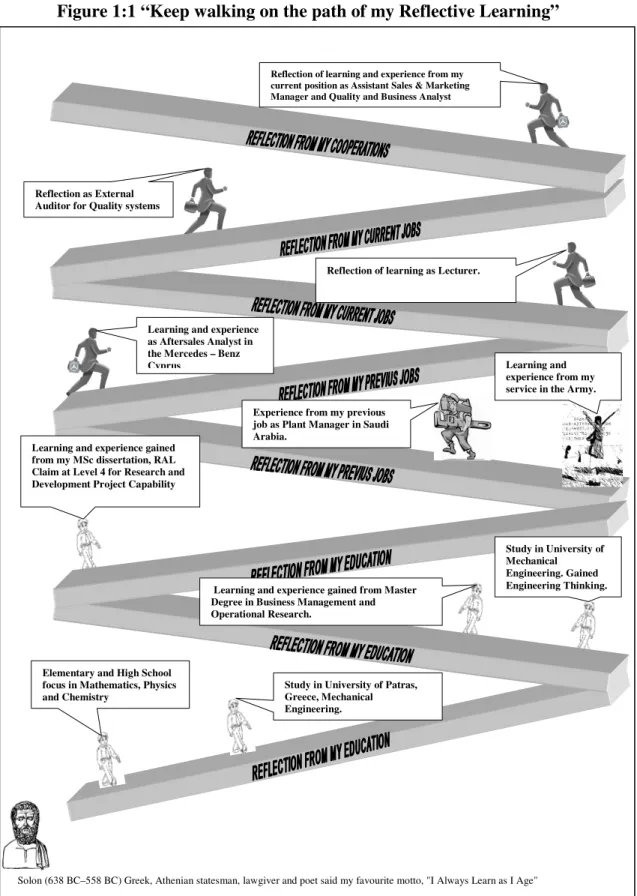
have held with Mercedes – Benz. With Mercedes – Benz, I have been fortunate to have a career that has spanned multiple disciplines including Information Technology, Quality, and Sales and Marketing. I present my learning in a chronological and thematic approach, with the following diagram figure 1:1 to reflect on my learning, which shows my lifelong learning stages up to this point.
16
Figure 1:1 “Keep walking on the path of my Reflective Learning”
Starting from school and during my first university degree, I had a special focus on Mathematics, which helped me develop my problem solving thinking which let me to my doctorate project. My first-degree in Mechanical Engineering, helped me understand
Study in University of Patras, Greece, Mechanical Engineering. Elementary and High School
focus in Mathematics, Physics and Chemistry
Study in University of Mechanical Engineering. Gained Engineering Thinking. Learning and experience gained from Master
Degree in Business Management and Operational Research.
Learning and experience from my service in the Army. Experience from my previous
job as Plant Manager in Saudi Arabia.
Learning and experience as Aftersales Analyst in the Mercedes – Benz Cyprus
Reflection of learning and experience from my current position as Assistant Sales & Marketing Manager and Quality and Business Analyst
Reflection of learning as Lecturer.
Learning and experience gained from my MSc dissertation, RAL Claim at Level 4 for Research and Development Project Capability
Solon (638 BC–558 BC) Greek, Athenian statesman, lawgiver and poet said my favourite motto, "I Always Learn as I Age" Reflection as External
Auditor for Quality systems position as Assistant Sales
17
how to bring together knowledge of previously solved problems and understand the current need to combine new solutions.
Following my first degree as a Mechanical Engineer, I continued for a Master degree related to Business and Operational Research. This Master Degree has had an important impact on my professional and academic development. As Neely (2002) states “researchers with functional backgrounds as diverse as accounting, operations management, marketing, finance, economics, psychology, and sociology are all actively working in the field of performance measurement”.
The research project I have undertaken for my Master dissertation studies was a Statistical Analysis of Labour Accident in Greece. Statistical analysis can integrate with the business performance management. It helped me develop my statistical thinking. Statistical thinking is the philosophy of learning and the action that builds the foundation for successful decision making in any process (Britz, et al. 2000). Additionally, my Master Dissertation gave me my first opportunity to develop an appropriate research strategy. It provided me with the basic framework for my research approach to identify the research methods and data collection techniques which are required for my Dprof research project.
I have worked in engineering as Plant Manager with one of the most important construction companies in Saudi Arabia and Cyprus. Living in Saudi Arabia strengthened my motivation to work in a demanding environment and made me challenge my perception of the importance of simple things in our everyday life and work.
Furthermore, working in the desert alone with my team, represented a new type of knowledge and a different way of learning for me. I learnt about personal influence and negotiation. Leading a team was an excellent learning opportunity for me, and one that was very different from my past ways of learning. I also gained specific skills including project management and managing contractors, as I was responsible for installing equipment at our sites.
Having decided to change my direction, I successfully applied to Mercedes – Benz Cyprus for the position of the After-sales Analyst. My education and training from DAIMLER A.G., a highly innovative company with a global presence, has enabled me to understand the practical application of theories, especially at management level. With the need to improve the stock levels and control the transport cost of spare parts, I developed several information systems. Increasingly I became involved in data analysis and interpretation of data, which strengthened my skills in these areas and helped me
18
develop my thinking on how information is used. In particular, I began to think about how the end-users of information could influence the way in which that data are produced, interpreted and presented, and the way this can change the meaning of information.
The Board of Director of Mercedes – Benz Cyprus offered me the challenge of the combined position of Assistant Sales & Marketing Director and Quality and Business Manager. My duties have three main directions. Firstly, the development and management of the passenger car Sales & Marketing business, at both the importer and retailer levels; secondly the design, the development and implementation of new Information Systems for supporting the Sales & Marketing Business and thirdly the developing, running and maintenance of the Quality systems of the organisation. My current role has provided me with valuable experience and opportunities for learning. This allowed me to develop a deep understanding of various functions, including Finance, Sales & Marketing, Quality, Service and Human Resources.
Finally, the module Review of Learning helped me realise my strengths and weaknesses and identify the areas in which I needed to develop skills. I identified how important for the development of the project was, to expand my knowledge in research philosophies, approaches and techniques. Additionally I expanded my awareness in the literature and documentation that already exists in the study areas of business performance.
1.3.2 Recognition and Accreditation of Learning (RAL 4): Professional Learning
The Master Degree in Business Management and Operational Research had an important impact on my professional and academic development. It equipped me with skills and experiences which guided me to the research process, starting from clarification of the problem until the presentation of the findings to stakeholders, elements that are necessary for my project.
An important subject undertaken was Total Quality Management (TQM) and Operational Research. It was my first experience with tools to control and develop business. Another important subject in my Master was Economics and Law, which was directed at understanding the basic notions of modern economic science, with emphasis on microeconomic concepts and macroeconomic analysis. I had actively engaged in the discipline in a way not possible simply by listening to lectures and reading textbooks, but through reflection of the process of research. Writing and peer reviewing helped me to understand my own behaviour within a group situation. Another main subject was Management Information System (MIS). It helped me understand how to develop,
19
analyse and design computer applications for organisations and offered me the opportunity to see solutions with the help of technology to some of the most important company problems.
1.3.3 Recognition and Accreditation of Learning (RAL 4): Research and Development Project Capability
This claim is based on the dissertation topic submitted as part of my Master Degree. The study was broad and high-level, focusing on data mining and data statistical analysis with special information systems. Also it was important at the conclusion to forecast the trends of labour accidents in Greece. In planning and designing my research, I found tools and methods which gave me the opportunity to forecast the future and helped me understand the past.
Moreover in that research project, I had an extended focus on data preparation, as most real-life data sets contained missing data. This gave me the challenge of understanding data mining, which is one of the most important rules for efficient and effective strategy.
1.3.4 RAL 5: Advanced developments in professional practice
I have submitted a claim based upon two projects, the design and development of Information Technology and Business Management Systems. They have been supported by theoretical background, literature review in the area of business and management information systems, areas which constitute integral and essential parts of business performance.
Project 1: Designing, developing, performing and maintaining the Management Quality System ISO 9001:2000 for the Mercedes – Benz Cyprus.
I realised that for this significant project, it was essential to improve my knowledge in the subject of the Quality Management. I did an extensive literature review on the subject of quality systems, which brought me up to date with what is current in the field. Based on this literature, I have established a system of monitoring, measuring, analysing and improving business performance so that service conformity was demonstrated, conformity to the Quality Management.
Project 2: “Designing and developing of the live information system for the Sales Department in Mercedes-Benz Cyprus”
The main targets to achieve this project were to design an intelligent information system that can track and manage car sales business, create summaries and reports. An important aim to achieve was the time spent by the Salesman in front of the computer screen would be no more of 15% of the total time. In this way, more time remains
20
available for the salesman to establish contact with an active and purposeful manner. For the design and development of the information system project, it was necessary to have extensive knowledge of the literature on the theories and approaches on how to build an enterprise data warehouse. The interface of the information system, as shown figure 1:2, came about from the observation of the way in which waiters take orders through a touch screen monitor. Only one screen in front of the users, without menus, only big clickable icons which are different from user to user and from level to level.
Figure 1:2 the interface of the information system. Print screen of the live information system for the Sales Department in Mercedes-Benz Cyprus
From the new vehicle arrival notification letters to the customer, until after the delivery follow up procedure, all were produced and controlled inside the system.
A different module in the system was the intelligence reporting analysis tool. The reporting tool concentrates data from different resources within the company and with a data mining procedure it prepares a final new database cube which gives the opportunity to show reports in different dimensions. Before this tool was available, about two working days were needed to prepare the monthly reports for Daimler A.G., but since the implementation of the Intelligence Reporting Analysis Tool, it is possible to complete all the reports in 30 seconds.
1.3.5 DPS 4561: Planning a Practitioner Research Programme
This module has given me a solid literature background in the area of business performance, and connected my professional experience with the deep academic knowledge and understanding of the current theories and practices. I have, in addition, expanded my research capability with new research approaches and techniques, which I
21
had not used in the past. I have developed a clearer understanding as to which ones I would use for my doctoral research project.
Furthermore, it helped me develop a significant and carefully planned research proposal for my research project. The final research proposal fulfils my aim to provide information about the theoretical and practical ways in which, in my opinion, this research should be conducted.
1.4 Environmental Context
Cyprus is a Eurasian island located at the Eastern Mediterranean Sea, 75 km south of Turkey, 105 km west of Syria, 380 km north of Egypt, 380 km east of Greek Island Rhodes. The maximum length of the island is 224 km from east to west and the maximum width is 96 km from north to south (Chimonidou & Vassiliou, 2010). The total area of Cyprus is 9,251 km2. The Republic of Cyprus was established in 1960. Since 1974 the island remains divided, approximately 36% of its territory is not under the control of the Republic of Cyprus. The northern part of the island refers to itself as “The Turkish Republic of Northern Cyprus” (TRNC) after Turkey’s 1974 invasion on the island subsequent occupation of 37% of its territory. The Administrative Districts are Lefkosia (partly occupied), Ammochostos (mainly occupied), Lemesos, Pafos, Larnaca and Kyreneia (occupied) (ISLENET, 2011).
As shown in figure 1:3, the population residing within the geographical boundaries administrated by the Republic of Cyprus were estimated at 8.03 hundred thousand at the end of 2009 with 4,5 hundreds of thousand private saloon cars registered, averaging one private saloon car for less than 2 people. This statistical analysis was based on data from Statistical Service of Cyprus (2010) as shown in Appendix 1 and Appendix 2.
22
Figure 1:3. Analysis of population, numbers of vehicles, persons per private saloon car in Republic of Cyprus
The demand for buying a vehicle has risen significantly over the last seven years according to the figure 1:3. In 2003 and 2006, reductions of import duty on vehicles based on a number of parameters have refuelled the market dynamics. There are various reasons that influence Cyprus consumers buy a car: it is needed for transportation but it is also used as a lifestyle accessory; cars have become an element of style through which their owners can express their individuality and their economic status.
Until the year 1999 the structure of the automotive retail sector had remained fundamentally unchanged in Europe (Urban & Hoffer, 1999). There were an authorised single brand dealer for every area under the control of the national distributor and the manufacturer. Car dealers were not allowed to sell cars outside their territory (Dutta et al., 1999). The European Community has taken various measures for creating a competitive market under the name of Block Exemption Regulations (BER, 2008). These rules have allowed dealers to set up secondary sales outlets in other areas of the European Union as well as in their own countries (BER, 2008). This new aggressive competitive environment forced automotive organisations to change their strategy by developing and restructuring their dealer network. Furthermore, these new rules forced dealers to follow specific standards to move upwards their costs and at the same time, due to the high competitive environment, the dealer’s profit shrunk considerably. Ernst & Young (2012) describes this phenomenon:
“Every day is a race to beat the competition. You’re under pressure to improve the way you operate, to make the most of your investments and to reduce your financial risk”
23
The automotive retail sector is characterised as one of the most competitive business within both the global and the local environment. The main competitors of the Mercedes-Benz as a premium brand are BMW and AUDI in the Cyprus market. BMW’s long tradition as a manufacturer of premium cars is connected to the attributes sportive, high quality and reliability (Bernhardt & Kinnear, 1994). AUDI is the fastest growing premium brand focusing on customer experience with fresh and innovative product portfolio. BMW and AUDI have aggressive strategy concepts which focusing on younger buyers by varying their product range with modern design and competitive prices and by focusing strongly on the strategic marketing plan.
1.5 Financial Crisis of 2008
The financial crisis which started in 2008 caused a global economic downturn. It has been extensively analysed in terms of its impact on corporate strategies in publications of governments, international organisations (World Bank, 2009). It has also been intensely felt in the automotive business in Cyprus. Customers are increasingly uncertain to buy cars and find it more difficult to plan for a finance support. Registration for private saloon vehicles in 2011 was down by approximately 7% from 2010, while compared to 2008, there were record losses of 40% as shown in figure 1:4. This statistical analysis was based on data from Statistical Service of Cyprus (2012) as shown in Appendix 3.
Figure 1:4. Registration of Private Saloon Cars, 2002-2011 in Cyprus
This situation altered organisational goals and strategies; emphasis is placed on examining feasible alternatives of reducing expenses and increasing cash flow. In this respect, innovations in processes, procedures, products and services that reduce costs or improve cash flow are more in demand than ever before. It is worth mentioning that
REGISTRATION OF PRIVATE SALOON CARS, 2002-2011 IN CYPRUS
0 5000 10000 15000 20000 25000 YEAR R E G IS R T A T IO N S CARS 7942 7797 18220 17687 18639 22878 22241 14981 14088 13178 2002 2003 2004 2005 2006 2007 2008 2009 2010 2011
24
during an interview on 15th December 2008, Christensen (2008) stated about the relationship of the financial crisis and improvements that “in an environment where you've got to push innovations out the door fast and keep the cost of innovation low, the probability that you'll be successful is actually much higher”.
Ramo (2009) states that it is a start of what may become the most dramatic change in the international order in several countries in financial sector creating an unprecedented corporate crisis. Eventually, the financial crisis will end, and surviving organisations will recover.
The situation of the financial crisis makes this research project absolutely necessary for the host organisation, as it is needed to be more effective and flexible in broadcasting its strategy and goals. March & Simon (1958) defined that “stress and time pressure obstruct crisis decision makers” search for information. Williams (1957) noticed that “the amount of information that must flow through existing channels greatly increased during a crisis”. It was crucial to these uncertain economic changes to have in place a flexible accurate measurement performance system.
1.6 Host Organisation
The CIC Ltd established in 1951 and commenced operations as a general trading company the same year. In 1955, it was appointed as the Sole General Distributor in Cyprus for all Mercedes-Benz vehicles; at that time, this prestigious brand had no presence whatsoever on the island (Cyprus Import Corporation Ltd. Quality Manual, 2005). Figure 1:5 shows the contract which had been signed by the first owner of the organisation Mr Christofis Economides.
25
Figure 1:5. Contract between the Mercedes-Benz and Cyprus Import Corporation
The company started its activities with a showroom in Nicosia as shown in figure 1:6. With proper marketing approach and a supreme after sales service, CIC has effectively established Mercedes-Benz as a top-selling luxury brand in Cyprus.
Figure 1:6. The first building of the organisation in Nicosia
Despite the severe consequences of the 1974 Turkish invasion and occupation, CIC expanded to Limassol, the second largest town, then to Larnaca and Paphos. By 1992, the firm had an established presence in all major towns of the free part of Cyprus.
In early 2004, Daimler A.G. the same year, CIC was The management buy
the cooperation of the managers of the different departments of the organisation. It ensured the smooth continuation of the business, because the new owners
previous managers in
In the midst of the global financial crisis
goal; this is to be the number one provider of quality products and services in the business areas in which it is active.
Mercedes-Benz and Smart showroom total area of 1.300 m
vehicles, a spare parts warehouse and an underground parking for 30 vehicles with a total area of 1.300 m2
Figure 1:7.
More importantly, CIC
people reaching to a total of 270 employees by December 2009, compared to 256 of the same month the previous year. At the
of Demades Bros Ltd., that is, the dealership for Fiat, Alfa Romeo With this buyout, it increased
of 325. Overall, the organisation cities in Cyprus (figure 1:
26
Daimler A.G. entrusted also the distributorship of was acquired from its original founders in a The management buy-in was led by the General Manager, Mr Kyriakos
ation of the managers of the different departments of the organisation. It ensured the smooth continuation of the business, because the new owners
in the company already.
In the midst of the global financial crisis, the Cyprus Import Corporation focuses on this is to be the number one provider of quality products and services in the business areas in which it is active. The latest development is the
Benz and Smart showroom in Nicosia in 2010 (figure 1:
m2, office space of 270 m2, a workshop for simultaneous repair , a spare parts warehouse and an underground parking for 30 vehicles with a
2 .
. New Mercedes-Benz and Smart showroom in Nicosia
More importantly, CIC invests in facilities and in human resources, by hiring more people reaching to a total of 270 employees by December 2009, compared to 256 of the same month the previous year. At the same time, it expanded the Group with the buyout of Demades Bros Ltd., that is, the dealership for Fiat, Alfa Romeo
With this buyout, it increased its employee base by 55 new members, reaching to a total the organisation has showrooms and after-sale facilities in all major (figure 1:8).
the distributorship of Smart to CIC. During a management buyout. Kyriakos Kyriakides with ation of the managers of the different departments of the organisation. It ensured the smooth continuation of the business, because the new owners have been
t Corporation focuses on its this is to be the number one provider of quality products and services in the latest development is the completion of the new (figure 1:7). The facility has a , a workshop for simultaneous repair of 7 , a spare parts warehouse and an underground parking for 30 vehicles with a
Benz and Smart showroom in Nicosia
in human resources, by hiring more people reaching to a total of 270 employees by December 2009, compared to 256 of the same time, it expanded the Group with the buyout of Demades Bros Ltd., that is, the dealership for Fiat, Alfa Romeo and Fiat Abarth. base by 55 new members, reaching to a total sale facilities in all major
27
Figure 1:8 Cyprus Import Corporation network
Figure 1:9 presents the structure of the Sales & Marketing department of the organisation and the position held by the author.
Sales department in the Mercedes - Benz Cyprus has a director who is also a member of the Board of Directors and one of the shareholders of the company. He has significant influences in decision making in the organisation giving flexibility and different weight to this research project. The author is the assistant of the Sales & Marketing Director having the authority and responsibility for developing this research project. The Marketing manager is in charge of setting up the company’s marketing action plans and carrying out the marketing and promotional activities. Every Branch Manager has the responsibility for all the operations that are performed by the employees at their retail branch. Sales consultants are the most crucial position in the sales process of selling vehicles with overall responsibility from the first contact until the follow up procedure after the delivery of the vehicle to the customer. All the sales consultants are certified by the manufacturer with a standardised development process to ensure high international standard for the brand in terms of the qualification of sales personnel. For every branch, there are front desk receptionists giving the first impression of the organisation to customers.
28
Figure 1:9. Flowchart of the organisation
1.7 Format of the Proposed Project
The proposed research defined a conceptual framework for measuring and managing sales performance in the organisation. To accomplish the research aim, the following objectives were identified. A literature review was conducted. Through this literature review, models, frameworks and approaches that can be used to manage and measure business performance in Mercedes-Benz Cyprus were identified and reviewed. Following this, practices in measuring and managing business performance in Mercedes-Benz Cyprus were examined. The proposed performance measurement approach was evaluated within the specific organisation. The scope and format of the outcome of this research were used as a roadmap for implementing the suggested performance monitoring and measuring framework. The proposed process of deriving the proposed performance monitoring and management system was also investigated to find out whether it may be used by other organisations. The author, holding the post as Assistant Sales and Marketing Director and having the responsibility for quality & business analysis for the Mercedes-Benz Cyprus gained the authority for the necessary resources. As this project was part of the main task of the organisation, the impact on the work of stakeholders was examined. It was essential to ensure that the involved people had the necessary tools, materials, and work space to support their tasks. In addition, specialist, statisticians or computer programmers were not used because, as the author had presented in his review of Learning, he has been leading the design and
29
development of a combination of business and information technology projects for Mercedes – Benz Cyprus.
1.8 Assumptions and limitations of the research 1.8.1 Assumptions of the research
The research was based on the following assumptions:
Participants had the knowledge and the experience to take whatever actions were necessary to support this project.
The research project was developed under the financial crisis conditions which affect the approach and performance results of an organisation.
The results of the research project were implemented only in passenger car sales in the automotive retail sector. It was assumed that the results could be generalised in any kind of sales in the automotive retail business.
1.8.2 Limitations
The primary limitations of this research are:
The findings were based only on two case studies, out of which generalised conclusions were drawn. In fact, both companies were from the automotive retail sector in the same country (Cyprus). However, it was also investigated whether the proposed framework could be used for many more organisations in other countries in order to be able to generalise the conclusions.
With the literature study used, there was the possibility that an important performance management system or problems had been ignored. However the most important ones were investigated.
The number and the knowledge level of the participants were substantial; However participation of experts in the area of measuring and managing sales performance could increase the overall validity of the results.
30
CHAPTER 2: RESEARCH METHODOLOGY 2.1 Chapter Summary
This chapter aims to point out the research methodology of the research project. It analyses its elements and the rationale for the choice of the specific research design as well as the step by step research implementation process for this project.
2.2 Elements of the research methodology 2.2.1 Introduction
This chapter reviews research methodologies and then, as a result of this review, it presents and evaluates the research methodology used in this project. Crotty (1998) illustrates four elements about the relations between method, methodology, theoretical perspective and epistemology, which inform one another as shown in figure 2:1.
Figure 2:1. Four elements (Crotty, 1998)
Furthermore, Crotty (1998) states that “assumptions about human knowledge can be traced through the choices we make in our respective responses to each of the four questions:
What methods do we propose to use?
What methodology governs our choice and use of methods?
What theoretical perspective lies behind the methodology in question?
What epistemology informs this theoretical perspective?”
Crotty (1998) defines the following important definitions in the research methodology: “Methods are the techniques or procedures used to gather and analyse data related to some research questions or hypothesis.
31
Methodology is the strategy, plan of action, process or design lying behind the choice and the use of particular methods and linking the choice and use of methods to the desired outcome.
Theoretical perspective is the philosophical stance informing the methodology and thus providing a context.
Epistemology is the theory of knowledge embedded in the theoretical perspective and thereby in the methodology”.
2.2.2 Epistemology
Epistemology can be comprehended as the sciences of analysing the way human beings understand knowledge about what is perceived to exist (Burrell & Morgan, 1979). Epistemology has been described from several authors as the possible ways of gaining knowledge of social reality (Blaikie, 2000; Chia, 2002; Hatch & Cunliffe, 2006).
Crotty (1998) suggests that we have three epistemological positions:
“Objectivism where knowledge exists whether we are conscious of it or not. It is foundationalist and absolute. Researchers with this position try to find causes, effects, and explanations. They try to predict events and test theories and hypotheses. And this stands in opposition to the other two positions which seek to understand and describe rather than explain. Subjectivism may be defined as the view that comprehending human behaviour consists solely in reconstructing the self-understandings of those engaged in performing them. To comprehend others is to understand their meaning of what they do and to understand this meaning is to understand them in their own terms.
Constructivism believes that social phenomena develop in particular social contexts. The concepts or practices in a particular context may seem obvious and natural but are actually artefacts of that context. Individuals and groups participate in the creation of their perceived social reality and this reality is ever evolving as social interactions occur”.
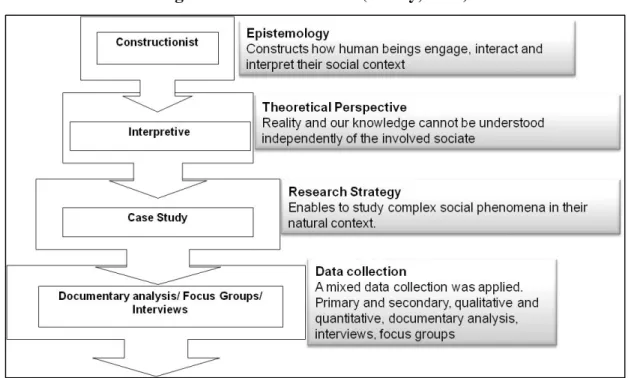
Given the nature of this research project, the epistemology it belongs to that of constructivism. It focuses to construct how human beings engage, interact and interpret their social context. Hammersley & Atkinson (1995) claims that “constructivism is all meaningful realities which are perceived by the research subjects will be contingent upon human practices; they will be constructed from the interaction between human beings and their world; and they will be developed and transmitted within an essentially social context”. Gergen (1999) states that “the basic contention of the constructivism argument is that reality is socially constructed by and between the persons who experience it”. That reality can be inconsistent for each of us based on our unique understandings of the world and our experience of it (Berger & Luckman, 1966). In contrast, the objectivism theoretical perspective is not suitable for this project as it suggests that truth and meaning reside in their objects, independent of any human
32
consciousness (Bourdieu, 1990). On the same taken, subjectivism is not suitable for this research as it goes to the other extreme by believing only in human consciousness (Adorno, 1983).
2.2.3 Theoretical perspective
Theoretical perspectives can be divided into the following different categories.
Post-positivism states that absolute truth can never be found. The word “Positivism” has developed to a common approach to research which incorporates methods and approaches of natural science for the study of human behaviour (Burns, 2000). It contains a clear distinction between theory and research and includes elements of both deduction and induction (Bryman & Teevan, 2005).
Interpretivism as Howcroft & Trauth (2005) state about that “reality and our knowledge of it are social products that cannot be understood independently of the social actors who construct and sense of that reality”.
This research project was conducted within the interpretivism approach as the social world, and the study of it, was fundamentally different from the natural world. It did not consider that there was one single objective truth that could be found and explained, thus both the positivist and realist approaches were not appropriate. Development and implementation issues for managing sales performance depend on the social world, type of business, consisting of humans. Crotty (1998) states that “interpretivism was conceived in reaction to the effort to develop a natural science of the social”. The study of a project in its natural social environment, in this case was part of the interpretivist philosophy and is suitable for this research.
The close relationship of the researcher and the researched area in this theoretical perspective, and the risk that any understanding could be framed within the approach of the researcher, meant that actions had to be introduced to avoid bias. It was essential to examine ways of critical thinking about the processes, relationships with the stakeholders, and the quality and richness of the data and analysis. It is normal for different reaction to be raised by the stakeholders as this project was effected to their responsibilities. Using training would give them opportunities to familiarise and accept the new concept of the measurement and management of sales performance in the organisation.
33
2.2.4 Research Strategy
The decision regarding research methodology used in work-based research was driven by the stated research questions. Six main research strategies which are outlined below set the frameworks of the different methodologies used to answer the research questions.
Action Research is suitable for improving our understanding in the study area, develop
our learning and influence others’ learning. As McNiff & Whitehead (2006) state Action Research “has become increasingly popular around the world as a form of professional learning. Action research is suitable for improving our understanding in the study area, develop our learning and influence others’ learning”. Kemmis & McTargets (1998) define that
“Action research is a form of collective, self-reflective inquiry that participants in social situations undertake to improve; the rationality and justice of their own social or educational practices and the situations in which they carry out these practices. Groups of participants can be teachers, students, parents, workplace colleagues, social activists or any other community member-that is any group with a shared concern and the motivation and will to address their shared concern.”
The steps for the Research Action are described by Kumar (2005) in figure 2:2.
Figure 2:2: Action research design (Kumar, 2005)
In this approach, the research cycle starts with an unmet need, analysing the data which are collected through a research process, suggesting potential changes, and finally taking action to set up these changes.
Action Research is collaborative as Kumar (2005) states it “is based upon a philosophy of community development that seeks the involvement of community members”. The action researcher is like a physician trying to help a patient (Cunningham, 2001). The
RESEARCH Aspects of concern
TAKE ACTION
to
Introduce changes
An intervention/
Program
Or
A felt unmet need
ANALYSE Data to draw conclusions with respect to areas of concern
SUGGEST
Changes to deal with the concerns34
rule of worker/ researcher as member of an organisation is to motivate the participants to their own change. Action research is a powerful and useful model for practitioner research.
Koshy (2005) states that:
Research can be defined within a specific circumstance or condition;
Researchers can be participate actively in the process – they don’t have to be distant and detached from the situation;
Action research involves constant assessment and modifications can be made as the project progresses;
There are circumstances for theory to emerge from the research rather than always follow a previously formulated theory;
The study can lead to open-ended outcomes;
Through action research, the researcher can bring a story to life”. The disadvantages are:
It is time consuming and continuing, for example as collaborative method it is essential to use interviews, which need time in the research.
It is not easy where there is not a set group of people.
It is based on the support of some participants
It is difficult to generalise from action research. It is focused on the research project and may not be safe to assume that other people or other systems can take action to set up the same changes.
It is difficult to generalise from action research (Adelman, 1993).
Soft Systems Methodology (SSM), developed by Checkland in 1970s, is a way of
analysing unstructured and poorly defined problems in real world (Lucey, 2004). It is. As cited by Checkland & Scholes (1999) “in the case of Soft Systems Methodology (SSM) we have a cyclic methodology which is itself a systemic process, one which within its procedures happens to make use of models”. This method places its emphasis on the analysis of the problem before any action is taken.
SSM is a comparison between the real life situations as it is, and as it might be. The stages for the SSM process are described by Checkland & Scholes (1999):
“Finding out and investigating the unstructured problem;
Expressing the problem situation;
Formulating root definitions, from what different perspectives we can look into this problem;