VYSOKÉ UČENÍ TECHNICKÉ V BRNĚ
BRNO UNIVERSITY OF TECHNOLOGYFAKULTA PODNIKATELSKÁ ÚSTAV EKONOMIKY
FACULTY OF BUSINESS AND MANAGEMENT INSTITUTE OF ECONOMICS
PROPOSAL OF AUTOMATIC RISK EVALUATION
FOR BANKING CLIENT LOANS
NÁVRH AUTOMATICKÉHO HODNOCENÍ RIZIKA ÚVĚRU BANKOVNÍCH KLIENTŮ
DIPLOMOVÁ PRÁCE
MASTER'S THESISAUTOR PRÁCE
Bc. JIŘÍ KOBELKA
AUTHOR
VEDOUCÍ PRÁCE
prof. Ing. PETR DOSTÁL, CSc.
SUPERVISOR
Brno University of Technology Academic year: 2010/2011
Faculty of Business and Management Institute of Economics
MASTER'S THESIS ASSIGNMENT
Kobelka Jiří, Bc.
European Business and Finance (6208T150)
Pursuant to Act. No. 111/1998 Coll., on Higher Education Institutions, and in accordance with the Rules for Studies and Examinations of the Brno University of Technology an Dean’s Directive on Realization of Bachelor and Master Degree Programs, the director of the Institute of is submitting you a master's thesis of the following title:
Proposal of Automatic Risk Evaluation for Banking Client Loans
In the Czech language:
Návrh automatického hodnocení rizika úvěru bankovních klientů
Instruction: Introduction
Executive summary
Theoretical basis of the work
Problem analysis and current situation
Proposals and contribution of suggested solutions Conclusions
References Apendices
Pursuant to section 60 of Act No. 121/2000 Coll., as subsequently amended (hereinafter referred to as "Copyright Act") this thesis is a "schoolwork" and its use complies to the legal regime of the Copyright Act. Quotations hereof are permitted upon prior consent of the Faculty of Business and Management of Brno University of Technology. Before any external use of this thesis it is strictly required to conclude a "License Agreement" pursuant to the Copyright Act.
Seznam odborné literatury:
DOSTÁL, P. Pokročilé metody analýz a modelování v podnikatelství a veřejné správě. 1. vyd. Brno: CERM, s.r.o., 2008. 340s. ISBN 978-80-7204-605-8.
DOSTÁL, P. Advanced Economic Analyses. 1. vyd. Brno: CERM, s.r.o., 2008, 80s. ISBN 978-80-214-3564-3.
ALIEV, A., ALIEV, R. Soft Computing and Its Applications. 1. vyd. World Scientific Pub. Ltd, UK 2002, 444s., ISBN 981-02-4700-1.
KLIR, G.J., YUAN, B. Fuzzy Sets and Fuzzy Logic, Theory and Applications. 1. vyd. Prentice Hall, New Jersy, USA, 1995, 279s., ISBN 0-13-101171-5.
THE MATHWORKS. MATLAB – Fuzzy Logic Toolbox – User’s Guide. The MathWorks, Inc., 2008.
The supervisor of master's thesis: prof. Ing. Petr Dostál, CSc.
Termín odevzdání master's thesis is given by the Schedule of the Academic year 2010/2011.
L.S.
_______________________________ _______________________________ doc. Ing. Tomáš Meluzín, Ph.D. doc. RNDr. Anna Putnová, Ph.D., MBA
Director of the Institute Dean of the Faculty
Abstract
This Master’s thesis is focused on application of fuzzy logic on the process of
automatic default client detection from the bank credit risk management point of
view. Based on contemporary Credit Risk Management information system
analysis author suggests changing approach in a loan client evaluation.
Abstract
Diplomová práce se zabývá aplikací fuzzy logiky na proces automatické detekce
úpadkového klienta z pohledu
ř
ízení úv
ě
rového rizika banky. Na základ
ě
analýzy stávajícího informa
č
ního systému Credit Risk Monitoring autor
navrhuje zm
ě
nu p
ř
ístupu v hodnocení úv
ě
rového klienta.
Keywords
Fuzzy logic, Credit Risk Management, Artificial Intelligence, Default client
detection
Klí
č
ová slova
Fuzzy logika,
Ř
ízení úv
ě
rového rizika, Um
ě
lá inteligence, Detekce úpadkového
Bibliographic Citation
KOBELKA, J. Proposal of Automatic Risk Evaluation for Banking Client Loans. Brno: Brno University of Technology, Faculty of Business and Management, 2011. 74 p.
Declaration of originality
I hereby declare that this Master’s Thesis is an original and has been written under the supervision of Professor Ing. Petr Dostál, CSc. All sources have been duly acknowledged in compliance with the relevant copyright legislation (Act. No. 121/2000 Coll., on copyright).
Brno, 31 August 2011
………..
Acknowledgements
The author would like to thank Professor Ing. Petr Dostál, CSc. for his valuable advice and support related to this Master’s Thesis and the underlying research and to Ing. Pavel Kozák for his collaboration and for providing the data needed for the research.
Contents
1. Introduction ... 10
2. Executive summary ... 12
3. Theoretical basis of the work ... 14
4. Problem analysis and current situation ... 16
4.1. Basic information about Volksbank ... 16
4.2. Analysis of the current situation ... 16
4.2.1. Definition of the loan client ... 17
4.2.2. Default and non-default clients ... 17
4.2.3. Loan products ... 18
4.2.4. Functioning of the current Information System ... 19
4.3. Test of the current Credit Risk Monitoring Information System ... 20
4.4. Summary of the current situation ... 23
5. Proposals and contribution of suggested solutions ... 24
5.1. Data ... 24
5.2. Retail clients ... 24
5.2.1. Selection of an appropriate credit risk model ... 25
5.2.2. Data attributes and their information value ... 26
5.2.3. Fuzzy logic ... 43
5.2.4. Fuzzy model ... 44
5.2.5. Result of the fuzzy model ... 53
5.3. Corporate clients ... 61
5.3.1. Commercial credit scoring products ... 62
5.3.2. Risk assessment models ... 64
6. Conclusion ... 67
7. References ... 69
8. List of abbreviations and symbols ... 71
9. List of figures ... 72
10. List of appendices ... 74
11. Appendices ... i
11.1. Appendix 1 – Interview with Ing. Pavel Kozák ... i
11.2. Appendix 2 – Variable definitions by Kočenda and Vojtek ... v
11.3. Appendix 3 – Information values of variables by Kočenda and Vojtek ... vii
11.4. Appendix 4 – Interview with Mgr. Martin Vojtek, PhD. ... viii
11.5. Appendix 5 - Variables commonly used in retail credit scoring models ... x
11.6. Appendix 6 – Formulas for the calculation of the individual variables in the transformation matrix ... xi
10
1.
Introduction
Volksbank CZ, a.s. (hereinafter Volksbank or the Bank) is a universal commercial bank. Bank activities include processing of loan products. For credit lines to be provided client risk needs to be assessed to determine whether the client in question will be able to meet his obligations to the bank and repay the loan plus the interest. The discipline which examines this issue is called credit risk management.
Every loan case is carefully examined by the bank to avoid exposure to the risk of loss, and Volksbank – like other banks – uses an automated system to carry out risk assessment of loan clients. The current loan clients are subject to monitoring with regard to their meeting the account turnovers required by their contracts or with regard to their inclusion in any of the black lists which are part of various bank registers.
The Bank currently operates a monitoring information system whose underlying principle is static. Fixed assessment ranges are set for individual information sources in line with the methodology of the Bank’s Credit Risk Management Department. The resulting values are added together, and the sum represents a rough overview of the risk posed by a client in absolute value. In principle, the higher the number, the higher the potential risk.
However, this leads to a situation in which the degree to which risk assessment can be automated is low, as there is a disproportion between the client’s absolute value and obligation. Larger clients will accumulate a higher number of risk points much more quickly although they need not be more risky.
The aim of this thesis is to analyze the current information system with respect to the automatic risk assessment of Volksbank´s loan clients and to put forward a new automatic solution to increase the relevance of risk assessment.
The thesis draws on actual data kindly provided by Volksbank. The data have been subjected to an irreversible modification consisting of the removal and change of client specific information and of text values. The numerical values have been preserved to avoid any
11
adverse effect on the conclusions of this thesis, which should, as a result, be able to provide a valuable solution to the Bank.
12
2.
Executive summary
The aim of this thesis is to analyze Volksbank’s capability for assessing the risk in existing loan clients by means of the Credit Risk Monitoring System and to put forward a proposal for improvement.
The thesis relies on qualitative research sources, especially on documents and books and non-standardized observations. Two interviews have also been conducted, one with Ing. Pavel Kozák from Volksbank’s Development Department and the other with Mgr. Martin Vojtek, Ph.D. from the Czech National Bank’s department of Banking Supervision.
The analysis of the methodology used by the Credit Risk Monitoring System has shown that the system has a low success rate in detecting high risk clients amounting from 17.7 to 19.12 percent. The low success rate is principally caused by the weak comparability of the individual data, which makes a relevant definition of the risk client threshold impossible. As a result, the system can only be automated to a limited extent and requires human intervention and correction.
The improvement on the existing risk assessment methodology put forward by the thesis draws on fuzzy logic. The variables for the transformation matrix have been selected based on an analysis of the discriminatory power of the individual variables established by means of information value calculation. The thesis divides clients in two groups: retail and corporate.
Calculation only concerns the retail group, as sufficient data for the corporate segment has not been available. The corporate segment has only been subjected to a theoretical analysis, which recommends the use of the neural network method for analyzing risk in existing corporate clients.
The fuzzy model drawn up for the retail group substantially improves on the accuracy of the existing Credit Risk Monitoring Methodology to the extent of up to 72.3%. This improvement in accuracy is, however, impaired by an increased error rate.
13
The increased error rate is probably caused by the lack of a highly discriminatory variable in the analyzed data, which would reduce the error rate while maintaining or improving the level of accuracy with respect to the identification of existing risk clients.
The author therefore recommends that the Bank should conduct a broader analysis of the information values of other indicators extractable from client data. A wider application of neural networks is also an option that should be considered.
14
3.
Theoretical basis of the work
The thesis use qualitative analysis to examine the Credit Risk Monitoring System at Volksbank. Its aim is to conduct a research to analyze the existing situation and attempt to put forward a better solution. The goal of the thesis is thus to answer the following main research question.
The main research question is:
“Does the existing solution for assessing risk in loan clients of the Bank lend itself to automation and in what ways can the existing solution be improved?“
The thesis follows the qualitative research strategy. Hendl (1) notes that when employing this strategy, the researcher relies on a longer intensive contact with the situation on the ground or of the individual or group in question and attempts to obtain an integrated picture of the subject of research and the logic of its context. Qualitative research is characterized by the researcher gaining a picture of the situation during research and an inductive analysis of the data followed by their interpretation.
Qualitative research employs the following methods: document study and non-standardized observation. “Documents may be the only underlying data source for the study or they may provide support for data obtained through observation or interviews“ (1 p. 204) Hendl differentiates between official documents, archive data, as well as mass media and virtual data.
With respect to the event examined, Hendl (1) distinguishes between contemporary documents (originating at the time of the examined event), retrospective documents (originating after the examined event), primary documents (drawn up by direct witnesses to the event) and secondary (drawn up based on primary documents). Contemporary and primary documents are the most suitable documents for the analysis attempted here; retrospective and secondary documents would be less reliable, as they themselves represent an interpretation of contemporary and primary documents.
15
Another important research method is the interview, which allows the researcher peep into the world of the interviewee. An interview is based on interaction between the interviewer and the interviewee. The direction of the interview is roughly sketched ahead of the actual interview by the interviewer, who may, however, also rely on spontaneous questions arising from the natural flow of conversation between him and the interviewee (2).
The Credit Risk Information System can be seen as consisting of two theoretical parts.
The first part encompasses the risk management methodology at the given bank, which is aimed at defining the individual risk, such as the Implicit Option Risk or Interest Rate Gaps. The theoretical framework used for risk management in this thesis is the 2010 book by Professor Joël Bessis entitled Risk Management in Banking. Professor Bessis gives a comprehensive survey of risk management across banks, and only selected parts of his framework will be relevant for the purposes of our analysis of Volksbank.
The second part consists in interpreting the individual risk areas and their contextualization. This can be done by using artificial intelligence, specifically by applying fuzzy logic and neural networks. In this respect, the thesis draws on a 2008 book by Petr Dostál entitled
Pokročilé metody analýz a modelování v podnikatelství a veřejné správě (“Advanced analytical methods and modelling in business and public administration”).
16
4.
Problem analysis and current situation
This chapter provides basic information on Volksbank followed by an analysis of the current way the automated risk assessment of loan clients is operated. The chapter concludes with an analysis of the problematic parts of the information system model and makes recommendations for modifying the information system based on this analysis.
4.1.
Basic information about Volksbank
Volksbank entered the Czech market in 1993 (3 p. 05). The owner of Volksbank is Volksbank International in Vienna (hereinafter VBI) (3 p. 05). In 2010, Volksbank reported an annual average of 622 employees including employees on maternity leave (3 p. 04). The overall volume of loans reached CZK 39.1 billion (3 p. 04). Credit risk management is the responsibility of the Bank’s Credit Risk Management Department (3 p. 18).
Figure 1 - Volumes of loans to clients of Volksbank (3 p. 4)
4.2.
Analysis of the current situation
According to Dostál a Sojka (4 p. 6), “credit risk means the failure of debtor against the creditor; it means of not payment of debt, the creditor receives the loss”. For the purposes of this thesis the Bank is deemed the creditor, while the loan client is deemed the debtor. It is the
17
interest of each creditor to assess his credit risk and to react to change in an adequate manner, for instance by writing down the loan or by increasing the interest rate to cover the risk (4 pp. 7-8).
Volksbank operates an in-house information system called Credit Risk Monitoring to monitor current loan clients. Individual client data from various sources form the basis for the assessment of client risk. Credit Risk Monitoring serves as an early warning system.
4.2.1. Definition of the loan client
The concept of a loan client is not as trivial as it may appear. Even within one bank one may encounter several interpretations of this term. Some may understand a loan client to denote a client with a mortgage or a consumer loan. Other users of the term may understand it to mean a client with an available credit line, such as a credit card. Yet other users may think of a client with an aggregate debit balance of below 0 at a given moment.
For the purposes of Credit Risk Monitoring, the Bank applies the last of the above methodologies. Thus ‘loan client’ denotes a client whose sum of debit balances on all both on- and off-balance accounts is below 0 at a given moment. Based on this criterion, the information system keeps track of all clients regardless of whether they are companies or individuals.
Although this definition may seem strange – it is not, after all, based on credit balance accounts –, there is a good reason for it. Normally, the bank may not perform netting against other client’s accounts, although this may be changed contractually. The Credit Risk
Monitoring information system, however, is based solely on real loan clients, namely those who have used at least a part of their credit line.
4.2.2. Default and non-default clients
Bessis describes the definition of default used by the Basel 2 banking rules as follows: “Basel 2 defines a default event as non-payment of debt obligations for 90 days“(5 p. 235). According to the Basel 2 rules, a default analysis should be carried out on an annual basis (5 p. 235). This thesis is based on the Basel 2 interpretation of default.
18
Accordingly, clients who have at least once been in default of the repayment of their loan for a period of more than 90 days will be considered default clients for the purposes of this thesis. Clients without such a recorded failure to repay their loan will, by contrast, be considered non-default clients.
4.2.3. Loan products
Let us now define the individual loan products, which will be referred to in the text below. Naturally, Volksbank’s products needs to be taken into account. The loan products portfolio of this bank is pretty usual. It consists of mortgages, current account overdrafts, consumer loans, bank guarantees, tranche loans and investment loans. These are the products that this thesis focuses on, as these products are subject to processing by the Credit Risk Monitoring Information System.
Within the Czech context, a mortgage loan is a product available to individuals and suitable for financing the purchase of a real estate or – in the case of an ‘American’ mortgage – its loan without purpose (6 pp. 3-6). A mortgage loan will always be secured by a real estate; if the mortgage is taken out for a real estate that is about to be or being built, the real estate at its current (registered) construction stage will serve as a guarantee. Furthermore, the client and his joint debtors will have compulsory death insurance, and a bill of exchange of the corresponding value will be deposited at the bank (7). It might seem that this form of assurance is sufficient and that the bank cannot suffer any serious loss if the client breaches his contractual obligations to such an extent that the bank is forced to a write-down. However, as the global financial crisis has shown, the fall of the real estate market may cause the market value of the pledge to plunge, resulting in the bank’s failure to satisfy its claims (5 pp. 3-18).
A current account overdraft is essentially a pre-approved credit line which the client may use as needed for a purpose of his choice and repay at any time in the future. However, interest accrues over the whole period and tends to be less favourable than that of a specific purpose loan such as a mortgage. A current account overdraft is available to the entire client portfolio, and may be acquired by private individuals, self-employed persons and companies (7; 8; 9).
19
A bank guarantee is a less commonly used bank product. Self-employed persons and companies might want to provide it to their business partners to give them the certainty that, even if they become insolvent, their business partner will still be able to satisfy its claims on them up to the amount of the bank guarantee. Thus, by issuing a bank guarantee the bank becomes a guarantor (8; 9).
A tranche loan is used by larger enterprises for inventory and production financing. By means of such a loan the bank enables its clients to repeatedly draw on, in individual tranches, the funds up to the amount of the approved credit line (8).
An investment loan is suitable for self-employed persons and companies in need of funds for the purchase of real estate, machinery and equipment or other fixed assets. The duration of its repayment should not exceed the depreciation period of the assets purchased (9; 8).
Credit cards operates on a principle which is similar to that of the current account overdraft,
but differ in that the loan usually needs to be repaid within 30 to 60 days to avoid being charged a high interest.
Volksbank does provide other loan products as well, but the above mentioned products are the most important ones.
4.2.4. Functioning of the current Information System
The Credit Risk Monitoring Information System collects large amounts of data on loan clients from various sources on a daily basis. Each data source provides different information; generally, the data in question are either acquired from in-house bank systems or externally.
The following in-house data, among others, are further processed in the Credit Risk Monitoring Information System:
- Unapproved debits,
- Failure to meet the minimum obligatory credit turnovers,
- Failure to submit documents for the year-on-year status assessment of the company as of the contractual date.
20 - Interbank registers,
- Rating agencies,
- Government institutions (such as the Czech Ministry of Finance or the Czech Ministry of Justice).
Data from these sources are then processed and “events” are extracted from them. Positive or
neutral events are kept track of but no risk points are awarded for them. Events considered
improper by the bank are called “negative events” (see Appendix 1). Risk points are awarded for negative events in line with preset rules.
Several rule types exists. Generally, risk point award rules can be divided into fixed or scope-based on the one hand and into one-off or recurrent on the other. For instance, a negative entry in the Commercial Register, such as a distraint, would result in the client being awarded risk points based on a one-off fixed rule. By contrast, failure to fulfil annual, quarterly or monthly contractual turnovers will result in the award of risk points based on a recurrent rule adjusted for scope. This is because the Credit Risk Monitoring Information System uses what is called a rule based credit scoring methodology (10).
Despite the use of rule based credit scoring methodology, the aim of the Credit Risk Monitoring System is clearly not an automatic risk assessment. As Kozák notes: “Employees of the Credit Risk Management Department issue opinions on the individual events. The number of points and point ranges applicable to negative events are defined by the specialists of this department” (see Appendix 1).
The role of the system rather consists in enabling the staff of the Credit Risk Management Department to take all the relevant data into account and comment on the individual events. The information system should therefore not be perceived as a stand-alone tool for automated risk assessment, but rather as a utility which helps the Credit Risk Management Department carry out preventive detection of risk loans.
4.3.
Test of the current Credit Risk Monitoring Information System
A test of a random sample of 1200 loan clients over a reference period of 12 months was carried out to verify the accuracy of the methodology currently used by the Credit Risk
Monitoring Information System in terms of default clie
had been identified as actual default clients and 1132 as actual non the Basel 2 methodology.
Figure 2 - Data set default share and segmentation
Since the Credit Risk Monitoring System uses an absolute point value (and not a percentage) to evaluate risk, a threshold for an automated assessment of default had to be set. The threshold was set at 50% of the maximum possible number of points over the reference period of 12 months. The description of the method for establishing the success
given in the following table.
Default client
TRUE TRUE FALSE FALSE
Table 1 -Interpretation of the methodology for establishing the Credit Risk Monitoring Test success
TYPE I ERROR indicates that an actual default client has gone unnoticed. TYPE II ERROR indicates that an actual non-default client has been incorrectly identified as a default client p. 543).
The current information system did not perform well in the test. 58 actual default clients were identified as non-default clients (TY
identified as default clients (TYPE II ERROR). Only in 10 cases did the Credit Risk
68
1132
Data set default share
21
ring Information System in terms of default client detection. Out of these clients, 68 had been identified as actual default clients and 1132 as actual non-default clients based on
Data set default share and segmentation
isk Monitoring System uses an absolute point value (and not a percentage) to evaluate risk, a threshold for an automated assessment of default had to be set. The threshold was set at 50% of the maximum possible number of points over the reference period
12 months. The description of the method for establishing the success
Credit Risk Monitoring default Result
TRUE TRUE
FALSE FALSE, TYPE I ERROR
FALSE TRUE
TRUE FALSE, TYPE II ERROR
Interpretation of the methodology for establishing the Credit Risk Monitoring Test success
TYPE I ERROR indicates that an actual default client has gone unnoticed. TYPE II ERROR default client has been incorrectly identified as a default client
The current information system did not perform well in the test. 58 actual default clients were default clients (TYPE I ERROR), and 15 actual non-default clients were identified as default clients (TYPE II ERROR). Only in 10 cases did the Credit Risk
Data set default share
Default Non-default 213 987
Data set
segmentation
. Out of these clients, 68 default clients based on
isk Monitoring System uses an absolute point value (and not a percentage) to evaluate risk, a threshold for an automated assessment of default had to be set. The threshold was set at 50% of the maximum possible number of points over the reference period 12 months. The description of the method for establishing the success-rate of the test is
, TYPE I ERROR
, TYPE II ERROR
Interpretation of the methodology for establishing the Credit Risk Monitoring Test success-rate
TYPE I ERROR indicates that an actual default client has gone unnoticed. TYPE II ERROR default client has been incorrectly identified as a default client (5
The current information system did not perform well in the test. 58 actual default clients were default clients were identified as default clients (TYPE II ERROR). Only in 10 cases did the Credit Risk
Data set
segmentation
Companies Individuals
Monitoring Information System manage to correctly identify actual risk (default) clients. It also managed to correctly identify 1117 out of the actual 1132 well
Figure 3 - Credit Risk Monitoring – test results (50% threshold)
The test result may be interpreted as showing the probability of correct automatic identification of a potential default client to be 14.7% and the probability of incorrect identification of an actual default client as non
To control for any errors resulting from the choice of the threshold based on which a client is assessed as default or non-default, the calculation for the same data sample over the same reference period of 12 months was performed again, this time with a threshold
maximum number of risk points reduced from 50% to 25%.
However, there was no significant improveme
default, while 55 (actual default) clients were incorrectly identified as non ERROR). 1104 clients were correctly identified as non
incorrectly identified as default
58
15 10 1117
Credit Risk Monitoring results
(50% threshold)
22
ystem manage to correctly identify actual risk (default) clients. It dentify 1117 out of the actual 1132 well-performing clients.
test results (50% threshold)
The test result may be interpreted as showing the probability of correct automatic potential default client to be 14.7% and the probability of incorrect identification of an actual default client as non-default to be 1.33%.
To control for any errors resulting from the choice of the threshold based on which a client is default, the calculation for the same data sample over the same reference period of 12 months was performed again, this time with a threshold
maximum number of risk points reduced from 50% to 25%.
However, there was no significant improvement. 13 clients were correctly identified as default, while 55 (actual default) clients were incorrectly identified as non
ERROR). 1104 clients were correctly identified as non-default, while 28 clients were incorrectly identified as default (TYPE II ERROR).
Credit Risk Monitoring results
% threshold)
TYPE I ERROR TYPE II ERROR Default Non-default
ystem manage to correctly identify actual risk (default) clients. It performing clients.
The test result may be interpreted as showing the probability of correct automatic potential default client to be 14.7% and the probability of incorrect
To control for any errors resulting from the choice of the threshold based on which a client is default, the calculation for the same data sample over the same reference period of 12 months was performed again, this time with a threshold for the
nt. 13 clients were correctly identified as default, while 55 (actual default) clients were incorrectly identified as non-default (TYPE I default, while 28 clients were
Figure 4 - Credit Risk Monitoring results (25
The decrease in the sensitivity threshold obviously increased the assessment accuracy default client from 14.7% to 19.12%, which amo
original result. At the same time, however
which means that the number of false alarms increased by as much as 85.71%.
4.4.
Summary of the current situation
The Credit Risk Monitoring default loans very accurately,
useless for automated risk assessment. It does not differentiate between individual loan products or between corporate and retail clients. Its heavy dependence on the interpretation of information by humans dramatically impairs its automatic interpretation capability as such. Therefore, the architecture of the whole system should be changed.
5528
1104
Credit Risk Monitoring results
(25% threshold)
23 Credit Risk Monitoring results (25% threshold)
The decrease in the sensitivity threshold obviously increased the assessment accuracy 14.7% to 19.12%, which amounts to an improvement of 30.07 original result. At the same time, however, the error rate increased from
which means that the number of false alarms increased by as much as 85.71%.
Summary of the current situation
The Credit Risk Monitoring Information System clearly does not reflect the real status of and its very limited ability to predict default makes it practically useless for automated risk assessment. It does not differentiate between individual loan or between corporate and retail clients. Its heavy dependence on the interpretation of information by humans dramatically impairs its automatic interpretation capability as such. Therefore, the architecture of the whole system should be changed.
13
Credit Risk Monitoring results
(25% threshold)
TYPE I ERROR TYPE II ERROR Default Non-default
The decrease in the sensitivity threshold obviously increased the assessment accuracy for a ovement of 30.07% on the , the error rate increased from 1.33 % to 2.47%, which means that the number of false alarms increased by as much as 85.71%.
ystem clearly does not reflect the real status of and its very limited ability to predict default makes it practically useless for automated risk assessment. It does not differentiate between individual loan or between corporate and retail clients. Its heavy dependence on the interpretation of information by humans dramatically impairs its automatic interpretation capability as such.
24
5.
Proposals and contribution of suggested solutions
As has been already pointed out in the chapter “Problem analysis and current situation”, the existing system for assessing risk in loan clients has a number of weaknesses:
1. The model it uses has a low accuracy of default identification. 2. The credit risk scoring model is not clearly defined.
3. The overall assessment is in absolute values: larger clients generally collect negative events “more easily” than smaller ones, yet the size of the client is not taken into account and the indicators are not weighted based on the relative size of the clients. 4. The system does lend itself to automation only to a limited extent and it still relies on
human interpretation.
To eliminate these drawbacks, advanced statistical methods need to be employed to find a suitable model.
5.1.
Data
The Bank provided a sample containing a higher-than-normal proportion of default clients for the purpose of examining the relationships between the individual variables and the extent to which these predict default. The sample includes 1178 clients, out of which 910 are retail and 268 corporate. Each client in the dataset has only one loan, which enables us to control for additional influences while testing the individual parameters. As a result, the outcomes of the calculations are not distorted by the impact of combinations of variables.
5.2.
Retail clients
Retail clients include natural persons, chiefly non-entrepreneurs. For the purposes of automated risk assessment of loan clients, self-employed persons will also be considered retail clients.
25
5.2.1. Selection of an appropriate credit risk model
Although there are a variety of approaches to credit risk assessment of retail clients (11), this thesis adheres to the methodology put forward by Bessis in 2010. For the retail segment, Bessis differentiates between “behavioural scoring models” and “origination scoring models” (5 p. 546).
Bessis defines a behavioral scoring models as “an atempt to model the behavior of existing clients, when there is no new event that would change the debt level, given historical data of account and loan behavior. Behavioural models apply to existing clients for whom there is historical data, say, at least 6 months. It makes it easier to deal with existing clients than new clients for whom there is no credit history” (5 p. 546).
By contrast, the origination model is more suitable for assessing new clients: “There are two types of origination models. For new clients, there is less information, although all banks would collect a minimum set of data on the client, such as revenue, wealth and, eventually, historical behaviour of other existing accounts in other banks. Therefore, we cannot use the same attributes for modelling their risk as with the existing clients. Consider an existing client that requests a new loan. A second type of origination model is required, because we already have historical data on the client. In this case, we have a different origination model, which applies to a known client whose credit standing might be affected by a new loan. It is also an origination model because “originating” to this existing client is considered” (5 p. 546).
Since the role of the Credit Risk Monitoring Information System is to monitor current clients and their loan burdens, the behavioural scoring model is the more suitable one. However, this type of model is more demanding in terms of client data. Bessis lists the following data as suitable for analysis (5 p. 547):
- Time series of flows, measured by the absolute value of flows, both negative and positive, and averaged over a period of the past 6 months;
- Number of debit days, measured by the maximum of debit days over the past 6 months;
- Number of transactions suspended by a credit officer because they would have triggered an excess overdraft;
26 - Count of incidents over the past 6 months;
- Amount of liquid savings – measure of wealth often known by the bank, with some average calculated from the end of the month average of balances over the past 6 months;
- Leverage ratio – monthly payments of due/credit flows; - origination of the account;
- Other personal wealth characteristics.
Different data sets may be used for actual modelling. Appendix 5 gives a summary of the various approaches to variables commonly used in retail credit scoring models.
5.2.2. Data attributes and their information value
The individual data attributes, i.e. variables, need to be subject to discrimination in order to determine their importance. Discrimination amounts to calculating the information value of the variable in question (5 p. 547; 12 p. 8). This chapter will provide a calculation of the information value of the individual attributes based on the data sample provided by the bank.
According to Kočenda and Vojtek (12) a variable´s information value can be expressed as follows:
= ln ( ) −
Where Defaultedi represents the clients identified as default based on the variable (attribute)
in question, and Defaulted represents all default clients of the data set. Similarly, Goodi
represents non-default clients identified in the same way and Good the sum of non-default clients in the entire data set. The information value expresses the predictive power of the variable for the given group (12 p. 8).
Oddsi is the value expressing the discrimination ability of the variable in question for the
given group. The vaulue of Oddsi is given by the following formula:
27
The interpretation of the variables in this formula is identical with that of the values in the information value formula above.
Kočenka and Vojtek note that: ”In banking practice a value above 0.2 is taken as a sign of the strong predictability of a given variable.” (12 p. 8). This thesis will use this value as a benchmark.
Calculations for the individual available variables in the examined data sample can be easily performed in the above way. For the sake of clarity, the calculation of the information value of the attribute “female” with regard to client risk is shown below as an example:
= 26170 649201 = 0.268199 × 3.2288557 = 0.8659758756
= ln(0.8659758756) 261 −70 201649 = −0.1438982281 × (0.268199 − 0.30970724) = −0.1438982281 × (−0.04150824) = 0.00597296
The calculation clearly shows that, with regard to the assessment of risk in a loan client, the information value of the attribute “female“ is very low. Interestingly, the research conducted by Kočenda and Vojtek (12) at an undisclosed Czech bank found out the information value of gender to be approximately 0.0230161. Although this value does not exceed the threshold of 0.2 either, it is still about 4 times higher than the value arrived at based on the data sample for this thesis. This suggests that although gender may not be a decisive factor, it is obviously a highly volatile one and that, as a result, it might perhaps not be adequate to use one value for this indicator across all Czech banks.
For the sake of completeness, let us now calculate the information value of the attribute “male”:
& = 191261 649448 = 0.731800766 × 1.44866 = 1.06013102
& = ln(1.06013102) 191261 −448649 = 0.0583925 × (0.731800766 − 0.690292758) =
28
Based on the above calculations, we arrive at the following information value of the attribute “gender”:
'()*(+ = + &- 0.00597296 + 0.00242375635714 = 0.008396446
In our case, the information value of the attribute “gender” has thus been shown to be below the considerable predictive power threshold, which is in line with Kočenda and Vojtek (12) who also consider gender a non-discriminatory value, at least in the Czech Republic. Dinh and Kleimeier, however, note that gender remains a discriminatory variable in developing countries (13 p. 483).
Information values for all other variables, for which data were made available for the purposes of this thesis, have been calculated and the non-discriminatory variables eliminated in a similar fashion.
Another data attribute is the Length of Relationship in years. It represents the duration of the relationship between the bank and the client at the time of the loan application to the date of calculation. The information value of this attribute over the data sample examined in this thesis looks as follows:
Years Clients Default
Non-default Information value 0 124 52 72 0.051695 1 567 130 437 0.052838 1-3 68 27 41 0.019862 3-5 50 16 34 0.001401 5-10 74 25 49 0.004827 >10 27 11 16 0.00938 Total 910 261 649 0.140003
Figure 5 - Length of Relationship
As shown in the table above, the overall information value of the Length of Relationship between the bank and its client at the time of the loan application is significantly more important than gender.
29
Figure 6 - Percentage of default clients by length of the relationships with the bank
The graph above clearly shows that the data sample does not allow for the conclusion to be made that a client who has been with the bank for a longer period of time at the time of his loan application is less likely to default on his loan than a client who has been with the bank for a shorter period.
Interestingly, the same calculation for a Czech bank carried out by Kočenda and Vojtek arrived at an information value of 0.601787, which implies very high predictive power. This suggests that the variable Length of Relationship is dependent on the specific client portfolio and may thus not be suitable for an indiscriminate application in risk assessment.
Kočenda and Vojtek (12) are strong supporters of making the “Points” variable part of the analysis. They define this variable as “the characteristics of a client’s behavior in the current account” (12 p. 28). Unfortunately our data set does not comprise a sufficient amount of data, and there is no known way of constructing this variable retroactively and so, although Kočenda and Vojtek assert the information value of this variable to amount to 0.502122 (see Appendix 3), this thesis cannot take it into account.
Another attribute which could be used for risk analysis is the client´s Date of Birth. The following table gives a list of the calculated values.
41.94% 22.93% 39.71% 32.00% 33.78% 40.74% 0,00% 5,00% 10,00% 15,00% 20,00% 25,00% 30,00% 35,00% 40,00% 45,00% 0 1 1-3 3-5 5-10 >10
Percentage of default clients by length
of the relationships with the bank
30
Born up to year
Clients Default
Non-default Information value 1953 54 15 39 0.000117 1957 43 9 34 0.007489 1962 67 23 44 0.005330 1966 75 30 45 0.023051 1969 76 22 54 0.000014 1972 79 23 56 0.000039 1974 62 17 45 0.000263 1977 125 34 91 0.000732 1993 329 88 241 0.003300 Total 910 261 649 0.040333
Figure 7 - Date of Birth information value
Not surprisingly, in our case, the client´s age is not an absolutely decisive factor. However, the overall Date of Birth information value arrived at from our data is roughly identical with the information value reported by Kočenda and Vojtek, which is 0.047698 (see Appendix 3).
Figure 8 - Percentage of default clients by Date of Birth
The Number of Years from the client’s opening of a current account at the bank proves to be an important attribute. The following table shows the calculations of the information values for the individual periods.
0 27,78% 20,93% 34,33% 40,00% 28,95% 29,11% 27,42% 27,20% 26,75% 0 0,05 0,1 0,15 0,2 0,25 0,3 0,35 0,4 0,45 1948 1953 1957 1962 1966 1969 1972 1974 1977 1993
31
Years Clients Default Non-default Information value
1 124 4 120 0.422288 2 90 19 71 0.014909 3 240 62 178 0.005278 4 210 83 127 0.059395 5-6 121 44 77 0.017543 >6 125 49 76 0.03334 Total 910 261 649 0.552754
Figure 9 - Number of years from the opening of the current account as at 1 July 2011
Kočenda and Vojtek report an information value of 0.631346 for the attribute “number of years for which a person has been the bank´s client”. The difference between the information value for this attribute arrived at from our data sample and the information value reported by Kočenda and Vojtek is not as substantial as the one observed for the Length of Relationship attribute. Consequently, the Number of Years attribute might be considered a generally strong variable, which could be used for defining scoring models at other Czech banks as well. The following graph illustrates an interesting growth trend: longer relationships between clients and the bank generally result in an increased client default risk for the bank.
Figure 10 - Percentage of default clients by the Number of Years from the opening of the account
3.23% 21.11% 25.83% 39.52% 36.36% 39.20% 0,00% 5,00% 10,00% 15,00% 20,00% 25,00% 30,00% 35,00% 40,00% 45,00% 1 2 3 4 5-6 >6
Percentage of default clients by the Number
of Years from the opening of the account
32
The information value for the Amount of Loan attribute was calculated by Kočenda and Vojtek at 0.123972 (see Appendix 3). In our case, however, the information value for this attribute is slightly higher, reaching the threshold of 0.2, at which the information value of a variable is considered high.
Amount of Loan in CZK Clients Default Non-default Information value
<100000 86 35 51 0.02967 >100000 and <300000 154 57 97 0.026142 >300000 and <800000 143 35 108 0.006975 >800000 and <1200000 133 26 107 0.032875 >1200000 and <1800000 142 38 104 0.001405 >1800000 and <3000000 147 28 119 0.040779 >3000000 105 42 63 0.032271 Total 910 261 649 0.170118
Figure 11 - Amount of Loan
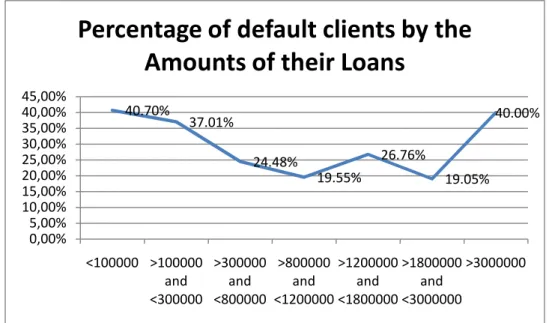
The graph below shows default risk to be lowest between CZK 800,000 and 3,000,000.
Figure 12 - Percentage of default clients by the Amounts of their Loans
For the Type of Product variable Kočenda and Vojtek report an information value of 0.022380 (see Appendix 3). Numbers from 1 to 4 are used to indicate different loan product types to ensure that data confidentiality is maintained and the data basis is clear.
40.70% 37.01% 24.48% 19.55% 26.76% 19.05% 40.00% 0,00% 5,00% 10,00% 15,00% 20,00% 25,00% 30,00% 35,00% 40,00% 45,00% <100000 >100000 and <300000 >300000 and <800000 >800000 and <1200000 >1200000 and <1800000 >1800000 and <3000000 >3000000
Percentage of default clients by the
Amounts of their Loans
33
Type of Product Clients Default
Non-default Information value 1 23 10 13 0.011858 2 880 249 631 0.000346 3 3 1 2 0.000163 4 4 2 2 0.004173 Total 910 262 648 0.016539
Figure 13 - Type of Product
There is no major difference compared to the value arrived at by Kočenda and Vojtek (see Appendix 3), but the information value of the Product Type variable does not reach a value sufficient to consider it discriminatory.
Kočenda and Vojtek (12) also consider a Region attribute, which they ascertain from the postal code. However, the data available for this thesis do not include any information on regions; the region attribute will, therefore, not be included in our analysis. If Kočenda and Vojtek are right, then the omission of the Region attribute should not be a serious issue, as the information value they calculated based on their data only reaches 0.093896 (see Appendix 3), and is thus not discriminatory.
Marital Status is yet another variable used in our analysis. To protect client data, actual
information on marital status has been transformed into a numerical index. This has, however, no bearing whatsoever on the process of variable discrimination.
Marital Status Clients Default Non-default Information value
1 177 66 111 0.032003 2 296 87 209 0.000390 3 320 75 245 0.024597 4 105 30 75 0.000003 5 12 3 9 0.000445 Total 910 261 649 0.056993
Figure 14 - Marital Status
The accuracy of risk calculation for a current loan client is obviously not too much affected by his or her Marital Status. Although Kočenda and Vojtek report a Marital Status information value of 0.112809 (see Appendix 3), the value in our case is about 50% lower.
34
The Citizenship attribute has proven irrelevant to risk assessment. The information values concerned are clearly presented in the following table.
Citizen of the CR Clients Default Non-default Information value
Yes 883 257 626 0.000415
No 27 4 23 0.016861
Total 910 261 649 0.017276
Figure 15 - Citizen of the Czech Republic
Likewise, the impact of the Residency attribute is minimal.
Residency Clients Default Non-default Information value
Czech Republic 893 258 635 0.00010326
Outside Czech Republic 17 3 14 0.00634405
Total 910 261 649 0.00644731
Figure 16 - Residency
By contrast, the information value of the Number of Persons in Joint Household attribute shows that this variable is highly discriminatory. Important note is that number of persons in joint household does not include applicant itself.
Persons in Joint Household
Clients Default Non-default Information value
0 481 167 314 0.043611 1 200 52 148 0.003891 2 106 21 85 0.024610 3 63 9 54 0.042917 4 53 10 43 0.015304 5 7 2 5 0.000000 Total 910 261 649 0.130333
Figure 17 – Number of Persons in Joint Household
The following graph clearly shows that the repayment reliability increases, up to an extent, with the number of persons living in a joint household with the client. With 4 and more persons in a joint household, the chance of default starts rising again. This may be caused by the higher cost of living faced by more numerous households in real terms.
35
Figure 18 - Percentage of default clients by the number of Persons in Joint Household
The client’s Housing Type proves to be a highly discriminatory variable. To protect client data, the values have been transformed into a numerical index, which does, however, not affect the values calculated. This variable clearly exceeds the recommended threshold. A comparison with another data set would be very interesting; unfortunately Kočenda and Vojtek (12) did not include this attribute in their analysis.
Housing Type
Clients Default Non-default Information value
0 481 168 313 0.046591 1 205 28 177 0.154368 2 70 22 48 0.001351 3 93 27 66 0.000030 4 4 3 1 0.020002 5 15 1 14 0.030658 6 28 6 22 0.004237 7 14 6 8 0.009235 Total 910 261 649 0.266471
Figure 19 - Housing Type
In their paper Kočenda and Vojtek (12) emphasized Education as a major reliability indicator of a client. More educated clients tend to default on their loans less often.
34.72% 26.00% 19.81% 14.29% 18.87% 28.57% 0,00% 10,00% 20,00% 30,00% 40,00% 0 1 2 3 4 5
Percentage of default clients by the
number of Persons in Joint
36
Education Clients Default Non-default Information value
0 486 169 317 0.044842 1 10 6 4 0.022148 2 94 33 61 0.009622 3 176 34 142 0.045908 4 27 5 22 0.008413 5 115 13 102 0.123364 6 2 1 1 0.002087 Total 910 261 649 0.256383 Figure 20 - Education
In the case of Volksbank data, education clearly has a highly discriminatory value; although it does not reach the level of 0.359725 reported by Kočenda and Vojtek for their data set (see Appendix 3). The graph vividly demonstrates that the percentage of loan clients in default falls with higher education, notwithstanding the sudden rise of default at 6, which is to be attributed to the small size of the data sample (only two clients) and seems to be too insignificant to refute the whole trend. Again, the data have been transformed into numerical values to protect client privacy.
Figure 21 - Percentage of default clients by Education
The Amount of Loan Instalment is a very interesting variable. This variable approaches the high discrimination threshold. The following table shows the results of the calculation of the
34.77% 60.00% 35.11% 19.32% 18.52% 11.30% 50.00% 0,00% 10,00% 20,00% 30,00% 40,00% 50,00% 60,00% 70,00% 0 1 2 3 4 5 6
Percentage of default clients by
Education
37
variable´s information value. The individual instalment ranges are not included to protect client data confidentiality.
Amount of Instalment
Clients Default Non-default Information value
Range 1 426 150 276 0.045004 Range 2 176 53 123 0.000935 Range 3 142 21 121 0.089062 Range 4 120 24 96 0.026605 Range 5 46 13 33 0.000021 Total 910 261 649 0.161627
Figure 22 - Amount of Loan Instalment
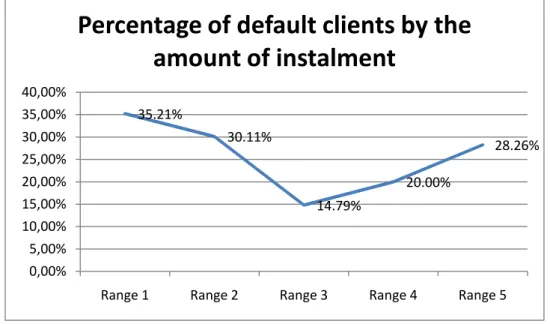
One would perhaps expect higher instalments to result in a higher chance of default. However, the graph clearly demonstrates a different trend. Paradoxically, the chance of default is highest for the lowest amounts of instalment. It should be noted that the data also includes consumer loans, which the bank may regard as more risky in terms of a possible default compared to, say, mortgages. As in the case of the number of Persons in a Joint household, however, the falling trend reverses, and in the medium range the number of defaults starts rising again. The Amount of Instalment should thus be taken into account when assessing the risk of a loan client defaulting.
Figure 23 - Percentage of default clients by the Amount of Instalment
35.21% 30.11% 14.79% 20.00% 28.26% 0,00% 5,00% 10,00% 15,00% 20,00% 25,00% 30,00% 35,00% 40,00%
Range 1 Range 2 Range 3 Range 4 Range 5
Percentage of default clients by the
amount of instalment
38
The following table shows that the Employee attribute, representing whether a loan client is an employee, is relatively discriminatory compared with other variables.
Employee Clients Default Non-default Information value
1 245 87 158 0.028243
2 469 100 369 0.073190
3 196 74 122 0.039264
Total 910 261 649 0.140697
Figure 24 – Employee
By contrast, the variables representing whether the client is an Entrepreneur (also in parallel with employment, if appropriate) or a member of the liberal profession both have almost identical information values and are discriminatory only to a minimum extent.
The following table shows the information value of the Entrepreneur attribute.
Entrepreneur Clients Default Non-default Information value
1 106 30 76 0.000040
2 608 157 451 0.013476
3 196 74 122 0.039264
Total 910 261 649 0.052780
Figure 25 – Entrepreneur
Similarly, the table below presents the calculation of for the Liberal Profession attribute. As can be seen, the overall information values are indeed almost the same.
Liberal Profession Clients Default Non-default Information value
1 709 185 524 0.012838
2 5 2 3 0.001537
3 196 74 122 0.039264
Total 910 261 649 0.053639
Figure 26 – Liberal Professions
Kočenda and Vojtek (12) consider the Number of Employments variable non-discriminatory with an information value of only 0.021004 (see Appendix 3). The result for Volksbank data is included in the following table. The actual number of employments is again in numerical
39
indexes, and the value 0 also includes the clients for which the number of employments is not known, as this may not have been a required piece of information for the provision of a loan.
Number of Employments
Clients Default Non-default Information value
0 668 213 455 0.017471 1 4 2 2 0.004173 2 195 37 158 0.054990 3 41 8 33 0.010222 4 2 1 1 0.002087 Total 910 261 649 0.088943
Figure 27 - Number of Employments
Compared to the information value reported for this attribute by Kočenda a Vojtek (12) the information value in our case in about four times higher. That still does not make it highly discriminatory. This is, however, not the only difference between this thesis and Kočenda and Vojtek (12) with regard to this variable – they define it as: “The total number of employments in the last 3 years“ (12 p. 26). The data Volksbank made available for the purposes of this includes the number of employments in the last 2 years. As a result a comparison of these values is not easily possible.
The graph below once again shows that the default rate is lower for medium values. Perhaps effective workers are able to change jobs reasonably often – not too often, and not too seldom. To have had two employers over the last 2 years is not terribly difficult. Consider a situation where the client asks for the loan, receives it and then, after 6 months, changes his job. This would bring the client to 2 employers in the last 2 years, while it is obviously not something negative.
40
Figure 28 - Percentage of default clients by the Number of Employments
The Employment Contract attribute has a slightly higher information value; it indicates whether the client in question has an employment contract or not or whether the relevant information is at all available. Although banks tend to prefer their mortgage loan applicants to have employment contracts, the real information value of this attribute with respect to a client’s default is not very discriminatory.
Employment Contract
Clients Default Non-default Information value
1 550 187 363 0.038914
2 329 67 262 0.066550
3 31 7 24 0.003264
Total 910 261 649 0.108727
Figure 29 - Employment Contract
By contrast, Salary is a highly discriminatory variable. Kočenda and Vojtek (12) do not take this variable into account, but the research presented here suggests it is fairly discriminatory.
31.89% 50.00% 18.97% 19.51% 50.00% 0,00% 10,00% 20,00% 30,00% 40,00% 50,00% 60,00% 0 1 2 3 4
Percentage of default clients by the
Number of Employments
41
Salary Clients Default Non-default Information value
Range 1 596 206 390 0.051351
Range 2 148 41 107 0.000376
Range 3 166 14 152 0.266139
Total 910 261 649 0.317867
Figure 30 - Salary
To protect client data confidentiality, the salary bands are denoted by ”Range 1” to “Range 3” without actual figures being indicated. The following graph shows the direct link between salary and the risk of default.
Figure 31 - Percentage of default clients by Salary
The information value of the Current Account variable amounts to a little more than half that of the Salary attribute. The Current Account variable indicates that a loan client also has a current account with Volksbank. The table below lists the information values calculated for the individual options.
34.56% 27.70% 8.43% 0,00% 5,00% 10,00% 15,00% 20,00% 25,00% 30,00% 35,00% 40,00%
Range 1 Range 2 Range 3
Percentage of default clients by
Salary
42
Current Account
Clients Default Non-default Information value
1 204 78 126 0.045164
2 399 78 321 0.098626
3 307 105 202 0.023364
Total 910 261 649 0.167154
Figure 32 - Current Account
Kočenda and Vojtek (12) consider the Own Resources attribute to be the most discriminatory variable with an information value of 1.462601. Nevertheless, Volksbank data, based on which the information value of Own Resources has been calculated at 0.095001 – well under the high discrimination threshold – show that a high information value of this attribute need not be a rule of thumb.
Own Resources Clients Default Non-default Information value
Range 1 786 245 541 0.012482
Range 2 79 10 69 0.069405
Range 3 45 6 39 0.035653
Total 910 261 649 0.117539
Figure 33 - Own Resources
Regular Income can also be considered an essential variable. For Volksbank data, the
information value of this variable amounts to 0.310012, which means that this attribute is a highly discriminatory one. The values calculated for this attribute are shown in the table below.
Regular Income Clients Default Non-default Information value
Type 1 823 258 565 0.014983
Type 2 44 1 43 0.177927
Type 3 43 2 41 0.117102
Total 910 261 649 0.310012
Figure 34 - Regular Income
Unfortunately, it was not possible to retrieve other potentially relevant variables, such as Purpose of Loan or Sector of Employment, from the data available for the purposes of this
43
thesis. The overall table listing the information values of all attributes discussed in this thesis looks as follows:
Variable Information value
Number of Current Account Years 0.552754
Salary 0.317867 Regular Income 0.310012 Housing Type 0.266471 Level of Education 0.256383 Amount of Loan 0.170118 Current Account 0.167154
Amount of Loan Instalment 0.161627
Employee 0.140697
Length of Relationship 0.140003
Number of Persons in Joint Household 0.130333 Own Resources 0.117539 Employment Contract 0.108727 Number of Employments 0.088943 Marital Status 0.056993 Liberal Profession 0.053639 Entrepreneur 0.052780 Date of Birth 0.040333 Citizenship 0.017276 Type of product 0.016539 Gender 0.008396 Residency 0.006447
Figure 35 - Information values arrived at
5.2.3. Fuzzy logic
Fuzzy logic, developed by L. Zadeh in 1965, works with what are called vague sets. These sets have a better correspondence to real world situations than the value sets used by classical