20
13
Solid Waste and Recycling
The broad field of waste management is a complex discipline that includes, but is not limited to: environmental protection, public education, waste reduction, recycling, composting, material collection, data gathering and analysis, government regulation and public relations. For municipal governments it requires continually learning new strategies, complying with government regulations, as well as adapting and advancing techniques of waste diversion, collection and disposal. Waste management solutions and strategies are continually reviewed and enhanced and this report outlines how the City of Burnaby has worked to improve performance.
This annual report provides an overview of the City’s waste management system including an outline of the programs and service elements in the upcoming year to achieve future waste diversion goals in Burnaby. Single family, multi-family and commercial/institutional waste diversion (recycling/green waste collection) and disposal (garbage) volumes are shown from program inception year to 2013 to illustrate waste trends.
Highlights from the 2013 workplan include:
• Entering into agreement with Multi-Materials British Columbia (MMBC) to collect
Packaging and Printed Paper from residential and multi-family facilities in Burnaby beginning May 2014.
• Multi-family, Commercial and Institutional (MCI) Project which modernized the
accounting and billing for multi-family and commercial customers.
• Audit of recycling and green waste materials from curbside and multi-family
customers.
• Joint waste reduction holiday campaign with Metro Vancouver. • Opening of the City’s new Eco-Centre.
• Ongoing expansion of the food scraps program for multi-family complexes
contributing to an 18% increase in green waste tonnage for multi-family over 2012.
• Expansion of the Employee “I Recycle @ Work Program” to Bonsor Recreation
Complex and Edmonds Community Centre .
• Styrofoam collection pilot project hosted at Burnaby Eco-Centre yielded 93 loads
of material (in 50 yard bins).
Table of Contents
1.0 Policy . . . 3
2.0 Programs . . . 7
3.0 Performance . . . 13
4.0 Places . . . 19
5.0 Pilots and Projects . . . 23
6.0 People . . . 27
7.0 A Look Ahead to 2014 . . . 29
Figures Figure 1- Single Family Curbside Garbage, Recycling and Green Waste Weights, 1989-2013 . . . 14
Figure 2 - Multi-Family and Commercial/Institutional Garbage and Recycling Weights, 1997-2013 . . . 15
Figure 3 - Multi-Family Green Waste Weights, 2003-2013 . . . 15
Figure 4 - Tonnage of Recycling Materials Collected in 2013 . . . 16
Figure 5 - Green Waste Collected at the Eco-Centre, 1997-2013 . . . 17
Acknowledgements
The City of Burnaby would like to thank the Recycling Council of British Columbia (www.rcbc.bc.ca) and Metro Vancouver (www.metrovancouver.org) for providing information and data supporting the creation of this report.
1.0
Policy
Our City is one of 22 member municipalities that coordinate with Metro Vancouver
on solid waste initiatives which shape the regional waste management system. Metro
Vancouver, with the participation of its member municipalities, developed the regional
Integrated Solid Waste and Resource Management Plan (ISWRMP) which was approved by the provincial Ministry of Environment in 2011. The City supports the regional Plan and the municipal actions in the Plan have been adopted by Council. The overall regional strategy moves towards a more aggressive waste diversion target of 70% by 2015. The ISWRMP details a plan to achieve this diversion and is summarised in the goals below: Goal 1: Minimize waste generation
Goal 2: Maximize reuse, recycling and material recovery
Goal 3: Recover energy from the waste stream after material recycling
Goal 4: Disposal of remaining waste in a landfill after material recycling and energy recovery Waste reduction and material reuse are the first steps of the waste diversion hierarchy.
Burnaby businesses and residents are encouraged to consider waste minimization in
their purchases and identify opportunities for repurposing of items. Recycling is the third step in the five step waste diversion process. It removes materials from the waste stream which are considered resource commodities as well as lowers volume of waste that is left to manage and dispose. Reduce, reuse and recycle elements rely on behaviour change and personal choices in order to be successful.
Even if participation in the first 3R’s is high, there are still items that will be left over-
Material that is not diverted by green waste collection, recycling or Extend Producer Responsibility (EPR) take-back programs is managed as Residual waste (garbage). Garbage collected from the residential/commercial sectors in Burnaby, is disposed of
at the Metro Vancouver waste–to-energy incinerator located in South Burnaby or taken
to the North Shore Transfer Station (to eventually be disposed of in the Cache Creek
Landfill). The diagram below illustrates the programs the City is utilizing to address the
5R’s with emphasis on reducing waste in the goal of managing less residual waste in the future.
Integration with Federal and Provincial Initiatives
In October 2009, the Canadian Council of Ministers of Environment (CCME) released a
Canada-wide Action Plan for EPR. The Plan aims to increase diversion and recycling of municipal solid waste by better coordinating provincial EPR programs and by extending the application of the principle of EPR as a part of Canadian waste policy. The strategy calls for a number of commitments from provinces and territories, including a list of various products to be considered for diversion and recycling.
British Columbia’s industry-led Product Stewardship programs require producers of designated products to take extended producer responsibility (EPR) for the life cycle management of their products, including collection and recycling. The key features of EPR policy include shifting of responsibility (physically and economically) upstream to the producer and away from municipalities, and to provide incentives to producers to take environmental considerations into the design of the product.
Current EPR materials includes:
• most electronics and electrical products, such as televisions, cell phones, small
appliances, electronic toys and outdoor power equipment
• paint, flammable liquids, pesticides and other household hazardous wastes • beverage containers
Engineering Department 2013 Annual Solid Waste and Recycling Repor t
4
City of Burnaby Public Education and Community outreach initiatives
Recycling Depot, curbside recycling collection, regional EPR programs
Yard Waste Depot, curbside organics collection of yard waste and food scraps
Energy recovery through waste disposal at regional waste to energy facility
Managing waste residuals through garbage collection and using regional disposal facilities
• lighting, lightbulbs and tubes
• thermostats, smoke and carbon monoxide alarms • medications
• vehicle tires
• household and lead-acid batteries • antifreeze, used oil, filters and containers
Future EPR materials includes:
• packaging and printed materials • construction and demolition materials • furniture, textiles and carpet
• large appliances
For a complete list of materials accepted through EPR programs, please visit www.burnaby.ca/takeback.
Multi-Materials British Columbia
The B.C. Recycling Regulation was amended in 2011 to require the producers of packaging and printed paper (PPP) to assume responsibility of residential PPP and transition the end-of-life management of PPP from the taxpayers to the industry and their consumers.
Multi-Material BC (MMBC), an industry lead and funded non-profit organization, assumed
the responsibility of managing residential PPP recycling on behalf of its members as of May 2014.
In 2013 the City signed onto an agreement with MMBC to provide recycling collection and program support to residents and businesses beginning May 2014.
Banned and Prohibited Materials
Certain items are banned or prohibited from the garbage in Burnaby and Metro Vancouver as they are either recyclable or hazardous. All banned materials can be recycled or
disposed of properly through municipal recycling programs, disposal companies or the Provincial EPR programs.
The standards for what is to be diverted and what is accepted in Burnaby’s waste stream are governed by the City’s Solid Waste and Recycling Bylaw. These requirements are distributed to all residents every fall in the annual curbside collection calendar.
In 2015, Metro Vancouver will add organic material to its Banned and Prohibited material
bylaw. When the Organics Disposal Ban comes into effect, compostable materials (food scraps, food soiled paper) will need to be separated from regular garbage. The City will be
meeting with Metro Vancovuer and stakeholders in 2014 in preparation for the Organics
2.0
Programs
Our Solid Waste and Recycling Division of the Engineering Department is responsible for planning, implementing and operating Burnaby’s solid waste collection, green waste collection, recycling collection, composting programs, street sweeping, litter pickup, waste diversion programs and related community outreach services. The solid waste management and recycling program integrates the principles of waste reduction, environmental preservation, participation and worker safety in order to serve the community. In 2013, the City continued to provide a multi-sector based service to single/two family households, multi-family units and commercial/institutional/civic facilities.
Our solid waste collection program was initiated several decades ago and the in-house collection service has been an integral part of the program. The solid waste and recycling
programs that we bring you are made possible by a team of approximately 95 regular and auxiliary staff members as well as a fleet of vehicles. The integrated approach has allowed
the City to deliver a multi-level program, meeting the changing needs of the community.
Curbside Collection Program
Single Family Materials Collection
Each week, collection service is provided to approximately 35,000 single and two-family households in Burnaby. Fourteen automated trucks, two rear-end loading trucks, and
one container delivery van comprises the garbage and green waste collection fleet. Every household is provided with a green bin and a garbage bin of size dependant on
the needs of their family. The curbside service also provides recycling collection to each household; a blue box for mixed containers, blue bag for newspapers and yellow bag for
mixed paper. The recycling continues to be loaded manually into a fleet of ten trucks.
In 2010, the City expanded the green waste collection service to include food scraps for single family residents. Residents can add specified kitchen food scraps (vegetable waste, meat waste and food soiled paper) to their green waste bins which is then processed and turned into compost at a City contracted composting facility.
Multi-Family, Commercial and Institutional Materials Collection Service
The multi-family and commercial/institutional waste collection service is a fully
automated service which utilizes four jitney trucks and four front loading container
trucks all of which are equipped with an automated lifting device. The multi-family green
waste and recycling collection program utilizes a semi-automated technology where a
hydraulic lifting device at the rear of the green waste truck is used to lift and empty the 360 L green waste bins into the truck hopper.
In 2013, 98% of the multi-family complexes who receive City waste collection service subscribed to recycling service. The multi-family program utilizes containers provided
by the City to each building complex for mixed containers, newspaper and mixed paper products collection. The bins are rolled out to the curbside by building staff for
weekly collection by City crews. The Solid Waste and Recycling Bylaw was amended in 2011, requiring multi-family complexes to establish recycling provisions within their facilities. The change gave City staff a tool to help ensure all Burnaby residents had access to recycling services even if they didn’t subscribe to the City’s collection services. Through continuing outreach and education regarding this change in 2013, several non-compliant multi-family facilities set up recycling services either with the City or through private subscriptions.
The multi-family food scraps program also became more popular in 2013 through outreach and education since its inception in late 2011. The program has grown from 41 to 120 complexes in 2013, a 34 percent increase over 2012, giving 6,000 units to date access to the program. Similar to the Single-Family Food Scraps Program, it allowed multi-family residents to add specified kitchen food scraps (vegetable waste, meat waste and food soiled paper) to their green waste bins once they subscribed to the service. Bulky Item Collection Service
In addition to the weekly garbage, recycling and green waste collection services, special pickups can be requested by residents for bulky items such as mattresses, appliances, chesterfields, etc., a service that is valued by many residents. In 2013, the Engineering Department received 5,641 service requests for bulk items (3% increase from 2012) and 2,224 service requests for appliance collection (5% decrease from 2012).
The Bulky Item Collection Service also includes the Mattress Recycling Program. As a result of a disposal ban on mattresses in 2011, the City continues to collect and divert unsoiled mattresses to a recycling facility contracted by the City. A total of 3,454 mattresses and box springs were recycled, and diverted from disposal, in 2013 (46% decrease from 2012).
Litter and Public Space Collection Program
Public Streetside Recycling and Waste Collection
Littering is a common issue in dense, urban areas such as Burnaby. Litter on city streets and properties detract from Burnaby’s natural environment and streetscape. The
City has over 500 waste receptacles installed on major arterial roads, at bus stops and
in heavy pedestrian traffic areas throughout Burnaby to provide public space waste management service. In furthering the waste reduction philosophy and to encourage recycling in public places, the City entered into an agreement with EcoMedia Direct Inc. (EcoMedia) in 2010, who supplied 200 of the City’s receptacles that offer three disposal compartments - one for waste, one for mixed paper recycling and one for mixed container
recycling. The project comes at no additional cost to the City with EcoMedia supplying
and maintaining the bins. In return, EcoMedia has rights to the advertising space on the front and back sides of the rectangular bins with a percentage of revenue payable to the City. A percentage of space on the units is allocated for City advertising at no cost. Public Facility Recycling
Waste diversion in public areas of recreation facilities was limited mainly to the collection of beverage containers and mixed paper. In 2013, the City’s Parks, Recreation and Culteral Services Department partnered with the Engineering Department to develop an action plan to enhance public space recycling within recreation facilities and sports fields.
Engineering Department 2013 Annual Solid Waste and Recycling Repor t
Waste audits were conducted at Bonsor Recreation Complex, Edmonds Community Centre, Kensignton Complex, Bill Copeland Sports Centre and CG Brown Memorial Pool to determine facility specific requirements for recycling receptacles and placement. Four-stream recycling stations that include separation of mixed containers, mixed paper, food scraps and food-soiled paper products and garbage were installed in public areas of Bonsor Recreation Complex, Bonsor 55+ and Edmonds Community Centre with other complexes to come on line in 2014. Roll out of the new public recycling systems
was done in conjunction with the introduction of the “I Recycle @ Work” staff recycling
program for both facilities that included the establishment of Office Champions to foster both the internal and external recycling systems. Communication about the new programs included staff information sessions, and outreach to the facility users via facility newsletters, InfoBurnaby and by staff.
Abandoned Material Service
The litter control fleet consists of seven pick-up trucks that empty the receptacles on
a regular basis and pick up litter on the streets and boulevards. Occasionally larger abandoned items such as old mattresses, chesterfields and appliances are found on the roadside. These abandoned materials are picked up by a garbage truck dispatched on
an “as needed” or complaint basis. In 2013, the department received 1,536 (7% decrease
from 2012) service requests for abandoned items and City crews responded to an additional 13 special clean-up events.
Street Sweeping
Street sweeping is carried out on a regular basis to keep Burnaby clean and to protect the environment as part of the residual waste management program. The City has a
fleet of five street sweeper trucks that operate on a sweeping and vacuuming principle
to remove debris accumulated in the street gutters. Since 2004, the City has taken on more road sweeping duties arising from the transfer of maintenance responsibilities for
major roads from the Province to local municipalities. Major arterial and collector streets
are swept regularly while local residential streets are cleaned at least once per year or more frequently in areas with tree leaf problems. Two of the sweeper trucks are also equipped with a special retractable mechanical broom that can be controlled remotely by the truck operator to remove curbside weeds while sweeping streets. The mechanical weed removal process provides an excellent solution to the unsightly weed problem in an environmentally friendly and cost efficient manner.
Internal Diversion Programs
City of Burnaby Employee “I Recycle @ Work” Program
The City’s “I Recycle @ Work” Program, launched in 2011 at City Hall Main and West buildings and Burnaby Fire Halls. The program expanded in 2012 to include the RCMP
building, and in 2013 the program rolled out to staff at the Bonsor Recreation Complex and the Edmonds Community Centres. Increased waste diversion has been achieved not only through education and outreach by Departmental Champions, but also by having a unified and more streamlined system that is identifiable to staff throughout civic facilities. The recycling stations include:
• A three unit stacker for mixed paper (office paper, cardboard), mixed containers (food
• A lined container for the collection of food scraps
• A separate container for the collection refundable beverage containers
• Containers in each washroom for the collection of “clean” paper towel (paper towel
used only for drying hands), to be recycled with mixed paper.
With the inclusion of the City Hall cafeteria in 2012 in the food scraps portion of the
program, cafeteria staff focused attention on further reducing waste through the introduction of more compostable and recyclable take-out containers and utensils, and are working towards the reduction of pre-packed condiments.
Internal audits of the participating programs have been conducted to determine and provide feedback on program performance as well as ensure that any contamination problems are addressed and the outreach information is tailored accordingly.
City of Burnaby “Green Team”
The City’s internal Green Team who meets monthly, is made up of staff from various departments and offices across the City with the goal of updating and enhancing Guidelines and City practices for Sustainable Purchasing. This team enables a greater level of engagement and collaboration from staff on making informed sustainable purchasing decisions
The Green Team has also been involved in outreach promoting paper reduction, holiday waste reduction, and other waste diversion initiatives such as the in-house collection
program for florescent tubes, CFLs and specialty bulbs.
Outreach and Education Programs
Waste Collection App
Single and Multi-family residents can avoid missing a collection day by downloading Burnaby’s free waste collection app. With the app, residents can set up reminders and get instant access to their garbage, recycling and green bin information. The app gets updated when needed so the information is always current. The app also provides the user with:
• collection day reminders for residential curbside collection schedules including alerts
for holiday schedule changes
• collection details including accepted items and preparation requirements for the
recycling, green bin or garbage programs
• drop off depot information through the “What goes where?” searchable database • customer service phone numbers
• “Report a Problem” feature to notify the City about missed collection, graffiti, litter and
burnt out street lamps
The app is currently available for apple and android operating systems only. In 2013, the number residents that are actively using the collection app was 1,785 (a 45% increase from 2012). In addition to the growth in users, the app now allows the City to direct message users on collection schedule changes, special events (e.g. Christmas Tree Collection) and reminders about sprinkling restrictions.
Engineering Department 2013 Annual Solid Waste and Recycling Repor t
Community Events
Every year, City staff look for outreach opportunities within the community to spread the word about how to reduce, reuse and recycle. City staff participated in nine community events with displays featuring information on waste reduction, recycling, food scraps collection and composting. Participants benefit from new ideas and other tips on how waste diversion can be made easy. They can connect with staff to answer their questions and provide clarification on new programs and services offered. Some examples of events attended were: Food First Community Food Gardening Fair at Byrne Creek Secondary
School, Great Salmon Send Off, Public Works Week, Hats Off Day, Environment Week’s Envirofest, City-Wide Garage Sale, Kitchener Elementary Open House and Willingdon
Centre Community Fair.
In 2013, Burnaby partnered with Metro Vancouver in a joint waste reduction Christmas Campaign “Create Memories, Not Garbage”. The campaign involved various civic facilities including recreation centres, libraries and City Hall having doors or windows decaled to
promote different ways residents can reduce garbage during the holidays through giving the gift of an experience and a social media campaign on the City’s Facebook and Twitter accounts. Multi-Family Food Scraps Orientation
With the expansion of the Food Scraps Programs to Multi-family residents, City Staff conducted audits and provided focused outreach and education to ensure proper participation from residents. Brochures were developed in multiple languages and on-site information sessions were held if requested.
School Outreach
Reaching out to Burnaby’s youth is an important part of the City’s efforts to spread the City’s waste reduction messages. City staff participate in one-on-one information sessions in the classroom and during summer camps, work with teachers and students through Burnaby School District’s English Language Services for Adults (ELSA) program and
coordinate the Zero Heros plays from Dreamrider Theatre for our elementary students.
Engineering Department 2012 Annual Solid Waste and Recycling Repor t
10
3.0
Performance
City services collected approximately 71,171 tonnes of waste and recyclables that was generated by Burnaby residents and businesses in 2013. The diagram below illustrates the disposal versus diversion rates. In addition to aspiring to new levels of waste reduction and diversion, we are committed to providing residents with an efficient and sustainable waste management service.
Disposed Diverted Green Waste Garbage
53%
29%
18%
Recycling2013 Breakdown of Disposal/Diversion Achieved of the City System (Single-Family, Multi-Family and Commercial/Industrial)
Single Family Diversion
Prior to the introduction of recycling and green waste diversion programs, the annual volume of single family garbage collected was approximately 40,000 tonnes. In 2013,
the volume of garbage was 19,730 tonnes- a reduction of approximately half of the 1989
level. As seen in Figure 1 below, the curbside recycling program continues to collect a steady volume of recyclable material. The well-established City recycling programs actively turn waste into resources. Thank you to all of our residents who have contributed to the success of these programs so far. With 40% of a typical residential household’s waste consisting of food scraps and food-soiled paper products, there is an opportunity to increase our green waste diversion even further. With EPR programs expanding (see Places section) there are more opportunities to divert additional recyclable material. See www.Burnaby.ca/garbageandrecycling for more information.
Engineering Department 2013 Annual Solid Waste and Recycling Repor t
14
Figure 1- Single Family Curbside Garbage, Recycling and Green Waste Weights, 1989-2013
*As of June 2010, Green Waste = Yard Waste + Food Scraps
180000 190000 200000 210000 220000 20,000 25,000 30,000 35,000 40,000 45,000 Tot al Cit y Po pu la tion Vo lu m e (T on na ge) 150000 160000 170000 0 5,000 10,000 15,000 1989 1991 1993 1995 1997 1999 2001 2003 2005 2007 2009 2011 2013 Garbage Recycling Green Waste Total City Population
180000 190000 200000 210000 220000 230000 20000 25000 30000 35000 40000 45000 To tal Ci ty Po pul ati on Vo lu m e (T on na ge ) 150000 160000 170000 0 5000 10000 15000 1998 2001 2004 2007 2010 2013
Garbage Recycling Total City Population
Multi - Family Diversion
Multi-family and commercial/institutional collection services are integrated into the
same routes to optimize efficiency and as a result the volumes of garbage and recycling are recorded together. This is reflected in the graph below.
Figure 2 - Multi-Family and Commercial/Institutional Garbage and Recycling Weights, 1997-2013
In 2013, green waste collected from the multi-family sector was approximately 494 tonnes – a 18% increase over 2012! Thanks to all of the new complexes who signed up for the program and to the complexes who have had continued success with the program!
Figure 3 - Multi-Family Green Waste Weights, 2003-2013
300 400 500 600 m e (to nn es) 0 100 200 2003 2004 2005 2006 2007 2008 2009 2010 2011 2012 2013 Vo lu m
Mixed Paper
Metal
Plastics
Glass
ng
Co
m
m
od
iti
es
0
200
400
600
800
1000
Newspaper
Cardboard
Mixed
Paper
Tonnes
Collected
in
2013
Recy
cl
in
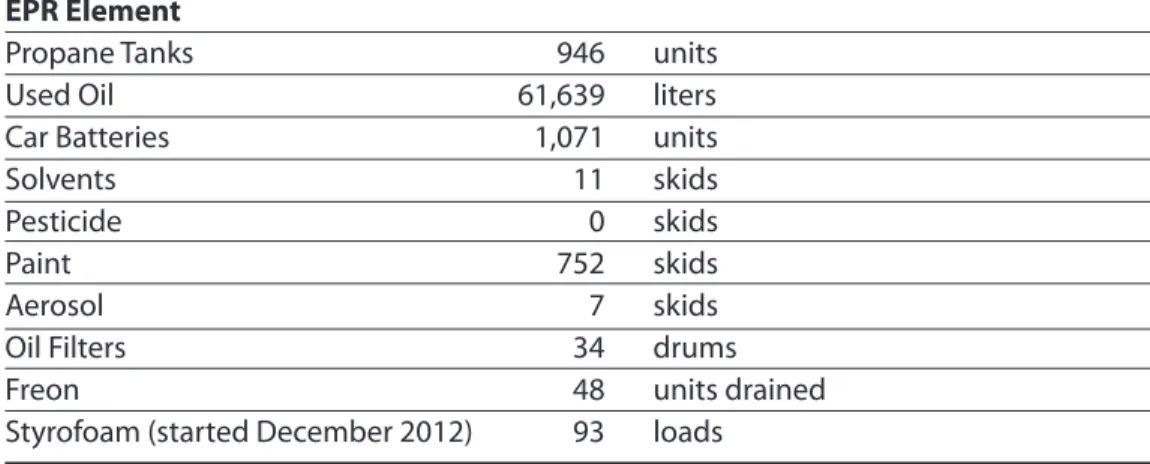
EPR ElementPropane Tanks 946 units
Used Oil 61,639 liters
Car Batteries 1,071 units
Solvents 11 skids
Pesticide 0 skids
Paint 752 skids
Aerosol 7 skids
Oil Filters 34 drums
Freon 48 units drained
Styrofoam (started December 2012) 93 loads
Engineering Department 2013 Annual Solid Waste and Recycling Repor t
16
Municipal Depot Diversion
In 2013 over 20 different types of recyclable materials were processed through the Eco-Centre. Figure 4 shows a detailed breakdown of ‘bluebox’ material recovered at the Eco-Centre and the table illustrates the amount of EPR materials that were collected at the Eco-Centre. Although the volumes of recyclables processed directly through the Eco-Centre are a small fraction of the curbside programs, the Eco-Centre provides a convenient venue for small business owners and residents to dispose of items that are
not collected at the curbside due to size/material constraints.
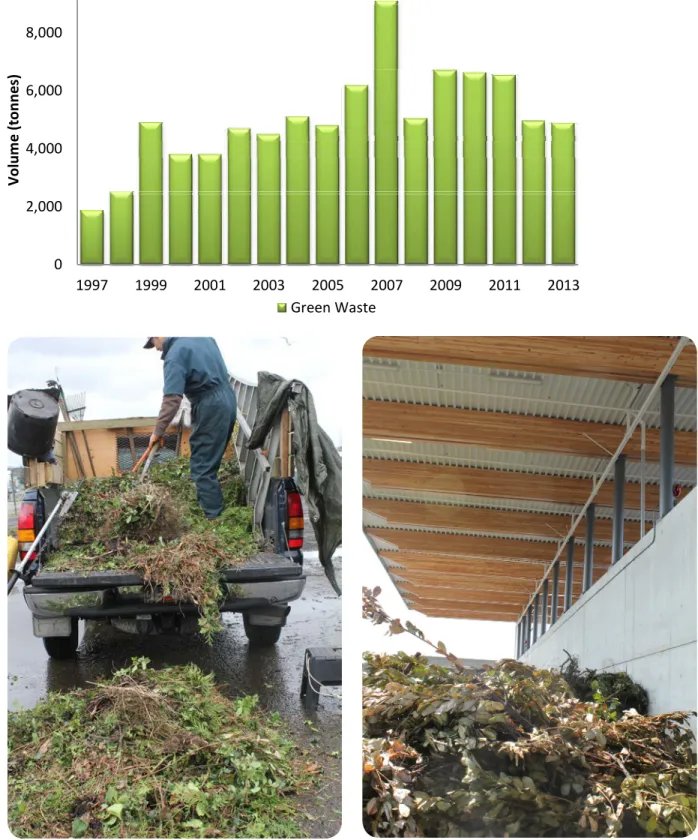
Figure 4 - Tonnage of Recycling Materials Collected in 2013
6,000 8,000 10,000 e (t onne s) 0 2,000 4,000 1997 1999 2001 2003 2005 2007 2009 2011 2013 Vo lu m e Green Waste
In 2013, the Eco-Centre received approximately 4,881 tonnes of green waste as illustrated
in Figure 5. Additionally, 165 composters and 39 rain barrels were sold to Burnaby
residents through the Eco-Centre.
Engineering Department 2012 Annual Solid Waste and Recycling Repor t
18
4.0
Places
Burnaby Eco-Centre
In 2013, construction on the new Burnaby public recycling depot ‘Burnaby’s Eco-Centre’ was completed and a celebration of the opening occurred on 2013 September 07. The new Eco-Centre incorporates design elements that include reclaimed heavy timber
salvaged from Burnaby Heights Resource Centre, a demonstration rain garden and bio-swale and a centre for Soil Health, and was built to a LEED Gold equivalent. The
Eco-Centre replaces the Still Creek Recycling Depot which served the community waste diversion programs over the last two decades. The expansion and redesign the depot was done to accommodate new recycling programs and an increase in community demand.
Operated by City staff, the Eco-Centre provides an easily accessible one-stop facility for Burnaby residents and businesses to drop-off bulky volumes of recyclable and garden/
yard trimmings as well as some hazardous household materials. In addition to the items
the City collects for recycling, the Eco-Centre partnered with several industry stewards to allow for the collection of many materials banned from disposal, including some EPR materials. The following materials are currently accepted at no charge:
• Newspaper, magazines, mixed paper (including phone books) • Cardboard
• Appliances • Scrap metal
• Glass jars and bottles • Tin and aluminium cans • Plastic (all hard and soft plastic)
Engineering Department 2013 Annual Solid Waste and Recycling Repor t
20
• Household paints, solvents, gasoline and pesticides (EPR) • Used motor oil, oil containers and filters and antifreeze (EPR) • Propane tanks (EPR)
• Good used clothing and books (for donation) • Styrofoam (as of December 2012)
Green waste (yard trimmings and food scraps) can be dropped-off at the facility for $63/ tonne. Burnaby residents with a small green waste load (100 kg or less) are allowed one visit per day at no cost.
Take Back for Recycling
The Province’s industry-led EPR programs complement the waste disposal options provided by the City. The following materials all have accompanying EPR programs,
some of which are accepted at Burnaby’s centralized Eco-Centre (as mentioned above): • Beverage containers
• Prescription and non-prescription medications • Motor oil, filters and containers
• Paint and empty paint containers • Automotive tires and batteries
• Flammable liquids, pesticides and gasoline • Electronics and electrical small appliances • Electronic toys and musical instruments
• Power tools, outdoor power equipment and exercise machines • Household rechargeable and single-use batteries
• Cell phones
Beverage Containers
Electronics
Medications
Antifreeze, Used Motor Oil, Containers & Filters
Lighting, Lightbulbs & Tubes
Thermostats, Smoke & Carbon Monoxide Alarms
Paint, Flammable Liquids, Gasoline & Pesticides (Some restrictions apply)
Small Appliances & Electric Exercise Equipment
Outdoor Power Equipment & Power Tools
Electronic Toys
Vehicle Tires & Automotive Batteries
Cell Phones & Household Batteries
Information on drop-off locations for EPR items not accepted at Burnaby’s Eco-Centre is available at: www.burnaby.ca/takeback. This website is updated frequently by City staff as EPR programs expand to capture more materials for diversion.
Engineering Department 2012 Annual Solid Waste and Recycling Repor t
22
Pilots and
5.0
Pilots and Projects
Recycling and Green Waste Audit
In late fall 2013, a recycling and green waste audit was completed with the purpose to assess the composition of the residential recycling and green bin materials stream. Key findings from the audit are listed below:
Single family households:
• Residential households have a participation rate of 44% in the newspaper stream, 59% in the mixed fibers stream and 59% participation in the mixed containers stream. • Residential households have a participation rate of 24% in the use of the green bin
program with 26% of those households adding food scraps to their green bin
• Material contamination rates in recycling and green waste streams were found to be
approximately 3.5% by volume.
Multi-family complexes (not individual participation rates within the complexes):
• Multi-family complexes have a participation are of 80% in the newspaper stream, 88%
in the mixed fibres stream, and 88% participation in the mixed containers stream.
• Multi-family complexes have a participation rate of 20% in use of the green bin
program with 38% of those buildings participating in the food scraps program.
• Material contamination rates in recycling and green waste streams were found to be
approximately 3.5% by volume.
The audit will allow the City to target programs to reduce contamination rates in the collection streams and increase the green bin program outreach efforts. The low participation rate found in the audit for the single family residential and multi-family green bin program can be attributed to time of the year the audit was conducted. Further audits
Engineering Department 2012 Annual Solid Waste and Recycling Repor t
24
Public School Food Scraps Recycling Project
Public schools in Burnaby already use City services for garbage and recycling materials. As a natural step in progression of achieving greater waste diversion, the City, in partnership
with the Burnaby School District, implemented a pilot project with nine schools (six
elementary, three secondary) to determine:
• Potential volume of food scraps from schools and the associated number of
containers required to adequately service them
• Possible logistical challenges associated with collection service
• Any barriers for participation and a communication strategy to address these barriers. The pilot project which began in November 2011 concluded in June 2012. Findings from the pilot project were used to develop an action plan that will phase-in the program at
Styrofoam Recycling Pilot
The City has provided various mechanisms for residents to divert waste through the inclusion of new material in the City’s recycling programs. Styrofoam packaging has long been identified as a material that is growing within the waste stream and is a material type to be included in the upcoming Packaging and Printed Materials Provincial EPR Program in 2014. To assist in preparations for the upcoming provincial packaging
program, the City has under taken a Styrofoam Recycling Pilot Project at the City’s
Eco-Centre to determine:
• Potential volume of Styrofoam received from Burnaby residents and businesses • Space allocation requirements for collection containers
• Potential collection and contamination concerns
The pilot project allows for residents to drop off up to three cubic yards of Styrofoam
per trip at no charge and charges a nominal fee of $6 per cubic yard for a maximum of six cubic yards per trip to businesses. The collected material is transported to a facility in Coquitlam for processing and subsequent shipment to a recycler overseas that uses the
material to make items such as photo frames. In 2013, Styrofoam collection pilot project hosted at Burnaby Eco-Centre yielded 93 loads of material (in 50 yard bins).
Engineering Department 2012 Annual Solid Waste and Recycling Repor t
26
6.0
People
The City, in conjunction with regional and provincial governments and industry, have
constructed a comprehensive materials management framework to handle a medley of
items, however the success of these programs depends on the users- you!
Public education and community outreach is one of the key components of our solid waste and recycling management plan. The success we have achieved on our previous waste reduction targets in the past decade is a result of public attitudes and behaviours toward recycling, reduction and composting. The education and outreach program provides the bridge between our programs and its users as we work towards the common goal of protecting the environment and preserving natural resources.
Burnaby residents are the key to Burnaby’s waste reduction goal, and it is important to showcase the success of our people and what they are doing to reduce waste at home, work, school and on-the-go.
Shri Guru Ravidass Sabha Community Centre
Located on Gilley Avenue in Burnaby, the Shri Guru Ravidass Sabba Community Centre has between 500 to 1000 people in attendance weekly, and upwards to 2000 people attend on special occasions. Food plays a vital role within the congregation, as it brings people together, and creates an avenue for discussion. With a growing congregation, it was through the sharing of food and conversation that the Shri Guru Sabha Community realised that they wanted to look for more sustainable solutions to the issue of garbage and food waste within their centre. Members of the congregation were already separating food scraps from the garbage at home, and asked why it could not be done at the centre. A volunteer from the congregation contacted the City of Burnaby to discuss options
for joining the City’s Food Scraps Program. City staff did an assessment of the current
garbage and recycling, and installed green bins and provided educational materials at the centre.
The congregation established a group of volunteers that took on the role of championing the program and promote the program within the centre. Collection containers were placed within the kitchen, beside the tray washing station to collect plate scrapings, and paper towel from washrooms and hand washing stations is also being diverted to the green bins. Since installation of the program, the Shri Guru Sabba Community Centre has seen remarkable results. The centre has been tracking the amount of food scraps they have been diverting, and estimate they divert 300 to 500 lbs of food scraps (including paper napkins and towels) per week from the garbage and have reduced garbage collection to bi-weekly. Not only has the centre seen a decrease in waste, they have seen an increase awareness and participation in sustainable and environmental activities within their congregation.
If you know any organizations doing extraordinary waste management practices? Send us your story! [email protected] We would love to hear from you!
Engineering Department 2012 Annual Solid Waste and Recycling Repor t
24
A Look Ahead
to 2014
7.0
A Look Ahead to 2014
The City has successfully met environmental challenges over the years through developing innovative solutions while maintaining its commitment to environmental protection. Looking ahead to 2014 brings forward enhancements to Burnaby’s waste reduction programs that will further strengthen our waste reduction goals.
• Expanding the City’s Residential Food Scraps Program to Burnaby Public Schools; • Continuing the expansion of the “I Recycle @ Work” Program to other civic facilities; • Exploring the use of “recycling stations” at City events;
• Undertaking a commercial and business Food Scraps Recycling Pilot Project;
• Participating in the Packaging and Printed Paper EPR Program development process; • Reviewing mechanisms and opportunities for waste diversion from demolition land
clearing activities;
• Implementing elements of the Contamination Management Plan to enhance waste
diversion, while reducing contamination in curbside, multi-family and commercial waste streams;
• Utilizing audit findings to target programs to reduce contamination rates in the
curbside, multi-family and commercial collection streams and increase the green bin program outreach efforts.