CCE Theses and Dissertations College of Computing and Engineering
2019
Assessing the Effects of Communication Media
Affordances and the Awareness of Media Security
on Knowledge Sharing Behavior
Linda C. Greene
Nova Southeastern University,[email protected]
This document is a product of extensive research conducted at the Nova Southeastern UniversityCollege of Computing and Engineering. For more information on research and degree programs at the NSU College of Computing and Engineering, please clickhere.
Follow this and additional works at:https://nsuworks.nova.edu/gscis_etd Part of theComputer Sciences Commons
Share Feedback About This Item
This Dissertation is brought to you by the College of Computing and Engineering at NSUWorks. It has been accepted for inclusion in CCE Theses and Dissertations by an authorized administrator of NSUWorks. For more information, please [email protected].
NSUWorks Citation
Linda C. Greene. 2019.Assessing the Effects of Communication Media Affordances and the Awareness of Media Security on Knowledge Sharing Behavior.Doctoral dissertation. Nova Southeastern University. Retrieved from NSUWorks, College of Computing and Engineering. (1086)
Assessing the Effects of Communication Media Affordances and the
Awareness of Media Security on Knowledge Sharing Behavior
by Linda Greene
A dissertation submitted in partial fulfillment of the requirements for the degree of Doctor of Philosophy
in
Information Systems
College of Computing and Engineering Nova Southeastern University
An Abstract of a Dissertation Submitted to Nova Southeastern University in Partial Fulfillment of the Requirements for the Degree of Doctor of Philosophy
Assessing the Effects of Communication Media Affordances and Awareness of Media Security on Knowledge Sharing Behavior
by Linda Greene
July 2019
Global Software Development (GSD) team members engage in intellectual activities that involve sharing business domain knowledge and technical knowledge across geographical areas, which is crucial to the successful development of software. In global software development, media choice may influence how virtual teams create and share knowledge. As digital technology advances and organizations become more digitally transformed, current communication theories for media selection lack the explanation to the complicated phenomena with the use of advanced media technologies. There have been many studies focused on the effectiveness of media, but they did not include user’s understanding of system security and its influence on knowledge sharing behavior. However, affordance theory explains the utility with both social actors and technical features. The use of media may be shaped by features of technologies and user’s perception on system security. The goal of this study was to empirically assess the effects of media affordances and media security awareness on knowledge sharing behaviors among GSD team members with the lens of affordance theory. In this study, data was collected through survey from 214 GSD employees, after inviting 1000 employees to participate. The survey data was
analyzed to test the effects of communication media affordance and user’s awareness of media security on behavior in knowledge sharing. The analysis results show that awareness of media security had significant moderating effects on the relationships from some actualized media affordances to implicit knowledge sharing. The results of this study revealed positive relationships between perceived media affordances and actualized media affordances. The results also showed that organization tenure had a significant effect on implicit knowledge sharing, and professional tenure had a significant effect on explicit and implicit knowledge behavior. This study contributed to the body of knowledge in organizational communication literature by providing new insights into how technology properties and users’ awareness on technology security shape team members’ knowledge sharing practice.
iv
Table of Contents
Abstract iii List of Tables vii List of Figures viii Chapters 1. Introduction 1 Background 1 Problem Statement 4 Dissertation Goal 8 Research Questions 8
Relevance and Significance 10 Barriers and Issues 11
Summary 13
2. Review of the Literature 15 Knowledge Sharing Behavior 15
Media and Knowledge Sharing Behavior 16 Information Security and Knowledge Sharing 18 Affordance Theory 20
Media Affordances for Knowledge Sharing Behavior 23 Capturing Tacit Knowledge 25
Motivating Knowledge Donation 26 Organizational Barriers 27
Identifying Expertise 27
Media Affordances for Information Security 28 Summary 28
3. Methods 30
Research Model and Hypotheses Development 30 Research Site 40
Survey Instrument Development 41 Validating Survey Instrument 50
v Data Collection 50
Data Analysis Plan 50
Preliminary Data Analysis 51 Measurement Model Test 51 Structural Model Test 54 Resources 54 Summary 55 4. Results 57 Data 57 Delphi Study 59 Pilot Study 59
Results of Preliminary Analysis of Primary Survey Data 60 Mahalanobis Distance and Box Plot 60
Normality and Scatter Plot 61
The Results of Measurement Model Testing 62 The Results of Structural Model Testing 65 Findings 68
5. Conclusions, Implications, Recommendations, and Summary 71 Discussion 71
Conclusions 74
Implications and Recommendations 75 Limitations and Future Studies 78 Appendices
A. Survey Questionnaire 80
B. IRB Approval Letter 110
C. Pilot Study Results 111
D. Mahalanobis Distance Stem and Leaf Plot 112
E. Normality and Scatter Plot 115 F. PLS Factor Analysis 118 G. Structural Path Analysis 119
H. PLS Analysis Moderating Effects 121
vi
J. Demographic Tenure - Implicit Knowledge 126
vii
List of Tables
Tables
1. Perceived media affordance survey items (adapted from Rice et al., 2017) 43 2. Awareness of media security (adapted from D'Arcy et al., 2009) 44
3. Knowledge sharing behavior survey items (adapted from Rehman et al., 2014) 45 4. Affordances of media (adapted from Strong et al., 2014) 47
5. Demographics 48
6. Participants Demographics 58
7. Factor Analysis Results of Reflective Measures 63 8. Factor Analysis Results of Formative Measures 64 9. Discriminant Validity (Fornell & Larcker, 1981) 65 10. Summary of Hypotheses Test Results 67
11. Path Coefficient (Bootstrapping) - Inner Loading (Explicit_KS) 119 12. Path Coefficient (Bootstrapping) – Inner Loading (ImplicitKS) 120 13. Path Coefficient (Bootstrapping) – Moderating Effect (ImplicitKS) 121
14. Path Coefficient – Moderating Effect on Actual Use of Editability (ImplicitKS) 122 15. Path coefficient – Moderating Effect on Actual Use of Self-Representation
(ImplicitKS) 123
16. Path Coefficient – Organizational Tenure (Explicit_KS) 124 17. Path Coefficient – Professional Tenure (Explicit_KS) 125 18. Path Coefficient – Organizational Tenure (ImplicitKS) 126 19. Path Coefficient – Professional Tenure (ImplicitKS) 127
viii
List of Figures
Figures
1. Research model of media affordances on knowledge sharing behavior 30 2. Results of research model testing 66
Chapter 1
Introduction
Background
Global Software Development (GSD) is a novel software engineering methodology that provides several benefits and challenges to organizations.
Organizations have benefitted from cost advantages, being closer to customers, merger and acquisition opportunities. Other benefits include access to a plethora of skilled software engineers, completing projects in a timely manner, and global presence of the organization (Khan, Khan, Aamir, & Khan, 2013). Due to the economic imperatives driving the globalization of software development, GSD teams are formed to develop information systems for multinational corporations with established offices around the world (Casey, 2011; Lowry & Zhang, 2008). The globally distributed software teams has emerged as a new software engineering methodology called GSD (Oshri, Kotlarsky, & Willcocks, 2007).
GSD has an impact on the team knowledge sharing processes (Ambos, Ambos, Eich, & Puck, 2016). Globalization has considerably changed the ways of traditional information systems development where software is developed locally in the same geographic location, it is now outsourced and offshored worldwide. GSD project teams may experience significant complexities due to the dispersion of teams worldwide creating various knowledge sharing challenges such as distance (Zahedi, Shahin, &
Baber, 2016). Distance which includes temporal, geographical, cultural, and language differences, has a significant impact on communication, coordination, collaboration, and knowledge sharing (Ambos et al., 2016; Ghobadi, 2015; Zahedi et al., 2016). Local culture and customs of a GSD team critically affects the knowledge sharing process (Huang & Trauth, 2016).
Liebowitz and Megbolugbe (2003) identified knowledge sharing as a key element of knowledge management in support of organizational learning. At the group level, Anwar, Rehman, Wang, Amin, and Akbar (2017) recognized knowledge sharing is a key activity in the proficient performance of GSD. Knowledge sharing is a key activity of GSD (Ambos et al., 2016). Knowledge is an intellectual asset for software projects and serves as inputs and outputs to the software development process. GSD teams manage their intellectual assets by using configuration management software to maintain, track, and control their work products, and share appropriate version of deliverables with each other (Da Silva et al., 2012). The use of centralized repositories enable knowledge sharing in GSD with the use of tools such as SVN and Redmine, which assist teams in sharing information as if the they were co-located (Yague, Garbajosa, Diaz, & Gonzalez, 2016). GSD teams have used a common tool to transfer knowledge across borders and to leverage knowledge resources globally (Ambos et al., 2016). Knowledge identification and sharing can be complicated by the dispersion of teams in different locations (Vahtera, Buckley, & Aliyev, 2017). Knowledge sharing within multinational global software development teams is affected by social and cultural influences (Galbraith, 2000; Govindarajan & Gupta, 2002). The influence of cultural, social, national influences are
evident in communication, collaboration, education, skills, within GSD teams (Govindarajan & Gupta, 2002).
Rich (synchronous) and lean (asynchronous) media are used in sharing knowledge. Global teams rely heavily on various information communication technologies for
communication and collaboration (Yu-Ting Caisy & Nguyen, 2008). Synchronous (rich) communication media, such as closed circuit television conferencing with audio,
telephone conferencing, and online computer conferencing, allows all communicators to be present at the same time and communicating in the same time period. Asynchronous (lean) media such as asynchronous discussion forums, bulletin boards, and e-mails free both the time synchronicity and place-sharing constraints (Yu-Ting Caisy & Nguyen, 2008). The challenge communicating through asynchronous (lean) media (e.g., e-mails) includes misinterpreting messages due to absence of body language, voice tone, and slow or missing feedback (Hayward, 2002). Researchers have argued that rich media
communication (e.g., video conferences) is more suitable when sharing knowledge that is equal in nature and complex. The choice of media (synchronous or asynchronous) may be associated with a particular outcome and the use of media may be shaped by featured aspects of technologies, user perceptions, and motivation (Rice et al., 2017).
Affordance is the relationship between materiality of technology and
organizational members to use the material features of social media technologies to accomplish their work. Direct interaction with technology can affect user perception and action through the process of experimentation and adaptation (Gaver, 1991; Leonardi, 2011). Media affordance is the integration of media with organizational communications
and the effect on socialization, information sharing and power relations (Treem &
Leonardi, 2012).
Problem Statement
Recent years have seen the evolution of a new generation of computer-mediated communication tools with new capabilities that may affect organizational performance. The choice of communication tools may change the way people communicate in an organization. For example, people show different knowledge sharing behaviors when they use emails or social media technology. Some organizations limit the use of social media technology, because of risk of data breaches. Thus, the research problem that this study addressed is that inappropriate choice and use of media may bring inefficiency and risks to employee work, organizations, and GSD (Feledi, Fenz, & Lechner, 2013).
Prior theories such as media richness and media synchronicity theory show
limitations in explaining the effectiveness of media. The theories focused on the interplay of media and tasks on communication performance (Dennis & Valacich, 1999; Dennis, Valacich, Speier, & Morris, 1998). The theories treat media itself and task characteristics as factors that affect communication performance, largely ignoring users’ ability or perception toward the use of media. User’s knowledge may influence on knowledge sharing behavior and awareness of media security is vital to mitigating the risk of the use of communication media (Parsons, McCormac, Butavicius, Pattinson, & Jerram, 2014). The interplay of both users’ media security awareness and media’s property on
knowledge sharing in virtual teams appears to have little attention in research. There is a call for research on the interpretative features of, rather than, system features themselves, to explain the complex phenomenon of technology use
(Burton-Jones & Straub, 2006; Leonardi, Huysman, & Steinfield, 2013). Media Richness Theory and Media Synchronicity Theory explain the effectiveness of media on communication performance, which depends on media type and task characteristics (Daft & Lengel, 1984; Suh, 1999). It is difficult to define the types of task and communication media classified in the theories. For example, sharing knowledge could be both conveying task and convergence task. Furthermore, the impact of media use depends not only on media itself and task characteristics, but also on user’s awareness on the security features of the media. For example, awareness of security regarding the use of certain media may influence on the actual use of media, thus altering information sharing behaviors. Therefore, organizations still suffer difficulties in choosing right communication media for sharing knowledge among employees. Often the use of certain media brings a threat to organizational assets (Dennis & Valacich, 1993; Leonardi, 2011; Markus, 1994; Markus & Silver, 2008; Rice, 1992; Silic & Back, 2016).
Media Richness Theory addresses the task of equivocality where task-information processing requirements are mapped to a medium's ability to convey information richness resulting in improved task performance (Dennis & Valacich, 1993). Media Richness Theory has been criticized for insufficient predictive power as a result of conceptual limitations of the theory (Dennis & Valacich, 1993; Markus, 1994; Rice, 1992). Researchers addressed that Media Richness Theory is oversimplified to evaluate the effectiveness of media technologies, because the effectiveness of media is more influenced by other factors such as social pressures or individual preferences on media choice (Markus, 1994). Researchers found problems relative to the theory instructing the mapping media to task characteristics does not improve performance (Dennis et al.,
1998). Empirical studies lacked support for media richness theory because the task-media fit was insufficient in explaining the choice of media (Dennis et al., 1998). Many
researchers have summarized that media selection is impacted by the richness of factors beyond the medium. In addition, Media Richness Theory does not consider the
advancement of technology and the influence of social interaction on media selection. Dennis and Kinney (1998) challenged the Media Richness Theory with empirical evidence that did not support the theory for the use of new media.
Dennis et al. (1998) proposed Media Synchronicity Theory. Media Synchronicity Theory refers to the state in which individuals share patterns of coordinated interactive behavior to transmit and process information through the use of media to accomplish a task simultaneously with multiple individuals (Dennis & Valacich, 1999; Dennis et al., 1998). The most effective media selection utilized to accomplish a task must consider two fundamental communication processes required to perform any task: conveying information and convergence (Deluca & Valacich, 2006). Conveyance is focused on how
information is communicated, while convergence involves reaching a consensus.Media
Synchronicity Theory is difficult for organizations to apply because of ambiguity interpreting a particular task, objective, or goal (Dennis & Valacich, 1993).
This study used affordance theory as a basis to provide insights on the choice and use of communication media in a global software development context. Affordance theory lens considers social actors’ aspects as well as material features. The advancement in technology placed emphasis on the technical features in media as well as social factors, because the technology use increased social interactions (Stephens & Mandhana, 2017).
The affordance theory was used to see the effects of media features and awareness of media security on knowledge sharing behaviors.
The prior literature treated media as the level of a study, not the level of
technology feature. However, the uses of media do not show certain patterns in affecting communication behaviors. Technology use is determined by not only technology’s capability and users’ skill to use technology (Leonardi, 2011; Markus & Silver, 2008). Media choice may be influenced by the ability of virtual team members to use media, their awareness of information security, and task characteristics. Even though media used in GSD affords high degree of communication, software development members show concerns like risk of disclosure, fear about that specialized knowledge will be stolen, and so on (Gibbs, Rozaidi, & Eisenberg, 2013; Govindarajan & Gupta, 2002). Not only does the property of media to transfer information influence on knowledge sharing behavior, but also individual’s system security awareness (Shin, 2010). As such, both aspects, material agents (communication media) and social agents (media users), have an
influence on the knowledge sharing behaviors. However, it is uncertain how these aspects interact each other for the success of knowledge management. The concept of media affordance is relative to building theory about the relationship between technology and communication. Media affordance as a conceptual lens focused on media technology and types of communicative practices that various media features afford in organizational relationships between people, networks and texts, creating opportunities and constraint.
Dissertation Goal
The goal of this research was to empirically assess how media affordances and users’ awareness about media security affect knowledge sharing behavior among GSD team members.
Research Questions
One of the goals of this study was to identify various media affordances as perceived and actualized affordance in the organizational context of knowledge sharing. Strong et al. (2014) argued that extending the affordance theory in an organizational context. In the context of healthcare, the organizational change process was examined through the lens of affordance and actualization theory. They identified eight
organizational affordances of electronic health record systems as both perceived affordances and actualizations in healthcare context. Treem and Leonardi (2012) identified four affordances of social media in the organizational context of knowledge sharing. Actualizing affordances can build knowledge and skills in ways that enable them to recognize and actualize affordances they could not before (Treem & Leonardi, 2012). This study aimed to answer the following research question by identifying affordances of media, including the affordances of social media identified in the study of Treems and Leonardi (2012), in the organizational context of knowledge sharing among team members.
• RQ1: What media affordances are perceived and actualized when global
software development teams share knowledge using media?
The literature, such as Strong et al. (2014), suggested perceived affordances and actualized affordances, but their relationships were not tested.
• RQ2: What are the relationships between perceived media affordances and
actualized media affordances in global software development teams?
Leonardi (2011) mentioned that perception and skills may affect actualized affordances. This study provided evidence on perception affect actualized affordance by examining the relationship of user’s awareness of media security and actualized media affordance.
• RQ3: Does media security awareness moderate the relationships between
perceived media affordances and actualized media affordances?
Many studies investigated the effects of media on the knowledge sharing behavior. However, the effects of each media on the organizational knowledge sharing are mixed. Carlson and George (2004) and Niinimaki, Piri, and Lassenius (2009) investigated the effects of synchronous media on communication. Schouten, van den Hooff, and Feldberg (2016) compared 3D virtual worlds and text-based chat in the performance of convergence tasks. They found that characteristics or capacity of media affects communication performance. However, it is hard to predict the effects of media used on communication performance because it is difficult to apply the characteristics or capacity of media to advanced technologies. It is also difficult to find the isolated effects of each media on knowledge sharing performance in an organization which mostly provides employees with several medias. In this research, the study of affordance theory empirically measured how affordance of communication technology features affect knowledge sharing behaviors.
• RQ4: How does media affordances affect knowledge sharing behaviors?
• RQ5: How media security awareness affects actualized media affordances and
Boardia, Irmer, and Abusah (2006) found when knowledge is shared interpersonally, organizational tenure can positively predict knowledge sharing behavior. Watson and Hewett (2006) argued that organizational tenure would be positively related to
knowledge sharing behavior because as tenure increases so do trust and commitment to the organization and its process. Trust and commitment has been found to have a positive effect on knowledge sharing behavior (Chowdhury, 2005; Van den Hooff & De Ridder, 2004; Wang et al., 2007).
• RQ6: What effect does demographic variables (gender, age, organization
tenure, professional tenure, etc.) have on knowledge sharing behavior? Relevance and Significance
This study contributed to the body of knowledge in affordance theory and literature on communication media and knowledge sharing. Examining these
relationships of media affordances, awareness of media security, and knowledge sharing behavior provided insight into how communication technologies and users’ knowledge on system security affect the ways team members collaborate and the ways they interact
to share knowledge. First, the affordance lens allows individuals’ and teams’ actions to
be integrated with technology, allowing consideration of both users and technologies, not in isolation, to understand the knowledge sharing behavior when using various media in an organization. As perspectives of social agents, the role of awareness of media security is investigated. This study confirmed that users’ awareness on media security affects actual media uses. Third, the identification of information security media affordances is a theoretical contribution. Prior literature identified media affordances, such as visibility, editability, self-presentation, pervasiveness, searchability, and awareness (Rice et al.,
2017). This research finds that some of the media affordances are closely related information security; that are visibility, editability, and self-presentation.Material properties (e.g., capability of technical features) and social agents (e.g., individual employees as well as a team) were considered to identify media affordances related to information security. In addition, this research finds that the actual media uses are moderated by users’ awareness of media security on their relationships with perceived media affordances. These new finding contribute to the body of knowledge of affordance literature.
This study provided practical contribution. In organizations, media can be leveraged in knowledge sharing by user awareness of system security and identifying how tools can be utilized relative to common or different affordances. Project managers can gain insight into the roles of media affordances and team’s awareness on media security in team performance. Software development teams can benefit from the alignment of media with activities for implementing requirements to develop software, communicating with internal and external stakeholders, and measuring the effectiveness of the code and application program interface (API) developed. Global software
development performances are affected by multiple media affordances actualized by multiple users.
Barriers and Issues
Communication media is rapidly evolving as new technology is introduced to facilitate communication. It can be difficult to examine every type of medium in use. The distinction between different media are more ambiguous and new media possesses a variety of media capabilities. The media use and configuration determine the media’s
capabilities and how media capabilities are perceived by users. It is pointless to examine the most effective media facilitating communication due to media possessing different capabilities depending upon how the media are configured and used. The different effects of media use is determined by the media capabilities and not media type. It is more meaningful to directly examine the specific media capabilities that actually cause the effects. The affordances provided by the existing communication structure and the associated technological support are not properly aligned with the communication requirements of the work and social structure. Distribution of domain knowledge within several types of the customers of the systems being developed, problems with the requirements engineering processes, and inability of the offshore development team result in a huge number of clarification queries, which are unlikely to be responded quickly. This situation causes long delays and context switching problems.
Assumptions, Limitations and Delimitation
The limitation of this study was the insufficient research of perceived affordances and actualized affordances, and the relationship between media affordance, media
information security, and knowledge sharing behavior. Delimitations exist in the scope of the survey and number of invited participants and the projected number of actual
participants.
Definition of terms
Affordance Theory. A socio-technical concept on how users perceive their environment and perform action; accounting for both the material features of the technology and the subjective perceptions and goals of the user.
Affordance. The potential for behaviors associated with achieving an immediate outcome from the relationship between an artifact and a goal-oriented actor or actors; a theoretical lens into media utility and sociability.
Media Affordance. The integration of media with organizational communications and the effect on socialization, information sharing and power relations.
Media Richness. The task of equivocality where task-information processing requirements are mapped to a medium's ability to convey information richness resulting in improved task performance.
Media Synchronicity. The state in which individuals share patterns of coordinated interactive behavior to transmit and process information through the use of media to accomplish a task simultaneously with multiple individuals.
List of Acronyms
• GSD – Global Software Development • MNE – Multinational Enterprise
Summary
This chapter provides an introduction and overview of GSD and the emergence of global distributed software development teams. GSD teams are influenced by cultural, social, and national influences, but also face challenges that impact team communication, collaboration, and knowledge sharing created by distance. Rich and lean media
communication and collaboration tools are selected by organizations to manage knowledge assets and to enable knowledge sharing. To explain the complex use of technology, the affordance theory provides insight on the choice and use of
security affect knowledge sharing behavior in GSD teams is examined in the next chapter.
Chapter 2
Review of the Literature
Knowledge Sharing Behavior
Knowledge sharing behavior is an individual’s choice to communicate one’s intellectual capital to others within an organization, and to collect knowledge by consulting with others to share their intellectual capital (Reychav & Weisberg, 2010; Weinberg, 2015). In the context of software engineering, software development is based on the knowledge of individuals, and learning is achieved through knowledge sharing (Rehman, Mahmood, Salleh, & Amin, 2014). A software development team’s success depends on knowledge sharing, and providing work environments for better knowledge sharing among employees is a high priority (Wu & Zhu, 2012).
Knowledge is usually classified into two categories: tacit knowledge and explicit knowledge. Many prior research studies investigated the relationships between actor’s characteristics and knowledge sharing, not considering material aspects. Bock, Zmud, Kim, and Lee (2005), for example, explored the factors supporting or inhibiting
individual’s attitudes toward and intentions regarding knowledge sharing behaviors in the context of explicit and tacit knowledge. Reychav and Weisberg (2010) compared
employees’ intentions to share explicit and tacit knowledge through the actual process of sharing the knowledge. Kolekofski and Heminger (2003) examined employee beliefs that may contribute to an attitude towards tacit and explicit knowledge sharing behavior within an organization. Hau, Kim, Lee, and Kim (2013) analyzed the variance of
employees’ tacit and explicit knowledge sharing intentions using data collected from employees in multiple industries. Suppiah and Sandhu (2011) explored the influence of various organizations types on tacit knowledge sharing behavior adopting organizational communications, personal interactions, mentoring/tutoring, and willingness to share knowledge freely as indicators.
Many researchers have explored people’s internal status factors that affect knowledge-sharing behavior including self-determination and altruism (Kolekofski & Heminger, 2003; Wang & Hou, 2015; Zhang, Tsui, & Wang, 2011). Zhang et al. (2011) analyzed three factors, self-efficacy, trust and outcome expectation, that influence team members’ knowledge sharing behavior in the context of product development. All the three factors have positive effect on team members’ knowledge sharing behavior, and self-efficacy has a significantly positive effect on team members’ outcome expectation. Ryu, Ho, and Han (2003) empirically examined the knowledge sharing behavior of physicians with factors that determine the physician’s intent to share tacit explicit knowledge at the group level. Dhanaraj, Lyles, Steensma, and Tihanyi (2004) examined the effect of social embeddedness on the transfer of tacit and explicit knowledge in international joint ventures, including trust relative to the social aspects of learning. Media and Knowledge Sharing Behavior
Several empirical studies support the findings that there are better fits between media capability and communication as a behavior of information sharing. Löber,
Grimm, and Schwabe (2006) discovered that participants who used audio chat performed better on convergence task when audio to text-based chat was compared. Schouten, van den Hooff, and Feldberg (2016) compared 3D virtual worlds and text-based chat for
convergence processes, 3D virtual worlds outperformed chat. In a virtual team environment virtual teams using video and audio (high synchronicity) performed
significantly better on a convergence task than did audio-only (low synchronicity) teams (Baker, 2002). Carlson and George (2004) found that participants preferred synchronous media when asked to detect deceptions (convergence) and asynchronous media when asked to engage in low-risk deceptions (conveyance). Niinimaki, Piri, and Lassenius (2009) found that global software development team members used media with higher synchronicity when requesting clarification (convergence). DeLuca and Valacich (2006) found that low synchronicity media were better for conveyance processes and that high synchronicity media were preferred for convergence processes.
Symbol variety or symbol set (e.g., verbal vs. non-verbal cues) are the ways in which the information can be communicated. Multiple symbol sets that include text, video, and audio provide users with the improved capability to facilitate coordination and interact quickly, which avoids the feelings of doubt and uncertainty in communication, thereby resulting in enhanced interactivity between users (Hwang & Park, 2007). Rehearsability enables the sender to compose a message with the exact meaning as planned. Reprocessability enables the receiver to repeatedly process message to ensure that he or she accurately understands the message as delivered (which may or may not be the message the sender intended to send), and more importantly it enables deliberation. Bacabac (2012) found problem solvers requiring immediate action used online chat to increase decision-making speeds. Real-time discussion boards or chat that support rehearsability and reprocessability may allow thought input and feedback to ease decision-making speed (Bacabac, 2012). Alexander (2012) proposed a multi-layered
writing model that allowed individual authors to work on overlapping parts of a project and then meet face-to-face to converge and discuss their written contributions. In light of a synchronous online medium, reprocessability varies depending on tools. Google
Hangout, a group video-chat tool, allows screen sharing and synchronous text-based chat. An individual can view a document draft, discuss the draft, and record key discussion point using text-based chat. A team member can then go back through the text-based chat and construct meeting minutes based on the chat. If a different video-chat option was chosen excluding text-based chat capabilities, vital information could not be reprocessed. Google Docs enables both synchronous and asynchronous revision, but it lacks the reprocessability afforded by the Microsoft Word comment feature. In this case, if everyone is present during the revision process, Google Docs may be a more effective tool. Asynchronous revision would benefit from a technology such as Microsoft Word as opposed to Google docs. Media high in rehearsability such as email, allows rehearsing or editing potentially negative or face-threatening feedback prior to sending, and receivers are able to react to feedback privately; quench the initial reactions (Wolfe, 2000). Information Security and Knowledge Sharing
Information security is protecting the confidentiality, integrity and availability or accessibility of internal and external information (Gifford, 2009; Gordon & Loeb, 2006; Ilvonen, 2013; Kim & Solomon, 2016). Information security is also concerned with managing the loss of information and the subsequent cost of that loss (Winkler, 2007). Information privacy is the ability of an individual to have control over the flow, transfer and exchange of personal information (Shin, 2010). Information privacy is interpreted as the assertion of individuals, groups, or institutions to determine the degree in which
information about them is communicated to others themselves (Belanger & Crossler, 2011; Chai, Bagchi-Sen, Morrell, Rao, and Upadhyaya, 2009; Westin, 1968).
Information privacy is a major concern for individuals in virtual environments. For example, individuals are less inclined to disclose personal information when the perception of threats to privacy are high, because of their inability to control information and protect themselves (Govindarajan & Gupta, 2002). When privacy policies are clearly documented and published, individuals are apt to disclose more personal information because their perception of low privacy risks and greater control (Gupta & Dhami, 2015). The perception of privacy risk has been a major obstacle for information disclosure and sharing in virtual environments (Krasnova, Spiekermann, Koroleva, & Hildebrand, 2010).
Gerber and von Solms (2005) argued that organizations should apply a information security perspective on knowledge transfer. As a top-down process that encompasses business, legal and regulatory requirements, and infrastructure risks.
Information security has a direct effect on usage behavior and information sharing (Lin & Lu, 2011; Shin, 2010).
User’s awareness about information security and privacy affects how media is used to share information. Dinev and Hu (2007) found that technology awareness leads to positive user behavioral intention for the use of protective technologies against
information security threats. D'Arcy, Hovav, and Galletta (2009) posited that user awareness of information security countermeasures directly impacts user perceptions of the certainty and severity of sanctions associated with information security misuse. In the context of teams, information security awareness does not reside with the individual
alone, nor with technology alone, but with the joint effort of human and technology (Barad, 1996). Team members through team interactions transform individual knowledge to collective knowledge and achieve information security awareness (Rehman et al., 2014). Team members benefit from information security awareness and media use in knowledge sharing.
Affordance Theory
Sociomaterial theory is based upon the theory of agential realism. It is the existence of an integrated relationship between technologies and human/institutions, where humans and artifacts interact dynamically with each other in daily practice.
Sociomaterial concept was established on the top of Barad’s work in 1996 on the concept of agential realism based on individual perceptions and the use of IT artifacts. The
concept of “agency” is a primary element of agential realism, which is the relationship of an individual and an artifact. For example, how a technical artifact can be understood by how people use and interact with it (Barad, 1996). Barad (1996) viewed the relationship between artifacts and people as interactive. It is important to recognize that reality does not equal perception (Barad, 1996). He also noted that an individual’s perception of reality is created by the artifacts. Artifacts shape people’s perception and actions, shaping the meaning of artifacts (Barad, 1996). Instead agencies of observation comprise a theory of knowledge epistemological and ontological framework which emphasizes the
inseparable nature of material and semiotic objects (Barad, 1996). Latour (2005) observed no intrinsic distinctions between the social and the material, in the same instance both are social and material. Orlikowski (2007) went further to describe the dependency of social and material, where neither exist without the other. Leonardi (2012)
concluded that the practice of sociomaterial is a subset of the socio-technical system, with human (social) and material agencies imbricated within the technical subsystem. Mutch (2013) argued that agential realism ignored the effect of change to practices over time, and overlooked relationships that are not mutually constitutive. Mutch (2013) proposed critical realism as an alternative to agential realism as being more appropriate for studying digital artifacts. Critical realism contends that artifacts’ properties do exist independently of their observation. Critical realism also allows for the possibility of different perspectives on reality (as opposed to multiple realities) that are endlessly renegotiated with varying meanings and intentions (Putnam, 2000). In this sense, critical realism is not entirely incompatible with agential realism. Agenial realism and critical realism are different in their actions towards human intent and properties of the artifact. Critical realism sees two separate entities that appear to become inseparable over time, whereas agential realism sees human agency and artifacts as being mutually constructed (Leonardi et al., 2013).
Although scholars have accepted the theory of sociomaterial, they continue to struggle with the configuration process of social and material agencies (Fayard & Weeks, 2014). Capturing the relationship between the human, technological, or social elements remains a challenge (Fayard & Weeks, 2014). Their goal is to conceptualize the
interconnectedness of ideational and material elements, social and physical construction, and the work arrangement between social and material enacted through constantly
changing practices (Fayard & Weeks, 2014). According to Fayard and Weeks (2014), the concept of affordance can provide a powerful lens for examining the influence of
importance of the relationship between material and social construction, artifacts, and the environments they impact.
The affordance theory was developed to describe how organisms perceive their environment and perform action (Nagy & Neff, 2015). Organisms tend to actualize diverse actions depending on how they perceive their surroundings. Gibson (1979) was the first to define the term affordance as an action possibility in relation to the capabilities of an actor in the environment. An affordance remains static whether or not the needs and goals of the actor changes. As a relational concept, affordance takes into account both the material features of the technology and the subjective perceptions and goals of the user. Rieber (1992) had a different perspective of affordances in his research of design and human-computer interaction as a design feature of an object, where the object informs how it should be utilized. Other studies found that through direct interaction with
technologies affordances can appear and shape the actions of people through processes of experimentation and adaption (Gaver, 1991; Leonardi, 2011). Both views align with a relational view of affordances in that the materiality of technology influences, but does not determine, the possibilities for users. Affordance theory can be used to address the differences between the production and use of technologies. Jordan (2008) viewed affordance as a symbol of authority, whereas Shaw (2015) posited that affordance can disclose how to determine who has the authority to distinguish and manage (control, negotiate, oppose positions related to) how technologies should be utilized.
Affordances have been used as a conceptual lens in many studies where the focus has been on the technological affordances to understand the relationship between
2008). Affordances are initiated in relationships between people and the materiality of the things with which they connect such that the same technology may provide different affordances to different users (Treem & Leonardi, 2012).
Strong et al. (2014) proposed perceived affordance and actualized affordances. Affordances are revealed when information includes hints for operation and guidance are accessible for user’s to perceive has been coined as perceived affordances (Norman, 1999). Affordances are the possibilities for action perceived in objects (Gibson, 1979), which can be both functional and relational (Hutchby, 2001). Functional affordances can enable or constrain interaction, and relational affordance is the manner in which attention is drawn. Increased awareness of information technology artifacts, increases the
affordances that can be perceived (Curry, Marshall, & Kawalek, 2014). The example provides evidence of the perceived affordances for theorizing the enablement and
constraint of information security. The development of an information security awareness theory of affordances is yet to be realized. The challenge is to develop a theoretical framework to study the specific ways by which the material properties of technology enable and constrain user behavior. Actualized affordances were studied by Strong et al. (2014) and Seidel, Recker, and Vom Brocke (2013). However, it appears that little attention has been provided in literature to investigate the relationship between perceived affordances and actualized affordances.
Media Affordances for Knowledge Sharing Behavior
Social media affordances are identified in the context of organizational knowledge sharing. The four affordances in organizations are visibility, association, persistence, and editability (Treem & Leonardi, 2012). Visibility affordance is associated
with the amount of effort people must expend to locate. People are less apt to seek information if information is perceived to be difficult to access, or if it’s unknown whether information exist to be accessed (Treem & Leonardi, 2012). Persistence affordance of social media allows individuals to contribute technical knowledge to develop and remain accessible over time (Treem & Leonardi, 2012). Persistence is known as reviewability, recordability, and permanence of content created and stored in social media (Treem & Leonardi, 2012). Blogs and wikis are examples of social media that provide almost limitless space for communication through the addition of posts and pages. Editability affordance is when individuals can spend time and effort drafting and revising a communicative act prior to being viewed by others, or modify and revise content previously communicated me (Treem & Leonardi, 2012). Dennis, Fuller, and Valacich (2008) description of rehearsability is similar to editability, when an individual can compose a message with the exact meaning as planned. The communicator is empowered with control over the initial display of information. Media users are able to correct identified errors without late viewers ever knowing a mistake occurred.
Association affordance is established connections or social ties between individuals, between individuals and content, or between an actor and a presentation me (Treem & Leonardi, 2012). Connections established through media associations between
individuals and knowledge in greater social connection (Treem & Leonardi, 2012). Media affords creating new associations between people and content with clear implications for the development of social capital in organizations and associated
knowledge transfer (Treem & Leonardi, 2012). Treem and Leonardi (2012) debated over other collaborative technologies such as e-mail, instant messaging, teleconferencing, and
collaborative software afford only limited visibility and association, as well as
inconsistent persistence and editability. Affordances are not only related to the design features of devices but also to the psychological and social characteristics of human– technology interaction (Nagy & Neff, 2015). Media affordance may have an effect on processes that are central to effective knowledge sharing in organization such as capturing tacit knowledge, motivating knowledge donation, and identifying expertise (Treem & Leonardi, 2012).
Media affordance may have an effect on four processes that are central to
effective knowledge sharing in organization: 1) capturing tacit knowledge, 2) motivating knowledge donation, 3) overcoming organizational boundaries, and 4) identifying expertise. Because of media affordance the visibility and persistence of communicative actions, they expand the range of people, networks, and texts from whom people can learn across the organization. These affordances that can create opportunities and constrain knowledge are visibility, persistence, editability and association. Gibbs et al. (2013) found that the same technology afforded different levels of visibility, influenced behaviors in relation to forms of knowledge sharing, engagement in communication, and when the technology was accessible to colleagues.
Capturing Tacit Knowledge
The ability to capture and learn from tacit knowledge is a challenge for many organizations. The visibility of social media provides a platform for donating information and unveiling subtle differences in task, processes, and knowledge (Treem & Leonardi, 2012). Huh et al. (2007) found that blogs were useful for capturing tacit knowledge because individuals were more diligent in articulating how they performed task in a
public forum. The visibility of the medium afforded people the opportunity to turn their tacit knowledge into explicit knowledge because they knew others were watching their actions and wanted to appear competent. Huh et al. (2007) also noted that users often had an audience in mind when sharing knowledge, which implies that users took advantage of the affordance of editability when communicating.
Motivating Knowledge Donation
In practice, knowledge sharing cannot be forced or mandated, rather intrinsically encouraged and facilitated (Hassandoust, Logeswaran, & Kazerouni, 2011; Hu & Randel, 2014; Liu & Liu, 2011), through group and organizational objectives. The emotional state of an individual at a given moment, may influence his or her attitude towards knowledge sharing as well as the intent to actually share knowledge (van den Hooff, Schouten, & Simonovski, 2012). In the absence of trust between people, they are not willing to share knowledge with each other (Holste & Fields, 2010). Liebowitz (1999) benchmark study found that individuals who were not open to sharing their knowledge was not because they wanted to keep their competitive edge close to the vest, but because they would not be able to put their personal stamp on knowledge if they had to use someone else's
knowledge. In this case, Liebowitz (1999) suggested a reward or incentive program could encourage knowledge sharing. The challenge is how to motivate users to donate personal knowledge (Cress, Kimmerle, & Hesse, 2006; Ling et al., 2005). In the study of social tagging, Mirzaee, Iverson, and Khan (2008) concluded that social media may not be as valuable or reliable for task-specific situations, because task are often more relational than personally oriented. Media used for project knowledge sharing is more project
task-specific and focused on project related situations. The lack of support by social media may influence donations for social exchange and not for organizational knowledge.
Organizational Barriers
Barriers in organizations prevent knowledge sharing because of difficulty understanding communication from other organizational members often because they have different vocabularies and situated understandings of work (Bechky, 2003; Cramton, 2001). Social tagging systems in organizations poses a problem in the
terminology used across applications and individuals (Muller, 2004). Some individuals have difficulty understanding other members with different vocabularies and
understanding work situations. This issue can be addressed through affordance of visibility, where individual activities and work groups are visible. Persistence and association affordances make it easier for individuals to connect with people or content that share their interest, and the opportunity to explore new relationships. Green,
Contractor, and Yao (2006) demonstrated how a social networking application designed to create immediate associations between people and user-generated content spurred cross-boundary interactions and knowledge sharing in environmental engineering.
Identifying Expertise
Experts are individuals who own valuable knowledge that organizations find interesting and warrants eliciting (Kendal & Creen, 2006; Waterman, 1986). In the context of knowledge management, most employees can be tagged as experts, as long as their knowledge is of value to an organization (Kendal & Creen, 2006; Waterman, 1986). The expertise of others can be recognized by visibility affordance, particularly those with whom they have had little or no interaction (Shami, Sakhaee, & Shahbaznezhad, 2009).
Pan and Millen (2008) leveraged bookmarking to enable sharing knowledge with others utilizing organizational social tagging.
Media Affordances for Information Security
With information security policy, information technologies are designed to guide and control users' behavior and to express the values and sets of instructions users must follow (Hedstrom, Kolkowska, Karlsson, & Allen, 2011). Information security policy provides the framework for streamlining methods of prevention, detection and response to data breaches (Doherty & Fulford, 2005). Organizations provide users with signaling alert technical feature to respond to possible data breaches. Employees who perceive a strong information security environment in an organization would be more likely to exhibit compliant behavior in information security (Chan, Woon, & Kankanhalli, 2005).
As it relates to information security, an individual ensures that the media used to share expertise is secure and accessible only by recipients with secure media and access privileges. The recipients of the information reciprocate the same level of information security and access. Through continuous acquisition of knowledge through information security training, employees increase their ability, skills, and knowledge to satisfy information security policy requirements (Ajzen, 1991; Pavlou & Fygenson, 2006). Summary
Chapter 2 explores an individual’s behavior, attitude, and intention towards sharing tacit and explicit knowledge. An individual’s attitude towards knowledge sharing may be influenced by their awareness of information security to protect the
confidentiality, integrity and availability or accessibility of internal and external information. Managing the loss of information, the loss of privacy, and the cost of that
loss is also a concern of the individual to control the flow, transfer and exchange of personal information. Sociomaterial theory captures the relationship between the human, technological, and social elements, but it remains a challenge for scholars. The concept of affordance was introduced to conceptualize the relationships the relationship between people and technology, where the same technology may provide different affordances to different users. In the context of organizational knowledge sharing, media affordance may have an effect on four processes central to effective knowledge sharing: capturing tacit knowledge, motivating knowledge donation, overcoming organizational boundaries, and identifying expertise. Information security policy, a component of information security awareness, provides the framework for streamlining methods of prevention to guide and control user behavior, and to detect and respond to data breaches.
Chapter 3
Methods
Research Model and Hypotheses Development
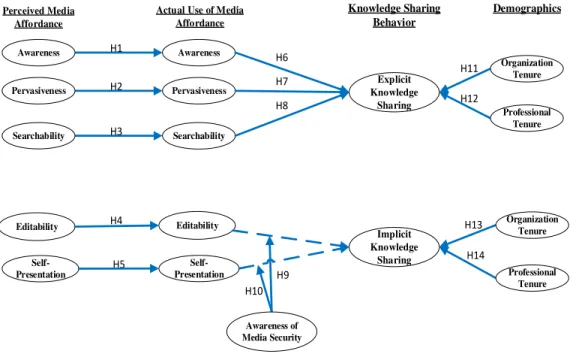
The research strategy for this study empirically assessed the effects of media affordances and users’ media security awareness on actual media use and knowledge sharing behavior among GSD team members. The strategy included the collection of quantitative data and testing the hypotheses using statistical analysis. The research model shown in Figure 1, represents media affordances and the variables used to test the
hypotheses. Awareness Editability Pervasiveness Searchability Self-Presentation Actual Use of Media
Affordance H1 H3 Awareness Editability Pervasiveness Searchability Self-Presentation Perceived Media Affordance Awareness of Media Security Explicit Knowledge Sharing Implicit Knowledge Sharing Knowledge Sharing Behavior H2 H4 H5 H7 H6 H8 H9 H10 Organization Tenure Professional Tenure Organization Tenure Professional Tenure Demographics H11 H12 H13 H14
The concept of affordance is a theoretical lens into media utility and sociability. Zammuto, Griffith, Majchrzak, Dougherty, and Faraj (2007) argued that a technological object has functionality but needs to be recognized as a social object, because
technological possibilities of action are not given, but they depend on the intents and the perceptions of social actors enacting them (Zammuto et al., 2007). Perceived affordances represent the relationships among information, technology, and users. They may be embedded within a domain or context like organization context (Strong et al., 2014). Strong et al. (2014) extended the affordance concept to actualization, which was defined as “the actions taken by actors as they take advantage of one or more affordances through their use of the technology to achieve immediate concrete outcomes in support of
organizational goals” (p. 70). An example is the study of social tagging by Mirzaee et al. (2008) which concluded that social media may not be as valuable or reliable for task-specific situations, because task are often more relational than personally oriented. Media used for project knowledge sharing is more project task-specific and focuses on project related situations. Imbrication of human agencies and the material agencies creates infrastructure in the form of routines and brings certain actions (Leonardi, 2011).
Because a technology carries various features, it brings a set of affordances. Treem and Leonardi (2012) address four affordances of social media technology; visibility, editability, persistence, and association. Rice et al. (2017) identified six affordances of general media that are visibility, editability, self-presentation, pervasiveness, searchability, and awareness. One of the social media affordances,
the meaning of association affordance. Persistence as social media affordance is measured through the survey item for searchability affordance.
This study viewed actual media use as the actualization of media affordances. The uses of certain media type indicate actualization of certain combinations of the media affordances. For example, the use of media such as video conferencing, teleconferencing, and text messaging indicates higher level of pervasiveness affordance in common. The use of email, Internet, Intranet, project management tool indicates the actualization of awareness affordance. Persistence or searchability media affordances may bring more use of certain types of media that have higher level of the same affordances (e.g.,
configuration management system, quality management system, requirements management system, global product lifecycle management system). If they view knowledge as a continual process that develops over time, people are more inclined to engage in the use of media that deliver knowledge. Thus, each of perceived media affordance brings more uses of certain types of media. The following hypotheses were developed:
H1: Awareness in the perceived media affordance is positively related to the awareness in actualized media affordance.
H2: Pervasiveness in the perceived media affordance is positively related to the pervasiveness in actualized media affordance.
H3: Searchability in the perceived media affordance is positively related to the searchability in actualized media affordance.
H4: Editability in the perceived media affordance is positively related to the editability in actualized media affordance.
H5: Self-presentation in the perceived media affordance is positively related to self-presentation in actualized media affordance.
The following hypotheses aim to test the impact of the actual use of various media technologies on different types of knowledge sharing behaviors. Actualized media use produces higher levels of affordances in media technologies such as configuration management system, quality management system, requirements management system, global product lifecycle management system. Awareness media affordance is the awareness of media used to manage knowledge sharing information. It requires
awareness of information and access control (who is authorized to edit or update and add or post information in different parts of the system) to prevent unauthorized access and consumption of information but also to provide relevant role-based information to individual users (Muniraman, Damodaran, & Ryan, 2007). Not having enough
information, having too much, or irrelevant information could severely affect the user’s access. The information stored and communicated through media could represent trade secrets or specially developed procedures and techniques which must be protected from unauthorized employees and external users (Muniraman et al., 2007). The lack of protection could threaten the organizations’ competitive advantage. In addition, information can be stolen, deleted, or accuracy changed by hackers and intruders resulting in loss of revenue or reputation (Muniraman et al., 2007).
Pervasive affordance provides knowledge of an individual’s social connections and daily events. It is a consequence of the person-to-network communication that enables persistent contact and the low social presence (Hampton, 2016). Pervasive
awareness is often the result of brief, asynchronous exchanges of text or photos and can result from the use of a variety of technologies, including text messaging, blogging, and other forms of media (Hampton, 2016). Media that require shorter period of time to deliver information tend to have high level of pervasiveness affordance. They may promote explicit knowledge sharing behaviors. On the contrary, media usually with written communication offer capability to store, retrieve, and re-read, thus it gives changes to recall previous communications and rethink.
Searchability media affordance is the ability to query implicit (applied tacit knowledge) information and receive the correct information (Benaloh, Chase, Horvitz, & Lauter, 2009). For example, a health server correctly returns the record which match the query, and privacy, which means the patient can perform the search without revealing any information to the server (if the server has been compromised information security is still guaranteed). Advancement in technology has made it possible for tacit knowledge to be accessible and easily explicable. For example, the technology to codify analytical feedback from an expert is not as complex as a highly tacit knowledge such as knowledge related to improvisation or emotion would need (Kabir, 2013). Organizations are able to augment their knowledge base and enhance innovation through activities such as research and development, collaboration, patenting and licensing, merger and acquisitions,
training and consulting, spin‐offs and new market entry, knowledge publication and
diffusion (Kabir, 2013). Through technology, media plays a crucial role in these areas to transfer tacit knowledge internally and externally to organization to be applied as implicit knowledge, such as expert systems and searchable multimedia files (Richer, 2012). Combining these two approaches with other knowledge management components can
significantly increase the capacity to capture expert tacit knowledge (Richer, 2012). The actual use of media and awareness of searchability affordance has a positive effect on implicit knowledge sharing behavior.
Explicit knowledge is transferable and searchable information that can be easily located through searchable media affordance. Query searches can be performed returning query records based on the values queried and access privileges controlled by information security policies. Users can collaborate on the value and use of the knowledge. It is possible to share, codify, and convert explicit knowledge as principles, formulae, data,
processes and information (Kabir, 2013).Searchability media affordance has a positive
effect on explicit knowledge sharing behavior. The following hypotheses were developed:
H6: Actualized uses of media with higher level of Awareness affordance have positive association with explicit knowledge sharing behavior.
H7: Actualized uses of media with higher level of Pervasiveness affordance have positive association with explicit knowledge sharing behavior.
H8: Actualized uses of media with higher level of Searchability affordance have positive association with explicit knowledge sharing behavior.
Implicit knowledge activities such as sharing and donating tacit knowledge is known to be more difficult than sharing explicit (Reychav & Weisberg, 2010). It is partly because the implicit knowledge itself is complicated, so it is not easy to deliver the hidden meaning and values. It may be because experts want to limit sharing their tacit knowledge under an unsafe environment. If the implicit knowledge is critical to their
work, then experts tend to resist sharing implicit knowledge using technology. Experts’ awareness of media security influences their willingness to share information with team members through the media. The ability to capture and learn from implicit knowledge is a challenge for many organizations.
Global software development team members in different geographical locations should use communication technologies to share knowledge. The emotional state of an individual, such as his or her attitude towards media as well as the intent to share
knowledge (van den Hooff et al., 2012), can be factors that motivate knowledge donation and at the same time can be factors that restrict knowledge sharing. This study focused on individual’s ability or perception on information security issues or privacy concerns that may influence on the actual media use. GSD members come to the media with diverse goals and concerns, which make a sociomaterial practice emerge. A member’s awareness of media security may alter perception on the media after realizing the features for
information protection in media. Those know more about the media security features may feel comfort or discomfort in the use of the media.
Media affordances that are related to media security feature, editability, and self-presentation, may show different effects on knowledge sharing behavior, depending upon what a user is aware of security features. Editability media affordance is the ability to create, modify, and revise content by the originator or by viewers of the content (Gibbs et al., 2013; Wagner, Wagner, & Vollmar, 2014). The editability makes content easily adaptable even if it was previously generated in a different setting (Wagner et al., 2014). The awareness of editability media affordance allows team members to manage personal expressions, target content to a specific audience, and continuously refine information
quality (Treem & Leonardi, 2012). The awareness of media security has a moderating effect on the perceived use of editability media affordance relative to actual use of media. Gibbs et al. (2013) expanded editability affordance through self-presentation to explain how an individual’s awareness of media security features can result in different effects of media use such as exploiting ambiguities afforded by media use. For example, team members may desire to become disengaged or less visible in collaborative interactions to better manage time or to limit knowledge sharing (Gibbs et al., 2013). Research also found that team members rarely returned email “read receipts”, because to the recipient it was an invasion of privacy. The recipient would rather the sender’s perception be that the email was not received as opposed to the email being ignored (Birnholtz, Dixon, & Hancock, 2012). Media may be strategically used for selective self-presentation by creating an editing messages that may lead to discriminatory practices through
manipulation and selective sharing of information (Gibbs et al., 2013). Limits may be placed on media where information is archived or documented to control how
information is shared and with whom (Ellison, Gibbs, & Weber, 2015). The awareness of media security has a moderating effect on the perceived use of self-presentation media affordance relative to actual use of media. Actualized media use produce higher levels of the same affordances in media technologies such as configuration management system, quality management system, requirements management system, global product lifecycle management system. Thus, the hypotheses test the moderating effects of awareness on media security on the relationships between perceived media affordances and actualized media affordances in global software development team work.