PHYSICAL-LAYER SECURITY: PRACTICAL ASPECTS
OF CHANNEL CODING AND CRYPTOGRAPHY
A Dissertation Presented to The Academic Faculty
by
Willie K. Harrison
In Partial Fulfillment
of the Requirements for the Degree Doctor of Philosophy in
Electrical and Computer Engineering
School of Electrical and Computer Engineering Georgia Institute of Technology
PHYSICAL-LAYER SECURITY: PRACTICAL ASPECTS
OF CHANNEL CODING AND CRYPTOGRAPHY
Approved by:
Professor Steven W. McLaughlin, Advisor
School of Electrical and Computer Engineering
Georgia Institute of Technology
Professor Jeff S. Shamma
School of Electrical and Computer Engineering
Georgia Institute of Technology
Professor Faramarz Fekri
School of Electrical and Computer Engineering
Georgia Institute of Technology
Professor Christopher J. Peikert School of Computer Science Georgia Institute of Technology
Professor David V. Anderson School of Electrical and Computer Engineering
Georgia Institute of Technology
ACKNOWLEDGEMENTS
Let me start at the beginning and thank my parents. They provided a glorious child-hood for me and my siblings in a small town in northern Utah. They are extremely diligent and humble, and they raised their family to appreciate traditional Christian values. No matter where my career leads, if I can only duplicate their success with their children, then I will have no regrets. Thank you Mom and Dad.
Next, I want to say thank you to my Ph.D. advisor, Dr. Steven McLaughlin. Steve hired me into his group at a time when most faculty probably wouldn’t have been willing to take on new students. So Steve, thank you for letting me join the group, for guiding me in my research, for opening up the world to me, for teaching me to write, for letting me teach your class on occasion, and for involving me with Whisper Communications. I will always be grateful for the many diverse experiences that made up my Ph.D., and you were the driving force behind nearly all of them.
Also, a very sincere thank you to the members of my Ph.D. dissertation committee: Dr. Faramarz Fekri, Dr. David Anderson, Dr. Jeff Shamma, and Dr. Chris Peikert. I appreciate the time you spent serving on my committee and the guidance you provided one-on-one to me. In that same vein, I should thank the other faculty at Georgia Tech, especially Dr. Jim McClellan and Dr. Greg Durgin.
I had the fabulous opportunity during my Ph.D. to work with Dr. Jo˜ao Barros at the University of Porto. Working in his group was an absolute pleasure. Thank you Jo˜ao for helping me discover a meaningful problem and publish it within three months. Thank you also for picking me, my family, and our eight suitcases up from the airport, for helping us find a place to live, for taking us to the beach, for feeding us pancakes, and for entertaining us with your family symphony.
During the last two years of my Ph.D., I started working with some of the best people I know in a very cool start-up company called Whisper Communications. Thank you Steve, Jeff, Cenk, and Demijan. I learned a lot from each one of you, and will always call you my friends.
Also to the students and postdocs I spent time with in Porto: J.P., Jo˜ao A., Saurabh, Paulo, Hannez, Luisa, Mari, Fausto, Tiago, Ian, Joao R., Diogo, Rui, and Gerhard. Thanks for reading my bills for me and telling me how to pay them (Fausto), helping me find contact solution (also Fausto), taking me to Bola em Jogo forfutebol, teaching me about Portugal, and, of course, solving research problems with me.
Although I appear to be the last of the McLaughlins for now, I still assert that our research group was very active and productive. Some of my best friends from my years at Georgia Tech are my labmates: Matthieu, Demijan, Arun, Jiaxi, and Hyoungsuk. Thanks guys. I’m sure we’ll stay in touch. Also, thank you to my friends from church who also happened to be at Georgia Tech: John, Marc, Jake, Chris, Jared, Joseph, and James.
Now, to my siblings: Rachel, Jeremiah, Terrah, and Anna, and to your families, thank you all. All of you came out to Atlanta at least once while we were at Georgia Tech. That meant a lot to Krista and me. To Krista’s family: thank you for not killing me for taking Krista and our boys so far away for so long, and thank you for the visits. Dave is the only one who has seenevery apartment we’ve lived in. Nanette only missed one, also a Herculean effort.
Having saved the best for last, I finally want to thank, from the bottom of my heart, my biggest support group. The group leader is my insanely beautiful wife Krista, who spends her time taking care of the roughest, toughest, gang of hoodlums in Atlanta: Parker, Lincoln, Henry, and baby girl (due date: July 30, 2012). You guys are absolutely awesome! I love you.
TABLE OF CONTENTS
ACKNOWLEDGEMENTS . . . iv LIST OF TABLES . . . ix LIST OF FIGURES . . . x SUMMARY . . . xiii I INTRODUCTION . . . 1 II PRELIMINARIES . . . 72.1 System-Level Overview and Notation . . . 7
2.2 Information Theory . . . 11
2.3 Cryptography and Perfect Secrecy . . . 12
2.3.1 One-Time Pad . . . 13
2.4 Channel Coding . . . 14
2.5 Physical-Layer Security . . . 15
2.5.1 Theory of Physical-Layer Security . . . 15
2.5.2 Practice of Physical-Layer Security . . . 17
III SIMPLE SUBSTITUTION CIPHER WITH ERASURES . . . . 22
3.1 Motivation . . . 22
3.2 Notation . . . 24
3.3 Background . . . 25
3.3.1 Simple Substitution Cipher . . . 25
3.3.2 Erasure Wiretap Channel . . . 27
3.4 Security with Noisy Ciphertext . . . 27
3.4.1 Key Equivocation . . . 29
3.4.2 Message Equivocation . . . 31
IV CRYPTANALYSIS OF STREAM CIPHER WITH BIT ERRORS 36
4.1 Background . . . 37
4.1.1 Binary Symmetric Channel . . . 37
4.1.2 Hamming Distance . . . 37
4.1.3 Linear-Feedback Shift Registers . . . 38
4.1.4 LFSR-Based Stream Ciphers . . . 39
4.1.5 Outline of Chapter . . . 42
4.2 Correlation Attacks . . . 42
4.2.1 Attack 1 . . . 45
4.2.2 Attack 2 . . . 46
4.3 Noisy Ciphertext Analysis . . . 48
4.3.1 Mutual Information at the Eavesdropper . . . 50
4.3.2 Security Enhancement for Attack 1 . . . 51
4.3.3 Security Enhancement for Attack 2—EXIT Charts . . . 54
4.4 EXIT Charts Based on Hard Decisions . . . 57
4.5 EXIT Charts Based on Densities . . . 61
4.6 Discussion and Conclusions . . . 65
V STOPPING SET CODES FOR PHYSICAL-LAYER SECURITY 67 5.1 Motivation and Outline . . . 67
5.2 System Model and Degrees of Freedom . . . 69
5.3 LDPC Codes and Stopping Sets . . . 72
5.3.1 LDPC Codes . . . 72
5.3.2 Maximum-Likelihood Decoding over the Binary Erasure Channel 74 5.3.3 Message-Passing Decoding . . . 76
5.3.4 Stopping Sets . . . 77
5.4 Encoder . . . 78
5.4.1 Nonsystematic LDPC Codes . . . 79
5.4.3 Regular versus Irregular Codes . . . 84
5.4.4 Interleaving . . . 85
5.5 Decoder for Legitimate Users . . . 86
5.6 Security against Wiretappers . . . 87
5.6.1 General Security Theorems . . . 88
5.6.2 Bounds on Security Enhancement for General Ciphers . . . . 90
5.6.3 One Receiver and One Wiretapper . . . 94
5.6.4 Multiple Intended Receivers . . . 96
5.6.5 Collaborating Eavesdroppers . . . 100
5.7 Correlated Erasures inQm and Qw . . . 101
5.7.1 Pearson Correlation Coefficient . . . 101
5.7.2 Security Results for Correlated Erasures . . . 103
5.8 Ciphertext Error Rates . . . 107
5.9 Discussion and Conclusions . . . 109
VI COMBINING PHYSICAL-LAYER SECURITY WITH CRYPTOG-RAPHY. . . 110
6.1 Conclusions . . . 110
6.2 Future Work . . . 112
LIST OF TABLES
1 Simulation results of Attack 2 comparing scenarios with and without added security from the physical layer. For these simulations, ν = 31,
LIST OF FIGURES
1 Depiction of a scytale, an instrument that provided ancient Spartans with a simple mechanism for performing permutation encryption and decryption. Figure obtained from [1]. . . 1 2 Wiretap channel model depicting Alice sending a message to Bob over
the main channel Qm, while Eve listens in on their communications
over the wiretap channel Qw. . . 2
3 General overview of a multilayer approach to security including key-based encryption and decryption and keyless physical-layer encoding and decoding in a wiretap channel setting. . . 3 4 Typical digital communications system with a series of encoders and
decoders. . . 8 5 General overview of a multilayer approach to security including
cryp-tography and physical-layer security, in a packet-loss environment with authenticated feedback for Bob. . . 10 6 One-time pad. . . 14 7 Degraded wiretap channel model depicting Alice sending a message to
Bob over the main channelQm, while Eve observes Bob’s received data
through yet another channel Qw. . . 16
8 Packet erasure wiretap channel model for simple substitution cipher. 27 9 Binary symmetric channel model. . . 37 10 Linear-feedback shift register (LFSR) with connection polynomialg(x) =
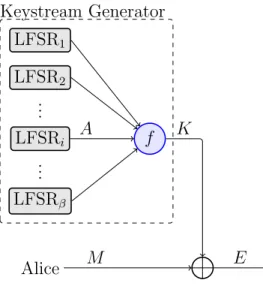
1 +x+x4, with nonzero feedback coefficients labeled. . . . 38 11 Keystream generator based on linear-feedback shift registers. . . 40 12 Simplified model of the keystream generator assumed in fast correlation
attacks. . . 43 13 System model depicting a known plaintext attack against the
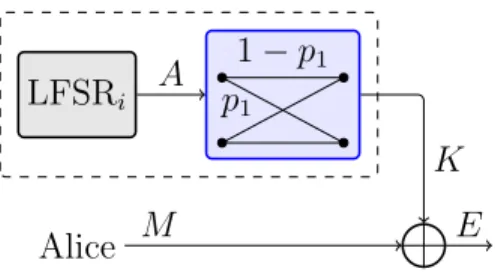
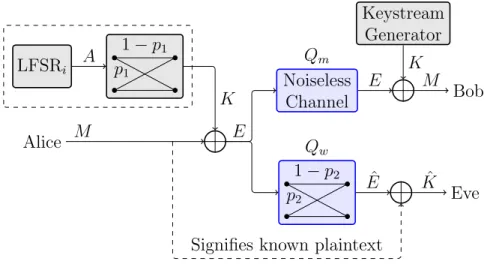
LFSR-based stream cipher system when physical-layer security coding main-tains a nonzero BER p2 in Eve’s ciphertext ˆE. . . 48 14 Model relating sequences An, Kn, and ˆKn using a pair of binary
sym-metric channels. . . 50 15 Effective known-plaintext attack model relating the two sequences An
16 Expected bound ¯φ(ν,r¯) on the number of trials required to find the secret key using Attack 1 whenν = 32, n=ν×106, and t = 6. . . . . 53 17 Results from simulations of Attack 1 showing necessary computations
to crack the LFSR-based cryptographic system. Here ν = 15, N0 = 1500, and t= 4. . . 54 18 Number of trials required for a successful attack versus ¯IAKˆ, an upper
bound on the per-letter mutual information betweenAn and ˆKn. The
order of g(x) is ν = 15, the number of nonzero coefficients in g(x) is
t= 4, and the amount of known plaintext bitsn = 1500. . . 55 19 Correction ratio F of Attack 2 for ν = 32, N0 = ν ×106, and t = 6.
F ≤0 indicates that an attack will likely fail. . . 57 20 EXIT chart with ∆ = 20 formed by averaging the hard-decision output
of 100 simulations of Attack 2 with ν = 31, t = 6, α = 5, n = 3100, and p1 =p0 = 0.2. . . 60 21 EXIT chart with ∆ = 20 formed by averaging the hard-decision output
of 100 simulations of Attack 2 with ν = 31, t = 6, α = 5, n = 3100,
p1 = 0.2, and p2 = 0.1 yieldingp0 = 0.26. . . 61 22 EXIT chart with ∆ = 15 formed by averaging soft-decision output of
100 simulations of Attack 2 with ν = 31, t = 6, α = 5, n = 3100,
p1 = 0.2, and p2 = 0, yielding p0 = 0.2. . . 64 23 EXIT chart with ∆ = 15 formed by averaging soft-decision output of
100 simulations of Attack 2 with ν = 31, t = 6, α = 5, n = 3100,
p1 = 0.2, and p2 = 0.05 yielding p0 = 0.23. The viewable range is adjusted to show the crossover point. . . 65 24 Wiretap channel model with feedback assuming packet erasure
chan-nels for both the main channelQm and the wiretap channel Qw. . . . 70
25 Tanner graph for MP decoding over the BEC with a highlighted stop-ping set caused by erasures at variable nodesv2, v4, and v6. . . 73 26 Binary erasure channel model. . . 75 27 Detailed block diagram of the encoder. Number and size of blocks or
packets are indicated at each step. . . 79 28 Detailed block diagram of Bob’s decoder. Number and size of blocks
or packets are indicated at each step. . . 87 29 Pr(D ≥ 1) when the number of packets η = 100, as a function of the
respective erasure probabilities in Qm and Qw, δ and . . . 96
30 Pr(D≥1) when the number of packets η= 5000, as a function of the respective erasure probabilities in Qm and Qw, δ and . . . 97
31 Pr(D ≥50) when α = 1 andη = 5000, as a function of the respective erasure probabilities inQm and Qw, δ and . . . 98
32 Pr(D ≥ 1) when the number of packets η = 100, α = 1, and Bob’s erasure probability δ = 0.5. Results are plotted for varying erasure probabilities for Eve’s channel as a function of the correlation coeffi-cientρ. . . 105 33 Pr(D ≥ 50) when the number of packets η = 5000, α = 1, and Bob’s
erasure probability δ = 0.5. Results are plotted for varying erasure probabilities for Eve’s channel as a function of the correlation coeffi-cientρ. . . 106 34 The simulated error rates in Eve’s decoded cryptogram ˆEwhenγerrors
are made in guessing bit values forDdegrees of freedom in one of Eve’s received codewords. . . 108
SUMMARY
A multilayer security solution for digital communication systems is provided by considering the joint effects of physical-layer security channel codes with application-layer cryptography. We address two problems: first, the cryptanalysis of error-prone ciphertext; second, the design of a practical physical-layer security coding scheme.
To our knowledge, the cryptographic attack model of the noisy-ciphertext attack is a novel concept. The more traditional assumption that the attacker has the ci-phertext is generally assumed when performing cryptanalysis. However, with the ever-increasing amount of viable research in physical-layer security, it now becomes essential to perform the analysis when ciphertext is unreliable. We do so for the simple substitution cipher using an information-theoretic framework, and for stream ciphers by characterizing the success or failure of fast-correlation attacks when the ciphertext contains errors.
We then present a practical coding scheme that can be used in conjunction with cryptography to ensure positive error rates in an eavesdropper’s observed ciphertext, while guaranteeing error-free communications for legitimate receivers. Our codes are called stopping set codes, and provide a blanket of security that covers nearly all possible system configurations and channel parameters. The codes require a public authenticated feedback channel.
The solutions to these two problems indicate the inherent strengthening of security that can be obtained by confusing an attacker about the ciphertext, and then give a practical method for providing the confusion. The aggregate result is a multilayer security solution for transmitting secret data that showcases security enhancements over standalone cryptography.
CHAPTER I
INTRODUCTION
Cryptography—literally,secret writing—has been used as a means of securing private information for roughly 3500 years, dating back to 1500 B.C. in ancient Mesopotamia where scribes encrypted secret recipes for pottery glazes using substitution ciphers [2]. Wartime encryption followed shortly thereafter, with the ancient Spartans being the first to employ military cryptography [2]. Their system was known as thescytale, pictured in Figure 1. The apparatus in the figure was used to construct a permutation on the letters in the message. First, a scroll or leather strip was wrapped around a stick of known proportions. Then, the message was written across the wrappings. The intended recipient of the message possessed a stick of the same proportions, and thus, could wrap the leather strip around his own stick and easily read the message. Perhaps one of the most famous military commanders to employ cryptography was Julius Caesar, who used a shift cipher to encrypt his personal and military messages [2].
Figure 1: Depiction of a scytale, an instrument that provided ancient Spartans with a simple mechanism for performing permutation encryption and decryption. Figure obtained from [1].
The cryptanalysis of these early ciphers always assumes that an attacker has access to the complete encrypted message. After all, full knowledge of the cryptogram or ciphertext must have been available to an attacker because the very nature of ancient cryptanalysis required physically intercepting the sent message. Today, however, en-crypted data are communicated over error-prone communication channels; therefore, this assumption no longer holds in general. In 1975, Aaron Wyner introduced the concept of the wiretap channel [3], and with it, the notion of physical-layer security. A modern version of the wiretap channel model is presented in Figure 2. The model depicts an entity named Alice who sends a secret message to a receiver named Bob through the main channel of communications, which is denoted Qm. During data
transfer, an eavesdropper named Eve overhears the transmitted message, although through a separate channel Qw called the wiretap channel.
Alice Encoder Main
Channel Qm Decoder Bob Wiretap Channel Qw Eve M X Y M˜ Z
Figure 2: Wiretap channel model depicting Alice sending a message to Bob over the main channel Qm, while Eve listens in on their communications over the wiretap
channel Qw.
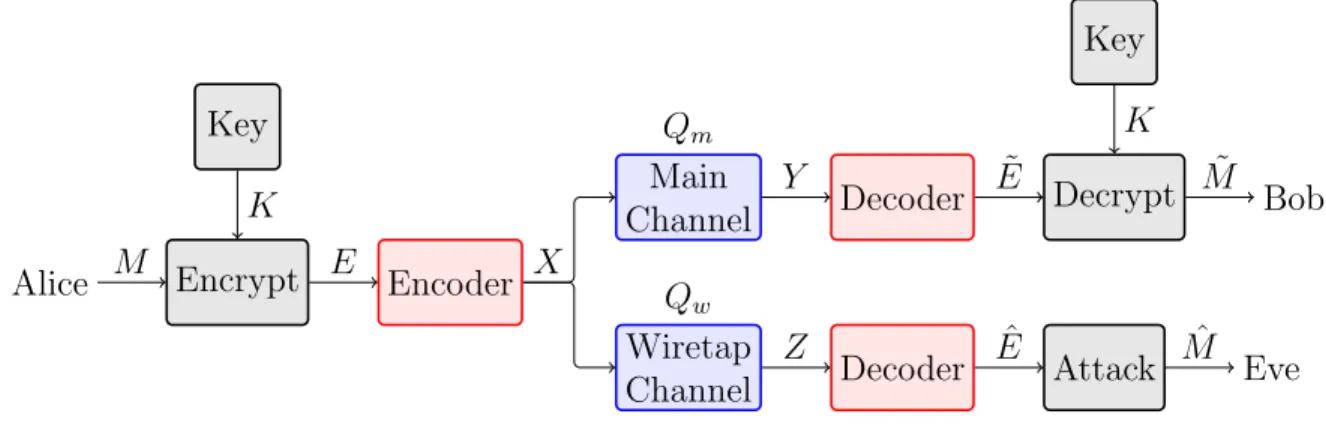
Although traditional cryptanalysis models assume that the ciphertext is known to an attacker, the wiretap channel model can be used to consider cases where an eavesdropper only has access to error-prone data. Physical-layer security is then any security obtained by exploiting the physical characteristics, e.g., noise, of the communications channels. Since Wyner’s paper in 1975, coding schemes have been found that take advantage of irregularities in communication channels for secrecy, although most of them are somewhat impractical for real world implementation. Our
approach to security of transmitted data is considered a multilayer approach, as outlined in Figure 3. First, we wish to understand how the strength of a cryptosystem is affected when an attacker’s ciphertext is contaminated with errors. Second, we wish to provide practical channel coding techniques that offer reliability for legitimate receivers, and exploit the noisy physical layer of a communications system to add confusion, or a positive error rate in the ciphertext, for eavesdroppers. Finally, we consider the joint security of coding with cryptography and discuss the benefits of relying on both types of encoding to keep data safe, rather than rely solely on one or the other. Alice Encrypt Key Encoder Main Channel Qm Decoder Decrypt Key Bob Wiretap Channel Qw
Decoder Attack Eve
M K E X Y E˜ K ˜ M Z Eˆ Mˆ
Figure 3: General overview of a multilayer approach to security including key-based encryption and decryption and keyless physical-layer encoding and decoding in a wiretap channel setting.
There is a danger in relying on only one layer of security, regardless of how strong that layer is considered to be. Typical arguments against cryptography as a stan-dalone security solution are firstly, that modern ciphers are designed around the assumption that certain mathematical operations are hard to compute. For example, the factoring of large integers, is deemed a hard problem if the integers are large enough. However, no proof exists showing this problem to conclusively be difficult. We simply do not have efficient ways to solve this problem right now [4]. Further-more, modern ciphers can often be attacked through side avenues when users employ the systems incorrectly, or using social engineering, thus relieving attackers from the
necessity of attacking the assumed hard problems by inadvertently opening other ways for them to obtain the data. Finally, there is nothing to stop entities from accidentally making use of outdated ciphers with known efficient attacks.
Of course, it would be foolish to reject cryptography because of these potential weaknesses. Let us say, that instead of cryptography, we now wish to rely solely on physical-layer coding techniques for data security. After all, the security measures are information-theoretic, and information-theoretic security is now commonly accepted as the strictest form of security [4]. However, there are many systems in the real world that provably cannot benefit from physical-layer security. For example, in a system without feedback, if an eavesdropper has a better channel than a legitimate receiver, physical-layer security schemes will either offer no protection or possibly limited protection depending on how much information the transmitting party knows about the system. Clearly then, relying on physical-layer security exclusively, is not a viable option for security in many instances.
We suggest that the proper implementation of physical-layer security in modern systems provides an enhancement to already-encrypted data. Again, a multilayered approach to security can provide the benefits of both physical-layer security and cryp-tographic security in the same system. The two layers are extremely complimentary to one anther, as will be seen throughout this work. Furthermore, physical-layer se-curity schemes are often keyless, relying only on channel characteristics for secrecy. Since secret key distribution can be somewhat painful in a practical system, it makes sense to look into physical-layer security techniques as a possible simplification in the key requirements of a system.
As a roadmap through the remaining chapters of this dissertation, we provide the following explanation. It will first be beneficial to provide a system-level overview as well as set forth some general notation, and then present some basic background in information theory, cryptography, channel coding, and physical-layer security. All
of this is done in Chapter 2. In addressing the issue of cryptanalysis of imperfect ciphertext, we look at characterizing the security enhancement that can be obtained if channel coding can simply provide a positive error rate in the eavesdropper’s re-ceived data stream. In Chapter 3 we analyze the simple substitution cipher in an information-theoretic sense when symbols of ciphertext are erased at random through a communications channel. The security enhancement from the erasures is given in terms of equivocation, or conditional entropy. Since substitution ciphers are often included in more modern and complex ciphers, this analysis may provide insights into a number of current cryptosystems. Then, thinking more practically, we inves-tigate stream ciphers in Chapter 4, providing insight into how cryptosystems can be individually analyzed based on existing attacks to chart the effects of errors in the ciphertext.
Following our discussions on cryptanalysis of noisy ciphertext, we move on to a novel practical physical-layer channel coding scheme in Chapter 5 that exploits packet erasures in the wiretap channel for secrecy. The coding at the physical layer is based on low-density parity-check (LDPC) codes, and assumes authenticated public feed-back channels for all legitimate receivers of the transmitted data. Several encoding and packaging techniques are leveraged for secrecy within the design to provide a blanket of security that covers almost all possible channel parameter configurations. We move on to further discuss the implications of combined security from cryptog-raphy and the physical-layer in Chapter 6. Initial findings of the interplay between channel coding for secrecy and cryptography are encouraging in that for codes and ciphers analyzed, we have been able to characterize physical-layer security by not-ing the reduced effectiveness of known attacks, or the increase in general confusion, given a certain percentage of errors at the eavesdropper’s receiver. We also note that our proposed encoder and decoder provide an error rate in excess of the decoding
threshold to an eavesdropper while maintaining reliable communication with legiti-mate parties using feedback. We also provide some conclusions and discuss future work that may stem from this research in Chapter 6.
As a guide through the publications of the author, Chapter 3 is drawn almost exclusively from [5]. Chapter 4 is primarily comprised of material from [6, 7] and [8]. The physical-layer coding scheme in Chapter 5 can be found in the literature in [9, 10] and [11]. Each of these papers, to some degree, express the idea of combined security addressed in Chapter 6.
CHAPTER II
PRELIMINARIES
As a precursor to addressing the problem of combined security derived from both cryptography and physical-layer security, it is first requisite to provide a system-level overview of the general setup, and set forth some notation regarding that system. In addressing the big picture up front, it is easier to see how each result contributes to the overall goal of this work, that is, to provide combined security through cryp-tography and physical-layer security coding. It is also necessary to give some basic background in information theory, cryptography, channel coding, and physical-layer security. When discussing physical-layer security in this chapter, we also discuss some of the short-comings of specific code designs that offer security, and introduce a new metric, degrees of freedom, that may be useful in assessing the security of some physical-layer schemes.
2.1
System-Level Overview and Notation
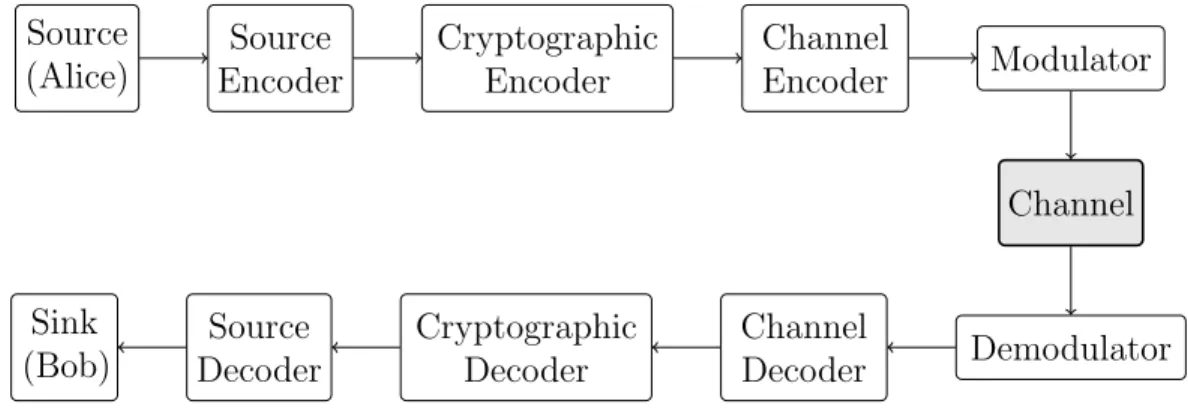
In a typical digital communications system, we anticipate a setup similar to that shown in Figure 4. We see a source of data, say Alice, and a destination for that data to be transmitted or sink, say Bob. Assume that Alice’s data are discrete symbols from a generic alphabet A. Prior to transmission of Alice’s data, she may choose to pass the data through a series of encoders. Figure 4 depicts three encoders; namely, a source encoder, a cryptographic encoder, and a channel encoder [12]. Of course, Bob’s receiver possesses matching decoders in reverse order. The source encoder removes redundancy in the data through some compression algorithm [13]; the cryptographic encoder conceals the meaning of the data from potential attackers of the system [14]; and finally, the channel encoder adds redundancy back into the data for the purpose
of error detection and correction [12]. The research presented in this work deals primarily with the cryptographic encoder and the channel encoder. Thus, we often assume the data have been compressed, but will not offer details as to the compression techniques. Source (Alice) Source Encoder Cryptographic Encoder Channel Encoder Modulator Channel Demodulator Channel Decoder Cryptographic Decoder Source Decoder Sink (Bob)
Figure 4: Typical digital communications system with a series of encoders and de-coders.
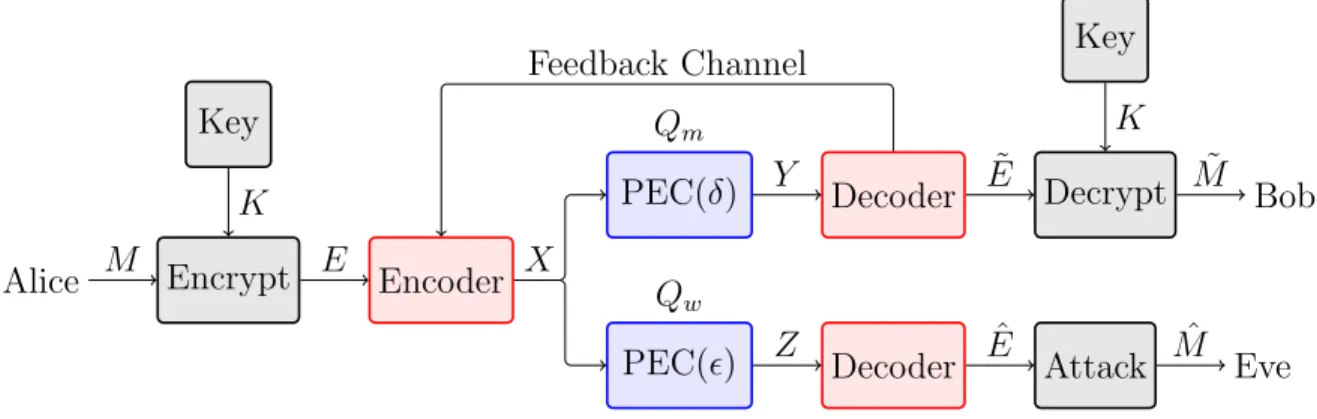
Throughout this work, we will follow the signal conventions and basic general design portrayed in Figure 5. The figure shows a compressed messageM as the input to a cryptographic encoder with cryptogram E as the output. The signal is then encoded and packetized to obtain a collection of packets X for transmission. Bob receives a collection of packets Y through the main channel Qm, while Eve receives
packets Z through the wiretap channel Qw. Both channels are assumed to be packet
erasure channels (PECs), meaning the receiver either receives full information about a packet or zero information about a packet with some fixed probability. The design of the encoder in Chapter 5 exploits the nature of packet erasure channels (and may also be applicable to other types of channels), and magnifies errors in the decoder caused by missing packets, all the while providing reliable communications to Bob using an authenticated feedback channel for automatic repeat request (ARQ). To be clear, all traffic on the feedback channel is public knowledge, so Eve can listen to everything occurring on the channel. However, since the channel is authenticated, Alice can detect whether or not transmissions on the channel come from a trusted source. This
effectively reduces Eve to passive status. Erasures occur with probabilityδin the main channel and with probability in the wiretap channel. Both Bob and Eve attempt to decode the data to obtain the cryptogramE. Bob’s decoder output is denoted ˜E, and Eve’s is ˆE. Finally, Bob decrypts using the known secret keyK and obtains ˜M. Eve does not know the secret key, and thus, must attack the cryptogram to obtain
ˆ
M, her best estimate of the message. The system design guarantees that the decoded and decrypted message ˜M for Bob is error free so that Pr( ˜M 6= M) = 0, while guaranteeing decoding failure for Eve with high probability for almost all channel state parameter pairs (δ, ). Clearly Eve can conceivably obtain partial information about the message in such a context. The encoder design, however, seeks to mitigate the usefulness of any leaked information in an attack.
Given this setup, it will be shown in Chapters 5 and 6 how missing packets at the eavesdropper propagate incorrect bit assignments through the system so that the decoded ciphertext is extremely unreliable. As a result, normally successful at-tacks against the cryptographic layer fail reliably because of excessive error rates in the ciphertext. This problem of cryptanalysis with error-prone ciphertext is actually treated first in Chapters 3 and 4. Eve can be made to receive error-prone cipher-text, even when she has a better channel than Bob, because Bob can request missing packets. Since the feedback channel is authenticated, Eve cannot make requests of her own. The intersection between the set of dropped packets in Qm and the set of
dropped packets in Qw may yet be obtained by the eavesdropper during
retransmis-sions; however the packets dropped inQw that are not dropped inQm are forever lost
to Eve.
It is also worth noting that since chapters in this dissertation address either noisy ciphertext cryptanalysis or the design of physical-layer security codes, we will find it advantageous to ignore portions of Figure 5 for chapters at a time. However, it should be noted, that the overall picture is still crucial to the interplay between the
Alice Encrypt Key Encoder PEC(δ) Qm Decoder Decrypt Key Bob PEC() Qw
Decoder Attack Eve
M K E X Y E˜ K ˜ M Z Eˆ Mˆ Feedback Channel
Figure 5: General overview of a multilayer approach to security including cryptog-raphy and physical-layer security, in a packet-loss environment with authenticated feedback for Bob.
different layers of security.
Regarding other basic notation, the manuscript will adhere to the following rules throughout the document.
x A scalar (lowercase).
xn A length-n row vector (bold lowercase, superscript may be omitted).
X A random variable, set, event, etc. taken in context (uppercase).
Xn A length-n random vector (bold uppercase, superscript may be omitted). Xm×n An m×n matrix (bold uppercase, superscripts may be omitted).
X An alphabet of discrete symbols (caligraphy). Pr (X) The probability of event X.
E[X] The expectation of random variable X.
pX(x) The probability mass function (pmf) of discrete random variable X.
H(X) Shannon entropy of discrete random variable X (in bits). See Definition 1. I(X;Y) The mutual information between discrete random variables X and Y. See
2.2
Information Theory
Physical-layer security is a research area in information theory, and hence, most of the traditional security metrics are information-theoretic. Hence, we provide here a brief overview of basic information-theoretic quantities, and refer the interested reader to [13] for more details. For the following definitions, assume X and Y to be discrete random variables with respective pmfs pX(x) defined over X and pY(y) defined over
Y.
Definition 1. The entropy of X is given as
H(X) = − X
x∈X
pX(x) log2pX(x).
The entropy can be thought of as a measure of the uncertainty in guessing real-izations of a random variable. Therefore, if a value inX occurs with probability zero, then the entropy that value contributes to the total entropy of X is also zero. This makes sense, because an event or value that never occurs cannot possibly increase our uncertainty of the random variable. Specifically, all information-theoretic definitions assume 0·log 0 = 0. Also note that all of the logarithms in this work are base two, and thus, all information-theoretic quantities are measured in bits.
Definition 2. The conditional entropy of X given Y is defined as
H(X|Y) = X
y∈Y
pY(y)H(X|Y =y).
Intuitively, H(X|Y) is a measure of the uncertainty inX that is not shared byY, or the uncertainty that remains in X if Y is known.
Definition 3. The mutual information betweenX and Y is calculated as
This quantity is equal to the amount of information that X and Y share, or the amount of information that one can theoretically collect about one if you know the other. Mutual information is symmetric in thatI(X;Y) = I(Y;X).
Definition 4. A discrete memoryless channel (DMC) is a channel with input mod-eled by the discrete random variable X and output modeled by the discrete random variable Y where the probabilities of specific outputs in Y are determined by tran-sition probabilities pY|X(y|x). The memoryless aspect of the channel indicates that
the ith channel output is only a function of the ith channel input.
Definition 5. For a communications channel, ifX is the input and Y is the output, then the channel capacity C is defined as
C = max
pX(x)I(X;Y). (1)
Note thatX andY are still deemed to be discrete random variables, therefore, the channel with capacity C can be described by transition probabilities pY|X(y|x). The
intuitive notion of channel capacity is the highest encoding rate that the channel can support with vanishingly low probability of error. This is discussed further in Section 2.4. The maximization is over all possible distributions on X. Therefore, there may be some inputs that cannot achieve the channel capacity due to their distributions.
2.3
Cryptography and Perfect Secrecy
Many cryptosystems in place today measure security computationally. If all attacks are computationally intractable, then the system is deemed to be secure. The chief failings of this notion of security are the assumptions placed on the attacker. First, it is assumed that the attacker has limited resources to confront the problem, even if those resources are state of the art. Second, new and unanticipated algorithmic attacks can be developed against the conjectured hard problems. Claude Shannon addressed these shortcomings by defining the notion of perfect secrecy [15]. This
was the first attempt at measuring security with an information-theoretic metric. Information-theoretic security makes no computational assumptions on the attacker, and is accepted as the strictest form of security [16].
Definition 6. If a secret message M is encrypted to form a cryptogram E using a secret key K, then perfect secrecy is achieved if
H(M|E) = H(M), (2)
that is, if the ciphertext provides no information about the message. Note that the entropies in (2) are calculated assuming K is chosen according to some random key distribution (usually uniform).
We note here, that the quantity H(M|E) is typically called the message equivo-cation, and H(K|E) is called the key equivocation.
2.3.1 One-Time Pad
Shannon analyzed the one-time pad cipher shown in Figure 6, and found that it achieves perfect secrecy. This cipher uses a key K composed of uniformly random binary data, and encrypts M by the operation
E =M ⊕K, (3)
where ⊕ signifies a bitwise exclusive-or (X-OR) function. The decoding assumes a noiseless channel and combines the same key with the received data ˆE to recover the message
ˆ
M = ˆE⊕K. (4)
This type of cryptography is symmetric, as the same key and operation perform both encryption and decryption. Although the one-time pad attains perfect secrecy, it fails to solve the practical problem of distributing the message, because |K| = |M|, and
K must still be distributed secretly. In fact, Shannon proved that perfect secrecy is only attainable if the key is at least as long as M, or more generally, only if
H(K)≥H(M). (5)
Although Shannon’s result seems disheartening, perfect secrecy also makes the lim-iting assumption that an attacker has access to an error-free cryptogram; however, this may not be the case in practice.
Alice K Channel K Bob M E Eˆ Mˆ
Figure 6: One-time pad.
2.4
Channel Coding
Channel codes are typically designed to make communications more reliable by adding redundancy into transmitted data that allow for error detection and correction at the receiver. Channel coding is also typically the last encoding rule prior to transmission as shown in Figure 4, thus preventing the propagation of errors at the decoder, because errors are corrected in the first step at the receiver. Since redundancy is added to the data during channel encoding, the length of the data stream increases according to the rate of the code.
Definition 7. Letk be the number of input bits to the encoder, andnbe the number of output bits from the encoder. Then the rate of the code is
R= k
n, (6)
Thanks to the father of information theory, Claude Shannon, we know that for rates less than the channel capacity C there exist channel codes that can obtain arbitrarily low probability of decoding error [17].
2.5
Physical-Layer Security
For physical-layer security code design, we not only wish to obtain arbitrarily low probability of decoding error for Bob, as in traditional channel coding, but also wish to provide some level of security against Eve.
2.5.1 Theory of Physical-Layer Security
The theoretical basis for physical-layer security is derived from the wiretap channel model, and then includes a number of different information-theoretical metrics for security. The secrecy capacity of a system is then defined based on satsfying those two goals. Our research also addresses regions of information leakage that do not necessarily fit within established security metrics. Therefore, we also introduce a new metric that allows us to account for information-theoretic security and cryptographic security in tandem.
2.5.1.1 Wiretap Channel Model
In 1975, Aaron Wyner gave birth to physical-layer security with his degraded wiretap channel model shown in Figure 7, along with a new condition for secrecy [3]. Let a message M of length k be encoded into a codeword X of length n, and then transmitted. A legitimate receiver obtainsY over themain channel denotedQm, and
an eavesdropper obtains Z, a degraded version of Y, through an additional channel called the wiretap channel Qw.
Definition 8. The secrecy condition is lim
n→∞
I(M;Z)
Alice Encoder Main Channel Qm Decoder Bob Wiretap Channel Qw Eve M X Y M˜ Z
Figure 7: Degraded wiretap channel model depicting Alice sending a message to Bob over the main channel Qm, while Eve observes Bob’s received data through yet
another channel Qw.
and is termed today weak secrecy.
Weak secrecy requires the rate of information leaked to an eavesdropper to go to zero as the blocklength of the encoder gets large. Wyner showed that for rates up to the secrecy capacity Cs, encoders and decoders exist that satisfy (7) and also achieve
arbitrarily low probability of error for intended parties in this degraded case, i.e. whenX →Y →Z is a Markov chain. Csisz´ar and K¨orner [18] later generalized these results removing the degraded restriction, but still showed that Cs > 0, only if Qm
is less noisy than Qw. This more general version of the wiretap channel model was
already shown in Figure 2 in Chapter 1. For the general degraded wiretap channel, the secrecy capacity is [4]
Cs = max pX(x)I (X;Y|Z) (8) = max pX(x)(I(X;Y)−I(X;Z)) (9) ≥max pX(x) (I(X;Y))−max pX(x) (I(X;Z)) (10) =Cm−Cw, (11)
whereCm is the channel capacity of the main channel, andCw is the channel capacity
of the wiretap channel. Note, for some channels, Cs = Cm −Cw, but in the general
degraded wiretap channel, the secrecy capacity is at least equal to this difference. Intuitively then, the greater the advantage in channel quality that a legitimate receiver
can leverage over an eavesdropper, the higher the rate at which data can be encoded but remain secret using only physical-layer security.
It is of some relevance to point out that there is a more meaningful secrecy con-dition besides that of weak secrecy.
Definition 9. If a system is such that lim
n→∞I(M;Z) = 0, (12)
then the system achieve strong secrecy.
Clearly this condition is much more restrictive on the information leakage than is the weak secrecy condition in (7). Also, one may expect Cs to decrease if we
define secrecy capacity as the maximum encoding rate at which strong secrecy is achievable, rather than weak secrecy. However, it is a well-known fact that for the degraded wiretap channel model, the secrecy capacity is the same regardless of which condition is used [19]. For more details as to the theory of physical-layer security, we direct the interested reader to the first concise text on the matter [4]. It should also be noted that semantic security addresses practical issues beyond those regarded in these information-theoretic security definitions [20].
2.5.2 Practice of Physical-Layer Security
Significant advances in the understanding of theoretically achievable secrecy rates of communication systems have been made beyond those already outlined—again, see [4] for further details. However, another of the main challenges regarding physical-layer security has been the design of practical schemes that achieve the secrecy rates indicated by the theory. These schemes exploit noise in the channel at the physical layer of the communications system to derive and magnify an advantage over the eavesdropper.
2.5.2.1 Notable Schemes and Techniques
The historical development of practical secrecy coding schemes began with Wyner in his original wiretap paper. His design was also clarified in an extension of the original work [21]. Here the general idea of partitioning a group code into cosets to achieve secrecy was first presented. Wei noted in 1991 [22] that generalized Hamming weights (which are defined based on the minimum-sizedsupport for subcodes of linear codes) can be used to characterize the performance of a linear code for the channel model depicted in [21]. The coset coding technique was shown to apply to low-density parity-check (LDPC) codes (see [23] and [24]) much more recently in [25], where code designs are given that achieve the weak secrecy condition in (7) for noiseless main channels when the wiretap channel is a binary erasure channel (BEC). This work in LDPC codes for secrecy has been furthered in [26, 27], where large-girth LDPC codes are considered, and shown to meet the strong secrecy constraint in (12) in certain cases. These codes always satisfy the weak secrecy condition when Qm is noiseless,
andQw is a BEC. Some interesting recent work discusses polynomial-time algorithms
that provide semantic security to some systems [28].
Interleaving coded symbols has been used in [29] and [30] in conjunction with wire-tap codes developed in [25] to offer secrecy to various systems. The secrecy properties of nonsystematic LDPC codes have also been discussed in [31]. The works of [32, 33] and [34] show how LDPC codes can be punctured to increase secrecy for scenarios where legitimate parties have an advantage in channel quality over eavesdroppers. Finally, it should be noted that Arıkan’s polar codes [35] can offer secrecy for general symmetric channels, although code construction is an issue for non-erasure channels. Schemes have been presented in [36] and [37] that achieve weak secrecy, although these schemes only offer secrecy for degraded wiretap channels. Furthermore, design of these codes is heavily contingent on perfect channel state information (CSI) at the encoder. There remains a need to deliver schemes that are robust enough to offer
security, even when system parameters are unknown to the designer. 2.5.2.2 Limitations of Current Schemes
While practical codes exist that obtain varying levels of information-theoretic security, most designs suffer from one or more of several drawbacks. For instance, code designs are almost always a function of specific channel parameters, or CSI, seen by legitimate receivers and eavesdroppers. Therefore, channels with varying or unknown parameters present design issues. For example, in the case of an undetected eavesdropper, a designer would have no information as to the channel parameters inQw. Furthermore,
say an eavesdropper listens to wireless communications from a different location over time. Then even if the eavesdropper could be detected, we would need time varying codes to take advantage of this information.
Other codes offer secrecy for only specific types of channels, or only when the eavesdropper’s channel is degraded. Still other designs are impractical in the real world as a result of design complexity, necessary side information for legitimate de-coding, or other limitations. Finally, the most glaring shortcoming of any scheme that derives security from the physical layer of a communications system, is that if an eavesdropper has a better channel than a legitimate receiver, say the channel capacity of the wiretap channel Cw exceeds that of the main channel Cm, then the
scheme will likely fail. For some channels,Cw > Cm implies that the secrecy capacity
of the system is zero. For example, consider what occurs when an eavesdropper has a noise-free channel and Z =X. These types of scenarios necessitate the coupling of physical-layer security schemes with additional protection. Of course, cryptography can fill that role nicely.
2.5.2.3 Degrees of Freedom
For this reason, and as part of a preview of coming attractions, we want to consider cases where the goal of the encoder is not necessarily to provide weak, strong, or per-fect secrecy, but rather a constant positive error rate in an eavesdropper’s received data. Assuming this data stream to be error-prone ciphertext provides a reasonable model for comprehending the effects of physical-layer security coupled with cryptog-raphy. It should be noted that this notion of security is in fact weaker than strong secrecy and weak secrecy, but may provide a more practical context from which to view the multilayer security problem.
Suppose that it is possible to encode already-encrypted data such that a legiti-mate party receives the cryptogram with no errors, but an eavesdropper receives the cryptogram with no information about some symbols. If there is truly no information about these symbols available to an eavesdropper, they will be forced to attempt a brute-force attack on this subset of symbols, that is, attacking the system by simply guessing unknown values. Let us call these symbols for which an eavesdropper recov-ers no information degrees of freedom D, because they represent degrees of freedom in the cryptogram space for the eavesdropper [10].
As a comparison between D and more conventional security notions, if bits in E
are uniformly zero or one and independent and identically distributed (i.i.d.), then perfect secrecy implies D=k, where k is the dimension of the encoder. This means that there are exactly 2k equally likely binary length-k sequences with which to fill in
the missing data. Note that an encoder only has 2k possible codewords in the code.
Thus, every codeword is equally likelya posteriori to the eavesdropper in a perfectly secure setup. In fact, on average there are E[2D] equally likely binary codewords
in a maximum a posteriori (MAP) decoder. This implies a multiplication of efforts necessary to attack a cryptogram with D degrees of freedom.
If the degrees of freedom are the only source of confusion to Eve, then the equiv-ocation (measured in symbols) of the transmitted message X and the eavesdropper’s received data Z is related to D in that H(X|Z) = E[D]. Therefore, we see that de-grees of freedom can provide the answers to meaningful practical security questions, as in how much stronger a system is if physical-layer security is employed to enhance cryptography, but can also map back to information theoretic origins.
CHAPTER III
SIMPLE SUBSTITUTION CIPHER WITH ERASURES
Cryptanalysis is the process of computing the secret key or message of a cryptosystem given the ciphertext [14]. Our problem requires estimating cryptographic strength when the ciphertext has errors. Since security analysis of cryptographic systems is aimed at proving the robustness of the system, a worst-case assumption that the attacker has perfect ciphertext is traditionally made. Therefore, the analysis of the strength of cryptography assuming errors in the ciphertext is a virtually untouched research topic. Only now, under the framework of physical-layer security, does it be-come a viable topic for investigation. In this chapter, we investigate the simple sub-stitution cipher when ciphertext symbols are erased randomly at the eavesdropper’s receiver. This chapter is derived from [5] and has been submitted for publication.
3.1
Motivation
In Shannon’s landmark paper on the communication theory of secrecy systems [15], he discussed the secrecy of a simple substitution cipher. The encryption outputs a cryptogram (ciphertext) E as a function of a message (plaintext) M and a key
K. His analysis provided the key equivocation H(K|E) for the simple substitution cipher in general terms, and showed that H(K|E) and the message equivocation H(M|E) are appropriate metrics for the characterization of the strength of ciphers. Later, Blom [38] and Dunham [39] completed the specific calculations ofH(K|E) and H(M|E), respectively, for the simple substitution cipher, while additional security characterizations were made by Sgarro in [40]. A common assumption made in all of these initial works is that an attacker always has access to a clean version ofE.
Chapter 2, we know that security against eavesdroppers can be formulated another way that takes into account characteristics of a noisy communications channel through which an eavesdropper obtains transmitted data. Many coding schemes were men-tioned in Section 2.5.2.1 that are commonly called wiretap codes. These and others like them, were developed to offer security by exploiting physical-layer characteristics. In Chapter 5, we showcase our own code designs that were developed to further secure already-encrypted data by structuring the leaked information such that attacks are restricted to a brute-force search over a subset of symbols for which the attacker has no information. In other words, the code gives degrees of freedom in Eve’s cryptogram as discussed in Section 2.5.2.3.
In a real system, sufficient signal reliability at the eavesdropper may, however, undermine physical-layer attempts at secrecy coding. Thus, we continue to stress that wiretap codes should be coupled with cryptographic schemes for a more com-plete security solution. This coupling removes the commonly assumed requirement that codes must individually provide secrecy, but rather allows coding to act as a security enhancement to cryptography. Suppose codes simply confuse attackers by providing a positive error rate in an attacker’s eavesdropped cryptogram. The secu-rity implications of such a code can then be characterized through cryptanalysis of noisy ciphertext.
Chapter 4 will show this analysis for correlation attacks on stream ciphers. This chapter will provide the analysis for the simple substitution cipher. The cryptanalysis performed herein is information-theoretic, and addresses the setup of an eavesdropper obtaining ciphertext through an erasure channel. The results are compared to the analysis when the attacker always has an error-free version of the cryptogram [38, 39]. The comparison quantifies the increase in security obtainable by wiretap coding. Since substitution ciphers are often a significant piece in more modern cryptosystems, this analysis may also carry over to more current ciphers. Furthermore, this analysis can
be seen as a first look at the noisy-ciphertext attack for block ciphers.
Regarding the rest of the chapter, notation specific to Chapter 3 is set forth in Section 3.2, while Section 3.3 provides the background to the substitution cipher and the packet erasure channel model. Section 3.4 then calculates the key equivocation and the message equivocation for the cipher assuming erased symbols, and the results are discussed by way of conclusion in Section 3.5.
3.2
Notation
Recall X = {1,2, . . . , N} denotes a finite set, or alphabet of discrete symbols. A length-Lvector of symbols from X is denoted xL= (x1, x2, . . . , xL)∈ XL.
Through-out the chapter, however, it is often more useful to consider symbols as they occur randomly, and hence we write
XL= (X1, X2, . . . , XL), (13)
to signify a random vector of message symbols drawn from X according to a proba-bility mass function (p.m.f.) pX(x). The superscript on vectors may be omitted when
L is obvious.
Furthermore, consider that vectorsxLandyLare composed of symbols from some alphabet, and then elements from one or more of the vectors are randomly erased, i.e., no information is known about them. Let ˆyL and ˆxL be the resulting output
vectors. If the ith symbol in ˆxL is erased, we write ˆx
i =e. Let the notation
ˆ
xL e= ˆyL (14)
signify that ˆxi = ˆyi for every iwhere both ˆxi 6=eand ˆyi 6=e. Thus, if (14) holds, the
equality of xL and yL can only be determined if both ˆxL and ˆyL have zero erasures.
At times, we will find it easier to work with patterns of symbols, rather than the symbols themselves. Borrowing notation from [41], we define theindex ıxL(x) to
be one more than the number of distinct symbols occurring in xL prior to the first
appearance of x. The pattern of xL is then given as the concatentation
Ψ(xL) = ıxL(x1)ıxL(x2). . . ıxL(xL). (15)
For example, ifx= (2,3,5,2,4,2,5,2,2,1), then Ψ(x) = 1231413115 becauseıx(2) =
1, ıx(3) = 2,ıx(5) = 3, ıx(4) = 4, and ıx(1) = 5.
Since this chapter deals only with the substitution cipher, all length-L vectors that have the same pattern are said to belong to the same residue class. This term is properly defined in Section 3.3.1 with more background on the substitution cipher. For now, suppose these residue classes are indexed, and again take the vectors with possible erasures ˆxL and ˆyL. We write
Ψ(ˆxL)= Ψ(ˆe yL). (16)
to indicate that the erasures in ˆxL and ˆyL prevent us from knowing whether or not
Ψ(xL) = Ψ(yL).
Finally, let us also denote S(xL) as the number of unique symbols in xL. For example, if x = (2,1,2,6,6,5), then S(x) = 4. Thus, S(XL) is a random variable with distribution dependent on pX(x) and L.
3.3
Background
This section presents the simple substitution cryptosystem, and the erasure wiretap channel in turn.
3.3.1 Simple Substitution Cipher
LetM={1,2, . . . , N}be a finite set representing the source alphabet. The message source M is memoryless, i.e., symbols are independent and identically distributed (i.i.d.), and source realizations are drawn from M according to the p.m.f. pM. We
necessarily uniform over M1. This signifies the lack of source coding in the system. The cryptogram alphabet E is equal to M. The simple substitution encryption rule maps the message M to the cryptogram E, and is a function of the key K which is taken from the keyspace K. Let T = {Tj(·)}Jj=1 be the collection of all invertible transformations from M onto E. The encryption scheme chooses a key randomly, which then acts as an index for a transformation from T. The distribution on keys is uniform, and K contains every mapping of N symbols onto N symbols. Thus,
J =|K|=N!, and each occurs with probability N1!.
We can then writeTK(ML) = ELas the encryption mechanism, or more precisely,
TK(M1, M2, . . . , ML) = (TK(M1), TK(M2), . . . , TK(ML))
= (E1, E2, . . . , EL). (17)
The decryption rule is similarly denoted asTK−1(EL) =ML. Of course, the cryptosys-tem is such that
Tk−1(Tk(mL)) = mL,∀k∈ K and ∀mL∈ ML. (18)
It was noted by Shannon in [15, pg. 674] that the simple substitution cipher is a pure cipher, meaning that for every i, j, k ∈ Kthere exists some s∈ K such that
TiTj−1Tk=Ts (19)
and every key is equally likely. Shannon then went on to defineresidue classes for pure ciphers. In essence, the set of residue classes are mutually exclusive in the message space ML, and the messages from a particular residue class can all be enciphered
into the same subset of cryptograms. This signifies that there are residue classes in
EL as well as inML. For the substitution cipher, the set of residue classes of ML are
1This nonuniformity provides the structure for frequency analysis attacks against the
cryptosys-tem by matching up the most frequent symbols of ciphertext with the most likely symbols of plaintext.
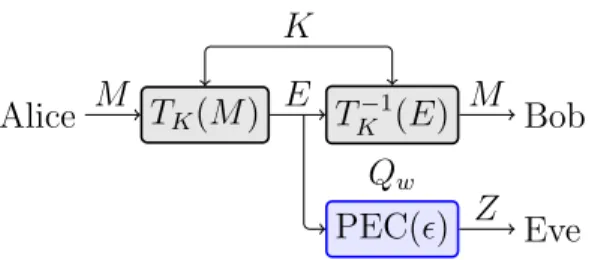
Alice TK(M) TK−1(E) Bob PEC() Qw Eve M E M Z K
Figure 8: Packet erasure wiretap channel model for simple substitution cipher. the set of length-L patterns that can be formed using an alphabet of size N. Also, encryption does not change the pattern of symbols in a substitution cipher, so mL
can only be encrypted into eL if Ψ(mL) = Ψ(eL).
3.3.2 Erasure Wiretap Channel
Figure 8 shows the channel model we assume throughout this chapter to be the packet erasure wiretap channel. Alice wishes to transmit a messageM secretly to Bob. She thus employs a secret keyK to encryptM into a cryptogramE using the simple sub-stitution cipher. Bob receives E error free over a noiseless communications channel, and applies his knowledge of K to decrypt E back to M. An eavesdropper named Eve listens in on the communication between Alice and Bob, albeit with independent randomly occurring packet erasures, where packets are erased with probability and obtained error free with probability (1−). For our analysis, each packet is comprised of exactly one ciphertext symbol; thus, the channel model could also be presented as a symbol erasure channel. The received vector of symbols at the eavesdropper is given asZL= (Z
1, Z2, . . . , ZL), where each Zi is a random variable over the alphabet
Z = {M ∪e}. Note that this model is akin to the overall system model given in Figure 5 in Section 2.1, but only the pieces crucial to this chapter are shown in Figure 8.
3.4
Security with Noisy Ciphertext
Theorem 1 (Dunham [39], Theorem 1). For any cipher system
H(ML|EL) +H(K|ML,EL) =H(K|EL). (20) Proof. The proof of the theorem is instructive. The starting point is given by equating the two relations
H(K,ML|EL) = H(ML|EL) +H(K|ML,EL)
H(K,ML|EL) = H(K|EL) +H(ML|K,EL). (21) Then the theorem is easily shown by realizing that H(ML|K,EL) = 0 by (18), that is, knowing the key and the cryptogram leaves no uncertainty about the message.
Consider the case where encrypted symbols are erased independently at random with probability to form ZL. Equating the following expressions no longer leads us
to an obvious simplification.
H(K,ML|ZL) =H(ML|ZL) +H(K|ML,ZL)
H(K,ML|ZL) =H(K|ZL) +H(ML|K,ZL). (22) Now, only knowing the received error-prone vector ZL and K, we cannot recover
ML unless ZL has no erasures. We can, however, calculate
H(ML|K,ZL) without too much work. Making use of the chain rule and the independent and memoryless
nature of the source and the channel [13], we have the following derivation. H(ML|K,ZL) = L X i=1 H(Mi|K,ZL, Mi+1, . . . , ML) = L X i=1 H(Mi|K, Zi) =LH(M|K, Z) =LX k∈K X z∈Z pK(k)pZ|K(z|k)H(M|k, z) =LX k∈K pK(k)pZ|K(Z =e|k)H(M|k, Z =e) =LX k∈K pK(k)H(M) =LH(M). (23)
Now we combine (22) and (23), and state the following lemma.
Lemma 1. If message symbols are i.i.d., then for any cipher system whereEi is only
a function of K and Mi, and ciphertext symbols in EL are then erased independently
at random with probability to yield ZL,
H(K|ZL) =H(ML|ZL) +H(K|ML,ZL)−LH(M). (24) This change in the relationship of equivocations due to the erasure channel comes as no surprise. Intuitively, we might anticipate such a term asLH(M) to enter into the relationship between key and message equivocation, as the i.i.d. nature of the source symbols clearly gives no way of recovering M if Z = e, even if the key is known.
3.4.1 Key Equivocation
To solve for the new key equivocation given erasure-prone ciphertext, H(K|ZL), we first look to the noise-free solution originally solved in [38] where it was shown that
H(K|EL) = X L! x1!x2!· · ·xN! N Y qxn n log PN! l=1 QN n=1q xn tl(n) QN qxn n . (25)
The one new piece of notation in this expression is the vector x = (x1, x2, . . . , xN)
which is a frequency vector for messages mL ∈ ML. The ith element of x signifies
the number of times i occurs in mL. For example, if mL = (3,2,4,2,2,3,3,3), and
N = 5, then x= (0,3,4,1,0). The first sum in (25) ranges over all xsuch that
|x|=
N
X
n=1
xn =L. (26)
The following relationship exists between the key equivocation under the erasure channel case and that obtained through noise-free ciphertext.
Lemma 2 (Key Equivocation). When a message of i.i.d. source symbols ML is
encrypted using a simple substitution cipher, and ciphertext symbols EL are erased
independently at random with probability to form ZL, then
H(K|ZL) = L X i=0 L i (L−i)(1−)iH(K|Ei). (27) Proof. H(K|ZL) = N! X k=1 X zL∈ZL pZLK(zL, k) log PN! l=1pZLK(zL, l) pZLK(zL, k) , (28) but pZLK(zL, k) = X mL∈ML pZL|KML(zL|k,mL)pK(k)pML(mL), (29) and pZL|KML(zL|k,mL) = (L−i)(1−)i if zL e=Tk(mL), 0 otherwise, (30)
where zL has (L−i) erasures. This implies that
pZLK(zL, k) = (L−i)(1−)i N! X eL:eL e=zL pML(Tk−1(eL)) (31)
Without loss of generality, assume the erasures are indexed last. Then,
pZLK(zL, k) = (L−i)(1−)i N! pMi(T −1 k (z i)). (32)
Now, because the symbols of mL are independent, we can use the frequency vector to write pMi(T−1 k (z i)) =qx1 1 q x2 2 . . . q xN N , (33)
where x = (x1, x2, . . . , xN) now represents the frequency of symbols that occur only
in the non-erased symbols as they are mapped back to M. Finally, plugging the combined result of (33) and (32) back into (28), along with some careful counting to include all the ways in which a single frequency vector can occur, yields the following expression. H(K|ZL) = L X i=0 L i (L−i)(1−)i X |x|=i i! x1!x2!. . . xN! N Y n=1 qxn n log PN! l=1 QN n=1q xn tl(n) QN n=1qnxn . (34) Comparison of (34) and (25) shows the proof to be complete.
3.4.2 Message Equivocation
In solving for the result of the message equivocation H(ML|ZL), we first remark that knowing H(K|ZL) allows us to solve for the key appearance equivocation2 H(K|MLZL), and then apply the result from Lemma 1 given in (24) to solve for the message equivocation as
H(ML|ZL) = LH(M) +H(K|ZL)−H(K|ML,ZL). (35) Since H(K|ML,ZL) is a much simpler calculation than H(ML|ZL), we will take this approach.
Again, we start by borrowing a result about the key appearance equivocation for noiseless ciphertext.
Theorem 2(Dunham [39], Theorem 2). If a discrete source is enciphered by a simple substitution cipher with equiprobable key and the source alphabet has N letters, we
2The expressionkey appearance equivocation was originally given to the quantity
H(K|ML,EL)
to signify the remaining key equivocation following anL-length message in a known plaintext attack
have H(K|ML,EL) = N X i=0 PSL(i) log((N −i)!). (36) Recall that S(ML) signifies the number of unique symbols in ML. The notation
PSL(i) is simply the probability thatS(ML) equalsi. We will consider varying length vectors in the following derivations, and so more generally, PSj(i) = Pr(S(Mj) = i) for any length-j vector of symbols.
Lemma 3(Key Appearance Equivocation).If symbols inMLare i.i.d. and encrypted
using a simple substitution cipher with equally likely keys to form EL, and thenZL is
formed by erasing symbols from EL independently with probability , then
H(K|ML,ZL) = L X i=0 L i L−i(1−)iH(K|Mi,Ei). (37) Proof. H(K|ML,ZL) = X mL∈ML X zL∈ZL pMLZL(mL,zL)H(K|ML=mL,ZL=zL) = X mL∈ML X zL∈ZL pMLZL(mL,zL) log((N −S(zL))!) (38) because there are exactly S(zL) unique symbols that are revealed in zL. Given we know the plaintext as well in the key appearance equivocation, this leavesN−S(zL) symbols that we have yet to identify in the key. Thus,
H(K|ML=mL,ZL=zL) = log((N −S(zL))!) (39) because there are (N −S(zL))! equally likely keys that are possible. We can also
write pMLZL(mL,zL) = X k∈K pMLZLK(mL,zL, k) = N! X k=1 pZL|MLK(zL|mL, k)pML(mL)pK(k) = pML(m L) N! N! X k=1 pZL|MLK(zL|mL, k). (40)
Now, assume that zL has (L−i) erasures, pZL|MLK(zL|mL, k) = (L−i)(1−)i if zL e=T k(mL), 0 otherwise. (41)
There are exactly (N −S(zL))! keys that will exhibit a nonzero value in (41). Thus,
pMLZL(mL,zL) = (N−S(zL))! N! pML(m L)(L−i)(1−)i if Ψ(mL)= Ψ(ze L) 0 otherwise. (42)
Combining the expressions in (38) and (42) yields H(K|ML,ZL) = X mL∈ML X zL:Ψ(zL)=Ψ(e mL) (N −S(zL))! N! × ×pML(mL)(L−i)(1−)ilog((N −S(zL))!). (43) Since we are summing over all possible messages in ML, and because both erasures
and source symbols are independent, we may fix the erasure pattern and simplify the expression so that H(K|ML,ZL) = X mL∈ML pML(mL) L X i=0 L i (L−i)(1−)i× × X ei:Ψ(ei)=Ψ(mi) (N −S(ei))! N! log((N −S(e i))!). (44)
Furthermore, since there are exactly N!
(N−S(ei))! different symbol combinations for ei in the residue class of mi, and because S(ei) = S(mi), therefore, we gain a further
simplification so that H(K|ML,ZL) = L X i=0 L i (L−i)(1−)i X mL∈ML pML(mL) log((N −S(mi))!). (45) Thus we can group elements in the sum according to S(mi), and write the final
expression H(K|ML,ZL) = L XL i (L−i)(1−)i N X PSi(j) log((N −j)!). (46)
Finally, by comparison of (46) and (36), we arrive at (37), and the proof is complete.
We can now combine our results to write the expression for the message equivo-cation.
Theorem 3 (Message Equivocation). For a simple substitution cipher that encrypts an L-length memoryless plaintext message ML into ciphertext EL, if symbols are
erased independently with probability from EL to form ZL, then
H(ML|ZL) = LH(M) + L X i=0 L i (L−i)(1−)iH(Mi|Ei). (47) Proof. From (24) in Lemma 1, we receive our starting point, and thus can derive the relationship as follows. H(ML|ZL) = H(K|ZL)−H(K|ML,ZL) +LH(M) =LH(M) L X i=0 L i (L−i)(1−)i× × H(K|Ei)−H(K|Mi,Ei) =LH(M) L X i=0 L i (L−i)(1−)iH(Mi|Ei). (48) The second relation comes directly from (27) in Lemma 2 and (37) in Lemma 3, while the final expression comes from (20) in Theorem 1.
3.5
Discussion and Conclusions
In conclusion, we have solved for the key equivocation, key appearance equivoca-tion, and message equivocation when cryptogram symbols are obtained independently through a symbol erasure channel by an eavesdropper. We have chosen to discuss the respective results of Lemma 2, Lemma 3, and Theorem 3 together because of the similar nature of the expressions in (27), (37), and (47). These expressions show that the three equivocations are all affected similarly by the erasure channel. We see a
weighted sum in each expression, where the total amount of equivocation is equal to the combination of equivocations for clean cryptograms of all lengths between zero and L. The weighting of each equivocation is simply the probability that the right number of erasures will occur to leave an effective cryptogram of that length. Only the message equivocation carries an additional term signifying the lost information that cannot be recovered about the message due to erasures. This additional term also presents a bias in the equivocation such that the message equivocation will only converge to zero if no erasures occur in the channel. Therefore, the key equivoca-tion should be used to measure the strength of the system rather than the message equivocation.
These relations are clearly dependent on the memoryless message source in the problem setup, and prompt us to consider message sources with additional structure in the future so as to apply the results to encrypted messages in a true spoken lan-guage. We see also, through simple comparisons of the results with their erasure-free counterparts, that if a wiretap code can force erasures of ciphertext symbols upon an eavesdropper, that the total equivocation at the eavesdropper will increase. Surely this also prompts the continued study of the interplay between physical-layer security and cryptography.