5988
EFFECT OF FEEDBACK CHANNEL DELAY ON IMPROVED
JOINT CARRIER SCHEDULING FOR HETEROGENEOUS
SERVICES BASED 5G LTE-ADVANCED NETWORKS
1HAITHAM S BEN ABDELMULA, 2M. N.MOHD WARIP, 3ONG BI LYNN, 4NAIMAH YAAKOB
1,2,3,4Embedded, Network and Advance Computing Research Cluster (ENAC), School of Computer and
Communication Engineering, University Malaysia Perlis, Level 1, Pauh Putra Main Campus, 02600 Arau, Malaysia
E-mail: 1[email protected], 2[email protected]
,
3[email protected],
4[email protected]ABSTRACT
5G Long Term Evolution-Advanced (LTE-A) network based Carrier Aggregation (CA) technique is a promising next generation of all IP mobile networks. The CA technique is very vital to support the 5G LTE-A network with unprecedented speed of data transmission and minimal latency. In order to support and meet the user level Quality-of-Services (QoS) obligations for diversified services “Real-Time (RT) and Non-Real-Time (NRT) traffic”, one of the main challenges in the presence of CA is to offer robust and suitable resource scheduling scheme. For each transmission, the Channel Quality Information (CQI) for individual wireless channel is sent back to the base station eNB, which is used for selecting the suitable modulation and coding scheme. However, prospect delays in the reception of such CQI may lead degradation in QoS performance due to a mismatch between CQI and current channel state at the eNB. This paper, proposes an Improved Joint Carrier Scheduling (IJCS) algorithm which optimizes the performance of User-Level Quality of Service in 5G LTE-A system. The IJCS scheme is more suitable to various traffic users by introducing the service weight factor. As for different feedback delays, both carrier scheduling algorithms namely, JCS and IJCS scheme’s metrics were computed in order to achieve the user quality of service (QoS) and equitable allocation of radio resources among users. Furthermore, a comparison between these schemes metrics was done under different feedback delays to select the best one that can satisfy the user-level QoS constraints. Simulation outcomes demonstrate that the proposed IJCS scheme has achieve the QoS demands for real-time users and fulfils the user’s throughput requirements of NRT streaming video.
Keywords: 5G, LTE-Advanced, Carrier Aggregation (CA), IJCS, QoS, OFDMA, Service Weight Factor, Feedback Delays
1. INTRODUCTION
The LTE-A wireless technology is achieved by the third generation partnership project (3GPP) with introduced Carrier Aggregation (CA) technique, which aims to meet the high level quality of service for a variety of applications (RT and NRT) for mobile users which were crucial concern in the preceding generation of mobile network. Since, the demand of extreme transmission bandwidth to fulfill the rapid growth in the traffic users and their service constraints, the application of CA technique which aggregates up to five component carriers (CCs) with same or diverse bandwidths (contiguous or non-contiguous) has achieved wider bandwidth up to
100MHz [1, 2]. Meanwhile, the sole objective here is to fulfill the IMT-Advanced demands with a peak data rate of 1 Gbps and 500 Mbpsfor downlink and uplink respectively within the new generation of mobile systems [2]. CA is reputed to be the best vital technology due to its capability of providing high throughput for LTE-A networks.
5989 base station eNB[1]. One of the major RRM tasks is the packet scheduler which is accountable for allocation the Physical Resource Blocks (PRBs) among mobile users in an efficient manner, taking into consideration the physical constraints and fulfilling the users’ QoS requirements. The CQI message plays a major role in the scheduling process which characterizing the instantaneous channel quality of the user. Each user always needs time for CQI measurements and reporting them to the eNB. This time has a massive impact on the scheduling performance. A good assignment of radio resources results in greater bandwidth frugality and better fairness of the system. In LTE-A system, the physical frame structure includes 10 sub-frames, each of 1 ms long in time domain. Each sub-frame is further divided into equally two slots which able to convey 6 or 7 OFDM symbols for each slot based on whether the normal or extended cyclic prefix is employed [3]. In frequency domain, each time slot consists of a number of PRBs depending on the used bandwidth which specified by LTE-A system. The PRB is the smallest unit of resource allocation assigned by scheduler which consisting of 12 consecutive subcarriers for one time slot [4].
Although numerous research studies of the resource scheduling in the LTE-A network along with carrier aggregation have been conducted and published, an algorithm of radio resource scheduling which is capable for satisfying the user-level QoS requirements is still open to be explored. Therefore, by considering the user-level QoS demands and exploit the features of Joint User Carrier Scheduling, in this paper the novel resource scheduling scheme notion which is based on the service weight factor is proposed. Moreover, the proposed scheme is compared with classical JCS scheme under impact of different feedback delays which has massive impact on the scheduling decision in order to analyze the performance of IJCS scheme.
The rest of this paper is organized as follows. Section 2 presents a related work. Section 3 demonstrates the joint carrier scheduling scheme. Section 4 the improved joint user resource allocation algorithm is discussed. Section 5 explains the simulation setup and results. Finally, the conclusion is given in Section 6.
2. RELATED WORK
Based on the applied carrier aggregation technique in LTE-A system, several research studies have been conducted on the downlink radio
resource scheduling and proposed numerous schemes in order to achieve the LTE-A network performance.
As shown by Fuet. al. [5], an achieved PF for LTE-A downlink in the presence of mix users “LTE-A and LTE users” that have diverse CA capability. It considers carrier weight factor which includes of carrier’s coverage weight factor and user grouping weight factor. The idea is to prevent starvation for the cell edge user and LTE user.
In [6], the authors proposed a radio resource reserved PF scheme with power allocation for achieve LTE-A system capacity. The users were classified into cell center users and cell edge users groups, where the specific number of CCs and RBs with higher power is preserved to cell edge users and the rest radio resources will be assigned to cell center users, but with minimal power to prevent co-frequency interference with neighbor cells in order to improve the transmission capacity and fairness of cell edge users.
Authors in [7] proposed the joint CC, RB and power allocation (JCRPA) algorithm that has two layers. The upper layer exploits the minimizing system utility loss (MSUL) to assign CCs and PRBs dynamically with fixed power allocation in order to improve the system utility. As for the lower layer, the multilevel water-filling power allocation scheme is utilized to optimize allocation of power for a specified CC and RB assignment for achieving the system fairness.
A two tier radio resource allocation framework was proposed in [8]. The proposed algorithm assigned the component carriers among the users in dynamic manner to achieve load balancing while the novel backlog PRBs scheduling algorithm with weighted CQI based link adaption scheme to obtain significantly better throughput and delay fairness.
5990 A novel greedy-based scheme was introduced in [10] which allocate PRBs of each CC with its associated MCSs to users at each transmission time interval (TTI). The goal is to maximize the system throughput while maintaining the fairness of radio resource assignment among all users in order to prevent starvation.
Authors in [11] proposed the novel enhanced cross-CC proportional fair in LTE-A network, which satisfy the fairness among various kinds of users “LTE and LTE-A users” by designing a weight factor that is based on the number of CCs assigned to users for RBs scheduler. As well as, it is achieving the system throughput.
Finally, an Efficient RB Allocation Algorithm (ERAA) was proposed in [12] which consider the link adaptation jointly with the CC selection and RB assignment. However, multi-user diversity and users CA capability are exploited by base station to assign CCs, RBs and MCSs. ERAA calculates the utility function of all combinations of users, CCs, and MCSs at each TTI with ignoring user CA capability. It significantly enhances the system performance in terms of system throughput and fairness while computational complexity increases a little bit.
Most previous studies related to RRM based carrier aggregation LTE-A system always strive to optimize the system-level scheduling performance i.e. system spectral efficiency and user fairness while the user-level scheduling performance i.e. QoS of real-time and non-real time services has not been researched in depth.
3. JOINT CARRIER SCHEDULING
ALGORITHM
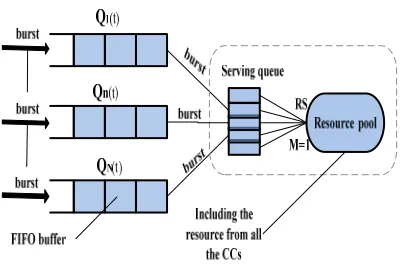
[image:3.612.324.526.93.225.2]For optimal system performance, the Joint User Carrier Scheduling (JCS) scheme has been used to provide throughput from the all CCs as demonstrated in Figure 1 [13]. JCS places the RBs of the entire CCs in the resource pool of a single resource scheduler (RS), that is M = 1. Consequently, it simply requires one-level scheduling which is completely managed by this single RS served all the users.
Figure 1: Joint Carrier Scheduling
However, when the number of users and CCs are large, Proportional Fairness is a suitable radio resource allocation system that pursues the maximum system throughput and assures that none of the users is starving.
In JCS scheduling, every user should transmit a signal to eNodeB on all CCs concurrently and consistently, even though merely one CC is enough of some users for data transmission. This greatly maximizes the intricacy of the signal processing and the user’s power consumption. Meanwhile, the JCS exploits absolute joint processing scheme to take advantage of the spectral efficiency under the obtainable chance of the resource scheduling strategy.
4. IMPROVED JOINT CARRIER
SCHEDULING
Recently, as the number of different mobile applications “RT and Non-RT services” is growing, the application of classical JCS scheduling is not a promising for accommodate the real-time and non-real time QoSdemands. To solve this issue, a novel user-level QoS aware packet scheduling based on JCS scheme is proposed. Based on the authors’ strategy, it alters the existing JCS scheduling by introducing the service weight factor for each traffic user to priority function.Then, the user-level QoS metrics “average delay packet and packet drop rate” for real-time applications and “long-term minimal user throughput” for non-real time flows are guaranteed.
4.1 Calculation of Service weight Factor
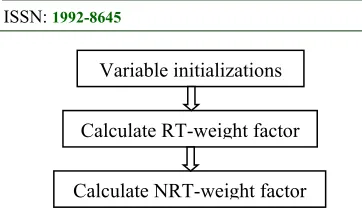
A service weight factor which considered in this study comprised of RT-weight factor and NRT-weight factor. Each user has a service NRT-weight factor on each service. The calculation process is shown in Figure 2.
5991
Figure 2: Calculation of Service Weight Factor
The specific steps are as follows:
Step 1: Variable initializations, including: 1. The arrival time for each traffic user to the
queue.
2. The queue size for each user.
Step 2: Calculate the RT-weight factor that each user maintains on the service. The HOL delay of packets i in the serving queue for real-time user k
is defined as:
𝐷
,𝑡
𝑇
𝑇
,(1) In which 𝑇 is the current transmission time and 𝑇, is the arrival time of packets i in
the user queue, which very crucial to be considered because RT flows is highly delay-sensitive. Then, the RT-weight factor can be expressed as:
𝐷
𝑡
, ∗(2)
. Where 𝑞 𝑡 is the queue length of user k at
time t and the delay highest bound 𝐻𝐷 is utilized
to normalize the HOL packets delay in the user k’s
queue.
Step 3: According to the NRT packet size, denoted by M; and the required minimum
throughput for NRT service, denoted by R. The
arrival time of packets i will be calculated virtually,
denoted by 𝑇, .
𝑇,
0, 𝑖𝑓𝑞 𝑡 0
𝑇, 𝑀 𝑅 , 𝑖𝑓𝑞 𝑡 0 (3)
Then, the HOL delay of packets i in the serving
queue for NRT user k is defined as:
𝐷 , 𝑡 max 𝑇 𝑇, , 0 (4)
Consequently, the NRT-weight factor can be expressed as:
𝐷 𝑡 , ∗ (5)
Based on the priority function of the scheduling algorithm, the resource scheduler assigns the PRBs to the users with the highest priority on all CCs:
𝑘, 𝑎𝑟𝑔 , ,…., max 𝑃, , (6)
Where 𝑘, is the selected user 𝑘 at 𝑖 CC of the 𝑛 PRBs.𝐾 is the total number of users.
At time t, all radio resources are allocated based
on the following priority function:
𝑃, , 𝑡 log , , ∗
, ∑ ,∗ , , (7)
𝑅 , , 𝑡 is estimated transmittable data rate for
user 𝑘 at the 𝑛 PRB group of the 𝑖 CC at time slot 𝑡; 𝐷 𝑡 is sum of HOL packets delay for user
k; ∑ 𝜌 , ∗ 𝑅 , , 𝑡 is the overall throughput of
user k at time slot t;𝜌 , is the assignment indicator
variable for user k and subcarrier n that is equal to 1
when the subcarrier n is allocated to the user k ,
while 0 otherwise; 𝑅, 𝑡 is user 𝑘 throughput
divided by the total of CCs; 𝑇 is the average
proportional window length.
The average user throughput for all
CCs,R , t is defined by:
𝑅 , 𝑡
∑𝐿𝑖 1
𝑅
𝑘,𝑖𝑡
, 𝑘 ∈ 𝑅𝑇∑𝐿𝑖 1
𝑅
𝑘,𝑖𝑡
𝛿, 𝑘 ∈ 𝑁𝑅𝑇
(8)
Where 𝑅 , 𝑡 is the average throughput for user
k on the 𝑖 CC; 𝛿is the minimum throughput for
NRT traffic “240kbps”.
Hence an updated version can be expressed as;
𝑅 , 𝑡 1
1 𝑅 , 𝑡 𝑅 , 𝑡 , 𝑘 𝑘∗
1 𝑅 , 𝑡 , 𝑘 𝑘∗
(9)
Repeat the priority function until all N radio
resources (PRBs) allocated to users, and then update𝑅 , 𝑡 .
5. CQI MEASUREMENT
For the selection of correct modulation and coding scheme beneath various channel conditions, the CQI measurements are exploited. It also is reported to the eNB for utilizing in the packet scheduling priority function calculations. The CQI reports are prepared through four basic steps in the simulator: (i) measuring SINR, (ii) introducing the measurement error to SINR, (iii) converting SINR values to the detached CQI steps, and (iv) giving the CQI report. Whereas, the ideal linear SINR is Variable initializations
Calculate RT-weight factor
5992 calculated for each physical resource block m from
the received pilot power and total interference in each measurement period. Each of SINR values derived from the measurement is converted to decibels as follows:
𝑆𝐼𝑁𝑅 𝑚 10 ∗ 𝑙𝑜𝑔 𝑆𝐼𝑁𝑅 𝑚 𝐸𝑟𝑟𝑜𝑟 (10)
A Gaussian distributed error ErrordB with
parameter specified contrast and zero mean is introduced to the ideal SINR results. Quantization steps are applied on SINR values to convert them to detached CQI as follows:
𝐶𝑄𝐼 𝑚 𝑄𝑆𝑡𝑒𝑝 ∗ 𝑓𝑙𝑜𝑜𝑟 0.5 (11)
Then, the values derived from the measurement of CQI are reported to the eNB by using the CQI reporting scheme with certain delay. In order to achieve a full feedback reporting, the CQI measurement is calculated individually for each PRB. However the feedback delay can be defined as a time lag between measuring the CSI and using it during the transmission process.
6. SIMULATION RESULTS AND
PERFORMANCE EVALUATION
The novel IJCS scheduling algorithm’s performance with different feedback delay configurations for LTE-A will be evaluated in this section.
6.1 Simulation Model
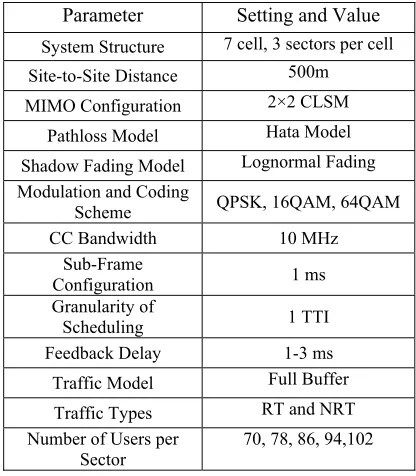
[image:5.612.320.528.108.346.2]The OFDMA downlink transmission system based on the JCS carrier scheduling algorithm is considered. Three CCs are to be aggregated with frequency of each carrier is 2.14GHz, 2.4GHz and 2.6GHz in this simulation. All component carriers possess uniformly transmitting power. As to PF scheduling algorithm, the window length average is𝑇 25. In order to attain high data transmission rate, the adaptive Modulation and Coding is very important. The total number of RT users is assumed to be equal to total number of NRT users. The delay upper bound for both RT traffic and NRT traffic is considered to be equally which is taken 20 msec. Other simulation parameters are listed in Table 1.
Table 1: LTE-A System Level Simulation Parameters
6.2 Performance Evaluation
In this section, the performance of the classical JCS algorithm and the proposed scheduling algorithm IJCS are investigated in terms of user level QoS metrics under the influence of different feedback channel delay. Packet Drop Ratio (PDR) represents the major performance indicator when dealing with QoS provisioning. Base on the premise that real-time application has no benefit from getting an expired packet; the packets that violate the application delay upper bound will be discarded according to QoS-aware strategies.
Figure 3 illustrates average PDR of real-time application under various system loads.
Figure 3: Packet Drop Ratio for RT-Users
Parameter Setting and Value
System Structure 7 cell, 3 sectors per cell Site-to-Site Distance 500m MIMO Configuration 2×2 CLSM
Pathloss Model Hata Model Shadow Fading Model Lognormal Fading Modulation and Coding
Scheme QPSK, 16QAM, 64QAM CC Bandwidth 10 MHz
Sub-Frame
Configuration 1 ms Granularity of
Scheduling 1 TTI Feedback Delay 1-3 ms
Traffic Model Full Buffer Traffic Types RT and NRT Number of Users per
Sector
[image:5.612.315.524.536.705.2]5993 The proposed IJCS algorithm outperformed of the conventional JCS algorithm under various 1, 2 and 3ms feedback delays in all different system loads by an approximate average gain of 35.72%, 31.47% and 30.69%.Where, the IJCS updates the priority of RT users based on RT service weight factor. It gives high priority to the users which have higher packet delay and longer queues length leading to lower average PDR.
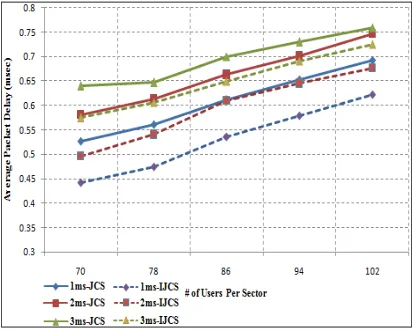
[image:6.612.92.301.244.410.2]Figure 4 demonstrates the normalized average delay of real-time service with respect to the system load.
Figure 4: Average Packet Delay for RT-Users
Due to the proposed IJCS jointly utilize channel state information and the queue status information in terms of queue length, it is ascertained that the IJCS performance better than classical JCS algorithm in all different feedback delays; that range from 1 to 3 ms by an approximate average gain of 12.89%, 10.39% and 6.70% respectively.
Figure5 shows the minimal throughput among all NRT users versus different system loads.
Figure 5: Minimal Long-Term Throughput for Non-Real time users
As the number of users per sector increases, the NRT users’ minimal throughput reduces for both algorithms, proposed IJCS and classicalJCS.The former scheme guarantees the long-term minimal data rate of NRT users “higher than 240kbps” in all feedback delays, while the later scheme has the lowest transmission rate and its rate under the rate requirement at 94 and 102 system loads with 3 ms feedback delay.
7. CONCLUSION
In this paper, the effect of CQI feedback delay on various resource scheduling algorithms is addressed in order to assess the amount of user-level QoS performance degradation that can be attributable to feedback delay. It was observed that the new proposed resource scheduling scheme known as Improved Joint Carrier Scheduling (IJCS) algorithm is more accurate with less degradation in user-level QoS performance due to feedback delay compared to the conventional JCS algorithm. The IJCS algorithm aims to exploit the service weight factor feature which adaptively allocates radio resources to heterogeneous services. It is clear from the simulation outcomes that the IJCS has satisfied the minimum average PDR, PD and throughput in terms of user-level QoS provision at different feedback delays.
REFRENCES:
[1] 3GPP TR 36.851: “Inter-band Carrier Aggregation”, Tech. Rep,Vol. 1, Dec. 2014. [2] H. Lee, S. Vahid, and K. Moessner, “A
Survey of Radio Resource Management for Spectrum Aggregation in LTE-Advanced”,
IEEE Commun. Surv. Tuts., Vol. 16, No. 2,
2014, pp. 745–760.
[3] Y. MIN, et al., “The Enhanced Decoding
Method for QO-SFBC System in Frequency Selective Fading Channel Environment”,
Journal of Networks, Vol. 6, Mar. 2011, pp.
378-386.
[4] T. Ali-Yahiya, “LTE Physical Layer”,
Understanding LTE and its Performance,
New York: Springer, Ch. 4, 2011, pp. 55-73.
[5] W. Fu, Q. Kong, Y. Zhang, and X. Yan, “A resource scheduling algorithm based on carrier weight in LTE-advanced system with carrier aggregation,” Wireless and Optical Communication Conf, 2013, pp. 1–5.
5994
Information Fusion (ICEDIF), 2015,pp.
344–347.
[7] F. Wu, Y. Mao, X. Huang, and S. Leng, “A joint resource allocation scheme for OFDMA-based wireless networks with carrier aggregation,” in proc. Ofthe IEEE Wireless Communications and Networking Conf., 2012,pp. 1299–1304.
[8] X. Cheng, G. Gupta, and P. Mohapatra, “Joint carrier aggregation and packet scheduling in LTE-Advanced networks,”
IEEE International Conf. on Sensing, Communications and Networking, 2013, pp.
469–477.
[9] K. Zheng, F. Liu, W. Xiang, and X. Xin, “Dynamic downlink aggregation carrier scheduling scheme for wireless networks,”
IET Communications, Vol. 8, No.1, 2014,
pp. 114–123.
[10] H. Liao, P. Chen, and W. Chen, “An efficient downlink radio resource allocation with carrier aggregation in LTE-advanced networks,” IEEE Trans. Mobile Computing,
Vol. 13, No.10, 2014, pp. 2229–2239. [11] M. Al-Shibly, M. Habaebi, and M. Islam,
“Novel Packet Scheduling Algorithm Based on Cross Component Carrier in LTE-Advanced Network with Carrier Aggregation”,IEEEInternational Conf. onComputer and Communication Engineering, 2014, pp. 213–216.
[12] S. Rostami, K. Arshad, and P. Rapajic, “A joint resource allocation and link adaptation algorithm with carrier aggregation for 5g lte-advanced network,” IEEEInternational Conf. onICT, 2015,pp. 102–106.
[13] H. Ben Abdelmula, M. Warip. O. Bi, and
N.Yaakob, “Technical Review of RRM for Carrier Aggregation in LTE-Advanced,” in
Journal of Theoretical and Applied Information Technology, Vol.9, No. 2, 2016,