Resaleable
debt and
systemic risk
Jason Roderick Donaldson
Eva Micheler
SRC Discussion Paper No 53
January 2016
ISSN 2054-538X
Abstract
Many debt claims, such as bonds, are resaleable, whereas others, such as repos, are not. There was a fivefold increase in repo borrowing before the 2008 crisis. Why? Did banks’ dependence on non-resaleable debt precipitate the crisis? In this paper, we develop a model of bank lending with credit frictions. The key feature of the model is that debt claims are heterogeneous in their resaleability. We find that decreasing credit market frictions leads to an increase in borrowing via non-resaleable debt. Borrowing via non-resaleable debt has a dark side: it causes credit chains to form, since if a bank makes a loan via non-resaleable debt and needs liquidity, it cannot sell the loan but must borrow via a new contract. These credit chains are a source of systemic risk, since one bank’s default harms not only its creditors but also its creditors’ creditors. Overall, our model suggests that reducing credit market frictions may have an adverse effect on the financial system and may even lead to the failures of financial institutions.
This paper is published as part of the Systemic Risk Centre’s Discussion Paper Series. The support of the Economic and Social Research Council (ESRC) in funding the SRC is gratefully acknowledged [grant number ES/K002309/1].
Jason Roderick Donaldson, Washington University in St Louis and Systemic Risk Centre, London School of Economics and Political Science
Eva Micheler, Department of Law and Systemic Risk Centre, London School of Economics and Political Science
Published by
Systemic Risk Centre
The London School of Economics and Political Science Houghton Street
London WC2A 2AE
All rights reserved. No part of this publication may be reproduced, stored in a retrieval system or transmitted in any form or by any means without the prior permission in writing of the publisher nor be issued to the public or circulated in any form other than that in which it is published.
Requests for permission to reproduce any article or part of the Working Paper should be sent to the editor at the above address.
RESALEABLE DEBT AND SYSTEMIC RISK
∗
Jason Roderick Donaldson
†Washington University in St Louis
Eva Micheler
‡London School of Economics
January 2, 2016
Abstract
Many debt claims, such as bonds, are resaleable, whereas others, such as repos, are not. There was a fivefold increase in repo borrowing before the 2008 crisis. Why? Did banks’ dependence on non-resaleable debt precipitate the crisis? In this paper, we develop a model of bank lending with credit frictions. The key feature of the model is that debt claims are heterogenous in their resaleability. We find that decreasing credit market frictions leads to an increase in borrowing via non-resaleable debt. Borrowing via non-resaleable debt has a dark side: it causescredit chains to form, since if a bank makes a loan via non-resaleable debt and needs liquidity, it cannot sell the loan but must borrow via a new contract. These credit chains are a source of systemic risk, since one bank’s default harms not only its creditors but also its creditors’ creditors. Overall, our model suggests that reducing credit market frictions may have an adverse effect on the financial system and may even lead to the failures of financial institutions.
∗The support of the Economic and Social Research Council (ESRC) in funding the Systemic Risk Cen-tre is gratefully acknowledged [grant number ES/K002309/1]. Thanks to Gaetano Antinolfi, Jen Dlugosz, Armando Gomes, Radha Gopalan, Dalida Kadyrzhanova, Mina Lee, Giorgia Piacentino, Adriano Rampini, Matt Ringgenberg, Edmund Schuster, Ngoc-Khanh Tran, Ed van Wesep, and Jean-Pierre Zigrand for com-ments.
1
Introduction
Credit frictions decreased substantially in the decades leading up to the 2008 financial crisis.1 This coincided with the expansion of repo markets, which grew fivefold between 1990 and 2007. Before the crisis, the value of outstanding repos in the US exceeded five trillion USD.2The markets appeared to be functioning well, allowing banks to find cheap, short-term liquidity. However, they were harboring systemic risk, because banks were exposed to one another in credit chains. This meant that if one bank defaulted, it harmed not only its immediate creditors, but potentially its creditors’ creditors as well. This systemic risk manifested itself in the financial crisis, in which shocks to a relatively small set of assets threatened to bring down the entire financial system. Did the buildup of systemic risk relate to the decrease in credit frictions? In general, can a decrease in credit frictions cause an increase in systemic risk?
In this paper, we construct a corporate finance-style model to address this question. We find that the answer is yes. Our main result is that a decrease in credit frictions increases systemic risk. This is because the decrease in credit frictions leads credit chains to become more widespread, and these credit chains harbor systemic risk.
The key novel ingredient in our model is the heterogeneous resaleability of debt claims. For concreteness, consider the salient examples of bonds and repos. Bonds are resaleable, whereas repos are not.3 As a result, lending via repos leads to credit chains, whereas lending via bonds does not. To see this, suppose you are a lender—you have a loan on the asset side of your balance sheet—and you suddenly need liquidity. Your options for raising this liquidity are different if you hold a bond than if you hold a repo. If you hold a bond you can sell it in the market. In contrast, if you hold a repo, you cannot sell it. Hence, you obtain liquidity by borrowing via a new repo. This creates a credit chain, because you are now not only a creditor in the original repo, but a debtor in the new repo as well. In summary, when you hold a non-resalebale instrument such as a repo, the result is a credit chain. This brings with it systemic risk, since defaults can transmit through the chain.
1Low credit market frictions in the US before the crisis reflected a number of factors, including advanced information technology for execution and settlement, low transaction costs (Domowitz, Glen, and Madhavan (2001), Jones (2002)), relatively low information asymmetries (Bai, Philippon, and Savov (2012), Greenwood, Sanchez, and Wang (2013)), and a number of potential legal factors, such as privileged bankruptcy treatment of some bank liabilities (Morrison, Roe, and Sontchi (2014)) and required financial disclosure (La Porta, Lopez-De-Silanes, and Shleifer (2006)).
2See Homquist and Gallin (2014).
3That bonds are resaleable and repos are not is a formal legal property of these claims. Other financial claims, such as derivatives, are also not resaleable; we comment on our model’s applicability to derivative markets in Subsection 1.1.
How does a change in credit frictions affect your choice whether to lend with a bond or a repo? In our model, a decrease in credit frictions makes you relatively more likely to lend via a repo. This is due to the fact that when you are an intermediate link in a credit chain, there are two contracts that must be enforced, one between you and your creditor and another between you and your debtor. Thus, you bear the costs of credit frictions twice, once for each contract. If frictions are high, you have a strong incentive to avoid these double costs. To do this you lend via resaleable debt like bonds. In this case, no credit chain is formed and systemic risk is low. On the other hand, if credit frictions are low, you have a weaker incentive to avoid the costs of credit chains. You may prefer to lend via non-resaleable debt like repos, as repos may come with other advantages, such as preferential treatment in bankruptcy or lower issuance costs. In this case, credit chains form and systemic risk is high. This is the essence of our main result: decreasing credit market frictions can increase systemic risk. The reason is that decreasing credit frictions makes it is less likely that banks issue resalable debt and, hence, more likely that credit chains form.
Model preview. We now describe our model and results in more detail. We model the interbank market within a classical corporate finance framework. At the core of the model is one financial institution, which we call Bank A, that needs to raise finance in order to scale up a project. Bank A borrows from a competitive creditor, which we call Bank B. Bank A can borrow via one of two instruments, a bond or a repo.4 As discussed above, a bond is resaleable whereas a repo is not. The amount that a bank can borrow is limited by the assets it can pledge, via a standard limit to pledgeabity. Specifically, the repayment a bank makes to its creditor cannot exceed a fixed fraction θ of the bank’s assets. This fraction θ, which we refer to as the “enforceability” in the economy, captures credit frictions. An increase in enforceability θ corresponds to a decrease in credit frictions. At an interim date, after Bank B has made the loan to Bank A, it may suffer a “liquidity shock,” i.e. it may suddenly need cash. If Bank B suffers a liquidity shock, it raises liquidity in the interbank market from a third financial institution, which we call Bank C. Specifically, Bank B raises this liquidity either by selling Bank A’s bond to Bank C or by entering a new repo agreement with Bank C.
Considering resaleability alone, bonds are strictly preferable to repos. However, repos may be preferable to bonds along dimensions other than resaleability. In our baseline model, we focus on the fact that repos are senior to bonds in bankruptcy; 4We use the labels repo and bond throughout for non-resaleable and resaleable instruments, respectively. Note that when we think about short-term bank funding, the kind of bond we have in mind is commercial paper. We discuss the applicability of our model to short-term bank funding further in Subsection 1.1 and to more general abstract settings in Subsection 4.1.
Bank B’s Sale of Bank A’s Bonds to Bank C
Bank A
A’s debt to B A’s debt to C
θ
C buys A’s bonds
Bank B
Bank C
Figure 1: Because bonds are resaleable, Bank B obtains liquidity by selling Bank A’s bonds
to Bank C. No credit chain emerges.
in fact, they are exempt from bankruptcy stays in reality. Thus, Bank A trades off the resaleability benefit of bonds against the seniority benefit of repos. However, we would like to emphasize that our model captures a general financing trade-off between resaleabale and non-resaleable debt; the case of bonds vs. repos is only one example of this trade-off, albeit an economically important one. We focus on these interbank markets for concreteness and simplicity. In Subsection 4.1, we apply our model to general debt markets with frictions following Kiyotaki and Moore (2005) and show that our results hold in that setting. In particular, the specific assumption that repos are senior in bankruptcy is not necessary.
Results preview. First consider the case in which Bank A borrows from Bank B via a bond. In this case, when Bank B suffers a liquidity shock, it sells Bank A’s bond to Bank C. This sale is depicted in Figure 1. Observe that Bank A now has a debt to Bank C directly. There is no credit chain. There is only one contract to be enforced, the debt from Bank A to Bank C. Credit frictions kick in only once and Bank A’s debt capacity is (roughly) proportional to the enforceabilityθ of this contract.
Now turn to the case in which Bank A borrows from Bank B via a repo. In this case, when Bank B suffers a liquidity shock, it must enter into a new contract to find liquidity—because Bank A’s repo debt is not resaleable, Bank B cannot liquidate it
A Credit Chain from Bank A to Bank B to Bank C
Bank A
A’s debt to Bθ
Bank B
B’s debt to Cθ
Bank C
Figure 2: A credit chain emerges when Bank A borrows from Bank B via repos.
in the market. Thus, Bank A borrows from Bank C via a new repo contract. This is depicted in Figure 2. Observe that Bank A has debt to Bank B and Bank B has debt to Bank C. There is a credit chain. There are two contracts to be enforced. Credit frictions kick in twice, once at each link in the credit chain, and Bank A’s debt capacity is (roughly) proportional to the enforceabilitysquared orθ×θ. Intuitively, there is one θ for each of the two contracts.
Now consider how an increase in enforceability affects Bank A’s choice between bonds and repos. Asθ increases, the amount Bank A can borrow with bonds increases
linearly and the amount Bank A can borrow with repos increases quadratically. In other words, the sensitivity of Bank A’s debt capacity to enforceability is higher when it borrows via repos than when it borrowers via bonds. Thus, as credit frictions decrease, Bank A switches from bond borrowing to repo borrowing.
What are the implications of increasing enforceability for systemic risk? We have just established that increasing enforceability leads Bank A to borrow via repos and that this, in turn, leads to credit chains. Credit chains harbor systemic risk because if Bank A defaults on its debt to Bank B, Bank B may default on its debt to Bank C. In our model, such default cascades can arise only when enforceability is high, because that is when Bank A funds itself with repos and credit chains emerge. Note that even though increasing enforceability improves the functioning of each market individually, it may have an adverse effect on the system as a whole, causing an increase in systemic
risk.
Policy. Our model is stylized, but may still cast light on policy debate. Should repos maintain their special treatment in bankruptcy? The exemption from automatic stays for repos makes repos more desirable to Bank A. Thus, the exemption leads Bank A to undertake more repo borrowing and, hence, leads to more credit chains. Since these credit chains are the source of systemic risk in the model, the exemption from the stay exacerbates systemic risk.
Our findings also affirm that regulators must take a macro-prudential approach, as decreasing credit frictions makes every market function better individually, but makes the system as a whole more dangerous.
Layout. The remainder of the paper is organized as follows. There are two remain-ing subsections in the Introduction, first, a discussion of the realism of our assumptions and the empirical relevance of our results and, second, a review of related literature. Section 2 presents the model. Section 3 contains the formal analysis. In Section 4, we do three extensions to affirm the importance and robustness of our conclusions. First, we adapt the model to a more general economic setting and argue that our main result that increasing enforceability can increase systemic risk applies to a broad variety of settings, not only to the interbank market we focus on in the baseline model. Second, we include default costs to show that under reasonable assumptions increasing systemic risk is tantamount to decreasing social welfare. Third, we take the role of repo collat-eral more seriously than we do in the baseline model and we argue that our results are not driven by simplifying assumptions about how contracts are collateralized. Section 5 concludes. Appendix A contains omitted derivations and proofs.
1.1
Realism and Empirical Evidence
While our model is stylized, we believe that our baseline model provides a useful approx-imation of the interbank market, with reasonable assumptions and predictions. Here we discuss these briefly in connection with empirical work. First, we point out that repos and asset-backed commercial paper (a type of bond) are relatively substitutable instru-ments for short-term bank funding. This is because they both have relatively short ma-turities and they are often secured by similar collateral (Krishnamurthy, Nagel, and Orlov (2014)). Second, we suggest that the bankruptcy advantage of repos is important, as repo volume increased after Congress introduced the safe harbor provision (Garbade (2006)). Third, we emphasize that credit chains are an important feature of the repo
market (repo chains are typically associated with the so-called “rehypothecation”5 of collateral, see Singh and Aitken (2010) and Singh (2010)). Banks assume offsetting long and short repo positions, even though many repos are very short-term and it may seem that they should be “self-liquidating.” This may be because banks manage liquid-ity over very short time horizons, taking offsetting positions within each day. Another reason for this may be that many repos are of longer maturities, with an estimated thirty percent of repos having maturity longer than a month (Comotto (2015)). Fi-nally, many repos have “open” tenors, with no specified maturity. These are typically thought about as overnight contracts, but a lender in an open repo must give its coun-terparty notice before closing the contract; sometimes several weeks’ notice is required (Comotto (2014)).
We would also like to point out that our model also applies to financial derivatives. Like repos, derivatives are non-resaleable instruments that enjoy special treatment in bankruptcy. Further, derivatives markets grew even more dramatically than repo mar-kets in the years before the 2008 crisis. The notional value of all financial derivatives contracts was estimated at 766 trillion USD in 2009, a three hundred-fold increase from thirty years earlier (Stulz (2009)). Repos and derivatives often constitute a larger frac-tion of banks’ balance sheets than bonds of all maturities combined. For example, in 2009 over forty-five percent of Barclay’s liabilities were listed as “repurchase agreements and stock lending” or “derivatives” on its balance sheet.6
Our application to the interbank market depends on the assumption that there are frictions in the interbank market. In particular, we assume that there is limited enforceability of contracts or, equivalently, limited pledgeability of cash flows. The assumption is standard in the theory literature—for example, Homstrom and Tirole (2011) make the assumption and provide a list of “several reasons why this [limited enforceability] is by and large reality” (p. 3). We think that the realism of the assump-tion for our applicaassump-tion is demonstrated by the importance of collateral in interbank contracts (Bank for International Settlements (2013))—if there were no pledgeablity frictions, banks would not need to post collateral at all. In addition, the years-long bankruptcy proceedings of Lehman Brothers demonstrated that bank creditors can face severe frictions when trying to claim repayment. Further, we point out that our 5Since a repo contract is formally the sale and repurchase of assets, not the pledging (or “hypothecating”) of collateral, the term “rehypothecation” is not favored by lawyers.
6Barclay’s annual reports are available online here <https://www.home.barclays/barclays-investor-relations/ results-and-reports/annual-reports.html>. The Royal Bank of Scotland reports similar numbers (see <http://investors.rbs.com/annual-report-subsidiary-results/2010.aspx>). The corresponding figures are hard to find for US banks, since they classify their derivatives holdings as risk management instruments and, therefore, are not required to list them on their balance sheets.
model does not rely on the assumption that contractual enforceability is weak, but only on the assumption that it is imperfect, which we believe it is for all contracts in practice.
Finally, to emphasize the empirical importance of the problem we study, we remark that several papers suggest that the systemic risk that built up in the repo market may have played an important role in the financial crisis of 2008–2009 (Copeland, Martin, and Walker 2014, Gorton and Metrick (2010), Gorton and Metrick (2012), Krishna-murthy, Nagel, and Orlov (2014)).7
1.2
Related Literature
Our paper is not the first to emphasize the potential economic importance of resaleabil-ity in the context of an economic model of limited enforcement; Kiyotaki and Moore (2000) also analyze how the resaleability of debt claims can mitigate the allocational inefficiencies that stem from limits to enforceability.8 They demonstrate that a small amount of resaleability (or “multilateral commitment”) can substitute for a substantial lack of enforceability (or “bilateral commitment”) in a deterministic, infinite horizon economy. Rather than focus on allocational efficiency as they do, we study borrow-ers’ endogenous choice of instruments and analyze the implications for systemic risk. Our analysis points to a potential dark side of enforceability that is not present in Kiyotaki and Moore’s deterministic setting.
In another 2001 paper, Kiyotaki and Moore study credit chains. Rather than study the transferability of debt, that paper shows how chains of bilateral borrowing can emerge and, as such, it constitutes an early contribution to the growing literature on financial networks. Many papers in this literature study systemic risk, including Acemoglu, Ozdaglar, and Thabaz-Salehi (2013), Allen, Babus, and Carletti (2012), Allen and Gale (2000), Blumh, Faia, and Krahnen (2013), Cabrales, Gottardi, and Vega-Redondo (2013), Elliott, Golub, and Jackson (2014), Gale and Kariv (2007), Glode and Opp (2013), Rahi and Zigrand (2013), and Zawadowski (2013). In only a few of these papers, however, is the equilibrium network endogenous. An emerging theory literature takes a detailed approach to modeling credit chains in the repo market specifically, including Kahn and Park (2015), Infante (2015), and Lee (2015).
Numerous other papers study the circulation of private debt, including Gorton and Pennacchi (1990), Gu, Mattesini, Monnet, and Wright (2013), Kahn and Roberts (2007), and Townsend and Wallace (1987). These papers typically do not consider 7Note that these papers dispute theway in which repos contributed to the crisis.
8In this paper, Kiyotaki and Moore develop a framework that they explore further in subsequent work, including Kiyotaki and Moore (2001a), Kiyotaki and Moore (2005), and Kiyotaki and Moore (2012).
debt resaleability as a choice of the borrower and, therefore, they do not study the implications of this choice for systemic risk.
We also hope to contribute to the debate surrounding the bankruptcy seniority of repos and derivatives. Relevant papers in this literature include Antinolfi, Carapella, Kahn, Martin, Mills, and Nosal (2014), Bliss and Kaufman (2006), Duffie and Skeel (2006), Edwards and Morrison (2005), Lubben (2009), Roe (2011), and Skeel and Jack-son (2012). Notably, Bolton and Oehmke (2014) bring a corporate finance model to bear on the question of bankruptcy seniority, but they focus on the exemptions for derivatives.
2
Model
In this section we set up the model, outlining the players and their technologies, the debt instruments by which they can borrow, the specific nature of limited enforcement, and the timing of moves. We also include a subsection describing several restrictions that we impose on parameters.
2.1
Players and Technologies
There is one good called cash. There are three dates Date 0, Date 1, and Date 2. The time between Date t and Date t+ 1 is called “overnight.” Cash is the input of production, the output of production, and the consumption good. The main actor in the model is a risk-neutral bank called Bank A. Bank A has an endowment ofepounds and a risky constant-returns-to-scale technology. The technology takes two periods to produce, starting at Date 0 and terminating at Date 2. It has random gross returnR˜, which isRH with probability πand RL< RH with probability1−π. Figure 3 depicts the technology. We call the event thatR˜ =RH “success” and the event that R˜ = RL “failure.” Denote the expected return byR¯:=πRH+ (1−π)RL.9
Bank A funds its investment by borrowing capital I from a competitive market of risk-neutral banks. The project is scaleable, so the quantity I is determined in equilibrium. We model the competitive market in reduced form by having Bank A make a take-it-or-leave-it offer to borrow from a second risk-neutral bank, Bank B. Bank B breaks even in expectation but its preferences are uncertain: with probability 1−μ Bank B values consumption only at Date 1 and with probabilityμit values consumption 9Note that we think about π as rather large so that failure is an extreme event. In the repo market, failure should be interpreted as the joint event in which Bank A’s project fails and the value of its pledged collateral is not sufficient to cover its loan. We do not model this collateral explicitly here, but we discuss it in the extension in Subsection 4.3.
−
(
e
+
I
A)
π
(
e
+
I
A)
R
H(success)
1
−
π
(
e
+
I
A)
R
L(failure)
Figure 3: Depiction of Bank A’s technology.
only at Date 2 (all random variables are pairwise independent). To be more specific, with probability1−μBank B lexicographically prefers Date 1 consumption to Date 2 consumption; with probability μBank B lexicographically prefers Date 2 consumption to Date 1 consumption.10 We call the event that a bank wishes to consume at Date 1 a“liquidity shock.” The inclusion of the possibility that a bank is hit by a liquidity shock is a simple way to generate a motive for trade in a secondary market at Date 1—when hit by a liquidity shock, Bank B wishes either to resell Bank A’s debt or to borrow against Bank A’s debt to satisfy its liquidity needs at Date 1.
For simplicity, we assume that Bank B has deep pockets at Date 0. By “deep pockets” we mean that it has sufficient cash to fund Bank A at Date 0 so that Bank A does not need to find a second creditor. If Bank B is hit by a liquidity shock, it uses all this cash to generate liquidity at Date 1. We discuss the role of assets in place further in Appendix 4.3.
There is a competitive interbank market open at Date 1, in which banks buy and sell bonds in the secondary market as well as borrow and lend among themselves. We model this by allowing Bank B to obtain funds from a third risk-neutral bank, Bank C. Bank B can either sell Bank A’s debt or borrow against it. Again, competition is captured by assuming that Bank B makes Bank C a take-it-or-leave it offer, whether 10The lexicographic preferences are just a modelling device that induces Bank B to have well-defined preference for more to less at Date 2 even if it is hit by a liquidity shock at Date 1; this is important only in the details of micro-founding enforcement constraints (see Subsection 2.3 below).
Date 0
Bank A returnsR˜
Date 1
Date 2
Bank A borrows from Bank B Bank B suffers liquidity shock Repayment
Bank B obtains liquidity from Bank C
Figure 4: Timeline when Bank B suffers a liquidity shock.
to sell bonds or to borrow against repos.
Figure 4 depicts the timing described here for the case in which Bank B suffers a liquidity shock. Subsection 2.4 below gives a more formal description of the timing.
2.2
Borrowing Instruments
The crux of the model is the trade-off between borrowing via abilateral contract called a repo and borrowing via a resaleable instrument called a bond. In the model, two features distinguish repos from bonds. The first feature is that bonds are resaleable. A bank that buys a bond can sell it to another bank in the Date-1 market. The issuer of the bond repays its bearer at maturity, regardless of whether this bearer was the original owner at Date 0. Repos, in contrast, are not resaleable. A repo must be settled by the writer and its counterparty. The second feature that distinguishes repos from bonds is that repos are not stayed in bankruptcy.11 The counterparty to a repo recoups its debt immediately, even if its counterparty defaults. The counterparty to a bond, in contrast, must wait to liquidate until it is awarded the assets in the bankruptcy proceedings. To capture the costs of waiting to liquidate, we normalize bondholders’ liquidation value to zero in the event of default.12 We assume that the realization of R˜ is not verifiable, so state-contingent contracts are impossible. Thus, as in reality, both bonds and repos 11As mentioned in the Introduction, this specific assumption of seniority is not essential for our main results, as we discuss in Subsection 4.1.
12We make this assumption following Bolton and Oehmke (2014), because it provides an easy way to model bankruptcy costs. In our model, it will also imply that the value of the bond in the event of default is independent of enforcement frictions. In Subsection 4.1, we relax this assumption to ensure that it is not driving our results.
Two Dimensions of Legal Asymmetry:
Transferability and Bankruptcy Treatment
super-senior
less senior
resaleable
e.g. bonds, stock
not resaleable
e.g. repos, derivatives
Figure 5: A table that depicts the two dimensions of legal asymmetry we focus on,
trans-ferability and bankruptcy treatment. Bonds and stock are resaleable, but they are junior in
bankruptcy to non-resaleable instruments such as repos and derivatives.
are debt contracts, i.e. promises to repay a state-independent face value in the future in exchange for cash today. We summarize the dimensions along which repos and bonds differ in Figure 5.
A main question we ask is under what conditions Bank A will fund its Date 0 investment via repos as opposed to bonds. When Bank A determines its funding in-strument, it will face a trade-off in borrowing costs. Repos decrease borrowing costs because creditors have higher recovery values in the event of default; in contrast, bonds reduce borrowing costs because they may come with a liquidity premium. This liquid-ity premium is a result of the fact that lenders can sell them at Date 1 to meet their liquidity needs when they suffer liquidity shocks. That is to say, borrowers trade off bonds’ resaleability against repos’ super-seniority.
2.3
Limited Enforcement
The key friction in the economy is limited enforcement. We assume that creditors cannot extract all of a project’s surplus when they collect on their debts. In particular, there is an exogenous number θ ∈(0,1) that gives an upper bound on the proportion of assets that a creditor can extract from its debtor, heuristically
repayment ≤θ×assets. (1) Note that this proportion θ is the same for all debts in the economy. We refer to θ as the enforceability in the economy. θ represents creditors’ power to extract repay-ment from debtors; developrepay-ments that we would expect to increase θ include efficient liquidation procedures, strong creditor rights, standardized contracts, technological
de-velopment for improved recored keeping, and increased accounting transparency. The formal micro-foundation we provide for the constraint above (inequality (1)) comes from borrowers’ incentives to divert assets and abscond. Specifically, θ is the
pledgeable proportion of assets. We assume that this fraction θ is not divertable. In other words, a borrower with assets A has the option to divert (1 −θ)A and then default. Thus a borrower will repay debt with face value F only if the residual value net of repayment exceeds its gain from diverting, or
A−F ≥(1−θ)A. This inequality can be rewritten as
F ≤θA,
which is simply inequality (1) restated symbolically. With this formalism, an increase in enforceability is an increase in the collateralizability or securitizability of assets, which makes it harder for borrowers to divert.
Note Subsection 2.4 formalizes this diversion motive which leads endogenously to the constraint in inequality (1).
2.4
Timing
We now specify the timing of the extensive game we use to model the economy. This section serves mainly to formalize the sequencing that we have already sketched above. Since bonds are resaleable but repos are not, we outline the timing for these two cases separately. We describe first what can happen when Bank A issues bonds at Date 0 and then what can happen when Bank A borrows via repos at Date 0. The repo case is slightly more complicated because credit chains can emerge.
The first move is Banks A’s choice of financing instrument: Date 0
0.0 Bank A chooses either bonds or repos
We write the subsequent moves separately for the cases in which Bank A chooses bonds and in which Bank A chooses repos.
Several of the moves below involve one bank making a take-it-or-leave-it offer to another bank. Should the second bank reject the offer, it forgoes the relationship. This captures the idea that the credit market is competitive.
Bank A Borrows via Bonds. If Bank A issues bonds, the game proceeds as follows:
Date 0
0.1 Bank A offers Bank B face value FA to borrow IA
• Bank B accepts or rejects
Date 1
1.1 Bank B is hit by a liquidity shock or not 1.2 If Bank B is hit by a liquidity shock
• Bank B offers Bank C a resale price to sell its claim toFA from Bank A – Bank C accepts or rejects
Date 2
2.1 The return R˜ on Bank A’s project realizes
2.2 Bank A either repays F to the bondholder or diverts and defaults
Recall from Subsection 2.2 that if the debtor defaults the bondholder’s payoff is nor-malized to zero to capture the costs of bankruptcy stays.
Bank A Borrows via Repos. If Bank A borrows via repos, the game proceeds as follows:
Date 0
0.1 Bank A offers Bank B face value FA to borrow IA
• Bank B accepts or rejects Date 1
1.1 Bank B is hit by a liquidity shock or not 1.2 If Bank B is hit by a liquidity shock
• Bank B offers Bank CFB to borrow IB from Bank C – Bank C accepts or rejects
Date 2
2.1 The return R˜ on Bank A’s project realizes
2.2 Bank A either repays FA to Bank B or diverts and defaults 2.3 If Bank B has borrowed from Bank C
2.5
Assumptions
In this section we make three restrictions on parameters. The first assumption im-plies that Bank A’s project is a good investment, even if all revenues are lost due to bankruptcy costs when R˜ = RL. Thus there is no question as to whether the project should go ahead.
Assumption2.5.1.
1< πRH.
The second assumption, in contrast, says that the returns on Bank A’s project are not so high that it can lever up infinitely. Specifically, it says that limits to enforcement are severe enough (θ is low enough) that Bank A’s credit is rationed according to the amount of its own capital it invests in its project.13
Assumption2.5.2.
θR <¯ 1.
Finally, the third assumption says that the return RL that realizes in the event of failure is relatively low. The assumption suffices to ensure that Bank A will default in equilibrium whenever its project fails (R˜=RL).
Assumption2.5.3. RL is sufficiently small that Bank A always defaults whenR˜=RL in equilibrium.
RL< (πRHRH−−1)1RH.
2.6
Equilibrium Concept
The equilibrium concept is subgame perfect equilibrium. We will solve the model by backward induction.
3
Results
In this section we solve the model. We analyze first the case when Bank A borrows via bonds, then, separately, the case in which Bank A borrows via repos. We then compare Bank A’s payoffs from borrowing via each instrument and solve for the equilibrium borrowing instrument. Finally, we study the implications for systemic risk; here we show our main result that increasing enforceability increases systemic risk.
13Note that the alternative assumption that Bank A’s project has decreasing-returns-to-scale would also prevent its project from becoming infinitely big; we choose the constant-returns-to-scale set-up because it is a particularly tractable way to capture the economic mechanism we wish to study.
3.1
Borrowing via Bonds
We now solve for the equilibrium of the subgame in which Bank A issues bonds. In particular we wish to calculate its loan size IAb and its Date 0 PV ΠbA, where the superscript “b” indicates that the quantities correspond to the subgame in which Bank A has borrowed via bonds.
In order to find the amount IAb that Bank B is willing to lend to Bank A against a promise to repay FAb, we solve the game backward. We begin with the case in which Bank B is not hit by a liquidity shock. In this case, it recovers the expected value of Bank A’s debt. If there is no default, then Bank B recoversFAband, if there is default, it recovers zero. Bank A defaults exactly when it prefers to repay rather than to divert capital, or whenθ(e+IAb)R < FAb for R∈ {RL, RH}. It repays zero when it defaults due to the stay in bankruptcy and it repays FA otherwise. This is summarized in the expression below.
expected bond repayment =
⎧ ⎪ ⎪ ⎪ ⎨ ⎪ ⎪ ⎪ ⎩ FA if θ(e+IAb)RL≥FAb, πFA if θ(e+IAb)RL< FAb≤θ(e+IAb)RH, 0 otherwise =π1{θ(e+Ib A)RH≥FAb}F b A+ (1−π)1{θ(e+Ib A)RL≥FAb}F b A. Now turn to the case in which Bank B is hit by a liquidity shock. Now it sells Bank A’s bonds to Bank C in a competitive market. Bank C demands its break-even value, which is the expected value of Bank A’s debt. This coincides with the expression above for Bank A’s expected repayment, i.e.
bond resale price =π1{θ(e+Ib
A)RH≥FAb}F b A+ (1−π)1{θ(e+Ib A)RL≥FAb}F b A. Thus, when Bank A issues bonds, Bank B’s payoff is independent of whether Bank B itself is hit by a liquidity shock. Bank B’s condition for accepting Bank A’s bond offer, i.e. the contract (FA, IA), reduces to the participation constraint that Bank B must make a positive NPV investment. This (ex ante) participation constraint takes into account the (ex post) limits to enforcement captured byθ. Hence, we can rewrite the first round of the game in which Bank A determines how much to borrow and invest as a constrained optimization program. Bank A maximizes its profits subject to its borrowing constraints. The next lemma states this problem.
Lemma3.1.1. FAb andIAb are determined to maximize ΠbA=E
max(e+I) ˜R−F,(1−θ)(e+I) ˜R
over F andI subject to
π1{θ(e+I)RH≥F}F + (1−π)1{θ(e+I)RL≥F}F ≥I.
The program has a convex objective with a piecewise linear constraint, so it has a corner solution. There are three possible solutions: (i) Bank A does not borrow at all, (ii) Bank A borrows as much as it can while ensuring it will never default—i.e. ensuring it can repayF even whenR˜=RL—or (iii) Bank A borrows as much as it can, accepting that it will default when it fails but that it will still be able to repay when it succeeds—i.e. ensuring it can repay F when R˜ =RH. The next lemma states that, given the assumptions in Subsection 2.5, this third possibility obtains in equilibrium, i.e. Bank A will always lever up so much that it will default when its project fails.
Lemma3.1.2.
Fb
A =θe+IAbRH.
Proof. See Appendix A.1
Because competition is perfect in the Date 1 market, Bank B sells Bank A’s bonds at fair value if it suffers a liquidity shock at Date 1. As a result, Bank B’s Date 1 payoff is unaffected by the liquidity shock and Bank B’s Date 0 break-even condition reads
IAb =πFAb
=πθe+IAbRH,
having taken into account that the recovery value for Bank B is zero due to the stay in bankruptcy. This says that
Ib A=
πθeRH
1−πθRH.
Before Bank B is hit by a liquidity shock, Bank B has Bank A’s debt on the assets side of its balance sheet. In response to the liquidity shock, Bank B sells Bank A’s bonds, replacing this asset with cash on its balance sheet. This is depicted in Figure 6. Note that Bank B only ever has equity on the right-hand side of its balance sheet—when Bank B funds Bank A via bonds, its balance sheet does not expand.
Now we can calculate Bank A’s expected equity value when it issues bonds. With probabilityπ it succeeds and repaysFAb =θe+IAbRH. With probability1−π it fails
Bank B’s Balance Sheet Composition when It Sells Bank A’s Bonds
Date 0
assets
liabilities
debt from A
all equity
−→
Date 1
assets
liabilities
cash
all equity
Figure 6: When Bank B sells Bank A’s bonds to Bank C, it does not assume a new liability.
and diverts capital(1−θ)(e+IAb). Thus,
ΠbA=π(e+IAb)RH−FAb+ (1−π)(1−θ)e+IAbRL
=π(1−θ)e+IAbRH+ (1−π)(1−θ)e+IAbRL
= (1−θ)e+IAbR¯
= (11−−πθRHθ)eR¯.
(2)
3.2
Borrowoing via Repos
We now solve for the equilibrium of the subgame in which Bank A issues repos. In particular, we wish to calculate its loan size IAr and its Date 0 PV ΠrA, where the superscript “r” indicates that the quantities correspond to the subgame in which Bank A has borrowed via repos.
Again we solve the game backward to determine the amount IAr that Bank B is willing to lend to Bank A against the promise to repay FAr. We begin with the case in which Bank B is not hit by a liquidity shock. In this case, it holds Bank A’s repos to maturity and recovers the expected value of Bank A’s debt. If there is no default, Bank B receivesFAr and if there is default, it recoversθ(e+IAr)RforR∈ {RL, RH}. As before, Bank A defaults exactly when it prefers to repay than to divert capital, or when θ(e+Ir
A)R < FAb. In contrast to the case of bonds, when Bank A defaults, its repo creditors are not subject to the bankruptcy stay and, hence, they recover the fraction
of assets that Bank A does not divert. This is summarized in the expression below.
expected repo repayment =π
1{θ(e+Ir A)RH≥FAr}F r A+1{θ(e+Ir A)RH<FAr}θ(e+I r A)RH + + (1−π) 1{θ(e+Ir A)RL≥FAr}F r A+1{θ(e+Ir A)RL<FAr}θ(e+I r A)RL =πminθ(e+IAr)RH, FAr + (1−π) minθ(e+IAr)RL, FAr =Eminθ(e+Ir A) ˜R, FAr .
Now turn to the case in which Bank B is hit by a liquidity shock. At Date 1, Bank B now must find liquidity in the interbank market. In contrast to the case of bond-borrowing considered in Subsection 3.1, Bank A’s debt to Bank B is not resaleable. Instead of liquidating Bank A’s bond in the interbank market as before, now Bank B must borrow from Bank C to obtain liquidity. It does so by borrowingIB in exchange for the promise to repayFB. But now Bank C must anticipate the enforcement frictions it faces with Bank B: Bank B will divert if its promised repayments to Bank C are too high. Specifically, Bank B diverts if it profits more from diverting its repayment from Bank A than it profits from making its promised repayment FBto Bank C. This gives the condition that Bank B diverts whenever
θminθ(e+IAr) ˜R, FAr
< FB.
If Bank B does divert and default on its debt to Bank C, then Bank C seizes Bank B’s assets and recoversθmin{θ(e+IAr) ˜R, FAr}. Note, now, that since the interbank market is competitive (Bank B makes Bank C a take-it-or-leave-it offer), Bank B will always borrow an amountIB equal to its expected repayment (given the face valueFB), so
IB= expected repayment from B to C=E
min θminθ(e+IAr) ˜R, FAr , FB . Further, since Bank B has been hit by a liquidity shock, it values Date 1 consumption infinitely more than Date 2 consumption. Thus, it sets FB to maximize IB in the equation above. Since the expectation is weakly increasing in FB, it is without loss of generality to setFB=∞. Thus,
IB=θE
minθ(e+IAr) ˜R, FAr .
Bank B’s Balance Sheet Expands when It Holds Bank A’s Repos
Date 0
assets
liabilities
debt from A
all equity
−→
Date 1
assets
liabilities
cash
debt to C
debt from A
equity
Figure 7: If Bank A borrows via repos and Bank B needs liquidity at the interim date, then
Bank B borrows from Bank C. Bank B’s balance sheet thus expands, as it holds debt on
both sides of its balance sheet.
of its balance sheet. In response to the liquidity shock, Bank B borrows from Bank C, adding cash as an asset on its balance sheet. This is depicted in Figure 7. Note that, in contrast with the bond case depicted in Figure 6, Bank B now has debt on both sides of its balance sheet—it has debt from Bank A on the assets side and debt to Bank C on the liabilities side. In other words, Bank B is a link in a credit chain. When Bank B lends via repos, its balance sheet blows up when it needs liquidity.
We now calculate Bank B’s expected payoff given it holds Bank A’s repo with face valueFA. To do so, we take the expectation of the value of the repo to Bank B across the two cases above—the case in which it is not hit by a liquidity shock and holds Bank A’s repo till maturity and the case in which it is hit by a liquidity shock and borrows from Bank C,
value of A’s repo =μE
minθ(e+IAr) ˜R, FAr + (1−μ)θE minθ(e+IAr) ˜R, FAr =μ+ (1−μ)θEminθ(e+Ir A) ˜R, FAr .
Bank A determines its repo contract (FAr, IAr) to maximize its PV ΠrA. It does by making Bank B a take-it-or-leave-it offer such that the value of the contract expressed above just induces Bank B to accept the offer. Thus, we can rewrite Bank A’s choice of contract as a constrained maximization problem in which the objective is Bank A’s PV and the constraint is that Bank B must (weakly) prefer the repo promise FAr to its cashIAr. We can now rewrite Bank A’s choice of repo contract as an optimization program. Lemma 3.2.1 summarizes.
Lemma3.2.1. FAr andIAr are determined to maximize ΠrA=E
max(e+I) ˜R−F,(1−θ)(e+I) ˜R
over F andI subject to
μ+ (1−μ)θEminθ(e+I) ˜R, F ≥I.
As in the program in Lemma 3.1.1 above for the bond borrowing case, there will be a corner solution. Lemma 3.2.2 now states that in equilibrium Bank A either does not borrow at all or it exhausts its debt capacity completely, promising the maximum repayment.
Lemma3.2.2. In equilibrium, Bank A either does not borrow, FAr =IAr = 0, or sets FAr large enough to induce the maximum repayment,14
FAr =θe+IArRH.
Proof. See Appendix A.2.
If Bank A borrows (i.e. ifIAr = 0), then we can plugFAr =θe+IArRH from Lemma 3.2.2 into the binding constraint in Lemma 3.2.1 to recover the following equation for Ir
A:
Ir
A =θμ+ (1−μ)θe+IArR.¯
The enforceability parameter θ appears in this equation twice, because enforceability kicks in twice, once at each link in the credit chain—Bank B has to enforce its contract with Bank A and Bank C has to enforce its contract with Bank B. We can solve this equation forIAr to recover
Ir A=
θμ+ (1−μ)θeR¯
1−θμ+ (1−μ)θR¯,
which allows us to write down an expression for the PV of Bank A when it funds itself with repos. WhenR˜=RH, Bank A repays its debtFAr =θe+IArRH, whereas when 14Whenever Fr A > θ e+Ir A
RH, the repayment does not depend on FAr, i.e. min{θ(e+IAr)R, FAr} = θ(e+Ir
A)R. Hence, any face valueFAr > θ
e+Ir A
RH is equivalent toFAr =θe+IArRHin the sense that it induces the same transfers for each realization of R˜. If IAr = 0, we focus onFAr =θe+IArRH without loss of generality.
˜
R=RL, Bank A diverts a proportion1−θ of its assets. Thus, if Bank A borrows,
ΠrA=π(e+IAr)RH−FAr+ (1−π)(1−θ)e+IArRL =π(e+IAr)RH−θe+IArRH+ (1−π)(1−θ)e+IArRL = (1−θ)e+Ir AR¯ = (1−θ)eR¯ 1−θμ+ (1−μ)θR¯ (3)
Recall that Bank A may prefer not to borrow and therefore prefer just to invest its inside equitye into its project, in which case ΠrA =eR¯. Thus, the value of borrowing via repos is the greater of the value of not borrowing and borrowing with face value Fr A=θe+IArRH, or Πr A= max eR,¯ (1−θ)eR¯ 1−θμ+ (1−μ)θR¯ . (4)
3.3
The Equilibrium Borrowing Instrument
This section presents our main theoretical result that increasing enforceability θ leads Bank A to favor repos and thereby leads to credit chains—Bank C lends to Bank B, which lends to Bank A.
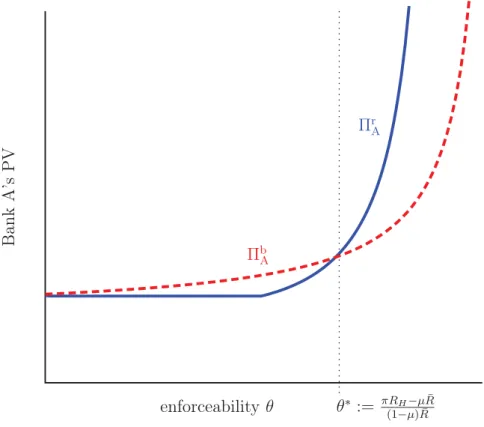
To determine when Bank A borrows via bonds and when it borrows via repos, we compare its PV in each case by comparing the expression for ΠbA in equation (2) with the expression forΠrA in equation (3). This comparison is illustrated in Figure 8. Bank A borrows via bonds wheneverΠbA ≥ΠrA or
(1−θ)eR¯
1−πθRH ≥
(1−θ)eR¯
1−θμ+ (1−μ)θR,¯ which can be written as
πRH ≥μ+ (1−μ)θR.¯
With the above equation, we have derived that increased enforceability leads Bank A to prefer repos. We now state this as Proposition 3.3.1.
Proposition 3.3.1. Bank A borrows via bonds only if
θ ≤θ∗:= πRH(1−−μ) ¯μRR¯ and borrows via repos otherwise.
Bank A’s PV from Issuing Bonds and Repos as a Function of Enforceability
Bank
A’s
P
V
enforceability
θ
θ
∗:=
πRH−μR¯ (1−μ) ¯RΠ
r AΠ
b AFigure 8: When enforceability is low (
θ
≤
θ
∗) Bank A’s PV is higher from issuing bonds; when
enforceability is high (
θ > θ
∗) Bank A’s PV is higher from issuing repos. The parameters
used to create the plot are
e
= 1
,
R
¯
= 1
.
4
, πR
H= 1
.
2
,
and
μ
= 1
/
2
.
This result is the key result behind our main finding that increasing enforceability can increase systemic risk, since more enforceability leads banks to rely more on non-resaleable instruments—on repos—and borrowing via non-non-resaleable instruments leads to credit chains.
3.4
Implications for Systemic Risk
In this subsection we analyze the effect of increasing enforceability on risk in the finan-cial system as a whole. Here, we analyze when risk on the balance sheet of a single institution can spread beyond that institution’s immediate creditors, in particular, when one bank’s default causes the default of other banks. This is our notion of systemic risk, which we call adefault cascade and restate in the next definition.
of another bank’s failure. In the model, this occurs whenever Bank B fails (which occurs only because its debtor, Bank A, has failed).
Bank B can fail only when it has debt to default on. Bank B has debt only when it borrows from Bank C to satisfy its liquidity needs. This occurs only when Bank A borrows via repos. In this case, since repos are not resaleable, Bank B cannot find liquidity by selling Bank A’s debt in the market; as a result, Bank B borrows from Bank C creating a credit chain. Hence, Bank A’s default can lead to Bank B’s default—i.e. default cascades can occur only when Bank A borrows via repos. The next result is that default cascades only happen when enforceability is high. This follows as a corollary of Proposition 3.3.1.
Corollary 3.4.1. Default cascades occur only when enforceability is high, specifically when
θ ≥ πRH(1−−μ) ¯μRR¯.
This result says that increasing enforceability increases systemic risk in the sense that increasing enforceability can cause default cascades. Specifically, with repo bor-rowing, a credit chain emerges in which Bank A borrows from Bank B and Bank B borrows from Bank C. When Bank A’s project fails it defaults on its debt to Bank B. This depletes the left-hand side of Bank B’s balance sheet, so Bank B cannot cover its debt to Bank C and Bank B also defaults.
4
Generalizations and Robustness
In this section, we extend the analysis in three ways. First, we argue that our main result that increasing enforceability increases systemic risk is broadly applicable, not only in the interbank market. Second, we consider implications for social welfare, not just systemic risk. Third, we discuss the role of additional collateral within the application to the interbank market and we argue that including it would not overturn our qualitative results.
4.1
More General Instruments
So far, we have focused on the trade-off between borrowing via bonds (commercial paper) and repos in the interbank market. In this section, we argue that our main result—that increasing enforceability leads to credit chains and, therefore, increases systemic risk—generalizes to other markets. In fact, the basic mechanism may be at work in nearly all debt markets, even absent the formal, legal differences in resaleability
and bankruptcy seniority that exist between repos and bonds. The reason is as follows. In addition to legal non-resaleabiity, fundamental economic frictions such as adverse selection can inhibit the resaleability of debt.15 A debt issuer may mitigate these frictions at a cost—for example by using securitization to combat the lemons problem— and thereby make debt resaleable or “liquid” in secondary markets. When enforceability increases, however, the relative benefits of resaleability decrease and, as a result, issuers are not willing to pay the cost to issue resaleable debt. Thus, for high enforceability, creditors, unable to sell their assets, may enter into new debt contracts to meet liquidity needs. This is the creation of a credit chain, which harbors systemic risk, just as in our baseline analysis. We formalize this argument below.
Here we abstract from legal asymmetries. Rather, we follow Kiyotaki and Moore (2005) and assume that adverse selection frictions inhibit the resale of debt in the secondary market, but that an issuer can pay an upfront cost to mitigate these fric-tions.16 Specifically, we modify the model above in the following way. When Bank A borrows from Bank B, it can pay a proportional cost cto securitize its project. That is, if Bank A securitizes its project, its returns are decreased by the proportion c to
(1−c)R, R ∈ {RL, RH}. Securitization circumvents the adverse selection friction, making Bank A’s debt resaleable. There are no bankruptcy costs. We now analyze when Bank A will choose to securitize its project, forfeiting some returns but making its debt liquid/resaleable.
Consider first the case in which Bank A doesnotsecuritize its project. Here its PV is simply the repo PV expression in equation (4):
Πno sec. A = max eR,¯ (1−θ)eR¯ 1−θμ+ (1−μ)θR¯ .
Now turn to the case in which Bank A securitizes its project. Securitization lowers the returns on its project, but eliminates the cost associated with the liquidity shock. This observation allows us to write Bank A’s PV in this no-securitization case immediately. We simply scale down the returns by a factor1−cand replace the probability1−μof a liquidity shock with zero:
Πsec. A = max e(1−c) ¯R,(11−−θθ)(1e(1−−c) ¯cR) ¯R .
15See Kiyotaki and Moore (2002) for a list of reasons that “between the date of issue and the date of delivery, an initial creditor C may not be able to resell [the debtor] D’s paper on to a third party...insofar as D gets locked in with C ex post.” (p. 62)
16See page 703 of Kiyotaki and Moore (2005) for a discussion of this adverse-selection-based microfoun-dation. Kiyotaki and Moore (2000, 2001a, 2005, 2012) make similar assumptions.
Now, Bank A securitizes only when Πsec.A ≥ Πno sec.A . This inequality leads to the main result of this section, that Bank A securitizes only below a threshold level of enforceabilityθ∗∗. Thus, credit chains emerge only for high levels of enforceability and, therefore, increasing enforceability increases systemic risk as in Subsection 3.4 above. We summarize this in Proposition 4.1.1 below.
Proposition4.1.1. Bank A securitizes its debt only if enforceabilityθis below a thresh-old, i.e. ifθ≤θ∗∗ where
θ∗∗ := 12 −1 + 1 +(1−μ)(14c−c) ¯R .
Thus, credit chains emerge and default cascades can occur for only high levels of en-forceability.
Proof. See Appendix A.3.
This result demonstrates that our finding that increasing enforceability can increase systemic risk is not specific to the interbank market. Rather, the interbank market is just an environment in which systemic risk arising from credit chains is especially important and in which formal legal asymmetries make the trade-offs between resaleable debt like commercial paper and non-resaleable debt like repos especially stark.
4.2
Welfare Consequences of Systemic Risk
Our analysis has focused on systemic risk and how to mitigate it. Whereas many regulations aim expressly to decrease systemic risk, we believe that it is important to acknowledge that decreasing systemic risk is just one component of a regulator’s objective function, and some policies that reduce systemic risk may have other costs. In this section, we argue that, in our model, decreasing systemic risk increases social welfare under reasonable assumptions.
We assume that there is a fixed social cost of each bank’s default.
Assumption4.2.1. Each bank’s default has social cost D.
This assumption leads immediately to the result that the social costs of bank default are higher when Bank A borrows via repos than when Bank A borrows via bonds.
Lemma 4.2.1. The social costs of default are higher when Bank A has borrowed via repos than when Bank A has borrowed via bonds, i.e.
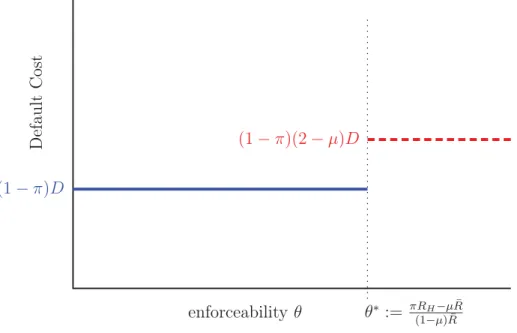
where(1−π)D is the expected social cost of bank default when Bank A borrows via bonds and (1−π)(2−μ)D is the expected social cost of bank default when Bank A borrows via repos.
Proof. See Appendix A.4.
Viewed in conjunction with Proposition 3.3.1, this proposition implies that decreasing credit market frictions can decrease welfare,17 as we state formally in the next corollary. Figure 9 depicts the social costs of default as a function of enforceability θ.
Corollary 4.2.1. Increasing credit frictions can decrease welfare. Specifically, in-creasing enforceability from belowθ∗ to above θ∗ leads to an increase in the social costs of default from(1−π)D to (1−π)(2−μ)D.
The Social Costs of Default as a Function of Enforceability
D
efault
C
o
st
enforceability
θ
θ
∗:=
πRH−μR¯ (1−μ) ¯R(1
−
π
)
D
(1
−
π)(2
−
μ)D
Figure 9:
When enforceability is low, Bank A funds itself via bonds and the social costs
of default are low; when enforceability is high, Bank A funds itself via repos and the social
costs of default are high. The parameters used to create the plot are
(1
−
π
)
D
= 100
,
and
μ
= 1
/
2
.
17Note that decreasing credit frictions also has a positive effect on welfare. It allows Bank A to scale up its project further. Thus, away from the cutoffθ∗increasing enforceability has the standard positive effect. However, we emphasize here the negative effect of increasing enforceability aroundθ∗.
4.3
The Role of Collateral
Repos and asset-backed commercial paper are collateralized by financial securities. In our model, we have assumed that Bank A’s project collateralizes its debt contracts. In this section, we briefly discuss the consequences of using other securities as collateral and argue that our main results are robust. Our result that credit chains emerge only when Bank A borrows via repos is a direct result of repos’ non-resaleability, so the inclusion of further collateral would not affect that result. What we need to argue is that increasing enforceability increases the value of repos relatively more than the value of bonds.
Suppose that Bank A borrowed from Bank B via a repo collateralized by securities. Denote the value of these securities at maturity by the random variables˜. When Bank B is hit by a liquidity shock, it rehypothecates the securities to borrow from Bank C, creating a credit chain. Note that Bank C holds the securities.
Now we argue that as long as there is some risk that the securities will not cover all debts, the credit chain leads (with some probability) totwo contracts having to be enforced. Thus, the limited enforcement frictions kick in twice with repos, giving our result that the value of repos is more sensitive than the value of bonds to increases in enforceability.
Suppose that ˜s < FB. In this case, even after Bank C has liquidated its collaterals˜, it must claim on Bank B for the remainder of its debt. This claim is subject to limited enforceability. Further, Bank B is now without collateral because it was liquidated by Bank C. Bank B now has to claim on Bank A for its repayment. This claim is subject to limited enforceability. In summary, whens < F˜ B, limited enforcement frictions kick in at each link in the credit chain.
Thus, our mechanism is robust to the inclusion of financial securities as collateral as long as their values˜is not perfectly riskless, as no asset value is.
5
Conclusions
In this paper, we have developed a model to analyze the connection between credit market frictions and systemic risk. We argued that a decrease in credit market frictions can lead to an increase in systemic risk and a decrease in welfare—even though a decrease in credit market frictions makes each market function better in isolation, it can harm the financial system as a whole. The reason is that in markets with low credit market frictions, financial institutions are likely to borrow via non-resaleable debt (e.g. repos) rather than resaleable debt (e.g. bonds) and borrowing via non-resaleable debt
leads to credit chains, which harbor systemic risk.
Our model is stylized, but we hope that it draws attention to some features of debt claims and financial markets that may deserve more attention in the policy debate. Most notably, borrowing via resalable instruments mitigates systemic risk. Therefore, a regulator aiming to combat systemic risk should encourage financial institutions to use resaleable debt to fund themselves. However, improvements in financial markets that mitigate credit frictions (e.g., improving creditor rights) may have unintended consequences. Specifically, lowering credit frictions may induce financial institutions to borrow via non-resaleable debt, increasing systemic risk. In particular, the exemption to the automatic stay for repos appears to have had unintended consequences, increasing repo borrowing, which lead to credit chains, consistent with the predictions of the model.
A
Omitted Derivations and Proofs
A.1
Proof of Lemma 3.1.2
Since the program in Lemma 3.1.1 is linear, it must have a corner solution. Thus, there are three possible solutions: the Bank A either borrows nothing, borrows the maximum so that it never defaults, or borrows the maximum so that it defaults only when it fails. The case in which it borrows the maximum so that it defaults only when it fails is analyzed in the main text and yields expected equity value given in equation (2),
Πb
Arepay ifR˜=R H =
(1−θ)eR¯
1−πθRH. If it borrows nothing its expected equity value is
ΠbAborrow nothing=eR.¯ Now, ΠbArepay ifR˜=R
H > Π b
Aborrow nothingif and only ifπRH >1, which is guaranteed by Assumption 2.5.1. Thus, it remains only to compare the case in which Bank A defaults only when it fails with the case in which Bank A never defaults.
If Bank A never defaults, it borrows as much as it can given that it does not default in the event thatR˜=RL. Thus, it borrows
IA=FA =θ(e+IA)RL and its expected equity value is
ΠA|never default=π (e+IA)RH −FA+ (1−π)(1−θ)(e+IA)RL =π(RH −θRL) + (1−π)(1−θ)RL(e+IA) =π(1−θ)RH−(1−θ)RH+RH −θRL)+ (1−π)(1−θ)RL(e+IA) =(1−θ) ¯R+πθ(RH−RL)(e+IA) = (1−θ) ¯R+πθ(RH−RL)e 1−θRL .
Assumption 2.5.3 ensures that this expression is always smaller than ΠbArepay ifR˜=R H from equation (2). Therefore, Bank A always setsFA = πθ(e+IA)RH, as in the case analyzed in the main text.
A.2
Proof of Lemma 3.2.2
Since there are no inefficiencies from default in the repo case, if Bank A borrows it is without loss of generality to assume that Bank A defaults whenever it borrows, i.e. thatF =∞ if I >0or, alternatively, since R≤ RH, thatF =θ(e+I)RH whenever I >0. Thus it suffices to considerF =θ(e+I)RH andF = 0, as stated in the lemma. Note that a more explicit computational proof could also be done in exact analogy with Lemma 3.1.2, but we omit it here.
A.3
Proof of Lemma 4.1.1
Recall that Bank A borrows via non-securitized debt if and only if Πno sec.
A ≥ Πsec.A . Recalling the expressions for Πno sec.A and Πsec.A in Subsection 4.1 from Subsection 4.1, we see that a necessary condition for this is that the
(1−θ)eR¯
1−θμ+ (1−μ)θR¯ ≥
(1−θ)e(1−c) ¯R
1−θ(1−c) ¯R or, rewriting, that
θ2+θ− c
(1−μ)(1−c) ¯R ≥0. Thus, Bank A securitizes only if
1 2 −1− 1 +(1−μ)(14c−c) ¯R ≤θ≤ 12 −1 + 1 +(1−μ)(14c−c) ¯R . Since the lower root is negative whenever it exists andθ ∈(0,1), this is equivalent to saying that Bank A securitizes only if
θ ≤θ∗∗:= 12 −1 + 1 +(1−μ)(14c −c) ¯R . The proposition follows.
A.4
Proof of Lemma 4.2.1
Bank A defaults with probability 1−π. Since no other bank ever defaults if Bank A has borrowed via bonds, the expected social costs of default are simply (1−π)D if Bank A has borrowed via bonds.
If Bank A has borrowed via repos, and only if Bank A has borrowed via repos, Bank B defaults if and only if Bank A defaults and Bank B itself has been hit by a
liquidity shock. This liquidity shock occurs with independent probability 1−μ. Thus, the expected social costs of default are
(1−π)D+ (1−π)(1−μ)D= (1−π)(2−μ)D.
References
Acemoglu, D., A. Ozdaglar, and A. Tahbaz-Salehi (2013, January). Systemic Risk and Stability in Financial Networks. NBER Working Papers 18727, National Bureau of Economic Research, Inc.
Allen, F., A. Babus, and E. Carletti (2012). Asset commonality, debt maturity and systemic risk. Journal of Financial Economics 104(3), 519–534.
Allen, F. and D. Gale (2000, February). Financial Contagion. Journal of Political Economy, University of Chicago Press 108(1), 1–33.
Antinolfi, G., F. Carapella, C. Kahn, A. Martin, D. Mills, and E. Nosal (2014). Repos, Fire Sales, and Bankruptcy Policy. Review of Economic Dynamics, (forthcoming). Bai, J., T. Philippon, and A. Savov (2012). Have financial markets become more
informative? Technical report.
Bank for International Settlements (2013). Technical report, CGFS Publications No 49.
Bliss, R. R. and G. G. Kaufman (2006, April). Derivatives and systemic risk: Netting, collateral, and closeout. Journal of Financial Stability 2(1), 55–70.
Bluhm, M., E. Faia, and J. Krahnen (2013). Endogenous banks’ network, cascades and systemic risk. Technical report.
Bolton, P. and M. Oehmke (2014). Should derivatives be privileged in bankruptcy?
Journal of Finance (forthcoming).
Bolton, P. and D. S. Scharfstein (1990, March). A theory of predation based on agency problems in financial contracting. American Economic Review 80(1), 93–106. Cabrales, A., P. Gottardi, and F. Vega-Redondo (2013, January). Risk-sharing and
contagion in networks. Economics Working Papers we1301, Universidad Carlos III, Departamento de EconomÌ?a.
Comotto, R. (2014). ICMA Eutopian repo council: a guild to best practice in the European repo market. Technical report.
Comotto, R. (2015). European repo market survey. Technical report, International Capital Market Association.
Copeland, A., A. Martin, and M. Walker (2014). Repo runs: Evidence from the tri-party repo market. The Journal of Finance 69(6), 2343–2380.
Domowitz, I., J. Glen, and A. Madhavan (2001). Liquidity, volatility and equity trading costs across countries and over time. International Finanace 4(2).
Duffie, D. and D. Skeel (2006). A dialogue on the costs and benefits of the automatic stays for derivatives and repurchase agreements. Technical report,Faculty Scholar-ship, University of Pennsylvania Law School.
Edwards, F. R. and E. R. Morrison (2005). Derivatives and the bankruptcy code: Why the special treatment? Yale Journal on Regulation 22, 91–122.
Elliott, M., B. Golub, and M. Jackson (2014). Financial networks and contagion.
American Economic Review (forthcoming).
Gale, D. and S. Kariv (2007). Financial networks. The American Economic Re-view 97(2), 99–103.
Garbade, K. (2006, May). The evolution of repo contracting conventions in the 1980s. Glode, V. and C. Opp (2013). Intermediating Adverse Selection. Technical report. Gorton, G. and A. Metrick (2010). Haircuts. Review (Nov), 507–520.
Gorton, G. and A. Metrick (2012). Securitized banking and the run on repo. Journal of Financial Economics 104(3), 425–451.
Gorton, G. and G. Pennacchi (1990, March). Financial Intermediaries and Liquidity Creation. Journal of Finance 45(1), 49–71.
Greenwood, J., J. M. Sanchez, and C. Wang (2013). Quantifying the impact of financial development on economic development. Review of Economic Dynamics 16(1), 194 – 215. Special issue: Misallocation and Productivity.
Grossman, S. J. and O. D. Hart (1986, August). The costs and benefits of ownership: A theory of vertical and lateral integration. Journal of Political Economy 94(4), 691–719.
Gu, C., F. Mattesini, C. Monnet, and R. Wright (2013). Banking: A New Monetarist Approach. Review of Economic Studies 80(2), 636–662.