A Pipeline Approach to Supervised Error Correction
for the QALB-2014 Shared Task
Nadi Tomeh† Nizar Habash‡ Ramy Eskander∗ Joseph Le Roux†
{nadi.tomeh,leroux}@lipn.univ-paris13.fr†
[email protected]‡, [email protected]∗
†Universit´e Paris 13, Sorbonne Paris Cit´e, LIPN, Villetaneuse, France
‡Computer Science Department, New York University Abu Dhabi
∗Center for Computational Learning Systems, Columbia University
Abstract
This paper describes our submission to the ANLP-2014 shared task on auto-matic Arabic error correction. We present a pipeline approach integrating an er-ror detection model, a combination of character- and word-level translation mod-els, a reranking model and a punctuation insertion model. We achieve an F1 score
of 62.8% on the development set of the QALB corpus, and 58.6% on the official test set.
1 Introduction
Devising algorithms for automatic error correction generated considerable interest in the community since the early 1960s (Kukich, 1992) for at least two reasons. First, typical NLP tools lack in ro-bustness against errors in their input. This sen-sitivity jeopardizes their usefulness especially for unedited text, which is prevalent on the web. Sec-ond, automated spell and grammar checkers facil-itate text editing and can be of great help to non-native speakers of a language. Several resources and shared tasks appeared recently, including the HOO task (Dale and Kilgarriff, 2010) and the CoNLL task on grammatical error correction (Ng et al., 2013b). In this paper we describe our partic-ipation to the first shared task on automatic error correction for Arabic (Mohit et al., 2014).
While non-word errors are relatively easy to handle, the task is more challenging for gram-matical and semantic errors. Detecting and cor-recting such errors require context-sensitive ap-proaches in order to capture the dependencies be-tween the words of a text at various lexical and se-mantic levels. All the more so for Arabic which
brings dependence down to the morphological level (Habash, 2010).
A particularity interesting approach to error cor-rection relies on statistical machine translation (SMT) (Brockett et al., 2006), due to its context-sensitivity and data-driven aspect. Therefore, the pipeline system which we describe in Section 2 has as its core a phrase-based SMT component (PBSMT) (Section 2.3). Nevertheless, several fac-tors may hinder the success of this approach, such as data sparsity, discrepancies between transla-tion and error correctransla-tion tasks, and the difficulty of incorporating context-sensitive features into the SMT decoder.
We address all these issues in our system which achieves a better correction quality than a simple word-level PBSMT baseline on the QALB corpus (Zaghouani et al., 2014) as we show in our exper-iments in Section 3.
2 Pipeline Approach to Error Correction
The PBSMT system accounts for context by learn-ing, from a parallel corpus of annotated errors, mappings from erroneous multi-word segments of text to their corrections, and using a language model to help select the suitable corrections in context when multiple alternatives are present. Furthermore, since the SMT approach is data-driven, it is possible to address multiple types of errors at once, as long as examples of them appear in the training corpus. These errors may include non-word errors, wrong lexical choices and gram-matical errors, and can also handle normalization issues (Yvon, 2010).
One major issue is data sparsity, since large amount of labeled training data is necessary to provide reliable statistics of all error types. We
dress this issue by backing-off the word-level PB-SMT model with a character-level correction com-ponent, for which richer statistics can be obtained. Another issue may stem from the inherent dif-ference in nature between error correction and translation. Unlike translation, the input and out-put vocabularies in the correction task overlap sig-nificantly, and the majority of input words are typi-cally correct and are copied unmodified to the out-put. The SMT system should handle correct words by selecting their identities from all possible op-tions, which may fail resulting in over-correction. To help the SMT decoder decide, we augment our pipeline with a problem zone detection compo-nent, which supplies prior information on which input words need to be corrected.
The final issue concerns the difficulty of incor-porating features that require context across phrase boundaries into the SMT decoder. A straightfor-ward alternative is to use such features to rerank the hypotheses in the SMT n-best hypotheses lists. Since punctuation is particularity noisy in Ara-bic data, we add a specialized punctuation inser-tion component to our pipeline, depicted in Figure 1.
2.1 Error Detection
We formalize the error detection problem as a sequence labeling problem (Habash and Roth, 2011). Errors are classified into substitution, in-sertion and deletion errors. Substitutions involve an incorrect word form that should be replaced by another correct form. Insertions are words that are incorrectly added into the text and should be deleted. Deletions are simply missing words that should be added.
We group all error classes into a simple binary problem tag: a word from the input text is tagged as “PROB” if it is the result of an insertion or a substitution of a word. Deleted words, which cannot be tagged themselves, cause their adjacent words to be marked as PROB instead. In this way, the subsequent components in the pipeline can be alerted to the possibility of a missing word via its surroundings. Any words not marked as PROB are given an “OK” tag.
Gold tags, necessary for training, can be gener-ated by comparing the text to its correction using some sequence alignment technique, for which we use SCLITE (Fiscus, 1998).
For this task, we use Yamcha (Kudo and
Mat-sumoto, 2003) to train an SVM classifier using morphological and lexical features. We employ a quadratic polynomial kernel. The static feature window context size is set to +/- 2 words; the pre-vious two (dynamic) predicted tags are also used as features.
The feature set includes the surface forms and their normalization after “Alef”, “Ya” and digit normalization, the POS tags and the lemmas of the words. These morphological features are obtained using MADA 3.0 (Habash et al., 2009).1 We also
use a set of word, POS and lemma 3-gram lan-guage models scores as features. These LMs are built using SRILM (Stolcke, 2002).
The error detection component is integrated into the pipeline by concatenating the predicted tags with the words of the input text. The SMT model uses this additional information to learn distinct mappings conditional on the predicted correctness of words.
2.2 Character-level Back-off Correction
Each word that is labeled as error (PROB) in the output of the error detection component is mapped to multiple possible corrections using a weighted finite-state transducer similar to the transducers used in speech recognition (Mohri et al., 2002). The WFST, for which we used OpenFST (Al-lauzen et al., 2007), operates on the character level, and the character mapping is many-to-many (similar to the phrase-based SMT framework).
The score of each proposed correction is a com-bination of the scores of character mappings used to build it. The list is filtered using WFST scores and an additional character-level LM score. The result is a list of error-tagged words and their cor-rection suggestions, which constitutes a small on-the-fly phrase table used to back-off primary PB-SMT table.
During training, the mapping dictionary is learned from the training after aligning it at the character level using SCLITE. Mapping weights are computed as their normalized frequencies in the aligned training corpus.
2.3 Word-level PBSMT Correction
Character-level Correction Error
Detection
Word-level
PBSMT Correction Reranking N-best
Punctuation Insertion
,
.
Input Error-tagged textN-best hypotheses
Reranked best hypothesis Output Back-off
Phrase tables Primary
Figure 1: Input text is run through the error detection component which labels the problematic words. The labeled text is then fed to the character-level correction components which constructs a back-off phrase table. The PBSMT component then uses two phrase tables to generate n-best correction hy-potheses. The reranking component selects the best hypothesis, and pass it to the punctuation insertion component in order to produce the final output.
it using Moses, a well-known PBSMT tool (Koehn et al., 2007). The decoder constructs a correction hypothesis by first segmenting the input text into phrases, and mapping each phrase into its best cor-rection using a combination of scores including a context-sensitive LM score.
Unlike translation, error correction is mainly monotonic, therefore we set disallow reordering by setting the distortion limit in Moses to 0.2
When no mapping can be found for a given phrase in the primary phrase table, the decoder looks it up in the back-off model. The decoder searches the space of all possible correction hy-potheses, resulting from alternative segmentations and mappings, and returns the list of n-best scor-ing hypotheses.
2.4 N-best List Reranking
In this step, we combine LM information with lin-guistically and semantically motivated features us-ing learnus-ing to rank methods (Tomeh et al., 2013). Discriminative reranking (Liu, 2009) allows each hypothesis to be represented as an arbitrary set of features without the need to explicitly model their interactions. Therefore, the system benefits from global and potentially complex features which are not available to the baseline decoder.
Each hypothesis in an n-best list is represented by ad-dimensional feature vector. Word error rate (WER) is computed for each hypotheses by com-paring it to the reference correction. The resulting 2Only 0.14% of edits in the QALB corpus are actually reordering.
scored n-best list is used for supervised training of a reranking model. We employ a pairwise ap-proach to ranking which takes pairs of hypotheses as instances in learning, and formalizes the rank-ing problem as pairwise classification.
For this task we use RankSVM (Joachims, 2002) which is a method based on Support Vec-tor Machines (SVMs). We use only linear kernels to keep complexity low. We use a rich set of fea-tures including LM scores on surface forms, POS tags and lemmas. We also use a feature based on a global model of the semantic coherence of the hy-potheses (Tomeh et al., 2013). The new top ranked hypothesis is the output of this step which is then fed to the next component.
2.5 Punctuation Insertion
We developed a model that predicts the occurrence of periods and commas in a given Arabic text. The core model is a decision tree classifier trained on the QALB parallel training data using WEKA (Hall et al., 2009). For each space between two words, the classifier decides whether or not to in-sert a punctuation mark, using a window size of three words surrounding the underlying space.
The model uses the following features:
• A class punctuation feature, that is whether to insert a period, a comma or none at the cur-rent space location;
• The part-of-speech of the previous word; • The existence of a conjunctive or connective
Precision−Recall Curve
Recall
Precision
0.0 0.2 0.4 0.6 0.8 1.0
0.2
0.4
0.6
0.8
1.0
−8.33
−5.02
−1.7
1.61
4.93
AUC= 0.715
[image:4.595.76.290.74.272.2]PRBE= 0.483, Cutoff= −0.349 Prec@rec(0.800)= 0.345, Cutoff= −1.045
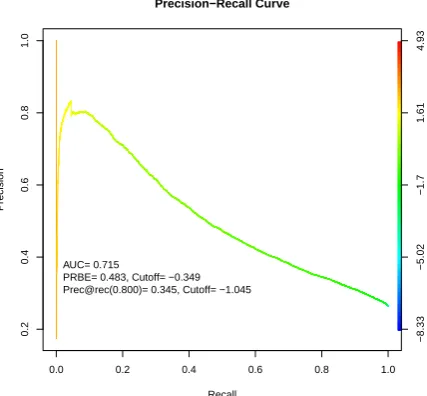
Figure 2: Evaluation of the error detection com-ponent. AUC: Area Under the Curve, PRBE: precision-recall break-even point. Classifier thresholds are displayed on the right vertical axis.
or “fa” proclitic that is either a conjunction, a sub-conjunction or a connective particle.
We obtain POS and proclitic information using MADAMIRA (Pasha et al., 2014). The output of this component is the final output of the system.
3 Experiments
All the models we use in our pipeline are trained in a supervised way using the training part of the QALB corpus (Zaghouani et al., 2014), while we reserve the development part of the corpus for test-ing.
3.1 Error detection
We evaluate the error detection binary classifier in terms of standard classification measures as shown in Figure 2. Each point on the curve is computed by selecting a threshold on the classifier score.
The threshold we use correspond to recall equal to 80%, at which the precision is very low which leaves much room for improvement in the perfor-mance of the error detection component.
3.2 Character-level correction
We evaluate the character-level correction model by measuring the percentage of erroneous phrases that have been mapped to their in-context refer-ence corrections. We found this percentage to be
41% on QALB dev data. We limit the size of such phrases to one in order to focus on out-of-vocabulary words.
3.3 Punctuation insertion
To evaluate the punctuation insertion indepen-dently from the pipeline, we first remove the pe-riods and commas from input text. Considering only the locations where periods and commas ex-ist, our model gives a recall of 49% and a precision of 53%, giving an F1-score of 51%.
When we apply our punctuation model in the correction pipeline, we find that it is always better to keep the already existing periods and commas in the input text instead of overwriting them by the model prediction.
While developing the model, we ran experi-ments where we train the complete list of fea-tures produced by MADAMIRA; that is part-of-speech, gender, number, person, aspect, voice, case, mood, state, proclitics and enclitics. This was done for two preceding words and two follow-ing words. However, the results were significantly outperformed by our final set-up.
3.4 The pipeline
The performance of the pipeline is evaluated in terms of precision, recall and F1 as computed by
the M2 Scorer (Dahlmeier and Ng, 2012b). The
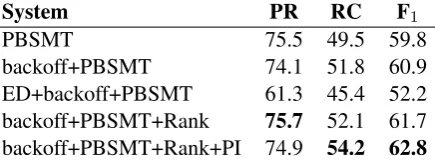
results presented in Table 1 show that a simple PBSMT baseline achieves relatively good perfor-mance compared to more sophisticated models. The character-level back-off model helps by im-proving recall at the expense of decreased preci-sion. The error detection component hurts the per-formance which could be explained by its intrin-sic bad performance. Since more investigation is needed to clarify on this point, we drop this com-ponent from our submission. Both reranking and punctuation insertion improve the performance.
Our system submission to the shared task (back-off+PBSMT+Rank+PI) resulted in an F1score of
58.6% on the official test set, with a precision of 76.9% and a recall of 47.3%.
4 Related Work
System PR RC F1
PBSMT 75.5 49.5 59.8
backoff+PBSMT 74.1 51.8 60.9
ED+backoff+PBSMT 61.3 45.4 52.2
backoff+PBSMT+Rank 75.7 52.1 61.7
[image:5.595.77.295.63.144.2]backoff+PBSMT+Rank+PI 74.9 54.2 62.8
Table 1: Pipeline precision, recall and F1 scores.
ED: error detection, PI: punctuation insertion.
the proposed systems build distinct models to ad-dress individual types of errors (see the CoNLL-2013, 2014 proceedings (Ng et al., 2013a; Ng et al., 2014), and combine them afterwords us-ing Integer Linear Programmus-ing for instance (Ro-zovskaya et al., 2013). This approach is relatively time-consuming when the number of error types increases.
Interest in models that target all errors at once has increased, using either multi-class classifiers (Farra et al., 2014; Jia et al., 2013), of-the-shelf SMT techniques (Brockett et al., 2006; Mizu-moto et al., 2011; Yuan and Felice, 2013; Buys and van der Merwe, 2013; Buys and van der Merwe, 2013), or building specialized decoders (Dahlmeier and Ng, 2012a).
Our system addresses the weaknesses of the SMT approach using additional components in a pipeline architecture. Similar work on word-level and character-level model combination has been done in the context of translation between closely related languages (Nakov and Tiedemann, 2012). A character-level correction model has also been considered to reduce the out-of-vocabulary rate in translation systems (Habash, 2008).
5 Conclusion and Future Work
We described a pipeline approach based on phrase-based SMT with n-best list reranking. We showed that backing-off word-level model with a character-level model improves the performance by ameliorating the recall of the system.
The main focus of our future work will be on better integration of the error detection model, and on exploring alternative methods for combining the character and the word models.
Acknowledgments
This material is partially based on research funded by grant NPRP-4-1058-1-168 from the Qatar Na-tional Research Fund (a member of the Qatar
Foundation). The statements made herein are solely the responsibility of the authors.
Nizar Habash performed most of his contri-bution to this paper while he was at the Center for Computational Learning Systems at Columbia University.
References
Cyril Allauzen, Michael Riley, Johan Schalkwyk, Wo-jciech Skut, and Mehryar Mohri. 2007. Openfst: A general and efficient weighted finite-state transducer library. InCIAA, pages 11–23.
Gabor Berend, Veronika Vincze, Sina Zarrieß, and Rich´ard Farkas. 2013. Lfg-based features for noun number and article grammatical errors. In Proceed-ings of the Seventeenth Conference on Computa-tional Natural Language Learning: Shared Task, pages 62–67, Sofia, Bulgaria, August. Association for Computational Linguistics.
Chris Brockett, William B. Dolan, and Michael Ga-mon. 2006. Correcting esl errors using phrasal smt techniques. In Proceedings of the 21st Inter-national Conference on Computational Linguistics and the 44th Annual Meeting of the Association for Computational Linguistics, ACL-44, pages 249– 256, Stroudsburg, PA, USA. Association for Com-putational Linguistics.
Jan Buys and Brink van der Merwe. 2013. A tree transducer model for grammatical error correction. In Proceedings of the Seventeenth Conference on Computational Natural Language Learning: Shared Task, pages 43–51, Sofia, Bulgaria, August. Associ-ation for ComputAssoci-ational Linguistics.
Daniel Dahlmeier and Hwee Tou Ng. 2012a. A beam-search decoder for grammatical error correction. In
EMNLP-CoNLL, pages 568–578.
Daniel Dahlmeier and Hwee Tou Ng. 2012b. Better evaluation for grammatical error correction. In HLT-NAACL, pages 568–572.
Robert Dale and Adam Kilgarriff. 2010. Helping our own: Text massaging for computational linguistics as a new shared task. InINLG.
Noura Farra, Nadi Tomeh, Alla Rozovskaya, and Nizar Habash. 2014. Generalized character-level spelling error correction. InACL (2), pages 161–167.
Jon Fiscus. 1998. Speech Recognition Scor-ing Toolkit (SCTK). National Institute of Standard Technology (NIST). http://www.itl.nist.
gov/iad/mig/tools/.
the 49th Annual Meeting of the Association for Com-putational Linguistics: Human Language Technolo-gies - Volume 1, HLT ’11, pages 875–884, Strouds-burg, PA, USA. Association for Computational Lin-guistics.
Nizar Habash, Owen Rambow, and Ryan Roth. 2009. MADA+TOKAN: A toolkit for Arabic tokenization, diacritization, morphological disambiguation, POS tagging, stemming and lemmatization. In Khalid Choukri and Bente Maegaard, editors,Proceedings of the Second International Conference on Arabic Language Resources and Tools. The MEDAR Con-sortium, April.
Nizar Habash. 2008. Four Techniques for Online Handling of Out-of-Vocabulary Words in Arabic-English Statistical Machine Translation. In Pro-ceedings of ACL-08: HLT, Short Papers, pages 57– 60, Columbus, Ohio.
Nizar Habash. 2010. Introduction to Arabic Natural Language Processing. Morgan & Claypool Publish-ers.
Mark Hall, Eibe Frank, Geoffrey Holmes, Bernhard Pfahringer, Peter Reutemann, and Ian H. Witten. 2009. The weka data mining software: An update.
SIGKDD Explor. Newsl., 11(1):10–18, November. Zhongye Jia, Peilu Wang, and Hai Zhao. 2013.
Gram-matical error correction as multiclass classification with single model. In Proceedings of the Seven-teenth Conference on Computational Natural Lan-guage Learning: Shared Task, pages 74–81, Sofia, Bulgaria, August. Association for Computational Linguistics.
Thorsten Joachims. 2002. Optimizing search en-gines using clickthrough data. In Proceedings of the eighth ACM SIGKDD international conference on Knowledge discovery and data mining, KDD ’02, pages 133–142.
Philipp Koehn, Franz Josef Och, and Daniel Marcu. 2003. Statistical Phrase-based Translation. In Pro-ceedings of the Human Language Technology and North American Association for Computational Lin-guistics Conference (HLT/NAACL), pages 127–133, Edmonton, Canada.
Philipp Koehn, Hieu Hoang, Alexandra Birch, Chris Callison-Burch, Marcello Federico, Nicola Bertoldi, Brooke Cowan, Wade Shen, Christine Moran, Richard Zens, Chris Dyer, Ondˇrej Bojar, Alexandra Constantin, and Evan Herbst. 2007. Moses: Open source toolkit for statistical machine translation. In
Proceedings of the 45th Annual Meeting of the ACL on Interactive Poster and Demonstration Sessions, ACL ’07, pages 177–180, Stroudsburg, PA, USA. Association for Computational Linguistics.
Karen Kukich. 1992. Techniques for automatically correcting words in text. ACM Comput. Surv., 24(4):377–439, December.
Tie-Yan Liu. 2009. Learning to Rank for Informa-tion Retrieval. Now Publishers Inc., Hanover, MA, USA.
Tomoya Mizumoto, Mamoru Komachi, Masaaki Na-gata, and Yuji Matsumoto. 2011. Mining revision log of language learning sns for automated japanese error correction of second language learners. In IJC-NLP, pages 147–155.
Behrang Mohit, Alla Rozovskaya, Nizar Habash, Wa-jdi Zaghouani, and Ossama Obeid. 2014. The First QALB Shared Task on Automatic Text Correction for Arabic. InProceedings of EMNLP Workshop on Arabic Natural Language Processing, Doha, Qatar, October.
Mehryar Mohri, Fernando Pereira, and Michael Ri-ley. 2002. Weighted finite-state transducers in speech recognition. Computer Speech & Language, 16(1):69–88.
Preslav Nakov and J¨org Tiedemann. 2012. Combin-ing word-level and character-level models for ma-chine translation between closely-related languages. InACL (2), pages 301–305.
Hwee Tou Ng, Joel Tetreault, Siew Mei Wu, Yuanbin Wu, and Christian Hadiwinoto, editors. 2013a. Pro-ceedings of the Seventeenth Conference on Compu-tational Natural Language Learning: Shared Task. Association for Computational Linguistics, Sofia, Bulgaria, August.
Hwee Tou Ng, Siew Mei Wu, Yuanbin Wu, Christian Hadiwinoto, and Joel Tetreault. 2013b. The conll-2013 shared task on grammatical error correction. In Proceedings of the Seventeenth Conference on Computational Natural Language Learning: Shared Task, pages 1–12, Sofia, Bulgaria, August. Associa-tion for ComputaAssocia-tional Linguistics.
Hwee Tou Ng, Siew Mei Wu, Ted Briscoe, Christian Hadiwinoto, Raymond Hendy Susanto, and Christo-pher Bryant, editors. 2014. Proceedings of the Eighteenth Conference on Computational Natural Language Learning: Shared Task. Association for Computational Linguistics, Baltimore, Maryland, June.
Arfath Pasha, Mohamed Al-Badrashiny, Mona T. Diab, Ahmed El Kholy, Ramy Eskander, Nizar Habash, Manoj Pooleery, Owen Rambow, and Ryan Roth. 2014. Madamira: A fast, comprehensive tool for morphological analysis and disambiguation of ara-bic. InLREC, pages 1094–1101.
Alla Rozovskaya, Kai-Wei Chang, Mark Sammons, and Dan Roth. 2013. The university of illinois sys-tem in the conll-2013 shared task. InProceedings of the Seventeenth Conference on Computational Natu-ral Language Learning: Shared Task, pages 13–19, Sofia, Bulgaria, August. Association for Computa-tional Linguistics.
Grigori Sidorov, Anubhav Gupta, Martin Tozer, Do-lors Catala, Angels Catena, and Sandrine Fuentes. 2013. Rule-based system for automatic grammar correction using syntactic n-grams for english lan-guage learning (l2). In Proceedings of the Seven-teenth Conference on Computational Natural Lan-guage Learning: Shared Task, pages 96–101, Sofia, Bulgaria, August. Association for Computational Linguistics.
Andreas Stolcke. 2002. SRILM - an Extensible Lan-guage Modeling Toolkit. InProceedings of the In-ternational Conference on Spoken Language Pro-cessing (ICSLP), volume 2, pages 901–904, Denver, CO.
Nadi Tomeh, Nizar Habash, Ryan Roth, Noura Farra, Pradeep Dasigi, and Mona Diab. 2013. Reranking with linguistic and semantic features for arabic op-tical character recognition. In Proceedings of the 51st Annual Meeting of the Association for Compu-tational Linguistics (Volume 2: Short Papers), pages 549–555, Sofia, Bulgaria, August. Association for Computational Linguistics.
Bong-Jun Yi, Ho-Chang Lee, and Hae-Chang Rim. 2013. Kunlp grammatical error correction system for conll-2013 shared task. In Proceedings of the Seventeenth Conference on Computational Natural Language Learning: Shared Task, pages 123–127, Sofia, Bulgaria, August. Association for Computa-tional Linguistics.
Zheng Yuan and Mariano Felice. 2013. Constrained grammatical error correction using statistical ma-chine translation. InProceedings of the Seventeenth Conference on Computational Natural Language Learning: Shared Task, pages 52–61, Sofia, Bul-garia, August. Association for Computational Lin-guistics.
Franc¸ois Yvon. 2010. Rewriting the orthography of sms messages. Natural Language Engineering, 16:133–159, 3.