Synthetic Peptides, Peptide Pools and Peptide Arrays for the Analysis of B- and T-Cell Responses
Holger Wenschuh, PhD
JPT Peptide Technologies, Berlin
The last years have shown that the focus of pharmaceutical drug discovery efforts shifted towards biologics and knowledge based approaches to develop vaccines for a variety of infectious diseases and cancer. In addition, more and more peptide based drugs reaching late stage clinical trials or are already approved by the FDA. Finally, content driven peptide based tools such as peptide arrays or intelligent peptide libraries and pools tremendously changed the efficiency of research activities in many fields of immunology and signal transduction.
These changes noticeable increased the demand for synthetic research peptides as well as GMP peptides. One of the most intense areas of research using peptides is related to the assessment of cellular immune response, the testing of vaccine efficacy and the identification of novel B- and T-cell epitopes.
Depending on whether B- or T-cell responses are targeted and which assay/screening format is being used peptides need to be presented in different formats and specifications. Accordingly, when humoral responses are studied by using antibody preparations or patient samples such as serum, synovial fluid or whole blood peptides can ideally be displayed in a matrix bound format. Although, different formats such as peptide-loaded beads, microplates, pins and others have been used flat surfaces like membranes and chips are especially well suited to study protein-protein interactions on the basis of binding events. Due to the ability to accommodate extremely large numbers of peptides, the low amounts of antibody or serum samples needed to run the binding assay, and the applicability of robust and inexpensive assay formats peptide microarrays became a routine tool for B-cell epitope mapping and elucidation of antibody signatures using samples of complex patient populations. At JPT two types of peptide arrays will be produced and applied for studying antibody signatures of biological fluids. Besides the generation of peptide arrays with peptides being covalently linked to cellulose membranes (macroarrays) peptide microarrays on glass slides (chips) are offered (Fig. 1 & Table 1).
Fig. 1. Profiling of B-cell responses using JPT’s peptide array platform.
Spatially addressed peptide synthesis
B-cell epitope mapping directly on membrane
1. Dry-state cleavage 2. Punch out
Antibody
Antibody signature profiling using patient samples
Peptides in microplates Immobilization onto chips patient serum Anti-Ig-Ab Fluo-labelled
=
antigenic peptide=
fluorophore Membrane supportfor peptide synthesis Spatially addressed
peptide synthesis
B-cell epitope mapping directly on membrane
1. Dry-state cleavage 2. Punch out
Antibody
Antibody signature profiling using patient samples
Peptides in microplates Immobilization onto chips patient serum Anti-Ig-Ab Fluo-labelled
=
antigenic peptide=
fluorophore Membrane supportTable 1. JPT’s peptide array formats for study B-cell responses.
All peptides are chemically synthesized in a high-throughput manner directly on membrane surfaces. The resulting peptides which are covalently connected via their C-terminal end can be directly used for solid phase screening assays [1] or cleaved from the membranes and re-immobilized to the surfaces of glass slides [2]. The advantages of the latter approach are: 1.up to 1000 microarrays can be generated with the amounts of peptide isolated from the membrane; 2. amounts of antibody or serum needed to incubate the chip is extremely low; 3. peptides on chips are purified due to the use of a built-in high throughput purification step, and 4. peptides can be analyzed using high-throughput LC-MS analyses before being admitted to the chip surface. The technology allows the generation of chips carrying up to 100 000 peptides thus allowing to display peptide scans through antigen groups or even entire proteomes of relevant pathogens to elucidate antibody signatures of complex patient cohorts.
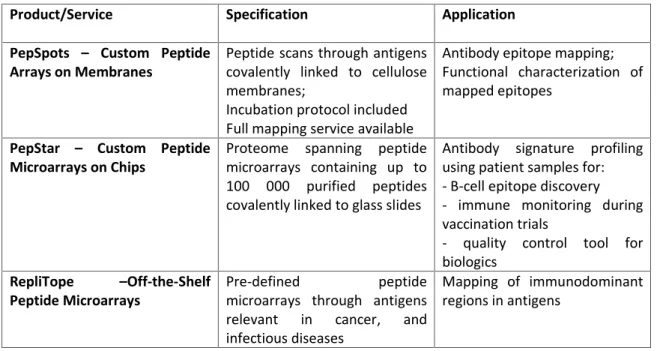
Table 2. JPT’s products and services to study B-cell responses.
Product/Service Specification Application PepSpots – Custom Peptide
Arrays on Membranes Peptide scans through antigenscovalently linked to cellulose membranes;
Incubation protocol included Full mapping service available
Antibody epitope mapping; Functional characterization of mapped epitopes
PepStar – Custom Peptide
Microarrays on Chips Proteome spanning peptidemicroarrays containing up to 100 000 purified peptides covalently linked to glass slides
Antibody signature profiling using patient samples for: - B-cell epitope discovery - immune monitoring during vaccination trials
- quality control tool for biologics
RepliTope –Off-the-Shelf
Peptide Microarrays Pre-defined microarrays through antigenspeptide relevant in cancer, and infectious diseases
Mapping of immunodominant regions in antigens
Peptide arrays on
Membranes -Spot™ Peptide arrays onChips - PepStar™ Surface Porous membrane Non-porous glass slide Peptide Loading 1 nanomol/mm2 15 femtomol/mm2 Peptide Density 10 peptides/cm2 200 – 300 peptides/cm2
Purity Crude Purified
Detection Methods Chemiluminescence
Radioactivity Chemiluminescence/Radioactivity/ Fluorescence Replica Generation 1 synthesis = 1 peptide
array 1 synthesis = 1000 copies Protein Consumption Medium Very low
Turnaround Time
(i.e. 10 000 peptides) 1 - 2 weeks (1 array) Synthesis: 2-3 weeks,Slide processing: 1 wk/250 copies Primary Applications Epitope mapping,
Functional characterization of epitopes,
Study of low affinity binding interactions,
Biomarker identification, Clinical trial assessment, Quality control of Biologics
MAP’s and Peptide Conjugates
for Antibody Generation Multiple antigenic peptides andpeptides conjugated to carrier proteins such as BSA, KLH, Thyroglobulin, Transferrin and adjuvants like Pam3Cys etc.
Antibody generation
Biotides - Custom Synthesis of Thousands of Biotinylated Peptides
50nmol/peptide; parallel assembly of up to 100 000 peptides, full LC-MS, freeze-dried, highly economical; USD <10/peptide
Biotin/Strepavidin based screening assays (ELISA, Luminex-Beads, AlphaScreen, SPA beads, Flashplates, microarrays)
Besides the study of B-cell responses using isolated antibody preparations or patient sera the analysis of T-cell responses to (synthetic) peptides has become an intense area of immunologic research. Although several attempts have been reported to use microarray based formats to analyze T-cells responses directly on chip surfaces [3] most of the currently used T-cell assay approaches rely on the use of isolated peptides or defined peptide pools [4].
The demand for peptides varying in scale and specification increased tremendously with the development of approaches such as cytokine-based flow cytometry (CFC) and ELIspot. These techniques were originally introduced as research tools but nowadays applied as high-throughput techniques for the clinical evaluation and efficacy definition of newly developed vaccines and as tools for proteome wide T-cell epitope discovery programs. Synthetic peptides are being used as single stimulants, antigen spanning peptide pools [4], defined mixes of epitopes [5] or peptide libraries. As a consequence of the changing demands from single high purity peptides as standards for structure activity relationship studies to large numbers of peptides with putatively lower specification requirements for T-cell activation studies commercial peptide suppliers invested into the expansion of their capacities to synthesize peptide libraries of crude materials or with mediocre purities connected to minimal quality control efforts.
This development was driven by the immense costs to obtain highly qualified peptides and the idea that T-cell response is induced by a highly specific interaction of a peptide presenting MHC molecule and the corresponding T-cell receptor eliminating the need for high quality peptides.
However, as more as peptides and peptide pools are being used in fields like vaccine efficacy testing and cellular immune response assessment during vaccination trials specific peptide quality assurance and quality control became an important issue.
Accordingly, it became evident that there is an immediate need to implement stringent standards for both determination of peptide specifications correlating with a specific application and definition and harmonization of quality control procedures to allow a maximum of reliability for the peptides being used in a variety of assays.
While the intimate experience and know-how of scientists using peptides for a variety of T-cell assays obviously allow a decision on the peptide’s target specification for a given application assessment of peptide providers and peptides received from a certain supplier remains a challenging task for most of the scientists working with T-cell assays.
First, in order to evaluate a proper peptide source the following key questions should be addressed before a specific provider is selected – especially in cases were hundreds of peptides need to be ordered for accompanying clinical trial work:
Does your peptide provider synthesize the peptides in-house or will the peptides or parts of the production process outcontracted to third party?
How many employees work at the providers company. How many of them have a degree in chemistry/biochemistry?
For how many years does the company provide peptide synthesis services?
How are the instrumental capabilities of your provider (peptide synthesizers, analytical and preparative HPLC’s, LC-MS, MALDI-MS, amino acid analyzer, lyophilizer, capillary electrophoresis etc.)?
Does the company have a Quality Management System in place? Was it audited by an independent agency? When was it audited first and last?
Will all peptides be synthesized and analyzed using the same standard procedures? What are the procedures? Are the details of the QC procedures for HPLC (column dimension, filling material, gradient, wavelength, eluent, flow etc.) and MS (ionization mode, detection mode, stand alone MS or LC-MS) accessible?
How is identity and quality of peptides being measured and documented?
Is there a standard handling procedure for peptides which are difficult to synthesize? How is cross-contamination of individual peptides by other peptides excluded? What procedures will be used to dry the peptides? How is proper drying determined? How are accurate amounts of aliquoted peptides being determined?
When peptide pools are generated: How is guaranteed that all peptides within the pool are present, have proper quality, and have equal amounts?
The answers to the above questions should enable the peptide user to differentiate between the various peptide providers on the market and to find a compromise between the need for appropriate quality standards and affordable pricing.
In addition to finding a reliable partner for the peptide services there is a legitimated uncertainty on whether a given peptide specification inhibits or promotes the chance to obtaining false positive results correlating with antigen specific T-cell responses.
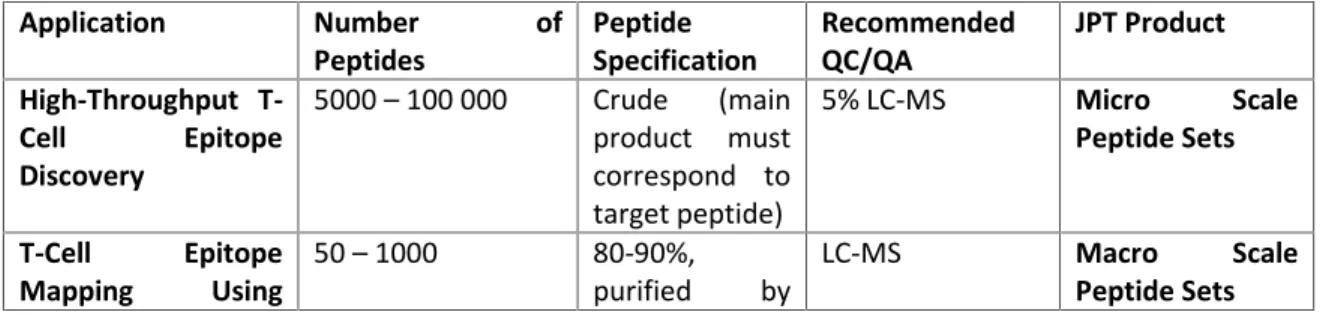
Experiences at JPT show that there is a direct correlation between the target purity of a peptide ordered and the chance to receive false positive responses. Thus, the probability to get false positives rises with the following purity specifications: 95% < 90% <80% <70% < crude peptides. Depending on the application JPT recommends the following peptide specifications and QC measures (Table 3).
Table 3. Recommended peptide specification for a variety of T-cell assay applications.
Application Number of
Peptides PeptideSpecification RecommendedQC/QA JPT Product High-Throughput T-Cell Epitope Discovery 5000 – 100 000 Crude (main product must correspond to target peptide) 5% LC-MS Micro Scale Peptide Sets T-Cell Epitope
Qualified Antigens HPLC T-Cell Epitope
Validation 1-50 >95%, purifiedby HPLC LC-MS, CE, AAA,content determination, solubility testing Specialty Peptides Peptide Pools (Matrix Approach for Epitope Discovery) 10-20 peptides per pool 80-90%,purified by HPLC LC-MS, pooling and aliquoting validated and documented PepMixTM Peptide Pools (Monitoring of Immune Responses) 30-200 peptides
per pool >70%:research for >90%: for vaccination trials LC-MS, pooling and aliquoting validated and documented PepMixTM
Although these suggestions may help to sort out false positive interpretations and problems to reproduce data especially in clinical trials it needs to be noted that false positive signals may also arise from impurities or contaminations of much smaller percentages than 10%.
Therefore even a peptide purified to an extent of 90% or greater may carry an impurity which gives rise of false positives. Accordingly, it is highly recommended to establish biological control experiments in addition to the physicochemical QC protocols provided by the peptide provider whenever peptides or peptides pools are planned to monitor clinical trials to reduce the risk of misinterpreted T-cell responses. For T-cell epitope discovery work which usually applies peptides of lower specification (refer to Table 3) validation of positive T-cell stimulants should be performed in an independent experiment using a highly purified epitope.
The development of novel high-throughput screening assays to measure and monitor B- and T-cell responses will revolutionize the knowledge based development of new immunotherapeutic strategies against cancer and infectious diseases.
Peptides and innovative peptide tools differing in both specification and formats will not only continue to escort this process they will also accelerate the advancements of new personalized medicine approaches. Given that impact of peptides both peptide providers and users in the vaccine area should work together to define robust, safe and cost efficient protocols to avoid cost-intensive failure in developing new immunotherapies.
References
[1] H. Wenschuh, R. Volkmer-Engert, M. Schmidt, M. Schulz, J. Schneider-Mergener, and U. Reineke, Biopolymers (Peptide Science) 55, 188 (2000); U. Reineke, R. Volkmer-Engert, and J. Schneider-Mergener, Curr. Opin. Biotech. 12, 59 (2001); U. Reimer, U. Reineke, and J. Schneider-Mergener, Curr. Opin. Biotech.13, 315 (2002); R. Frank, J. Immunol. Methods267, 13 (2002); R. Frank, and J. Schneider-Mergener, in Peptide Arrays on Membrane Supports - Synthesis and Applications, edited by J. Koch, and M. Mahler (Springer Verlag, Berlin, Heidelberg, 2002), p. 1; R. Frank, Comb. Chem. High Throughput Screen.5, 429 (2002).
Jens Schneider-Mergener, Mol. Div.8291 (2004); M. Schutkowski, U. Reimer, S. Panse, L. Dong, J.M. Lizcano, D.R. Alessi, and J. Schneider-Mergener, Angewandt. Chem.116, 2725 (2004); L. Rychlewski, M. Kschischo, L. Dong, M. Schutkowski, and U. Reimer, J. Mol. Biol. 336307(2004).
[3] R.H. Meloen, W.C. Puijk, and J.W. Slootstra, J. Mol. Recognit.13, 352 (2000); S. D. Chen, Y. Soen, T. B. Stuge, P.P. Lee, J.S. Weber, P.O. Brown, and M.M. Davis, PLOS2e265 (2005); G. Deviren, K. Gupta, M.E. Paulaitis, and Schneck JP, J. Mol. Reconit. Nov 9; [Epub ahead of print] (2006).
[4] F. Kern, N. Faulhaber, C. Frömmel, E. Khatamzas, S. Prosch, C. Schonemann, I. Kretzschmar, R. Volkmer-Engert, H.D. Volk, P. Reinke, Eur. J. Immunol. 30 1676 (2000); F. Kern, T. Bunde, N. Faulhaber, F. Kiecker, E. Khatamzas, I.-M. Rudawski, A. Pruss, J.-W. Gratama, R. Volkmer-Engert, R. Ewert, P. Reinke, H.-D. Volk, and L. J. Picker, J. Inf. Disease1851709 (2002).
[5] J.R. Currier, E.G. Kuta, E. Turk, L.B. Earhart, L. Loomis-Price, S. Janetzki, G. Ferrari, D.L. Birx, J.H. Cox, J Immunol Methods260157 (2002).
Contact Information: Holger Wenschuh, PhD. Managing Director JPT Peptide Technologies GmbH Volmerstrasse 5 (UTZ) 12489 Berlin, Germany T: +49-30-6392-7880 X: +49-30-6392-5501 [email protected] www.jpt.com