The compelling call for change
is in patient outcome data
Connie E. Hill, RN, BS, CPHQ, CPUR Kathy Zaharias, RN, MBA
St. Jude Medical Center (SJMC) created an agenda for change based on the MillimanCare Guidelines® and CareWebQI®
interactive software. Support for change was driven by the implementation of the evidence-based best practice Care
Guidelines and the ability to track patient progress and outcomes in
CareWebQI.
The appropriate use of the Care Guidelines can promote efficient, quality care through delivery of the right care to the right patient at the right time by the right provider. SJMC discovered that the Care Guidelines provided a road map for improving care processes by:
Clarifying care delivery issues •
Uncovering length-of-stay inefficiencies and physician •
practice variations
Identifying focus areas for the chief medical officer (CMO) as •
physician advisor, to address physician-related circumstances and get physicians involved in supporting an interdisciplinary team concept
Creating a sense of urgency for modification of care •
management workflows Using the
• Care Guidelines during rounds to support proactive and anticipatory case management
Reviewing service expectations for ancillary departments •
Strengthening the interaction between care managers •
and physicians
Identifying gaps in documentation that impact patient •
outcome data Background
SJMC is one of the ministries in a much larger health system. St. Joseph Health System (SJHS) is an integrated healthcare delivery system providing a broad range of medical services. The system is organized into three regions—Northern California, Southern California, and West Texas/Eastern New Mexico.
In fiscal year 2007, the SJHS board approved a new strategic plan and refocused its strategic initiatives into three pillars:
Perfect Care • Sacred Encounters • Healthiest Communities •
The Care Guidelines were licensed by SJHS but not widely used by the ministries. In the summer and fall of 2007, Milliman was asked to conduct an initial data review and a care management workflow assessment at two of the SJHS ministries where the data reflected considerable opportunities for improved or enhanced care management processes. Milliman noted considerable variations in performance between the two ministries and a patient care team that was not fully integrated.
Milliman and SJHS chose St. Jude Medical Center to participate in a collaborative case study in spring 2008 to:
Promote the use of evidence-based clinical best practices and •
support the Perfect Care initiative by supporting an integrated patient care team approach
Evaluate the impact of the use of the
• Care Guidelines and
CareWebQI in the delivery of inpatient care at St. Jude Medical Center
It was Milliman’s opinion that these tools (the Care Guidelines and
CareWebQI), combined with the modified St. Jude Medical Center medical management processes, would assist in management of patients along the continuum of care, and would promote the use of evidence-based clinical best practices in the care delivered. MilliMan/SJMc collaBoration
Both organizations worked collaboratively to promote the use of evidence-based best practice guidelines and support the Perfect Care initiative by supporting an integrated patient care team approach. The Care Guidelines were endorsed by SJHS as a tool for refocusing care coordination at the bedside and for reducing insurance-denied care days.
SJMC staff members were not familiar with the Care Guidelines, although they had experience utilizing guidelines and criteria. It was determined that implementation would focus on selected diagnoses and procedures instead of implementing the entire set of Care Guidelines. Heart failure, pneumonia, hip and knee replacements, stroke, chest pain, and acute myocardial infarction (AMI) were selected because they represented high-volume admissions that were also core measures for both the Centers for Medicare and Medicaid Services (CMS) and for SJMC.
The established case study goals were to: Support the Perfect Care initiative •
Improve staff performance related to identification of potentially •
avoidable days
Decrease average length of stay (ALOS) through increased •
identification of potentially avoidable days BeSt Practice ViSion
Effective implementation of evidence-based best practice requires more than case managers’ use of the Care Guidelines. It requires top-down support and an organizational priority. That organizational priority is demonstrated through an interdisciplinary strategic plan carried out by effective leadership and management infrastructure, from the chief operating officer to the shift nursing coordinators. An integrated management team of physicians, staff nurses, case managers, social workers, and others need to work collaboratively to develop and implement the strategic approach to use evidence-based clinical best practices. The Care Guidelines and CareWebQI
are excellent tools, but the workflow assessment completed the previous year showed that the SJMC care management processes did not support the most efficient best practice care delivery. iMPleMentation
Implementation requires strategic development of processes and a strong infrastructure. An assessment of current workflows to identify any existing barriers to successful implementation prior to “going live” with the Care Guidelines and CareWebQI was necessary.
Implementation consisted of three major phases: pre-implementation, implementation week one, and post-implementation. Even though implementation of CareWebQI was scheduled for October 1, 2008, an initial tactical plan was developed with activities planned for as early as July 2008.
Pre-implementation
Pre-implementation provides a tremendous opportunity to identify and resolve obstacles that may threaten a successful implementation. The outline in Figure 1 on page 3 reflects some of the activities that took place in the months prior to the go-live date.
We identified these barriers to success during pre-implementation: There was a delay in executing pre-project work that resulted in a •
postponed implementation date.
An executive sponsor change resulted in diminished support for •
the project activities.
The physician advisor role was not defined within the new role •
of the CMO, which resulted in no clinical physician champion to support care managers, interface with attending physicians on behalf of the care managers, and promote physician cooperation and collaboration regarding evidence-based best practice care delivery.
Technology challenges resulted in additional administrative •
burdens to data-enter patient demographic information, which was due to the lack of an HL7 interface with the medical management software.
There was a varying degree of care management staff buy-in •
because of:
Experience using a different criteria set −
Utilization of two different medical management software −
programs, and incomplete documentation that would eventually impact patient outcome data
Philosophical change for care managers around proactive and −
anticipatory case management expectations and processes Competing operational priorities resulted in diminished focus on •
the project activities.
Staffing challenges resulted in diminished focus on the •
project activities.
Implementation: The First Week
The implementation date was extended to December 2008. Despite barriers identified during the pre-implementation phase, the decision was made to continue to move forward. Although implementation was delayed, the delay gave the care management staff an opportunity to “practice” utilizing the Care Guidelines and documenting into CareWebQI.
The main focus during the first week of implementation was to address the various barriers that had been identified during pre-implementation and to provide backup to answer questions, coach, and support care management (CM) staff. The care manager “super-user” and Milliman reviewed the staff’s clinical documentation throughout the week to ensure appropriate application of the Care Guidelines and compliance with the established documentation standards for CareWebQI.
Figure 1: Pre-iMPleMentation actiVitieS
task
July 2008 Finalize/execute research project agreement
Finalize implementation/coaching start date (initially planned for October 2008) Finalize project goals
Finalize diagnoses/procedures for the project (CHF, pneumonia, joint replacements, CvA, AMI, chest pain) Finalize decision regarding CareWebQI software (standalone, batch-load)
Present work plan to chief operating officer (COO) for approval/support Present work plan to chief nursing officer (CNO) for support
Present project goals and application of Care Guidelines to the perfect care initiative to perfect care committee
Identify SJMC “super-users” for an “in-house” resource for staff and system decision with the authority to initiate changes within the CareWebQI
Meet with physician leadership to outline research project goals/objectives
Develop a plan to communicate processes to physicians, identify physician champions, and gain feedback and buy-in
Conduct initial super-user training on CareWebQI; review program and modification capabilities (search default, variance categories/reasons) and discuss documentation standards
Research types of data/reports that already exist to measure potentially avoidable days, length of stay, reimbursement denials, readmissions Establish baseline benchmarks for the case study
Review Care Guidelines for designated diagnoses and procedures to identify barriers and potential standing physician order set conflicts Develop a communication plan to explain research project and the relevancy to the Perfect Care initiative
Training considerations:
- Identify staff for training (care management, nursing, physician)
- Identify training needs (content/application, reporting, system administration) - Develop training plan
- Schedule training sessions Begin care management staff training
august 2008 Determine CareWebQI customization, which for example would include variance reasons
Conduct follow-up workflow review to identify processes that do not support effective implementation of the Care Guidelines or evidence-based best practice
Develop and/or modify processes workflow to support project (admission, concurrent review, rounding, communication with the physician) Begin communication and education with nursing coordinators and hospitalists
Continue care management staff training Continue super-user training and coaching
September 2008 Continue to develop and/or modify processes and workflow to support project (admission, concurrent review, rounding, communication with the physician)
Continue communication and education with nursing coordinators and hospitalists Continue care management staff training
Begin report training for the business data analyst and super-user Evaluate training effectiveness and schedule additional sessions as needed Continue super-user training and coaching
Post-implementation
Beyond the initial week of implementation, the care manager “super-user” continued to coach the staff to ensure appropriate application of the Care Guidelines, compliance with documentation standards, and identification of potentially avoidable days. Clinical summaries from CareWebQI were printed and utilized to coach care management staff. Random audits of the documentation were conducted throughout the post-implementation process. A spreadsheet was developed to track the audit results and identify follow-up education and training needs.
Post-implementation marks the time for collecting data for reporting, conducting formalized training for new staff, and providing additional training for staff requiring extra support. Process improvement and ongoing efforts to identify and modify workflows that do not support best practice delivery of care is a continual process and an important component of post-implementation activities.
MetricS For MeaSureMent
The research project measures for discharged acute care patients were tracked for eight months. November 2008 through June 2009 was the study period. The results were compared to November 2007 through June 2008.
Key Findings
There was an increase, compared to the baseline, in admissions •
during the study period for patients who had strokes and for patients who underwent major joint replacements
Potentially avoidable days were identified in the delivery of care •
for all case study diagnoses and procedures, indicating that opportunities exist to enhance processes that support evidence-based best practice care:
Physician-related variances proved to be the top cause, while −
patient and family circumstances and hospital system delays followed close behind
The most significant opportunity to decrease potentially avoidable −
days was with patients who were admitted with chest pain Lengths of stay fell into the moderately to loosely managed •
delivery-of-care categories
Medically necessary variance days were identified and contributed •
to lengthening acute care lengths of stay
Readmissions (in aggregate) increased, thus requiring further •
investigation into the root cause, with particular attention to potential post-discharge coordination
Admissions
There was only a small increase in the number of admissions in aggregate, although there was some variation by diagnosis and procedure. There was a considerable decrease in chest pain admissions, which may have been due to the refocus of the facility on
the cardiac service line and managing patients with chest pain in an observation level of care. (See Figure 2 below.)
Admissions were also influenced by a higher volume of the senior population and by orthopedic surgeon recruitment, which increased the number of joint replacements. Although the study period did not reflect an increase in admissions, readmissions for heart failure doubled.
Figure 2: adMiSSionS
noV 07 – June 08 noV 08 – June 09
aMi 135 adMiSSionS 140 adMiSSionS
cheSt Pain 301 adMiSSionS 264 adMiSSionS heart Failure 265 adMiSSionS 265 adMiSSionS PneuMonia 239 adMiSSionS 240 adMiSSionS
Stroke 290 adMiSSionS 323 adMiSSionS
Joint
rePlaceMentS 443 adMiSSionS 464 adMiSSionS
Variances
variances occur when there is a difference between the patient’s actual clinical status on any given day and the Care Guidelines
recovery milestones. It is common for hospitals to track potentially avoidable day variances on a consistent basis, but not medically necessary variances. The most common reason why hospitals do not track medically necessary variances is because they are unavoidable. It is important to capture this variance type, however, because it represents additional hospital days attributed to clinical conditions, complications, and comorbidities that extend the lengths of stay beyond a hospital’s goal and it can be used for comparison purposes for overall variance reporting.
Potentially Avoidable Day Variances
Potentially avoidable day (PAD) variances represent situations where opportunities exist to strengthen the efficiency of processes that support evidence-based best practices.
One of the case study goals was to improve the staff’s performance related to the identification and tracking of potentially avoidable days. There was an overall increase in the staff’s ability to identify potentially avoidable days from the baseline, as illustrated in Figure 3.
Figure 3: Pad Percent change trend
noV 07 1.7% dec 07 2.4% Jan 08 1.7% FeB 08 2.0% Mar 08 1.3% aPr 08 0.9% MaY 08 2.8% June 08 2.2% noV 08 4.7% dec 08 4.5% Jan 09 5.5% FeB 09 7.1 % Mar 09 5.7% aPr 09 3.0% MaY 09 4.0% June 09 6.6%
The percent increase in the staff’s performance, as illustrated in Figure 3, occurred monthly on a consistent basis compared to the baseline. It is important to note that the table in Figure 3 reflects a consolidation of the diagnoses and procedures studied. There was variation in terms of potentially avoidable days and admissions for each studied diagnosis and procedure. For example, the most significant increase in potentially avoidable days compared to the baseline occurred with chest pain admissions from 1.5% to 19% potentially avoidable days. There was also a significant increase in potentially avoidable days with pneumonia admissions, from 1.04% to 7%, as well as a moderate increase in heart failure admissions, from 2.84% to 5.1%, and in acute myocardial infarction admissions, from 2.03% to 5.0%, compared to the benchmark data.
The potentially avoidable days that were encountered during the case study represented additional hospital days that were attributed to four main categories: physician-related circumstances, hospital system delays, patient and family circumstances, and delays of admission or transfer to alternate levels of care. SJMC developed a list of reasons for each of these four categories that provided further detail on the potentially avoidable days. The following list represents a sampling of some specific circumstances associated with hospital system delays:
Transfer to desired level of care •
Discharge planning •
Therapy or test initiation •
Nursing intervention •
Lack of weekend therapy, surgical, or diagnostic service •
Figure 4 illustrates the prevalence of the top variance categories. As evidenced by this table, opportunities exist to address physician-related, hospital system, and patient and family circumstances.
Figure 4: SourceS oF PotentiallY aVoidaBle daYS
categorieS Percentage
PhYSician-related circuMStanceS 34.2% Patient and FaMilY circuMStanceS 32.3%
hoSPital SYSteM delaY 27.7%
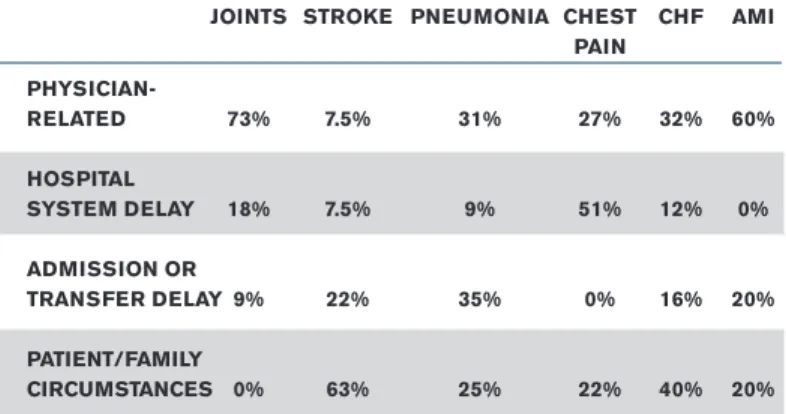
delaY oF adMiSSion or tranSFer 5.8% What does this mean? What accounted for the increase in potentially avoidable days? How can this information help when developing a strategic action plan? Before answering those questions, let’s review some additional data. The horizontal row in Figure 5 represents the top diagnoses by volume of admissions at SJMC. The vertical columns represent the variance categories.
Figure 5: SourceS oF PotentiallY aVoidaBle daYS BY diagnoSeS
JointS Stroke PneuMonia cheSt chF aMi Pain PhYSician- related 73% 7.5% 31% 27% 32% 60% hoSPital SYSteM delaY 18% 7.5% 9% 51% 12% 0% adMiSSion or tranSFer delaY 9% 22% 35% 0% 16% 20% Patient/FaMilY circuMStanceS 0% 63% 25% 22% 40% 20% Physician-related and patient/family circumstances were top variance categories overall, although the issues varied by diagnosis/ procedure. For example, physician-related circumstances was the top category for joint replacements at 73% and for acute myocardial infarctions at 60%. Physician-related discharge delays and delays related to work-ups and starting therapy were the top variance reasons for patients who had joint replacements. Physician related discharge delays, and outpatient procedures being done on an inpatient basis, were the top variance reasons for patients who were admitted for an acute myocardial infarction.
Patient and family circumstances was the top variance reason for patients who were admitted because of a stroke, accounting for 63% of the variances; it was also responsible for 40% of the variances for patients admitted for heart failure. Physician-related circumstances were also a significant variance category for heart failure patients. Lack of adequate home caregiver, financial circumstances, family disagreement with the treatment plan, and patient refusal of the treatment or procedure were the top variance reasons for patients admitted because of a stroke. Patient refusal of the treatment or procedure, family disagreement with the treatment plan, physician-related discharge delays, and alternate site not being accepted by the patient’s physician were the top variance reasons for patients admitted for heart failure.
Delay of admission or transfer was the top variance category for patients admitted with pneumonia, at 35%. Physician-related circumstances were also high for this diagnosis. Transfer delays, physician-related discharge delays, and physician delays in ordering therapy were the top variance reasons for pneumonia.
Hospital system delay was the top category for patients admitted with chest pain, at 51% of the variances. Lack of weekend services and delay in test initiation were the top variance reasons for patients admitted with chest pain.
MedicallY neceSSarY VarianceS CareWebQI addresses medically necessary variances through the hospital efficiency ratio (HER), which reflects a calculation of care efficiency with a built-in adjustment for patient acuity that is based on medically necessary variances. Unlike potentially avoidable day variances, medically necessary variances represent additional hospital days, deviating from the goal length of stay, that are attributed to clinical conditions, complications, and comorbidities.
The HER is also a good indicator of the staff’s ability to identify potentially avoidable days and accurately document the hospital stay. The HER ranged from 0.83 to 0.98 for the case study diagnoses and procedures and is reflective of what we commonly observe during the first few months of implementation as the staff learns how to apply and document against the
Care Guidelines. As you will see in the “Length of Stay” metric narrative, SJMC falls into the moderately to loosely managed delivery-of-care categories. At best, for a moderately managed system, you would expect less than 15% of inpatient days to be potentially avoidable, which correlates to a 0.84 HER. Although medically necessary variances were identified, it is apparent through documentation audits of CareWebQI ad hoc reports that there are still gaps in documentation and variance tracking, especially with consideration being given to the increases in the staff’s identification of potentially avoidable days.
length oF StaY
SJMC’s utilization falls into the moderate to loosely managed care delivery categories. Milliman utilization benchmark models classify hospital inpatient care as well managed, moderately managed, or loosely managed in a population with an average case mix and severity ratio. The table in Figure 6 describes the criteria for the classifications and illustrates the degree of inpatient healthcare management efficiency benchmarks related to potentially avoidable days, potentially avoidable admissions, and average length of stay (ALOS).
The Medicare and commercial (BCBS, managed care, private pay) models from which the table is derived reflects average non-institutionalized Medicare and commercial populations (average case mix). Utilization is sensitive to the underlying demographic distribution. For example, a population whose case mix and/or severity ratio indicates a higher burden of illness will have a higher ALOS, but the potentially avoidable days and admissions will not be influenced by severity or demographics.
The table in Figure 7 reflects SJHS’s degree of healthcare management related to the case study diagnoses and procedures. There was some improvement in the lengths of stay for some of the case study diagnoses or procedures from the baseline, although in general utilization falls into the moderately to loosely managed categories.
readMiSSionS
Readmissions increased for the case study diagnoses and procedures from 4.4% of admissions to 6.0% of admissions, thus requiring investigation:
The most significant increase occurred with patients admitted for •
chest pain and heart failure.
Readmissions for the same Medicare Severity Diagnosis Related •
Group (MS-DRG) and ICD-9 were also the most significant with patients admitted for chest pain and heart failure. More than one-fourth of the patients admitted for a stroke were readmitted with the same MS-DRG and ICD-9.
Of concern is the readmission rate for patients with heart •
failure who do not participate in the heart failure clinic
activities that support outpatient management of the condition. There was a decrease in readmissions for patients admitted for •
joint replacements, two of whom were readmitted for surgical complications. Potentially avoidable days were not identified during these hospitalizations.
(See Figure 8 on page 8.)
Figure 6: hoSPital inPatient degree oF healthcare ManageMent criteria
criteria Well ModeratelY looSelY
Managed Managed Managed % PotentiallY aVoidaBle adMiSSionS
(not dePendent on caSe Mix or SeVeritY) <5% 5%-15% >15% % PotentiallY aVoidaBle daYS
(not dePendent on caSe Mix or SeVeritY) <15% 15%-30% >30% Medicare aloS
Medical 3.93 4.85 5.37
Surgical 4.87 5.85 6.46
coMMercial
(Managed care, BcBS, PriVate PaY) aloS
Medical 3.15 4.00 4.53
Figure 7: SJMc hoSPital inPatient degree oF healthcare ManageMent
coMMercial
WM* MM** lM*** 01/08 - 06/08 01/09 - 06/09 VerSion deScriPtion oF BaSe diagnoStic
26 MS-drgS related grouP aloS aloS aloS # adMitS aloS # adMitS aloS
61-63 acute iScheMic Stroke W/
uSe oF throMBolYtic agent 4.18 5.09 5.75 4 6.00 12 4.33
64-66 intracranial heMorrhage
or cereBral inFarction 3.71 4.37 4.91 77 5.06 98 4.08
67-68 nonSPeciFic cVa & PrecereBral occluSion
W/o inFarct 2.71 3.18 3.46 2 4.50 3 3.33
69 tranSient iScheMia 1.78 2.22 2.40 32 2.41 28 2.79
193-195 SiMPle PneuMonia & PleuriSY 2.84 3.42 3.91 121 5.50 116 3.59 280-282 acute MYocardial inFarction,
diScharged aliVe 2.44 3.22 3.98 45 5.27 48 4.52
283-285 acute MYocardial
inFarction, exPired 3.94 4.07 4.20 6 4.83 8 5.38
291-293 heart Failure & Shock 3.24 4.09 4.64 98 4.93 104 5.69
311 angina PectoriS 1.26 1.57 1.78 5 1.00 6 2.67
312 SYncoPe & collaPSe 1.69 2.11 2.29 26 3.27 30 2.67
313 cheSt Pain 1.15 1.47 1.6 106 1.80 87 1.85
466-468 reViSion oF hiP or
knee rePlaceMent 2.99 3.78 4.24 9 4.56 9 2.67
469-470 MaJor Joint rePlaceMent or
reattachMent oF loWer extreMitY 2.35 3.15 3.61 176 3.45 198 3.29 Medicare
WM* MM** lM*** VerSion deScriPtion oF BaSe diagnoStic
26 MS-drgS related grouP aloS aloS aloS # adMitS aloS # adMitS aloS
61-63 acute iScheMic Stroke W/
uSe oF throMBolYtic agent 5.04 6.3 6.84 6 5.17 6 5.83
64-66 intracranial heMorrhage or
cereBral inFarction 4.20 4.85 5.32 69 5.16 75 4.89
67-68 nonSPeciFic cVa & PrecereBral
occluSion W/o inFarct 3.33 3.63 3.80 4 3.50 2 2.5
69 tranSient iScheMia 2.32 2.81 3.05 22 3.64 32 2.66
193-195 SiMPle PneuMonia & PleuriSY 4.00 4.80 5.33 93 4.98 87 5.56
280-282 acute MYocardial inFarction,
diScharged aliVe 4.38 5.22 5.81 40 5.93 40 6.48
283-285 acute MYocardial inFarction,
exPired 4.30 4.44 4.55 11 2.36 4 4.00
291-293 heart Failure & Shock 3.56 4.59 5.18 109 4.69 120 4.77
311 angina PectoriS 1.79 2.21 2.51 4 3.50 2 2
312 SYncoPe & collaPSe 2.27 2.86 3.15 28 2.43 23 3.17
313 cheSt Pain 1.57 1.93 2.12 56 2.09 38 2.29
466-468 reViSion oF hiP or
knee rePlaceMent 2.98 4.04 4.72 3**** 6.67 6 5.50
469-470 MaJor Joint rePlaceMent or
reattachMent oF loWer extreMitY 2.62 3.47 4.00 139 4.14 144 4.12 *WM = Well Managed **** one Patient had a 14-daY loS
**MM = ModeratelY Managed cellS not highlighted had < 10 adMiSSionS ***lM = looSelY Managed and are not StatiSticallY SigniFicant
concluSionS and initial action Plan The patient outcome data from CareWebQI
provided SJHS with a road map and starting point to create an agenda for change, develop an action plan, and further investigate and address the issues that were identified during the study.
The Perfect Care committee is chaired by the COO and is comprised of key members/ stakeholders for the Perfect Care initiative through responsibilities related to physician training and education, nursing care,
appropriate documentation to support accurate coding, quality, and risk management. The case study findings will provide important data
to address two important committee goals: managing the length of acute care stays, and addressing practice pattern variations. The patient outcome data from the case study will be presented to the committee members with the intent to:
Gain executive sponsorship related to the implementation of the •
evidence-based best practice Care Guidelines
Get assistance from committee members to support and promote •
the processes and activities that are required to deliver evidence-based best practices
Data reflects that SJMC is moderately to loosely managed for those diagnoses and procedures studied, with significant opportunities to improve the delivery of care. When comparing the baseline data to the post-implementation data, one should not expect significant changes in lengths of stay at this point as the study time is short and the Care Guidelines have not been fully integrated into a team workflow of all point-of-care providers, including the floor nurses, physicians, physical therapists, care managers, social workers, etc.
Chest pain average length of stay for the Medicare and •
commercial populations fell into the loosely managed category. Potentially avoidable days and readmissions were doubled from the case study baseline. A rapid improvement event (RIE) to specifically focus on the cardiac service line was initiated. Many of the patients were found to be more appropriate for an observation level of care, thus prompting development of an enhanced care management process. Weekend care management staff members are responsible for reviewing the clinical status of patients with chest pain in the emergency department in an effort to identify those who are appropriate for an observation level of care. Patient and family circumstances created discharge planning •
challenges for Medicare patients admitted with a stroke. A stroke program is currently in place. A care manager is assigned specifically to patients admitted with a stroke. The care manager and the stroke program manager make rounds daily, using the stroke guideline to address issues and facilitate safe and timely discharges.
Patient and family circumstances also created discharge •
planning challenges for patients admitted with heart failure. The identified potentially avoidable days and readmissions were significantly higher than the case study baseline. A heart failure clinic exists to support management on an outpatient basis, thus there may be opportunities to enhance the referral process to increase the referrals.
Physician-related circumstances topped the potentially avoidable •
day category for patients who were admitted for major joint replacements. There were practice pattern variations among the various orthopedic surgeons, which can be communicated to the CMO for discussion at the Utilization Management (UM) committee meeting. The goal would be to establish an evidence-based best practice standard of care, using the Care Guidelines
as the starting template/care pathway. This is also useful information for the Perfect Care committee, because one of its goals is to address practice pattern variations.
The physician advisor role was incorporated into the new CMO •
position with care management reporting to this individual. One of the CMO’s important functions is to serve as a liaison between the care managers and interface directly with the attending physician when necessary. In addition, the CMO is now armed with CareWebQI patient outcome data to present at the UM committee meetings.
The Care Guidelines “super-user’ was promoted to the care manager supervisor, and is an outstanding resource for the staff— promoting the proactive anticipatory care management processes that are required to support evidence-based best practices. Efforts are underway to continue reaching out to the physicians and nursing coordinators to expand awareness and use of the Care Guidelines. Additional initiatives include:
Random audits of reviewer documentation to ensure accurate •
identification and tracking of variances and compliance with documentation standards
Review of the current variance categories and reasons in order to •
ensure sufficient detail to identify potentially avoidable day issues
Figure 8: readMiSSionS
readMiSSionS 11/07-06/08 % oF adMitS 11/08-06/09 % oF adMitS
aggregate 73 4.4% 103 6.0% aMi 8 6.0% 12 8.6% cheSt Pain 10 3.3% 20 7.6% chF 17 6.4% 33 12.5% PneuMonia 10 4.2% 15 6.3% Stroke 17 5.9% 17 5.3% JointS 11 2.5% 6 1.3%
Monthly review of utilization and patient outcome reports with the •
director of care management to develop corrective action plans for identified inefficiencies
The application provider interface (API) with the existing medical management software was generally available fourth quarter 2010. There will be one data entry point where all care management documentation can reside. Supplemental Care Guidelines and
CareWebQI training and coaching will be provided to: Support the use of all of the inpatient guidelines •
Promote the consistent use of the guidelines during rounds to •
support proactive anticipatory care management
Improve data entry and standardized documentation to ensure •
accurate reporting SuMMarY coMMentS
The compelling call for change is in the patient outcome data. Use of the Care Guidelines and CareWebQI supports an agenda for change to improve and achieve evidence-based best practice care processes. The best practices contained in the Care Guidelines
may not be achievable immediately or perhaps at all without a well-orchestrated implementation approach. Years of experience have shown us that successful implementation of evidence-based best practices requires a comprehensive foundation. The appropriate use of the Care Guidelines can promote efficient, quality care through delivery of the right care to the right patient at the right time by the right provider.
There are several key factors common to efficient and quality-oriented hospitals that help them obtain their results:
Shared care delivery and recovery expectations among everyone 1.
on the patient care team—patient, family, physicians, caregivers, and support staff
An integrated, multidisciplinary, and proactive approach to care 2.
management
Mutual cooperation between the hospital and the physician 3.
community to facilitate care
Implementation of evidence-based best practices at the point of 4.
care as a way of doing business, rather than a transient program or initiative
Best practice hospitals implement evidence-based best practices by focusing on areas consistent with wider organizational goals, where streamlined efforts will result in the greatest benefit and where opportunities exist to change resource use and improve quality. CareWebQI provides useful patient progress information to support decisions related to potential reallocation of staff where opportunities have been identified. The infrastructure supporting care delivery and management related to the focus areas addresses organizational communication, staffing levels, care management
tools, information systems, training, documentation, clinical tools, and patient care resources.
Strong physician leadership is imperative in promoting a philosophy aligned with senior management’s strategic goals. The role of the CMO will require continued strengthening to:
Address and coach physicians regarding practice patterns •
Identify educational programs and opportunities to improve •
provider knowledge regarding best practices, resource management, and case management
Promote physician cooperation and collaboration by offering •
clinical and managerial support
Function as a clinical resource for providers and case managers •
An integrated management team of physicians, staff nurses, case managers, social workers, and others will need to work collaboratively to develop and implement the strategic approach to use evidence-based clinical best practices. A strong medical community infrastructure must support timely access to appropriate alternatives to acute care. On-site alternate care evaluation teams and care managers must work directly with hospital staff to identify opportunities and facilitate discharge and transfer.
Efficient and quality-oriented hospitals use effective tracking, measurement, analysis, and reporting systems that accurately reflect quality outcome, utilization, and cost measures through integration of financial and clinical data.
Medically necessary and potentially avoidable variations from the optimal recovery course are identified as they occur. The CareWebQI
reports are clear, simple, and include measures that are actionable. The reports are used to measure progress and identify opportunities for improvement. Constant feedback is obtained and used to optimize data collection processes and report quality.
The best part of the case study? Not only does the data provide SJMC with an agenda for change, but the Care Guidelines and
CareWebQI implementation experience can be used as a road map for the SJHS as it rolls out the products at the other ministries.
Connie Hill is a senior account manager at Milliman Care Guidelines. Connie has more than 20 years healthcare experience working as a registered nurse in various clinical areas, including inpatient and outpatient settings as well as health plans. She also has 10 years of account management experience supporting hospital systems, payors, and providers. She can be reached at [email protected]. Kathy Zaharias is a principal with Milliman’s Indianapolis office. A registered nurse, she has worked extensively with a wide variety of healthcare delivery systems and healthcare providers. She can be reached at [email protected].
The materials in this document represent the opinion of the authors and are not representative of the views of Milliman, Inc. Milliman does not certify the information, nor does it guarantee the accuracy and completeness of such information. Use of such information is voluntary and should not be relied upon unless an independent review of its accuracy and completeness has been performed. Materials may not be reproduced without the express consent of Milliman.