Middlesex University Research Repository
An open access repository of
Middlesex University research
http://eprints.mdx.ac.uk
Zia, Tehseen, Zahid, Usman and Windridge, David ORCID:
https://orcid.org/0000-0001-5507-8516 (2019) A generative adversarial strategy for modeling
relation paths in knowledge base representation learning. In: KR2ML - Knowledge
Representation and Reasoning Meets Machine Learning Workshop, NeurIPS 2019, Thirty-third
Conference on Neural Information Processing Systems, 09-14 Dec 2019, Vancouver, Canada. .
Final accepted version (with author’s formatting)
This version is available at:
http://eprints.mdx.ac.uk/28083/
Copyright:
Middlesex University Research Repository makes the University’s research available electronically.
Copyright and moral rights to this work are retained by the author and/or other copyright owners
unless otherwise stated. The work is supplied on the understanding that any use for commercial gain
is strictly forbidden. A copy may be downloaded for personal, non-commercial, research or study
without prior permission and without charge.
Works, including theses and research projects, may not be reproduced in any format or medium, or
extensive quotations taken from them, or their content changed in any way, without first obtaining
permission in writing from the copyright holder(s). They may not be sold or exploited commercially in
any format or medium without the prior written permission of the copyright holder(s).
Full bibliographic details must be given when referring to, or quoting from full items including the
author’s name, the title of the work, publication details where relevant (place, publisher, date),
pag-ination, and for theses or dissertations the awarding institution, the degree type awarded, and the
date of the award.
If you believe that any material held in the repository infringes copyright law, please contact the
Repository Team at Middlesex University via the following email address:
[email protected]
The item will be removed from the repository while any claim is being investigated.
A Generative Adversarial Strategy for Modeling
Relation Paths in Knowledge Base Representation
Learning
Zia T.
Department of Computer Science Comsats University Islamabad [email protected]
Zahid U.
Department of Computer Science Comsats University Islamabad [email protected]
Windridge D.
Middlesex University, London, UK University of Surrey, Guildford UK
Abstract
Enabling neural networks to perform multi-hop (mh) reasoning over knowledge bases (KBs) is vital for tasks such as question-answering and query expansion. Typically, recurrent neural networks (RNNs) trained with explicit objectives are used to model mh relation paths (mh-RPs). In this work, we hypothesize that explicit objectives are not the most effective strategy effective for learning mh-RNN reasoning models, proposing instead a generative adversarial network (GAN) based approach. The proposed model – mh Relation GAN (mh-RGAN) – consists of two networks; a generatorG, and discriminatorD.Gis tasked with composing a mh-RP andDwith discriminating between real and fake paths. During training,
GandD contest each other adversarially as follows: Gattempts to foolDby composing an indistinguishably invalid mh-RP given a head entity and a relation, whileDattempts to discriminate between valid and invalid reasoning chains until convergence. The resulting model is tested on benchmarks WordNet and FreeBase datasets and evaluated on the link prediction task using MRR and HIT@ 10, achieving best-in-class performance in all cases.
1
Introduction
There is an increasing interest in enabling neural networks (NNs) to accomplish the type of complex reasoning previously only performed by logical and symbolic reasoning systems. Equipped with this capability, NNs become able to reason over large-scale knowledge bases (KBs) such as WordNet [1], Freebase [2], which is essential for natural language understanding tasks such as question answering. NN-based reasoning is currently most successfully performed by modeling KBs via the embedding approach [3] in which KB elements (entities and relations) are embedded into vector spaces of appropriate dimensionality. The dimensionality of the vector space is controlled by forcing the model to generalize to novel facts of the kind generated by iterative symbolic reasoning. Nonetheless, most existing methods use only a one-hop reasoning path to learn the models [3, 4, 5] and ignore mh-RP, which is crucial for capturing complex inference patterns such as, e.g., inference of a person’s nationality given her city of birth (the city belonging to a state, and the state belonging to a country). Typically, mh-RPs are modeled via recurrent neural networks (RNNs) trained with explicit objectives to progressively utilize entities and relations in order to produce a novel entity at each step [6, 7, 8].
The models are trained with objectives that either rely on hidden negative samples [7] or perform step-wise optimization of a loss function [8]. While the former can lead to the learning of unsound models due to its reliance on unrealistic negative samples, the later, although it seeks to generate the best candidate entity at each step, may yet introduce a bad component with respect to the logical chain over the long run. For example, consider two mh-RPs(Donald Trump, child, Ivanka Trump, mother, Ivana Trump)and(Donald Trump, child, Barron Trump, mother, Melania Trump). Given
(Donald Trump, child)as input, the outputIvanka Trump is a good single step decision but a bad decision if we are reasoning generally about the spouse of Donald Trump.
In this work, we address the above mentioned issues in the training objective of learning mh relation model (mh-RM). We take inspiration from generative adversarial networks (GANs) to propose the direct training of mh-RM for producing a relation path which is indistinguishable from real paths. The proposed GAN model consists of two networks; a mh-RP generatorG, and a mh-RP discriminatorD. We enableGto compose a mh-RP andDto discriminate between real and fake paths. During training,
GandDcontest each other as follows: Gattempts to foolDby composing an indistinguishable invalid mh-RP given a head entity and a relation, andDattempts to discriminate between valid and invalid relation paths. This contention drives both to improve their learning as training progresses, until the convergence point in which generator paths are indistinguishable from true reasoning paths and the discriminator is effective at distinguishing between valid and invalid relation paths.
Related work on mh path modeling approaches and GANs is described in Section 2. The proposed method (mh-RGAN) is presented in Section 3. Experiments and results are reported in Section 4. Finally, the paper is concluded in Section 5.
2
Related Work
2.1 Multi-hop Reasoning over KBs
In this study, we focus on the modeling of mh-RP for reasoning over KBs. In this context, the majority of extant work proposes to model the relation pathp= (r1, . . . , rt)by using addition as (p=r1+· · ·+rt)or multiplication as(p=r1. . . rt)[9]: Neelakantan et al. (2015) use RNNs to
model the path aspi=RN N(pi−1, ri), wherepiis cumulative path information up to pointi[6];
Das et al. (2017) enable RNNs to invoke within-path entities while modeling the paths [7] (however, in this case, the RNN takes a fixed set of entities as input); Yin et al. (2018) equip RNNs with the capability of predicting the entity as output and use this prediction to update the path, rather than using fixed set of entities as in [8].
In the approach to be outlined, although we shall follow the broad modeling approach of [8], rather than training RNN on single-hop paths, we will train the RNN on mh-RPs by using GANs. This development restricts the likelihood of the RNN generating candidate entities that are optimal at a given instant but sub-optimal with respect to the path as a whole. It also enables the RNN to produce natural or human-like reasoning paths. Relevant to our study is the research area concerned with learning rules from KBs. However, contrary to the modeling of reasoning pathways, rule learning seeks to emulate an inference procedure. Commonly, these methods represent facts using vectors or tensors and employ RNNs, such as memory networks, to model transitivity relations between facts in order to perform inferences [10, 11]; other studies approach the learning of representations of entities and relations via a transitivity structure [12]. Neuro-symbolic computing is another relevant domain dealing with integrating and reasoning over symbolic knowledge utilizing neural networks; some notable recent efforts include [13, 14].
2.2 Generative Adversarial Networks
Primarily, GANs were conceived for producing data samples from a continuous space such as images [15]. In the original setting, the generator is used to generate an image from random noise and discriminator is employed to classify between real and generated (a.k.a. fake) images [16]. Latterly, it has been demonstrated that GANs can also produce images conditioned on specific inputs [17]. However, an undesirable drawback of the GAN approach, in its original form, is that it cannot generate discrete samples such as the entity of a relation, since discrete sampling restricts gradients from being transmitting back to the generator [18]. To address this problem, one solution is to use reinforcement learning (RL) to learn a generator with policy gradient [18]. This approach, using single-step policy gradient, is employed in [19] for generating negative samples for training KB
completion models. A similar approach is followed for graph representation learning where the generator is used to predict edges between vertices and the discriminator is employed to distinguish well-connected vertex pairs from ill-connected pairs [20].
3
The Method
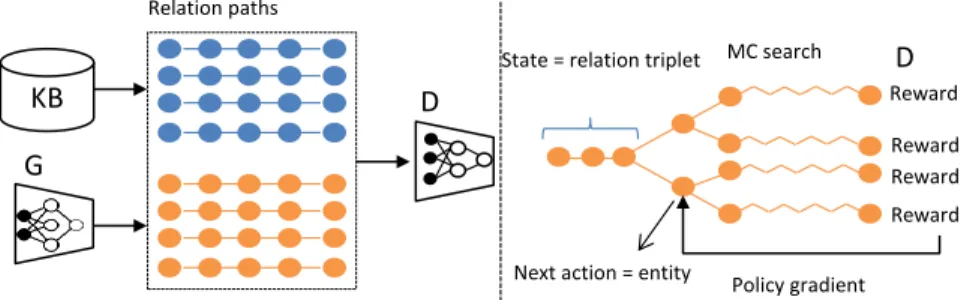
A broad outline of the proposed mh-RGAN architecture is given in Figure 1 ; given a dataset ofN
relation paths,P(h, t) ={p(1), . . . , p(N)}, connecting pairs of entitieshandt, we wish to train a generatorGto compose a mh-RPp1:L= (h1, r1, . . . , tL)of lengthL, and use a discriminatorDto
process the generated paths and provide supervision to the generator. In the typical GAN setting, the generator cannot predict discrete samples. To deal with this issue, we adopt a policy gradient based reinforcement learning (RL) method for trainingGalongsideDbased on the approach of [18].
discriminator is employed to classify between real and generated (a.k.a. fake) images [16]. Latterly, it has been demonstrated that GANs can also produce images conditioned on specific inputs [17]. However, an undesirable drawback of the GAN approach, in its original form, is that it cannot generate discrete samples such as the entity of a relation, since discrete sampling restricts gradients from transmitting back to the generator [18]. To address this problem, one solution is to use reinforcement learning (RL) to learn a generator with policy gradient [18]. This approach with a single step of policy gradient is employed in [19] for generating negative samples for training KB completion models. A similar approach is followed for graph representation learning where the generator is used to predict edges between vertices and the discriminator is employed to distinguish well-connected vertex pairs from ill-connected pairs [20].
The Method
Given a dataset of N relation paths, P(h, t) = {p(1), … , p(N)}, connecting pairs of entities h and t, we
want to train a generator G to compose a mh-RP p1:L= (h1, r1, … , tL) of length L, and use a discriminator D to process the generated paths and provide supervision to the generator. In the typical GAN setting, we cannot train generator to predict discrete samples [18]. To deal the issue, we adopt a policy gradient based reinforcement learning (RL) method for training G alongside 𝐷, as suggested in [18]. An illustration of proposed mh-RGAN is depicted in Figure 1.
To model G, we want a method that can sequentially compose a relation path. Inspiring from the efficacy of RNN in the prior methods, we use RNN to take as input a sequence of relations (r1, r2, … , rL )
and a head entity h1 and produces as output a relation path (h1, r1, … , tL). Specifically, RNN consumes entity and relation at each time step and produces an entity; relations are kept within the input space and entities are embedded in the hidden latent space. The modeling approach is depicted in Figure 2.
This model is realized by modifying the RNN’s recursive function as follows:
KB G
D
Relation paths
State = relation triplet MC search
Reward Reward Reward Reward D Policy gradient Next action = entity
Figure 1: The illustration of proposed mh-RGAN. Left: D is trained over the real and generated relation paths. Right: G is trained via policy gradient for which the final reward signal is provided by D and is passed back to the intermediate action value via Monte Carlo search.
Figure 1: Proposed mh-RGAN architecture.Left:Dis trained over the real and generated relation paths.Right:Gis trained via policy gradient for which the final reward signal is provided byDand
is passed back to the intermediate action value via Monte Carlo search.
To model G, we require a method that can sequentially compose a reasoning path. Given the demonstrable efficacy of RNNs in this domain previously alluded to, we shall employ an RNN to map the input sequence of relations(r1, r2, . . . , rL)along with a head entityh1to an output reasoning path:(h1, r1, . . . , tL). Specifically, the RNN greedily selects an entity and relation at each time step
and produces an output entity; relations are kept within the input space and entities are embedded in the hidden latent space. The broad modeling approach is depicted in Figure 2 . This model is realized by modifying the RNN’s recursive function as follows:
ˆ
vel=f(W[ˆvel−1;vrl]) (1) vel=Sof tmax(ˆvel) (2)
where vel and vrl are vector representations of entity and relation at respective positionsl. To
initialize the model, we setvˆe0 =vh.
where 𝑥𝑖∈ ℝ𝑘 is a 𝑘 −dimensional token (i.e. an entity or relation) and ⨁ is a concatenation operator
applied in building a matrix ℰ1:𝑇. The convolution is performed by applying a filter 𝜔 ∈ ℝ𝑙×k to a
window of 𝑙 tokens in order to produce a feature map 𝑣𝑖 as:
𝑣𝑖= 𝑔(𝜔 ∗ ℰ𝑖:𝑖+𝑙−1+ 𝑏)
The convolution is then followed by max-over-time pooling over feature maps as: 𝑣̂ = 𝑚𝑎𝑥{𝑣1, 𝑣2, … 𝑣𝑇−𝑙+1}
The pooling layer is connected to a fully connected (FC) layer and finally to a sigmoid unit to produce the probability that the relation path is real.
FIGURE 4:MODELING APPROACH OF PATH-KCGAN GENERATOR.
Experiments and Results
A. Datasets and Evaluation Protocol
We employ two benchmarks ‘common sense reasoning’ datasets to evaluate the proposed method in common with the baseline studies [7, 8]. Wordnet (WN18) [1] is a collection of pairs of English dictionary and thesaurus words that are related in terms of relations such as: subclass_of, type_of, part_of and has_part, etc. Freebase (FB15k) [2] consists of relation triplets from the personal ID domain and which includes relations such as: gender, nationality, profession, place of birth, location, religion, parents, children, ethnicity and spouse, etc. Both datasets are separated into training, validation and test sets. The statistics of the datasets are summarized in Table 1. As we use a generator to predict the missing link of a predicate at each time step of RNN, the performance of generator is gauged via benchmark link prediction by using the standard HIT@10 metric.
TABLE1:STATISTICS OF WN18 AND FB15K
Dataset # Relation # Entity # Train # Validate # Test WN18 18 40,943 141,442 5,000 5,000 FB15K 1,345 14,951 483,142 50,000 59,071
B. Results
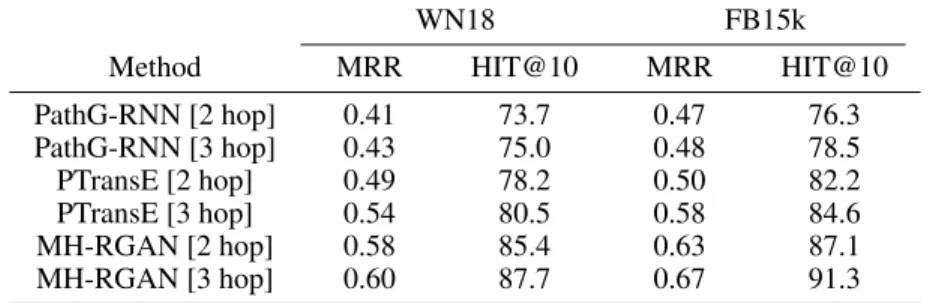
Table 5 shows link prediction performances of the baseline, existing and proposed multi-hop relation learning models. The RNNs – trained for generating relation paths – are used as baseline models and referred as PathG-RNNs. We also compare with PTransE which is a variant of TransE for integrating relation paths for knowledge representation learning. Results reveal that: (1) path-KCGAN performs
𝑒ℎ 𝑒2 𝑒𝑖 … 𝑒𝑙
𝑟2 𝑟𝑖 … 𝑟𝑙
𝑒1
𝑟1
Figure 2: Generator modeling approach (latent states in blue, entities denotedei, relations,ri)
In order to modelD, we require a method for classifying relation paths. We select a Convolution Neural Network (CNN) given the performance of CNN in text classification. To apply the CNN, we extend the single-hop path representation approach proposed in [21] in order to represent mh-RP
p1:L= (h1, r2, . . . , tL)as:
ε1:T = (h1⊕r2⊕. . .⊕tL) (3)
wherexi∈Rkis a k-dimensional token (i.e. an entity or relation) and⊕is a concatenation operator
applied in building a matrixε1:T. The convolution is performed by applying a filterω∈Rl×kto a
window ofltokens in order to produce a feature mapvias:
vi=g(ω∗εi:i+l−1+b) (4) The convolution is then followed by max-over-time pooling over feature maps as:
ˆ
v=max{v1, v2, . . . vT−l+1} (5) The pooling layer is connected to a fully connected (FC) layer and finally to a sigmoid unit to produce the probability that the relation path is real.
4
Experiments and Results
4.1 Datasets and Evaluation Protocol
We employ two benchmark ‘common sense reasoning’ datasets to evaluate the mh-RGAN in common with the baseline studies [7, 8]. Wordnet (WN18) [1] is a collection of pairs of English dictionary and thesaurus words that are linked via relations such as:subclass_of, type_of, part_of, has_part, etc. Freebase (FB15k) [2] consists of relation triplets from the personal ID domain and which includes relations such as:gender, nationality, profession, place of birth, location, religion, parents, children, ethnicity, spouse, etc. Both datasets are separated into training, validation and test sets. The statistics of the datasets are summarized in Table 1. As we use a generator to predict the missing link of a predicate at each time step of RNN, the performance of generator is gaged via benchmark link prediction by using the standard HIT@10 metric.
Table 1: Statistics of WN18 and FB15k
Dataset # Relation # Entity # Train # Validate # Test
WN18 18 40,943 141,442 5,000 5,000
FB15K 1,345 14,951 483,142 50,000 59,071
4.2 Results
Table 3 shows link prediction performances of the baseline, existing and proposed mh path learning models. The RNNs – trained to generate relation paths according to the method proposed in [8]– are used as baseline models and referred as PathG-RNNs. We also compare with PTransE [9] which is a variant of TransE for integrating relation paths for knowledge representation learning. Results reveal that: (1) mh-RGAN performs significantly better than baseline and existing models. (2) The relation paths provide very useful supplement for representation learning of KBs, which have been effectively modeled by mh-RGAN.
For example, sinceDavid CameronandTony Blairare both prime ministers of United Kingdom, they are assigned a similar embedding by single-hop representation learning methods. This may lead to confusion in single-hop methods in e.g. predicting the spouse ofCherie Blair. Contrarily, mh-RGAN learns relation paths between entities such asTony BlairandCherie Blairwhich helps it to perform more accurately. We also analyze the effect of path length by experimenting with a path-length of 2 (i.e. consisting of 2 triplets) and a path-length of 3 (i.e. consisting of 3 triplets). Results show that the performance of the model improves with path length. Since mh-RGAN is a generative model it can generate multi-hop relation paths. Examples of various generated relation paths are presented in Table 2. We initialize mh-RGAN with the entity given in the first column of the table. The following columns show the result of model prediction at each hop. We show a ranked list of predicted entities in the last column. In the first example, the model composes a hierarchical relation between entities. In the second, third and fourth examples, the model produces correlations such as hyponym and hypernym, and meronym and holonym between entities. In the fifth and sixth example, the model generates an elaboration of terms. It can be seen that each of the generated relation paths are plausible.
Table 2: Examples of relation paths generated by the path-kcgan generator on the wn18 dataset. The first column shows the entity given to the generator to initiate the generation process. The last
column shows top ranked entities produced after hop 6.
Entity Relation Entity Relation Entity Relation Generated entites
asia _has _part Syria _part _of middle
_east
_has _part ’lebanon’, ’syria’, ’turkey’, ’iran’, ’iraq’,
’himalayas’, ’nepal’, ’india’ dicot _family _hyponym magnoliid _dicot _family _hypernym dicot _family
_hyponym ’sapotaceae’, ’rosid _dicot _family’, ’asterid _dicot _family’, ’anacardiaceae’, ’magnoliid _dicot _family’, ’dilleniid _dicot _family’, ’myrtaceae’ diptera _member _meronym dipterous _insect _member _holonym diptera _member _holonym ’insecta’, ’animal_order’, ’liliales’, ’vertebrata’, ’property’, ’physical _condition’, ’tool’ amphibian _family _member _holonym vertebrata _member _meronym
Vertebrate _hyponym ’bird’, ’coleoptera’, ’blow’, ’division
_eubacteria’, ’vertebrata’, ’asterid
_dicot _genus’, ’dilleniid _dicot _genus’, ’edible _fruit’
Table 3: Link prediction empirical results on WN18 and FB15k test sets with respect to the relation path representation method variants.
WN18 FB15k
Method MRR HIT@10 MRR HIT@10
PathG-RNN [2 hop] 0.41 73.7 0.47 76.3 PathG-RNN [3 hop] 0.43 75.0 0.48 78.5 PTransE [2 hop] 0.49 78.2 0.50 82.2 PTransE [3 hop] 0.54 80.5 0.58 84.6 MH-RGAN [2 hop] 0.58 85.4 0.63 87.1 MH-RGAN [3 hop] 0.60 87.7 0.67 91.3
5
Conclusion
We have proposed a novel generative adversarial network based framework for reasoning over knowledge bases. The components of the framework consist in two networks: a generator for composing relation paths and a discriminator for classifying paths as real or fake. Experiments on standard data sets show that proposed method outperforms both the baseline and the most relevant method in the literature. In future, we intend to explore GAN-based methods for generating discrete samples as the existing policy gradient based framework requires pretraining of generator and discriminator models.
Acknowledgments
References
[1] G.A. Miller, "WordNet: a lexical database for English", Commun. ACM 38.11 (1995): 39-41.
[2] B. Kurt et al., "Freebase: a collaboratively created graph database for structuring human knowledge", Proceedings of the 2008 ACM SIGMOD international conference on Management of data, AcM, 2008. [3] Maximilian Nickel, Volker Tresp, and Hans-Peter Kriegel. 2011. A three-way model for collective learning
on multi-relational data. In Proceedings of ICML, pages 809–816.
[4] R. Socher et al., "Reasoning with neural tensor networks for knowledge base completion", Advances in neural information processing systems, 2013.
[5] A. Bordes et al., "Translating embeddings for modeling multi-relational data", Advances in neural informa-tion processing systems, 2013.
[6] Arvind Neelakantan, Benjamin Roth, and Andrew McCallum. 2015. Compositional vector space models for knowledge base completion. In Proceedings of ACL, pages 156–166.
[7] Rajarshi Das, Arvind Neelakantan, David Belanger, and Andrew McCallum. 2017. Chains of reasoning over entities, relations, and text using recurrent neural networks. In Proceedings of EACL, pages 132–141. [8] Yin, Wenpeng, Yadollah Yaghoobzadeh, and Hinrich Schütze. "Recurrent One-Hop Predictions for
Reason-ing over Knowledge Graphs." arXiv preprint arXiv:1806.04523 (2018).
[9] Lin, Yankai, Zhiyuan Liu, Huanbo Luan, Maosong Sun, Siwei Rao, and Song Liu. "Modeling relation paths for representation learning of knowledge bases." arXiv preprint arXiv:1506.00379 (2015).
[10] F. Yang, Y. Zhilin and W.C. William, "Differentiable learning of logical rules for knowledge base comple-tion", CoRR, abs/1702.08367, 2017.
[11] T. Rocktäschel and R. Sebastian, "End-to-end differentiable proving", Advances in Neural Information Processing Systems, 2017.
[12] P. Minervini et al., "Towards neural theorem proving at scale", arXiv preprint arXiv:1807.08204, 2018. [13] S. N. Tran, and S. A. G. Artur. "Deep logic networks: Inserting and extracting knowledge from deep belief
networks", IEEE T NEUR NET LEAR. vol. 29, issue.2, 2016, pp: 246-258.
[14] G. Sourek et al., "Lifted relational neural networks: Efficient learning of latent relational structures", J ARTIF INTELL RES vol. 62, 2018, pp: 69-100.
[15] I. Goodfellow et al., "Generative adversarial nets", Advances in neural information processing systems, 2014.
[16] A. Radford, M. Luke and C. Soumith, "Unsupervised representation learning with deep convolutional generative adversarial networks", arXiv preprint arXiv:1511.06434, 2015.
[17] M. Mirza, and O. Simon, "Conditional generative adversarial networks", Manuscript: https://arxiv. org/abs/1709.02023, vol. 9, 2014, pp. 24.
[18] L. Yu et al. "Seqgan: Sequence generative adversarial nets with policy gradient." Thirty-First AAAI Conference on Artificial Intelligence, 2017.
[19] L. Cai, and Y.W. William, "Kbgan: Adversarial learning for knowledge graph embeddings", arXiv preprint arXiv:1711.04071, 2017.
[20] H. Wang et al., "Graphgan: Graph representation learning with generative adversarial nets", Thirty-Second AAAI Conference on Artificial Intelligence, 2018.
[21] Nguyen, Dai Quoc, et al. "A novel embedding model for knowledge base completion based on convolutional neural network." arXiv preprint arXiv:1712.02121 (2017).