Structured Cases in CBR – Re-using and Adapting Cases for
Time-tabling Problems
E. K. Burkea, B. MacCarthyb, S. Petrovica, R. Qua
a
School of Computer Science and Information Technology, The University of Nottingham, Nottingham, NG8 1BB, U.K
b
Division of Manufacturing Engineering & Operations Management, The University of Nottingham, Nottingham, NG7 2RD, U.K
Corresponding author: Tel: 44-115-9514206; Fax: 44-115-9514254.
Abstract
In this paper, we present a case-based reasoning (CBR) approach solving educational time-tabling
problems. Following the basic idea behind CBR, the solutions of previously solved problems are
employed to aid finding the solutions for new problems. A list of feature-value pairs is insufficient to
represent all the necessary information. We show that attribute graphs can represent more information
and thus can help to retrieve re-usable cases that have similar structures to the new problems. The case
base is organised as a decision tree to store the attribute graphs of solved problems hierarchically. An
example is given to illustrate the retrieval, re-use and adaptation of structured cases. The results from
our experiments show the effectiveness of the retrieval and adaptation in the proposed method.
Keywords: case-based reasoning; time-tabling problems; attribute graphs
1 Introduction
CBR [1] solves problems by retrieving the most similar previous cases in a case base (source
cases) and by re-using the knowledge and experiences from previous good quality solutions.
If necessary, the retrieved solutions are adapted by using domain knowledge so that they are applicable for the new problem. The case base is then updated by the new learned cases.
1.1 Traditional Case Representation in CBR
most similar case(s) retrieved from the case base are adapted for the new problem. In some domains, this representation and retrieval method is sufficient to find similar cases. However, some complex problems (such as time-tabling problems) consist of events that are heavily inter-connected with each other. A list of feature-value pairs by itself is not able to describe important information that could make differences in finding high quality solutions to this kind of problem. Thus the similarity measure cannot recognise the correspondence between the features in cases and characteristics of the solutions. It can be very difficult to adapt the retrieved cases for the new problems and the adaptation may take as much effort as scheduling from scratch. Smyth and Keane [2] questioned the similarity assumption in CBR and introduced a concept called “adaptation-guided retrieval”. It is unwarranted to assume that the most similar case is also the most appropriate from the re-use perspective. Similarity must be augmented by a deeper knowledge about how easy it is to modify a case to fit a new problem. Traditional case representation does not enable this description of the deeper knowledge that is needed in cases such as heavily inter-connected time-tabling problem. A similarity measure such as the nearest-neighbour method is not sophisticated enough to reflect deeper similarities between these problems.
The aim of this paper is to present the possibilities and advantages of using attribute graphs to represent cases structurally in a CBR system which solves educational time-tabling problems. The attribute graphs are used to describe the relations between the events in a time-tabling problem more concisely and explicitly and thus can express deeper knowledge stored in the cases such as the correspondence between structures of events and characteristics of the solutions. The solutions of the retrieved cases are adaptable and can be reused for the new problem that has similar structure.
1.2 Structured Cases in CBR
pre-selected candidate cases into a structural representation to find the common structure between the new problem and candidate cases. This approach was also used to represent the topological structure to support layout design [4]. Structural similarity is usually defined using maximum common sub-graphs, which are employed as prototypes to represent classes of cases thus reducing much of the memory retrieval effort.
Racci and Sender [5] used a tree to represent structured cases. The similarity measure takes into account both the structures and the labels in the cases. A set of algorithms was explored to solve subtree-isomorphism and it was shown that significant speed-up can be obtained on randomly generated case bases.
Two systems CHIRON and CAPER were used in [6] to show how the graph-structured representation implemented as semantic networks support Case-Based Planning in two domains. The benefits and cost associated with graph-structured representation were also discussed. In CAPER, the retrieval problem was solved by a massively parallel mechanism [7].
Jantke introduced “nonstandard concepts” [8] where cases are represented as structured cases. The similarity measure thus takes structural properties into account, with the aim of making the CBR approach more flexible and expressive.
The FABEL project [9] provides more details of some existing systems that employ structured cases. The case similarities described were classified into five groups: restricted geometric relationships; graphs; semantic nets; model-based similarities and hierarchically structured similarities.
1.3 CBR in Scheduling and Time-tabling Problems
1.3.1 CBR in Scheduling
justified. A review was also carried about CBR systems dealing with scheduling problems. Koton [11] proposed a system for the scheduling of a large-scale airlift management problem by abstracting and decomposing it, and afterwards the precedent cases were combined for the new problem. The CBR-1 project [12] used CBR in the dynamic job-shop scheduling problem. A pool of methods in the system provides rules dealing with a constrained environment but it requires a large amount of memory. Miyashita and Sycara [13] stored previous schedule repair tactics as cases in the CABIN system for job shop scheduling problems by incrementally revising a complete but sub-optimal schedule to produce a better schedule according to a set of optimisation criteria.
Hennessy and Hinkle [14] explored a new approach for retrieval and adaptation processes to solve the autoclave management and loading problem. Case adaptation finds the substitute by searching the case that has the correct context in the new environment for the unmatched parts. In [15] two approaches were explored that reuse the portions of good schedules to build new schedules. The experiment results were compared with other methods and showed that the approach worked efficiently for less-complex scheduling problems. Schmidt [16] proposed a problem solving system that used the theory of scheduling within CBR to solve production planning and control problems. Scheduling problems are organised by using “transformation graphs” to show similarities between problem characteristics in terms of polynomial transformation between cases. In [17] MacCarthy and Jou discussed the use of CBR in the development of a class of scheduling problems involving sequence dependent set up times. General problems about the application of CBR to scheduling problems were also addressed.
1.3.2 Time-tabling Problems
types of scheduling problems that can be highly constrained and difficult to solve. A general time-tabling problem consists of assigning a number of events (e.g. exams, courses, meetings, etc) into a limited number of timeslots (periods of time) so that no person is assigned to two or more events simultaneously. Constraints which should under no circumstances be violated are known as hard constraints. Other constraints which are desirable but not essential (such as that two events should be consecutive, etc) are known as soft constraints. The violations of the soft constraints should be minimised.
Various methods have been used to solve educational time-tabling problems [19, 20]. The graph theoretic approach was a widely employed technique in the early days of research on time-tabling problems.
Recent research has considered a variety of modern metaheuristic methods and approaches such as Tabu Search (e.g. see [21, 22]), Simulated Annealing (e.g. see [23, 24]), Genetic Algorithms (e.g. see [25, 26, 27]) and hybrid methods (such as Memetic Algorithms e.g. see [28, 29, 30, 31, 32]). A wide variety of research work on time-tabling can be found in [33, 34].
CBR is potentially a very valuable tool in scheduling problems [10, 16]. One of the major contributions of CBR, as a modeling tool to capture knowledge, is the ability of avoiding computation (in Tabu search, GA, etc) by searching, selection and matching techniques. CBR is also a valuable method for scheduling problems that put emphasis on constraint directed research, a major feature in time-tabling problems.
2 Attribute Graphs for Course Time-tabling Problems
In course time-tabling, a number of courses (events) have to be assigned to a limited number of timeslots. Two courses may have common students so they conflict with each other and cannot be assigned to the same timeslot.
Attribute graphs are used here to represent course time-tabling problems structurally. In attribute graphs, nodes indicate events and edges show the relation between any pair of events. Nodes and edges have attributes that represent the problem more precisely. Each attribute corresponds to a label assigned to nodes and edges. Table 1 and Table 2 show parts of the labels and attributes of nodes and edges that are used in our problems.
Insert Table 1. somewhere here
Insert Table 2. somewhere here
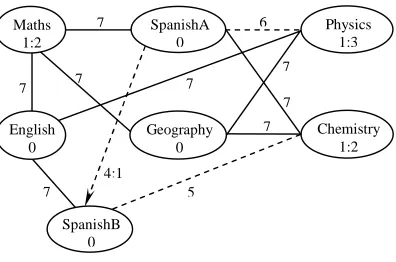
A simple example is shown in Figure 1 to illustrate a course time-tabling problem represented as an attribute graph. Nodes represent courses. Solid edges indicate hard constraints (labelled 7) which means that the adjacent courses cannot be held simultaneously. Dotted lines indicate soft constraints labelled 4, 5 or 6. The labels on the edges and inside the nodes correspond to the attributes shown in Table 1 and Table 2. For example, Maths, Physics and Chemistry are labelled with a 1 (to indicate that they are multiple courses) and with values 2, 3 and 2 that denote that they should be held 2, 3 and 2 times a week respectively. Other courses are labelled 0 (ordinary courses), which denote that they should be held just once a week. SpanishA should not be consecutive to Physics (because the edge between them is labelled by a 6) and Chemistry should be consecutive to SpanishB (labelled by a 5). The directed line between SpanishA and SpanishB has the label 4 (with value 1) which denotes that SpanishA should be held before SpanishB.
Insert Figure 1. somewhere here
structures, unlike in traditional case representation using the list of feature-values pairs where all the cases have the same form of feature slots.
3 Implementation of the CBR System for Course Time-tabling Problems
3.1 The Graph Isomorphism Problem and Decision Tree Algorithm
Using attribute graphs to represent cases has many advantages. However, the matching problem between the structured cases is equivalent to that of the graph isomorphism or sub-graph isomorphism problem that is known to be NP-Complete [35]. A sub-graph G is isomorphic to graph G' if there exists a one to one correspondence between nodes and edges of the two graphs. A graph G is sub-graph isomorphic to graph G' if G is isomorphic to a sub-graph of G'. Some methods have been attempted to solve this problem in CBR by detecting cliques of the graph [3]. The system being proposed here is based on Messmer’s algorithm [36] where graphs are organised in a decision tree.
graph isomorphism(s) or sub-graph isomorphism(s) stored in the tree can be found in polynomial time (quadratic to the number of nodes of the new graph).
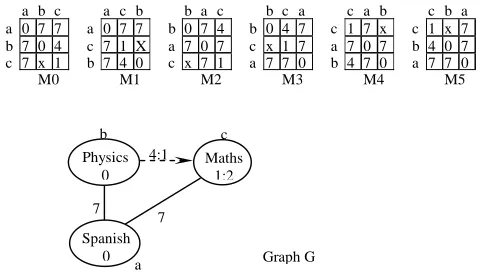
For example, in Figure 2, attribute graph G represents a 3-course time-tabling problem. Maths is labelled 1 with value 2 (multiple course, held twice a week). Physics and Spanish are labelled 0 (ordinary course, held once a week). Physics should be held before Maths. Spanish should not be scheduled simultaneously with Physics as Maths. There are 6 adjacency matrices M0~M5representing graph G, X denotes that there is no edge between two nodes and the labels in the matrices are described in Table 1 and Table 2.
Insert Figure 2. somewhere here
These matrices are used to build the decision tree (see Figure 3). If a matrix M can be seen as consisting of an array of so-called row-column elements ai = (m1i, m2i, … mii, mi(i-1), …, mi1), then a 3 X 3 matrix consists of 3 elements: a1 = a11,a2 = a21a22a12 and a3 = a31a32a33a23a13. The first element of each of the matrices M0~M5 can be 1 or 0, and therefore there are two branches from the root node with label 0 and 1 on the first level. The second level under branch 1 can be 707 and 40x in M4 and M5, thus two branches below branch 1 are built. Then the following levels of the decision tree can be built by the same process, each branch on level i leads to a successor node that is associated with a specific value for the ith element of M0~M5. Each permutation matrix is stored in the corresponding node in the decision tree (not shown in the figure). Then all the other known attribute graphs can be added into the tree in the same way.
Insert Figure 3. somewhere here
Insert Figure 4. somewhere here
3.2 Retrieving Structurally Similar Cases
Some course time-tabling problems are generated randomly and their attribute graphs are used to build up a decision tree in the proposed system. The solutions of these problems are obtained by using a heuristic graph colouring method described in [37].
A penalty is associated to each pair of labels described in Table 1 and Table 2 and used in the retrieval process. A threshold is also set to judge whether two labels are similar or not. When the system tries to match each pair of events in the new problem with source cases, the events can be seen as similar if the penalty between their labels is below the threshold. They are identified as similar and returned to be matched to each other.
If an event in the new problem has the same label and the same value as the source case, then they match with no penalty. Two events are considered not to be matching if the penalty between their labels exceeds the given threshold.
Two events that are labelled the same are further analysed to see if they have the same values. Penalties are given for the differences between the values and are taken into account in the similarity measure.
Every label is also given a weight using domain knowledge for the similarity measure. The similarity measure is thus given by formula (1):
where n is the total number of the labels, pi,j is the penalty between label i of node or edge in the new problem and label j of node or edge of source cases, wi is the weight of label i in the new problem and P is the sum of the penalty for every pair of labels times the weight of every label.
Using the penalties assigned to each pair of labels in the course time-tabling problems, the retrieval is targeted at matching between every pair of events, not just a single judgement
∑
=
× −
= n
0 j , i
i
ij w /P
p 1
between the whole cases. The system can retrieve the case(s) suitable for adaptation for the new problem from the case base.
When a new problem is entered in the system, it is classified to a node in the decision tree and the system retrieves all the cases stored in and below that node as candidates. As the tree stores cases hierarchically, all the cases that have more events and/or more relations are stored below those having less events and/or relations. It is observed that solutions of more constrained cases can be adapted easily for less constrained problems. Thus all the cases in and below the node are retrieved.
Using the penalties for every pair of the labels of nodes and edges, the system calculates the similarity between the new problem and the candidate cases in and below the node. The most similar case(s) are selected for adaptation.
3.3 Reuse and Adaptation of the Solutions
After the system finds the most similar case(s), the solutions or part of the solutions of the retrieved case(s) can be reused. The system substitutes the events in the solution(s) of the retrieved case(s) with the matching events in the new problem according to the isomorphism(s) found. After the substitution, a partial solution for the new problem can be obtained although there may be some violations of constraints. If there is no violation of hard constraint in the retrieved solutions, there is also no violation of hard constraint in the solutions after substitution.
4 A Simple Illustrative Example
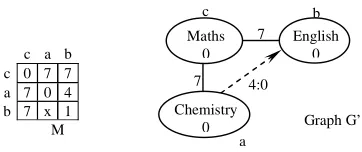
Let us suppose that the problem shown in Figure 1 is the new problem. All the cases and their isomorphisms are retrieved from the node that the new problem is classified to in the case base. Not only the case(s) that are graph isomorphic to the new problem can be adapted, but also the case(s) which the new problem is sub-graph isomorphic can be adapted, although they may not be “good” solutions for the new problem. Two cases whose similarities pass a given threshold (a score we set) are considered to be the most similar to the new problem and are retrieved from the case base. The structures of these two cases are shown in Figure 5. It is possible to find more than one isomorphism between two graphs. Two isomorphisms were found for each of the retrieved cases in this example.
Insert Figure 5. somewhere here
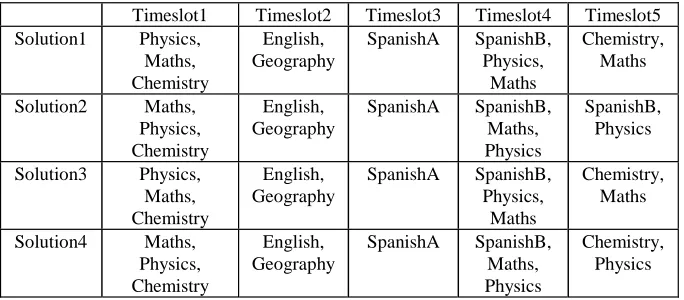
After substituting the events of the retrieved cases shown in Figure 4 by matching events indicated by the isomorphisms, four solutions can be obtained for the new problem (see Table 3).
Insert Table 3. somewhere here
It can be seen that there are 3 violations of soft constraints in solution 1: SpanishA is consecutive to Physics, Physics is held only 2 times and Maths is scheduled one more time. Using the graph heuristic method takes 2 adaptation steps: It deletes Maths from timeslot1 and adds another Physics to timeslot 5. It can also be seen that there are 1, 3 and 1 violation(s) of soft constraints in solution 2, 3 and 4 respectively. Using the graph heuristic method takes 1 and 2 adaptation step(s) respectively for solution 2 and 3. There is no adaptation for solution 4. After adaptation, there is only one violation of a soft constraint in each solution.
the retrieved case(s) finds the most adaptable cases for the new problem, thus a corresponding relation between the events and adaptation requirements is built up. Employing the adaptation requirements in the definition of the similarity between every event pair gives a more elaborate description for the similarity measure. Thus the knowledge and experiences previously stored in the retrieved cases’ solutions can be exploited for re-use for new similar problems. We note that the CBR can re-use the sub-solutions of previously solved problems within the case-base, a manner similar to that of experts in time-tabling.
5 Conclusions and Future Work
In this paper, a method is proposed to help solve course time-tabling problems using CBR in which attribute graphs are used to represent cases. To our knowledge, the CBR approach proposed in this paper is new in solving the timetabaling problems. Retrieval targets every
pair of nodes and edges between the new problem and source cases so that the retrieved
case(s) are the most adaptable for the new problem. The retrieved cases’ solutions store good
optimised or sub-optimised schedules for the previously solved problems. These schedules can be exploited and re-used for the new similar cases, after only limited adaptations for solutions which are then applicable for the new problem. The graph data structure gives a detailed description of the time-tabling problem. The relations between any events can be described clearly, and therefore the application of this method to time-tabling problems is
likely to find the similar cases adaptable for the new problem.
method and it provides promise. We believe it is applicable to large real world problems. Comparison with other methods will form a major part of our future work in this area.
References
[1] Waston I and Marir F, Case-based reasoning: a review, The Knowledge Engineering Review 9
(1994) 327-354.
[2] Smyth B and Keane ML, Adaptation-guided retrieval: questioning the similarity assumption in
reasoning, Artificial Intelligence 102 (1998) 249-293.
[3] Börner K, Structural similarity as guidance in case-based design, in: Wess S, Althoff KD and
Richter M, eds., Topics in Case-based Reasoning, (Springer-Verlag, Kaiserslautern, 1993) 197-208
(EWCBR-93).
[4] Börner K, Coulon CH, Pippig E and Tammer EC, Structural similarity and adaptation, in: Smith I
and Faltings B, eds., Advances in Case-based Reasoning (Springer-Verlag, Switzerland, 1996) 58-75
(EWCBR-96).
[5] Ricci F and Senter L, Structured cases, trees and efficient retrieval, to appear in Proceedings of the
Fourth European Workshop on Case-based Reasoning, (Springer-Verlag, Dublin, 1998).
[6] Sanders KE, Kettler BP and Hendler JA, The case for graph-structured representations, to appear in
Proceedings of the Second International Conference on Case-based Reasoning, (Springer-Verlag,
Berlin, 1997).
[7] Andersen WA, Evett MP, Kettler B and Hendler J, Massively parallel support for case-based
planning, IEEE Expert 7 (1994) 8-14.
[8] Jantke KP, Nonstandard concepts of similarity in case-based reasoning, Proceedings of the 17th
Annual Conference of the “Gesellllschaft fűr klassifikation e.V.”, (Springer-Verlag, Kaiderslautern,
1993).
[9] Gebhardt F, Methods and systems for case retrieval exploiting the case structure, FABEL-Report
[10] MacCarthy B and Jou P, Case-based reasoning in scheduling, in: Khan MK and Wright CS, eds.,
Proceedings of the Symposium on Advanced Manufacturing Processes, Systems and Techniques
(AMPST96), (MEP Publications Ltd, 1996) 211-218.
[11] Koton P, SMARTlan: A case-based resource allocation and scheduling system, in: Proceedings:
Workshop on Case-based Reasoning (DARPA) 1989 285-289.
[12] Bezirgan A, A case-based approach to scheduling constraints, in: Dorn J and Froeschl KA ed.,
Scheduling of Production Processes, (Ellis Horwood Limited, 1993) 48-60.
[13] Miyashita K and Sycara K, Adaptive case-based control of scheduling revision, in: Zweben M and
Fox MS, eds., Intelligent Scheduling, (Morgan Kaufmann, 1994) 291-308.
[14] Hennessy D and Hinkle D, Applying case-based reasoning to autoclave loading, IEEE Expert, 7
(1992) 21-26.
[15] Cunningham P and Smyth B, Case-based reasoning in scheduling: reusing solution components,
The International Journal of Production Research 35 (1997) 2947-2961.
[16] Schmidt G, Case-based reasoning for production scheduling, International Journal of Production
Economics 56-57 (1998) 537-546.
[17] MacCarthy B and Jou P, A case-based expert system for scheduling problems with sequence
dependent set up times, in: Adey RA and Rzevski G, eds., Applications of Artificial Intelligence in
Engineering X, (Computational Machines Publications, Southampton, 1995) 89-96.
[18] Wren A, Scheduling timetabling and rostering – a special relationship, in: [33] 46-76.
[19] Carter MW and Laporte G, Recent developments in practical examination timetabling, in: [33]
3-21.
[20] Carter MW and Laporte G, Recent developments in practical course timetabling, in: [34] 3-19.
[21] Boufflet JP and Negre S, Three methods to solve an examination timetable problem, in: [33]
327-344.
[22] Dowsland KA, Off-the-peg or made to measure? Timetabling and scheduling with SA and TS, in:
[34] 37-52.
[23] Thomson JM and Dowsland KA, General cooling schedules for a simulate annealing based
timetabling system, in: [33] 345-364.
[24] Elmohamed MAS, Coddington P and Fox G, A comparison of annealing techniques for academic
[25] Rich DC, A smart genetic algorithm for university timetabling, in: [33] 181-197.
[26] Erben W and Keppler J, A genetic algorithm solving a weekly course-timeatbling problem, in: [33]
198-211.
[27] Ross P, Hart E and Corne D, Some observations about GA-based exam timetabling, in: [34]
115-129.
[28] Burke EK, Newell JP and Weare RF, A memetic algorithm for university exam timetabling, in:
[33] 241-250.
[29] Burke EK and Newall JP, A multi-stage evolutionary algorithm for the timetable problem, IEEE
Transactions on Evolutionary Computation 3 (1999) 63-74.
[30] Burke EK, Newell JP and Weare RF, Initialisation strategies and diversity in evolutionary
timetabling, Evolutionary Computation Journal (special issue on scheduling) 6 (1998) 81-103.
[31] Paechter B, Cumming A and Luchian H, The use of local search suggestion lists for improving the
solution of timetable problems with evolutionary algorithms, in: Goos G, Hartmanis J and Leeuwen J,
eds., AISB workshop, (Springer-Verlag, Sheffield, 1995) 86-93 (Lecture Notes in Computer Science
993).
[32] Paechter B, Cumming A, Norman MG and Luchian H, Extensions to a memetic timetabing system,
in: [33] 251-265.
[33] Burke E and Ross P, eds., The Practice and Theory of Automated Timetabling: Selected Papers
from the First International Conference, (Springer-Verlag, Berlin, 1996) (Lecture Notes in Computer
Science 1153).
[34] Burke E and Carter M eds., The Practice and Theory of Automated Timetabling: Selected Papers
from the Second International Conference, (Springer-Verlag, Berlin, 1997) (Lecture notes in computer
science 1408).
[35] Garey MR and Johnson DS, Computers and Intractability: A Guide to the Theory of
NP-Completeness, (Freeman and Company. New York, 1979).
[36] Messmer BT, Efficient graph matching algorithms for preprocessed model graph, PhD thesis,
University of Bern, Switzerland, 1995.
[37] Burke EK, Elliman DG and Weare RF, A university timetabling system based on graph colouring
Label Attribute Value(s) Notes 0 Ordinary course N/A Takes place once a week 1 Multiple course N (No. of times) Takes place N times a week 2 Pre-fixed course S (Slot No.) Assigned to timeslot S 3 Exclusive course S (Slot No.) Not assigned to timeslot S
Label Attribute Values(s) Notes 4 Before/after 1 or 0 (direction) One before/after another course 5 Consecutive N/A Be consecutive with each other 6 Non-consecutive N/A Not consecutive with each other 7 Conflict N/A Conflict with each other
Timeslot1 Timeslot2 Timeslot3 Timeslot4 Timeslot5 Solution1 Physics, Maths, Chemistry English, Geography SpanishA SpanishB, Physics, Maths Chemistry, Maths Solution2 Maths, Physics, Chemistry English, Geography SpanishA SpanishB, Maths, Physics SpanishB, Physics Solution3 Physics, Maths, Chemistry English, Geography SpanishA SpanishB, Physics, Maths Chemistry, Maths Solution4 Maths, Physics, Chemistry English, Geography SpanishA SpanishB, Maths, Physics Chemistry, Physics
Figure 1. Attribute graph of a course time-tabling problem 7
5 4:1
7
7 7 7 6 7
7 7
Chemistry 1:2 Physics
1:3 SpanishA
0
Geography 0 Maths
1:2
English 0
a b c a c b b a c b c a c a b c b a a 0 7 7 a 0 7 7 b 0 7 4 b 0 4 7 c 1 7 x c 1 x 7 b 7 0 4 c 7 1 X a 7 0 7 c x 1 7 a 7 0 7 b 4 0 7 c 7 x 1 b 7 4 0 c x 7 1 a 7 7 0 b 4 7 0 a 7 7 0 M0 M1 M2 M3 M4 M5
Figure 2. Matrices of attribute graph G of a course time-tabling problem 4:1
c b
a 7 7 Physics
0
Spanish 0
Maths 1:2
1 0
Figure 3. Part of a decision tree storing matrices of attribute graph G of a course time-tabling problem.
(M0, M2 and M4 are shown) 7
7 0
M2 M0
M4
7 4 7 x 1
X x 4 0
7 7 0
7 4 7 x 1 x
c a b c 0 7 7 a 7 0 4 b 7 x 1 M
Figure 4. Matrices of attribute graph G’ for a new course time-tabling problem
c b
7 7 4:0
a Maths
0
English 0
Chemistry
Figure 5. Two retrieved cases from case base 4:1
6
7 5 5
7 7
4:0 7 7
7 7
7 7
7 7 7
7 7 7 7 7
7 7
1:2 1:2
1:2
1:2 0
0
0
1:2
1:2 1:2
1:2 2:2
1:3