AIS Electronic Library (AISeL)
AIS Electronic Library (AISeL)
ICIS 2019 Proceedings
Digital Learning Environment and Future IS
Curriculum
A Social Network Approach to Blogs: Improving Digital
A Social Network Approach to Blogs: Improving Digital
Collaborative Learning
Collaborative Learning
Franz Strich
Chair of Management, People and Information, [email protected]
Anne-Sophie Mayer
Chair of Management, People and Information, [email protected]
Marina Fiedler
Chair of Management, People and Information, [email protected]
Follow this and additional works at: https://aisel.aisnet.org/icis2019
Strich, Franz; Mayer, Anne-Sophie; and Fiedler, Marina, "A Social Network Approach to Blogs: Improving Digital Collaborative Learning" (2019). ICIS 2019 Proceedings. 6.
https://aisel.aisnet.org/icis2019/learning_environ/learning_environ/6
This material is brought to you by the International Conference on Information Systems (ICIS) at AIS Electronic Library (AISeL). It has been accepted for inclusion in ICIS 2019 Proceedings by an authorized administrator of AIS Electronic Library (AISeL). For more information, please contact [email protected].
A Social Network Approach to Blogs:
Improving Digital Collaborative Learning
Completed Research Paper
Franz Strich
University of Passau
Germany
[email protected]
Anne-Sophie Mayer
University of Passau
Germany
[email protected]
Marina Fiedler
University of Passau
Germany
[email protected]
Abstract
Blogs as digital collaboration tools are promising resources in higher education to impart knowledge, enhance collaboration and social interaction among students and thus, to increase their success. Despite the widespread use of blogs, little is known about blogs’ impact on students’ social networks and its effect on learning success. Therefore, based on a social network perspective, we empirically assess the change in the social network of 51 blog users. We are among the first to investigate the influence of the social network’s characteristics on students' subjectively perceived performance and access to knowledge within a blog-learning environment. We find evidence that blogs significantly increase the students' social networks, but are primarily a medium for reinforcing what the student has learned rather than influencing performance related outcomes. Our results yield important practical and theoretical recommendations on how blogs can be used to enhance students’ social networks and in turn increase their success.
Keywords: Social Network Approach, Blended Learning, Blogs, Students’ Success
Introduction
New learning technologies become increasingly important in the business as well as the educational context as they promise to foster communication, collaboration, and knowledge exchange between learners (Cairncross and Mannion 2001; Hsu 2007; López-Pérez et al. 2011). As scholars as well as practitioners continuously strive for learner-centered learning, enhanced collaboration, and social inclusion among learners, the use of blended learning tools is a prevalent approach to enrich traditional learning settings (López-Pérez et al. 2011). By combining teacher-centered face-to-face learning with online technologies, blended learning tools have the potential to test novel learning strategies and thus, to improve learning processes as well as performance outcomes (Garrison and Kanuka 2004; Poon 2013). Within the blended learning environment, blogs are a particularly promising tool to enhance students’ success.
Blogs are digitally collaborative tools which allow students to write, read, and collect information as well as to share it with lecturers or peers (Lee and Bonk 2016). As blogs are cost effective, easy to create, and require little technical skills, they are of particular relevance for educational purposes across all industries (Yang 2009; Yang and Chang 2012). Blogs as supplements to traditional learning approaches promise to enhance
students’ intellectual exchange (Williams and Jacobs 2004; Zeng and Harris 2005), critical and reflective thinking skills (Ellison and Wu 2008; Hsu 2007), and engagement (Lee and Bonk 2016). Moreover, as blogs combine features of social interaction and knowledge exchange, they promise to enhance students’ social networks and thus, to foster supportive collaboration among users (Blau 2009; Lee and Bonk 2016). Therefore, blog usage has the potential to improve the students’ overall learning experience as well as their performance outcomes (Du and Wagner 2005; Halic et al. 2010; Miyazoe and Anderson 2010; Sim and Hew 2010).
Following a social network perspective, blog usage promises to enhance the building of peer relationships and interconnected networks by facilitating communication, interaction and knowledge exchange among users (Chhabra and Sharma 2013; Du and Wagner 2005; Lee and Bonk 2016). The social network perspective assumes that individuals are interconnected with other individuals and thus, embedded within a network of relationships (Borgatti et al. 2018; Borgatti and Foster 2003; Kenis and Oerlemans 2007). Therefore, the social network perspective sheds light on the relationships and interactions among participants of a social system (Borgatti and Foster 2003; Freeman 2004). As a social network acts as a collective source of information and knowledge, a dense and interconnected network is favorable for different outcomes such as innovation (e.g. Abrahamson et al. 2016; Tsai 2001) and creativity (e.g. Perry-Smith and Shalley 2003; Zhou et al. 2009). Moreover, the sharing of information and knowledge through social networks promotes collaborative learning among participants (Cho et al. 2007; Haythornthwaite 2002; Yang and Chen 2008) which is associated with enhanced learning outcomes (Du and Wagner 2005; Leidner and Jarvenpaa 1995).
Based on the idea of constructivism, blog usage promotes active knowledge creation as well as collaborative learning and thus, contributes to a shift from instruction-focused learning to student-centered learning (Du and Wagner 2005; Leidner and Jarvenpaa 1995). The constructivist learning theory assumes that individuals’ learning processes have a greater impact when they are able to actively create and construct content rather than receiving instruction only (Bruner 1960; Leidner and Jarvenpaa 1995; Piaget 1928; Vygotsky 1978). Constructivist learning theory contains individual and collaborative aspects. Whereas the research has sufficiently examined the influence of blog usage on individuals, such as self-directed learning or reflective thinking, (Du and Wagner 2005; Ellison and Wu 2008; Xie and Sharma 2005), the impact on collaborative aspects remains vague. Collaborative learning involves the construction of knowledge by interacting and working together with other learners in order to develop a shared understanding of learning contents (Hsueh-Jui Liu and Yu-Ju 2016; Leidner and Jarvenpaa 1995). As the synergy effects of collaborative constructivism represent a desirable state that is made possible by the boundless communication of digital tools, the possible interrelations must be examined. Up to now, whether blog usage increases students’ interconnectivity and how it affects their learning success in terms of (1) subjectively perceived performance and (2) access to knowledge is unclear. By taking a social network approach regarding the impact of blog usage in the learning environment and focusing on collaborative aspects of learning, we aim to shed light on the following two research questions:
1. Does blog usage increase an individual’s social network?
2. How does the structure of a social network support students’ learning success?
Based on a social network perspective as well as collaborative constructivism, we examine the supplemental use of blogs in a blended learning environment with 51 graduate students over the course of one semester. In the first step, we outline the changes in the capacity of the social network through blogging. In the second step, we examine the relationship between the social network’s characteristics and the students’ learning success. Finally, we use post hoc interviews to deepen our understanding regarding the usefulness of blogs within the context of higher education.
Our research makes several theoretical and practical contributions: First, by embedding blog usage within a social network context, we shed light on the impact of students’ social network capacities on their learning success. Second, we relate students’ social network’s characteristics to their learning success within the online learning environment. Thus, we accentuate the impact of interpersonal connections when learning with blogs. Third, by elaborating on the collaborative dimension of constructivism, we highlight the social dimension of learning in a technology-enabled environment. Finally, we outline the limits of digital
technologies in the learning context by highlighting important and necessary opportunities for future development.
The remainder of the paper is organized as follows. First, we set out the theoretical framework by highlighting the potential benefits of blogs in higher education based on the social network perspective as well as the constructivist learning theory. Second, we outline the research method and mode of data collection. Third, the research findings are presented followed by a detailed discussion of the results and hypotheses. Fourth, we derive important recommendations, discuss potential limitations, and outline directions for future research.
Theoretical Background
New learning technologies do not only support learning processes, but transform the overall concept of learning by offering the possibility to produce, distribute, and receive knowledge in a more efficient way (Orton-Johnson 2009; Säljö 2010). As higher educational institutions tend to focus on transmitting instructed information, lecturers often struggle to promote problem solving and critical thinking skills of students, a continuous acquisition of knowledge as well as a lasting effect of learning (Alavi 1994; Du and Wagner 2005). Moreover, traditional learning settings often stop short in fostering social exchange, relationship building and interaction among peers and thus, in promoting collaborative learning (Lee and Bonk 2016). However, interconnected social networks are vital for collaborative learning which in turn promises to positively affect learning outcomes (Cho et al. 2007; Leidner and Jarvenpaa 1995). Therefore, teacher-centered instructions are increasingly being extended or even replaced by tools for digital collaboration and information sharing (Davidovitch and Belichenko 2018).
Blogs have proven particularly valuable in the context of higher education as they are easy to use and offer a wide variety of different functions for both social and knowledge exchange (Yang and Chang 2012). Blogs provide learners a medium to exchange opinions, thoughts and reflections on learning contents (Xie and Sharma 2005) as well as to connect and collaborate with each other (Lee and Bonk 2016). This is a unique characteristic of blogs as similar tools such as wikis or Facebook either focus on content and knowledge exchange (wikis) (Cress and Kimmerle 2008) or on relationship building and social interaction (Facebook) (Pempek et al. 2009). In addition, as collaboration is digital and can be viewed by the teachers at any time, changes or adjustments can easily be implemented. Thus, the learning process can be accompanied and evaluated in a lasting and supportive way (Ferdig and Trammell 2005).
As blogs are interactive tools, their use fosters interpersonal as well as group interactions among students (Chhabra and Sharma 2013; Lee and Bonk 2016). Moreover, blog usage allows shorter communication channels and tightened relationships among peers as well as between students and instructors (Chhabra and Sharma 2013). Therefore, vital aspects of learning favor intellectual exchange (Williams and Jacobs 2004; Zeng and Harris 2005), sense of classroom community (Chhabra and Sharma 2013; Kuo et al. 2017), and collaboration (Blau 2009; Lee and Bonk 2016). Thus, in line with the social network perspective as well as collaborative constructivism, blogs have the potential to foster students’ social networks as well as to enhance collaborative student-centered learning.
Social Network Perspective and Collaborative Constructivism
The social network perspective sheds light on the relationship and exchange between participants as it considers the individual as part of an interconnected social structure (Borgatti et al. 2018; Borgatti and Foster 2003; Moolenaar 2013). As prior research emphasized the benefits of interconnected networks such as enhanced creativity (e.g. Perry-Smith and Shalley 2003; Zhou et al. 2009), performance (e.g. Baldwin et al. 1997; Bolander et al. 2015; Brass 1981) or innovation (e.g. Abrahamson et al. 2016; Tsai 2001), the promotion of network building is of high relevance.
A social network acts as a medium for sharing and distributing resources such as task advice or strategic information (Podolny and Baron 2006) as the social network enables interaction, feedback, and communication among individuals (Borgatti and Ofem 2010; Burt 1992; Moolenaar 2013). Within blogging environments, for instance, these resources may constitute information and knowledge sharing regarding
learning contents, blog posts and comments. The fostered interaction and communication through social networks in turn contributes to collaborative learning (Cho et al. 2007; Haythornthwaite 2002; Yang and Chen 2008) which is associated with enhanced learning processes and outcomes in line with the constructivist learning theory (Du and Wagner 2005; Leidner and Jarvenpaa 1995).
The constructivist learning theory promotes a transition from a solely instruction-based to a student-centered approach (Bruner 1960; Piaget 1928; Vygotsky 1978). As one of the main perspectives of constructivism, collaborative constructivism focuses on the improvement of learning processes through the interaction and cooperation among students (Leidner and Jarvenpaa 1995). Collaborative constructivism assumes that learning emerges by creating knowledge in collaboration with other students (Slavin 1990) as the consideration of multiple perspectives fosters the construction of a novel, shared knowledge (Whipple 1987). As learning is a social process by nature, the interaction and exchange between students promises to further enhance their understanding (Blumenfeld 1992). Therefore, collaborative constructivism focuses on the construction of a shared understanding of learning contents by encouraging students to engage, interact, and collaborate with each other (Leidner and Jarvenpaa 1995).
As blogs address both social interaction and knowledge exchange (Blau 2009; Du and Wagner 2005; Kuo et al. 2017; Lee and Bonk 2016), blog usage enables social as well as collaborative aspects of learning in three major ways. First, blog usage promotes knowledge sharing among learners as blogs allow learners to post information, ideas, and thoughts as well as to comment and respond to posts by others (Du and Wagner 2005; Lee and Bonk 2016). Second, blogs provide various feedback opportunities as learners can receive prompt feedback from both lecturers and peers (Hsu 2007). Third, blogs enable online learning communities by inciting discussions and dialogues among learners (Hsu 2007; Yang and Chang 2012). Overall, blogs are a promising digital learning tool for improved learning by enhancing social interaction, the transparent exchange of information, and knowledge as well as collaboration among learners.
Social Network Analysis
Although the research has outlined blog usage’s contribution to aspects of collaborative learning such as enhanced peer interaction and participation (Blau 2009; Williams and Jacobs 2004; Zeng and Harris 2005), the impact of blog usage on the students’ social network remains vague. A social network analysis (SNA) enables the examination of the development of and change in the social relations within a network (Borgatti and Everett 1997; Lee and Bonk 2016; Scott 1988). A social network consist of nodes (agents within a network) and ties (links between the nodes), whereas the latter one constitutes the relationship between the different nodes. The analysis of a social network allows for the investigation of connections between different actors at an individual as well as a group level for a single point in time as well as for multiple measurement points (Lee and Bonk 2016; Scott 2017), and thus represents a highly useful way of depicting relationships between individuals.
Research has proposed various measures to quantify the quality of a network (for an introduction see Borgatti et al. 2018; Scott 2017). On an individual level, the (degree) centrality of a node refers to the number of incoming (in-degree) and outgoing (out-degree) ties to other nodes. Thus, “a central point is one that is literally at the center of a number of connections” (Scott 2017, p. 98). Furthermore, the centrality of a node can be extended by including path distances or relevant connected neighbors that result in similar measures such as eccentricity or eigenvector-centrality (Koschützki et al. 2015). Eccentricity relates to the greatest distance between any two connected points within a network, whereas eigenvector-centrality indicates the importance of a node relative to all other nodes (Borgatti et al. 2018; Koschützki et al. 2015). At the group level, the density of a network describes how well all nodes are interconnected. In its simplest form, density describes the ratio of actual connections to all possible connections (Borgatti et al. 2018). Thus, network density describes the probability of a connection between two randomly chosen nodes. The investigation of individuals’ networks is a promising approach to uncover important resources as prior studies in the organizational context have shown. For example, a central structural position in a network has proven to be conducive to power (Brass 1984) or being promoted (Burt 1992). People who use their networks’ structural resources are able to outperform their colleagues or peers (Cho et al. 2007;
Marqués-Sánchez et al. 2018). Due to these findings, the influence of new digital collaboration tools on the social networks of students is a relevant research approach as they promise to enhance students’ success.
Social Network Capacities within Blogging Environments
A large and well-connected network has a number of positive properties: Firstly, information moves faster in a dense network because the individual actors are connected with each other (Burt 2008; Haythornthwaite 2002). Secondly, in a large network there is a greater variety of possible skills and competences available, which can be used by each individual actor (Perry-Smith and Shalley 2003). Thirdly, a balanced network leads to an even distribution of resources so that nodes at the periphery of the network can participate in the same way as very central actors (Cook et al. 1983). From a constructivist perspective, this is desirable, as the holistic and comprehensive support of peers has a positive effect on learning (Johnson and Johnson 2009; Leidner and Jarvenpaa 1995).
Blogs have the potential to positively influence these processes in several ways. On the one hand, blog usage allows a high degree of visibility, as users tend to have a personal profile including the name as well as a personal photo or an avatar. Therefore, users can draw attention to themselves by writing interesting and eye-catching posts or critically commenting on others’ contributions. As each post is linked to the authors’ name, users can easily remember peers and connect them to specific contributions, opinions or ideas. Consequently, we argue that the use of blogs increases the connection of individual nodes in terms of being known by others (in-degree):
H1: Blog usage leads to a higher degree of being known by others.
On the other hand, the high visibility of users promotes the interconnection between all learners in terms of knowing others. As it is possible to connect blog posts and comments to specific authors, blog usage allows users to identify the author of an interesting post in the offline context and to get in contact. Consequently, we argue that the use of blogs increases the connection of individual nodes in terms of knowing others (out-degree):
H2: Blog usage leads to a higher degree of knowing others.
In addition to possible changes in the size of the network through the usage of blogs, it is unclear how changes in the centrality of individual actors affect the students’ learning success. To the best of our knowledge, no research has investigated this relationship so far. Thereby, we operationalize learning success as (1) students’ subjectively perceived performance, and (2) students’ access to knowledge. In line with collaborative constructivism, we would expect an increase in centrality to positively influence students’ learning success.
In terms of students’ subjectively perceived performance, we assume a positive relationship for two reasons. First, users benefit from multiple perspectives and understandings as blog usage fosters communication and knowledge sharing (Chhabra and Sharma 2013; Lee and Bonk 2016). Second, reading other users’ posts, ideas, and comments enhances students’ spectrum of knowledge and information. Consequently, we argue that increased social network capacities promote students’ subjectively perceived performance:
H3: An increase in social network centrality has a positive impact on students’ subjectively perceived performance.
In terms of students’ access to knowledge, we assume a positive relationship for two reasons. First, a more central network allows faster information exchange as the connection between two random nodes is shorter. Second, the use of blogs should lead to an equally distributed network, as all (relevant) information are available online and can be equally used by all. Consequently, we argue that increased social network capacities promote students’ access to knowledge:
H4: An increase in social network centrality has a positive impact on students’ access to knowledge.
Method
We set out to investigate our research questions with students enrolled in a traditional human resources lecture. In addition to the regular face-to-face content presented in class, students received an assignment on a weekly basis that was closely related to the content of the lecture. The assignments were formulated as open statements or questions and had to be discussed such as “How does digital transformation change existing tasks?” or “What are the opportunities and risks of social networks for companies and employees?” While the questions were directly related to the content of the course, the responses were exclusively discussed by the students themselves. There was no presentation of the answers or discussions during the course. However, the content and comments of the blogs were evaluated on a weekly basis, giving students feedback on the quality of their contributions during the semester.
The blogs were hosted on a free and openly accessible content management platform, so that the respective contributions could be viewed not only by the participants, but also by external users. Participants were free to design and change the layout of their blogs, which they frequently did. Each contribution can be tagged, liked and linked by people with an user account. There was no obligation to use real names or images in their profiles, although this was widely done by students. However, students were encouraged to keep communication and profiles as open and clear as possible. Moreover, each blog entry could be commented and furthermore shared with other social media tools such as Twitter, Facebook or Instagram. Accordingly, blogs differed not only in terms of available features, but also regarding their intended use: Blogs are social media tools, which primarily emphasize social interaction in addition to the exchange of knowledge and collaboration.
The instructor encouraged the students to read each other’s posts and, if applicable, leave comments if they perceived certain points in a different way or wanted to make an additional contribution. Students were advised to upload the respective content at least three days prior to the next class in order to leave enough time for an engaging discussion. For increasing participation, students had the opportunity to improve the final grade of their exam depending on the evaluation of their contributions and comments by up to 30 %. More precisely, if students did not participate in the additional tasks, they received their regular exam grade as their final grade, while blog users had the opportunity to improve their exam grades accordingly. Overall, 127 graduate students participated in the course and completed the voluntary assignment of creating and maintaining blogs. However, in order to conduct our survey, we had to ask the students to complete multiple questionnaires at different times during the semester. This additional effort, which was not related to the grade, led to a response rate of 40.16%. A total of 51 graduate students answered the questionnaires completely at all times, with 66.67 % being female. On average, participants were 24 years old (M = 23.58, SD = 2.12), ranging from 19 to 28 years. Most students were enrolled in a masters’ program for business administration (n = 28), followed by International Cultural and Business Studies (n = 16), and others (n = 6). One student did not indicate which subject he or she was majoring in. Overall, more than two-thirds of the respondents indicated that Facebook was the most used social media platform (68.75 %) followed by WhatsApp (22.92 %) and Instagram (6.25 %). Regarding prior experience, most respondents had been using social media for about 6 to 10 years (60.79 %), while 15.68 % had been using social media for less than 6 years and 23.52 % for more than 10 years.
Data collection
In order to investigate the students’ social networks, we distributed online questionnaires at multiple times throughout the course of the semester. The questionnaires were distributed independently of the blogs with a separate tool. We assessed the students’ network by asking them to name all the other students that they knew from class at the beginning and a week after the end of the course. One week prior to the final network assessment, we collected additional information on sociodemographic variables. Furthermore, we assessed the perceived benefit of the blog usage on subjective learning performance as well as the blogs’ impact on students’ knowledge access in the course. We asked participants to rate their responses along a five-point Likert scale (1 = strongly disagree, 2 = disagree, 3 = neither agree nor disagree, 4 = agree, 5 = and strongly agree). The first scale consists of three items, asking participants to indicate (1) if the use of blogs supports their learning, (2) if the use of blogs enables them to use the content of the course more effectively, and (3)
whether they can use the blog posts to improve their learning success (α = 0.84). Notably, the self-assessment of performance-related measures is common in the absence of reliable objective data or third-party measures (Ali-Hassan and Wade 2015; Teigland and Wasko 2003). The second scale consists of two items regarding students’ communication patterns. We asked (1) if the use of blogs enables them to receive important information from other course members, and (2) whether blog usage enables them to access other students’ knowledge more easily (α = 0.70).
To further deepen our understanding of the influence of blogs on students’ success, we supplemented the quantitative approach with 10 qualitative in-depth interviews. Students had the opportunity to indicate if they wanted to participate in a voluntary and unrewarded interview. Of the voluntary interviewees, 10 out of 20 were randomly selected. Six of the interviewees were female. On average, participants were 23 years old (M = 23.20, SD = 1.54). We used semi-structured interviews to gain deeper insights into blog users’ opinions and experiences of working and learning with blogs. We conducted the interviews face-to-face, and each interview lasted about 25 minutes. We coded the interviews using MAXQDA 18. First, we focused on gaining an overview of interviewees’ statements using open coding. Then, the deductive category assignment method (Mayring 2015) was performed for a detailed analysis. The overall aim was to generate a deeper understanding of the underlying processes that influence the students’ perception of blog usage.
Analysis and Findings
To answer our first research question, we reproduced the social networks of the students. By comparing the size of the network at the beginning and the end of the course, we were able to investigate potential changes due to the use of blogs. We used the open-source program Gephi that could visually represent network connections and estimate different network indicators such as node centrality or the general density of the network. The in-degree of a node represents the number of connections directed to a respective node as an indicator for being known by others. The out-degree, on the other hand, specifies the number of outgoing connections from a node as an indicator of being known by others. If, for example, Sarah stated in her questionnaire that she knew Tom, then there is a directed connection between Sarah and Tom. Sarah has an out-degree of 1 and Tom has an in-degree of 1. Furthermore, if Sarah named seven people (out-degree) but was named only 2 times herself (in-degree), then Sarah knows more people than people know her. Figure 1 shows a comparative representation of the social networks at the beginning of the course (time 1) and at the end of the semester (time 2). Table 1 shows the different network indicators for each time. Furthermore, we tested for significant differences between t1 and t2. As Table 1 shows, both the number of in-degrees and the number of out-degrees increase significantly from time 1 to time 2. Thus, students were better connected in terms of being known by others as well as in terms of knowing others. Furthermore, a corresponding change is also evident for the measures eccentricity and eigenvector-centrality. Regarding eccentricity, the results indicate that the ties between the nodes increase and thus, on average, the paths between two randomly chosen nodes became shorter from t1 to t2. For eigenvector-centrality, the results indicate an average decrease in the importance of individual nodes in the network. Thus, the individual actors in the network of participants became equal and had a more similar importance.
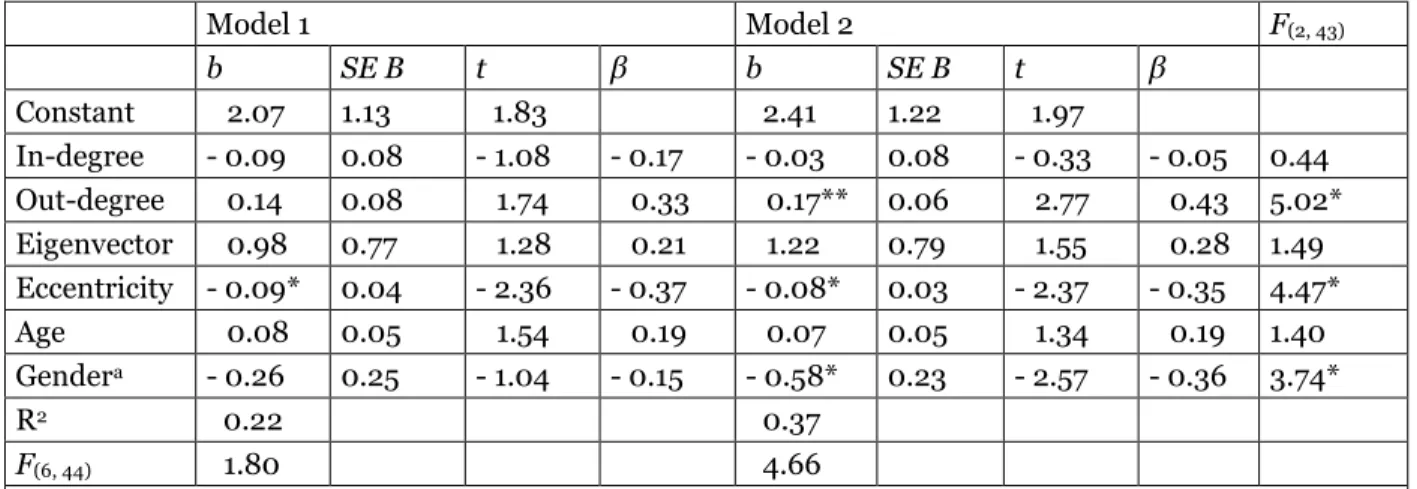
Regarding our second research question, we conduct a multivariate OLS with participants’ subjective learning performance and knowledge access as dependent variables. In order to account for changes in the social network, we compute the differences from t1 to t2 for in-degree, out-degree, eccentricity, and eigenvector-centrality as the independent variables. Furthermore, we control for age and gender as covariates. Overall, there is a statistically significant difference between students’ subjective learning performance and knowledge access with regard to the influence of the combined independent variables
F(12,86) = 2.21, p < 0.05. As Table 2 shows in the right most column, participants’ out-degree, eccentricity, and gender vary between the dependent variables, whereas no such differences exist for in-degree, eigenvector-centrality, and age. For Model 1 that uses students’ performance as the dependent variable, only eccentricity proved to be a significant predictor (β = - 0.37). A one standard deviation increase in eccentricity decreases participants’ subjectively perceived performance by 0.37 standard deviations.
For Model 2, the changes in out-degree (β = 0.43) and eccentricity (β = - 0.35) from t1 to t2 prove to be significant predictors for students’ access to knowledge. An increase of one standard deviation in out-degree increases access to knowledge by 0.43 standard deviations, whereas an increase in eccentricity decreases the respective dependent variable. Again, referring to Table 1 for the tendency, the number of out-degrees increases significantly from t1 to t2, whereas the eccentricity of the nodes in the network decreases significantly. Regarding the out-degree, the results indicate that the more people are known by a specific node, the higher their respective access to knowledge. This is not particularly surprising in of itself, as one can presume the more people are known to an actor, the more easily that person can access different and helpful information. However, the additional and significant effect of eccentricity gives the results more meaning.
Figure 1. Participants’ Social Network at t1 and t2. Top-left: In-Degree at t1; Top-right: Out-Degree at t1; Bottom-left: In-Degree at t1; Bottom-right: Out-Degree at t2. The Brighter and Larger a Node, the Higher the Number
As pointed out earlier, eccentricity describes the centrality of a node in a network. The lower the value, the more central is the node, as the connection between a specific node and any other node in the network can be reached by using a comparably short path. Conclusively, the more central a node is in the network, the easier knowledge can be accessed. Thus, an increase in the actors’ network and an increase in network density both positively influence the students’ access to knowledge. Furthermore, gender proves to be a significant covariate in Model 2 and indicates that female students have higher values for access to knowledge than men do. Overall, the results indicate that the changes from t1 to t2 regarding the network metrics do not have any significant impact on students’ subjective learning performance, whereas an enlargement of the network and an increase in centrality positively influence the students’ access to knowledge. t1 t2 M-Diff a t M SD M SD In-degree 3.12 2.03 4.00 2.01 0.88 4.08*** Out-degree 4.12 2.08 6.28 2.52 2.16 7.65*** Eccentricity 8.41 3.16 6.45 1.55 - 1.96 - 4.09*** Eigenvector-centrality 0.18 0.18 0.25 0.18 0.07 2.99**
Notes. * p<0.05, ** p<0.01, *** p<0.001; N = 51; a Differences in mean values for t1 and t2.
Table 1. t-Test Statistics for Differences Between t1 and t2 Regarding the Network Characteristics Model 1 Model 2 F(2, 43) b SE B t β b SE B t β Constant 2.07 1.13 1.83 2.41 1.22 1.97 In-degree - 0.09 0.08 - 1.08 - 0.17 - 0.03 0.08 - 0.33 - 0.05 0.44 Out-degree 0.14 0.08 1.74 0.33 0.17** 0.06 2.77 0.43 5.02* Eigenvector 0.98 0.77 1.28 0.21 1.22 0.79 1.55 0.28 1.49 Eccentricity - 0.09* 0.04 - 2.36 - 0.37 - 0.08* 0.03 - 2.37 - 0.35 4.47* Age 0.08 0.05 1.54 0.19 0.07 0.05 1.34 0.19 1.40 Gendera - 0.26 0.25 - 1.04 - 0.15 - 0.58* 0.23 - 2.57 - 0.36 3.74* R2 0.22 0.37 F(6, 44) 1.80 4.66
Notes. * p<0.05, ** p<0.01; N = 51; a (female = 0; male = 1); Please note: We used differences between t1 and t2 for the respective independent variables and robust standard errors.
Table 2. Multivariate OLS Regression for Students’ Performance (Model 1) and Students’ Access to Knowledge (Model 2)
In summary, (1) the use of blogs increases the participants’ network both in terms of being known (in-degree) and knowing others (out-(in-degree). Therefore, this finding confirms Hypothesis 1. Furthermore, (2) the usage of blogs increases the centrality of the networks. Thus, this finding confirms Hypothesis 2. In addition, we find a decrease regarding the importance of individual students in the network as evidenced by the change in eigenvector-centrality. Accordingly, the network structure is determined less by individually dominant students but instead, the use of blogs leads to an increasing equality for students. With regard to the influence on students' overall behavior, the results show that a decrease in eccentricity has positive effects on students’ performance as well as on their access to knowledge. Furthermore, an increase in out-degree has an additional positive effect on access to knowledge. Thus, our results support
Qualitative Analysis
Overall, we derive two main categories from the interviews: (1) Social Networks and (2) Collaborative
Learning. The category of Social Networks refers to the first research question on whether students’ social
network increase by the use of blogs. The second identified category Collaborative Learning relates to our second research question on whether a change in a social network’s centrality affects students’ learning success.
Social Networks
The first category Social Networks aims to shed light on the impact of blog usage on students’ social networks in terms of the degree of being known by others (in-degree) and knowing others (out-degree). We find that students praised the option to read and comment on others’ contributions and thus, to interact and collaborate with their peers. In addition, students also enjoyed visiting the profiles of their peers to get a first impression of them. As a result, they were able to associate the members of the course with individual contributions and to recognize them in the offline context. Consequently, all interviewees stated that using blogs fostered a way of getting to know their peers as well as being known by others.
“Maybe you are sitting in row with other students, but generally you are not having a conversation while having class, whereas within blogs you are interacting with each other and yes, that’s how you get much more in touch with peers, which is simply not happening in class.” (I 5)
“I remember reading a very good blog post of someone and then, sitting next to that person in class and I was like ‘Ah, you’re the one that wrote that post’.” (I 3)
“It was my first semester and I didn’t know anyone but through this commenting it was easy to recognize a name or a face and then it was easy to get in contact with them.” (I
10)
Collaborative Learning
The second category Collaborative Learning emphasizes the influence of a densely connected network on students’ learning success. First, most interviewees praised the access to other students’ ideas and opinions on course-related topics as helpful. Reading and commenting on other students’ blog posts allowed students to gain additional insights from multiple perspectives.The simplified access to the knowledge of the other students led to a deeper understanding of the different topics.
“I think it was really interesting to see how differently people dealt with the topic although everyone had the same topic, you got some really interesting insights, well yes, that was a great enrichment.” (I 2)
“Yes, as already mentioned in one way positive as you, yes, dealt with the topic in a more in-depth way, you dealt with it in an enhanced way.” (I 4)
Second, interviewees’ said that reading and commenting on other students’ blog posts helped them to build relationships with peers as well as to collaborate and interact with each other. The social features of the blogs do not only allow access to the knowledge of the other students, but there is also a noticeable interaction among them.Thus, the repeated discussion of issues and the exchange with their peers led to a more in-depth understanding of the subject.
“You do reflect on the topic much more critically because you consider many opinions of the other students [...].” (I 3)
However, students also said that a targeted peer-to-peer exchange with blogs proved to be difficult. The use of blogs was more like a targeted and scheduled exchange, whereas short and spontaneous questions were asked and answered through other channels.
“We chatted via WhatsApp as it is the easiest way to ask short questions and get immediate answers.” (I 9)
“Every time I had an organizational question, I used WhatsApp to ask my peers.” (I 3)
Discussion
The purpose of this paper is twofold. First, we examine whether blog usage increases students’ degree of knowledge of others as well as being known by them. Second, we investigate whether a change in a social network’s centrality influences students’ learning success in terms of (1) subjectively perceived performance and (2) access to knowledge. In order to shed light on our research questions, we use a social network analysis to combine the quantitative survey data with the qualitative semi-structured interviews.
Owing to blog usage’s potential to contribute to the collaborative learning by enhancing students’ social networks (Blau 2009; Lee and Bonk 2016), we hypothesize a positive impact from its use on the growth of students’ networks. Indeed, we find a positive relationship as both the students’ degree of knowing others as well as the degree of being known by others increased during the semester. The interviews provide additional reasoning for our findings. First, the visibility of the individual students increases their networking, as they can create an individual profiles with personal information. Furthermore, the visibility of their posts and comments allows students to present themselves to a large audience of their peers. Thus, possible off-center students can become more visible. Therefore, blogs as online social networks promise to enhance the social inclusion of students who are at risk to social exclusion (Díaz, Andrade and Doolin 2016; Notley 2009). Second, the social media features enable communication between the students with significantly lower barriers (Chhabra and Sharma 2013). Commenting on a contribution or another post leads to the interacting students to become more familiar with each other. Overall, blogs enable a higher level of networking among students and increase inclusiveness by fostering the building of peer relationships.
Beyond examining the impact of blog usage on students’ individual networks, our research sheds light on the effect of increased centrality of a social network on students’ learning success. Our findings indicate a positive impact on students’ (1) subjective learning performance and (2) access to knowledge. Compared to the beginning of the semester (t1), the paths between the students are significantly shorter. The use of the blogs has led to information being even more equally accessible to all students. While this is not a unique feature of blogs but is enabled by most social media platforms (Giermindl et al. 2017), the positive effect is still remarkable and illustrates the benefits of blogs in the context of higher education. Moreover, as more information is shared within the network, students are able to benefit from their peers’ ideas and opinions and thus, are able to develop a shared understanding of learning contents (Leidner and Jarvenpaa 1995). In line with the premises of collaborative constructivism, the sharing of information as well as the interaction between students promote successful learning (Hsueh-Jui Liu and Yu-Ju 2016). The interviews further support our findings, as students predominantly praised the development of an in-depth understanding based on the access to their peers’ blog posts and comments. However, the impact of students’ social network indices on participants’ subjective learning performance was not as strong as the impact on access to knowledge. As indicated by the interviews, blogs are primarily used as a platform to understand and discuss a given topic. While blog usage deepens the understanding of the course-related material, other skills are necessary for the exam-related performance. While blogs encourage interaction between participants (Chhabra and Sharma 2013; Lee and Bonk 2016) and stimulate creative thinking (Deng and Yuen 2011; Kjellberg 2010) and critical reflection (Dos and Demir 2013), exams often demand
specific answers to clearly structured questions. The performance in the exam therefore corresponds more to the querying of knowledge and less to the independent linking of topics, as promoted by blogs.
Theoretical Contributions
Our work makes several important contributions to information systems (IS) research: First, we relate the use of blogs to the social network of students and illustrate how their networks evolve over time. The benefits of a highly interconnected network are well established in the research (e.g. Bodin and Crona 2009; Bolander et al. 2015; Haythornthwaite 1996). We have shown that the use of blogs is an effective lever to broaden a student’s network. Thus, we contribute to the IS research in the areas such as knowledge sharing (Brown et al. 2010), collaborative technologies (Giermindl et al. 2017 ) as well as technologically supported learning (Zhang and Venkatesh 2013). Second, we show that blogs can help to expand a network and improve the flow of information between students. At the same time, however, we find that blogs do not automatically lead to an improved perception of performance. While blogs provide a creative and self-contained exchange, students must rely on other means to enhance their exam-related performance. Technologically enabled collaboration is no guarantee of improving actual performance. Thus, we extend the literature on blog usage by showing potential boundaries of collaborative technologies in the context of higher education. Third, we apply collaborative constructivism to the context of digital learning settings and thus, extend the theory’s meaningfulness. We emphasize the potential of blended learning tools such as blogs to strengthen student-centered learning and collaborative knowledge creation to develop a shared understanding of knowledge and thus, to enhance learning processes. Therefore, we highlight the value and necessity of digital learning tools as supplements to traditional learning approaches.
Practical Contributions
Furthermore, our research makes several practical contributions as the successful transfer of knowledge depends to a large extent on the means used and their effectiveness that is independent of the context. First, while the use of technological tools to convey knowledge has already been applied to many areas (Ellison et al. 2015), their degree of efficiency is still vague (Edwards et al. 2005). By using blogs as a social media tool, our research shows that the use of blogs increases the availability of information in the network. This usage shortens the paths between members and simplifies how students access knowledge. Second, we show how the use of blogs can change the relationship between individual students in their community. Through the involvement of the different students, the structures in the network become more equal. In the context of higher education, blogs can help to integrate marginalized groups into the learning process (Dickey 2004; Hall and Davison 2007). Furthermore, boundaries and differences based on origins, economic status, or appearance can be overcome through the use of digital collaboration (Díaz Andrade and Doolin 2016). Thus, our research adds to the IS literature on social barriers and technologically induced collaboration. Finally, blogs should be supplemented by additional peer-to-peer communication tools that allow direct chats and exchange among peers in order to facilitate communication that exceeds the discussion on others’ blog posts and comments. The possibility of exchanging sensitive information can additionally increase the success of technology-supported knowledge transfer. The high degree of visibility can limit the disclosure of potentially highly relevant information and thus have a partially counterproductive effect (Giermindl et al. 2017). The decisive factor here is for learning to encourage open exchange but not prevent protected dialogue.
Limitations and Further Research
The findings of our study must be evaluated in the light of some limitations: First, our sample consists of students. While we clearly embed our research focus in the context of higher education, the transferability of our findings is limited. Electronically supported learning and the resulting possibilities are increasingly used in higher education (Costello and McNaughton 2018; Montgomerie et al. 2016). In addition, there is a multitude of different learning tools in the area of higher education, with different areas of application. So far, it is unclear how the different tools (Blogs, Discussion boards, Wikis) are connected to each other and how the offered features differ with regard to the identified effects. Thus, future studies need to explicitly consider the change in learning performance using distinct social media tools in different contexts. Second, we surveyed a group of blog users and examined their network characteristics. While the
changes in the network are clearly due to the use of blogs, the results of our study should be further validated by including a control group. In addition, we surveyed only 51 participants in our study. While our study design and the continuous questioning of the respondents pushed the dropout rate, a study with a higher number of participants can certainly be considered advisable in order to further increase the validity of our results. We therefore call on the research community to explore the impact of blogs and social networks by using an experimental research designs with a larger sample size. Third, we have used items of subjective self-assessment to evaluate participants' performance. While the use of subjective performance measures is generally accepted in the absence of objective measures, the use of additional, especially more reliable performance measures would further increase the validity of our results. Fourth, we focus this study on the influence of subjectively perceived changes in performance and access to knowledge in the community that uses blogs. While subjective changes in performance can have an impact on actual performance not least through self-efficacy (Chemers et al. 2001; Stajkovic and Luthans 1998; Wall et al. 2004), future studies examine the non-survey performance of blog users. In particular, long-term changes in performance-related non-survey criteria, for example, after training in an organizational context, can provide deeper insights into the relationship among blogs, social networks, and performance-related indicators.
Conclusion
With our study, we sought to answer two important research questions in the field of digitally supported knowledge exchange. First, whether the use of blogs leads to an increase in the social network of the students. Second, how the structure of the social network supports the students' learning success. Thus, we have tracked the social network of 51 graduate students over the course of a semester and have analyzed the influence of blogs. Our results show that the use of blogs leads to a significant increase in the networks of the individual students. In addition, we were able to show that changes in the network have a significant influence on the students’ subjectively perceived performance and access to knowledge. With our research, we make several important contributions to the field of digitally supported knowledge transfer and highlight the importance of considering social networks. Furthermore, our results are transferable to the organizational context in which digital training and continuing education are increasingly being implemented.
References
Abrahamson, E., and Rosenkopf, L. 1997. “Social Network Effects on the Extent of Innovation Diffusion: A Computer Simulation,” Organization Science (8:3), pp. 289–309.
Alavi, M. 1994. “Computer-Mediated Collaborative Learning: An Empirical Evaluation,” MIS Quarterly (18:2), pp. 159–174.
Ali-Hassan, H., and Wade, M. 2015. “Linking Dimensions of Social Media Use to Job Performance: The Role of Social Capital,” The Journal of Strategic Information Systems (24:2), pp. 65–69.
Baldwin, T. T., Bedell, M. D., and Johnson, J. L. 1997. “The Social Fabric of a Team-Based M.B.A. Program: Network Effects on Student Satisfaction and Performance.,” Academy of Management Journal (40:6), pp. 1369–1397.
Blau, I. 2009. “Open the Windows of Communication: Promoting Interpersonal and Group Interactions Using Blogs in Higher Education,” Interdisciplinary Journal of E-Learning and Learning Objects (5:1), pp. 233–246.
Blumenfeld, P. C. 1992. “Classroom Learning and Motivation: Clarifying and Expanding Goal Theory,”
Journal of Educational Psychology (84:3), pp. 272–281.
Bodin, Ö., and Crona, B. I. 2009. “The Role of Social Networks in Natural Resource Governance: What Relational Patterns Make a Difference?,” Global Environmental Change (19:3), pp. 366–374. Bolander, W., Satornino, C. B., Hughes, D. E., and Ferris, G. R. 2015. “Social Networks within Sales
Organizations: Their Development and Importance for Salesperson Performance,” Journal of
Marketing (79:6), pp. 1–16.
269.
Borgatti, S. P., Everett, M. G., and Johnson, J. C. 2018. Analyzing Social Networks, (1st ed.), London, UK: Sage Publications Ltd.
Borgatti, S. P., and Foster, P. C. 2003. “The Network Paradigm in Organizational Research: A Review and Typology,” Journal of Management (29:6), pp. 991–1013.
Borgatti, S. P., and Ofem, B. 2010. “Overview: Social Network Theory and Analysis,” in Social Network
Theory and Educational Change, A. J. Daly (ed.), Cambridge, MA: Harvard University Press.
Brass, D. J. 1981. “Structural Relationships, Job Characteristics, and Worker Satisfaction and Performance,” Administrative Science Quarterly (26:3), pp. 331–348.
Brass, D. J. 1984. “Being in the Right Place: A Structural Analysis of Individual Influence in an Organization,” Administrative Science Quarterly (29:4), pp. 518–539.
Brown, S. A., Dennis, A. R., and Venkatesh, V. 2010. “Predicting Collaboration Technology Use: Integrating Technology Adoption and Collaboration Research,” Journal of Management Information Systems (27:2), pp. 9–53.
Bruner, J. 1960. The Process of Education, Cambridge, MA: Harvard University Press.
Burt, R. S. 1992. Structural Holes: The Social Structure of Competition, Cambridge, MA: Harvard University Press.
Burt, R. S. 2008. “Structural Holes versus Network Closure as Social Capital,” in Social Capital - Theory
and Research (4th ed.), N. Lin, K. Cook, and Ronald S. Burt (eds.), New Brunswick, New Jersey: Transaction Publishers, pp. 31–56.
Cairncross, S., and Mannion, M. 2001. “Interactive Multimedia and Learning: Realizing the Benefits,”
Innovations in Education and Teaching International (38:2), pp. 156–164.
Chemers, M. M., Hu, L. T., and Garcia, B. F. 2001. “Academic Self-Efficacy and First-Year College Student Performance and Adjustment,” Journal of Educational Psychology (93:1), pp. 55–64.
Chhabra, R., and Sharma, V. 2013. “Applications of Blogging in Problem Based Learning,” Education and
Information Technologies (18:1), pp. 3–13.
Cho, H., Gay, G., Davidson, B., and Ingraffea, A. 2007. “Social Networks, Communication Styles, and Learning Performance in a CSCL Community,” Computers and Education (49:2), pp. 309–329. Cook, K. S., Emerson, R. M., and Gillmore, M. R. 1983. “The Distribution of Power in Exchange Networks :
Theory and Experimental Results,” American Journal of Sociology (89:2), pp. 275–305.
Costello, J. T., and McNaughton, R. B. 2018. “Integrating a Dynamic Capabilities Framework into Workplace E-Learning Process Evaluations,” Knowledge and Process Management (25:2), pp. 108– 125.
Coutinho, C. P. 2007. Cooperative Learning in Higher Education Using Weblogs: A Study with
Undergraduate Students of Education in Portugal, Int Inst Informatics & Systemics, pp. 60–64.
Cress, U., and Kimmerle, J. 2008. “A Systemic and Cognitive View on Collaborative Knowledge Building with Wikis,” International Journal of Computer-Supported Collaborative Learning (3:2), pp. 105– 122.
Davidovitch, N., and Belichenko, M. 2018. “Facebook Tools and Digital Learning Achievements in Higher Education,” Journal of Education and E-Learning Research (5:1), pp. 8–14.
Deng, L., and Yuen, A. H. K. 2011. “Towards a Framework for Educational Affordances of Blogs,” Computers
and Education (56:2), Elsevier Ltd, pp. 441–451.
Díaz Andrade, A., and Doolin, B. 2016. “Information and Communication Technology and the Social Inclusion of Refugees,” MIS Quarterly (40:2), pp. 405–416.
Web-Based DistancLearning Environment,” Open Learning: The Journal of Open, Distance and
e-Learning (19:3), pp. 279–291.
Dos, B., and Demir, S. 2013. “The Analysis of the Blogs Created in a Blended Course through the Reflective Thinking Perspective,” Kuram ve Uygulamada Egitim Bilimleri (13:2), pp. 1335–1344.
Du, H. S., and Wagner, C. 2005. “Learning with Weblogs: An Empirical Investigation,” in Proceedings of
the 38th Annual Hawaii International Conference on System Sciences, pp. 7b-7b.
Edwards, J. S., Shaw, D., and Collier, P. M. 2005. “Knowledge Management Systems: Finding a Way with Technology,” Journal of Knowledge Management (9:1), pp. 113–125.
Ellison, N. B., Gibbs, J. L., and Weber, M. S. 2015. “The Use of Enterprise Social Network Sites for Knowledge Sharing in Distributed Organizations: The Role of Organizational Affordances,” American
Behavioral Scientist (59:1), pp. 103–123.
Ellison, N. B., and Wu, Y. 2008. “Blogging in the Classroom: A Preliminary Exploration of Student Attitudes and Impact on Comprehension,” Journal of Educational Multimedia and Hypermedia (17:1), pp. 99– 122.
Ferdig, R. E., and Trammell, K. D. 2005. “Content Delivery In The Blogosphere,” I-Manager’s Journal of
Educational Technology (1:4), pp. 16–19.
Freeman, L. C. 2004. The Development of Social Network Analysis: A Study in the Sociology of Science, Vancouver: Empirical Press.
Garrison, D. R., and Kanuka, H. 2004. “Blended Learning: Uncovering Its Transformative Potential in Higher Education,” Internet and Higher Education (7), pp. 95–105.
Giermindl, L., Strich, F., and Fiedler, M. 2017. “Why Do You NOT Use the Enterprise Social Network ? Analyzing Non-Users’ Reasons through the Lens of Affordances,” Proceedings of the International
Conference on Information Systems, pp. 1–20.
Halic, O., Lee, D., Paulus, T., and Spence, M. 2010. “To Blog or Not to Blog: Student Perceptions of Blog Effectiveness for Learning in a College-Level Course,” Internet and Higher Education (13:4), Elsevier Inc., pp. 206–213.
Hall, H., and Davison, B. 2007. “Social Software as Support in Hybrid Learning Environments: The Value of the Blog as a Tool for Reflective Learning and Peer Support,” Library & Information Science
Research (29:2), pp. 163–187.
Haythornthwaite, C. 1996. “Social Network Analysis: An Approach and Technique for the Study of Information Exchange,” Library and Information Science Research (18:4), pp. 323–342.
Haythornthwaite, C. 2002. “Building Social Networks via Computer Networks: Creating and Sustaining Distributed Learning Communities,” in Building Virtual Communities: Learning and Change in
Cyberspace, K. A. Renninger and W. Shumar (eds.), Cambridge: Cambridge University Press, pp.
159–190.
Hsu, J. 2007. “Innovative Technologies for Education and Learning: Education and Knowledge-Oriented Applications of Blogs, Wikis, Podcasts, and More,” International Journal of Information and
Communication Technology Education (3:3), pp. 70–89.
Hsueh-Jui Liu, S., and Yu-Ju, L. 2016. “Social Constructivist Approach to Web-Based EFL Learning: Collaboration, Motivation, and Perception on the Use of Google Docs,” Journal of Educational
Technology & Society (19:1), pp. 171–186.
Johnson, D. W., and Johnson, R. T. 2009. “An Educational Psychology Success Story: Social Interdependence Theory and Cooperative Learning,” Educational Researcher (38:5), pp. 365–379. Kenis, P. N., and Oerlemans, L. A. G. 2007. The Social Network Perspective: Understanding the Structure
of Cooperation, Oxford University Press.
Kjellberg, S. 2010. “I Am a Blogging Researcher: Motivations for Blogging in a Scholarly Context,” First
Koschützki, D., Lehmann, K. A., Peeters, L., Richter, S., Tenfelde-Podehl, D., and Zlotowski, O. 2015. “Centrality Indices,” in Network Analysis, pp. 16–61.
Kuo, Y. C., Belland, B. R., and Kuo, Y. T. 2017. “Learning through Blogging: Students’ Perspectives in Collaborative Blog Enhanced Learning Communities,” Educational Technology and Society (20:2), pp. 37–50.
Lee, J., and Bonk, C. J. 2016. “Social Network Analysis of Peer Relationships and Online Interactions in a Blended Class Using Blogs,” Internet and Higher Education (28), Elsevier Inc., pp. 35–44.
Leidner, D. E, and Jarvenpaa, S. L. 1995. “The Use of Information Technology to Enhance Management School Education: A Theoretical View,” MIS Quarterly (19:3), pp. 265–291.
López-Pérez, M. V., Pérez-Lopéz, M. C., and Rodríguez-Ariza, L. 2011. “Blended Learning in Higher Education: Students’ Perceptions and Their Relation to Outcomes,” Computers and Education (56), pp. 818–826.
Marqués-Sánchez, P., Muñoz-Doyague, M. F., Martínez, Y. V., Everett, M., Serrano-Fuentes, N., Van Bogaert, P., Vassilev, I., and Reeves, D. 2018. “The Importance of External Contacts in Job Performance: A Study in Healthcare Organizations Using Social Network Analysis,” International
Journal of Environmental Research and Public Health (15:7).
Mayring, P. 2015. “Qualitative Content Analysis: Theoretical Background and Procedures,” in Approaches
to Qualitative Research in Mathematics Education: Examples of Methodology and Methods, A.
Bikner-Ahsbahs, C. Knipping, and N. Presmeg (eds.), Dordrecht: Springer Netherlands, pp. 365–380. Miyazoe, T., and Anderson, T. 2010. “Learning Outcomes and Students’ Perceptions of Online Writing:
Simultaneous Implementation of a Forum, Blog and Wiki in an EFL Blended Learning Setting,”
System (38:2), pp. 185–199.
Montgomerie, K., Edwards, M., and Thorn, K. 2016. “Factors Influencing Online Learning in an Organisational Context,” Journal of Management Development (35:10), pp. 1313–1322.
Moolenaar, N. M. 2013. “A Social Network Perspective on Teacher Collaboration in Schools : Theory , Methodology , and Applications,” American Journal of Education (119:1), pp. 7–39.
Notley, T. 2009. “Young People, Online Networks, and Social Inclusion,” Journal of Computer-Mediated
Communication (14:4), pp. 1208–1227.
Orton-Johnson, K. 2009. “‘I’ve Stuck to the Path I’m Afraid’: Exploring Student Non-Use of Blended Learning,” British Journal of Educational Technology (40:5), pp. 837–847.
Pempek, T. A., Yermolayeva, Y. A., and Calvert, S. L. 2009. “College Students’ Social Networking Experiences on Facebook,” Journal of Applied Developmental Psychology (30:3), Elsevier Inc., pp. 227–238.
Perry-Smith, J. E., and Shalley, C. E. 2003. “The Social Side of Creativity : A Static and Dynamic Social Network Perspective,” Academy of Management Review (28:1), pp. 89–106.
Piaget, J. 1928. Judgment and Reasoning in the Child, London: Routledge & Kegan Paul.
Podolny, J. M., and Baron, J. N. 2006. “Resources and Relationships: Social Networks and Mobility in the Workplace,” American Sociological Review (62:5), p. 673.
Poon, J. 2013. “Copyright : 2013, Multimedia Education Resource for Learning and Online Teching ( M E R L O T ) Blended Learning: An Institutional Approach for Enhancing Students’ Learning Experiences,” Journal of Online Learning and Teaching (9:2), pp. 271–288.
Säljö, R. 2010. “Digital Tools and Challenges to Institutional Traditions of Learning: Technologies, Social Memory and the Performative Nature of Learning,” Journal of Computer Assisted Learning (26:1), pp. 53–64.
Scott, J. 1988. “Trend Report Social Network Analysis,” Sociology (22:1), pp. 109–127. Scott, J. 2017. Social Network Analysis, (4th ed.), London, UK: Sage Publications Ltd.
Sim, J. W. S., and Hew, K. F. 2010. “The Use of Weblogs in Higher Education Settings: A Review of Empirical Research,” Educational Research Review (5:2), pp. 151–163.
Slavin, R. E. 1990. Cooperative Learing: Theory, Research, and Practice, Englewood Cliffs, New Jearsey: Prentice Halle.
Stajkovic, A. D., and Luthans, F. 1998. “Self-Efficacy and Work-Related Performance: A Meta-Analysis,”
Psychological Bulletin (124:2), pp. 240–261.
Teigland, R., and Wasko, M. M. 2003. “Integrating Knowledge through Information Trading: Examining the Relationship between Boundary Spanning Communication and Individual Performance,”
Decision Sciences (34:2), pp. 261–286.
Tsai, W. 2001. “Knowledge Transfer in Intraorganizational Networks: Effects of Network Position and Absorptive Capacity on Business Unit Innovation and Performance,” Academy of Management
Journal (44:5), pp. 996–1004.
Vygotsky, L. 1978. Mind in Society, Cambridge, MA: Harvard University Press.
Wall, T. D., Michie, J., Patterson, M., Wood, S. J., Sheehan, M., Clegg, C. W., and West, M. 2004. “On the Validity of Subjective Measures of Company Performance,” Personnel Psychology (57:1), pp. 95–118. Whipple, W. R. 1987. “Collaborative Learning: Recognizing It When We See It,” Bulletin of the American
Association for Higher Education (40:2), pp. 3–7.
Williams, J. B., and Jacobs, J. S. 2004. “Exploring the Use of Blogs as Learning Spaces in the Higher Education Sector,” Australasian Journal of Educational Technology (20:2), pp. 232–247.
Xie, Y., and Sharma, P. 2005. “Students’ Lived Experience Of Using Weblogs In a Class: An Exploratory Study,” in Paper Presented at the 27th Asso- Ciation for Educational Communications and
Technology Conference, Association for Educational Communications and Technology, pp. 839–846.
Yang, C., and Chang, Y.-S. 2012. “Assessing the Effects of Interactive Blogging on Student Attitudes towards Peer Interaction, Learning Motivation, and Academic Achievements,” Journal of Computer Assisted
Learning (28), pp. 126–135.
Yang, S.-H. 2009. “Using Blogs to Enhance Critical Reflection and Community of Practice,” Journal of
Educational Technology & Society (12:2), pp. 11–21.
Yang, S. J. H., and Chen, I. Y. L. 2008. “A Social Network-Based System for Supporting Interactive Collaboration in Knowledge Sharing over Peer-to-Peer Network,” International Journal of
Human-Computer Studies (66), pp. 36–50.
Zeng, X., and Harris, S. T. 2005. “Blogging in an Online Health Information Technology Class,”
Perspectives in Health Information Management / AHIMA, American Health Information Management Association (2:6).
Zhang, X., and Venkatesh, V. 2013. “Explaining Employee Job Performance: The Role of Online and Offline Workplace Communication Networks,” MIS Quarterly (37:3), pp. 695–722.
Zhou, J., Shin, S. J., Brass, D. J., Choi, J., and Zhang, Z. X. 2009. “Social Networks, Personal Values, and Creativity: Evidence for Curvilinear and Interaction Effects,” Journal of Applied Psychology (94:6), pp. 1544–1552.