The copyright © of this thesis belongs to its rightful author and/or other copyright owner. Copies can be accessed and downloaded for non-commercial or learning purposes without any charge and permission. The thesis cannot be reproduced or quoted as a whole without the permission from its rightful owner. No alteration or changes in format is allowed without permission from its rightful owner.
A MODIFIED MULTI-CLASS ASSOCIATION RULE FOR TEXT
MINING
MOHAMMAD HAYEL AL REFAI
DOCTOR OF PHILOSOPHY
UNIVERSITI UTARA MALAYSIA
ii
Permission to Use
In presenting this thesis in fulfilment of the requirements for a postgraduate degree from the from University Utara Malaysia, I agree that the University Library may make it freely available for inspection. I further agree that permission for copying of this project in any manner, in whole or in part, for scholarly purpose may be granted by my supervisor or in his absence by the Assistant of Vice Chancellor of College of Arts and Sciences. It is understood that any copying or publication or use of this project or parts thereof for financial gain shall not be allowed without my written permission. It is also understood that due recognition shall be given to me and to University Utara Malaysia for any scholarly use which may be made of any material from my thesis.
Requests for permission to copy or to make other use of materials in this thesis, in whole or in part, should be addressed to
Dean of Awang Had Salleh Graduate School of Arts and Sciences UUMCollege of Arts and Sciences
Universiti Utara Malaysia 06010 UUM Sintok
iii
Abstrak
Klasifikasi dan perlombongan peraturan berkait adalah tugas yang signifikan dalam perlombongan data. Integrasi antara penemuan peraturan berkait dengan klasifikasi dalam perlombongan data menghasilkan klasifikasi perkaitan. Salah satu kekurangan Pengklasifikasi Perkaitan adalah penghasilan bilangan peraturan yang besar bagi mencapai kejituan klasifikasi yang tinggi. Kajian ini memperkenalkan Modified Multi-class Association Rule Mining (mMCAR) yang mengandungi tiga prosidur; penemuan peraturan, cantasan peraturan dan pengumpukan kelas berdasarkan kumpulan. Prosidur penghasilan peraturan dan cantasan peraturan direkabentuk untuk mengurangkan bilangan peraturan klasifikasi. Manakala, prosidur pengumpukan kelas berdasarkan kumpulan menyumbang kepada peningkatan kejituanklasifikasi. Eksperimen ke atas koleksi data teks berstruktur dan tidak berstruktur yang diperolehi dari repositori UCI dan Reuters dilaksanakan untuk menilai Pengklasifikasi Perkaitan yang dicadangkan. Pengklasifikasi mMCAR yang dicadangkan telah ditanda aras dengan pengklasifikasi tradisional dan Pengklasifikasi Perkaitan sedia ada. Keputusan eskperimen menunjukkan bahawa Pengklasifikasi Perkaitan yang dicadangkan menghasilkan kejituan klasifikasi yang tinggi dengan menggunakan bilangan peraturan yang lebih kecil. Bagi koleksi data berstruktur, pengklasifikasi mMCAR telah menghasikan nilai purata 84.24% kejituan berbanding dengan MCAR yang memperolehi 84.23%. Walaupun perbezaan kejituan klasifikasi adalah kecil, pengkaslifikasi mMCAR hanya menggunakan 50 peraturan manakala kaedah penanda aras melibatkan 60 peraturan. Dalam pada itu, mMCAR didapati setanding dengan MCAR apabila koleksi data tidak berstruktur digunakan. Kedua-dua pengklasifikasi menghasilkan 89% kejituan tetapi mMCAR menggunakan bilangan peraturan yang lebih kecil untuk membuat klasifikasi. Kajian ini menyumbang kepada domain perlombongan teks kerana klasifikasi automatik bagi
data yang besar dan teragih boleh membantu proses perwakilan dan capaian teks.
iv
Abstract
Classification and association rule mining are significant tasks in data mining. Integrating association rule discovery and classification in data mining brings us an approach known as the associative classification. One common shortcoming of existing Association Classifiers is the huge number of rules produced in order to obtain high classification accuracy. This study proposes s a Modified Multi-class Association Rule Mining (mMCAR) that consists of three procedures; rule discovery, rule pruning and group-based class assignment. The rule discovery and rule pruning procedures are designed to reduce the number of classification rules. On the other hand, the group-based class assignment procedure contributes in improving the classification accuracy. Experiments on the structured and unstructured text datasets obtained from the UCI and Reuters repositories are performed in order to evaluate the proposed Association Classifier. The proposed mMCAR classifier is benchmarked against the traditional classifiers and existing Association Classifiers. Experimental results indicate that the proposed Association Classifier, mMCAR, produced high accuracy with a smaller number of classification rules. For the structured dataset, the mMCAR produces an average of 84.24% accuracy as compared to MCAR that obtains 84.23%. Even though the classification accuracy difference is small, the proposed mMCAR uses only 50 rules for the classification while its benchmark method involves 60 rules. On the other hand, mMCAR is at par with MCAR when unstructured dataset is utilized. Both classifiers produce 89% accuracy but mMCAR uses less number of rules for the classification. This study contributes to the text mining domain as automatic classification of huge and widely distributed textual data could facilitate the text representation and retrieval processes.
v
Acknowledgement
First of all, I would like to thank god, whose grace has led me to this important moment of my life.
I would like to take this opportunity to express my thanks to my supervisor Dr. Yuhanis binti Yusof for her encouragement, support and guidance throughout this research project.
I would also dedicate this research to the spirit of my father, and a special thanks to my mother and brother for their ongoing support and advice. Last but not least, I would like to thank my wife and children who has been a source of inspiration and much support to me.
vi
List of Acronyms
AC Associative Classification
ACCF Association Classification based on Closed Frequent Itemsets ACCR Association Classification based on Compactness of Rules ACN Association Classifier with Negative Rules
BCAR Boosting Association Rules
CACA Class Based Association Classification
CAR Class Association Rule
CBA Classification based on Association Rule
CMAR Classification based on Multiple Class-Association Rules CPAR Classification based on Predictive Association Rules
IG Information Gain
JCSCP Joint Confidence Support Class Prediction Method MCAR Multi-class Classification based on Association Rule MMAC Multi-class, Multi-label Associative Classification
mMCAR Modified Multi-class Classification based on Association Rule
PRM Pruning Method Partly Rule Match
RIPPER Repeated Incremental Pruning to Produce Error Reduction
SVM Support Vector Machine
TC text classification
vii
Table of Contents
Permission to Use ... ii Abstrak ... iii Abstract ...iv Acknowledgement... vList of Acronyms ...vi
Table of Contents ... vii
List of Tables... xii
List of Figures ...xiv
Dissemination ... xv CHAPTER ONE ... 1 INTRODUCTION ... 1 1.1Background ... 1 1.2Research Motivation ... 6 1.3Research Problem... 6 1.4Research Questions ... 8 1.5Research Objectives ... 8 1.6Research Scope ... 9 1.7Research Contributions ... 9 1.8Thesis Organization ... 10 CHAPTER TWO ... 11 RELATED WORK ... 11 2.1Introduction ... 11 2.2Data pre-processing ... 11
2.2.1A Bag of Word Representation ... 11
2.2.2A Numerical Vector Representation ... 12
viii
2.2.2.2 Feature Selection and Dimensionality Reduction ... 15
2.2.2.3 Document Frequency ... 17
2.3Text Classification ... 17
2.3.1K-nearest Neighbor ... 17
2.3.2Naive Bayesian... 19
2.3.3Decision Trees ... 19
2.3.4Support Vector Machine ... 20
2.4Evaluation Measures in Text Classification ... 21
2.5Association Classification ... 24
2.5.1Classification Based on Association Rule... 27
2.5.2Multi-class Classification based on Association rule... 28
2.5.3Classification based on Multiple Association Rules ... 30
2.5.4Classification based on Predictive Association Rule ... 31
2.5.5Multi-class, Multi-label Association Classification Approach ... 32
2.5.6Two-Phase Based Classifier Building ... 33
2.5.7Class Based Association Classification ... 33
2.5.8Association Classifier with Negative Rules ... 34
2.5.9Association Classification based on Closed Frequent Itemsets ... 35
2.5.10 Boosting Association Rules ... 35
2.5.11 Association Classification based on Compactness of Rules ... 35
2.6Rule Discover and Production in Association Classification ... 36
2.6.1Apriori ... 37
2.6.2Frequent Pattern Growth ... 39
2.6.3Tid-list Intersection ... 40
2.7Pruning Methods in AC ... 41
2.7.1Database Coverage ... 43
2.7.2Lazy Methods ... 44
ix
2.7.4Mathematical Based Pruning ... 47
2.7.4.1 Chi-Square Testing ... 47
2.7.4.2 Pessimistic Error Estimation ... 49
2.7.4.3 Pearson’s Correlation Coefficient Testing ... 50
2.7.5Laplace Accuracy ... 51
2.7.6Redundant Rule Pruning ... 52
2.7.7Conflicting Rules ... 52
2.7.8Compact Rule Set ... 53
2.7.9I-Prune ... 54
2.7.10 PCBA-based Pruning ... 55
2.8The Methods of Prediction ... 55
2.8.1Single Rule Class Assignment ... 56
2.8.2Class Assignment Based on Group of Rules ... 57
2.8.2.1 Weighted Chi-Square Method ... 57
2.8.2.2 Laplace based Method ... 58
2.8.2.3 Dominant Class and Highest Confidence Method ... 59
2.8.3Predictive Confidence ... 60
2.9Comparison of Association Classification Algorithm ... 61
2.10 Chapter Summary... 68 CHAPTER THREE ... 69 RESEARCH METHODOLOGY ... 69 3.1Introduction ... 69 3.2Data collection ... 71 3.3Data Pre-processing ... 73 3.3.1Tokenisation ... 74 3.3.2Stopwords Removal ... 74 3.3.3Stemming ... 74 3.3.4Data Representation ... 75 3.3.5Feature selection... 77
x
3.4Design Classifier Model ... 77
3.4.1Rule discovery ... 77
3.4.2Rule ranking ... 79
3.4.3Rule Pruning ... 79
3.4.4Predicting of Test Data... 80
3.5Development classifier and Evaluation ... 81
3.6Summary ... 82
CHAPTER FOUR ... 83
MODIFIED MULTICLASS ASSOCIATION RULE CLASSIFIER ... 83
4.1Introduction ... 83
4.2Proposed Classifier ... 83
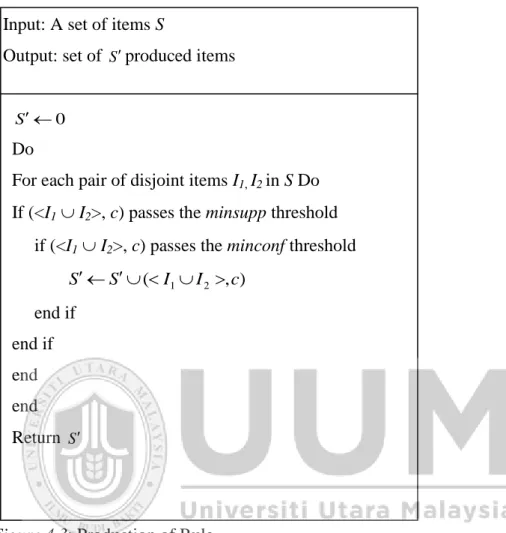
4.3CARs Discovery and Production ... 85
4.4Rule Ranking ... 92
4.5Pruning Method Partly Rule Match ... 93
4.6Joint Confidence Support Class Prediction Method ... 97
4.7Summary ... 101
CHAPTER FIVE ... 102
RESULTS AND DISCUSSION ... 102
5.1Introduction ... 102
5.2Rules Obtained Using Both the MCAR and mMCAR ... 103
5.3Structured Data Set ... 106
5.3.1Prediction Accuracy for UCI Data Set ... 106
5.3.2Number of Rules for UCI Data Set ... 111
5.3.3Win-Loss-Tie Record for UCI Data Set... 114
5.3.4Compression Variation Between AC Algorithms ... 115
5.3.5Computational Time for UCI Data Set ... 116
5.4Unstructured Dataset ... 117
5.4.1Prediction Accuracy for Reuters Data Set ... 118
5.4.2Number of rule for Reuters Data Set... 120
3.4.5The Win-Loss-Tie Record... 123
xi
5.4.5Training and Testing Time for Reuter’s Data Set ... 127
5.5Summary ... 128
CHAPTER SIX ... 129
CONCLUSION AND FUTURE WORK ... 129
6.1Conclusion ... 129
6.2Rule Discovery Algorithm that Reduces Computational Time ... 129
6.3Rule Pruning Algorithm that Reduces the Number of Classification Rules ... 130
6.4Rule Prediction Algorithm that Improves Accuracy ... 130
6.5Future Work ... 131
6.5.1Multi-label in Text Classification ... 131
6.5.2Discretisation... 132 6.5.3Pre-Pruning ... 132 6.6Summary ... 133 REFERENCE ... 134 APPENDIX A ... 142 APPENDIX B ... 149 APPENDIX C ... 150 APPENDIX D ... 151
xii
List of Tables
Table 2.1: Documents possible sets based on a query in IR ... 22
Table 2.2: Training Data ... 25
Table 2.3: Summary of AC algorithms ... 67
Table 3.1: Description of UCI Data Sets ... 72
Table 3.2: Number of documents (REUTERS-21578) ... 73
Table 3.3:Examples of Item Found on Each Line... 75
Table 3.4: Representation of Item ... 76
Table 4.1: Training data set ... 88
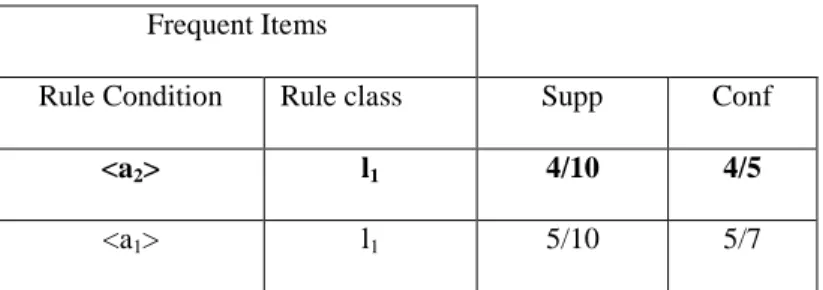
Table 4.2: Frequent Items ... 89
Table 4.3: Example data from Weather Dataset ... 89
Table 4.4: Candidate 1-ruleitemYES ... 90
Table 4.5: Candidate 1-ruleitem NO ... 90
Table 4.6: Candidate 2-ruleitemclass YES ... 91
Table 4.7: Candidate 2-ruleitemclass No ... 91
Table 4.8: Frequent items ... 92
Table 4.9: Rule Ranking ... 93
Table 4.10: Rule Pruning Using Weather Dataset ... 95
Table 4.11: Frequent item and rule ranking for Weather Dataset ... 95
Table 4.12: A Rule-Based Model... 100
Table 4.13: Testing case ... 100
Table 4.14: Applicable Rules for Ts ... 101
Table 5. 1 Training Data Set ... 103
Table 5. 2 Ranked candidate rules produced by MCAR and mMCAR ... 104
Table 5. 3 Sample of rules by mMCAR and MCAR on UCI “Cleve” data set ... 105
Table 5. 4 Sample of rules by mMCAR and MCAR on Reuter’s “acq” data set ... 106
Table 5. 5 The Prediction Clasification Accuracy on UCI Data Sets ... 108
Table 5. 6 The Classification Accuracy Between mMCAR and all Algorithms ... 110
Table 5. 7 The Number of Rules for the UCI Data Sets ... 112
Table 5. 8 The Number of Rules Between mMCAR and all Algorithms ... 113
Table 5. 9 Won Loss-Tie Accuracy for UCI Dataset ... 114
Table 5. 10 Won-Loss-Tie Number of Rules for UCI Dataset ... 114
xiii
Table 5. 12 Training Time for UCI Data Sets Using AC Algorithm ... 117
Table 5.35 ClassificationAccuracy on seven most populated Reuters data sets .... 119
Table 5. 14 Classification Accuracy Between mMCAR and all Algorithms ... 120
Table 5. 15 Number of Rules using different pruning approach ... 121
Table 5. 16 Number of Rules Between mMCAR and all Algorithms ... 122
Table 5. 17 Results on Win/Lose/Tie for accuracy ... 123
Table 5. 18 Results on Win/Lose/Tie for number of rule ... 123
Table 5. 19 The variation of Reuter’s data set between AC algorithms ... 124
xiv
List of Figures
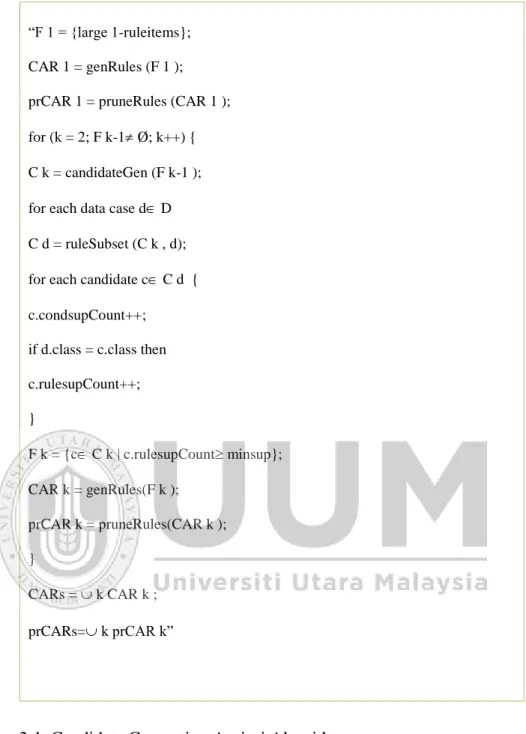
Figure 2.1: Candidate Generation Apriori Algorithm ... 38
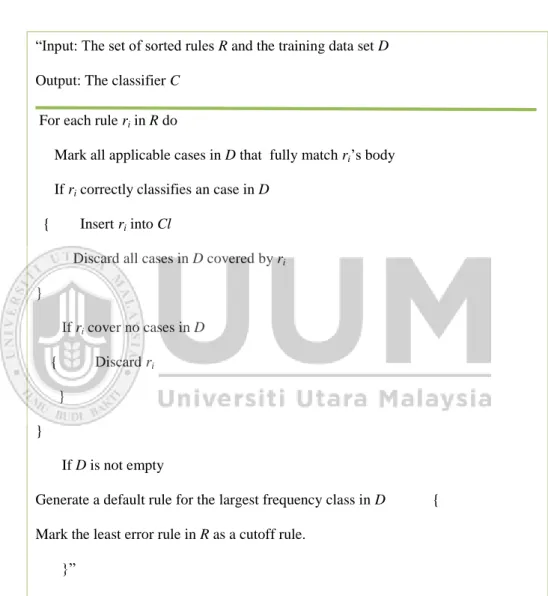
Figure 2.2: Database Coverage Pruning Methods... 44
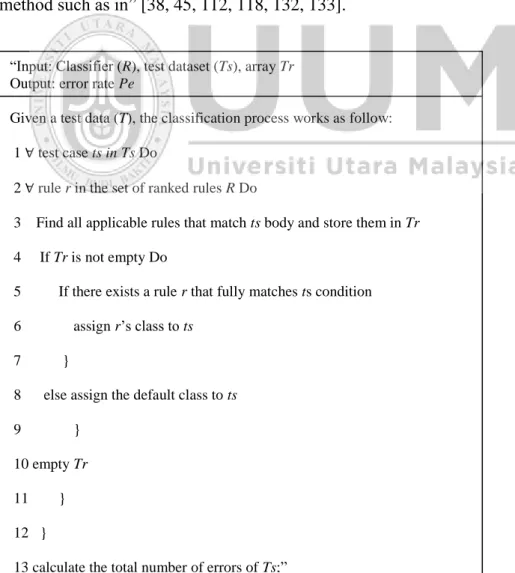
Figure 2.3: Single Rule Class Assignment Methods ... 56
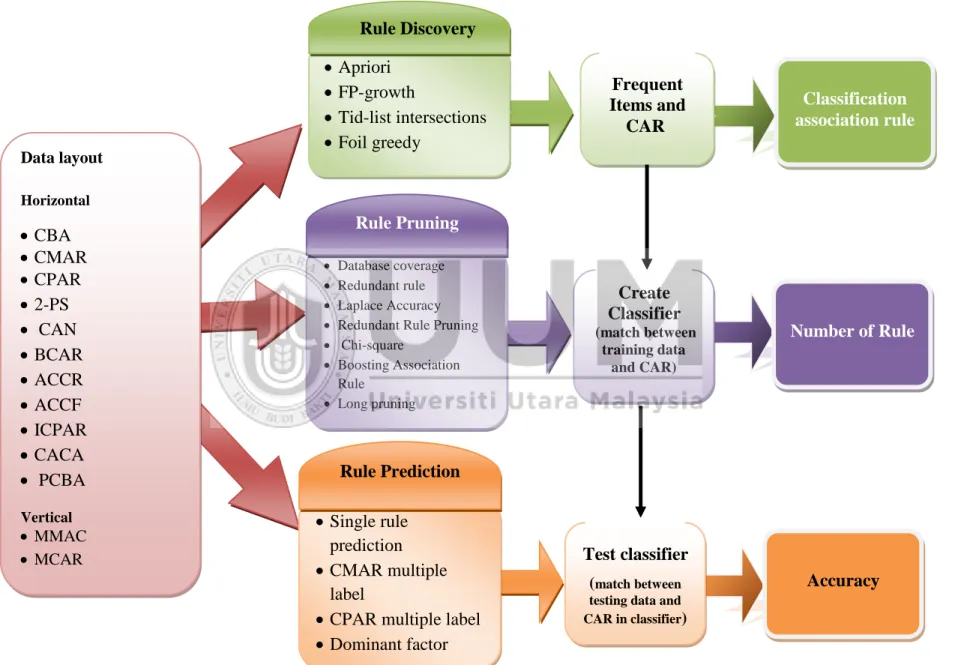
Figure 2.4: Theoretical Framework... 66
Figure 3.1: Research Methodology ... 70
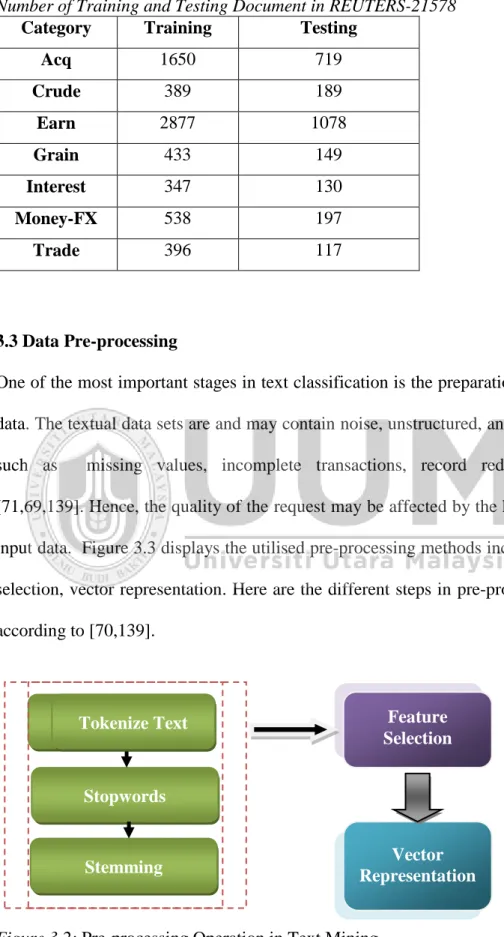
Figure 3.2: Pre-processing Operation in Text Mining ... 73
Figure 4.1: mMCAR Steps ... 84
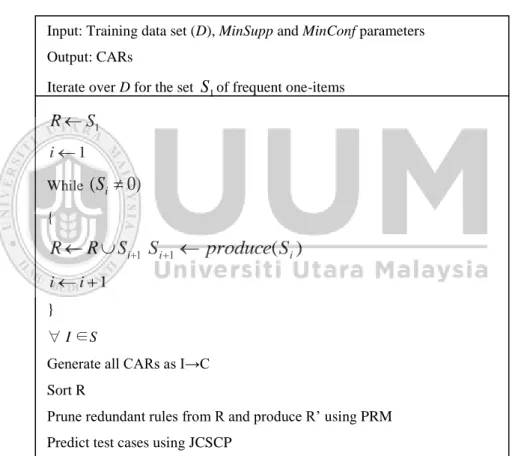
Figure 4.2: The mMCAR Algorithm ... 85
Figure 4.3: Production of Rule ... 87
Figure 4.4: Partly Rule Match Pruning Method ... 96
Figure 4.5: Joint Confidence Support Class Prediction ... 99
Figure 5. 1: Prediction Accuracy on UCI Data sets ... 109
Figure 5. 2: Number of Rules of the considered algorithms on UCI data sets ... 112
Figure 5. 3: Classification Accuracy of Reuters Data Sets ... 119
xv
Dissemination
Most part of this thesis has been published in international scientific journals, and conference proceeding. The list of published papers is provided below.
1. Y. Yusof and M. H. Refai, "MMCAR: Modified Multi-class Classification based on Association Rule," in Proceedings of the International Conference on Information Retrieval and Knowledge Management, Kuala Lumpur, 2012, pp. 6-11.
2. Y. Yusof and M. H. Refai, "Modified Multi-Class Classification using Association Rule Mining," Pertanika Journal of Science and Technology, vol. 21, pp. 205-216, 2013
3. M. H. Refai and Y. Yusof, "Partial Rule Match for Filtering Rules in Association Classification," Journal of Computer Science, vol. 10, pp. 570-577, 2014.
1
CHAPTER ONE
INTRODUCTION
1.1Background
In the field of Computer Science, data mining is one of the main phases in the Knowledge Discovery Database process (KDD). It involves the utilization of discovery algorithms and data analysis to produce particular details of patterns (or models) in the data under acceptable computational efficiency constraints [1-4]. The other phases in KDD are data cleansing, pattern evaluation, data reduction, data selection and visualization of the discovered information[2, 5]. In data mining, one of the main tasks studied is classification [5]. The main objective of classification is to create a model from a group of attributes where every attribute is the target class[6, 7]. This model is then used to forecast the classes of a new group of attributes [2, 8]. Classification has been applied in many areas, for instance medical analysis[9], space exploration[10] and textual mining [5, 8, 11].
Text classification (TC), has been one of the popular task in text mining [12-15], and it involves the understanding, recognition and organization of various types of textual data [16]. The objective of TC is to classify an incoming textual document into a group. The "supervised" learning classification classifies a new document on predetermined input text collection [2]. TC is a multi-phase process that includes processing of the textual documents, classifying the document based on an algorithm and evaluating the produced classification model [17]. A number of dissimilar classification methods are used in TC and these have been adopted from data mining and machine learning, for instance, decision trees [10, 18, 19], Naive bayes [20-22],
2
Support Vector Machine [23-25] and neural network [26].These methods have mainly been investigated and used in the classification of English documents[15, 27, 28].
Alternatively, there is a method in TC that is known as Association classification (AC) [29, 30], which represents a field of research in data mining that combines association rules discovery with classification [10, 31].The main objective of the AC is to build a model that is also known as classifier [32, 33], which consists of a specific amount of knowledge from labelled input, with the intending purpose of predicting the class attribute for a test data case that is accurate as possible [34]. AC is a promising data mining approach, which builds more accurate classifiers than traditional classification technique. This made by integrating association rules mining with classification.
The classifier is usually built based on the content of the training data set, and later been utilized to predict the category for new unseen document [19]. This type of learning is called supervised learning since the input data set contains labelled categories and the search for knowledge is restricted with target categories [24]. Multi class classification divides a training data according to class labels, for each class in the training dataset, rules are built in initially from the training items (depend the minimum support and minimum confident) [18]. One rule may be associated with multiple classes, but only the class with the largest occurrence will be considered by multi class AC methods.
3
In the last few years, several AC algorithms have been developed such as Classification Passed Association Rules CPAR [35], Live and Let Live (L3G) [36], Multi Class Association Rule MCAR [37], CACA [38], BCAR [39], LCA [31] and others. Previous studies have indicated that AC approach produces more accurate classifiers than others data mining approaches such as probabilistic [40], and decision tree [41]. AC unlike traditional data mining methods, such as neural network [42] and probabilistic methods [40], which produce classification models that are hard to understand or interpret by end-user, AC produces rules that are easy to understand and manipulate by end-users [37]. However, AC algorithms usually suffer from the exponential growth of rules which means they derive large number of rules which make the resulting classifiers outsized and consequently limit their use and it may be affiant to understand and maintain them.
Several AC techniques have been proposed in recent years such as CBA [43], CAEP [29] , CMAR [30] , Negative-Rules [44], CPAR [35], Negative-Rules [45] , MMAC [46] , 2-PS [116] , MCAR [37], CACA [38], ACCF , and BCAR [39]. These techniques use several different approaches rules discover, rank rules, rule prune and rule prediction.
Data mining classification, there was only one data format in AC inherited from association rule mining called horizontal [43]. In the horizontal data format, created by the Apriori algorithm authors [47]. Apriori algorithm use multiple data scans when searching for frequent item sets which leads to high computation time. On the other hand, few association rule mining algorithms use the vertical format [48, 49]. The advantage of vertical data representation is when the cardinality of the
4
transactions identification (tid-list) becomes very large, intersection time gets larger as well. This happens particularly for large and correlated transactional databases.
Many rule pruning procedures have been employed in AC to reduce the size of the classifiers, some of which have been brought from decision trees like pessimistic estimation [50] and others from probabilities like Chi-square (χ2)[51]. These pruning methods are used while building the classifier, for instance, an early pruning, which removes rule items that do not survive the support threshold, like database coverage [43]. The rule pruning is responsible about the classifier size (number of rule).
AC has deferent Class prediction or class assignment approaches [36, 37, 39], to appropriate class labels to test case, single rule prediction use one rule to apply in all the test cases, while the other methods use group rule prediction to test case, the single and group rule prediction use the higher rule ranked in the classifier to apply in the test case.
The AC approach uses association rule mining to discover the Classification
Association Rules (CARs) [10]. The problems in AC during the discovery process, a
large number of rules are produced. These rules were redundant especially when the
support threshold that is used is very low [31].Hence, the support threshold is the
key factor, which controls the number of rules produced in AC. Based on that, the
number of extracted rules are small if the support value is high. Thus, the rules are
excluded with the high assurance rule, which may lead to discard the essential knowledge even though it will be helpful in the classification stage. Based on above, the support threshold is set to a very small value to solve this problem. Nevertheless, a large number of rules are generated, even though many of the rules are useless,
5
because they hold assurance values and low support. Several problems may occur due to the large number of rules such and this include over fitting [52, 53].
Furthermore, another problem in AC method is the removal of redundant rules is able to make the classification procedure more effective and accurate [54, 55]. It is not always helpful to get a large number of rules when classify a new test document since this may require long prediction time.
There is a great chance to have more than one rule contradicting each other in the answer class. In the data mining, the primary aim for classification is predicting the class labels of test cases, which can be classified into two main categories. The first category makes the prediction based on multiple rules [10, 35, 56], while the second category makes the prediction based on the highest precedence single rule applicable to the test case [43, 56, 57]. The problem of a single rule prediction is that it will specifically use when there is just single rule applicable to the test case, but there could be multiple rules applicable to the test case making the decision questionable. The main advantage of using multiple rules to predict are rules to contribute the class, which can limit the chance of every single rule for predicting all test the cases to satisfy the rules.
The main goal of this study is to develop a text classifier based on association classification. Particularly, the study presents an efficient method for discovering rules based on intersection sequence that requires only one database scan to generate rules from text collection. Furthermore, the need of progress a new rule pruning method to remove redundant rules (rules that lead to incorrect classification). And
6
later, develop a new prediction method that classifies unseen documents into correct categories.
1.2Research Motivation
Association Classification (AC) is one the methods in data mining that has been effectively used to solve the real world categorization issues such as image processing [58], medical diagnoses [59, 60] and bioinformatics [61]. A number of experimental studies have shown that Association classification is a more accurate method in building classification model [43, 62, 63]. Furthermore, Association classification model produces rules, which may not be discovered using traditional classification algorithms SVM [23] KNN [22] C4.5 [41]; rule sample was attached in appendix C. The AC generates “If-Then” rules which are more comprehensible and controllable for end-users [63, 64].
The applicability of AC classification approach is mainly due to several advantages offered by this approach such as the simplicity of the produced classification model (classifier), a high prediction accuracy and the easy maintenance of the classifier where rules can be easily sorted, added and detached [8, 65].
1.3Research Problem
AC approach usually produces more accurate classifiers than classic classification data mining approaches [36, 37, 39]. It is a data mining approach that have been studied extensively in the last decade and applied in various real world application domains including medical diagnoses [66], market basket analysis [67], security [68] and others. However, for unstructured textual data, AC mining has not yet
7
being thoroughly explored due to the representation complexity and the high dimensional of textual data. Therefore, mining unstructured and high dimensional data sets like Reuter [69] while using AC approach is a challenge.
One common shortcoming of most existing AC algorithms [31, 46, 70-73] is the massive number of rules produced by the classifier. In particular, the number of rules that might be generated in an association rule mining phase could reach thousands if not tens of thousands [27, 46, 74, 75]. Such a huge number becomes impractical and thus can limit their use in applications such as medical diagnoses and text categorization. This is due to utilized rule pruning methods such as database coverage [43] or lazy pruning [34]. Examples of AC that implement these methods includes the CPAR [35], CBA [43] and MCAR [37]. These AC classifiers produce either a high accuracy but with large size of classifier or a small set of rules that generates low classification accuracy. The MCAR [37], in particular, obtained such result due to three factors; a single form of data representation (i.e vertical layout), a rigid rule pruning method that relies on both the precedent and antecedent of a rule, and a single rule prediction.
This study discusses means on improving the MCAR by proposing a rule discovery method that reduces dimensionality through data representation. This is later complimented by a pruning method which eliminates redundant rules. We also provide a procedure of multiple rule prediction that enhances the classification accuracy while the number of rules is minimized.
8 1.4Research Questions
Based on the issues highlighted above, this research will seek to answer the following questions:
How can existing AC methods be improved in order to produce less number of rules without reducing the prediction accuracy?
Will reducing the number of rules have an impact on the model’s accuracy?
Will a change in the class assignment methodology contribute to the prediction rate of the classification model?
1.5Research Objectives
The main goal of this research is to develop a text classifier based on multi-class association rule mining. In order to achieve such goal, this research needs to accomplish the following:
To design a rule discovery algorithm based on intersection of transactions
identification (TID-list), represented using vertical and horizontal data layout to reduce data scanning, which in turn reduces computational time.
To design a rule pruning algorithm based on database coverage pruning
method that eliminates redundant rules and reduces number of rules.
To design a group based class prediction algorithm that enhances
9 1.6 Research Scope
The scope of this research focus on both structured and unstructured textual collections. For unstructured data set, the Reuters-21578, which is a commonly used text collection in data mining [69] that contains 21578 Reuter's news documents is utilized. The news documents in this data set are about different subjects such as 'people', 'places' and 'topics'. The total number of categories is 672. For the structured data sets, we have selected fourteen data sets from UCI data repository [76] that have different number of training cases and attributes.
The proposed AC algorithm is evaluated by comparing its results with existing AC and rule-based classification algorithms such as C4.5, MCAR and PART. The bases of the comparison are textual evaluation measures test that includes accuracy and the number of rules for the structured data sets (UCI data), as well as the unstructured data set (Reuters).
1.7Research Contributions
A summary of the contributions of this research are as follows:
1. An AC data mining algorithm that operates on structured and unstructured data.
2. A rule discovery algorithm that uses TID-list intersection to reduce time for create frequent rule item.
3. A rule pruning algorithm that reduces the size of the classifier.
4. A rule prediction algorithm that improves classification accuracy by developing new group of rules if relevant.
10 1.8Thesis Organization
This thesis is organized into 6 chapters including this chapter. The following paragraphs provide brief descriptions of the remaining chapters of this thesis.
Chapter Two includes literature review on the classification and association rule discovery approaches in data mining. It is also discusses various approaches used by AC to discover frequent item, rule pruning and prediction method.
Chapter Three presents the research methodology of this research, which describes the methods and tools that were used in this research, moreover, describes the experimental phases for the performance association classification algorithms.
Chapter Four presents the proposed Modified Multi Class Association Rule (mMCAR). The chapter should illustrate detailed experimental on UCI data collection and Reuters. Through this chapter will determine all the steps of experimental, and identify clearly the methods that will be used in the experimental.
Chapter Five Presents the results for the experiments conducted for structured and unstructured data.
Structured data use UCI data sets, for unstructured Reuters-21578 dataset. The evaluation measure will be number of accuracy number or rule and computational time and breakeven point.
Chapter Six, Provide a summary of the entire thesis, including the research contribution and gives suggestions for the direction of possible future works with regards to this research.
11
CHAPTER TWO
RELATED WORK
2.1Introduction
This chapter introduces the essential concepts related to the concerns of this research as well as discusses related work relevant to this research. In doing so this chapter will focus on the following six main categories; In first section, data pre-processing will identify the methods to process the unstructured data. In text classification section, will introduce the most popular approaches, then will be describe the techniques that used to assess the classifier in the section of evaluation measures in text classification. Furthermore, Association classification section reviews association classificatioon approaches which iclude association rules btechniques, pruning methods in Association classification and the prediction methods.
2.2Data pre-processing
The first process in TC involves the transformation of documents which are called unstructured data; this is done by doing a bag word [77, 78] which removes any unnecessary data and numerical vector representation [79] to represent the data numerically, to makes it suitable for the learning algorithm and classification task. The next two sub-sections discuss these two methods.
2.2.1 A Bag of Word Representation
The most basic way of representing documents in a structured form is through representing documents in a structured form is through the “bag of words” method.
12
A ‘bag of words” is a set of words which are not ordered and inconsistent in their
size, depending on the length of a given document. A bag of words is denoted by Djc = {Wj1, Wj2, Wj3,…,Wjn} where j is an index of a particular document and n is the size
of the set of words. The transformation of a document into a bag of words involves three steps [77]. The first step is called Tokenisation, whereby the document is segmented into tokens by white space. The second step, called stemming involves the conversion of each token into its root (stemming). For example, plural nouns are changed into singular forms and past tense verbs are changed into their root. Finally, the last step called stop word elimination, involves removing words which perform just grammatical functions regardless of the content of the text. These words contain prepositions, conjunctions, particles, auxiliary verbs, and so on. When these three steps are completed, a structured list of words representing a document is produced.
2.2.2 A Numerical Vector Representation
When an unstructured document is represented in structured form, each distinct word corresponds to a feature and the number of times a particular word occurs in the document corresponds to its value. The words, which are selected as features of the numerical vectors, are denoted by W1, W2…, Wn. However, this representation scheme results in very high-dimensional feature spaces which may contain 10,000 dimensions or more[79]. Thus, in order to avoid unnecessarily large feature vectors, researchers have suggested several methods for feature selection, such as mutual information[80], chi-square[80], frequency based method [80], and information theory based method[81].
13
Three common methods are used to define feature values in numerical vectors. The first method uses a binary value that is, zero or one, for each word. Zero indicates the absence of the word while one indicates the presence of the word in a given document. The second method uses the frequency of every word in each document as its value. In this way, each element is an integer. The third method uses the weight of each word, wk (1≤ k≤ n), as a feature value, based on any term weighting
method such as Inverse Document Frequency
(
IDF) or Weighted Inverse DocumentFrequency (WIDF) [82, 83]. The next two sub-sections will discuss the nature of term weighting approaches and feature selection methods.
2.2.2.1Term Weighting
Term weighting, an important issue in TC, has been widely investigated in information retrieval (IR) [51, 84, 85]. Term weighting refers to value given to a term in order to reflect the significance of that term in the document.
A. Term Frequency
Tokunaga [82] defined Term Frequency as the simplest term weighting methods which is applied to examine the significance of each term in a given document. It is assumed that by using TF method, the term has a value relative to the number of times occur. Usually, for a term t and a document d, the following equation is used to calculate the weight of t in d:
W (d, t) = TF (d, t) (2.1)
According to Rijsbergen [86] that the TF method can be used to enhance the TC and IR assessment measure called recall. Recall is represented in the form of an equation (2.13).
14 B. Inverse Document Frequency
While TF reflects the importance of a term in a single document, however, it does not reflect the occurrence of a term in a set of documents. In this regard the Inverse Document Frequency method (IDF) offers a solution. Inverse Document Frequency (IDF), means the importance of each term is inversely proportional to the number of documents that contain that term.
Equation 2.2 defines the IDF when the term t is within n documents as following: IDF (t) = log (N/n) (2.2)
Slaton combined the TF and IDF [87] in terms of mass and this approach resulted in better performance when compared to other techniques. The combination of product TF IDF is given in equation (2.3)
W(d, t) =TF (t).IDF (t) (2.3)
C. Weighted Inverse Document Frequency
One of the weaknesses of IDF is Binary Counting [20]. Binary counting treats each term in the documents equally. This weakness can be overcome through the Weighted Inverse Document Frequency (WIDF) algorithm. The WIDF of a term t in a document d is given as:
D i t i TF t d TF t d WIDF ) , ( ) , ( ) , ( (2.4)15
Where TF(d ,t) is the occurrence of t in d, and i indicates the range over the documents in the collection D. However, during the collection to the normalized term frequency, WIDF weight of a term is given as:
W (d, t) =WIDF (d, t) (2.5)
Based on that, it is pertinent to note that studies on the above mentioned term weighting approaches have indicated that these approaches have produced good results when used on English text collections [20, 82, 88].
2.2.2.2Feature Selection and Dimensionality Reduction
This procedure refers to a process of selecting the best K terms as a subset of the terms occurring in the training set and using only this subset as features in TC. This procedure results in the achievement of two main goals. Firstly, it trains more efficiently through decreasing the high dimensionality of the effective vocabulary. Secondly, it frequently increases classification correctness by removing rare terms[20]. There are many attribute selection methods available such as Document Frequency (DF), Information Gain (IG) [89], and Chi-square Testing (χ2) [90]. The following sub-sections will discuss these methods.
A. Chi-square Testing
Snedecor [90] stated that the chi-square testing (χ2) is “a well-known discrete data hypothesis testing method in statistics”. It determines if the variables are correlated
or independent by assessing the correlation between two variables. The independence test, implemented to a population of subjects will determine whether the variables a negatively correlated or vice versa. Thus, the following equation (2.6) can be defined by the χ2 value for each term t in a category c accordingly:
16 ) )( )( )( ( ) ( 2 D C B A D B C A CB AD N c t X 2 (2.6)
Where C is the number of documents in c not containing t, the total number of training documents is N. A refers to the number of documents in c containing t, and B is the number of documents not in c containing t, while D is the number of documents not in c not containing t. χ2 . This test was used by Yang and Padersen [80] in TC and showed promising results.
B. Information Gain
Information Gain (IG) is a method commonly used to measure goodness in machine learning. The goodness value refers to the amount of information gained when a prediction is conducted with the presence or absence of a term in a document.measure in the field of machine learning [89, 91]. It measures the amount of information gained for category prediction as a function of the presence or absence of a term in a document. IG is formulated in the following equation: 2.7.
) , ( log ) , ( ) ( ) , ( log ) , ( ) ( ) ( log ) ( -IG(t) 1 1 1 i m i i i m i i i m i i P c P t P t c P t c P t P t c P t c c P
(2.7) In this equation m is the number of categories, P(ci) is the probability of the
category ci.
P(t,ci) is the joint probability of the category ci and the occurrence of the
term t.
P(t) is the probability that the term t occurs in a document, and P(t ) is the
17 2.2.2.3Document Frequency
The Document Frequency (DF) method basically measures how many documents contain a particular word. To do this, it is necessary to compute the DF for each unique term in the training documents and remove those terms whose DF is lower than a predetermined threshold. The selection of frequently occurring words will improve the chances that these features will be presented in future test cases. In a study carried out by Yang and Pedersen[80], it was shown that DF performance is better than Mutual Information. However, it is often dominated by IG and Chi square measures.
The previous sections have discussed the advantages and disadvantages of the various procedures available in data mining. The next section will proceed to review learning Approaches to text categorization.
2.3Text Classification
In the field of data mining and machine learning a number of Text Classification (TC) approaches exist., These approaches include Decision Trees [41], Support Vector Machine [92], Naïve Bayes [40], and Neural Network [26]. In the next sub-sections, TC methods will be discussed.
2.3.1K-nearest Neighbor
KNN is a statistical classification approach, which has been intensively studied in prototype detection for over four decades. KNN has been successfully applied to TC problems [93-95] and shows promising results when compared to other statistical approaches such as Baysian based Network [6, 96].
18
The KNN algorithm is quite simple. In a given situation of training and testing documents, the KNN algorithm will proceed to find the k-nearest neighbours amid the training documents, as well as uses the categories of the k-neighbours to weight the category of the test document. The evaluation scores of every neighbour document to the test document are used as a weight of the categories of the neighbouring document. If many k-nearest-neighbours share a category, then the pre-neighbour weights of that category are added together, and the resulting weighted sum is used as the probability score of that category with respect to the test document. By sorting the scores of the candidates’ categories, a ranked list is
obtained for the test document [80, 93].
Actually, the value of K is fixed beforehand in the traditional kNN algorithm, while, the big classes will overwhelm small ones if k is too large. According to Jirng [97] refers that the advantage of kNN algorithm, which could make use of many experts, will not be exhibited k is too small, actually, could make use of many experts. Other issues in kNN are similarity and distance measures, computational complexity, dimension reduction feature selection [98]. KNN requires more time for classifying objects when a large number of training examples are given. KNN should select some of them by computing the distance of each test objects with all of the training examples. Practically Othman [99] compared five algorithms of classification using breast cancer dataset. The mean of total Error for K-nearest Neighbour was 32.3840% and Root Relative Squared Error 79.496%, the time taken to create the classifier 0.81 second.
19 2.3.2Naive Bayesian
As indicated by Thabtah [20] and Hadi [100] Naive Bayesian is a simple probabilistic classifier based on applying Baye's theorem [101]. It is a predictive, easy and language independent method [102, 103].
In the study conducted by Othman [99] five algorithms of classification using breast cancer dataset were compared., Using the Bayesian classifier, the Mean Absolute Error for NB was 22.2878 % and Root Relative Squared Error 65.1135 %. The time taken to create the classifier is 0.19 seconds.
NB classifier is not very robust to classify noise since independence of the attributes is not preserved. problem related to NB is its inability to classify noise [104].
2.3.3Decision Trees
According to Quinlan [41], the most popular decision tree learning program is C4.5. This approach begins by selecting the best attribute as a root node, where each branch of the root corresponds to one of its possible value. The process is then repeated on each branch until no examples are left in the training data set. In order to decide which attribute is to be selected at each step, information gain (IG) is used [89]. The attribute with the highest gain is chosen as the node. In an informal situation, IG measures how good an attribute separates the training set with respect to the class labels. Therefore, the higher the gain, the better the separation resulting from classifying training examples on the associated attribute. In a formal situation, IG provides equations for computing information gain Joachims [79] Mitchell[91] applied C4.5 and other TC methods in two data sets, and the results showed that the
20
C4.5 procedure produced competitive results if compared with other methods such as KNN[93], SVM[92] Rocchio [105].
In the study conducted by Othman [99] the Mean Absolute Error for Decision Tree was 39.2681% and Root Relative Squared Error 73.57%. The time taken to create the classifier 0.23 seconds.
In classification, while the aim of reducing the error rate to zero, requires a long training phase, which may deteriorate in general performance of the resulted classifier on test data objects. The general description of the over fitting problem, which can occur due to many reasons such as a noise among the training objects or limited number of training data objects [106]. In decision tree algorithms for instance, it is possible to construct a highly accurate decision tree for the training data, but, during the construction of the tree it is usually useful to stop the building process early in “order to generalise the performance of the outcome on test data
objects. Therefore, pruning approaches like pre-pruning and post-pruning [18] have been widely used during building decision trees” in order to provide accurate
performance on test data and to avoid over fitting the training data very well.
2.3.4Support Vector Machine
Support Vector Machine SVM was introduced by Vapnik, [92] as a class of supervised machine learning techniques. It is based on the principle of structural risk minimisation. In linear classification, SVM creates a hyper plane that separates the data into two sets with the margin. A hyper plane with the maximum-margin has the distance from the hyper plane to points when the two sides are equal.
21
In mathematical terms, SVMs learn the sign function f(x)sign(wxb), where w
is a weighted vector inR . SVMs find the hyper plane n ywxbby separating the
space R into two half-spaces with the maximum-margin. Linear SVMs can be n widespread for non-linear problems. To do so, the data is mapped into another space
H and the linear SVM algorithm is performed over this new space. In recent times
SVM has been successfully used on TC [79] and they produce better results with reference to accuracy when compared to other machine learning techniques such as NB, decision trees, and KNN. support vector machine (SVM) problems the high-dimensional classification [107].
There are main two issues in SVM. First, it is applicable to only binary classification. If a multiple classification problem is given, it must be decomposed into multi binary classification problems using SVM. The second issue is the sparse distribution, representing documents into numerical vectors, training examples generates zero values very frequently and since inner products of its input vector [108].
2.4Evaluation Measures in Text Classification
Most existing TC techniques use the popular error-rate method [42,149,150] to estimate the effectiveness of their classifiers. Basically, the classifier predicts the class of a test data case, which is an error if not counted, and right or success if it is counted. However, the overall error on the data is gotten when the total number of cases in a test data is divided into number of error cases. Hence, prediction accuracy is measured by the error-rate of a classifier on a test data set.
22
Precision is a method for evaluation used in TC. Moreover, in the IR field, the precision was presented together with the Recall method [86]. Recall and Precision work as follows: as the first step, they have a query through a collection of objects/documents. Several of the objects relate to the query and some of other objects are not. It can make two kinds of mistakes that are false negatives and false positives. Precision measures the proportion of correct answers from all those that were retrieved while recall measures the proportion of correct answers retrieved from the set of all correct answers.
Generally and with respect to a given query, documents can be divided into four different sets as shown in Table 2.1.
Y X X precision (2.8) and Z X X recall (2.9) Table 2.1
Documents possible sets based on a query in IR
In the case of classification problems in data mining, precision functions similarly to accuracy and problems can be described in terms of class by class or globally. However, to derive precision, the number of cases classified in the class can divide the number of correct classifications, within each class. In the test, the total number
Iteration Relevant Irrelevant
Documents Retrieved X Y
23
of cases set can divide the number of correct classifications, which will refer to the precision. Nevertheless, recall method shows better results when is performed class-by-class. For example, the number of cases divides the correct classifications, which should have been classified in that class to obtain recall.
Provost and Kohavi [109], proposed a universal method called confusion matrix in the case of binary classification that count the cost of wrong prediction. Confusion matrix is like a precision and recall methods in that it consist of information about actual and predicted classifications carried out by the classifier. The performance of the resultant classifier is commonly evaluated using the data in the matrix.
Table 2.1 illustrates a confusion matrix where “Documents Retrieved” and “Relevant” represent the class “yes” while “Documents not Retrieved” and “Irrelevant” represent class “no”. In Table 2.1, “X” corresponds to what is so called
true-positive and represents the number of cases when the predicted outcome matches the actual class for class “yes”. “Y” represents the outcome when it is incorrectly predicted as “no” when it is in fact “yes” and is called false-positive. “Z” represents the outcome when it is incorrectly predicted as “yes”, when it is in fact “no” and is called false-negative. Lastly, “W” is known as true-negative and represents the number of cases where the predicted outcome matches the actual class for “no”. The accuracy on a data set can be obtained by adding the values of “X” and “W” from the confusion matrix of that data set.
24
On the whole, TC researches, including those carried out by [20, 39, 79, 93] use the error-rate (accuracy) method. In addition through using Precision, Recall, and F1 the effectiveness of their classifiers is improved.
2.5Association Classification
Association Classification (AC) is based on the association of rules. It is an integration of the two significant data mining tasks, namely, association and classification. The AC approach works in the following way. Firstly, all rules that satisfy user-specified restrictions (minsupp, minconf), are produced using an association rule mining algorithm. However, since the number of rules generated run into several thousands, and furthermore many of them are both redundant and not discriminative among the classes, they need to be pruned using pruning procedure(s). At this stage a number of rules can be reduced. The rules that are left are the interesting ones that will form a model (classifier) used to classify new data. However, each one of the classifiers should have a defaulting rule which is useful when no classifiers rule preserve to be used.
If ruleitems satisfy minsupp they are said to be frequent ruleitems. In general, the item has passes minsupp in association rule mining will be known as a frequent item set. If the frequent itemset consists of only a single attribute value, it is said to be a frequent 1-itemset.
25 Table 2.2
Training Data
For example, with a minsupp of 20%, the frequent 1-itemset in Table 2.1 are < (AT1, z1)>, < (AT1, z2)>, < (AT2, w1)>, < (AT2, w2)> and < (AT2, w3)>. A ruleitem is a combination of itemsets and a class label in the form T1, T2 …Tm →c where Ti is a
set of itemsets and c is a class. If a ruleitem is passing confident, then it is called an accurate ruleitems.
It is the case that at present, AC methods generate frequent ruleitems by scanning a few times over the training data set. However, with the first time scan will identify the support of 1- ruleitems then to be frequent in the previous scan they start with the ruleitems that are found, so as to generate new possible frequent ruleitems that increase more attribute values. In other words, frequent 1- ruleitems is used to discover frequent 2- ruleitems, and frequent 2- ruleitems is the input for the discovery of frequent 3- ruleitems and so forth. After all the frequent ruleitems have been discovered, based on algorithms of association rules, the process of
Row# AT1 AT2 Class
1 Z1 W1 P1 2 Z1 W2 P2 3 Z1 W1 P2 4 Z1 W2 P1 5 Z2 W1 P2 6 Z2 W1 P1 7 Z2 W3 P2 8 Z1 W3 P1 9 Z2 W4 P1 10 Z3 W1 P1
26
classification is carried out. Thus, extracting a complete set of class-association-rules (CAR) from those frequent ruleitems that excused the minconf threshold.
Liu [43] proposed one of the first algorithms to combine association rules with classification. In fact, there are two main phases in the process, Apriori algorithm [47] is implemented in phase one to discover frequent ruleitems, and stage two involves building the classifier. Experimental results indicate that the approach developed in [43] produced rules which are competitive to popular learning methods like decision trees [41].
It has been pointed out that when classification and association rule mining are combined, it is possible to produce efficient and accurate classification systems[43, 46] . This is evidenced by the fact that a number of empirical studies have shown that AC is often capable of building more accurate classification systems compared to traditional classification techniques. [34, 43, 46, 52, 110, 111]. In addition, AC create rules being easy to recognize and influence by end-users, unlike neural network and probabilistic approaches which are produce classification models that are hard to understand or interpret by end-users, when the association classification models generates IF Then rules which are more comprehensible and controllable for end user. However, one shortcoming of AC algorithms is that they have been investigated mainly on classic classification benchmarks such as UCI Archives [76], which are simple and medium sized data sets. In other words, AC has yet to be applied on large and complex data collections such as TC in order to evaluate its effectiveness and efficiency. Thus, one of the ultimate objectives of this thesis is to extend existing AC approach on large and unstructured data collections (TC).
27
Several AC techniques have been proposed in recent years, such as CBA [43], CAEP [29], CMAR [30], ARC-AC [44], CPAR [35], MMAC [46] , 2-PS (Qian et al.,2005), MCAR [37], CACA [38], ACCF [112], BCAR [39], and ACN [45]. These techniques use several different approaches to discover rules, prune redundant and classify new test cases. The next sub-sections present a survey of common Association algorithms in data mining.
2.5.1Classification Based on Association Rule
One of the earliest studies that illustrated the utilisation of association rule in classification benchmarks is Classification Based on Association Rule (CBA)[43]. The CBA implements the Apriori algorithm [47] to discover frequent ruleitems. This stage is called candidate generation. The frequent ruleitems are (<attributes, values>, class) that exceeds minsupp. Then, these frequent ruleitems are used to produce the complete set of CARs, which are then used to form the classifier. This stage is called classifier building.
There are various processes involved in candidate generation (Apriori algorithm) and the classifier building steps of CBA. In the candidate generation stage, the search for frequent 1- ruleitems is first carried out following which the disjoint frequent 1- ruleitems are combined to form candidate 2- ruleitems. This process is repeated until no more frequent ruleitems can be found. In fact, CBA focuses on a special subset of association rules whose right-hand-side is restricted to the class attribute. The CARs are rules whose consequents are limited to the class label in a form A→ciwhere A is
28
Furthermore, the CBA classifier is created when CARs are first produced following which, a subset is chosen to form the classifier. The algorithm first ranks all the derived CARs according to the ranking procedure. The rule gets an opportunity to be inserted into the classifier if it correctly covers at least one training data case. If a rule is inserted into the classifier, all cases inside the training data that are covered by the inserted rule are removed. This process is stopped when all training data cases are covered by some rules or all candidate rules are used. When this happens, the majority class among all cases left in the training data is selected as the default class.
The CBA uses only a single minimum support in rule generation, which is inadequate for unbalanced class distribution, and classification data often contains a huge number of rules, which may cause combinatorial explosion. For many datasets, the rule generator is unable to generate rules with many conditions, while such rules may be important for accurate classification.
2.5.2Multi-class Classification based on Association rule
The Multi-class Classification based on Association rule (MCAR) [37] focuses on the rule ranking scheme which ensures that rules with high assurance are kept for prediction. MCAR consists of two major stages, namely, rules production and classifier building.
In the first stage, “the training data set is scanned once in order to discover frequent
one-ruleitems, and then MCAR combines the ruleitems generated to produce candidate ruleitems that involve more attributes. Any ruleitem with support and
29
confidence larger than minsupp and minconf, respectively, is created as a candidate rule. In the second stage, the rules created are used to build a classifier based on their effectiveness on the training data set. Only rules that cover a certain number of training cases are kept in the classifier.”
MCAR continues with two type of data, integers and real [113]. Through the scan, frequent 1-ruleitems are determined, and their occurrences in the training data (rowIds) are indexed inside an array in a vertical format. In addition, classes and their frequencies are indexed in an array. Any ruleitem that fails to pass the support threshold is discarded. MCAR drive the produced function to locate frequent ruleitems of size k by appending disjoint frequent itemsets of size k-1 and intersecting their rowIds. Based on above, the frequent ruleitems detection method in work by MCAR scans the training data set for counting the frequencies of 1-ruleitems in order to determine those that hold enough support.
Furthermore, the result of a simple intersection between rowIds of two itemsets gives a set, which holds the rowIds where both itemsets happened together in the training data. This set along with the class array, can hold the class labels of frequencies and is used during the first scan, can be created to count the support and self-confidence of the new ruleitem that results from the intersection. The produce function is increase iteratively for every set of frequent itemsets produced at iteration K in order to produce probable frequent ruleitems at iteration K+1. As [114] [36] point out, since the number of rules generated by AC can be large, it is important to select a suitable rule set for forming the classifier.
30
Generally, in AC, the rule ranking is based on the cardinality of the rule’s antecedent, support, and confidence. The advantage of MCAR is that it contributes further to previous rule ranking approaches by looking at the class distribution frequencies in the training data and prefers rules that are associated with dominant classes.
The strength of MCAR is its ability to generate rules with multiple classes from data sets where each data objects is associated with just a single class.
2.5.3Classification based on Multiple Association Rules
According to Li [30], another AC algorithm that selects and analyses the correlation between high confidence rules, instead of relying on a single rule is the Classification based on Multiple Association Rules CMAR algorithm. It stores rules in a prefix tree data structure known as a CR-tree. The CR-tree store all rules in a descending order depend of the rule frequency of their attribute values appearing in the rule occurred. The first rule is generated; it will be inserted into the CR-tree as a path from the root node. Its support, confidence and class are stored at the last node in the path. When the second rule is inserted into the tree and it contains common features with another existing rule in the tree, the path of the existing rule is extended to reflect the addition of the new rule.
The CMAR uses a set of related rules to make a prediction decision by evaluating the correlation among them. The CMAR algorithm adopts the chi-square testing in its rules discovery step. When a rule is found, CMAR tests whether its body is
31
positively correlated with the class. If a positive correlation is found, CMAR keeps the rule, otherwise the rule is discarded.
In addition, a new prefix tree data structure called CR-tree which handles the set of rules generated and speeds up the retrieval process of a rule has been introduced. The CR-tree has proven to be effective in saving storage since many condition parts of the rules are shared in the tree. Experimental tests using CMAR [30], CBA [43] and C4.5[18] on different data sets[76] have shown that the classifiers generated by CMAR are more accurate than those of C4.5 and CBA on 50% of the benchmark problems considered. Furthermore, the results revealed that 50%-60% of space can be saved in the main memory using the CR-tree when compared to CBA.
Scan the training data two times will give the time consumed to find the complete set of rules that meet certain support and confidence thresholds, and then it scans the training data set again to construct an FP-tree.
2.5.4Classification based on Predictive Association Rule
Another AC algorithm called Classification based on Predictive Association Rule Classification based on Predictive Association Rule (CPAR) is also available for data mining according to Yin and Han [35]. Quinlan and Cameron-Jones [18] stated that, CPAR adopts FOIL in generating the rules from data sets, to find the best rule condition that generates the biggest gain between the available ones in the data set. It condition is identified; the weights of the positive examples associated with it will be deteriorated by a multiplying factor. This procedure will be repetitive until all positive examples in the training dataset are covered. The searching process for the