THE EFFECT OF FIRM SIZE, PROFITABILITY, LEVERAGE AND BOARD SIZE ON DISCLOSURE OF CORPORATE SOCIAL RESPONSIBILITY IN
&203$1<¶6 $118$/ 5(32576
by:
Frily Ansyelia Wagiu1
Peggy A. Mekel2
1,2,3
Faculty of Economics and Business, International Business Administration (IBA) Program
University of Sam Ratulangi Manado email: 1[email protected]
2
ABSTRACT
The important aspect in economics that has to be considered by company when reached achivement in expending their business in Global competition is corporate social responsibility or CSR, many manufactured companies listed on Indonesia stock exchange who have been taken advantages from public environment. This study tries to prove the importance of CSR disclosure by using four variables: firm size, profitability, leverage and board size that have been tested in previous researches which predicted by author will give positive result on CSR disclosure. Research method that had been used for this research is associateed with multiple linear regression analysis technique. The sample in this study is a company listed on the Indonesia Stock Exchange (BEI) in the year 2005 to 2008, published in the Indonesian Capital Market Directory (ICMD) 2009-2012 and data collection method obtained through the website owned by BEI, ie www.idx.co.id, BEI in Mega Mas Manado and in Faculty of Economics, Sam Ratulangi University and Indonesian Capital Market directory (ICMD). The result of this research shows positive impact of firm size and board of commisioner size and negative impact of profitabilty and leverage on CSR disclosure partialy. Therefore, company should consider about the CSR Disclosure since it is the most crucial part of the company and how the company should revealed their self to the public.
Keywords: firm size, profitabilty, leverage
INTRODUCTION Research Background
The idea of social responsibility is basically how companies pay attention to the environment, the impact caused by the operations of the company. In addition to generating profits, companies have to help solve social problems related or not companies have created the problem even if there cannot be a potential short-term gain or long term. The concept of CSR is generally stated that the company's responsibility not only to its owners or shareholders, but also to the relevant stakeholders and / or affected by the existence of the company. CSR activities of companies that run the company's operations will consider the impact on the social and environmental conditions and strive to be a positive impact.
The growing stakeholder pressure in terms of CSR disclosure practices by the company led to the need to incorporate an element of corporate social responsibility in accounting. This led to the birth of a concept called Social Accounting, Socio Economic-and Social Responsibility Accounting Walker and Kent (2009). With the birth of social accounting, accounting product can also be used by management as a means to take responsibility for corporate social performance and provide information useful in decision making for stakeholders. Furthermore, the CSR in Indonesia is regulated in Law Number 40 of 2007 on Limited Liability Companies. Article 74 paragraph 1 of the Act states that "the Company is conducting its business activities in the field and / or related to the natural resources required to carry out social and environmental responsibility".
In Law No. 25 of 2007 on Investment, Article 15 (b) states that "every investor is obliged to carry out corporate social responsibility".
The importance of CSR disclosure has led many researchers to conduct research and discussion on the practice and motivation of companies to do CSR. Several studies related to the disclosure of corporate social responsibility has been done on the factors that influence CSR disclosure. Among the factors that become variables in the study are firm size, profitability, leverage and board size Karen, et.al (2005)
Effect of firm size on CSR disclosures are reflected in agency theory that explains that the big companies have big agency costs, therefore large firms will disclose more information than smaller companies. However, not all studies support the relationship between firm size and corporate social responsibility. Another factor that is thought to affect the profitability of CSR disclosure. Another factor affecting the disclosure of CSR is the board of commissioners. By the authority vested in, the board of commissioners may provide a strong enough influence to pressure management to disclose CSR.
Research Objectives
There are some objectives have to be achieved in this research which is to analyze the influence of:
1. Firm size, profitability, leverage and Commisioner board size on CSR disclosure of manufacturing companies listed in Indonesia Stock Exchange
2. Firm size on CSR disclosure of manufacturing companies listed in Indonesia Stock Exchange. 3. Profitability on CSR disclosure of manufacturing companies listed in Indonesia Stock Exchange 4. Leverage on CSR disclosure of manufacturing companies listed in Indonesia Stock Exchange
5. Commisioner board size on CSR disclosure of manufacturing companies listed in Indonesia Stock Exchange
THEORITICAL FRAMEWORK Theories
Stakeholder Theory
One strategy to maintain the relationship with the stakeholders of the company is to implement CSR, the CSR is expected willingness of stakeholders can be accommodated so that it will produce a harmonious relationship between the company and its stakeholders. Harmonious relationship will result in the company can achieve its sustainability or sustainability Freeman and McVea (2001).
Agency Theory
Agency theory assumes that all individuals acting on their own interests. So there is a conflict of interest between owners and agents as possible agents do not always act in accordance with the interests of the principal, thus triggering the agency cost (agency cost). Being the agent is assumed to receive satisfaction in the form of financial compensation and the terms that accompany the relationship Jensen and Meckling (1976).
Corporate Social Responsibility (CSR)
The idea of social responsibility is basically how companies pay attention to the environment, the impact caused by the operations of the company. Furthermore according to the states "in addition to generating profits, companies have to help solve social problems related or not companies have created the problem even if there cannot be a potential short-term gain or long-term (Moir, 2001).
Firm Size
Agency theory states that large firms have greater agency costs than small firms Abigail, et.al (2001). Therefore large companies will disclose more information in order to reduce the agency costs.
Profitability
Profitability is a factor that gives the freedom and flexibility to management to disclose social responsibility to the shareholders. This means that the higher the level of profitability of the company, the greater the social disclosure made by the company Abigail, et.al (2001).
Leverage
According to the agency theory, the management company with a high level of leverage will reduce social responsibility disclosure made in order not to be the spotlight of the debt holders Rahim, et.al (2011).
The Size of the Board of Commissioners
As a representative of the principals in the company's board of commissioners may affect the extent of disclosure of social responsibility is because the board of commissioners is the highest executive in the firm Abigail, et.al (2001).
Previous Researches
Dahlsrud (2008) Exemined there are many available definitions of CSR and they are consistently referring to five dimensions. Although they apply different phrases, the definitions are predominantly congruent, making the lack of one universally accepted definition less problematic than it might seem at first glance. The CSR definitions are describing a phenomenon, but fail to present any guidance on how to manage the challenges within this phenomenon. Therefore, the challenge for business is not so much to define CSR, as it is to understand how CSR is socially constructed in a specific context and how to take this into account when business strategies are developed. Heledd and Natalia (2006) Argued CSR in their research about Corporate social responsibility in the mining industry: Exploring trends in social and environmental disclosure. In recent years, concerns about the sustainability and social responsibility (CSR) of businesses have become an increasingly high profile issue in many countries and industries, none more so than the mining industry.
Source: Theoretical Review 2014
Figure 1 Conceptual Framework
Partially Simultaneously Firm Size (X1)
Profitability(X2)
Leverage(X3)
Commissioner Board Size(X4)
CSR disclosure in manufacturing
Research Hypothesis
The hypotheses of this research are :
H1: Firm size, Profitability, Leverage and Commissioner Board Size Influance CSR disclosure of manufacturing companies listed in Indonesia Stock Exchange Simultaneously.
H2: Firm size Influances CSR disclosure of manufacturing companies listed in Indonesia Stock Exchange in Manado Partially.
H3: Profitability Influances CSR disclosure of manufacturing companies listed in Indonesia Stock Exchange in Manado Partially.
H4: Leverage Influances CSR disclosure of manufacturing companies listed in Indonesia Stock Exchange in Manado Partially.
H5: Commissioner Board Size Influance CSR disclosure of manufacturing companies listed in Indonesia Stock Exchange Partially.
RESEARCH METHOD Types of Research
This research used Causal research which is to test hypotheses about cause-and-effect relationships. If the objective is to determine which variable might be causing certain behavior, i.e. whether there is a cause and effect relationship between variables, causal research must be undertaken In order to determine causality, it is important to hold the variable that is assumed to cause the change in the other variable(s) constant and then measure the changes in the other variable(s).
Place and Time of Research
This research object is Manufacturing Companies in Indonesia listed in BEI. This research is proceeded between August ± October 2014 in Manado.
Population and Sample
The sample in this study is a company listed on the Indonesia Stock Exchange (BEI) in the year 2005 to 2008, published in the Indonesian Capital Market Directory (ICMD) 2009-2012. 4-year period chosen because it is the most recent data can be obtained and the expected period of 4 years will obtain good results in explaining the factors that influence CSR disclosure. The sample was selected using purposive sampling. The researcher hopes to get information from specific target groups Sekaran and Bougie (2009:162)
Data Collection Method
Data collection methods used in this study is the study of methods of documentation, to obtain the data in the form of annual reports that have been issued by the company in the period 2005-2008. The data obtained through the website owned by BEI, ie www.idx.co.id, BEI in Mega Mas Manado and in Faculty of Economics, Sam Ratulangi University and Indonesian Capital Market directory (ICMD). Literature through the study of literature or textbooks, scientific journals, articles and magazines, as well as other written sources associated with the information needed, also used as a source of data collection.
Definition of Research Variables are:
1. Firm size (X1):can be measured by the number of employees, total assets, sales volume, or the ranking index. In this study, the indicators used to measure the level of firm size are total assets.
2. Profitability (X2): Profitability is defined as a company's ability to generate earnings or profits in an effort to increase shareholder value.
3. Leverage (X3): Leverage can be defined as the level of the company's dependence on debt to finance its operations; thereby leverage also reflects the level of financial risk.
4. Commissioner Board size (X4): Commissioner Board size (BS) is meant here is the large number of board members in a company.
Data Analysis Method
Multiple Regression Analysis Model
The method of analysis used in this study is multiple regression models to approach the return. To find out the influence of dependent variable with independent variables used multiple linear regression with the formula: Y= .+ X1+ X 2 + X3 + X4+ e Where: Y : CSR Disclosure X1 : Firm Size X2 : Profitability X3 : Leverage
X4 : Commissioner Board Size e : Error
RESULT AND DISCUSSION Result
Multiple Regression Analysis Model
Table 1. Unstandardized Coefficient Beta
Model Unstandardized Coefficients Standardized Coefficients
B Std. Error Beta 1 (Constant) 14.260 6.106 Firm Size 3.685 1.104 .338 Profitability -5.953 7.984 -.063 Leverage -2.071 1.399 -.125 Board Size 1.523 .362 .145
Source: SPSS Data Analysis, 2014. The equation is as follows:
Y = 14.260 + 3.685 X1- 5.953 X2 - 2.071 X3 + 1.523 X4
1. Constant value of 14.260 means that if the variables in this research of Log Firm Size, ROA, Leverage and Board Size simultaneously increased by one scale or one unit will increase the CSR at 14.260 point. 2. Coefficient value of 3.685 means that if the variables in this research of Log Firm Size increased by one
scale or one unit; it will improve and increase CSR at 3.685.
3. Coefficient value of -5.953 means that if the variables in this research of ROA increased by one scale or one unit; it will decrease CSR at 5.953.
4. Coefficient value of 2.071 means that if the variables in this research of Leverage increased by one scale or one unit; it will decrease CSR at 2.071.
5. Coefficient value of 1.523 means that if the variables in this research of Board Size increased by one scale or one unit, it will improve and increase CSR at 1.523.
Coefficient Correlation (r)
The correlation coefficient is used to measure the Influence of Log Firm Size, ROA, Leverage and Board Size on CSR.
Source: SPSS data processed, 2014
Source: Data Processed, 2014
Table 2. Coefficient Correlation (r) and (r2)
Coefficient Determination (r2)
r2 value of 0.724 in this study may imply that the contribution of Log Firm Size, ROA, Leverage and Board Size on CSR of 72.4 % while the remaining 17.6% is affected by other variables not examined in this study.
Heteroscesdastisity Test
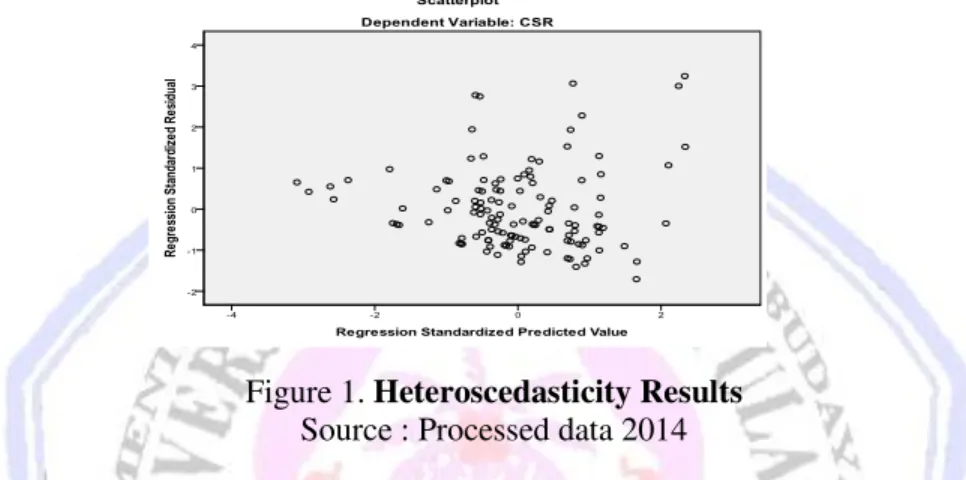
Figure 1. Heteroscedasticity Results
Source : Processed data 2014
The figure above it can be seen that there is no established pattern, in other words the graph describing the plot spread above and below the number 0 (zero) on the Y-axis. This proves that the independent variable of on CRS Disclosure are free of Heteroscesdastisity.
Multicolinearity Test
Table 3. Multicolinearity Test
a. Dependent Variable: CSR
The results in the table above can be seen by SPSS output does not occur because the symptoms of multicollinearity VIF value of Log Firm Size, ROA, Leverage and Board Size are below <10, this means that there is no connection between the independent variables. Thus, multicollinearity assumptions are met (free of multicollinearity).
Autocorrelation Test
Table 4. Autocorrelation test Durbin-Watson
1.970
R R Square
.973a .724
Model Collinearity Statistics
Tolerance VIF
X1 Ln_FirmSize .615 1.626
X2 ROA .898 1.114
X3 Lev .886 1.129
The output table autocorrelation test using Durbin-Watson rate of 1.982 which is in the free area autocorrelation, so the regression model The Log Firm Size, ROA, Leverage and Board Size on CSR are free from autocorrelation.
Normality Test
Figure 3. Normality Results
Source: Processed data 2014
From the figure above it can be seen that the points spread and spread around the diagonal line in the direction diagonal lines. This proves that the model Regression of The Log Firm Size, ROA, Leverage and Board Size on CSR in test normality assumption was met.
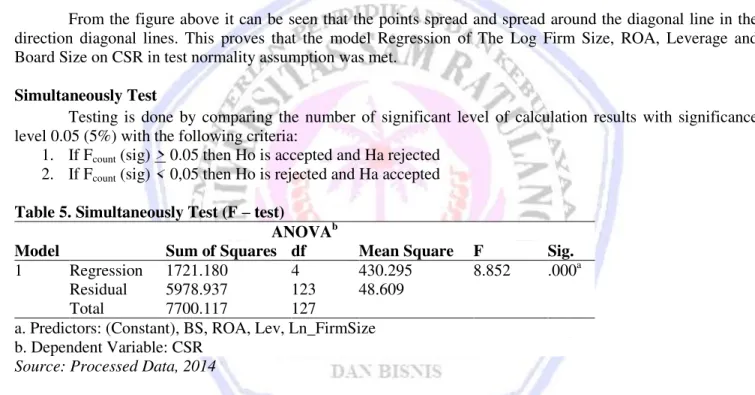
Simultaneously Test
Testing is done by comparing the number of significant level of calculation results with significance level 0.05 (5%) with the following criteria:
1. If Fcount (sig) > 0.05 then Ho is accepted and Ha rejected 2. If Fcount (sig) < 0,05 then Ho is rejected and Ha accepted
Table 5. Simultaneously Test (F ± test)
ANOVAb
Model Sum of Squares df Mean Square F Sig.
1 Regression 1721.180 4 430.295 8.852 .000a
Residual 5978.937 123 48.609
Total 7700.117 127
a. Predictors: (Constant), BS, ROA, Lev, Ln_FirmSize b. Dependent Variable: CSR
Source: Processed Data, 2014
Value of 8.852 of FCount significant 0.000. Because the sig < 0.05 means the confidence of this prediction is above 95% and the probability of this prediction error is below 5% which is 0.000. Therefore H0 is rejected and accepting Ha. Thus, the formulation of the hypothesis that The Influence of Log Firm Size, ROA, Leverage and Board Size on CSR Simultaneously, accepted.
Partially Test
Table 6. Partial Test Analysis (t-test)
Model t Sig. Ln_FirmSize 3.338 .001 ROA -.746 .457 Lev -2.480 .014 BS 2.442 .015 a. Dependent Variable: CSR Source: Processed Data, 2014
The calculations in the table above, the interpretation as follows:
1. tcount for Log Firm Size is 3.338 greater than the ttable value 1.96 means Log Firm Size has significant influence partially on CSR. The sig. value at 0.001 means that prediction of Firm Size has significant influence on CSR doing errors is 0.1 %, thus the confidence of this prediction is above 95%. Therefore, Ha received.
2. tcount for ROA is -0.746 smaller than the ttable value 1.96 means ROA has no significant influence partially on CSR. Therefore, Ha rejected.
3. tcount for Leverage is -2.480 greater than the ttable value 1.96 means Leverage has significant influence partially on CSR. The sig. value at 0.014 means that prediction of Firm Size has significant influence on CSR doing errors is 1.4 %, thus the confidence of this prediction is above 95%. Therefore, Ha received. 4. tcount for Board Size is 2.422 greater than the ttable value 1.96 means Board Size has significant influence
partially on CSR. The sig. value at 0.015 means that prediction of Board Size has significant influence on CSR doing errors is 1.5 %, thus the confidence of this prediction is above 95%. Therefore, Ha received.
Discussion
The influence of Log Firm Size, ROA, Leverage and Board Size on CSR Disclosure simultaneously have a significant level. This is proven by the data analysis shows the f-count bigger than f-table. Therefore, the company's commitment to contribute to nation building by focusing on financial or economic, social, and environmental (triple bottom line) that is the main issue of the concept of Corporate Social Responsibility (CSR) or corporate social responsibility and this Disclosure are supported by several factors affecting the company inside and outside.
The firm size partially has significant influence on CSR Disclosure, Effect of firm size on CSR disclosures are reflected in agency theory that explains that the big companies have big agency costs, therefore large firms will disclose more information than smaller companies. However, not all studies support the relationship between firm size and corporate social responsibility. Another factor that is thought to affect the profitability of CSR disclosure. Relation to the profitability of CSR, that social sensitivity requires the same managerial style as necessary to be able to make the company profitable Jensen and Meckling (1976)
The CSR definitions are describing a phenomenon, but fail to present any guidance on how to manage the challenges within this phenomenon. Therefore, the challenge for business is not so much to define CSR, as it is to understand how CSR is socially constructed in a specific context and how to take this into account when business strategies are developed Dahlsrud (2008). TKH GDWD DQDO\VLV DERYH 52$ GRHVQ¶W KDYH D VLJQLILFDQW influence. Thus this result caused by the assets of the company are fluctuated cause to the change in working capital.
Leverage has a negative significant influence on CSR Disclosure is because leverage gives an overview of the company's capital structure, in order to see the level of non-collection of a debt risk. The higher the leverage the more likely the company will experience a breach of contract debts, then the manager will attempt to report the earnings now higher than earnings in the future. Companies that have a high leverage ratio would be less revealing of CSR in order to report higher profits now.
Commissioner Board Size has significant influence on CSR Disclosure is because of Another factor affecting CSR disclosure is the board of commissioners. With the authority of, the board of commissioners may provide a strong enough influence to pressure management to disclose CSR. So the company that has a board size bigger will be more revealing CSR. This is consistent with research , which shows the result that the proportion of independent board affect the level of voluntary disclosure Dahlsrud (2008).
CONCLUSION AND RECOMMENDATION Conclusions
There are four constructive findings in this research, which are:
1. There is a significant influence of firm size partially on CSR Disclosure. 2. There is no significant influence of ROA partially on CSR Disclosure.
3. There is a negative significant influence of Leverage partially on CSR Disclosure.
4. There is a significant influence of Commissioner Board Size partially on CSR Disclosure. 5. There is a significant influence of Leverage, ROA, Leverage and Commissioner Board Size
Simultaneously on CSR Disclosure.
Recommendation
There are four practical recommendations, which are listed as follow:
1.
In managerial role should consider about the CSR Disclosure since it is the most crucial part of the company and how the company should revealed their self to the public.2.
For the next researcher should add more variable on CSR Disclosure to make a diversification in this research.REFERENCES
Abagail, McWilliams., Donald, Siegel. 2001. Corporate Social Responsibility: A Theory of the Firm Perspective. Academy of Management Review 2001, Vol. 26, No. 1. Available on:
http://www.jstor.org/stable/259398. Accessed August 30th 2014 Pp. 117-127.
Dahlsrud, Alexander. 2008. How Corporate Social Responsibility is Defined: an Analysis of 37 Definitions. Journal of Corporate Social Responsibility and Environmental Management. 15. Available on:
http://www.readcube.com/articles/10.1002/csr.132. Accessed August 30th 2014 Pp. 1-13.
Freeman, R.E ., & J, McVea. 2011. A Stakeholder Approach to Strategic Management. Darden Business School
Working Paper No. 01-02. Available on:
http://faculty.wwu.edu/dunnc3/rprnts.stakeholderapproach.pdf. Accessed August 30th 2014, Pp. 1-32. Heledd, J ., & Natalia, Y ., 2006. Corporate social responsibility in the mining industry: Exploring trends in social and environmental disclosure. Journal of Cleaner Production, Volume. 14, Issues: 3±4, 2006. Available on: http://www.sciencedirect.com/science/article/pii/S0959652605000375. Accessed August 30th 2014 Pp. 271±284.
Jensen, M.C., and Meckling., W.H., 1976. Theory of the firm: managerial behavior, agency costs and ownership structure. Journal of Financial Economics, Vol. 3, No. 4, October, 1978. Available on:
http://papers.ssrn.com/sol3/papers.cfm?abstract_id=94043. Accessed August 30th 2014, Pp. 305±360. Karen, L., Becker-Olsen., Hill, R., 2005. The Impact of Perceived Corporate Social Responsibility On Consumer Behavior. Working Paper Series, Center for Responsible Business, UC Berkeley. Available on: http://www.iei.liu.se/fek/722g86/uppladdning-av-artiklar-infor artikelseminarium. Accessed August 30th 2014, Pp. 1-31.
Moir., L .2001. What Do We Mean By Corporate Social Responsibility?. Journal of Corporate Governance, 2001, Volume:1 Issue: 2. Available on: http://core.kmi.open.ac.uk/download/pdf/138652.pdf. Accessed August 30th 2014 Pp. 16 ± 22.
Rahim, A.R ., Farah, W. J., & Kasmah, T. 2011. The Importance Of Corporate Social Responsibility On Consumer Behavior In Malaysia. Asian Academy of Management Journal, Vol. 16, No. 1, January 2011. Available on: http://www.iei.liu.se/fek/722g86/uppladdning-av-artiklar-inforartikel
seminarium/1.511049/Theimpactofperceivedcorporatesocialresponsibilityonconsumerbehavior.pdf.
Accessed August 30th 2014, Pp. 119-139.
Sekaran, U ., & R, Bougie. 2009. Research Methods for Business 5th edition. John Wiley & Sons Ltd. United Kingdom.
Walker, M ., & Kent, A. 2009. Do Fans Care? Assessing the Influence of Corporate Social Responsibility on Consumer Attitudes in the Sport Industry. Journal of Sport Management, Vol. 23, 2009. Available
on: