EFL Teachers’ Views about their Roles in the Curriculum of the
EFL Foundation Year Programme in Saudi Arabia
Submitted by Hussain Mohammedadam AL Houssawi to the University of Exeter as a thesis for the degree of Doctorate of Education in TESOL in March 2016 This thesis is available for the library use on the understanding that it is copyright material and that no quotation from the thesis may be published without proper acknowledgement.
I certify that all material in this thesis which is not my own has been identified and no material has been previously submitted and approved for the award of a degree by this or any other university.
Dedication
To my wife Ferial and my children Sallah, Housam, Fadel and Waeel Thank you for your patience and support
Abstract
This research is an exploratory study that investigated teachers’ roles in an English as a Foreign Language (EFL) curriculum within a Foundation Year Programme (FYP), at an English Language Institute (ELI) in one of the public universities in Saudi Arabia. The study focused on teachers’ roles in three different stages of the curriculum: development, implementation and evaluation. The participants of the study were twenty-two expatriate and Saudi EFL teachers, male and female, with experience in teaching in the FYP. The study adopted an interpretive approach to address the issues under investigation. Three research questions were raised to address the teachers’ roles in each area separately. Data were obtained through semi-structured interviews with teachers. Based on interpretative principles, data were analysed in the form of explanation and interpretation of the participants’ views about their roles in the investigated stages of curriculum.
The findings indicated that EFL teachers had limited roles in the curriculum development process as they participated in only two different curriculum development tasks: the pre-use course book selection and the students’ language needs analysis. In the implementation stage, teachers were more active as they reported that they had the freedom to develop and use their own supplementary teaching materials in addition to having the freedom to adopt the teaching methodology they felt was appropriate for their students. In the evaluation stage, the teachers reported different levels of involvement in the evaluation of certain curriculum elements selected by the ELI administration, namely, course books, pacing guide, tests, the module system and students’ portfolios. Finally, teachers offered various suggestions for engaging them more actively in the curriculum decision-making process in the three stages of curriculum.
The study made some recommendations for improving teachers’ roles in the development, implementation and evaluation stages of the curriculum for future consideration.
Acknowledgement
I would like to express my great appreciation to Professor Salah Troudi, my first supervisor, for his encouragement and guidance without which this thesis would not have been possible. I am very grateful to him for his endless academic support throughout my doctoral journey. I am also in debt to Dr. Gill Haynes, my second supervisor, for her valuable insights and feedback on my thesis.
My special gratitude is also extended to my wife, Ferial for her continuous encouragements and support that helped me to complete this journey. My brother Sallah deserves special appreciation for his endless encouragement that helped me to achieve my academic ambition.
My appreciation is extended to my friends Mazin Mansory and Dr. Ismail Lbouber from TESOL department for their provocative discussions during the writing process of my thesis. In addition, I like to thank my friend Dr. Saggad Houssawi for his constructive feedback and invaluable enthusiasm that encouraged me to complete this work. I am also grateful to Dr. Amad Mousa for his spiritual support that empowered me during my research journey.
Finally, I am so appreciative of the ELI teachers who devoted their time to participate in this study.
Contents
Abstract ... 3
Acknowledgement ... 4
1 Chapter One: Introduction to the Study ... 12
1.1 Introduction ... 12
1.2 Institutional Experience ... 14
1.3 Impact of Foundation Year Programme ... 14
1.4 Personal Interests ... 15
1.5 Rationale of the Study ... 16
1.6 Significance of the Study ... 16
1.7 Research Questions ... 17
1.8 Thesis Organisation ... 18
2 Chapter Two: Context of the Study ... 20
2.1 Introduction ... 20
2.2 Teaching English in Saudi Arabia ... 20
2.3 Higher Education in Saudi Arabia ... 21
2.4 ELT in Higher Education: A brief History ... 21
2.5 Profile of Foundation Year Programme ... 22
2.5.1 Foundation Year Programme in Saudi Universities ... 23
2.5.2 Structurer of the Intensive English Programme ... 23
2.6 Curriculum of the Foundation Year Programme ... 24
2.6.1 Objectives ... 24 2.6.2 Needs Analysis ... 25 2.6.3 Teaching Materials ... 25 2.6.4 Teaching ... 26 2.6.5 Students’ Assessment ... 26 2.6.6 Evaluation ... 27
2.6.7 Students’ Background in Higher Education ... 28
2.7 EFL Teachers in Higher Education ... 28
3 Chapter Three: Literature Review ... 30
3.1 Introduction ... 30
3.2 Definition of Curriculum ... 31
3.3 Curriculum Approaches ... 35
3.3.1 Curriculum as a Product ... 36
3.3.2 Curriculum as a Process ... 36
3.4 Components of English as a Foreign Language Curriculum ... 37
3.5 Curriculum Development ... 39
3.5.1 Teachers’ Roles in Curriculum Development ... 40
3.6 Curriculum Implementation ... 44
3.6.1 Approaches to Curriculum Implementation ... 46
3.6.2 Teachers Roles in Curriculum Implementation ... 47
3.6.3 Factors Influencing Curriculum Implementation ... 52
3.7 Curriculum Evaluation ... 53
3.7.1 Approaches to curriculum Evaluation ... 54
3.7.2 Teachers’ Roles in Curriculum Evaluation ... 55
4 Chapter Four: Methodology ... 60
4.1 Introduction ... 60
4.2 Research Questions ... 60
4.3 Interpretive Research Paradigm ... 61
4.4 Theoretical Framework ... 62
4.4.1 Ontological Stance ... 62
4.4.2 Epistemological Stance ... 63
4.5 Qualitative Research Approach ... 64
4.7 Participants ... 66
4.7.1 Sampling Method ... 67
4.8 Gaining Access ... 67
4.9 Data Collection Method ... 68
4.9.1 Semi-Structured Interviews ... 69
4.10 Piloting the Study ... 70
4.11 Interviews Procedure and Atmosphere ... 71
4.12 Recording Interviews ... 71 4.13 Informal Meetings ... 71 4.14 Interview Analysis ... 72 4.15 Research Trustworthiness ... 73 4.15.1 Credibility ... 73 4.15.2 Transferability ... 74 4.15.3 Confirmability ... 75 4.16 Ethical Considerations ... 76
4.17 Limitations and Challenges of the Study ... 77
4.18 Conclusion ... 78
5 Chapter Five: Findings ... 79
5.1 Introduction ... 79
5.2 EFL Teachers’ Views about their Roles in the Development Stage of the Curriculum ... 79
5.2.1 Nature of Teachers’ Involvement ... 81
5.2.2 Reasons for Teachers’ Involvement & Non-Involvement in Curriculum Development ... 85
5.2.3 Suggestions for Teachers’ Roles in Curriculum Development ... 89
5.3 EFL Teachers’ Views about their Roles in the Implementation Stage of the Curriculum ... 91
5.3.2 Restrictions on Teaching Strategies ... 95
5.3.3 Challenges to Implementing the Curriculum ... 97
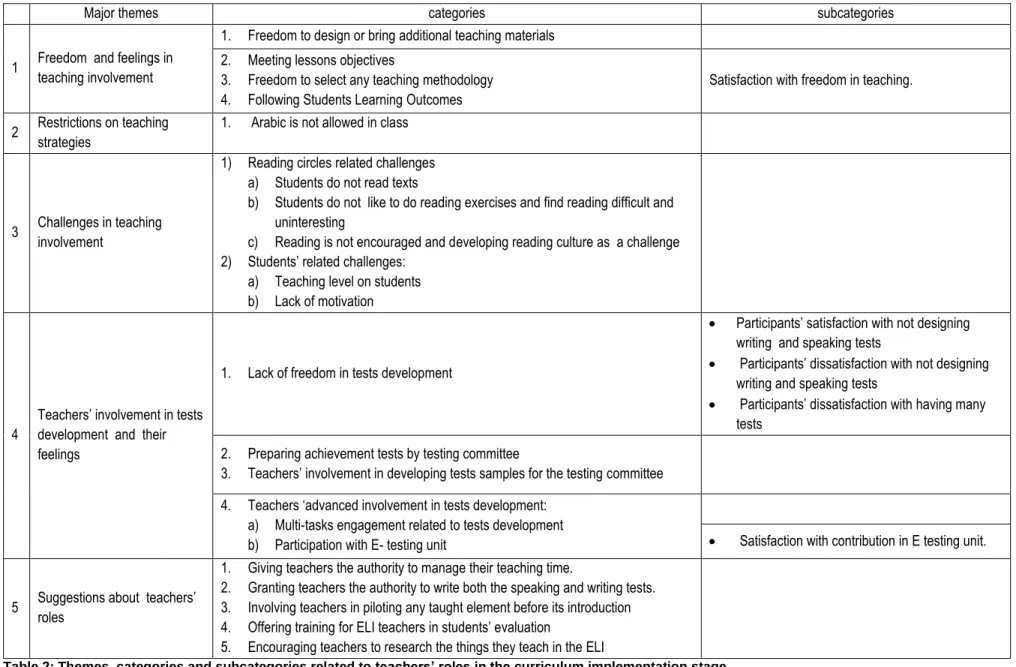
5.3.4 Teachers’ Involvement in Tests Development and their Feelings . 99 5.3.5 Suggestions for Teachers’ Roles in Implementing the Curriculum 104 5.4 EFL Teachers’ Views about their Roles in the Evaluation Stage of the Curriculum ... 107
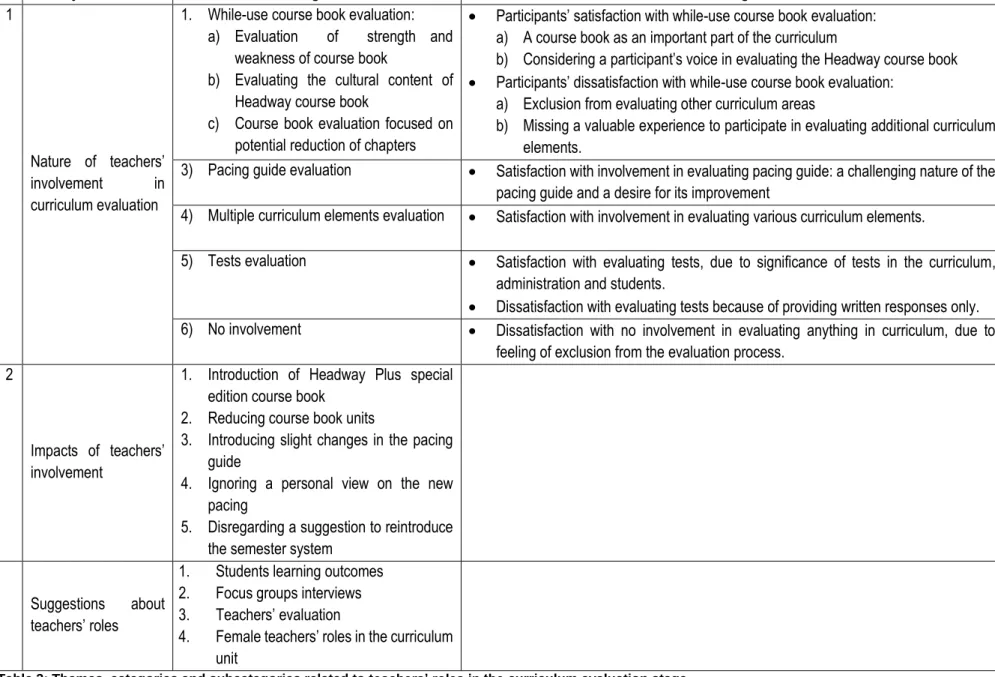
5.4.1 Nature of Teachers’ Involvement in Curriculum Evaluation ... 109
5.4.2 Pacing Guide Evaluation ... 111
5.4.3 Impact of Teachers’ Involvement in Curriculum Evaluation ... 114
5.4.4 Suggestion about Teachers’ Roles in Curriculum Evaluation ... 116
5.5 Conclusion ... 119
6 Chapter Six: Discussion ... 120
6.1 Introduction ... 120
6.2 Course Books Issues in Curriculum Development ... 120
6.3 The Relationship between the Centre and Periphery ... 124
6.4 Teachers’ Roles in Needs Analysis ... 126
6.5 Reading Culture ... 130
6.6 Attitudes towards L1 ... 133
6.7 Language Assessment Literacy ... 137
6.8 EIL: a new Era in Global Course Book ... 140
6.9 Teachers’ Portfolios... 144
6.10 Conclusion ... 146
7 Chapter Seven: Recommendation for Further Research ... 148
7.1 Overview of the Chapter ... 148
7.2 Summary of the Main Findings ... 148
7.3.1 Contribution to the Saudi Context ... 150
7.3.2 Theoretical Contribution ... 151
7.3.3 Methodological Contribution ... 151
7.3.4 Pedagogical Contribution ... 152
7.4 Recommendations for the Curriculum Development Stage ... 153
7.5 Recommendations for the Curriculum Implementation Stage ... 154
7.6 Recommendation for the Curriculum Evaluation Stage ... 155
7.7 Suggestions for Future Research ... 156
7.8 Personal Reflection ... 157 7.9 Final Remarks ... 158 Appendix 1 ... 159 Appendix 2 ... 160 Appendix 3 ... 161 Appendix 4 ... 167 Appendix 5 ... 174 Appendix 6 ... 177 Bibliography ... 178
List of tables
Table 1: Themes, categories and subcategories related to teachers’ roles in curriculum development ... 80 Table 2: Themes, categories and subcategories related to teachers’ roles in the curriculum implementation stage ... 92 Table 3: Themes, categories and subcategories related to teachers’ roles in the curriculum evaluation stage ... 108
List of Abbreviations
Curriculum development: CD
Curriculum implementation: CI
English as a foreign language: EFL
English as a Medium of Instruction: EMI
English as a Second Language: ESL
English as Foreign Language: EFL
English for Academic Purposes: EAP
English for Specific Purposes: ESP
English Language Curriculum: ELC
English Language Institute: ELI
English Language Institutes: ELIs
English Language Teaching: ELT
English Language: EL
Foundation Year Deanship: FYD
Foundation Year Programmes: FYP
General English: GE
King Fahd University of Petroleum and Minerals: KFUPM
Kingdom of Saudi Arabia: KSA
Language Assessment Literacy: LAL
Ministry of Education: MoE
Science Technology Engineering Mathematics: STEM
Teaching of English to Speakers of Other Language: TESOL
1 Chapter One: Introduction to the Study
1.1 IntroductionIn Saudi Arabia, English is taught as a foreign language and become one of the major priorities in the national strategy to improve higher education. In many universities, this strategy was reflected in the adoption of educational plans and policies in the area of the teaching of English as Foreign Language (EFL) for undergraduate students. In 2009, most Saudi universities adopted a new educational policy, which made English the medium of instruction for all scientific departments for undergraduate studies. This has led to establishing Foundation Year Programmes (FYP) in English Language Institutes (ELIs) in a number of Saudi universities. These programmes aim to improve English language proficiency levels of undergraduate students in order to help them cope with the requirements of their academic disciplines and their professional lives. ELIs are responsible for offering Intensive EFL courses in one academic year. Moreover, these programmes seek to accomplish major objectives, namely, to help students achieve the required level of language competence in the four language skills, communicate effectively in English and acquire basic academic skills and learning tools that are essential at university. These ELIs offer intensive compulsory courses such as English for Academic Purposes (EAP), English for Specific Purposes (ESP) and General English (GE) (AL-Murabit, 2012; Javid et al., 2012; Al-Shumaimeri, 2013). Although this can be regarded as a constructive and promising institutional change, it is vital to involve the “teachers who will be the main group for implementing the change” (Nation & Macalister, 2010: 176). Indeed, their engagement in the decision making process in terms of EFL curriculum is an essential factor that helps in achieving the intended plans and objectives of such language courses because “a curriculum is the core of educational decision activities, and outcomes of a particular settings” (Carroll, 2007: v), since the curriculum “is structured as a series of intended learning outcomes and it prescribes the result of the instruction” (Johnson, 1967:130, cited in McKernan, 2008). The role of EFL teachers in the EL curriculum is an extremely important issue in language curriculum development (Carroll, 2007) and in transmitting knowledge from the curriculum to the learners (Freeman, 2002).
Nevertheless, EFL teachers of these intensive English courses in ELIs, which is the focus of the current study,face many challenges and huge responsibilities in terms of EFL curriculum. These challenges can be attributed to three basic factors: institutional and administrative pressure, pedagogical demands and accreditation requirements. The institutional and administrative factors can be noticed through the required teaching performance that must be met by teachers in order to match the high expectations of various stakeholders including students and the teaching faculty from other university colleges who are to teach the students after they successfully pass the FYP. With respect to the pedagogical demands, teachers are required to adapt their teaching to contemporary teaching methodologies. In addition, they need to bridge the gap between their students’ low levels of language competence and the required level of language proficiency expected upon completing the FYP, taking into account their contextual learning background constraints and conditions. Furthermore, students who join the FYP have different language needs and requirements depending on their future academic discipline and area of specialisation. It is a highly demanding task for teachers to address the multiple needs of thousands of students across the university colleges through the current EFL curricula of the FYPs. Regarding the accreditation requirements, the quality of teaching standards must be similar to other long-standing and well-established ELIs at university level in similar EFL contexts, in terms of professionalism, and practicality.
The aforementioned institutional challenges point to the huge tasks associated with the EFL teachers’ roles in the Kingdom of Saudi Arabia (KSA) in implementing the EFL curriculum. Moreover, the above suggests that the FYP EFL curricula in ELIs in general and the teachers’ roles in the curriculum in particular appear to be a rich area for conducting research due to the recent introduction of the FYP in the country.
1.2 Institutional Experience
In 2009, I worked as an EFL teacher in an ELI in the KSA, the site of this study, in one of the Saudi universities. At that time, a new EFL curriculum was introduced in the ELI simultaneously with the implementation of the FYP for undergraduate students. Through recurrent discussions with a great number of experienced EFL teachers, I noticed that the issue of the teachers’ involvement in the newly implemented EFL curriculum was a subject of concern for teachers who often seemed to reveal a certain feeling of disappointment, frustration and dissatisfaction due to their limited role in various aspects of the curriculum. For example, a number of EFL teachers seem to have experienced certain changes in terms of course books, testing, courses, teachers’ evaluation and students’ assessment. Throughout my personal and professional interaction with a great number of EFL teachers in this ELI, I have come to realise that they seem to express opposition towards most of the decisions taken in relation to the changes that occur in the curriculum. Consequently, numerous teachers mentioned the growing number of problems and obstacles that they experienced in implementing the curriculum in addition to their absence of engagement in terms of decision making in the curriculum. The negative attitudes of ELI teachers in this context have drawn my attention to an interesting area for exploration and gave me an initial clue for this research topic. Therefore, I was motivated to investigate the roles of teachers in the EFL curriculum through conducting the current study.
1.3 Impact of Foundation Year Programme
The introduction of the FYP was associated with new academic regulations and important changes for undergraduate students. The essential issue is that the intensive English courses in the FYP are compulsory for all undergraduate students who cannot pursue their studies at university unless they pass the FYP. This policy has put an unprecedented intensive academic burden on students who have to cope with this important requirement right in their first year at university following graduation from secondary school. It is important to realise that failure to pass the FYP can have very negative impacts on the future of a great number of students which can consequently result in serious outcomes and make their future lives more difficult at different levels: psychologically, socially,
professionally and economically. These anticipated negative outcomes can be caused by a number of shortcomings in terms of the design of the courses, the selection of materials, the testing procedures and the perception of students’ actual needs in EFL. As a result, this can be reflected on students’ low academic achievements in EFL and their failure to meet the FYP language requirements. Therefore, it is vital to make sure that the curriculum of the intensive English courses is designed adequately in order to help the students achieve its intended aims. This undoubtedly requires an active involvement of the teachers who are responsible for implementing the curriculum. In practice, teacher’ roles are crucial in the early stages of planning, particularly when conducting a needs analysis, setting the goals and objectives of the curriculum, designing the teaching materials (Hadley, 1999) and also in the other elements of the EFL curriculum. Furthermore, EFL teachers can play a major role in implementing the learning activities in accordance with their students’ interests and needs (Goodman, 1986). In that respect, I believe that involving the teachers in the areas of curriculum development, implementation and evaluation can have positive impacts on reducing any potential negative effects on the students due to their extended knowledge of the students’ needs, context knowledge and experience in the field. 1.4 Personal Interests
Since I joined the EdD programme as a doctoral student, I have conducted extensive reading in the field of the Teaching of English to Speakers of Other Languages (TESOL) in relation to teacher education, curriculum issues, language policy, materials design, and critical pedagogy. I have had the chance to focus on these domains and study issues from the perspectives of students, teachers, administrators or policy makers. Interestingly, the aspects that particularly caught my attention were the curriculum-related issues, which I found very interesting and practical. As a result, I was encouraged to investigate EFL teachers’ perceptions of curriculum evaluation through a research study conducted as part as a preparation phase in the doctorate. However, it was a small-scale study which only focused on one aspect, namely, curriculum evaluation. This experience has prompted me to move a step further and investigate more rigorously the wider perspectives of the teachers’ views regarding their roles in an EFL curriculum in my specific teaching context, that is, the KSA, in more depth and breadth.
1.5 Rationale of the Study
The rationale for this study is to identify the teachers’ roles in the FYP curriculum in the three stages of curriculum: development, implementation and evaluation, in an English Language Institute (ELI) in a Saudi university, through conducting an empirical research. Consequently, it is hoped that this investigation can lead to the recognition of the potential advantages of teachers having active roles in the curriculum and the disadvantages of their lack of voices in its three stages. The main benefit of addressing this issue from the teachers’ perspectives is that it provides an account of actual practices and procedures from within the field. Thus, moving from general to specific, the study seeks to achieve two essential objectives: practical and personal. The first objective is to draw some attention towards EFL teachers’ roles in a FYP curriculum. Given that this is a new educational policy in the country, this research is an attempt to participate in tackling some vital areas for its improvement and success. This is because Saudi universities invest heavily in managing the FYP and spend considerable amounts of money to provide all the needed resources. The personal objective of the study is to provide the researcher with a deep knowledge and understanding about the roles of teachers in the FYP curriculum. In fact, before conducting the current study, I had limited background knowledge about the EFL curriculum of the FYP in Saudi Arabia. Therefore, I consider this study as rich and constructive experience in terms of gaining curriculum expertise. Also, it is a positive step towards my personal research development, as I intend to specialise in the field of EFL curriculum.
1.6 Significance of the Study
This study could be of significant importance in Saudi Arabia, because of the lack of research in terms of teachers’ roles in curriculum, as this is the first attempt in Saudi Arabia to explore together the teachers’ roles in three stages of the curriculum: development, implementation and evaluation. Previous studies investigated teachers’ roles in only one or two curriculum stages separately. Mullick (2013) investigated EFL teachers’ perception of their involvement in curriculum development, while Shah et al. (2013) explored teachers’ perspectives about the factors that influence their implementation duty, namely, their teaching practice and the techniques they used to deal with those factors. Therefore, the
study can be useful for the Saudi context as it can increase people’s awareness of a recent EFL programme. It is hoped that the results of this study can provide valuable insights for curriculum policy makers and specialists in ELIs as it sheds light on the views and experiences of the research participants about the FYP. In that regard, the findings could provide them with a deeper understanding of various issues related to the nature of teachers’ roles in these three curriculum stages and the lessons that could be learned from the findings for future consideration. Furthermore, the study may contribute to the literature and open the field to further enquiry; therefore, this could promote further research focusing on teachers’ roles in the EFL curriculum in other similar ELIs in the country. Additionally, this research is significant for the immediate context of the study, ELI, at different levels. The study recognises the primacy of teachers’ roles and gives them the chance to share their experiences and convey their views and concerns regarding the investigated curriculum issues. Thus, this research can be regarded as a form of empowerment for the research participants as it considers their views to be the core of the research. Another significant aspect relates to the approach adopted with the participants throughout the research. Indeed, although quantitative methodologies are still dominant in the KSA, this study has highlighted the potential and the positive impact of a qualitative approach. This study has paved the ground for other qualitative studies, since such a research approach has not been previously utilised in this context with this particular topic. Lastly, the study can enhance teachers’ roles in the curriculum and contribute to curriculum management reform in the current research context by sharing the findings with the ELI top management, members of curriculum committees and senior staff of curriculum units. These findings can deepen our understanding of teachers’ perceptions of their roles in the curriculum and how to enhance their participation in the decision-making process. The findings can be of particular interest to the administration who may wish to revisit and improve certain institutional curriculum policies. The administration, heads of units, supervisors and coordinators are in need of the information provided by the research participants, in order to improve teachers’ roles in the three stages of the curriculum: development, implementation and evaluation. Eventually, this could help in improving teaching and learning in the programme as well.
The study attempts to explore the views of teachers about their roles in the EFL curriculum of a FYP within an ELI in in Saudi Arabia and seeks to answer the following three research questions
1. What are EFL teachers’ views about their roles in the development stage of the curriculum?
2. What are EFL teachers’ views about their roles in the implementation stage of the curriculum?
3. What are EFL teachers’ views about their roles in the evaluation stage of the curriculum?
1.8 Thesis Organisation
This thesis is organised in seven chapters. The current chapter has described the institutional experience, the impacts of the FYP, my personal interests, the rationale of the study, its significance and the research questions.
The second chapter introduces the context of the study by shedding light on the history of teaching English in Saudi Arabia and the history of higher Education focusing on the status of English and ELT in this context. The chapter also examines the nature of the FYPs in Saudi universities in terms of the structure of the intensive English language programmes in place. Additionally, the chapter discusses components of intensive English courses of the FYP curriculum and students’ background in higher education. Finally, it also outlines EFL teachers’ background in higher education.
Chapter three reviews the literature and is divided into two main sections: theoretical and practical. The theoretical part discusses the definition of the term curriculum, the approaches to curriculum and the components of an EFL curriculum. The practical part discusses in more detail the relevant concepts related to the three stages of the curriculum: development, implementation and evaluation. The curriculum development section addresses the issues of teachers’ roles in this stage, while the curriculum implementation section discusses the approaches that underpin this stage, in addition to examining the literature pertaining to teachers’ roles in curriculum implementation by focusing on specific research studies conducted in this domain.
Chapter four describes the research methodology adopted by the current study, its research paradigm including its ontological, epistemological and
methodological assumptions. The research participants, the sampling strategy and the site of the study are presented as well as the justifications for the data collection tool used in this study. The overall data collection and analysis procedures implemented in the study are highlighted. In addition, the trustworthiness of the study, its limitations and challenges as well as ethical issues are addressed. Chapter five reports the findings of the study and in chapter six, they are discussed in light of the reviewed literature. Finally, chapter seven summarises the major findings, presents the contribution of the study and makes a number of recommendations for further research. The chapter ends with concise final remarks.
2 Chapter Two: Context of the Study
2.1 IntroductionThis chapter aims to provide the relevant background information that is essential to understand the contextual issues related to the investigated problem. It starts with a brief history of the teaching English in Saudi Arabia. Then, a short account of Saudi Arabia higher Education is presented and followed by a section that sheds some lights on the status of English in the country. The next section describes ELT in higher education in the Saudi context. The chapter contains three sections that discuss issues related to the FYP in three ways, namely, a historical overview of the FYPs in Saudi Arabia, FYP recent implementation within Saudi universities and the structure of the intensive English programmes in Saudi universities. Also, the chapter discusses components of intensive English courses of FYP curriculum. Finally, a brief account of EFL teachers’ background in higher education in Saudi Arabia is presented.
2.2 Teaching English in Saudi Arabia
In Saudi Arabia, the introduction of EFL is associated with the establishment of “the formal education in the country after the unification of the Kingdom in 1926” (Al Maini, 2002: 1). Initially, English was taught in elementary schools (Baghdadi, 1985) and later, in 1943, a change in the education policy was made with regards the teaching of English whereby it was removed from the elementary level and was introduced at a higher educational stage, namely, the intermediate levels ˗ i.e. year thirteen to sixteen (Al-Haq & Smadi, 1996). By the time students had completed this stage, English became part of the secondary school subjects ˗ i.e. year sixteen to eighteen. Since that time, English has become compulsory in both intermediate and secondary schools in Saudi Arabia (Al-Haq & Smadi, 1996; Al Nasser, 1999 & Al Maini, 2002). In 2004, the Saudi Ministry of Education (MoE) made changes to its policy in terms of English language teaching and decided to reintroduce EFL as a compulsory subject in the elementary stage ˗ i.e. years four to six. This decision was based on the assumption that the younger the children start learning English, the better they learn the target language.
2.3 Higher Education in Saudi Arabia
The history of higher education in Saudi Arabia started with the establishment, in 1949, of the first college of higher education in the country: the College of Islamic law in Makkah (Baghdadi, 1985). The Ministry of Higher Education was later established in 1975 (Al Kuwaiti, 2007) and was responsible for setting both short and long-term plans and development strategies for universities. Its main role was to offer educational opportunities for Saudi students and supervise the implementation of the educational policies that consider the government’s interests, regulations and needs in the universities (Abu-Rizaizah, 2010). In 2014, the Saudi Ministry of higher education was merged with the MoE and came under the direction of the MoE which is now in charge of supervising education in Saudi universities. Currently, there are twenty-five public universities all of which are linked to the MoE.
Each university has an ELI which provides English Language Teaching (ELT) and manages the EFL programme of the FYP at university. The university provides all the required support to make ELT effective in terms of facilities, academic consultations and resources that are necessary for ELIs to carry out their required mission.
2.4 ELT in Higher Education: A brief History
In higher education, English is used as a medium of instruction for all the STEM (Science Technology Engineering Mathematics) disciplines in all public universities. This policy became more appealing for thousands of students and parents after the government started offering Saudi undergraduate and postgraduate students international scholarships to study in Western universities, mainly in the UK, the USA, Canada and Australia (Dahlan, 2009; Alhawsawi, 2013; Barnawi & Le Ha, 2014). It significantly increased the status of the English language in Saudi universities and provided further justification for its current role in academia. For example, stakeholders in Saudi universities including academics and educationalists have become more convinced and determined than before to implement the policy of English as a Medium of Instruction (EMI). This is because they believe that it can prepare undergraduate students for future postgraduate academic studies abroad, enabling them to work in scientific research projects along with foreign expatriate researchers in the country.
Additionally, they contend that this policy can help them join competitive international research centres, such as the newly established ones in King Abdullah University of Science and Technology in Jeddah, Saudi Arabia. However, Al Dhubaib, (2007), a local researcher, disagrees with the EMI policy and promotes adopting a translation policy as an alternative for EMI, which, he believes, is as an effective method of transferring scientific knowledge to the Arabic language. He advocates the use of Arabic to teach and test students, prepare course books and to ask students to write their assignments.
English is a compulsory subject for students of other academic disciplines such as business, education, and arts and humanities. Although the Arabic language remains the medium of instruction for these subjects, they have to pass the Intensive English Course (IEC) of the FYP.
2.5 Profile of Foundation Year Programme
The establishment of the Foundation Year Programme in Saudi Universities is not a very recent policy as the King Fahd University of Petroleum and Minerals (KFUPM) founded its Foundation year programme in 1964 (McMullen, 2014). This is the first public university to introduce such a programme, compulsory for all undergraduate students. In this respect, Al Dosary & Assaf (1996: 215) provide a brief description of the programme, as in the following quotation:
“All incoming students take a one-year orientation program before enrolling in the university undergraduate programs. This program introduces them to the required English skills which will be needed for the undergraduate work, in addition to reinforcing some basic mathematics, sciences, workshops and computer literacy” ( ibid).
These courses are essential in their academic disciplines as English is the official medium of instruction in the OYP and also for all the undergraduate specialties in the university (KFUPM Prep year, n.d.). Furthermore, Foundation year English programmes have been gradually established in universities across the Kingdom after 2009 (McMullen, 2014) including the context of this study.
2.5.1 Foundation Year Programme in Saudi Universities
The MoE regards the KFUPM Foundation Year Programme as an inspiring experience and a good example that deserves to be replicated in other universities due to its positive impact on the students’ academic skills and knowledge. Therefore, in 2009, the government requested all other universities to implement PYPs and EMI in all undergraduate STEM disciplines. Numerous universities have founded separate deanships to manage all issues related to the PYP. This type of deanship, commonly referred to as the Foundation Year Deanship (FYD), is responsible for offering all the STEM courses and subjects, such as mathematics, physics, computer and communication skills, in addition to intensive English courses which are usually offered by the ELIs. The university where the study was conducted does not have a FYD and all the compulsory courses like mathematics, physics or statistics are offered by the relevant university departments. However, in that university, the ELI is an independent body treated as a separate deanship. Furthermore, the English programme constitutes a major component of the PYP as the stakeholders in Saudi universities consider it to be an essential indicator of the success or failure of the PYP outcomes.
2.5.2 Structurer of the Intensive English Programme
ELIs are in charge of delivering and administering the English programmes in Saudi universities and provide different intensive English courses with diverse focus aimed at all the newly-admitted undergraduate students, such as GE, EAP and ESP. These courses are provided for the three main tracks in all the universities: health colleges, engineering/scientific colleges and non-scientific majors, such as business and administration, education, and arts and humanities colleges (ELC Taibah University n.d.; King Saud University n.d.; KFUPM Prep year, n.d.). These ELIs follow two main trends in offering these courses: traditional and quarter. Most ELIs implement the former one where these intensive courses are offered for different levels, 1-4 or 1-6, and are taught within two academic semesters. The allocated teaching hours vary from eighteen to twenty hours per week.
In the ELI where the study was conducted, the intensive English programme only provides general intensive English courses based on four levels, each of which
is taught using one particular course book (see Appendix 1). These courses are delivered following a quarterly system with four quarters in an academic year, i.e., two in each semester. Two different levels are taught in each quarter: levels one and two in quarter one and levels three and four in quarter two. Each quarter is made up of seven academic weeks and the teaching hours are eighteen per week (Kinsara, 2012). Students are placed in the above course levels depending on their language proficiency level based on their score at the Oxford Online Placement Test (OOPT) which they take after being admitted to university (ibid). 2.6 Curriculum of the Foundation Year Programme
Intensive English courses are vital components of the FYP curriculum and have certain similar characteristics that exist in all Saudi universities. Yet, some minor differences remain with regards the curriculum elements, depending on each ELI language policies or administrative trend followed by stakeholders. The intensive English courses content covers many vital and interesting elements that can be categorised under different areas, like objectives, needs analysis, teaching materials, teaching, and students’ assessment and evaluation.
2.6.1 Objectives
ELT curriculum philosophy, planning or conceptualisation in Saudi Arabia is dominated by the objectives-led model, which means that the curriculum is perceived as product-oriented. English language programmes and curriculum policy makers and developers have designed pre-specified sets of objectives and specific English language proficiency levels FYP students should reach by the end of the programme. Therefore, intensive English courses in the ELIs in Saudi Arabia have multiple objectives, focusing on certain learning outcomes and tackling different angles. These objectives differ in terms of the intended achievement levels to be reached by students upon completing the intensive English courses (i.e. intermediate, upper-intermediate or advanced levels). It is noticeable, however, that these institutes did not create their own local framework of English language competence that considers the characteristics of Saudi EFL learners. In fact, all Saudi ELIs, including where the study was conducted, adopt the Common European Framework Reference implemented in language institutes in the U.K and other ones across Europe. The English language institute where this study was carried out has a set of objectives that it attempts
to help FYP students to reach, at least, the intermediate level in terms of English language proficiency accepted by the institution (Kinsara, 2011).
2.6.2 Needs Analysis
The Saudi MoE requested the implementation of new intensive English courses, along with the introduction of the PYP in Saudi universities. Nevertheless, this decision was not associated with any needs analysis investigation prior to its implementation in Saudi universities. In fact, this decision was left to the management of each ELI according to its priorities, internal policy, adopted professional practice and selected timing preference. Therefore, the ELI, where this study took place, conducted a needs analysis investigation to determine the FYP students’ English language needs towards the end of the 2010 academic year. It is worth noting that the investigation was conducted more than eighteen months after the implementation of the intensive English courses in the programme. It was carried out by an intuitional internal committee, Students Needs Analysis Committee, established for this purpose. The committee suggested the implementation of certain recommendations which were submitted to the ELI top management. These suggestions were regarded as classified documents and its access was restricted to the ELI management.
2.6.3 Teaching Materials
There is a big demand for EFL teaching materials and course books, to cover the increased demand of ELIs for these essential aspects in the FYP. However, there is no local publishing house or agency specialising in developing the teaching materials and course books, according to ELIs needs. Therefore, the overwhelming majority of these institutes, including the site of the study, have to depend completely on ready- made teaching materials and course books designed and published by international publishers. These course books are produced by famous international publishers, such as Bell Education, Cambridge University Press, Pearson, Longman, or Oxford University Press. There is intense competition among these publishers to have their global course books series selected by the numerous ELIs in Saudi Arabia. These publishers also offer attractive e-learning resources, such as additional online support and practice activities for FYP students, in order to make their course book series more attractive for potential customers.
Furthermore, it is a common and expected practice in ELIs to change the course books used in their programmes,including the site of the study. Since 2009, the ELI course books were changed four times. These course books were produced by four different international Western publishers. The course books currently used at this ELI are the English Unlimited Special Edition. The series, produced by Cambridge University Press, include four different levels – beginner, elementary, pre-intermediate and intermediate – and adopts an integrated skills approach.
2.6.4 Teaching
Most ELIs have certain similar regulations and policies in term of teaching; for instance, the teaching load of EFL teachers is of a minimum of eighteen hours per week. However, they can be asked to teach more hours, depending on the availability of teachers, and are compensated for their overtime. In addition, teachers have to teach the selected course book by the institution management. They are not allowed to teach a course book they selected based on their own personal or pedagogical preferences. The context of the study also shares the above features with other English language institutes.
2.6.5 Students’ Assessment
As indicated earlier (section 1.3), students are not allowed to pursue their studies at the university unless they pass the FYP. This has put pressure and significant responsibilities on ELIs testing procedures. Thus, ELIs have employed different evaluation methods to assess English language development and achievements of the FYP students during and at the end of the intensive English courses. The common assessment methods used in ELIs for each course or level are the continuous assessment, speaking tests, writing tests, quizzes, mid-term exams, progress tests and final examinations which have the highest percentage in the assessment process in all the ELIs. However, each ELI adopts its own internal policy for the distribution of mark proportion for each piece of assessment. For example, the adopted evaluation methods in the context of the study for each module are portfolio assessment (i.e. continuous assessment) which counts for 10%, two speaking tests counting for 10%, two writing tests that count for 10%, a mid-term exam equating 30% and the final exam that counts for 40% of the final
score (See Appendix 2). All the tests for all levels are standardised, including final exams, and prepared by the testing committee.
The FYP students should obtain a score of at least 60% in order to be admitted to a higher level course; if the required grade is not attained, the students must repeat the same course as scheduled during the PYP (Kinsara, 2011).
2.6.6 Evaluation
The MoE founded the National Commission for Academic Accreditation and Assessment (NCAAA) in 2005. However, the Ministry did not conduct any evaluation research or investigation of the FYP offered in various ELIs in Saudi universities, and left the decision of its evaluation to the management of universities, in terms of timing, scope and procedures. They can also seek external consultations and academic assistance from experts or Western universities to conduct a professional and thorough evaluation of the offered programmes. For example, three public universities, namely Al Dammam, AL-Baha and Princess Nourah Universities have had their intensive English courses evaluated by two American universities: Texas A&M University and Sam Houston State University. The evaluators focused on the programmes' structure, institutional academic procedures, implementation and qualifications of the teaching staff. However, the evaluations results were not published, which makes it difficult to get some insights into their conclusions.
As an insider to the ELI where this study was conducted, I have no knowledge of an evaluation of the whole FYP curriculum being conducted. Nevertheless, the ELI higher authorities, the curriculum committee and the ELI Council, select and decide on specific curriculum elements to be included in the formative evaluation process. Then, they instruct the curriculum unit to implement the evaluation procedure to improve the quality and effectiveness of the evaluated elements.
2.6.7 Students’ Background in Higher Education
Saudi students joining higher Education in Saudi Arabia are usually secondary school graduates, from the state or private schools, who have already specialised in either science or arts & administration and are aged between eighteen to twenty years old. The FYP students in the context of the study share the same background. The number of newly admitted students annually in the university where the ELI is located is between 12,000 to 15,000 male and female students. These undergraduate students are divided into two main tracks: the sciences and administration & arts. The ELI offers the same English courses with different levels for both tracks; however, they are required to take other different compulsory courses, depending on their college specialities (Kinsara, 2011). The majority of students in the ELI are from state schools and a minority are private schools’ graduates.
2.7 EFL Teachers in Higher Education
The ELIs context reflects the multicultural environment in higher education in Saudi universities and in other Gulf countries like the United Arab Emirates and Qatar. EFL teachers in these institutes can be categorised into two main categories: expatriate EFL teachers and local Saudi teachers. Three kinds of expatriate teachers can be identified: native speakers of English, bilingual teachers and international teachers. The native speakers are found to be less qualified and less experienced compared to other teachers and many of them do not hold postgraduate qualifications in TESOL and only have certificates in TESOL such as the CELTA (Khan, 2011). They have completed undergraduate degrees in non-related areas such as business and management, sociology or history (ibid), which do not appear to be an adequate preparation for a competent and effective foreign language teacher, especially if they are not required to have previous teaching experience as ESL/EFL teachers. The other group of EFL teachers are the bilingual teachers who mainly come from Arab countries including Morocco, Sudan, Tunisia, Egypt, Jordan and Syria and most of them hold relevant postgraduate qualifications in teaching English, such as Master degrees and PhDs (Alrashidi & Phan, 2015). Recruiting such teachers is advantageous for universities as they are familiar with the challenges of teaching and learning English and their previous experience may help them in teaching in a similar Arab context like Saudi Arabia. The third group are the international
teachers from various countries like India, Pakistan, South Africa and Malaysia. Many of these teachers are highly qualified and hold relevant degrees in teaching English. They also have teaching experience as second language educators in their countries (Khan, 2011). Lastly, all Saudi assistant lecturers in the ELIs hold undergraduate degrees either in linguistics or literature specialties and are graduates of the English departments of Saudi universities from colleges of arts or education. In addition, few lecturers completed Master degrees in these English departments while the majority completed postgraduate studies in the UK, the USA and Australia. A number of Saudi assistant teachers and lecturers also have prior teaching experience in technical colleges or secondary schools before joining the ELIs.
EFL teachers need to attend in-service Professional Development Programmes (PDP) in order to refresh and update their knowledge and skills and gain new insights into contemporary teaching and learning issues; in doing so, they may be able to cope with teaching and learning situations in the Saudi context. Therefore, most ELIs in Saudi Arabia, including the context of the study, provide in-service PDP opportunities to their teaching staff which aim to help teachers implement innovative teaching and learning methods, enhance student-centred learning and contribute to effective learner outputs. Such PDPs usually focus on general teaching techniques pertaining to instruction techniques, learning theories and strategies, and classroom management. They also include more specific topics tackling language acquisition issues (Khan, 2011; 2012).
The majority of EFL teachers in higher education in Saudi Arabia are Arab teachers (Alrashidi & Phan, 2015). In the ELI where the study was conducted, there are about three hundred EFL teachers within the male campus, most of whom are non-native speakers from international ESL/EFL contexts. The local Saudi teachers represent a minority of the teaching staff in the ELIs.
The next chapter discusses the literature review. It addresses theoretical and practical aspects of EFL curriculum. It also highlights in detail the teachers’ roles in curriculum, development, implementation and evaluation with reference to relevant studies from different contexts.
3 Chapter Three: Literature Review
3.1 IntroductionThe purpose of this chapter is to provide an overview of the literature pertinent to the topic of investigation. In order to review the relevant literature, the university of Exeter Electronic databases, such as EBSCO and Science Direct, were recurrently used. This was a systematic process that consisted in using specific keywords and phrases such as, for instance, curriculum definition, curriculum concepts or curriculum approaches. More importantly, because major approaches to curriculum in general education and in English Language Teaching (ELT) share the same foundations, I adopted a general to specific strategy, in terms of search and selection, whereby I usually started with a general review of the concept of curriculum in general education and then examined definitions and approaches of curriculum. It is worth indicating that the literature in general education is well-established regardless of the specific discipline. In addition and more specifically, I focused my search on terms like
curriculum as imagination, curriculum as product, curriculum as praxis and
curriculum as process. Then, the general education literature naturally led me to approaches of curriculum in ELT. Finally, guided by the research questions, other key keywords were used in combination with curriculum-specific terms. For instance, the phrase teachers’ roles was searched in combination with curriculum development, curriculum implementation, curriculum evaluation in order to find and select relevant studies in each of these curriculum stages.
This chapter is divided into two main sections, the theoretical and practical parts. The former discusses issues related to definitions of curriculum from three different perspectives: as objectives, as praxis and as a process. Additionally, it contains approaches to curriculum and components of curriculum. The latter covers the relevant literature on the practical aspects of curriculum in three subsections. First, I will address curriculum development, teachers’ roles in this development and research on these roles. Second, I will tackle curriculum implementation, approaches of curriculum at this stage, teachers’ roles in curriculum implementation and relevant studies on these roles, and factors influencing curriculum implementation. Finally, I shall highlight some issues
related to curriculum evaluation, approaches of curriculum evaluation, teachers’ roles in curriculum evaluation and related studies on these roles.
3.2 Definition of Curriculum
Definitions of curriculum remain one of the most controversial topics among many curriculum theorists and scholars. Authors’ definitions often advocate their own preferred stance towards curriculum, but some of these suggested definitions replicate approaches adopted by theorists and havecreated an overlap between approaches and definitions (Ornstein, 1987). This has fuelled the debate about the definitions of curriculum in the literature. Therefore, there has not been a consensus on certain common grounds or features, because definitions and conceptionscan contrast according to the context of the discussion (Connelly & Lantz, 1991). This has made it difficult for curriculum theorists and specialists to agree on a convincing definition that addresses both the theoretical and practical aspects of curriculum. Consequently, it has caused continuous confusion and misunderstanding among educationalists and practitioners in the field of education and added an additional intellectual challenge, particularly for teachers, in interpreting these competing definitions of curriculum and relating them to their professional practice. In this section, I shall review some major positions advocated in the literature on defining curriculum.
In an effort to suggest an adopted definition for the term ‘curriculum’, I shall refer to three sorted lists of definitions and explain some aspects of their features. This approach is guided by Ornstein’s (1987) assertion that categorizing researchers’ intellectual views and thoughts is a demanding practice and it is not an easy task to carry out due to the potential overlap and similarities in their proposed notions about curriculum. As the literature shows, “there are many conceptions and definitions of the curriculum: as a content, learning experiences, as behavioural objectives, as a plan for instruction and as a nontechnical approach” (Lunenburg, 2011:1). I will review the literature and analyse the curriculum theorists’ viewpoints towards definitions of curriculum from three major diverse perspectives, namely, curriculum as objectives, as praxis and a process.
The first group of curriculum theorists regard curriculum as objectives achieved by students (e.g. Wiles & Bondi, 1984; Ornstein, 1987; Levine, 2002), (see Appendix 3). This is also known as curriculum as product model which is
informed by a technical-behavioural ideology (Sheehan, 1986 ; McKernan,2008 ).There has been a longstanding but still current perception of curriculum in the literature that the objectives of curriculum have to be vital features of any logical decision in curriculum planning and development (Lunenburg, 2011). “These pre-specified objectives will determine the design of the learning experience” (Grundy, 1987:28) for teachers and expect students to achieve desired learning outcomes. According to Kelly (2009), there are three levels of objectives: a) general statements of goals that will guide the planning of the curriculum as a whole, b) behavioural objectives derived from these, which will guide the planning of individual units or courses and c) objectives that guide specific lessons. Kelly goes on to claim that these objectives have to be considered as fixed or given aims for both teachers and students which need to be achieved by the end of a programme ( ibid).
Definitions that are based on the objectives stance, can lead to some undesirable practices and policies in learning environments. For example, they emphasize the concepts of power and control in curriculum at three different levels at the same time, namely, in design and development, and implementation. At the design level, objectives writers or designers have the power to decide on the content and direction of the objectives (Grundy, 1987) according to their own priorities and beliefs in curriculum. At the implementation level, they ignore essential features in teachers’ professional identity, such as creativity and autonomy in teaching. For Apple (1980: 16), this means imposing certain pedagogical approaches on teachers, the teaching materials and the expected responses from students in an actual learning event or practice. At the achievement level, these designed objectives can restrict the ambitions and creativity of some students, particularly gifted ones who could achieve beyond the level of the aimed objectives. In contrast, they require them to“achieve [only] what the curriculum designers have planned” (Grundy, 1987:32), and includedin the stated objectives. The issue of power relationships in curriculum continues to cause a heated debate in contemporary curriculum literature: see, in particular, Mckernan, who criticises this trend and considers it as an undemocratic educational practice (2008).
The second group of curriculum researchers perceive curriculum as praxis. This means a curriculum should be informed by a desire to emancipate human beings
and should act upon this purpose accordingly (e.g. Freire 1972; Kemmis & Fitzclarence, 1986; Grundy, 1987; Luke, 1988). Freire has been one of the key education theorists to argue for the notion of emancipation of human beings in education. He contends that teachers and students should participate actively in creating knowledge and explicitly argues for considering them as legitimate partners in constructing teaching and learning experiences in their societies. In the same vein, Grundy (1987: 102) states that liberating education requires considering the roles of teachers and students, as he states that “talk of emancipation pedagogy must, therefore, encompass the teaching-learning act within its meaning.” A critical curriculum contradicts perceiving curriculum as objectives, because the former considers students as active creators of knowledge with teachers, while the latter regards students as passive receivers of knowledge and recipients of educational experience only (ibid).
Fraser and Bosanquet (2006) argue that emancipating teachers and students involves encouraging them to challenge common curriculum understanding, practices and reflect critically on curriculum policies, implementation, and evaluation matters, in order to help them to change teaching and learning restrictions in their contexts. Many researchers are of the view that there should be a strong relationship between critical reflection and actions (e.g. Schön, 1987; Grundy, 1987; Barnett & Coate, 2005; Fraser & Bosanquet, 2006; Yek & Penney, 2006). This concept has been a key to their conceptualisation of curriculum as praxis. For example, Grundy (1987: 115) explicitly highlights his understanding of curriculum as praxis:
praxis takes place in the real, not hypothetical world. It follows, from this principle that the construction of curriculum cannot be divorced from the act of ‘implementation’. If we regard the curriculum as a social praxis, not a product, then it must be constructed within real, not hypothetical learning situations and with actual, not imaginary students Similarly, Fraser and Bosanquet contend that curriculum means “actions or practices which arise as a consequence of reflection” (2006: 280). In the same vein, Yek and Penney argue that “praxis takes place in the real world and at the centre of praxis is informed and committed action” (2006: 7).
A critical approach to curriculum was not adopted in this study, and this excluded selecting a definition reflecting a critical stance of curriculum, because social and political issues in the context of the study are perceived from a conservative view
of education and top-down approach is the dominant approach towards curriculum. Therefore, given the conservative nature of the political and cultural background of the study it is not feasible to adopt a critical view of curriculum. However, I can take the reflection element from criticality to explore teachers’ views about their roles in curriculum in more depth.
The third group of curriculum researchers have a broader viewpoint about curriculum, viewing it as a mixture of multiple, diverse and interrelated processes (e.g. Cornbleth, 1990; Print, 1993; McKernan, 2008; Troudi & Alwan, 2010), (see Appendix 3). This perception views curriculum as a process: I have adopted this view because it offers a more comprehensive picture of curriculum understanding. The common impression in the literature about this concept is observed in Cornbleth’s (1990) stance, as he states that the curriculum consists of continuous and different interrelated processes that reflect interrelated relationships between teachers, students, the learning environment and the implemented curriculum. Moreover, McKiernan’s (2008) perspective presents a contemporary view in understanding process definitions of curriculum, as he acknowledges the mental experiences that result from learning practices, such as students’ views, attitudes, skills and abilities in coping with curriculum requirements in their context. He also contends that the main advantage of the process view of curriculum in recent years is that it offers the chance for discussions for the purpose of “development and improvement […] to allow for school-based curriculum reform and improvement to re-occur” (McKernan, 2008:4).
One of the main reasons for the current contrast in curriculum definitions and concepts between the objectives and the process stance is that each one adopts or reflects an independent approach to curriculum. For example, the objectives approach represents some of the key characteristics of the objectives/ product approach, such as the attainment of objectives. Moreover, curriculum theorists’ definitions or views on curriculum constructs may not be similar to the views of those who are involved in a curriculum in the field, particularly teachers. More specifically, teachers often perceive curriculum as a statement or document they are required to teach accordingly, under close supervision and direct scrutiny of the government, the school administrations, or some other officials outside the classroom context (Doll, 1996). As discussed above, each set of definitions focuses on essential elements or features of curriculum. However, each
standpoint on the definition of curriculum is still a valid one and covers an essential aspect in understanding its nature, concepts and complexity.
The definition adopted in this study is the one that views curriculum as a process, as suggested by Troudi & Alwan: “the curriculum is a term that represents the whole educational experience with its various stages, processes and outcomes” (2010:108). The rationale behind this choice is that it provides a more open-ended and comprehensive vision of curriculum, in terms of considering the entire educational experience or exposure to curriculum at any stage in an educational setting. In addition, it leaves the door open for the inclusion of all sorts of explicit or implicit interaction processes that can occur, re-occur between teachers, students and the implemented curriculum in both teaching and learning practices equally and simultaneously. Furthermore, this definition explicitly tackles the impacts of curriculum implementation, either positive or negative results, and regards them as an essential part of a curriculum. According to Mckernan (2008:4), the curriculum as a process “is really about being faithful to certain key principles of procedure in the conduct of education” in general and in curriculum aspects in particular.
3.3 Curriculum Approaches
In curriculum literature, the terms ‘approaches’ and ‘models’ of curriculum are used interchangeably among curriculum theorists and researchers who have advocated for diverse theories of curriculum (Bennett, 2006). Both terms refer to the theoretical aspects of curriculum. The former term is adopted in this study, as it is the used term by some of the prominent English Language Curriculum (ELC) specialist, like Brown, 1995; Richards, 2003; Nation & Macalister (2010). The curriculum domain has two main elements: the theoretical and the practical. The former offers coherent justification for previous curriculum approaches. There has been a noticeable increase in the suggested curriculum approaches by curriculum theorists, which vary in simplicity and complexity in terms of principles, structures and proposed actions (March, 2009). Yet, advocates of these approaches share some common features regardless of the focus of their principles or the adopted way of thinking. For instance, a curriculum approach expresses researchers’ personal views and philosophy about curriculum in different aspects, such as learning theory, the development and design of
curriculum, required knowledge in the field, the theoretical and practical principles of curriculum, and the role of the learner, the teacher and the curriculum specialist in curriculum planning (Ornstenin & Hunkins, 1998). It is not within the scope of this study to discuss all of these curriculum approaches. Nevertheless, I shall highlight the two main approaches that are relevant to the current study: the product and process approaches.
3.3.1 Curriculum as a Product
The product approach “is still a major approach to curriculum [...].It relies on technical and scientific principles” (Ornsten & Hunkins, 1998:2) and it is also referred to as the objectives or technical approach. Historically, this approach has no educational background or basis, but has been imported from technical and industrial fields (Rowntree, 1982; Smith, 2000; Kelly, 2009). The central elements of the product-oriented approach are the goals, instructional and behavioural objectives of a curriculum (Brown, 1995; Smith, 2000; Fliders & Thornton (1997). They have to be reflected in the content and teaching of the curriculum (Smith, 2000; Grundy, 1987). This approach emphasises measuring the achievement of the objectives (Grundy, 1987; McKernan, 2008; Kelly, 2009) and their successful attainment is an indication of the success in meeting the intended goals of a curriculum (Tyler, 1951, cited in Norris, 1998; Brown, 1995).
3.3.2 Curriculum as a Process
Stenhouse (1975) is considered as a key curriculum theorist and one of the main advocates of the process approach as an alternative to the objectives approach in designing curriculum in education. The literature shows that one of the major factors in the appearance of the process approach to curriculum was the dissatisfaction among some curriculum theorists with the long-standing dependence and dominance of the product approach and its inadequacy for educational settings (e.g. Smith, 2000; Norris, 2008; McKernan, 2008; Kelly 2009). The process approach offers educators the freedom to form goals and aims based on their understanding of their students’ needs and make their own decisions on issues related to curriculum development, content and pedagogy. This approach also emphasises evaluating students’ and teachers’ progress through teachers’ understanding of their roles, values and aspirations in the educational environment (Stenhouse, 1975; Grundy, 1987; Kelly, 1989; Marsh &