Centre for Research and Analysis of Migration Department of Economics, University College London
Discussion Paper Series
CDP No 10/07
Skilled migration: the perspective of
developing countries
Frédéric Docquier and Hillel Rapoport
Centre for Research and Analysis of Migration
Department of Economics, Drayton House, 30 Gordon Street, London WC1H 0AX CReAM Discussion Paper No 10/07
Skilled migration: the perspective of
developing countries
Frédéric Docquier* and Hillel Rapoport† * National Fund for Economic Research and
IRES Université Catholique de Louvain † Department of Economics, Bar-Ilan University,
and EQUIPPE, Universités de Lille
Forthcoming in J. Baghwati and G. Hanson (eds), Skilled migration: prospects, problems and policies, Russell Sage Foundation: New York.
Non-Technical Abstract
This chapter focuses on the effects of skilled migration on developing countries. We first present new evidence on the magnitude of the”brain drain” at the international level. Using a stylized model of education investment in a context of migration, we then survey the theoretical and empirical brain drain literature in a unified framework. Finally we use a particular specification of the model to discuss a number of policy issues from the perspective of developing countries.
Skilled migration: the perspective of
developing countries
¤
Frédéric Docquier
aand Hillel Rapoport
ba National Fund for Economic Research and IRES Université Catholique de Louvain b Department of Economics, Bar-Ilan University, and EQUIPPE, Universités de Lille
Forthcoming in J. Baghwati and G. Hanson (eds), Skilled migration: prospects, problems and policies, Russell Sage Foundation: New York.
Abstract
This chapter focuses on the e¤ects of skilled migration on developing coun-tries. We …rst present new evidence on the magnitude of the ”brain drain” at the international level. Using a stylized model of education investment in a context of migration, we then survey the theoretical and empirical brain drain literature in a uni…ed framework. Finally we use a particular speci…cation of the model to discuss a number of policy issues from the perspective of developing countries.
¤Corresponding author: Hillel Rapoport, Department of Economics, Bar-Ilan University, 52900 Ramat Gan, Israel. Email: [email protected]. We thank for their comments Jose Antonio Gon-zalez, Gordon Hanson, Arye Hillman, Hubert Jayet, Maurice Schi¤, participants at the IZA/Urban Institute Workshop on Migration, Washington, May 2004, the conference on ”Skilled migration to-day: prospects, problems and policies”, New York, March 2005, our discussants Prachi Mishra and David Weinstein, and seminar audiences at Bar-Ilan, Ben-Gurion, Haifa, the Inter-American Devel-opment Bank, Lille, Southampton, and the World Bank. A previous version of this paper appeared as World Bank Policy Research Working Paper No 3382, August 2004 (Docquier and Rapoport, 2004). This project is part of the World Bank Migration and Development Program, which we thank for …nancial support. The usual disclaimer applies.
Contents
1 Introduction . . . 3
2 How big is the brain drain? . . . 4
3 Theory and evidence . . . 7
3.1 The model . . . 8
3.2 The traditional view . . . 10
3.3 Temporary migration . . . 12
3.4 Uncertainty . . . 15
3.5 Remittances . . . 18
3.6 Network e¤ects . . . 20
4 Policy issues . . . 22
4.1 Migration policy: the optimal rate of skilled migration . . . 23
4.2 Education policy . . . 24
4.3 The case for a Bhagwati tax . . . 25
5 Conclusion . . . 27
1
Introduction
The current wave of economic globalization has opened a window of opportunity for human capital to agglomerate where it is already abundant and yet best rewarded, i.e, in the most economically advanced countries. This trend has been strengthened by the gradual introduction of selective immigration policies in many OECD countries since the 1980s. What started as an e¤ort to increase the quality of immigration in countries such as Australia or Canada has developed into an international competition for attracting the highly educated and skilled. Together with traditional self-selection e¤ects on the supply-side, this explains the overall tendency for migration rates to be much higher for the highly-skilled. Globalization indicators reveal that between 1990 and 2000, the world Export/GDP ratio has been multiplied by 1.5 and the FDI/GDP ratio by three (WTO, 2004). During the same period, the total number of foreign-born individuals legally residing in the OECD member countries has also been multiplied by 1.4, with a larger increase for highly skilled migrants (£1:64)than for low skilled migrants (£1:14) (Docquier and Marfouk, 2006).
What are the consequences of this human capital ‡ight for sending (developing) countries? In a world of perfect competition with complete markets, the free mo-bility of labor is pareto-improving: migrants receive higher incomes, natives in the receiving countries can share the immigration surplus, and remaining residents in the sending countries can bene…t from the rise in the land/labor and capital/labor ra-tios. However, it is obvious that a number of ”externalities” also have to be factored in. First, skilled migrants are net …scal contributors and their departure therefore represents a …scal loss for those left behind (…scal externality). Second, skilled and unskilled labor complement one another in the production process; in a context of scarcity of skilled labor and abundant unskilled labor, as is the case in developing countries, skilled labor migration may have a substantial negative impact on unskilled workers’ productivity and wages and lead to higher inequality in the home country. Third, think of an economy where human capital is the engine of growth and edu-cation decisions engender both intragenerational and intergenerational externalities (Lucas, 1988); in such a setting, brain drain migration will negatively a¤ect the home country’s current economic performance as well as its growth prospects. And fourth, as demonstrated in various new economic geography (e.g., Ho¤mann, 2003) and new growth (e.g., Klenow and Rodriguez-Clare, 2005) frameworks, skilled labor is key to attracting FDI and fostering R&D activities (technological externality).
At the same time, skilled migrants continue to a¤ect the economy of their origin country after they have left, be it through remittances, return migration, or partic-ipation in business and scienti…c networks. Putting all these channels together and taking account of the various externalities listed above within a single model is a very complex if not impossible task. In this chapter, we make the simpli…cation that the impact of highly-skilled migration on source countries may ultimately be cap-tured through its e¤ect on the long-run level of the human capital stock there; this
simpli…cation will allow for a uni…ed treatment of the di¤erent channels mentioned above.
The rest of this chapter is organized as follows. Section 2 provides updated …gures on the size and distribution of the brain drain at the international level. This is based on immigration data collected from OECD countries for 1990 and 2000 by Docquier and Marfouk (2006) (henceforth DM) and on the corrections for age of entry of Beine, Docquier and Rapoport (2007a). These data show that the brain drain has gained in magnitude over the period covered but that substantial di¤erences remain across regions and countries. In Section 3 we develop a stylized model of brain drain migration and human capital formation that allows for presenting the recent and less recent …ndings of the brain drain literature in a fully harmonized framework. We …rst present the relatively pessimistic view of the early brain drain literature, and contrast it to more recent models exploring various channels through which developing countries may experience a social gain from the brain drain. Section 4 uses a particular speci…cation of the model to discuss a number of policy issues from the perspective of developing countries. Section 5 concludes.
2
How big is the brain drain?
There is clear evidence that the brain drain has increased dramatically since the 1970s. Thirty years ago, the United Nations estimated the total number of highly-skilled South-North migrants for 1961-72 at only 300,000 (UNCTAD, 1975); less than a generation later, in 1990, the U.S. Census revealed that there were more than 2.5 million highly educated immigrants from developing countries residing in the U.S. alone, excluding people under age 25 (that is, without counting most foreign stu-dents). Country studies commissioned by the International Labor Organization also showed that nearly 40% of Philippines’ emigrants are college educated, and, more surprisingly, that Mexico in 1990 was the world’s third largest exporter of college-educated migrants (Lowell and Findlay, 2001). Since 1990, the chief causes of the brain drain have gained in strength due to a combination of changes on the supply side (e.g., skill-biased technological progress, human capital agglomeration e¤ects) that contribute to positive self-selection among migrants and of quality-selective im-migration policies on the demand-side. Quality-selective imim-migration policies were …rst introduced in Australia and Canada in the 1980s in the form of point-systems before being gradually adopted by other OECD countries. In the U.S., the Immi-gration Act of 1990 and the substantial relaxation of the quotas for highly-skilled professionals (H1-B visas) represent an major step in that direction, while European countries such as France, Germany, Ireland or the UK have recently adopted policies aiming at attracting a quali…ed workforce (OECD, 2002).
Until very recently, there were no comparative data on the magnitude of the brain drain. The …rst serious e¤ort to put together harmonized international data on migration rates by education level is due to William Carrington and Enrica
Detra-giache from the International Monetary Fund, who used US 1990 Census data and other OECD statistics on international migration to construct estimates of emigration rates at three education levels (primary, secondary and tertiary schooling) for about 60 developing countries.1 The Carrington-Detragiache (henceforth CD) estimates, however, su¤er from four main shortcomings. First, CD assumed for each country that the skill composition of its emigration to non-US OECD countries is identical to that of its emigration to the US; for example, Nigerian immigrants in the UK are assumed to be distributed across educational categories in the same way as Nigerian immigrants in the US. Consequently, the CD estimates are not reliable for countries for which the US is not the main destination (transposition problem). Second, at the time CD conducted their study, the OECD immigration data (notably for the EU, Japan, Switzerland or New Zealand) did not allow for a full decomposition of the im-migrants’ origin-mix; more precisely, many OECD countries used to publish statistics indicating the immigrants’ origin country for the top 5 or 10 sending countries only. For small countries not captured in these statistics, the …gures reported in the CD database are therefore biased: the total number of emigrants is under-estimated, and in some cases one is (mis)led to conclude that 100% of a given country’s workers who immigrated to an OECD member-country immigrated to the US (under-reporting problem); as acknowledged by Carrington and Detragiache, this may approximate the reality for Latin America, but is clearly erroneous, for example, in the case of most African countries and of many Asian countries. Third, the CD data excludes South-South migration, which may be signi…cant in some cases (e.g., migration to the Gulf States from Arab and Islamic countries, or to South-Africa from its neighbor-ing countries). Finally, recall that all foreign-born individuals residneighbor-ing in an OECD country are de…ned as immigrants independently of their age at arrival; for example, Mexican-born individuals who arrived in the US at age 5 or 10 and then graduated from US high-education institutions later on are counted as highly-skilled Mexican immigrants.
In an attempt to extend Carrington and Detragiache’s work, Docquier and Mar-fouk (2006) collected data on the immigration structure by education levels and coun-try of birth from most OECD countries in 1990 and 2000. They used the same methodology and de…nitions as Carrington and Detragiache (1998), but extended their work in a number of ways. First, Census, Register and Survey data reporting educational levels and countries of birth were used for all OECD countries. On this basis, Docquier and Marfouk (2006) published emigration rates by education level for 195 countries in 2000 and 174 countries in 1990. Their estimates address two of the above-mentioned problems arising from the CD database: under-reporting for small countries, and transposition of the US immigration education structure to the rest of the OECD countries (and, in addition, they provide data for a second year, 2000). Aggregating over countries, it appears from the DM database that the total number
1See Carrington and Detragiache (1998). Relying on the same assumptions, Adams (2003)
of adult immigrants living in the OECD area and aged 25 or more may be estimated at 59 million for 2000 and 41.8 million for 1990. Emigration rates by education levels are then obtained by comparing the number of emigrants to the population from which they are drawn (taken from Barro and Lee (2001)), giving average emigration rates to the OECD of 1.1%, 1.8% and 5.4% respectively for low-skill, medium-skill and high-skill workers.
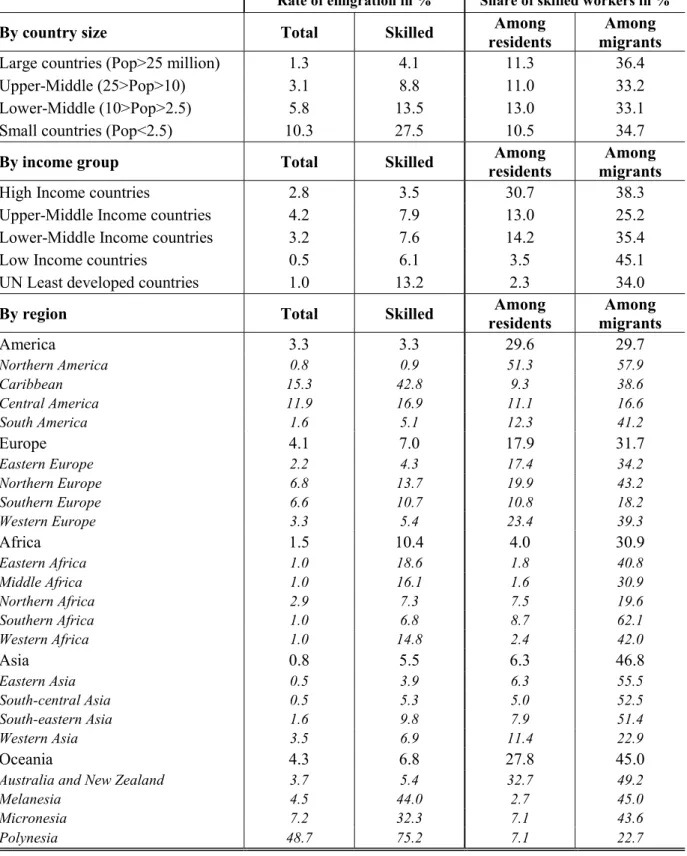
Table 1 compares total and skilled-emigration rates in 1990 and 2000 by region, income group (using the 4-group classication of the World Bank) and country size (for countries with population higher than 25 million, between 10 to 25 million, between 2.5 to 10 million, and lower than 2.5 million). It shows that average migration rates are strongly decreasing with country size, which is hardly surprising as small countries tend to be more open to trade and migration. Regarding income groups, the highest rates are observed for middle-income countries, where people have both the incentives and means to emigrate. High-income countries (less incentive to emigrate) and low-income countries (where liquidity constraints are more binding and/or for which the transferability of human capital is problematic) exhibit the lowest rates. Finally, the analysis by region shows that the regions most a¤ected are Africa, Central America and, due to small-size e¤ects, the Paci…c and the Carribean.
[INSERT TABLE 1]
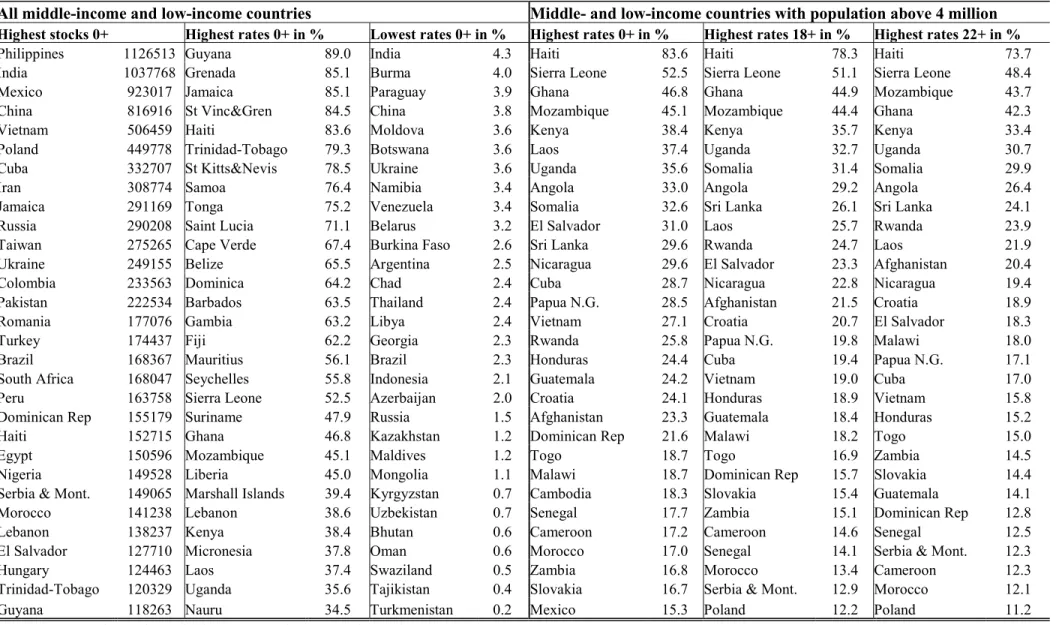
After excluding high-income countries from our sample, the left panel of Table 2 gives the data for developing countries only. Obviously, the size of the brain drain depends on whether it is measured in absolute or relative terms. In terms of absolute numbers (see Column 1), the Philippines, India, Mexico, China, Vietnam and Poland appear as the major sending countries. In terms of emigration rates (that is, as percent of the native-born skilled labor force), the rankings are of course very di¤erent. Columns 2 and 3 show the 30 countries for which emigration rates among the highly-skilled are respectively the highest and the lowest in 2000. The brain drain appears very strong in small countries, with emigration rates as high as 80% in some Paci…c and Carribean islands. By contrast, Eastern-European and South-American countries exhibit relatively low brain drain levels. It is also noteworthy that India, China, Brazil are among the least a¤ected countries in relative terms despite their important contribution to the overall stock of skilled migrants at the world level.
[INSERT TABLE 2]
The DM data set considers as skilled immigrants all foreign-born workers with university or post-secondary training living in an OECD country. Such a de…nition based on the country of birth does not account for whether education has been ac-quired in the home or in the host country. Depending on the objective for which the data are going to be used, such a de…nition could appear either too inclusive or too exclusive. For example, it would seem appropriate (or even too exclusive) if one
wants to measure the extent of a country’s ”skilled diaspora”. Conversely, it may seem too inclusive if one wants to estimate the …scal cost of the brain drain for the source country, in which case only people with home-country higher education should be considered as skilled emigrants. Building on DM estimates, Beine, Docquier and Rapoport (2007a) used immigrants’ age of entry as a proxy for where education has been acquired. They provide alternative measures of the brain drain by de…ning skilled immigrants as those who left their home country after age 12, 18 or 22, and to do so for 1990 and 2000.
On the right panel of Table 2 (columns 4 to 6), we compare the uncorrected DM rates (referred to as 0+) with the corrected rates excluding migrants who left their country before age 18 or 22 (referred to as 18+ and 22+). For a better illustration of the phenomenon, we present data only for countries with total population higher than 4 million. Controlling for familial migration does not signi…cantly a¤ect the rankings, as may be seen from the Table. The corrected rates are by construction lower than those calculated without age-of-entry restrictions. The correlation between corrected and uncorrected rates is very high and the country rankings by brain drain intensities are only mildly a¤ected by the correction. Skilled emigration is highest (higher than 30 percent) in countries that su¤ered from civil war and political instability during the last decades (e.g., Haiti, Somalia, Ghana, Sierra Leone, Lebanon) and is particularly strong in Central America and Sub-saharan Africa.
3
Theory and evidence
This section provides an overview of the theoretical and empirical literature on the consequences of highly-skilled emigration for developing countries.2 Roughly, three
generations of economics research on the brain drain may be distinguished.
The …rst generation dates back to the late 1960s and includes mainly descrip-tive papers (see for example Grubel and Scott, 1966, and the collection of papers in Adams, 1968) and welfare analyses within standard trade-theoretic frameworks (Johnson, 1967, Berry and Soligo, 1969). Basically, these early contributions con-clude to an essentially neutral impact of the brain drain on source countries. This is due to the general belief that the negative externalities at work are small if not ”negligible” (Grubel and Scott, 1966, p. 270), to the fact that skilled emigrants may leave behind them part of their assets which complement remaining skilled and un-skilled labor in the production process (Berry and Soligo, 1969), or simply to the role of remittances and other positive feedback e¤ects that act to compensate those left behind for any real loss the brain drain may cause. From a broader perspective, these studies (with the exception of Berry and Soligo) generally emphasize the bene…ts of free migration to the world economy as a whole and tend to disregard ”nationalistic” and ”outdated” claims about the alleged losses of developing countries.
The second generation of brain drain studies is in sharp contrast with the previous one. Under the leadership of Jagdish Bhagwati, a series of alternative models were de-veloped throughout the 1970s to explore the welfare consequences of the brain drain in more reallistic institutional settings. Domestic labor markets rigidities (Bhagwati and Hamada, 1974), informational imperfections (Hamada and Bhagwati, 1975), as well as …scal and other types of externalities (Bhagwati and Hamada, 1974, Bhagwati and Rodriguez, 1975, Rodriguez, 1975, McCulloch and Yellen, 1977) were introduced to emphasize instead the negative consequences of the brain drain for those left behind. Consequently, skilled emigration was viewed as contributing to increased inequality at the international level, with rich countries becoming richer at the expenses of poor countries.3 About twenty years later, the …rst papers to investigate the
migration-human capital formation relationship in an endogenous growth framework rested on similar arguments and also emphasized the negative e¤ects of the brain drain (e.g., Miyagiwa, 1991, Haque and Kim, 1995). Together with the literature of the 1970s, these papers constitute what we may term the ”traditional” or ”pessimistic” view.
Finally, a third generation of brain drain research has emerged since the mid-1990s around the idea that migration prospects can foster domestic enrollment in education in developing countries, raising the possibility for a brain drain to be bene…cial to the source country (e.g., Mountford, 1997, Stark et al., 1998, Beine et al., 2001). These studies look at how the country’s stock of human capital is built up and how migration modi…es the incentive structure faced by developing countries’ residents when making their education decisions. This literature is mainly theoretical but also includes a small number of empirical studies. At the same time, the various feedback e¤ects underlined in the early literature (remittances, return migration and business networks) have also given rise to an important literature, also contributing to nuance the negative view still dominant in many academic and international forums.
In the next section, we …rst present the general set-up, reformulate the results of early contributions within this framework, and then introduce the various channels emphasized in later research. We also present the existing evidence on each particular channel.
3.1
The model
Consider a stylized small open economy populated by two-period lived individuals. For the sake of simplicity, we assume that a composite good is produced at each period of time according to a linear production function,Yt =wtLt. We do not model capital
accumulation and set the interest rate to zero. The labor supply,Lt; sums up skilled
3An additional feature of this strand of the literature is to examine di¤erent possible taxation
schemes that could compensate the sending countries for the losses incurred, for example through a ”tax on brains” (later coinded ”Bhagwati tax”) to be collected on skilled emigrants’ earnings abroad and redistributed within the country of origin (Bhagwati and Dellalfar, 1973, McCulloch and Yellen, 1975, Bhagwati, 1976). See also the special issue of the Journal of Public Economics on ”Income taxation in the presence of international personal mobility”, August 1982.
and unskilled labor. Normalizing the number of e¢ciency units o¤ered by an unskilled individual to 1, a skilled individual is assumed to o¤erh >1 such units.
The scale factor wt measures the wage rate per e¢ciency unit of labor. It is
endogenous and time-varying. To formalize the spillover e¤ects associated to human capital formation, we assume that wt is an increasing function of the economy-wide
average level of human capital of the workers remaining in the country, Ht; itself a
function of the proportion of skilled workers in that generation, Pt (we write Ht = 1+Pt(h¡1), withPtthe share of skilled workers andh >1their relative productivity).
Hence, the domestic wage rate per e¢ciency unit of labor is given by: wt´w(Ht)
with the derivative w0 >0.
When young, people are o¤ered the choice between working as unskilled workers or devoting part of their time to education. There is a single education program, the cost of which is proportional to the domestic wage rate wt. However, individuals
are heterogenous in their ability to learn and may therefore be characterized by di¤erent education costs, with high-ability individuals incurring a lower cost. The cost of education for a type-cagent is denoted bycwt;withcdistributed on[0;1]according
to the cumulative distribution F(c). When adult, skilled (educated) and unskilled agents work full-time, with education enhancing one’s productivity and, thus, one’s income, by the exogenous skill premium h: Utility is linear in consumption, there is no discounting of income and no domestic savings. In the following we will assume for simplicity an uniform distribution of education costs and, consequently, restrict the values ofh to the interval ]1;2[ in order to obtain interior solutions.4
Without migration, the lifetime income of an uneducated agent is given by wt+
wt+1. By contrast, the lifetime income for an educated agent is wt¡cwt+wt+1h.
Clearly, education is worthwhile for individuals whose education cost is lower than a critical value. At the steady state (wt+1 =wt), the condition for investing in education
in an economy with no migration (henceforth denoted using the subscriptn) is: c < cn´h¡1:
In poor countries, however, liquidity constraints are likely to impact on education choices. Assume, therefore, that the …rst-period consumption cannot be lower than a minimal threshold, Áwt, which is assumed to be proportional to domestic wages.
Hence, an agent with education cost abovecL´1¡Áhas no access to education, and
the liquidity constraint may or may not be binding depending on whethercL?cn:
Consequently, the economy-wide average level of human capital of the current generation of adults may be written as:
Hn= 1 +Pn(h¡1)
4Given thatc2[0;1], the restrictionh <2ensures that the proportion of educated is lower than
where Pn=M in[F(cn);F(cL)] measures the proportion of educated adults.
Let us now examine the impact of skilled migration on the sending economy. In our setting, the impact of migration on remaining residents is related to the way it a¤ects the composition of the labor force. Obviously, the relationship between social welfare and skilled emigration is likely to depend on other channels. For example, skilled emigration may cause a loss of social capital (Schi¤, 2002) or have redistributive e¤ects we are abstracting from in this paper.5 We focus instead on the impact of the brain drain on the source country’s average stock of human capital, our proxy for the country’s long-run economic potential.
3.2
The traditional view
As explained above, the literature of the 1970s developed a pessimistic view of the brain drain. Careful examination of these models reveals that their central conclu-sions rest on a number of critical assumptions. In particular, it is assumed that: (i) Migrants self-selected out of the general population, (ii) There is free international mobility of skilled labor and, therefore, no uncertainty regarding future migration opportunities for the educated, and (iii) There is a complete disconnection between emigrants and their country of origin once they have left. Is such conditions, clearly, skilled emigration can only a¤ect negatively the proportion of educated in the re-maining population,P:
Building on the stylized model above, consider that workers now have the possibil-ity to emigrate toward a developed country where, due to an exogenous technological gap, one unit of human capital is paid w¤ > wt. The wage ratio can be written
as !t = w¤=wt = !(Pt) with !
0
< 0. Migration entails a cost kw¤ which captures
transportation, search, assimilation and psychic costs of leaving one’s home country. Individuals have to choose whether to educate (ED or NE) and whether to migrate (MI or NM). The lifetime income associated to each pair of decisions is given by:
U(N E; N M) = wt+wt+1
U(N E; M I) = wt+w¤(1¡k)
U(ED; N M) = wt¡cwt+wt+1h
U(ED; M I) = wt¡cwt+w¤(h¡k)
At the steady state, the condition for a positive self-selection equilibrium to emerge (i.e., skilled workers only emigrate) is :
!(1¡k)<1< !(1¡ k
h)
5See however Section 4.2. below where we discuss such redistributive e¤ects when education is
In this case, migration prospects impact on the education cost threshold required for investing in education; the condition for investing in education becomes:
c < co´!(h¡k)¡1
which is higher thancn=h¡1 providing that the self-selection condition holds.
There is strong evidence that migration prospects indeed impact on people’s de-cisions to invest in higher education. According to the International O¢ce for Mi-gration (IOM, 2003), the prospects of working abroad have increased the expected return to additional years of education and have led many people to invest in more schooling, especially in occupations in high demand overseas. For example, in their survey on medical doctors working in the UK, Kangasniemi et al. (2004) indicate that the migration premium in the medical professions lies between 2 and 4 (in PPP values); about 30% of Indian MDs surveyed acknowledge that the prospect of emigra-tion a¤ected their e¤ort to put into studies; furthermore, the respondents estimate that migration prospects a¤ect the e¤ort of about 40% of current medical students in India. In the case of the software industry, Commander et al. (2004b) estimate that the migration premium for Indian IT workers contemplating emigration to the US lies between 3 to 5 (depending on the type of job) in PPP values.6
On the basis of survey and anecdotal evidence (and of introspection, too), one can therefore easily admit that migration prospects stimulate domestic enrollment in education. In a context of free migration and with no feedback e¤ects, however, emigration deprives the country from its educated workforce, the proportion of edu-cated in the remaining population falls to zero, and the average level of human capital of remaining members falls to one. In the presence of a minimal threshold for con-sumption, migration can be limited by an additional liquidity constraint. Liquidity constraints here are due to the monetary fraction of the migration costs (as psychic costs of leaving and assimilation costs are incurred only once migration has occured). Let us denote byk0w¤ < kw¤ this monetary component of the migration cost. Agents
with education costs abovecM ´1¡k
0
!¡Á < cL cannot both educate and migrate
so that some educated individuals remain in the home country when the threshold cM is lower than cn. In this case, indeed, individuals with education cost between
cM and cn cannot a¤ord paying for both migration and education but still have an
incentive to invest in education (see case 1 on Figure 1). When cM is higher than
cn, however, agents who cannot a¤ord paying for migration costs have no incentive
to educate and all the educated leave the country at the end of period 1 (see case 2 on Figure 1).
[INSERT FIGURE 1]
6In current US$, the migration premium is obviously much higher. Many migrants confess that
they are unable to compare earnings on a PPP basis. The expected migration premium is likely to lie between the PPP and the current $ values.
In any event, the traditional view posits that once migration opportunities are introduced, the average level of human capital among remaining residents, Ht;
de-creases, which in turn depresses wages through the various externalities outlined above (Hamada, 1977, Usher, 1977, Blomqvist, 1986). Using a di¤erent perspective, Bhagwati and Hamada (1974) developed a model of wage determination in which the departure of skilled workers also reduces unskilled workers’ expected earnings. The transmission mechanism involves a non-competitive wage-setting assumed to capture the various labor markets imperfections prevailing in developing countries. Assume that educated wages are determined by workers’ unions and incorporate an element of international emulation (i.e., depend positively on wages abroad). Once skilled-workers wages are set, unskilled-skilled-workers wages follow with some rule of proportion-ality. In this setting, skilled migration reduces skilled unemployment, meaning that wage pressures become stronger. While the net e¤ect on skilled employment depends on the elasticity of demand for skilled labor (determining whether the skilled labor wage bill increases), this tends to extend unemployment and reduces welfare among the uneducated.
Note that Bhagwati and Hamada (1974), as well as McCulloch and Yellen (1977), take into account the incentive e¤ects of the brain drain on education decisions, with the increase in the expected wage for skilled workers stimulating human capital investments; they also raise a number of questions regarding optimal public …nancing of education in such a context, an issue that is dealt with in Section 4.
We now turn to the potentially bene…cial aspects of the brain drain for source countries, starting with the case of temporary migration.
3.3
Temporary migration
As explained, most receiving countries have recently made admission conditions for candidate immigrants more selective. Quality-selective procedures have been put in place and, in addition, many immigration programs targeting the educated and skilled are designed for temporary immigrants. To account for this, assume that can-didate immigrants are allowed to spend only a fraction° of their working life in the destination economy. Substituting temporary to permanent visas reinforces positive self-selection among migrants: the expected return to education being lowered, fewer people invest in education and only those at the upper-end of the ability distribution will …nd it bene…cial to do so. Obviously, the exact impact depends on the length of the migration period. In terms of our notations, the lifetime income for educated
agents is now given by:7
U(ED; N M) = wt¡cwt+wt+1h
U(ED; M I) = wt¡cwt+°w¤h+ (1¡°)hwt+1¡kw¤
At the steady state, emigration is optimal for skilled workers when the following condition holds:
°h(!¡1)> k!
If the latter condition does not hold, migration prospects have no e¤ect on human capital formation. If it does hold, then the prospect of temporary migration stimulates human capital investments at home.
Without liquidity constraints, the condition for investing in education then be-comes:
c < c° ´°(!¡1)h+h¡1¡k! if °h(!¡1)> k!
< cn ´h¡1 if not
In the …rst alternative, and assuming a uniform distribution of education costs, the proportion of educated workers in the country becomes:
P° =
(1¡°)c° 1¡°c°
:
In terms of incentives, the case of temporary migration is similar to the case of permanent migration except that the incentive e¤ect is propotional to°. In terms of total impact, however, there is a major di¤erence with the case of permanent visas in that the incentive e¤ect now partly bene…ts the home country. Indeed, the probability P° can be lower or higher thanPn. Let us denote by°¤ ´ h(!k!¡1) the value of ° above
which skilled workers start opting for migration and, therefore, above which some migration takes place and impact on education decisions. Formally, a possibility of ”bene…cial brain drain” emerges if the derivative of P° with respect to ° is positive
at° =°¤: This derivative is given by: · @P° @° ¸ °h(w¡1)=k! = (h¡1)(h¡2) +h(!¡1)¡k! [1¡°(h¡1)]2 Q0
If it is positive, then there is an interval of ° for which the temporary migration of skilled workers stimulates human capital formation (i.e., raises the economy-wide
7Note that for simplicity we assume migration costs to be identical to the case of permanent
migration. This could be justi…ed by assuming that higher transportation costs (since people now travel both ways) strictly compensate for reduced psychological costs, or that the latter are in-curred during the …rst years following immigration. Alternatively, we could assume that in case of temporary migration, people incur a migration cost ofk0+°(k¡k0)´k00.
average level of human capital).8 However, liquidity constraints are likely to limit the size of the incentive e¤ect. Ifc° > cL, some agents have no access to education in spite
of the fact that education is a pro…table investment and this reduces the likelihood of a bene…cial brain drain. Similarly, if liquidity constraints restrict migration prospects, the incentive e¤ect is thereby weakened. In the particular case where cM > cn, the
number of individuals engaging in education is constant and temporary migration reduces the share of educated workers.
Dos Santos and Postel-Vinay (2003) argue that a bene…cial brain drain can still emerge even if the share of educated workers decreases. This is shown in a set-ting where growth is exogenous at destination and endogenous at origin, the engine of growth in the developing country being the knowledge and technology spillovers somehow carried out by migrants returning from the more advanced economy. To the extent that returnees contribute to the di¤usion of the more advanced technology they experienced abroad, emigrants’ return is therefore a potential source of growth for their home country. In terms of our notations, this is as if return migrants would come back with a productivity gain,£h > h, which stimulates human capital forma-tion at home. The average stock of human capital then becomes:
H = 1 +P°(£h¡1)
which must be compared to the case of no migration, H = 1 +Pn(h¡1).9
Using a di¤erent perspective, Stark et al. (1997) elaborate on the possibility of a brain gain associated with a brain drain in a context of imperfect information with re-turn migration. In their setting, workers’ productivity is revealed at destination only after a certain period of time during which people are paid according to the average productivity of their group. Some relatively low-skill workers will therefore …nd it bene…cial to invest in education in order to migrate and be pooled at destination with high-skill workers; once individuals’ ability are revealed, the low-skill workers return to their home country, which may then bene…t from their educational investments.
There is limited evidence that return migration is signi…cant among the highly-skilled. In fact, we know that in general, return migration is characterized by negative self-selection (Borjas and Bradsberg, 1996) and is seldom among the highly skilled unless sustained growth preceded return. For example, less than a …fth of Taiwanese PhDs who graduated from US universities in the 1970s in the …elds of Science and Engineering returned to Taiwan (Kwok and Leland, 1982) or Korea, a proportion that rose to about two-thirds in the course of the 1990s, after two decades of impressive
8Clearly, for°= 1, the e¤ect of the brain drain is unambiguously detrimental.
9In a companion paper, Dos Santos and Postel-Vinay (2004) show that a change in immigration
policy in the form of an increase in the share of temporary visas, may bene…t to the sending countries. Such a change lowers the incentives to acquire education, which in turn lowers the pre-migration stock of human capital at origin, but implies a higher proportion of returnees among emigrants, which increases the country’s stock of knowledge, a complement of human capital. Their paper derives the theoretical conditions required for an overall positive e¤ect to occur.
growth in these countries. The …gures for Chinese and Indian PhDs graduating from US universities in the same …elds during the period 1990-99 are fairly identical to what they were for Taiwan or Korea 20 years before (stay rates of 87% and 82%, respectively) (OECD, 2002). This is con…rmed by a recent survey showing that in the Hsinchu Science Park in Taipei, a large fraction of companies have been started by returnees from the USA (Luo and Wang, 2002). In the case of India, the evidence for the software industry is mixed. Saxeenian (2001) shows that despite the quick rise of the Indian software industry, only a fraction of Indian engineers in Bangalore are returnees. On the other hand, a recent comprehensive survey of India’s software industry reached more optimistic conclusions and con…rmed the presence of network e¤ects and the importance of temporary mobility. The survey, conducted among 225 Indian software …rms, showed strong evidence of brain circulation, with 30-40% of the higher-level employees having relevant work experience in a developed country (Commander et al., 2004b).10
Such speci…c experiences apart, return skilled migration remains relatively limited and is often more a consequence than a trigger of growth in the home country.
3.4
Uncertainty
Before 1965, the U.S. immigration policy was based on country-speci…c quotas. This quota system is now abolished but various types of requirements and restrictions im-posed by the U.S. and other countries’ immigration authorities render the migration decision very uncertain. Implicit or explicit size-quotas are e¤ectively in place, and receiving an immigration visa, whether temporary or permanent, requires being in a close relationship either with relatives or employers who must then demonstrate that the migrant’s skills can hardly be found among native workers. Moreover, in some countries, point-systems are used to evaluate the potential contribution of immigrants to the host economy. This means that at all stages of the immigration process, there is a probability that the migration project will have to be postponed or abandonned. Individuals engaging in education investments with the prospect of migration must therefore factor in the risks involved. Paradoxically, such uncertainty, which is cer-tainly a bad thing ex ante from the individual’s perspective, creates the possibility for a brain drain migration to generate a net human capital gain for the home country.
Starting with Mountford (1997), a series of theoretical contributions have explored the conditions required for this possibility to materialize. This has been done in various theoretical frameworks with heterogeneous (Mountford, 1997, Docquier and Rapoport, 1999, Beine et al., 2001) and homogenous agents (Stark et al., 1998, Vidal, 1998). As explained in the introduction of this section, the basic idea is that in a context of uncertainty regarding future migration opportunities and of higher earnings
10In their survey on medical doctors working in the UK, Kangasmieni et al. (2004) found that
”many” doctors intend to return after completing their training abroad. Note that the survey asks about intentions, not actual returns.
abroad, migration prospects foster education investments (this induces an incentive or ”brain” e¤ect) which can compensate the loss from actual emigration (‡ight or ”drain” e¤ect), with the sign of the net e¤ect on human capital formation being positive or negative depending on which e¤ect dominates.11
In order to incorporate these approaches within our general framework, assume that the probability of migration depends solely on the achievement of a given ed-ucational requirement, which is observable, and not on individuals’ ability, which is not perfectly observable (i.e., migrants are assumed to be randomly selected among those who satisfy some kind of prerequisite with informational content regarding their ability - in our case, education).12 The model with uncertainty is similar to an out-selection model where receiving countries accept a fractionp >0of skilled candidates and reject all unskilled applications. Assume moreover that the subjective probability of receiving a visa, as seen by a potential migrant, equals to the proportion of educated who e¤ectively emigrated among the previous generation. Under these assumptions, the lifetime income for educated agents is now given by:
U(ED; N M) = wt¡cwt+wt+1h
U(ED; M I) = wt¡cwt+pw¤h+ (1¡p)hwt+1¡pkw¤
Uncertainty and return migration induce similar e¤ects on the expected return to education, which is lower in both cases than in the case of a certain and perma-nent migration. However, several di¤erences are worth noticing. First, the incentive mechanism operates even for low values of p (remember that an incentive e¤ect was obtained under temporary migration only for ° ¸ h(!k!¡1)). Second, at p =°, uncer-tainty generates more incentives to educate than temporary migration (at least at low levels of risk-aversion). The reason for this is straightforward and has to do with the fact that migration costs are incurred with probability p <1 under uncertainty but with probability p= 1in case of temporary migration.
At the steady state, the condition for skilled migration being optimal is the same as under certainty (i.e., 1 < !(1¡ kh)); but now education is worthwhile for people
11In a similar spirit, Katz and Rapoport (2005) develop a framework where expected wages are
identical at origin and destination but are charaterized by a higher variance in the origin country. In such a context, education is imparted with an option value thanks to the possibility of migration, and the authors show that more variability raises the expected proportion of educated in the remaining population when individual abilities and domestic shocks are uniformly distributed.
12Our simpli…ed model assumes homogenous skills among the educated. The size of the incentive
e¤ect would be di¤erent with heterogenous skills (see Commander et al, 2004). In reality, immi-gration authorities may be combining education with other selection devices such as tests of IQ or host-country language ‡uency. Were IQ a perfect signal of ability and the only criterion retained, migration could only be detrimental to human capital formation at home. Still, to the extent that knowing one’s skills is a discovery process or, lternatively, to the extent that IQ or other tests are imperfect signals of ability, migration prospects induce additional incentives to invest in education for some workers with intermediate ability.
for whom: c < cp ´h¡1 +ph · !(1¡ k h)¡1 ¸
Clearly, we have cp =cn when p= 0 andcp =co when p= 1.
As in the case of temporary migration, there is a possibility of bene…cial brain drain for the sending country thanks to the incentive e¤ect. Indeed, the proportion of educated workers in the country becomes Pp =
(1¡p)cp
1¡pcp ; which can be lower or higher
than Pn. A bene…cial brain drain can be obtained for some ranges of p, providing
that the derivative of Pp with respect to pis positive at p= 0. We obtain:
· @Pp @p ¸ p=0 = (h¡1)(h¡2) +h(!¡1)¡k!Q0
As in previous cases, liquidity constraints are likely to lower the size of the incen-tive e¤ect. If cp > cL, the incentive e¤ect will be limited to agents with education
costs comprised between cn andcL. A similar remark applies if cp > cM.
What is the empirical evidence on this ”prospect” channel? To the best of our knowledge, the …rst study to attempt at estimating the growth e¤ects of the brain drain using cross-country comparisons is Beine, Docquier and Rapoport (2001); in a cross-section of 37 developing countries, and after controlling for remittances, they found that migration prospects have a positive and signi…cant impact on human capital formation at origin, especially for countries with low GDP per capita levels. This was a …rst but imperfect try since they used gross migration rates as a proxy measure for the brain drain due to the lack of comparative data on international migration by education levels.
In a subsequent study, Beine et al. (2007b) used the DM emigration rates by education level to empirically assess the impact of the brain drain on human capital formation in developing countries. They …nd evidence of a positive impact of skilled migration prospects on gross human capital levels in a cross-section of 127 developing countries. In contrast, Faini (2003) …nds a depressing but not signi…cant e¤ect of tertiary emigration on domestic enrollment in higher education, a …nding he attributes to the choice of would-be migrants to pursue their studies abroad. As he himself aknowledges, however, his results must be taken with caution as they are based on enrollment data known to raise measurement problems.13
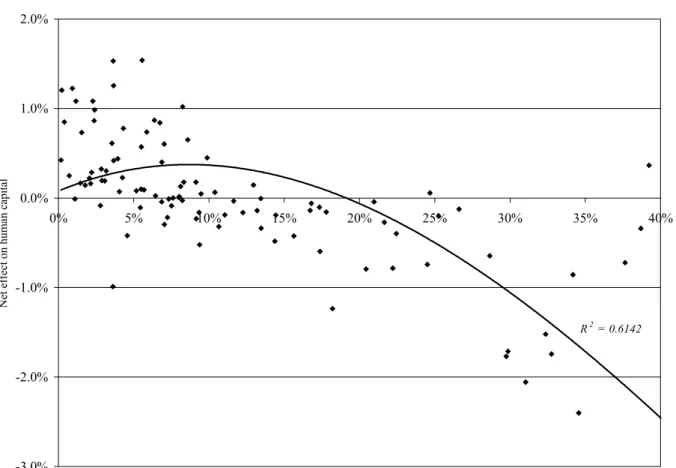
Beine et al. (2007b) also computed the net e¤ect of the brain drain using counter-factual experiments: they compare the current proportion of post-secondary educated workers to their erstwhile value would skilled workers be allowed to emigrate at the same rate as unskilled workers. They …nd that countries combining relatively low levels of human capital and low skilled emigration rates are likely to experience a
13Beine et al. (2007), on the other hand, use the improved Barro and Lee data which estimate the
proportion of highly educated partly on the basis of census data and partly on the basis of schooling data using an inventory method aimed at limiting measurement errors.
net gain, and conversely. Figure 2 gives the reduced-form net e¤ect of the brain drain on human capital formation in developing countries. The X-axis gives the DM emigration rates for the highly educated and the Y-axis gives the net impact of the brain drain on the proportion of skilled remaining in the country. The variability across countries at given migration rates is due to the impact of other right-hand-side variables, and the curve itself is adjusted using a second-order polynomial. On the whole, there appears to be more losers than winners, and in addition the former tend to lose relatively more than what the latter gain. Nonetheless, at an aggregate level and given that the largest developing countries are all among the winners (China, India, Indonesia, Brazil), brain drain migration may be seen not only as increasing the total number of skilled workers worldwide but also the number of such workers living in the developing world.
[INSERT FIGURE 2]
3.5
Remittances
Migrants’ remittances constitute another channel through which the brain drain may generate positive e¤ects for source countries. It is well documented that workers’ remittances often make a signi…cant contribution to GNP and are a major source of income in many developing countries. Remittances impinge on households’ deci-sions in terms of labor supply, investment, education (Hanson and Woodru¤, 2003, Cox Edwards and Ureta, 2003), migration, occupational choice, and fertility, with potentially important aggregated e¤ects. This is especially the case in poor countries where capital market imperfections reduce the set of options available to members of low-income classes.
The literature on migrants’ remittances shows that the two main motivations to remit are altruism, on the one hand, and exchange, on the other hand.14 Altruism
is primarily directed towards one’s immediate family, and then decreases with social distance. In contrast, no such proximity is required in the case of exchange; the exchange-based theory of remittances posits that remittances simply ”buy” various types of services such as taking care of the migrant’s assets (e.g., land, cattle) or relatives (children, elderly parents) at home. Such transfers are typically observed in case of a temporary migration and signal the migrants’ intention to return. A particular type of exchange takes place when remittances are de facto repayments of loans used to …nance the migrants’ investments in education and/or migration, with altruism and social norms and sanctions making the intergenerational contract self-enforcing. Hence, it is a priori unclear whether educated migrants would remit more than their uneducated compatriots; the former may remit more to meet implicit commitments to reimburse the family for funding of education investments (and, in
14See Rapoport and Docquier (2006) for a comprehensive survey of the theoretical and empirical
addition, they have a higher income potential), but on the other hand, they tend to emigrate with their family, on a more permanent basis, and are therefore less likely to remit (or are likely to remit less) than someone moving alone on a temporary basis.
McCormick and Wahba (2000) obtain the result that highly-skilled migration may bene…t those left behind in a trade-theoretic model where migration, remittances and domestic labor-market outcomes are jointly determined and multiple equilibria arise, with the high-migration equilibrium pareto-dominating the low-migration equilib-rium. In a setting closer to the one used throughout this paper, Cinar and Docquier (2004) develop a stylized model where skilled emigrants altruistically remit part of their earnings to relatives in the source country. They assume that each remaining resident receives an identical amount of remittances (which depends on the proportion of migrants, the intercountry wage gap, and the altruistic parameter) and character-ize the transition path (i.e., the dynamics of transfers) and the long-run equilibrium of the economy.
In our basic framework with constant marginal utility of income, remittances im-pact on human capital formation only when liquidity constraints are binding. With-out migration (and assuming a uniform distribution of education costs), the share of the educated is given by cL. With migration, two opposite e¤ects are observed.
Initially, the number of educated remaining in the country falls to cL¡cM. If
em-igrants remit part of their foreign income, liquidity constraints become less binding for recipients in the source country. The traditional negative e¤ect can therefore, in principle, be compensated by better access to education for those left behind, with the total e¤ect depending on the amounts transferred and on recipients’ location on the cost axis.
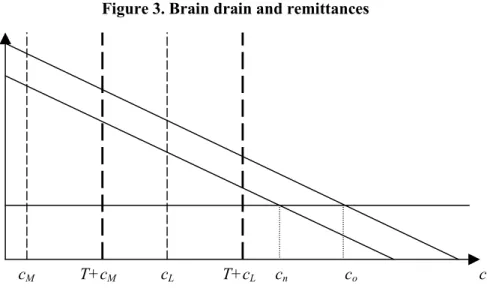
Let us denote byT the amount of remittances received by each remaining resident at the steady state. As shown on Figure 3, the e¤ect of remittances is to shiftcL and
cM to the right. With a uniform distribution, and given that (cL+T)¡(cM +T) =
cL¡cM, the proportion of educated and the economy-wide average level of human
capital are given by: PT = 1cL¡cM¡cM¡T andHT = 1 +PT(h¡1). A bene…cial brain drain
obtains if HT > Hn, that is, ifT > T¤ ´cM(cL1 ¡1):
[INSERT FIGURE 3]
In words, this means that for a bene…cial brain drain to obtain through remit-tances, the transfer received by each remaining resident must be relatively high so that a large share of the population gains access to education. This is unlikely when migration costs are quite high (as@T¤=@k >0)and, more generally, does not seem to
portray the evidence on remittance behavior in developing countries. Although remit-tances are generally positively correlated with donors’ incomes, meaning that skilled emigrants are presumably important remitters, the results from empirical studies are mixed. Most micro-studies (e.g., Lucas and Stark, 1985, Cox et al., 1998, Brown and Poirine, 2005) …nd a positive e¤ect of education on the probability of sending remittances and on the amounts remitted after controling for income, which suggests
that remittances have a loan repayment component. However, at an aggregate level, Faini (2007) shows that migrants’ remittances decrease with the proportion of skilled individuals among emigrants and concludes that ”this result suggests that the neg-ative impact of the brain drain cannot be counterbalanced by higher remittances”. This does not imply that remittances by skilled migrants are negligible, especially if the proportion of temporary migrants increases; for example, Kangasniemi et al. (2004) show that nearly half (45%) of Indian medical doctors working in the UK remit income to their home country and that remitters transfer on average 16% of their income.
Instead of sending remittances to relatives at home, migrants may return after they have accumulated savings abroad and use such savings to promote investment projects (generally small businesses). There is much evidence that low-skill workers migrate with the aim of accumulating enough savings to access to self-employment and entrepreneurship (see, e.g., Mesnard (2004) and Mesnard and Ravallion (2001) for Tunisia, Dustmann and Kirchkamp (2002) for Turkey, Ilahi (1999) for Pakistan, Woodru¤ and Zenteno (2007) for Mexico, or McCormick and Wahba (2001) for Egypt). The latter study also suggests that skill-acquisition may be more impor-tant for relatively educated migrants than the need to overcome liquidity constraints.
3.6
Network e¤ects
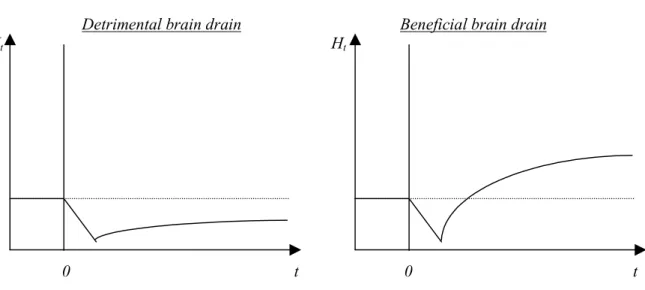
Our analysis has so far focused on the long run steady state. In the short run, with unanticipated migration, emigration of educated workers is a net loss to the home country. As time goes by, however, successive cohorts adapt their education decisions and the economy-wide average level of education partly (as in Figure 4a) or totally catches up, with a possible net gain in the long run (as in Figure 4b) thanks to the various channels detailed above. On the transition path, additional e¤ects are likely to operate. In particular, there is a large economic and sociological literature emphasizing that the creation of migrants’ networks facilitates exchanges of goods, factors, and ideas between the migrants’ host and home countries. In this section we consider two types of migrant network e¤ects: networks that encourage trade, FDI in‡ows and technology di¤usion, and networks that encourage further migration.
[INSERT FIGURE 4]
An important socio-economic literature has emerged recently to analyze the conse-quences of the constitution of migrants’ networks on migration patterns. For example, Massey, Goldring and Durand (1994) outline a cumulative theory of migration, not-ing that the …rst migrants usually come from the middle ranges of the socioeconomic hierarchy, and are individuals who have enough resources to absorb the costs and risks of the trip, but are not so auent that working abroad is unattractive. Family and friends then draw on ties with these migrants to gain access to employment and assistance in migrating, substantially reducing the costs and risks of movement to
them. This increases the attractiveness and feasibility of migration for additional members, allowing them to migrate and expand further the set of people with net-work connections. Migration netnet-works can then be viewed as reducing the costs, and perhaps also increasing the bene…ts of migration (Bauer et al., 2002, Munshi, 2003, and McKenzie and Rapoport, 2007, …nd strong evidence of such network e¤ects). In other words, migration incentives become endogenous once networks are formed.
Building on this idea, Kanbur and Rapoport (2005) introduce networks e¤ects at destination in a standard model of selective migration. In the spirit of Carrington et al. (1996), they assume that migration costs, k, are decreasing with the size of the network at destination, that is, with the number of migrants already emigrated abroad. As explained above, the role of migrants’ networks is to di¤use information on job availability and provide hospitality and help in job search. Hence, past mi-gration progressively raises the expected return to education (net of mimi-gration costs) and, therefore, domestic enrollment in education.15 For a givenp or°, this raises the
optimal number of individuals engaging in education and the share of educated work-ers remaining in the country. In this sense, migrant networks have positive e¤ects on human capital formation and serve to mitigate the short-run detrimental e¤ects of the brain drain.
Another type of network e¤ect consists in the creation of business and trade net-works; such a ”diaspora externality” has long been recognized in the sociological literature and, more recently, by economists in the …eld of international trade. In many instances indeed, and contrarily to what one would expect in a standard trade-theoretic framework, trade and migration appear to be complements rather than substitutes (e.g., Gould, 1994, Lopez and Schi¤, 1998). Interestingly, such a comple-mentarity has been shown to prevail mostly for trade in heterogeneous goods, where ethnic networks help overcoming information problems linked to the very nature of the goods exchanged (Rauch and Trindade, 2002, Rauch and Casella, 2003). How is the relationship of substitutability or complementary between trade and migration impacted by the skill composition of migration, however, remains unclear. The only empirical study on this question we are aware of is that of Lopez and Schi¤ (1998), who used episodes of trade liberalization to conclude to a relationship of complemen-tarity between trade and unskilled migration, and conversely for skilled migration.16
Similarly, one may ask whether migration and FDI are substitutes (as one would expect) or complements, and whether the skill composition of migration, or the sec-toral composition of FDI, impact on the relatiosnhip between the two. Again, the
15For this incentive e¤ect to operate, however, education must not only increase one’s chances
of migration but also allow for accessing to legal, high-skill jobs. In a context where immigration is illegal and migrants can only access unskilled jobs, the prospect of migration can instead reduce education investment. See McKenzie and Rapoport (2006) on Mexico-U.-S. migration, and De Brauw and Giles (2006) on rural-urban migration in China.
16Interestingly, a recent theoretical paper (Kar and Beladi, 2004) using a Hecksher-Ohlin
frame-work augmented to allow for non competitive wage settings comes up with predictions just opposite to the empirical …ndings of Lopez and Schi¤.
evidence on these issues is scant. There are certainly many case-studies suggesting that skilled migrants take an active part in the creation of business networks leading to FDI project deployment in their home country. This is the case, in particular, for the software industry (Saxeenian, 2001, Arora and Gambardella, 2005, Comman-der et al., 2004b). At an agregate level, Kugler and Rapoport (2007) investigate the migration-FDI relationship for U.S.-rest of the world bilateral ‡ows throughout the 1990s. They show that FDIs towards a given country are positively correlated with the initial U.S. immigration stock of that country (for both skilled and unskilled migration) but negatively correlated with the change in immigration stocks during the period studied. >From this they conclude to a relationship of contemporaneous substitutability and of dynamic complementarity between migration and FDI. Inter-estingly, after disagregating the results by skill level and destination sector, they …nd signi…cant relationships only for current unskilled migration and current manufactur-ing FDI, which appear to be substitutes, and for past skilled migration and current FDI in the service sector, which appear to be complements.
4
Policy issues
Our discussion of policy issues is based on a simpli…ed model combining liquidity constraints and uncertain migration prospects (solutions are henceforth indexed by pl). Since this kind of model relies on out-selection immigration policies, we consider that migration costs are zero (k = k0 = 0). However, similar conclusions would be obtained through combining self-selection (which requires positive migration costs) and return migration.
Without public intervention our model can be summarized by the following equa-tions:
cpl ´ M in[cO;cM]
Ppl =
(1¡p)cpl 1¡pcpl
whereco =cn+phis the open economy critical education cost threshold,=!¡1
measures the foreign wage premium, cn = h¡1 is the critical agent in the closed
economy, and cM = 1¡Á is the critical threshold of education cost when liquidity
constraints are binding. The foreign wage premium is endogenous and decreases with the domestic proportion of educated Ppl.
In this framework, we analyze the role of emigration (or immigration) policy, education policy, and (Bhagwati) tax policy on the interplay between migration and human capital formation. These policies are evaluated in terms of their impact on the average level of human capital, Hpl = 1 + (h¡1)Ppl and in terms of their impact
on the income of the unskilled, Ipl = 2w. Basically, these two social objectives can
for a given p, the average level of human capital increases with the critical ability. Focusing on e¢ciency therefore requires maximizingcpl. Without public intervention,
maximizing the proportion of educated also maximizes the welfare of uneducated agents, which means that e¢cient and socially just solutions coincide.
4.1
Migration policy: the optimal rate of skilled migration
We use a diagrammatic representation in the (; p) plane.
If liquidity constraints are not binding, a bene…cial brain drain emerges ifPpl > cn,
or, equivalently, if:
>BB(p)´
(h¡1)(2¡h)
h[1¡p(2¡h)]
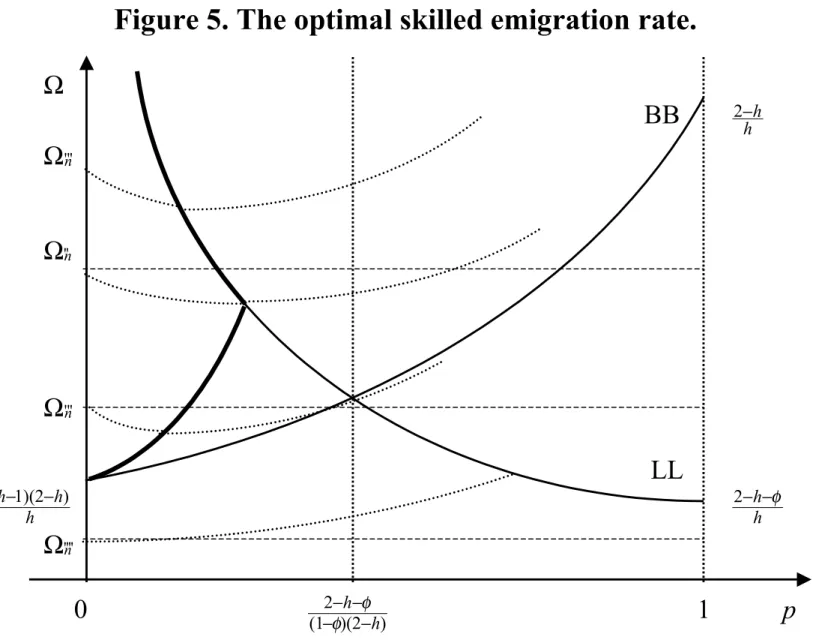
This expression is an increasing and convex function of p; depicted as the BB curve in Figure 5.
Liquidity constraints are binding if cpl > cn, i.e. if: >LL(p)´
2¡h¡Á ph which is depicted as the LL curve in Figure 5.
When liquidity constraint are binding, a bene…cial brain drain emerges when
(1¡p)cM
1¡pcM > cn, or equivalently, whenp < pb ´
2¡h¡Á
(1¡Á)(2¡h). Note thatpbis the intersection
between LL and BB.
The optimal rate of skilled migration depends on ; which is itself endogenous as it depends on human capital accumulation and, therefore, on migration prospects. Let us de…nen as the foreign wage premium prevailing at p= 0. Ifn >BB(0) = (h¡1)(2¡h)=h, then there is room for a bene…cial brain drain over some ranges of p. Several paths of migration premium can be represented diagrammatically. In each case (i.e., for each n), the optimal migration rate corresponds to the minimal
value of the (; p)locus. For limited values ofp, the proportion of educated increases and the foreign wage premium decreases with p. For a higher p, the proportion of educated decreases. The optimal migration rate lies between 0 and the BB curve (depicted as the bold curve). If liquidity constraints are binding, the incentive e¤ect of migration vanishes and the optimal rate of migration is constrained by the LL curve. In countries where n > BB(0), a brain drain is always detrimental. The
proportion of educated and the welfare of unskilled workers decrease with p. The optimal rate of migration is then zero. These results may be summarized as follows:
Remark 1 As apparent from Figure 5, the optimal migration rate is zero for rela-tively rich countries, that is, for countries with a low foreign wage premium. It then increases with the foreign wage premium as long as liquidity constraint are not binding, and then decreases with for poor countries where liquidity constraints are binding.
[INSERT FIGURE 5]
In other words, there is an inverse-U shape relationship between optimal skilled emigration and level of development.
4.2
Education policy
Consider now that the government collects an income tax on both educated and uneducated adults remaining in the country. The tax may be expressed in terms of educated workers’ wages, ¿ wh, with ¿ denoting the tax rate, and is assumed to …nance an education subsidy allocated to each young opting for education; the education subsidy may itself be expressed in terms of the local wage,µw. The critical education cost threshold then becomes:
c¿O = h¡1 +µ+ph(+¿)
c¿M = 1¡Á+µ c¿pl = M in[c¿O; c¿M]
Education policy plays a double role in the debate on the brain drain e¤ects. First, for a given pair (¿,µ), the condition for a bene…cial brain drain to obtain is modi…ed. Second, the brain drain requires budgetary adjusments (increasing taxes or reducing subsidies). We address these two e¤ects separetely.
Let us …rst consider that the government budget in the closed economy is balanced under the pair (¿n,µn). The budget constraint implies that ¿nh = mµn(h¡1 +µn),
where m is the number of children per adult. Assume also that liquidity constraints are not binding in the closed economy so thatc¿ =h¡1 +µn <1¡Á+µn. Without
…scal adjustments (e.g., assuming that international aid allows the government to keep the policy (¿n,µn) unchanged), and assuming …rst that liquidity constraints are
not binding (that is, c¿
O ·c¿M), then a bene…cial brain drain emerges if: >¿BB(p)´ (h¡1 +µn)(2¡h¡µn)
h[1¡p(2¡h¡µn)] ¡
¿n
Compared to the economy without taxes and subsidies, the BB curve shifts down-ward: ¿
BB(p)<BB(p). This is clearly the case for high values of p (atp= 1). This
is also the case for small values ofp, at least when the skill premium is su¢ciently high (at p= 0, using the budget constraint, ¿BB(0)<BB(0) requires µ >
(3¡2h)¡m(h¡1) 1+m
which decreases with h and m; if m= 0, a su¢cient condition to obtain the desired condition is h > 4=3). On the other hand, if liquidity constraints are binding, that is, if c¿O > c¿M (this will be the case if >¿LL(p) ´ 2¡phh¡Á ¡¿n), then compared to
the economy without taxes and subsidies, the LL curve will also shift downwards but the condition for a bene…cial brain drain to emerge will be:
p < p¿b ´ 2¡h¡Á
(1¡Á+µn)(2¡h¡µn)
If the subsidy is su¢ciently high (µn > Á¡h+ 1), then p¿b is higher than pb, the
critical migration rate without education policy. These results may be summarized as follows:
Remark 2 If the closed economy …scal policy can be maintained, then education policy reinforces the likelihood of a bene…cial brain drain. As apparent from Figure 6, the area for which a bene…cial brain drain obtains in the(; p) plane (see the area delimited by the solid lines) is larger than in the case without education policy (see the area delimited by the dashed lines).
[INSERT FIGURE 6]
Secondly, the brain drain generates a …scal loss that requires …scal adjustments such as decreasing education subsidies by ¢µ and/or increasing taxes by ¢¿. The optimal policy-mix depends on the social objective of the government. Reducing education subsidies lowers the proportion of educated in both the constrained and unconstrained cases:
¢c¿O = ¡¢µ ¢c¿M = ¡¢µ
In contrast, increasing taxes stimulates education investment in the unconstrained case but has no in‡uence on human capital accumulation in the constrained case:
¢c¿O = ph¢¿
¢c¿M = 0
Therefore, if the government’s objective is to maximize the average level of human capital (e¢ciency), adjusting through taxes appears to be the best option. Alterna-tively, if the objective is to maximize the income of unskilled workers, now de…ned as Ipl = w(2¡¿ h), then adjusting through taxes would seem preferable in terms
of e¢ciency but disproportionately harms the uneducated workers; if human capital externalities are not too strong, reducing subsidies is therefore preferable for the sake of social justice.
Remark 3 The …scal adjusment to the brain drain raises a tradeo¤ between e¢ciency and social justice. The optimal policy mix depends on the social welfare function of the government.
4.3
The case for a Bhagwati tax
Finally, consider that the government is allowed to collect a tax (expressed in percent of educated workers’ wages at home, ¿¤wh) on skilled emigrants. We do not discuss here the feasibility of such tax scheme, which obviously requires international tax