Effect of Variable Viscosity, Dissipation and Hall Currents on
Convective Heat and Mass Transfer Flow Past a Stretching Sheet
P. Kristaiah1 V. Srinivas1 D. R. V. Prasada Rao2
1.Department of Mathematics, Ambedkar Open University, Telangana, India 2.Department of Mathematics, S.K. University, Anantapur-515003, A.P, India Abstract
We consider the influence dissipation, variable viscosity, Hall current of a magneto-hydrodynamic free-convective flow and heat and mass transfer flow past a stretching sheet in the presence of heat generation/absorption. The fluid viscosity is assumed to vary as an inverse linear function of temperature. The boundary-layer equations governing the fluid flow, heat and mass transfer under consideration have been reduced to a system of non-linear ordinary differential equations by employing a similarity transformation. Using the finite difference scheme, numerical solutions to the transform ordinary differential equations have been obtained and the results are presented graphically. The rare of heat anf mass transfer sre discussed numerically for different variations.
Keywords:Radiation absorption, Variable viscosity, Soret effect, MHD, Hall current, Heat and mass transfer. NOMENCLATURE
B r
magnetic induction vector
Bo strength of applied magnetic field
C dimensionless concentration variable
Cf local skin-friction coefficient
Cs concentration susceptibility factor
Cp specific heat at constant pressure
D thermal molecular diffusivity
Dm solution diffusivity of the medium
E r
intensity vector of the electric field
E charge of the electron
G Grashof number
go acceleration due to gravity
J r
electric current density vector
K mean absorption coefficient
Kf thermal conductivity
k0 measures the rate of reaction
KT thermal diffusion ratio
M Hartmann number
m Hall current parameter
N Buoyancy ratio
Nr thermal radiation parameter
Nu local Nusselt number
ne number of density of the electron
Pr Prandtl number
Ec Eckert number
Sc Schmidt number
Sr Soret parameter
Sh local Sherwood number
T dimensional temperature variable
Tw fluid temperature at walls
T∞ free stream temperature
u,v,w velocity components
x,y,z direction components
µe magnetic permeability V r velocity vector Greek Symbols thermal diffusivity
βc coefficient of species concentration
βT coefficient of thermal expansion
similarity variable
∞
ρ
fluid density
µ co-efficient of dynamic viscosity
σ electrical conductivity of the fluid
θ non-dimensional temperature
θr viscosity parameter
φ non-dimensional concentration
λ Heat generation/absorption parameter
γ non-dimensional chemical reaction
parameter
τx, τz shear stress components
kinematic viscosity Subscripts
c cold wall
w warm side wall
1. Introduction
Combined heat and mass transfer problems with chemical reaction are important in many processes and have, therefore, received a considerable amount of attention in recent years. In processes such as drying, evaporation at the surface of a water body, energy transfer in a wet cooling tower and the flow in a desert cooler, heat and mass transfer occur simultaneously. Possible applications of this type of flow can be found in many industries. For
example, in the power industry, among the methods of generating electric power is one of in which electrical energy is extracted directly from a moving conducting fluid. Obviously, the understanding of this transport process is desirable in order to effectively control the overall transport characteristics. The combined effect of thermal and mass diffusion in channel flows has been studied in the recent times by a few authors Das et al[1994], Gnaneswara Reddy and Bhaskar Reddy[2010], Nelson and Wood [1989], Raptis [1985, 1999].
In the recent past there has been a growing interest in boundary-layer flow on a continuous moving surface in the presence of magnetic field with or without considering the effect of Hall current. These are very significant types of flow encountered in several engineering applications, such as in polymer processing, gas turbines, various propulsion device for aircraft, space vehicles, electro-chemistry, MHD power generators, flight magneto hydrodynamics as well as in the field of planetary magnetosphere, aeronautics and chemical engineering. If the temperature of the surrounding fluid becomes high then the thermal radiation effect play a vital role in the case of space technology. The study of heat generation or absorption effects in moving fluids is important in view of several physical problems such as fluids undergoing exothermic or endothermic chemical reactions. The volumetric heat generation has been assumed to be constant or a function of space variable. For example, a hypothetical core – disruptive accident in a liquid metal fast breeder reactor (LMFBR) could result in the setting of fragmented fuel debris on horizontal surfaces below the core. The porous debris could be saturated sodium coolant and heat generation will result from the radioactive decay of the fuel particulate.
In most of the studies, the effects of both the viscous dissipation and Joule heating are neglected since they are of the same order as well as negligibly small. However, it is more realistic to include the effects of viscous dissipation and Joule heating to explore the impact of the magnetic field on the thermal transfer in the boundary layer. The effect which bears a great importance on heat transfer is viscous dissipation. When the viscosity of the fluid is high, the dissipation term becomes important. Fro many cases, such as polymer processing which is operated at a very high, the viscous dissipation term becomes important. For many cases, such as polymer processing which is operated at a very high temperature, viscous dissipation cannot be neglected. The main advantage of Joule heating is the rapid and relatively uniform heating achieved together with the lower capital cost compared to other electro heating methods such as microwave and radio frequency heating. The applications of Joule heating technique in industries include the blanching, evaporation, dehydration and pasteurization of food products. Some recent interesting contributions pertaining to heat transfer aspects of viscous dissipation and Joule heating are cited in Azim et al.[2010], Nandeppanavar et al. [2011], pal et al. [2011], yavari et ai. [2012].
Most of the previous studies are concerning the constant thermo-physical properties of the fluid. It is well known that the fluid property most sensitive to temperature rise is viscosity. For many liquids, among them water, petroleum oils, glycerin, glycols, silicone fluids and some molten salts, the viscosity shows a rather pronounces variation with temperature. For example, when the temperature increases from 10 °C (µ=0.00131g/cm) to 50 °C (µ=0.00548g/cm), the viscosity of the water decreases by 240%. To predict the heat transfer rate accurately, it is necessaryk to take the variation of viscosity with temperature into consideration. The variation of viscosity in thermal boundary layer is large. There exist several applications of this problem, for example, in the processes of hot rolling, wire drawing, glass fiber production, paper production, gluing of labels on hot bodies, drawing of plastic films and the study of spilling pollutant crude oils over the surtace of seawater. Many researchers have studied the flows with temperature dependent viscosity in different geometries and under various flow conditions (Barakat [2004], Seddeek and Salem [2005], El-Aziz [2007], Makinde and Ogulu [2008], Rahman and Eitayab [2022], Khan et al. [2011].
Vajravelu and Hadjinicolaou [1993] studied the heat transfer characteristics in the laminar boundary layer of a viscous fluid over a stretching sheet with viscous dissipation or frictional heating and internal heat generation. Hossain et al [2004] studied the problem of natural convection flow along a vertical wavy surface with uniform surface temperature in the presence of heat generation or absorption. Alam et al [2009] studied the problem of free convection heat and mass transfer flow past an inclined semi-infinite heated surface of an electrically conducting and steady viscous incompressible fluid in the presence of a magnetic field and heat generation. Chamkha [1997] investigated unsteady convective heat and mass transfer past a semi-infinite porous moving plate with heat absorption. Hady et al [2010] studied the problem of free convection flow along a vertical wavy surface embedded in electrically conducting fluid saturated porous media in the presence of internal heat generation or absorption effect.
The application of electromagnetic fields in controlling the heat transfer as in aerodynamic heating leads to the study of magneto hydrodynamic heat transfer. This MHD heat transfer has gained significance owing to recent advancement of space technology. The MHD heat transfer can be divided into two sections. One contains problems in which the heating is an incidental by-product of the electro magnetic fields as in MHD generators, pumps etc., and the second consists of problems in which the primary use of electromagnetic fields is to control the heat transfer. With the fuel crisis deepening all over the world, there is a great concern to utilize the enormous power beneath the earth’s crust in the geothermal region. Liquid in the geothermal region is an
electrically conducting liquid because of high temperature. Hence the study of interaction of the geomagnetic field with the fluid in the geothermal region is of great interest, thus leading to interest in the study of MHD convection flows through porous medium. The influence of a uniform transverse magnetic field on the motion of an electrically conducting fluid past a stretching sheet was investigated by Pavlov [1974]. The effect of chemical reaction on free-convective flow and mass transfer of a viscous, incompressible and electrically conducting fluid over a stretching sheet was investigated by Afify [2004] in the presence of transverse magnetic field. Das et al. [2014] investigated MHD Boundary layer slip flow and heat transfer of nanofluid past a vertical stretching sheet with non-uniform heat generation/absorption. Ibrahim and Makinde [2015] studied the Double-diffusive mixed convection and MHD Stagnation point flow of nanofluid over a stretching sheet. Rudraswamy et al. [2015] considered the effects of magnetic field and chemical reaction on stagnation-point flow and heat transfer of a nanofluid over an inclined stretching sheet.
Bharathi et al [2009] have discussed Non Darcy Hydromagnetic Mixed convective Heat and Mass Transfer flow of a viscous fluid in a vertical channel with Heat generating sources. Non-Darcy Hydromagnetic convective Heat and Mass transfer through a porous medium in a cylindrical annulus with Soret effect, radiation and dissipation. Balasubramanyam et al [2010 ] have discussed Non Darcy viscous electrically conductive Heat and Mass transfer flow through a porous medium in a vertical channel in the presence of heat generating sources. Hall currents are important and they have a marked effect on the magnitude and direction of the current density and consequently on the magnetic force term. The problem of MHD free convection flow with Hall currents has many important engineering applications such as in power generators, MHD accelerators, refrigeration coils, transmission lines, electric transformers, heating elements etc., Watanabe and Pop [1995], Abo-Eldahab and Salem [2004], Rana et al. [2008], Singh and Gorla [2009], Shit [2009] among others have advanced studies on Hall effect on MHD past stretching sheet. Shateyi and Motsa [2011] considered boundary layer flow and double diffusion over an unsteady stretching surface with Hall effect. Chamkha et al [2011] analyzed the unsteady MHD free convective heat and mass transfer from a vertical porous plate with Hall current, thermal radiation and chemical reaction effects.
All the above mentioned studies are based on the hypothesis that the effect of dissipation is neglected. This is possible in case of ordinary fluid flow like air and water under gravitational force. But this effect is expected to be relevant for fluids with high values of the dynamic viscosity force. Moreover Gebhart and Mollendorf[1969] have shown that viscous dissipation heat in the natural convective flow is important when the fluid is of extreme size or is at extremely low temperature or in high gravitational field. On the other hand, Zanchini [1998] pointed out that relevant effects of viscous dissipation on the temperature profiles and the Nusselt number may occur in the fully developed convection in tubes. In view of this, several authors, notably, Sreevani [2003] have studied the effect of viscous dissipation on the convective flows past an infinite vertical plate and through vertical channels and ducts.
In the recent past there has been a growing interest in boundary-layer flow on a continuous moving surface in the presence of magnetic field with or without considering the effect of Hall current. These are very significant types of flow encountered in several engineering applications, such as in polymer processing, gas turbines, various propulsion device for aircraft, space vehicles, electro-chemistry, MHD power generators, flight magneto hydrodynamics as well as in the field of planetary magnetosphere, aeronautics and chemical engineering. If the temperature of the surrounding fluid becomes high then the thermal radiation effect play a vital role in the case of space technology.
Steady heat flow on a moving continuous flat surface was first considered by Sakiadis [1961] who developed a numerical solution using a similarity transformation. Crane [1970] motivated by the processes of polymer extrusion, in which the extrudate emerges from a narrow slit, examined semi-infinite fluid flow driven by a linearly stretching surface. Many researchers and academicians have advanced their studies relating to problems involving MHD in stretching sheet considering various parameters. (Sharidan [2006], Gupta and Gupta [2009], Ishak et al. [2007-2009], Aziz et al. [2011], Abel et al. [2008], Mukhopadhyay and Mondal [2013], Krishnendu [2013]), Swati Mukhopadhyay et al. [2013], Prasad et al. [2003], Wang [2006] among others). Rashad et al [2011] considered MHD free convective heat and mass transfer of a chemically-reacting fluid from radiate stretching surface embedded in a saturated porous medium. Theuri et al [2013] studied unsteady double diffusive magneto hydrodynamic boundary layer flow of a chemically reacting fluid over a flat permeable surface.
To accurately predict the flow and heat transfer rates, it is necessary to take into account the temperature-dependent viscosity of the fluid. The effect of temperature-dependent viscosity on heat and mass transfer laminar boundary layer flow has been discussed by many authors (Mukhopadhyay et al. [2005], Mukhopadhyay and Layek [2008], Ali [2006], Makinde [2006], Prasad et al. [2010], Alam et al. [2009]) in various situations. They showed that when this effect was included, the flow characteristics might change substantially compared with the constant viscosity assumption. Salem [2007] investigated variable viscosity and thermal conductivity effects on MHD flow and heat transfer in viscoelastic fluid over a stretching sheet. Anjali
Devi and Ganga [2009] have considered the viscous dissipation effects on MHD flows past stretching porous surfaces in porous media. Mohamed El-Aziz [2014] analyzed unsteady mixed convection heat transfer along a vertical stretching surface with variable viscosity and viscous dissipation. Xi-Yan Tian et al. [2015] investigated the 2D boundary layer flow and heat transfer in variable viscosity MHD flow over a stretching plate.
The thermal-diffusion effect, for instance, has been utilized for isotope separation and in mixture between gases with very light molecular weight (Hydrogen-Helium) and of medium molecular weight (Nitrogen-air) the diffusion-thermo effect was found to be of a magnitude such that it cannot be neglected Kafoussias and Williams [1995]. Alam et al. [2006] studied Dufour and Soret effects on steady free convection and mass transfer flow past a semi-infinite vertical porous plate in a porous medium. Makinde [2011] studied numerically the influence of a magnetic field on heat and mass transfer by mixed convection from vertical surfaces in porous media considering Soret and Dufour effects. Rashidi et al [2015] analyzed heat and mass transfer for MHD viscoelastic fluid flow over a vertical stretching sheet considering Soret and Dufour effects. Recently, Sreedevi
et al [2015] have discussed the effect of radiation absorption and variable viscosity on hydromagnetic convective heat and mass transfer flow past a stretching sheet.
Motivated by the above-mentioned researchers, this paper aims at studying the combined influence of dissipation, variable viscosity effect, thermo-diffusion and Hall current on the hydromagnetic free-convective flow, heat and mass transfer flow past a stretching surface in the presence of heat generation/absorption source. The governing equations have been solved by employing fifth-order Runge-Kutta-Fehlberg method along with shooting technique. The effects of various parameters on the velocity, temperature and concentration as well as on the local skin-friction coefficient, local Nusselt number and local Sherwood number are presented graphically and discussed.
2. Problem Formulation
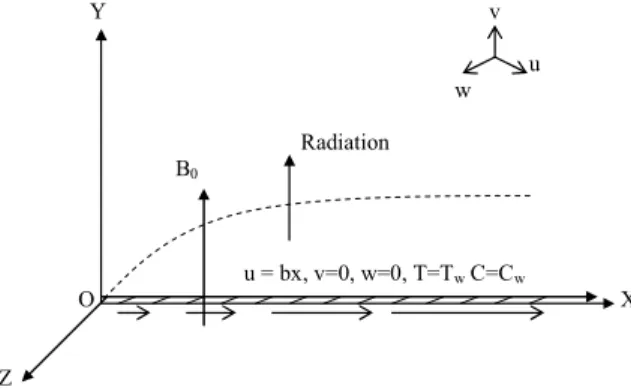
We consider the steady free-convective flow, heat and mass transfer of an incompressible, viscous and electrically conducting fluid past a stretching sheet and the sheet is stretched with a velocity proportional to the distance from a fixed origin O (cf. Fig. 1).
Y v u w Radiation B0 u = bx, v=0, w=0, T=Tw C=Cw O X Z
Figure 1. Physical Sketch of the Problem
A uniform strong magnetic field of strength B0 is imposed along the y-axis and the effect of Hall current is taken
into account. Taking Hall effects into account the generalized Ohm’s law provided in the following form
)
*
1
*
(
1
2f
B
en
B
V
E
m
J
er
r
r
r
r
r
−
+
+
+
=
σ
Where c oen
B
m
=
σ
is defined as the Hall current parameter. A very interesting fact that the effect of Hall current gives rise to a force in the z-direction which in turn produces a cross-flow velocity in this direction and then the flow becomes three-dimensional. The temperature and the species concentration are maintained at prescribed constant values Tw, Cw at the sheet and T∞ and C∞ are the fixed values far away from the sheet.
The fluid viscosity µ is assumed to vary as a reciprocal of a linear function of temperature given by
)]
(
1
[
1
1
0 ∞ ∞−
+
=
γ
T
T
µ
µ
(1))
(
1
∞ ∞−
=
a
T
T
µ
(2) Where ∞=
µ
γ
0a
and 01
γ
−
=
T
∞T
rIn the above equation both a and Tr are constants, and their values depend on the thermal property of the fluid,
i.e., g0. In general a > 0 represent for liquids, whereas for gases a < 0.
Owing to the above mentioned assumptions, the boundary layer free-convection flow with mass transfer and generalized Ohm’s law with Hall current effect are governed by the following system of equations:
0
=
∂
∂
+
∂
∂
y
v
x
u
(3)(
)
(
)
(
)
1
2 2 0 0 0w
m
u
m
B
C
C
g
T
T
g
y
u
y
y
u
v
x
u
u
c m m m+
+
−
−
+
−
+
∂
∂
∂
∂
=
∂
∂
+
∂
∂
∞ ∞σ
β
ρ
β
ρ
µ
ρ
τ (4))
(
1
2 2 0m
u
w
m
B
y
w
y
y
w
v
x
w
u
m−
+
+
∂
∂
∂
∂
=
∂
∂
+
∂
∂
σ
µ
ρ
(5)(
)
( 2 2) 2 2 w u T T Q y T k y T v x T u Cp f m − − + + ∂ ∂ = ∂ ∂ + ∂ ∂ ∞ µ ρ (6)(
)
22 0 2 2 y T T K D C C k y C D y C v x C u m T m m ∂ ∂ + − − ∂ ∂ = ∂ ∂ + ∂ ∂ ∞ (7) where (u,v,w) are the velocity components along the (x,y,z) directions respectively.Dm
is the solution diffusivity of the medium,K
T is the thermal diffusion ratio,C
s is the concentration susceptibility,C
pis the specific heat at constant pressure and Tm is the mean fluid temperature.The boundary conditions for the present problem can be written as
u = bx, v = w = 0, T = Tw, C = Cw at y=0 (8)
u →0, w→0, T→T∞, C→C∞ at y→∞ (9)
where b (> 0) being stretching rate of the sheet. The boundary conditions on velocity in Eq. (8) are the no-slip condition at the surface y = 0, while the boundary conditions on velocity at y→∞ follow from the fact that there is no flow far away from the stretching surface.
To examine the flow regime adjacent to the sheet, the following transformations are invoked
);
(
);
(
);
(
η
v
bv
f
η
w
bxg
η
f
bx
u
=
′
=
−
=
∞ ∞ ∞ ∞−
−
=
−
−
=
=
C
C
C
C
T
T
T
T
y
v
b
w wφ
η
θ
η
;
(
)
;
(10) where f is a dimensionless stream function, h is the similarity space variable, θ and φ are the dimensionless temperature and concentration respectively. Clearly, the continuity Eq. (3) is satisfied by u and v defined in Eq. (9), Substituting Eq. (10) the Eqs. (4)-(7) reduce to(
)
0
1
)
(
2 2
=
+
+
′
′
−
+
+
−
−
′′
−
′
−
′′
′
+
′′
−
′
−
m
mg
f
M
N
G
f
f
f
f
f
r r r r r r rθ
θ
θ
φ
θ
θ
θ
θ
θ
θ
θ
θ
θ
θ
(11)(
)
0
1
2 2=
+
+
′
−
−
′
−
′
−
′′
+
′
−
′
−
m
g
f
m
M
g
g
g
f
g
f
r r r r rθ
θ
θ
θ
θ
θ
θ
θ
θ
(12) 0 ) ( 1 Pr 3 4 1 2 2 2 2 '' ′ + = + + + + f g m EcM Nrr θ λθ (13) '' ' '')
(
φ
γφ
θ
φ
−
Sc
f
−
=
−
ScSr
(14)Similarly, the transformed boundary conditions are given by
f′(η)=1,f(η)=0,g(η)=0,θ(η)=1,φ(η)=1atη=0 (15)
f′(η) → 0, g(η)→ 0, θ(η) → 0, φ(η) → 0 at η→∞ (16)
where a prime denotes the differentiation with respect to η only and the dimensionless parameters appearing in
the Eqs. (11)-(16) are respectively defined as
− − = − − = ∞ ∞ ∞ ) ( 1 0 T T T T T T w w r r γ θ
the viscosity parameter,
b P B M ∞ = 2 0 σ
the magnetic parameter, k
v C Pr = ρ p
the Prandtl number,
) ( 0 ∞ − = C C b k w γ the non-dimensional
chemical reaction parameter, b x
T T g G T w 2 0 ( − ∞) = β
the local Grashof number, ( )
) ( ∞ ∞ − − = T T C C N w T w C β β the Buoyancy ratio, ∗ ∞ = σ 3 0 4T kk Nr
is the thermal radiation parameter, s p
T m C C K D Sr=
the Soret parameter, D
Sc ∞ =
ρ
µ
the Schmidt number , C b Q p ∞ = ρ λis defined as the heat generation / absorption parameter and T T C b
EC p w ) ( 2 ∞ − = µ is the Eckert number.
3. Method of Solution
The coupled ordinary differential equations (11)-(14) are of third-order in f, and second-order in g, θ and φ which have been reduced to a system of nine simultaneous equations of first-order for nine unknowns. In order to solve this system of equations numerically we require nine initial conditions but two initial conditions on f and one initial condition each on g, θ and φ are known. However the values of f¹, g, θ and φ are known at
η
→
∞
. These four end conditions are utilized to produce four unknown initial conditions at η=0 by using shooting technique. The most crucial factor of this scheme is to choose the appropriate finite value ofη
∞. In order toestimate the value of
η
∞, we start with some initial guess value and solve the boundary value problemconsisting of Eqs. (11)-(14) to obtain f¹¹(0), g¹(0), θ¹(0) and φ¹(0). The solution process is repeated with another large value of
η
∞until two successive values of f¹¹(0), g¹(0), θ¹(0) and φ¹(0) differ only after desired significantdigit. The last value of
η
∞is taken as the final value ofη
∞for a particular set of physical parameters fordetermining velocity components f¹(η), g(η), temperature θ(η) and concentration φ(η) in the boundary layer. After knowing all the nine initial conditions, we solve this system of simultaneous equations using fifth-order Runge-Kutta-Fehlberg integration scheme with automatic grid generation scheme which ensures convergence at a faster rate. The value of
η
∞ greatly depends also on the set of the physical parameters such as Magneticparameter, Hall parameter, buoyancy ratio, Heat source parameter, Prandtl number, thermal radiation parameter, porous parameter, Schmidt number, Soret number and chemical reaction parameter so that no numerical
oscillations would occur. During the computation, the shooting error was controlled by keeping it to be less than 10-6. Thus, the coupled non-linear boundary value problem of third-order in f, second-order in g, θ and φ has
been reduced to a system of nine simultaneous equations of first-order for nine unknowns as follows:
,
,
,
1 3 2 2 1 1 1f
f
f
f
f
f
=
=
=
] 1 ) ( ) 1 )( ( ) ( ) ( ) )( ( ) [( 2 2 4 2 2 2 2 4 2 6 2 8 6 6 3 1 2 2 6 3 6 7 1 3 m f f Ec M m mf f f M f f G f f f f f f f f f r r r r r r r + + + + + − − + − + − − − − = θ θ θ θ θ θ θ , 5 1 4 4g
,
f
f
f
=
=
)]
1
)(
(
)
)(
(
)
[(
2 6 2 24 5 1 4 2 6 5 6 7 1 5m
f
mf
f
M
f
f
f
f
f
f
f
f
f
r r r r r+
−
−
+
−
−
−
−
=
θ
θ
θ
θ
θ
)
4
3
/(
3
)]
4
3
/(
3
[
,
,
1 6 8 7 7 1 6 6f
f
f
P
rf
N
rQf
N
rf
=
θ
=
=
−
λ
+
+
+
)]
4
3
/(
(
3
)
(
[
,
,
8' 9 9' 8 1 9 6 1 8 8f
f
f
Sc
f
f
f
ScS
rP
rf
Q
f
N
rf
=
φ
=
=
γ
−
−
λ
+
+
(17) Where 9 1 1 8 8 1 7 6 1 5 4 11 3 1 2 1f
,
f
f
,
f
f
,
f
,
f
g
,
f
,
f
,
f
,
f
f
f
=
=
=
=
θ
=
=
θ
=
θ
=
φ
=
φ
=
(18) and a prime denotes differentiation with respect to η. The boundary conditions now become∞
→
→
→
→
→
=
=
=
=
=
=
η
η
at
f
f
f
f
at
f
f
f
f
f
0
,
0
,
0
,
0
0
1
,
1
,
0
,
1
,
0
8 6 4 2 8 6 4 2 1 (19) Since f3(0), f5(0) , f7(0) and f9(0) are not prescribed so we have to start with the initial approximations asf3(0)=s10, f5(0)=s20, f7(0)=s30 and f9(0)=s40. Let γ1, γ2, γ3 and γ4 be the correct values of f3(0), f5(0) and f7(0)
respectively. The resultant system of nine ordinary differential equations is integrated using fifth-order Runge-Kutta-Fehlberg method and denote the values of f3, f5 ,f7 and f9 at
η
=
η
∞by f3(s10, s20, s30, s40,η
∞), f5(s10, s20,s30, s40,
η
∞), f7(s10, s20, s30, s40,η
∞) and f9(s10, s20, s30, s40,η
∞) respectively. Since f3, f5, f7 and f9 atη
=
η
∞ areclearly function of γ1, γ2, γ3 and γ4, they are expanded in Taylor series around γ1 – s10, γ2 – s20, γ3 – s30 and γ4 – s40
respectively by retaining only the linear terms. The use of difference quotients is made for the derivatives appeared in these Taylor series expansions.
Thus, after solving the system of Taylor series expansions for δγ1= γ1 – s10, δγ2 = γ2 – s20, δγ3= γ3 – s30, and
δγ4= γ4 – s40 we obtain the new estimates s11=s10+δs10, s21= s20+δs20, s31= s30+δs30 and s41= s40+δs40. Thereafter the
entire process is repeated starting with f1(0), f2(0), s11, f4(0), s21, s31 and s41 as initial conditions. Iteration of the
whole outlined process is repeated with the latest estimates of γ1, γ2, γ3 and γ4 until prescribed boundary
conditions are satisfied.
Finally, s1n=s1(n-1)+ δ s1(n-1), s2n=s2(n-1)+ δ s2(n-1), s3n=s3(n-1)+δ s3(n-1) and s4n=s4(n-1)+δ s4(n-1) for n=1,2,3,... are
obtained which seemed to be the most desired approximate initial values of f3(0), f5(0), f7(0) and f9(0). In this
way all the six initial conditions are determined. Now it is possible to solve the resultant system of seven simultaneous equations by fifth-order Runge-Kutta-Fehlberg integration scheme so that velocity, temperature fields and concentration for a particular set of physical parameters can easily be obtained. The results are provided in several tables and graphs.
3.1 Skin Friction, Nusselt Number and Sherwood Number
The local skin-friction coefficient Cf, the local Nusselt number Nu and the local Sherwood number Sh defined by
)
0
(
f
bx
C
v b w f=
=
′′
µ
τ
(20) where(
)
),
0
(
0 ∞ =−
=
′′
=
∂
∂
=
T
T
k
q
Nu
f
bx
y
T
w v b w v b y w&
µ
µ
τ
(21) where)
0
(
)
(
0θ
′
−
−
=
∂
∂
−
=
∞ =T
T
k
y
T
k
q
v w b y w and)
0
(
)
(
−
=
−
φ
′
=
∞C
C
D
m
Sh
w v b w (22) where)
0
(
)
(
0φ
′
−
−
=
∂
∂
−
=
∞ =C
C
D
y
C
D
m
v w b y wIf we consider M = m = 0, θr →∞ and Sr=Sc=θr=N=0, the present flow problem becomes hydrodynamic boundary-layer flow past a stretching sheet whose analytical solution put forwarded by Crane (2) as follows
f (η) = 1 – e-n i.e., f′ (η) = e-n (23)
An attempt has been made to validate our result for the axial velocity f′ (η). We compared our results with this analytical solution and found to be in good agreement.
4. Results and Discussion
The system of coupled non-linear Eqs. (5.14)-(5.17) together with the boundary conditions (5.18) and (5.19) have been solved numerically. In our present study the numerical values of the physical parameters have been chosen so that G, M, m, λ, Nr, γ, Sr, Ec and θr are varied over a range which is listed in the following figures. (cf. Watanabe and Pop (1993) and (1995), Afify (2004), Salem (2007) and Shit and Haldar (2012))
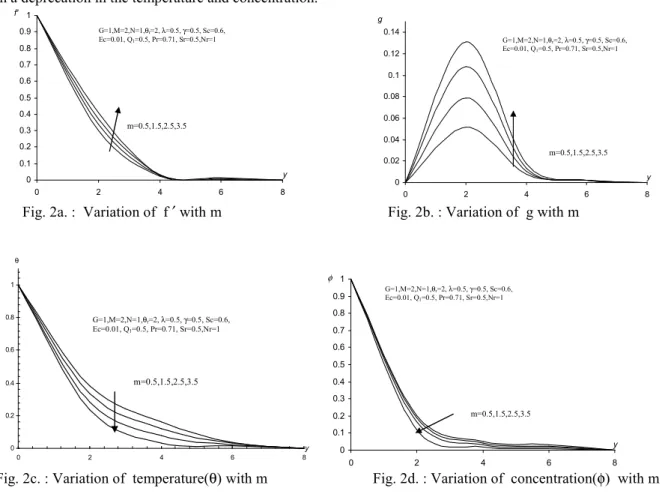
Figs. 2-13 represent the axial velocity ƒ′ and distribution of the z′ component of velocity which is induced due to the presence of the Hall effects. All these figures show that for any particular values of the physical parameters g(ç) reaches a maximum value at a certain high ç above the sheet and beyond which g(ç) decreases gradually in asymptotic nature for different velocities of m, Sr, γ, Ec and θr. Figs. 2(a & b) shows that the axial velocity ƒ′(η) increases with increase in Hall parameter which increases due to the fact that as m increases the Lorentz force which opposes the flow and leads to the degeneration of the fluid motion. The anomalous behavior of θ with variation of m is observed due to the presence of the Hall Current and there by induces a cross flow velocity component g(η). For an increase in the Hall parameter m we noticed n enhancement in cross flow velocity. From Figs.2(c & d), we find that an increase in the Hall parameter m, results in a deprecation in the temperature and concentration.
0 0.1 0.2 0.3 0.4 0.5 0.6 0.7 0.8 0.9 1 0 2 4 6 8 y f' m=0.5,1.5,2.5,3.5 G=1,M=2,N=1,θr=2, λ=0.5, γ=0.5, Sc=0.6, Ec=0.01, Q1=0.5, Pr=0.71, Sr=0.5,Nr=1 0 0.02 0.04 0.06 0.08 0.1 0.12 0.14 0 2 4 6 8 y g m=0.5,1.5,2.5,3.5 G=1,M=2,N=1,θr=2, λ=0.5, γ=0.5, Sc=0.6, Ec=0.01, Q1=0.5, Pr=0.71, Sr=0.5,Nr=1
Fig. 2a. : Variation of f ′ with m Fig. 2b. : Variation of g with m
0 0.2 0.4 0.6 0.8 1 0 2 4 6 8 θ y m=0.5,1.5,2.5,3.5 G=1,M=2,N=1,θr=2, λ=0.5, γ=0.5, Sc=0.6, Ec=0.01, Q1=0.5, Pr=0.71, Sr=0.5,Nr=1 0 0.1 0.2 0.3 0.4 0.5 0.6 0.7 0.8 0.9 1 0 2 4 6 8 y φ m=0.5,1.5,2.5,3.5 G=1,M=2,N=1,θr=2, λ=0.5, γ=0.5, Sc=0.6, Ec=0.01, Q1=0.5, Pr=0.71, Sr=0.5,Nr=1
0 0.1 0.2 0.3 0.4 0.5 0.6 0.7 0.8 0.9 1 0 2 4 6 8 y f' γ = 0.5,1.5 G=1,M=2,m=0.5r=2, Sc=0.6, λ=0.5, N=1, Ec=0.01, Q1=0.5, Pr=0.71, Sr=0.5,Nr=1 γ =-0.5,-1.5 0 0.02 0.04 0.06 0.08 0.1 0.12 0.14 0.16 0.18 0.2 0 2 4 6 8 y g γ = 0.5,1.5 G=1,M=2,m=0.5r=2, Sc=0.6, λ=0.5, N=1, Ec=0.01, Q1=0.5, Pr=0.71, Sr=0.5,Nr=1 γ =-0.5,-1.5
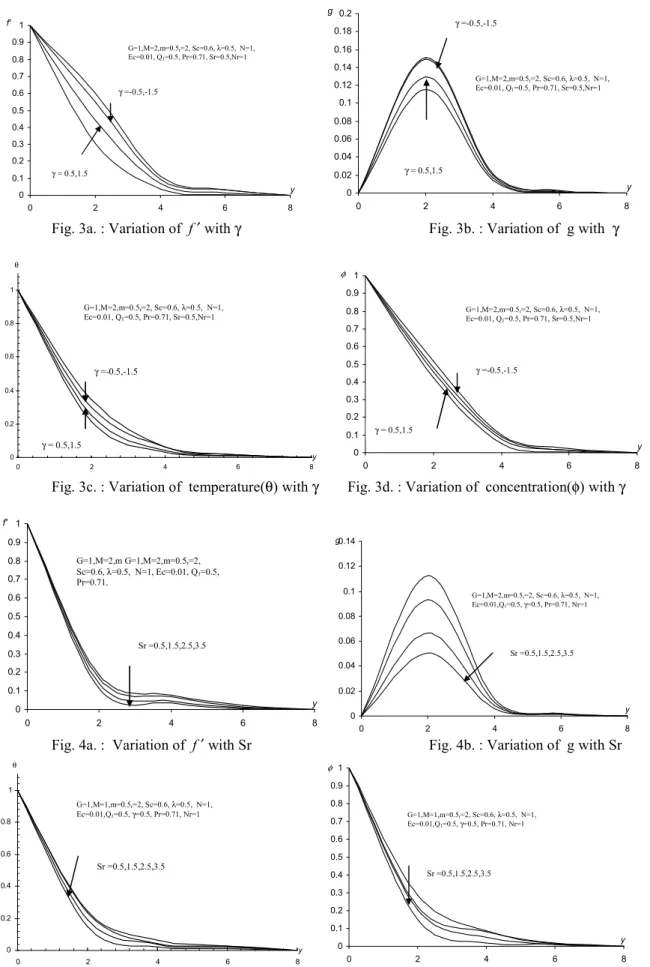
Fig. 3a. : Variation of f′ with γ Fig. 3b. : Variation of g with γ
0 0.2 0.4 0.6 0.8 1 0 2 4 6 8 θ y γ = 0.5,1.5 G=1,M=2,m=0.5r=2, Sc=0.6, λ=0.5, N=1, Ec=0.01, Q1=0.5, Pr=0.71, Sr=0.5,Nr=1 γ =-0.5,-1.5 0 0.1 0.2 0.3 0.4 0.5 0.6 0.7 0.8 0.9 1 0 2 4 6 8 y φ γ = 0.5,1.5 G=1,M=2,m=0.5r=2, Sc=0.6, λ=0.5, N=1, Ec=0.01, Q1=0.5, Pr=0.71, Sr=0.5,Nr=1 γ =-0.5,-1.5
Fig. 3c. : Variation of temperature(θ) with γ Fig. 3d. : Variation of concentration(φ) with γ
0 0.1 0.2 0.3 0.4 0.5 0.6 0.7 0.8 0.9 1 0 2 4 6 8 y f' G=1,M=2,m G=1,M=2,m=0.5r=2, Sc=0.6, λ=0.5, N=1, Ec=0.01, Q1=0.5, Pr=0.71, Sr =0.5,1.5,2.5,3.5 0 0.02 0.04 0.06 0.08 0.1 0.12 0.14 0 2 4 6 8 y g G=1,M=2,m=0.5r=2, Sc=0.6, λ=0.5, N=1, Ec=0.01,Q1=0.5, γ=0.5, Pr=0.71, Nr=1 Sr =0.5,1.5,2.5,3.5
Fig. 4a. : Variation of f′ with Sr Fig. 4b. : Variation of g with Sr
0 0.2 0.4 0.6 0.8 1 0 2 4 6 8 θ y G=1,M=1,m=0.5r=2, Sc=0.6, λ=0.5, N=1, Ec=0.01,Q1=0.5, γ=0.5, Pr=0.71, Nr=1 Sr =0.5,1.5,2.5,3.5 0 0.1 0.2 0.3 0.4 0.5 0.6 0.7 0.8 0.9 1 0 2 4 6 8 y φ G=1,M=1,m=0.5r=2, Sc=0.6, λ=0.5, N=1, Ec=0.01,Q1=0.5, γ=0.5, Pr=0.71, Nr=1 Sr =0.5,1.5,2.5,3.5 Fig. 4c. : Variation of temperature(θ) with Sr Fig. 4d. : Variation of concentration (φ) with Sr
0 0.1 0.2 0.3 0.4 0.5 0.6 0.7 0.8 0.9 1 0 2 4 6 8 y f' G=1,M=1,m=0.5r=2, Sc=0.6, λ=0.5, N=1, Ec=0.01,Q1=0.5, γ=0.5, Pr=0.71, Sr=0.5 θr =-2,-4,-6,-8 0 0.1 0.2 0.3 0.4 0.5 0.6 0 2 4 6 8 y g G=1,M=1,m=0.5r=2, Sc=0.6, λ=0.5, N=1, Ec=0.01,Q1=0.5, γ=0.5, Pr=0.71, Sr=0.5 θr =-2,-4,-6,-8
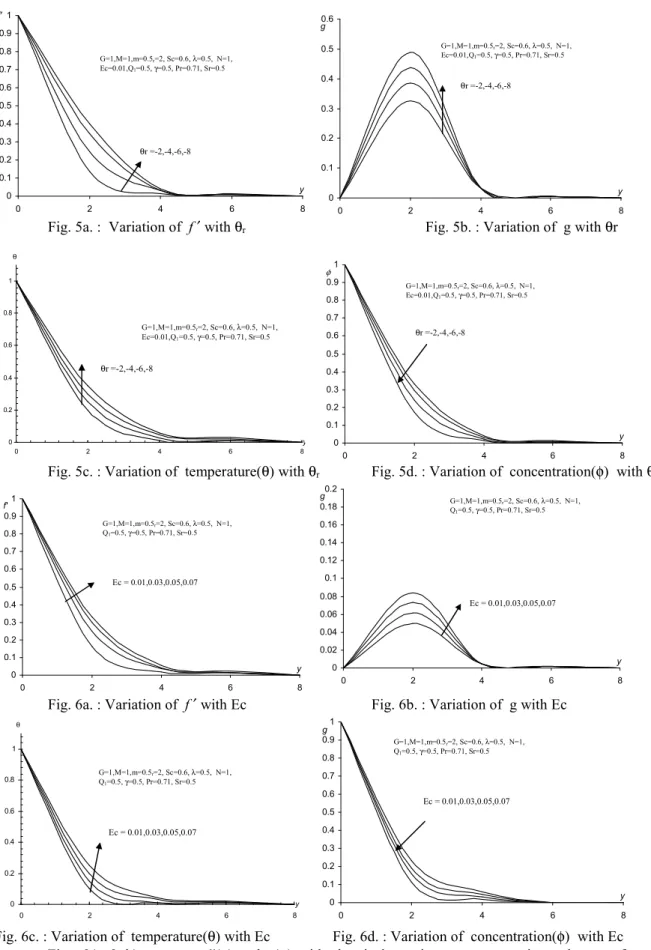
Fig. 5a. : Variation of f′ with θr Fig. 5b. : Variation of g with θr
0 0.2 0.4 0.6 0.8 1 0 2 4 6 8 θ y G=1,M=1,m=0.5r=2, Sc=0.6, λ=0.5, N=1, Ec=0.01,Q1=0.5, γ=0.5, Pr=0.71, Sr=0.5 θr =-2,-4,-6,-8 0 0.1 0.2 0.3 0.4 0.5 0.6 0.7 0.8 0.9 1 0 2 4 6 8 y φ G=1,M=1,m=0.5r=2, Sc=0.6, λ=0.5, N=1, Ec=0.01,Q1=0.5, γ=0.5, Pr=0.71, Sr=0.5 θr =-2,-4,-6,-8
Fig. 5c. : Variation of temperature(θ) with θr Fig. 5d. : Variation of concentration(φ) with θr
0 0.1 0.2 0.3 0.4 0.5 0.6 0.7 0.8 0.9 1 0 2 4 6 8 y f' G=1,M=1,m=0.5r=2, Sc=0.6, λ=0.5, N=1, Q1=0.5, γ=0.5, Pr=0.71, Sr=0.5 Ec = 0.01,0.03,0.05,0.07 0 0.02 0.04 0.06 0.08 0.1 0.12 0.14 0.16 0.18 0.2 0 2 4 6 8 y g G=1,M=1,m=0.5 r=2, Sc=0.6, λ=0.5, N=1, Q1=0.5, γ=0.5, Pr=0.71, Sr=0.5 Ec = 0.01,0.03,0.05,0.07
Fig. 6a. : Variation of f′ with Ec Fig. 6b. : Variation of g with Ec
0 0.2 0.4 0.6 0.8 1 0 2 4 6 8 θ y G=1,M=1,m=0.5r=2, Sc=0.6, λ=0.5, N=1, Q1=0.5, γ=0.5, Pr=0.71, Sr=0.5 Ec = 0.01,0.03,0.05,0.07 0 0.1 0.2 0.3 0.4 0.5 0.6 0.7 0.8 0.9 1 0 2 4 6 8 y g G=1,M=1,m=0.5r=2, Sc=0.6, λ=0.5, N=1, Q1=0.5, γ=0.5, Pr=0.71, Sr=0.5 Ec = 0.01,0.03,0.05,0.07
Fig. 6c. : Variation of temperature(θ) with Ec Fig. 6d. : Variation of concentration(φ) with Ec Figs. 3(a & b) represent ƒ′(η) and g(η) with chemical reaction parameter γ, it can be seen from the profiles that the axial and cross flow velocity components enhance in the degenerating chemical reaction parameter γ and reduces in generating chemical reaction (γ<0). The temperature reduces and concentration enhances in the degeneration chemical reaction case and in the generating case, the temperature and
concentration reduce in the boundary layer.
Figs. 4(a & b) represents ƒ′(η) with Soret parameter Sr. It can be observed from the profiles that the axial and cross flow velocity components reduces with increase in Sr in the boundary layer. An increase in the Soret parameter Sr, leads to a deprecation in the temperature and concentration. Thus the effect of the thermo diffusion is to reduce the temperature and concentration in the boundary layer (Figs. 4(c & d). Figs. 5(a & b) depict the axial velocity ƒ′(η) increases with the increase of viscosity parameter θr. This observation leads to the increase of thermal boundary layer thickness. The cross flow velocity g(η) enhances with increase in viscosity parameter θr. Figs. 5(c & d) represent temperature and concentration with viscosity parameter θr, it is found that an increase in θr( 0), enhances the temperature and the reduces concentration in the boundary layer.
The variation of ƒ′(η) and g(η) shows that higher the dissipative heat larger the axial and cross flow velocity components. The temperature increases and the concentration reduces with increase in Ec in the entire flow region is shown in Figs. (6a-6d).
The variation of Skin friction with different parameters is exhibited in Table.1.It is found that. An increase the Hall parameter (m) enhances τx and reduces τy at the wall. An increase in the viscosity parameter θr leads to an enhancement in τx and reduction in τy. Higher the dissipative heat larger the skin friction components. The variation of skin friction component with Heat sources parameter (λ) shows that the skin friction components reduce with increase in the strength of the heat generating heat source and a reversed effect is observed in the case of heat absorption case. The rate of heat transfer (Nusselt number) at the wall η=0 is shown in Tables.7-9 for different parametric variations. Higher the radiative heat flux larger the rate of heat transfers. The rate of heat transfer reduces in the degenerating chemical reaction case and enhances in the generating chemical reaction case. The variation of Nu with Soret parameter (Sr) and viscosity parameter shows that higher the thermo-diffusion effects smaller the rate of heat transfer at the wall. The variation of Nu with Ec shows that higher the dissipative heat larger the rate of heat transfers. The rate of mass transfer (Sherwood Number) at the wall is shown in Tables 10-12 for different variations of the parameters. It is found that the rate of mass transfer reduces with increase in m and enhances with increase in M. Higher the radiative heat flux/thermo-diffusion effects/higher the dissipation heat/higher the viscosity parameter smaller the rate of mass transfer at the wall. The variation of Sh with γ shows that the rate of mass transfer enhances at the wall in both degenerating and generating chemical reaction cases. with respect to heat source parameter(λ), we find that the rate of mass transfer increases with increase in the strength of the heat generating source and in the case of heat absorption sources case, it reduces on the wall.
Table 1 : Skin friction (τx) and Skin friction (τz) at η = 0
M I II III IV V I II 1 -0.2240 -0.37498 -0.229982 -0.169908 -0.142464 0.101697 0.457131 2 -0.81729 -1.03341 -0.597994 -0.748834 -0.714801 -0.30814 0.754672 3 -1.15584 -1.2647 -0.930891 -1.12375 -1.10862 -0.51255 1.0128 γ .5 1.5 2.5 -.5 -1.5 0.5 0.5 m 0.5 0.5 0.5 0.5 0.5 1.5 1.5
Table 2 : Skin friction (τz) at η = 0
M I II III IV V
1 0.327984 0.311932 0.349701 0.334938 0.338632
2 0.479339 0.433289 0.16688 0.495622 0.503943
3 0.603959 0.573597 0.683315 0.614067 0.618989
γ .5 1.5 2.5 -.5 -1.5
Table 3 : Skin friction (τx) at η = 0
M I II III IV V 1 -0.224087 -0.273523 -0.321122 -0.222953 -0.221815 2 -0.81729 -0.876127 -0.91729 -0.730499 -0.728232 3 -1.15584 -1.19338 -1.2286 -1.15275 -1.14964 So .5 1.5 2.5 .5 .5 Ec .01 .01 .01 .03 .05
Table 4 : Skin friction (τz) at η = 0 M I II III IV V 1 0.327984 0.321781 0.31555 0.328104 0.328223 2 0.479339 0.476171 0.459339 0.499619 0.499979 3 0.603959 0.592654 0.581893 0.604481 0.605008 So .5 1.5 2.5 0.5 0.5 Ec .01 .01 .01 .03 .05
Table 5 : Nusselt Number (Nu) η = 0
M I VI VI VII VIII IX 1 -0.044032 -0.0425575 -0.020881 -0.11888 -0.054653 -0.060494 2 -0.029859 -0.0291104 0.008493 0.199479 -0.045426 -0.053858 3 -0.053838 -0.0525966 -0.0273999 -0.153963 -0.06395 -0.0690398 m 0.5 1.5 .5 .5 .5 .5 γ 0.5 0.5 1.5 2.5 -.5 -1.5
Table 6 : Nusselt Number (Nu) η = 0
M I II III IV V 1 -0.0440326 -0.0350437 -0.0265163 -0.0489398 -0.0538574 2 -0.0298597 -0.0291626 -0.0288597 -0.061991 -0.0749878 3 -0.0538387 -0.0431349 -0.0331725 -0.0756825 -0.0976799 So .5 1.5 2.5 .5 .5 Ec .01 .01 .01 .03 .05
Table 7: Sherwood Number (Sh) η = 0
M I VI VI VII VIII IX 1 0.670855 0.695265 1.24235 -0.113321 0.515931 0.443561 2 0.973886 1.00175 1.99504 0.261495 0.711571 0.589033 3 0.599217 0.639085 1.14356 -0.21619 0.465302 0.405146 m .5 1.5 .5 .5 .5 .5 γ .5 0.5 1.5 2.5 -.5 -1.5
Table 8 : Sherwood Number (Sh) η = 0
M I II III IV V 1 0.670855 0.839894 1.00084 0.672547 0.674242 2 0.973886 1.007028 1.073886 0.635252 0.639705 3 0.599217 0.78174 0.953674 0.606679 0.614194 So .5 1.5 2.5 0.5 0.5 Ec .01 .01 .01 .03 .05 5. Conclusions
The problem of combined influence of dissipation, variable viscosity effect, Hall current of a magneto hydrodynamic free-convective flow and heat and mass transfer over a stretching sheet in the presence of heat generation/absorption has been analyzed. The fluid viscosity is assumed to vary as an inverse linear function of temperature. The numerical results were obtained and compared with previously reported cases available in the literature and they were found to be in good agreement. Graphical results for various parametric conditions were presented and discussed for different values. The main findings are summarized below:
In the presence of Hall current, both axial and cross flow velocity distribution enhances. Increase in Hall parameter m results into a depreciation in the temperature and concentration. With increase in skin friction parameter τx, Hall current reduces at η=0 and enhances τz at η=0. The rate of heat transfer reduces with
increase in Hall parameter, whereas the rate of mass transfer enhances with increase in Hall parameter. The presence of degenerating chemical reaction cases, the axial velocity and cross flow velocity reduces and both these velocities enhance in the generating chemical reaction case. The temperature and concentration reduces in the degeneration chemical reaction case and enhances in the generation chemical reaction case. The skin friction parameter reduces with chemical reaction parameter γ in the degenerating case and enhances with the generating case. The rate of heat transfer reduces with lower values of γ and enhances with higher values of γ. The rate of mass transfer enhances with lower values of γ and reduces with higher values of γ.
An increase in thermo-diffusion Sr, the axial velocity reduces and cross flow velocity decreases and reduces the temperature and concentration. The skin friction parameter τx increases with increase in Sr at η=0. The
skin friction parameter τz reduces with increase in Sr at η=0. The rate of heat transfer reduces with increase in
thermo-diffusion Sr. Thus higher the thermo-diffusion Sr, larger the rate of mass transfer at the sheet.
Higher the dissipative heat larger the axial and cross flow velocity components. The temperature increases and the concentration reduces in entire flow region.
The axial velocity increases the boundary layer thickness with the increase in the viscosity parameter θr. The cross flow velocity g(η) thinning the momentum boundary layer with increase in the viscosity With increase in the viscosity parameter the temperature of the fluid flow also increases and reduces the concentration of the boundary layer.
References
[1] Sakiadis BC. Boundary layer behaviour on continuous solid surfaces. American Institute of Chemical Engineering J. (AIChE) 1961;7(2):221-5.
[2] Crane LJ. Flow past a stretching plate. Zeitschrift für Angewandte Mathematik und Physik 1970;21:645-7. [3] Sharidan S, Mahmood T, Pop I. Similarity solutions for the unsteady boundary layer flow and heat
transfer due to a stretching sheet. Int J Appl Mech Eng 2006;11(3):647-54.
[4] Carragher P, Crane LJ. Heat transfer on continuous stretching surface. ZAMM 1982;62:564-77.
[5] Gupta PS, Gupta AS. Heat and mass transfer on a stretching sheet with suction or blowing. Can J Chem
Eng 2009;55:744-6.
[6] Ishak A, Nazar R, Pop I. Mixed convection on the stagnation point flow toward a vertical continuously stretching sheet. ASME J Heat Transfer 2007;129:1087-90.
[7] Ishak A, Nazar R, Pop I. Mixed convection on the stagnation point flow of a micro fluid towards s a stretching sheet. Meccnica 2008;43:411-8.
[8] Ishak A, Nazar R, Pop I. Boundary layer flow and heat transfer over an unsteady stretching vertical surface. Meccanica 2009;44:369-75.
[9] Aziz RC, Hashim I, Alomari AK. Thin film flow and heat transfer on an unsteady stretching sheet with internal heating. Meccanica 2011;46:349-57.
[10] Abel MS, Sanjayanand E, Nandeppa navar MM. Viscoelastic MHD flow and heat transfer over a stretching sheet with viscous and ohmic dissipations. Commun Nonlinear Sci Numer Simul 2008;13(9):1808-21
[11] Mukhopadhyay S, Mondal IC. Heat analysis for fluid flow over an exponentially stretching porous sheet with surface heat flux in porous medium. Ain Shams Eng J 2013;4:103–10.
[12] Krishnendu B. Heat transfer analysis in unsteady boundary layer stagnation-point flow towards a shrinking/stretching. Ain Shams Eng J 2013;4:259-64.
[13] Mukhopadhyay S, Ranjan P, Krishnnedu B, layek GC. Casson fluid flow over an unsteady stretching surface. Ain Shams Eng J 2013;4:933-8.
[14] Prasad KV, Abel AS, Datti PS. Diffusion of chemically reactive species of non-Newtonian fluid immersed in a porous medium over a stretching sheet. Int. J. Non-Linear Mech 2003; 38(5):651-7. [15] Wang C. Analytic solutions for a liquid film on an unsteady stretching surface. Heat Mass Transfer
2006;42:43-8.
[16] Rashad AM, Modather M, Chamkha AJ. MHD Free Convective Heat and Mass Transfer of a
Chemically-Reacting Fluid from Radiate Stretching Surface Embedded in a Saturated Porous Medium. International Journal of Chemical Reactor Engineering 2011;9:A66.
[17] David Theuri, Oluwole Daniel Makinde, Nancy Wangare Kabuki. Unsteady Double Diffusive Magneto Hydrodynamic Boundary Layer Flow Of A Chemically Reacting Fluid Over A Flat Permeable Surface, Australian Journal of Basic and Applied Sciences 2013; 7(4):78-89.
[18] Pavlov KB. Magnetohydrodynamic flow of an incompressible viscous fluid caused by deformation of plane surface, Magnitnaya Gidrodinamika1974;4:146-7.
[19] Afify AA. MHD free-convective flow and mass transfer over a stretching sheet with chemical reaction, Heat Mass Transf 2004:40:495-500.
[20] Das S, Jana RN, Makinde OD. MHD Boundary layer slip flow and heat transfer of nanofluid past a vertical stretching sheet with non-uniform heat generation/absorption. International Journal of Nanoscience 2014;13(3):1450019.
[21] Ibrahim W, Makinde OD. Double-diffusive mixed convection and MHD Stagnation point flow of nanofluid over a stretching sheet. Journal of Nanofluids 2015; 4:28-37.
[22] Rudraswamy NG, Gireesha BJ, Chamkha AJ. Effects of Magnetic Field and Chemical Reaction on Stagnation-Point Flow and Heat Transfer of a Nanofluid over an Inclined Stretching Sheet. Journal of Nanofluids 2015; 4:239-46.
[23] Watanabe T, Pop I. Hall effects on magneto-hydrodynamic boundary layer flow over a continuous moving flat plate. Acta Mechanica 1995;108:35-47.
[24] Abo-Eldahab EM, Salem AM. Hall effects on MHD free convection flow of a non-Newtonian power-law
fluid at a stretching surface. Int. Commun. Heat Mass Transfer 2004; 31:343-54.
[25] Rana MA; Siddiqui AM and Ahmed N. Hall effect on Hartmann flow and heat transfer of a Burger’s fluid. Phys. Letters A 2008;372:562-8.
[26] Singh AK, R. Gorla SR. Free convective heat and mass transfer with Hall current, Joule heating and thermal diffusion, Heat and Mass Transfer. 2009;45:1341-9.
[27] Shit GC. Hall effects on MHD free convective flow and mass transfer over a stretching sheet. Int. J of Applied Mathematics and Mechanics 2009;5(8):22-38.
[28] Shateyi S, Motsa SS. Boundary Layer Flow and Double Diffusion over an Unsteady Stretching Surface with Hall Effect. Chem. Eng. Comm. 2011;198:1545-65.
[29] Chamkha AJ, Mansour MA, Aly AM. Unsteady MHD Free Convective Heat and Mass Transfer from a
Vertical Porous Plate with Hall Current, Thermal Radiation and Chemical Reaction Effects. International Journal for Numerical Methods in Fluids 2011;65:432-47.
[30] Mukhopadhyay S, Layek GC, Samad SA. Study of MHD boundary layer flow over a heated stretching sheet with variable viscosity. Int J Heat MassTransf 2005;48(21-22):4460–6.
[31] Mukhopadhyay S, Layek GC. Effects of thermal radiation and variable fluid viscosity on free convective flow and heat transfer past a porous stretching surface. Int J Heat Mass Transf 2008;51(9-10):2167-78. [32] Ali ME. The effect of variable viscosity on mixed convection heat transfer along a vertical moving
surface. Int. J. Therm. Sci. 2006;45(1):60-9.
[33] Makinde OD. Laminar falling liquid film with variable viscosity along an inclined heated plate. Appl Math Comput 2006;175(1):80-8.
[34] Prasad KV, Vajravelu K, Datti PS. The effects of variable fluid properties on the hydro-magnetic flow and heat transfer over a non-linearly stretching sheet. Int J Therm Sci 2010;49(3):603-10.
[35] Alam MS, Rahman MM, Sattar MA. Transient magnetohydrodynamic free convective heat and mass transfer flow with thermophoresis past a radiate inclined permeable plate in the presence of variable chemical reaction and temperature dependent viscosity. NonlinearAnal. Modell. Control 2009;14(1):3-20. [36] Salem AM. Variable viscosity and thermal conductivity effects on MHD flow and heat transfer in
viscoelastic fluid over a stretching sheet. Phys Lett A 2007;369(4):315-22.
[37] Anjali Devi SP, Ganga B. Effects of viscous and Joules dissipation on MHD flow, heat and mass transfer past a stretching porous media. Nonlinear Anal Model Control 2009;14(3):303-14.
[38] Mohamed Abd El Aziz. Unsteady mixed convection heat transfer along a vertical stretching surface with variable viscosity and viscous dissipation. Journal of the Egyptian Mathematical Society 2014;22(3):529-37.
[39] Xi-Yan Tian, Ben-Wen Li, Ya-Shuai Wu, Jing-Kui Zhang. Chebyshev collocation spectral method simulation for the 2D boundary layer flow and heat transfer in variable viscosity MHD fluid over a stretching plate. International Journal of Heat and Mass Transfer 2015;89:829-37.
[40] Makinde OD. On MHD mixed convection with Soret and Dufour effects past a vertical plate embedded in
a porous medium. Latin American Applied Research 2011;41:63-8.
[41] Sreedevi,G, Raghavenra Rao,R,Prasada Rao,D.R.V and Ali J Chamka:Influence of tadiation absorption and Hall current effects on convective heart and mass transfer flow past a stretching sheet, Accepted for publication, Ain shams Journal(2015)
[42] Das U.N, Deka R.K and Soundalgekar V.M. : Radiation effects on flow past an impulsively started vertical plate – an exact solution, J.Theo. Appl. Third Mech., Vol.1, pp 111-115 (1994).
[43] Gnaneswara Reddy.M and Bhaskar Reddy.N : Soret and Dufour effects on steady MHD free convection
flow past a semi-infinite moving vertical plate in a porous medium with viscous dissipation, Int.J. of Appl.Math and Mech.6(1).p.1-12 (2010).
[44] Nelson, D.J and Wood, B.D. : Combined heat and mass transfer natural convection between vertical parallel plates, Int. J.Heat mass transfer, V.32, pp 1779-1781 (1989).
[45] Raptis.A.A and Singh.A.K : Free convection flow past an impulsively started vertical plate in a porous medium by finite difference method, Astrophysics space science J, Vol. 112, pp 259-265 (1985).
[46] Raptis.A.A and Perdikis.C : Radiation and free convection flow past a moving plate, Appl. Mech. Eng, Vol.4, pp 817-821(1999).
[47] Vajravelu.K, Hadjinicolaou.A : Heat transfer in a viscous fluid over a stretching sheet with viscous dissipation and internal heat generation, Int. Comm. Heat Mass transfer 20, pp.417-430 (1993).
[48] Hossain M.A., Molla M.M., Yaa L.S. : Natural convective flow along a vertical wavy surface temperature in the presence of heat generation/ absorption, Int. J. Thermal Science 43, pp157-163 (2004).
21, No.2, pp. 205-216, (2009).
[50] Balasubramanyam S, Int. Journal of Appl. Math& Mechanic, Vol 6 (15) pp.33-45, (2010).
[51] Chamkha A.J : Solar Radiation Assisted natural convection in a uniform porous medium supported by a
vertical heat plate, ASME Journal of heat transfer, V.19, pp 89-96 (1997).
[52] Gebhert,B and Mollendorf:J.Fluid Mech,V.38,pp.97-107(1969).
[53] Zanchini.E : Effect of viscous dissipation on mixed convection in a vertical channel with boundary conditions of the third kind, Int. J. Heat mass transfer, V.41, pp.3949-3959 (1998)
[54] Sreevani.M : Mixed convective heat and mass transfer through a porous medium in channels with dissipative effects, Ph.D thesis, S.K.University, Anantapur, India (2003).