Automated Refactoring for Size Reduction of CSS Style
Sheets
Marti Bosch, Pierre Genev`
es, Nabil Laya¨ıda
To cite this version:
Marti Bosch, Pierre Genev`
es, Nabil Laya¨ıda. Automated Refactoring for Size Reduction of
CSS Style Sheets. 2014.
<
hal-01021332
>
HAL Id: hal-01021332
https://hal.inria.fr/hal-01021332
Submitted on 9 Jul 2014
HAL
is a multi-disciplinary open access
archive for the deposit and dissemination of
sci-entific research documents, whether they are
pub-lished or not.
The documents may come from
teaching and research institutions in France or
abroad, or from public or private research centers.
L’archive ouverte pluridisciplinaire
HAL
, est
destin´
ee au d´
epˆ
ot et `
a la diffusion de documents
scientifiques de niveau recherche, publi´
es ou non,
´
emanant des ´
etablissements d’enseignement et de
recherche fran¸cais ou ´
etrangers, des laboratoires
publics ou priv´
es.
Automated Refactoring for Size Reduction of CSS Style
Sheets
Martí Bosch
UPC & InriaPierre Genevès
CNRS [email protected]Nabil Layaïda
∗ Inria [email protected]ABSTRACT
Cascading Style Sheets (CSS) is a standard language for stylizing and formatting web documents. Its role in web user experience becomes increasingly important. However, CSS files tend to be designed from a result-driven point of view, without much attention devoted to the CSS file struc-ture as long as it produces the desired results. Furthermore, the rendering intended in the browser is often checked and debugged with a document instance. Style sheets normally apply to a set of documents, therefore modifications added while focusing on a particular instance might affect other documents of the set.
We present a first prototype of static CSS semantical an-alyzer and optimizer that is capable of automatically de-tecting and removing redundant property declarations and rules. We build on earlier work on tree logics to locate re-dundancies due to the semantics of selectors and properties. Existing purely syntactic CSS optimizers might be used in conjunction with our tool, for performing complementary (and orthogonal) size reduction, toward the common goal of providing smaller and cleaner CSS files.
Categories and Subject Descriptors
1.7 [Document and Text Processing]: Document prepa-ration; D.2 [Software Engineering]: Testing and Debug-ging
Keywords
Web development, Style sheets, CSS, Debugging
1.
INTRODUCTION
Cascading style sheets (CSS) is one of the main compo-nents of web development, used to describe the aspect and
Permission to make digital or hard copies of all or part of this work for personal or classroom use is granted without fee provided that copies are not made or distributed for profit or commercial advantage and that copies bear this notice and the full citation on the first page. To copy otherwise, to republish, to post on servers or to redistribute to lists, requires prior specific permission and/or a fee.
Copyright 20XX ACM X-XXXXX-XX-X/XX/XX ...$15.00.
∗ Detailed affiliation of authors: M. Bosch1,2,3,4, P.
Genev`es2,1,3, N. Laya¨ıda1,2,3with:1Inria;2CNRS, LIG;3Univ.
Grenoble Alpes; 4Universitat Polit`ecnica de Catalunya. Work
partly supported by ANR project Typex (ANR-11-BS02-007).
format of a markup document, most of the time an HTML web page. The simplicity of its syntax makes it attractive for designers and amateurs as it only requires assigning values to properties under certain elements of the document.
However CSS language presents a set of combinatorial fea-tures that empower its possibilities, while inevitably making it more complex. A single document might use several style sheets, include embedded CSS under thestyle HTML el-ement, or even use inline styles set directly as attributes of the element concerned. Furthermore, the language used to write selectors is very expressive. The combination of these features might lead to a series of semantical errors and redundancies that make it difficult to spot the origin of problems when one does not get the desired output in the browser. The tool we propose is aimed to help web de-velopers in that matter, as well as reducing the style sheet size.
2.
RELATED WORKS
In sharp contrast with existing debugging tools [5, 6, 7, 4], we propose a method for automatically analysing and refac-toring a CSS file, with the guarantee that the rendering in the browser will not be affected,for any possible document that might use the CSS. A highly novel aspect of our tool is that it is capable of performing CSS refactoring by a se-mantical analysis of a given CSS file, in the absence of any other information (such as a particular document instance). For this purpose, we build on our previous logical model-ing of CSS selectors introduced in [2]. The main difference between the present work and [2] is that [2] focuses on the detection of rendering bugs, whereas the present work seeks to perform automatic CSS size reduction while preserving the rendering semantics.
3.
CSS ANALYSIS AND REFACTORING
In CSS, rules are encapsulated by a selector, that points to the set of elements that will be affected by the rule’s declara-tions. We borrow ideas from the fields of set theory and tree logics to analyze the sets of elements pointed by the different selectors present in a CSS file. Our tool is concerned with the detection of semantical relations between CSS selectors. When some of these relations are detected, our tool might determine that a property declaration is unnecessary and it will thus be deleted, based on thespecificity of selectors. In CSS, a selector’s specificity is a vector of four integers (a, b, c, d), wherea= 1 if the property is declared in astyle
attribute (a= 0 otherwise),bis the number ofidattributes (of the form “# ”) in the selector,cis the number of other
attributes and pseudo-classes in the selector, and d is the number of element names and pseudo-elements in the selec-tor. Our tool exploits the facts that: (1) if selectors of two different rules have the same specificity, then the last rule in the style sheet gains precedence; (2) when several selec-tors point to the same set of elements, then the declarations under the one with higherspecificitygain precedence.
3.1
Containment of selectors
One fundamental relation between two CSS selectors is containment. For example we say that “ul > li” is con-tained into “li” since any “li” element with an “ul” parent is indeed a “li” element. The existence of containment rela-tions is determined by the analysis of the nested structures of elements and the sets of attributes carried by elements. A selector such as “p.someclass” is contained into “p”, since any “p” element with “class” attribute “someclass” is in-deed a “p” element. These two kinds of containment can oc-cur simultaneously as it is the case with “table td#someid”
⊂“td”. More generally, containment relates sets of pointed elements that are associated with selectors.
Given two selectors Sb and Sp,Sb is contained in Sp iff
any element pointed bySbis also pointed bySp. In this
sec-tion we treat onlyproper containment, which meansSb⊂Sp
and notSb⊆Sp. Under these circumstances, for each
prop-erty declared under both selectors, there are two different procedures according to the selector’s specificity:
Refactoring 1. Subset more specific: delete the property declaration from Sb only if it has the same value set under
bothSb andSp.
Refactoring 2. Subset less specific: delete the property declaration fromSb, since the value set underSpwill always
override the one underSb.
For example, consider the following code snippet:
Listing 1: containment input.css
1 t a b l e . f o o { c o l o r : #333; 2 f o n t−s i z e : 12 px ; 3 f o n t−w e i g h t : b o l d } 4 5 t a b l e { c o l o r : #666; 6 f o n t−s i z e : 12 px }
Note that “table.foo”⊂“table” and the subset has a higher specificity (0,0,1,1) against (0,0,0,1) from the su-perset, so we are in the case ofoptimization 1. Consequently, we have to preserve the “color: #333” declaration as it will override the one from “table” when both rules apply. On the other hand, the “font-size” property statement can be removed from the subset as the same value is already pulled from the superset “table”. The following code corresponds to the output of the analysis:
Listing 2: containment output.css
1 t a b l e . f o o { c o l o r : #333; 2 f o n t−w e i g h t : b o l d } 3 4 t a b l e { c o l o r : #666; 5 f o n t−s i z e : 12 px }
If “table” was more specific than “table.foo”, optimiza-tion 2 would apply and the “color” property declaration could be erased from the subset too as its value would always be overridden by the dominant “#666” set in the superset.
3.2
Equivalence of selectors
Another relation between CSS selectors that can lead to some refactoring isequivalence. Two or more CSS selectors can be equivalent in several ways. Is not uncommon to find a ruleRiwith a selector such as “body”, and later in the same
file another ruleRjwith the same selector “body”. Another
case of equivalence could be a class selector “.classname” and the attribute selector “[class=’classname’]”, or any similar case with the dual syntax foridattributes. These ex-amples could be studied with basic string processing, but the logical and semantical analysis of selectors allows us to de-tect more complex equivalences too such as the one between selectors “p:nth-child(odd), p:nth-child(even)” and “p”, as every paragraph is either odd or even.
Given two selectorsSi andSj, they areequivalent iff any
element pointed bySi is also pointed bySjand vice-versa.
In this context there is only one procedure over the bodies:
Refactoring 3. For each property declared under both se-lectors, delete the statements under the less specific selector.
To illustrate the analysis, let’s look at the next listing:
Listing 3: equivalence input.css
1 d i v#b a r { f o n t−s t y l e : i t a l i c ; 2 b o r d e r : none } 3 4 d i v [ i d =’ bar ’ ] { c o l o r : #666; 5 f o n t−s t y l e : normal ; 6 b o r d e r : none }
In this case we have two equivalent selectors, “div#bar” and “div[id=’bar’]” whose specificities are (0,1,0,1) and (0,0,1,1) respectively. For the properties declared under both rules, the values from “div#bar” will dominate, so the ones under “div[id=’bar’]” will never apply, as selectors point to the same set of elements. This means that for “font-style” and “border”, the declarations can be safely erased from “div[id=’bar’]”, resulting in the following out-put:
Listing 4: equivalence output.css
1 d i v#b a r { f o n t−s t y l e : i t a l i c ; 2 b o r d e r : none } 3 4 d i v [ i d =’ bar ’ ] { c o l o r : #666 }
3.3
Inheritance of properties
Whenever containment or equivalence relations are de-tected between selectors, several selectors point to the same elements, and specificity decides which declarations get prece-dence. In the context of inheritance, an element might be pointed by only one selector and yet be affected by declara-tions outside the concerning rule. This is because the decla-ration has been propagated from some ancestor through the inheritance mechanism. Consider a selector using a descen-dant combinator “Eanc> Edesc” with a inheritable property
declarationPa : Va, and another selector “Eanc” with the
same declaration. This statement might then be redundant as forEdesc the property might inherited fromEdesc.
However we do not know if some document using this CSS file, presents a structure in which there is a certain element
Ex placed in between Eanc and Edesc, and the property
declarations for Ex alter the property inheritance among
EancandEdesc. For example, a selector concerning only an
attribute, such as “[input]”, is free to be applied to any element on the document. Only certain CSS properties are inherited by default. Therefore, in our analyses, the amount of refactoring due to inheritance is a priori limited.
4.
IMPLEMENTATION TECHNIQUES
4.1
Reasoning over selectors
Given two selectors, we intend to automatically check whether some containment or equivalence relation holds be-tween them. For this purpose, we use the translation of CSS selectors into the tree logic described in [2] and obtain logical formulas. We then formulate containment as logical implication, and test the formula for satisfiability using the logical solver of [3]. For two selectorsS1 and S2, Table 1
summarizes the tests performed, the four possible scenar-ios obtained according to the results, and the corresponding actions performed, as explained in section 3.1 and 3.2.
S1⊆S2 S1⊇S2 Relation Action
0 0 None None
0 1 S1⊃S2 Refactoring 1, 2 1 0 S1⊂S2 Refactoring 1, 2 1 1 S1⇔S2 Rafactor 3 Table 1: Actions associated with detected relations.
4.2
Processing on declaration blocks
Once a relation between selectors S1 and S2 has been
found, for each of the properties declared under both rules, we determine whether it is necessary or not, depending on three aspects: the relation between selectors, the selector’s specificity, and whether the properties share the same value; as illustrated on examples in sections 3.1 and 3.2.
In some cases, the deletion of unnecessary property state-ments results in an empty rule. In this case, the whole rule is (safely) erased from the style sheet.
4.3
Optimization of elapsed time
In a style sheet with n rules, each rule can be tested against all rules but itself, adding up to a total ofn×(n−1) possible tests. Given the diversity of elements in a HTML tree, tests concerning selector pairs such as “body” and “p” will not be uncommon. Only by adding a few basic pre checks, we will be able to determine the result of logical tests before actually processing it. We take advantage of two main observations for drastically reducing the number of pairwise tests:
1. If two selectors point to elements with syntactically dif-ferent names, they will never be contained in each other, in any of the two possible containment directions.
2. If a selector S1 refers to one or more attributes thatS2
does not,S1 will never containS2.
4.4
Statistics tracking
The tool tracks some statistics about the analysis. First, while parsing it detects the total number of rules, the num-ber of ignored ones, the numnum-ber of possible tests, and the tests that were actually carried out. After all reasoning is done, the tool counts the number of relations between selec-tors, the modified rules, the number of deleted properties as well as the deleted bits. Finally, the time spent on each one of the analysis parts is also shown.
4.5
Room for improvements
Our prototype implements the aforementioned procedures for a significant CSS subset, sufficient for performing practi-cal experiments with real-world style sheets. Our prototype can be improved in many respects, though. In particular, the library css-validator1, that is used for parsing the CSS file and traversing the properties of the rules, could be im-proved. Some methods concerning comparisons of proper-ties are not implemented, and thus some potential property deletions cannot be automatically carried out. It does not support browser specific properties yet.
Some CSS selectors’ features are not supported yet, such as grouping, pseudo-classes, pseudo-elements, multiple class and id selectors and media queries. Consequently, the con-cerning selectors are ignored. With their implementation, additional refactoring might be performed.
5.
EXPERIMENTAL RESULTS
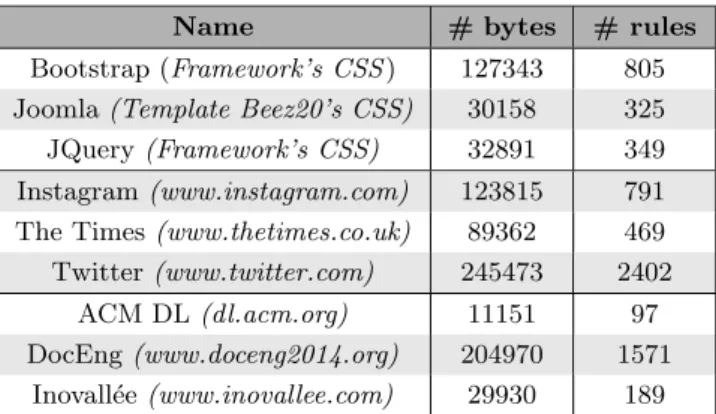
In order to get a representative collection of results, three different groups have been defined. The first group involves CSS code provided by frameworks and CMS, and is repre-sented byBootstrap,JoomlaandJQuery. The second group consists in style sheets from complex web applications, and features Instagram, Twitter and The Times. Finally, we have extracted CSS files from some random web sites of medium complexity, which are ACM DL,DocEng, and In-ovall´ee. Table 2 provides detailed information about the corresponding CSS file sizes and complexity.
Name # bytes # rules
Bootstrap (Framework’s CSS) 127343 805 Joomla(Template Beez20’s CSS) 30158 325 JQuery(Framework’s CSS) 32891 349 Instagram(www.instagram.com) 123815 791 The Times(www.thetimes.co.uk) 89362 469 Twitter(www.twitter.com) 245473 2402
ACM DL(dl.acm.org) 11151 97 DocEng(www.doceng2014.org) 204970 1571
Inovall´ee(www.inovallee.com) 29930 189
Table 2: Dataset for the experiments.
5.1
CSS Size Reduction in Practice
1
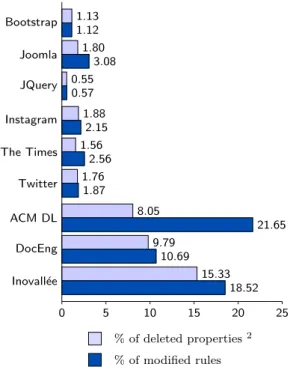
After processing the aforementioned files, the tool has spotted on average 4.95%2of unnecessary properties, modi-fying 4.56% of the total rules. Of the relations found, 83.38% were containment ones, and the remaining 16.62% corre-spond to equivalence between selectors.
1.13 Bootstrap 1.12 1.80 Joomla 3.08 0.55 JQuery 0.57 1.88 Instagram 2.15 1.56 The Times 2.56 1.76 Twitter 1.87 8.05 ACM DL 21.65 9.79 DocEng 10.69 15.33 Inovall´ee 18.52 0 5 10 15 20 25 % of deleted properties2 % of modified rules
Figure 1: Refactoring performed.
It is clear that the style sheets from the first and second group present a low percentage of deleted properties (1.16% and 1.73% respectively). The same holds for the percentage of modified rules (1.59% for the first group and 2.19% for the second one). However, in the third group these numbers rise dramatically, reaching 11.05% of deleted properties and 16.95% of modified rules. Although these latter sites might not have involved as much testing as the first ones, they are not amateur web sites either.
5.2
Performance of the tool
The time taken to analyze each file is shown in Figure 2. A 34.30% of the rules have been ignored due to unsupported se-lectors commented in Section 4.5, and an average of 99.88%3 of the them has been discarded by the optimization mech-anism described in Section 4.3. Each test between selectors requires a median of 156.71 ms, so without the optimization mechanism, each file analysis would have taken a median of 16.60 hours, in contraposition to the 78.16 seconds that were actually required, still guaranteeing the same results.
6.
CONCLUSION
This paper presents a tool that automatically detects and removes unnecessary property declarations in CSS files, based on the analysis of semantical relations between selectors. We provide a first prototype implementation, with many perspectives for further development. Our method can con-stitute the core mechanism in several applications aimed to help developers code higher quality style sheets. A basic
2calculated over the properties that the tool supports. 3
calculated over considered tests, discarding ignored ones.
31.40 Bootstrap 17.39 Joomla 18.37 JQuery 59.01 Instagram 45.54 The Times 292.21 Twitter 5.21 ACM 220.66 DocEng 13.65 Inovall´ee 0 50 100 150 200 250 300
Figure 2: elapsed time (s)
example could be a file processor where the user inputs a CSS file and gets as output an equivalent lighter file. The tool could also be integrated into more powerful components such as context features for web IDEs. In any scenario, the benefit of our tool is to conduct precise semantical analyses, that go far beyond the capabilities of purely syntactic anal-yses done by current CSS optimizers. Generating equivalent but simpler CSS files not only improves the time spent in loading and formatting a web page, but also facilitates the debugging process of style sheets.
Despite the large number of unsupported features, the re-sults obtained in section 5 already validate our approach: we have been able to detect large numbers of unnecessary property declarations in non-amateur web pages; and we have also found mistakes in the style sheets of some of the most popular web sites. The number of safe modifications can easily grow as more components of CSS are supported and more features are implemented, such as property inher-itance, translation of pseudo-classes into query languages, analysis of media queries, merging of equivalent selectors or containment involving grouped selectors.
A perspective for further work consists in extending the number and the precision of our analyses by supporting con-straints on the document structure when they are available (as a DTD/Schema, or via another formalism such as [1]).
7.
REFERENCES
[1] E. Benson and D. R. Karger. Cascading tree sheets and recombinant HTML: better encapsulation and
retargeting of web content. InWWW’13, pages 107–118, 2013.
[2] P. Genev`es, N. Laya¨ıda, and V. Quint. On the analysis of cascading style sheets. InWWW’12, pages 809–818, 2012.
[3] P. Genev`es, N. Laya¨ıda, and A. Schmitt. Efficient static analysis of XML paths and types. InPLDI ’07, pages 342–351, 2007.
[4] Google. Chrome developer tools, May 2014. https://developer.chrome.com/devtools/.
[5] H.-S. Liang, K.-H. Kuo, P.-W. Lee, Y.-C. Chan, Y.-C. Lin, and M. Y. Chen. SeeSS: Seeing what i broke – visualizing change impact of cascading style sheets (CSS). InUIST’13, pages 353–356, 2013.
[6] A. Mesbah and S. Mirshokraie. Automated analysis of CSS rules to support style maintenance. InICSE’12, pages 408–418, 2012.