A comparative study of bidirectional ring and crossbar
interconnection networks
Hitoshi Oi
a,*, N. Ranganathan
baDepartment of Computer Science and Engineering, Florida Atlantic University, Boca Raton, FL 33431, USA bDepartment of Computer Science and Engineering, University of South Florida, Tampa, FL 33620, USA
Received 16June 1999; accepted 3 April 2000
Abstract
For distributed shared memory multiprocessors, the choice and the design of interconnection networks have a signi®cant impact on their performance. Bidirectional ring networks are considered to be physically fast due to their simple structure, but topologically slow since their communication latency grows pro-portionally to the number of nodes. In this paper, we will present a quantitative measure to the question of how physically fast a bidirectional ring has to be to overcome its topologically slow communication latency by comparing it to the crossbar, an interconnection network that has opposite characteristics to the ring network.
A hybrid method, in which workload parameters extracted from memory traces are given to an analytical model is used for performance evaluation. Our study shows for 16nodes con®guration, the performance of two networks are similar. For 32 and 64 nodes con®gurations, the bidirectional ring outperforms the crossbar by 21% and 61% respectively, on the average of four parallel applications. Ó 2001 Elsevier Science Ltd. All rights reserved.
Keywords: Interconnection networks; Distributed shared memory multiprocessor; Performance evaluation; Slotted ring; Crossbar
1. Introduction
A distributed shared memory (DSM) multiprocessor provides a view of a globally shared address space by sending coherence protocol messages between processing elements. Therefore, the interconnection network aects the performance of a DSM multiprocessor signi®cantly.
*Corresponding author. Tel.: +1-408-341-5546.
E-mail addresses:[email protected] (H. Oi), [email protected] (N. Ranganathan). 0045-7906/01/$ - see front matter Ó 2001 Elsevier Science Ltd. All rights reserved.
Ring networks have the advantages of (1) ®xed node degree (modular expandability), (2) simple network interface structure (fast operation speed) and (3) low wiring complexity (fast transmission speed). On the other hand, the main disadvantage of the ring network is its com-munication latency growth rate is proportional to the number of nodes. However, when non-local misses are likely to be destined to neighboring nodes, this disadvantage can be alleviated by using a bidirectional ring [1,2]. Crossbar switches have opposite characteristics: they can connect any pair of nodes by one hop, but the transmission speed is expected to be much slower due to wiring and circuit complexity [3]. In this paper, we will present a quantitative measure to the question of how physically fast a bidirectional ring has to be to overcome its topologically slow communication latency, by comparing its performance to that of the crossbar switch.
This paper is organized as follows: The rest of this section introduces the past studies on the comparisons of the interconnection networks for multiprocessors and instances of multiprocessor using either ring or crossbar switch networks. The architectures of multiprocessors that will be assumed in our study are presented in Section 2. Our methodology for evaluating the performance and the pro®le of the applications used in the performance evaluation are described in Section 3. The comparison of the bidirectional ring and the crossbar by estimated execution times (ETs) is presented in Section 4. Some conclusions are provided in Section 5.
1.1. Related work
There have been several researches in the comparisons of interconnection networks for multiprocessors in the past. Ravindran and Stumn compared the performance of multipro-cessors using hierarchical ring and mesh networks [4]. The miss latency was used for per-formance comparison. Their study mainly showed maximum number of nodes at which the hierarchical ring outperformed the mesh network. Since they assumed a unidirectional ring, nearest-neighbor communication pattern was not taken into account. Barroso and Dubois evaluated the performance of the slotted ring multiprocessor [5]. They investigated the eect of the design choices such as coherence protocols (snoopy, linked list and full-map directory) and processor speed, and compared their unidirectional ring architecture with the split-transaction bus. Lang et al. studied the eective bandwidth of the crossbar switches, and compared it to that of the multiple-bus interconnection network using parametric simulations [3]. They assumed the dance-hall UMA architecture (processors and memories are dierent sides of interconnection network).
The instances of multiprocessors using crossbar switches or ring networks include the fol-lowing. NUMAchine [6] is a multiprocessor developed at the University of Toronto. It has three hierarchy levels: a small number of PEs connected by a bus form a cluster (called ``station'') and the stations are connected by two levels of (local and central) rings. KSR-1 of Kendall Square Research was a cache-only memory architecture (COMA) multiprocessor with hierarchy rings [7]. Exemplar S-Class of Hewlett Packard [8] and CP-PACS developed at University of Tsukuba [9] use crossbar switches. Convex SPP-1000 [10] uses a crossbar switch within a cluster and scalable coherence interface (SCI) [11] rings between clusters.
2. Architecture model
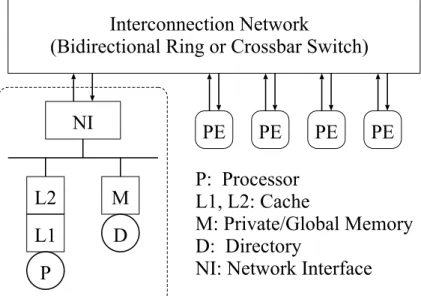
In this section, we describe the architecture of the DSM multiprocessors using the bidirectional ring and the crossbar that will be assumed in this paper. Each processing element (PE) consists of a processor, a memory unit with directory entries, L1 and L2 cache, and a network interface (Fig. 1). PEs are connected by either a bidirectional ring or a crossbar switch network.
It is assumed that both architectures are based on the CC-NUMA model with directory based cache coherency protocol. The memory unit within a PE is a part of the globally shared memory and is associated with directory entries corresponding to the part of global address space assigned to the PE. L1 cache is direct mapped, write-through and its access time and size are one clock cycle and 16KB. L2 cache is full associative, write-back and its access time (tL2) and size are ®ve
clock cycle and in®nity. Block size of both L1 and L2 is 16bytes. L2 cache miss is responded either by the home node (the PE that is assigned the portion of global address of the accessed data) or by the owner node (the PE that owns a modi®ed copy of the requested data in the cache). For a write access, invalidation scheme is used. On the bidirectional ring, a single invalidation message is broadcast by passing it all the way through the ring. On the other hand, the crossbar network is assumed to have the multicast functionality to send invalidate messages simultaneously to all the PEs that have copies of the block.
The parameters that de®ne the con®guration of the system are listed in Table 1.tL2,ts,tr,tm, and
tc are no-contention timing parameters, and they are represented in terms of processor clock
cycles. In this paper, we consider small to medium scale multiprocessors, and hence we chose
N 16, 32 and 64. The speed of crossbar network is ®xed, while that of ring network is varied
widely to ®nd out the point where the performance of two con®gurations match.
Both bidirectional ring and crossbar are assumed to be ¯at (one level). On the bidirectional ring, a header message is divided into two packets, and it takestr to transfer a packet between
adjacent PEs. This assumption oftris to compensate that a node on the bidirectional ring has two
links for each direction. On the bidirectional ring, each link connects a pair of adjacent PEs with a minimum wire length. Therefore, it is not dicult to keeptr constant for largerN. Thus, we use
the same tr1;. . .;5 for all N.
tsis the time to transfer a header message between any pair of PEs on the crossbar network. We
have chosen ts as follows: First, we take two instances of shared memory multiprocessors using
crossbar switches, and look at their relative speed between the processor and the crossbar, the dimensional size and the data path width of the crossbar, and the word length of the processor.
Exemplar S-Class of Hewlett Packard uses 180 MHz 64-bits processors and 88 crossbars
op-erating at 120 MHz with 64-bits datapath [8]. CP-PACS developed at University of Tsukuba uses
180 MHz 64-bits processors and 1717 crossbar switches with data bandwidth of 300 MB/s per
node [9]. Using the above de®nition, Exemplar and CP-PACS have ts1:5 and ts 8
respec-tively. Taking these values into consideration, we have chosents4 and 8 forN 16. Next, we considertsfor largerN(32 and 64). The delay of crossbar switch grows at O N2due to the length
of wire and number of nodes [3]. Thus, we usets 16andts64 forN 32 and 64, respectively. Unlike UMA (including Exemplar) in which the delay of crossbar is dominant for the network latency, both the wire connection between PEs and crossbar, which is considered to be O N, and the delay of crossbar switches aect the latency of the network in NUMA architecture. Hence, we also use lower values of ts8 and ts 16and 32 for N 32 and 64, respectively.
A data message is assumed to be four times longer than a header message dp4. This value is chosen from the cache block size (16bytes for 32 bit processors) assumed when the trace ®les were collected. On the crossbar, a data message is transmitted in a contiguous 4tstime period, while on
the bidirectional ring a data message is divided into multiple packets and they are sent in (pos-sibly) uncontiguous slots. Therefore, the transmission delay of a data message on the bidirectional ring is P8tr. 1We assume the slotted ring con®guration for the bidirectional ring.
3. Performance model
The methods that have been used for performance evaluation of computer systems include analytical models [12], parametric simulations [4], trace-driven simulations [13] and
execution-Table 1
System parameters (timing parameters are in processor clock cycles)
Symbol Description Value
N Number of PE 16, 32, 64
tL2 L2 cache access time 5
ts Crossbar switch packet transfer time 4, 8, 16, 32, 64
tr Bidirectional ring packet transfer time 1±5
tm Memory access time 50
tc Protocol handling time 10
dp Data message packet length 4
driven simulations [14]. In this paper, we use the hybrid approach by Barroso and Dubois [5] by extending it to the bidirectional ring and the crossbar. Below, we brie¯y describe the derivation of
ETusing the hybrid approach.
The ETin clock cycles is given by
ET InstDataAccess; 1
whereInstis instruction fetches. We assume that all the instruction fetches are L1 cache hit. Let Refs,L1Miss, L2Miss, andL2MissLatencybe the number of references, the number of L1 cache misses, the number of L2 cache misses, and the penalty of L2 cache miss, respectively. Thus, Eq. (1) becomes
ET RefsL1MisstL2L2MissL2MissLatency: 2
L2 cache miss is responded by either local or remote memory. Thus, L2MissLatency is de®ned to consist of T, the time to transmit a message (either request or data) to the network, P, the propagation delay of a message to reach the destination on the network,M, the time to access the
memory, and C, the time of coherence protocol handling. These components of miss latency
appear dierent number of times per miss depending on the access mode and the state of the
memory block. Note thatM includes contention delay while tm in Table 1 does not.
Pis constantts on the crossbar while it is the average message traversal length extracted from
the traces on the bidirectional ring.Cis assumed to be constanttc(i. e. no contention at L2 cache
is modeled).
We model the contention at network and memory. Thus, the values of parametersTandMare
the functions of the utilizations of the resources, network and memory, respectively. The utili-zation of the bidirectional ringRu is
Rutr
P
H dTrvdpPDtTrv
ET ;
where+H dTrvand+DtTrvare the sums of header and data message traversals, respectively. On
the other hand, the utilization of the crossbar switch is
SWuts +H dTxdp+H dTx
ET ;
where+H dTxand+DtTxare the the numbers of header and data message transmissions. This is
because on the crossbar switch network, a message only takes one hop to reach any destination PE. These utilization parameters are combined with the M=G=1 queue model to estimate the ET of applications on both architectures [15].
Thus, ET itself is a function of ET.
ET RefsL1MisstL2L2MissL2MissLatency ET:
The derivation of ET is iterated until it converges to a tolerant level (<0.1%). We use two metrics to evaluate the performance of two architectures. One is the ratio ofETs, namely, theET
on the crossbar divided by the ET on the bidirectional ring. Another metric is the scalability
3.1. Trace ®les
The pro®le of the memory traces we use in our experiments are listed in Table 2. These trace ®les are from the MIT trace set [16], and are obtained from the ftp server of the TraceBase project at the New Mexico State University [17]. FFT, Simple and Weather were written in FORTRANFORTRAN,
and traces of these applications were derived using the postmortem method, a technique that generates a parallel trace from a uniprocessor execution. Speech was written in the programming language Mul-T, and its trace ®le was collected by inserting instrumentation codes into the program by the compiler. Write miss rate (sixth column) is the fraction of write misses within all L2 cache misses. A write access to shared block is considered to be a write miss since it generates memory access and network trac.
The workload parameters of each application were extracted from the trace ®le as follows: Each trace ®le is fed to a cache/directory simulator developed at the laboratory for computer science of MIT,2and statistical information of the applications such as hit/miss, read/write, clean/dirty was
collected. These trace ®les were collected on a 64 processor system. To extract data for the case of 16(32) processors, access traces from 4ito 4i3 (from 2ito 2i1) were given toith cache, where
i0;. . .;15 i0;. . .;31. It is assumed that all the instruction fetches are cache hits.
In addition to the original functionality, two modi®cations were made on the cache simulator. First, two-level cache hierarchy was incorporated as described in the previous section. Another modi®cation made to the cache simulator was to collection of communication distance (number of links on the bidirectional ring) between the node where miss occurs and the home node. We assume that the ®rst PE that accesses a block is the home node of the block. When the miss node and the home node are the same, no network trac is generated. On FFT and Speech, more than
Table 2
Pro®le of trace ®les Application Refs
(Inst) N Miss Rate (%)L1 L2 Write Local
FFT 7.44M (3.11M) 1623.9432 24.84 5.085.99 77.9866.30 52.4650.87 64 25.78 6.92 57.41 50.09 Simple 27.03M (11.59M) 1619.7832 20.28 4.65.329 31.1428.04 24.0220.56 64 21.84 7.10 22.35 11.41 Weather 31.76M (13.64M) 169.1832 9.33 2.412.61 59.2056.99 42.5439.66 64 10.33 3.56 42.57 23.90 Speech 22.55M (11.77M) 1613.8032 14.08 12.8813.54 84.2981.96 666.147.20 64 14.64 14.30 78.58 65.60
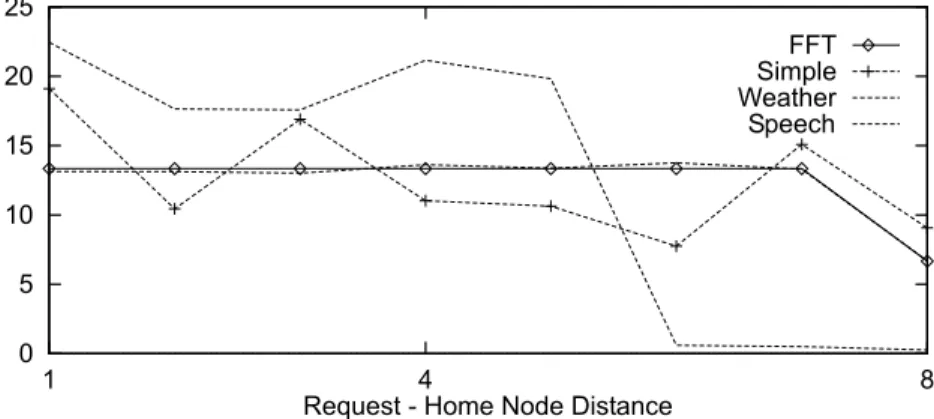
half of accesses to shared data are to local addresses, while on Simple and Weather the locality of shared access is quite low. This communication distance aects the performance of the bidirec-tional ring signi®cantly in two ways: First, the longer the distance the longer the propagation delay (higherP). Second, the longer the distance the higher utilization of the ring (higherT). Figs. 12±14 show the distribution of request ± home node distance on the bidirectional ring. For
N 64, the dierence of communication pattern among applications is observed most clearly.
FFT and Speech exhibit all-to-all communication pattern while Weather and Simple have a certain level of nearest neighbor communication patterns. Especially forN 64 on Weather, 30%
of non-local misses are accesses to adjacent nodes. For N 16and 32, the degree of nearest
neighbor communication pattern of Weather and Simple are weaker than the case of N 64.
Although the number of applications is not large, these applications exhibit variations in their workload parameters.
4. Bidirectional ring versus crossbar evaluation
In this section, we present comparisons of the bidirectional ring and the crossbar using the model and the traces presented in the previous section (Figures in this section are placed after the references).
FFT (Fig. 2) has all-to-all communication pattern (Fig. 14), which is an advantage to the crossbar over the bidirectional ring. The speed up for largerNis medium among four applications
(Fig. 3). L2 miss rate of FFT is relatively small, and it increases by 36% for N 16!64.
However, its local miss rate is almost constant overN. This suppresses the increase of network trac, and is advantageous for both architecture. Write miss rate of FFT decreases from 78% to 57% forN 16!64. This is an advantage for the bidirectional ring since on the bidirectional
ring a write miss generates an invalidation message that traverses the entire ring and hence in-creases the ring utilization. With fast ring speed tr1, the bidirectional ring outperforms the
crossbar by 6%, 27%, and 73% forN 16, 32 and 64 andts4, 8, and 16, respectively.
Miss rate of Simple increases for largerN while local miss rate decreases. These cause more
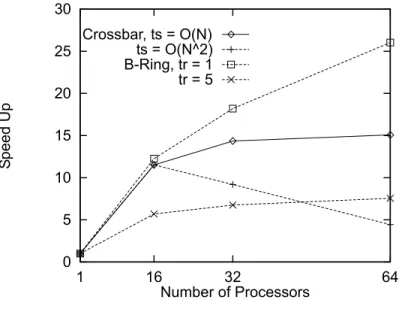
network trac and hence are disadvantage for both network. On the other hand, decreasing write miss rate and increasing nearest neighbor communication pattern of Simple are advantageous for the bidirectional ring. With tr1, the bidirectional ring outperforms the crossbar by 5%, 19%, and 70% forN 16, 32 and 64 andts4, 8, and 16, respectively (Fig. 4). WhenN 32!64, the bidirectional ring achieves speed up of 40% while the performance of the crossbar decreases slightly even with an assumption ofO N communication latency growth rate (Fig. 5).
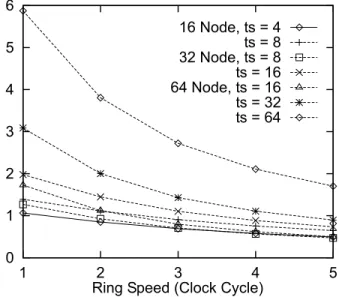
Weather has relatively low miss rate, and hence the performance dierence between two net-works is relatively small, especially forN 16and 32 (Fig. 6). However, whenNis increased from 32 to 64, the eect of interconnection network becomes stronger due to increasing miss rate by 37% and decreasing local miss rate by 40%. The bidirectional ring can still achieve speed up of 46% withtr1, while the performance of the crossbar stays almost the same (Fig. 7). The sources of this performance dierence between two networks are considered to be decreasing write miss
rate by 20% and increasing degree of nearest neighbor communication for N 32!64. With
tr1, the bidirectional ring outperforms the crossbar by 2%, 9% and 58% forN 16, 32 and 64 and ts4, 8, and 16, respectively.
The miss rate and local miss rate of Speech are constant over increasing N. Therefore, the
growth of communication latency of interconnection networks is the dominant factor for the performance. In addition, since Speech has the all-to-all communication pattern, relative
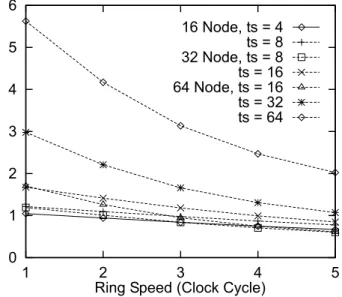
per-formance of Speech is mainly aected by the speed of both networks (Fig. 8). With tr 1, the
bidirectional ring outperforms the crossbar by 5%, 16%, and 45% for N 16, 32 and 64 and
ts4, 8, and 16, respectively. ForN 32! 64, the bidirectional ring still provides some level of
speed up (18% to 66%), while the performance of the crossbar 7 can be either increased by 32% or decreased by 42% depending on the speed of the switch (Fig. 9).
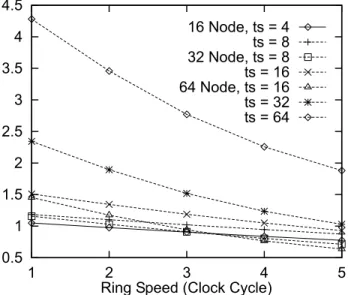
The average (geometric mean) of relative performance and speed up of both networks are shown in Figs. 10 and 11. On the average of four applications, the bidirectional ring provides better performance by 4%, 21%, and 61% forN 16, 32 and 64 andts4, 8, and 16, respectively. The slowest ring speed for the bidirectional ring (Figs. 12±14) to outperform the crossbar are shown in Table 3. ForN 16, we need a very fast ring that can operate at the same speed as the
Fig. 4. Relative performance/Simple.
processor clock tr 1 to outperform a very fast implementation of a crossbar switch network ts 4. If the speed of a crossbar switch is moderate, a ring that operates at half the speed of the processor clock is sucient. ForN 32, a bidirectional ring with half and one fourth the speed of the processor clock suce to outperform the crossbar switch network with very fast and moderate (ts 8 and 16) speed respectively. ForN 64, it is much easier for a bidirectional ring to
out-Fig. 6. Relative performance/Weather.
perform a crossbar switch network due to the latter physically slow operating speed. However, although it outperforms the crossbar, without suciently fast ring speed, we cannot expect speed up on the bidirectional ring. For example, on the average of four applications, we have speed up of 48% on the bidirectional ring withtr1 whenNis increased from 32 to 64. On the other hand, iftr 5, which is sucient to outperform a moderately fast crossbar, the speed up is only 11% for
N 32!64.
Fig. 8. Relative performance/Speech.
5. Conclusions
In this paper, we have evaluated the performance of the bidirectional ring by comparing it to the performance of the crossbar network. We used a hybrid evaluation method which is a combination of an analytical model and workload parameters extracted from the memory traces of four parallel applications. Our study indicates that for a 16nodes con®guration, which is a
Fig. 10. Relative performance/Average.
Fig. 12. Home node distribution (bidirectional ring, 16nodes).
Fig. 13. Home node distribution (bidirectional ring, 32 nodes).
typical size of crossbar switches used in some of actual multiprocessors, both architecture achieve similar performance for the link speed we have assumed. For a 32 nodes con®guration, the bi-directional ring outperforms the crossbar by 21% on the average of four application programs, with an assumption that the growth rate of the communication latency of the crossbar is sup-pressed to O N. For a 64 nodes con®guration, we can still expect speed up on the bidirectional ring (48% on the average) while that of the crossbar increases only by 8%.
Further investigations could include analysis of dynamic behavior of both networks (such as hot spot contention) using execution-driven simulations and the hierarchical network models.
References
[1] Oi H, Ranganathan N. Performance analysis of the bidirectional ring-based multiprocessor. Proceedings of the ISCA Tenth International Conference on Parallel and Distributed Computing Systems, 1997. p. 397±400. [2] Oi H, Ranganathan N. Eect of message length and processor speed on the performance of the bidirectional
ring-based multiprocessor. Proceedings on the International Conference on Computer Design, October 1997. p. 267±72. [3] Lang T, Valero M, Alegre I. Bandwidth of crossbar and multiple-bus connection for multiprocessors. Trans Comp
IEEE 1982;c31(12):1227±34.
[4] Ravindran G, Stumm M. A performance comparison of hierarchical ring- and mesh-connected multiprocessor networks. Proceedings of International Symposium on High Performance Computer Architecture, February 1997. p. 58±69.
[5] Barroso LA, Dubois M. Performance evaluation of the slotted ring multiprocessor. Trans Comp IEEE 1995;44(7):878±90.
[6] Vranesic Z, et al. The NUMAchine Multiprocessor. Technical report, Department of electrical and computer engineering, Department of computer science, University of Toronto, June 1995.
[7] Kendall square research corporation. KSR1 Technical Summary, 1992.
[8] Exemplar System Architecture. http://www.hp.com/wsg/products/servers/exemplar/sx-class/exemplar2.html, Hew-lett Packard.
[9] Boku T, et al. Architecture of massively parallel processor CP-PACS. Proceedings of the 1997 Second Aizu International Symposium on Parallel Algorithms/Architecture Synthesis, Fukushima, Japan, 1997. p. 31±40. [10] Sterling T, et al. An empirical evaluation of the convex SPP-1000 hierarchical shared memory system. Int J Parallel
Prog 1996;24(4):377±96. Table 3
Ring speed to outperform crossbar
N ts Application Average
FFT Simple Weather Speech
16 48 12 12 13 13 12
32 81631 23 3>5 24 24
162 2 >5 2 2
6 4 32 4 >5 >5 >5 >5
[11] Gustavason DB. Scalable coherent interface and related standards projects. IEEE MICRO 1992;12(1):10±22. [12] Zhang X, Yan Y. Comparative modeling and evaluation of CC-NUMA and COMA on hierarchical ring
architecture. Trans Parallel Distributed Sys IEEE 1995;6(12):1316±31.
[13] Farkas K, Vranesi Z, Stumn M. Scalable cache consistency for hierarchically structured multiprocessors. J Supercomput 1995;8:345±69.
[14] Davis H, Goldschmidt SR, Hennessy R. Multiprocessor simulation and tracing using tango. Proceedings of the 1991 International Conference on Parallel Processing, vol. II, 1991. p. 99±107.
[15] Bhuyan L, Ghosal D, Yang Q. Approximate analysis of single and multiple ring networks. Trans Comp IEEE 1989;38(7):1027±40.
[16] Chaiken D, et al. Directory-based cache coherence in large-scale multiprocessors. IEEE Comp 1990;23(6):49±58. [17] ftp://tracebase.nmsu.edu/pub/, Parallel Architecture Research Laboratory, New Mexico State University.
Hitoshi Oiis an assistant professor in the Department of Computer Science and Engineering at the Florida Atlantic University. Before joining FAU, he was working with HAL Computer Systems in Campbell, Cali-fornia, as a Computer Architect. He received a Ph.D. degree in Computer Science and Engineering from the University of South Florida. He also reveived a Bachelor's degree in Electronics and Communication En-gineering and a Master's degree in Electrical EnEn-gineering, both from Meiji University. His research interests include computer architecture and performance evaluation, LSI design and veri®cation, and non-standard logic.
N. Ranganathan received the Ph.D. degree in Computer Science from the University of Central Florida, Orlando in 1988. He is currently a professor in the Department of Computer Science and Engineering and the Center for Microelectronics Research at the University of South Florida, Tampa. His research interests include VLSI design, design automation, hardware algorithms, computer architecture and parallel processing.