Government of Saint Lucia
Wildfire Management Plan
Version | November 12, 2008Cabinet Conclusion 1151/2009
Authorised the 2007 National Emergency Management
Plan for Saint Lucia
Acknowledgement
The Wildfire Management Plan was developed using the outputs from stakeholder meetings and consultations on wildfire management in Saint Lucia, the reports of the Strategy for the Cooperation of the Caribbean on Management of Wildfires, the Jamaica National Fire Management Plan 2002 and the Central American Strategy for Fire Management- 2005- 2015.
Table of Contents
ACKNOWLEDGEMENT ...3
INTRODUCTION ...5
VISION...5
SCOPE OF THE PLAN ...5
ASSUMPTIONS ...6
LIMITATIONS...6
GENERAL OBJECTIVES ...6
SPECIFIC OBJECTIVES ...6
DEFINITIONS...7
BACKGROUND AND HISTORY ...8
GENERAL POLICY AND PROCEDURES FOR WILDFIRE MANAGEMENT IN SAINT LUCIA ...8
STATUTORY AUTHORITY...8
THE PLAN...10
RELATED DOCUMENTS ...10
TRAINING...10
OPERATIONAL ELEMENTS ...11
ORGANIZATION FOR FIRE MANAGEMENT...11
Membership...11
WILDFIRE RESPONSE HAZARD COORDINATION...11
Phase 1 Warning Call Out Procedures and Notification ...11
Phase 2 Alert at the N.E.O.C. and incident site ...12
Phase 3 Plan Activation ...12
ACTIVATING THE REGIONAL RESPONSE MECHANISM...13
APPENDIX 1: EMERGENCY RESPONSE FLOW CHART...15
APPENDIX2: SITUATION REPORT FORM ...16
APPENDIX 3: FIRE MANAGEMENT- MITIGATION AND PREVENTION...17
APPENDIX 4: LOGICAL FRAMEWORK FOR WILDFIRE MANAGEMENT PLAN ...18
APPENDIX 5: WILDFIRE AREAS ...24
Introduction
The purpose of this plan is to develop and establish a framework for cooperation with local and regional agencies for effective wildfire management in Saint Lucia. Having a system of coordinated actions, objectives and goals is essential to successfully confront the challenges caused by the risks and the negative effects of wildfires.
The significance, urgency and the need for a comprehensive wildfire plan is magnified with the predictions of climate change- the global temperatures are predicted to increase by 1.4 to 5.8 degrees Celsius by 2100, if nothing is done to reduce gas emissions. (B.B.C. News 2006. Even more threatening is another prediction that most of the forest types will be converted to a predominantly tropical dry forest if the quantity of rainfall decreases by 20 %. (John 2002). Less rainfall and increased temperatures are factors that will increase the probability and intensity of wildfires. At this projected level of risk, key industries and aspects of Saint Lucian life such as housing, agriculture and tourism can be adversely affected.
Vision
To establish an inter-sectoral organization that would foster the development and implementation of an integrated system of reporting, goals, objectives and actions to directly impact on the effective management of wildfires. Ultimately the aim is to minimize the environmental and socio economic impacts that may be caused by wildfires and to maintain and improve the quality of life of all Saint Lucians in facing the challenge.
Scope of the Plan
The plan details actions and responsibilities related to the emergency response, mitigation and preparedness for wildfires in Saint Lucia.
The responsibilities for this plan were done using a multi-sectoral approach to manage the challenges and minimize the risks related to wildfires. The actions to execute the plan will be fortified locally, regionally and internationally by sourcing information, technical and financial assistance to improve planning, implementation and monitoring of wildfires. The processes and actions for effective wildfire management will be standardized and updated based on the recommendations of the agencies responsible for wildfire management. The plan also aims to increase public awareness of the effects, prevention and control of wildfires, especially in vulnerable locations or communities.
ASSUMPTIONS
• That the Saint Lucia Fire Service is the lead responder to all fire situations occurring nationally .
• A large scale emergency will result in increased demands on personnel of the the Saint Lucia Fire Service
• That the Government of Saint Lucia shall respond to a National Disaster. • That Emergencies in Saint Lucia may be categorised in two ways:
Those that are preceded by a build-up [slow onset] period, which can provide NEMO with advance warnings, which is used to facilitate timely and effective activation of national arrangements
Other emergencies occur with little or no advance warning thus requiring
mobilization and almost instant commitment of resources, with prompt support from the Government of Saint Lucia just prior to or after the onset of such emergencies
Limitations
This plan is limited to the coordination of a Fire response to actual or potential major events. The Saint Lucia Fire Service will stage the first level of response and assess the need to notify the National Emergency Management Organization.
The National Emergency Management Organisation [NEMO] must be notified of all MAJOR activations. This is necessary to allow for the rapid coordination of resources should the incident escalate to a level requiring National mobilisation.
General Objectives
1. To reduce the negative effects of wildfires on natural ecosystems and socio- economic development.
2. To foster the participation and integration of civil society, government and non governmental organizations in Saint Lucia and within the Caribbean region in wildfire management in Saint Lucia.
Specific Objectives
1. Contribute to the development and implementation of an organized structure at the national level with protocols and standards for hazards in wildfire management.
2. To use all systems of information available, technological and financial assistance at the local and regional level for planning, implementation and monitoring of wildfire management.
3. Identify the legal gaps and design a framework to strengthen legal aspects related to an integrated sectoral approach to wildfire management.
4. Establish a plan of applied investigation that permits the prediction of scientific knowledge of the environmental and socio economic impacts of wildfires.
5. Develop a framework to supply information and to update environmental education plans to sensitize the civil population of the issues dealing with wildfires.
6. To promote the standardization of mitigation methods that results in the reduction of the impact of wildfires in Saint Lucia.
7. Adopt a proactive approach to assessing and flagging areas prone to wildfires and taking steps to mitigate such risks.
8. To rehabilitate plants of ecological importance in ecosystems affected by fires. 9. To increase the technical, human and physical capacities related to wildfire
management locally and with other regional countries.
Definitions
• A wildfire, also known as a forest fire, vegetation fire, grass fire, brush fire, bushfire, or hill fire, is an uncontrolled fire often occurring in wildland areas, but which can also consume houses or agricultural resources. (Wikipedia Encyclopedia).
• Mitigation: actions aimed at reducing losses. (Jamaica National Fire Management Plan 2002)
• Fire management: activities required for the protection of burnable wildland values from fire and the use of prescribed fire to meet land management objectives. (Glossary of Wildland Fire Terminology 1996)
• Prescribed burning: Controlled application of fire to wildland fuels in either their natural or modified state, under specified environmental conditions, which allows the fire to be confined to a predetermined area, and produce the fire behavior and fire characteristics, required to attain planned fire treatment and resource management objectives. (Glossary of Wildland Fire Terminology 1996)
Background and History
In Saint Lucia, most of the fires occur in the northern coastal region adjacent to populated areas such as villages and towns. Wildfires generally occur in the dry season from January to June coinciding with dry weather and low humidity. (Isaac 2004).
These fires are caused by:
• Fire incorporated for agricultural purposes- land clearance and soil improvement.
• Natural causes- spontaneous combustion due to the presence of broken glasses and dark coloured rocks. (Isaac 2004).
These fires could have also been caused by people disposing of lit cigarette butts, by campers using fires for the camp, by children playing with fire, provoked deliberately as a form of resolution of problems against another person or the state or owing to vandalism. (F.A.O. 2005). Traditionally the Fire Department has the responsibility for combating fires. From 2004, there have been stakeholder consultations and discussions amongst the Fire Department, Forestry Department and the Secretariat of the National Emergency Management (N.E.M.O.) that started in 2004, to examine the issues and challenges affecting wildfire management and to determine the way forward. Other agencies incorporated into this process included: Meteorology Department, Ministry of Agriculture (Information Unit), Saint Lucia National Trust, Ministry of Social Transformation, Attorney General’s Office, Ministry of Finance (Budget Office), Police Department, and Ministry of Planning- Crown Lands.
This integral management approach also has proposed to take advantage of the “Regional Network of the Caribbean on Wildfires” to source: information, assistance to increase technical capacity and to undertake the projects for effective wildfire management. The Regional Network is part of the World Network on Forest Fires which is part of the program for the International Strategy for the Reduction of Disasters of the United Nations. This program is facilitated by the Global Fire Monitoring Centre. (G.F.M.C.)
General Policy and Procedures for Wildfire
Management in Saint Lucia
Statutory Authority
Table 1 Agency, enabling legislation, and substantive provision related to Wildfire Management in Saint Lucia (Isaac 2004)
Agency Enabling legislation Substantive provision
Forestry Department Forest Soil and Water Conservation Act (1946)
Unlawful to kindle, keep or carry any fire on crown lands without the permission of the Chief Forest Officer.
Fire Services Act Authorized to extinguished fires deemed a threat to life and property.
Saint Lucia Fire Service
Criminal code Section 382-384;
Control of fires through
permission granted by a Justice of the peace.
National Conservation Authority
National Conservation Authority Act (1999)
Unlawful to do anything likely to cause damage to a beach or protected area.
Land conservation Board
Land Conservation and Improvement Act (1992)
A protection order may be issued by the board to prohibit, regulate, and control the lighting of fires and the burning of vegetation.
Solid Waste
Management Authority
The Waste Management Act (No. 8 of 2004)
Requires that the unauthorized burning of waste is illegal (viz. Sec. 17 (c);
Ministry of Works Water & Sewage Act No. 14 of 2005
Division 3 Emergencies Section 10-1
declaring a water-related emergency
N.E.M.O. Disaster Management Act No
30 of 2006 Section 11(3)
ensuring the development of procedures for, mitigation of, response to and recovery from emergencies and disasters by public officers, Ministries and Departments of Government, statutory bodies, local government units
Ministry of Health Public Health (Nuisance) Regulation No 10 of 1978
Identifies situations in which human activities impacting on health of persons are unlawful.
The Plan
Once accepted all plans must be tested. This is usually done in three ways:
1. Ongoing Maintenance - Any change in methodologies, organization, staffing, business methods, etc., must be reviewed in terms of impact to the Agency’s COOP.
2. Tests and Exercises - These are tests of individual components and exercises that ensure that staff is familiar with the plan and that the supporting procedures and infrastructure are workable. The tests and exercises to ensure the continued viability of the branch’s business continuity plan are itemized below to ensure that every critical aspect of the plan will be effective when required. There are four types of Exercises: Orientation, Drill, Desktop and Full scale
3. Actual Event: Though no one wants the experience of an actual disaster, the event provides the opportunity to test the validity of the assumptions within the plan. A review of responses after an event provides the opportunity to upgrade the disaster plan.
Related Documents
This plan is a “stand alone” document that may be activated to support hazard management plans. Other documents related to this plan are:
1. Fire Service General Plan [To be signed by PS]
2. Wildfire Hazard Mitigation Plan [To be completed by Fire Services] 3. Structural Fires Response Plan [To be completed by Fire Services]
4. Urban Search and Rescue Plan [To be completed by Fire Services by March 2007]
5. Water Management Plan for Drought Conditions [To be submitted to NEMAC] 6. Saint Lucia Draft National Action Programme on the UN Convention to Combat
Desertification
-
Training
It is recognized that to achieve the capacity and competency that will allow staff to function smoothly during a response, training must be an ongoing component of professional
development. The following subjects shall be presented, but by no means is limited to: 1. Introduction to Disaster Management [IDM]
2. Emergency Operations Centre [EOC] Management 3. Incident Command System [ICS]
4. Telecommunications
5. Initial Damage Assessment [IDA] 6. First Aid / CPR
7. Fire Preparedness
8. Assessment of Wildlife/ Ecosystem Sensitivities and amelioration.
Where appropriate it shall be the responsibility of Agencies to ensure that said training is incorporated into its annual training program.
Operational Elements
Organization for Fire Management
Membership
The following organizations are proposed to be part of the wildfire management plan: 1. Fire Department,
2. Meteorology Department,
3. Ministry of Agriculture Forestry and Fisheries - (Forestry, Propagation, Extension, Research and Development),
4. Saint Lucia National Trust,
5. Ministry of Social Transformation, 6. Attorney General’s Office,
7. Ministry of Finance (Budget Office), 8. Royal Saint Lucia Police Force
9. Ministry of Planning - Sustainable Development Section 10.Crown Lands,
11.Ministry of Health
12.Department for Local Government 13.City, Town and Village Councils 14.Ministry of Education
15.Secretariat of the National Emergency Management Organisation (N.E.M.O.),
Wildfire Response Hazard Coordination
The response at a major fire has four (4) operational phases
1. Warning Call Out Procedures and Notification.
2. Alert at the National Emergency Operations Centre (N.E.O.C.) and incident site 3. Plan Activation
4. Debriefing, analysis and deactivation Phase 1 Warning Call Out Procedures and Notification
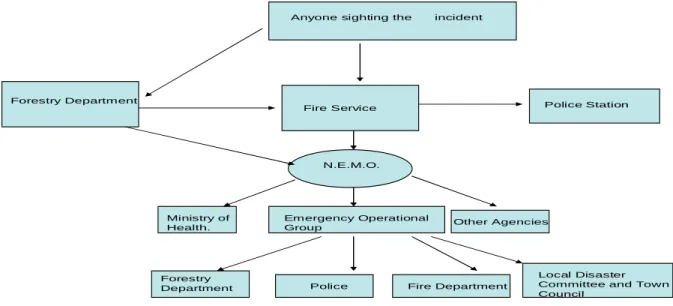
Anyone sighting a wildfire should call the nearest Fires station, National Emergency Management Organization, Police station or Forestry Department. Information to guide the person taking information of a fire should include:
1. Description of the Fire 2. Location and time
3. Threats/danger to the environment or pubic or to agriculture 4. Areas need to be restricted
5. Diversion of vehicular traffic needed 6. Evacuation needed
8. Name of agency/ person reporting and contact numbers 9. Any injuries and status
10.Actions taken.
At the determination that the wildfire is major, N.E.M.O. will be contacted. N.E.M.O. will contact the other critical agencies and activate the N.E.O.C. if necessary. Other agencies should also monitor the situation to inform the N.E.O.C. and its operation.
The agencies responsible for establishing this system of warning are: a. Fire Department.
b. N.E.M.O. Secretariat c. Police Department. d. Forestry Department
Phase 2 Alert at the N.E.O.C. and incident site
1. A major situation, which threatens population centres will require that the Saint Lucia Fire Service Incident Commander [IC] receives support for its control and management. This will be coordinated by the National Emergency Operations Centre (NEOC). The person who in charge at the site of a fire hazard is also the Incident Commandeer [IC]. The decision to advise the NEMO Secretariat of the need for additional support will be made by the IC.
2. The NEOC, once activated, will coordinate response, request additional resources and ensure adequate support to all relevant functions. Once the NEOC is activated all Standard Operating Procedures shall come into effect. The IC will retain operational control of all operations and The Water and Sewerage Authority will be alerted for additional water needs by the Fire Department or N.E.M.O. Secretariat
3. Saint Lucia Electricity Services (L.U.C.E.L.E.C.) will be alerted to de- energize power lines.
4. The N.E.O.C. would ensure that communications are established between the site affected and the N.E.O.C.
Phase 3 Plan Activation
1. The agencies responsible for plan activation are: 1. Royal Saint Lucia Police Force
2. Solid Waste Management Authority, 3. N.E.M.O. Secretariat
4. Ministry of Health- Environmental Health Unit. 5. Forestry Department.
The procedure for a large scale fire emergency is for the activation of the National Response Plan. This would be initiated by a request from any of the response agencies or individuals to N.E.M.O. Secretariat, which would make a decision based on Situation Reports or other
professional assessments. Based on that decision all the necessary individuals as per the National Response Plan will be required to report to the Command Post. When the plan is activated, the National Emergency Operations Centre (N.E.O.C.) will be established. The relevant ministries, agencies and Disaster Committees will activate their Emergency Operation Centres. This unit consists of senior personnel from the various departments who have authority to make decisions relating to the large scale emergency. This unit will also be responsible to transfer that information to the media.
ACTIVATING THE REGIONAL RESPONSE MECHANISM
A major situation, which threatens population centres in Saint Lucia, may require that the Government of Saint Lucia receives support for its control and management. This will be coordinated by the Caribbean Disaster Emergency Response Agency [CDERA].The decision to advise the CDERA Coordination of the need for additional support will be made by the Prime Minister, the Cabinet Secretary or the Director NEMO, based upon established response levels.
The Director NEMO will complete a Situation Report Form for the Coordinator of CDERA. The Coordinator of CDERA in consultation with the Government of Saint Lucia will decide on activation of the Regional Response Plan.
Once activated, CDERA Coordinating Unit will coordinate regional response, request additional resources and ensure adequate support to all relevant National functions. Once activated all Standard Operating Procedures shall come into effect.
The National Emergency Operations Centre [NEOC] shall retain operational control of all operations in Country.
OF SPECIAL NOTE: Should the CDERA/CU receive a request for activation from an alternate source regardless of its apparent credibility, the CU is to confirm the request with the Prime Minister, the Cabinet Secretary or the Director NEMO.
Phase 4 Debriefing, analysis and deactivation
The N.E.O.C. will be deactivated by the Director of N.E.M.O. based on the Saint Lucia Fire Service Declaring that the fire is under control or other professional assessments.
The Debriefing exercise of the incident will be carried out, along with the necessary analysis for lessons learnt.
The Damage Assessment and Needs Analysis Committee [DANA]
FYI: Recovery, Rehabilitation and Reconstruction fall to the Ministry of Planning.
DANA is set up to enable the rapid collection of information pertaining to the damage incurred after any disaster event.
There are a number of DANA Teams; the type and magnitude of the event will determine the team deployed. The teams are:
a) Reconnaissance Team [Recon Team]
b) National Damage & Needs Analysis [DANA] Team c) District Damage Assessment Team [DDAT] d) Sector Assessment Team [SAT]
Appendix 1: Emergency Response Flow Chart
Table 2 Contact Directory of Authorized Personnel
Agency Name of
Person
Position Contact During Business Hours
Contact After Business Hours
Figure 1 Emergency Response Flow Chart
Anyone sighting the incident
Nearest Fire
StationFire Service Police Station Forestry Department N.E.M.O. Ministry of Health. Emergency Operational Group Forestry
Department Police Fire Department
Local Disaster Committee and Town Council
Other Agencies
Changes made during the year shall be recorded in Table 3 and must be authorized, approved and signed by the designated personnel.
Table 3 Changes made to the Plan during the Year
Appendix2: Situation Report Form
National Structural Fire Response Plan
SITUATION REPORT [use additional paper where needed]
1. DATE: TIME:
2. EVENT:
3. DEATHS……….. INJURIES………. MISSING………. 4. RESPONSE ACTIONS TAKEN:
(Since last report)
5. PERSONNEL, EQUIPMENT DEPLOYED:
6. POPULATION THEATENED:
7. THREAT OF HAZARDOUS MATERIALS IF ANY:
8. NEED FOR EVACUATION (Y) (N)
9. APPROXIMATE NO. OF PERSONS:
10. SPECIAL POPULATION NEEDS:
11. ADDITIONAL RESOURCES NEEDED IN PRIORITY ORDER:
12. COMMENTS on need for activating N.E.O.C.
13. COMMENTS ON SIGNIFICANT HABITAT IMPACT/LOSS
Appendix 3: Fire Management- Mitigation and Prevention
Effective wildfire management in Saint Lucia will involve planning and implementation of a series of tasks before, during and after the dry season. In Table 4 is a chronological sequence of tasks for integrated wildfire management.
Appendix 4: Logical Framework for Wildfire Management Plan
LOGFRAME
Intervention logic Objectively verifiable
Indicators
Means of Verification Assumptions
Goal To minimize the environmental and socio economic impacts of wildfires using a multi-sectoral approach.
Wildfire management practices involve at least
70% of stakeholders and
reduce the occurrence and the impacts of wildfires
Management reports, wildfire policy and legislation
Wildfire management remains a national priority
Specific Objective (1) Contribute to the development and implementation of an organizational structure at the national level with protocols and standards for wildfire management.
An organizational structure established with agreed protocols and standards for hazards in wildfire management.
Protocols and standards available
Terms of reference of
organizational structure available
Stakeholders willing to participate in planning and implementation of protocols.
Specific Objective (2) To use all systems of information available and technological and financial assistance at the local and regional level for planning, implementation and monitoring of wildfire management
Wildfire planning and management practices reflect information, techniques and tools from advances in research done on wildfires regionally and internationally.
Management plans
The number of projects on wildfire management approved for implementation. Sources of funding available to address limitations in wildfire management. Capacity exists/can be sourced to design wildfire management plans and projects relevant to Saint Lucia.
Outputs Output 1.1:
Organization with legal structure to develop and recommend protocols and standards to be approved by Cabinet for wildfire management.
Organization established consisting of at least 20 stakeholders: from government, private sector and rural and community with legal framework for operation approved by Cabinet.
Organization Terms of Reference Wildfire Management Plans Stakeholder consultation reports. Survey reports
Stakeholders agree to participate in committee.
Recommendations of organization of actions, protocols and standards to Cabinet.
Output 2.1:
Technical capacity of personnel enhanced for effective wildfire management locally and regionally.
At least 20 persons from the agencies involved in wildfire management receive training to enhance ability to manage wildfires.
Wild fire Management plans developed.
An applied plan of investigations on the environmental and socio economic impacts of wildfire developed locally.
Capacity exists locally for wildfire management in terms of
management of hazards, mitigation and prevention of wildfires.
Finance available to increase capacity of personnel
Output 2.2
Scientific knowledge and socio economic impacts of wildfire management in Saint Lucia developed.
GIS database developed using data collected on wildfires.
GIS database is capable of predicting and zoning areas vulnerable to wildfires.
Wildfire management plans include standard guidelines to monitor the quantity of combustible vis-à-vis areas zoned for wildfires. Maps produced that show
Wildfire Management Plans; Forestry Department reports;
Market based expertise available through Ministry of Agriculture Forestry and Fisheries.
a spatial distribution of risk , occurrence and impacts of wildfires. Increase in effectiveness of mitigative measures in 2 zoned areas against wildfires
Output 2.3
Increased awareness and knowledge to deal with issues on Wildfire management.
Increased awareness of wildfires amongst 60% of population 2 years after implementation of environmental education plan.
Workshop reports and participant evaluation
Stakeholder consultation reports. Survey reports Stakeholders agree to participate in committee. Funding available to undertake project
Activities Means Responsibility
1.1.1 Research the legal and
institutional gaps in wildfire management
1.1.2 Review legislature authorizing
JP to give permission for burning fire. Make
recommendations to Cabinet to enact laws that permit greater control and monitoring for issuing of fire permits. 1.1.3 Review the legislature dealing
with for charcoal pit burning. a) Determine if there are gaps and limitations for enforcement.
b) Determine if there is limited scope for action by the Fire Department.
c) Determine if there are any provisions in the law/regulations
Stakeholder consultations, consultants contracted, recommendations and reports. Stakeholder consultations, consultants contracted, recommendations and reports. Stakeholder consultations, consultants contracted, recommendations and reports.
Attorney General's Office
Attorney General's Office
Attorney General’s Office, Sustainable Development, External Affairs
Willingness of Stakeholders to plan and execute activities Cabinet approves recommendations
for zoning of charcoal production. d) Determine if there are any legal gaps with charcoal pit production and any memoranda of understanding.
e) Determine if charcoal pit production is in conflict with multilateral environmental agreements that Saint Lucia is signatory to. Make
recommendations to resolve issues.
2.1.1 Do needs analysis to develop technical capacity of stakeholders for effective wildfire management:
a) Review online database of location and occurrence of wild fires.
b) Collate all Data in GIS database.
c) Predict and Zoning Vulnerable Areas for Fire Management
d) Monitor Quantity of Combustible material in Vulnerable Areas.
e) Determine the target number of persons to be trained, from which agency and the financial cost training
2.2.2 Management Reporting- monitor
Stakeholder consultation, needs analysis,
recommendations and reports
a) Ministry of Finance- Budget Office, Ministry of Education, Statistics Department, Sustainable Development, Fire Service and Forestry Department. b) Ministry of Finance- Budget Office, Ministry of Education, Statistics Department, Sustainable Development, Fire Service and Forestry Department c) Ministry of Finance- Budget Office, Ministry of Education, Statistics Department, Sustainable Development, Fire Service and Forestry Department
d) Ministry of Finance- Budget Office, Ministry of Education, Statistics Department, Sustainable Development, Fire Service and Forestry Department e) Ministry of Finance- Budget Office, Ministry of Education, Statistics Department, Sustainable Development, Fire Service and Forestry Department
Willingness and ability of Stakeholders to undertake needs analysis.
and timely reporting progress of tasks on a quarterly basis, incorporating information from regional web into updates of stakeholders and planning activities.
Reports
Fire Department, Forestry Department, Sustainable Development.
Willingness of stakeholders to read communications
2.2.1Specify the type of data
requirements and the format for data sharing to research historical data on wildfires in terms of:
a) Weather conditions b) Number of Fires c) Inventory of all forms of
biodiversity present
d) Review online data base of Global Fire Monitoring Centre location and occurrence of fires. e) Monitor ongoing fires
f) Collate all historical Data in GIS database
2.2.2 Compile all data on historical
information into GIS to predict and Zone Vulnerable Areas for Wildfire Management
2.2.3 Monitor Quantity of Combustible material in Vulnerable Areas and compile data into GIS to predict and zone vulnerable areas for wildfire management.
Data Collection
Data modelling and queries
Data collection, Data modelling and queries
a) Meteorological Service. b) Fire Service
c) Forestry Department d) Fire and Forestry
Department e) Fire and Forestry
Department f) Forestry Department
and Sustainable Development Unit
Forestry Department and Sustainable Development
Fire and Forestry Department
All data can be standardized. Data available
Capacity exists to do statistical regression models and queries in GIS
Capacity exists to do statistical regression models and queries in GIS
2.2.4. Monitor edaphic and weather conditions and with GIS information, develop an early warning system
2.2.5. Production of plants of ecological importance affected by wildfires and the rehabilitation of affected sites.
Use of GIS, data analysis and radio announcements
Inventories, Propagation and Establishment
Meteorological Service, Forestry Department and Fire Service.
Propagation Unit and Forestry Department
Collaboration amongst agencies
2.3.1Public Education on causes and
effects of wildfires, prone/vulnerable areas and safety into public relation and education campaigns.
2.3.2. Determine the groups that use slash and burn, the reasons for use, location, extent of slash and burn and the impact of this method agriculture. Determine suitable alternatives of production and methodologies to impart this knowledge to vulnerable locations and groups for wildfires
Facilitators contracted ,Workshops, reports,
Facilitators contracted ,Workshops, reports,
N.E.M.O., Forestry Department, the Fire Service, Ministry of Education, Ministry of Social Transformation and the
Sustainable Development Unit of the Ministry of Planning. Forestry Department, Ministry of Agriculture- Extension, Ministry of Social Transformation, Sustainable Development
For protocols during the dry season see:
The Water Management Plan for Drought is part of the National Emergency Response Plan and is
a stand alone document.
Bibliography
1. B.B.C. News, Climate Change, cited at
http://news.bbc.co.uk/2/hi/science/nature/3928017.stm, January 30 2006. 2. Central American Commission on the Environment, Central American
Wildfire Management Plan 2005 to 2015.
3. Food and Agriculture Organization (FAO), Strategy for Caribbean Cooperation for Wild Fire Management- 2006 to 2011.
4. F.A.O. 2005, Institutional and legal aspects related to the management of forest fires in the Caribbean, Proyecto TCP/RLA/3010 (C) – FAO “Desarrollo de una Estrategia Regional de Cooperación para la Prevención, Control y Combate de Incendios Forestales”. Informe preparado por M.P. Ramos Rodríguez.
5. Forestry Department, Minutes of Stakeholder Fire Management Meeting, April 10 2006.
6. Forestry Department, Minutes of Stakeholder Fire Management Meeting, July 27 2006.
7. Isaac, C., Wildland Fire Management in Saint Lucia, 2005. 8. Jamaica National Fire Management Plan, revised May 2002.
9. John, L., Forestry and Terrestrial Ecosystems Climate Change Vulnerability and Adaptation, 2002.
10.National Wildfire Coordinating Group, Glossary of Wildland Fire Terminology, November 1996.
11.Wikipedia Encyclopedia, Definitions of Wildfire cited at http://en.wikipedia.org/wiki/Bushfire