Romanian JouRnalof Stomatology – Volume lXVi, no. 3, yeaR 2020 167 DOI: 10.37897/RJS.2020.3.3
TeeTh bleaching wiTh epic diode laser
940 nm (biolase Usa)
assist. prof. dana andreea Tudose, md, phd, prof. cornelia biclesanu, md, phd Discipline of Dentistry, Faculty of Dentistry, „Titu Maiorescu“ University, Bucharest, Romania
Corresponding author:
Prof. Cornelia Biclesanu, MD, PhD E-mail:[email protected]
ABSTRACT
Tooth bleaching is a simple, minimally invasive cosmetic procedure, with important benefits in dental cosmetics and frequently requested by patients.
Clinical case presentation. The clinical case presented refers to the teeth whitening protocol with hydrogen perox-ide gel activated with Epic Biolase diode laser light (940 nm). The anamnestic result did not show any indications of this type of treatment. The procedure was performed on the vestibular faces with teeth visible in the smile, respec-tively the frontal area up to the 1st molar at the jaw and the mandible. The postoperative sensitivity and the whitening performance of the work performed in a single session were analyzed.
Conclusions. Teeth whitening with Epic 940 nm diode laser (Biolase USA) is a quick method to obtain a whitening with 6 shades lighter than the initial color of the enamel in a single session but also without pain or discomfort of the patient.
Keywords: tooth bleaching, peroxide, laser, diode
INTRODUCTION
Tooth bleaching is a simple, minimally invasive cosmetic procedure, with important benefits in dental cosmetics and frequently requested by pa-tients. However, teeth whitening plays an impor-tant role not only aesthetically, by achieving a smile that increases self-esteem, but also in the concept of oral hygiene that could be responsible for the oc-currence of systemic diseases, such as diabetes, as a typical example [1].
The bleaching techniques are applied in the den-tal office but also at home, both for viden-tal and deviden-tal teeth. The substances used in the bleaching tech-niques are hydrogen peroxide, carbamide peroxide and non-peroxide products.
In teeth bleaching performed in the office, higher concentrations of whitening substances (hydrogen peroxide) are used and laser, LED, ultraviolet and halogen light can be used to intensify the whitening process. Hydrogen peroxide can dissociate under the action of light or heat in water and oxygen ions that remove discoloration from the enamel [2].
Whitening at home uses carbamide peroxide with lower concentrations (10% Opalescence Ul-tradent and 20% Opalescence F UlUl-tradent) so it is less active than hydrogen peroxide.
Regarding non-peroxide products some studies show that they have the potential to whiten and damage the enamel. The whitening effect is varia-ble, however, it is very likely to be similar to the effect of sodium hypochlorite-based products [3].
A recent review of the products used in teeth whitening, which analyzes the period 1989-2017, shows that there is on average a variation from 10% to 15% carbamide peroxide for home whitening, 37% carbamide peroxide to 40% hydrogen perox-ide for bleaching in the cabinet and 10% carbamperox-ide peroxide and 9.5% hydrogen peroxide for non-per-oxide products [4].
The use of lasers in dentistry has gained mo-mentum in recent years. Depending on the wave-length, the laser has a certain absorption in chromo-phores (hemoglobin, anaerobic bacteria, melanin etc.) or in hydroxyapatite or water, which gives them particularities of action in the treatment of oral and maxillofacial disorders [5].
The use of laser in whitening has advantages re-lated to obtaining the desired aesthetic results in a single session, with 6-8 shades lighter than the ini-tial color but also the lack of pain or discomfort during the procedure. The high cost and the occur-rence of hypersensitivity after bleaching could be the disadvantages of this work.
Epic 940 nm diode laser (US Biolase) 940 nm is scientifically proven to be ideal in dentistry for the interaction with hemoglobin and oxyhemoglobin present in the soft tissue of the oral cavity. Among its many clinical uses related to soft tissue patholo-gy are the treatment of hypersensitivity and tooth whitening [6].
CASE PRESENTATION
The 39-year-old patient presented with the anaesthetic appearance of the teeth, in terms of tooth color.
Following the observation sheet, they did not exist the contraindications of the bleaching dental treatment. During the intraoral examination, no carious lesions or deficient mineralizations of the enamel were found, the patient has no indications for cosmetic or prosthetic treatment. An overall X-ray examination was indicated, for control with the initial appearance.
The patient has coronary fillings at the level of the posterior teeth, correctly adapted, without other clinical changes. After the bleaching procedure, we will find out if it is necessary to re-examine the fill-ings.
Vitality tests were negative, periodontal appear-ance is normal, without inflammatory processes.
The patient is not a smoker and does not fre-quently consume teas or colored drinks.
THERAPEUTIC PROTOCOL
Prior to the bleaching procedure, tooth brushing with abrasive paste was performed. The paste used was Cleanic (Kerr). This is a universal prophylactic paste that integrates a differential polishing system. In the first seconds of use, the peril particles includ-ed in the paste exert a vigorous cleaning action. Their progressive fragmentation then causes a pol-ishing effect on the tooth surfaces. This technology based on the use of perlite particles makes Cleanic a unique paste, integrating cleaning and polishing
properties to the same extent, without the risk of affecting the dental tissues [7] (fig. 1).
Figure 1. Cleanic polishing paste (Kerr)
The color was set with the VITA Bleaching Key (Vita Zahnfabrik, Bäd Sackingen, Germany), the initial color is A3 (fig. 2).
Figure 2. Initial appearance, initial color A3
The operating field was highlighted by the intro-duction, after the lubrication of the lips, of the Optra Gate spacer (Ivoclar Vivadent). After the application of the spacer, the gingival barrier was applied, at the level of the gingival festoon and about 4 mm buccal and labial surfaces, which was then light-cured from 1 cm distance. It must be properly fitted so as not to allow the whitening substance to enter the gingival level. This whitening substance has a high concen-tration of peroxide, so that the gel that comes in con-tact with the gum can create burns and a feeling of discomfort to pain (fig. 3).
For bleaching, the whitening putty (Laser White 20 Biolase, USA) was used, which contains a sy-ringe with insulating material, the gingival barrier also called a liquid dam, 1 syringe with 45%
hydro-gen peroxide gel and a syringe containing catalyst. After mixing the contents of the 2 syringes the per-centage of hydrogen peroxide is 35%. This gel is activated only by laser light [8] (fig. 4).
In the kit we also find a fluoride gel syringe de-signed to protect the teeth after this procedure and applicator tips.
Figure 3. Application of the gingival barrier
Figure 4. Biolase bleaching putty and Epic Dioda 940 nm laser (Biolase USA)
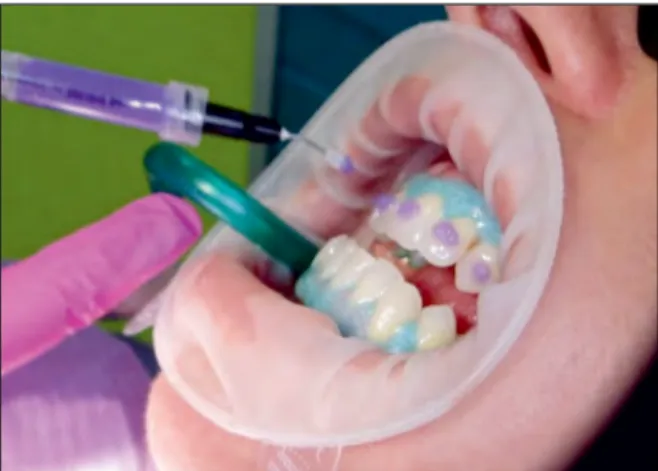
The application of the whitening gel will be done on each tooth separately in a uniform layer of approx. 2 mm (fig. 5).
Figure 5. Application of 45% hydrogen peroxide gel
After it has been applied evenly on the entire surface on which we want to achieve bleaching.
In this case, the patient’s smile was contained from the level of the second premolars, on ten teeth.
The gel will be activated by laser light, using the Epic diode with a wavelength of 940 nm. A special whitening end is used, which will diffuse the laser light evenly over side. The actuation time is 30 sec-onds for each side, at a power of 7 Watts, below the continuous wave (CW) (fig. 6).
Figure 6. Activation of the peroxide gel with the bleaching piece light by Epic Biolase laser
After activating the gel, it will be left for up to 3 minutes to act without light, then removed with cotton balls. The application is done in the same way three times (fig. 6).
At the end of the procedures, remove the gingi-val barrier with a hand tool, wash thoroughly with water at room temperature, dry and then apply the flower gel on the entire tooth surface which is left to act for 1-2 minutes. The patient can then rinse his mouth with water at room temperature.
The classic Vita whitening wrench was used to measure the new color of the teeth.
RESULTS
Whitening was obtained with 6 shades from A3-A2-A1-BL4-BL3 to BL2.
The patient will return to control after two weeks.
If the dental sensitivity appears and it persists, a desensitization can be done only by applying the di-ode laser light, at a power of 3 W, for 3-5 minutes, on the entire sensitive tooth surface, also with the bleaching piece that will create uniform radiation.
DISCUSSIONS
The aim of this study was to observe the effec-tiveness of the 940 nm diode laser in combination with the gel in the bleaching process, by analyzing the sensitivity of the teeth and the improvement of the color after the whitening process.
The mechanism of tooth sensitivity in bleaching is not yet fully explained. Sensitivity can be caused either by heat generation during mild activation or by pulp irritation due to the penetration of hydro-gen peroxide into the dental pulp [2].
Diode lasers have a monochrome feature that would reduce the risk of pulpal damage due to overheating.[9]
The study by Abbasi M et al., who compared the temperature in the pulp chamber in the cabinet bleaching technique and the diode laser bleaching technique with different wavelengths, shows that in 940 nm diode laser bleaching (1.5 W, continuous mode, 3X30 sec regime with the piece with 500 µm diameter and temperature measurement at 5 min-utes after the bleaching gel has been removed) the penetration of hydrogen peroxide into the pulp chamber is not higher than in bleaching in the den-tal office [10].
In the case presented, the patient showed sensi-tivity, but the use of laser light without the use of desensitizing products can significantly reduce this symptom, until disappearance. This is possible by the action of the laser with this wavelength on the dentinal nerve endings, reducing inflammation at this level.
There is also the theory that the bleaching pro-cess can only be produced by the action of laser
light with a wavelength that acts on chromophores. The sensitivity due to the whitening process may be related to the peroxide and its concentration when applied to the tooth surface [8].
Tooth color is irrelevant to the physiological success of a dental restoration, but it could be the controlling factor in the patient’s acceptance of it.
In the clinical case presented, related to color, the result was significant whitening, with 6 shades of teeth from A3-A2-A1-BL4-BL3 to BL 2, in a single session.
The literature shows that the performance of this technique is between 6 and 8 shades of color ob-tained in a whitening session. The same value is reported by Al-Maliky MA in his study [2].
Other authors obtained in their studies average scores of 8 using 810 nm diode laser [11].
Studies on the use of laser for whitening proce-dures have shown that 940 nm diode laser photoacti-vation produced the largest color change, with only a minor increase in pulp chamber temperature [12].
Regarding the performance of laser whitening, there are opinions according to which the use of different wavelengths of diode lasers for whitening has an efficiency similar to conventional whiten-ing, only that the results are obtained in a shorter time. It is also shown that no significant difference in bleaching efficiency was observed using lasers with different wavelengths [13].
CONCLUSIONS
Teeth bleaching procedure with Epic 940 nm di-ode laser (Biolase USA) is a quick method to
tain a whitening with 6 shades lighter than the ini-tial color of the enamel in a single session but also without pain or discomfort of the patient both in-side and after the procedure. The method of teeth bleaching is minimally invasive by applying all
technological means that make it possible to reduce the contact time of the whitening agent with the tooth surface and to obtain a satisfactory chromatic effect, but also non-traumatic.
1. Tada E, Tominaga T, Yasukawa H, Oshida Y. Temperature Increase during Tooth Whitening. Dent Pract. 2019;2(1):1-8.
2. Al-Maliky MA. Clinical investigation of 940 nm diode laser power bleaching: an in vivo study. J Lasers Med Sci. 2019;10(1):33-36. 3. Greenwall-Cohen J et al. The safety and efficacy of ‘over the counter’
bleaching products in the UK. British Dental Journal. 2019; 226:271-276.
4. Kwon Ran S et al. Systematic review of in vitro studyes evaluating tooth bleaching efficacy. American Journal of Dentistry. 2020;33(1). 5. https://journals.sagepub.com/doi/pdf/10.1177/2633366X19899961. 6. https://www.laser-stomatologic.ro/laser-dentar-biolase-despre-noi/
laser-stomatologic-dioda-epic-vs-alte-lasere. 7. www.materialedentare.ro.
8. https://www.biolase.com/media/EPIC_User_Manual.pdf.
9. Ergin E, Ruya Yazici A, Kalender B, Usumez A, Ertan A, Gorucu J et al. In vitro comparison of an Er:YAG laser-activated bleaching system with different lightactivated bleaching systems for color change,
surface roughness, and enamel bond strength. Lasers Med Sci. 2018;33(9):1913-1918.
10. Abbasi M et al. Hydrogen peroxide penetration into the pulp chamber during conventional in-office bleaching and diode laser-assisted bleaching with three different wavelengths. Laser Therapy. 2019; 28(4):285-90.
11. Gurgan S, Cakir FY, Yazici E. Different light-activated in-office bleaching systems: A clinical evaluation. Lasers Med Sci. 2010; 25:817-822.
12. Al-Karadaghi TS et al. The effect of bleaching gel and (940 nm and 980 nm) diode lasers photoactivation on intrapulpal temperature and teeth whitening efficiency. Aust Endod J. 2016;42(3):112-118. 13. Saeedi R, Omrani LR, Abbasi M, Chiniforush N, Kargar M. Effect of
Three Wavelengths of Diode Laser on the Efficacy of Bleaching of Stained Teeth. Front Dent. 2019;16(6):458-464.