C
ORPORATE
T
AXATION AND
M
ULTINATIONAL
A
CTIVITY
P
ETER
E
GGER
S
IMON
L
ORETZ
M
ICHAEL
P
FAFFERMAYR
H
ANNES
W
INNER
CES
IFO
W
ORKING
P
APER
N
O
.
1773
C
ATEGORY1:
P
UBLICF
INANCEA
UGUST2006
P
RESENTED ATCES
IFOA
REAC
ONFERENCE ONG
LOBALE
CONOMY,
A
PRIL2006
An electronic version of the paper may be downloaded
• from the SSRN website: www.SSRN.com
• from the RePEc website: www.RePEc.org
CESifo
Working Paper No. 1773
C
ORPORATE
T
AXATION AND
M
ULTINATIONAL
A
CTIVITY
Abstract
This paper assesses the impact of corporate taxation on multinational activity. A numerically
solvable general equilibrium model of trade and multinational firms is used to incorporate the
following components of corporate taxation: parent and host country statutory corporate tax
rates, withholding tax rates, and parent and host country depreciation allowances. We account
for their differential impact under alternative methods of double taxation relief (i.e., credit,
exemption, and deduction). The hypotheses regarding the effects of changes in the tax
parameters are investigated in a panel of bilateral OECD outbound stocks of foreign direct
investment (FDI) from 1991 to 2002. For this, we compile annual information on taxation to
construct the largest existing panel of tax parameters at the bilateral level based on national
tax law and bilateral tax treaties. Our findings indicate that the parent country's statutory
corporate tax rate tends to foster outward FDI, whereas the host country's statutory corporate
and withholding tax rates are negatively associated with outward FDI. Depreciation
allowances exert a significant impact on FDI, as hypothesized.
JEL Code: H25, H73, F21, F23, C33.
Keywords: corporate taxation, foreign, direct investment, panel econometrics.
Peter Egger
Ifo Institute for Economic Research
at the University of Munich
Poschingerstr. 5
81679 Munich
Germany
Simon Loretz
Department of Economics and Statistics
University of Innsbruck
Universitaetsstr. 15
6020 Innsbruck
Austria
Michael Pfaffermayr
Department of Economics and Statistics
University of Innsbruck
Universitaetsstr. 15
6020 Innsbruck
Austria
Hannes Winner
Department of Economics and Statistics
University of Innsbruck
Universitaetsstr. 15
6020 Innsbruck
Austria
1
Introduction
What are the expected effects of parent and host country parameters of taxation (statutory corporate and withholding tax rates, and the definition of the tax base) on bilateral multinational activity in general equilibrium under alternative methods of double taxation relief? What is their impact on bilateral stocks of foreign direct investment (FDI) in an empirical application? These issues are of obvious importance to policy makers. Yet, existing research does not provide an encompassing answer to these questions, as will be illustrated in detail below.
The importance of relying on general equilibrium models to derive the hy-potheses regarding the impact of taxation on FDI has been pointed out by Hines (1997, p. 418):
”In the absence of a complete general equilibrium model, it is impos-sible to predict with certainty the impact of tax changes on capital demand throughout a multinational firm.”
This paper analyzes the relationship between taxation and FDI in a knowledge-capital general equilibrium model of multinational enterprises (MNEs; see Markusen, 1997, 2002). This framework seems especially suited for studying the role of corporate taxation on FDI, since it has become the workhorse model of numerous recent empirical studies on the determinants of bilateral multinational activity (e.g., Carr, Markusen, and Maskus, 2001; Markusen and Maskus, 2002; Blonigen, Davies, and Head, 2003; Braconier, Norb¨ack, and Urban, 2005). Controlling for the most important endowment-related and trade and investment impediment-endowment-related determinants of FDI, we analyze the role of parent and host country parameters of taxation under alter-native methods of double taxation relief. The model enables us to predict the sign of the effect of an increase in each parameter of taxation on multinational activity, separately. One particular advantage of this general equilibrium model is that taxation does not only affect the extent of multinational activity (as, e.g., in Devereux and Hubbard, 2003, and in Devereux and Lockwood, 2006), but even the configuration of plants and the integration strategies of firms in equilibrium.
Based on the insights of the theoretical model we use parent and host statu-tory country corporate tax rates, withholding tax rates, (net present values of) parent and host country depreciation allowances, and information about the underlying method of double taxation relief (i.e., credit, exemption, and deduc-tion) in the empirical exercise. We collect annual data from national tax codes
and bilateral double tax treaties for 26 OECD countries over the period 1991 to 2002. Accordingly, the time-variant tax components vary at the parent-to-host country-pair rather than the host country (unilateral) level. Overall, we obtain about 8000 data points for each bilateral tax component. To the best of our knowledge, this represents the largest existing panel data set of tax compo-nents. We assess the impact of all tax parameters separately on real bilateral outbound FDI stocks. The majority of the estimated parameter signs of the taxation variables is in accordance with the theoretical hypotheses. An omission of withholding tax rates and depreciation allowances in empirical specifications seems to ignore important dimensions of taxation and likely leads to biased estimates of the pure corporate tax effect.
The remainder of the paper is organized as follows. Section 2 provides a brief review of the existing literature. Section 3 presents a Markusen-type knowledge-capital model of trade and multinational firms, which accounts for the mentioned parameters of taxation and the methods of double taxation relief. Section 4 discusses the major testable hypotheses relating to the parameters of taxation. Section 5 describes the empirical specification. Section 6 presents the empirical findings and provides a sensitivity analysis. Section 7 concludes with a summary of the most important findings.
2
Previous research
Under which conditions and to which extent corporate taxes influence a firm’s location and production decisions is lively debated, not only among policy mak-ers but also among researchmak-ers (see Hines, 1997, 1999; Gresik, 2001; Devereux, 2006, for comprehensive surveys). If firms cannot arbitrarily shift their profits abroad, taxes reduce their after-tax profits and this, in turn, affects both the location and the volume of FDI. Then, a high tax burden in a host country represents an impediment to its inbound FDI, even if its effect is partly offset to the extent that governments use tax revenues to reduce investment costs. In fact, this reasoning may explain why several industrialized countries have
recently reduced their corporate tax rates.1 For instance, in the Western
Euro-1Within the OECD, the statutory corporate tax rate (excluding local corporate income
taxes) fell by 15 percent between 2000 and 2005, where the strongest reductions took place in Austria (2005, from 34 to 25 percent), Belgium (2005, from 39 to 33 percent), Canada (several reductions 2000-2005, from 28 to 21 percent), Germany (2001, from 40 to 25 percent), Iceland (2002, from 30 to 18 percent), Ireland (several reductions 2000-2005, from 24 to 12.5 percent) and Luxembourg (2002, from 30 to 22 percent). Among the Eastern European members, the lowest levels of corporate tax rates amount to 16 percent (Hungary, since 2004) and 19 percent (Poland and Slovak Republic, since 2004), respectively.
pean economies corporate tax rates have been reduced in response to the much lower tax rates in Central and Eastern Europe.
Empirical evidence tends to confirm the presumption that taxation is de-cisive for production and location decisions of MNEs. The bulk of results is available for the U.S. (see Hines, 1997, for an excellent overview). Three strands of the literature can be distinguished here. One of them analyzes the impact of U.S. corporate tax rates on inbound FDI (see, e.g., Hartman, 1984; Bar-tik, 1985; Coughlin, Terza, and Arromdee, 1991; Head, Ries, and Swenson, 1999). A second line of research studies the effects of host country taxes on U.S. outbound FDI (see Grubert and Mutti, 1991, 2000; Hines and Rice, 1994; Devereux and Griffith, 1998; Grubert and Slemrod, 1998; Altshuler, Grubert, and Newlon, 2001; Mutti and Grubert, 2004; Desai, Foley, and Hines, 2005). A third strand of work considers both parent and host country taxation by additionally accounting for the role of the underlying method of double taxa-tion relief, i.e., whether (repatriated) profits of foreign affiliates are taxed on a territorial or a worldwide basis in the country where the headquarters are located (see Slemrod, 1990; Shah and Slemrod, 1991; Cummins and Hubbard, 1995; Swenson, 1994, 2001; Hines, 1996). In general, the U.S. evidence reveals
that inbound FDI is negatively affected by the U.S. tax burden,2 and U.S.
out-bound FDI is positively (negatively) associated with domestic (host country) tax rates. Although one would expect that the impact of tax rates differs be-tween countries applying the credit and exemption method (see, e.g., Slemrod,
1990),3 there is no clear-cut empirical support for this view.
Only a few studies consider a broader set of country-pairs. Devereux and Freeman (1995), using bilateral FDI flows between seven countries (including the U.S.) from 1984 to 1989 and referring to a cost-of-capital concept of taxa-tion, find that a firm’s choice between domestic and foreign investment as such is not influenced by taxation. However, given that a firm has decided to invest abroad, taxation is decisive for where the investment takes place. The results of B´enassy-Qu´er´e, Fontagn´e, and Lahr`eche-R´evil (2005), relying on bilateral FDI flows among 11 OECD countries over the period 1984-2000 and using statutory corporate tax rates as well as (forward-looking) effective marginal (EM T R)
2One notable exception is Swenson (1994), who finds that the increased after-tax cost
of capital after the Tax Reform Act 1986 induced an increase in U.S. inbound FDI. The underlying reason is that the broadening of the tax base raised the attractiveness of U.S. assets for foreign investors whose parent countries allowed a tax credit against taxes abroad (see Scholes and Wolfson, 1990, for a theoretical foundation of this argument).
3Under the credit method, foreign-earned profits are taxed both in the parent and the
host country, but the foreign taxes are deductible from the domestic tax liability. Under the exemption method, by way of contrast, foreign-earned profits are only taxed abroad.
and average tax rates (EAT R) as published in Devereux, Griffith, and Klemm (2002), indicate a significant role of tax differentials for foreign plant location. Razin, Rubinstein, and Sadka (2005) point out that statutory tax rates affect FDI flows in two ways. First, they determine whether it is profitable for any firm to invest in a particular host country at all (sample selection). Second, given that some investment takes place, they affect the magnitude of these in-vestments. Razin, Rubinstein, and Sadka (2005) find supportive evidence for these hypotheses in a panel of bilateral OECD FDI flows. Regarding invest-ment flows to Central and Eastern European countries, Carstensen and Toubal (2004) observe a significant negative impact of the difference in host and parent
country statutory corporate tax rates on inward FDI.4
Overall, previous empirical research is characterized by two features. First, most of the existing literature considers the parent and/or host country tax rate or composite measures of tax burden (e.g., forward- or backward-looking effective tax rates). The former approach ignores important tax-related deter-minants of FDI, such as depreciation allowances or host country withholding taxes (see Clark, 2000; OECD, 2001). The problem with the latter approach is that it is difficult to draw strong conclusions about the ’composite’ impact of
the tax components through effective tax rates on MNE activity.5 In particular,
our theoretical hypotheses shed light on the fact that some of the components of effective tax rates exert a non-monotonic effect on FDI, where the sign of the impact depends on the relative prevalence of multinational versus national firms.
Second, many of the existing applications tend to rely on an eclectic ap-proach to specifying empirical FDI equations. In this regard, Hines (1999, p. 311) emphasizes that
”[O]ne of the difficulties facing all cross-sectional studies of FDI lo-cation is the inevitable omission of many important determinants of FDI that may be correlated with tax rates and therefore bias estima-tion of tax elasticities.”
4De Mooij and Ederveen (2003), performing a meta-analysis based on 25 empirical studies
on FDI and taxation, estimate a (median) tax rate elasticity of -3.3. Focusing on U.S. studies, Hines (1997) reports a tax rate elasticity of approximately -0.6.
5Basically, effective tax rates are an aggregate measure of company tax burden, i.e., the
same level of the effective tax rate may be a result of different combinations of its components. Hence, an increase of effective tax rates may be due to entirely different changes in the underlying components. More importantly, it can be shown that in a general equilibrium model of trade and multinationals as the one applied below, effective (marginal and average) tax rates change across endowment configurations, even if the tax parameters themselves remain unchanged. Hence, effective tax rates are endogenous even for given tax rates.
Of course, this argument does not advocate an empirical analysis that uses all available explanatory variables, disregarding their theoretical relevance. But rather, it makes the case for a specification of FDI capturing the most important empirical determinants consistent with theory. Following this advice, we employ an empirical specification based on a variant of the knowledge-capital model of multinational firms.
3
A numerically solvable general equilibrium model
of trade and multinational firms under corporate
taxation
Consider two economies, indexed {i, j} = {1,2}, and two sectors, Z and X.
Z is a homogeneous (agricultural) good produced at constant returns to scale.
There is a large number of varieties of (manufactures) X that are imperfect
substitutes as in Dixit and Stiglitz (1977).
Xcan be produced by three types of firms. National enterprises (NEs) serve
domestic consumers locally and foreign ones via exports. The corresponding
number of NEs in countryiis denoted byni. Horizontal MNEs headquartered
in countryirun a plant each at home and abroad. Hence, they serve consumers
in both countries through local production and do not engage in trade. The central motives to enter as a horizontal MNE are the avoidance of trade costs
and the exploitation of multi-plant economies of scale. hi indicates the number
of horizontal MNEs headquartered in i. Vertical MNEs unbundle their
head-quarters’ activities from the production process. They produce headhead-quarters’ services in the skilled labor abundant economy and locate production in the unskilled labor abundant country. They serve foreign consumers locally and
domestic ones via exports from their foreign subsidiary. vi denotes the number
of vertical MNEs headquartered ini.
Quantities are indexed as follows. The superscript indicates the firm type, the first subscript refers to the country where the firm is headquartered, the second one denotes the country where the variety is produced, and the third subscript labels the economy where the variety is consumed. For instance,
Xn
iij is the production of manufactures produced by a single NE of i in i for
consumers in j. Consider a horizontal MNE with headquarters in country i.
Then, Xh
ijj indicates this firm’s production in country j for consumers there.
Now, focus on a vertical MNE with headquarters ini. Such a firm’s production
in country j for consumers in iis denoted by Xv
same way with the homogeneous goodZ.
3.1 Households
Preferences are assumed to be a Cobb-Douglas nest of the homogeneous Z
-good and the differentiatedX-good. The price ofZ serves as the num´eraire. Ui
describes the utility function of a representative household in countryi, where
µdenotes the fixed expenditure share for differentiated products and σ >1 is
the elasticity of substitution between differentiated product varieties:
Ui = Xicµ(Ziii+Zjji)1−µ, Xic ≡ " ni(Xiiin) σ−1 σ +nj µ Xn jji 1 +τ ¶σ−1 σ +hi ³ Xiiih ´σ−1 σ + hj ³ Xjiih ´σ−1 σ +vi µ Xv iji 1 +τ ¶σ−1 σ +vj ¡ Xjiiv ¢σ−σ1 # σ σ−1 . (1)
Transportation of the differentiatedX-good across the border is subject to
iceberg transport costs (τ) for the shipment of each unit. Z-goods, in contrast,
are costlessly tradeable.
For each firm type and location, the utility maximization of consumers yields demand for a single variety of manufactures
Xiiik = ³ pkiii ´−σ Piσ−1µEi ∀ i∈ {1,2} ∧ ∀ k∈ {n, h} Xjiik = ³ pkjii ´−σ Piσ−1µEi ∀ i6=j ∈ {1,2} ∧ ∀ k∈ {h, v}
Xijiv = ¡pviji¢−σPiσ−1µEi ∀ i6=j∈ {1,2}
Xjjin = ¡pnjji¢−σPiσ−1µEi ∀ i6=j ∈ {1,2}. (2)
Eirepresents the total expenditures of consumers in countryi. The price index
Pi of differentiated goodsconsumed in countryican be written as
Pi = · ni(pniii)1−σ+nj¡pnjji¢1−σ+hi ³ phiii ´1−σ +hj ³ phjii ´1−σ +vi ¡ pviji¢1−σ+vj ¡ pvjii¢1−σ ¸ 1 1−σ . (3)
Expenditures forX and Z are allocated as follows:
Xic = µEP i
Ziii+Zjji= (1−µ)Ei. (5)
3.2 Production and labor market
The production function for Z is a CES technology being identical in both
countries. It uses skilled labor (S) and unskilled labor (L), at a technical rate
of substitution of 1/(1−ρ):
Ziii+Ziij = [aSρi + (1−a)Lρi]
1
ρ, (6)
where a is a weighting parameter. Since all firms within a country face the
same homothetic technology and identical factor prices, theZ-sector input
co-efficients are identical across firms. LetwSi andwLi denote the factor rewards
for skilled and unskilled labor in countryi. Skipping the arguments, these input
coefficients are determined as
aLZi = µ wLi 1−a ¶ 1 ρ−1 "µwρ Si a ¶ 1 ρ−1 + µ wLiρ 1−a ¶ 1 ρ−1 #−1 ρ (7) aSZi = ³w Si a ´ 1 ρ−1 "µ wSiρ a ¶ 1 ρ−1 + µ wLiρ 1−a ¶ 1 ρ−1 #−1 ρ . (8)
Perfect competition in the production of the homogeneousZ ensures zero profits
so that unit costs satisfy
aLZiwLi+aSZiwSi ≥ 1 ⊥ Ziii ≥0, Ziij≥0 ∀ i, j∈ {1,2}, (9)
where ⊥ indicates that at least one of the adjacent conditions has to hold
with equality. Zero trade costs lead to an equalization of marginal costs across countries.
The production of manufactures X uses both factors in fixed proportions
(see Markusen, 2002), where aLX and aSX are the corresponding input
coeffi-cients for production. The set-up of firms in theX-sector requires skilled labor
in order to produce firm-specific assets and blueprints as well as unskilled labor to set up plant-specific assets (production facilities). In line with the literature, we assume that fixed input requirements are highest for horizontal MNEs, lower for vertical MNEs, and lowest for NEs. Specifically, national firms need 2 units
of skilled labor, while (horizontal and vertical) MNEs employ 2 +θunits. This
net-work. For NEs and for domestic plants of horizontal MNEs the plant-specific fixed input requirements are equal to 1 unit of unskilled labor. Setting up a
plant abroad requires 1 +γ units of unskilled labor, reflecting the associated
fixed cost disadvantages of MNEs.
Under full employment, the factor market clearing conditions for unskilled
and skilled labor in countryi require
Li ≥ aLX
h
ni
¡
Xiiin +Xiijn ¢+hiXiiih +hjXjiih +vj
¡
Xjiiv +Xjijv ¢i
+ aLZi(Ziii+Ziij)
+ ni+hi+ (1 +γ)(hj+vj) ⊥ wLi≥0, (10)
Si ≥ aSX
h
ni
¡
Xiiin +Xiijn ¢+hiXiiih +hjXjiih +vj
¡
Xjiiv +Xjijv ¢i
+aSZi(Ziii+Ziij) + 2ni+ (2 +θ)(hi+vi) ⊥ wSi≥0. (11)
Variable unit costs for the production of an X-variety are given by cXi =
aSXwSi +aLXwLi. Fixed costs are financed by operating profits. There is
a fixed markup over variable costs, which is determined by the elasticity of substitution between varieties. Identical technologies and price elasticities of demand ensure that the domestic price of a locally produced good (the mill price) is identical in equilibrium across all firms producing there. Therefore, it is sufficient to use a single subscript for the producer prices, indicating the
country of production: pi ≡ pniii = piiih = phjii = pvjii. The consumer price for
varieties exported from countryitojis thenpi(1 +τ)≡pniij =pvjij. Given that
the demand for all varieties is positive due to our assumptions, the mill price
of a variety ofX iniis determined by
pi =cXiσσ−1. (12)
Free entry of firms implies that after-tax profits are zero. Therefore, the
corresponding zero-profit conditions determine the number of firms. NEs in i
face fixed costs ofF Cn
i = 2wSi+wLi. After subtracting depreciation allowances,
these fixed costs have to be covered by after-tax operating profits. Operating
profits of NEs are subject to the domestic statutory corporate tax rate (ti). We
denote the share of fixed costs which is deductible from the tax base by δi.6
6An alternative would be to apply depreciation allowances for variable costs additionally.
However, since variable costs are not deductible at the same rate as fixed costs, we do not rely on this variant in the main text but relegate it to a sensitivity analysis. We briefly discuss the outcome of this model variant in Footnote 18, below.
NEs in countryiexist if their fixed costs are equal to after tax profits including depreciation allowances (Dn i) F Cin≥ pi ³ Xiiin +Xiijn ´ σ (1−ti) +|δiti(2wSi{z+wLi}) Dn i ⊥ ni ≥0. (13)
The fixed costs of MNEs are F Ch
i = (2 +θ)wSi+wLi + (1 +γ)wLj for
a horizontal MNE and F Cv
i = (2 +θ)wSi+ (1 +γ)wLj for a vertical MNE,
respectively. The corresponding zero profit conditions are given by
F Cih ≥ piXiiih σ (1−ti) + pjXijjh σ (1−tj)(1−t M ji) + δiti(2wSi+wLi) +δjtj(tMji −twj)(1 +γ)wLj | {z } Dh ii + δjtj(1 +twj)(1 +γ)wLj | {z } Dh ij ⊥hi ≥0 (14) F Civ ≥ pj ³ Xv iji+Xijjv ´ σ (1−tj)(1−t M ji) +δjtj(tMji −twj)(1 +γ)wLj | {z } Dv ii +δjtj(1 +twj)(1 +γ)wLj | {z } Dv ij ⊥ vi≥0, (15)
whereDijh indicates the depreciation allowances of a horizontal MNE with
head-quarters in country i at marketj, and similarly for the other depreciation
al-lowances. Our setting implicitly assumes that fixed costs are deductible only in the country where the investment takes place. We further assume that MNEs fully repatriate the profits of foreign subsidiaries to the domestic headquarters (see Hartman, 1985; and Sinn, 1993, for a discussion). In this case, operat-ing profits of foreign affiliate firms are subject to corporate taxation in the host
country (tj). Under repatriation, foreign-earned profits are additionally subject
to withholding taxes (tw
j) and taxation at home (tMji), where the first subscript
in tMji denotes the origin and the latter the destination of the dividend flow.
Hence, if double taxation is not alleviated unilaterally or bilaterally (via tax treaties), foreign affiliate income is exposed to double taxation. The extent to which double taxation occurs depends on the method of double taxation relief
(Alworth, 1988, provides a detailed discussion).7 tMji = twj (exemption) = max · ti−tj 1−tj, t w j ¸ (credit) = ti(1−twj) +twj (deduction) (16)
All production factors are owned by the households, so that consumer
in-come is determined by the sum of factor rewards in countryi(wSiSi+wLiLi)
plus the eventual transfers of tax revenues to them. Below, we discuss two modes of public spending of tax revenues, where only one of them involves such transfers.
3.3 Public sector
The only source of tax revenues are taxes on operating profits of firms. Hence,
tax revenues for countryican be summarized as
Gi = ni h¡ Xiiin +Xiijn ¢pi σti−D n i i + hi h Xiiih pi σti+X h ijj pj σ(1−tj)(t M ji −twj)−Diih i + vi h¡ Xijjv +Xijiv ¢pj σ(1−tj)(t M ji −twj)−Dvii i + hj h Xjiih pi σ(ti−tit w i +twi )−Djih i + vj h¡ Xjiiv +Xjijv ¢pj σ (ti−tit w i +twi )−Djiv i . (17)
Tax revenues are either used to finance a lump-sum transfer to consumers or to provide public infrastructure to the firms to lower their fixed input require-ments (see Kellenberg, 2003, for a treatment of infrastructure in a model with
MNEs). In case of lump-sum transfers, the gross national income of country i
(Ei) includes the tax revenues collected by its government. In case of public
infrastructure provision, no such transfers occur and the gross national income
equals total factor income ini. We assume that one unit of public infrastructure
needs one unit of skilled labor and one unit of unskilled labor.8 Accordingly,
public infrastructure (Ii) in countryiequals
7See Bond and Samuleson (1989), Janeba (1995), and Davies (2003) for a theoretical
analy-sis on the effects of the methods of double taxation relief on the volume of foreign investment. Davies (2004) provides a survey.
8This guarantees that the production of public infrastructure as such only induces minor
Ii = w Gi
Si+wLi. (18)
Under the assumption that public infrastructure reduces the fixed factor requirement of firms headquartered in a given country, the fixed costs of setting
up a national firm in countryiare
F Cin= 2wSi+wLi
(Ii+ 1)β , (19)
where β > 0 is a scaling parameter. Similarly, the fixed costs for horizontal
and vertical multinationals are then reduced by the public infrastructure in the relevant country F Cih = (2 +θ)wSi+wLi (Ii+ 1)β + (1 +γ)wLj (Ij+ 1)β , (20) F Civ = (2 +θ)wSi (Ii+ 1)β + (1 +γ)wLj (Ij+ 1)β . (21) 3.4 Model parameterization
Due to the non-linearities and the numerous possible corner solutions, an an-alytical solution of the model is infeasible (see Markusen and Venables, 1998, 2000; Markusen, 2002). Therefore, we derive the empirically testable hypothe-ses of interest by means of numerical simulation, using the following parameter
values. World factor endowments are set atL = 200 andK = 50. a= 0.9 for
the skilled labor coefficient in the CES technology ofZ. The production of the
differentiatedX-good is relatively more skilled labor intensive with fixed input
coefficient of aLX = 0.75 and aSX = 0.25 (see Markusen, 2002). We
parame-terize the additional effort of transferring knowledge abroad withθ = 0.1 and
the additional resources required for setting up a plant abroad with γ = 0.1.
According to the United Nation’s World Trade Database, the share of man-ufacturing goods trade in the 1990s is about 70 to 80 percent of total trade.
Therefore, we assume an expenditure share for manufactures of µ = 0.8. We
consider σ = 4 as value for the elasticity of substitution, which is close to the
one usually applied in the knowledge-capital literature (see Markusen, 2002).
Trade costs are assumed to be high with τ = 0.25 being in line with Carr,
Markusen, and Maskus (2001). Finally, the elasticity of substitution in the
production of the homogeneous good is (1/(1−ρ)) = 3.
sym-metrically atti =tj = 0.3, which roughly resembles the average corporate tax
rate in the OECD countries in 2004. We account for the fact that bilateral tax treaties prevail among the countries of interest and set the withholding tax rate
at a low level,tw
i =twj = 0.05. We assume that about 20 percent of fixed costs
are tax deductible so that δ = 0.2.9 In the case where tax revenues are used
to finance public infrastructure, the scaling parameter determining the relative
importance of public infrastructure is set atβ= 0.1.
4
Simulation results and hypotheses
Without corporate taxation (i.e., setting all parameters of taxation to zero) the chosen calibration of the model leads to a pattern of affiliate production which is virtually identical to the one in Carr, Markusen, and Maskus (2001) and in Markusen and Maskus (2002). Below, we measure foreign affiliate activity as
the share of outbound affiliate production of countryi(defined as (hi+vi)Xijj+
viXiji) in the world production of X. Horizontal multinational firms prevail,
if country size and relative factor endowments are not too different. Vertical multinationals come into existence only, if relative factor endowment differences (i.e., production cost differences) are large enough. Higher trade costs (foreign plant set-up costs) discourage NEs (MNEs).
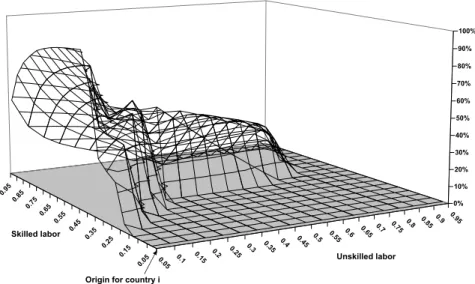
Figure 1 displays foreign affiliate production in an Edgeworth box with fac-tor endowments on the axes for the benchmark case without corporate taxation. First, consider factor endowments along the main diagonal indicating countries with identical relative factor endowments. Here, NEs and horizontal MNEs prevail, and foreign affiliate production is higher the more similar the countries are in size. Second, moving from the center towards the North-Western corner implies larger differences in relative factor endowments, inducing an increase in foreign affiliate production by vertical MNEs, all else equal. In the subsequent analysis we introduce corporate taxation and primarily focus on the case where tax revenues are used to finance public infrastructure. However, in qualitative terms, the effects are similar for lump-sum transfers. The reason is that cor-porate taxation affects the equilibrium plant configuration even if tax revenues
are redistributed in a lump-sum fashion.10
9In our empirical analysis below, we measure tax base reducing allowances by depreciation
rates including first-year extra depreciations (see Devereux and Griffith, 1999, 2003). The net present value of depreciation allowances for tax purposes is about 30 percent higher than the assumed depreciation rate in the model simulation. The means of the periodical depreciation rates in the sample are about 22 percent (machinery) and 5 percent (buildings), respectively.
0.95 0.85 0.75 0.65 0.55 0.45 0.35 0.25 0.15 0.05 0.05 0.1 0.15 0.2 0.25 0.3 0.35 0.4 0.45 0.5 0.55 0.6 0.65 0.7 0.750.8 0.850.9 0.95 0% 10% 20% 30% 40% 50% 60% 70% 80% 90% 100% Skilled labor Unskilled labor
Origin for country i
Figure 1: Share of affiliate production without corporate taxation
Figure 2 displays the share of foreign affiliate production under the
exemp-tion or credit method.11 In this case, multinational activity is affected only to
a minor extent by corporate taxation (see the small differences between Figures
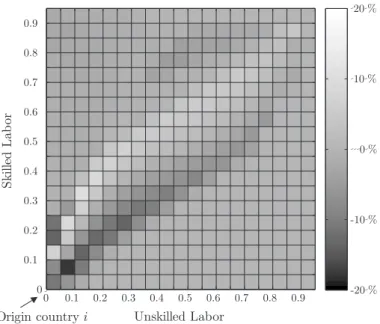
1 and 2).12 Only for small countries near the main diagonal we observe less
foreign affiliate activity of horizontal MNEs, resulting from the additional tax burden for MNEs due to withholding taxes. The foreign affiliate activities of vertical MNEs located in the North-Western corner of the Edgeworth box are more or less unaffected by profit taxation.
Compared to tax credit and exemption methods the deduction method is associated with a higher tax burden on MNEs. Accordingly, the distortion of multinational activity induced by corporate taxation becomes more evident under deduction. Figure 3 illustrates that the foreign activity of horizontal MNEs is significantly reduced as compared to the case of the exemption and the
credit method, especially for small countries.13 In small economies, firms choose
serving the foreign markets via exports since double taxation reduces foreign affiliate profits required to cover the fixed costs abroad. However, if the home country is large enough and tax revenue is used to finance public infrastructure, horizontal MNEs come into existence even under deduction. In this case, tax
upon request but are suppressed here for the sake of brevity.
11Note that we assume symmetric tax rates in the initial equilibrium so that the exemption
and the credit methods have an identical effect.
12See also Figure 5 in the Appendix, displaying the difference between the surfaces in Figure
2 and Figure 1.
0.95 0.85 0.75 0.65 0.55 0.45 0.35 0.25 0.15 0.05 0.05 0.1 0.15 0.2 0.25 0.3 0.35 0.4 0.45 0.5 0.55 0.6 0.65 0.7 0.750.8 0.850.9 0.95 0% 10% 20% 30% 40% 50% 60% 70% 80% 90% 100% Skilled labor Unskilled labor
Origin for country i
Figure 2: Share of affiliate production with exemption or credit method
(ti=tj= 0.3; twi =twj = 0.05; δi=δj= 0.2; public infrastructure investments)
revenues are high enough to finance public infrastructure, reducing fixed plant setup costs to compensate the disadvantages of double taxation. Again, the production decisions of vertical MNEs are nearly unaffected by double taxation. In the following, we focus on four factor endowment configurations within the Edgeworth box to derive the effects of the considered tax parameters on
MNE activity.14 For each of these endowment points and each method of
dou-ble taxation relief (credit, exemption, and deduction), we compare the foreign affiliate production in the reference case as described in Section 3.4 with a counterfactual where the taxation parameters of interest are increased by one percentage point, one at a time. Our parameterization (symmetric tax rates) is not suitable to illustrate the differential effects of taxation under the credit method as compared to exemption. Therefore, we allow initial tax rate differ-entials between domestic and foreign countries in alternative scenarios. The results are summarized in Table 1.
We consider the following endowment configurations. First, one where
coun-tryiis small but the relative factor endowments are identical across countries at
Li/(Li+Lj) =Si/(Si+Sj) = 0.15. There, countryi’s foreign affiliate
produc-tion is small, amounting to only 1.65 percent of the world producproduc-tion ofXunder
tax credit or exemption (there is no MNE activity under deduction at this en-dowment configuration). Second, at zero relative factor enen-dowment differences,
14We do not consider any impact of taxation on outbound MNE activity of an unskilled
0.95 0.85 0.75 0.65 0.55 0.45 0.35 0.25 0.15 0.05 0.05 0.1 0.15 0.2 0.25 0.3 0.35 0.4 0.45 0.5 0.55 0.6 0.65 0.7 0.750.8 0.850.9 0.95 0% 10% 20% 30% 40% 50% 60% 70% 80% 90% 100% Skilled labor Unskilled labor
Origin for country i
Figure 3: Share of affiliate production with deduction method (ti=tj = 0.3;
tw
i =twj = 0.05; δi=δj= 0.2; public infrastructure investments)
Li/(Li+Lj) =Si/(Si+Sj) = 0.85, countryiis large relative toj. Still, its MNE
activity is relatively small. Countryi’s foreign affiliate production amounts to
14.98 percent of the world production ofX under tax credit or exemption and
to 8.07 percent under deduction, respectively. Third, in the center of the Edge-worth box the two countries are identical in size and relative factor endowments
withLi/(Li+Lj) =Lj/(Li+Lj) =Si/(Si+Sj) =Sj/(Si+Sj) = 0.5.
There-fore, exactly 50 percent of a horizontal MNE’s production takes place in its foreign subsidiary. Vertical MNEs do not exist in this case. The foreign
affil-iate production of country i accounts for 25 percent of the overall production
of X by NEs and MNEs, irrespective of the applied method of double
taxa-tion relief. Finally, consider an endowment allocataxa-tion where countryiis skilled
labor abundant withLi/(Li+Lj) = 0.15 andSi/(Si+Sj) = 0.85. At this
con-figuration, it headquarters mainly vertical MNEs that exploit the gains from
comparative advantage, and 45.26 (45.94) percent of the production of X are
due to countryi’s foreign subsidiary activity under credit or exemption
(deduc-tion). Table 1 also provides a summary of the effects of a one percent increase
in each of the parameters of taxation on countryi’s MNE activity, separately.
The impact of statutory corporate tax rates on MNE activity: Under the exemption method, any increase in the parent country tax rate stimulates
T a b le 1 : T h e imp a c t o f c o r p o r a t e t a x a t io n o n fo r e ig n a ffil ia t e p r o d u c t io n a A ffil ia t e p r o d u c t io n in c o u n t r y j if c o u n t r y i is : s k il le d la b o r s ma ll la r g e id e n t ic a l a b u n d a n t E X C D E D E X C D E D E X C D E D E X C D E D A ffil ia t e p r o d u c t io n 1 .6 5 % 1 .6 5 % 0 b 1 4 .8 9 % 1 4 .8 9 % 8 .0 7 % 2 5 .0 0 % 2 5 .0 0 % 2 5 .0 0 % 4 5 .2 6 % 4 5 .2 6 % 4 5 .9 4 % ∆ ti + + / -c 0 (-) + + / -c -+ + / -e -+ + + ∆ tj --/ + d 0 (-) --/ + d --/ + f + g -∆ t w j -0 (-) -∆ δi + + 0 (+ ) + + + + + + -∆ δj -0 (-) -+ + + N o t es : T h e a ss u m p ti o n s a b o u t fa c to r e n d o w m e n ts in c o u n tr y i a re a s fo ll o w in g : s m a ll : Li / ( Li + Lj ) = Si / ( Si + Sj ) = 0 . 1 5 . la r g e : Li / ( Li + Lj ) = Si / ( Si + Sj ) = 0 . 8 5 . id en t ic a l : Li / ( Li + Lj ) = Si / ( Si + Sj ) = 0 . 5 . s ki ll ed la b o r a b u n d a n t : Li / ( Li + Lj ) = 0 . 1 5 , Si / ( Si + Sj ) = 0 . 8 5 . ∆ ti (∆ tj ) in d ic a te s a n in c re a se o f th e c o rp o ra te ta x ra te in c o u n tr y i (c o u n tr y j ). ∆ t w j in d ic a te s a n in c re a se o f th e w it h h o ld in g ta x in c o u n tr y j . ∆ δi (∆ δj ) in d ic a te s a n in c re a se in th e d e p re c ia ti o n a ll o w a n c e s in c o u n tr y i (c o u n tr y j ). a A ffi li a te p ro d u c ti o n is m e a su re d in p e rc e n t o f th e to ta l p ro d u c ti o n o f th e X -g o o d . b T o e v a lu a te th e im p a c t o f a ch a n g e in ta x p a ra m e te r, th e ta x ra te s a re se t a t ti = tj = 0 . 0 5 , w h ic h le a d s to a ffi li a te p ro d u c ti o n o f 7 .8 6 % in it ia ll y . c P o si ti v e , if c o u n tr y i is in e x c e ss c re d it p o si ti o n , i. e . if ti < ( tj + t w(1j − tj )) h o ld s, o th e rw is e n e g a ti v e . d N e g a ti v e , if c o u n tr y i is n o t in e x c e ss c re d it p o si ti o n , i. e . if tj < ( ti − t w j (1 − tj )) h o ld s, o th e rw is e p o si ti v e . e P o si ti v e , if b o th c o u n tr ie s a re in e x c e ss c re d it p o si ti o n , i. e . w it h in th e ra n g e ( tj − t w i (1 − ti )) < ti < ( tj + t w(1j − tj )) , o th e rw is e n e g a ti v e . f N e g a ti v e , if b o th c o u n tr ie s a re in e x c e ss c re d it p o si ti o n , i. e . w it h in th e ra n g e ( ti − t w j (1 − tj )) < tj < ( ti + t w(1i − ti )) , o th e rw is e p o si ti v e . g P o si ti v e , fo r a re a so n a b ly la rg e ta x in c re a se , o th e rw is e n e g a ti v e .
foreign affiliate production.15 The reason for the positive nexus of parent
coun-try tax rates and outbound MNE activity is that the change in its tax rate only affects domestic production. For similar reasons, a higher tax rate in the host country reduces affiliate production there. Hence, the predicted effect of an increase in parent (host) country corporate tax rates on a country’s outbound MNE activity is positive (negative) under exemption.
With the credit method, the effects of corporate tax rates are ambiguous if
horizontal MNE activity prevails (i.e., the factor endowment differences are not important; see the first three endowment configurations under tax credits in Table 1). As becomes apparent from (16), the impact of a tax increase depends on the differential between domestic and foreign corporate tax rates. If the parent country is in an excess credit position (i.e., its corporate tax rate is
lower than the host country tax burden; see footnotecin Table 1) the effect of
the parent country’s tax increase is the same as under the exemption method. An increase in the statutory tax rate of the parent country fosters its foreign affiliate production. The tax increase, by contrast, applies to operating profits of foreign affiliates if the parent tax rate is equal to or higher than the host tax burden. This reduces foreign affiliate activities of horizontal MNEs, while
rendering the domestic production of host country owned firms better off.16 For
similar reasons, an increase in the host country’s corporate tax rate induces the opposite effect.
With adeduction system, an increase in the corporate tax rate reduces MNE
activities in both countries,17 with two exceptions. First, if both countries
are identical, an increase in the host country corporate tax rate fosters foreign affiliate activity there, as long as the tax burden becomes not prohibitively high. Although the tax burden is increased for all (domestic and foreign) MNEs, the foreign ones are even more exposed to double taxation. Second, for skilled labor abundant parent countries, an increase in the parent country’s corporate tax
15Slemrod (1990) was the first who has pointed to a positive relationship between the parent
country tax rate and outbound FDI, especially under the exemption system. In this regard, Hartman (1990, p. 121) criticized that ”... the sign of the home country taxation parameter is indeterminate from economic theory.” According to the insights from our model, Slemrod rightfully suggested using parent country corporate tax rates as a determinant of outbound FDI.
16In the case of identical factor endowments, the impact of a parent country’s tax increase
on foreign affiliate activity is only positive if both countries are in an excess credit position, i.e., (tj−twi(1−ti))< ti<(tj+twj(1−tj)), obtaining the same result as with the exemption
method.
17As discussed above, the deduction method leads to zero MNE activity for a small country.
For such a situation, we are not able to identify a change in MNE activity due to an increase in the tax parameters. However, to illustrate the impact of tax changes we re-parameterize the model such that MNE activity arises in the initial equilibrium (see footnotebin Table 1).
rate fosters its foreign affiliate activity at the expense of the NE activity there.
The impact of withholding tax rates on MNE activity: The effects of an increase in the withholding tax rate are unambiguous and straight-forward. An increase in the host country’s withholding tax rate increases the tax burden of the parent country’s MNEs only, irrespective of the method of double taxation relief. Consequently, MNE activity there is then reduced.
The impact of depreciation allowances on MNE activity: If the parent country provides more generous depreciation allowances (reflected in a higher
level ofδi), the model predicts an increase of the parent’s horizontal outbound
MNE activity. The reason for this result lies in the assumption that fixed costs are deductible in the country where they are actually paid (firm-specific and do-mestic plant-specific fixed costs in the parent country and foreign plant-specific fixed costs abroad). Hence, domestically headquartered MNEs gain the most, as they face the highest fixed costs. However, this effect exists only under cross-hauling, i.e., the coexistence of outbound and inbound horizontal MNE activity at small (zero) relative factor endowment differences. The effects of depreciation allowances are reversed if large relative factor endowment differences exist and
vertical MNEs prevail.18 Since vertical MNEs do not operate a production
facil-ity at the headquarters’ location, they only can deduct fixed plant set-up costs (in contrast to domestic NEs or horizontal MNEs). Accordingly, an increase in domestic depreciation allowances leads to a distortion in favor of domestic NEs and vertical outbound MNE activity is crowded out. An increase in the depreciation allowances in an unskilled labor abundant host country attracts even more affiliate production there and fosters the parent country’s vertical outbound MNE activity. In the remaining factor configurations, we obtain the opposite sign to a change in depreciation allowances in the parent country.
5
Specification of bilateral outbound FDI
Our empirical analysis employs a panel data set of real bilateral outbound FDI stocks among the OECD economies with annual information between 1991 and 2002. To guard against the bias from omitted time-invariant variables and time-specific common shocks that affect all country-pairs in the same way, we include fixed country-pair and time effects. The specification of the empirical
18The effects of δ
i andδj are also reversed if depreciation allowances are not only applied
model follows our theoretical framework and is also in line with recent empirical research emphasizing parent and host country size, their skilled labor endow-ments, trade and investment costs, and interaction terms thereof as the most important determinants of MNE activity (Carr, Markusen, and Maskus, 2001; Markusen and Maskus, 2002; Blonigen, Davies, and Head, 2003). Whereas most of the estimated specifications employ dependent and independent variables in levels, Mutti and Grubert (2004) find that a specification in logs is superior from an econometric point of view.
Therefore, we specify the log of FDI stocks from country i to country j
in year t, F DIijt, as a log-linear function of the following explanatory
vari-ables. The sum of parent and host country GDP in period t, ΣGDPijt =
logGDPit+ logGDPjt, the similarity between the parent and the host
mar-ket in country size, ∆GDP2
ijt = (logGDPit −logGDPjt)2, and four
inter-action terms to account for the impact of knowledge-capital (skilled labor
endowment differences, ∆SKijt = logSKit −logSKjt) on FDI: IN T1ijt =
∆SKijt×∆GDPijt×I(∆SKijt>0), where ∆GDPijt= (logGDPit−logGDPjt)
and I(∆SKijt>0) is a dummy variable that is set to 1, if ∆SKijt >0, and 0
else; IN T2ijt = ∆SKijt×ΣGDPijt×I(∆SKijt >0); IN T3ijt = −∆SKijt×
ΣGDPijt×I(∆SKijt <0), where I(∆SKijt < 0) is a dummy variable that is
set to 1, if ∆SKijt<0, and 0 else; andIN T4ijt= ∆SKijt×logDISTij, where
DISTij is the great circle distance between the parent’s and the host’s capitals,
serving as a proxy for trade costs. According to the literature, horizontal FDI is expected to rise, if the two economies become larger and more similar (i.e.,
ΣGDPijt rises and ∆GDPijt declines). Vertical FDI is expected to increase,
if the parent country becomes smaller and/or relatively better endowed with skilled labor, especially, if the trade costs between the two countries are low.
Hence, we expect a positive sign for the parameters of ΣGDPijt and ∆GDPijt2 ,
but a negative one for the parameters ofIN T1ijt, ..., IN T4ijt.
In addition to the variables motivated by the original knowledge-capital model, the above variant of it supports the use of the following components of country-pair specific (bilateral) tax rates: the parent and the host country
statutory corporate tax rates (tit, tjt), whose impact depends on the prevailing
method of double taxation relief established in tax treaties (i.e., exemption,
credit, and deduction);19the withholding tax rate applying to repatriated
prof-19Note that for about 97 percent of the observations a tax treaty is effective. Of the
remain-ing three percent, about one percentage point (i.e., 18) of the observations are covered by the European Union’s Parent-Subsidiary Directive (Directive 90/435) that applies to FDI within the European Union. For the remaining two percent (i.e., 54) observations in our database, methods of double taxation relief (exemption, credit, deduction) are applied unilaterally.
its in a given host country (tw
jt); and the parent and host country-specific net
present values of depreciation allowances (δit, δjt). To avoid a possible
endo-geneity bias, we use the lagged values of all tax variables.20
Regarding the parent country’s statutory tax rate, we have no clear-cut hy-pothesis on the sign of the parameter estimate. However, the above theoretical model suggests that its impact depends on the skilled-to-unskilled labor endow-ment ratio in the parent country relative to the host (see Table 1). We include
the interaction termti,t−1×∆SKij,t−1×I(∆SKij,t−1>0), where we expect a
positive sign for the exemption as well as the credit method. Additionally, we
include the present values of depreciation allowances,δi,t−1 andδj,t−1, and two
interaction terms between the depreciation allowances and the skill differences,
δi,t−1×∆SKij,t−1×I(∆SKij,t−1 >0) andδj,t−1×∆SKij,t−1×I(∆SKij,t−1 >0).
Similar to the parent country statutory corporate tax rate, the inclusion of these interaction terms is necessary, since the theoretical model does not predict a clear-cut relationship between the depreciation allowances and outbound FDI. The theoretical model predicts a negative parameter for the first and a positive one for the second interaction term.
Overall, the empirical specification reads as follows
F DIijt = β1ti,t−1+β2tj,t−1+β3twj,t−1+β4δi,t−1+β5δj,t−1
+ β6[ti,t−1×∆SKij,t−1×I(∆SKij,t−1 >0)]
+ β7[δi,t−1×∆SKij,t−1×I(∆SKij,t−1>0)]
+ β8[δj,t−1×∆SKij,t−1×I(∆SKij,t−1>0)]
+ β9ΣGDPijt+β10∆GDPijt2 +β11IN T1ijt+β12IN T2ijt
+ β13IN T3ijt+β14IN T4ijt+µij+λt+εijt (22)
where µij and λt are fixed country pair and time effects, respectively. ε is an
identically and independently distributed stochastic error term.
6
Empirical analysis
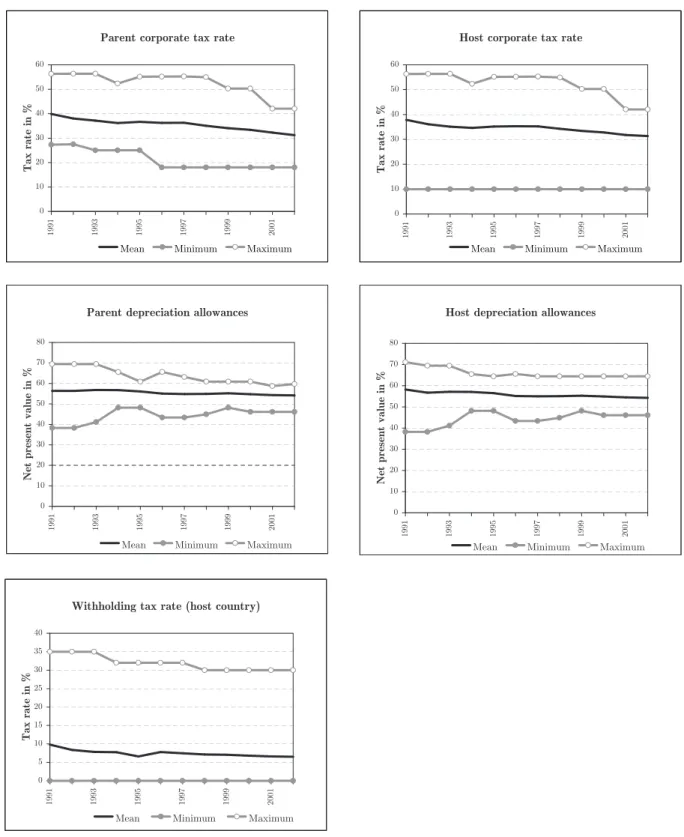
Baseline results: We provide details on the data sources and descriptive statistics for all variables in the Appendix (Tables A1 to A3) and in Figure 4. The figure illustrates the change in all considered components of corporate
tax-20Given the large number of taxation-related variables (eight) it seems infeasible to employ
instrumental variable methods. However, with panel data one can use lagged values of the tax variables to get rid of the endogeneity problem as long as the contemporaneous variation in foreign direct investment does not cause a change in taxation in the past.
ation: parent and host country statutory corporate tax rates, their depreciation allowances, and the host economy’s withholding tax rate.
The figure covers the same sample of host countries and years that is consid-ered in the empirical analysis. We report the mean as well as the minimum and maximum values of each tax parameter and year. Obviously, there is enough time variation in every component, rendering parameter estimation by a fixed effects model feasible.
Table 2 summarizes the results for (i) the full sample (covering all country-pairs and years, independent of the implemented method of double taxation relief), (ii) the sub-sample covering the country-pairs which apply the exemp-tion method, and (iii) the sub-sample covering country-pairs which apply the
credit method.21
To facilitate the comparison of the point estimates with the theoretical hypotheses, we indicate in Table 2 whether our findings are in line with the
predictions (labelled ’Y’) or not (’N’). If the expected effects are ambiguous
according to Table 1, i.e., for the entries ’+/−’ (e.g., the credit method), this
is indicated by a ’?’ in the table. All estimated standard errors and test statis-tics are corrected for heteroskedasticity and autocorrelation, following Newey and West (1987). In general, the model fit is quite well. Inspired by Razin, Rubinstein, and Sadka (2005) we check for a potential bias due to sample se-lection arising from missing FDI data. We follow Wooldridge (1995, 2002) in applying testing procedures that are suited for panel data. However, in our sample of OECD country-pairs, there is no indication for endogenous selec-tion into the sample, given the adopted specificaselec-tion. This can be seen from the insignificant parameters of the inverse Mills’ ratio reported in Table 2. With regard to the usual knowledge-capital variables, we find across the board
that the impact of overall and relative country size (ΣGDPijt and ∆GDPijt2 )
is in line with theory, whereas the skill-endowment interaction term
parame-ters (IN T1ijt, ..., IN T4ijt) are insignificant in almost all specifications.22 In
21In our sample, the exemption (credit) method applies for around 59 percent (34 percent)
of the observations (either through unilateral tax law or through bilateral tax treaties). The remaining observations use the deduction method (around 7 percent). Since the latter group contains only 149 observations, it is not possible to estimate the tax effects precisely for the deduction sub-sample.
22In this regard, our findings do not match with the empirical results in Carr, Markusen,
and Maskus (2001) and Markusen and Maskus (2002). However, there are four reasons for this. First, we use stocks of outbound FDI rather than foreign affiliate sales as our dependent variable (however, Blonigen, Davies, and Head, 2003, indicate that the results tend to be very similar for FDI and foreign affiliate sales). Second, we apply a log-linear specification (as suggested by Mutti and Grubert, 2004) rather than one in levels. Third, our sample covers a panel of OECD parent and host countries that are relatively similarly endowed, which differs
T a b le 2 : E s ti m a ti o n R e s u lt s -D is s e c ti n g th e Im p a c t o f C o r p o r a te In c o m e T a x a ti o n o n F D I E st . a s E x e m p ti o n E st . a s C r e d it E st . a s E x p la n a to r y v a r ia b le s F u ll s a m p le p re d ic te d m e th o d p re d ic te d m e th o d p re d ic te d P a re n t co u n tr y co rp o ra te ta x ra te : ti,t − 1 0 .8 5 0 Y 0 .8 7 2 Y -0 .0 0 0 ? (1 .8 0 ) (1 .6 1 ) (0 .0 0 ) H o st co u n tr y co rp o ra te ta x ra te : tj,t − 1 -1 .4 2 8 Y -1 .8 8 7 Y -0 .6 8 5 ? (-2 .4 5 ) (-2 .5 8 ) (-0 .7 6 ) W it h h o ld in g ta x ra te o n re p a tr ia te d p ro fi ts : t w j,t − 1 -1 .6 1 2 Y -2 .1 1 1 Y -1 .2 5 6 Y (-3 .2 6 ) (-2 .6 5 ) (-2 .1 1 ) P a re n t co u n tr y d ep re ci a ti o n a ll ow a n ce s: δi,t − 1 -4 .2 5 7 N -3 .5 0 8 N -3 .3 0 1 N (-4 .5 1 ) (-2 .1 0 ) (-2 .7 8 ) H o st co u n tr y d ep re ci a ti o n a ll ow a n ce s: δj,t − 1 -0 .4 2 7 Y -0 .5 4 4 Y -0 .4 9 5 Y (-0 .6 5 ) (-0 .6 7 ) (-0 .4 9 ) ti,t − 1 × ∆ S Kij ,t − 1 × I (∆ S Kij ,t − 1 > 0 ) -0 .0 0 4 N 0 .0 1 4 Y -0 .2 2 0 N (-0 .1 1 ) (0 .3 5 ) (-1 .2 4 ) δi,t − 1 × ∆ S Kij ,t − 1 × I (∆ S Kij ,t − 1 > 0 ) -0 .1 6 5 Y -0 .1 3 6 Y -0 .3 6 1 Y (-2 .3 1 ) (-1 .3 3 ) (-2 .2 8 ) δj,t − 1 × ∆ S Kij ,t − 1 × I (∆ S Kij ,t − 1 > 0 ) 0 .0 7 4 Y 0 .0 8 9 Y 0 .0 1 5 Y (2 .0 8 ) (1 .2 3 ) (0 .4 5 ) lo g ( G D Pit + G D Pj t ): Σ G D Pij t 1 .9 5 5 Y 2 .3 4 0 Y 4 .9 5 1 Y (3 .3 6 ) (3 .0 2 ) (2 .9 9 ) lo g ( G D Pit / G D Pj t ): ∆ G D Pij t -0 .1 3 8 Y 0 .0 0 2 N -0 .3 1 2 Y (-2 .7 9 ) (0 .0 3 ) (-5 .1 2 ) ∆ S Kij t × ∆ G D Pij t × I (∆ S Kij t > 0 ): IN T 1 a 0 .1 1 9 N 0 .3 1 6 N 0 .3 3 0 N (0 .9 4 ) (1 .1 3 ) (1 .2 3 ) ∆ S Kij t × Σ G D Pij t × I (∆ S Kij t > 0 ): IN T 2 a 0 .2 1 7 N 0 .1 0 6 N 0 .9 4 0 N (1 .4 3 ) (0 .4 3 ) (2 .4 2 ) ∆ S Kij t × ∆ G D Pij t × I (∆ S Kij t < 0 ): IN T 3 a 0 .0 4 7 N 0 .0 1 5 N 0 .0 8 5 N (2 .9 0 ) (0 .7 1 ) (2 .9 0 ) (∆ S Kij t ) 2× lo g ( D I S Tij ): IN T 4 a -0 .0 0 2 Y -0 .0 0 0 Y -0 .0 0 2 Y (-2 .1 0 ) (-0 .1 2 ) (-1 .4 4 ) O b se rv a ti o n s 2 1 9 5 1 2 5 7 7 8 9 R 2 0 .9 9 7 0 .9 9 8 0 .9 9 6 F ix ed co u n tr y -p a r eff ec ts : F -s ta ti st ic 5 0 6 .5 9 2 .6 8 E + 0 5 3 1 5 .6 8 d eg re es o f fr ee d o m (D F 1 / D F 2 ) (3 8 8 ,1 7 8 2 ) (2 2 3 ,1 0 0 8 ) (1 3 8 ,6 2 6 ) p -v a lu e 0 .0 0 0 0 .0 0 0 0 .0 0 0 F ix ed ti m e eff ec ts : F -s ta ti st ic 1 0 .5 3 1 3 .7 7 6 .4 4 d eg re es o f fr ee d o m (D F 1 / D F 2 ) (1 0 ,1 7 8 2 ) (1 1 ,1 0 0 8 ) (1 1 ,6 2 6 ) p -v a lu e 0 .0 0 0 0 .0 0 0 0 .0 0 0 S a m p le S el ec ti o n (M il l’ s ra ti o ) -0 .1 3 3 -0 .1 4 9 0 .3 7 3 p -v a lu e 0 .1 2 4 0 .2 7 3 0 .3 8 1 N o te s : H A C -c o rr ec te d t-va lu es in p a re n th es es (N ew ey a n d W es t, 1 9 8 7 ). a P a ra m et er a n d st a n d a rd er ro r m u lt ip li ed b y 1 0 0 .
the subsequent discussion of Table 2, we summarize our findings regarding the impact of the tax variables on bilateral outbound FDI in the OECD.
In general, we would expect that the parent country tax rate exerts a
posi-tive impact on the country’s outbound FDI.23 This is in line with the positive
point estimate in the pooled sample and in the exemption sub-sample. For instance, the point estimate in the full sample indicates that a one
percent-age point increase in the parent country statutory tax rate (ti,t−1) is
associ-ated with an increase in outbound FDI by about 0.85 percent. For the credit method sub-sample, the impact of the parent country corporate tax rate is the-oretically ambiguous, which is in line with our findings. The interactive term
ti,t−1×∆SKij,t−1×I(∆SKij,t−1>0) enters as expected in the sub-sample
cov-ering the exemption countries, but not so in the full sample and in the credit sub-sample. Regarding the host country corporate tax rate, we expect a
nega-tive impact on a country’s outbound FDI.24This is confirmed by the empirical
finding of a significantly negative estimate of the corresponding parameter. Sim-ilarly, Table 1 clearly suggests a negative relationship between the host country withholding tax rate and outbound FDI, which is confirmed by the signifi-cantly negative parameter estimates in all samples. Finally, the parent country
depreciation allowances (δi,t−1) exert a significantly negative impact on foreign
outbound FDI, which is not supported by the simulations in Table 1. A negative
but insignificant effect is estimated for its host country counterpart (δj,t−1), as
expected. Further, the point estimate ofδi,t−1×∆SKij,t−1×I(∆SKij,t−1>0)
is negative, and the one of δj,t−1×∆SKij,t−1×I(∆SKij,t−1 >0) is positive,
being in line with the theoretical hypotheses. Across the board, the support for the tax-related hypotheses is remarkable, considering the large number of parameters to be estimated.
Sensitivity analysis and discussion: We check the sensitivity of our find-ings in various ways. Table 3 provides a summary, pointing to their robustness in qualitative terms. For the sake of brevity, we refer to the full sample in Table
from that one in Carr, Markusen, and Maskus (2001) and Markusen and Maskus (2002), who use U.S. foreign affiliate sales across a larger set of host countries over time. Finally, we employ country-pair and time fixed effects. In particular, this wipes out all time-invariant level information so that the parameters of the relatively time-invariant endowment variables can hardly be estimated significantly.
23The predicted impact across all methods (i.e., the pooled sample) is ambiguous (see Table
1). However, the number of cases in our sample, where deduction is applied or the excess credit position is evident is rather small. Accordingly, we expect the positive impact to dominate in the pooled sample.
24Again, the prediction is ambiguous, but we expect the negative impact to dominate for
2 and only report the taxation parameters of interest.
In the first sensitivity check, we replace tertiary school enrollment by
al-ternative skill measures in the construction of IN T1ijt, ..., IN T4ijt and the
interaction terms involving ∆SKij,t−1: gross secondary school enrollment in
ModelA; the sum of professional, technical, kindred and administrative
work-ers to total employment in ModelB (as in Carr, Markusen, and Maskus 2001;
and Markusen and Maskus, 2002); and physical capital stocks per worker in
Model C. As can be seen, most of the point estimates, especially the ones
of statutory tax rates and depreciation allowances, exhibit the same sign as
in Table 2. Only in the case of host country depreciation allowances (δj,t−1)
we obtain positive but insignificant parameter estimates in Models A and C
which should be negative according to the predictions of the theoretical model.
Similarly, the sign of δi,t−1 ×∆SKij,t−1 ×I(∆SKij,t−1 > 0) is now positive
in Models A and C (it was and should be negative), and the coefficient of
δj,t−1×∆SKij,t−1×I(∆SKij,t−1 >0) becomes positive in ModelsB and C (it
was negative in Table 2, as expected). ti,t−1×∆SKij,t−1×I(∆SKij,t−1 > 0)
is now positive in Models B and C, as it should be (it was negative before).
Generally, we would prefer the original model in Table 2 and ModelAin Table
3 over ModelsB and C, since the sample size is substantially reduced for the
latter ones (to 1011 and 1410 observations, respectively). Further, as can be seen from Table A3 in the Appendix, the correlation between the interaction effects is much lower for tertiary school enrollment than for secondary school enrollment. Therefore, we consider the original model as preferable over Model A.
The second sensitivity check (Model D) replaces the knowledge-capital
model variables that are not related to corporate taxation by standard grav-ity model variables (i.e., parent and host country GDP and GDP per capita). For instance, such a specification is employed by Mutti and Grubert (2004), B´enassy-Qu´er´e, Fontagn´e, and Lahr`eche-R´evil (2005), and also by Blonigen and Davies (2004) in a paper on the tax treaty effects on FDI. In Model D, the parameter signs are very similar to their counterparts in the original
model, except for the interaction effectsti,t−1×∆SKij,t−1×I(∆SKij,t−1 >0),
δi,t−1×∆SKij,t−1×I(∆SKij,t−1 >0) andδj,t−1×∆SKij,t−1×I(∆SKij,t−1 >0),
which have changed their sign. ti,t−1×∆SKij,t−1×I(∆SKij,t−1 >0) is now
sig-nificantly positive, as expected. However, it must be said that a test on the joint
significance of the skilled labor endowment variablesIN T1ijt, ..., IN T4ijt
T a b le 3 : R o b u s tn e s s T a x c o m p o n e n ts M o d e l A M o d e l B M o d e l C M o d e l D M o d e l E M o d e l F M o d e l G M o d e l H M o d e l I P a re n t co u n tr y co rp o ra te ta x ra te : ti,t − 1 0 .8 4 5 0 .8 1 7 1 .1 7 0 1 .1 1 3 0 .4 4 6 0 .5 1 7 -0 .2 6 2 0 .7 0 2 0 .8 1 6 (1 .8 0 ) (0 .8 7 ) (2 .2 1 ) (2 .4 1 ) (0 .8 0 ) (1 .1 5 ) (-0 .3 6 ) (1 .4 9 ) (1 .7 1 ) H o st co u n tr y co rp o ra te ta x ra te : tj,t − 1 -1 .4 9 8 -2 .1 6 1 -1 .7 1 6 -1 .3 0 2 -0 .8 9 2 -1 .1 3 6 -1 .4 0 2 -1 .6 7 0 -1 .6 2 6 (-2 .5 7 ) (-1 .9 1 ) (-2 .5 7 ) (-2 .2 1 ) (-1 .2 7 ) (-2 .1 0 ) (-1 .6 6 ) (-2 .7 6 ) (-2 .7 4 ) W it h h o ld in g ta x ra te o n re p a tr ia te d p ro fi ts : t w j,t − 1 -1 .5 4 5 -2 .4 3 9 -2 .4 1 5 -1 .3 5 9 -1 .3 5 4 -1 .6 0 6 -1 .5 5 4 -1 .5 9 1 -1 .4 5 3 (-3 .0 6 ) (-1 .8 0 ) (-3 .3 3 ) (-2 .7 9 ) (-2 .3 2 ) (-3 .2 4 ) (-2 .1 4 ) (-3 .2 2 ) (2 .9 3 ) P a re n t co u n tr y d ep re ci a ti o n a ll ow a n ce s: δi,t − 1 -4 .5 3 0 -4 .8 6 9 -4 .4 5 2 -4 .2 9 4 -3 .3 6 0 -5 .1 0 6 -4 .2 9 6 -3 .6 1 7 -3 .8 4 8 (-4 .7 4 ) (-2 .2 8 ) (-3 .7 7 ) (-4 .4 5 ) (-2 .9 3 ) (-4 .9 1 ) (-2 .0 4 ) (-3 .6 8 ) (-3 .9 9 ) H o st co u n tr y d ep re ci a ti o n a ll ow a n ce s: δj,t − 1 0 .2 0 1 -1 .1 7 6 0 .0 6 7 -0 .2 2 9 0 .5 6 2 -0 .7 2 1 -1 .6 2 0 -0 .3 5 5 -0 .3 2 4 (0 .2 9 ) (-1 .1 9 ) (0 .1 0 ) (-0 .3 4 ) (0 .7 2 ) (-0 .9 8 ) (-1 .2 2 ) (-0 .5 2 ) (-0 .4 6 ) ti,t − 1 × ∆ S Kij ,t − 1 × I (∆ S Kij ,t − 1 > 0 ) -0 .0 0 1 0 .1 6 4 1 .0 7 7 0 .0 7 9 0 .0 6 3 0 .0 3 4 0 .0 4 4 -0 .0 1 9 0 .0 0 4 (-0 .0 2 ) (2 .4 8 ) (0 .8 4 ) (2 .2 2 ) (0 .8 5 ) (0 .8 5 ) (0 .9 6 ) (-0 .4 7 ) (0 .0 9 ) δi,t − 1 × ∆ S Kij ,t − 1 × I (∆ S Kij ,t − 1 > 0 ) 0 .0 0 5 -0 .0 7 3 0 .6 9 8 0 .0 1 8 -0 .1 1 3 -0 .0 6 3 -0 .1 8 8 -0 .1 0 9 -0 .0 8 2 (0 .0 9 ) (-0 .5 6 ) (0 .5 3 ) (0 .5 4 ) (-0 .9 8 ) (-0 .7 9 ) (-1 .4 2 ) (-1 .4 1 ) (-1 .0 7 ) δj,t − 1 × ∆ S Kij ,t − 1 × I (∆ S Kij ,t − 1 > 0 ) 0 .0 0 6 -0 .0 0 7 -0 .4 6 5 -0 .0 9 3 -0 .3 7 5 -0 .0 0 0 -0 .1 1 0 0 .0 6 9 0 .0 5 0 (0 .1 5 ) (-0 .0 6 ) (-0 .5 9 ) (-2 .3 3 ) (-1 .5 2 ) (-0 .0 1 ) (-1 .4 9 ) (1 .9 0 ) (1 .3 6 ) N o te s : H A C -c o rr ec te d t-va lu es in p a re n th es es (N ew ey a n d W es t, 1 9 8 7 ). M o d el A (2 1 9 5 o b se rv a ti o n s) : S ec o n d a ry sc h o o l en ro ll m en t in st ea d o f te rt ia ry sc h o o l en ro ll m en t. M o d el B (1 0 1 1 o b se rv a ti o n s) : S k il l m ea su re a s p ro p o se d b y M a rk u se n (2 0 0 2 : p . 2 2 8 ) ra th er th a n te rt ia ry sc h o o l en ro ll m en t. M o d el C (1 4 1 0 o b se rv a ti o n s) : C a p it a l st o ck p er w o rk er in st ea d o f te rt ia ry sc h o o l en ro ll m en t. M o d el D (2 1 9 5 o b se rv a ti o n s) : G ra v it y m o d el in st ea d o f K n ow le d g e C a p it a l m o d el . M o d el E (1 7 9 2 o b se rv a ti o n s) : D y n a m ic m o d el a s p ro p o se d b y A re ll a n o a n d B o n d (1 9 9 1 ) fo r p a n el d a ta ; L a g g ed d ep en d en t va ri a b le a m o u n ts to 0 .2 2 1 (s .e . = 0 .1 1 0 ). M o d el F (2 0 1 1 o b se rv a ti o n s) : E x cl u d