Compositional Dynamic Test Generation
(Extended Abstract)
Patrice Godefroid
∗ Microsoft Research [email protected]Abstract
Dynamic test generation is a form of dynamic program analysis that attempts to compute test inputs to drive a program along a specific program path. Directed Automated Random Testing, or DART for short, blends dynamic test generation with model checking techniques with the goal of systematically executing all feasible program paths of a program while detecting various types of errors using run-time checking tools (like Purify, for instance). Unfortunately, systematically executingallfeasible program paths does not scale to large, realistic programs.
This paper addresses this major limitation and proposes to per-form dynamic test generationcompositionally, by adapting known techniques for interprocedural static analysis. Specifically, we in-troduce a new algorithm, dubbedSMARTforSystematic Modular Automated Random Testing, that extends DART by testing func-tions in isolation, encoding test results as function summaries ex-pressed using input preconditions and output postconditions, and then re-using those summaries when testing higher-level functions. We show that, for a fixed reasoning capability, our compositional approach to dynamic test generation (SMART) is both sound and complete compared to monolithic dynamic test generation (DART). In other words, SMART can perform dynamic test generation com-positionally without any reduction in program path coverage. We also show that, given a bound on the maximum number of feasible paths in individual program functions, the number of program exe-cutions explored by SMART is linear in that bound, while the num-ber of program executions explored by DART can be exponential in that bound. We present examples of C programs and preliminary experimental results that illustrate and validate empirically these properties.
Categories and Subject Descriptors D.2.4 [Software Engineer-ing]: Software/Program Verification; D.2.5 [Software Engineer-ing]: Testing and Debugging; F.3.1 [Logics and Meanings of Pro-grams]: Specifying and Verifying and Reasoning about Programs General Terms Verification, Algorithms, Reliability
Keywords Software Testing, Automatic Test Generation, Scala-bility, Compositional Program Analysis, Program Verification
∗This work was done mostly when the author was still affiliated with Bell
Laboratories. It is also funded in part by NSF CCR-0341658.
Permission to make digital or hard copies of all or part of this work for personal or classroom use is granted without fee provided that copies are not made or distributed for profit or commercial advantage and that copies bear this notice and the full citation on the first page. To copy otherwise, to republish, to post on servers or to redistribute to lists, requires prior specific permission and/or a fee.
POPL’07 January 17–19, 2007, Nice, France. Copyright c2007 ACM 1-59593-575-4/07/0001. . . $5.00.
1.
Introduction
Given a programP, say a C program with a million lines of code, with a set of input parameters, wouldn’t it be nice to have a tool that could automatically generate a set of input values that would exercise, say, even only 50% of the code ofP?
This problem is called the test generation problem, and has been studied since the 70’s (e.g., [Kin76, Mye79]). Yet, effective solutions and tools to address this problem have proven elusive for the last 30 years. What happened?
There are several possible explanations to the current lack of practically-usable tools addressing this problem. First, the expen-sive sophisticated program-analysis techniques required to tackle the problem, such as symbolic execution engines and constraint solvers, have only become computationally affordable in recent years thanks to the increasing computational power available on modern computers. Second, this steady increase in computational power has in turn enabled recent progress in the engineering of more practical software model checkers, more efficient theorem provers, and, last but not least, more precise yet scalable static anal-ysis tools. Indeed, automatic code inspection tools based on static program analysis are increasingly being used in the software indus-try (e.g., [BPS00, HCXE02]).
Recently, there has been a renewed interest on automated test generation from program analysis (e.g., [BKM02, BCH+04, VPK04, CS05, GKS05, CE05]). Work in this area can roughly be partitioned into two groups:staticversusdynamictest generation.
Static Test Generation is Often Ineffective
Static test generation (e.g., [Kin76]) consists of analyzing a pro-gramP statically, by exclusively using symbolic execution tech-niques to attempt to compute inputs to drivePalong specific exe-cution paths or branches,without ever executing the program. The idea is to symbolically explore the tree of all computations the pro-gram exhibits when all possible value assignments to input param-eters are considered. For eachcontrol pathρ, that is, a sequence of control locations of the program, apath constraintφρ is con-structed that characterizes the input assignments for which the pro-gram executes alongρ. All the paths can be enumerated by a search algorithm that explores all possible branches at conditional state-ments. The pathsρfor whichφρis satisfiable arefeasibleand are the only ones that can be executed by the actual program. The so-lutions toφρexactly characterize the inputs that drive the program throughρ. Assuming that the theorem prover used to check the satisfiability of all formulasφρis sound and complete, this use of static analysis amounts to a kind of symbolic testing.
Unfortunately, this approach does not work whenever the pro-gram contains statements involving constraints outside the scope of reasoning of the theorem prover, i.e., statements “that cannot be reasoned about symbolically”. This limitation is illustrated by the following example.
void obscure(int x, int y) {
if (x == hash(y)) return -1; // error
return 0; // ok
}
Assume that the functionhashcannot be reasoned about symbol-ically. Formally, this means that it is in general impossible to gen-erate two values for inputsxandythat are guaranteed to satisfy (or violate) the constraintx == hash(y). (For instance, ifhash
is a hash or cryptographic function, it has been mathematically de-signed to prevent such reasoning.) In this case, static test generation cannot generate test inputs to drive the execution of the program
obscurethrough either branch of the conditional statement: static test generation is helpless for a program like this.
The practical implication of this simple observation is signifi-cant: static test generation as proposed by King 30 years ago and much discussed since then (e.g., see [Mye79, Edv99, BCH+04, VPK04, XMSN05, CS05]) is doomed to perform poorly whenever symbolic execution is not possible. Unfortunately, this is frequent in practice due to complex program statements (pointer manipula-tions, arithmetic operamanipula-tions, etc.) and calls to operating-system and library functions that are hard or impossible to reason about sym-bolically with good enough precision.
Dynamic Test Generation is More Powerful
A second approach to test generation isdynamic test generation (e.g., [Kor90, GMS00]): it consists of executing the program P, typically starting with some random inputs, gathering symbolic constraints on inputs gathered from predicates in branch statements along the execution, and then using a constraint solver to infer variants of the previous inputs in order to steer the next execution of the program towards an alternative program branch. This process is repeated until a given final statement is reached or a specific program path is executed.
Directed Automated Random Testing [GKS05], or DART for short, is a recent variant of dynamic test generation that blends it with model checking techniques with the goal of systematically executingallfeasible program paths of a program while detecting various types of errors using run-time checking tools (like Purify, for instance). In DART, each new input vector attempts to force the execution of the program through some new path. By repeating this process, such adirected searchattempts to force the program to sweep through all its feasible execution paths, in a style similar to systematic testinganddynamic software model checking[God97]. In practice, DART typically achieves much better coverage than pure random testing (see [GKS05]).
A key observation from [GKS05] is thatimprecision in symbolic execution can be alleviated using concrete values and randomiza-tion: whenever symbolic execution does not know how to generate a constraint for a program statement depending on some inputs, one can always simplify this constraint using the concrete values of those inputs.
Let us illustrate this important point with an example. Consider again the programobscuregiven above. Even though it is stat-icallyimpossible to generate two values for inputsxandysuch that the constraint x == hash(y) is satisfied (or violated), it is easy to generate, for a fixed value ofy, a value ofxthat is equal tohash(y)since the latter is known at runtime. By picking ran-domly and then fixing the value ofy, we can, in the next run, set the value of the other inputxeither tohash(y)or to something else in order to force the execution of the then or else branches, respectively, of the test in the functionobscure. (DART does this automatically [GKS05].)
In summary, static test generation is totally helpless to generate test inputs for the programobscure, while dynamic test generation
can easily drive the executions of that same program through all its feasible program paths!
Dynamic test generation can thus be viewed as extending static test generation with additional runtime information, and is thus more general and powerful. Indeed, it can use the same symbolic execution engineanduse concrete values to simplify constraints outside the scope of the constraint solver. This is why we believe that dynamic test generation is our only hope of one day providing effective, practical test generation tools that are applicable to real-life software. And the purpose of the present paper is to discuss how to make this possible forlargesoftware applications.
SMART = Scalable DART
Obviously, systematically executing all feasible program paths does not scale to large, realistic programs.
This paper addresses this major limitation and proposes to per-form dynamic test generationcompositionally, by adapting known techniques for interprocedural static analysis (e.g., [RHS95]) that have been used to make static analysis scalable to very large pro-grams (e.g., [BPS00, DLS02, HCXE02, CDW04]). Specifically, we introduce a new algorithm, dubbedSMARTforSystematic Modular Automated Random Testing, that extends DART by testing func-tions in isolation, encoding test results as function summaries ex-pressed using input preconditions and output postconditions, and then re-using those summaries when testing higher-level functions. We show that, for a fixed reasoning capability, our compositional approach to dynamic test generation (SMART) is both sound and complete compared to monolithic dynamic test generation (DART). In other words, SMART can perform dynamic test generation com-positionally without any reduction in program path (and hence branch) coverage. We also show that, given a bound on the max-imum number of feasible paths in individual program functions, the number of program executions explored by SMART is linear in that bound, while the number of program executions explored by DART can be exponential in that bound. We present examples of C programs and preliminary experimental results that illustrate and validate empirically these properties. To the best of our knowledge, SMART is thefirst algorithm for compositional dynamic test gen-eration. We claim that a SMART search isnecessaryto make the “DART approach” scalable to large programs.
2.
The DART Search Algorithm
In this section, we briefly recall the DART search algorithm first introduced in [GKS05], later re-phrased in [SMA05] and (indepen-dently) in [CE05]. We present here a simplified version to facilitate the exposition, see [GKS05] for additional details.
Like other forms of dynamic test generation (e.g., [Kor90]), DART consists of running the programP under test both con-cretely, executing the actual program, and symbolically, calculating constraints on values stored in program variables and expressed in terms of input parameters. These side-by-side executions require the programP to be instrumented at the level of a RAM (Ran-dom Access Memory) machine. ThememoryMis a mapping from memory addressesmto, say, 32-bit words. The notation+for map-pings denotes updating; for example,M:=M+ [m→v]is the same map asM, except thatM(m) = v. We identifysymbolic variablesby their addresses. Thus in an expression,mdenotes ei-ther a memory address or the symbolic variable identified by ad-dressm, depending on the context.
The program P manipulates the memory throughstatements that are specially tailored abstractions of the machine instructions actually executed. A statement can be aconditional statement c of the form if(e)then goto (where e is an expression over symbolic variables and is a statement label), an assignment statementaof the formm←e(wheremis a memory address),
abort, corresponding to a program error, orhalt, corresponding to normal termination. The functionget next statement() specifies the next statement to be executed.
The concrete semantics of the RAM machine instructions ofP is reflected inevaluate concrete(e,M), which evaluates expres-sionein contextMand returns a 32-bit value fore. A program P defines a sequence ofinput addressesM0 , the addresses of the input parameters ofP. Aninput vectorIassociates a value to each input parameter and defines the initial value ofM0andM.1
LetCbe the set of conditional statements andAthe set of as-signment statements inP. Aprogram executionwis a finite2
se-quence inExecs:= (A∪C)∗(abort|halt). The concrete seman-tics ofP at the RAM machine level allows us to define for each input vectorIan execution sequence: the result of executingPon I(the details of this semantics is not relevant for our purposes). Let
Execs(P)be the set of such executions generated by all possible I. By viewing each statement as a node,Execs(P)forms a tree, called theexecution tree. Its assignment nodes have one successor; its conditional nodes have one or two successors; and its leaves are labeledabortorhalt. The goal of DART is to explore all paths in the execution treeExecs(P).
To simplify the following discussion, we assume that we are given a theorem prover that decides a theoryT (for instance, in-cluding integer linear constraints, pointer constraints, array/string constraints, bit-level operation constraints, etc.). DART maintains a symbolic memory S that maps memory addresses to expres-sions. Initially, S is a mapping that maps each m ∈ M0 to itself. Expressions are evaluated symbolically with the function evaluate symbolic(e,M,S). When an expression falls outside the theoryT,DART simply falls back on the concrete valueof the ex-pression, which is used as the result. In such a case, we also set a flag completeto0, which we use to track completeness. With this evaluation strategy, symbolic variables of expressions inSare always contained inM0.
To carry out a systematic search through the execution tree, our instrumented program is run repeatedly. Each run (except the first) is executed with the help of a record of the conditional statements executed in the previous run. For each conditional, we record a donevalue, which is 0 when only one branch of the conditional has executed in prior runs (with the same history up to the branch point) and is 1 otherwise. This information associated with each conditional statement of the last execution path is stored in a list variable called stack, kept between executions. For i, 0 ≤ i < |stack|, stack[i] is thus the record corresponding to thei+ 1th conditional executed.
More precisely, the DART test driverrun DART is shown in Figure 1 where the two lines marked by (*) should beignored. This driver combines random testing (the repeat loop) with directed search (the while loop). If the instrumented program throws an ex-ception, then a bug has been found. The completeness flagcomplete holds unless a “bad” situation possibly leading to incompleteness has occurred. Thus, if the directed search terminates—that is, if di-rectedof the inner loop no longer holds—then the outer loop also terminates provided the completeness flag still holds. In this case, DART terminates and safely reports that all feasible program paths have been explored. But if the completeness flag has been turned off at some point, then the outer loop continues forever.
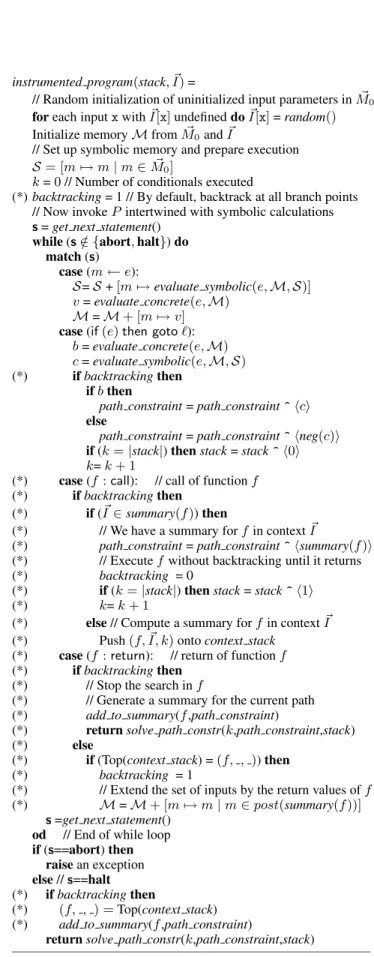
The instrumented program itself is described in Figure 2 where the lines marked by (*) should again be ignored for now (^denotes
1To simplify the presentation, we assume thatM
0 is the same for all executions ofP.
2We thus assume that all program executions terminate; in practice, this can
be enforced by limiting the number of execution steps.
list concatenation). It executes as the original program, but with interleaved gathering of symbolic constraints. At each conditional statement, it also possible to check whether the current execution path matches the one predicted at the end of the previous execution and represented instack passed between runs. How to do this is described in the functioncompare and update stackof [GKS05].
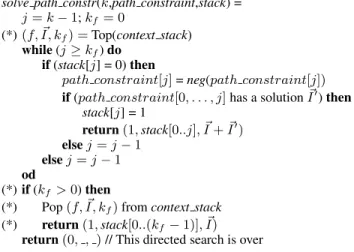
When the original program halts, new input values are generated insolve path constraint, shown in Figure 3 while ignoring again all the lines marked with (*), to attempt to force the next run to execute the last3unexplored branch of a conditional along the stack. If such a branch exists and if the path constraint that may lead to its execution has a solutionI, this solution is used to update the mappingIto be used for the next run; values corresponding to input parameters not involved in the path constraint are preserved (this update is denotedI+I).
The main property of DART is stated in the following theorem, which formulates (a) soundness (of error founds) and (b) a form of completeness.
THEOREM1. [GKS05] Consider a programP as previously de-fined. (a) If run DART prints out “Bug found” forP, then there is some input toPthat leads to an abort. (b) If run DART terminates without printing “Bug found,” then there is no input that leads to an abort statement inP, and all paths inExecs(P)have been ex-ercised. (c) Otherwise, run DART will run forever.
Proofs of (a) and (c) are immediate. The proof of (b) rests on the assumption that any potential incompleteness in DART’s search is (conservatively) detected by setting the flagcompleteto0.
3.
The SMART Search Algorithm
We now present an alternative search algorithm that does not com-promise search completeness but is typically much more efficient than the DART search algorithm. The general idea behind this new search algorithm is to perform dynamic test generation composi-tionally, by adapting (dualizing) known techniques for interproce-dural static analysis to the context of automated dynamic test gener-ation. Specifically, we introduce a new algorithm, dubbedSMART forSystematic Modular Automated Random Testing, that tests func-tions in isolation, collects testing results as function summaries ex-pressed using preconditions on function inputs and postconditions on function outputs, and then re-use those summaries when testing higher-level functions.
We assume we are given a programP that consists of a set of functions. If a functionf is part ofP, we write f ∈ P. In what follows, we use the generic term offunctionto denote any part of a programP that we want to analyze in isolation and then summarize its observed behaviors. Obviously, any other kinds of program fragments such as program blocks or object methods can be treated as “functions” as done in this paper.
To simplify the presentation, we assume that the functions in P do not perform recursive calls, i.e., that the call-flow graph of P is acyclic. (This restriction can be lifted using dynamic pro-gramming techniques to compute function summaries, as is stan-dard in interprocedural static analysis and pushdown system verifi-cation [RHS95, ABE+05].) As previously stated, we also assume that all the executions ofP terminate. Note that both of these as-sumptions do not preventPfrom possibly having infinitely many executions paths, as is the case ifPcontains a loop whose number of iterations may depend on some unbounded input.
3A depth-first search is used for exposition, but the next branch to be forced
could be selected using a different strategy, e.g., randomly or in a breadth-first manner.
3.1 Definition of Summaries
For a given theoryT of constraints, a function summary φf for a functionfis defined as a formula of propositional logic whose propositions are constraints expressed inT.φf can be computed by successive iterations and defined as a disjunction of formulas φwof the formφw=prew∧postw, whereprewis a conjunction
of constraints on the inputs off whilepostw is a conjunction of constraints on the outputs of f. φw can be computed from the path constraint corresponding to the execution pathwas will be described shortly. An input to a functionfis any address (memory location) that can be read byfin some of its execution, while an output offis any address that can be written byfin some of its executions and later read byPafterfreturns.
Preconditions in function summaries are expressed in terms of constraints on function inputs instead of program inputs in order to avoid duplication of identical summaries in equivalent but different calling contexts. For instance, in the following program
int is positive(int x) { if (x > 0) return 1; return 0;
}
void top(int y, int z) { int a,b; a = is positive(y); b = is positive(z); if (a && b) then [...] [...] }
the summary for the functionis positivecould be(x > 0∧ ret = 1)∨(x ≤0∧ret= 0)(ifT includes linear arithmetic) whereretdenotes the value returned by the function. This sum-mary is expressed in terms of the function inputx, independently of specific calling contexts which may mapxto different program inputs likeyandzin this example.4
Whenever a constraint on some input cannot be expressed within T, no constraint is generated. For instance, consider the following functiong: 1 int g(int x) { 2 int y; 3 if (x < 0) return 0; 4 y = hash(x); 5 if (y == 100) return 10; 6 if (x > 10) return 1; 7 return 2; 8 }
Assuming the constraint (hash(x)==100) cannot be expressed inT, the summaryφw of the execution pathwcorresponding to taking all the else branches at the three conditional statements in functiongis then(x≥0∧x≤10∧ret= 2).
A precondition defines an equivalence class of concrete execu-tions. All the concrete executions corresponding to concrete inputs satisfying the same precondition are guaranteed to execute the same program pathonly provided that all the constraints along that path are inT. In the example above, if the path wthat takes all the else branches in functiongwas explored with a random concrete value, say,x= 5, another value satisfying the same precondition
(x≥0∧x≤10), sayx= 6isnotguaranteed to yield the same
4Remember that symbolic variables are associated with program or
func-tion inputs, i.e., memory locafunc-tions where inputs are being read from. When syntactic program variables uniquely define where those inputs are stored, like variablesx,yandzin the above example, we merely write “an input
x” in the text to simplify the presentation.
program path, because of the presence of the unpredictable con-ditional statement in line 5 (ashash(6)could very well be 100). The execution of this conditional statement makes a DART search incomplete (the flagcompleteis then set to0). In that case, all the preconditions in a function summary may no longer be mutually exclusive: a given concrete state may satisfy more than one pre-condition in a function summary when the function contains con-ditional statements whose corresponding constraints are outsideT.
3.2 Computing Summaries
Function summaries can be computed by successive iterations, one path at a time. When the execution of the function terminates, the DART-computed path constraint for the current pathwin the function can be used to generate a precondition prew for that path:prewis obtained by simplifying the conjunction of branch conditions on function inputs in the path constraint forw.
If the execution of the function terminates on a return state-ment, a postconditionpostwcan be computed by taking the con-junction of constraints associated with memory locations m ∈ W rite(f, I, w)written during the execution off during the last executionwgenerated from a context (set of input values)I. Pre-cisely, we have
postw=
^
m∈W rite(f,I,w)
(m=evaluate symbolic(m,M,S)) Otherwise, if the function terminates on ahaltor abort state-ment, we definepostw=falseto record this in the summary for possible later use in the calling context, as described later.
A summary for the execution pathwinfis thenφw=prew∧
postw. The process is repeated for other DART-exercised pathsw inf, and the overall summary forfis defined asφf =Wwφw.
By default, the above procedure can always be used to compute function summaries path by path. But more advanced techniques, such as automatically-inferred loop invariants, could also be used (see Section 4). Note thatprew can always be approximated by false(the strongest precondition) whilepostwcan always be ap-proximated bytrue(the weakest postcondition) without compro-mising the correctness of summaries, and that any technique for generating provably correct weaker preconditions or stronger post-conditions can be used to improve precision.
Given the call-flow graphGP of a programP(which we have previously assumed to be acyclic) and a topological sort of the functions inGP computed starting from the top-level function of the program, function summaries can then be computed in either a bottom-uportop-downstrategy.
With a bottom-up strategy, one starts testing functions at the deepest level inGP, one computes summaries for those, and then moves up the topological sort to functions one-level up while re-using the summaries for the functions below (as described in the next subsection), and so on up to the top-level function of the program. While the bottom-up strategy is conceptually the easiest to understand, it suffers from two major limitations that make its implementation problematic in the context of compositional dynamic test generation.
First, testing lower-level functions in isolation for all possible contexts (i.e., for all possible input values) is likely to trigger un-realistic behaviors that may not happen in the specific contexts in which the function can actually be called by higher-level pro-gram functions; this analysis can be prohibitively expensive and will likely generate an unnecessarily large number of spurious sum-maries that will never be used subsequently. Thus,too many sum-maries are computed.
Second, because of the inherent limitation of symbolic execu-tion to reason about constraints outside the given theoryT, sum-maries computed in bottom-up fashion may be incomplete in
pres-run() = complete= 1
(*)summary= [f→ ∅ |f∈P]// Set of summaries
repeat
stack=;I= [] ;directed= 1
(*) context stack=(, ,0)// Stack of contexts
while(directed)do try(directed,stack,I) =
SMART instrumented program(stack,I)
catchany exception→ print“Bug found”;exit()
untilcomplete
Figure 1. run DART and (*) run SMART test drivers ence of statements involving constraints outsideT. For instance, in the case of functiongpresented in Section 3.1, analyzinggin isolation using DART techniques will probablynotbe able to exer-cise the then branch of the conditional statement on line 5, i.e., to randomly find a value ofxsuch thathash(x) == 100. However, in its actual calling contexts within the programP, it is possible that the functiongis often called with values forxthat satisfy this constraint. In this case,too fewsummaries are pre-computed, and it is necessary to compute later in the search a summary for the case wherehash(x) == 100is satisfied.
To avoid these two limitations, we recommend and adopt a top-down strategy for computing summaries on a demand-driven basis. A complete algorithm for doing this is described next.
3.3 Algorithm
A top-down SMART search algorithm is presented in Figures 1, 2 and 3. The pseudo-code for SMART is similar to the one for DART with the exception of the new additional lines marked by (*). Indeed, SMART strictly generalizes DART and reduces to it in the case of programs consisting of a single function.
A SMART search performs dynamic test generation composi-tionally, using function summaries as defined previously. Those summaries are dynamically computed in a top-down manner through the call-flow graphGP ofP. Starting from the top-level function, one executes the program (initially on some random in-puts) until one reaches a first functionf whose execution termi-nates on a return orhaltstatement. One then backtracks insidef as much as possible using DART, computing summaries for that function and each of those DART-triggered executions. When this search (backtracking) inf is over, one then resumes the original execution wheref was called, this time treatingf essentially as a black-box, i.e., without analyzing it and re-using its previously computed summary instead. The search proceeds similarly, with the next backtracking point being in some lower-level function, if any, called afterfreturns, or in the functiongthat calledf other-wise, or some other higher-level function that calledgif the search ingis itself over. This search order is thus different from DART’s search order.
A SMART search starts by executing the procedurerun SMART described in Figure 1. The only differences with the procedure run DARTis the initialization of a set of summaries and of a con-text stack that records the sequence of calling concon-texts for which summaries still need to be computed along the current execution, and is also used to resume execution in a previous context.
The main functionality of SMART is presented in Figure 2. The key difference with DART is that function calls and returns are now instrumented to trigger and organize the computation of function summaries. Whenever a functionf is called, a SMART instrumented programchecks whether a summary forfis already available for the current calling context. This is done by checking
instrumented program(stack, I)=
// Random initialization of uninitialized input parameters inM0
foreach inputxwithI[x]undefineddoI[x]=random() Initialize memoryMfromM0andI
// Set up symbolic memory and prepare execution S= [m→m|m∈M0]
k=0// Number of conditionals executed
(*)backtracking= 1 // By default, backtrack at all branch points // Now invokePintertwined with symbolic calculations
s=get next statement()
while(s∈ {/ abort,halt})do match(s)
case(m←e):
S=S+[m→evaluate symbolic(e,M,S)] v=evaluate concrete(e,M)
M=M+ [m→v]
case(if(e)then goto): b=evaluate concrete(e,M) c=evaluate symbolic(e,M,S) (*) ifbacktrackingthen
ifbthen
path constraint=path constraint^c
else
path constraint=path constraint^neg(c)
if(k=|stack|)thenstack=stack^0
k=k+ 1
(*) case(f:call): // call of functionf (*) ifbacktrackingthen
(*) if(I∈summary(f))then
(*) // We have a summary forfin contextI
(*) path constraint=path constraint^summary(f) (*) // Executefwithout backtracking until it returns
(*) backtracking = 0
(*) if(k=|stack|)thenstack=stack^1
(*) k=k+ 1
(*) else// Compute a summary forfin contextI (*) Push(f, I, k)ontocontext stack
(*) case(f:return): // return of functionf (*) ifbacktrackingthen
(*) // Stop the search inf
(*) // Generate a summary for the current path (*) add to summary(f,path constraint)
(*) returnsolve path constr(k,path constraint,stack) (*) else
(*) if(Top(context stack) =(f, , ))then
(*) backtracking = 1
(*) // Extend the set of inputs by the return values off (*) M=M+ [m→m|m∈post(summary(f))]
s=get next statement()
od // End of while loop
if(s==abort)then raisean exception
else//s==halt
(*) ifbacktrackingthen
(*) (f, , ) =Top(context stack) (*) add to summary(f,path constraint)
returnsolve path constr(k,path constraint,stack)
solve path constr(k,path constraint,stack) = j=k−1;kf = 0
(*)(f, I, kf) =Top(context stack)
while(j≥kf)do if(stack[j] = 0)then
path constraint[j]=neg(path constraint[j])
if(path constraint[0, . . . , j]has a solutionI)then
stack[j] = 1 return(1,stack[0..j], I+I) elsej=j−1 elsej=j−1 od (*)if(kf >0)then
(*) Pop(f, I, kf)fromcontext stack (*) return(1,stack[0..(kf −1)], I)
return(0, , )// This directed search is over
Figure 3. DART and (*) SMART solve path constr whether the current concrete function input assignment satisfies one of the preconditions currently recorded in the summary forf.5 If so, this summary is added to the current path constraint, and the execution proceeds by turning backtracking off inf and any function below it in the call-flow graph ofP. The latter is done through the use of a boolean flagbacktracking. Backtracking is resumed later in the current execution path whenf returns: this is done in the else branch of the conditional statement included in thereturncase, where the set of inputs (in the function calling f) is also extended with the set of return values appearing in the setpost(summary(f))of postconditions included in the summary summary(f)currently available forf.
If no summary is available for the current calling context, this calling context is saved by pushing it onto the context stack, and the algorithm will compute a summary for it by continuing the search deeper in the called functionf. When backtracking is on and the inner-most function terminates either on a return statement or ahaltstatement,add to summary(f,path constraint) computes a summary forf and the last path executed as discussed in Sec-tion 3.2. Note that a funcSec-tion summary forfincludes in itself sum-maries of lower-level functions possibly called byfitself.
After computing a summary for the current function and exe-cution path,solve path constr, presented in Figure 3, is called to determine where the algorithm should backtrack next. When back-tracking in a specific functionfand calling contextIis over, the search resumes in the last calling context saved in the context stack.
3.4 Correctness
The correctness of the SMART search algorithm is defined with respect to the DART search algorithm, thus independently of a spe-cific theoryT representing the reasoning capability of symbolic execution. Specifically, we can prove that, for any programP con-taining exclusively statements whose corresponding constraints are in a given decidable theoryT (i.e., for which the flagcomplete al-ways remains 1), the SMART search algorithm provides exactly the same program path coverage as the DART search algorithm. Thus, for those programsP,every feasible path that is exercised by DART is also “explored”, albeit compositionally, by SMART; and conversely, every compositional execution considered by SMART is guaranteed to correspond to a concrete full execution path. For-mally, we have the following.
5Checking later that the output values off for that run satisfy the
corre-sponding postcondition in the summary is not mandatory for correctness but can increase precision and hence coverage.
THEOREM2. (Relative Soundness and Completeness) Given any programPand theoryT, run SMART terminates without printing “Bug found”if and only ifrun DART terminates without printing “Bug found”.
In practice, programs P typically contain statements corre-sponding to constraints outsideT (whateverT is). The SMART and DART searches may then behave differently because their search order vary, and calls to the function random() to initial-ize undefined inputs may return different values, hence exercis-ing the code randomly differently. Nevertheless, a corollary of the previous theorem is that the SMART search algorithm is func-tionally equivalentto DART, in the sense that it still satisfies the conditions identified in Theorem 1 characterizing the correctness of the DART search algorithm (and of its various implementa-tions [GKS05, CE05, SMA05, YST+06]). Formally, we can prove the following.
THEOREM3. Consider a programP as previously defined. (a) If run SMART prints out “Bug found” forP, then there is some input toP that leads to an abort. (b) If run SMART terminates without printing “Bug found,” then there is no input that leads to an abort statement inP. (c) Otherwise, run SMART will run forever.
In summary, SMART is functionally equivalent to DART and, typically, whatever test inputs DART can generate, SMART can too, although possibly much more efficiently. How much more efficient (hence scalable) can SMART be compared to DART? This question is addressed next.
3.5 Complexity
Letbbe a bound on the maximum number of distinct execution paths that can be contained in any functionfof the programP. If a functionfdoes not contain any loop, such a bound is guaranteed to exist, although it can be exponential in the number of statements in the code describingf. Iffcontains loops whose number of itera-tions may depend on an unbounded input, the number of execution paths infcould be infinite, and such a boundbmay not exist. In practice, a boundbcan always be enforced by simply limiting the number of execution paths explored in a function, i.e., by limiting the size of summaries; this heuristics has been shown to work well in the context of interprocedural static analysis (e.g., see [BPS00]). Given such a boundb, it is easy to see that the number of execu-tion paths considered by a SMART search (while the flagdirected is kept to 1) will be at mostnb, wherenis the number of functions finP, and is thereforelinearinnb. In contrast, the number of exe-cution paths considered by a DART search (while the flagdirected is kept to 1) can beexponentialinnb, as DART does not exploit program hierarchy and treats a program as a single, “flat” function. This reduction in the number of explored paths from exponential to polynomial inbis also observed with compositional verification algorithms for hierarchical finite-state machines [AY98].
Although SMART can avoid systematically executing all the possibly exponentially many feasible program paths inP, it does require the use of formulasφf representing function summaries which can be of size linear inb, and the use of theorem proving techniques to check satisfiability of those formulas, with decision procedures which can, in the worst case, be exponential in the size of those formulas, i.e., exponential inb. However, while DART can be viewed as always trying to systematically execute all pos-sible execution paths, i.e.,allpossible disjuncts inφf =Wwφw, SMART will try to check the satisfiability ofφf in conjunction with additional constraints generated from a calling context off, and hence try to find justoneway to satisfy the resulting formula using a logic constraint solver. This key point is illustrated next.
4.
Example, Case Study, Discussion
A Simple Example
Consider the functionlocatewhose code is as follows:
1 // locate index of first character c 2 // in null-terminated string s 3 int locate(char *s, int c) { 4 int i=0; 5 while (s[i] != c) { 6 if (s[i] == 0) return -1; 7 i++; 8 } 9 return i; 10 }
Given a stringsof maximum sizen(i.e,s[n]is always zero), there are at most2ndistinct execution paths for that function ifcis non-zero (and at mostnifcis zero). Those2npaths can be denoted by the regular expression: (line5:then; line6:else)i (line5:else | (line5:then; line6:then))for0 ≤ i≤ (n−1). There aren+ 1 possible return values: -1 (for thenpaths(line5:then; line6:else)i (line5:then; line6:then)for0≤i≤(n−1)), and0,1, . . . ,(n−
1), each returned by the path(line5:then; line6:else)iline5:else whereiis equal to the return value.
Now, consider the functiontopwhich calls the functionlocate:
11 void top(char *input) {
// assume input is null-terminated 12 int z;
13 z = locate(input,’a’);
14 if (z == -1) return -1; // error code 15 if (input[z+1] != ’:’) return 1; // success
16 return 0; // failure
17 }
In the functiontop, there are 3 possible execution paths:line14:then, line14:else; line15:thenandline14:else; line15:else.
Following the call tolocate, the outcome of the test at line 14 is completely determined by the return value from functionlocate
stored in z. In contrast, the test at line 15 constraints the next elementinput[z+1]in the stringinputand its outcome depends on the value stored at that address. That input value could either be equal to’:’or not, except forinput[n]which we assumed to be zero. Therefore, for the whole programP composed of the two functionstopandlocate, there are3n−1possible execution paths:nexecutions terminate after the then branch of line 14,n executions terminate after the then branch of line 15, andn−1 executions terminate in line 16. Thus, the number of feasible paths inPis (roughly) theproductof the number of paths in its functions
locateandtop.
A DART search attempts to systematically execute all possi-ble execution paths and would thus perform3n−1runs for this program. In contrast, a SMART search will systematically execute all possible execution paths of the functionlocateandtop sepa-rately. Precisely, a SMART search computing function summaries as described in Section 3.2 would compute2npath summaries for functionlocate, whose function summaryφf would then be of the form
φf = (s[0] =c∧ret= 0)
∨(s[0]=c∧s[0] = 0∧ret=−1)
∨(s[0]=c∧s[0]= 0∧s[1] =c∧ret= 1)
etc.
Then, the SMART search would explore the feasibility of the 3 paths of the functiontopusingφfto summarize functionlocate.
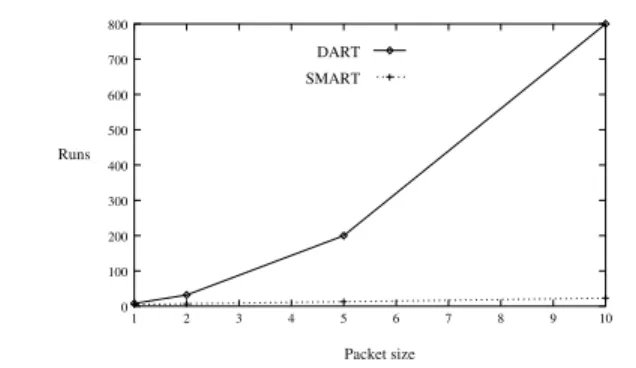
Packet size Runs 8 7 5 4 6 10 400 SMART DART 9 1 300 200 100 0 500 3 2 800 700 600
Figure 4. Experimental comparison between DART and SMART For this example, SMART would then perform2n+ 3runs, i.e., thesumof the number of paths in its functionslocateandtop.
Observe how the addressz+1is defined relative tozand that its absolute value “does not matter” (as long asz+ 1=n) when proving the satisfiability of the constraint generated from the test
input[z+1] != ’:’and of its negation. This is captured by the SMART algorithm, which will not attempt to tryallpossible ways to satisfy/violate these constraints (as DART would), but will only findoneway to satisfy those. This observation explains intuitively the significant speed-up that SMART can provide compared to DART, while guaranteeing the same path (and hence branch) cov-erage (100% branch covcov-erage is achieved in this example).
Case Study
We have developed an implementation of the SMART search algo-rithm for the C programming language, extending the DART im-plementation described in [GKS05]. We report here preliminary experiments comparing the efficiency of DART and SMART on the oSIP example discussed in [GKS05]. oSIP is an open-source C library implementing the SIP protocol and consisting of about 30,000 lines of C code. SIP messages are transmitted as ASCII strings and a large part of the oSIP code is dedicated to parsing SIP messages.
Figure 4 presents the number of runs needed by DART and SMART to fully explore all the feasible program paths in a subset of the oSIP parser code. Experiments were performed for several, small packet sizes. Runtime is linear in the number of runs for those experiments. As is clear from Figure 4, SMART can fully cover all the feasible program paths of this example much more efficiently than DART. In fact, for this example, the SMART search isoptimal in the sense that its number of runs (and runtime) grows in a linear way with the size of the input packet.
Discussion
Another way to limit the “path explosion” problem in a DART search is simply to allow backtracking only at branches of condi-tional statements that have never been executed so far. IfBdenotes the number of conditional statements in a programP, the number of execution paths (runs) explored by such a “ branch-coverage-driven” DART search is trivially bounded by2B, i.e., is linear in the program size. The drawback of this naive solution is obviously thatfull feasible path coverageis no longer guaranteed, even for programs containing only statements with constraints inT. This, in turn, typically reduces overall branch coverage itself, and thus chances of finding bugs. In contrast, SMART reduces the compu-tational complexity of DARTwithout sacrificingfull path coverage and hence provably without reducing branch coverage.
In the presence of loops, loop invariants could be used to gen-erate more general and compact function summaries than those generated by the path-by-path procedure for computing summaries presented in Section 3.2. For instance, considering again the func-tionlocate, a more compact and general function summary is
φf = ((∃i ≥ 0 : s[i] = c∧(∀j < i : (s[j] = c)∧(s[j] = 0)))∧ret = i)∨ ((∃i ≥ 0 : s[i] = 0∧(∀j < i : s[j] =
c))∧ret=−1), which is independent of any maximum sizenfor the strings. Concrete values known at runtime could be used to detect “partial” loop invariants, i.e., simplified loop invariants that are valid only when some input variables are fixed.
5.
Conclusion
DART [GKS05], and closely related work (e.g., [SMA05, CE05, YST+06]), is a promising new approach to automatically generate tests from program analysis. Actually, DART can be viewed [GK05] as one way of combining static (interface extraction, symbolic ex-ecution) and dynamic (testing, run-time checking) program analy-sis with model-checking techniques (systematic state-space explo-ration) in order to address one of the main limitations of previous dynamic, concrete-execution-based software model checkers (such as VeriSoft, JavaPathFinder and CMC, among others), namely their inability to automatically deal with input data nondeterminism.
But DART suffers from two major limitations. First, its effec-tiveness critically depends on the symbolic reasoning capabilityT available. Whenever symbolic execution is not possible, concrete values can be used to simplify constraints and carry on with a sim-plified, partial symbolic execution. Randomization can also help by suggesting concrete values whenever automated reasoning is im-possible or difficult. Still, it is currently unknown whether dynamic test generation is really that superior to static test generation, that is, how effective using concrete values and randomization help sym-bolic execution for testing purposes in practice. More experiments with various kinds of examples are needed to determine this.
Second, DART suffers from the “path explosion” problem: sys-tematically executingallfeasible program paths is typically pro-hibitively expensive for large programs. This paper addresses this second limitation in a drastic way, by performing dynamic test gen-eration compositionally and eliminating path explosion due to in-terprocedural program paths (i.e., paths across function boundaries) without sacrificing overall path or branch coverage. A SMART search can be viewed as exploring the set of feasible whole pro-gram pathssymbolically, i.e., by exploring simultaneouslysetsof such paths, instead of executing those one by one.
Our approach adapts known techniques for interprocedural static analysis to the context of dynamic test generation. While implementations of interprocedural static analysis are typically both incomplete (may miss bugs) and unsound (may generate false alarms) with respect to falsification [GK05], our compositional dy-namic test generation is performed in such a way to preserve the soundness of bugs [God05]: any error path found is guaranteed to be sound, as everycompositional symbolic executionis grounded, by design, into some concrete execution. The only imprecision in our approach is incompleteness with respect to falsification: we may miss bugs by failing to exercize some executable program paths and branches.
The idea of compositional dynamic test generation was al-ready suggested in [GK05]; the motivation of the present paper is to investigate this idea in detail. Other recent related work in-cludes [CG06], which proposes and evaluates several heuristics based on light-weight static analysis of function interfaces to par-tition large software applications into groups of functions, called units. Those units can then be tested in isolation without generating too many false alarms caused by unrealistic inputs being injected at interfaces between units. In contrast with the present work, no summarization of unit testing, nor any global analysis is ever per-formed in [CG06]. Both types of techniques can actually be viewed as complementary. We refer the reader to [GKS05] for a detailed discussion of other automated test generation techniques and tools, and to [GK05] for a discussion of other possible DART extensions.
References
[ABE+05] R. Alur, M. Benedikt, K. Etessami, P. Godefroid, T. Reps, and M. Yannakakis. Analysis of Recursive State Machines.
TOPLAS, 27(4):786–818, July 2005.
[AY98] R. Alur and M. Yannakakis. Model Checking of Hierarchical State Machines. InFSE’98.
[BCH+04] D. Beyer, A. J. Chlipala, T. A. Henzinger, R. Jhala, and R. Majumdar. Generating Tests from Counterexamples. In
ICSE’2004.
[BKM02] C. Boyapati, S. Khurshid, and D. Marinov. Korat: Automated testing based on Java predicates. InISSTA’2002.
[BPS00] W.R. Bush, J.D. Pincus, and D.J. Sielaff. A static analyzer for finding dynamic programming errors. Software Practice and Experience, 30(7):775–802, 2000.
[CDW04] H. Chen, D. Dean, and D. Wagner. Model Checking One Million Lines of C Code. InNDSS’04.
[CE05] C. Cadar and D. Engler. Execution Generated Test Cases: How to Make Systems Code Crash Itself. InSPIN’2005. [CG06] A. Chakrabarti and P. Godefroid. Software Partitioning for
Effective Automated Unit Testing. InEMSOFT’2006. [CS05] C. Csallner and Y. Smaragdakis. Check’n Crash: Combining
Static Checking and Testing. InICSE’2005.
[DLS02] M. Das, S. Lerner, and M. Seigle. ESP: Path-Sensitive Program Verification in Polynomial Time. InPLDI’2002. [Edv99] J. Edvardsson. A Survey on Automatic Test Data Generation.
InProceedings of the 2nd Conference on Computer Science and Engineering, pages 21–28, Linkoping, October 1999. [GK05] P. Godefroid and N. Klarlund. Software Model Checking:
Searching for Computations in the Abstract or the Concrete (Invited Paper). InIFM’2005.
[GKS05] P. Godefroid, N. Klarlund, and K. Sen. DART: Directed Automated Random Testing. InPLDI’2005.
[GMS00] N. Gupta, A. P. Mathur, and M. L. Soffa. Generating Test Data for Branch Coverage. InASE’2000.
[God97] P. Godefroid. Model Checking for Programming Languages using VeriSoft. InPOPL’97.
[God05] P. Godefroid. The Soundness of Bugs is What Matters (Position Paper). InBUGS’2005.
[HCXE02] S. Hallem, B. Chelf, Y. Xie, and D. Engler. A System and Language for Building System-Specific Static Analyses. In
PLDI’2002.
[Kin76] J. C. King. Symbolic Execution and Program Testing.Journal of the ACM, 19(7):385–394, 1976.
[Kor90] B. Korel. A Dynamic Approach of Test Data Generation. In
IEEE Conference on Software Maintenance, 1990. [Mye79] G. J. Myers.The Art of Software Testing. Wiley, 1979. [RHS95] T. Reps, S. Horwitz, and M. Sagiv. Precise interprocedural
dataflow analysis via graph reachability. InPOPL’95. [SMA05] K. Sen, D. Marinov, and G. Agha. CUTE: A Concolic Unit
Testing Engine for C. InFSE’2005.
[VPK04] W. Visser, C. Pasareanu, and S. Khurshid. Test Input Generation with Java PathFinder. InISSTA’2004.
[XMSN05] T. Xie, D. Marinov, W. Schulte, and D. Notkin. Symstra: A Framework for Generating Object-Oriented Unit Tests Using Symbolic Execution. InTACAS’2005.
[YST+06] J. Yang, C. Sar, P. Twohey, C. Cadar, and D. Engler. Automat-ically Generating Malicious Disks using Symbolic Execution. InProceedings of IEEE Security and Privacy’2006, Oakland, 2006.