Faculty of Computer Science Institute of Systems Architecture, Chair of Computer Networks
ENHANCING MOBILITY IN LOW POWER
WIRELESS SENSOR NETWORKS
Jianjun Wen, M.Sc.
Born on: 23rd July 1982 in Taiyuan, China
DISSERTATION
to achieve the academic degree
DOKTOR-INGENIEUR (DR.-ING.)
First referee
Prof. Dr. rer. nat. habil. Dr. h. c. Alexander Schill, TU Dresden
Second referee
Prof. Dr. Dieter Hogrefe, University of Göttingen
Advisor
Prof. Dr.-Ing. Eduard A. Jorswieck, TU Dresden
Submitted on: 13th July 2018 Defended on: 9th October 2018
SUPERVISOR
PD Dr.-Ing. habil. Waltenegus Dargie Chair of Computer Networks
Faculty of Computer Science Technical University of Dresden Dresden, Germany
DOCTORAL COMMITTEE
Prof. Alexander Schill (first reviewer) Chair of Computer Networks
Faculty of Computer Science Technical University of Dresden Dresden, Germany
Prof. Dieter Hogrefe (second reviewer) Telematics Group
Institute of Computer Science University of Göttingen
Göttingen, Germany
Prof. Sebastian Rudolph (chair)
International Center for Computational Logic Faculty of Computer Science
Technical University of Dresden Dresden, Germany
Prof. Eduard A. Jorswieck (subject expert) Chair of Communications Theory
Faculty of Electrical and Computer Engineering Technical University of Dresden
Dresden, Germany
Prof. Diana Göhringer (committee member) Chair of Adaptive dynamic Systems
Faculty of Computer Science Technical University of Dresden Dresden, Germany
ABSTRACT
In the early stages of wireless sensor networks (WSNs), low data rate traffic patterns are assumed as applications have a single purpose with simple sensing task and data packets are generated at a rate of minutes or hours. As such, most of the proposed communication protocols focus on energy efficiency rather than high throughput. Emerging high data rate ap-plications motivate bulk data transfer protocols to achieve high throughput. The basic idea is to enable nodes to transmit a sequence of packets in burst once they obtain a medium. How-ever, due to the low-power, low-cost nature, the transceiver used in wireless sensor networks is prone to packet loss. Especially when the transmitters are mobile, packet loss becomes worse. To reduce the energy expenditure caused by packet loss and retransmission, a burst transmission scheme is required that can adapt to the link dynamics and estimate the number of packets to transmit in burst. As the mobile node is moving within the network, it cannot always maintain a stable link with one specific stationary node. When link deterioration is constantly detected, the mobile node has to initiate a handover process to seamlessly trans-fer the communication to a new relay node before the current link breaks. For this reason, it is vital for a mobile node to (1) determine whether a fluctuation in link quality eventually results in a disconnection, (2) foresee potential disconnection well ahead of time and establish an alternative link before the disconnection occurs, and (3) seamlessly transfer communication to the new link.
In this dissertation, we focus on dealing with burst transmission and handover issues in low power mobile wireless sensor networks. To this end, we begin with designing a novel mobility enabled testing framework as the evaluation testbed for all our remaining studies. We then perform an empirical study to investigate the link characteristics in mobile environments. Using these observations as guidelines, we propose three algorithms related to mobility that will improve network performance in terms of latency and throughput:
i) Mobility Enabled Testing Framework (MobiLab). Considering the high fluctuation of link quality during mobility, protocols supporting mobile wireless sensor nodes should be rig-orously tested to ensure that they produce predictable outcomes before actual deployment. Furthermore, considering the typical size of wireless sensor networks and the number of
parameters that can be configured or tuned, conducting repeated and reproducible experi-ments can be both time consuming and costly. The conventional method for evaluating the performance of different protocols and algorithms under different network configurations is to change the source code and reprogram the testbed, which requires considerable effort. To this end, we present a mobility enabled testbed for carrying out repeated and reproducible experiments, independent of the application or protocol types which should be tested. The testbed consists of, among others, a server side control station and a client side traffic flow controller which coordinates inter- and intra-experiment activities.
ii) Adaptive Burst Transmission Scheme for Dynamic Environment.Emerging high data rate applications motivate bulk data transfer protocol to achieve high throughput. The basic idea is to enable nodes to transmit a sequence of packets in burst once they obtain a medium. Due to the low-power and low-cost nature, the transceiver used in wireless sensor networks is prone to packet loss. When the transmitter is mobile, packet loss becomes even worse. The existing bulk data transfer protocols are not energy efficient since they keep their radios on even while a large number of consecutive packet losses occur. To address this challenge, we propose an adaptive burst transmission scheme (ABTS). In the design of the ABTS, we estimate the expected duration in which the quality of a specific link remains stable using the conditional distribution function of the signal-to-noise ratio (SNR) of received acknowledgment packets. We exploit the expected duration to determine the number of packets to transmit in burst and the duration of the sleeping period.
iii) Kalman Filter Based Handover Triggering Algorithm (KMF). Maintaining a stable link in mobile wireless sensor network is challenging. In the design of the KMF, we utilized combined link quality metrics in physical and link layers, such as Received Signal Strength Indicator (RSSI) and packet success rate (PSR), to estimate link quality fluctuation online. Then Kalman filter is adopted to predict link dynamics ahead of time. If a predicted link quality fulfills handover trigger criterion, a handover process will be initiated to discover alternative relay nodes and establish a new link before the disconnection occurs.
iv) Mobile Sender Initiated MAC Protocol (MSI-MAC).In cellular networks, mobile sta-tions are always associated with the nearest base station through intra- and inter-cellular handover. The underlying process is that the quality of an established link is continually eval-uated and handover decisions are made by resource rich base stations. In wireless sensor networks, should a seamless handover be carried out, the task has to be accomplished by energy-constraint, resource-limited, and low-power wireless sensor nodes in a distributed manner. To this end, we present MSI-MAC, a mobile sender initiated MAC protocol to enable seamless handover.
ACKNOWLEDGMENTS
First and foremost, I would like to thank my supervisor PD Dr.-Ing. habil. Waltenegus Dargie for his patient and instructive guidance through my entire Ph.D research life. I have worked with him since the early stage of my master study as a student assistant in his energy lab. He taught me a lot, not only how to do the research, but also his attitude of life. He is a person pursuing perfection, especially for research, which has a profound impact on me. He was always patient to listen to my immature ideas and arguments. I thank to him for all his effort of helping me to improve my scientific English, to construct my research ideas and to teach me how to be a thorough researcher.
I would also like to express my profound gratitude to Prof. Dr. rer. nat. habil. Dr. h. c. Alexander Schill for providing me the opportunity to do research in his group and always giving me valuable feedback. Many thanks for his patience and kindness which gave me great power to conquer each challenge till this successful end. Furthermore, I would like greatly appreciate my advisor Prof. Dr.-Ing. Eduard A. Jorswieck and external reviewer Prof. Dr. Dieter Hogrefe for their kindness to review this dissertation and provide valuable feedback.
I want to express my next gratitude to my office mate and friends: Zeeshan who was always tolerant of my countless complaints about challenging research problems and always stood by and encouraged me. I do remember we often discussed with each other and wrote papers till late night together. Many thanks go to my best friend Taiba, who is considerate and sweet, for feeding me many gourmet food and encouraging me patiently when I felt depressed.
Additionally, many thanks go to my brilliant colleagues and students who were always sup-portive. I want to especially appreciate Chen Liang, Weiyi He for their hard work to conduct a large number of experiments with me. Sebastian Itting, who partially implemented and tested the robot control scripts for the testbed. Dr. Tenshi Hara, who was always enthusiastic to help me solve documentary problems and shared his research experience with me.
Another special acknowledgments go to my proof-readers. They are Dr. Taiba Zahid, Dr. Qian Dong, Dr. Lisa Lines and my supervisor. Without their careful and patient help, this dissertation would be more difficult to articulate.
I also want to express my gratitude to many of my friends in Germany and in China. Yi Zhang, Yunyi Fu, Ran Zhang, Hui Chen, Chao Li, Nikolaos Draganoudis. Especially, I would like to express my profound gratitude to Prof. Xianping Chen who is my best friend, brother and mentor, for encouraging and supporting me to study abroad.
Last but not the least, I want to express my most profound gratitude to my parents for their selfless love and support, for believing in me for no reason. To my father, thank you for teaching me to be a strong and honest man since I was in childhood. To my late mother, thank you for your hardwork and countless sacrifices for our family. You have always encouraged me to pursue my dreams even in the last days of struggling with the cancer.
Jianjun Wen Dresden, October 2018
This work has been partially funded by the German Research Foundation (DFG) under project agreements: DA 1211/5-1 and SFB-921
CONTENTS
List of Figures XIII
List of Tables XV
List of Abbreviations XVII
1 Introduction 1
1.1 Challenges in Mobile Wireless Sensor Network Communication . . . 2
1.2 Objectives of the Dissertation . . . 4
1.3 Contributions of the Dissertation . . . 5
1.4 Structure of the Dissertation . . . 9
2 Background and Literature Review 11 2.1 Bulk Data Transfer in Wireless Sensor Networks . . . 11
2.1.1 Bulk Data Transfer Protocol without Duty Cycling . . . 12
2.1.2 Bulk Data Transfer Protocol with Duty Cycling . . . 12
2.2 Medium Access Control Protocols in Wireless Sensor Networks . . . 13
2.2.1 Frame-slotted MAC protocols . . . 14
2.2.2 Synchronous MAC Protocols . . . 14
2.2.3 Asynchronous MAC Protocols . . . 15
2.3 Mobility Aware Medium Access Control Protocols in Wireless Sensor Networks 17 2.3.1 Frame-Slotted protocols . . . 17
2.3.2 Synchronous Protocols . . . 18
2.3.3 Asynchronous Protocols . . . 20
2.3.4 Comparison . . . 25
2.4 Evaluation Methodology for Mobility Management Protocols in Wireless Sen-sor Networks . . . 28
2.4.1 Experiment Management Methods . . . 28
3 MobiLab: Mobility Enabled Testing Framework 31
3.1 Challenges and Requirements . . . 32
3.2 Traffic Flow Control Protocol . . . 35
3.2.1 Traffic Flow Control Primitives . . . 35
3.2.2 Protocol Design . . . 36 3.3 Architecture of MobiLab . . . 37 3.3.1 Hardware Architecture . . . 37 3.3.2 Software Architecture . . . 38 3.3.3 Node Manager . . . 42 3.3.4 Sensor Node . . . 43 3.4 Implementation . . . 43 3.5 Evaluation . . . 44 3.6 Conclusion . . . 45
4 Link Characteristics of Mobile Wireless Sensor Networks 47 4.1 Background . . . 47
4.2 Experimental Methodology . . . 48
4.2.1 Platforms . . . 49
4.2.2 Testbed and Environments . . . 49
4.2.3 Communication Protocol and Its Parameters . . . 50
4.3 Static vs Mobile . . . 50
4.3.1 Temporal Characteristics . . . 51
4.3.2 Spatial Characteristics . . . 52
4.3.3 PDR and RSSI Relationship . . . 54
4.4 Characteristics of Mobile Links . . . 56
4.4.1 Temporal-Spatial Characteristics . . . 56
4.4.2 Consecutive Failure Analysis . . . 58
4.4.3 Corner Impact . . . 61
4.5 Conclusion . . . 61
5 Adaptive Burst Transmission Scheme for Dynamic Environment 63 5.1 Approach . . . 65
5.2 Link Quality Estimation . . . 67
5.2.1 Theoretical Conditional PDF . . . 67
5.2.2 Empirical Conditional PDF . . . 69
5.3 Evaluation . . . 72
5.4 Conclusion . . . 72
6 A Handover Triggering Algorithm for Managing Mobility in WSNs 75 6.1 Background . . . 76
6.1.2 Handover Triggering Algorithm in Mobile Wireless Sensor Networks . . 77
6.2 Modeling . . . 78
6.2.1 Handover Triggering Criterion . . . 79
6.2.2 Packet Success Rate . . . 79
6.2.3 Prediction with Kalman Filter . . . 80
6.3 Implementation . . . 84
6.3.1 Online Link Quality Estimator . . . 84
6.3.2 Additional Handover Triggering Algorithms . . . 85
6.3.3 Memory Footprint and Computational Complexity . . . 86
6.4 Evaluation . . . 86
6.4.1 Prediction Accuracy . . . 87
6.4.2 Handover Trigger Event . . . 88
6.4.3 Goodput and Packet Success Rate . . . 89
6.4.4 Simulation . . . 90
6.5 Conclusion . . . 92
7 MSI-MAC 93 7.1 Seamless Handover . . . 94
7.1.1 Protocol Design . . . 95
7.1.2 Fast Network Join . . . 95
7.1.3 Burst Transmission . . . 97
7.1.4 Neighbor Discovery (ND-phase) . . . 97
7.1.5 Neighbor Selection (NS-phase) . . . 98
7.2 Implementation . . . 100
7.2.1 Anycast Communication . . . 100
7.2.2 Handover Request . . . 100
7.2.3 Data and Beacon Format . . . 100
7.3 Evaluation . . . 101
7.3.1 Methodology . . . 101
7.3.2 Packet Success Rate . . . 102
7.3.3 Handover Triggers . . . 102
7.3.4 Signaling Overhead . . . 102
7.3.5 Latency . . . 104
7.3.6 Comparison with SmartHop . . . 104
7.4 Conclusion . . . 105
8 Conclusion 107 8.1 Formalizing Experiment On Mobility Enabled Testbed . . . 107
8.2 Adaptive Burst Transmission to Address Link Dynamics . . . 108
8.3 Enhancing Mobility by Seamless Handover . . . 109
LIST OF FIGURES
1.1 Link dynamics . . . 3
1.2 Mobility scope . . . 5
1.3 Overview and task description of this dissertation . . . 6
2.1 An example of TDMA based MAC protocol . . . 14
2.2 An example of asynchronous MAC protocol: S-MAC . . . 15
2.3 Examples of asynchronous MAC protocols . . . 16
2.4 Taxonomy of mobility aware MAC protocols . . . 17
3.1 An example experiment . . . 33
3.2 TFCP encapsulated as the payload of an existing communication packet. . . 37
3.3 The hardware architecture of MobiLab. . . 38
3.4 The software architecture of the control station. . . 40
3.5 An overview of the software architecture of the testbed from a single node perspective . . . 41
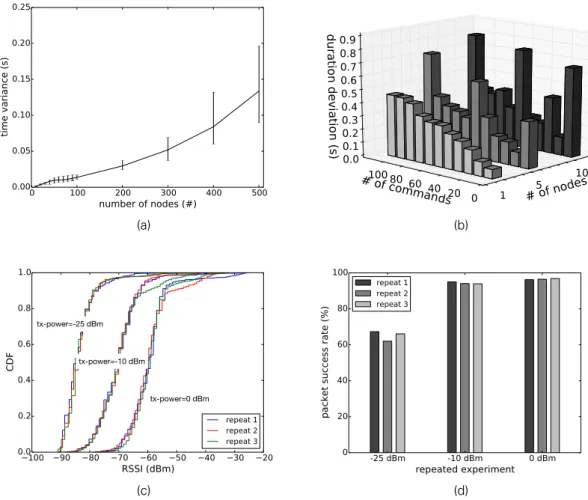
3.6 Performance analysis of MobiLab as an experiment management tool . . . 44
4.1 Experiment environment for empirical studies . . . 49
4.2 Background noise in different environments . . . 51
4.3 Comparison of temporal characteristics for static and mobile links . . . 52
4.4 Comparison of spatial characteristics for static and mobile links . . . 53
4.5 Radio irregularity . . . 54
4.6 Relationship between RSSI and PDR. . . 55
4.7 Temporal-spatial characteristics of link quality in indoor and outdoor environ-ments. . . 57
4.8 Density function of consecutive failure . . . 59
4.9 RSSI distribution upon specific consecutive failure (CF) in indoor and outdoor environments. . . 60
5.1 A summary of the relationship between the SNR and ARR of a wireless link. . 66
5.2 An illustration of the three link types. . . 68
5.3 The fluctuation of SNR in received ACK packets and the transformation of the continuous function to a discrete function to estimate the conditional duration of a stable condition. . . 69
5.4 The empirical conditional distribution function of consecutive success and fail-ure of a link. . . 70
5.5 Empirical conditional PDF of consecutive success (CS) and failure (CF) for dif-ferent SNR thresholds. . . 70
5.6 The conditional PDF of consecutive success for different links. . . 71
5.7 Comparison of the successfully transmitted packets when they were transmit-ted continuously without intermission and then they were transmittransmit-ted by tak-ing the expected durations of continuous success and continuous failure in to account. . . 73
5.8 Comparison of the successfully transmitted packets in burst in different indoor and outdoor links. . . 74
6.1 The fluctuation of link quality during mobility and the associated packet success rate in different regions. . . 76
6.2 Simplified block diagram of KMF. . . 78
6.3 Packet success rate and RSSI value. psr is calculated for every 100 packets. . 80
6.4 The steps of estimation to support a seamless handover. . . 81
6.5 The conditional variance ofpsr given RSSI. . . 84
6.6 The deployment environments for our experiments: (a) Lobby. (b) Corridor. (c) Pathway. . . 87
6.7 The prediction accuracy of Kalman filter based handover trigger algorithm ap-plied to 5 different links in three environment. . . 88
6.8 Evaluation of the five algorithms in terms of: (a) Number of handover events. (b) Goodput. (c) psr. . . 90
6.9 The runtime performance of the handover triggering algorithms for the same data trace. . . 91
7.1 The initial phase of MSI-MAC. . . 96
7.2 The collision probability distribution function during anycast packet transmis-sion within a single wakeup period. . . 97
7.3 Neighbor discovery (ND) and selection (NS) phases. . . 98
7.4 The expected duration of a neighbor discovery phase. . . 99
7.5 The format of a beacon for responding to a neighbor discovery request. . . 101
7.6 Performance comparison. . . 103
LIST OF TABLES
2.1 Summary of mobility aware MAC protocols . . . 27
2.2 Summary of mobility enabled testbeds . . . 30
3.1 TFCP message types and commands. . . 36
3.2 Traffic flow control primitives. . . 42
4.1 Correlation coefficients of PDR and RSSI, PDR and LQI . . . 58
5.1 Summary of the experiment set up for characterizing the fluctuation of link quality. 66 5.2 A summary of the parameters used to transmit packets in burst in different links forSNR= 6dBas a threshold). . . 72
6.1 The memory footprint and computational complexity of the different algorithms. 86 6.2 Parameters used for handover trigger experiments in different environment. . 87
6.3 Averagepsr for different links. . . 88
6.4 Configuration parameters of the different algorithms. . . 89
7.1 Performance comparison: The wakeup interval of relay nodes was set to 1000 ms. The number of neighbors is the potential nearby relay nodes. . . 102
LIST OF ABBREVIATIONS
ABTS Adaptive Burst Transmission SchemeACK Acknowledgment
ARR Acknowledgment Reception Ratio
BAN Body Area Networks
CCA Clear Channel Assessment
CF Consecutive Failure
CPDF Conditional Probability Distribution Function
CS Consecutive Success
CTI Cross Technology Interference
CTS Clear to Send
DC Duty Cycle
IPI Inter Packet Interval
LMS Least Mean Square Filter
LPL Low Power Listening
LPP Low Power Probing
LQE Link Quality Estimator
LQI Link Quality Indicator
MAC Medium Access Control
MWSN Mobile Wireless Sensor Network
PAN Personal Area networks
PDF Probability Distribution Function
PDR Packet Delivery Ratio
PFR Packet Failure Rate
PHY Physical Layer
PRR Packet Reception Ratio
PSR Packet Success Rate
QoS Quality of Service
RSSI Received Signal Strength Indicator
RTS Request to Send
SNR Signal to Noise Ratio
TDMA Time Division Multiple Access
TTL Time to Live
LIST OF PUBLICATIONS
1. Jianjun Wenand Waltenegus Dargie. A Handover Triggering Algorithm for Managing Mobility in WSNs. In Proceedings of the 21st International Conference on Information Fusion (FUSION), pages 1-7. IEEE, 2018.
2. Jianjun Wen and Waltenegus Dargie. A Mobility Management Protocol for Wireless Sensor Networks. In Proceedings of the IEEE Symposium on Computers and Commu-nications (ISCC), pages 1-7. IEEE, 2018.
3. Jianjun Wen, Zeeshan Ansar, and Waltenegus Dargie. Mobilab: A Testbed for Evaluat-ing Mobility Management Protocols in WSN. In International Conference on Testbeds and Research Infrastructures, pages 49-58. Springer, 2016.
4. Jianjun Wen, Zeeshan Ansar, and Waltenegus Dargie. A System Architecture for Man-aging Complex Experiments in Wireless Sensor Networks. In Proceedings of the 25th IEEE International Conference on Computer Communication and Networks (ICCCN), pages 1-9. IEEE, 2016.
5. Jianjun Wen, Zeeshan Ansar, and Waltenegus Dargie. A Link Quality Estimation Model for Energy-Efficient Wireless Sensor Networks. In Proceedings of the IEEE International Conference on Communications (ICC), pages 6694-6700. IEEE, 2015.
6. Zeeshan Ansar,Jianjun Wen, and Waltenegus Dargie. Efficient Online Burst Transmis-sion Scheme for Wireless Sensor Networks. In Proceedings of the 25th IEEE Inter-national Conference on Computer Communication and Networks (ICCCN), pages 1-9. IEEE, 2016.
7. Zeeshan Ansar, Jianjun Wen, Eyuel Debebe Ayele, and Waltenegus Dargie. An Effi-cient Burst Transmission Scheme for Wireless Sensor Networks. In Proceedings of the 18th ACM International Conference on Modeling, Analysis and Simulation of Wireless and Mobile Systems, pages 151-155. ACM, 2015.
8. Eyuel D Ayele,Jianjun Wen, Zeeshan Ansar, and Waltenegus Dargie. Adaptive Sleep--Time Management Model for WSNs. In Proceedings of the 24th IEEE International Conference on Computer Communication and Networks (ICCCN), pages 1-7. IEEE,
2015.
9. Waltenegus Dargie and Jianjun Wen. A MAC Protocol for Medical Applications. In Proceedings of the 13th international symposium on Information processing in sensor networks (IPSN), pages 287-288. IEEE Press, 2014.
10. Waltenegus Dargie andJianjun Wen. Power-Latency Trade-Offs in Virtualized Environ-ments. In Proceedings of the 28th IEEE International Conference on Advanced Informa-tion Networking and ApplicaInforma-tions Workshops (WAINA), pages 398-403. IEEE, 2014. 11. Waltenegus Dargie andJianjun Wen. A Seamless Handover for WSN Using LMS Filter.
In Proceedings of the 39th IEEE Conference on Local Computer Networks (LCN), pages 442-445. IEEE, 2014.
12. Waltenegus Dargie andJianjun Wen. A Probabilistic Model for Estimating the Power Consumption of Processors and Network Interface Cards. In Proceedings of the 12th IEEE International Conference on Trust, Security and Privacy in Computing and Commu-nications (TrustCom), pages 845-852. IEEE, 2013.
1 INTRODUCTION
Wireless sensor networks are useful for a large number of applications which require mobile nodes. For example, in the healthcare domain, they have been proposed to monitor patients with Parkinson Disease[SXFL15], gastroparesis [GOV+03], epilepsy [LEVG+13], and asthma [SGS+09]. As a result, there have been endeavors to integrate medical devices and make them interact with existing wireless sensor platforms. For instance, the wireless motility cap-sule integrating pH, pressure, and temperature sensors for the diagnosis of gastroparesis has officially been approved by the United States Food and Drug Administration (FDA) since 2006. It has produced promising results and may replace existing invasive and painful procedures such as endoscopy [RKM+09]. Most existing or proposed healthcare applications rely on Body Area Networks (BAN) and are often self-contained. In a BAN, nodes transfer sensed data to a mobile phone or a laptop computer, which is carried by the user or placed nearby. In some applications, individual nodes temporarily store the data they sensed locally, which are then offloaded, either manually or automatically, to a base station whenever the user happens to be at a close proximity. The advantage of the first strategy is that live and steady monitoring can be supported. One of its disadvantages is that the user is force to always carry an addi-tional device (mobile phone or a laptop) with them or make do with restricted mobility. The advantage of the second is that the user can enjoy unrestricted mobility but the applications have to be delay tolerant. Moreover, individual nodes should have sufficient storage.
The scope and usefulness of the proposed healthcare applications can be significantly en-hanced if the BAN they employ is augmented by Personal Area Networks (PAN). In places such as the patient’s home or rehabilitation centers, additional and stationary nodes can be strategically placed so that the BAN can interact with them to transfer data to a remote base station where the information is available to an expert or for advanced data processing. How-ever, there are two formidable challenges. First, most healthcare applications require high throughput, low latency, and low jitter to ensure that the sensed data is reliable (to determine whether measurements are correlated, for example). Second, it is difficult to maintain a reli-able link between a mobile node and a stationary node, because the quality of a wireless link, in addition to distance, strongly depends on mobility.
To address the aforementioned challenges, this dissertation focuses on designing and implementing a set of novel communication protocols in mobile wireless sensor networks (MWSN) in which nodes with limited resources are static-mobile mixed and transmission is in burst.
1.1 CHALLENGES IN MOBILE WIRELESS SENSOR NETWORK
COMMUNICATION
In wireless sensor networks, the typical device is usually equipped with a low-power mi-crocontroller unit (MCU), a low-power low-data-rate radio transceiver, and limited memory resources (RAM and ROM). It is often powered by a battery with constraint capacity. For example, the most commonly used platform in WSNs, TelosB mote [PSC05], uses a 16-bits MSP430 MCU with 48 KB ROM and 10 KB RAM, works at a frequency of 8 MHz and inte-grates with an IEEE 802.15.4 compliant transceiver ChipCon CC2420. This mote is powered by two AAA batteries. These limitations in hardware resources pose several challenges when designing communication protocol in WSNs.
Energy efficiency. Energy efficiency is the most important concern when designing com-munication protocols. Since the motes are battery powered and usually deployed in harsh environments or in large quantities, changing or recharging the batteries is often impossible. Compared to other components in the mote, the radio transceiver consumes most of the energy. To achieve the long node and network lifetime requirement, duty cycling mechanism is commonly used in WSNs. As such, the nodes are periodically in deep sleep and active mode. The ratio of sleep and active period is called the duty cycle (DC). This parameter can be adjusted according to the traffic load in the network.
Link dynamics. Due to the low power feature, the radio transceiver used in WSNs is prone to packet loss. To ensure the quality of service requirement, retransmission mechanism is widely used at different protocol layers (such as MAC, routing etc.). However, retransmission can degrade the performance of the network in terms of throughput, as many packet retrans-missions increase the collision probability and in turn aggravate the packet loss. Furthermore, inefficient retransmission causes energy wastage.
Besides the aforementioned challenges, dealing with mobility in energy constraint, resource limited, low-power wireless sensor networks poses more challenges.
1) Links in MWSNs experience more dynamic fluctuations compared to their stationary counterpart. Link dynamics have been studied exhaustively in the static environment by the WSNs research community. Prior works show that low power wireless links are affected by many factors [SKAL08][DÖD11][BZB+14][LC12], such as temperature, interference and background noise, which result in link quality degradation in time span from hundreds of milliseconds to several seconds. In mobile environments, mobility is the main contributor to link dynamics. To highlight this challenge, a simple experiment is conducted. A static receiver
static (3m) mobile static (5m) PSR = 0.89 휇RSSI = -80.1 휎2RSSI =15.48 PSR = 1.0 휇RSSI = -86.9 휎RSSI2 =0.66 PSR = 1.0 휇RSSI = -81.3 휎2RSSI =0.53
Figure 1.1: Link dynamics. The link is between a static receiver and a mobile transmitter which is carried by a robot. The mobile transmitter first sends packets at a location 3 meters away from the receiver for 10 seconds (static (3m) in the figure). It then moves toward a five-meter location at a speed of 0.13 m/s (mobile in the figure). Finally, it stays at the 5 meter location, transmitting packets for another 10 seconds (static (5m) in the figure). The data is collected at the transmitter side. The mean value (µRSSI), variance (σRSSI2 ) of RSSI and PSR are calculated accordingly.
and a mobile transmitter are deployed. The transmitter first stays at 3 meter location away from the receiver for 10 seconds and then moves toward the 5 meter location at a speed of 0.13m/ sand stays there for another 10 seconds, while transmitting packets continuously. We collect the received signal strength indicators (RSSI) and the acknowledgments (ACK) at the transmitter side and calculate the link quality in terms of RSSI fluctuation (mean and variance) and packet success rate (PSR) at each section. As shown in Figure 1.1, we observe that: a) the movement of the mobile node introduces more packet losses than the static scenario; b) the RSSI experiences more fluctuation, which is as high as more than 10 dB. These observations require mobile communication protocol has the ability of being resilient to the transient link dynamics and agile to react to persistent link quality degradation.
2) In MWSNs, the devices are mobile, instead of static, resulting in more frequent topology changes. In traditional static WSNs, network dynamics is usually coped with at the network layer. The node has to access the quality of links and update their routing information peri-odically by using link quality estimators and specific routing metrics. Usually, this updating activity is at very low frequency, since the link quality changes slowly over time in a fixed envi-ronment and link quality estimation over the path is costly for both time and energy. However, due to the mobility nature, the link conditions of mobile nodes are changing more frequently,
thus resulting in more frequent topology updating. This constant updating requirement exac-erbates scarce bandwidth resources and increase energy expenditure. So leaving the mobile node out of routing construction is a better option. Furthermore, despite the link dynamics, the mobile node may move out of the communication range of its current receiver, which can lead to disconnection from the network and increase latency. To deal with this issue, a seamless handover mechanism is required so that a new link can be established before the current link breaks.
3) Although duty cycling significantly improves energy efficiency, it poses the challenge of discovering alternative relay nodes. As we know, to achieve the long node and network lifetime requirement, the duty cycling mechanism is commonly used. Before data transmis-sion, the transmitter and the receiver have to be active and idle at the same time. Especially in an asynchronous schedule, the transmitter has to wait for a long time to be synchronous with the intended receiver, which increases latency. In static deployment, this delay can be shortened by learning the neighbors’ schedule in advance, for example, the phase lock mech-anism in ContikiMAC [Dun11]. In contrast, in mobile environment, the mobile node does not have enough information or is unaware of neighboring nodes before probing them. Hence, choosing an appropriate alternative receiver before the current link breaks is time consuming.
1.2 OBJECTIVES OF THE DISSERTATION
With the growing interest in involving mobility in WSNs applications, it is of paramount im-portance to enhance the low power communication protocol supporting mobility efficiently. Among all of the solutions, seamless handover (or handoff) should be the best option. The term handover is defined as a process a mobile node transfers communication from one re-lay node to the other. For more details, we assume a scenario illustrated as Figure 1.2. A mobile node has bulk data to transfer and moves freely within the network. According to the moving scope, mobility can be classified into two categories: intra-network mobility and inter-network mobility. Intra-network mobility refers to the mobile node roaming within a specific WSN domain where its address remains the same during handover. Inter-network mobility refers to the mobile node moving from one WSN domain to the other. In this case, during the handover process, the mobile node’s address has to be re-assigned by the new network. In this dissertation, we only focus on intra-network mobility issues.
When the mobile node is ready to transfer bulk data, it first joins the network and then begins transmission in burst with a stationary node (relay node). Due to link dynamics, the link quality fluctuates over time, which leads to packet loss. As a result, transmitting data packet continuously without awareness of link quality is not energy efficient. To reduce the energy expenditure caused by packet loss and retransmission, a burst transmission scheme is required, which can adapt to the link dynamics and estimate the proper number of packets to transmit in burst. Moreover, as the mobile node is moving within the network, it cannot always maintain a stable link with one specific stationary node. When link deterioration is
inter-mobility
network i intra-mobility network j
Internet >_ gateway mobile node static node motion trajectory
Figure 1.2: Mobility scope
constantly detected, the mobile node has to initiate a handover process to seamlessly transfer communication to a new relay node before the current link breaks. For this reason, it is vital for a mobile node to be able to (1) determine whether a fluctuation in link quality eventually results in a disconnection, (2) foresee potential disconnection well ahead of time and establish an alternative link before the disconnection occurs, and (3) seamlessly transfer communication to the new link.
In this dissertation, the following questions are addressed:
1. What is the optimal burst transmission size when the mobile node attains a stable link. 2. When is the most appropriate time to initiate the handover process when the mobile
node detects constant link quality deterioration with the current relay node.
3. How to discover alternative receivers in the vicinity of the mobile node during the han-dover process.
4. Which neighbor node is the best option to seamlessly handover to before the current link breaks.
1.3 CONTRIBUTIONS OF THE DISSERTATION
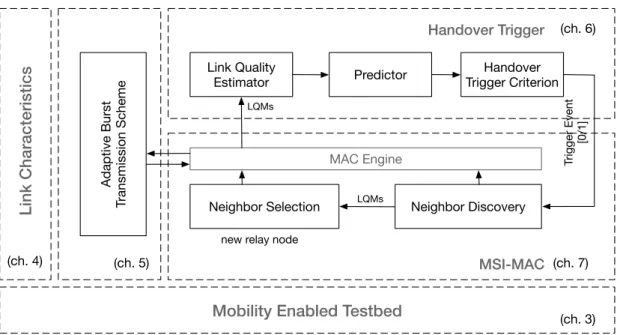
In this dissertation, we focus on dealing with mobility issues in low power mobile wireless sensor networks. To this end, we begin with designing a novel mobility enabled testing framework as the evaluation testbed for our remaining studies. We then perform an empirical study to investigate the link characteristics in mobile environment. Using these observations as guidelines, we propose a set of algorithms and communication protocols that deal with
Link Characteristics
(ch. 4)
Mobility Enabled Testbed (ch. 3)
Handover Trigger Criterion Trigger Event [0/1] Neighbor Discovery Neighbor Selection LQMs
new relay node
(ch. 7) MSI-MAC MAC Engine LQMs Link Quality Estimator Predictor Handover Trigger (ch. 6) Adaptive Burst Transmission Scheme (ch. 5)
Figure 1.3: Overview and task description of this dissertation
mobility to improve network performance in terms of latency and throughput. Figure 1.3 illus-trates the research components of this dissertation. The main contributions are highlighted as follows.
MOBILAB: MOBILITY ENABLED TESTING FRAMEWORK – CHAPTER 3
Wireless sensor networks that support the mobility of nodes are finding applications in differ-ent areas such as healthcare, elderly care, and rehabilitation from total knee and hip replace-ment. These application areas also require reliable and high throughput networks. Consider-ing the high fluctuation of link quality durConsider-ing mobility, protocols supportConsider-ing mobile wireless sensor nodes should be rigorously tested to ensure that they produce predictable outcomes before actual deployment. Furthermore, considering the typical size of wireless sensor net-works and the number of parameters that can be configured or tuned, conducting repeated and reproducible experiments can be both time consuming and costly. The conventional method for evaluating the performance of different protocols and algorithms under different network configurations is to change the source code and reprogram the testbed, which re-quires considerable effort.
In this chapter, we present a wireless sensor network testbed for carrying out repeated and reproducible experiments, independent of the application or protocol types which should be tested. The testbed consists of, among others, a server side control station and a client side traffic flow controller which coordinates inter- and intra-experiment activities. The testbed is fully implemented for the TinyOS and TelosB platforms. Diddyborg robots are employed for emulating different types of movement in indoor and outdoor environments.
LINK CHARACTERISTICS OF MOBILE WIRELESS SENSOR NETWORKS – CHAPTER 4 Radio link quality of low-power WSNs is one of the essential factors that should be taken into consideration when designing Medium Access Control (MAC), or routing protocols. Due to low-cost, low-power features, the radio transceivers used in WSNs can be affected by background noise, multi-path fading, shadowing and environment changing. Furthermore, the imperfectness of the hardware production and design of the antenna usually cause the irregularity of the radio propagation in different directions. These factors may lead to link qual-ity fluctuations, and may subsequently affect the performance of the protocols. In addition, when the mobile nodes are included in the network, other factors may dominantly affect the link quality, such as the body-effect and the angle of the antenna. In the last decades, a large number of studies have been conducted in order to investigate and model the characteristics of low power radios, and how they affect the performance of communication protocols. Most of these studies only focus on static scenarios. There has been less effort on studying the mobility impact on link quality and what factors should be taken into account when design-ing mobility-aware protocols. To better understand the challenges and to provide guidelines for designing mobility management protocol, we conduct a large number of experiments in different environments and settings.
ADAPTIVE BURST TRANSMISSION SCHEME FOR DYNAMIC ENVIRONMENT – CHAPTER 5
Understanding fluctuations of link quality in a wireless sensor network is useful for different reasons. For example, nodes can determine when and for how long they should transmit packets, so that they can reduce packet loss rate and the cost of retransmission (delay as well as power consumption). However, because the quality of a link depends on many factors, it cannot be accurately known except in a probabilistic sense. In this chapter, we estimate the expected duration in which the quality of a specific link remains stable using the conditional distribution function of the signal-to-noise ratio (SNR) of received acknowledgment packets. The expected duration is employed to determine how long nodes should transmit packets in burst and how long they should refrain from contention. To develop our model, Imote2 sensor platforms are deployed in indoor and outdoor environments. More than 70,000 packets are transmitted. Then additional 16,900 packets are transmitted to test our model. In 90% of the time, this approach results in high packet delivery in comparison to the case in which packets are transmitted without the knowledge of link quality fluctuations
A HANDOVER TRIGGERING ALGORITHM FOR MANAGING MOBILITY IN WSNS – CHAPTER 6
One of the reasons why a handover triggering threshold is required is that a handover entails a seamless neighbor discovery phase wherein a transmitting node searches for an alternative
relay node. During this phase, it has to transmit packets in a multicast or broadcast mode, which is inefficient. Almost all proposed handover triggering algorithms rely on an empirically obtained RSSI threshold or the failure of a single packet is sufficient to trigger a handover. An empirical threshold is highly environment dependent. In this work, we propose a handover triggering algorithm which does not rely on a predefined threshold. Instead, it equates the cost of packet retransmission (which can be expressed in terms of packet delivery latency or energy) with the cost of a handover. If the former is higher than the latter, a handover is triggered. To compute these costs, the approach proposed in this work establishes the statistics of received acknowledgment packets and employs a Kalman filter to characterize and predict link quality fluctuation.
MSI-MAC – CHAPTER 7
In cellular networks, mobile stations are associated with the nearest base station through intra- and inter-cellular handover. The underlying process is that the quality of an established link is constantly evaluated and handover decisions are fully made by resource rich base sta-tions. In wireless sensor networks, should a seamless handover be carried out, the task has to be accomplished by energy-constraint, resource-limited, and low-power wireless sensor nodes in a distributed manner. In this chapter, a sender initiated mobility management pro-tocol is proposed to enable seamless handover. The propro-tocol is fully implemented in TinyOS environment for the TelosB and Imote2 platforms. Experiment results show that our protocol achieves high reliability and triggers less handover requests (less than 50% to 80%) compared to three state-of-the-arts. Furthermore, our protocol reduces the signaling overhead by up to 95%.
Chapter 3, 5, 6 and 7 are based on following publications:
• Jianjun Wen, Zeeshan Ansar, and Waltenegus Dargie. Mobilab: A Testbed for Evaluating Mobility Management Protocols in WSN. In International Conference on Testbeds and Research Infrastructures, pages 49-58. Springer, 2016.
• Jianjun Wen, Zeeshan Ansar, and Waltenegus Dargie. A System Architecture for Man-aging Complex Experiments in Wireless Sensor Networks. In Proceedings of the 25th IEEE International Conference on Computer Communication and Networks (ICCCN), pages 1-9. IEEE, 2016.
• Jianjun Wen, Zeeshan Ansar, and Waltenegus Dargie. A Link Quality Estimation Model for Energy-Efficient Wireless Sensor Networks. In Proceedings of the IEEE International Conference on Communications (ICC), pages 6694-6700. IEEE, 2015.
• Jianjun Wen and Waltenegus Dargie. A Handover Triggering Algorithm for Managing Mobility in WSNs. In Proceedings of the 21st International Conference on Information Fusion (FUSION), pages 1-7. IEEE, 2018.
• Jianjun Wen and Waltenegus Dargie. A Mobility Management Protocol for Wireless Sensor Networks. In Proceedings of the IEEE Symposium on Computers and
Commu-nications (ISCC), pages 1-7. IEEE, 2018.
1.4 STRUCTURE OF THE DISSERTATION
The remainder parts of this dissertation are structured as follows: In Chapter 2, we summarize the corresponding related work in recent decades. Chapter 3 presents MobiLab, a mobility enabled testing framework. All of the protocols, algorithms and results presented in this dissertation are verified and evaluated on this testbed. In Chapter 4, we empirically study the link quality characteristics of mobile wireless sensor networks. The observations and conclusions in this chapter are fundamental to the design of other algorithms and protocols in this dissertation. In Chapter 5, an adaptive burst transmission scheme (ABTS) is presented. This scheme is an adaptive approach to tune the burst transmission size which can maintain a high packet success rate, even when the link quality is not perfect. In Chapter 6, we present a Kalman Filter based handover trigger algorithm, namely KMF. In chapter 7, a mobile sender initiated mobility management protocol (MSI-MAC) is proposed. At last, we conclude this dissertation and discuss the future work in Chapter 8.
2 BACKGROUND AND LITERATURE
REVIEW
In this chapter we give an overview of relevant state of the arts to this dissertation. First, we review bulk data transfer protocols in wireless sensor networks. Second, we describe the common features of Medium Access Control (MAC) protocols and give a brief discussion about them. Third, we assess mobility aware MAC protocols in detail and make compari-son. Finally, we examine the mobility enabled testbeds with which the performance of the proposed protocols were tested.
2.1 BULK DATA TRANSFER IN WIRELESS SENSOR NETWORKS
Devices such as wireless electrocardiograms typically generate data at a rate of tens of kilobits per second. While this in itself may not be high, if other sensors such as 3D accelerometers and gyroscopes have to be sampled at comparatively the same rate, then the aggregate data rate from a single node can be high. This high data rate requirement motivates bulk data transfer protocol. In the early stages, energy efficiency is not the first concern when design-ing bulk data transfer protocol. They usually disable duty cycldesign-ing mechanism to achieve high throughput. Additionally, they all assume that links are stable. However, in real deployment, links are not steady, instead, they are dynamic and prone to packet loss. Some researches re-ported that packet losses are not independent, but are temporally correlated with each other [SKAL08][DÖD11]. In other words, if one packet transmission failed, the probability that sub-sequent consecutive transmissions also failed is high. This failure periods could span typically up to 500 ms [SDTL10]. Since duty cycling mechanism is not enabled in these protocols, ra-dios keep on all the time even when a large number of consecutive packet losses occur. In this case, network energy efficiency is significantly decreased as the number of retransmissions increases. By taking link dynamics and energy efficiency into consideration, new protocols with duty cycling enabled are proposed. The basic idea is that, if a consecutive packet loss
period is detected, nodes can turn off their radios and halt data transmission for a while to avoid unnecessary energy wastage. In the following, we summarize the existing bulk data transfer protocols from two perspectives.
2.1.1 BULK DATA TRANSFER PROTOCOL WITHOUT DUTY CYCLING
Flush [KFD+07] is a sink initiated multi-hop bulk data transfer protocol for wireless sensor networks. The pipelined transmission begins by sending a request from the sink node to a specific source node. Once this request is received at the source node, it begins to transfer bulk data at the maximum rate along a route to the sink node until all packets are sent. After bulk data transmission is finished, the sink node sends selective negative acknowledgments back to the source node, which is the retransmission request for the missing packets. This process is repeated until all the data packets are successfully received by the sink node. In ad-dition, during data transmission, all nodes involved in communication continuously estimate the maximum transmission rate which avoids interference from neighbor nodes by overhear-ing control packets (request messages) and data traffic. Since Flush uses soverhear-ingle channel for pipelining, the throughput is limited (below 1 kB/s).
To solve the bandwidth bottleneck caused by intra-path interference, a TDMA-based, multi-channel bulk data transfer protocol named PIP [RCBG10] is proposed by Raman et al.. In PIP, instead of using beacons for synchronization, it uses simple per-hop synchronization by data packets themselves along the route. The schedule and channels used in transmission and receiving are determined centrally by the sink node. When all these parameters are agreed along the path, the source node starts transferring data packets in burst until all packets are received at the sink node. Since multi-channels are used during data transmission, intra-path interference is significantly eliminated. Thus, high throughput can be achieved up to 7.5 kB/s. Practical packet pipeline (P3) [DC14] is a synchronized multi-path, multi-channel, bulk data transfer protocol which exploits both sender and receiver diversities to avoid single path fail-ure. InP3, data packets are concurrently transmitted by multiple senders to multiple receivers at every time slot. This design is based on the constructive interference. Constructive in-terference is a phenomenon that when multiple nodes transmit the same data packet with synchronization, the receiver can decode this packet correctly. Furthermore, at each transmis-sion/receiving cycle, a different radio channel is assigned to mitigate intra-path interference like in PIP. By fully utilizing the radio transmission capacity, the throughput can reach up to 22.3 kB/s.
2.1.2 BULK DATA TRANSFER PROTOCOL WITH DUTY CYCLING
As links are dynamic over time, turning on the radio all the time is not energy efficient, es-pecially when a large number of packet failures occur. To eliminate energy wastage, several protocols with awareness of link dynamics are proposed. By studying the short-term variation of wireless links, STLE [ALL+09] is proposed to identify short-term stable periods in a dynamic
link. They use the temporary stable links for multi-hop communication. Similarly, Rusak et al. [RL09] investigate the time varying characteristics of wireless channels at physical and link layers. They observe that packet reception rate (PRR) changes over time, suggesting that at different time scales the channels are most appropriately characterized as bursty rather than stable. They apply wavelet transformation on RSSI for analyzing and characterizing the burstiness of the channels. They observe that burst periods repeat themselves and have self-similar nature.
Srinivasan et al. [SKAL08] propose a β metric to measure the burstiness of a link. The β factor is a measure of how close a link is to an ideal link. It is calculated by using the Kantorovich-Wasserstein (KW) distance [CT05], which measures the distance between a con-ditional probability delivery function (CPDF) of a given link with an ideal link. The CPDF expresses the probability of receiving the next packet successfully aftern consecutive suc-cesses or failures. The value ofβ determines the burstiness of the link. Aβ = 1 represents a perfect link andβ = 0 represents an uncorrelated link. To explore the performance of the β metric, the authors propose a transmission control scheme which is intended to increase the packet reception ratio by sending packets in bursts until they encounter a failure. When a failure is detected, transmission is halted for 500 ms. The limitation of this approach is that the algorithm requires a large amount of data to predict the success of the next packet.
Munir et al. [MLH+10], propose a scheduling algorithm which produces latency bound for real-time periodic streams for burst links. The authors define the burst period as a period of continuous packet loss and use a metric called Bmax to compute this. They perform an em-pirical study for 21 days and collect data from different links. For each link they transmit over 3 million packets and record the data trace of success and failure which is used to compute Bmax. The algorithm is used offline. Likewise, Brown et al. [BMR+11] introduce BurstProbe, a mechanism to measure link burstiness online. Probing slots, embedded transmission sched-ule to access link burstiness online, are shared between neighbors. The probe mechanism is more reactive for capturing burst period due to online probe sharing, but it increases the energy consumption and duty cycle by 2%.
2.2 MEDIUM ACCESS CONTROL PROTOCOLS IN WIRELESS SENSOR
NETWORKS
The medium access control (MAC) protocol belongs to the data link layer of the Open Sys-tem Interconnection (OSI) model. It is responsible for coordinating multiple nodes to access a shared wireless medium. Since transmission is broadcast by nature in wireless communi-cation, the shared medium can only be accessed by one transmitter at a time. Otherwise, interference or collision may happen, which results in packet loss. Hence, a MAC protocol has to define a mechanism to schedule transmissions between nodes to avoid or mitigate colli-sion. According to the scheduling mechanism they used, the existing MAC protocols in WSNs
1 N
time frame time frame
slot D D D D 2 S1 Si Sn 3 i n D D 1 i D D D D transmit receive
Figure 2.1: An example of TDMA based MAC protocol
can be classified into three categories [HXS+13]: frame-slotted, synchronous, asynchronous.
2.2.1 FRAME-SLOTTED MAC PROTOCOLS
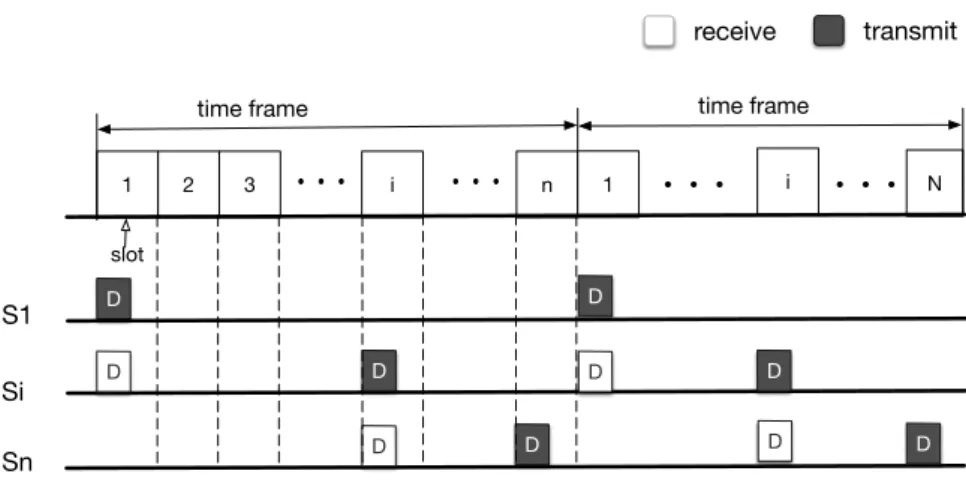
In frame-slotted MAC protocols, the wireless medium is divided into slots in time manner and each slot is allocated to a specific node. A node can only access the medium in its own slot, thus collisions are completely avoided. For example, in Time Division Multiple Access (TDMA) based protocols, time is divided into slots and each slot is assigned to one and only one node. A node can transmit packets only during its own time slot. Consequently, there is no transmission collision in the network. Figure 2.1 illustrates the basic mechanism of TDMA based protocol. Although TDMA-based protocols can prevent transmission from collision, they have some drawbacks. The time slots are preallocated to nodes, which means they are only applicable for fixed topology. Any change in topology may lead to inefficient medium utilization (i.e. a node leaves the network) or require time slot reassignment (i.e. a new node joins the network). Additionally, the clocks of each node will differ due to clock drift. Thus, periodical time synchronization is required.
2.2.2 SYNCHRONOUS MAC PROTOCOLS
In synchronous MAC protocols, nodes in a network are usually organized in clusters. Nodes within the same cluster are synchronized with each other. They have a common active/sleep schedule. The nodes that have more than one schedules are border nodes which can bridge two or multiple clusters. The cluster topology is shown in Figure 2.2a. The active period is divided into two parts, one for synchronization and the other for data transmission. When a node wakes up, it first listens to the medium for a period of time to receive the schedule from neighboring nodes. If no schedule is received from other nodes, it broadcasts its own schedule. Otherwise it follows the received schedule. After the synchronization period, nodes within the same cluster use request-to-send (RTS) and clear-to-send (CTS) control packets to
cluster header node border node cluster 1 cluster 2 S1 S2 R (a) clusters active sleep sync period R T S R S1 S2 D A C K D transmit receive active sleep S Y N C S Y N C S Y N C C T S C T S C T S R T S C T S R T S R T S D A C K A C K A C K D
data transmission period
(b) S-MAC
Figure 2.2: An example of asynchronous MAC protocol: S-MAC
contend the medium. Once the medium is obtained, data exchange begins. Figure 2.2b illustrates the working mechanism of a representative synchronous MAC protocol in WSNs, namely S-MAC[YHE02].
2.2.3 ASYNCHRONOUS MAC PROTOCOLS
Unlike the synchronous protocols in which nodes within the same cluster have a common ac-tive/sleep schedule, nodes choose their own schedule independently in asynchronous proto-cols. The asynchronous schedule mechanism relieves the time synchronization requirement. However, preamble sampling or low power probing prior to data transmission is required. For example, X-MAC [BYAH06] is one of the most representative asynchronous protocols. In X-MAC, nodes periodically switch on and off their radios without knowing the schedules of other nodes. When a node wakes up, it first performs Clear Channel Assessment (CCA) to detect whether the medium is busy or not. If the medium is idle and it has data packets to transmit, it sends a sequence of strobed preambles which are short packets including desti-nation address. Once the intended receiver wakes up and receives the preamble, it replies with an early acknowledgment. Upon receiving the early acknowledgment from the intended receiver, the transmitter sends its data packet subsequently. Other awaken nodes which are not the target receiver can go to sleep immediately after receiving a preamble packet to save energy. Figure 2.3a shows the working mechanism of X-MAC. The preamble sampling based protocol can significantly improve energy efficiency when the traffic load is light. However, the preamble transmission occupies the medium before a connection with the intended re-ceiver is established, which prevents other nodes from transmitting their data packets. To avoid the medium occupation caused by preamble transmission, several receiver-initiated protocols are proposed, which rely on beacon messages to establish the connection, such as RI-MAC [SGJ08], RC-MAC [HWXC10] and A-MAC [DDHC+10]. Figure 2.3b shows the work-ing mechanism of RI-MAC. In RI-MAC, nodes sleep and wake up asynchronously. When a node with data packet to transmit wakes up (S in the figure), it first listens to the medium and
P S Ri Rj dst = Ri transmit receive wakeup
D data packet A acknowledgement
strobed preamble P P P P P A D A A D A P P sleeping period go to sleep dst Rj
keep awake for a while go to sleep
6
=
(a) sender-initiated: X-MAC
Si R Sj transmit receive wakeup
D data packet B beacon
listening B B
D
B D B
waiting for other packet go to sleep D B D B B (b) receiver-initiated: RI-MAC
Figure 2.3: Examples of asynchronous MAC protocols
waits for a beacon from intended receiver. A receiver (R) immediately broadcasts a beacon to announce that it is awake and ready to receive data packet after switching on its radio. Once the beacon is received, the transmitter can send its data packet immediately. Then the receiver replies with another beacon to acknowledge the successful reception of the data packet, and to announce readiness for another receiving. If there is no packet received after beacon transmission, the node will go to sleep.
ME-Contiki 2015 MS-MAC 2004 EMS-MAC2011 MT-MAC 2014 MD-SMAC 2009 CFMA2013 MA-MAC 2010 FLMC 2014 MRI-MAC 2013 MX-MAC 2014 MobiSense 2011 contention fr ee contention based synchronous TDMA asynchronous M_TDMA 2007 cluster topology asynchronous synchronous sender-initiated receiver-initiated M-Contiki 2015 X-Machiavel 2013 time line multi-channel MOBINET 2011 S-GinMob 2011 MoX-MAC 2014 Machiavel 2009 frame-slotted
Figure 2.4: Taxonomy of mobility aware MAC protocols
2.3 MOBILITY AWARE MEDIUM ACCESS CONTROL PROTOCOLS IN
WIRELESS SENSOR NETWORKS
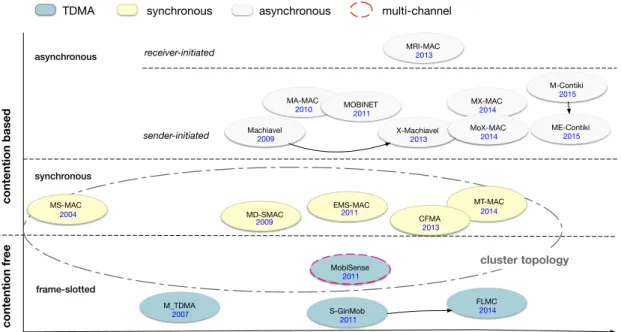
Wireless sensor networks that support mobile nodes require mobility management protocols. The task of these protocols is to continuously evaluate link quality and to transfer communi-cation to a more reliable link when the link quality or packet loss rate of the current link dete-riorates beyond a certain level (this level is defined by the application according to the quality of service requirement, such as the acceptable packet loss rate). In this section, we provide an overview of the existing or proposed mobility aware MAC protocols. A taxonomy of mo-bility aware MAC protocols is illustrated in Figure.2.4, which follows the same classification as discussed above.
2.3.1 FRAME-SLOTTED PROTOCOLS
M_TDMA [JK07] is an extension of TDMA MAC protocol to support mobility in wireless sensor networks. In M_TDMA, the network is partitioned into several non-overlapping clusters at the start-up phase. The header node is responsible for managing the schedule and for assigning time slots to other nodes within the cluster. A time frame is divided into two parts: the control part and the data part. The control part consists of the first three slots in a time frame, which are used to exchange control messages and to deal with mobility. The header node broadcasts the cluster information in the first slot, such as cluster schedule, node ID and round number. If a new node is present in the cluster due to mobility, and hears the cluster information, it broadcasts its own node ID in the second slot. Upon receiving a new
ID, the head node assigns an unused time slot and sends it to the new node in the third slot. Afterwards, all the nodes in the cluster transmit their data packet subsequently according to the schedule.
S-GinMob [SZSV11] is a cross layer mechanism to support mobility in an industry environ-ment. It extends GinMAC [SBR10], which is a TDMA-based MAC protocol. In S-GinMob, nodes are organized as a tree topology and it is managed by a component named Dynamic Topology Control (DTC). In addition to the topology management, the DTC module is respon-sible for managing the schedule and allocating different functions to the time slots, such as scanning neighbors, and transmitting and receiving data packets. A mobile node can overhear these control messages and estimate their RSSI in idle time slots to detect new attachments and make handover decisions. If the RSSI value of control messages from a new attachment point is higher than the current attachment node, the mobile node will send a join request to the new attachment point. When the join request is acknowledged, the mobile node will handover to the new attachment point in the next frame.
FLMC [ZCV14] is a variant of S-GinMob. Instead of using the RSSI value to trigger the handover process in S-GinMob, FLMC develops a new handover trigger algorithm based on fuzzy logic. It takes two metrics, RSSI and link loss, as the inputs of the fuzzy inference sys-tem. If the output, trigger decision probability, is below a predefined threshold, the handover procedure is initiated.
MobiSense [GLJ11] is a hybrid solution that integrates TDMA and multichannel commu-nication schemes together to handle mobility in wireless sensor networks. In MobiSense, nodes are organized into clusters and each cluster has a header node. The header node is responsible for maintaining topology and for managing schedules within the cluster. Adjacent cluster header nodes operate on different channels, except that they send probe beacons on a common channel during the neighbor discovery phase. Similar to the TDMA protocol, commu-nication in MobiSense is organized into time frames. Each frame is divided into downlink and uplink data transmission slots, admission mini slots, and discovery slots. The first two slots are scheduled slots which are used to exchange data packets. The discovery slots are used to broadcast beacons by header node. A mobile node can overhear these beacons to gather network information and to make handover decisions. For example, if a mobile node detects the RSSI value of packets from the current cluster header is below a predefined threshold, it initiates the handover process by overhearing the discovery beacon. If the RSSI value of the received beacon from a new header is higher than the handover threshold, it sends a join request to the new header in a randomly selected admission slot in the next frame. The handover process is complete if the new header node admits the handover request.
2.3.2 SYNCHRONOUS PROTOCOLS
As discussed in section 2.2.2, the common design principles of synchronous MAC protocols for wireless sensor networks are: 1) nodes in the network are organized into clusters; 2) the
communication scheme is partitioned into two phases, one is used for the synchronization of the active time of all nodes within the cluster, and the other is used for exchange of data packets.
When mobile nodes accommodate in the network, the scenarios can be classified into two cases: 1) The mobile node roams within a cluster. It can be treated as a static node because it shares the same schedule as its neighbors. 2) The mobile node approaches the border nodes and attempts to cross the border of the two clusters. Communication may be disabled while crossing the border, because the mobile node may go out of the communication range of the current cluster and has not been yet synchronized with the new one. This disconnection, usu-ally up to 2 minutes, is too long and consequently degrades the performance of the protocol in terms of energy1 and latency. Hence, the synchronous mobility management protocol is to find a solution to 1) detect the mobile node that is attempting to cross the cluster border and 2) shorten the synchronization time when the handover occurs.
MS-MAC [PJ04] is the first MAC protocol which supports mobility in wireless sensor net-works. It handles the handover by following two schedules when the mobile node crosses the border of two clusters. At each periodic synchronization phase, each node learns the mobility status of its neighbors by estimating the RSSI value of the received synchronization mes-sages (SYNC). When the mobile node is crossing the cluster border, an active zone is created within the neighborhood of the mobile node to adapt the synchronization period according to the mobility information. The border nodes broadcast their schedules more frequently than in the stationary scenario, thus the mobile node can establish a connection with the new cluster before it disconnects from the old cluster. However, during the handover phase, the border nodes consume more energy due to frequent synchronization.
Inspired by MS-MAC and DS-MAC [YBS+08], the authors developed a mobility-aware, de-lay-sensitive MAC protocol named MD-SMAC [HSFG09]. In addition to the basic operations inherited from MS-MAC and DS-MAC, MD-SMAC makes several modifications to enhance mobility management and power consumption efficiency. In the mobility management as-pect, the mobile node increases its listening frequency to receive the new schedules when it is crossing the cluster border. In the energy consumption aspect, MD-SMAC only allows the mobile node to listen to the schedules of new clusters, and to keep the other nodes in regular operations. After receiving the new schedule, the mobile node decreases the listening fre-quency to its default setup (from 30 seconds to 5 minutes.). At the same time, it withdraws the old schedule and adopts the new one immediately.
To deal with high energy consumption in MS-MAC in random movement and high mobility scenarios, the enhanced mobility-aware S-MAC (EMS-MAC) [ZTBW11] is proposed. The au-thor argued that using RSSI alone to detect mobility is not accurate, due to the unstable nature of RSSI measurement. Even in a stationary network, the RSSI value can fluctuate drastically. These RSSI fluctuations can cause false positive mobility events. To reduce unnecessary
han-1the mobile node has to keep awake to listen to the synchronization messages of the new cluster. The active mode of the radio consumes more energy than the sleeping mode.
dover events, EMS-MAC combines RSSI with link quality indicator (LQI) to predict mobility. Instead of creating an active zone which involves all the border nodes in the neighborhood of the mobile node when the mobile node attempts to cross the border, EMS-MAC introduces a mobility zone which only includes the nodes that detected the mobility of the approaching mobile node. After mobility detection, the border node sends a SYNC message to introduce itself and the mobile node replies to the SYNC packet with the handover request. Then the border node broadcasts the new cluster schedule. Once the mobile node has learned the new schedule, it adopts this schedule as well as the old one to finish the handover process.
CFMA [KA13], collision free mobility adaptive MAC protocol, is another type of synchronous mobility management protocol. Nodes in CFMA are organized in a cluster-tree topology. Each cluster has a head node called coordinator. Other nodes in the cluster are synchronized with the coordinator by periodically transmitted beacons. The coordinators are not only functioned as bridges to the sink node, but also can communicate with each other directly to exchange network information, especially when the mobile node is moving from one cluster to another. Another contribution of CFMA is the idea of allocating predefined backoff value to the nodes which have buffered data to avoid collision at the beginning of each transmission round. The mobile node can overhear these backoff assignment packets. If it detects that the RSSI value of these packets from the neighboring coordinator is continuously increasing, the mobile node requests the current coordinator for a delay value of the neighboring cluster. Once the mo-bile node acquires the delay value from the new cluster coordinator, it can handover to the new cluster with a specific delay. Furthermore, the mobile nodes always have the highest priority when they enter a new cluster, which ensures that they can join the new cluster with minimum latency.
MT-MAC [ZAI+14] is the latest developed mobility management MAC protocol in the syn-chronous group, which is based on T-MAC [VDL03]. The mobility handling strategy is almost the same as EMS-MAC. The only difference between these two protocols is that MT-MAC inherits an adaptive duty cycling mechanism from T-MAC and supports burst transmission. Alternatively, EMS-MAC uses a fixed duty cycling strategy.
2.3.3 ASYNCHRONOUS PROTOCOLS
Another large group of mobility management protocols is extension of asynchronous MAC protocols. Unlike synchronous protocols in which synchronization, RTS and CTS are used to access the medium, asynchronous MAC protocols apply different schedules for each node in the network, and use low power listening (LPL) or low power probing (LPP) to establish communication between the sender and the receiver. According to which node, sender or receiver, initiates the communication, asynchronous MAC protocols can be categorized into two groups: sender-initiated and receiver-initiated.
Both sender-initiated and receiver-initiated MAC protocols work well in static networks, however, inherently they are not suitable for mobile wireless sensor networks. As the mobile