Multisite Adaptive Computation
Offloading for Mobile Cloud Applications
Dawand Jalil Sulaiman
This thesis is submitted in partial fulfilment for the degree of
Doctor of Philosophy (PhD)
at the
University of St Andrews
Abstract
The sheer amount of mobile devices and their fast adaptability have contributed to the proliferation of modern advanced mobile applications. These applications have characteristics such as latency-critical and demand high availability. Also, these kinds of applications often require intensive computation resources and excessive energy consumption for processing, a mobile device has limited computation and energy capacity because of the physical size constraints.
The heterogeneous mobile cloud environment consists of different computing resources such as remote cloud servers in faraway data centres, cloudlets whose goal is to bring the cloud closer to the users, and nearby mobile devices that can be utilised to offload mobile tasks. Heterogeneity in mobile devices and the different sites includes software, hardware, and technology variations. Resource-constrained mobile devices can leverage the shared resource environment to offload their intensive tasks to conserve battery life and improve the overall application performance. However, with such a loosely coupled and mobile device dominating network, new challenges and problems such as how to seamlessly leverage mobile devices with all the offloading sites, how to simplify deploying runtime environment for serving offloading requests from mobile devices, how to identify which parts of the mobile application to offload and how to decide whether to offload them and how to select the most optimal candidate offloading site among others.
To overcome the aforementioned challenges, this research work contributes the design and implementation of MAMoC, a loosely coupled end-to-end mobile computation offloading framework. Mobile applications can be adapted to the client library of the framework while the server components are deployed to the offloading sites for serving offloading requests. The evaluation of the offloading decision engine demonstrates the viability of the proposed solution for managing seamless and transparent offloading in distributed and dynamic mobile cloud environments. All the implemented components of this work are publicly available at the following URL: https://github.com/mamoc-repos
v
Declaration
Candidate's declaration
I, Dawand Jalil Sulaiman, do hereby certify that this thesis, submitted for the degree of PhD, which is approximately 49,700 words in length, has been written by me, and that it is the record of work carried out by me, or principally by myself in collaboration with others as acknowledged, and that it has not been submitted in any previous application for any degree.
I was admitted as a research student at the University of St Andrews in January 2016. I received funding from an organisation or institution and have acknowledged the funder(s) in the full text of my thesis.
Date Signature of candidate
Supervisor's declaration
I hereby certify that the candidate has fulfilled the conditions of the Resolution and
Regulations appropriate for the degree of PhD in the University of St Andrews and that the candidate is qualified to submit this thesis in application for that degree.
Date Signature of supervisor
Permission for publication
In submitting this thesis to the University of St Andrews we understand that we are giving permission for it to be made available for use in accordance with the regulations of the University Library for the time being in force, subject to any copyright vested in the work not being affected thereby. We also understand, unless exempt by an award of an embargo as requested below, that the title and the abstract will be published, and that a copy of the work may be made and supplied to any bona fide library or research worker, that this thesis will be electronically accessible for personal or research use and that the library has the right to migrate this thesis into new electronic forms as required to ensure continued access to the thesis.
I, Dawand Jalil Sulaiman, confirm that my thesis does not contain any third-party material that requires copyright clearance.
The following is an agreed request by candidate and supervisor regarding the publication of this thesis:
Printed copy
No embargo on print copy.
Electronic copy
No embargo on electronic copy.
Date Signature of candidate
Date Signature of supervisor
vii
Underpinning Research Data or Digital Outputs Candidate's declaration
I, Dawand Jalil Sulaiman, hereby certify that no requirements to deposit original research data or digital outputs apply to this thesis and that, where appropriate, secondary data used have been referenced in the full text of my thesis.
Acknowledgements
I would like to acknowledge my supervisor, Prof. Adam Barker, for his patience and invaluable guidance in this journey. Thank you for treating me as a friend and creating such a relaxed environment for our discussions.
My appreciation goes to the head of school, Prof. Simon Dobson, the school manager, Alex Bain, and the systems and front desk office admin members for their support. Also, the libraries of University of Abertay and University of Dundee where I spent long hours to produce this thesis.
I deeply appreciate the help of my current and former PhD colleagues including Dr. Simone Conte for his valuable and continuous feedback on my PhD work and Dr. Ward Jaradat for his great insights and guidance during coffee breaks. I would also like to thank Dr. Khawar Shahzad, Mohammad Ramadan, and Sheriffo Ceesay for the great times and the fruitful discussions. Thanks to Xu Zhu, Xue Guo, Wangjia Yu, and Teng Yu for their company and allowing me to practice my spoken Chinese with them.
I am in forever debt to my parents who provided me with everything I needed to grow and excel. The emotional support and endless love throughout this journey and always believing in me.
I would also like to acknowledge my good friend and mentor, Dr. Graeme Bell for his precious advice, inspiration, and support.
Finally, I want to thank my bonny wife, Simav. Her comfort and encouragement have carried me on a long way through the difficulties in both my PhD candidature and life. This work is for you.
Funding
This work was supported by the University of St Andrews (School of Computer Science). I thank the University of St Andrews for the research training support and facilities to let me pursue my PhD degree.
Table of Contents
List of Figures xv
List of Tables xvii
List of Algorithms xx
List of Codes xx
1 Introduction 1
1.1 Motivations and Challenges . . . 4
1.2 Research Hypotheses . . . 8
1.3 Contributions of This Research . . . 10
1.4 Publications . . . 11
1.5 Organisation of The Thesis . . . 12
2 Background 13 2.1 Mobile Cloud Architectures . . . 13
2.1.1 Mobile Cloud Computing . . . 14
2.1.2 Mobile Edge Computing . . . 16
2.1.3 Mobile Fog Computing . . . 17
2.1.4 Comparison of Mobile Cloud Architectures . . . 18
2.1.5 Discussion . . . 22
2.2 Mobile Computation Offloading . . . 23
2.2.1 Adaptive Offloading . . . 25
2.2.2 Multisite Offloading . . . 26
2.3 Tools and Technologies . . . 28
2.3.1 Containers . . . 28
2.3.2 Android-x86 . . . 30
2.3.3 Zero Configuration Network . . . 31
2.3.5 Web Application Messaging Protocol . . . 33 2.4 Summary . . . 34 3 Literature Review 35 3.1 Overview . . . 35 3.2 Survey Methodology . . . 36 3.3 Taxonomy . . . 38 3.3.1 Offloading Objectives . . . 38 3.3.2 Partitioning Granularity . . . 40 3.3.3 Partitioning Model . . . 43
3.3.4 Task Scheduling & Allocation . . . 45
3.3.5 Offloading Decision . . . 49
3.3.6 Offloading Sites . . . 50
3.4 Discussion . . . 51
3.4.1 Current Trends . . . 51
3.4.2 MAMoC and the gaps . . . 53
3.5 Summary . . . 54
4 System Analysis and Models 55 4.1 Overview . . . 55
4.2 Requirements Analysis . . . 55
4.2.1 Functional Requirements . . . 56
4.2.2 Non-Functional Requirements . . . 56
4.3 Task Models and Problem Formulation . . . 57
4.3.1 Compute Nodes . . . 58
4.3.2 Problem Description . . . 60
4.3.3 Execution Time Analysis . . . 60
4.3.4 Energy Consumption Analysis . . . 62
4.3.5 Task Offloading Cost . . . 63
4.4 Offloading Policy . . . 64
4.4.1 Decision Making Algorithm . . . 65
4.4.2 Offloading Score . . . 67
4.5 Multi-criteria Solver . . . 69
4.5.1 Criteria Evaluation . . . 70
4.5.2 AHP Group Decision Making . . . 73
4.5.3 Site Ranking Calculation . . . 76
Table of Contents xiii
5 Design and Implementation 81
5.1 Overview . . . 81 5.2 Design Assumptions . . . 82 5.2.1 Task Specifications . . . 82 5.2.2 Communication Assumptions . . . 83 5.2.3 Execution Assumptions . . . 83 5.3 Architecture Overview . . . 84 5.4 Service Discovery . . . 88 5.4.1 Device to Device . . . 88 5.4.2 Device to Server . . . 90 5.4.3 Request Validation . . . 92
5.5 Task Execution Workflow . . . 93
5.5.1 Preparation Phase . . . 93
5.5.2 Decision Making Phase . . . 96
5.5.3 Execution Phase . . . 97 5.5.4 Post-execution Phase . . . 99 5.6 MAMoC Client . . . 102 5.6.1 Service Discovery . . . 102 5.6.2 Code Decompiler . . . 107 5.6.3 Context Profilers . . . 109
5.6.4 Offloading Decision Engine . . . 110
5.6.5 Deployment Controller . . . 112 5.6.6 Database Adapter . . . 115 5.7 MAMoC Server . . . 116 5.7.1 MAMoC Router . . . 116 5.7.2 Server Manager . . . 117 5.7.3 MAMoC Repository . . . 121
5.8 Integrating MAMoC Client to Existing Projects . . . 122
5.9 Summary . . . 125
6 Experimental Evaluation 127 6.1 Overview . . . 127
6.1.1 Setup and Deployment . . . 128
6.2 Offloading Decision Algorithm Evaluation . . . 130
6.2.1 Experimental Environment . . . 130
6.2.2 Demo Application . . . 131
6.2.3 Results and Analysis . . . 132
6.3 Task Partitioning Evaluation . . . 139
6.3.1 Experimental Environment . . . 139
6.3.2 Offloading Scenarios . . . 140
6.3.3 Results and Analysis . . . 143
6.4 MCDM Evaluations . . . 147
6.4.1 Single Decision Making . . . 147
6.4.2 Group Decision Making . . . 150
6.5 Application Refactoring Evaluation . . . 154
6.5.1 Experimental Environment . . . 155
6.5.2 Results and Analysis . . . 155
6.6 Evaluation of Requirements . . . 157
6.7 Discussion and Limitations . . . 158
6.8 Summary . . . 161
7 Conclusion and Future Work 163 7.1 Summary of Thesis . . . 163
7.2 Review of Hypotheses . . . 164
7.3 Review of Contributions . . . 166
7.4 Future Works . . . 167
References 169 Appendix A Code Transformation Examples 185 A.1 Transforming Classes . . . 185
A.2 Transforming Methods . . . 187
Appendix B The Group Decision Making Results of Each Decision
Maker 189
Acronyms 195
List of Figures
1.1 General architecture of multisite mobile cloud systems . . . 3
1.2 The hardware advancements of Samsung galaxy smartphones . . . 4
1.3 Global Mobile Devices and Connections Growth [32] . . . 6
1.4 Android-x86 VM and container image file sizes . . . 7
2.1 Fog computing architecture [118] . . . 18
2.2 Number of published papers by year for MCC, MEC, EC, and FC 23 2.3 Computation Offloading Process Overview [4] . . . 24
2.4 A Proposed Multisite Offloading System Architecture [112] . . . . 27
2.5 Container vs. native benchmarking . . . 29
3.1 A taxonomy of multisite offloading mechanisms . . . 39
4.1 Standard AHP Comparison Scale . . . 71
4.2 Fuzzy linguistic terms mapped to their numerical range values . . 77
5.1 High-level architecture and communication mechanisms of MAMoC 84 5.2 Zero Configuration Network communication diagram . . . 89
5.3 Wi-Fi P2P communication diagram . . . 90
5.4 RPC and Pub/Sub messages using WAMP . . . 90
5.5 MAMoC task execution workflow . . . 94
5.6 Service Discovery Android Activity . . . 103
5.7 WiFi P2P Service Discovery Process . . . 105
5.8 Dex decompiler Sequence Diagram . . . 109
5.9 Decision Engine Sequence Diagram . . . 111
5.10 Remote execution using RPC and PubSub sequence diagram . . . 113
5.11 Local execution on the host and nearby devices sequence diagram 114 6.1 Mobile Ad-hoc Cloud devices connected through WiFi-Direct . . . 128
6.2 The demo application task execution results in the offloading deci-sion algorithm evaluation . . . 133
6.3 Demo applications of both MAMoC and ULOOF for conducting the comparative evaluation . . . 137 6.4 Comparative evaluation results for the demo applications in local,
MAMoC, and ULOOF executions . . . 137 6.5 Incremental comparison between ULOOF and MAMoC completion
times for text search and sorting tasks . . . 138 6.6 Full offloading: the whole computation and payload are offloaded
to the offloading site . . . 141 6.7 Partial Offloading (equal task distribution) - Local mobile device
executes 50% of the task while the remaining 50% is offloaded . . 142 6.8 Multisite partial offloading evaluation results . . . 144 6.9 The task partitioning evaluation results . . . 145 6.10 The reported results from [136] . . . 146
List of Tables
1.1 iPhone and HTC hardware advancements in the last 10 years . . . 5
2.1 Comparison of mobile cloud related paradigms . . . 21
3.1 Digital Library Database Search Results . . . 36
3.2 A taxonomy of the multisite offloading works . . . 42
3.3 Task scheduling and allocation algorithms used in our primary studies 46 4.1 Compute Node Notations . . . 59
4.2 Computed Variable Notations . . . 61
4.3 Task Offloading Decision Algorithm Symbols . . . 66
4.4 Pairwise comparison matrix (A) for offloading criteria . . . 72
4.5 The judgement matrices from the decision makers based on the application requirements. B: Bandwidth, Sp: Speed, A: Availability, Sc: Security, P: Price . . . 75
4.6 Decision maker weights under different battery context . . . 75
4.7 The GCI and GCCI values of Ak(k = 1,2, ...,5) and AG . . . 76
4.8 Fuzzy membership and Linguistic scale for TOPSIS . . . 77
5.1 Node table and its fields with their description . . . 100
5.2 ExecutionHistory table and its fields with their description . . . . 101
5.3 Annotation indexing library comparisons conducted in [9] . . . 107
6.1 Device specifications for the offloading decision algorithm evaluation131 6.2 Experimental environment device specifications for the offloading score evaluation . . . 139
6.3 Calculating offloading scores of the nodes for the task partitioning evaluation . . . 143
6.4 Fuzzy value assignment based on criteria conditions of the offloading sites . . . 147
6.6 Fuzzy TOPSIS results (sorted by Ci∗) for the single decision maker 149
6.7 Experimental environment device specifications for the MCDM GDM evaluation . . . 150 6.8 The assigned fuzzy values for offloading sites: MCDM-GDM . . . 152 6.9 Weighted fuzzy evaluation for group judgement matrix of offloading
sites: MCDM-GDM . . . 153 6.10 Final ranking of the offloading sites: MCDM-GDM . . . 153 6.11 Benchmarking applications used for application refactoring evaluation154 6.12 Application refactoring evaluation results . . . 156 B.1 Weighted fuzzy evaluation of offloading sites according to DM1:
MCDM-GDM-DM1 . . . 190 B.2 Final ranking of the offloading sites according to DM1:
MCDM-GDM-DM1 . . . 190 B.3 Weighted fuzzy evaluation of offloading sites according to DM2:
MCDM-GDM-DM2 . . . 191 B.4 Final ranking of the offloading sites according to DM2:
MCDM-GDM-DM2 . . . 191 B.5 Weighted fuzzy evaluation of offloading sites according to DM3:
MCDM-GDM-DM3 . . . 192 B.6 Final ranking of the offloading sites according to DM3:
MCDM-GDM-DM3 . . . 192 B.7 Weighted fuzzy evaluation of offloading sites according to DM4:
MCDM-GDM-DM4 . . . 193 B.8 Final ranking of the offloading sites according to DM4:
MCDM-GDM-DM4 . . . 193 B.9 Weighted fuzzy evaluation of offloading sites according to DM5:
MCDM-GDM-DM5 . . . 194 B.10 Final ranking of the offloading sites according to DM5:
List of Codes
5.1 Java @Offloadable annotation used for offlodable tasks on MAMoC 95
5.2 Java code for decompiling the annotated classes . . . 96
5.3 WiFiP2P service initialization . . . 104
5.4 Registering local WiFiP2P service . . . 106
5.5 The WebSocket interface for managing the edge and public node connections . . . 106
5.6 decompileDex method that converts a .dex file to Java source code 108 5.7 getExecutions method in the client database adapter . . . 115
5.8 Fetching local and remote task executions from the database in the offloading decision engine module . . . 115
5.9 Fetching and broadcasting server status . . . 118
5.10 Application refactoring class in MAMoC server . . . 119
5.11 Prime counter Java class example . . . 122
5.12 @Offloadable interface to annotate the compute-intensive tasks . . 123
5.13 Initializing the MAMoC framework . . . 123
5.14 Local broadcast registration for receiving the offloaded task execu-tion result . . . 123
5.15 Executing the task by specifying the execution location . . . 124
A.1 KMP on Android . . . 185
A.2 KMP on server side . . . 186
A.3 NQueens on Android . . . 187
A.4 NQueens on server . . . 187
A.5 Identifying class and method level offloading requests . . . 188
A.6 Method example passed to the code transformer . . . 188
List of Algorithms
4.1 Task Offloading Decision Algorithm . . . 67
4.2 Aggregating offloading scores of the nodes . . . 69
4.3 Task partitioning algorithm using offloading scores . . . 69
4.4 Multi-Criteria Solver Algorithm . . . 79 5.1 Decompiled Android code transformation algorithm in the server . 118
Chapter 1
Introduction
The number of mobile users exceeded desktop users by the end of 2014 [92]. This growth is expected to continue with the opportunity lying in mobile internet that will add 1.75 billion new users over the next eight years, reaching a milestone of 5 billion mobile internet users in 2025 [141]. From an economic perspective, consumers downloaded over 30.3 billion mobile applications only in the second quarter of 2019 with consumer spend hit nearly $22.6 billion in revenue, up to 20% year over year [8]. Mobile devices have become an essential part of modern life in this new era of mobile computing and Internet of Things. However, there exists a contradiction between the inadequate processing capacity of mobile devices and the users’ ever-growing need for better performance and longer battery life. A wide range of applications is now executed on mobile devices, many of which demand high computational power. The tremendous success of mobile technologies is placing severe strains on the underlying resources needed to continue the growth and deployment of new users, new applications, and new services.
Mobile devices are constrained by many limiting factors, including battery life, storage space, and CPU speed. To overcome these limitations, many augmentation approaches have been proposed by researchers, including offloading computation to more powerful servers. Facilitating seamless integration of mobile computing and cloud computing has led to the emergence of a research topic of Mobile Cloud Computing (MCC). Modern mobile devices have become advanced in terms of processing speed, sharper display screens and greater sensors that cause higher energy consumption. Backed by the unbounded resources of cloud computing, MCC can meet the demands of even the most computationally and resource-intensive applications.
Mobile Computation Offloading (MCO) has become a promising method to reduce execution time and save the battery life of mobile devices. The process
involves augmenting execution through migrating heavy computation from mobile devices to high-performance cloud servers and then receiving the results via wireless networks. The constraints of the mobile devices in terms of execution power and battery life make the idea of offloading attractive. Unfortunately, in MCC, offloading to Remote Cloud infrastructure is not always guaranteed to be time efficient and energy conserving [12]. When the network bandwidth is fairly limited, it may be too slow to transmit data between Host Mobile Devices and Remote Cloud servers; When the network status is highly unstable, maintaining a connection to a server might consume more energy than local computation. With continuous growth in the number of neighbourhood mobile and fixed devices, we envision designing environment-aware mobile cloud applications that span across multiple cloud resource levels.
The heterogeneous mobile cloud environment contains different types of com-puting resources such as Remote Clouds, Cloudlets, and Nearby Mobile Devices in the vicinity that can be utilised to offload mobile tasks. Heterogeneity in mobile devices includes
• Software with multiple versions of phone/tablet OS such as Android & iOS, laptop OS such as MacOS, Windows and Linux). For example, more than 7 different versions of Android are in popular use in 2019 [6].
• Hardware with diverse ARM-based and x86-based low power solutions for phones, tablets, and laptops.
• And technology variations such as different WiFi chip-sets, supported WiFi standards, and power-management approaches.
The current frameworks in the literature lack the automated transparency feature so that the surrounding devices can be detected and the computation offloading take place in a seamless manner [117]. Among other challenges, dynamic environmental changes are one of the most significant facing offloading decision making in mobile cloud applications. Mobile cloud frameworks need to adapt to these changes for efficient task partitioning and high QoS of mobile applications running on end-user devices.
Therefore, this thesis focuses on multisite adaptive mobile clouds that aims to utilize the surrounding service providers and ensure adaptation to different mobile cloud environments. Each mobile device within the shared environment checks whether a task is worth offloading and where to offload its computation among the available external platforms. MAMoC Client is a mobile client library which allows an Android mobile device to offload its tasks (classes or methods) to
3
Fig. 1.1 General architecture of multisite mobile cloud systems
other offloading sites including Nearby Mobile Devices running Android OS, fixed edge devices (also called Cloudlets [120]) such as laptops and desktops or Remote Clouds instances such as Amazon Web Services (AWS), Google Cloud Platform (GCP), and Microsoft Azure datacenter regional servers. MAMoC Server is a set of lightweight containers including a runtime environment deployed to the Cloudlet and Remote Cloud servers.
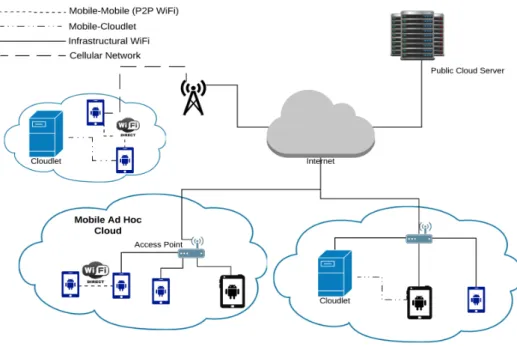
The general architecture of the framework is depicted in Figure 1.1. The objectives of the proposed solution include performance enhancement in terms of computational time by offloading resource-intensive computations to more powerful external resources, energy efficiency by reducing the computational overhead on the mobile device, context-awareness by making smart offloading decisions considering the associated cost of computation and offloading delay, code reusability by following a highly modular approach, and high adoptability by keeping the adoption of the application model easy for the application providers. The implementation of both the mobile client offloading library 1 and server
runtime environment solution 2 are open-sourced. The demonstration of the framework and integration guidelines are also publicly available 3.
The remainder of this chapter describes motivations for studying the challenges of dynamic mobile cloud environments in Section 1.1. Section 1.2 describes the research hypotheses of this thesis. Section 1.3 presents an overview of the contributions of this thesis. Section 1.4 lists the peer-reviewed papers that were published during the course of conducting this work. Finally, Section 1.5 outlines the structure of the rest of the chapters of this thesis.
1.1 Motivations and Challenges
This thesis is motivated by the notion that offloading parts of a mobile application to multiple sites can improve the performance and reduce the overall energy usage of the mobile device. The following motivations and challenges need to be considered in designing an adaptive and multisite offloading system:
Fig. 1.2 The hardware advancements of Samsung galaxy smartphones
Extending battery life
A study established that the most commonly expressed criterion for choos-ing a mobile phone in 2018 was the battery life, with over 46% of users nominating it as their “most important aspect” [132]. Poor battery life is among the many problems that confront mobile devices but the most
2https://github.com/mamoc-repos/MAMoC-Server 3https://github.com/mamoc-repos/MAMoC-Demo
1.1 Motivations and Challenges 5
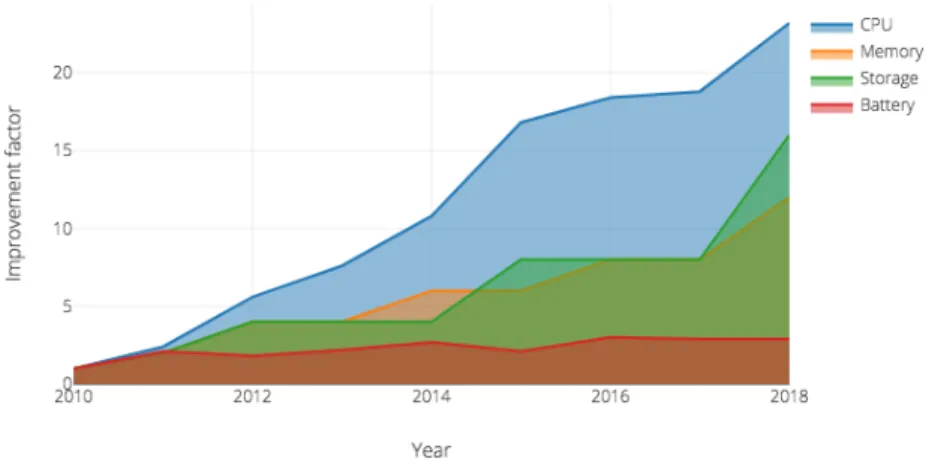
apparent one. The fact that the development of battery life is far behind other hardware advancements has been a struggle for device manufacturers in the last several years. As an example, it can be observed in Figure 1.2 for the Samsung galaxy family smartphones that the CPU performance has improved about 23 fold, memory storage about 12 and 16 fold respectively while the improvement in battery life is merely 2 to 3 fold.
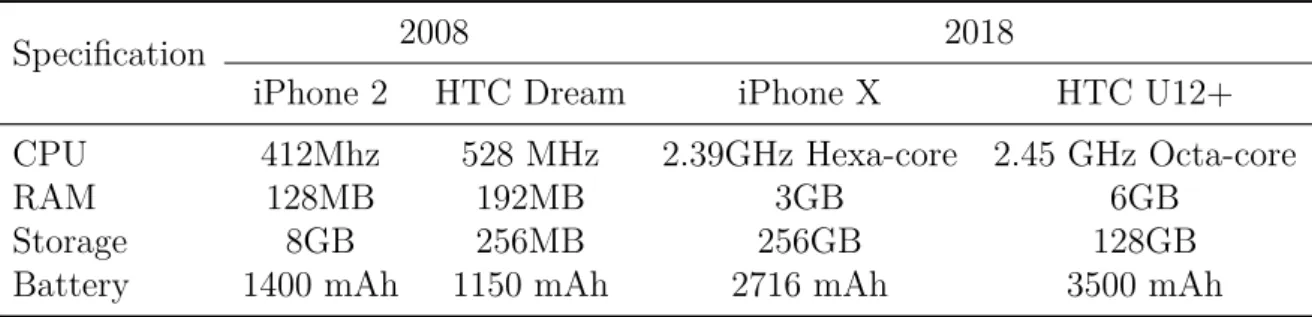
This trend can be identified across all mobile devices in the market. As an example, the hardware specifications of the first iPhone and HTC smart-phones with the latest releases of them in 2018 are listed in Table 1.1. It is evident that the battery capacity of iPhone smartphones has only doubled while the HTC battery is at most tripled. This is incomparable with the exponential growth of the other hardware parts of both smartphones.
Specification 2008 2018
iPhone 2 HTC Dream iPhone X HTC U12+ CPU 412Mhz 528 MHz 2.39GHz Hexa-core 2.45 GHz Octa-core
RAM 128MB 192MB 3GB 6GB
Storage 8GB 256MB 256GB 128GB
Battery 1400 mAh 1150 mAh 2716 mAh 3500 mAh Table 1.1 iPhone and HTC hardware advancements in the last 10 years
It is benchmarked that most of the battery energy is consumed with heavy computations, which causes overheating [160]. It is shown that the CPU power consumption to total power consumption can be up to 40% in the gaming applications [24]. Therefore, through offloading computation from mobile devices to external servers, we can decrease the load on the device and reduce the energy consumption of the heavy tasks which results in extending the battery life.
Availability of multiple service providers
The last few years have witnessed unprecedented growth in the number of mobile devices. People are becoming more reliant on their smartphones, and the cost of purchasing these devices has reduced in emerging markets. Globally, Cisco indicates that there will be 12.3 billion mobile-connected devices accumulating for around 1.5 mobile devices per person by 2022 [32] as shown in Figure 1.3. There are a vast amount of mobile cloud offloading systems that have been developed by different researchers. As described in Chapter 3, the majority of them use a single-site offloading, i.e., offloading
application parts from the mobile device to a single server. Moreover, the existing works do not provide a formal framework to include the overall offloading process; Rather, they conduct numerical results of their reference architectures through simulations. The vision of mobile computing among heterogeneous converged networks and multiple computing devices can be achieved by designing resource-efficient environment-aware mobile cloud systems.
Fig. 1.3 Global Mobile Devices and Connections Growth [32]
Dynamic nature of mobile cloud systems
The connection between mobile users and external cloud resources is not guaranteed. The non-persistent connection is a key factor distinguishing mobile cloud with conventional cloud systems. The essence of random unavailability of wireless connections in mobile cloud environments makes consistently beneficial offloading difficult. The presence of intermittent connections may fail the offloading request from the user, which causes the user to execute it locally or re-transmit the job again. Mobile device movement, jointly with unstable wireless networks, can lead to service failures in mobile cloud systems regularly. The performance of a certain type of cloud resources such as Mobile Ad-hoc Cloud (MAC) (i.e., mobile ad hoc networks) depends on routing protocols that are affected by the mobile device mobility. As a result, mobility management and fault-tolerance need to be considered providing a reliable mobile cloud service. Other examples of dynamic changes in the system include devices joining/leaving the cloud, battery running low, temperature rising too high, OS throttling the CPU, etc. Therefore, it is imperative to consider these changes before making computation offloading decisions at all times to avoid undesirable application performance.
1.1 Motivations and Challenges 7
(a) The file sizes of Android-x86 VM images
[104] (b) The file sizes of Android-x86 con-tainer images [155] Fig. 1.4 Android-x86 VM and container image file sizes
Deployment complexity of runtime environments
To design a reliable mobile cloud system, provisioned offloading servers with high availability need to be present to serve the offloading requests from mobile devices. Unfortunately, these solutions have not been implemented yet worldwide [51]. Many companies lack enough equity to cope with the expense of deploying small clouds at multiple base stations or other locations at the edge of the network. There is still an ongoing difficulty when trying to set up an offloading runtime environment based on Android server-side OS (Android x86) to serve offloading requests. Figure 1.4a shows the latest Android x86 image files of which the 64-bit OSs are over 800 Megabytes in size. Figure 1.4b shows an effort by researchers proposed in a paper [155] to run a lightweight version of Android on containers rather than Virtual Machine (VM)s. However, it is apparent that the size of the files is still too large. An investigation of reducing the size and simplifying the deployment of these solutions is required as well as the ease of managing the servers remotely.
Platform heterogeneity and inter-operability
The diversity of hardware architectures and operating systems in mobile devices makes it difficult to design a uniform mobile cloud system. In an “always offload” strategy, transmitting a large amount of data for remote execution may consume more time and energy than running it locally on the device itself. It would be more beneficial to acquire the same processing power in nearby mobile or fixed devices in the ad hoc network through parallel execution and low latency network transmission. Therefore, it is essential to develop intelligent decision-making strategies for selecting the right candidates in different scenarios. Network heterogeneity also needs to be taken care of in scenarios where mobile users switch to cellular networks when there is no WiFi network available. The energy consumption and
transmission speeds are different in these assorted types of wireless network interfaces. There is a need for a framework that can provide an abstraction of these heterogeneous, resource-constrained devices in order to allow for seamless development, deployment, and management of mobile applications.
Transparency and automation mechanisms
Even after enabling offloading between different devices with various com-putational capabilities; It is essential to hide these interactions from the user. Transparency is the ability to implement software without the need for manual program modification [83]. It is important for mobile phone users to have transparency and choice [44]. In offload-enabled mobile applications, invoking instrumentation transparently and selectively each time the appli-cation executes is a challenging task. Automated refactoring processes are needed to make application components follow an appropriate adaptation strategy.
1.2 Research Hypotheses
This thesis investigates two central hypotheses regarding optimising mobile devices through mobile computation offloading techniques. The first one is related to the goal of improving the performance of mobile applications by offloading parts of them while minimising the incurred energy consumption of the host mobile device. The second is concerned with facilitating the deployment of offloading service providers and automating the process of determining offloadable tasks. These two hypotheses are considered throughout this thesis and examined in the evaluations.
H1 Mobile devices can be seamlessly leveraged with all the surround-ing sites includsurround-ing nearby mobile devices and edge servers as well as distant cloud resources. Moreover, the decision to offload a task and identify the most optimal candidate for single-site offloading and the most optimal ranking of the candidates for multisite of-floading scenarios can be taken adaptively.
We are surrounded by a vast amount of both mobile and fixed devices. The number of smart device candidates increases every day. It is depicted that on average, a person would have two devices starting from lower-end devices such as smartwatches, wristbands, and smartphones all the way to higher specification computing devices including tablets and laptops [32]. Discovering nearby devices and performing offload operations can be a
1.2 Research Hypotheses 9
simple task between two homogeneous devices but it is not a primitive task with heterogeneous devices which have diverse hardware capabilities and software programs. Accordingly, a lightweight service discovery technique for seamless device integrations are needed to achieve that. The framework should provide an environment for homogeneous application development in such heterogeneous environments. The framework should further make it simple to offload parts of an application either to Nearby Mobile Devices or to Cloudlets and Remote Clouds to meet the application’s requirements. The framework should also support simple development, configuration and deployment tools to facilitate the life-cycle management of applications. The design of algorithms for adaptive application deployment and configura-tion are essential for seamless mobile offloading. To decide which deployment and configuration are optimal given a certain context at runtime, the decision engine with the help of the dynamic profilers should be capable of deciding whether the task is better off being executed locally on the device or send it to the external site(s) for remote execution. The solver then needs to check the availability of the sites and output a ranking among them with multiple criteria such as the execution speed, bandwidth, and availability of the sites. Decision methods and fuzzy logic for solving this optimization problem can be used when different optimisation goals are considered, such as minimising execution time and energy usage.
H2 The process of deploying runtime environments for serving of-floading requests from mobile devices can be simplified. It can farther be utilised to automatically identify offloadable tasks in unmodified mobile applications when manual task annotation is infeasible.
One of the bottlenecks of computation offloading solutions is setting up service provider runtime environments in the offloading sites. Previous MCC studies have used VMs to host mobile operating system images in the cloud. Hardware virtualization allows different guest operating systems to coexist in the same physical server. The main drawbacks of using VMs are the long startup time and high virtualization overhead. Heavyweight VM solutions cannot meet these requirements. Though pre-starting the VM can reduce its startup time, it would inevitably incur a high resource cost due to numerous offloading requests. Moreover, it cannot work as a service provider for different mobile devices with various architectures. Because of the aforementioned heterogeneity in mobile devices, different runtime
environments need to be deployed for handling service providers. Decreasing the boot-up time and deploying a uniform and loosely coupled runtime environment which accommodates to serving offloading requests from mobile devices with different capabilities can greatly simplify this process.
During the evolution of a mobile application, the developer can manually annotate the classes or methods that are compute-intensive to be executed remotely. However, to support the existing mobile applications in app stores, an automation process needs to be designed to enable the offloading mechanism even without access to the original source code. Static analysis and bytecode injection tools can be used to allow us to overcome the difficulty of supporting arbitrary mobile applications where it is impractical to solicit developers for manual annotation.
1.3 Contributions of This Research
1. A comprehensive review of the mobile cloud architectures and a derived taxonomy of multisite MCO research works.
2. An adaptive task offloading algorithm for individual mobile devices to make offloading decisions based on the context changes in dynamic mobile cloud environments.
3. An offloading site ranking system based on Multi-Criteria Decision Methods (MCDM) and fuzzy logic to select candidate offloadees and achieve different
optimization goals using group decision-making concept.
4. An overview and discussion of the design principles and challenges of imple-menting MAMoC, a system framework to enable mobile task offloading for heterogeneous mobile cloud systems that can be used as a simple program-ming model to build mobile cloud applications.
5. A loosely coupled, router-based, containerized, and lightweight runtime environment for serving the mobile offloading requests on the heterogeneous offloading sites for providing a more scalable and reliable offloading service. 6. Seamless support for arbitrary mobile applications by determining the set of tasks that can be offloaded without any constraints. An automated task annotation methodology using static analysis and code instrumentation techniques is proposed when the manual annotation is infeasible.
1.4 Publications 11
1.4 Publications
The work conducted in the course of my PhD resulted in publishing a number of peer-reviewed papers in international conferences. The major works including the framework design, implementation, and evaluations presented in ??,??, and Chapter 6 are extracted from the publications with necessary modifications. The papers are listed as follows:
• Dawand Sulaiman and Adam Barker, "MAMoC-Android: Multisite Adaptive Computation Offloading for Android Applications", 2019 7th IEEE Interna-tional Conference on Mobile Cloud Computing, Services, and Engineering (MobileCloud), Newark, CA, USA, 2019, pp. 68-75. [137]
• Dawand Sulaiman and Adam Barker, "MAMoC: Multisite Adaptive Offload-ing Framework for Mobile Cloud Applications" 2017 IEEE International Conference on Cloud Computing Technology and Science (CloudCom), Hong Kong, 2017, pp. 17-24. [136]
• Dawand Sulaiman and Adam Barker, "Task Offloading Engine for Het-erogeneous Mobile Clouds." In Proceedings of The 8th EAI International Conference on Mobile Computing, Applications and Services. ACM, 8th EAI International Conference on Mobile Computing, Applications and Services, Cambridge, United Kingdom, 2016. [135]
Additionally, a survey paper will be extracted from the contents of Chapter 3 and will be published in a Journal.
1.5 Organisation of The Thesis
The remainder of this thesis is structured as follows:
• Chapter 2 provides a detailed overview of mobile cloud architectures and key techniques including computation offloading and related research area. • Chapter 3 explains the multisite offloading in the area of MCO and collects the literature work. Moreover, state-of-the-art on multisite MCO is provided in the form of a systematic review.
• Chapter 4 defines the system requirements and models and formulates the problem of offloading to multiple offloading sites in terms of execution time and energy consumption. It also explains the offloading policy and decision making algorithms that are core parts of the offloading decision engine. Additionally, it describes MCDMs that are used to evaluate and rank the candidate offloading sites.
• Chapter 5 discusses the design assumptions and the components of the mo-bile offloading framework. It also describes the different phases of the task execution workflow. Moreover, it provides an overview of the communication mechanisms used in the service discovery module for handling communica-tions between Host Mobile Device and offloading sites. The chapter also highlights interesting aspects of the implementation of software components within the framework in both Host Mobile Device and offloading sites. • Chapter 6 evaluates the framework through four sets of real-world
experi-ments, evaluates the proposed design requireexperi-ments, analyses and discusses the results, and presents the evaluation limitations.
• Chapter 7 presents a summary of the thesis, revisits the hypotheses and the contributions, and proposes future research directions.
Chapter 2
Background
This chapter presents the background and context of mobile cloud architectures and setting the ground for next chapter to review the existing work in research and development of multisite offloading approaches. It begins with the background technologies of the different mobile cloud architectures and a comparison of the different paradigms in Section 2.1. Then, it describes computation offloading with a focus towards the two important aspects, including adaptability and multisite offloading features in Section 2.2. Finally, Section 2.3 describes some of the main technologies and communication mechanisms used in the field of MCC research.
2.1 Mobile Cloud Architectures
The global mobile data traffic handled by Cisco has grown 4,000 fold over the past 10 years and almost 400 million fold over the past 15 years. The data traffic grew 74 per cent in 2015 reaching 3.7 Exabytes per month at the end of 2015, up from 2.1 Exabytes per month at the end of 2014 [32]. This is mainly because of modern data and computation-intensive mobile applications that are resource hungry and cannot be run locally. To cater to ever-increasing requirements for storage and network resources, efficient data distribution and optimization techniques need to be adopted. The result of the vast growth in the number of mobile devices along with transferring data and compute-intensive applications to the cloud has led researchers to search for more effective and intelligent ways to create this two-way relationship.
The current MCC trend has set the focus on the ubiquity of computation. However, the main current cloud platforms still confine the servers into datacenters, which are far from the users. Distance leads to increased energy consumption in the network, higher utilization of the broadband Wide Area Network (WAN) and
poor client experience, especially for latency-critical applications. As a solution, distributed architectures try to locate computation among different sites. These distributed cloud architectures that bring data closer to the client are emerging as an alternative to centralised ones.
In this section, an overview of the most researched areas in mobile cloud studies is discussed, starting with MCC and its three different models. The more recently emerged post cloud computing studies which are Edge Computing and Fog Computing and their approaches are explained regarding mobile device augmentation. Finally, the similarities and differences between these paradigms are demonstrated with real-world use cases and supporting statistics.
2.1.1 Mobile Cloud Computing
Advancements in mobile device technologies have led to the production of more complicated and interactive applications such as face recognition, real-time video, healthcare monitoring, Augmented Reality, and Virtual Reality mobile applica-tions. The common feature between these applications is that they all need high processing power and fast and near real-time response time. Due to these require-ments, the concept of computation offloading from mobile devices to resourceful cloud servers has been introduced as MCC. The complicated computation-intensive modules of the mobile applications can be easily executed with a fast response time on the powerful remote surrogates [77]. However, the performance of offloading is highly affected by the available bandwidth and latency [129]. Mobile computation offloading will be explained in detail in Section 2.2.
MCC is an emerging paradigm that encompasses mobile computing, cloud computing, networking and virtualization. It is well studied in the literature. There are many extensive MCC surveys in the literature [44] [128] [38] [76]. MCC can support mobile devices through either computation augmentation which is about leveraging powerful external resources to execute the heavy parts of the application or storage augmentation for using the excessive data storage capabilities of the cloud [163].
Because of high latency and low bandwidth issues of remote cloud servers in traditional MCC studies, researchers have suggested using one-hop away powerful surrogates to the mobile devices in the form of Cloudlets which is discussed in Section 2.1.1.1. As smartphones and tablets gain more CPU power and longer battery life, the meaning of MCC gradually changes. Instead of being fully hooked to Remote Cloud, a number of Nearby Mobile Devices can be used to coordinate and distribute content in a decentralized manner discussed in Section 2.1.1.2.
2.1 Mobile Cloud Architectures 15 2.1.1.1 Cloudlet
Cloudlet is viewed as a small-scaled cloud having a cluster of computers that is well-connected to the Internet serving mobile devices in close proximity. In this way, we manage to overcome the high latency problem faced in the traditional MCC approaches, which depend on Remote Cloud servers only. The idea of using cloudlets (surrogates) as near fixed devices was introduced in [120] in which the mobile device offloads its workload to a local cloudlet comprised of several multi-core computers with connectivity to the remote cloud servers. Satyanarayanan [119] uses four futuristic scenarios as case studies for the facts on the architectural evolution of mobile cloud computing from a 2-tier (mobile device - cloud) to a 3-tier (mobile device - cloudlet - cloud). Several approaches to this design are mentioned in this paper, such as VM synthesis and code offloading. Alongside solving latency issues, he sheds light on other value propositions of cloudlets such as the bandwidth, crowd-sourcing, privacy and security, and availability.
From an energy point of view, offloading to cloudlet saves energy because of access to the short-range wireless connection [48]. Sending and receiving data not only claims large shares of wireless bandwidth but also drains the battery of mobile devices. It is shown that despite several new power-saving mechanisms of 4G/LTE cellular data; it requires 23 times more power than WiFi and it is less power efficient than 3G [61]. In some works, the resource-intensive application tasks are first offloaded to the cloudlet, and then later to nearby devices in the LAN or remote cloud resources if needed [147]. In case the connection to cloudlet service is interrupted, the offloaded tasks can be retrieved back and send them to be executed on alternative avenues.
The main goal of using cloudlets is to be able to reduce the response time in order to meet the needs of some latency-sensitive applications [49]. The advantage of being close to the user allows us to achieve this goal but does not provide us with the same computation and storage capabilities as those of the remote cloud. Thus, its computing capacities are limited to certain services. In addition to its proximity to the users, Cloudlet also has the advantage of being exploited by mobile users who do not even have an Internet connection [120].
2.1.1.2 Mobile Ad-hoc Clouds
The concept of Ad-hoc Cloud Computing has been discussed in [91]. According to [44], apart from offloading to central clouds, there are two other definitions of MCC. The first is where some mobile devices act as cloud resource providers forming a Peer-to-Peer (P2P) network. In this model, the mobile devices in the
local vicinity and other stationary devices (if available) would create an ad-hoc network which can be accessed by other mobile devices in order to run their applications. Theoretically, this model allows offloading the tasks to the mobile devices that form the virtual resource cloud. Besides, latency is also reduced, since the mobile users only have to access the virtual cloud resource instead of traversing lots of hops to get to the Remote Cloud.
MACs are about leveraging the computational capabilities of the surrounding mobile devices by having them as resource nodes. It is also known as Mobile Device Clouds (MDC) [95], Mobile Edge Clouds (MEC) [40] [14] [45], and Virtual Computing Provider for Mobile Devices [62]. The most well-known works at accomplishing resource sharing and data distribution among mobile devices in the vicinity include Hyrax [90], Scavenger [75], Serendipity [124], and Cirrus [122].
2.1.2 Mobile Edge Computing
In order to reduce latency between end-users and service providers, without dropping the main benefits of MCC, Mobile Edge Computing (MEC) has emerged as a new paradigm where the functions that have been traditionally located in a remote datacenter are called back to locations nearer to the user, e.g., networking devices in the access network with spare or added computational capabilities. MEC resources may offer more limited capacities or reliability guarantees than core resources but are geographically spread closer to the end-users, providing smaller network latencies [81].
MEC is the new evolution of mobile networking by providing computation capabilities in base stations. Theoretically, data would only need to travel a few miles between customers and the nearest cell tower or central office, instead of hun-dreds of miles to reach a cloud datacenter. Mobile edge servers are co-placed with the mobile network base station at the edge of the mobile network. Mobile edge hosts in network operators are connected to the mobile core. User equipments are connected to hosts that contain local VMs through API endpoints. The white paper proposed by the European Telecommunications Standards Institute (ETSI) [60] introduced the MEC concept with its reference architecture and application scenarios. MEC is widely regarded as a promising paradigm to enable mobile terminals to enjoy the abundant wireless resource and vast computation power ubiquitously [86].
Cloudlet can be considered as an edge server for their common objectives to bring computation closer to the end-user [59]. The authors at [81] explain the several related computing paradigms to Edge Computing including Content
2.1 Mobile Cloud Architectures 17
Delivery Networks (CDN) [144] and P2P computing, among the others. There are also attempts to combine the concept of Cloudlets and Edge Computing in designing future mobile cloud systems [64]. Similar to cloudlets, the MEC system has several advantages including low latency, content caching, traffic monitoring, local aggregation of information, and local services. It should be noted that the ultimate goal of MEC is to increase the bandwidth, reduce the latency and jitter, and provide Quality of Service (QoS) for mobile apps. There are many use cases of MEC, such as CDNs, smart grids, augmented reality, and traffic management [1].
2.1.3 Mobile Fog Computing
Fog Computing was first proposed by Bonomi et al. [17] that describes it as a scenario where a huge number of heterogeneous ubiquitous and decentralised devices communicate and potentially cooperate among them and with the network to perform storage and processing tasks. These tasks can be for supporting basic network functions or new services and applications that run in a sandboxed environment. The rise of the Internet of Things (IoT) popularity made Fog Computing interesting to researchers and practitioners. In IoT, a huge amount of sensors are deployed everywhere. For low-capacity sensors, the best place to process data from these sensors should not be far away cloud servers [87]. Instead, devices such as routers and switches are better choices.
Mobile Fog Computing (MFC) is considered as the complementary of Fog Computing for providing low latency mobile services [58]. Mobile Fog proposed by Hong et al. [56] is a high-level programming model for latency-sensitive and large-scale future applications over heterogeneous devices. Applications can invoke event handling and function calls by the model. The model is evaluated with a simulated use case of a vehicle tracking application where the traffic cameras are used to help police identify and track certain vehicles. The compute-intensive functions of the application, such as license plate recognition, video streaming are all performed on the intermediate fog nodes before the data are sent to Remote Clouds.
Fog computing and Edge Computing have a number of similarities. Although, Fog Computing mainly focuses on communication optimization at the infrastruc-ture level, while Edge Computing manages the computing needs and network demand of both end devices and infrastructure, including the collaboration among end devices, edge servers, and remote cloud.
Fig. 2.1 Fog computing architecture [118]
2.1.4 Comparison of Mobile Cloud Architectures
In this section, the different mobile cloud approaches are compared in Table 2.1. The evaluation is based on the following properties, which have been chosen due to their effects on the Quality of Service of mobile applications:
Latency: This property evaluates how fitting is the system for latency-critical applications. In some mobile applications such as Augmented Reality, users request low latencies to avoid having slow frame loading, which affects the performance. As shown in Table 2.1, MCC solutions that offload to Remote Cloud servers have a high latency which does not make them ideal candidates for low latency applications. The delay-sensitive mobile tasks are ideally offloaded to the cloudlets or nearby devices. On the other hand, differences between Edge Computing and Fog Computing are dependent on the location of the edge servers to the mobile user as they are confined to the edge infrastructures.
Distance: This depicts the physical distance of the infrastructure providing the service to the mobile device. This is closely related to the latency due to the
2.1 Mobile Cloud Architectures 19
number of network hops that are being introduced further the mobile device gets to the servers. Nearby local devices are usually within 10-20 meters away, while the Cloudlets and edge servers can be as far as a kilometre to Host Mobile Device.
Deployment: The cloud service providers such as AWS and Azure are usu-ally the sources of Remote Cloud servers. To resolve latency issues, fixed surrogates can be deployed in the vicinity to be a one-hop away from the mobile device in the form of Cloudlets. These can also be in the form of macro-datacenters, small clouds, femtocells, etc. MEC servers are deployed in Radio Access Networks which can provide fast services to mobile users.
Computation Power & Storage Capacity: The abundance of resources at cloud data centers and the elasticity feature of Cloud Computing allow for ample computation power and storage capacity. Even though cloudlets and nearby devices solve the latency issues of far clouds, their computation power is rather limited. Edge and Fog Computing use a distributed set of powerful servers deployed in the network edges to provide powerful services to mobile users.
Communication Medium: Mobile devices connect to different service providers using different wireless technologies. Since the public cloud infrastructure is accessed through the Internet, both Wi-Fi or cellular technologies can be used to establish connections between them. Cloudlets are deployed in Local Area Network (LAN) so they can be connected to devices in the local network. Traditionally, Bluetooth has been the most popular choice for Device-to-Device (D2D) communications. However, there are multiple new approaches to achieving nearby peer connection establishments, such as WiFi-Direct and ZigBee [19]. The Edge servers are mainly deployed in network servers, so cellular technologies such as 3G/4G are the common network interfaces to connect to them.
Architecture: The architecture tier is a physical structuring mechanism for the system infrastructure in which the computation levels depend on the existence of devices and communications. The most common architecture is when the mobile device is only connected to a single Remote Cloud server that forms a 2-tier mobile-cloud architecture. Cloudlets are used as middle managers to form a 3-tier mobile-cloudlet-cloud architecture for enabling the cloudlet to be closely connected to both the mobile device and the cloud. The MAC devices are normally in the same architecture tier. Meanwhile,
MEC and MFC do not have a standard architecture so devices in different cloud resource levels can be included such as smart routers, nearby mobile devices, forming a multi-tier architecture as shown in Figure 2.1.
Availability: Service availability is one of the most important factors affecting responsiveness and energy consumption in mobile device augmentation scenarios. Cloud providers guarantee high availability of services through a Service Level Agreement. Although cloudlets are deployed close to mobile users, in cases of service churns and multi-user requests, the limited server might not be able to serve all the users in the same way as remote cloud servers. As for MAC, because of the mobility feature of nearby mobile devices, it makes them highly volatile and could become non-available on the fly [93]. MEC and MFC solve the issue of mobility using horizontal and vertical handoff strategies to avoid service disruptions for mobile users [86].
Use Cases: The applications running on Cloudlets and Nearby Mobile Devices are typically time critical and require very low computing and communication latency in an environment with limited bandwidth, and limited computing power. For example, applications such as Linpack (computation-intensive), 3D Car Racing (intensive) and Chess (computation & interaction-intensive) [147]. MEC is actively used in smart city planning and video surveillance scenarios [86] while MFC conducted studies are mainly targeted towards IoT applications [17].
Operators: Cloudlets are mostly deployed by an individual or a local business such as a coffee shop owner [49]. Since MAC is developed in an ad-hoc fashion, it can be performed locally by an individual or a number of individuals within an organization. The network providers have added powerful edge servers in their base stations to enable MEC [88]. Fog nodes can either use the edge servers in base stations or cloud servers in cloud service providers [158].
2.1 Mobile Cloud Arc hitectures 21
Table 2.1 Comparison of mobile cloud related paradigms
Property Core CloudletMCC MAC MEC MFC
Latency High Low Low Low Relatively low
Distance Far Close Very close Close Relatively close
Deployment Data centers Fixed surrogates Nearby devices Network edge
(RAN) Fog nodes
Computational power & Stor-age capacity
Ample Limited Very limited Fair Ample
Communication
medium WiFi/Cellular WiFi WiFi/Bluetooth Cellular WiFi/Cellular
Architecture 2-tier 2-tier or more 2-tier 2-tier or more 3-tier or more
Availability High Average Low Average High
Use cases Social networking,
health care VR) appsImmersive (AR & Disasterlief, privacy- re-preserving local processing
Video surveillance, video caching, traf-fic control, health monitoring, AR
IoT, Connected ve-hicles, smart city, smart delivery
Operators Cloud service
providers local businesses self-organized Networktructure providers infras-(RAN-based)
Cloud service providers and net-work infrastructure providers
2.1.5 Discussion
The centralised processing model uploads computation and data to the cloud datacenter through the network and leverages its ample power to solve the com-puting and storage problems of resource-constrained devices. However, traditional cloud computing has several shortcomings, including high latency and insufficient bandwidth, which leads to high energy consumption for limited devices.
While Cloudlets are mostly managed by individuals and can be deployed at any appropriate location such as coffee shops and university campus buildings [49], MEC servers are owned by mobile operators and need to be located near the base stations in order to provide access to the mobile network users over Radio Access Network (RAN). This helps operators to increase service quality through effective mobility management besides the benefits of utilising cloud-like resources at the edge [86] to perform computation offloading on edge [89]. Computation offloading techniques formulated for cloud technologies are now common to edge and fog computing paradigms. Many researchers have pursued the idea of offloading computation to multi-site or heterogeneous resources at once [86].
A notable difference between Cloudlets and both MEC and MFC is in the virtualization technology. Most of the cloudlet research work use VM technology for virtualization [147], while Edge and Fog studies consider other types of virtual-ization techniques [88]. Another difference is that MEC functions in a stand-alone mode where the tasks are processed at the edge of the network. Cloudlets can function in either stand-alone mode or connected to a cloud. Meanwhile, MFC is designed as an extension to the cloud, so it is mainly in connected mode. More-over, Cloudlets are mainly designed for mobile offloading solutions (e.g. wearable cognitive apps [26]) while MEC aims at any application that is better provisioned at the edge. Fog-enabled applications can span the public cloud and network edge. This is demonstrated in the firefighting application use-case in [158].
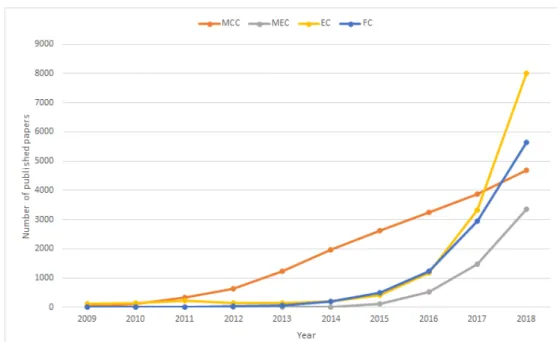
To examine the popularity of these different paradigms, we use a tool [134] to find the published academic papers for each of the aforementioned techniques. As we can note from Figure 2.2, MCC has been well researched and kept the pace from 2012 until recently where Edge Computing (EC) and Fog Computing (FC) papers have gained more popularity. This could be due to the more modern approaches of EC and FC to include a wider spectrum of devices (e.g. IoT devices) instead of only focusing on smartphones which most of the MCC research has been centralised around it. Since 2015, the number of papers related to Edge/Fog Computing has grown tenfold. EC has entered the rapid growth period. Researchers have also been investigating MEC which started around the same time
2.2 Mobile Computation Offloading 23
Fig. 2.2 Number of published papers by year for MCC, MEC, EC, and FC the EC attracted the attention of academia and industry. The pace of it might not keep up with EC and FC as the name was currently changed to Multi-access Edge Computing (MEC) to include a wider variety of devices [138].
2.2 Mobile Computation Offloading
Offloading computation from a weaker device to a more powerful server is not a new concept. The first attempt to conserve the energy consumption of laptops was introduced by offloading larger tasks to fixed surrogates [114]. Then, the concept of cyber-foraging was termed in [10] for offloading parts of applications from mobile devices to nearby discovered servers. Computation offloading either fully or partially migrate the resource-heavy parts of a mobile application to nearby resource-rich surrogates such as computational clouds. Computation offloading not only conserves the usage of local resources such as memory, battery, and storage but also enables execution of computation-intensive applications in mobile devices.
MCO is a mechanism to enable mobile devices to run mobile applications that require extensive computation and communication [84]. It extends battery life by moving the computation-intensive portions of the application to external resources with greater computation power. In addition, it decreases latency and communication costs by using single-hop proximity to nearby devices [49]. This improves the user experience, especially in highly interactive applications that
Fig. 2.3 Computation Offloading Process Overview [4]
require high bandwidth and low latency. Figure 2.3 illustrates the environment that supports computation offloading. In this overview, the mobile device decides to offload method B to a cloud server or a powerful machine. The cloud here provides virtual computation resources to run the offloaded components. It can be another device, a server or cluster in a nearby location or a virtual server in the public cloud datacenters.
To enable computation offloading, an offloading client needs to be running on the Host Mobile Device and an offloading server in the external resources. They need to be able to communicate for coordinating the offloading operation. After the application starts executing, the invoked task that has been identified as offloadable will be passed to the offloading client. The offloading client can either follow the "always offload" scenario where every invoked task will be offloaded, or an offloading runtime decision is made (based on a comparison of local and remote execution times or energy consumption) before transferring the task to the offloading server. Any other metadata (invocation parameters, resource files, etc.) will also be provided to the offloading server. The offloaded component starts executing and communicates directly with the mobile app for sending back the results of the remote execution.
Since offloading migrates computation to a more resourceful computer, it involves deciding whether and what computation to migrate. A vast body of research exists on offloading decisions for (1) improving performance and (2) saving energy. The offloading decision making is the bottleneck and the most prominent part of the mobile computation offloading process. This offloading decision making process is being affected by more than a factor [76]. The four
2.2 Mobile Computation Offloading 25
aspects of offload decision making are studied in mobile cloud offloading scenarios [152].
When to offload: an optimal offloading decision has to be made at the right time to offload under different conditions of the device, such as available bandwidth, amount of data to be transferred, and energy to execute.
What to offload: in dynamic mobile environments, full offloading is not always beneficial, so choosing the right component to offload by splitting a specific application into local and remote parts is also important.
Where to offload: since mobile devices are surrounded by multiple offloading sites, it is essential to find the optimal site in which the computation to be offloaded under different cloud resource conditions.
How to offload: Due to the heterogeneity of communication networks available between the mobile device and cloud resources, the right path to offload needs to be determined.
2.2.1 Adaptive Offloading
A system is considered being adaptive if it is designed to continuously monitor its environment and then modify its behaviour in response to changing environmental conditions [15]. Mobile computation offloading systems are affected by wireless network characteristics and the capabilities of available external resources. The workload also varies depending on the applications that are running on the mobile device. For designing an effective offloading system, a range of environmental variables such as bandwidth variation, intermittent connectivity and user expecta-tions need to be considered [15]. User expectaexpecta-tions need to be incorporated into the architecture of the offloading system. The different parameters that are set by user preferences need to be defined in the deployed mobile application.
In mobile computation adaptive offloading, the system needs to implement sufficient and accurate change detection mechanisms to detect the changes in the dynamic environment. It has to be responsive to the changes and ensure a fast, accurate, user transparent, and low overhead techniques for change detection. The quality-aware opportunistic response mechanism can be implemented by employing adaptive techniques for using the available resources and by implementing high-quality degradation of the execution when network connectivity is lost or another failure occurs. The authors of [74] propose a lightweight application partitioning mechanism to achieve seamless computational offloading. The partitioning decision
![Fig. 2.1 Fog computing architecture [118]](https://thumb-us.123doks.com/thumbv2/123dok_us/10134596.2914457/38.892.215.653.144.614/fig-fog-computing-architecture.webp)
![Fig. 2.3 Computation Offloading Process Overview [4]](https://thumb-us.123doks.com/thumbv2/123dok_us/10134596.2914457/44.892.181.683.142.435/fig-computation-offloading-process-overview.webp)