Representation Theory
and Polytopes
Habilitationsschrift
zur Erlangung des akademischen Grades
doctor rerum naturalium habilitatus (Dr. rer. nat. habil.) der Mathematisch-Naturwissenschaftlichen Fakultät
der Universität Rostock.
vorgelegt von Frieder Ladisch, geboren am 25. März 1977 in Karlsruhe, aus Rostock. Eingereicht: 1. Juni 2017 Verteidigt: 18. Januar 2018 urn:nbn:de:gbv:28-diss2018-0026-2
Institut für Mathematik 18051 Rostock (Germany) [email protected]
Research supported by the Deutsche Forschungsgemeinschaft (DFG), Project: SCHU 1503/6-1.
Gutachter:
Prof. Dr. rer. nat. habil. Achill Schürmann Institut für Mathematik, Universität Rostock. Peter McMullen, Emeritus Professor, Ph.D., D.Sc. University College London.
Prof. Dr. rer. nat. habil. Rudolf Scharlau
Fakultät für Mathematik, Technische Universität Dortmund. Eingereicht: 01. Juni 2017
Probevorlesung: 21. Dezember 2017 Kolloquium: 18. Januar 2018
2010 Mathematics Subject Classification: 52B15 Symmetry properties of polytopes
05E18 Group actions on combinatorial structures
20B25 Finite automorphism groups of algebraic, geometric, or combinatorial structures
20C10 Integral representations of finite groups 20C15 Ordinary representations and characters
52B05 Combinatorial properties of polytopes and polyhedra 52B20 Lattice polytopes
90C10 Integer programming Keywords and Phrases:
Orbit polytope, group representation, affine symmetry, generic symmetry, repre-sentation polytope, permutation polytope, character, core point, lattice polytope, integer linear programming, Birkhoff polytope, abstract regular polytope
Preface
The present habilitation thesis concerns applications of the representation theory of finite groups to polytopes and their symmetries, and in particular, orbit polytopes. This is a cumulative thesis, and so the main part of this thesis consists of papers (listed on Page 23) which are already published, or submitted for publication. All
papers are also available from the preprint server arXiv.
The papers contained in this thesis have been written at the Institute for Mathematics of the University of Rostock between 2014 and 2017. I wish to thank the members of the Geometry group in Rostock for their collegiality and for stimulating discussions. In particular, I wish to thank Achill Schürmann for his steady support and encouragement during the writing of this thesis, and Erik Friese for the many discussions that led to our two joint papers.
Since 2015, the author is supported by the Deutsche Forschungsgemeinschaft (DFG), Project SCHU 1503/6-1.
Frieder Ladisch Rostock May 2017.
For the publication of this thesis, the references were updated, and the comments of the referees of the corresponding papers have been incorporated (in ChaptersII, IV and VI).
F. L. January 2018
Preface iii
I. Introduction 1
1. Polytopes and their different symmetries . . . 2
2. Orbit polytopes . . . 4
3. Affine symmetries of orbit polytopes . . . 8
4. Groups with a nontrivial ideal kernel . . . 13
5. Core points . . . 16
6. Two properties of the Birkhoff polytope . . . 19
7. Realizations of abstract regular polytopes. . . 20
8. Contributions to this thesis . . . 22
Papers contained in this thesis . . . 23
References . . . 24
II. Linear Symmetries of Orbits and Orbit Polytopes 31 (Erik Friese and Frieder Ladisch) 1. Introduction . . . 31
2. Affine and linear symmetries . . . 39
3. Computing linear symmetries . . . 41
4. Generic points . . . 43
5. The generic symmetry group . . . 51
6. Representation polytopes . . . 55
7. Generic symmetries and left ideals. . . 58
8. Orbit polytopes as subsets of the group algebra . . . 59
9. Representation polytopes as subsets of the group algebra . . . 64
10. Character criteria . . . 68
References . . . 71
III. Groups with a Nontrivial Nonideal Kernel 75 (Frieder Ladisch) 1. Introduction . . . 75
2. Skew-linear characters . . . 77
3. The nonideal kernel . . . 80
4. Dedekind groups . . . 83
5. Classification over the reals . . . 85
6. Classification over the rational numbers . . . 88
Acknowledgment . . . 95
References . . . 95
IV. Classification of Orbit Symmetry Groups for some Fields 97 (Erik Friese and Frieder Ladisch) 1. Orbit polytopes of elementary abelian 2-groups . . . 97
2. Classification of affine symmetry groups of orbit polytopes . . . . 101
3. Classification of affine symmetry groups of rational orbit polytopes 106 4. Open questions and conjectures . . . 109
Acknowledgments . . . 112
References . . . 112
V. Equivalence of Lattice Orbit Polytopes 115 (Frieder Ladisch and Achill Schürmann) 1. Introduction . . . 115
2. Equivalence for core points . . . 117
3. Preliminaries on orders . . . 119
4. Finiteness of equivalence classes . . . 121
5. Rationally irreducible . . . 124
6. Application to integer linear optimization. . . 132
References . . . 135
VI. Uniqueness of the Birkhoff Polytope 139 (Barbara Baumeister and Frieder Ladisch) 1. Introduction . . . 139
2. Preliminaries on permutation actions on a group . . . 141
3. The combinatorial symmetry group of the Birkhoff polytope . . . 143
4. Characterization of the Birkhoff polytope . . . 145
Acknowledgments . . . 147
References . . . 147
VII. Realizations of Abstract Regular Polytopes from a Representation Theoretic View 149 (Frieder Ladisch) 1. Introduction . . . 149
2. Realizations as G-homomorphisms. . . 151
3. The structure of the realization cone . . . 155
4. Counterexamples to a result of Herman and Monson. . . 160
5. Orthogonality . . . 164
6. Cosine vectors and spherical functions . . . 166
7. On the realizations of the 600-cell . . . 169
References . . . 173
Chapter I.
Introduction
The character theory of finite groups was invented by Ferdinand Georg Frobenius on April 12, 1896 in a letter to Richard Dedekind1, motivated by finding the
factorization of the group determinant. Soon thereafter, Frobenius introduced the general notion of a representation of an abstract group. The theory was further developed and simplified by William Burnside, Issai Schur, Emmy Noether, and Richard Brauer, to name only a few.
On the one hand, the representation theory of finite groups is a beautiful subject in its own right. On the other hand, it was soon realized that this theory provides a powerful tool to prove theorems about finite groups. For example, Burnside used character theory to prove that groups of order paqb (p and q primes) are solvable, or that a transitive permutation group of prime degree pis either doubly transitive, or permutation isomorphic to a proper subgroup of AGL(1,Fp), the group of affine transformationsFp →Fp. But the range of applications of representation theory is not limited to pure mathematics, and includes subjects such as physics, chemistry, engineering and statistics. Indeed, whenever some object is given, which is or can be embedded into a linear space, and when this object has symmetries, then representation theory can usually be applied in profitable ways.
In this thesis, we apply this philosophy to the study of symmetry properties of polytopes. Symmetric polytopes in dimension 3 have fascinated mathematicians since antiquity, the most famous examples being the five Platonic solids. The Platonic solids are polytopes that are “as symmetric as possible”. Making precise this statement leads to the definition ofregular polytopes in arbitrary dimension [26].
In the papers contained in this thesis, we are mostly concerned with a larger class of symmetric polytopes, namely orbit polytopes. These can be characterized as polytopes whose (linear) symmetry group acts transitively on their vertices. Equivalently, an orbit polytope is the convex hull of an orbit of a point v ∈ Rd under a finite group G⊂AGL(d,R).
Of course, all of the well known regular polytopes are orbit polytopes. By (one) definition, the Archimedean solids are orbit polytopes in dimension 3 such that all faces are regular polygons (By another definition, the pseudo-rhombicuboctahedron
1This is one of the few instances where one can assign a specific date to the birthday of a whole
mathematical theory.
is also an Archimedean solid, which is not vertex transitive. Indeed, many authors do not clearly distinguish these definitions [35].) Another classical example is the permutahedron [17], which is an orbit polytope of the symmetric group Sn in its standard representation (permuting coordinates of Rn). Other permutation groups yield orbit polytopes which are important in combinatorial optimization, for example the (symmetric or asymmetric) traveling salesman polytope [6, 68].
A particularly interesting case are orbit polytopes of finite reflection groups, which are often called generalized permutahedra, or simply permutahedra [17, 43, 44, 58, 78]. The classical Wythoff construction [25, 26, 27] basically consists in taking orbits under a reflection group to construct polytopes or tessellations of a sphere. In particular, Coxeter [25] has shown that several uniform polytopes can be obtained as orbit polytopes of (finite) reflection groups by choosing a suitable starting pointv (see also [65]). In the language of Sanyal, Sottile and Sturmfels [73], orbit polytopes are polytopal orbitopes. (An orbitope is the convex hull of an orbit of a compact group, not necessarily finite. Convex hulls of orbits of compact groups were also studied by Barvinok and Blekherman [7].)
Ellis, Harris and Sköldberg [31] used orbit polytopes to compute free resolutions for finite groups (in the context of group homology).
An interesting class of orbit polytopes is formed by representation polytopes. A representation polytope is defined as the convex hull of D(G), where D: G→ GL(d,R) is a representation of an abstract finite group G. If the image group consists of permutation matrices, the polytope is called a permutation polytope. A well-known example is the celebrated Birkhoff polytope of doubly stochastic matrices (also known as assignment polytope), which is the convex hull of all permutation matrices of a fixed dimension. Permutation polytopes and some other special classes of representation polytopes have also been studied by a number of people [8,36, 42, 57].
In the papers included in this thesis, we study several special aspects of orbit polytopes, including a special property of the Birkhoff polytope. In the following, we give a more detailed summary of these papers and their relations to each other. We will recall the relevant definitions as we go along.
1. Polytopes and their different symmetries
Recall that apolytope P is the convex hull of a finite number of points v1, . . .,vn in some euclidean spaceV, without loss of generality V =Rd:
P = conv{v1, . . . , vn}:= { n ∑ i=1 λivi ⏐ ⏐ ⏐ n ∑ i=1 λi = 1, λi >0 } .
Thedimension dim(P) of a polytope P (or any subset P ⊆V) is by definition the dimension of its affine hull Aff(P) (the smallest affine subspace ofV containingP).
1. Polytopes and their different symmetries 3
A linear inequality atx6b isvalid for the polytope P if atx6b for all x∈P. A face of P is a set F of the form
F =P ∩ {x∈V |atx=b},
where atx6b is valid for P. The vertices ofP are the pointsv ∈V such that {v} is a face ofP. Thus the vertices correspond to the faces of P of dimension 0. We write Vert(P) for the set of vertices of a polytopeP. The faces of dimensions 1 and dim(P)−1 are callededges and facets, respectively.
By the Farkas-Minkowski-Weyl theorem, a polytope can equivalently be defined as a bounded subset ofRdwhich is the intersection of finitely many half-spaces. This is the dual description of the polytope. Another important fact is that each face of a polytope is the convex hull of the vertices of the polytope that are contained in the face in question. Thus we can (and often do) identify a face of P with the set of vertices ofP contained in it. The aforementioned facts can be found in any text on polytopes, for example in the first few lectures of Ziegler’s book on polytopes [77].
Now we recall the definitions of the different types of symmetries of polytopes. More generally, we consider isomorphisms between two polytopes P ⊂ V and Q⊂W, whereV and W are two euclidean spaces.
1.1 Definition. LetP ⊂V and Q⊂W be polytopes.
(a) AnisometryfromP toQ is a bijectionα: P →Qthat preserves (euclidean) distances.
(b) Alinear isomorphism between P and Q is a bijection α: P →Q that can be extended to a linear map from V intoW.
(c) An affine isomorphism betweenP and Q is a bijectionα: P →Q that can be extended to an affine map from V intoW.
(d) A combinatorial isomorphism fromP ontoQ is a bijection α: Vert(P)→Vert(Q)
that sends faces ofP onto faces of Q.
The isometry group or euclidean symmetry group of P is the group of all isometries fromP onto itself. Similarly,linear, affine or combinatorial symmetries of P are linear, affine or combinatorial isomorphisms of P onto itself. We write
Isom(P), GL(P), AGL(P), Comb(P)
for the orthogonal, linear, affine and combinatorial symmetry group of P.
The first three definitions make sense for arbitrary subsets S ⊆V and T ⊆W, and in particular, Isom(S), GL(S) and AGL(S) are defined for arbitrary subsets
vertices of P. In particular, we can identify Isom(P), GL(P) and AGL(P) with permutation groups on Vert(P), and then we have
Isom(P)⊆AGL(P)⊆Comb(P) and GL(P)⊆AGL(P).
It is easy to see by examples that these containments can be strict. It is also easy to see that each polytope P is affinely isomorphic to a polytope Q such that GL(Q) = AGL(Q) (simply translate P into a polytope with barycenter 0). Indeed, most questions about affine symmetries of polytopes reduce to questions about linear symmetries, which are usually easier to handle algebraically. On the other hand, GL(P) is not “intrinsically interesting” in the sense that GL(P) depends on the concrete embedding of the affine object P into a space, while AGL(P) is independent of the choice of a coordinate system of the surrounding affine space.
It is less obvious, but well known and not very difficult to see that each polytope P is affinely equivalent to a polytope Qsuch that Isom(Q) = AGL(Q). Basically, this follows from the fact that for each finite group G 6 GL(d,R), there is a
G-invariant scalar product on Rd. This is a standard fact in the representation theory of finite groups.
It is not true, however, that every polytope is combinatorially equivalent to a polytope Q such that AGL(Q) = Comb(Q). Indeed, in 1984, Bokowski, Ewald and Kleinschmidt [16] constructed a polytope P with a combinatorial symmetry ϕ ∈ Comb(P), such that for every combinatorial isomorphism α: P → Q onto some polytope Q, we have α◦ϕ◦α−1 ∈/ AGL(Q). In other words,ϕ is not “affinely realizable”. Since then, other examples of this kind have been constructed [33, 69].
2. Orbit polytopes
Suppose that G 6 GL(V) is a finite subgroup, where V is a finite dimensional vector space over R. It seems to be a folklore result that in this situation, there are polytopesP ⊂V such thatG= GL(P). How might one construct such a polytope? First we observe that it is easy to find polytopes such that G6AGL(P): just take a union of G-orbits of points and form the convex hull. The simplest case of this construction is that of an orbit polytope, the convex hull of the orbit Gv of some point v ∈Rd. We denote it by
P(G, v) = conv{gv|g ∈G}.
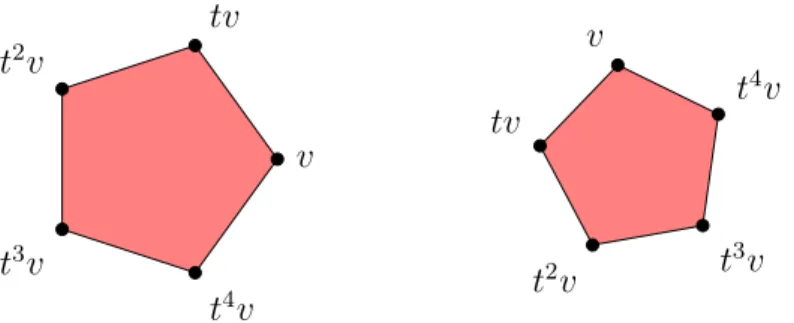
Of course, such a polytope may have additional symmetries. For example, when G6O(R2) is the cyclic group generated by a rotation of ordern, then every orbit of a point is a regularn-gone and has a linear symmetry group of order 2n >|G|=n. The usual idea then is to take the G-orbit of a “sufficiently asymmetric” set, or to cut off pieces from a polytope constructed as above in a “sufficiently asymmetric”
2. Orbit polytopes 5 v tv t2v t3v t4v v tv t2v t3v t4v
Figure 1. Two orbit polytopes of the groupG=⟨t⟩ of rotations preserving a pentagon. All nontrivial orbit polytopes have additional symmetries.
way. Different possibilities to do this are discussed in the answers to a MathOverflow question [59], for example.
However, there is also a short, elegant and elementary argument by I. M. Isaacs which shows that every finite group G 6 GL(V) is the full stabilizer of a finite, spanning set X ⊆ V, whenever V is a finite dimensional vector space over an infinite field [47]. A small modification of the argument shows that in the case of a real vector space, the set X can be chosen as the vertex set of a polytope. Isaacs’ argument also shows that every abstract finite group is isomorphic to the linear symmetry group of a polytope, with at most two orbits on the vertices. (Let us mention here that only quite recently it has been shown that every finite group is isomorphic to the combinatorial symmetry group of a polytope [29, 74].)
Of course, we can still ask for which groups G6AGL(V) we can find an orbit polytope P(G, v) such that G= AGL(P(G, v)). This was one of the questions that motivated my two joint papers with Erik Friese [FL1, FL2]. Chapters II andIV contain parts of these papers in revised form.
For example, we have seen above that when G∼=Cn is a cyclic group of order n generated by a rotation in 2-space, then every orbit polytope has additional symmetries. On the other hand, there are many finite groups G 6 GL(V) such that G= GL(P(G, v)) for some v ∈V. This yields a number of related questions, for example:
2.1 Questions.
(a) For which subgroups G6GL(V) is G= AGL(P(G, v)) for some v ∈V? (b) Given G6GL(V), how are the symmetry groups AGL(P(G, v)) for different
v related?
(c) Let Gbe an abstract finite group. For which representations D: G→GL(V) do we have D(G) = AGL(P(G, v)) for some v ∈ V? (Here we extend the notation P(G, v) to mean P(G, v) = conv{D(g)v |g ∈G}.)
(d) Which finite groupsG are isomorphic to AGL(P(G, v)) for some v ∈V and some representation D: G→GL(V)?
Before we go on, let us mention that in all these question, it makes not really a difference whether we consider affine or linear symmetry groups (see Section 2 in Chapter II).
Another immediate observation is that we can replace the orbit polytope P(G, v) by its set of vertices, which is just the orbit Gv. Thereby, the problems become purely algebraical in nature. For example, the first question becomes whether we can find an orbit Gv such that G= GL(Gv). In the case thatV = Span(Gv), this simply means that G is the setwise stabilizer of the subset Gv ⊂V in GL(V). It is clear that in this form of the problem, there is no reason to restrict oneself to the case of vector spaces over the real numbers. Instead one can work with vector spaces over an arbitrary field.
Recall that a group G6GL(V) (or a representation D: G→GL(V)) is said to be absolutely irreducibly, if only the scalar matrices centralize G (or D(G), respectively). In the paper mentioned before, Isaacs [47] showed that when the finite group G6GL(V) is absolutely irreducible, where V is a vector space over an infinite field, then G= GL(Gv) for some orbit Gv⊂V. So this gives a sufficient condition for a positive answer to Question (a). As the example Cn 6 GL(2,R) shows, it is not sufficient to assume that V is irreducible over G.
Question (d) was in fact posed by Babai [2] in 1977. Notice that we could ask the same questions for isometries instead of affine or linear symmetries. With this modification, Question (d)was answered by Babai [2]. More precisely, Babai classified all finite groups which are not the euclidean symmetry group of an orbit polytope, namely:
2.2 Theorem (Babai [2]). A finite group Gis not isomorphic to the isometry group of an orbit polytope, if and only if one of the following holds:
(i) G is abelian, but not elementary 2-abelian. (ii) G is generalized dicyclic.
(We will recall the definition of generalized dicyclic groups in Chapter IV, Section2.)
In the same paper, Babai asked for a characterization of finite groups which are isomorphic to the affine symmetry group of an orbit polytope, which is Question(d) above. (Babai asked also for the analogous characterizations with some other types of symmetries, namely sense-preserving (euclidean) and projective symmetries, but we will not consider these problems here.) In Chapter IV, we will answer Question (d). As we will explain later, a standard argument shows that a group which is isomorphic to the affine symmetry group of an orbit polytope, is also isomorphic to the euclidean symmetry group of an orbit polytope. The converse is not true, but the surprising outcome of the answer to Babai’s question is that there are only three groups, which can be realized as euclidean symmetry groups
2. Orbit polytopes 7
of orbit polytopes, but not as affine symmetry groups. These are the elementary abelian groups with the orders 4, 8 and 16.
Realizing a (finite) group as symmetry group of a polytope is a concrete example of a general kind of problem, namely realizing a given group as automorphism group of an object in a given class of mathematical objects. For example, the central problem of inverse Galois theory is whether every finite group is isomorphic to the Galois group of some finite extension field over Q. Another example is a classical theorem of Frucht [32] that says that every finite group is the automorphism group of a (finite, simple, undirected) graph. The last problem can be made more interesting by asking which finite groups can be realized as the automorphism group of a vertex-transitive graph. This means that the automorphism group acts transitively on the vertices of the graph. Obviously, this is analogous to Question(d) above. Even more, it turns out that the problems are related, but the relation is not entirely understood.
The automorphism groups of finite vertex-transitive graphs have been completely classified by Hetzel (unpublished) and Godsil [34] building on work of others (a more complete list of references can be found in Babai’s paper [2], in a subsequent paper of Babai and Godsil [4], or in the handbook chapter of Babai on this and related topics [3, Section 4.3]). The outcome of this classification is as follows: 2.3 Theorem. The only finite groups which can not be realized as the automorphism group of a vertex-transitive graph, are the following:
(i) abelian groups of exponent >2, (ii) generalized dicyclic groups,
(iii) 13 other groups of order at most 32, including the elementary abelian groups of orders 4, 8 and 16.
The graphs constructed by the various authors to represent other groups as transitive graph automorphism groups, are actually GRRs: A graphX is said to be aGRR (graphical regular representation) of the finite group G, when Aut(X)∼=G and Aut(X) acts regularly on the vertices of X.
It follows from Theorem 2.3 and our classification of affine symmetry groups of orbit polytopes, that every finite group admitting a GRR is also isomorphic to the affine symmetry group of an orbit polytope. We are not aware of any direct proof of this fact. On the other hand, Babai showed directly that every group admitting a GRR is isomorphic to the euclidean symmetry group of an orbit polytope. More precisely, Babai showed that a groupGis the euclidean symmetry group of an orbit polytope if and only if Ghas an SRR (symmetric regular representation): An SRR of a group G can be defined as an edge-colored graph X such that Aut(X)∼=G and Aut(X) acts regularly on the vertices of X. Here Aut(X) is meant to preserve the edge colors. Obviously, any GRR is an SRR.
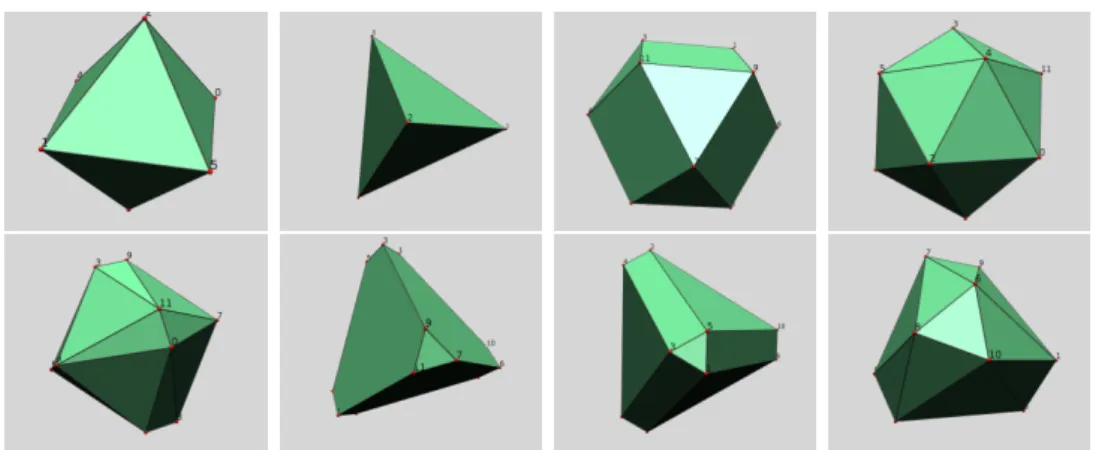
Figure 2. Examples of the different types of orbit polytopes of the tetrahedral rotation group T ∼=A4. First row (from left to right): Octahedron, tetrahedron, cuboctahedron,
(regular) icosahedron, second row: skew icosahedron with symmetry group±T, truncated tetrahedron, skew cuboctahedron, and generic icosahedron with symmetry group T.
It also follows from the classifications that there are only 10 finite groups (up to isomorphism) which are isomorphic to the affine symmetry group of an orbit polytope, but admit no GRR.
3. Affine symmetries of orbit polytopes
Motivated by the questions in 2.1, we develop in Chapter II a general theory of orbit symmetries.
Let us begin with a concrete example. Let G=T ⊆GL(3,R) be the rotation group of the tetrahedron, more concretely, let
G=T = ⟨ ⎛ ⎜ ⎝ 0 1 0 0 0 1 1 0 0 ⎞ ⎟ ⎠, ⎛ ⎜ ⎝ −1 0 0 0 −1 0 0 0 1 ⎞ ⎟ ⎠ ⟩ .
This is the group of rotations of the tetrahedron with vertices (±1,±1,±1), where the number of −1-s is even. As an abstract group, G∼=A4.
Now let us see what orbit polytopes we get for this group, depending on our starting pointv ∈R3. Of course, forg ∈Gwe have P(G, gv) = P(G, v). Forλ ∈
R,
we have P(G, λv) =λP(G, v), and these two orbit polytopes are similar. A common generalization of these two observations is this: Suppose that
n ∈NGL(3,R)(G) :={n ∈GL(3,R)|n
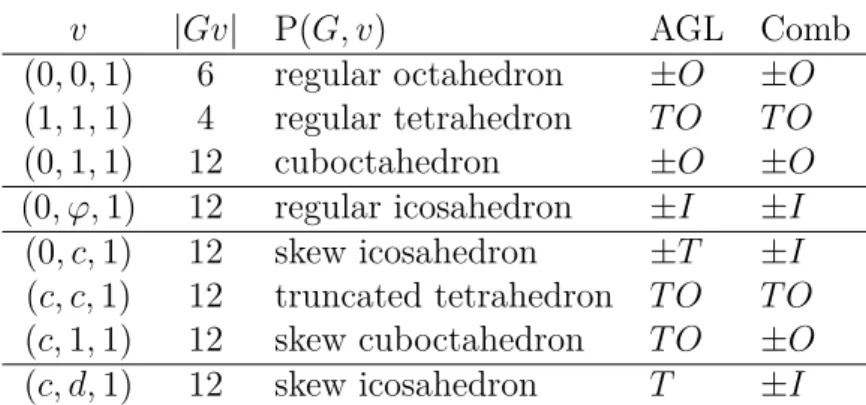
3. Affine symmetries of orbit polytopes 9 v |Gv| P(G, v) AGL Comb (0,0,1) 6 regular octahedron ±O ±O (1,1,1) 4 regular tetrahedron T O T O (0,1,1) 12 cuboctahedron ±O ±O (0, ϕ,1) 12 regular icosahedron ±I ±I (0, c,1) 12 skew icosahedron ±T ±I (c, c,1) 12 truncated tetrahedron T O T O (c,1,1) 12 skew cuboctahedron T O ±O (c, d,1) 12 skew icosahedron T ±I
Table 1. The different orbit polytopes of the tetrahedral rotation group T ∼=A4. Here, ϕ = (−1 +√5)/2, the golden ratio, while c and d are arbitrary with 0< c < 1, and 0 < c < d < 1, respectively. The last two columns give the affine and combinatorial symmetry group in notation following Conway and Smith [24].
the normalizer of G in GL(3,R). Then
P(G, nv) = conv(Gnv) = conv(n n−1Gnv) = conv(nGv) =nconv(Gv) =nP(G, v).
This means that n induces a linear isomorphism from P(G, v) onto P(G, nv). These orbit polytopes are thus affinely equivalent.
In our concrete example, the group G is normalized by all scalar matrices, and also by the full symmetry group of the cube, consisting of all signed permutation matrices. Thus up to affine equivalence, and leaving aside the trivial case v = 0, we can choose our starting point v = (x, y, z) such that 0 6 x 6 y 6 z = 1. Geometrically, this means that our point lies in a certain triangle on the surface of a cube.
It turns out that there are 8 different cases, counting the occurring combinations of combinatorial type and affine symmetry groups of the orbit polytope. These are listed in Table 1. Indeed, only 5 orbit polytopes up to combinatorial equivalence arise, but some of these occur with different affine symmetry groups. Namely, the icosahedron occurs with three different affine symmetry groups, and the cubocta-hedron with two. The notation for the affine and combinatorial symmetry groups follows Conway and Smith [24], which is of course a slight abuse of notation in the case of combinatorial symmetry groups. Notice that in the few cases where the combinatorial symmetry group is strictly larger than the affine symmetry group, there is a starting point v yielding a combinatorial equivalent polytope and such that AGL(P(G, v)) = Comb(P(G, v)).
The truncated tetrahedron, which occurs in the table as orbit polytope of the point (c, c,1), is in general not archimedean, as its hexagonal faces are not regular.
Only for a special value of c is this solid archimedean. However, this makes no difference for the affine symmetry group, and so we did not give separate mention to this case in the table.
The “generic” orbit polytope in this example is an icosahedron with no additional affine symmetries, and the generic starting point is a pointv = (x, y, z) with nonzero, pairwise different coordinates.
In Chapter II, we give a precise definition of generic points. Basically, a point v ∈Kd is not generic for a group G6GL(d,
K), if either its stabilizer Gv ={g ∈ G|gv=v} is nontrivial, or if the linear span of the orbit Gv is a proper subspace of Kd, or if the orbit has “more” affine symmetries than a generic orbit. We will prove that the non-generic points are the zero set of some nonzero polynomials.
In order to compare affine symmetry groups of different orbit polytopes, we will identify each affine symmetry group with a permutation group on G itself. The affine symmetry group of a generic orbit polytope is always minimal among all the permutation groups arising in this way from full-dimensional orbit polytopes.
Of course, in our example with the tetrahedral rotation group, every generic orbit polytope has just T as its affine symmetry group, which corresponds to the permutation group onT defined by the left regular action of T on itself. But in our earlier example with G=⟨t⟩ ⊆GL(2,R) generated by a rotation (see Figure1), each generic orbit polytope has additional affine symmetries. All affine symmetry groups of generic orbit polytopes correspond to the same permutation group on G. Moreover, the different affine symmetry groups of generic orbit polytopes are similar. These are special cases of general results we will prove in Chapter II.
In our examples, all generic orbit polytopes are combinatorially equivalent. This is not true in general. Onn [68] gave an example of a representation of S4, where different “generic” points yield combinatorially nonisomorphic orbit polytopes. (The points termed “generic” by Onn are certainly generic in our sense, but not
conversely.) In Onn’s examples,S4 acts on R6 by permuting coordinates, yielding
5-dimensional orbit polytopes. The corresponding representation of S4 is the direct sum of three different representations, one of them trivial. In view of this example, Onn remarked that a representation being multiplicity free is not enough to have a trivial polytope stratification. But as we will see in Chapter II, there are cases where in fact all generic orbit polytopes are even affinely equivalent, namely when the multiplicities of the occurring irreducible constituents of a representation are as large as possible. (The multiplicities are bounded from above by the requirement that there are full-dimensional orbit polytopes. If some multiplicity of an irreducible constituent is too large, then every G-orbit will only span a proper G-invariant subspace.) This is somewhat contrary to the intuition suggested by Onn’s remark.
A classical situation where all generic orbit polytopes are combinatorially equivalent is that of finite reflection groups. Indeed, here a point can be generic only if it does not belong to any of the “mirrors” of the reflection group (that is,
3. Affine symmetries of orbit polytopes 11
the hyperplanes fixed by the reflections), and all such points yield combinatorially equivalent orbit polytopes. Orbit polytopes of finite reflection groups are called (generalized) permutahedra [17, Chapter 14]. The geometrical structure is nicely related to the geometry of the Coxeter chamber complex. More generally, the combinatorial type of an orbit polytope P(G, v) depends only on the set of reflection hyperplanes that contain v [30, Proposition 3].
As already said, we will show that the affine symmetry group of a generic orbit polytope is minimal among the affine symmetry groups of full-dimensional orbit polytopes under the same group G (when viewed as permutation groups onG). As our example G=T shows, no such thing is true for the combinatorial symmetry groups. Indeed, in our example, the combinatorial symmetry groups of the generic orbit polytopes have maximal size. Also notice that there is no containment between the groups T O (or ±O) and ±I. On the other hand, there are examples where the generic orbit polytopes have also minimal combinatorial symmetry group, for example the cube rotation group O. Here the generic orbit polytope is a snub cube (where some of the triangle faces are in general not regular). The combinatorial
symmetry group of the snub cube is again only the cube rotation group.
In view of Babai’s question mentioned above, it seems natural to ask which finite groups can appear as the combinatorial automorphism group of a polytope and act transitively on the vertices. In our example with G= T, all orbit polytopes have more combinatorial automorphisms than T ∼=A4, and thus one might wonder whether A4 appears as combinatorial automorphism group of some orbit polytope at all. (It is known that A4 is not isomorphic to the automorphism group of a vertex transitive graph.) But some of the orbit polytopes ofA4 in dimension 5 have indeed combinatorial symmetry group A4.
Most of the deeper results in ChaptersIIandIVdepend on the module theoretic view of representation theory. This viewpoint was introduced by Emmy Noether in 1929 [67], thereby creating a very effective conceptual framework for representation theory. Nowadays, this viewpoint is of course commonplace. Recall that the group algebra KGof a (finite) group G over the field Kis by definition the set of formal sums
∑
g∈G
rgg, rg ∈K,
together with component-wise addition and multiplication extended distributively from multiplication in the group. Any representation D: G → GL(V), where V is a vector space over K, endows V with the structure of a left module over the group algebra KG, by defining ∑
grgg·v =∑grgD(g)v. Conversely, any left KG module V defines a representation D: G → GL(V), where D(g) : V → V is the map v ↦→gv. Similar representations correspond to isomorphic KG-modules and conversely [49].
g ∈G} generated by theG-orbit of v equals Span(Gv) ={∑
g∈G
rggv |rg ∈K}={av|a ∈KG}=KGv.
This is the cyclic KG-module generated by v. So in order to study the linear symmetries of G-orbits, we need to consider only cyclic KG-modules.
We can view a permutation π ∈Sym(G) as a linear map on the group algebra. Then whether π represents a linear symmetry of one or all generic orbits Gv ⊆V is equivalent toπ preserving certain left ideals ofKG.
In the case whereK has characteristic zero, the group algebraKGis semisimple by Maschke’s theorem, and left ideals have complements. Any cyclic KG-module is then isomorphic to a left ideal. It turns out that a left ideal and its complement have the same generic symmetry group. This is related to Gale duality.
A special place is taken by cyclic modules which are isomorphic to two-sided ideals of KG. These are exactly the KG-modules, which are isomorphic to a module of the form Span(D(G)), whereD: G→GL(V) is some representation. In particular, for K =R the affine symmetries of generic orbit polytopes in such a module are in fact the affine symmetries of a representation polytope. We will show how to determine the permutations of G corresponding to the generic symmetries from the character of Gon I, where I is the ideal of KG which is isomorphic to Span(D(G)) as left KG-module. (In general, the character on I is not the same as the character of the representation D.)
Computing the affine symmetry group of a representation polytope can be viewed as a linear preserver problem. Alinear preserver problem is the problem of determining the set of linear transformations of Mn(K) that map a given subset G⊆Mn(K) to itself, where Mn(K) denotes the ring of n×n-matrices with entries inK. More generally, one may look for linear transformations which preserve certain invariants of matrices, like the determinant or the rank. Linear preserver problems have already been studied for various specific subsets G, usually infinite subsets like the set of all singular matrices. We refer the reader to the nice overview by Li and Pierce [53]. In a few cases, linear preservers of finite matrix groups Gwere studied, in particular when Gis a finite irreducible reflection group [52, 54,55].
Finally, in Section10 of ChapterII, we show how to determine the generic orbit symmetries for a cyclic module in characteristic zero from the decomposition of the character of V into its irreducible constituents. In a sense, this result answers Question 2.1(c) above, but the answer is technical. However, the answer shows that for large classes of finite groups, it is true that for “most” representations D: G→GL(V), we have GL(Gv) =D(G) for generic points v ∈V.
4. Groups with a nontrivial ideal kernel 13
4. Groups with a nontrivial ideal kernel
The main result of Chapter II, Section 10, and the desire to answer Babai’s Question(d) yield a purely representation theoretical problem. Let K be a field of characteristic 0 and G a finite group. By Maschke’s theorem, the group algebra
KG is semisimple. There are only a finite number of non-isomorphic simple left KG-modules, say S1,. . ., Sr [50, Ch. XVII, §4]. By the general Wedderburn-Artin theory of semisimple rings and modules, we can write
KG∼=d1S1⊕ · · · ⊕drSr with di ∈N.
A module V has the form V = KGv for some v ∈V, if and only if it is isomorphic to a submodule (that is, a left ideal) of the regular module KG, and thus V ∼=
m1S1⊕ · · · ⊕mrSr with mi 6di for all i. Now let V be the module defined by
V := ⨁ i: 1<di
Si.
(Ifdi = 1 for alli, thenV = {0}.) If the action of Gon V is faithful, then it follows from the main result of ChapterII, Section10, that GL(Gv) =Gfor generic points v ∈V. In the case K=R, this means that G is isomorphic to the affine symmetry group of an orbit polytope.
In general, we define NKerK(G) as the kernel of G on this particular moduleV. Thus when NKerK(G) ={1}, then G= GL(Gv) for genericv ∈V, and usually also for genericv’s in certain other cyclic modules. In particular, when NKerR(G) ={1}, then G is isomorphic to the affine symmetry group of an orbit polytope.
Thus we are led to the problem of classifying finite groups G with NKerK(G)̸= {1}. (If NKerK(G)̸={1}, then it may still happen thatG= GL(Gv) for some other
KG-module U and some v ∈U.) The content of Chapter III is the classification of
finite groups Gwith NKerR(G)̸={1} or NKerQ(G)̸={1}.
Let us further elaborate on the meaning of the numbers di. By the Wedder-burn-Artin structure theory of semisimple rings, we have that
KG∼=Md1(D1)× · · · ×Mdr(Dr),
where Di := EndKG(Si) is a division ring (by Schur’s lemma). We also have
di = dimDi(Si).
When K = C, or more generally when K is algebraically closed, or just a splitting field for G, then
(By an important theorem of Brauer [48, Theorem 10.3], a field K is already a splitting field for Gwhen it contains a primitive |G|-th root of unity.) In this case, it follows that all di’s are 1 if and only if G is abelian. It is also not difficult to see, using the orthogonality relations of character theory, that NKerC(G)̸={1} if and only if G is (nontrivial) abelian (this is Corollary 3.3 in Chapter III). It follows that every nonabelian finite group is isomorphic to a subgroup of GL(d,C) that is the setwise stabilizer of some orbit in Cd. (For abelian groups, the problem is open. We conjecture that only finitely many abelian groups can not be realized in this way.)
For general fieldsK, all multiplicitiesdi = 1 if and only ifKGis a direct product of division rings. For other fields than C, there exist non-abelian groups with that property. For example, when G=Q8, the quaternion group of order 8, then
RQ8 ∼=R×R×R×R×H, where H denotes Hamilton’s skew field of the quaternions.
The finite groups G, such that QG is a direct product of division rings, have been classified by Sehgal [76]: We have
4.1 Theorem (Sehgal 1975). Let G be a finite group.
(i) QG is a direct product of division rings if and only if G is abelian or G∼=
Q8×(C2)r×A, where A is an abelian group of odd order and such that the multiplicative order of 2 modulo |A| is odd.
(ii) RG is a direct product of division rings if and only if G is abelian or G∼=
Q8×(C2)r.
(Statement (ii) does not appear in Sehgal’s paper [76], but follows easily from Sehgal’s methods or directly. See Corollary9.3 in ChapterII.)
But it is also possible that some of the multiplicities di are greater than 1, but NKerK(G) ̸= {1} nonetheless. For example, let G be the group of order 12 described by generators and relations as follows:
G:=⟨a, b|a4 =b3 = 1, a−1ba=b−1⟩. Then one can show that
RG∼=R×R×C×H×M2(R).
Thus there is only one simple module S which occurs with multiplicityd= 2>1 in the regular module RG. On this module, a2 acts trivially, and so S can in fact be seen as a module for G/⟨a2⟩ ∼= S3. It turns out that G is not the affine symmetry group of any orbit polytope. (This follows also from Babai’s classification, since G is dicyclic.)
4. Groups with a nontrivial ideal kernel 15
Another example is the group G= Q8×C4. Again, NKerR(G)̸={1}. However,
this group can be realized as symmetry group of an orbit polytope in dimension 10. Fortunately, it turns out that the groups with NKerQ(G)̸= {1} and the groups with NKerR(G)̸={1} can be classified, and this is what we do in ChapterIII. It turns out that NKerK(G) is always contained in the intersection of all nonnormal subgroups of G. Finite groups where this intersection is nontrivial have been classified by Blackburn in 1966 [14], and we use this classification. It turns out that the proof for the real numbers is not very difficult or deep, and one could avoid Blackburn’s classification (which itself is also not particularly difficult). On the other hand, the proof for the rational numbers is quite long and depends on some deep facts about Schur indices.
Let χ ∈ IrrG be an irreducible character. There is a unique factor Mdi(Di) from the decomposition of KG as above, on which χ does not vanish. Then the center of Di is isomorphic to the field K(χ) generated by the values of χ, and the dimension of Di over its center is a square of some number m=mK(χ), that
is, |Di : Z(Di)| = m2. This number is called the Schur index of χ (over K). It
can also be characterized as the smallest integer m such thatmχ is afforded by a representation with entries in K(χ). We always have χ(1) =mdi, and sodi = 1 if and only if χ(1) =m.
When Gis a finite nonabelian group with NKerQ(G)̸= 1, thenG has at least one irreducible character χ ∈ IrrG with χ(1) = mQ(χ) > 1. This means that the corresponding block in the decomposition of QG into simple algebras is a division ring. Thus QG has a central idempotent e such that χ(e) = χ(1) and
QGe ∼= D is a division ring. In particular, G/Ker(χ) is isomorphic to a finite
subgroup of the multiplicative group D∗. Finite groups which appear as subgroups of the multiplicative group of a division ring have been classified by Amitsur [1]. We do not use Amitsur’s classification, but of course the groups G with NKerQ(G)̸= 1 are closely related to finite subgroups of division rings. For example, the smallest nonabelian group of odd order that appears as a subgroup of some division ring is the group G of order 63 which can be described by generators and relations as follows:
G=⟨a, b|a9 =b7 = 1, a−1ba=b2⟩.
(Previously, in 1953, Herstein [41] had conjectured that a finite multiplicative subgroup of a division ring which has odd order, is necessarily cyclic. The above G is the smallest counterexample to this conjecture.) It turns out that NKerQ(G)̸= 1 for this group G, and that G can not be realized as the affine symmetry group of an orbit polytope with integral (or rational) vertices. The group G is isomorphic to the affine symmetry group of an orbit polytope (in dimension 6), some of the vertices of such a polytope have necessarily irrational coordinates.
some irreducible character of some finite group. The groups used by Brauer to achieve this are metacyclic groups which have an irreducible character χ with χ(1) =mQ(χ) =n, for any given n. The group Gof order 63 displayed above is an example of such a group. (In particular, Brauer almost surely knew already in 1930 that G is isomorphic to a subgroup of the multiplicative group of a division ring.) For the classification of groups G with NKerQ(G) ̸= 1, and in particular in order to see that NKerQ(G)̸= 1 for certain groups, we need several nontrivial facts about Schur indices and division algebras. For example, we use that Schur indices can be computed “locally”, that is, by computing Schur indices over the fields of p-adic numbers and over the reals. To verify that certain characters have nontrivial Schur index, we use a result by Benard [12] which ultimately relies on modular representation theory. However, the reader can view these results as black boxes, if not familiar with the tools needed for their proofs.
The classification results of Chapter III then allows us to classify also the affine symmetry groups of orbit polytopes, and of orbit polytopes with rational (or integer) coordinates.
5. Core points
Recall that alattice polytopeis a polytopeP ⊂Rdwhose vertices have coordinates in Z. More generally, we could assume that some other lattice Λ ⊆ Rd is given, but we will not need this added generality here. A lattice polytope P is called lattice-free, ifP ∩Zd= Vert(P). (Lattice-free polytopes are sometimes also called empty lattice polytopes [37, 75].) The theory of lattice polytopes, and of lattice points contained in polytopes, has connections to representation theory, number theory, commutative algebra, algebraic geometry, statistics, computer science and of course linear optimization. (For examples, see the papers in the Snowbird 2006 conference proceedings [11].)
Now letG6GL(d,Z) be a finite group. Often we will assume thatGis a group of permutation matrices. Then forv ∈Zd, the orbit polytope P(G, v) is of course a lattice polytope. We call v a core point (with respect to G) if the orbit polytope P(G, v) is lattice-free.
Core points are relevant to integer linear optimization: suppose we are given an integer linear program of the form
Ax6b, ctx→max (x∈Zd), (ILP) and suppose that this problem is invariant under some finite group G6GL(d,Z). (This means that for allg ∈Gwe haveA(gx)6bif and only ifAx6b, andgc=c.) If we forget about the requirement x∈Zd, then (ILP) has optimal solutions in the
5. Core points 17
fixed space of G in Rd,
FixRd(G) :={v ∈Rd |gv=v for all g ∈G}.
(This is easy to see: If x∈Rd is optimal, then every element gx in the G-orbit is optimal. Thus the average (1/|G|)∑
ggx is optimal, too, and is in the fixed space.) There may be no optimal integral solutions in the fixed space, however. Instead, optimal integral solutions can be found among the core points [39, Theorem 4].
Core points were first introduced by R. Bödi, K. Herr and M. Joswig [15] with a different definition in the case where G is the alternating or symmetric group on d elements. Bödi, Herr and Joswig determined all core points of G=Ad or Sd. The concept was generalized to arbitrary permutation groups by K. Herr, T. Rehn and A. Schürmann [39], who showed how core points can be used in integer optimization in certain cases. Both Herr and Rehn studied core points extensively in their doctoral theses [38,72]. Some of their results are contained in another joint paper with A. Schürmann [40].
It is clear that when z is a core point for Gandt ∈Zdis fixed by all ofG, then P(G, z+t) = P(G, z) +t andz+t is also a core point. In this situation, let us callz andz+ttranslation equivalent. Herr, Rehn and Schürmann [40] showed that when G6Sd is a permutation group acting transitively on the 2-subsets of {1, . . . , d}, then there are only finitely many core points up to translation equivalence. They conjectured that there are infinitely many core points up to translation equivalence for all other transitive permutation groups, and showed this in two different special cases.
Here we study a natural generalization of translation equivalence. Namely, suppose thatn ∈NGL(d,Z)(G), the normalizer ofGin GL(d,Z). Then one can easily
show that P(G, nv) = nP(G, v), and in particular, when z ∈ Zd is a core point, thennz is also a core point. This leads to the notion of normalizer equivalence, which coarsens translation equivalence.
On the one hand, this sheds new light on the above mentioned problem: Namely, in many (but not all) cases, the new equivalence classes contain infinitely many points up to translation. In these cases, we see thus immediately that there are infinitely many core points up to translation.
On the other hand, we show that when Qd/Fix
Qd(G) is simple as a module over
QG, then there are only finitely many core points up to normalizer equivalence.
Our conjecture is that in all other cases, there are infinitely many core points up to normalizer equivalence. This generalizes the conjecture of Herr, Rehn and Schürmann, which remains open in general. (There are infinitely many lattice-free polytopes, not necessarily symmetric, up to a suitable equivalence relation. Indeed, Barany and Kantor [5] showed that the number of lattice-free simplices of dimension d and volume at most v, up to translations and GL(d,Z)-transformations, is of magnitude vd−1.)
Permutation groups G such that Qd/Fix
Qd(G) is irreducible were studied by
Dixon [28], who called these groups QI-groups. Dixon’s paper contains first steps towards a classification of QI-groups which are not 2-transitive. To complete this classification, one would very likely have to use the classification of the finite simple groups, as there are some nonsolvable examples of such groups (namely, PSL(2,2k) with 2k−1 prime in a permutation representation of degree d= 2k−1(2k−1)).
Whend= pis a prime, then any transitive groupG6Sp is a QI-group. However, by a celebrated theorem of Burnside (which we mentioned already at the beginning of this introduction), either G is 2-transitive, or G is permutation similar to a proper subgroup of AGL(1,Fp). In the first case, there are only finitely many core points up to translation equivalence, by the aforementioned result of Herr, Rehn and Schürmann. In the second case, the structure of Gis already quite restricted, by Burnside’s result. (Burnside proved his result by using characters [20, §251]. Perhaps the most direct proof is due to P. Müller [66], who also gives references to some other proofs.)
The easiest example of a QI-group is when G=Cp is generated by ap-cycle (as permutation group), where p is a prime as before. Then the orbit polytopes of G are (p−1)-dimensional simplices, and thus in particular trivial from the viewpoint of Chapter II. But this is not true from the viewpoint of integer symmetries. The different orbit polytopes P(G, z) have all the same affine symmetry group, but not the same “lattice symmetries”, that is, (affine) symmetries that also preserve the lattice Zd, and so are described by GL(p,
Z)-matrices. On the other hand,
normalizer equivalent orbit polytopes have of course similar lattice preserving symmetry groups. It remains a challenging task to extend the theory of Chapter II to the case of lattice-preserving symmetries.
These simplices are also nontrivial from the viewpoint of integer programming, as it is in general difficult to decide whether such a simplex is lattice free or not. Some experiments conducted by A. Schürmann show that we can generate integer linear programs from orbit polytopes of small cyclic groups of prime orders, which seem to be difficult for commercial solvers like Gurobi. The trick is to transform orbit polytopes of “easy” core points with elements of infinite order from the normalizer of G=Cp in GL(p,Z). Conversely, one can try to transform an arbitrary integer linear program withCp-symmetry into a simpler one, by using GL(p,Z)-matrices in the normalizer. The idea of using GL(d,Z)-matrices to transform an integer linear program is not new. In fact, it is one of the ingredients of Lenstra’s celebrated proof that integer linear programs in fixed dimension can be solved in polynomial time [51]. But in the case of problems with symmetry, it is natural to choose transformations preserving the symmetry. It may also be a more efficient way of finding transformations that simplify the problem. The torsion-free part of the normalizer of ap-cycle in GL(p,Z) is a free abelian group of rank (p−3)/2.
6. Two properties of the Birkhoff polytope 19
6. Two properties of the Birkhoff polytope
The Birkhoff polytopeBn, the convex hull of all permutation matrices of sizen×n, is probably the most celebrated example of a permutation polytope (or even an orbit polytope). It is also known as assignment polytope, perfect matching polytope of Kn,n, and the polytope of doubly stochastic matrices. The last name refers to the fact that Bn contains exactly the doubly stochastic matrices, which means that every doubly stochastic matrix can be written as a linear combination of permutation matrices. This was proved by G. Birkhoff [13] in 1946, but follows also easily from earlier results of D. Kőnig from 1916 (cf. the treatment by Lovasz and Plummer [56, Theorem 1.4.13]).
The result mentioned last also yields the dual description of Bn by equalities and inequalities, and thus the facet structure of Bn (for all n∈N). This is a very
unusual thing for permutation polytopes in general. For example, the face lattice of the permutation polytope of the alternating group is unknown, and there is little hope that it can be described in any easy way. Hood and Perkinson [45] describe exponentially many facets (in n) of this polytope. And even for a cyclic permutation group, the corresponding permutation polytope can have exponentially many facets [9]. There are a few other classes of permutation groups where a description of the face lattice can be given, namely Frobenius groups [23], dihedral groups [10] and cyclic groups with at most two orbits [9]. And of course when the permutation groupG6Snis regular, then the corresponding permutation polytope is a simplex of dimensionn−1. In fact, the permutation polytope is then lattice isomorphic to the standard simplex spanned by the standard basis vectors of Rn. On the positive side, Guralnick and Perkinson give a concrete description of the smallest face of a (general) permutation polytope containing two given elements of the underlying permutation group [36].
Although the face lattice of the Birkhoff polytope is known, many other questions remain open [70]. For example, it is an outstanding problem to find the volume of the Birkhoff polytope. On the other hand, the volumes (even the Ehrhart polynomials) of some other classes of permutation polytopes are known [19].
The first main result of Chapter VI is the determination of the combinatorial symmetry group of the Birkhoff polytope, which is in fact straightforward from knowledge of the face lattice. It turns out that the Birkhoff polytope has only those symmetries that a representation polytope necessarily has: all combinatorial symmetries are induced by multiplications with permutation matrices from the left or the right, or by combining this with matrix transposition. (In the language of the linear preserver literature, these are standard transformations [53].) Thus all combinatorial symmetries of Bn are in fact isometries, and preserve the lattice. In terms of the standard basis of the space of matrices, all symmetries are described by permutation matrices. Thus for the Birkhoff polytope, all the symmetry groups
which we introduced so far coincide.
The linear symmetry group of the Birkhoff polytope has already been determined in the literature [54, 55], as an example of a linear preserver problem.
The other main result of ChapterVIconfirms a conjecture of Baumeister, Haase, Nill and Paffenholz [8]. The result says that whenP is some representation polytope of a faithful representation D: G→GL(d,R) (that is, P = conv{D(g)|g ∈G}), and if P is combinatorially equivalent to the Birkhoff polytope Bn, then there is a group isomorphism α: Sn→G, such that D◦α and the standard permutation representation of Sn have the same nontrivial irreducible constituents. (There is an exception for n = 3.) This is a uniqueness property of the Birkhoff polytope, and is surprising insofar as in general, one can not reconstruct a finite group from a permutation polytope. Of course, if P is affinely (or combinatorially) equivalent to the convex hull of some finite matrix group G, then the affine (or combinatorial) symmetry group ofP contains a subgroup isomorphic with G. Since we may multiply with elements of Gfrom the left or the right, we have in fact two subgroups (maybe the same) which are isomorphic with G, act regularly on the vertices of P, and centralize each other. In general, this is not enough to determine G up to isomorphism, as can be seen from the example of a simplex. Another key ingredient in our proof is the fact that Sn×Sn contains only one pair of regular, mutually centralizing subgroups, namely{Sn×1,1×Sn}, whenn >3. To see this, we use a very elementary method found by Chermak and Delgado [22] in 1989.
7. Realizations of abstract regular polytopes
Peter McMullen has developed a theory of realizations of abstract regular poly-topes [60, 61, 62,63]. Actually, the theory generalizes to a theory of “realizations of transitive G-sets”, as already pointed out by McMullen [62, Remark 2.1]. So let G be a finite group and Ω a transitiveG-set.
A realization of (G,Ω) is a homomorphism of G-sets A: Ω → V, where V is an euclidean vector space equipped with an action of G by orthogonal maps. In other words, we are given a representation D: G → O(V). Thus we have
A(gω) = D(g)A(ω) for all ω ∈ Ω and g ∈ G. (We should mention that in Chapter VII, we write all maps and G-actions on the right, other than in the rest of this thesis. So the last conditions becomes (ωg)A=ωAD(g) for all ω ∈Ω,
g ∈G. We are thereby following the convention used by McMullen in his papers on the topic. To keep this introduction consistent, we continue to write maps and group actions an the left for the rest of the introduction.)
The group G is usually assumed to be the automorphism group of an ab-stract regular polytope [64] with Ω as vertex set, and then realizations are called realizations of the abstract regular polytope.
7. Realizations of abstract regular polytopes 21
The study of realizations ofG-sets can be seen as the study of all orbit polytopes of a finite group G with a given subgroup H stabilizing one of the vertices. This is related to Chapter II, where we study all orbit polytopes of a given finite group, usually in a givenRG-module. Probably one can generalize the definitions of Chapter II to the situation, where one studies all orbit polytopes in a given
RG-module V, such that a given subgroup H stabilizes a vertex. Of course, this is
only interesting when FixV(H)̸={0}.
A natural equivalence relation is defined for realizations of a fixed G-set Ω: Namely, A1: Ω → V1 and A2: Ω → V2 are called congruent, if there is a linear isometry σ from the linear span of {Aω | ω ∈ Ω} into V2 such that σ◦A1 =A2. The congruence classes of such realizations (and the corresponding orbit polytopes) form a pointed convex cone, the realization cone.
The relation of congruence corresponds to the relation of affine G-equivalence which we introduce in Chapter II(see Definition6.1there), whereσ is only an affine isomorphism. This means that we further identify orbit polytopes in McMullen’s realization cone. For example, the interior of the realization cone consists of non-congruent simplices, but these are all affinely equivalent. The isometry group of most of the simplices is usually justG(exceptions are whenGis abelian of exponent greater than 2, or generalized dicyclic), while the affine symmetry group is the full symmetric group on Ω.
The paper, which is reproduced here as Chapter VII, arose initially from an attempt to understand McMullen’s papers and theory from a more representation theoretical viewpoint. (McMullen’s arguments are more in a geometrical spirit.) In particular, we prove a result on the structure of the realization cone. In part, this corrects a mistake in the proof of a corresponding result of McMullen and Monson [63], and in part this just reproves a structure theorem of McMullen. To be more specific, let RΩ be the permutation module corresponding to the G-set Ω. Recall that RΩ is the set of formal sums
RΩ :={∑
ω∈Ω
rωω|rω ∈R},
so that Ω can be viewed as a basis of R. The group action ofG on RΩ is induced by the action of G on Ω, namely g·∑
ωrωω := ∑ωrωgω. We can write RΩ as a direct sum of simple RG-modules:
RΩ∼=m1S1⊕ · · · ⊕mkSk,
with natural numbers mi, and where the different Si’s are non-isomorphic. To each isomorphism class of simple modules S corresponds a subcone RCS(Ω) of the realization cone RC(Ω), and RC(Ω) is the direct product of these subcones. Originally, this was proved by McMullen [60, Theorem 16], in the situation where
G is the automorphism group of an abstract regular polytope with vertex set Ω, and we reprove it in Chapter VII (for arbitrary G-sets Ω).
But the structure and the dimension of RCS(Ω) was described incorrectly by McMullen in the first of his series of papers [60], and also in the second (joint with Barry Manson) [63]. We correct the description in Chapter VII. It turns out that the subcone RCSi(Ω) is isomorphic tomi×mi-matrices of the formAA∗ with entries either in R, in C or in H (the quaternions). Here mi is the multiplicity of Si in RΩ, as introduced in the decomposition above. In other words, we have hermitian positive semidefinite matrices over D=R, C or H. The division ring D is determined by D:= EndRG(Si). This is a division ring by Schur’s lemma, and thus either D=R, Cor H by a celebrated theorem of Frobenius.
In Section 4, we construct counterexamples to a result of Herman and Monson. This result was a consequence of the aforementioned errors. Since the result was stated for automorphism groups of abstract regular polytopes, our counterexamples must be objects of this kind, too.
Abstract regular polytopes are certain purely combinatorial objects, namely partially ordered sets which share certain properties with the face lattice of a regular polytope [64]. Abstract regular polytopes can also be defined in purely group theoretical terms by certain properties of their automorphism groups, which leads to the notion of string C-groups. These groups generalize Coxeter groups whose Coxeter diagram is a string. Our counterexamples realize projective special linear groups PSL(2, p) as automorphism groups of abstract regular polytopes, and we show that when p ≡ −1 mod 4, then there is some simple module S with EndRG(S) =C and multiplicity m which is large when p is large. Our proof uses one of the irreducible constituents of the Weil representation[46, 71] of SL(2, p).
Other sections of Chapter VII consider relations between McMullen’s theory and other aspects of representation theory, for example between McMullen’s cosine vectors and spherical functions in the theory of Gelfand pairs [21]. In the context of finite groups, a Gelfand pair is just a group G with a subgroup H 6 G such that the permutation module of G on the cosets ofH in Gis multiplicity free. The realization cone is then polyhedral, and McMullen’s cosine vectors correspond to the spherical functions associated with the Gelfand pair (G, H).
8. Contributions to this thesis
To meet the requirements of the habilitation regulation, I have to specify my own contributions to the joint papers contained in this thesis. The references [FL1, FL2] appear in revised form in Chapters II and IV, while all other papers appear unchanged, except for occasional cross references.