Methods for Proving Termination of
Rewriting-based Programming Languages by
Transformation
Francisco Dur´
an
1DLCC, Universidad de M´alaga, M´alaga, Spain
Salvador Lucas
2DSIC, Universidad Polit´ecnica de Valencia, Valencia, Spain
Jos´
e Meseguer
3CS Dept., University of Illinois at Urbana-Champaign, Urbana, IL, USA
Abstract
Despite the remarkable development of the theory of termination of rewriting, its application to high-level (rewriting-based) programming languages is far from being optimal. This is due to the need for features such as conditional equations and rules, types and subtypes, (possibly programmable) strategies for controlling the execution, matching modulo axioms, and so on, that are used in many programs and tend to place such programs outside the scope of current termination tools. The operational meaning of such features is often formalized in a proof theoretic manner by means of an inference system rather than just by a rewriting relation. The corresponding termination notions can also differ from the standard ones. During the last years we have introduced and implemented different notions and transformation techniques which have been proved useful for proving and disproving termination of such programs by using existing tools for proving termination of (variants of) rewriting. In this paper we provide an overview of our main contributions.
Keywords: Program Analysis and Verification, Rewriting Logic, Term Rewriting, Termination, Tools
1
Programs and logics
Rewriting-based languages with expressive features are supported by expressive log-ics, that typically include less expressive ones as sublogics. In this regard,
member-1 Partially supported by the EU (FEDER) and Spanish MEC/MICINN under grants TIN2005-09405-C02-01 and TIN2008-03107. Email:[email protected]
2 Partially supported by the EU (FEDER) and the Spanish MEC/MICINN, under grant TIN 2007-68093-C02-02. Email:[email protected]
3 Partially supported by ONR grant N00014-02-1-0715. Email: [email protected]
1571-0661 © 2009 Elsevier B.V. Open access under CC BY-NC-ND license.
www.elsevier.com/locate/entcs
ship equational logic (MEL) [29,3] has proved to be a very expressivelogical frame-work, in which a wide range of partial and total equational logics can be faithfully embedded [29]. In particular,Maude’s equational sublanguage, whose (functional) modules are membership equational theories (enriched with somecontext-sensitivity
information regarding the possibility of performing reductions within the arguments of the function calls, see [21,22]), has itself a simple representation into this frame-work.
Example 1.1 Consider the following Maude functional module [8]:
fmod LengthOfFiniteListsAndTake is
sorts Nat NatList NatIList . subsort NatList < NatIList . op 0 : -> Nat .
op s : Nat -> Nat . op zeros : -> NatIList . op nil : -> NatList .
op cons : Nat NatIList -> NatIList [strat (1 0)] . op cons : Nat NatList -> NatList [strat (1 0)] . op take : Nat NatIList -> NatList .
op length : NatList -> Nat . vars M N : Nat .
var IL : NatIList . var L : NatList . eq zeros = cons(0,zeros) . eq take(0, IL) = nil .
eq take(s(M), cons(N, IL)) = cons(N, take(M, IL)) . eq length(nil) = 0 .
eq length(cons(N, L)) = s(length(L)) . endfm
where sorts NatList and NatIListare intended to classify finite and infinite lists of natural numbers, respectively. The function zeros generates an infinite list of zeros, and take can be used to obtain an initial segment of a list by giving the number of items we want to extract. Finally, length computes the length of a
finite list. Note the overloadedoperatorcons, which can be used for building both finite and infinite lists of natural numbers and is declared with evaluationstrategy4
(1 0). The interpretation of this strategy annotation is as follows: the evaluation of an expressioncons(h,t)proceeds by first evaluatinghand then trying a reduction step at the top position (represented by 0). No evaluation is allowed on the second argumenttbecause index 2 is missing from the annotation. Note also thatNatList is a subsort of NatIList, thus allowing the use oftake to extract finite sublists of items both from finite andinfinite lists.
With MEL, complex types can be described by means of explicit memberships
which establish whether a given (instance of an) expression belongs to a given sort.
Example 1.2 The followingpalindrome recognizer program PALINDROMEis a mem-bership equational program expressible inMaudeas follows [11]:
fmod PALINDROME is
protecting QID . *** Imports sort Qid (quoted identifiers)
sorts List Pal .
subsorts Qid < Pal < List . op nil : -> Pal .
op : List List -> List [assoc id: nil] .
4 Actually, the final 0 could be removed from the strategy annotation for consbecause no rule applies on top of terms havingconsas root symbol. However, since zero-ended strategy annotations are usually assumed/required in OBJ/Maude programs (see, e.g., [12]), we keep it in our example.
var I : Qid . var P : Pal .
mb I P I : Pal . *** membership axiom
endfm
This program (where list concatenation is expressed with empty syntax and satisfies associativity (assoc) and identity (idfornil) axioms) is terminating, that is, given a list of quoted identifiers the specification can always be used to compute in a finite number of steps whether it is a palindrome, i.e., has sortPal, or not. But note that no rewriting at all is involved.
In MEL, memberships can also be conditional, as in the following example:
Example 1.3 The following functional module
fmod INF is sorts Nat Inf . subsort Inf < Nat . op 0 : -> Nat . op s : Nat -> Nat . var N : Nat .
cmb s(N) : Inf if s(s(N)) : Inf . endfm
provides an interesting example of anonterminating program involving no rewrite rule (borrowed from [11, Introduction]). Here, a conditional membership establishes that termss(N)(for terms Nof sortNat) have sortInfprovided that s(s(N))has sortInftoo. Again, no rewritings are specified here.
Generalized Rewrite Theories (GRT) [4] are a recent generalization of rewrite theories at the heart of the most recent formulation of Maude[5]. In contrast to MEL, which only covers the functional modules of Maude, GRT cover the most general ofMaudemodules, namely,system modules. In contrast to a MEL theory, a rewrite theoryR(and therefore a Maude system module) contains both equations Eand rewrite rulesR. Both equations and rules are computed by rewriting (perhaps modulo some structural axiomsA). But the equationsE (including memberships!) and the rules R have a different mathematical and operational semantics. In par-ticular, equations in E can be conditional, but their conditions can only involve other equational axioms. Instead, a conditional rule inRcan have both equational conditions and non-equational rewrite conditions. This means that there are two
different rewrite relations,→E and →R. It also means that termination may cru-cially depend on the distinction between→E and→R. We can illustrate this crucial distinction between equationsE and rulesRwith the following simple example.
Example 1.4 Consider the following system module [10]:
mod MARKS-LISTS is
sorts Nat List MNat MList . subsort List < MList . subsort Nat < MNat . op 0 : -> Nat . op s : Nat -> Nat . op # : -> MNat . op nil : -> List .
op _;_ : Nat List -> List . op _;_ : MNat MList -> MList . op <_> : MList -> MList . vars M N N1 N2 N3 : Nat . vars L L’ : List . vars X : MNat .
vars XS : MList .
crl [introduce] : < L > => < # ; L > if < N1 ; N2 ; N3 ; L’ > := < L > . rl [propagate] : # ; (N ; M ; L) => N ; (# ; M ; L) .
rl [remove] : # ; N ; L => L . endm
which given a list representation of a multiset of natural numbers (nondeterminis-tically) computes its submultisets of size 2. A mark ‘#’ is introduced into a given List of numbers (of sort Nat) to yield a marked list of sort MList (supersort of List). The matching condition < N1 ; N2 ; N3 ; L’ > := < L > in the condi-tional rule ensures that ‘#’ is introduced into lists of at least three elements. Note thatno equation is specified, i.e.,E=∅andRconsists of the three rulesintroduce, propagate, andremove. As we discuss below, this fact is essential to appropriately explain the termination behavior of the program. Symbol # is intended to mark a number to be removed by using the third rule (thus producing a sublist of the original one). The mark can be propagated inside the structure of the list until it is finally removed (together with its companion number) to produce a list of sort List on which we can restart the process. Objects from bothList andMListcan be built by using a single overloaded constructor _;_.
2
Termination of rewriting-based programs
Termination has been studied in depth in the abstract framework of rewrite systems [1,32,35]. There are many available tools for proving termination of (different vari-ants of) rewrite systems (e.g.,AProVE[14],CiME[7],mu-term[23],TPA[20],TTT [18],...). The notions coming from the already quite mature theory of termination of Term Rewriting Systems (TRSs) provide a basic collection of abstractions, notions, and methods for treating termination problems in sophisticated programming lan-guages. A suitable way to prove termination of programs written in declarative pro-gramming languages like CafeOBJ[13],ELAN[2],Haskell [19], Maude/OBJ [5,17], or Prolog [31] is translating them into (variants of) TRSs and then using techniques and tools for proving termination of rewriting, see [11,15,24,34] for re-cent proposals of concrete procedures and tools that apply to the aforementioned programming languages.
In rewriting-based programming languages likeCafeOBJ,ELAN, orMaude, one is often tempted to map termination problems for programs in such languages directly into termination problems for TRSs orconditional TRSs (CTRSs, see [32] for a good and sufficiently updated account of notions and results in this subfield) in quite a straightforward way. However, handling programs in this way can often lead to wrong conclusions about their real termination behavior. This is because the programs make use of additional features whose appropriate consideration is often essential to prove termination and which are not captured by the computational model of (pure) term rewriting:
(i) Sorts, subsorts, and operator overloading, as in Examples 1.1and1.4.
(ii) Memberships, as in Example1.2, and conditional memberships, as in Example 1.3.
(iii) Conditions, which may introduce extra variables, as in Example1.4.
(iv) Matching conditions (modulo a set of equations) in the conditional part of rules, as in Example 1.4.
(v) Mixed rewriting, membership, and matching conditions in the conditional part of the rules.
(vi) Context-sensitivity, which permits the introduction of annotations to specify the arguments which can be evaluated in each function call (as in the program in Example 1.1for the two overloaded versions ofcons).
(vii) Fixed evaluation strategies (e.g., leftmost-innermost or leftmost-outermost); for instance, the Maude programs in the examples above use a default leftmost-innermost strategy.
(viii) Programmable evaluation strategies, which specify a particular ordering for the evaluation of the arguments in function calls [12]: a typical example is the strategy (1 0 2 3)associated to the symbolif_then_else_fi.
(ix) Rewriting modulo axioms like associativity (A), commutativity (C), identity (I), AC, ACI, and so on, as in Example1.2(where the ‘empty-syntax’ concate-nation of lists is an associative operator).
Let us briefly illustrate the role of some of these features in determining the termi-nation behavior of a program with some discussion concerning the examples above: (i) Modeling MARKS-LISTS in Example 1.4 as a CTRS yields a nonterminating
system: the matching condition is translated into a rewriting condition which becomes part of the obtained conditional rule
< L >→< # ; L >if < L >→< N1 ; N2 ; N3 ; L’ >
The application of this rule requires the reduction of (an instance of)< L >into (an instance of) < N1 ; N2 ; N3 ; L’ > to satisfy the condition. Since the left-hand side< L >of the conditional rule itself can also be considered in any attempt to satisfy the conditional part of the rule, we run into a nonterminating computation, see [25] for a deeper discussion on this issue.
However, viewed as a rewrite theoryR= (Σ, E, R) and executed as a Maude program, MARKS-LISTS is terminating. The key point here is that solving the matching condition involves no rewriting step. Matching conditions are evaluated in Maude with respect to the set E of equations which is different from the set of rules R in R. A matching-modulo-E semantics is given for solving matching conditions. In our MARKS-LISTS example, E is empty and the matching condition becomes syntactic pattern matching. No reduction is allowed! Indeed, only when thetwo kinds ofE- andR-computations which are implicit in the specification are (separately!) taken into account, are we able to prove this program terminating.
(ii) Sort information (including both the existence of a sort hierarchy as the one which has been specified in LengthOfFiniteListsAndTakeand MARKS-LISTS
and also the association of asort discipline to the arguments of symbols and terms built from them), context-sensitivity, etc., can play a crucial role in the termination behavior and hence in any attempt to provide an automatic proof of it. For instance,LengthOfFiniteListsAndTakeis terminating. However, (a) If we disregard sort information, a nonterminating context-sensitive TRS
(CS-TRS5 [21,22]) is obtained, as shown by the infinite rewrite sequence:
length(zeros)→length(cons(0,zeros))→s(length(zeros))→ · · ·
(b) If we disregard context-sensitivity information (thus enabling reduction in the second argument ofcons), thenzeros→cons(0,zeros)→ · · · (iii) Even though no rewriting is involved in any computation with program INF
above (specifying only a conditional membership whose conditional part is a membership again), this program is nonterminating (as one can easily check by using theMaudeinterpreter).
(iv) The following program, involving both equations and memberships, shows how the recursive interaction between rewriting and membership computations can lead to subtle nontermination problems:
fmod INF2 is sorts S . op a : -> [S] . op f : [S] -> [S] [strat (0)] . ceq a = f(a) if a : S . endfm
Note that botha andf do not have a sort, and are only defined at the kind
level, using the kind [S] associated to the sort S (see Section4.2). Note also thatfhas a strategy(0), forbidding reductions in the argument off. Maude fails to terminate when trying to reduce the term a. The problem is that the computation of the membershipa:Srequires the reduction of a. This leads to an infinite computation (see below).
What these examples show, most strikingly the PALINDROME, INF, and INF2 specifications, is that termination of a declarative program may not involve rewriting at all, or, as in the case ofINF2, may involveboth rewriting and other computational relations. Thus, the standard (rewriting-based) termination notions that have been developed for rewriting-based programming languages, including those for CTRSs, are insufficient for dealing with termination of MEL or rewriting logic programs. For this reason, we use in this paper a proof-theoretic termination notion, called
operational termination [25]. This notion is parametric on the logic: it can be defined not just for MEL, but for many other logics, that may or may not involve rewriting in their computations. Intuitively, a program is operationally terminating if all its well-formed proof trees are finite. For example, the nontermination of the
5 A CS-TRS (R, μ) is a TRSRtogether with a replacement mapμ, i.e., a mapping from symbolsf into sets of their argument indices which specifies where reductions are allowed.
INFprogram is witnessed by the infinite proof tree,
. . . s(s(s(N))):Inf
s(s(N)):Inf s(N):Inf
Similarly, an attempt to evaluateaw.r.t.INF2above leads to the infinite proof tree
. . .
a→f(a) f(a):s a:s
a→f(a)
showing thatINF2fails to be operationally terminating.
As we further explain in Section3, one key advantage of the notion of operational termination is that it is parametric on the logic underlying the given programming language. In particular, it is useful to clarify termination issues forconditional spec-ifications, even for the special case of term rewriting specifications [25]. Intuitively, and this is for example illustrated byINF2 above, the problem is that a conditional specification may have a terminating rewriting relation (INF2 does, since it is the empty relation) and still be nonterminating by “looping” in evaluating a condition. Where some notions of conditional termination run aground, for example that of “effective termination” (see [25]), is in failing to give a proper account of such loop-ing. In operational termination terms, any nonterminating behavior, either in the rewrite relation, or in a condition, or in any other computational relation, is both detected and characterized by the existence of an infinite proof tree.
3
Operational termination
We consider a logic L defined by inference rules, parameterized by a theory S. That is, we focus on provability, and assume the axiomatic framework of general logics [28], in which what we call a logic becomes a particular style of presenting anentailment system. We refer to [4] for a more detailed account of the axiomatic metalogical background that we assume in what follows. The notion ofoperational termination [25] isparametricon the inference system. We briefly recall the notions we need for our purpose.
Definition 3.1 The set of (finite) proof trees for a theory S in a logic L and the head of a proof tree are defined inductively as follows. Aproof tree is
• either anopen goal, simply denoted as ϕ, where ϕ is a formula for S; then, we definehead(ϕ) =ϕ.
• or a non-atomic tree withϕ as its head, denoted as T1 · · · Tn
ϕ (Δ)
whereϕ is a formula forS, Δ is an inference rule in L, andT1,. . . ,Tn are proof trees such that
head(T1) · · · head(Tn) ϕ
is an instance of Δ for the theoryS.
We say that a proof tree isclosed whenever it is finite and contains no open goals.6
Notice the difference between ϕ, an open goal, and ϕ, a goal closed by a rule without premises.
Definition 3.2 A proof treeT is aproper prefix of a proof treeT if there are one or more open goals ϕ1, . . . , ϕn in T such that T is obtained from T by replacing each ϕi by a non-atomic proof tree Ti having ϕi as its head. We denote this as T ⊂T.
An infinite proof tree is an infinite increasing chain of finite trees, that is, a sequence{Ti}i∈N such that for all i, Ti⊂Ti+1.
We characterize the proof trees with computational meaning (those which are computed by aninterpreter [25]), by means of the notion of well-formed proof tree.
Definition 3.3 We say that a proof tree T is well-formed if it is either an open goal, or a closed proof tree, or a proof tree of the form
T1 · · · Tn
ϕ (Δ)
where, for each j, Tj is itself well-formed, and there is i ≤ n such that Ti is not closed, for any j < i, Tj is closed, and each of the Ti+1 ,. . . ,Tn is an open goal. An infinite proof tree iswell-formed if it is an ascending chain of well-formed finite proof trees. S is called operationally terminating if no infinite well-formed tree for
S exists.
So operational termination intuitively means that, given an initial goal, an in-terpreter that solves goals from left to right will either succeed in finite time in producing a closed proof tree, or will fail in finite time, not being able to close or extend further any of the possible proof trees, after exhaustively searching all such proof trees.
6 Open goals appear at the leaves of a proof tree; but they can beclosed by the application of inference rules with no premises. For example, an open goalt→tcan be closed by applying a Reflexivity inference rule.
4
A transformational approach to termination of
pro-grams
In this paper we study the termination problem for rewrite theories, and informally describe a number of theory transformations Θ which have been developed so far and that can be composed in various ways. These transformations are nontermination preserving (or termination reflecting), i.e., given a theory R in a given logic L, the operational termination of Θ(R) in a given logic L implies the operational termination of R w.r.t. L. Thus, they can in the end map a rewrite theory to a transformed TRS that can be proved terminating with standard tools.
Before being able to describe these transformations, we briefly sketch the differ-ent kind of logics/theories/programs that we transform here. Due to lack of space, we cannot provide full technical details, but we provide the appropriate references to more precise descriptions.
4.1 Rewrite theories (RWT)
A rewriting logic specification is called a rewrite theory (RWT) [4]. It is a tuple
R= (Σ, E∪Ax, μ, R, φ), where:
• (Σ, E ∪Ax) is a membership equational (MEL) theory: Σ is an order-sorted signature [16],Axis a set of (equational) axioms, and E is a set of sentences
t=t if A1, . . . , An or t:s if A1, . . . , An
where theAi are atomic equations or memberships ti :si establishing that term ti has sort si [3,29]. Since we are often interested in distinguishing the MEL
component within a rewrite theory, we refer to it asRT, i.e.,RT = (Σ, E∪Ax) for R as above. Furthermore, we often (shortly) denote a rewrite theory R as
R= (RT, μ, R, φ) when the underlying MEL theoryRT is clear from the context.
• μ: Σ→ Pfin(N) is a mapping specifing for each f ∈Σ the argument positions under which subterms can be simplified with the equations inE [21,22].
• Ris a set oflabeled conditional rewrite rulesof the general form r: (∀X)q−→q if ( i ui=ui)∧( j vj :sj)∧( l wl−→wl).
• φ : Σ → Pfin(N) is a mapping assigning to each function symbol f ∈Σ (with, say, n arguments) a set φ(f) ⊆ {1, . . . , n} of frozen positions under which it is forbidden to perform any rewrites with rules inR.
Intuitively,Rspecifies aconcurrent system, whose states are elements of the initial algebra TΣ/E∪Ax and whose concurrent transitions are specified by the rules R, subject to the frozenness constraints imposed by φ. Therefore, mathematically each state is modeled as an (E∪Ax)-equivalence class [t]E∪Axof ground terms, and rewriting happensmodulo E∪Ax, that is, R rewrites not just terms tbut rather (E∪Ax)-equivalence classes [t]E∪Ax representing states.
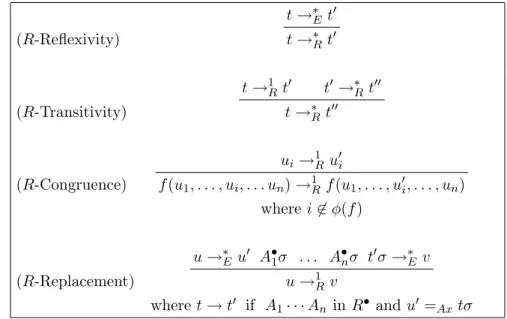
(R-Reflexivity) t→∗E t t→∗Rt (R-Transitivity) t→1Rt t→∗R t t→∗Rt (R-Congruence) ui →1Rui f(u1, . . . , ui, . . . un)→R1 f(u1, . . . , ui, . . . , un) wherei∈φ(f) (R-Replacement) u→∗E u A•1σ . . . A•nσ tσ→∗E v u→1R v wheret→t if A1· · ·An inR• andu=Axtσ Fig. 1. Inference rules for executing rewrite theories
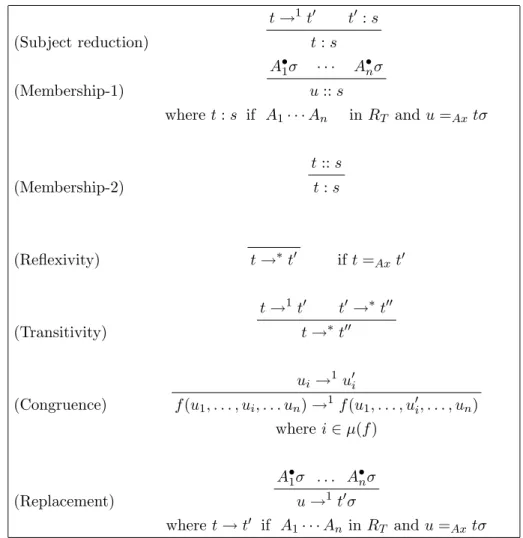
The execution semantics is defined by the inference system in Figure 1, which uses the inference system of Figure2, as an auxiliary subsystem and involves the two rewriting relations→E and→R(in both one-step and reflexive-transitive variants), as well as the ‘:’ and ‘::’ membership relations. Here, t::s is a subrelation of the relationt:s, corresponding to the special case of a membership in which the termt is not further rewritten with→Ebefore computing its sort (see [11]). To distinguish between→E and→R we adopt the convention of decorating all rewrite relations in the subinference system of Figure 2with E. So they now appear as either →1E or
→∗
E in that subsystem.
4.2 Sugared Membership Rewrite Theories (SCS-MCTRSs)
By a sugared context-sensitive membership rewrite theory (SCS-MCTRS) we un-derstand a tupleR= (Σ, S,≤, μ, Ax, R, M) where [26]:
(i) S is a set ofsorts and (S,≤) is a partial order.
(ii) Σ = Σ0Σ1, where Σ0 contains the symbols which are given an explicit sort in the SCS-MCTRS specification, whereas Σ1 contains symbols that do not admit a profile based only on ‘proper’ sorts but rather require the use ofkinds
(corresponding to the connected components in (S,≤) as a whole7). Such use of kinds is typically needed for functions that areintrinsically partial. For example, given a sort Path of paths in a graph, a binary path concatenation function has to be declared at the kind level as ; : [Path] [Path] -> [Path], because it is intrinsically partial on pairs of paths: it is undefined unless the target node of the first path coincides with the source node of the
7 The connected components of (S,≤) can be thought of as the equivalence classesS/≡≤, where≡≤ is the smallest equivalence relation containing the order≤.
(Subject reduction) t→1 t t:s t:s (Membership-1) A•1σ · · · A•nσ u::s wheret:s if A1· · ·An in RT andu=Axtσ (Membership-2) t::s t:s (Reflexivity) t→∗ t ift=Axt (Transitivity) t→1t t→∗t t→∗ t (Congruence) ui→1ui f(u1, . . . , ui, . . . un)→1f(u1, . . . , ui, . . . , un) wherei∈μ(f) (Replacement) A•1σ . . . A•nσ u→1tσ wheret→t if A1· · ·An in RT andu=Axtσ Fig. 2. Inference rules for membership rewrite theories
second path.
(iii) As for rewrite theories,μ: Σ→ Pfin(N) is a mapping sending each symbol f accepting narguments to a subsetμ(f)⊆ {1, . . . , n}.
(iv) Axis a collection of axioms such as associativity, commutativity. (v) R is a set ofconditional rewrite rules of the form
(∀X)t→t if A1 ∧ . . . ∧ Ak
where the Ai are either rewrite conditionsu→v, or memberships w:s. (vi) M is a set ofconditional memberships of the form
(∀X)t:s if A1 ∧ . . . ∧ Ak with the Ai as before.
4.3 Conditional Term Rewriting Systems and Context-Sensitivity
We refer the reader to [32] to recall the usual notions and notations regarding term rewriting and CTRSs. In general, a conditional rewrite rule is as follows:
l→r if s1 =t1,· · ·, sn =tn
where l, r, s1, t1,· · ·, sn, tn are terms (without any sort or kind information and discipline). Termsl andr are called the left- and right-hand sides of the rule, and the sequence s1 = t1,· · ·, sn = tn (often denoted c) is the conditional part of the rule. We are mainly concerned with orientedCTRSs whose (conditional) rules are written as follows:
l→r if s1→t1,· · ·, sn →tn
indicating that the conditions si → ti for 1 ≤ i ≤ n are intended to express the
reachability, in arbitrarily many steps, of (instances of) ti from (instances of)si. We also consider two further generalizations of the CTRS notion. First, we want to allow rewriting modulo a set Ax of equational axioms, so that matching of rules is performed with an Ax-matching algorithm. We therefore view such a CTRS as a triple R = (Σ, Ax, R) with Σ the signature of function symbols, Ax the equational axioms we rewrite modulo, and R the set of conditional rewrite rules. A second generalization is making rewriting context-sensitive [21,22] so that only certain function arguments are rewritten, whereas other arguments remain “frozen”. For example, it is natural to restrict the evaluation of an if-then-else operator so that rewriting is only allowed on the first argument. In this way, we can express that the evaluation of the conditions only makes sense after evaluating the guard of the conditional expression. The simplest way of specifying requirements of this kind is to assume that there is a replacement map [21], i.e., a function μ: Σ −→ P(N) associating to each operatorf of narguments a set of argument positions μ(f) = {i1, . . . , im}, with 1 ≤ ij ≤ n, which are those under which rewriting is allowed. For example, μ(if-then-else) = {1}, and in Example 1.1 μ(cons) = {1}. A context-sensitive CTRS (CS-CTRS) is a pair (R, μ), with R a CTRS that may involve axioms Axand a replacement mapμ.
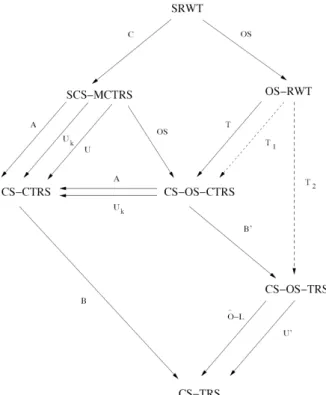
4.4 Sketch of the transformations
The overall family of composable nontermination-preserving transformations is sum-marized in Figure 3. In the following sections, we briefly describe how these trans-formations proceed and which is the main focus for each of them.
5
From SRWTs to SCS-MCTRSs: merging equations
and rules (transformation
C
)
Perhaps the simplest theory transformation we can attempt in order to reduce the operational termination of an SRWT R= (Σ, E∪Ax, μ, R, φ) = (RT, μ, R, φ) to a simpler termination problem is to merge equations E and rules R (transformation
Fig. 3. Transformations for proving termination of Rewrite Theories
C [9]). This can be achieved under the assumption thatμandφarecomplementary
maps, that is, for any function symbolfwithnarguments, and for anyi, 1≤i≤n, we havei∈μ(f) if and only ifi∈φ(f).
The theory transformation R → C(R) transforms R into the (S)CS-MCTRS C(R). This transformation reduces the problem of proving the operational termi-nation of R (under the inference system of Figure 1, plus the auxiliary inference subsystem of Figure2) to proving the operational termination of the (S)CS-MCTRS C(R) under the simpler inference system of Figure 2. The transformation extends (RT, μ) by just adding a new sortTruth to the set of sorts, a new constant tt of that sort, and a new operatorequalof sortTruthto the signature, and by further adding to RT rulesequal(x : [s], x : [s])→ tt for each kind [s], and the following setR◦ of rules:
R◦={t→t if A◦1, . . . , An◦ |(t→t if A1, . . . , An)∈R}
where if Ai is a membership then A◦i = Ai, if Ai is a matching equation ui = vi, then A◦i is the rewrite condition vi →∗ ui, if Ai is an ordinary equation ui = vi, thenA◦i is the rewrite conditionequal(ui, vi)→∗tt, and ifAi is a rewrite condition wi → qi, then Ai◦ is the rewrite condition wi →∗ qi. That is, we wipe out any
distinction betweenE andRin the conditions ofR (note thatRT never contained such distinctions).
Example 5.1 The rewrite theory expressed as a system module in Example 1.4 becomes afunctional module (the equaloperator is not needed):
fmod MARKS-LISTS-C is sorts Nat List MNat MList . subsort List < MList . subsort Nat < MNat . op 0 : -> Nat . op s : Nat -> Nat . op # : -> MNat . op nil : -> List .
op _;_ : Nat List -> List . op _;_ : MNat MList -> MList . op <_> : MList -> MList . vars M N N1 N2 N3 : Nat . vars L L’ : List . vars X : MNat . vars XS : MList . ceq < L > = < # ; L > if < L > = < N1 ; N2 ; N3 ; L’ > . eq # ; (N ; M ; L) = N ; (# ; M ; L) . eq # ; N ; L = L . endfm
There is no distinction now between equations, matching conditions and rules.
6
From SCS-MCTRSs/CS-OS-CTRSs to CS-CTRSs:
en-coding sort information (transformation
A
)
The transformation A [11] allows us to deal with sort information (subsort decla-rations, rank declarations for symbols in the signature, sorted variables occurring in equations or rules,. . . ) of an SCS-MCTRSs or a CS-OS-CTRSs.
We add a truth-value constant tt, plus unary operators iss, iss for each s ∈S. Here, predicates iss deal with sort declarations for variables likex:s wherex is a variable andno reductionbelowissin an instance ofiss(x) is required to check the membership (hence we further let μ(iss) = ∅). On the other hand, predicates iss are intended to deal with ‘proper’ membershipsw:s, wherewis a nonvariable term (ors is amembership sort). In order to appropriately check such memberships, the obtained sort expressions iss(w) may require some subject reduction; thus we let μ(iss) ={1}to enable such reductions. We have new rulesiss(x)→iss(x) for each sorts∈S. In this way, we implement the idea that_::s(represented by predicates iss) is a subrelation of _:s (represented by predicatesiss): if iss(t) holds (i.e., it rewrites to tt), then iss(t) also holds. Each conditional rulet→ t if A1, . . . , An involving variablesx1:s1, . . . , xm:sm; becomes a conditional rule of the form,
t→t if {issi(xi)→tt}1≤i≤m, A1, . . . , An (1)
where if Ai is a membershipui:si, then: (i) ifui is a nonvariable term, then Ai is the rewrite condition iss
i(ui)→ tt, and (ii) if ui ≡ x is a variable, thenAi is the
rewrite conditioniss
i(x)→tt; otherwise, ifAi is a rewrite conditionui →vi, then
Aiis the rewrite conditionui→vi. Finally, we replace each conditional membership
t:s if A1, . . . , An involving variablesx1:s1, . . . xm:sm, by a conditional rule iss(t)→tt if {issi(xi)→tt}1≤i≤m, A1, . . . , An. (2) In this way, type checking within a membership condition t : s (corresponding to the sorted variables x1 : s1, . . . , xm : sm occurring in t) is handled by predicates issi, 1≤i≤m.
Example 6.1 The CS-CTRS obtained from the SCS-MCTRS in Example 1.1 is:
fmod LengthOfFiniteListsAndTake-A is sort S .
op isKNat : S -> S [strat (0)] . *** Kind predicates op isKNatIList : S -> S [strat (0)] .
op isNat : S -> S [strat (0)] . *** Sort predicates: ‘primed’ versions are not op isNatIList : S -> S [strat (0)] . *** necessary due to the absence of ‘proper’ op isNatList : S -> S [strat (0)] . *** membership
op tt : -> S . op and : S S -> S .
op 0 : -> S . *** The unsorted signature begins op s : S -> S .
op zeros : -> S . op nil : -> S .
op cons : S S -> S [strat (1 0)] . op take : S S -> S .
op length : S -> S . *** End of the unsorted signature vars T M N IL L : S . *** Unsorted variables
eq isKNat(0) = tt . *** Definition of kind predicates ceq isKNat(s(N)) = tt if isKNat(N) = tt .
ceq isKNat(length(L)) = tt if isKNatIList(L) = tt . eq isKNatIList(nil) = tt .
eq isKNatIList(zeros) = tt .
ceq isKNatIList(cons(N,IL)) = tt if isKNat(N) = tt /\ isKNatIList(IL) = tt . ceq isKNatIList(take(N,IL)) = tt if isKNat(N) = tt /\ isKNatIList(IL) = tt . ceq isNatIList(IL) = tt if isNatList(IL) = tt . *** Implementation of subsorting eq isNat(0) = tt . *** Sorting for the symbols in the signature ceq isNat(s(N)) = tt if isNat(N) = tt .
ceq isNat(length(L)) = tt if isNatList(L) = tt . eq isNatIList(zeros) = tt .
ceq isNatIList(cons(N,IL)) = tt if isNat(N) = tt /\ isNatIList(IL) = tt . eq isNatList(nil) = tt .
ceq isNatList(cons(N,L)) = tt if isNat(N) = tt /\ isNatList(L) = tt . ceq isNatList(take(N,IL)) = tt if isNat(N) = tt /\ isNatIList(IL) = tt . eq zeros = cons(0,zeros) . *** Transformed rules begin ceq take(0,IL) = nil if isKNatIList(IL) = tt /\ isNatIList(IL) = tt .
ceq take(s(M),cons(N,IL)) = cons(N,take(M,IL)) if isKNat(M) = tt /\ isKNat(N) = tt /\ isKNatIList(IL) = tt /\ isNat(M) = tt /\ isNat(N) = tt /\ isNatIList(IL) = tt . ceq length(nil) = 0 .
ceq length(cons(N,L)) = s(length(L)) if isKNat(N) = tt /\ isKNatList(L) = tt /\ isNat(N) = tt /\ isNatList(L) = tt .
endfm
Transformations UK and U were also discussed in [11] as increasingly simpler lightweight variants ofA: UK ignores kind information, but still encodes sort infor-mation as predicates; whereasU ignores both kind ans sort information.
7
From SCS-MCTRSs to CS-OS-CTRSs: dealing with
explicit memberships (transformation
OS
)
The transformationOS, mapping an SCS-MCTRS to a CS-OS-CTRS, is described in detail in [26]. An SCS-MCTRS does already have an order-sorted signature, with a poset of sorts (S,≤). The corresponding order-sorted signature for the transformed CS-OS-CTRS has a new top sort for each connected component in (S,≤). Furthermore, we add a new sort, Truth, unrelated to all previous sorts, with a constant tt. However, we must remove from this signature all so-called
memberships may be intrinsically needed to determine whether a term has that sort. All other sorts are called order-sorted sorts. While membership of a term in an order-sorted sort can be determined syntactically by the exclusive use of an order-sorted parsing algorithm, membership of a term in a membership sort cannot be so determined; it is instead axiomatized in the transformed theory by adding to its signature new Truth-valued predicates for each membership sort that return tt when applied to a term in the transformed theory if and only if that term has that sort in the original theory.
Example 7.1 ThePALINDROME program above can be viewed as an SCS-MCTRS. After applying transformationOS, we obtain the following CS-OS-CTRS8:
fmod PALINDROME-OS is
sorts Qid List Pal [List] [Truth] . subsorts Qid < Pal < List < [List] . op tt : -> [Truth] .
op nil : -> [Pal] .
op : [List] [List] -> [List] [assoc id: nil] . op is’-Qid : [List] -> [Truth].
op is’-Pal : [List] -> [Truth]. op is’-List : [List] -> [Truth].
op is-Pal : [List] -> [Truth] [strat (0)] . op is-List : [List] -> [Truth] [strat (0)] . var I : Qid .
var P : [Pal] . var K : [List] . vars L L’ : List .
ceq is-Pal(I P I) = tt if is-Pal(P) = tt . eq is’-Pal(K) = is-Pal(K) . eq is’-List(K) = is-List(K) . eq is’-Qid(I) = tt . eq is’-Pal(I) = tt . eq is-Pal(I) = tt . eq is’-List(I) = tt . eq is-List(I) = tt .
ceq is-List(L L’) = tt if is-List(L) = tt /\ is-List(L’) = tt . ceq is-List(K) = tt if is-Pal(K) = tt .
endfm
In contrast, the SCS-MCTRSLengthOfFiniteListsAndTakeremainsunchanged
under transformation OS!
8
From SRWTs to OS-RWT: dealing with explicit
mem-berships in rewrite theories (transformation
OS
)
A very important transformation maps a SRWT R to a corresponding OS-RWT OS(R). This is just a slight generalization of the transformation from a SCS-MCTRS to a CS-OS-CTRS in Section 7, which is extended in a straightforward way to our desired transformation R → OS(R). The corresponding transforma-tion R → OS(R) has now a very simple description. If R = (RT, μ, R, φ), then OS(R) = (OS(RT, μ), OS(R), OS(φ)), where (RT, μ) → OS(RT, μ) is the just-summarized transformation from a SCS-MCTRS to a CS-OS-CTRS, OS(R) con-tains for each rulet→t if A1, . . . , AninRa corresponding rule with the same left-8 Note that we use brackets for giving names tosortsin the obtained OS-CS-CTRS; despite this ‘kind-like’ notation, no kinds are actually present here!
and right-hand sides, but where: (i) all variables having a membership sort remain unchanged; and all variables having a kind have been replaced by variables of the corresponding new top sort for the connected component of sorts for that kind; (ii) all variables x having a membership sort s have been replaced by variables of the corresponding new top sort for the connected component of that membership sort, and an additional condition of the formiss(x)−→∗E tt; (iii) any conditionAi of the form w : s for some sort s is replaced by a condition of the form iss(w) −→∗E tt, (where, as explained in [26] and in Section6, the difference between theiss andiss predicates is thatissallows equational reduction of its argument, whereasiss does not); and (iv) all other conditions Aj are left unchanged. Finally, the frozenness mapping OS(φ) extends the original φ in a straightforward way by agreeing with φ on the old function symbols and considering all arguments of all new function symbols added to the signature as unfrozen. The end result is that the transformed theoryOS(R) is an OS-RWT, as desired.
Example 8.1 The program MARKS-LISTS remains unchanged under transforma-tionOS.
9
From OS-RWTs to CS-OS-CTRSs: encoding
equa-tional rewriting (transformation
T
)
Given an order-sorted rewrite theory R = (Σ, S,≤, E∪Ax, μ, R, φ), we define a transformationR →T(R), whereT(R) = (Σ, S,≤, Ax, E∪R, μ) is an OS-CS-CTRS, and therefore has a single rewrite relation. Here:
• S ⊃ S extends S by adding a fresh new sort True, and for each connected componentC of sorts (which need not have a top sort), a fresh new sort C; and
≤ extends≤ only by the identity relationsC≤C, andTrue ≤ True.
• Σ⊃Σ extends Σ by adding: (i) a constantttof sortTrue; (ii) for each connected component of sortsCan operatoreq :CC −→True; and (iii) for each connected componetC of sorts and each maximal sort s∈C two new operators:
[ ],{ }:s−→C
• μ extendsμby the declarationsμ([ ]) =∅, μ({ }) =∅, and μ(eq) =∅.
• Ax⊃AxextendsAxby declaring eacheq commutative.
• E consists of the following rules:
· For each (possibly conditional) equation
t=t if A1, . . . , An (3)
inE, rules
t→t if A•1, . . . , A•n (4)
{t} →[t] if A•1, . . . , A•n (5)
[vi] → [ui], and if Ai is an ordinary equation ui = vi, then A•i is the rewrite condition eq([ui],[vi])→tt.
· The following rules are given foreq (for s, s (not necessarily distinct) maximal sorts in the same connected component, withx, z of sorts, and y of sorts):
eq([x],[x])−→tt (6)
eq([x],[y])−→eq([z],[y]) if {x} −→[z] (7)
· For each nonconstantf in Σ having a maximal aritys1. . . sn and eachiinμ(f) we add a rule (with xj of sortsj, andy of sortsi)
{f(x1, . . . , xi, . . . , xn)} −→[f(x1, . . . , y, . . . , xn)] if {xi} →[y] (8)
· for each maximal sort sin the subsort ordering of (S,≤), with variablesx, y of sorts we add the rule
[x]−→[y] if {x} →[y] (9)
• For each rule t −→ t if A1, . . . , An in R, we get in R the rule t −→ t if A•1, . . . , A•n where A•i is defined as above; plus the case of conditions of the formu−→v, which are left without change.
Example 9.1 The programMARKS-LISTS-OS(which coincides with MARKS-LISTS, see Example 8.1) is transformed by T as follows:
mod MARKS-LISTS-OS-T is
sorts List MList MNat Nat Thruth [MList] [MNat] . subsort List < MList .
subsort Nat < MNat . op # : -> MNat . op 0 : -> Nat .
op <_> : MList -> MList . op _;_ : MNat MList -> MList . op _;_ : Nat List -> List .
op [_] : MList -> [MList] [frozen (1)] . op [_] : MNat -> [MNat] [frozen (1)] . op {_} : MList -> [MList] [frozen (1)] . op {_} : MNat -> [MNat] [frozen (1)] .
op equal : [MList] [MList] -> Thruth [frozen (1 2)] . op equal : [MNat] [MNat] -> Thruth [frozen (1 2)] . op nil : -> List .
op s : Nat -> Nat . op tt : -> Thruth .
crl [introduce] : < L:List > => < # ; L:List >
if [< L:List >] => [< N1:Nat ; N2:Nat ; N3:Nat ; L:List >] .
rl [propagate] : # ; N:Nat ; M:Nat ; L:List => N:Nat ; # ; M:Nat ; L:List . rl [remove] : # ; N:Nat ; L:List => L:List .
rl equal([X:MList], [X:MList]) => tt . rl equal([X:MNat], [X:MNat]) => tt .
crl {< X1:MList >} => [< Y:MList >] if {X1:MList} => [Y:MList] .
crl {X1:MNat ; X2:MList} => [X1:MNat ; Y:MList] if {X2:MList} => [Y:MList] . crl {X1:MNat ; X2:MList} => [Y:MNat ; X2:MList] if {X1:MNat} => [Y:MNat] . crl {X1:Nat ; X2:List} => [X1:Nat ; Y:List] if {X2:List} => [Y:List] . crl {X1:Nat ; X2:List} => [Y:Nat ; X2:List] if {X1:Nat} => [Y:Nat] . crl {s(X1:Nat)} => [s(Y:Nat)] if {X1:Nat} => [Y:Nat] .
endm
Note that if the theory R, besides satisfying conditions (1)–(3), is such that: (i) the equations E are unconditional; and (ii) in any rule t−→t if A1, . . . , An
in R, all the conditions Ai are non-equational rewrite conditions, then the above transformationR →T(R) can be greatly simplified: we do not need the new sorts and the new operatorstt,eq, [ ], and{ }, so that the signature remains unchanged. And we do not need to add any extra, auxiliary rules at all: we just convert the equations E into rules, and leave the rules R unchanged. We denote by T1 this
simpler transformation. An even simpler case is when, in addition, (iii) the rulesR are unconditional. Then we just turn the equations into rules and try to prove the termination of the OS-CS-TRS with unconditional rulesE∪RmoduloA. We then denote the transformation byT2. It is just exactly likeT1, but it has the advantage thatT2(R) is always anunconditonal OS-TRS.
Yet a different kind of simplification can be obtained when E = ∅ but R has equational conditions. If such equational conditions include ordinary equations, then we just need to add tt, eq, and [ ], and just rules of the form eq(x, x) −→tt. Furthermore, if all equational conditions only involve matching equations, then we can also ignorett andeq, and only need to add [ ].
10
Final transformations to a CS-TRS
The transformations sketched in Sections5to9show how to deal with the features of rewriting logic programs. They finally yield (possibly together with some underly-ing set of axioms) either a context-sensitive, order-sorted conditional rewrite system (CS-OS-CTRS) or a context-sensitive, conditional rewrite system (CS-CTRS). De-spite the fact that no termination tool deals with such kind of systems directly, it is possible to further transform them into a context-sensitive term rewriting sys-tem (CS-TRS) for which we can obtain an automatic proof of termination by using tools like AProVE or mu-term. Transformation B from CS-CTRS to CS-TRSs (described in [11]) generalizes to the CS-case a well-known transformation form CTRSs to TRSs described, e.g., in [32]. Transformation B from CS-OS-CTRS to CS-OS-TRSs (described in [26]) plays a similar role for the order-sorted case. The transformation ¨O-L from CS-OS-TRS to CS-TRSs (described in [26]) generalizes to the CS level a well-known transformation by ¨Olveczky and Lysne [33].
Thus, given a rewrite theory R, which we assume in sugared form (SRWT), we can always transform it, in a way that preserves operational nontermination, into a CS-TRS, which can then be sent to a number of automatic termination tools, so that a proof of termination of this transformed CS-TRS yields a proof of operational termination for our original rewrite theory.
11
Conclusions and further work
We have studied the problem of proving the operational termination of rewrite theories having expressive features such as the distinction between equations E and rulesR, sorts, subsorts, membership predicates, rewriting modulo axioms, and context-sensitive rewriting for both equations and rules. Our approach is trans-formational and relies on the preservation of operational nontermination in the transformations we propose. We have implemented all these transformations in theMaudeTermination Tool (MTT,http://www.lcc.uma.es/~duran/MTT). Our initial experiments suggest that these transformations can be effective in proving termination of a wide range of rewriting logic programs. However, we believe that the techniques presented here should be combined with more intrinsic techniques,
for example to keep sort and subsort information around and to use it directly in termination proofs rather than encoding such sort information into conditions. For instance, the following specification of the factorial function [27]:
fmod FACTORIAL is sorts Nat NzNat . subsorts NzNat < Nat . op 0 : -> Nat . op s : Nat -> NzNat . op p : NzNat -> Nat . op _+_ : Nat Nat -> Nat . op _+_ : NzNat Nat -> NzNat . op _+_ : NzNat NzNat -> NzNat . op _*_ : Nat Nat -> Nat . op _*_ : NzNat NzNat -> NzNat . op fact : Nat -> NzNat . vars x y : Nat . vars x’ : NzNat . eq x + 0 = x . eq x + s(y) = s(x + y) . eq x * 0 = 0 . eq x * s(y) = x + (x * y) . eq fact(0) = s(0) . eq fact(x’) = x’ * fact(p(x’)) . eq p(s(x)) = x . endfm
can be easily proved terminating (as an Order-Sorted Term Rewriting System) by using the recently introduced order-sorted dependency pairs method [27], imple-mented as part of the toolmu-term. In contrast, we could not obtain an automatic proof of termination using the transformations described above. Thus, developing direct methods for proving termination of programs at the different theory levels depicted in Figure3 is an interesting subject for future work.
References
[1] F. Baader and T. Nipkow. Term Rewriting and All That. Cambridge University Press, 1998. [2] P. Borovansk´y, C. Kirchner, H. Kirchner, and P.-E. Moreau. ELAN from a rewriting logic point of
view.Theoretical Computer Science, 285:155–185, 2002.
[3] A. Bouhoula, J.-P. Jouannaud, and J. Meseguer. Specification and proof in membership equational logic.Theoretical Comput. Sci., 236:35–132, 2000.
[4] R. Bruni and J. Meseguer. Semantic foundations for generalized rewrite theories. Theoretical Computer Science351(1):386-414, 2006.
[5] M. Clavel, F. Dur´an, S. Eker, P. Lincoln, N. Mart´ı-Oliet, J. Meseguer, and C. Talcott. All About Maude – A High-Performance Logical Framework. Lecture Notes in Computer Science 4350, 2007. [6] CoFI Task Group on Semantics. CASL—The common algebraic specification language, version 1.0,
Semantics.http://www.brics.dk/Projects/CoFI/Documents/CASL/Semantics/index.html, 1999. [7] E. Contejean and C. March´e, B. Monate and X. Urbain. Proving termination of rewriting with CiME.
InProc. of WST’03, pages 71-73, Technical Report DSIC II/15/03, Valencia, Spain, 2003. Available at
http://cime.lri.fr.
[8] F. Dur´an, S. Lucas, C. March´e, J. Meseguer, and X. Urbain. Proving Termination of Membership Equational Programs. In P. Sestoft and N. Heintze, editors,Proc. of ACM SIGPLAN 2004 Symposium PEPM’04, pages 147–158. ACM Press, 2004.
[9] F. Dur´an, S. Lucas, and J. Meseguer. Operational Termination in Rewriting Logic. Technical Report 2008.http://www.dsic.upv.es/~slucas/tr08.pdf
[10] F. Dur´an, S. Lucas, and J. Meseguer. MTT: The Maude Termination Tool. InProc. of IJCAR’08, LNCS 5195:313-319, Springer-Verlag, Berlin, 2008.
[11] F. Dur´an, S. Lucas, J. Meseguer, C. March´e, and X. Urbain. Proving Operational Termination of Membership Equational Programs.Higher-Order and Symbolic Computation, 21(1-2):59–88, 2008.
[12] S. Eker. Term Rewriting with Operator Evaluation Strategies. In C. Kirchner and H. Kirchner, editors,
Proc. of 2nd International Workshop on Rewriting Logic and its Applications, WRLA’98, Electronic Notes in Computer Science, 15(1998):1-20, 1998.
[13] K. Futatsugi and R. Diaconescu.CafeOBJ Report. World Scientific, AMAST Series, 1998.
[14] J. Giesl, P. Schneider-Kamp, and R. Thiemann. AProVE1.2: Automatic Termination Proofs in the Dependency Pair Framework. In Proc. of IJCAR’06, LNAI 4130:281-286, Springer-Verlag, Berlin, 2006.
[15] J. Giesl, S. Swiderski, P. Schneider-Kamp, and R. Thiemann. Automated Termination Analysis for Haskell: From Term Rewriting to Programming Languages. InProc of RTA’06, LNCS 4098:297-312, Springer Verlag, Berlin, 2006.
[16] J. Goguen and J. Meseguer. Order-sorted algebra I: Equational deduction for multiple inheritance, overloading, exceptions and partial operations. Theoretical Computer Science, 105:217–273, 1992. [17] J.A. Goguen, T. Winkler, J. Meseguer, K. Futatsugi, and J.-P. Jouannaud. Introducing OBJ. In J.
Goguen and G. Malcolm, editors,Software Engineering with OBJ: algebraic specification in action, Kluwer, 2000.
[18] N. Hirokawa and A. Middeldorp. Tyrolean termination tool: Techniques and features.Information and Computation, 205:474-511, 2007.
[19] P. Hudak, S. Peyton-Jones, and P. Wadler. Report on the Functional Programming Language Haskell: a non–strict, purely functional language.SIGPLAN Notices, 27:1–164, 1992.
[20] A. Koprowski. TPA: Termination Proved Automatically. InProc of RTA’06, LNCS 4098:257-266, Springer Verlag, Berlin, 2006. http://www.win.tue.nl/tpa
[21] S. Lucas. Context-sensitive computations in functional and functional logic programs. Journal of Functional and Logic Programming, 1998(1), 1-61, 1998.
[22] S. Lucas. Context-sensitive rewriting strategies.Information and Computation, 178(1):294–343, 2002. [23] S. Lucas. MU-TERM: A Tool for Proving Termination of Context-Sensitive Rewriting InProc. of 15h RTA’04, LNCS 3091:200-209, Springer-Verlag, Berlin, 2004. Available athttp://www.dsic.upv. es/~slucas/csr/termination/muterm.
[24] S. Lucas. Termination of on-demand rewriting and termination of OBJ programs. InProc. of 3rd International Conference on Principles and Practice of Declarative Programming, PPDP’01, pages 82-93, ACM Press, 2001.
[25] S. Lucas, C. March´e, and J. Meseguer. Operational termination of conditional term rewriting systems.
Information Processing Letters, 95:446–453, 2005.
[26] S. Lucas and J. Meseguer. Operational Termination of Membership Equational Programs: the Order-Sorted Way. In Proc. of WRLA’08, Electronic Notes in Theoretical Computer Science, to appear, 2009.
[27] S. Lucas and J. Meseguer. Order-Sorted Dependency Pairs. InProc. of 10th International Conference on Principles and Practice of Declarative Programming, PPDP’08, pages 108-119,ACM Press, 2008. [28] J. Meseguer. General logics. InLogic Colloquium’87, pages 275–329. North-Holland, 1989.
[29] J. Meseguer. Membership algebra as a logical framework for equational specification. In F. Parisi-Presicce, editor, Proceedings WADT’97, volume 1376 ofLecture Notes in Computer Science, pages 18–61. Springer-Verlag, 1998.
[30] J. Meseguer and J. Goguen. Initiality, induction and computability. In M. Nivat and J. Reynolds, editors,Algebraic Methods in Semantics, pages 459–541. Cambridge University Press, 1985.
[31] U. Nilsson and J. Maluszynski. Logic, Programming and Prolog (2ed) John Wiley & Sons, 1995 [32] E. Ohlebusch.Advanced Topics in Term Rewriting. Springer-Verlag, Berlin, 2002.
[33] P.C. ¨Olveczky and O. Lysne. Order-Sorted Termination: The Unsorted Way. InProc. of ALP’96, LNCS 1139:92-106, Springer-Verlag, Berlin, 1996.
[34] P. Schneider-Kamp, J. Giesl, A. Serebrenik, and R. Thiemann. Automated Termination Analysis for Logic Programs by Term Rewriting. InProc. of LOPSTR’06 (selected papers), LNCS 4407:177-193, Springer-Verlag, Berlin, 2007.