Caching in LTE networks using
Software-Defined Networking
School of Electrical Engineering
Thesis submitted for examination for the degree of Master of Science in Technology.
Espoo 22/09/2014
Thesis supervisor:
Prof. Jukka Manner
Thesis advisor:
Author: Maël Kimmerlin
Title: Caching in LTE networks using Software-Defined Networking
Date: 22/09/2014 Language: English Number of pages: 6+68
Department of Communications and Networking
Professorship: Communications Networking Code: S-38
Supervisor: Prof. Jukka Manner Advisor: D.Sc. (Tech.) Jose Costa
Data consumption is increasing rapidly in mobile networks. The cost of network infrastructure is increasing, which leads to an "end of profit" within next few years. Thus, mobile operators require a new technology that allows increasing the network capacity within low network costs. Therefore, using caching is the most evident solution to be used in their backhaul networks. However, the cur-rent architecture of LTE network does not provide sufficient flexibility to place the caches in the most optimal locations. The current work on Software-Defined Networking in Evolved Packet Core virtualization has enabled us to integrate a dynamic caching functionality in a LTE network and improve the caching system performance. In this thesis, we present the solution we designed for this aim based on Software Defined Networking technology. Moreover, we developed a testbed for the proof-of-concept and we present the results and analyze the performances of this solution. We propose three possible optimizations, that we analyze through a simulation.
Keywords: Caching, SoftwaDefined Networking, LTE networks, Content re-location
Acknowledgements
I would like to express my sincere gratitude to Dr. Jose Costa-Requena for instruct-ing this work. He taught me many thinstruct-ings, such as how to proceed in a scientific work and how to write a paper out of my results. This thesis has been a long journey, along which he has always been present to help me. I also want to thank Pr. Jukka Manner for supervising this work and reviewing the thesis. I am grateful to Jesus Llorente Santos and Vicent Ferrer Guasch for their advice, the long discussions on the prototypes and their help to get objective views of my ideas. I also would like to thank my family for financial and moral support.
This work was done in the SIGMONA research project funded by the Finnish Funding Agency for Technology Innovation and Industry TEKES.
Otaniemi, September 2014
Contents
Abstract ii Acknowledgements iii Contents iv Abbreviations vi 1 Introduction 12 In-Network caching application for mobile networks 5
2.1 Performance improvements by caching Http . . . 5
2.1.1 Advantages and drawbacks of web caching . . . 5
2.1.2 Desired properties . . . 5
2.1.3 Caching features . . . 6
2.1.4 Architectures . . . 7
2.2 Cacheability analysis for Http in a LTE network . . . 7
2.3 Caching location selection . . . 8
2.4 Caching optimizations . . . 9
2.5 Cache cooperation . . . 10
2.5.1 Virtual Proxy Graph . . . 11
2.5.2 Caching Strategy . . . 11
2.5.3 Adaptation to wireless environment and performance study . . 11
2.6 In-network caching with ICN . . . 12
2.7 Summary . . . 13
3 Software-Defined Networking application for caching 14 3.1 Applying SDN to mobile networks . . . 14
3.1.1 Application of SDN . . . 14
3.1.2 SDN architecture . . . 16
3.2 Using SDN for CCN with a new transport protocol . . . 17
3.2.1 Infrastructure . . . 18
3.2.2 Operations . . . 18
3.3 CCN support over a SDN IP network . . . 18
3.3.1 Description of the solution . . . 18
3.3.2 Interaction with usual networks . . . 19
3.3.3 Features . . . 19
3.4 An interface between SDN and CCN . . . 20
3.5 A content management layer transparent for users . . . 21
3.5.1 Architecture . . . 21
3.5.2 Considerations . . . 22
4 SDN-based caching validation in mobile networks 25
4.1 Solution for the testbed . . . 25
4.2 Caching based on IP addresses . . . 25
4.2.1 Advantages and drawbacks . . . 28
4.2.2 Rules needed on the SDN switches . . . 29
4.2.3 Runtime operations on the SDN controller . . . 30
4.2.4 Caching system requirements . . . 30
4.3 Principle validation . . . 30
4.3.1 Openflow rules . . . 30
4.3.2 Forwarding rules . . . 33
4.3.3 NAT rules . . . 33
4.4 Caching relocation first validation . . . 34
4.5 Issues of the system . . . 37
4.6 Summary . . . 38
5 Caching integration in Software-Defined networks 39 5.1 Forwarding-on content solution . . . 39
5.2 Proxy fully-based solution . . . 43
5.3 Hybrid solution . . . 46
5.4 Simulation setup . . . 50
5.4.1 Description of the model . . . 50
5.4.2 Limitations . . . 52
5.4.3 Results of the first simulation set . . . 53
5.4.4 Results of the second simulation set . . . 57
5.4.5 Forewarn . . . 59
5.5 Miscellaneous optimizations . . . 61
5.6 Charging for the cached content . . . 61
5.7 Summary . . . 61
6 Conclusion 63
Abbreviations
ACK Acknowledgement
CCN Content-Centric Network
CDN Content Delivery Network
DNS Domain Name System
enodeB Evolved Node B
EPC Evolved Packet Core
ETAG Entity Tag
FIB Forwarding Information Table
GGSN Gateway GPRS Support Node
GPRS General Packet Radio Service
GTP GPRS Tunneling Protocol
GW Gateway
HLC Home Location Cache
HLS HTTP Live Streaming
HSS Home Subscriber Server
HTTP Hypertext Transfer Protocol
HTTPS Hypertext Transfer Protocol Secure
ICN Information-Centric Network
IP Internet Protocol
ISP Internet Service Provider
LFU Least Frequently Used
LRU Least Recently Used
LTE Long Term Evolution
MME Mobility Management Entity
NAT Network Address Translation
OPEX Operational expenditure
PDN Packet Data Network
P-GW Packet Gateway
PIT Pending Interest Table
QOE Quality of Experience
QOS Quality of Service
RNC Radio Network Controller
RST Reset flag (TCP)
RTT Round-Trip Time
SDN Software-Defined Networking
SGSN Serving GPRS Support Node
S-GW Serving Gateway
SIB Subscriber Information Base
SYN Synchronization request flag (TCP)
SYN ACK Synchronization Acknowledgement flag (TCP)
TCP Transmission Control Protocol
TOS Type of Service
TTL Time To Live
UDP User Datagram Protocol
UMTS Universal Mobile Telecommunications System
URL Uniform Resource Locator
VEPC Virtual Evolved Packet Core
VLAN Virtual Local Area Network
Mobile devices such as smart-phones and tablets are more and more widely used by end users. This leads to a fast growth of the data consumption which results in higher bandwidth and resources consumption. The costs are increasing for the operators to create and maintain a network capable of providing internet access to all their end users. Moreover, users are not willing to pay more for their mobile data services. Thus the incomes generated with those equipment are not increasing, which leads to the "end of profit" situation for networks operators in 2015 according to a recent study [1, 2].
Therefore, mobile operators require a solution that will allow increasing the net-work capacity or optimizing the usage of available resources and reduce the Op-erative Expenses (OPEX). Caching is already a solution used in wired networks, and widely deployed by Internet Service Providers (ISP) to lower their bandwidth consumption and improve the user experience of their clients. Caches are servers added in the networks, that intercept the requests of the clients in order to serve them from local storage as much as possible. When a request arrives, for a piece of content that is not already stored in the cache, the cache retrieves it from the original web server, stores a copy depending on certain conditions and forwards the response to the client. Any following request for the content will be served with the local copy. By storing the content in a location close to the users, caching permits to reduce the load on the network. The contents are served from a location close to the users, thus the packets travel less, so the network resources are spared. Caching mainly avoids that requests to the same contents go every time through the whole network to the packet gateways and the interconnections. It also permits to reduce the peering costs. From an end user point of view, caching permits to improve the quality of experience (QoE). Since the content is stored closer, the latency is reduced, and the content might be downloaded faster. [2]
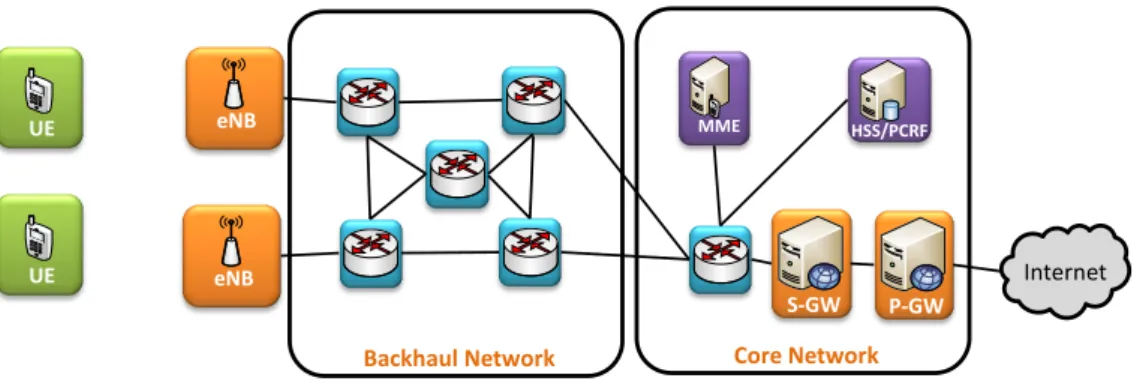
The LTE mobile network architecture defines a logical network running on top of a legacy L3 transport network. The latter is providing the connection between the different network elements of the LTE network. The LTE network is usually divided in two parts : the backhaul and the core networks. The backhaul network is the part of the network connecting the access network where the enodeBs (LTE base stations) are located to the core network where the other logical components of the LTE network are located. The main logical components of the core LTE network are :
• The mobility Management Entity (MME) that handles the mobility of the
users and controls the handovers between different enodeBs. It handles the tunnel setup between the base stations and the gateways.
• The Home Subscriber Server (HSS) contains all the information needed about the subscribers
MME HSS/PCRF eNB UE Internet Backhaul Network eNB UE Core Network S-GW P-GW
Figure 1: Current LTE network architecture
• The Packet Data Network (PDN) GateWay (P-GW) acts as a gateway to
Internet
• The Serving GateWay (S-GW) forwards the data between the enodeBs and
the P-GW. The P-GW and S-GW are usually together referred to as S/P-GW.
• There are also other elements such as the Policy Control and Charging Rules Function (PCRF) that applies the QoS and the charging.
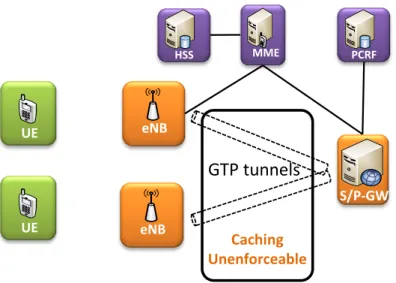
Figure 1 shows the current architecture with the access, backhaul and core net-works where the LTE logical network elements are deployed. Caching solutions can be applied to LTE mobile network to allow a faster download and spare the power resources of the devices. However, mobile network infrastructure has been designed with tunneling functionality (GTP tunnels) to allow mobility while keeping an active session. Therefore, this tunneling between the base station and the Gateway that connects to public Internet makes it difficult to place the caching in most optimal lo-cations as shown in Figure 2. The caching can be located in both ends of the tunnel which, in practice, means either in the base station or in the core network where the GWs are located. Due to the random and fully distributed content consumption, it is no longer enough to provide an Internet access to the users with centralized caching. Distributed in-network caching could permit even more savings in terms of cost by reducing the bandwidth consumption. Introducing caching in mobile networks also improves the users’ experience by reducing the perceived latency. Therefore, the current concern is to move it from this central point to distributed locations in any part of the network that leads to more optimal usage of the network resources. [2]
The current goal is to bring content caching as close to the users as possible but also to dynamically move the cached contents to more optimal location that optimize the overall network bandwidth available. The content would be cached in different places depending on the user demand. Research has been done already on distributed caching in Base Stations for example [3]. Current work on Evolved Packet Core (EPC) in the SIGMONA project [4] permits to propose a new approach to solve this problem of placing the caching in any part of the network. Other works with the same aim could also enable a new approach [5, 6].
MME PCRF eNB UE eNB UE S/P-GW GTP tunnels HSS Caching Unenforceable
Figure 2: Current LTE Signaling
The work in this thesis explores how an in-network caching system could be im-plemented in LTE mobile networks. We get started first with the implementation of a testbed of a system working in a legacy IP network. In this implementation, we use software-defined networking to redirect the users’ requests to the optimal cache location. This solution uses rules on the Openflow switches to redirect the request to the new cache where the content is located. We use the testbed to measure the efficiency of the proposed design. In our tests, this system decreased the download time of a video from 5.5s when fetching it from its web server to less than 1s when served by the caching system. This system can also reduce the load on the network by nearly 50% for users streaming the same video. Even though the system gives interesting results, it includes some flaws; the main one being the lack of granularity in the control of the content location. There were also some performance issues specific to the implementation. Thus, we propose several optimizations, including different relocation methods. Before deploying the new design in the testbed, we first validate the proposed solutions in a simulation. [2] We found that a hybrid sys-tem based on those solutions performs the best and that our time-based relocation system performs better than the solution triggering the relocation decision process based on the arrival of the requests, in terms of load reduction.
We refer to the process that allows fetching the content from the new location of the cache instead of the previous location as a "relocation". With the "relocation" functionality, we are not moving the object itself, which will lead to additional traffic generated to move content between caches, but instead we set the rules in the SDN switches to forward the request to the new location of the content [2].
Chapter 2 presents some previous works related to caching in mobile networks. This previous research investigates the different properties of caching, the possible locations and the features to improve its efficiency. This chapter also presents pre-vious work on virtual Evolved Packet Core (vEPC) that enabled us to propose our solution. In Chapter 3, we explore the possible integration of SDN into caching
sys-tems. The different proposals include several Information-Centric Networks (ICN) or Content-Centric Networks (CCN) architectures. Then we present our prototype, based on those previous works, in Chapter 4. The performance tests results are displayed in this chapter too. Due to the issues of the system, we present some optimizations in Chapter 5. We detail the different possible relocation methods and the setup of the simulation used to analyze them and its results.
2
In-Network caching application for mobile
net-works
This section presents a diverse panel of possible improvements for caching. We study the design and testing of a distributed system using SDN networking so we do not focus on internal cache content management methods. In this section, similar re-search performed in this area is described for extensiveness and comparison analysis. In this section, we first present the HTTP caching principles and then some features of the caching system. Finally, we present the optimizations based on which we design our caching infrastructure.
2.1
Performance improvements by caching Http
There are several ways to cache the content, such as peer-to-peer web caching [7] or database caching [8]. The best known is HTTP based caching that is applied in most networks through caches and proxies. J. Wang has published a survey of the http caching schemes [9], where he gives details about techniques to reduce congestion and load on the servers by caching the web content.
2.1.1 Advantages and drawbacks of web caching
The first and most relevant advantage is that caching reduces the network traffic and the bandwidth consumption. The requests are served from a local copy, thus they do not go across the whole network to fetch the content from Internet. Thus, caching reduces the network load and the peering costs since less volume is going in and out of the network. Another advantage is that serving the content from local copies improves the users’ experience by reducing the latency. The cache allows retrieving the content from a close location so the round-trip time (RTT) is lower for the local cache than for the original web server.The caching also increase reliability since the connection does not go across multiple links through the uncertain Internet. Another positive point is that caching reduces the load on the servers by load-balancing the requests on the different caches. Thus caching can also enhance the robustness of the service since in case the web server goes down, the contents can still be served with the local copy stored in the cache. However, caching can have drawbacks too, since it increases the latency in case of a cache-miss (content not stored yet) or in case of non-cacheable content. Caches can also be a bottleneck or a single point of failure if the design is not done carefully. Finally, the caches modify the content retrieval information.
2.1.2 Desired properties
The implementation of the caches should comply the following recommendations:
• Fast access : to ensure a low latency.
• Transparency : for the users not to care about it.
• Scalability : to support the load.
• Efficiency
• Adaptiveness : to adapt to the demand changes
• Stability : to avoid disruption in services.
• Load balancing : for scalability and stability reasons.
• Simplicity : for the system administration.
These items are fundamental to implement an efficient caching system.
2.1.3 Caching features
The cache systems can be highly complex and this section provides an overview of the different features that can be implemented in a cache. The first feature when implementing a caching system is the resolution procedure. Resolving caches follows a similar process to DNS resolution, that maps a content identifier such as an URL to a caching location in case of distributed caching. There are two techniques to locate the content. The first one is a cache routing table containing pointers to the location of the content. This table is updated using multicast communications between switches. The second option to locate the cached content consists of a hashing function that gives the location based on the URL and the cache membership list. In both cases, updates are needed if the caches network changes.
Moreover, there are also two solutions such as prefetching and cache placement that can be used to improve the cache-hit ratio. The prefetching is done by re-trieving future popular files based on a prediction algorithm. The prefetching can be performed at different levels, either between user and proxies, between proxies and web servers or between users and web servers. The second solution consists of cache placement or replacement. It can use traditional policies such as Least Recently Used (LRU) or Least Frequently Used (LFU). The LRU removes the file that was not accessed for the longest time. The LFU removes the file that is the least frequently accessed. Modified versions of those algorithms that consider the properties of the files, such as their size where the biggest files are removed or LRU with a minimum size are removed, are new approaches to solve the problem. An-other algorithm can be based on the latency for retrieving the file so the files with the lowest retrieving latency are removed.
Removing files leads to the cache coherence problem. Caches need a way to
remove outdated pages. There are two ways to ensure cache consistency. One
way is by using revalidation, such as conditional GET including ETags, or server invalidation. Conditional GET is a kind of Http request similar to the GET request but including a "If-modified-since" header. This header contains the timestamp of the version currently cached by the client. If the resource on the server has been modified since this time, the server sends the new version, otherwise the server sends
a "304 Not Modified" header. This method is quite expensive because it implies to contact the server every time the resource is downloaded by the client. The other revalidation way is called server invalidation. It is a process where servers update their clients, but this means keeping track of them, thus increasing the load on the server itself. Those solutions are not simple and instead weak solutions such as a time-to-live for the documents may be preferred. The TTL is based on the time since the content has been sent and not outdated. The TTL defines a time during which the cached version can be served directly. But this static solution may lead to problems in case of high rate of changes for the resources. Another solution is to require a validation of the already stored content of a web server when accessing it, so that all the contents from the same server are revalidated or discarded at once.
2.1.4 Architectures
The different features described above are used to increase the efficiency of the caching system. Another possibility for improving the caching system efficiency is to distribute the system so that caches can cooperate. There are two main and a third hybrid architecture achieving this objective. One of the main architecture is the hierarchical where caching takes place at every level of the network and a request will go through the caches from the access level to the gateways level until it finds a cached copy, otherwise the request will be forwarded to the web server. The reply is cached in all the proxies the request crossed. In this solution, coordination is needed between the different levels and multiple copies are hold at different levels. Moreover, overload may happen on high level caches, with a queue that may increase too much the latency.
The second main architecture is the distributed that is only composed of low level caches. These caches keep metadata about the content of each other. Even if the requests that are cache-misses are retrieved from the other distributed caches, metadata stored by the caches are still hierarchically distributed. The advantage of this solution is that the traffic remains in the access network. However, if the size of the distributed system is too big, connection times may be unacceptable. Te third hybrid architecture with a limitation on the cache cooperation can ensure that the time needed to serve the content remains smaller than the one needed to fetch the content from the web server.
The remainder of the thesis focuses on the distributed architecture type. The research is focusing on caching in the mobile networks since it can reduce the load, mainly in the backhaul network, and reduce the latency for the users. Solutions such as proactive caching and distributed caching have been proposed. This section presents these techniques, focusing first on the cached content and the location of the caches, and then on the caching techniques.
2.2
Cacheability analysis for Http in a LTE network
The performances of the caching systems are tightly related to the type of content targeted for caching. B.A. Ramanan et al. have published an analysis of the content
cacheability in a LTE network [10]. Their study defines what content could be cached in the Base Stations to reduce the bandwidth consumption. To be cacheable, an object must fulfill requirements on its http header fields:
• Set-cookie must be null.
• Vary must be null.
• Content-Length must not be equal to 0.
• Last-Modified must not be set to 0.
• Cache-Control must not be "private" or "no-cache".
Moreover, only the responses with the codes 200, 203, 206, 300, 301 and 410 can be cached.
With these criteria, 31% of the requests in their samples were cacheable, and 74% of the http volume was cacheable. The type of content such as images, video, audio, text or application, also impacts the cacheability. The images are easy to cache, their rate of revisit is high and this permits to reduce the latency and the bandwidth consumption. Moreover, few revalidations are needed. The text contents have a high rate of revisit too, but a low data volume. It reduces the latency but does not change the bandwidth consumption. Their revalidation rate is quite high. The application contents are similar, but they have a higher revalidation rate. A piece of content with a high revalidation rate should not be cached since the cache will probably send a request to the web server to revalidate the content. Caching such content can only spare bandwidth. Thus, audio contents are not a good target for caching because of their very high revalidation rate. Video contents are a good target, since there are few requests and a huge data volume so caching videos spares bandwidth but does not reduce latency. For saving bandwidth, videos should be cached, while images, text and application contents caching would reduce latency.
Moreover, the time an object is cached impacts the performances. Thus, caching images a longer time than other contents can improve the system performances since their maximum age is usually over 24h. For the other resources, it is less possible to do so since the maximum age is much lower. Even if we focus on these cacheable contents, we ensure that the performances for non-cacheable contents are not degraded.
2.3
Caching location selection
This thesis focuses on the caching location, that has economic impacts; for example, in the network of a Universal Mobile Telecommunications System (UMTS) [11]. The base stations are not the best place for caching content with the usual caching techniques. In a mobile network, each caching place such as GGSN, SGSN, RNC or base station, has both advantages and drawbacks. Caching in GGSN or SGSN is centralized, so it is easier to manage but it does not reduce the load on the backhaul network. On the contrary, caching in RNC is decentralized, so it spares bandwidth
and reduces latency, but it is more difficult to manage and there are less cache-hits since there are less users accessing each cache. Caching in the base station is very close to the end user and may both spare bandwidth and reduce latency, but the cache-hit rate is quite low since there are few users.
Cache-hit ratio and traffic costs including the transport cost and the devices cost are two criteria for the comparison of these locations. The best savings are done in SGSN but base station caching performs the worst savings.
However, this study only focuses on usual caching locations and does not include distributed caching methods. Some techniques can improve caching in general. For example, decentralized caching improves caching when getting closer to the users.
2.4
Caching optimizations
S. Woo et al. used samples of a mobile internet provider in Seoul to compare caching strategies such as usual web caching, prefix-based caching and TCP redundancy eliminating caching [12]. From the traffic provided, 95% is using TCP protocol and 75% is using HTTP. The usual web caching can save up to 1/4 of the downlink bandwidth with an infinite cache but the load reduction decreases quickly with the cache size. The prefix-based caching technique removes duplication based on the hash of the first N bytes of the cached content and the content length, but does not improve the performances more than 5% and induces serious problems with false positive. Depending on the value of N, it increases false positive or reduces process speed. Finally, the TCP Redundancy Elimination solution includes two middle-boxes A and B. B divides the incoming TCP flows into small chunks of data and sends it to A that stores the chunks, reconstitutes the flow and sends it to the user. In this solution, the TCP flow caching can be managed easily. This solution permits to save up to 40% of the bandwidth.
Improvements of the caching performances can be done either on the contents themselves or on different aspects such as cache relocation, that can also improve decentralized caching.
K. Y. Lai et al. proposed a cache relocation solution [13]. The Home Location Cache (HLC) is a per-device cache on base stations but this system has some limi-tations linked to the user’s mobility. For example, when changing cells, if the cache does not move with the user, it may be too far from the client and cannot be used any longer or might introduce higher latency and delays. Path prediction could be used to predict the next position of the user and move the cache to the new base station, but it may be sent to the wrong cell if the prediction is not accurate enough.
Two-phase relocation A two-phase relocation mechanism has been designed to fix these flaws. When a user changes the base station, the cache content is copied to a parent node of the current cache and a defined percentage of the content of the current cache is also copied to the predicted future base station. Thus, if the prediction is wrong, the cache content is in the parent node, closer to any new base station and is retrieved from there. If the prediction is right, the rest of the content is retrieved. The content is then suppressed from the other places.
The choice of the parent node takes into account the cost of the move and the probabilities for the new cell so that it minimizes the costs in both case of wrong and accurate predictions. The percentage is chosen with regard to the minimum hit ratio which must be achieved for the client. This relocation method has interesting properties considering the relocation process, but is tightly linked to the devices themselves. This method is optimized to move contents following specific users and does not offer a global view on the requested contents, leading to high duplication level in the HLC.
Return-path Object List Passing In the two-phase relocation solution, the contents must be moved from one cache to the other while there might be some copies stored in other locations that are closer to the destination base station. Hence, the Return-path Object List Passing (ROLP) solution consists in sending a list of the objects the cache contains, from the cache of the original base station to the caches that are in the possible next base stations. Thus, the new cache can retrieve the content from the closest location, and not from the previous cache. This solution permits to save bandwidth and permits some cooperation between the caches. These solutions are improving the performances of the HLC but do not fit in our context.
Pre-loaded caching alternative Å. Arvidsson et al. proposed a solution based on pre-loaded caching to improve decentralized caching [14]. The pre-loaded caching solution supports both pooling and equalizing. Pooling consists in retrieving content in one cache from other caches and equalizing in pushing objects from one cache to the other to preload contents. A central controller manages content by keeping track of the requests and of the contents location. The controller can be reactive or proactive. If the controller is reactive, in case of a cache-miss, it defines the location from which the content must be retrieved. If the controller is proactive, it predicts which content will be popular in the close future and defines which objects should be pre-loaded in the caches during the off-peak hours, based on estimations of the requests.
Pooling always increases cache-hit ratio, and full equalization improves the per-formances. When using equalization, cache-hit ratios are similar in all the cells. As a side effect, equalization may lead to saturation in extreme cases due to load on the network that might be unnecessary if the predictive algorithm is wrong or per-formed during a high-load period. Moreover, this system needs a transient time to fill the caches, during which they do not perform as well as usual caches and gener-ate big amount of traffic. Pre-loading caches is an efficient method of improving the performances of the system. Thus, we decided to include in our optimized design a similar feature so that, when using a predictive algorithm for the relocation, the system could pre-load the contents that will be requested in the optimal location.
2.5
Cache cooperation
Usual caching techniques includes hierarchical cooperative proxy caching or vertical cooperative caching. However, these caching schemes are not efficient in mobile
networks since these techniques cannot handle the handover of the clients and do not focus on the costs between proxies. Thus, J. Z. Wang et al. have proposed a cooperative caching model for Base Stations [15]. The proposal is similar to a previous work by J. Z. Wang and V. Bhulawala [16].To fix the issues of hierarchical or vertical caching systems, they propose a peer-to-peer cooperative proxy caching scheme. This scheme is built over a new cache line containing a cached document and references to the cache that previously stored the object in its header.
2.5.1 Virtual Proxy Graph
In this case, the caching scheme is based on a Virtual Proxy Graph (VPG), to ease the data linkage and transfer. The VPG contains all the nodes and the links between them. Thus, each proxy can determine which nodes are its neighbors and communicate exclusively with them. A centralized control is not needed and the whole proxy network is automatically adjusted since proxies use broadcast messages to update their characteristics. The broadcast messages permit to fill in the neighbor table, from which the caches select the neighbors they will communicate with to create a virtual link. This selection is based on the distance between each other and the impact on the user, to keep the latency reasonable. Each proxy sets up its copy of the VPG.
Thus, the whole proxy graph is known by all the proxies and may be self-adjusted with other broadcast messages. For example, if the communication is too low on a virtual link or too high without a virtual link, proxies may agree to drop or create the virtual link and will send a broadcast update of the VPG.
2.5.2 Caching Strategy
In proxies, the new cache line can be in three states for each piece of content:
• The full cache line is stored; the document is served when requested.
• Only the header is stored; then the cache will retrieve and store the document from the closest cache indicated in the header if it takes a shorter time than fetching it directly from the web server.
• Nothing is stored; the cache will send a broadcast request. If any cache has the line or its header, it will send the header. Every proxy that forward the reply will also update its own table of headers. Then the proxy will process the request as in the previous case. If not, the line is created and the content fetched from the web.
The replication in this design is on-demand only, the caches are storing only the requested content while performing a high load reduction.
2.5.3 Adaptation to wireless environment and performance study
To best fit the wireless environment, there is a need for geographical information during the self-configuration. Such information includes for instance the physical
distance between the base stations. However, the self-configuration must be miti-gated by self-adjustment, for example, if two Base Stations are close but no user move from one to the other, the proxies will drop the virtual link. Compared with caching strategies such as cache relocation, multicast-based cooperative caching or peer-to-peer cooperative caching, the peer-to-peer cooperative caching with cache line migrations performs the best in terms of cache-hits and latency since the head-ers are smaller than the full documents. The cache line migration consists in moving the headers when the user changes of base station. But this caching scheme does not perform better considering the volume of data exchanged in comparison with the same caching scheme without cache-line migration since there are more movements. However, the increase of cache hits justifies the load increase.
This caching scheme is fully decentralized. Due to the current centralized nature of SDN protocols such as OpenFlow, we have been considering a distributed caching system with a centralized cache controller where we could apply those techniques. The equivalent of the VPG and the cache lines are stored in the cache controller. We implement pooling and later equalization as optimizations to our caching system.
Such distributed caching, with or without a centralized controller, is applied in new types of networks such Information Centric Networks (ICN) or Content-Centric Network (CCN), where it has a prominent role.
2.6
In-network caching with ICN
ICNs are applying caching to a wider range of protocols, not only to HTTP. They gather new approaches of networking that focus on content, including Content-Centric Networking. Instead of being based on a point-to-point communication concept, CCN is on the contents rather than on their positions. There are already several proposals for implementing this new approach [17]:
• The "clean slate" proposal is aimed at implementing CCN directly over the layer 2 networks, thus replacing the IP protocol.
• The "overlay" proposal is aimed at implementing CCN over IP networks using TCP or UDP.
• The mixed approach proposes an extension of IPv4 and IPv6 to include ICNs. The overlay proposal is close to the aim we want to achieve with our system, thus in Chapter 3 we detail the different solutions to implement ICN on top of SDN. The remainder of this section presents the Information Centric Networks in more details. In any of those three proposals, the packets should be routed based on the content name and not on its location. This routing-by-name is composed of two parts [17]: the forwarding-by-name, transferring the packet to its output interface based on the content name in each network equipment and the content routing, spreading the content location information over the network.
Caching becomes a central part of ICNs. Caches bring the content closer to the users transparently, using content retrieval based on the contents names and no
longer on the contents location, independently of any application specific caching system [17]. G. Rossini and D. Rossi proposed a performance study for caching in CCN. CCN is defined as a model with users, proxies and caches. The users request contents with "interest packets". If the contents are stored, they are sent directly. Otherwise, the name and the interface on which the request came are added to the Pending Interest Table (PIT). The request is forwarded based on the Forwarding Information Table (FIB). Thus, if a node receives several requests for a same piece of content simultaneously, the requests are aggregated if the content has not yet been received. The corresponding PIT entries are removed when the reply is received. Content is also cached when going through the nodes [18].
The forwarding parameters impact the performances of this type of networks. In CCN, routing and forwarding are decoupled, routing being considered as modifying the FIB and forwarding using the FIB to send the packets. The behavior of the nodes when there are several caches containing the data chunk is an influential parameter. The possible solutions tested are to forward the request to the closest cache, or to forward it to all the caches. Forwarding to the closest cache reduces the possibility of aggregation for the responses, that is a key point of CCN, and forwarding to all the caches induces more competition between caches and thus a faster eviction for content.
The problems ICNs try to solve also include an adaptation to the biased distri-bution of the requests, by some factors such as the language of the users. In Finland for example, if there is a region speaking mostly Swedish and a region speaking mostly Finnish, the contents fetched will not be the same, e.g. the news websites will be adapted to the language of the users.
All those solutions implemented in ICN or CCN are targeted at improving the performances of caching systems. We believe that including Software-Defined Net-working in this architecture will also participate in this aim.
2.7
Summary
Caching is defined as storing a local copy of contents from the web and serving the requests from the copy instead of the original . It is an efficient way to spare bandwidth and network resources, as well as improving the user experience by re-ducing the latency and increasing the speed of the downloads. There are several methods of improving the efficiency of caching systems, most of them are based on a distribution of the service. For instance, cooperation between caches increases the cache-hits and the overall performances of the system. Hierarchical cooperation has been implemented as a first cache cooperation system, and currently more efficient proposals include neighbors in different ways to increase the number of cache-hits. Finally, caching has been placed as a central feature for a new generation of net-works, the Information-Centric Networks. There have been several attempts to base such systems on SDN in order to keep improving the caching systems. Hence, the next section focuses on SDN and its applications in caching and in LTE networks.
3
Software-Defined Networking application for caching
Research has focused on Software-Defined Networking as a component of caching systems, for example Software-Defined Networking in Information-Centric Network-ing. This chapter presents the different solutions proposed. First, it describes the principles of SDN and a direct application in mobile networks. Then we present how SDN is used in the context of the SIGMONA project to remove the GTP tunnels and enable caching in the backhaul networks. The remainder of the section presents different ways to apply SDN in ICN or CCN.
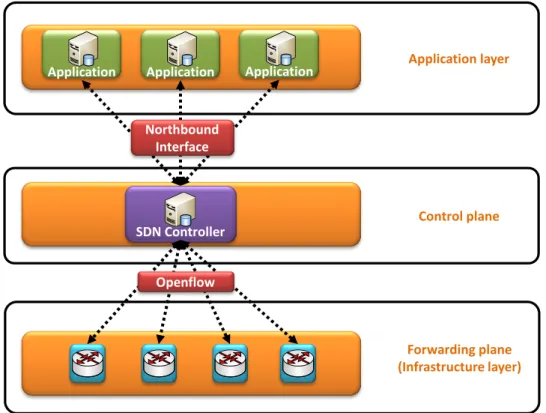
Software-Defined Networking implements a separation between the control plane and the forwarding plane of a network. Figure 3 shows the dissociation between the application layer, the control plane and the forwarding plane (hardware switches). This architecture makes the control plane of the network entirely programmable. Moreover, the control of the network is centralized. Thus, the control plane is dissociated from the switching equipment since it is managed by the centralized controller [4]. All the decisions made at the controller level will be applied on the forwarding plane (switches). Thus, changes do not have to be done on each piece of the network, but once in the controller that will apply it to the underlying infras-tructure. The control layer is thus independent of the hardware components and provides the network services and API for applications that would not be available in usual network components. Openflow is one implementation of this architecture [19]. With the current focus on content-centric networks, researchers on SDN have been focusing on how to introduce a software-defined networking solution, such as Openflow, in mobile networks.
3.1
Applying SDN to mobile networks
CellSDN was designed by L. E. Li et al. as an infrastructure using Software-Defined Networking in mobile networks [6]. The goal of CellSDN is to simplify the design and the management of cellular networks by using SDN features. In a legacy LTE network, the Serving Gateways (SGW) handle the changes in the user location and tunnel the traffic to the Packet network Gateway (PGW) that applies the fine-grained policies such as firewalls, Quality of Service and billing, defined by the Policy Control and Charging Function (PCRF). Base Stations (BS) can also use the subscriber’s information to reduce the rates when it gets congested. Communication between them and the Mobility Management Entity (MME) is getting more and more complicated, for handover for example. So the complexity is increasing in a network that is not evolving any longer. SDN could solve the problem.
3.1.1 Application of SDN
In order to use SDN in mobile networks, some adjustments to SDN are required:
• The policies based on the subscribers’ information must be translated into packet-matching rules.
SDN Controller Application Application Application Forwarding plane (Infrastructure layer) Control plane Application layer Openflow Northbound Interface
Figure 3: Software-Defined Networking Architecture
• Some mechanisms of the SDN controller should be delegated to reduce the load of the controller, for example, counter pulling can be done by local agents.
• Some actions should be added to the switches such as header compression/de-compression.
• The network virtualization should be based on the subscribers’ information. With such adaptations, SDN can have several applications in mobile networks:
• Directing the right part of the traffic to middle-boxes such as Intrusion Pro-tection System or echo suppression for VoIP, and if the switch has some DPI extensions, it could even provide the functions by itself.
• Monitoring for control and charging. For example, a SDN controller with real-time monitoring can adapt the network to the changes such as global users’ mobility and thus load-balance the traffic.
• Providing a seamless mobility for the user. SDN can control the routing over different technologies that would otherwise require long delays and complex mechanisms when the user switches of technology.
• Providing QOS and control access policies. That is currently done in PGW but could be distributed over all the switches with SDN, thus enforcing the policies also for the traffic remaining in the cellular networks.
• Providing network virtualization. LTE does not permit to fully virtualize the networks but SDN could provide isolation for each carrier for example, or for roaming customers and usual subscribers. Each part of the network could then be managed independently.
• Providing a centralized and decoupled control of the base stations with a hardware API.
3.1.2 SDN architecture
These features are proposed as extensions of the current SDN implementations. In order to translate the policies based on the subscribers’ information, the first extension includes several modules to get the users’ location, the paths between the different network equipment, etc. The modules need the subscriber’s information to adapt to the users for roaming, rates, echo cancellation if needed. The controller maps the subscribers with user IP addresses by using a Subscriber Information Base (SIB). Finally, the SDN controller uses this table to translate policies based on the user to policies based on packets.
The second extension is aimed at offloading the controller. Local agents on the switches can handle events that may be difficult for the controller to handle, or would use too many resources, such as adaptation to congested networks. The agents can also perform some predictable actions such as pulling counters. These agents have a limited control on their environment so that they can solve some of the problems independently, and faster than the controller.
The third extension focuses on the patterns and actions of the switches. Larger rule tables are needed for fine-grained policies and DPI modules. They also include features such as header compression and decompression.
The last extension is aimed at virtualizing the networks based on the subscribers’ attributes. Thus, it is possible to slice the network resources, and base station resources as slicing the semantic space, to isolate roaming subscribers for example.
However, the main application of the SDN controller in this work has been pro-posed in the SIGMONA project. Caching in the backhaul network can only be performed on top of a legacy IP network. In current backhaul networks, the traffic is encapsulated in GTP tunnels. SDN permits to remove these GTP tunnels that were preventing the operators from caching in backhaul networks. Previous work in the SIGMONA project has focused on integrating SDN in LTE network with this aim. In this design, the S/P- GW is removed and a SDN based packet network is used instead with the SDN controller interacting directly with the MME to set up the rules on the SDN switches. The MME handles the handovers by notifying the SDN controller to change the rules on the SDN switches.
Double vlan encapsulation (802.1ad) is used instead of GTP tunneling. The first vlan tag is used as a service tag to identify the operators and the second is used as a customer tag to set up tunnels between the enodeB and the IP routers at the edge of the network. This tunneling can be handled by SDN switches [4].
IP IP IP IP IP IP
PDCP PDCP GTP-U GTP-U GTP-U
Ethernet
UDP UDP UDP
RLC RLC
IP IP IP
MAC MAC Ethernet Ethernet Ethernet
L1 L1 L1 L1 L1 L1
UE enodeB S-GW P-GW
Figure 4: Current LTE stack [4]
IP IP IP IP IP
PDCP PDCP
Ethernet Ethernet Ethernet
RLC RLC
MAC MAC
L1 L1 L1 L1 L1
UE enodeB S/P-GW
Figure 5: New LTE stack [4]
Table 4 presents the current protocol stack in LTE networks and Table 5 presents the new protocol stack when using SDN. It clearly shows that all the encapsulation and the tunneling layers have been removed and that the Layer 3 is indeed the client IP layer. Thus we can work with the clients IP packets in SDN switches. [4]
SDN can also be used to build caching systems. Current research has been fo-cusing on using SDN in Information-Centric Networks or Content-Centric Networks to maximize the performances.
3.2
Using SDN for CCN with a new transport protocol
A first solution to join SDN and CCN was proposed by N. Blefari-Melazzi et al. Their design is based a new IP transport protocol and is not interoperable with legacy networks. Gateways are used to connect with other networks on which only TCP or UDP are supported [17].
3.2.1 Infrastructure
The infrastructure contains different types of nodes: end nodes that correspond to the users, border nodes that are taking in charge the forwarding of requests and responses, based on names and internal nodes that are caching nodes.
The client will first issue a request and send it to the closest border node. The border node will forward it based on the name of the content, and will fill its Pending Interest Table (PIT) with the name of the content and the port the request came from. The request will reach other border nodes or internal nodes. There, it will either be a cache-hit or a cache-miss. If the object is stored in the internal node, then the content will be sent. If the object is not stored, the request will be forwarded by the rules installed by the controller. In this infrastructure, every node, even the border nodes, can have a cache for content.
3.2.2 Operations
A Name Resolution System (NRS) maps the content name with the redefined port fields of the packet so the content can be easily identified. The responses of the NRS are cached in the nodes. A single request to the NRS for a piece of content is needed until the timeout of the response expires. Then the ports combination may be reused.
The ingress border node will send the incoming user’s request to the controller that will query the NRS to get the identifier of the object. Then the controller will set the rules to forward either to the correct cache or to the egress switch if the content is not cached. All the requests and responses are sent within IP packets for transfer between nodes.
Due to the mapping between content and ports, only 232 pieces of content can
be requested at once. Moreover, this solution uses a custom transport protocol. So other solutions have been proposed to solve these issues.
3.3
CCN support over a SDN IP network
M. Vahlenkamp et al. proposed an infrastructure supporting of the ICN/CCN fea-tures such as routing based on names and aggregation. The main constraints of this solution are to respect the existing protocols and to allow interconnection with usual networks (not SDN). The controller of the network has an overall knowledge of the content of the caches [20].
3.3.1 Description of the solution
All the ICN transfers are made over the IP protocol, using either TCP or UDP. Figure 6 presents the Operation flow of this design. When receiving an ICN request, the first switch will identify it based on a special port or transport protocol and will send it to the controller. In the network where this solution is applied, IP headers are not modified but they are used differently. The source IP field contains the message identifier, the source port contains the reference of the switch on which the request
8 6 6 5 5 4 3 2 1 0 7 9 0 2 1 3 4 5 Request Request detection Request indication Forwarding/routing decision
Installation of forwarding rules
6 7 8 9 Request forwarding Response forwarding Response indication State removal
Final response delivery
Figure 6: ICN Operation process [20]
first arrived and the destination IP field contains the IP of the cache containing the requested content. The destination port contains a reference identifying the packet as part of an ICN request or response. Thus, if the packet is coming from or going outside of the network, a header rewriting operation is needed at the ingress or egress switch. The controller performs the mapping needed for the header rewriting. When receiving a packet from outside the network transmitted by the ingress switch, the controller will store the source IP and port and will generate a message identifier. It will then change the IP header accordingly and send it back to the ingress switch while installing the rules for the flows to forward the packets to the cache containing the requested content. The controller needs an exhaustive knowledge of the contents of the caches. If a piece of content is not found, the request may be forwarded to the original web server.
3.3.2 Interaction with usual networks
This infrastructure can interact with networks that are not SDN networks due to the header rewriting. The whole network may be identified outside by a single IP address and a special destination port identifying ICN requests or a source port for ICN responses. The request or response will then be routed using this IP address as destination or source in the packets on the usual networks. The header rewrite operations permit this interconnection.
3.3.3 Features
Typical ICN features such as request or response aggregation are enabled. The controller can define some forking switches where the content is duplicated in case
of several identical requests. The SDN controller can perform these operations because of its extensive knowledge of the network and the content of the caches. Thus it can drop duplicated requests and fork the responses to satisfy the users while reducing the network load. Moreover, if the content is not found, the request can be immediately forwarded, depending on the network policy. The balance between network load and controller load can be adapted through system configuration.
3.4
An interface between SDN and CCN
Wrappers are another solution to provide CCN features over SDN. An example of such an interface between usual SDN switches and CCN nodes has been designed by X.-N. Nguyen et al. The wrapper provides an abstraction layer used between Openflow and CCNx, in order to enable name-forwarding [21, 22].
The wrapper is an intermediate layer that interacts with both CCNx and Openflow without any modification to the existing software. The aim of the wrapper is to encapsulate content in an IP packet where the header fields such as IP addresses or ports are based on the hash of the name of the content. Thus, Openflow can perform forwarding based on the name. This solution uses hardware capacities natively, for Openflow for example. However, with this mapping on the header fields, the original fields lose their meaning. This is not a flaw if the whole network is consistent, applying this solution, otherwise header rewriting is needed to interconnect with other legacy networks, as in the previous solution.
Each CCNx node is connected via a wrapper to a SDN node. When a user sends a request or a server send a piece of content, the Openflow switch will set the TOS (type of service) field of the packet accordingly to the port the packet came in and will send it to the wrapper. If it is a request for content, called interest for CCNx, the wrapper will use the TOS to send it to the right face of the CCNx instance. A face is a virtual port corresponding to the host port on the switch. If it is some data, the wrapper will send it directly to the CCNx instance on a dedicated face. The reply of the CCNx instance can be either pieces of data or another request in case of unsatisfied user request. If the reply is a piece of data, it will be sent on the face corresponding to the destination host. Then the wrapper will accordingly set the TOS based on the incoming face and the IPs based on the content name and will send it to the switch. If the reply is a request coming from the dedicated face, the wrapper will set the TOS to 0, and send it to the switch. The switch will then send it to the right port according to the TOS. If the TOS is 0, the packet will be forwarded to a configured default interface on the switch.
This design decreases the performances, around 5%, but enables a centralized control of the Pending Interest Tables and Content Store. However, by using original CCNx nodes, this solution is tied to the CCNx project so currently, the users have to use dedicated software.
3.5
A content management layer transparent for users
ContentFlow is a transparent solution designed by A. Chanda and C. Westphal. ContentFlow is based on the HTTP protocol [23] and aimed at providing a content management layer, corresponding to the Openflow controller, that manages contents, maps each of them with a location and takes in charge the routing or forwarding based on the name of the contents. Their solution is aimed at being transparent for the users and for other networks, thus interconnection is possible without gateways.
3.5.1 Architecture
ContentFlow is composed of proxies, caches and a controller. Since the solution is using http, proxies are needed to establish the TCP connection. Figure 7 shows the architecture and process this solution.
When sending a request, a client will first try to connect (TCP) to the web server. It is mandatory to use proxies to establish the connection with, instead of the real server, because the content request is sent once the connection is established. So when a user is willing to send a request, his first TCP packet (SYN flag) that do not match any flow on the switch will be sent to the controller. The controller will create some static rules to redirect the traffic of this flow to the proxy. Then the connection will be established and the user will send its request. The proxy will analyze the request and create a handle composed of the file identifier, the source and destination IP addresses and ports. The proxy will send the handle to the controller to query the location. Then the controller will look up where the content is stored, if any.
If the content is not cached, the controller will determine whether it should be cached and where. Then the handle will be sent to the selected cache and the controller will create a forking point for the reply on the switch that is the best located considering the proxy and the cache, to minimize the load on the network for the forking operation. It will install the static rules for the flows and reply. After receiving the reply, the proxy will forward the request to the actual web server. The reply is then duplicated at the forking point; a copy is stored in the cache and the response is sent to the user who requested it.
If the file is found in the caches, the controller will send the IP of the cache to the proxy that will forward the request to this cache and the reply to the user. In order to perform such a process, the proxy is adapted. It must be able to communicate with the controller. This communication is performed through a REST API.
The cache must be adapted too since it does not receive both requests and responses but only the responses. So it must receive the information metadata from the controller. It also has to use the Content-Length header in case of partial content e.g using the HTTP response code 206 to know when the whole response has been received. For these metadata, the controller has two dictionaries, one mapping the file names and the cache IP addresses and the other one mapping the content names with the server IP addresses and ports. The mapping with the file names is used to find if the content is cached and where. The mapping with the server information is compulsory to set up the rules for the flows.
6 5 4 3 2 1 0 5 3 2 1 0 Request Controller query Reply Connection to web server 4 5 6 Cache instruction
Forking and forwarding of the response Final forwarding
Figure 7: ContentFlow process [23]
3.5.2 Considerations
The file naming is the native scheme of HTTP which can ensure the uniqueness of a name and a standard method for parsing. However, there is a necessary mapping between the file name and some fields of the IP and TCP headers. The size of the fields in the TCP and IP headers is limited, so the number of possible mappings is limited too. Hence, the fields are freed in order to be reused later. The caching policy applied can be adapted to take some parameters into account, such as popularity.
Y. Sakurauchi et al. had previously proposed a similar solution, redirecting requests to proxies depending on either the IP or the URL [24]. In the case of URL-based redirection, since http is using TCP, the controller let the client do the TCP handshake with the server then the http request is redirected to the proxy and forwarded to the cache. The problem then is that the connection is not established with the cache, thus a RST packet is sent to the client. So there are two connections needed and this decreases the performances of the system. This flaw was fixed in the ContentFlow solution by also redirecting the TCP handshake to the proxy as in the IP-based redirection. Figure 8 presents the IP-based redirection. Every packet with a new IP address is sent to the controller that selects a cache location and instructs the switch to forward the packets to the proxy. Every following packet is then forwarded to the same location. However, most of the websites have several IP
Figure 8: IP-based redirection [24]
addresses but in the controller, when receiving the notice for the SYN packet, it is not possible to relate it to any previous request, even if it is for the same content with a different IP. Thus there is no control over what content is stored in the caches, thus where the contents are stored and over the contents replication.
Considering the different solutions, we have selected the contentFlow solution. It has the main advantage to use the TCP/IP protocols without modifying them, only modifying the routing or the forwarding of the packets with the SDN switches. In our work we decided not to implement an elaborated solution such as a wrapper since our concern is only about HTTP. This protocol is already natively supported over the TCP/IP networks. To build our first implementation for validating the concept in mobile networks, we consider the work of Y. Sakurauchi et al. about redirection based on IP addresses.
3.6
Summary
SDN can have multiple applications either in LTE networks or in ICN / CCN. In LTE networks, SDN can be used to increase the performances of the networks with applications such as redirection or seamless mobility. In the SIGMONA project, SDN is used to create a virtual EPC. This vEPC permits to remove the GTP tunneling and thus to set up caches in the backhaul networks. We are aiming our project at adding values to bringing SDN in LTE network. Thus we aim to use SDN to improve the caching in LTE networks. SDN has already been used to improve performances in ICN or CCN networks, either in systems built using new protocols or working over a TCP/IP network. There are several proposals but due to our constraints such as using a legacy IP network, we selected one of the solutions as a basis to build our new system. In the next section, we will present the new architecture and describe the validation tests and their results.
4
SDN-based caching validation in mobile networks
This chapter presents the implementation of the prototype and the tests we per-formed to validate the concept. In this section, we first present the environment of the tests, the implementation and the results of these validation tests.
4.1
Solution for the testbed
The architecture used for the testbed has been inspired by the ContentFlow solution. It is composed of several elements, including caches, proxies, a SDN controller and a cache controller. The proxies include a request analyzer, to get the URL requested, and is thus referred to either as a proxy or an analyzer. In this testbed, the topology is defined and does not change so some related static rules are set on the switches. They are detailed in Section 20.
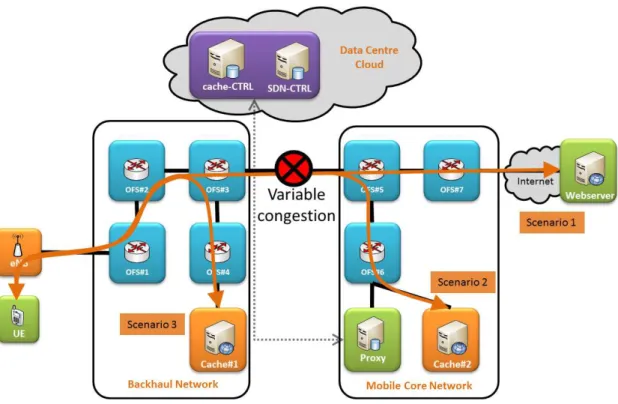
Figure 9 presents the first testbed, composed of a single client, a proxy, a SDN controller, a cache controller and two caches. The tests were performed with three configurations:
• Without any caching, directly fetching the content from internet.
• With caching in a first cache.
• With caching in a cache closer to the client.
The tests have been performed by adding latency and reducing bandwidth on the link between the two parts of the network [25].
4.2
Caching based on IP addresses
This proposition is our first attempt to use SDN in a caching system designed for LTE backhaul networks. Limiting the number of intermediary elements such as proxies when processing the requests was a requirement. In this proposition, the caching is done on a per IP basis. We uses the destination IP address of the packets to redirect them to the cache in charge of this website.
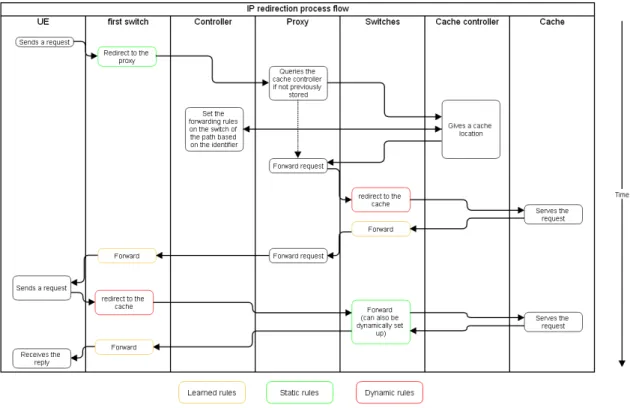
Figure 10 shows the process of our solution. The first request of a client to a website that was not already reached (1) is redirected to the proxy (2). The proxy gets the host by analyzing the request and sends it to the cache controller (3). The cache controller will associate all the IP addresses it gets by resolving the hostname to a cache location. Then the cache controller set rules in the first switch after the enodeB to redirect to the cache in a specific vlan all the HTTP traffic with those IP addresses as the destination (4). The vlan tag will be removed at the last switch (4). Then the proxy can either forward the request to the cache by himself (6) if the controller inserted the rules needed, or send a response with a redirection to the client, that will then issue a second request to the same IP. Even if the second solution is not optimal in terms of users’ experience, we implemented it for the sake of simplicity in our proof-of-concept testbed. This flaw has been corrected in the optimizations proposed. Our design is based on network address
Figure 9: Demonstration scenarios of the SDN caching implementation 1 2 3 4 4 5 6 7 8 9
Figure 11: process of the UE request
translation (NAT) on the destination address, to redirect the packets to the right cache (7)(8), in order to be interoperable with legacy IP networks and routing or forwarding processes. Changing the routing or forwarding process, instead of using NAT, is another possible solution. This method requires to add higher priority rules matching the IP addresses and ports that should be redirected to output the packets through a specific port. This would imply a higher number of operations, with a higher number of switches to configure, and requires a fully SDN-compliant network. Moreover, the load due to the number of rules would be on all the switches, not only the switches at the base stations. Thus, we selected the NAT based solution. [2]
Currently, building a webpage in a browser includes requests to 17 different domains on average [26], for purposes such as advertisements or social modules. Those domains can also be associated to several IP addresses with different servers using DNS round-robin. Thus, a webpage request can lead to a high number of operations, but once the setup done, any following request to the same elements will not lead to any further operation.
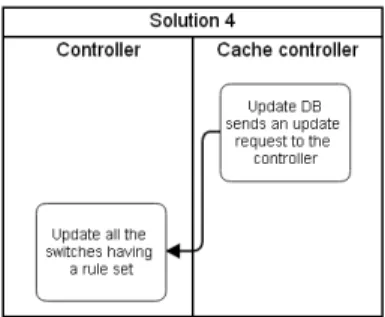
Figure 11 presents the mobile’s request process and Figure 12 shows the relo-cation process for this solution. Currently, the relorelo-cations are triggered manually. In further sections, the relocations are triggered based on time. We define a time interval between two sets of relocations. The impact of this period will be described in Section 4.4.
Figure 12: relocation process
4.2.1 Advantages and drawbacks
We designed our prototype to ensure the following advantages [2]:
• A single SDN switch is needed per enodeB . If the use of the vlan is not usual, such as in the SIGMONA vEPC, another SDN switch can be required at the connection points of the caches.
• A reduced number of configuration operations is required, one per IP address on the switch of the enodeB and some static rules set up beforehand.
• Since most requests are made to the same websites, e.g. Facebook, Google: Gmail, Youtube etc., Yahoo, Wikipedia etc. and thus to the same IP addresses, most rules can be set for long times. Only the websites that are not often accessed need new rules. The frequency of new rules setup is rather small when the rules for the most accessed websites have been set up.
• Relocating content implies only a single operation per switch at the base sta-tions.
• The system does not need big computation power. Since it is not fine-grained, the rules are set per website, including thousands of contents. So the number of needed operations is divided by the average number of contents per website. But the drawbacks are quite important [2]:
• The contents of a website are not separated. Due to the redirection mechanism, the whole website contents have the same caching location. It is not possible to apply fine-grained policies to favor some Youtube videos in their location among others, for example.
• Relocation can only be performed for the whole website, moving all the con-tents stored from the same website at once. It is not possible to relocate only the most accessed content. Thus the relocation operations take a very long time and are not efficient.
• Duplication is not controlled. If duplication is required, it is performed on a website basis, all the contents are duplicated.
The inaccurate handling of contents is the main problem of this solution and will be further detailed in Section 4.5.
4.2.2 Rules needed on the SDN switches
This solution uses mainly two kinds of rules:
• A first static rule is needed per base station to redirect the http traffic to the proxy. Depending on whether the proxy is transparent or not, the switch might learn new rules from this one. These learned rules are dynamic.
• One rule per IP of the accessed websites, per switch where is connected an enodeB on which users accessed the content, is used to set the vlan and the destination Mac and IP if needed to perform the NAT.
Table 13 presents the rules for this solution.
Switch Match Action Aim
First after the UE TCP, port 80 Set dst IP and
Mac to proxy, out-put, learn [match (TCP, dst IP = src IP, dst port = src port, input port = output), action set src IP, set src Mac]
Redirect to the
proxy, learn a rule to set back the original IP based on the src IP and port
First after the UE or last before the cache
Dst IP, TCP, port X
Set dst IP and Mac to cache, out-put, learn [match (TCP, dst IP = src IP, dst port = src port, input port = output), action set src IP, set src Mac]
Forward to the
cache, learn a rule to set back the original src IP and
Mac address of
the reply
First after the
cache or last
before the UE
Dst Mac, dst IP and dst port, in-put port
Set src IP, Mac and port
Set the webserver
IP as src IP
(learned rule)
All Dst Mac, Dst IP,
dst port
Output Forwarding rule
(optional) Figure 13: rules on the SDN switches
![Figure 4: Current LTE stack [4]](https://thumb-us.123doks.com/thumbv2/123dok_us/10126968.2913439/23.892.200.736.107.323/figure-current-lte-stack.webp)
![Figure 6: ICN Operation process [20]](https://thumb-us.123doks.com/thumbv2/123dok_us/10126968.2913439/25.892.202.734.111.461/figure-icn-operation-process.webp)
![Figure 7: ContentFlow process [23]](https://thumb-us.123doks.com/thumbv2/123dok_us/10126968.2913439/28.892.187.770.103.598/figure-contentflow-process.webp)
![Figure 8: IP-based redirection [24]](https://thumb-us.123doks.com/thumbv2/123dok_us/10126968.2913439/29.892.167.773.108.651/figure-ip-based-redirection.webp)