NATHANIEL SALAWU
NATHANIEL SALAWU
A thesis submitted in fulfilment of the requirements for the award of the degree of Doctor of Philosophy (Electrical Engineering)
School of Electrical Engineering Faculty of Engineering Universiti Teknologi Malaysia
Above all, I dedicate this thesis to Almighty God for granting me His grace, wisdom, knowledge and understanding to complete this study successfully. The thesis is also
dedicated to my beloved wife (Mrs Mary Nene Salawu) and my lovely children (Adinoyi Kingsley, Isoyiza Princess, Omeiza PrinceWilliam and Onyioza Queensley).
They invested all their best and invaluable comfort to aid me go through the study successfully.
ACKNOWLEDGEMENT
I would like to express my appreciation to my supervisor, Associate Professor Ir. Dr. Sharifah Hafizah Syed Ariffin. Without her support and professional guidance, this program would not have come to an end successfully. She was patient with me and I benefited so much from her deep level of experience.
My sincere appreciation goes to all staff and student members of Advanced Telecommunication Technology (ATT) research group of FKE, UTM, Malaysia. The conducive work station environment provided is deeply appreciated.
I wish to also thank the management of Federal University of Technology, Minna, Niger State, Nigeria and Tertiary Education Trust Fund (TETFund) for approving the study fellowship and the financial assistance provided for the program.
My gratitude also goes to Dr. O. D. Ahmed, Dr. U. S Dauda, Mr. Ebele Paulson and all other family friends and colleagues. I appreciate all your prayers and moral support towards the successful completion of this program.
I am deeply indebted to my invaluable parents, my awesome siblings and my priceless in-laws for their unending love and support. Your contributions would forever be remembered.
To my lovely wife (Mrs. Mary Nene Salawu) and my dear children (Adinoyi Kingsley, Isoyiza Princess, Omeiza PrinceWilliam and Onyioza Queensley), many thanks. Your prayers, sacrifices and love would forever live in my hearts. I salute your courage, unshaken faith and the priceless love. Despite all the challenges that came with my long absence from the family during the program, you all watched my back for me to succeed. Together and by the grace of God, we won.
Finally, my deepest gratitude goes to Almighty God. He never let me and my family down even at the toughest times of the program. To Him alone be the glory.
ABSTRACT
This thesis presents a hard handover for load balancing in Long Term Evolution (LTE) network. LTE is a cellular self-organizing network (SON) standardized by Third Generation Project (3GPP) to optimally provide high data rate and high quality of service to end users. However, the huge amount of data requirements for the diverse multimedia services by LTE subscribers is fast affecting the network’s quality of service (QoS) negatively. On the other hand, the need for an optimized energy consumption algorithm to reduce the network access cost and optimize the battery life of the user’s equipment (UE) is also on the increase. Therefore, the main aim of this thesis is to provide a new solution for load control as well as providing energy efficient solution for both the network and the mobile devices. In the first contribution, a new network-energy efficient handover decision algorithm for load balancing is developed. The algorithm uses load information and reference signal received power (RSRP) as decision parameters for the handover decision scheme. The second contribution focuses on the development of an optimized handover decision algorithm for the load balancing and ping-pong control. The algorithm uses the cell load information, the received signal strength (RSS) and an adaptive timer as inputs for the handover decision procedure. Besides, the third contribution is on the development of a handover decision algorithm to optimize the UEs energy consumption as well as load balancing optimization. Overall, key performance indicators such as load distribution index (LDI), number of unsatisfied users (NUU), cumulative number of ping-pong handover request (CNPHR), cumulative number of non-ping-pong handover request (CNNPHR), average throughput of the cell (ATC), handover blocking rate (HBR), new call blocking rate (NCBR) and number of handover calls (NHC) were evaluated through simulations. The results were compared with some other works in the literature. In particular, the proposed algorithm achieved over 10% higher for LDI, 50% lower for NUU, 30% higher for CNPHR and 5% lower for CNNPH when compared with works in the literature. Other results are 10% higher for ATC, 75% lower for HBR and 40% lower for NCBR. In general, the proposed handover decision algorithm for energy efficient load balancing management in LTE has proven its ability for energy consumption optimization, load balancing management and ping-pong handover control.
ABSTRAK
Tesis ini adalah berkenaan algoritma pemutusan serahan untuk pengimbangan muatan di dalam rangkaian Evolusi Jangka Panjang (LTE). LTE adalah rangkaian penyusunan sendiri (SON) yang diseragamkan oleh Projek Generasi Ketiga (3GPP) untuk mengoptimumkan penyediaan data berkadar tinggi dan perkhidmatan berkualiti tinggi kepada pengguna-pengguna akhir. Walaubagaimanapun, keperluan data dalam jumlah yang tinggi untuk pelbagai perkhidmatan oleh pelanggan-pelanggan LTE, dengan pantas memberi kesan buruk terhadap kualiti perkhidmatan rangkaian ini. Sebaliknya, keperluan untuk algoritma pengoptimuman penggunaan tenaga bagi mengurangkan kos akses rangkaian dan mengoptimumkan kadar hayat bateri alatan pengguna (UE), juga meningkat. Oleh itu, tujuan utama thesis ini adalah untuk memberi satu penyelesaian baru untuk kawalan muatan dan juga menyediakan penyelesaian tenaga yang optimum untuk kedua-dua rangkaian dan peranti mudah alih. Di dalam sumbangan pertama, satu algoritma baru, pemutusan serahan rangkaian-tenaga yang optimum untuk pengimbangan muatan dibangunkan. Algoritma ini menggunakan maklumat beban dan rujukan isyarat kuasa yang diterima (RSRP) sebagai parameter penentu untuk skim pemutusan serahan. Sumbangan kedua berfokuskan kepada pembangunan algoritma pemutusan serahan yang optimum untuk pengimbangan muatan dan kawalan ping-pong. Algoritma ini menggunakan maklumat beban sel, kekuatan isyarat terima (RSS) dan satu pemasa mudah suai sebagai input kepada tatacara pemutusan serahan. Selain itu, sumbangan ketiga yang berkenaan dengan pembangunan algoritma pemutusan serahan untuk mengoptimumkan penggunaan tenaga UE dan juga pengoptimuman pengimbangan muatan. Keseluruhannya beberapa penunjuk utama prestasi seperti indeks pengimbangan muatan (LDI), bilangan pengguna yang tidak dipenuhi (NUU), bilangan permintaan ping-pong serahan kumulatif (CNPHR), bilangan permintaan bukan ping-pong serahan kumulatif (CNNPHR), purata throughput sel (ATC), kadar halangan serahan (HBR), kadar halangan panggilan baru (NCBR) dan bilangan serahan panggilan (NHC) dinilai melalui simulasi. Hasil-hasilnya dibandingkan dengan hasil kerja yang terdahulu dari penulisan-penulisan. Khususnya, algoritma yang dicadangkan mencapai lebih 10% lebih tinggi untuk LDI lain, 50% lebih rendah untuk NUU, 30% lebih tinggi untuk CNPHR dan 5% lebih rendah untuk CNNPH apabila dibandingkan dengan penulisan-penulisan lain. Hasil lain adalah 10% lebih tinggi untuk ATC, 75% lebih rendah untuk HBR dan 40% lebih rendah untuk NCBR. Secara umumnya, algoritma pemutusan serahan yang dicadangkan untuk pengurusan pengimbangan muatan tenaga efisien bagi LTE telah membuktikan kemampuannya dalam pengoptimuman penggunaan tenaga, pengurusan pengimbangan muatan dan kawalan serahan ping-pong.
TABLE OF CONTENTS
CHAPTER TITLE PAGE
DECLARATION ii
DEDICATION iii
ACKNOWLEDGEMENT iv
ABSTRACT v
ABSTRAK vi
TABLE OF CONTENTS vii
LIST OF TABLES xi
LIST OF FIGURES xii
LIST OF ABBREVIATIONS xiv
LIST OF SYMBOLS xvii
LIST OF APPENDICES xviii
1 INTRODUCTION 1
1.1 Background 1
1.2 Problem statement 5
1.3 Objectives of the research 7
1.4 Scope of work 7
1.5 Contributions of the research 9
1.6 Thesis organization 10
2 BACKGROUND AND LITERATURE REVIEW 12
2.1 Introduction 12
2.2 3GPP Fourth Generation (4G) Mobile Radio
Evolution 12
2.3 Overview of LTE Architecture 17
2.3.1 Mobility Management Entity (MME) 18
2.3.2 Serving Gateway (S-GW) 20
2.3.3 Packet Data Networks Gateway (P-GW) 21 2.3.4 Home Subscription Server (HSS) 21
2.3.5 Policy and Charging Resource Function
(PCRF) 22
2.3.6 Service Domains 22
2.3.7 Evolved-UTRAN (E-UTRAN)
Architec-ture 22
2.3.8 Evolved NodeB (eNB) 23
2.3.9 User Equipment (UE) 23
2.4 Handover Management in LTE Networks 25
2.5 Handover Classifications 25
2.5.1 Horizontal Handover 26
2.5.2 Vertical Handover 27
2.5.3 Soft Handover 28
2.5.4 Hard Handover 29
2.5.5 Other Type of Handover Classifications 31 2.6 Overview of LTE Hard Handover Procedure 31 2.7 SON Feature and Architecture for LTE Networks 35 2.8 SON Self-Optimization Use-Case for LTE
Net-works 38
2.8.1 SON Load Balancing Optimization
Use-Case for LTE Networks 40
2.8.2 SON Energy Saving Optimization
Use-Case for LTE Networks 43
2.9 Related Works on Handover, Load Balancing and
Energy Management Procedure for LTE Networks 44 2.9.1 Related Works on Handover Schemes for
LTE Networks 44
2.9.2 Related Works on Load Balancing
Scheme for LTE networks 49
2.9.3 Related Works on Energy Saving
Schemes 54
2.10 Summary 59
3 RESEARCH FRAMEWORK AND METHODOLOGY 60
3.1 Introduction 60
3.2 LTE Measurements and Mobility Prediction 60 3.2.1 Signal to Interference plus Noise Ratio
(SINR) 61
3.2.2 Radio Signal Strength (RSS) and Radio
3.2.3 Reference Signal Received Power
(RSRP) 64
3.2.4 Reference Signal Received Quality
(RSRQ) 65
3.2.5 Mobility Prediction using Markov Chain 65
3.3 Methodology Framework 69
3.4 Handover Decision Use Case Scenario 72
3.5 Network Model 77
3.6 Network-Energy Efficient Handover Decision
Al-gorithm for Load Balancing 79
3.7 UE-Energy Efficient Handover Decision Algorithm
for Load Balancing 81
3.8 Handover Decision Algorithm for Ping-pong
Con-trol and Load Balancing 83
3.9 Performance Evaluation Metrics 85
3.10 Simulation Environment, Validation and and
Verifi-cation Procedure 86
3.10.1 Simulation Environment 87
3.10.2 Research Validation Procedure 87 3.10.3 Research Verification Procedure 90
3.11 Research Phases and Activities 91
3.12 Summary 93
4 ENERGY EFFICIENT HANDOVER DECISION
ALGO-RITHM FOR LOAD BALANCING 94
4.1 Network-energy efficient handover decision
algo-rithm for load balancing 94
4.1.1 Introduction 94
4.1.2 System Modeling 95
4.1.3 Results and Discussion 96
4.1.4 Summary 108
4.2 UE-energy efficient handover decision algorithm
for load balancing 109
4.2.1 Introduction 109
4.2.2 System Modeling 110
4.2.3 Adaptive Cost Function Formulation 112
4.2.4 Results and Discussion 116
5 HANDOVER DECISION ALGORITHM FOR
PING-PONG CONTROL AND LOAD BALANCING 123
5.1 Introduction 123
5.2 System Modeling 123
5.2.1 Decision Variable Formulations 125 5.2.2 Received Signal Strength Formulation 125
5.2.3 Cell Load Formulation 125
5.2.4 Ping-pong Adaptive Timer Formulation 127 5.2.5 Dual-Parameter Adaptive Timer Decision
Algorithm 128
5.3 Results and Discussion 128
5.3.1 Simulation Results 129 5.4 Summary 135 6 CONCLUSION 137 6.1 Conclusion 137 6.2 Future Work 139 REFERENCES 140 Appendices A – B 151 – 152
LIST OF TABLES
TABLE NO. TITLE PAGE
2.1 Summary showing key features of LTE, LTE-A and IMT-A
network reqirements 16
2.2 Summary of Self-Optimization Use-Case for Long Term
Evolution Network 39
2.3 Summary of related works on LTE handover scheme 48 2.4 Continuation table of the summary of related works on LTE
handover scheme 49
2.5 Summary of related works on LTE load balancing scheme 53 2.6 Continuation table of the summary of related works on load
balancing scheme 54
2.7 Summary of related works on energy saving scheme 57 2.8 Continuation table of the summary of related works on energy
saving scheme 58
3.1 Simulation parameters 88
4.1 Simulation parameters 97
4.2 Simulation parameters 116
LIST OF FIGURES
FIGURE NO. TITLE PAGE
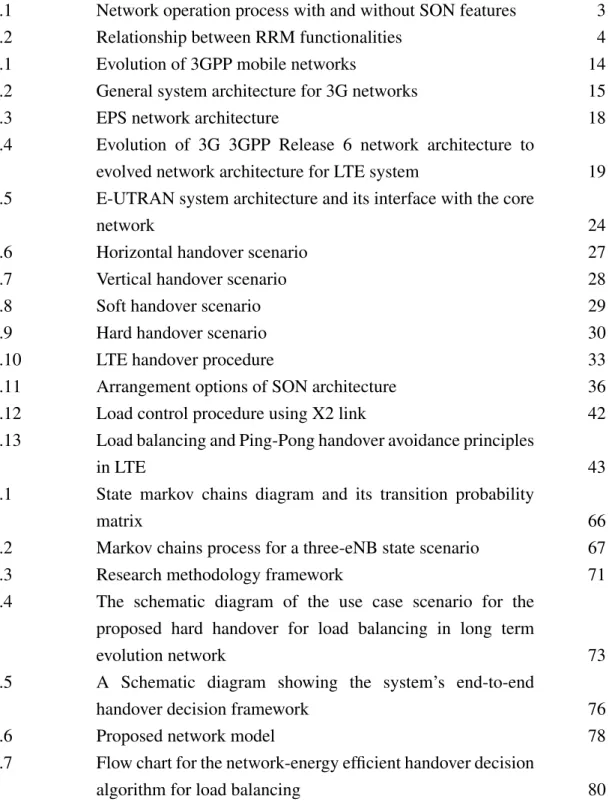
1.1 Network operation process with and without SON features 3
1.2 Relationship between RRM functionalities 4
2.1 Evolution of 3GPP mobile networks 14
2.2 General system architecture for 3G networks 15
2.3 EPS network architecture 18
2.4 Evolution of 3G 3GPP Release 6 network architecture to
evolved network architecture for LTE system 19 2.5 E-UTRAN system architecture and its interface with the core
network 24
2.6 Horizontal handover scenario 27
2.7 Vertical handover scenario 28
2.8 Soft handover scenario 29
2.9 Hard handover scenario 30
2.10 LTE handover procedure 33
2.11 Arrangement options of SON architecture 36
2.12 Load control procedure using X2 link 42
2.13 Load balancing and Ping-Pong handover avoidance principles
in LTE 43
3.1 State markov chains diagram and its transition probability
matrix 66
3.2 Markov chains process for a three-eNB state scenario 67
3.3 Research methodology framework 71
3.4 The schematic diagram of the use case scenario for the proposed hard handover for load balancing in long term
evolution network 73
3.5 A Schematic diagram showing the system’s end-to-end
handover decision framework 76
3.6 Proposed network model 78
3.7 Flow chart for the network-energy efficient handover decision
3.8 Flow chart for the UE-energy efficient handover decision
algorithm for load balancing 82
3.9 Flow chart for the handover decision algorithm for ping-pong
control and load balancing 84
3.10 Validation result for the static scenario of the UEs 89 3.11 Validation result for the dynamic scenario of the UEs 89
3.12 Research phases and activities 92
4.1 Load distribution index of the network 98
4.2 Number of unsatisfied users 99
4.3 Average energy efficiency per cell against the number of load
balancing cycles 100
4.4 Average energy efficiency per cell against load distribution
index 101
4.5 Average energy efficiency per cell against average number of
users 102
4.6 Average number of handover against user’s velocity 103 4.7 Average call dropping ratio against user’s velocity 104 4.8 Average call blocking ratio against user’s velocity 105 4.9 Average call dropping ratio against the number load balancing
cycles 106
4.10 Average call blocking ratio against the number load balancing
cycles 107
4.11 Average total throughput of users per cell against the number
of load balancing cycles 108
4.12 Handover blocking rate 118
4.13 New call blocking rate 119
4.14 New call blocking rate 120
4.15 Load distribution index 120
4.16 Average UE power consumption against average total
throughputs of users per cell 121
5.1 Load distribution index versus number of load balancing
cycles 131
5.2 The number of unsatisfied users versus load balancing cycles 132 5.3 Cumulative number of ping pong handover request versus
load balancing cycles 133
5.4 Cumulative number of non-ping pong handover request
versus load balancing cycles 134
LIST OF ABBREVIATIONS
1G – First Generation
2.5G – Second and a Half Generation
2G – Second Generation
3G – Third Generation
3G – Third Generation
3GPP – Third Generation Partnership Project 3GPP2 – Third Generation Partnership Project 2
AGW – Access Gateway
AP – Access point
ATC – Average Throughput of the Cell
BE – Best Effort
CAPEX – Capital Expenditure
CBR – Constant Bit Rate
CDMA – Code Division Multiple Access
C-DRX – connected DRX
CNNPHR – Cumulative Number of Non Ping-pong Handover Request CNPHR – Cumulative Number of Ping-pong Handover Request C-RNTI – Cell Radio Network Temporary Identifier
D2D – Device-to-Device
DL – Downlink
DRX – Discontinuous Reception
ECGI – E-UTRAN Cell Global Identifier
EDGE – GSM Evolution
eNB – Evolved NodeB
EPC – Evolved Packet Core
EPS – Evolved Packet System
E-RAB – E-UTRAN Radio Access Bearer
GGSN – Gateway GPRS Support Node GMSC – Gateway Mobile Switching Center GPRS – General Packet Radio Service
GSM – Global System for Mobile Communication GUTI – Global Unique Temporary Identity
HBR – Handover Blocking Rate
HOM – Handover Margin
HSDPA – High Speed Downlink Packet Access HSPA – High Speed Packet Access
HSPA+ – HSPA evolution
HSS – Home Subscriber Server
HSUPA – High Speed Uplink Packet Access
IMS – Multimedia Subsystem
IMSI – International Mobile Subscriber Identity
IMT-2000 – International Mobile Telecommunications-2000
IMT-A – IMT-Advanced
IoT – Internet of Things
IP – Internet Protocol
KPI – Key Performance Indicator LDI – Load Distribution Index
LTE – Long Term Evolution
LTE-A – LTE-Advanced
MATLAB – Matrix Laboratory
MME – Mobility Management Entity MSC – Mobile Switching Center NCBR – New Call Blocking Rate NHC – Number of Handover Calls NUU – Number of Unsatisfied Users OAM – Operation and Management
OFDMA – Orthogonal Frequency Division Multiple Access OPEX – Operational Expenditure
PCEF – Policy Control Enforcement Function PDC – Pacic Digital Cellular
PDN – Packet Data Network
ProSe – Proximity Service PRB – Physical Resource Block
QoS – Quality of Service
RCC – Radio Resource Control RNC – Radio Network Controller
RRM – Radio Resource Management
RSRP – Reference Signal Received Power RSS – Received Signal Strength
SAE – System Architecture Evolution
SC-FDMA – Single Carrier Frequency Division Multiple Access
SDU – Service Data Unit
SG – Serving Gateway
SGSN – Serving GPRS Support Node
SINR – Signal to Interference and Noise Ratio SIP – Session Initiation Protocol
SMS – Short Message Services
SoC – State of Charge
SON – Self Organizing Network
TA – Tracking Area
TAI – Tracking Area Identity
TE – Terminal Equipment
TL-MLB – Two-Layer Mobility Load Balancing
TTT – Time-to-Trigger
UE – User Equipment
UICC – Universal Integrated Circuit Card
UL – Uplink
UMTS – Universal Mobile Telecommunications Service USIM – Universal Subscriber Identity Module
VoIP – Voice over Internet Protocol
WCDMA – Wideband CDMA
LIST OF SYMBOLS
∆T – Measurement period
σ2 – Variance
ρi – Cell load
α – Total number of users in a cell
β – The ratio of the occupied PRBs to the cells total PRBs –
LIST OF APPENDICES
APPENDIX TITLE PAGE
A List of Publications 151
INTRODUCTION
1.1 Background
Generally, the benefits of a communication system in any society cannot be overemphasized. Recently, the quests to get connected in more ways using more mobile devices than ever are on the rapid increase with an annual growth rate of 60 to 70% [4, 5]. This resulted in the continuous high demand for communication services of various classes and applications. Consequently, there should be a concerted effort by the research community and service providers to provide for these needs not only in terms of improved communication systems but also in terms of cost reduction. In order to continue to attract and sustain more subscribers, telecommunication service providers are constantly sorting for better options for meeting these demands prompting the encouragement and drive for more research in this area. Until today, many efforts have been made and many are still ongoing towards better communications network improvement. Many challenges surround the provision of cellular networks with high data rate and acceptable Quality of Service (QoS) to cope with the present subscriber’s demand realities which are mostly multimedia and real-time services [6, 7]. Specifically, the quest for users to always stay connected and the evolution of bandwidth-hungry services such as online gaming, audio/video streaming and other multimedia services in the cellular wireless network can no longer be avoided. The solution to ameliorate this problem among others forms the bedrock for the development of Third Generation (3G) and other recent generations of cellular networks over the earlier pre-3G networks that were grossly becoming too limited in many aspects [8, 9].
Presently, there are various working groups accredited to develop new wireless communication standards that have better specifications than the pre-3G mobile networks [10]. One of such working groups is the Third Generation Partnership Project
(3GPP) that developed a new Radio Access Technology (RAT) for mobile broadband network named Long Term Evolution (LTE). LTE is developed to run in parallel with all other mobile networks previously developed. The product of further improvement on LTE by 3GPP gives rise to a new network generation called LTE-Advanced (LTE-A). LTE-A is also popularly known as 4th Generation (4G) network [11].
The primary aim of developing LTE network as given by 3GPP in release 8 is to provide a network with higher spectrum efficiency and flat architecture for simplicity than the previous generations of cellular networks [10]. LTE design includes support for mobility and is backward compatible with the previous mobile network generations [11]. LTE is as well meant for all Internet Protocol (IP) services to cope with IP applications and services that previous cellular communication networks before it could not support effectively. With LTE network, a peak data rate of up to 100 Mbps for downlink (DL) and 50 Mbps for uplink (UL) under diverse network operation scenarios and mobility condition is achievable. For LTE-A, a peak data rate of 1Gbps is its target. In order to obtain the promises of LTE summed up for higher capacity, the DL and UL transmission access technology is designed to use Orthogonal Frequency Division Multiple Access (OFDMA) and Single Carrier Frequency Division Multiple Access (SC-FDMA) respectively [10]
All efforts by 3GPP are to provide better system capacity, low access cost and improved Quality of Sevice (QoS). QoS provision involves a lot of issues including limited network resource management such as energy and load management. Particularly, these aspects are very important nowadays since most user devices are mobile and are remotely used with limited battery capacities. Currently, technological improvement of batteries is not able to catch up with the technological improvement success in data delivery over wireless communication systems. Furthermore, the issue of network congestion due to huge data traffic requires newer methods of efficient load balancing management to be developed to cope with the current global reality. This will address the need of constant cell loads redistribution between the overloaded cell and underloaded cells to avoid any particular cell being congested (overloaded) while leaving some cells underloaded.
Currently, there is no standard method of energy and load management in LTE according to 3GPP working document [10]. Hence the area of research in this field is promising and wide open for more contributions. There are few strategies in known literature directed at solving the problem of energy and load balancing issues for LTE. However, most of the solutions are treated in an isolated way. Thus, it is a worthwhile
idea to contribute a new way of solving these raised issues optimally. Interestingly, mobile networks have handover feature as one of their specifications for mobility and service connection transfer management.This important feature of mobile networks is no longer used for mobility management alone since it can be used to manage other scarce network resources such as energy and system bandwidth. Handover is simply the process of seamless connection transfer of a user from one Base Station to another without noticeable connection breakdown of the ongoing service. The fact that LTE is developed with self-organizing network (SON) functionalities included makes handover more important and interesting feature than ever [6, 12]. Figure 1.1 [13] shows the contrast summary between a deployed network operation process with and without SON features.
Manual Tuning eNB power on Self-Configuration eNB power on Self-Optimization Self-Healing Without SON functionalities With SON functionalities Manual Tuning Manual Tuning Configuration Optimization Healing SON Coordinator Module Pre-operational stage Operational stage
Figure 1.1: Network operation process with and without SON features [13].
For high QoS delivery, there should be a policy for effective management of the system’s limited resources. Good network resource management increases systems capacity and reduces other inherent costs. One possible way out is the continuous optimization of Radio Resource Management (RRM) functionalities of the
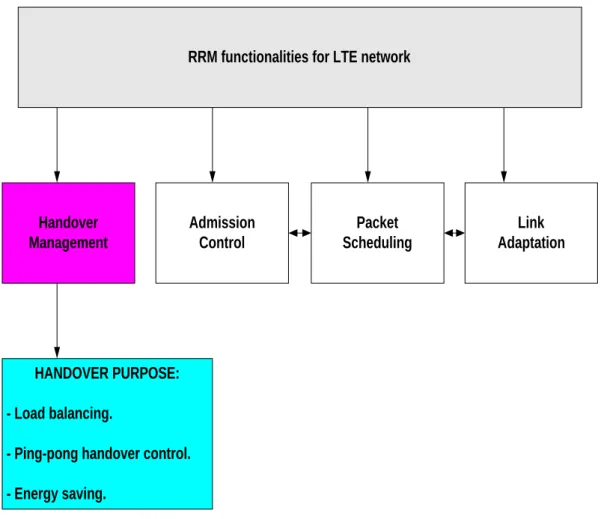
network. RRM functionalities in LTE include admission control, packet scheduling, link adaptation and handover. In Figure 1.2, the relationship between the relevant RRM is shown where the purpose of handover decision process in this work as one of the RRM functionalities is indicated. The admission control process is responsible for managing the amount of traffics in the network while the packet scheduling processes are used to decide on how resources could be engaged between varieties of possible operations. The link adaptation process provides a means of fast response to varying wireless communication channel to enhance spectrum efficiency of the system.
RRM functionalities for LTE network
Handover Management Admission Control Packet Scheduling Link Adaptation HANDOVER PURPOSE: - Load balancing.
- Ping-pong handover control. - Energy saving.
Figure 1.2: Relationship between RRM functionalities.
.
In mobile networks generally, handovers are mainly grouped into several classifications. Further explanations about handover classifications are given in section 2.4. The LTE handover mechanism is designed to be simple and effective for seamless transfer of ongoing connection session from one cell to another. Handover decision algorithms could be designed toward solving many issues depending on the target
factors. Consequently, the focus of our solution in this thesis is to develop a handover decision algorithm that is capable of providing an energy efficient load balancing optimization process for LTE network. This assumption is a typical high traffic LTE system scenario where a user with User Equipment (UE) having limited battery backup would have the need to stay connected for an extended period of time. In this scenario, there are two main challenges the user may face. Firstly, the network may be slow with poor QoS since the traffic is high and that may lead to the second problem of faster battery depletion. In such situation, therefore, a decision algorithm for load balancing that is also energy efficient could be vital in such situation.
For long time performance competitiveness, the need to develop an upgraded system for even longer time performance competitiveness in terms of lower Capital Expenditure (CAPEX), lower Operational Expenditure (OPEX), higher capacity and QoS are the major driver for this research [14, 15, 16].
1.2 Problem statement
Different from the earlier cellular network generations, 3GPP designed LTE standard to operate as SON because network Operations such as handover, load balancing, energy savings can no longer be sustained with manual tunning due to geometric increase in network parameters and algorithms. This new feature of LTE network is good for OPEX and CAPEX reduction but has some problems.
Firstly, handover which is one of the SON functionalities is traditionally initiated and executed when the transmitted signal on the radio channel gets deteriorated and can no longer secure an ongoing communications services [17, 18, 19, 20, 21]. However, only the radio signal parameter of the network is not adequate to effectively and accurately design an optimal handover decision scheme. A well designed handover algorithm should not only address a seamless communications within the network but issues like load balancing and energy savings should also be addressed [22, 14, 15, 16, 23, 24, 25, 26, 27, 28, 29].
Secondly, LTE has high amplitude variability signal known as Peak to Average Power Ratio since it is OFDMA based. This reduces the efficiency of the eNB transmitter which has to be compensated for by transmitting high dynamic power to ensure high data rate delivery. High transmission power increases energy consumption
cost of the service provider which not desired. Furthermore, the recent development of energy gulping of mobile users’ applications and devices is another problem that needs adequate solution too. Different from what is widely available in literature where only one parameter for energy saving is used, this work uses multiple parameters such as path loss, channel conditions and the number of occupied PRBs (cell load) to develop an enhanced handover and energy efficient scheme.
Lastly, just like the traditional cellular networks, ping pong handover is an issue in LTE network too. in literature, this problem is widely approached using a static TTT parameter value for ping pong handover avoidance. However, static TTT value can not provide optimal solution since the channel condition changes rapidly. Again, with static TTT parameter, the network is highly prone to too early or too late handover failures. Therefore, our solution uses a dual adaptive timer approach to solving this problem making it unique against previous approaches.
With the problem background give above, the default handover schemes in LTE which are mainly based on static handover decision parameters are no longer adequate to solve some targeted and critical issues (i.e load balancing and energy saving) of handover jointly. Again, wireless network signal condition changes rapidly and it is best handled dynamically too. Furthermore, the problem of exponential increase in the handover control parameters and the addition of newer algorithms to enhance the system’s performance has necessitated the development of a new scheme that is not based on single handover parameter and long timescale updating as contributed in previous works [30, 31, 32, 33, 34]. Other handover schemes based on a combination of several handover parameters (Reference Signal Received Power (RSRP), Handover Margin (HOM), load information, Time-to-Trigger (TTT), UE battery information, power transmission or reception information, etc) have also been proposed in literature to enhance handover decisions [6, 34, 35, 36, 37, 38].
The problem of selecting the best combination of these parameters to design to enhance handover decision algorithm in LTE is not easy most especially if ping pong handover control, load balancing and energy saving are targeted. Non-optimal selection of handover parameters for handover decision algorithms is not desirable since they come with high cost and poor QoS which have negative impacts on the overall system’s QoS. The energy savings proposed is for both the user and the service provider which is different from the traditional method of targeting either only the UE or the service provider. Since the cost function concept proposed is also adaptive and simple, the weighted value of each of the selected parameter makes the contribution
unique and better than the static schemes.
1.3 Objectives of the research
Development of Handover Decision Algorithm for Energy Efficient Load Balancing Management in Long Term Evolution Network is the main goal of this research. The target of the proposed solutions is to optimize the energy consumption of both the network and the UE while performing ping pong and load control procedures on the network.
In order to simplify the research’s main goal, the research objective is divided into three parts and stated as follows:
1. To develop a network-energy efficient handover decision algorithm for load balancing using cell switch-off approach.
2. To develop a UE-energy efficient handover decision algorithm for load balancing using adaptive cost function approach.
3. To develop a handover decision algorithm for ping-pong control and load balancing using adaptive timer.
1.4 Scope of work
The scope of this research is limited to the use of multi-parameter handover decision algorithm to enforce energy efficient load balancing. The algorithm is design for LTE network. LTE system is considered for the research because of the huge potential it has in terms of capacity, simplicity of network architecture and its downward compatibility ability.
Normally, handover procedure is responsible for the seamless transfer of an on going communications without the service interruption of the user due to unavailability of network access or poor signal reception. Alternatively, handover could also be initiated based on many reasons such as energy consumption, load balancing, user priority, class of service, cost of network access etc. The reason for initiating any handover procedure would determine the selection of handover parameters selection
to use for handover decision process. However, the purpose of the handover decision in this work falls within the scope of designing a mechanism for load control, ping-pong handover control and energy savings for both the UE and the network. Therefore, the proposed algorithm is limited to handover based energy efficient load balancing decision mechanism for LTE network.
Because of the instantaneous position of the users that is constantly updated and used, the users can be mobile or static. This applies to all users in the network in all the simulation performed. In other to make the whole system simple, the study is based on cost function formulation it is based on a seven hexagonal cells clusters architecture.
LTE is fully SON compliant and it has the ability to support a multi-criteria handover algorithm design. However, only the self-optimizing aspect of the SON functionalities is covered in this work. Consequently, the parameters consider for the research are limited to cell load information report, RSRP, uplink transmission power and ping-pong handover timer. For the simulations, users were assumed to be randomly placed on each cell during the simulation time and only users that receive signals from multiple eNBs are targeted for handover execution. To test the performance of the algorithm, Matlab and OMNeT++ simulation tools were used.
The KPI considered in this work are limited to the load distribution index (LDI), the number of unsatisfied users (NUU), the cumulative number of ping-pong handover request (CNPHR), the cummulative number of non ping-pong handover request (CNNPHR), the average throughput of the cell (ATC), the handover blocking rate (HBR), the new call blocking rate (NCBR) and the number of handover calls (NHC) were evaluated through simulations. However, the assumption is that, cell edge users receive signal from both the serving and target cells. Due to the sensitivity of the cell edge users to ping-pong handover, a good consideration to solving it is also covered within the research scope. In all, the scope of the handover design is limited to the issues of load balancing, ping-pong handover control and energy savings for both the UE and the LTE network.
1.5 Contributions of the research
In this work, a new method of handover decision algorithm for energy efficient load balancing for LTE network has been proposed. The proposed algorithm guarantees energy efficient based QoS beneficial to both the network and the UE. The contributions made have been broken down into three major categories. They are as follows:
1. The first contribution is the development of a network-energy efficient handover decision algorithm for load balancing using cost function approach. The gain of this algorithm is more towards the service providers. The mechanism is capable of reducing the energy consumption of the base stations while providing good load redistribution service to the network. Consequently, network’s QoS provision can be increased and its OPEX be reduced. The proposal is based on a scheme that uses cell load, RSRP and cell switch technique to achieve the energy efficient load balancing. The parameters are carefully selected contrary to the traditional method of using single parameter in literature for load balancing. The parameters considered here are cell load measurement, RSRP. The algorithm uses cost function scheme that is able to improve network load distribution. Evaluation test was based on network load distribution index and the number of unsatisfied users in terms of network load distribution index with a few numbers of unsatisfied user. The cell switching aspect uses a predefined threshold as a guide for decision making. The flowchart of the algorithm is given in chapter 3.The results show 98% attainment in terms of network load distribution index. Few number of unsatisfied users were also obtained at the end of the simulations indicating satisfactory performance of the developed algorithm.
2. The second contribution presents the development of a UE-energy efficient handover decision algorithm for load balancing using adaptive cost function approach. The advantage of this third algorithm is more towards the users. The system is capable of reducing the energy consumption of the UE while also enjoying good load redistribution service of the network. Consequently, the UE’s battery life can be optimized for the device to stay connected as long as possible. Cell load, RSRP and uplink transmission power were the parameters considered for the cost function formulation. The adaptivity of the proposed algorithm is based on the battery life information of the UE, load information and energy consumption for packet transmission. The parameters help the cost function to compute the cost weight of each cell to make handover decision. In
summary, the simulation results show that more than 90% percent in terms of load distribution index. This serves as a pointer that cell loads in the network were fairly distribution while the battery life of the UE is being optimized. 3. The third contribution of this work is the development of a handover decision
algorithm for ping-pong control and load balancing using adaptive timer. Ping-pong handover waste already scare network resources. If the effect is properly controlled, more resources would be available for users and the service provider earns more in monetary value while the users are also happy for the satisfied QoS provided. In this respect, this second research contribution is very important and beneficial to both the users and service providers. Here, the idea is to leverage on the used of SON distributed architecture to develop a decision algorithm that is uses adaptive timer to optimize load balancing and ping pong handovers in LTE network. Two major parameters receive signal strength (RSS) and cell load were used to formulate the adaptive timer. With the algorithm, ping-pong handover and non ping-pong handover request can be monitored and avoided. Simulations were done to evaluate the load balancing index of the network, the number of unsatisfied users, the cumulative number of ping-pong handover request, then cumulative number of non ping-ping-pong handover request and the average throughputs of the cell. The performance show a good improvement meaning a new method of ping-pong handover and load control for LTE network has been added to knowledge.
1.6 Thesis organization
The thesis is organized into six chapters. The explanation of each chapter is presented in this section.
Chapter 1 gives the preliminary as well as introductory information about the research. The research motivation background as well as the problem statement are given in this chapter. Others information contain in this chapter are the research objectives, research scope, research contributions and a brief explanation of how the thesis is organized.
Chapter 2 presents the relevant information in literature used for this research. the research background information. An overview of LTE architecture and handover management are also discussed.Further discussed in this chapter are the various
1. Luan, L., Wu, M., Shen, J., Ye, J. and He, X. Optimization of handover algorithms in LTE high-speed railway networks. JDCTA, 2012. 6(5): 79–87. 2. Kov´acs, I. Z., Laselva, D., Michaelsen, P.-H., Wang, Y., Djapic, R. and Spaey, K. Performance of SON for RSRP-based LTE/WLAN access network selection. Wireless Communications Systems (ISWCS), 2014 11th International Symposium on. IEEE. 2014. 360–364.
3. Wang, H., Liu, N., Li, Z., Wu, P., Pan, Z. and You, X. A unified algorithm for mobility load balancing in 3GPP LTE multi-cell networks. Science China Information Sciences, 2013. 56(2): 1–11.
4. Index, C. V. N. Global mobile data traffic forecast update, 2012-2017. Cisco white paper, 2013.
5. Ericsson, A. Traffic and market data report: On the pulse of the networked society. White Paper, 2014.
6. Lee, D.-W., Gil, G.-T. and Kim, D.-H. A cost-based adaptive handover hysteresis scheme to minimize the handover failure rate in 3GPP LTE system. EURASIP Journal on Wireless Communications and Networking, 2010. 2010(1): 750173.
7. Van Quang, B., Prasad, R. V. and Niemegeers, I. A survey on handoffslessons for 60 GHz based wireless systems. IEEE Communications Surveys & Tutorials, 2012. 14(1): 64–86.
8. Smith, C. 3G wireless networks. McGraw-Hill, Inc. 2006.
9. Ghosh, A., Ratasuk, R., Mondal, B., Mangalvedhe, N. and Thomas, T. LTE-advanced: next-generation wireless broadband technology [Invited Paper]. IEEE Wireless Communications, 2010. 17(3).
10. Holma, H. and Toskala, A. WCDMA for umts: hspa evolution and lte. John Wiley & Sons. 2010.
11. Motorola, L. T. E. A technical overview. Technical white paper, 2007. 12. Rapiei, N. N., Yusof, A. L., Ya’acob, N. and Ali, M. T. Handover mechanism
in dynamic load balancing for LTE systems. Wireless Technology and Applications (ISWTA), 2012 IEEE Symposium on. IEEE. 2012. 43–47.
13. Hu, H., Zhang, J., Zheng, X., Yang, Y. and Wu, P. Self-configuration and self-optimization for LTE networks. IEEE Communications Magazine, 2010. 48(2).
14. Schmelz, L., van den Berg, H. et al. Framework for the development of self-organisation methods. INFSO-ICT-216284 Socrates D2. 4, 2008. 15. Amirijoo, M., Litjens, R., Spaey, K., D¨ottling, M., Jansen, T., Scully, N.
and T¨urke, U. Use cases, requirements and assessment criteria for future self-organising radio access networks. International Workshop on Self-Organizing Systems. Springer. 2008. 275–280.
16. 3GPP. Self-configuring and self-optimizing network use cases and solutions. Technical Report TR 36.902, available at http://www.3gpp.org.
17. Bauer, C. I. and Rees, S. J. Classification of handover schemes within a cellular environment. Personal, Indoor and Mobile Radio Communications, 2002. The 13th IEEE International Symposium on. IEEE. 2002, vol. 5. 2199– 2203.
18. 3GPP. Evolved Universal Terrestrial Radio Access (E-UTRA); EUTRA and EUTRAN; Overall description. Technical Specification TS 36.300 V8.2.0, October 2007.
19. Alonso-Rubio, J. Self-optimization for handover oscillation control in LTE. Network Operations and Management Symposium (NOMS), 2010 IEEE. IEEE. 2010. 950–953.
20. Mu˜noz, P., Barco, R. and de la Bandera, I. On the potential of handover parameter optimization for self-organizing networks. IEEE Transactions on Vehicular Technology, 2013. 62(5): 1895–1905.
21. B˘alan, I. M., Sas, B., Jansen, T., Moerman, I., Spaey, K. and Demeester, P. An enhanced weighted performance-based handover parameter optimization algorithm for LTE networks.EURASIP Journal on Wireless Communications and Networking, 2011. 2011(1): 98.
22. THEODORS, S. Wireless Communcations: Principles and Practice. 2nded. New York: IEEE Press, 2001. 71: 85–90.
23. Samdanis, K., Taleb, T., Kutscher, D. and Brunner, M. Self organized network management functions for energy efficient cellular urban infrastructures. Mobile networks and applications, 2012. 17(1): 119–131.
24. Almowuena, S., Rahman, M. M., Hsu, C.-H., Hassan, A. A. and Hefeeda, M. Energy-aware and bandwidth-efficient hybrid video streaming over mobile networks. IEEE Transactions on Multimedia, 2016. 18(1): 102–115.
25. Han, C. and Armour, S. Energy efficient radio resource management strategies for green radio. IET communications, 2011. 5(18): 2629–2639. 26. Van, D. P., Rimal, B. P., Andreev, S., Tirronen, T. and Maier, M.
Machine-to-machine communications over FiWi enhanced LTE networks: A power-saving framework and end-to-end performance. Journal of Lightwave Technology, 2016. 34(4): 1062–1071.
27. Zheng, F., Li, W., Meng, L., Yu, P. and Peng, L. Distributed energy saving mechanism based on CoMP in LTE-A system.China Communications, 2016. 13(7): 39–47.
28. Kanwal, K. and Safdar, G. A. Reduced early handover for energy saving in LTE networks. IEEE Communications Letters, 2016. 20(1): 153–156. 29. Safdar, G. A., Ur-Rehman, M., Muhammad, M., Imran, M. A. and Tafazolli,
R. Interference mitigation in D2D communication underlaying LTE-A network. IEEE Access, 2016. 4: 7967–7987.
30. Holma, H. and Toskala, A.LTE for UMTS: Evolution to LTE-advanced. John Wiley & Sons. 2011.
31. Feng, S. and Seidel, E. Self-organizing networks (SON) in 3GPP long term evolution. Novel Mobile Radio Research, 2008.
32. 36.902, G. T. Evolved Universal Terrestrial Radio Access Network (E-UTRAN); Self-con?guring and self-optimizing network (SON) use cases and solutions. April 2010.
33. 36.300, G. T. Evolved Universal Terrestrial Radio Access (E-UTRA) and Evolved Universal Terrestrial Radio Access Network (E-UTRAN); Overall description; Stage 2. January, 2010.
34. Hussein, Y. S., Ali, B. M., Rasid, M. F. A. and Sali, A. Handover in LTE Networks with Proactive Multiple Preparation Approach and Adaptive Parameters Using Fuzzy Logic Control. TIIS, 2015. 9(7): 2389–2413. 35. Anas, M., Calabrese, F. D., Mogensen, P. E., Rosa, C. and Pedersen, K. I.
Performance evaluation of received signal strength based hard handover for UTRAN LTE. Vehicular Technology Conference, 2007. VTC2007-Spring. IEEE 65th. IEEE. 2007. 1046–1050.
P. E. Performance analysis of handover measurements and layer 3 filtering for UTRAN LTE. Personal, Indoor and Mobile Radio Communications, 2007. PIMRC 2007. IEEE 18th International Symposium on. IEEE. 2007. 1–5.
37. Naeema, B., Chude-Okonkwoa, U. A., Ngaha, R., Hashimc, S. Z. M., Maqboolb, W. and Hashimb, S. Exploring the Open Problems and Future Trends Concerning Handovers in Heterogeneous Wireless Networks: A Review. 2014.
38. Bhosale, S. and Daruwala, R. Multi-criteria Vertical Handoff Decision Algorithm Using Hierarchy Modeling and Additive Weighting in an Integrated WLAN/WiMAX/UMTS Environment-A Case Study. KSII Transactions on Internet & Information Systems, 2014. 8(1).
39. Young, W. R. Advanced mobile phone service: introduction, background, and objectives. Bell Labs Technical Journal, 1979. 58(1): 1–14.
40. Davies, A. and Brady, T. Policies for a complex product system. Futures, 1998. 30(4): 293–304.
41. Adachi, F. Wireless Past and Future–Evolving Mobile Communications Systems–. IEICE transactions on fundamentals of electronics, communica-tions and computer sciences, 2001. 84(1): 55–60.
42. Mishra, A. R. Fundamentals of cellular network planning and optimisation: 2G/2.5 G/3G... evolution to 4G. John Wiley & Sons. 2004.
43. Callendar, M. H. International Mobile Telecommunications-2000 Standards Efforts Of The ITU [Guest Editorial].IEEE Personal Communications, 1997. 4(4): 6–7.
44. Conti, J. P. LTE vs WiMax: the battle continues. Engineering & Technology, 2010. 5(14): 63–65.
45. Parkvall, S. and Astely, D. The evolution of LTE towards IMT-advanced. Journal of communications, 2009. 4(3): 146–154.
46. Sawahashi, M., Kishiyama, Y., Taoka, H., Tanno, M. and Nakamura, T. Broadband radio access: LTE and LTE-advanced. Intelligent Signal Processing and Communication Systems, 2009. ISPACS 2009. International Symposium on. IEEE. 2009. 224–227.
47. Flore, D. LTE RAN architecture aspects. IMT advanced evaluation, 2009. 48. Ekstrom, H., Furuskar, A., Karlsson, J., Meyer, M., Parkvall, S., Torsner, J.
and Wahlqvist, M. Technical solutions for the 3G long-term evolution. IEEE Communications Magazine, 2006. 44(3): 38–45.
49. Ali-Yahiya, T. Understanding LTE and its Performance. Springer Science & Business Media. 2011.
50. Chadchan, S. and Akki, C. 3gpp lte/sae: an overview. International Journal of Computer and Electrical Engineering, 2010. 2(5): 806.
51. Hussein, Y. S., Ali, B. M., Varahram, P. and Sali, A. Enhanced handover mechanism in long term evolution (LTE) networks. Scientific Research and Essays, 2011. 6(24): 5138–5152.
52. Sesia, S., Baker, M. and Toufik, I. LTE-the UMTS long term evolution: from theory to practice. John Wiley & Sons. 2011.
53. Nasser, N., Hasswa, A. and Hassanein, H. Handoffs in fourth generation heterogeneous networks. IEEE Communications Magazine, 2006. 44(10): 96–103.
54. Zhu, F. and McNair, J. Multiservice vertical handoff decision algorithms. EURASIP Journal on wireless communications and networking, 2006. 2006(2): 52–52.
55. Siddiqui, F. and Zeadally, S. Mobility management across hybrid wireless networks: Trends and challenges. Computer Communications, 2006. 29(9): 1363–1385.
56. Lin, C.-C., Sandrasegaran, K., Ramli, H. A. M. and Xue, M. Requirement of handover modeling in the downlink 3GPP long term evolution system. Advanced Information Networking and Applications Workshops (WAINA), 2010 IEEE 24th International Conference on. IEEE. 2010. 305–310.
57. Karimi, O. B., Liu, J. and Wang, C. Seamless wireless connectivity for multimedia services in high speed trains. IEEE Journal on selected areas in communications, 2012. 30(4): 729–739.
58. 3rd Generation Partnership Project. E-UTRA and E-UTRAN, Overall description. Tech. Rep. TS 36.300, Mar. 2012.
59. 3GPP. Technical Specification Group Radio Access Network; Evolved Universal Terrestrial Radio Access (E-UTRA) and Evolved Universal Terrestrial Radio Access Network (E-UTRAN); Overall Description. Technical Specification, TS36.300 v12.0.0, Stage 2 (Release 12), 2014.
60. Dottling, M. and Viering, I. Challenges in mobile network operation: Towards self-optimizing networks. Acoustics, Speech and Signal Processing, 2009. ICASSP 2009. IEEE International Conference on. IEEE. 2009. 3609– 3612.
61. Kwan, R., Arnott, R., Paterson, R., Trivisonno, R. and Kubota, M. On mobility load balancing for LTE systems. Vehicular Technology Conference Fall (VTC 2010-Fall), 2010 IEEE 72nd. IEEE. 2010. 1–5.
62. Xue, C., Luo, J., Halfmann, R., Schulz, E. and Hartmann, C. Inter gw load balancing for next generation mobile networks with flat architecture. Vehicular Technology Conference, 2009. VTC Spring 2009. IEEE 69th. IEEE. 2009. 1–5.
63. Rapiei, N. N., Yusof, A. L., Ya’acob, N. and Ali, M. T. Handover mechanism in dynamic load balancing for LTE systems. Wireless Technology and Applications (ISWTA), 2012 IEEE Symposium on. IEEE. 2012. 43–47.
64. Fotiadis, P., Polignano, M., Laselva, D., Vejlgaard, B., Mogensen, P., Irmer, R. and Scully, N. Multi-layer mobility load balancing in a heterogeneous LTE network. Vehicular Technology Conference (VTC Fall), 2012 IEEE. IEEE. 2012. 1–5.
65. Zhang, L., Liu, Y., Zhang, M., Jia, S. and Duan, X. A two-layer mobility load balancing in LTE self-organization networks. Communication Technology (ICCT), 2011 IEEE 13th International Conference on. IEEE. 2011. 925– 929.
66. Al-Juboori, F. A. and Al-dahwi, N. S. Load Balancing Algorithm based Adaptive Handovers and Target Cell Load Estimation. International Journal of Computer Applications, 2013. 84(17).
67. He, H., Wen, X., Zheng, W., Sun, Y. and Wang, B. Game theory based load balancing in self-optimizing wireless networks. Computer and Automation Engineering (ICCAE), 2010 the 2nd International Conference on. IEEE. 2010, vol. 4. 415–418.
68. Lv, W., Li, W., Zhang, H. and Liu, Y. Distributed mobility load balancing with RRM in LTE. Broadband Network and Multimedia Technology (IC-BNMT), 2010 3rd IEEE International Conference on. IEEE. 2010. 457–461.
69. Ghanem, K., Alradwan, H., Motermawy, A. and Ahmad, A. Reducing ping-pong Handover effects in intra EUTRA networks. Communication Systems, Networks & Digital Signal Processing (CSNDSP), 2012 8th International Symposium on. IEEE. 2012. 1–5.
70. Feh´er, Z., Veres, A. and Heszberger, Z. Ping-pong reduction using sub cell movement detection. Vehicular Technology Conference (VTC Spring), 2012 IEEE 75th. IEEE. 2012. 1–5.
71. Huang, Y.-F., Gao, F.-B. and Hsu, H.-C. Performance of an adaptive timer-based handoff scheme for wireless mobile communications. Proceedings of the 10th WSEAS international conference on Signal processing, computational geometry and artificial vision. Stevens Point. 2010, vol. 1. 46–51.
72. Lee, Y., Shin, B., Lim, J. and Hong, D. Effects of time-to-trigger parameter on handover performance in SON-based LTE systems. Communications (APCC), 2010 16th Asia-Pacific Conference on. IEEE. 2010. 492–496.
73. Richter, F., Fehske, A. J. and Fettweis, G. P. Energy efficiency aspects of base station deployment strategies for cellular networks. Vehicular Technology Conference Fall (VTC 2009-Fall), 2009 IEEE 70th. IEEE. 2009. 1–5.
74. Arnold, O., Richter, F., Fettweis, G. and Blume, O. Power consumption modeling of different base station types in heterogeneous cellular networks. Future Network and Mobile Summit, 2010. IEEE. 2010. 1–8.
75. Peng, J., Hong, P., Xue, K. and Tang, H. A dynamic energy savings scheme based on enhanced mobility load balancing. Vehicular Technology Conference (VTC Fall), 2012 IEEE. IEEE. 2012. 1–5.
76. Han, J. and Wu, B. Handover in the 3GPP long term evolution (LTE) systems. Mobile Congress (GMC), 2010 Global. IEEE. 2010. 1–6.
77. Nawaz, S. J., Patwary, M., Abdel-Maguid, M., Kamar, A.et al.The impact of propagation environment and velocity on the handover performance of LTE systems. Wireless Communications and Signal Processing (WCSP), 2010 International Conference on. IEEE. 2010. 1–5.
78. Lin, C.-C., Sandrasegaran, K., Ramli, H. A. M. and Basukala, R. Optimized performance evaluation of LTE hard handover algorithm with average RSRP constraint. arXiv preprint arXiv:1105.0234, 2011.
79. Ge, H., Wen, X., Zheng, W., Lu, Z. and Wang, B. A history-based handover prediction for LTE systems. Computer Network and Multimedia Technology, 2009. CNMT 2009. International Symposium on. IEEE. 2009. 1–4.
80. Carvalho, M. and Vieira, P. An enhanced handover oscillation control algorithm in LTE Self-Optimizing networks. Wireless Personal Multimedia Communications (WPMC), 2011 14th International Symposium on. IEEE. 2011. 1–5.
81. Ghanem, K., Alradwan, H., Motermawy, A. and Ahmad, A. Reducing ping-pong Handover effects in intra EUTRA networks. Communication Systems, Networks & Digital Signal Processing (CSNDSP), 2012 8th International
Symposium on. IEEE. 2012. 1–5.
82. Alonso-Rubio, J. Self-optimization for handover oscillation control in LTE. Network Operations and Management Symposium (NOMS), 2010 IEEE. IEEE. 2010. 950–953.
83. Legg, P., Hui, G. and Johansson, J. A simulation study of LTE intra-frequency handover performance. Vehicular Technology Conference Fall (VTC 2010-Fall), 2010 IEEE 72nd. IEEE. 2010. 1–5.
84. Zhang, H., Wen, X., Wang, B., Zheng, W. and Lu, Z. A novel self-optimizing handover mechanism for multi-service provisioning in LTE-advanced. Research Challenges in Computer Science, 2009. ICRCCS’09. International Conference on. IEEE. 2009. 221–224.
85. Lee, Y., Shin, B., Lim, J. and Hong, D. Effects of time-to-trigger parameter on handover performance in SON-based LTE systems. Communications (APCC), 2010 16th Asia-Pacific Conference on. IEEE. 2010. 492–496.
86. Luan, Y., Wang, B., Lv, Z. B. and Wang, J. Q. A novel optimizing mechanism of load balancing in LTE network. Advanced Materials Research. Trans Tech Publ. 2013, vol. 756. 3293–3297.
87. El Morabet, F., El Moussaoui, A. and Aknin, N. Adaptive handover time scheme for dynamic load balancing in LTE systems. Multimedia Computing and Systems (ICMCS), 2012 International Conference on. IEEE. 2012. 578– 582.
88. Wang, H., Ding, L., Wu, P., Pan, Z., Liu, N. and You, X. Dynamic load balancing in 3GPP LTE multi-cell networks with heterogenous services. Communications and Networking in China (CHINACOM), 2010 5th International ICST Conference on. IEEE. 2010. 1–5.
89. Zhou, F., Feng, L., Yu, P. and Li, W. A load balancing method in downlink LTE network based on load vector minimization. Integrated Network Management (IM), 2015 IFIP/IEEE International Symposium on. IEEE. 2015. 525–530.
90. Huang, Z., Liu, J., Shen, Q., Wu, J. and Gan, X. A threshold-based multi-traffic load balance mechanism in LTE-A networks. Wireless Communications and Networking Conference (WCNC), 2015 IEEE. IEEE. 2015. 1273–1278.
91. Yang, C. Concurrent mobility load balancing in LTE self-organized networks. Telecommunications (ICT), 2014 21st International Conference on. IEEE. 2014. 288–292.
92. Tung, C.-T., Chung, Y.-L. and Tsai, Z. An efficient power-saving downlink transmission scheme in OFDM-based multiple component carrier systems. Advanced Communication Technology (ICACT), 2012 14th International Conference on. IEEE. 2012. 116–120.
93. Samdanis, K., Kutscher, D. and Brunner, M. Self-organized energy efficient cellular networks. Personal Indoor and Mobile Radio Communications (PIMRC), 2010 IEEE 21st International Symposium on. IEEE. 2010. 1665– 1670.
94. Elnashar, A. and El-Saidny, M. A. Extending the battery life of smartphones and tablets: A practical approach to optimizing the LTE network. IEEE Vehicular Technology Magazine, 2014. 9(2): 38–49.
95. Mach, T. and Tafazolli, R. Battery life idle parameter optimization of UE in self organizing network.Personal Indoor and Mobile Radio Communications (PIMRC), 2010 IEEE 21st International Symposium on. IEEE. 2010. 1332– 1336.
96. Han, F., Safar, Z., Lin, W. S., Chen, Y. and Liu, K. R. Energy-efficient cellular network operation via base station cooperation.Communications (ICC), 2012 IEEE International Conference on. IEEE. 2012. 4374–4378.
97. Ta, T., Baras, J. S. and Zhu, C. Improving smartphone battery life utilizing device-to-device cooperative relays underlaying LTE networks. Communications (ICC), 2014 IEEE International Conference on. IEEE. 2014. 5263–5268.
98. Mumtaz, S., Monteiro, V., Rodriguez, J. and Politis, C. Energy efficient Load Balancing in self organized shared network. Telecommunications and Multimedia (TEMU), 2012 International Conference on. IEEE. 2012. 37–42.
99. Frenger, P., Moberg, P., Malmodin, J., Jading, Y. and G´odor, I. Reducing energy consumption in LTE with cell DTX.Vehicular Technology Conference (VTC Spring), 2011 IEEE 73rd. IEEE. 2011. 1–5.
100. Migliorini, D., Stea, G., Caretti, M. and Sabella, D. Power-aware allocation of MBSFN subframes using discontinuous cell transmission in LTE systems. Vehicular Technology Conference (VTC Fall), 2013 IEEE 78th. IEEE. 2013. 1–5.
101. Bousia, A., Antonopoulos, A., Alonso, L. and Verikoukis, C. ” Green” distance-aware base station sleeping algorithm in LTE-Advanced. Communications (ICC), 2012 IEEE International Conference on. IEEE. 2012. 1347–1351.
102. Bousia, A., Kartsakli, E., Alonso, L. and Verikoukis, C. Dynamic energy efficient distance-aware base station switch on/off scheme for LTE-Advanced. Global Communications Conference (GLOBECOM), 2012 IEEE. IEEE. 2012. 1532–1537.
103. Hossain, M. F., Munasinghe, K. S. and Jamalipour, A. Toward self-organizing sectorization of LTE eNBs for energy efficient network operation under QoS constraints. Wireless Communications and Networking Conference (WCNC), 2013 IEEE. IEEE. 2013. 1279–1284.
104. Li, G., Jin, S., Zheng, F., Gao, X. and Wang, X. Energy efficient link adaptation for downlink transmission of LTE/LTE-A systems. Vehicular Technology Conference (VTC Fall), 2013 IEEE 78th. IEEE. 2013. 1–5.
105. Ling, D., Lu, Z., Zheng, W., Wen, X. and Ju, Y. Energy efficient cross-layer resource allocation scheme based on potential games in LTE-A. Wireless Personal Multimedia Communications (WPMC), 2012 15th International Symposium on. IEEE. 2012. 623–627.
106. Bilen, T., Canberk, B. and Chowdhury, K. R. Handover Management in Software-Defined Ultra-Dense 5G Networks. IEEE Network, 2017. 31(4): 49–55.
107. Zhang, B., Qi, W. and Zhang, J. A Markov Based Performance Analysis of Handover and Load Balancing in HetNets. International Journal of Communications, Network and System Sciences, 2017. 10(10): 223.
108. Ulvan, A., Bestak, R. and Ulvan, M. Handover procedure and decision strategy in LTE-based femtocell network. Telecommunication systems, 2013. 52(4): 2733–2748.
109. Hamid, M. and Kostanic, I. Path loss models for LTE and LTE-A relay stations.Universal journal of communications and network, 2013. 1(4): 119– 126.
110. Virdis, A., Stea, G. and Nardini, G. Simulating LTE/LTE-Advanced Networks with SimuLTE. In: Simulation and Modeling Methodologies, Technologies and Applications. Springer. 83–105. 2015.
111. Nardini, G., Stea, G. and Virdis, A. A scalable data-plane architecture for one-to-one device-to-device communications in LTE-Advanced. Computer Networks, 2018. 131: 77–95.
112. Siomina, I. and Yuan, D. Analysis of cell load coupling for LTE network planning and optimization. IEEE Transactions on Wireless Communications, 2012. 11(6): 2287–2297.
113. 3GPP. Technical Specification Group Radio Access Network; Evolved Universal Terrestrial Radio Access (E-UTRA); Requirements for support of radio resource management (Release 8). TS 36.133 V8.3.0, 2008-09.
114. Xu, J., Zhao, Y. and Zhu, X. Mobility model based handover algorithm in LTE-Advanced. Natural Computation (ICNC), 2014 10th International Conference on. IEEE. 2014. 230–234.
115. Atayero, A. A. and Luka, M. K. Adaptive Neuro-Fuzzy Inference System for Dynamic Load Balancing in 3GPP LTE. International Journal of Advanced Research in Artificial Intelligence, 2012. 1(1): 11–16.
116. Zarrinkoub, H. Understanding LTE with MATLAB: from mathematical modeling to simulation and prototyping. John Wiley & Sons. 2014.
117. Virdis, A., Stea, G. and Nardini, G. SimuLTE-A modular system-level simulator for LTE/LTE-A networks based on OMNeT++. Simulation and Modeling Methodologies, Technologies and Applications (SIMULTECH), 2014 International Conference on. IEEE. 2014. 59–70.
118. Todinca, D. and Cern˘azanu-Gl˘avan, C. OMNeT++ framework for efficient simulation of vertical handover decision algorithms. Applied Computational Intelligence and Informatics (SACI), 2013 IEEE 8th International Symposium on. IEEE. 2013. 477–482.
![Figure 1.1: Network operation process with and without SON features [13].](https://thumb-us.123doks.com/thumbv2/123dok_us/10126756.2913407/21.892.177.783.442.943/figure-network-operation-process-son-features.webp)