Private Business Mobile Radio (TETRA)
Published: 11 April 2003 Version: 1.1 98/34/EC notification number: 2000/0701/UK
1. Foreword
1.1 The Radio Equipment and Telecommunications Terminal Equipment Directive 99/5/EC (R&TTE Directive) was implemented in the United Kingdom (UK) on the 8 April 2000 by The Radio Equipment and Telecommunications Terminal Equipment Regulations, Statutory Instrument (SI) 730. In accordance with Articles 4.1 and 7.2 of Directive 1999/5/EC, this UK Interface Requirement contains the requirements for the licensing and use of private business mobile radio systems in the specified frequency bands.
1. Nothing in this UK Interface Requirement shall preclude the need for equipment to comply with the requirements of Directive 1999/5/EC.
1.3 It is required by the Wireless Telegraphy Act 1949 that no radio equipment shall be installed or used in the UK, except under the authority of a licence granted (or license exempted) by Ofcom. It is a condition of such a licence (or exemption order) that the equipment must meet the minimum requirements specified in this UK Interface Requirement for the stated equipment types and for the stated frequency bands.
1.4 The criteria given in the main body of this UK Interface Requirement will apply in the licensing of private business TETRA mobile radio in the UK. All frequency bands administered by Ofcom in the UK for business radio are covered.
1.5 This UK Interface Requirement will be revised as necessary, for example to follow: i) current technology developments for reasons related to the effective and appropriate
use of the spectrum in particular maximising spectrum utilisation; and ii) changes to the available spectrum allocated for private business mobile radio
systems.
1.6 All UK Interface Requirements notified under Directive 98/34/EC will be published. All approved documentation will be made available free of charge from the Ofcom website. The address for the website is given on the back cover of this document.
1.7 Further information on this UK Interface Requirement can be obtained from the technical enquiry contact given on the back of this document.
2.
Minimum Equipment Requirements for Operation
within the UK
2.1 The minimum radio requirements in this document are made for reasons related to the effective and appropriate use of the radio spectrum, in particular maximising spectrum utilisation.
2.2 This UK Interface Requirement gives a high level description of how the spectrum in the UK is used for private business TETRA mobile radio systems. It does not prescribe a technical interpretation of the ‘essential requirements’ of Directive 1999/5/EC.
2.3 This UK Interface Requirement therefore stipulates the necessary equipment
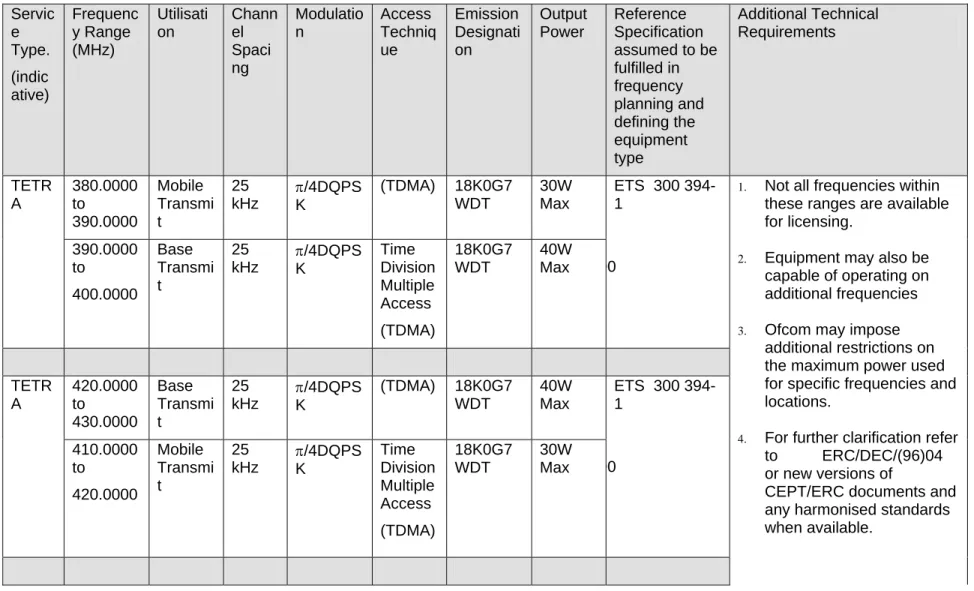
parameters for the licensing of private business TETRA mobile radio equipment in the UK. Table 2.1 contains the relevant equipment parameters. These together with the ‘essential requirement’ detailed in Article 3.2 of the Directive 1999/5/EC constitute the minimum equipment requirements for private business mobile radio equipment within the UK.
2.4 The technical parameters specified in the UK Interface Requirement are applied to achieve the desired level of compatibility within the TETRA Service and with other radiocommunications services whilst promoting enterprise, innovation and competition.
2.5 This UK Interface Requirement provides the necessary technical information, which facilitates access to the TETRA Service spectrum by making clear the assumptions that are made in planning the use of the TETRA Service spectrum in the UK. It is not the intention of this UK Interface Requirement to duplicate or impose any additional ‘essential requirements’ of the Directive 1999/5/EC on products. Any specified
parameters within this document are for the purpose of identifying product options and not as a de facto national product requirement.
Table 2.1: Minimum Equipment Requirements
Servic e Type. (indic ative) Frequenc y Range (MHz) Utilisati on Chann el Spaci ng Modulatio n Access Techniq ue Emission Designati on Output Power Reference Specification assumed to be fulfilled in frequency planning and defining the equipment type Additional Technical Requirements 380.0000 to 390.0000 Mobile Transmi t 25 kHz π/4DQPS K (TDMA) 18K0G7 WDT 30W Max TETR A 390.0000 to 400.0000 Base Transmi t 25 kHz π/4DQPS K Time Division Multiple Access (TDMA) 18K0G7 WDT 40W Max ETS 300 394-1 00 420.0000 to 430.0000 Base Transmi t 25 kHz π/4DQPS K (TDMA) 18K0G7 WDT 40W Max TETR A 410.0000 to 420.0000 Mobile Transmi t 25 kHz π/4DQPS K Time Division Multiple Access (TDMA) 18K0G7 WDT 30W Max ETS 300 394-1 001. Not all frequencies within
these ranges are available for licensing.
2. Equipment may also be
capable of operating on additional frequencies
3. Ofcom may impose
additional restrictions on the maximum power used for specific frequencies and locations.
4. For further clarification refer
to ERC/DEC/(96)04 or new versions of
CEPT/ERC documents and any harmonised standards when available.
450.0000 to 460.0000 Mobile Transmi t 25 kHz π/4DQPS K (TDMA) 18K0G7 WDT 30W Max TETR A 460.0000 to 470.0000 Base Transmi t 25 kHz π/4DQPS K (TDMA) 18K0G7 WDT 40W Max ETS 300 394-1
Table 2.1 (continued): Minimum Equipment Requirements
Servic e Type. (indic ative) Frequenc y Range (MHz) Utilisati on Chann el Spaci ng Modulatio n Access Techniq ue Emission Designati on Output Power Reference Specification assumed to be fulfilled in frequency planning and defining the equipment type Additional Technical Requirements 915.0000 to 921.0000 Base Transmi t 25 kHz π/4DQPS K (TDMA) 18K0G7 WDT 40W Max TETR A 870.0000 to 876.0000 Mobile Transmi t 25 kHz π/4DQPS K Time Division Multiple Access (TDMA) 18K0G7 WDT 30W Max ETS 300 394-1 00Draft Date Changes
v0.1 Dec 2000 Original draft
v1.0 April 2003 Draft accepted – no changes v1.1 Nov 2004 Updated for Ofcom
Technical enquiries to Business Radio team
Tel: 020 7981 3000
Fax: 020 7981 3333
Email: [email protected]